PJFP.com

Pursuit of Joy, Fulfillment, and Purpose

Day: October 30, 2025

  • AI vs Human Intelligence: The End of Cognitive Work?

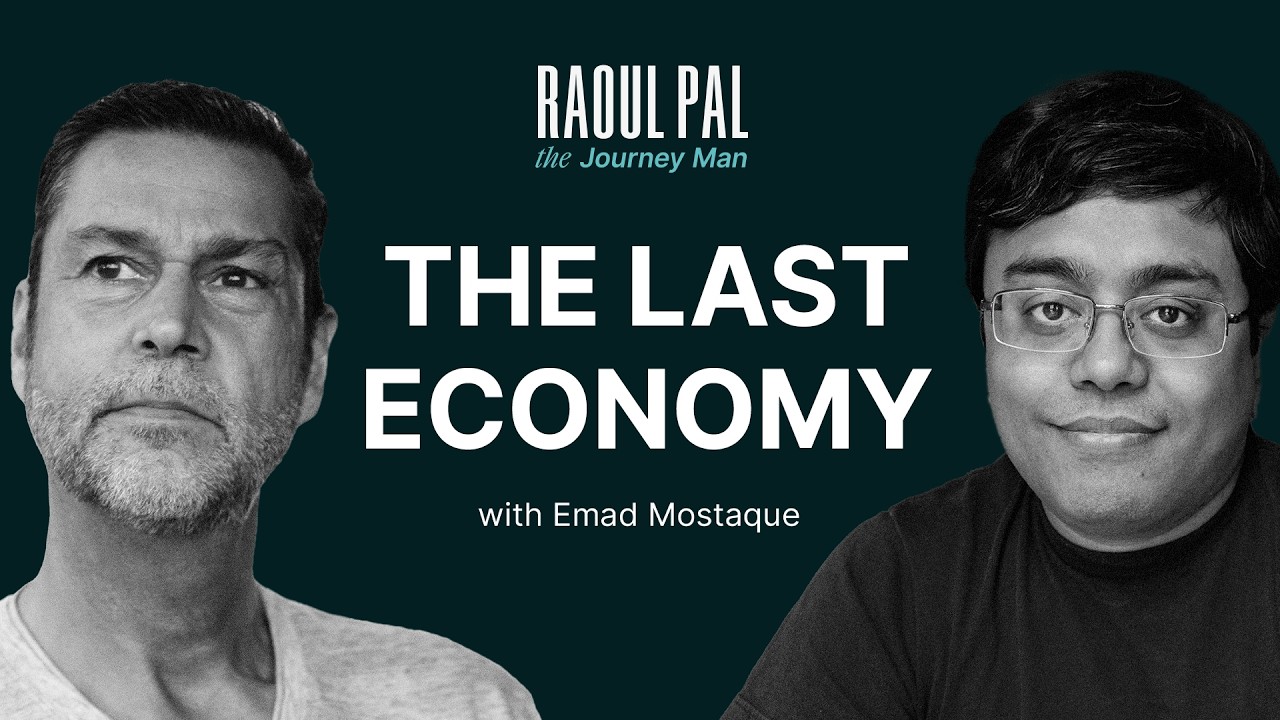
    In a profound and unsettling conversation on “The Journey Man,” Raoul Pal sits down with Emad Mostaque, co-founder of Stability AI, to discuss the imminent ‘Economic Singularity.’ Their core thesis: super-intelligent, rapidly cheapening AI is poised to make all human cognitive and physical labor economically obsolete within the next 1-3 years. This shift will fundamentally break and reshape our current economic models, society, and the very concept of value.

    This isn’t a far-off science fiction scenario; they argue it’s an economic reality set to unfold within the next 1,000 days. We’ve captured the full summary, key takeaways, and detailed breakdown of their entire discussion below.

    🚀 Too Long; Didn’t Watch (TL;DW)

    The video is a discussion about how super-intelligent, rapidly cheapening AI is poised to make all human cognitive and physical labor economically obsolete within the next 1-3 years, leading to an “economic singularity” that will fundamentally break and reshape our current economic models, society, and the very concept of value.

    Executive Summary: The Coming Singularity

    Emad Mostaque argues we are at an “intelligence inversion” point, where AI intelligence is becoming uncapped and incredibly cheap, while human intelligence is fixed. The cost of AI-driven cognitive work is plummeting so fast that a full-time AI “worker” will cost less than a dollar a day within the next year.

    This collapse in the price of labor—both cognitive and, soon after, physical (via humanoid robots)—will trigger an “economic singularity” within the next 1,000 days. This event will render traditional economic models, like the Fed’s control over inflation and unemployment, completely non-functional. With the value of labor going to zero, the tax base evaporates and the entire system breaks. The only advice: start using these AI tools daily (what Mostaque calls “vibe coding”) to adapt your thinking and stay on the cutting edge.

    Key Takeaways from the Discussion

    • New Economic Model (MIND): Mostaque introduces a new economic theory for the AI age, moving beyond old scarcity-based models. It identifies four key capitals: Material, Intelligence, Network, and Diversity.
    • The Intelligence Inversion: We are at a point where AI intelligence is becoming uncapped and incredibly cheap, while human intelligence is fixed. AI doesn’t need to sleep or eat, and its cost is collapsing.
    • The End of Cognitive Work: The cost of AI-driven cognitive work is plummeting. What cost $600 per million tokens will soon cost pennies, making the cost of a full-time cognitive AI worker less than a dollar a day within the next year.
    • The “Economic Singularity” is Imminent: This price collapse will lead to an “economic singularity,” where current economic models no longer function. They predict this societal-level disruption will happen within the next 1,000 days, or 1-3 years.
    • AI Will Saturate All Benchmarks: AI is already winning Olympiads in physics, math, and coding. It’s predicted that AI will meet or exceed top-human performance on every cognitive benchmark by 2027.
    • Physical Labor is Next: This isn’t limited to cognitive work. Humanoid robots, like Tesla’s Optimus, will also drive the cost of physical labor to near-zero, replacing everyone from truck drivers to factory workers.
    • The New Value of Humans: In a world where AI performs all labor, human value will shift to things like network connections, community, and unique human experiences.
    • Action Plan – “Vibe Coding”: The single most important thing individuals can do is to start using these AI tools daily. Mostaque calls this “vibe coding”—using AI agents and models to build things, ask questions, and change the way you think to stay on the cutting edge.
    • The “Life Raft”: Both speakers agree the future is unpredictable. This uncertainty leads them to conclude that digital assets (crypto) may become a primary store of value as people flee a traditional system that is fundamentally breaking.

    Watch the full, mind-bending conversation here to get the complete context from Raoul Pal and Emad Mostaque.

    Detailed Summary: The End of Scarcity Economics

    The conversation begins with Raoul Pal introducing his guest, Emad Mostaque, who has developed a new economic theory for the “exponential age.” Emad explains that traditional economics, built on scarcity, is obsolete. His new model is based on generative AI and redefines capital into four types: Material, Intelligence, Network, and Diversity (MIND).

    The Intelligence Inversion and Collapse of Labor

    The core of the discussion is the concept of an “intelligence inversion.” AI models are not only matching but rapidly exceeding human intelligence across all fields, including math, physics, and medicine. More importantly, the cost of this intelligence is collapsing. Emad calculates that the cost for an AI to perform a full day’s worth of human cognitive work will soon be pennies. This development, he argues, will make almost all human cognitive labor (work done at a computer) economically worthless within the next 1-3 years.

    The Economic Singularity

    This leads to what Pal calls the “economic singularity.” When the value of labor goes to zero, the entire economic system breaks. The Federal Reserve’s tools become useless, companies will stop hiring graduates and then fire existing workers, and the tax base (which in the US is mostly income tax) will evaporate.

    The speakers stress that this isn’t a distant future; AI is predicted to “saturate” or beat all human benchmarks by 2027. This revolution extends to physical labor as well. The rise of humanoid robots means all manual labor will also go to zero in value, with robots costing perhaps a dollar an hour.

    Rethinking Value and The Path Forward

    With all labor (cognitive and physical) becoming worthless, the nature of value itself changes. They posit that the only scarce things left will be human attention, human-to-human network connections, and provably scarce digital assets. They see the coming boom in digital assets as a direct consequence of this singularity, as people panic and seek a “life raft” out of the old, collapsing system.

    They conclude by discussing what an individual can do. Emad’s primary advice is to engage with the technology immediately. He encourages “vibe coding,” which means using AI tools and agents daily to build, create, and learn. This, he says, is the only way to adapt your thinking and stay relevant in the transition. They both agree the future is completely unknown, but that embracing the technology is the only path forward.

  • Composer: Building a Fast Frontier Model with Reinforcement Learning

    Composer represents Cursor’s most ambitious step yet toward a new generation of intelligent, high-speed coding agents. Built through deep reinforcement learning (RL) and large-scale infrastructure, Composer delivers frontier-level results at speeds up to four times faster than comparable models:contentReference[oaicite:0]{index=0}. It isn’t just another large language model; it’s an actively trained software engineering assistant optimized to think, plan, and code with precision — in real time.

    From Cheetah to Composer: The Evolution of Speed

    The origins of Composer go back to an experimental prototype called Cheetah, an agent Cursor developed to study how much faster coding models could get before hitting usability limits. Developers consistently preferred the speed and fluidity of an agent that responded instantly, keeping them “in flow.” Cheetah proved the concept, but it was Composer that matured it — integrating reinforcement learning and mixture-of-experts (MoE) architecture to achieve both speed and intelligence.

    Composer’s training goal was simple but demanding: make the model capable of solving real-world programming challenges in real codebases using actual developer tools. During RL, Composer was given tasks like editing files, running terminal commands, performing semantic searches, or refactoring code. Its objective wasn’t just to get the right answer — it was to work efficiently, using minimal steps, adhering to existing abstractions, and maintaining code quality:contentReference[oaicite:1]{index=1}.

    Training on Real Engineering Environments

    Rather than relying on synthetic datasets or static benchmarks, Cursor trained Composer within a dynamic software environment. Every RL episode simulated an authentic engineering workflow — debugging, writing unit tests, applying linter fixes, and performing large-scale refactors. Over time, Composer developed behaviors that mirror an experienced developer’s workflow. It learned when to open a file, when to search globally, and when to execute a command rather than speculate.

    Cursor’s evaluation framework, Cursor Bench, measures progress by realism rather than abstract metrics. It compiles actual agent requests from engineers and compares Composer’s solutions to human-curated optimal responses. This lets Cursor measure not just correctness, but also how well the model respects a team’s architecture, naming conventions, and software practices — metrics that matter in production environments.

    Reinforcement Learning as a Performance Engine

    Reinforcement learning is at the heart of Composer’s performance. Unlike supervised fine-tuning, which simply mimics examples, RL rewards Composer for producing high-quality, efficient, and contextually relevant work. It actively learns to choose the right tools, minimize unnecessary output, and exploit parallelism across tasks. The model was even rewarded for avoiding unsupported claims — pushing it to generate more verifiable and responsible code suggestions.

    As RL progressed, emergent behaviors appeared. Composer began autonomously running semantic searches to explore codebases, fixing linter errors, and even generating and executing tests to validate its own work. These self-taught habits transformed it from a passive text generator into an active agent capable of iterative reasoning.

    Infrastructure at Scale: Thousands of Sandboxed Agents

    Behind Composer’s intelligence is a massive engineering effort. Training large MoE models efficiently requires significant parallelization and precision management. Cursor’s infrastructure, built with PyTorch and Ray, powers asynchronous RL at scale. Their system supports thousands of simultaneous environments, each a sandboxed virtual workspace where Composer experiments safely with file edits, code execution, and search queries.

    To achieve this scale, the team integrated MXFP8 MoE kernels with expert and hybrid-sharded data parallelism. This setup allows distributed training across thousands of NVIDIA GPUs with minimal communication cost — effectively combining speed, scale, and precision. MXFP8 also enables faster inference without any need for post-training quantization, giving developers real-world performance gains instantly.

    Cursor’s infrastructure can spawn hundreds of thousands of concurrent sandboxed coding environments. This capability, adapted from their Background Agents system, was essential to unify RL experiments with production-grade conditions. It ensures that Composer’s training environment matches the complexity of real-world coding, creating a model genuinely optimized for developer workflows.

    The Cursor Bench and What “Frontier” Means

    Composer’s benchmark performance earned it a place in what Cursor calls the “Fast Frontier” class — models designed for efficient inference while maintaining top-tier quality. This group includes systems like Haiku 4.5 and Gemini Flash 2.5. While GPT-5 and Sonnet 4.5 remain the strongest overall, Composer outperforms nearly every open-weight model, including Qwen Coder and GLM 4.6:contentReference[oaicite:2]{index=2}. In tokens-per-second performance, Composer’s throughput is among the highest ever measured under the standardized Anthropic tokenizer.

    Built by Developers, for Developers

    Composer isn’t just research — it’s in daily use inside Cursor. Engineers rely on it for their own development, using it to edit code, manage large repositories, and explore unfamiliar projects. This internal dogfooding loop means Composer is constantly tested and improved in real production contexts. Its success is measured by one thing: whether it helps developers get more done, faster, and with fewer interruptions.

    Cursor’s goal isn’t to replace developers, but to enhance them — providing an assistant that acts as an extension of their workflow. By combining fast inference, contextual understanding, and reinforcement learning, Composer turns AI from a static completion tool into a real collaborator.

    Wrap Up

    Composer represents a milestone in AI-assisted software engineering. It demonstrates that reinforcement learning, when applied at scale with the right infrastructure and metrics, can produce agents that are not only faster but also more disciplined, efficient, and trustworthy. For developers, it’s a step toward a future where coding feels as seamless and interactive as conversation — powered by an agent that truly understands how to build software.