PJFP.com

Pursuit of Joy, Fulfillment, and Purpose

Day: January 8, 2026

  • Tailwind CSS Layoffs 2026: AI’s Double-Edged Sword Causes 75% Staff Cuts at Tailwind Labs

    Tailwind CSS Layoffs 2026: AI's Double-Edged Sword Causes 75% Staff Cuts at Tailwind Labs

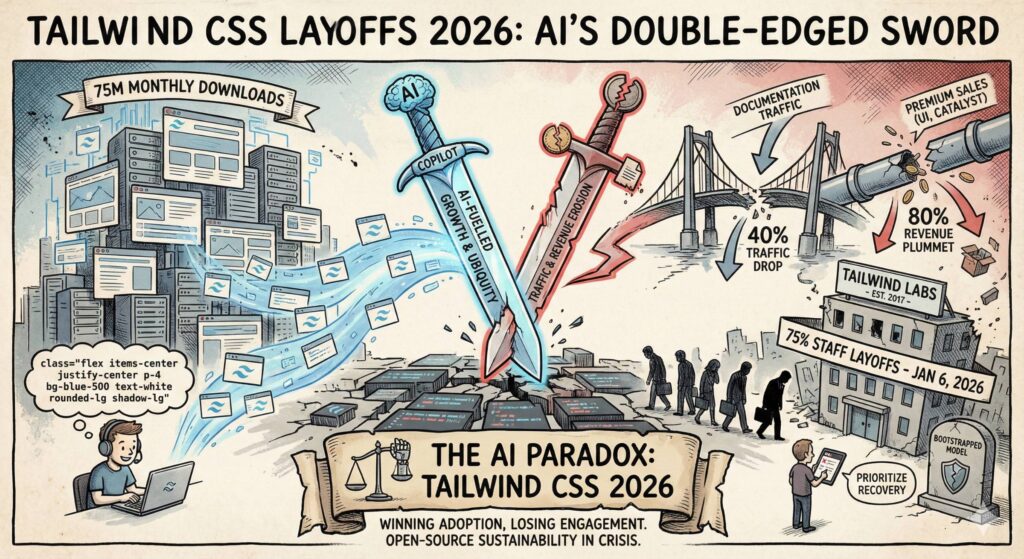
    TLDR: Tailwind Labs, creators of the popular Tailwind CSS framework, laid off 75% of its engineering team on January 6, 2026, due to AI-driven disruptions. While AI boosted Tailwind’s popularity with 75 million monthly downloads, it slashed documentation traffic by 40% and revenue by 80%, as developers rely on AI tools like GitHub Copilot instead of visiting the site. This “AI paradox” highlights vulnerabilities in open-source business models, sparking community debates on sustainability and future adaptations.

    Key Takeaways

    • Tailwind CSS’s explosive growth is fueled by AI coding agents generating its code by default, leading to ubiquity in modern web development but bypassing traditional learning and monetization channels.
    • Documentation site traffic dropped 40% since early 2023, crippling upsells for premium products like Tailwind UI and Catalyst, as AI handles queries without site visits.
    • Revenue plummeted 80%, forcing drastic layoffs in the bootstrapped company, with no venture backing to cushion the blow.
    • The announcement came via a GitHub PR comment, going viral on X, Hacker News, and Reddit, eliciting sympathy, irony, and calls for pivots or acquisitions.
    • Broader implications include risks for other doc-heavy tools, reduced deep learning among developers, and acceleration of open-source commoditization by AI.
    • Potential futures: Short-term focus on maintenance, long-term shifts to AI-integrated products, partnerships, or new revenue streams like subscriptions.

    Detailed Summary

    Tailwind CSS, launched in 2017 by Adam Wathan and Steve Schoger, revolutionized web development with its utility-first approach. Developers apply classes directly in HTML for rapid UI building, integrating seamlessly with frameworks like React and Next.js. Tailwind Labs monetizes through premium offerings while keeping the core framework open-source and free.

    The crisis unfolded on January 6, 2026, when Wathan announced in a GitHub pull request that 75% of the engineering team was laid off. The PR proposed an “AGENTS.md” file for guiding LLMs to generate Tailwind code optimally. Wathan rejected it, citing the need to prioritize business recovery over community features.

    In his comment, Wathan explained: Traffic to tailwindcss.com fell 40% despite rising popularity, as AI tools like Copilot and Claude output Tailwind code without users needing docs. This site was crucial for promoting paid products, leading to an 80% revenue drop. Contributor Michael Sears warned of potential “abandonware” without sustainable funding.

    The news exploded online. On X (formerly Twitter), posts like one from @ybhrdwj amassed thousands of likes, highlighting the irony. Discussions on Hacker News (over 465 comments) and Reddit’s r/theprimeagen debated AI’s commoditization of knowledge. Media outlets like DevClass and OfficeChai framed it as a warning for traffic-reliant businesses.

    Community reactions mixed shock with suggestions: Pivot like avoiding Kodak’s fate, shame Big Tech for non-contribution, or pursue acquisitions by firms like Vercel or Anthropic.

    Some Thoughts on the AI Paradox and Open-Source Future

    This situation exemplifies AI’s disruptive power—boosting adoption while eroding foundations. Tailwind “won” by becoming AI’s default CSS choice but lost human engagement essential for monetization. It’s a wake-up call for bootstrapped startups: Relying on organic traffic is precarious when AI answers queries instantly.

    For developers, AI enhances productivity but risks shallower skills, potentially flooding codebases with unvetted “junk.” Hiring may favor those who can curate AI outputs effectively.

    Open-source sustainability feels more fragile; premium add-ons falter as AI replicates value for free. Alternatives like enterprise support or AI partnerships could emerge. Tailwind’s resilience lies in its community—if it adapts to AI-native tools, it could thrive. Otherwise, it risks fading, underscoring that in 2026, AI reshapes value chains relentlessly.
  • Gmail Enters the Gemini Era: New AI Features Revolutionizing Your Inbox in 2026

    Gmail Enters the Gemini Era: New AI Features Revolutionizing Your Inbox in 2026

    TL;DR: Google is supercharging Gmail with Gemini AI, introducing features like AI Overviews for instant answers from your inbox, Help Me Write for drafting emails, Suggested Replies, Proofread, and an upcoming AI Inbox for prioritizing tasks. Many roll out today for free, with premium options for subscribers, starting in the US and expanding globally.

    Key Takeaways

    • AI Overviews: Summarizes long email threads and answers natural language questions like “Who quoted my bathroom renovation?” – free conversation summaries today, full Q&A for Google AI Pro/Ultra subscribers.
    • Help Me Write & Suggested Replies: Draft or polish emails from scratch, with context-aware one-click responses in your style – available to everyone for free starting today.
    • Proofread: Advanced checks for grammar, tone, and style – exclusive to Google AI Pro/Ultra subscribers.
    • AI Inbox: A personalized briefing that highlights to-dos, prioritizes VIPs, and filters clutter securely – coming soon for trusted testers, broader rollout in months.
    • Personalization Boost: Next month, Help Me Write integrates context from other Google apps for better tailoring.
    • Availability: Powered by Gemini 3, starting in US English today, with more languages and regions soon. Link to original announcement: Google Blog Post.

    Detailed Summary

    Google’s latest announcement marks a pivotal shift for Gmail, transforming it from a simple email client into an intelligent, proactive assistant powered by Gemini AI. With over 3 billion users worldwide, Gmail has evolved since its 2004 launch, but rising email volumes have made inbox management a daily battle. Enter the “Gemini era,” where AI takes center stage to streamline your workflow.

    At the heart of these updates is AI Overviews, inspired by Google Search’s AI summaries. This feature eliminates the need for manual digging through emails. For lengthy threads, it provides a concise breakdown of key points right when you open the message. Even better, you can query your entire inbox in natural language—think asking for specific details from old quotes or reservations—and Gemini’s reasoning engine delivers an instant overview with the exact info you need. Conversation summaries are free for all users starting today, while the full question-answering capability is reserved for paid Google AI Pro and Ultra plans.

    Productivity gets a major upgrade with Help Me Write, now available to everyone, allowing you to draft emails from scratch or refine existing ones. Paired with Suggested Replies (an evolution of Smart Replies), it analyzes conversation context to suggest responses that mimic your personal writing style—perfect for quick coordination like family events. Just tap to use or tweak. For that extra polish, Proofread offers in-depth reviews of grammar, tone, and style, ensuring your emails are professional and on-point. Help Me Write and Suggested Replies are free, but Proofread requires a subscription.

    Looking ahead, the AI Inbox promises to redefine how you start your day. It acts as a smart filter, surfacing critical updates like bill deadlines or appointment reminders while burying the noise. By analyzing signals such as frequent contacts and message content (all done privately on Google’s secure systems), it identifies VIPs and to-dos, giving you a personalized snapshot. Trusted testers get early access, with a full launch in the coming months.

    These features are fueled by the advanced Gemini 3 model, ensuring speed and accuracy. Rollouts begin today in the US for English users, with expansions to more languages and regions planned. Next month, Help Me Write will pull in data from other Google apps for even smarter personalization.

    Some Thoughts

    This Gemini integration could be a game-changer for overwhelmed inboxes, turning Gmail into a true AI sidekick that anticipates needs rather than just storing messages. It’s exciting to see free access for core features, democratizing AI for everyday users, but the premium gating on advanced tools like full AI Overviews and Proofread might frustrate non-subscribers. Privacy remains a hot topic—Google emphasizes secure processing, but users should stay vigilant about data controls. Overall, in a world drowning in emails, this feels like a timely evolution that could boost productivity without sacrificing usability. If it delivers on the hype, competitors like Outlook might need to play catch-up fast.

  • Beyond the Bubble: Jensen Huang on the Future of AI, Robotics, and Global Tech Strategy in 2026

    In a wide-ranging discussion on the No Priors Podcast, NVIDIA Founder and CEO Jensen Huang reflects on the rapid evolution of artificial intelligence throughout 2025 and provides a strategic roadmap for 2026. From the debunking of the “AI Bubble” to the rise of physical robotics and the “ChatGPT moments” coming for digital biology, Huang offers a masterclass in how accelerated computing is reshaping the global economy.


    TL;DW (Too Long; Didn’t Watch)

    • The Core Shift: General-purpose computing (CPUs) has hit a wall; the world is moving permanently to accelerated computing.
    • The Jobs Narrative: AI automates tasks, not purposes. It is solving labor shortages in manufacturing and nursing rather than causing mass unemployment.
    • The 2026 Breakthrough: Digital biology and physical robotics are slated for their “ChatGPT moment” this year.
    • Geopolitics: A nuanced, constructive relationship with China is essential, and open source is the “innovation flywheel” that keeps the U.S. competitive.

    Key Takeaways

    • Scaling Laws & Reasoning: 2025 proved that scaling compute still translates directly to intelligence, specifically through massive improvements in reasoning, grounding, and the elimination of hallucinations.
    • The End of “God AI”: Huang dismisses the myth of a monolithic “God AI.” Instead, the future is a diverse ecosystem of specialized models for biology, physics, coding, and more.
    • Energy as Infrastructure: AI data centers are “AI Factories.” Without a massive expansion in energy (including natural gas and nuclear), the next industrial revolution cannot happen.
    • Tokenomics: The cost of AI inference dropped 100x in 2024 and could drop a billion times over the next decade, making intelligence a near-free commodity.
    • DeepSeek’s Impact: Open-source contributions from China, like DeepSeek, are significantly benefiting American startups and researchers, proving the value of a global open-source ecosystem.

    Detailed Summary

    The “Five-Layer Cake” of AI

    Huang explains AI not as a single app, but as a technology stack: EnergyChipsInfrastructureModelsApplications. He emphasizes that while the public focuses on chatbots, the real revolution is happening in “non-English” languages, such as the languages of proteins, chemicals, and physical movement.

    Task vs. Purpose: The Future of Labor

    Addressing the fear of job loss, Huang uses the “Radiologist Paradox.” While AI now powers nearly 100% of radiology applications, the number of radiologists has actually increased. Why? Because AI handles the task (scanning images), allowing the human to focus on the purpose (diagnosis and research). This same framework applies to software engineers: their purpose is solving problems, not just writing syntax.

    Robotics and Physical AI

    Huang is incredibly optimistic about robotics. He predicts a future where “everything that moves will be robotic.” By applying reasoning models to physical machines, we are moving from “digital rails” (pre-programmed paths) to autonomous agents that can navigate unknown environments. He foresees a trillion-dollar repair and maintenance industry emerging to support the billions of robots that will eventually inhabit our world.

    The “Bubble” Debate

    Is there an AI bubble? Huang argues “No.” He points to the desperate, unsatisfied demand for compute capacity across every industry. He notes that if chatbots disappeared tomorrow, NVIDIA would still thrive because the fundamental architecture of the world’s $100 trillion GDP is shifting from CPUs to GPUs to stay productive.


    Analysis & Thoughts

    Jensen Huang’s perspective is distinct because he views AI through the lens of industrial production. By calling data centers “factories” and tokens “output,” he strips away the “magic” of AI and reveals it as a standard industrial revolution—one that requires power, raw materials (data/chips), and specialized labor.

    His defense of Open Source is perhaps the most critical takeaway for policymakers. By arguing that open source prevents “suffocation” for startups and 100-year-old industrial companies, he positions transparency as a national security asset rather than a liability. As we head into 2026, the focus is clearly shifting from “Can the model talk?” to “Can the model build a protein or drive a truck?”