PJFP.com

Pursuit of Joy, Fulfillment, and Purpose

Day: May 5, 2026

  • Subquadratic (SubQ) Explained: The First Fully Sub-Quadratic LLM with a 12M-Token Context Window, 50x Cost Reduction, and a Post-Transformer Architecture

    Subquadratic, the AI infrastructure company behind subq.ai, just emerged from stealth with a $29M seed round and a claim that should make every AI engineer pay attention: they have built the first large language model whose compute scales linearly, not quadratically, with context length. The result is SubQ, a frontier model with a 12 million token context window, roughly 50x lower cost than leading frontier models at 1M tokens, and benchmark numbers that put it ahead of Gemini 3.1 Pro, Claude Opus 4.6/4.7, and GPT-5.4/5.5 on key long-context tasks. This is a deep, opinionated breakdown of everything Subquadratic has published so far, who is behind it, why a sub-quadratic architecture matters, and what changes for developers, agents, and enterprise AI if the numbers hold up.

    TLDR

    Subquadratic is a Miami-based frontier AI lab that launched on May 5, 2026 with $29M in seed funding and a new LLM called SubQ. SubQ is the first fully sub-quadratic LLM, meaning attention compute grows linearly with context length instead of quadratically. The model offers a 12M token context window, around 150 tokens per second, roughly one-fifth the cost of leading frontier models, 95% accuracy on RULER 128K, 92% accuracy at the full 12M tokens, and the company is targeting 100M tokens by Q4 2026. Two products are launching in private beta: SubQ API (OpenAI-compatible, streaming, tool use) and SubQ Code (a CLI coding agent that plugs into Claude Code, Codex, and Cursor to load entire repositories into a single context window).

    Key Takeaways

    • SubQ is the first fully sub-quadratic LLM, with attention compute scaling at O(n) instead of the transformer’s O(n²).
    • The context window is 12 million tokens, enough to fit the entire Python 3.13 standard library (around 5.1M tokens) or roughly 1,050 React pull requests (around 7.5M tokens) in a single prompt.
    • At 12M tokens, SubQ reduces attention compute by almost 1,000x compared to other frontier models.
    • Pricing benchmarks: 95% accuracy on RULER 128K at $8 of compute, versus 94% accuracy at roughly $2,600 on Claude Opus, a 260x to 300x cost reduction.
    • Speed: about 150 tokens per second.
    • Cost: roughly 1/5 of other leading LLMs at 1M tokens, more than 50x cheaper according to launch coverage.
    • Two products in private beta: SubQ API (12M token window, streaming, tool use, OpenAI-compatible endpoints) and SubQ Code (one-line install CLI for coding agents, ~25% lower bills, 10x faster exploration, auto-redirects expensive model turns).
    • SubQ Code integrates with Claude Code, Codex, and Cursor, positioning Subquadratic as the long-context infrastructure layer beneath existing agent workflows rather than a competing chat product.
    • Architecture: a fully sub-quadratic sparse-attention design that learns which token relationships actually matter and skips the rest, redesigned from first principles.
    • Funding: $29M seed led by investors including Javier Villamizar (former SoftBank Vision Fund partner) and Justin Mateen (Tinder co-founder, JAM Fund), alongside early investors in Anthropic, OpenAI, Stripe, and Brex.
    • Founders: Justin Dangel (CEO, five-time founder) and Alex Whedon (CTO, ex-Meta engineer, former Head of Generative AI at TribeAI). Research team includes PhDs from Meta, Google, Oxford, Cambridge, and BYU.
    • Headcount is 11 to 50, headquartered in Miami, Florida, with active hiring for API engineering, developer advocacy, product design, sales, and people operations.
    • Tagline and thesis: “Efficiency is Intelligence.” The company argues that quadratic attention has been the real ceiling on AI applications, and breaking it unlocks workloads that were previously cost-prohibitive or architecturally impossible.

    Detailed Summary

    What is Subquadratic and what is SubQ?

    Subquadratic is a frontier AI research and infrastructure company. Their public homepage is intentionally minimal, with the single line “Efficiency is Intelligence.” and a contact email at [email protected]. The full product story lives on the launch demo site, where the company introduces SubQ as the first model built specifically for long-context tasks. The pitch is direct: SubQ is a sub-quadratic LLM built for 12M-token reasoning, allowing agents to work across full repositories, long histories, and persistent state without quality loss.

    Three numbers dominate the marketing copy. Context: 12M token reasoning. Speed: 150 tokens per second. Cost: one-fifth of other leading LLMs. Those three numbers, taken together, are why this launch matters. Until now, you could optimize for one of the three at a time. SubQ claims to push all three at once because the underlying architecture changed, not because the company applied better quantization or smarter caching on top of a transformer.

    The architecture: why “sub-quadratic” is the whole story

    Standard transformers, the architecture behind ChatGPT, Claude, Gemini, and almost everything else, use dense self-attention. Every token compares itself to every other token, which means compute scales as O(n²) in the context length n. Double the context, quadruple the compute. That single property is the reason context windows are usually capped at 128K tokens for open models and around 1M tokens for the most aggressive frontier offerings, and it is the reason most production AI systems lean on retrieval-augmented generation, chunking, agentic retrieval, and prompt engineering tricks to dodge the cost curve entirely.

    SubQ is built on a fully sub-quadratic sparse-attention architecture, redesigned from first principles. The argument from co-founder and CEO Justin Dangel is that LLMs waste compute by processing every possible token-to-token relationship when only a small fraction of those relationships actually matter for the task. SubQ learns to find and focus only on those relevant relationships, which is what brings the scaling behavior down from O(n²) to O(n). At 12M tokens, this design cuts attention compute by almost 1,000x compared to other frontier models. The research community has been chasing this for years through linear attention, state space models, Mamba, and various sparse attention variants. According to Subquadratic, the unsolved problem was never the idea, it was building a sub-quadratic architecture that did not sacrifice frontier-level accuracy. That is what their team spent the time on.

    The benchmarks

    Subquadratic published a benchmark table comparing a SubQ 1M-Preview against Gemini 3.1 Pro, Claude Opus 4.6, Claude Opus 4.7, GPT-5.4, and GPT-5.5 across SWE-Bench Verified (real-world software engineering), RULER at 128K (long-context accuracy across 13 tests), and MRCR v2 8-needle at 1M (multi-round coreference resolution).

    • SWE-Bench Verified: SubQ scores 81.8%, ahead of Gemini 3.1 Pro at 80.6% and Opus 4.6 at 80.8%, with Opus 4.7 leading at 87.6%.
    • RULER at 128K: SubQ scores 95.0%, narrowly ahead of Opus 4.6 at 94.8% (internally evaluated). Other vendors did not report this benchmark.
    • MRCR v2 8-needle, 1M: SubQ scores 65.9%, behind Opus 4.6 at 78.3% and GPT-5.5 at 74.0%, but well ahead of GPT-5.4 at 36.6%, Opus 4.7 at 32.2%, and Gemini 3.1 Pro at 26.3%.
    • The launch blog post adds that on RULER 128K, SubQ scored 97% accuracy at $8 of compute, versus 94% on Claude Opus at roughly $2,600. That is a cost reduction of about 260x at superior accuracy.
    • On MRCR v2 specifically, the launch post lists SubQ at 83, Claude Opus at 78, GPT-5.4 at 39, and Gemini 3.1 Pro at 23.
    • At the full 12M token context, SubQ hits 92% on RULER while other frontier models reportedly break down well before reaching their stated 1M-token limit.
    • Subquadratic notes the SubQ results are third-party validated and a full technical report is forthcoming.

    The story these numbers tell is consistent: SubQ is competitive on traditional benchmarks like SWE-Bench, decisively better on long-context retrieval where compute economics dominate, and dramatically cheaper to run when the workload actually exercises a long context.

    The two products: SubQ API and SubQ Code

    SubQ ships in two flavors. The first is SubQ API, the full-context API for developers and enterprise teams. It exposes the 12M token context window, supports streaming and tool use, and uses OpenAI-compatible endpoints so existing client libraries and orchestration code can be repointed with minimal change. The product positioning is to process full repositories and pipeline states in a single API call at linear cost, rather than chunking inputs and stitching results.

    The second is SubQ Code, a long-context layer designed specifically for coding agents. Instead of competing with Claude Code, Codex, or Cursor, SubQ Code plugs into them. It maps codebases, gathers context, and answers token-heavy questions faster than the host agent’s default model. According to Subquadratic, the integration delivers roughly 25% lower bills and around 10x faster exploration, auto-redirects the most expensive model turns to SubQ, and installs in a single line. The design implication is that agent builders do not have to switch ecosystems to benefit from a 12M token window. They keep their preferred agent and offload the heavy long-context work to SubQ.

    Both products are in private beta. Access is gated through a request early access form where applicants choose SubQ Code, SubQ API, or both, and provide context about their workload.

    What 12M tokens actually unlocks

    Subquadratic illustrates the size of the context window with two concrete examples. The entire Python 3.13 standard library is roughly 5.1M tokens, well under the limit. Six months of React pull requests, around 1,050 PRs against the React codebase, comes in around 7.5M tokens, also under the limit with room to spare. At this scale, the standard pattern of curating which files or chunks the model gets to see goes away. The model just sees everything.

    The downstream implications are significant. RAG pipelines, embedding stores, chunking heuristics, and multi-agent coordination layers exist primarily to compensate for short context windows and quadratic compute. If a model can ingest the whole corpus in one pass at linear cost, large parts of that workaround stack become optional. Long-running agents can preserve full state instead of summarizing it. Coding agents can reason about a refactor across an entire repository without juggling tool calls. Document-heavy workflows in legal, finance, and research can run on the source material directly. And once Subquadratic hits its 100M token target by Q4 2026, the design space shifts again toward applications that depend on persistent state and long time horizons.

    The economic argument

    Subquadratic’s framing is that cost has become the binding constraint on AI deployment, not capability. Many ideas never reach production because the unit economics do not work out. Quadratic attention is the structural reason for that. By breaking the scaling law, SubQ aims to make previously cost-prohibitive workloads viable at scale: high-volume inference, longer included context, and applications that rely on sustained interaction with the model. The 260x to 300x cost reduction reported on RULER 128K is the headline number that operationalizes this thesis.

    The team and the funding

    Subquadratic raised $29M in seed funding. Investors include Javier Villamizar, former partner at SoftBank Vision Fund, and Justin Mateen, co-founder of Tinder and founder of JAM Fund, alongside early investors in Anthropic, OpenAI, Stripe, and Brex. CEO Justin Dangel is a five-time founder with prior companies in health tech, insurance tech, and consumer goods. CTO Alex Whedon previously worked as a software engineer at Meta and led over 40 enterprise AI implementations as Head of Generative AI at TribeAI. The research team is built around PhDs and published researchers from Meta, Google, Oxford, Cambridge, and BYU. The company is headquartered in Miami, Florida, with a headcount in the 11 to 50 range.

    Public hiring lists show the company is staffing across API engineering, founding developer advocacy, principal full-stack engineering, technical copywriting, account executive roles for enterprise sales, senior product design for the Voice AI and API surface, and head of people and talent operations. The Voice AI mention is notable because the public homepage at subq.ai still references a Speech-To-Text API as a current product, suggesting Subquadratic is operating across both speech and language with the same architectural thesis.

    The site itself

    The current public site at subq.ai is deliberately spartan. Visitors see only the company name, the line “Efficiency is Intelligence.”, and a contact email. The full marketing surface lives at the launch demo URL, which acts as the de facto homepage for the launch and links out to the request early access flow, the introducing SubQ blog post, the LinkedIn page, the X account, the Discord community, careers, press contact at [email protected], terms of use, privacy policy, cookies policy, and acceptable use policy. The structure makes sense for a private beta launch: keep the apex domain minimal, push announcement traffic to a dedicated launch site, and gate product access behind a form.

    Thoughts

    The interesting part of Subquadratic’s pitch is not the context window. It is the implicit claim that the entire workaround economy built around transformers, RAG vendors, vector databases, chunking middleware, agentic retrieval frameworks, context compression startups, was always a tax paid because of one architectural property: O(n²). If SubQ’s numbers hold up under independent scrutiny, a meaningful slice of that ecosystem becomes optional rather than mandatory. That has product, infrastructure, and venture implications that go well beyond a faster, cheaper LLM.

    The product strategy is also notably humble in a smart way. Subquadratic is not trying to win the consumer chat war against ChatGPT, Claude, or Gemini. SubQ Code is positioned as a layer underneath Claude Code, Codex, and Cursor, and the API is OpenAI-compatible. That is a classic infrastructure play: do not ask developers to abandon their tools, just route the expensive long-context turns to you. The “auto-redirects expensive model turns” framing is essentially a routing economic argument aimed at agent builders who already feel the pain of paying frontier prices for high-token requests.

    There are open questions worth holding lightly. The MRCR v2 numbers in the public benchmark table show SubQ behind Opus 4.6 and GPT-5.5, even as the launch post emphasizes a higher relative score. The cost comparisons rely on a specific compute basis that the upcoming technical report will need to spell out. And the gap between strong RULER scores at 128K and the 92% claim at 12M tokens is a long way to extrapolate without external replication. None of this is unusual for a launch, but it is the right place to apply pressure once the technical report drops.

    The bigger architectural bet is the one that should hold attention. If sub-quadratic attention done well genuinely matches frontier accuracy, then context length stops being a meaningful product axis and a generation of brittle infrastructure built around context limits gets reconsidered. Subquadratic is making the strongest public case so far that the post-transformer era starts with attention scaling, not parameter count. The next twelve months, the technical report, third-party benchmarks, and the first real production deployments through SubQ Code, will tell us whether this is the inflection point or another promising direction that does not quite cross the line. Either way, “Efficiency is Intelligence” is the right frame for where AI economics are heading, and Subquadratic is one of the few companies whose architecture is consistent with the slogan.

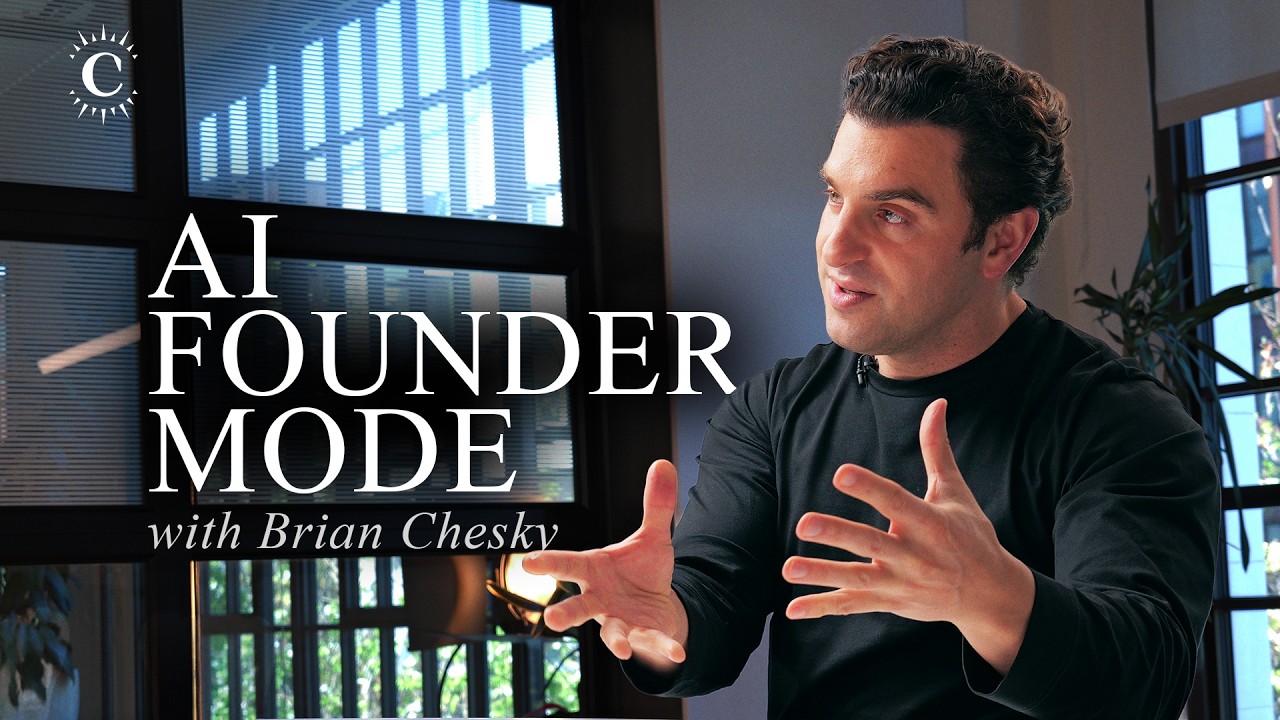
  • Brian Chesky on AI Founder Mode, the 11-Star Experience, and Reinventing Airbnb for the Age of AI

    Airbnb CEO Brian Chesky sits down with Patrick O’Shaughnessy on Invest Like The Best to talk about the next evolution of company building: AI Founder Mode. He covers the shift from founder to CEO, the lessons he learned from Steve Jobs through Hiroki Asai, why consumer AI is the next great frontier, and how he plans to change the atomic unit of Airbnb from a home to a person.

    TLDW

    Brian Chesky believes the next era of company building belongs to founders who refuse to delegate the soul of their company. He coined Founder Mode with Paul Graham after the pandemic forced him to take Airbnb back into his own hands. Now he is shaping what comes next: AI Founder Mode, where leaders work with on-demand context, fewer layers of management, asynchronous communication, and a new generation of hybrid manager-makers. He shares why most software companies have not been touched by AI yet, why consumer AI is about to explode, and why he is rebuilding Airbnb around people, not homes. The conversation also touches on the 11-Star Experience exercise, the power of small teams, why recruiting is the most important job a CEO has, and why every adult is still an artist underneath.

    Key Takeaways

    • Founder Mode is not micromanagement, it is having a steering wheel. Chesky woke up in 2019 feeling like the car had no steering wheel. After the pandemic, he reviewed every detail for two to three years before delegating again. Start hands-on and give ground grudgingly, not the other way around.
    • AI Founder Mode is even more intense. With AI, leaders can be in significantly more details because almost everything is on demand. Expect fewer layers of management, mostly asynchronous work, and the death of the pure people manager.
    • Two types of leaders will not survive AI. Pure people managers who only do one-on-ones, and rigid people who refuse to evolve. Everyone needs to be a hybrid manager-IC who can still touch the work.
    • Manage people through the work, not through meetings. Frank Lloyd Wright did it. Johnny Ive does it. You are not anyone’s therapist.
    • Consumer AI is the next great prize. 159 of the last 175 Y Combinator companies were enterprise. Almost every app on your home screen has not changed since AI arrived. That changes in the next 12 to 24 months.
    • Why consumer AI is hard. No proven business model, mature distribution, trend-chasing investor culture, and the simple fact that consumer is more hits-driven and requires excellence in design, marketing, culture, and press, not just technology and sales.
    • Project Hawaii is the new operating model. A 10 to 12 person Navy SEAL team, hands-on coaching from the CEO, crawl-walk-run-fly. The first project added roughly $200 million in year one and $400 to $500 million in year two.
    • Make the problem as small as possible. Airbnb spent 16 years failing to launch a second hit because it kept trying to scale globally on day one. Now: pilot in one city, expand to 10, then industrialize.
    • It is better to have 100 people love you than a million people sort of like you. Paul Buchheit shipped Gmail only after 100 Googlers loved it. The sample size of intense love is enough to predict mass adoption.
    • The 11-Star Experience is an imagination exercise. Push to absurdity (Elon takes you to space) so a 6 or 7-star experience suddenly seems normal. The gap between 5 and 6 stars is the gap between you and your competitor.
    • Simplicity is distillation, not subtraction. Hiroki Asai, Steve Jobs’s longtime creative director, taught Chesky that great design distills something to its essence. First principles is a design term too.
    • The score takes care of itself. Bill Walsh and John Wooden both taught that you do not focus on winning, you focus on making every input perfect. Wooden spent his first hour with new players teaching them how to put on socks.
    • Industrial design is the original product management. There are no PMs in industrial design. The designer is the PM, working alongside engineers and program managers to design through user journeys.
    • Recruiting is the CEO’s number one job. The more time you spend recruiting, the less time you spend managing, because great people self-manage. Build pipelines, not searches. Start with results, work backwards to people.
    • Co-hire the top 200 people, not just the executive team. Most CEOs hire executives and let them hire their teams. Chesky considers that fatal because most executives cannot hire well without help.
    • Bodybuilding is a metaphor for leadership. If you can change your body, you can change your life. Progressive overload, 1 percent a day, is how compounding works. Start with biology before therapy.
    • Founder-led companies build the deepest moats. Disney is still selling Walt’s playbook 60 years after he died. Apple is still selling Steve’s iPhone. The longer founders stay in founder mode, the more the company can endure when they leave.
    • Software is hyper fast fashion. Hardware ages well. Buildings get patina. Software always looks dated 10 years later. What endures is the community, the brand, the principles, the mission, and the network effect.
    • Apps are dying. Agents are coming. Chesky says we should let go of our attachment to apps because they are not what the future looks like.
    • Airbnb’s atomic unit is changing from a home to a person. Chesky wants to build the most authenticated identity on the internet, the richest preference library, a real-world social graph, and a membership program. Then expand to 50 to 70 verticals on top of that identity.
    • AI shifts attention from consumption to creation. Social media gave you a paintbrush only for opinions. AI gives everyone a real paintbrush and canvas. We are heading into a creative renaissance.
    • Founders are expeditionaries, not visionaries. They put one foot in front of the other and call it a vision later.
    • Detach from accolades. Chesky describes adulation as a cup with a hole in the bottom. Status is a drug. The path to durable creative work is doing it because you love it, the way Walt Disney, Da Vinci, Van Gogh, and Steve Jobs did until the very end.
    • The kindest gift is belief. The best way to activate a person’s potential is to see something in them they do not yet see in themselves.

    Detailed Summary

    From Industrial Design to the CEO Chair

    Chesky studied industrial design at the Rhode Island School of Design. He chose it on instinct after a department head told him industrial designers design everything from a toothbrush to a spaceship. He grew up enchanted by the Reebok Pump, the Game Boy, the Nintendo, and eventually by the late 1990s golden age of Apple. Raymond Loewy, the man who designed Air Force One and an enormous catalog of mid-century consumer products, became a touchstone, but Johnny Ive was the real hero.

    What he loved about industrial design was that it is technical, commercial, and empathetic. A building can win an architecture award and never be leased. A piece of industrial design that does not sell is a failure. So you have to think about manufacturing, distribution, marketing, and most importantly, user journeys. There are no product managers in industrial design. The designer is the PM. That training, he says, prepared him directly for the role of CEO.

    The Pandemic and the Birth of Founder Mode

    Chesky says no one is born a good CEO. People are born good founders. The job of CEO is counterintuitive in almost every direction. Founders are taught to learn by doing, but a CEO who learns by trial and error wastes years unwinding the empires of misfit hires.

    By 2019 he was running a 7,000 person company he no longer recognized. He felt he was driving a car without a steering wheel. He had a dream that he had left Airbnb for ten years and come back to find it had become a giant political bureaucracy. Then he realized he had been there the whole time. The pandemic hit and Airbnb lost 80 percent of its business in eight weeks. He shifted from peacetime to wartime, took control of every detail, worked 100-hour weeks, and reviewed everything for two to three years.

    The vision was never to micromanage forever. The vision was: I need to know what is going on before I can empower anyone. Hire people, audit their work, and only then give ground grudgingly. Most founders do the opposite, which is why they end up with executives building empires they later have to dismantle.

    AI Founder Mode

    Chesky says AI Founder Mode will be even more intense than Founder Mode because nearly everything will be on demand. He used to live in 35 hours of meetings a week to gather information, the same way Steve Jobs ran Apple. He held weekly, biweekly, monthly, and quarterly group reviews with the full chain of command in one room, anyone could speak, and he made the final call after listening last.

    In the AI era, that culture shifts from meetings to asynchronous work. He expects fewer layers of management. He cites the Catholic Church as a 2,000-year-old institution with only four layers and asks why most companies need seven, eight, or nine. Pure people managers will not survive. Every manager will have to be a hybrid IC, an engineer who still codes, a lawyer who still reads case law, a designer who still designs. You manage through the work, not through one-on-ones.

    He is also bullish that AI tooling will become consumer-grade simple very soon. The current tools, including Claude Code and Cowork, are not yet intuitive to the average person, but the economic incentive will force that to change.

    Why Consumer AI Is the Next Great Frontier

    Chesky points out that 159 of the last 175 Y Combinator companies were enterprise. Almost every consumer app on your phone, including Airbnb, has not fundamentally changed since the arrival of AI. He gives four reasons: investors feared ChatGPT would kill consumer companies; consumer AI has no proven business model because subscriptions hit a local max against free Claude and Gemini, ads are off the table for most labs, and e-commerce has been shut down via third-party app removals; distribution is mature; and Silicon Valley culture, while branded as rebellious, is in practice trend-following.

    The deeper reason is simply that consumer is harder. It is hits-driven, requires great design, marketing, culture, press, and you cannot easily start by selling to your dorm-mates the way enterprise YC startups sell to other YC startups. The prize is bigger. The risk is bigger. He predicts a consumer AI renaissance over the next 12 to 24 months.

    Project Hawaii and the Magic of Small Teams

    Inside Airbnb, Chesky tested a new operating model called Project Hawaii. He took 10 to 12 people, designers, engineers, product, and data scientists, treated them like a startup inside the company, and pointed them at one problem: improving the guest funnel. The system is crawl, walk, run, fly. First fix bugs, then add features, then re-imagine flows, then completely reinvent.

    The first team delivered roughly $200 million of internal revenue in year one and $400 to $500 million the next year, eventually contributing more than 600 basis points of conversion improvement on a base of $134 billion in gross sales. Then they took the same system to pricing, then to other problems, then to launching new businesses like Services and Experiences.

    The guiding lesson: make the problem as small as possible. Airbnb launched in one city, New York. Uber in San Francisco. DoorDash in Palo Alto. When Chesky launched Services and Experiences in 100 cities at once last year, it did not work. The fix was to dominate one city, expand to 10, then industrialize. Peter Thiel said it cleanly: better to have a monopoly of a tiny market than a small share of a big market.

    Underneath that is a Paul Buchheit insight Chesky calls the best advice he ever got. It is better to have 100 people love you than a million people sort of like you. Buchheit refused to ship Gmail until 100 Googlers loved it, and that took two years. Once 100 people loved it, 100 million people did.

    The Hiroki Asai Lessons: Simplicity and Craft

    Hiroki Asai, Steve Jobs’s quietly legendary creative director, taught Chesky two principles. The first is that simplicity is not removing things, simplicity is distillation, understanding something so deeply that you can express its essence. Steve Jobs called design the fundamental soul of a man-made creation that reveals itself through subsequent layers. Elon Musk’s first principles thinking is the same idea applied to physics.

    The second is craft. How you do anything is how you do everything. Chesky cites Bill Walsh’s The Score Takes Care of Itself and John Wooden’s first hour with UCLA players, an hour spent teaching them how to put on their socks. Walsh said the way you tucked your jersey was one of 10,000 details that decided whether you won. The lesson is to focus on getting every input right. The output follows.

    The 11-Star Experience

    The 11-Star Experience is one of Chesky’s most copied frameworks. Most Airbnb stays get five stars because anything else means something went wrong. So Chesky asked: what would six stars look like? Your favorite wine on the table, fruit, snacks, a handwritten card. Seven stars? A limousine at the airport and the surfboard waiting for you because they know you surf. Eight stars? An elephant and a parade in your honor. Nine stars, the Beatles arrive in 1964 with 5,000 screaming fans. Ten stars, Elon Musk takes you to space.

    The point is the absurdity. By imagining the impossible, six and seven star experiences stop seeming crazy. The gap between five and six stars is the gap between you and your competitor. If you can industrialize a sixth star, you may have product-market fit. The exercise also restarts your imagination, which Patrick noted has atrophied for many people in the era of consumption-only social media.

    AI as a Canvas for Creativity

    Chesky frames AI as the ultimate platform shift, the ultimate creative expression, and possibly the greatest invention in human history. Social media made us mostly consumers and gave creators only opinion-shaped tools. AI gives everyone a paintbrush. He believes far more people are creative than we recognize because most have never had craftsmanship or tools to express what is in their heads. Pablo Picasso said all children are born artists; the problem is to remain one as you grow up. Chesky thinks every adult is still an artist underneath.

    The Next Chapter of Airbnb

    Chesky describes four phases of the CEO journey: get to product-market fit, scale to hyper-growth, become a real profitable public company, and finally reinvent. Airbnb’s stock has been flat because the core idea is saturating. He is now squarely in phase four, with three priorities.

    First, change the atomic unit from a home to a person. He wants Airbnb to build the most authenticated identity on the internet, the richest preference library, a real-world social graph, and a membership program. Proof of personhood, he says, will be enormously valuable in the AI age. Second, industrialize the new-business engine to support 50 to 70 verticals (homes, experiences, services, eventually flights, and more) all built on top of that personal atomic unit. Third, navigate the AI transition without breaking the existing business or the livelihoods of hosts. He is also exploring sandbox apps that imagine a radically different Airbnb, the answer to “what is after Airbnb?”

    What Endures in the Age of AI

    Chesky is direct that software does not endure. Look at any software from 10 years ago and it looks dated. Hardware ages better. Buildings develop patina. Paris endures. So if you want to build something lasting, you cannot bet on the app. You have to bet on the community, the brand, the mission, the principles, the identity, and the network effect. Apps are going away, replaced by agents. Founders attached to apps need to let go.

    Founder-Led Moats: Disney and the Ham Sandwich Paradox

    Chesky reconciles Warren Buffett’s “buy a company a ham sandwich could run” with the venture capital truth that a founder’s ceiling is the company’s ceiling. The reconciliation is Disney. Most people cannot name a Paramount, Warner Brothers, Universal, or MGM film off the top of their head, but everyone can name Disney films. Walt Disney was a founder in founder mode for so long that he created enough IP and momentum that the company has been running on his playbook for 60 years after his death. Apple is similar with Steve Jobs and the iPhone.

    The counterintuitive lesson: if you want a company to last 100 years, do not delegate early to make it independent of you. Stay in founder mode for as long as possible so you can institutionalize the magic deeply enough that it endures after you. Tech is the industry of change, so founder mode matters even more there than in chocolate or insurance.

    Bodybuilding as Leadership Training

    Chesky was a 135-pound late bloomer who told his friends he would compete at the national level in bodybuilding by 19. He did. Two lessons came out of it. First, if you can change your body, you can change your life. Start with biology before therapy. Second, you cannot get in shape in one day. Progressive overload, discipline, consistency, and roughly 1 percent a day compound into massive gains. The visible feedback loop in bodybuilding taught him to break invisible problems (like the quality of a leadership team) into observable, measurable proxies (like the quality of the room at a twice-yearly roadmap review of the top 100 people).

    Recruiting as the CEO’s Number One Job

    Sam Altman told a 27-year-old Chesky he would spend 50 percent of his time on hiring. Chesky did not, and considers that his biggest mistake. He now starts and ends every day with his recruiter and spends two to three hours a day on hiring. The more time you spend recruiting, the less time you have to spend managing because great people self-manage.

    His system is pipeline recruiting, not search recruiting. He never starts with a search firm. He constantly meets the best people in their fields, asks each one to introduce him to the next two or three best, and builds a rolling rolodex. He starts with results, finds an ad he loves, and works backwards to the team that made it. He builds little mafias of top talent inside the company. He is the co-hiring manager for the top 200 people at Airbnb, not just executives, because most executives cannot hire well without help.

    Activating Talent and the Power of Belief

    You cannot teach motivation. You can only give people a problem and see if they have agency. The way to activate someone, Chesky says, is to show them potential they cannot yet see in themselves. He cites John Wooden, who said the secret to coaching was that he saw potential in players they did not see in themselves. People will climb mountains for that.

    The kindest gift anyone gave Chesky, he says, was belief. A high school art teacher named Miss Williams told his parents he was going to be a famous artist. He never became one, but the belief gave him the confidence to choose art school and to choose to be happy. Michael Seibel and the Justin.tv founders believed in him. Paul Graham made an exception to fund a non-engineer with what he thought was a bad idea. His co-founders Joe and Nate believed in him when he had no business being a CEO. The biggest gift you can give back, he says, is belief in others.

    Detaching from the Scoreboard

    Chesky describes adulation as a cup with a hole in the bottom. Status keeps draining out and you keep needing more to feel the same. The day Airbnb went public at a $100 billion valuation should have been one of the best days of his life. The next morning he put on sweatpants for a Zoom meeting and felt nothing. That triggered a re-evaluation. He stopped seeking accolades and started focusing on intrinsic work. He cites Rick Rubin: an artist is an artist when they make for themselves. He cites Vice President Obama, who told him to focus on what you want to do, not who you want to be.

    His four heroes are Leonardo da Vinci, Vincent Van Gogh, Walt Disney, and Steve Jobs. All four were working until the last week or day of their lives. Da Vinci carried the Mona Lisa with him until he died. Van Gogh sold one painting in his life. Disney was imagining theme parks in the ceiling tiles of his hospital room. Chesky says his motivation is the motivation of an artist. He calls being a CEO of a public company at his scale “almost a glitch in the system” that gave him one of the largest design canvases in human history.

    Thoughts

    What stands out about this conversation is how clearly Chesky has decoupled identity from outcome. He frames himself first as a designer, second as a CEO, and considers the resources he commands as a kind of accidental fortune for an industrial designer to be sitting on. That self-image is what lets him talk about disrupting Airbnb, killing the app paradigm, and changing the atomic unit of the company without flinching. Most public-company CEOs cannot afford that posture.

    The framework worth stealing is Project Hawaii. The pattern of taking a 10-person elite team, putting them under direct CEO coaching, and running them through crawl-walk-run-fly is a near-universal answer to the problem of innovation inside a large company. It works because it removes abstraction layers, creates direct contact with reality, and gives the founder a way to teach muscle memory before delegating. Anyone running a team of any size can borrow the pattern: pick one problem, staff it small, work with it weekly, then let go gradually. The golf-instructor analogy of teaching muscle memory before bad habits set in might be the most important management metaphor of the year.

    His prediction about consumer AI is the most economically interesting part of the talk. The fact that 159 of 175 recent YC companies are enterprise is a startling concentration. If he is right that the next 12 to 24 months bring a consumer renaissance, the opening is enormous. The hard part is what he names directly: there is no proven business model for consumer AI yet. Subscriptions cap out against free incumbents, ads are off-limits for the labs, and e-commerce has been throttled. Solving the business model is probably more valuable than building the next great consumer interface.

    The deeper philosophical thread, that AI is the transition from consumption to creation, is one that anyone building tools for makers should hold close. The 11-Star Experience also reads differently in the AI era. It used to be a thought exercise constrained by what you could plausibly build. AI compresses the gap between imagination and execution to minutes, sometimes seconds. The question is no longer “what is the most absurd version of this experience?” but “which six and seven star experiences can I now industrialize that were unthinkable a year ago?” The exercise has become operational.

    Finally, the meta-lesson on founder-led moats is worth taking seriously. The instinct in venture capital and at most public-company boards is to professionalize early. Chesky’s argument is the opposite: the longer the founder stays in founder mode, the deeper the IP and the longer the company endures after they leave. Disney is the proof. Apple is the proof. Whether Airbnb will be is the open question, and it is the question Chesky is using AI Founder Mode to answer.