PJFP.com

Pursuit of Joy, Fulfillment, and Purpose

Day: May 22, 2026

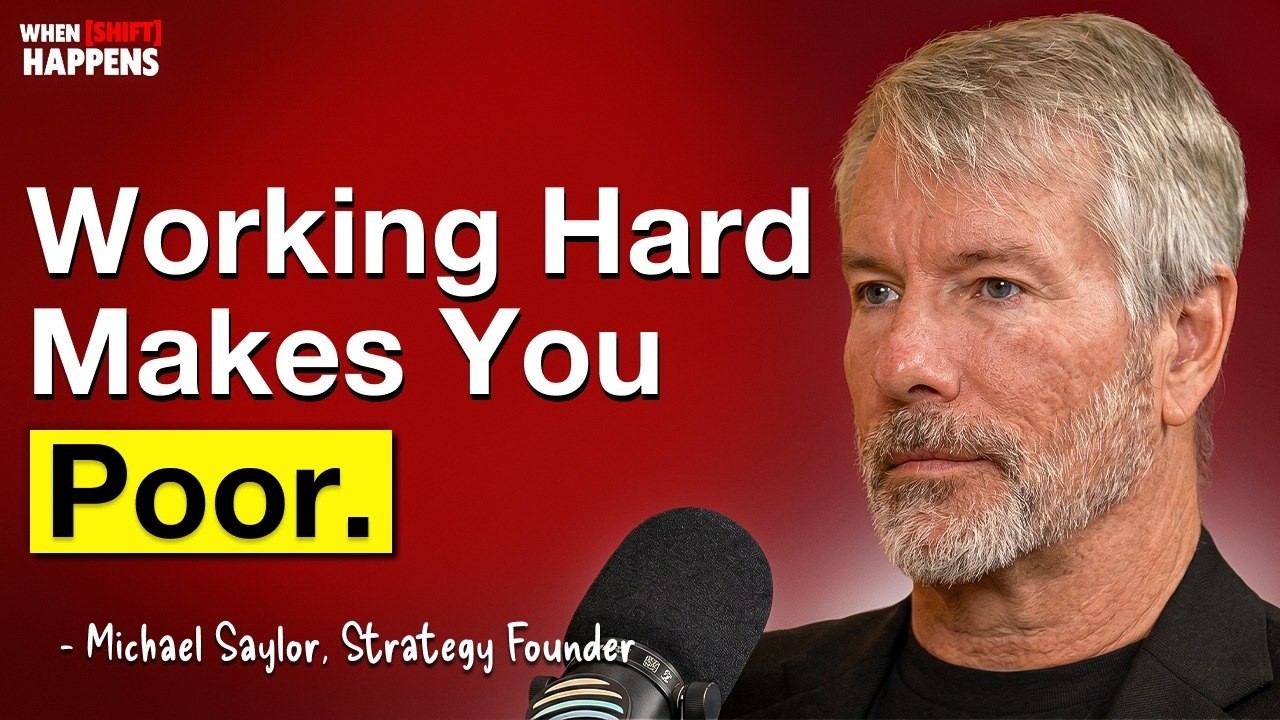
  • Michael Saylor on Strategy’s Bitcoin Playbook, the 11.5% Stretch Preferred Stock, Why Working Hard Is Bad Advice, and Bitcoin as Cyber Manhattan

    Michael Saylor, founder and executive chairman of Strategy (formerly MicroStrategy), sits down for Episode 172 of the When Shift Happens podcast for a wide-ranging, two-hour conversation on how a near-bankrupt enterprise software company became the world’s largest corporate holder of Bitcoin, why he calls his new preferred stock STRC “stretch” the most successful credit instrument in the world, and what 40 years of trial and error taught him about focus, leverage, time horizons, and the difference between working hard and working smart. This one is essential listening for anyone trying to understand Bitcoin as a protocol, Strategy as a capital markets machine, and what an “AI-pilled” 61-year-old founder actually does with his time.

    TLDW

    Saylor walks through his MIT-trained engineer’s framing of money as an adiabatic thermodynamic system, where the dollar loses roughly 7% of its energy per year, gold loses 2%, and Bitcoin loses zero, giving it an infinite half-life. He explains how COVID-era zero interest rates “rent controlled” the cash on Strategy’s balance sheet and forced him to search for a Facebook-of-money, leading to a $62 billion Bitcoin position across 818,000 coins. He details Strategy’s evolution from buying Bitcoin with cash, to convertibles, to senior bonds, to the equity ATM, to the new preferred stock family (Strike, Strife, Stride, and now Stretch), and argues that STRC is “rocket fuel kerosene” distilled from Bitcoin’s pure economic energy: an 11.5% monthly dividend, tax-deferred return of capital, designed to trade tightly around $100. He returns repeatedly to focus, the lesson he says he learned the hard way after spinning up alarm.com, voice.com, angel.com, and a half-dozen other ventures in his 30s. He argues working hard is now bad advice in an era where AI demonetizes labor, that volatility is vitality and the only honest time horizon is four to ten years, and that Bitcoin is to money what English is to language and Arabic numerals are to math: the protocol that won the network effect contest, and the place “all the money and power” now lives.

    Thoughts

    The most useful part of this conversation is not the Bitcoin maximalism, which is by now a fully formed Saylor genre. It is the brutal honesty about the decade he wasted launching alarm.com, voice.com, angel.com, michael.com, hope.com, and a half-dozen others while a billion-dollar MicroStrategy sat at the center of his portfolio asking for more attention. He admits the “imaginary future business is always more fun than struggling with the existing mature business,” which is one of the cleanest descriptions of founder ADHD I have read. The fact that someone at his level of intelligence and pattern recognition still required 20 years and a near-death experience to learn focus should make every operator under 40 reread that section twice. The single takeaway worth tattooing on a wall is his rule: “Just because you can do a thing doesn’t mean you should do a thing.”

    The engineering framing of money is the strongest intellectual move in the episode. Saylor is treating monetary supply expansion as energy loss in a thermodynamic system, with the dollar at a 10-year half-life, weak currencies at 3 to 5 years, gold at 36 years, and Bitcoin at infinity. Whether or not you accept the conclusion, the model is internally consistent in a way most macroeconomic arguments are not, and it gives him a vocabulary for talking about scarcity that economists trained on continuous-supply commodities literally do not have. The Max Planck quote he leans on, “science advances one funeral at a time,” is doing real work here. He is not saying he is smarter than the old guard. He is saying the old guard has no incentive to update because they already have money and power, and that the paradigm shift will be carried by the people with everything to gain. That is a more humble and more accurate version of the maximalist line.

    The Strategy capital markets machine is the part that deserves more scrutiny than it usually gets. The pitch for Stretch is genuinely interesting on its merits: a preferred stock that trades around $100, pays 11.5% monthly as return-of-capital dividends that defer all tax for roughly nine years, gets a step-up in basis on inheritance, and is positioned as a digital money market for people who believe in Bitcoin but do not want 40% volatility. If you take Saylor’s network-effect thesis seriously, this is the natural product to build, and his Standard Oil analogy (“distill the kerosene out of the crude oil”) is the right mental model. The risk that does not get discussed is what happens to the entire instrument family in a 99.8% drawdown of the kind he himself lived through with MicroStrategy in 2002. He waves it off by saying Strategy has 10x the enterprise value over the preferred, but in a deep enough Bitcoin winter, that cushion compresses fast. Worth holding both ideas at once: this is the most elegant Bitcoin-native fixed income product yet built, and it is still fundamentally a leveraged Bitcoin bet wearing a money-market mask.

    The “working hard is bad advice” thread is going to be the most controversial clip, and it is also the most important. Saylor is not saying do not work. He is saying do not be John Henry. Do not race the steam drill with a hammer. In a world where AI can translate, draft legal briefings, write books in 100 languages, and out-produce any individual professional by orders of magnitude, the marginal value of pure human labor is collapsing, and the right move is to ask “what tool can do this for me” before “how do I get better at this.” That is the same logic that took him from “I would have fired anyone who suggested Zoom in 2019” to running a global operation from a Florida studio. The unsubtle implication, especially for the 34-year-old host he is talking to, is that the 10,000-hour mastery model your parents grew up with is increasingly a status symbol with no underlying economics, like learning to compose Shakespearean sonnets in 2026.

    The single underrated line in the whole episode is “everything you own in the physical world you own at the pleasure of someone more powerful than you.” He is using it to make the Bitcoin self-custody case, but it generalizes to a much broader political and historical observation about property rights, minorities, and the steady drumbeat of expropriation events across 10,000 years of recorded history. Whether or not Bitcoin is the answer, the framing of “where do you store value such that nobody can decide to take it from you” is the right question to ask in the current decade, and most people are not asking it.

    Key Takeaways

    • Strategy now holds roughly 818,000 Bitcoin worth $62 billion, making it the world’s largest corporate Bitcoin holder and effectively a reserve bank built on a hard-capped digital monetary network.
    • Saylor’s working definition of an investor: anyone willing to hold a position for at least four years. Anyone with a shorter horizon is a trader, and most traders are fools who do not know they are fools.
    • His core advice to a 40-year-old Uber driver who cannot afford a house: own assets that appreciate faster than the 7% annual US dollar debasement rate. Anything slower means you are getting poorer in real terms while working harder every year.
    • The MIT-trained engineer’s framing of money: gold has a 36-year half-life because supply inflates ~2% a year, the dollar has a ~10-year half-life at ~7% debasement, weak currencies have 3 to 5-year half-lives, and Bitcoin’s half-life is infinite because supply growth is zero.
    • The 2020 pivot was forced, not chosen. When the Fed took rates to zero and signaled no hikes, Strategy’s $500 million in cash became, in Saylor’s metaphor, a rent-controlled building paying zero. They were forced to look for a way out and ended up at Bitcoin.
    • Saylor’s aha moment was recognizing Bitcoin as the only commodity in history with absolute scarcity. Gold inflates, silver inflates, even land can be reclaimed from the sea. Only Bitcoin’s 21 million cap is mathematically fixed.
    • The biggest lesson of his 30s and 40s: focus. He launched alarm.com, voice.com, angel.com, michael.com, hope.com, and several others while running MicroStrategy, and none of them matched the original. The line he leaves with is “just because you can do a thing doesn’t mean you should do a thing.”
    • By the time he was 55, he had been humbled enough to take someone else’s billion-dollar idea (Satoshi’s) instead of trying to generate his own.
    • Strategy’s evolution as an issuer: cash purchases, then convertibles, then senior bonds, then asset-backed loans (Silvergate failure ended that path), then the equity ATM, then the preferred-stock family Strike, Strife, Stride, and now Stretch.
    • Stretch (STRC) is a preferred stock targeted to trade around $100 with about 1 unit of volatility, paying 11.5% monthly as return-of-capital dividends, tax-deferred for roughly nine years until the basis is fully recovered.
    • STRC pairs with a step-up in basis on inheritance, meaning heirs can receive another nine years of tax-deferred dividends on top of what the original holder collected, an arrangement neither bonds nor most preferred stocks allow.
    • Strategy can create roughly 10 to 20 cents of digital credit per dollar of Bitcoin held, which positions a trillion dollars of future Bitcoin holdings to support $200 to $400 billion of credit instruments.
    • The addressable market for STRC-style instruments, in Saylor’s framing, is the roughly $300 trillion global credit market currently delivering about 350 basis points after tax. A product offering three times that yield is targeting trillions of dollars of demand.
    • Standard Oil analogy: Rockefeller called his company “Standard” because impure kerosene blew up engines and houses. Strategy is in the business of distilling pure financial instruments out of the raw economic energy of Bitcoin, the way refineries distill kerosene from crude.
    • Four-letter NASDAQ ticker discipline. Saylor specifically chose STRC over MSTR.P because retail can search, remember, and trade four-letter symbols on Robinhood and Schwab. About 80% of STRC is held by retail.
    • Bitcoin as a lifeboat thesis: in any country with a collapsing currency (Argentina, Brazil, most of Africa, historical Germany), no physical asset is safe because property is held at the pleasure of whoever has power. Bitcoin allows wealth to cross borders inside someone’s head.
    • The Saylor leverage example: a 2.5% mortgage in 2021 plus a 40% appreciating asset is a roughly 37.5% net spread on borrowed money, equivalent to a real after-tax salary of several hundred thousand dollars in a high-tax city, earned for nothing more than paperwork.
    • Volatility is the feature, not the bug. Bitcoin reacts in real time to events in every country, every hour, which is why 500 million people care about it and almost nobody cares about the value of Tokyo imperial real estate.
    • Saylor’s litmus test for trading: if you would not hold it for ten years, you should not hold it for ten minutes. Anything less than a four-year horizon means you are doing entertainment, not investing.
    • He spends “thousands of hours a year” thinking about Bitcoin’s first, second, third, and fourth-order effects, and runs a stochastic risk model that updates every 15 seconds, refusing to diversify because adding silver, gold, or real estate would shatter the model.
    • Bitcoin as protocol: the same network-effect logic that made English the default global language, Arabic numerals the default math, TCP/IP the default networking protocol, and the shipping container the default freight format. Once a protocol locks in, only an asteroid-strike-level event can dislodge it.
    • “There is no second best language” is the analogy he keeps returning to. Bitcoin is to money what English is to communication. Wishing it were Swahili or Esperanto does not change where the wealth concentrates.
    • The Newtonian network effect: when Rupert Murdoch joins Facebook he brings 50 friends. When he joins Bitcoin he brings $50 million. Monetary networks compound faster than social networks because billionaires bring billions.
    • “Don’t sell the thing that will make your children’s children wealthy” is the operating heuristic. He uses the great-great-grandfather analogy: if your ancestor sold Bitcoin to buy velvet for a horse-and-buggy, you would not be rich today.
    • Working hard is not the path. The forklift outperforms the strongest worker with a shovel. John Henry beat the steel drill once and his heart burst doing it.
    • AI is now the forklift for white-collar work. Saylor uses it to draft 25-page legal briefings, translate content into 100 languages, and avoid going back to law school. “It would take 10 years and a million dollars to do what the AI does in two minutes.”
    • Personal communication leverage: a single Lex Fridman appearance has reached more than 11 million views, more people than a 30-year teaching career could reach.
    • Saylor was inspired into engineering as a child by Robert Heinlein’s “Have Space Suit, Will Travel,” in which the hero saves Earth and is rewarded with a full scholarship to MIT. The same Heinlein-Asimov-Clarke pipeline shaped Elon Musk and Jeff Bezos.
    • His mother imprinted on him that he was expected to do great things while he was a 9-year-old paper boy in Dayton, Ohio. He credits the combination of literature plus maternal expectation with his early ambition.
    • He calls himself a late bloomer and “the Colonel Sanders of crypto,” noting that more interesting things have happened in the last 12 months of his career than in the entire previous 35 years.
    • Strategy’s succession is already in motion. CEO Phong Le, Andrew Kang, and CJ are running operational layers, and Saylor expects Strategy to outlast him the way Lloyd’s of London has outlasted its founders by hundreds of years.
    • The Bitcoin price path he is willing to articulate publicly: “We’ll buy it at 100,000, we’ll buy it at 200,000. We’ll buy it at 500,000, we’ll buy it at a million, 2 million, 4 million, 8 million.” The business is “drive Bitcoin to millions of dollars.”
    • He survived a 99.8% drawdown in MicroStrategy from $333 to $0.42 between 2000 and 2002, three days from bankruptcy. He says current Bitcoin volatility does not feel like stress by comparison.
    • He has no children, is not married, and describes himself as singularly married to the business, which he expects to keep doing as long as the civilization needs the money fixed.

    Detailed Summary

    Who Saylor is and why MicroStrategy became Strategy

    Saylor grew up in an Air Force family, lived on bases across Japan, New Zealand, Nebraska, Florida, and Ohio, and won a US Air Force scholarship to MIT, where he studied aerospace engineering and the history of science. He founded MicroStrategy at 24, took it public on the NASDAQ in 1998, and built it into a billion-dollar business intelligence company with about 2,000 employees. By 2020 the business was being slowly crushed by Microsoft Power BI, and lockdowns plus zero interest rates eliminated the natural return on the company’s $500 million cash position. The frustration drove Strategy into Bitcoin: $250 million, then another $250 million, then a billion, then two, until the company became the world’s largest corporate holder with ~$62 billion across 818,000 coins.

    The hard-earned lesson of focus

    Saylor’s defining career mistake was the period between his mid-30s and mid-40s when he launched ten other businesses on the side of MicroStrategy: alarm.com (now a public multi-billion-dollar company spun off), angel.com (sold for about $110 million), voice.com (sold for about $30 million), and several others including michael.com, frank.com, emma.com, hope.com, and usher.com. He concedes that almost none of these matched the original, that the imaginary future business is always more fun than the mature one, and that he wishes he had instead poured 150% of his energy into MicroStrategy. The crystallized lesson, repeated several times: “Just because you can do a thing doesn’t mean you should do a thing.”

    Money as a thermodynamic system

    The intellectual core of the conversation is Saylor’s framing of money as energy in an adiabatic system. Gold inflates ~2% a year and therefore has a 36-year half-life. The dollar debases at ~7% a year and has roughly a 10-year half-life. Weaker currencies have half-lives of 3 to 5 years. Bitcoin’s hard cap of 21 million coins means zero supply inflation, which produces an infinite half-life. He learned thermodynamics designing aircraft wings at MIT and applies the same closed-system logic to money: any system with energy lapse cannot be a long-term store of value, and Bitcoin is the first asset in human history with no lapse.

    Bitcoin as a global lifeboat

    For people in collapsing currency regimes, Saylor argues no domestic instrument holds value. Argentinian and Brazilian hyperinflations destroy 99.9% of purchasing power on familiar cycles. German marks were used in wheelbarrows to buy soap. Buying local real estate, bonds, or currency in those environments is useless because the underlying economy decays around them. The only escape historically has been gold or paintings, which then need to be smuggled across borders. Bitcoin solves the same problem digitally: it crosses borders inside someone’s head via private keys, and it cannot be expropriated by whoever currently holds power. Saylor’s broader point, “everything you own in the physical world you own at the pleasure of someone more powerful than you,” is the philosophical anchor of the entire Bitcoin maximalist case.

    Strategy’s capital markets evolution

    Strategy has run through every available capital structure to keep buying Bitcoin: cash, tender offers, equity issuance, convertible bonds (where Strategy became the largest issuer in the world), senior bonds (abandoned because covenants choked growth), asset-backed loans (Silvergate’s failure ended that channel), the equity ATM, and finally the preferred-stock family. Strike, Strife, Stride, and Stretch were each iterations toward what Saylor calls “the perfect credit instrument,” refined the way Standard Oil refined crude into kerosene. Stretch (STRC) is the current state of the art: a preferred stock targeted to $100, with about 1 unit of volatility, paying 11.5% monthly as return-of-capital dividends that defer all tax for roughly nine years.

    Why STRC matters as a product

    Saylor argues STRC is the first credit instrument that lets a retiree treat a Bitcoin-backed yield as a money-market alternative. The mechanics: a $100 share generates roughly $10/year in monthly dividends, each of which reduces the cost basis instead of triggering current income tax. After about nine years, basis is exhausted and the instrument becomes a qualified-dividend security taxed at long-term capital gains rates. On inheritance, the heir receives a step-up in basis to $100, and another nine-year cycle of tax-deferred dividends restarts. Eighty percent of the issue is held by retail through Robinhood and Schwab, and the company actively manages the price by issuing or buying back to hold the $100 anchor. The mission for the rest of the decade, Saylor says, is to scale this to $200, then $400, then $600, then $800 billion in outstanding credit, with Bitcoin as the underlying capital base.

    Working smart, not hard, in the age of AI

    Saylor’s most pointed advice to younger founders and operators is that hard work is becoming a low-return strategy. AI now drafts legal briefings, translates content into 100 languages, writes books, and outperforms most professional output by orders of magnitude. The 10,000-hour mastery model that built his generation’s careers, he says, will not produce equivalent results in the next one. The right move is to ask what tool can do the thing for you before asking how to do the thing yourself. He uses himself as the example: working 70 hours a week for ten years built MicroStrategy, but it felt easy compared to MIT, and the leverage from AI plus podcasts plus digital distribution lets him now reach more people in a single sitting than a 30-year teaching career could reach.

    Volatility, time horizon, and the trader-versus-investor split

    Saylor refuses to be rattled by short-term Bitcoin moves and uses his 99.8% MicroStrategy drawdown in 2002 as a baseline for what real volatility feels like. He argues that Bitcoin’s price swings are evidence of its utility: it is the only globally-tradable asset where a regulatory rumor in China at 2am can move price in real time, which is why it absorbs all attention. His rules are blunt: an investor holds for at least four years (40% volatility, 40% expected return for Bitcoin), the right indicator is the 200-week moving average, and the Buffett rule “if you would not hold it for ten years you should not hold it for ten minutes” still applies. Everything shorter is trading, which is fine if you are an expert, foolish if you are not.

    Bitcoin as protocol, not as bet

    The closing intellectual frame is that Bitcoin won the network-effect competition the same way English won language, Arabic numerals won math, TCP/IP won networking, and the standard shipping container won freight. None of these became dominant because they were objectively perfect. They became dominant because critical mass locked in, the wealthy and powerful coordinated around them, and any alternative now has to dislodge a $1.5 trillion incumbent. The protocols that win do so because “people aren’t stupid” and a billion small coordination decisions converge on the same standard. Bitcoin, on this read, is not an investment to be allocated against silver or real estate. It is the digital capital protocol that the rest of the financial world is going to be denominated in, and choosing not to participate is closer to refusing to learn English than it is to skipping a stock pick.

    Notable Quotes

    “Just because you can do a thing doesn’t mean you should do a thing.”

    Michael Saylor, distilling 20 years of side-business mistakes into one line

    “Bitcoin is a lifeboat tossed on a stormy sea, offering hope to anyone in the world that needs to get off their sinking ship.”

    Saylor’s framing of Bitcoin as a solution for collapsing-currency regimes

    “There is no second best crypto asset. There’s only one crypto asset and that’s Bitcoin. Human civilization settles on protocols.”

    The closing thesis of the conversation, in Saylor’s own words

    “Don’t sell the thing that will make your children’s children wealthy.”

    Saylor on holding Bitcoin through volatility and selling something else instead

    “Everything you own in the physical world you own at the pleasure of someone more powerful than you.”

    Saylor on why physical assets are not real property rights

    “Volatility is vitality. Bitcoin’s volatile because it’s useful.”

    Saylor reframing Bitcoin price swings as a feature

    “Don’t try to outwork a forklift.”

    Saylor on why “work harder” is increasingly bad advice in the AI era

    “I’m like the Colonel Sanders of crypto. But it’s okay. At least I found a mission at some point in my life.”

    Saylor on being a late bloomer at 55

    “Bitcoin is cyber Manhattan. A thousand years from now, your children’s children’s great-great-great 10x grandchildren will be rich, if you kept it.”

    Saylor on Bitcoin as multi-generational real estate

    “The world doesn’t care whether I’m a good manager of a hundred different things. The world wants me to be the best manager of one thing.”

    Saylor on focus as the only durable professional posture

    Watch the full conversation here: When Shift Happens E172: Michael Saylor on How To Get Rich With Crypto (Without Working Hard).

    Related Reading

  • Mohnish Pabrai on How to Invest in 2026: The Ten Commandments of Investing, Charlie Munger Lessons, Cloning, Turkey Warehouses, Constellation Software, and Why Less Than 1% of Stock Pickers Beat the Market

    Mohnish Pabrai sat down with Shaan Puri to lay out exactly how he thinks about investing in 2026, walking through the ten commandments that have shaped a 27 year track record where every dollar invested in his oldest fund turned into roughly thirty. Watch the full conversation on YouTube here. Pabrai manages over a billion dollars, was close friends with Charlie Munger, has had lunch with Warren Buffett for 650,000 dollars, and has produced multiple 100 bagger investments in his career. This conversation is a complete operating manual for value investors, deep value hunters, and anyone trying to figure out how to compound capital in a market where the S&P trades at elevated valuations and AI capex is rewriting the rules.

    TLDW

    Pabrai argues that under one percent of stock pickers are actually good investors, that the game is a wealth transfer from the active to the inactive, and that temperament beats IQ every time. He walks through his core mental models: watching paint dry, the mistress versus the wife, introducing randomness into your life, cloning instead of inventing, taking a simple idea and taking it seriously, the too hard pile, no called strikes, the salmon spear, the inner scorecard, and don’t die at 25 and get buried at 75. He shares the full story of his 100 bagger Turkish warehouse company Reysas, his coal bets, his Constellation Software thesis around Mark Leonard, and why he is bearish on the S&P 500, bullish on pickaxe makers like TSMC and ASML conceptually but unwilling to pay current prices, and why GLP-1 drugs and Bitcoin both sit in his too hard pile. He retells Warren Buffett’s American Express salad oil crisis trade, the lesson Buffett delivered about Rick Guerin and leverage, the inner versus outer scorecard, and the Ed Thorp blackjack to Ken Griffin to Citadel chain. The closing punchline is that the most important investment any person can make is leading an aligned life, getting your music out, and discovering your calling before the wilderness years pile up.

    Key Takeaways

    • Well under one percent of Americans picking individual stocks are actually good at it. Index funds put you ahead of more than ninety percent of the crowd with zero effort.
    • The single biggest mistake smart investors make is impatience. Temperament, not IQ, decides outcomes.
    • Watching paint dry is the core skill. After making an investment, nothing may happen for three to five years. That is the nature of the game.
    • The mistress is always hotter than the wife. The stock you do not own looks more exciting than the one you do own because you do not know its flaws. The bar for swapping must be extremely high.
    • Raise your standards across the board: the investments you make, the people you hang out with, the relationships you keep. Buffett’s gravitational pull rule applies to both portfolios and friendships.
    • Introduce randomness into your life. Pabrai picking up a Peter Lynch book at Heathrow in 1994 led him to Buffett, Berkshire, Charlie Munger, bridge games, and his entire investing career.
    • Cloning works because almost no one will do it. Sam Walton copied everything. Walmart came from Kmart, Sam’s Club came from Sol Price’s Price Club, Burger King located across from McDonald’s instead of running their own site selection.
    • Elon Musk’s idiot index, calculating raw material cost on the London Metals Exchange and refusing to pay more than a small multiple over it, is the kind of simple framework no competitor will adopt even though it is publicly visible.
    • Take a simple idea and take it seriously. None of the other mental models work unless you commit fully to the first one.
    • The too hard pile is the most important box on a value investor’s desk. Buffett claims ninety eight percent of businesses belong there. Investing has no called strikes, so passing on ten thousand pitches before swinging is the right behavior.
    • The whale is swimming all the time, you only see it when it surfaces. Real investor activity is reading and studying, not trading.
    • Buffett at twelve gathered discarded racetrack tickets at Ax-Sar-Ben, found winners drunks had thrown away, and had his Aunt Alice cash them. He carried that pattern of finding anomalies into the Moody’s manuals in his twenties and into the Japan Company Handbook for two decades before pulling the trigger on the five Japanese trading companies.
    • The Japanese trading company trade was financed at half a percent in yen, the companies paid eight to nine percent dividends that later doubled, and Berkshire’s five billion has roughly doubled with almost no risk attached.
    • The American Express salad oil crisis taught Buffett to test the moat in the real world. He stood next to restaurant cash registers in Omaha, saw zero hesitation about accepting the card, and put forty percent of his fund into AMX.
    • The Buffett lunch lesson Pabrai still carries: a slightly above average investor who spends less than they earn and does not use leverage cannot help but get rich over a lifetime. Rick Guerin lost his Berkshire shares to margin calls in the 1973 to 1974 crash. Buffett bought them at forty dollars each, currently worth over seven hundred thousand.
    • Inner scorecard versus outer scorecard is the most fundamental life model. Buffett’s frame: would you rather be the greatest lover in the world and known as the worst, or the worst lover known as the greatest.
    • The Turkish stock market cycles through its float every seventeen days. Pure speculation. Indian quality companies trade at stratospheric valuations. The two together created a poker table Pabrai could sit at alone.
    • Reysas, the Istanbul warehouse operator, was bought at roughly three percent of liquidation value with a fifteen to sixteen million dollar market cap on eight hundred million in assets. It is now approaching a 100 bagger in dollars.
    • Pabrai’s thermonuclear event mental model: if ninety nine percent of humans were wiped out, someone would still produce Coke concentrate, because people will always trade fifteen minutes of labor for a Coke. Cement, paint, land, and steel are inflation indexed.
    • TAV Airports earned revenue in euros, paid costs in collapsing lira, traded at three to four times earnings on the Istanbul exchange. A natural monopoly hiding inside a panicked market.
    • The stock market is a church with a casino attached. Robinhood, prediction markets, zero day options, and two day options all increase the wealth transfer from the active to the inactive. Pabrai welcomes more casino activity because it helps his side.
    • On Polymarket, roughly one tenth of one percent of users capture sixty percent of profits. Two thousand traders made half a billion dollars in a year. The casual gambler funds the sharp.
    • On AI: invest in pickaxe makers. The alphabets and metas are playing a high capex game they have never played before. TSMC, ASML, and Micron are toll bridges. Pabrai is not making the bet because it sits between too hard, too expensive, and outside his circle of competence.
    • Constellation Software is Pabrai’s vertical SaaS bet because Mark Leonard built a mousetrap nobody else will clone. They acquire roughly two hundred small vertical market software companies a year, in delegated fashion, at five to six times cash flow that quickly becomes three to four times after revenue and license fee tweaks.
    • The market is wrong about AI killing software. Coding is one fifth of the pie. Adobe is not going out of business because someone can vibe code a Photoshop alternative. Incumbents reduce cost via automation while keeping cash flows intact.
    • Pabrai is bearish on the S&P 500. He agrees with Howard Marks that when the index trades at twenty three times earnings, the historical forward ten year return has bounced between minus two and plus two percent.
    • GLP-1 drugs sit in the too hard pile because industries with rapid change are the enemy of the investor. Ozempic to Mounjaro to upcoming tablets is too much turnover for valuations that already price in success.
    • Bitcoin sits in the too hard pile. Pabrai prefers gold and asks why a society that already has gold needs Bitcoin.
    • The four percent rule of compounding: roughly four percent of stocks have delivered the entire return of the US market over ninety years. Twelve investments built Berkshire across sixty years.
    • Investing rewards aging. Unlike basketball, the game gets easier with experience. Pattern recognition, expanded circle of competence, and the option to ride winners all compound.
    • Circle the wagons around your winners. Not selling Coke, not selling Apple, not firing Ajit Jain. The success of Berkshire was about not interfering with the four percent that worked.
    • Charlie Munger made an investment six days before he died at age ninety nine point nine. He invested like he was twenty five. Ben Franklin’s line: many people die at twenty five and are buried at seventy five.
    • Don’t save sex for old age. Don’t delay starting your real life until after the McKinsey rotation. Buffett’s frame transfers to careers too.
    • Ed Thorp wrote Beat the Dealer after the mob threatened him with a baseball bat for cleaning out single deck blackjack in Vegas. He then cracked options pricing before Black Scholes, ran Princeton Newport Partners, and became an early backer of Ken Griffin’s Citadel out of a Harvard dorm room.
    • Ken Griffin once told a Harvard recruit he wanted to quit at ten million dollars: please reject our offer, we do not want someone who dies at twenty five.
    • Lead an aligned life. Personality is largely baked by age five. The window to specialize is age eleven to twenty, which is exactly when the school system forces you to be a jack of all trades.
    • Get your music out. Every person has something specific they are meant to bring into the world. A misaligned life is the highest cost most people pay.

    Detailed Summary

    Why fewer than one percent of stock pickers are actually good

    Pabrai opens with a brutal estimate: well under one percent of the Americans who pick individual stocks are good at it. The game, he says, is a mechanism for transferring wealth from the active to the inactive. The good news is that index funds let anyone capture market returns with zero analytical work and end up ahead of more than ninety percent of active stock pickers. The implication is that anyone choosing to pick individual stocks is voluntarily entering a competition where the base rate of success is below ten percent, and the differentiator is almost never intelligence. It is temperament.

    That temperament shows up as patience. After making an investment, three to five years can go by with nothing happening. Sometimes the investment is a mistake and the patience converts into the discipline to reverse course. But on the whole, the less activity an investor takes, the better the outcomes. The first commandment is to enjoy watching paint dry.

    The mistress is always hotter than the wife

    The investments you already own are the wife. You see every flaw because you live with them every day. The investments you do not own are the mistress. Glamorous, unknown, exciting precisely because the temperament and the warts have not been revealed. Guy Spier, Pabrai’s longtime friend, deliberately stays reluctant to act on his portfolio. The point is not that you never act. The point is that the bar for action needs to be extremely high, and you have to learn to be comfortable passing on everything below that bar. Pabrai extends this directly to life: raise your standards about the people you spend time with, the projects you take on, and the investments you select.

    Introduce randomness into your life

    Charlie Munger told Pabrai over and over to introduce randomness into his life. The example Pabrai uses is his own origin story. He was an engineer running an IT company in 1994, sitting in Heathrow with his wife, looking for something to read on a flight. He picked up Peter Lynch’s One Up On Wall Street, finished it, picked up Beating the Street, finished that, encountered Buffett through a mention in Lynch, found the first two Buffett biographies fresh off the press, dove into the Berkshire and partnership letters, and within three years started attending the Omaha annual meeting. Every flight to Omaha on a Friday in May has both seatmates pre filtered for above average humans, all going for the same reason. The randomness exploded outward into Charlie Munger, the bridge games, Charlie’s friends, and decades of compounding social and intellectual capital.

    Shaan tells the parallel story of his own randomness bet. He flew to FarmCon in Kansas City for no particular reason, met newsletter operator Kevin Van Trump, cloned the model, launched The Milk Road for crypto, built the largest crypto newsletter in the world inside a year, and sold it for millions with one employee. Two mental models stacked: introduce randomness, then clone.

    Cloning is the cheat code no one will use

    Sam Walton freely admitted he had no original ideas. He walked into more competitor retail stores than any human in history. He looked at Sol Price’s Price Club, said no brainer, and opened Sam’s Club. He took his managers into a competitor and when they complained the store was a mess, he pointed at the one good candle display and said you can learn from anyone. He bought donuts at five thirty in the morning for distribution center drivers because they had ground level intel on every store. Walmart’s market cap dwarfs that of every competitor combined, and every system came from somewhere else.

    Tesla, SpaceX, and the Boring Company exist because Elon Musk applies the idiot index. He asks what raw materials go into a part, looks up the price on the London Metals Exchange, and refuses to pay a multiple over it without a fight. None of his competitors think this way even though he has written about it publicly and Walter Isaacson devoted a book to it. SpaceX intentionally blows up rockets to learn. Blue Origin tries hard not to blow up rockets. SpaceX is miles ahead. Burger King famously assigned two guys to track McDonald’s site selection and just put a store across the street. The reason cloning works so well is that almost no one is willing to do it.

    Take a simple idea and take it seriously

    This is the bedrock model that makes every other model work. Without total commitment to one simple idea, the rest of the mental models stay theoretical. Pabrai went to Turkey on a hunch in 2018 because the market screened cheap. He discovered that Turkish public companies cycle through their float every seventeen days, meaning every shareholder turns over more than twenty times a year. Compared with Berkshire, whose float may take a decade to rotate, Turkey is a hyperactive day trader’s casino. India, by contrast, has roughly one hundred to one hundred fifty quality companies, all picked over and priced at stratospheric multiples. The Turkish market gave Pabrai a poker table he could sit at almost alone. He chose to be an inch wide and a mile deep.

    Circle of competence and the too hard pile

    Pabrai’s eighth commandment is thou shalt not use Excel, and his ninth is that if you cannot explain an investment thesis to a ten year old in about four sentences, it is a pass. Investing is journalism more than spreadsheet work. Buffett stood at restaurant cash registers in Omaha during the salad oil crisis to test whether AMX’s brand had cracked. He walked into Snow White with his briefcase to study Disney. Peter Lynch told amateurs to make a list of every brand they consume because that is the most authentic intel they have. Buffett keeps a too hard box on his desk and claims ninety eight percent of businesses go in it. Investing has no called strikes, which means an investor can let ten thousand pitches go by and only swing at the fattest center cut pitch.

    The whale is swimming all the time. You only see it when it surfaces. Buffett at age twelve gathered discarded racetrack tickets at Ax-Sar-Ben to find ones drunks had thrown away, then had his aunt Alice cash them because he was underage. In his twenties he flipped through Moody’s manuals page by page looking to be hit in the head with a two by four. Western Insurance at fifteen dollars made twenty five dollars a share and had forty dollars of cash on the balance sheet. He has been flipping through the Japan Company Handbook for at least twenty years before pulling the trigger on the five Japanese trading companies, financing the entire five billion in yen at half a percent against eight to nine percent dividend yields that have since doubled. Berkshire’s five billion is now ten billion paying eight hundred million a year, essentially risk free.

    The 650,000 dollar lunch and what Buffett actually said

    Pabrai paid 650,000 dollars to have lunch with Warren Buffett in 2007 because his net worth had hit eighty four million dollars almost entirely from intellectual property he had taken from Buffett for free. He wanted to look him in the eye and thank him. Buffett’s stance on the lunches was that whoever paid should feel like they got a bargain, so he came prepared having studied biographies of every guest. Pabrai asked an innocent update question about Rick Guerin, the third partner of Buffett and Munger in the sixties and early seventies who then disappeared. Buffett’s answer became the lesson of the lunch. Charlie and I knew we were going to be rich, but we were not in a hurry. Rick was in a hurry. He was always levered. The 1973 to 1974 crash, the slowest motion crash in modern history, gave him margin calls. Buffett bought Rick’s Berkshire shares for forty dollars each. They are over seven hundred thousand now. The lesson: if you are even a slightly above average investor and you spend less than you earn and you do not use leverage, you cannot help but get rich over a lifetime.

    The other lunch lesson Pabrai still cites is the inner scorecard. Buffett’s framing: would you rather be the greatest lover in the world and known as the worst, or the worst lover known as the greatest. The answer determines whether you can resist external stimuli and stay centered. The way Pabrai practices it is by remembering that even Gandhi has critics. If Gandhi is fair game, so is anyone else with a public footprint.

    The Turkey trade and the thermonuclear event mental model

    The headline Turkey investment is Reysas, an Istanbul warehouse operator Pabrai started buying when the market cap was fifteen to sixteen million dollars on eight hundred million dollars of assets, roughly three percent of liquidation value. He told the broker to take out every ask up to the ten percent daily price limit. Templeton Fund called offering five percent of the company for a million dollars and Pabrai said why are you even calling, just take it. Templeton was exiting Turkey because of currency instability and inflation, both of which Pabrai considered irrelevant for the specific kinds of assets he was buying.

    The mental model that unlocked Turkey was the thermonuclear event scenario he discussed with Charlie Munger. If ninety nine percent of humans were wiped out, someone would still produce Coke concentrate and rebuild a bottling plant. The remaining seventy million people will trade fifteen minutes of labor for a Coke regardless of currency or exchange rate. A warehouse is land, paint, cement, and steel. All four are inflation indexed. Whatever happens to the lira, those assets do not care. When the lira collapsed ninety percent against the dollar in seven years, Reysas went up roughly ninety times in dollars and effectively to infinity in lira. He applied the same logic to TAV Airports, which collected revenue in euros while paying costs in collapsing lira. A natural monopoly trading at three to four times earnings on a panicked exchange.

    The casino, prediction markets, and Polymarket

    Buffett’s line at the most recent Berkshire meeting is that the stock market is a church with a casino attached, and the casino is getting crowded. Robinhood, two day options, leverage, and prediction markets like Polymarket all funnel casual gamblers into a transfer game where the sharps already know the prices. Pabrai notes that on Polymarket, roughly one tenth of one percent of users capture sixty percent of profits, and two thousand traders made half a billion dollars in a year. The horse track keeps twenty one percent of every dollar, Vegas keeps two to four percent on a great blackjack game, and yet some players still make a living off horse racing by spotting odds that make no sense. The casino activity is bad for society and great for any investor patient enough to wait for the obvious mispricing.

    AI, pickaxe makers, and the too hard pile

    On AI, Pabrai says invest in pickaxe makers. The alphabets and metas are playing a high capex game they have never played before, which is a recipe for surprise. The capex must pass through TSMC, ASML, and probably Micron. But all of those toll bridges are either too expensive, outside Pabrai’s circle of competence, or in his too hard pile. He is not making the bet. There is no scenario where he sells his Turkish warehouses to buy TSMC. The mistress, in this case, looks uglier than the wife and there are no bonus points for clever valuation work.

    Constellation Software, Mark Leonard, and vertical SaaS

    Where the market gets AI wrong is the assumption that AI coding kills software. Coding is at most one fifth of a software business. The market assumes Adobe is dead because someone can vibe code Photoshop. Pabrai disagrees. Incumbents will reduce costs through automation, keep cash flows intact, and possibly cut prices without losing margin. He invested in Constellation Software specifically because Mark Leonard has built a mousetrap nobody else will clone. Constellation’s M&A team touches seventy to one hundred thousand private vertical market software companies twice a year by phone and twice by email. They acquired roughly two hundred companies last year alone, never using bankers. They pay five to six times cash flow, then bump revenue and license fees about twenty percent, and the effective purchase price drops to three or four times within a year or two. The model is delegated, with deal authority pushed out to teams that do not need headquarters approval up to a threshold. They buy and hold, which scares away private equity that wants to flip. The universe of vertical SaaS targets is too small for private equity to bother with and big enough to keep Constellation compounding for decades. Mark Leonard is the kind of unicorn operator who does not appear twice in a generation.

    S&P bearish, GLP-1 too hard, Bitcoin too hard

    Pabrai is bearish on the S&P 500 because at roughly twenty three times earnings, historical forward ten year returns have ranged between minus two and plus two percent. Howard Marks’s analysis matches his own. GLP-1 drugs like Ozempic and Mounjaro are generating roughly seventy nine billion in revenue annually, more than the entire AI economy, but Pabrai puts them in the too hard pile because industries with rapid change are the enemy of the investor. Ozempic to Mounjaro to upcoming oral tablets is too many turns of the wheel. Bitcoin sits in the same too hard pile. Pabrai prefers gold and asks why a society that already has gold needs Bitcoin, which is widely used by scammers and ransomware operators.

    The four percent rule and circling the wagons

    Over the past ninety years, roughly four percent of US stocks have delivered the entire market return. The other ninety six percent have treaded water. Buffett himself has made three to four hundred investments and only twelve of them built Berkshire Hathaway. Index funds work because they are too dumb to sell Nvidia and too dumb to sell TSMC. Active investors and portfolio managers second guess winners and trim them. The most important investing discipline is circling the wagons around winners: not selling Coke, not selling Apple, not firing Ajit Jain. Capitalism is brutal and most businesses go to zero eventually. The thin slice of enduring moats, like FICO, McDonald’s brand, prime Istanbul warehouses, airport monopolies, and Coke bottlers, are what compound for decades. Pabrai’s bets on coal, airports, warehouses, and Constellation do not all need to work. If half work, the portfolio is a home run. If forty percent work, still a home run. Investing is a forgiving game.

    Ed Thorp, Ken Griffin, and the chain of investing genius

    Ed Thorp used MIT’s mainframe in the early sixties to crack single deck blackjack with basic strategy and card counting. He cleaned out mob run Vegas casinos until they showed him a baseball bat. To get back at them he wrote Beat the Dealer, which sold millions of copies and forced the industry to introduce multi deck shoes and rule changes. He then cracked options pricing before Black-Scholes and skipped the Nobel Prize to make money on it through Princeton Newport Partners, compounding at twenty five to thirty percent a year with no down years. He met a young Ken Griffin running Citadel out of a Harvard dorm and not only handed over algorithms but became an early backer. Pabrai’s first meeting with Thorp happened in a racquetball locker room while Pabrai was completely naked, copy of The Wall Street Journal next to him. Thorp introduced himself, Pabrai’s excitement overcame his sense of decorum, and they have been friends ever since. The Ken Griffin lore extends to his recruiting filter: a Harvard recruit who said he would quit at ten million dollars was told to please reject the offer, because Citadel does not want people who die at twenty five.

    Don’t die at twenty five and get buried at seventy five

    Ben Franklin’s line that many people die at twenty five and get buried at seventy five becomes Pabrai’s closing frame. Charlie Munger made an investment six days before he died at age ninety nine point nine. He invested like he was twenty five. The whole point of life is to keep growing, keep learning, keep finding the alignment between who you are inside and how you show up in the world. Personality is largely baked by age five, and after twelve the most a parent can really influence is the peer group. The window to specialize runs from age eleven to twenty, which is precisely when most educational systems force kids to be jacks of all trades. Bill Gates slipped out of his house to code through the night and accumulated ten to twenty thousand hours by his early twenties. Buffett picked stocks at eleven. Michelangelo sculpted at ten.

    The most important thing Pabrai wants viewers to take from the conversation is that an aligned life is more important than a great investment record. Get your music out. Find what energizes you. If you do not know your calling, work with a thoughtful industrial psychologist like Jack Keene or pay attention to which activities and people genuinely energize you and which drain you. Pabrai himself wandered the wilderness until his mid thirties when he finally understood his own calling. Buffett’s frame applies: do not save sex for old age and do not save your real work for after the McKinsey rotation.

    Thoughts

    The most useful thing Pabrai does in this conversation is collapse the gap between life philosophy and portfolio construction. Most investing content treats temperament as a soft skill on the side of the spreadsheet. Pabrai puts it where it belongs, at the center. The reason the four percent rule matters is not statistical, it is psychological. Almost everyone can identify the few enduring compounders. Almost nobody can sit on them for forty years without selling, trimming, switching to a hotter mistress, or breaking discipline on a leverage call. The actual edge in public markets is not analytical, it is the willingness to be inactive in the face of constant pressure to act.

    The Turkey trade is the most instructive case study in the whole conversation because it is genuinely replicable. Not the specific market, but the architecture. Pabrai stacked four simple mental models on a single trade: take a simple idea seriously, identify a market where the float churns so fast that price has no relationship to value, isolate assets whose intrinsic worth is currency independent, and run the thermonuclear event sanity check on the underlying demand. The result was a 100 bagger held in roughly the worst macro environment of his investing career. The lesson is not to go to Istanbul. It is that real edge tends to come from combining three or four boring frameworks at the same time, in a place where nobody else is bothering to combine them.

    The Constellation Software section deserves more attention than it gets in most investor decks. Pabrai is making a clean bet that vertical SaaS is misread by the market because of generic AI fear. He is probably right. Coding is a labor input to software, not the moat. Switching costs, regulatory tangles, integration depth, and decades of accumulated workflow customization are what keep customers paying. Mark Leonard has industrialized the act of acquiring those moats two hundred times a year. If the DNA holds after Mark eventually steps back, the math is hard to beat. The asymmetric risk is leadership transition, not technological disruption.

    The AI commentary is more interesting for what Pabrai refuses to do than for what he says. He acknowledges the pickaxe makers thesis, names the toll bridges, and then explicitly declines to make the bet because the valuations are too high and the path forward is genuinely uncertain. That is the discipline of the too hard pile in action. Plenty of investors right now are putting money to work in TSMC and ASML at multiples that bake in success scenarios, telling themselves they have done the homework. Pabrai’s position is that even when you are largely right about a trend, paying any price for it is a mistake. The structural humility there is the actual lesson.

    The aligned life closing argument hits hardest because it reframes the entire conversation. The ten commandments of investing are a subset of a broader operating system: figure out who you are by age twenty if you can, raise your standards on the people you spend time with, do not borrow against tomorrow, do not chase the mistress, and do not save your real ambitions for old age. Investing is just the highest leverage application of those rules. The viewers who walk away with one usable change probably should not be picking new stocks. They should be auditing whether they are leading the life that fits.

    Watch the full conversation with Mohnish Pabrai and Shaan Puri on YouTube here.