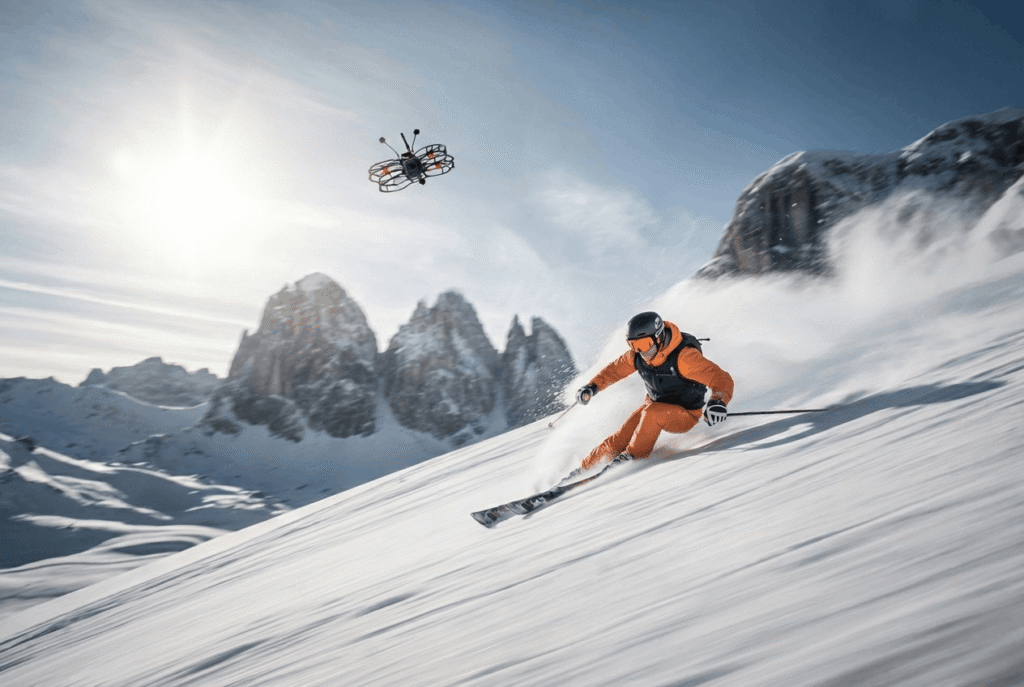
Inside the 243-gram flying cameras chasing Olympic gold at 90 mph — the pilots, the tech, the controversy, and why Milano Cortina 2026 will be remembered as the “Drone Games.”
TLDR
The Milano Cortina 2026 Winter Olympics have deployed FPV (First-Person View) drones as a core broadcast tool for the first time in Winter Games history. A fleet of 25 custom-built drones — weighing just 243 grams each and capable of 90 mph — are chasing bobsleds through ice canyons, diving off ski jumps alongside athletes, and orbiting snowboarders mid-trick. Built by the Dutch firm “Dutch Drone Gods” and operated by former athletes turned drone pilots, the system uses a dual-feed transmission architecture that sends ultra-low-latency video to the pilot’s goggles while simultaneously beaming broadcast-quality HD to the production truck. The result is footage that makes viewers feel like they’re sitting on the athlete’s shoulder. But the revolution comes with a buzzkill — literally. The drones’ high-pitched whine has sparked a global “angry mosquito” debate, and Italian defense contractor Leonardo has erected an invisible “Electronic Dome” of radar and jamming systems over the Dolomites to keep unauthorized drones out. Love it or hate it, FPV has graduated from experiment to Olympic standard, and the 2030 French Alps Games will inherit everything Milano Cortina pioneered.
Key Takeaways
- First-ever structural FPV integration at a Winter Olympics. These aren’t novelty shots — FPV is the default angle for replays and key live segments in speed disciplines at Milano Cortina 2026.
- 25 custom drones, 15 dedicated FPV teams. The fleet is built by Dutch Drone Gods for Olympic Broadcasting Services (OBS), each unit weighing just 243 grams with top speeds of 140 kph.
- Dual-feed transmission solves the latency problem. Pilots see 15-40ms ultra-low-latency video through their goggles while a separate HD broadcast feed with 300-400ms delay goes to the production truck via COFDM signal.
- Pilots are former athletes. Ex-Norwegian ski jumper Jonas Sandell flies the ski jumping coverage. He anticipates the “lift” because he’s done it himself thousands of times.
- Three-person teams modeled on military aviation. Every flight requires a pilot (goggles on, zero outside awareness), a spotter (line-of-sight, abort authority), and a director (in the OB truck, calling the live cut).
- The inverted propeller design is the secret weapon. Mounting motors upside-down lowers the center of gravity and lets the drone “carve” air like a skier carves snow — smoother banking, cleaner footage.
- Battery life is 5 minutes in sub-zero conditions. Heated cabins keep LiPo packs at body temperature until seconds before flight. Cold batteries can voltage-sag and drop a drone mid-chase.
- Leonardo’s “Electronic Dome” protects the airspace. Tactical radar, RF sniffing, and electronic jamming distinguish sanctioned drones from rogue threats. Unauthorized flight is a criminal offense.
- The “angry mosquito” controversy is real. Props spinning at 30,000+ RPM emit a 400Hz-8kHz whine that cuts through the natural soundtrack of winter sports. AI audio scrubbing is in development for 2030.
- 93% viewership spike. 26.5 million viewers in the first five days — and FPV footage is being credited as a major factor.
The Full Story
As the 2026 Winter Olympic Games in Milano Cortina reach their halfway point, a singular technological narrative has emerged that eclipses even the introduction of ski mountaineering or the unprecedented decentralized venue structure spanning 400 kilometers of northern Italy. It’s not a new sport. It’s a new way of seeing sport.
For the first time in Winter Olympics history, First-Person View drones have been deployed not as experimental novelties bolted onto the margins of production, but as the primary architectural component of the live broadcast for speed disciplines. From the icy chutes of the Cortina Sliding Centre to the vertical drops of the Stelvio Ski Centre in Bormio, a fleet of custom-engineered, high-speed micro-drones is fundamentally altering the viewer’s relationship with gravity, velocity, and fear.
No longer tethered to fixed cable cams or zoomed-in telephoto lenses that compress depth and flatten the terror of a 90 mph descent, audiences are now riding shotgun. They’re sitting on the shoulder of a downhill skier as she threads a 2-meter gap between dolomite rock walls. They’re matching a four-man bobsled through a concrete-and-ice canyon where the walls blur into a warp-speed tunnel. They’re floating parallel to a ski jumper at the apex of a 140-meter flight, looking down at the terrifying void between athlete and earth.
This is FPV at the Olympics. And it changes everything.
The Hardware: 243 Grams of Purpose-Built Fury
The drones chasing Olympic gold are nothing like the DJI Mavic sitting in your closet. They are bespoke, purpose-built broadcast machines designed to survive a hostile alpine environment while delivering cinema-grade imagery at insane speeds. The fleet comprises approximately 25 active units with 15 dedicated FPV teams, and the hardware was developed by the Netherlands-based firm Dutch Drone Gods (DDG) in partnership with Olympic Broadcasting Services.
The engineering brief was a paradox: build something fast enough to chase a bobsled at 140 kph, yet light enough that if it ever made contact with an athlete, the damage would be survivable. The answer weighs 243 grams — just under the critical 250-gram threshold that triggers stricter aviation classification in most jurisdictions.
Core Specs at a Glance
| Feature | Specification | Why It Matters |
|---|---|---|
| Weight | 243 grams | Sub-250g classification bypasses stricter aviation rules; minimizes impact energy |
| Max Speed | 100+ kph (bursts to 140 kph / 90 mph) | Matches bobsled and downhill skiing velocities |
| Flight Time | ~5 minutes (two athlete runs) | Cold degrades batteries fast; hot-swap protocol keeps packs warm until launch |
| Frame Design | Inverted propeller “Cinewhoop” (2.5″ to 7″) | Lowered center of gravity; cleaner air over props for smoother banking |
| Operating Temp | -20°C to +5°C | LiPo batteries pre-heated in thermal warmers to prevent voltage sag |
| Pilot Feed | DJI O4 Air Unit, 15-40ms latency | Reflex-speed video to goggles — the pilot’s “nervous system” |
| Broadcast Feed | Proton CAM Full HD Mini + Domo Pico Tx, 300-400ms latency | HD HDR signal via COFDM to production truck — the “visual cortex” |
The Inverted Propeller Innovation
The single most important hardware decision DDG made was mounting the motors upside down. In a traditional drone, propellers sit above the arms and push air downward over the frame, creating turbulence. The Olympic drones flip this — motors are mounted below the arms in a “pusher” configuration.
The physics payoff is significant. When chasing a skier through a Super-G turn, the drone must bank aggressively — sometimes 60-70 degrees. The inverted design lowers the center of gravity, allowing the drone to “carve” through the air the way a ski carves through snow. The result is footage with smooth, sweeping curves that mirror the athlete’s line rather than fighting it. And because the propellers push air away from the frame rather than washing it over the body, there’s less self-induced turbulence — critical when you’re flying centimeters from ice inside a bobsled track.
The Dual-Feed Architecture: Two Brains, One Drone
Here’s the fundamental problem with live FPV broadcast: a pilot flying at 90 mph needs to see what the drone sees instantly. Even a half-second delay and you’ve already crashed. But broadcast television needs high-definition, color-corrected, HDR imagery — processing that inherently introduces latency.
The solution is elegant: each drone carries two independent transmission systems.
The pilot feed runs through a DJI O4 Air Unit at 15-40 milliseconds of latency. It’s lower resolution, optimized purely for frame rate and response time. This is the drone’s “nervous system” — raw, twitchy, and fast. Only the pilot sees it.
The broadcast feed uses a completely separate camera (Proton CAM Full HD Mini) and transmitter (Domo Pico Tx), running at 300-400ms latency via COFDM signal — a modulation scheme specifically chosen because it’s robust against the multipath interference caused by radio signals bouncing off dolomite rock walls and concrete sliding tracks. This feed goes straight to the Outside Broadcast van where it’s color-graded and cut into the world feed alongside 800 other cameras.
The result: the pilot flies on instinct while the world watches in HD. Two realities, one airframe.
The Human Element: Athletes Flying Athletes
The most fascinating aspect of the 2026 FPV program isn’t the hardware — it’s the hiring strategy. OBS and its broadcast partners realized early on that following a ski jumper off a 140-meter hill requires more than stick skills. It requires understanding what the athlete’s body is about to do before it does it.
So they recruited athletes.
Jonas Sandell is a former member of the Norwegian national ski jumping team. He now flies FPV for OBS at the Predazzo Ski Jumping Stadium. His athletic background gives him something no amount of simulator time can replicate: a proprioceptive understanding of when a jumper will “pop” off the table and transition from running to flying. He anticipates the lift phase — throttling up the drone milliseconds before the visual cue — because his own body remembers the feeling. He knows the flight envelope of a ski jumper because he used to be the flight envelope.
For the sliding sports — luge, skeleton, bobsled — the pilot known as “ShaggyFPV” from Dutch Drone Gods leads what might be the most dangerous camera crew at the Games. Flying inside the bobsled track is essentially flying inside a concrete pipe with no GPS, no stabilization assists, and a 1,500-kilogram sled bearing down at 140 kph. ShaggyFPV and his team fly up to 50 runs per session, building muscle memory of every curve and transition so deeply that the flying becomes subconscious. If a sled crashes and rides up the walls, the pilot must have a faster-than-conscious “bail out” reflex — throttle up and out of the track instantly to avoid becoming a 243-gram projectile aimed at a downed athlete.
The Three-Person Team Protocol
No FPV drone flies alone at the Olympics. Every unit operates under a strict three-person crew structure modeled on military aviation:
- The Pilot — goggles on, immersed in the FPV feed, zero awareness of the physical world. They fly on reflex and audio cues.
- The Spotter/Technician — maintains visual line-of-sight with the drone at all times. Monitors signal strength, battery voltage, wind, and physical hazards. Has unilateral “tap on the shoulder” authority to abort any flight, no questions asked.
- The Director — sits in the warmth of the OB truck, watching the drone feed alongside 20+ other camera angles. Calls the shot: “Drone 1, stand by… and TAKE.” Coordinates the cut so the drone enters the broadcast mix at exactly the right moment.
This three-person ballet is performed hundreds of times a day across all venues. It’s the invisible choreography that makes the “wow” moments look effortless.
The Visual Philosophy: “Movement in Sport”
Mark Wallace, OBS Chief Content Officer, defined the visual strategy for 2026 with a two-word mandate: “Movement in Sport.” The goal isn’t just to show what happened. It’s to make the viewer feel what happened.
In alpine skiing, the drone doesn’t just follow — it mimics. When the skier tucks, the drone drops altitude. When the skier carves, the drone banks. The camera becomes a kinesthetic mirror, conveying the violence of the vibration and the crushing G-forces in a way that a static telephoto shot from the sideline never could.
In ski jumping, the drone tracks parallel to the athlete mid-flight, revealing the true scale of a 140-meter jump — the terrifying height, the impossible hang time, the narrow margin between textbook landing and catastrophe. Tower cameras flatten this. FPV restores it.
In the sliding sports, the FPV drone may be the only camera capable of honestly conveying speed. Fixed trackside cameras pan so fast the sled blurs into abstraction. But the drone matches velocity, keeping the sled in razor-sharp focus while the ice walls dissolve into a warp-speed tunnel around it. For the first time, viewers at home can viscerally understand why bobsled pilots describe their sport as “controlled falling.”
And in snowboard and freestyle at Livigno, the pilots have creative license to orbit athletes mid-trick, creating real-time “Bullet Time” effects that would have required a Hollywood rig and months of post-production just a decade ago.
Venue by Venue: Where FPV Shines (and Struggles)
Milano Cortina 2026 is the most geographically dispersed Olympics in history, with venues stretching across hundreds of kilometers of northern Italy. Each location presents unique challenges that force the FPV teams to adapt their hardware, techniques, and risk calculus.
Bormio — The Vertical Wall
The Stelvio Ski Centre hosts men’s alpine skiing on one of the steepest, iciest, most terrifying courses in the world. The north-facing slope sits in perpetual shadow. Pilots switch to heavier 7-inch drone configurations here to fight the brutal updrafts on the exposed upper mountain. The “San Pietro” jump — one of the Stelvio’s signature features — requires the drone to dive with the skier off a cliff at 140 kph, judging the athlete’s speed with centimeter-level precision. Too slow and the skier vanishes. Too fast and the shot is ruined.
Cortina d’Ampezzo — The Amphitheater
At the Olympia delle Tofane, women’s alpine skiing threads through massive dolomite rock formations. The challenge here is dual: RF multipath (radio signals bouncing off rock walls threaten to break up the video feed) and extreme light contrast (bright sun to deep rock shadow in seconds). The COFDM transmission system earns its keep here, and technicians in the truck ride the iris and ISO controls like a musician riding a fader.
The Cortina Sliding Centre is the most technically demanding FPV environment at the Games. A concrete and ice canyon with no GPS signal. Pilots fly purely on muscle memory in Acro mode — no stabilization, no computer assistance, just stick and reflex. Every flight carries an abort plan because if a sled crashes, the drone needs to exit the track faster than human thought.
Livigno — The Playground
The open terrain of the Livigno Snow Park is where FPV gets to play. In Big Air, drones orbit rotating athletes. In Slopestyle, they chase riders across sequences of rails and jumps. When a rider checks speed to set up a trick, the drone “yaws” — turning sideways to increase drag and bleed speed instantly. It’s the most creatively expressive FPV work at the Games.
Milan — The Indoor Frontier
The most experimental deployment is indoors at the Mediolanum Forum for speed skating. Metal stadium beams create RF havoc, reflecting signals and causing video breakup. The solution: specialized RF repeaters and miniaturized 2.5-inch shrouded Cinewhoops safe to fly near crowds. The drones track skaters from inside the oval, revealing the tactical chess of team pursuit events in a way overhead cameras never could. Pilots fly in full manual mode with the compass disabled — the steel structure would send a magnetometer haywire.
The Physics Problem: Flying Fast in Thin, Frozen Air
Flying a 243-gram drone at 2,300 meters above sea level in -20°C is not the same as flying it in a parking lot in the Netherlands. The physics conspire against you at every level.
Thin air. At the Bormio start elevation of 2,255 meters, air density is significantly lower than at sea level. Propellers generate lift by moving air, and when there’s less air to move, the props must spin faster. This draws more current, drains batteries faster, and makes the drone feel “looser” — less grip on the air, harder to hold tight lines. The DDG drones use high-pitch propellers and high-KV motors that bite aggressively into the thin atmosphere to compensate.
Cold batteries. Lithium-polymer battery chemistry slows down as temperature drops. Internal resistance rises. When the pilot punches the throttle to chase a skier out of the start gate, the battery voltage can plummet — a phenomenon called “voltage sag” — potentially triggering a low-voltage cutoff that kills the drone mid-flight. The “Heated Cabin” protocol is not a comfort measure; it’s mission-critical. Batteries are stored at body temperature (~37°C) in thermal warmers until the final seconds before flight, and packs are swapped every two runs even if they’re not fully depleted.
Blinding contrast. The visual environment of winter sports is an exposure nightmare: blinding white snow and ink-black shadows from rock formations. The Proton CAM was selected specifically for its HDR capability, resolving detail in both extremes simultaneously. But it’s not set-and-forget — technicians in the truck ride the exposure adjustments in real-time as the drone descends from sun to shadow and back.
The Electronic Dome: Security in the Sky
While OBS drones are the stars of the broadcast, they fly in one of the most securitized airspaces on the planet. The Alps present a defender’s nightmare: valleys provide radar shadows where a rogue drone can launch from a hidden floor, pop over a ridge, and be over a stadium in seconds.
Italian defense giant Leonardo, appointed as Premium Partner for security and mission-critical communications, has erected a multi-layered Counter-UAS defense grid — an invisible “Electronic Dome” — over every venue.
The system works in three phases:
- Detection. Tactical Multi-mission Radar (TMMR) — an AESA array optimized for “low, slow, and small” targets — scans the mountain clutter for anything that shouldn’t be there. Simultaneously, passive RF sensors listen for the telltale handshake signals between a remote controller and a drone.
- Classification. Once detected, the system must instantly determine friend or foe. OBS drones broadcast specific Remote ID signatures and operate on reserved, whitelisted frequencies coordinated with ENAC (the Italian Civil Aviation Authority). Anything detected outside the predefined 3D geofences is flagged as hostile.
- Mitigation. At an Olympic venue, you can’t shoot a drone down — falling debris over a crowd of thousands is not an option. Instead, Leonardo’s Falcon Shield technology performs a “soft kill,” flooding the rogue drone’s control frequencies (2.4GHz / 5.8GHz) with electronic noise. With its link severed, most consumer drones hover momentarily and then execute a Return-to-Home. Tactical teams on the ground carry handheld jamming rifles for close-range backup.
ENAC has designated all Olympic venues as temporary “Red Zones” from February 6-22. Unauthorized drone flight in these zones isn’t a civil fine — it’s a criminal offense under the Games’ National Security designation. The US Diplomatic Security Service has gone so far as to warn American travelers that Italy will enforce strict bans and anticipates at least one “high profile drone incursion.”
The Angry Mosquito: FPV’s Buzzing Controversy
For all the visual brilliance, the FPV revolution has a PR problem — and it sounds like an angry insect trapped in your living room.
Small propellers spinning at 30,000+ RPM generate a high-frequency whine in the 400Hz-8kHz range. This is precisely the frequency band where human hearing is most sensitive (we evolved to find high-pitched buzzing irritating — thanks, mosquitoes). The drone’s whine cuts through the natural soundtrack of winter sports: the roar of edges on ice, the whoosh of wind, the crunch of snow, the silence of flight. In some broadcast feeds, the drone noise overpowers everything else.
Traditionalists argue the footage, while undeniably dynamic, can be disorienting — a “video game aesthetic” that detracts from the gravity of the Olympic moment. Others counter that the immersion is worth the acoustic cost.
OBS CEO Yiannis Exarchos has publicly acknowledged the problem. Engineers are testing AI audio filters that can “fingerprint” the specific waveform of the DDG drone motors and subtract them from the live mix in real-time — essentially noise-canceling headphones for the broadcast. The technology isn’t fully deployed for every event in 2026, but OBS views it as a mandatory requirement for the 2030 French Alps Games.
The Road Here: A Brief History of Olympic Drones
Milano Cortina didn’t happen overnight. The path from aerial curiosity to broadcast infrastructure took 12 years and four Olympic cycles.
- Sochi 2014: Drones debuted as flying tripods — slow, heavy multi-rotors capturing landscape “establishing shots” of the Caucasus Mountains. They couldn’t follow athletes and had unpredictable battery life in the Russian cold.
- PyeongChang 2018: The 1,200-drone Intel Shooting Star light show at the Opening Ceremony was spectacular, but it was performance art, not sports coverage. Broadcast drones remained stuck on scenic B-roll.
- Beijing 2022: COVID restrictions accelerated remote camera technology. Drones were used more aggressively in cross-country skiing and biathlon, but still as “high-eye” perspectives looking down. The latency barrier for close-proximity FPV hadn’t been cracked for broadcast-grade reliability.
- Paris 2024: The breakthrough. OBS tested FPV in mountain biking and urban sports, proving the hybrid dual-feed transmission model worked in live production. The critical lesson: FPV pilots need to understand the sport, not just the stick. This directly shaped the athlete-recruitment strategy for 2026.
- Milano Cortina 2026: FPV graduates from experiment to standard. It is no longer a “special feature” — it is the primary camera system for speed disciplines, treated with the same priority as a wired trackside camera on the main production switcher.
By the Numbers
| 25 | Active drone units across all venues |
| 15 | Dedicated FPV teams |
| 243g | Weight of each drone (sub-250g class) |
| 140 kph | Maximum burst speed (90 mph) |
| 5 min | Flight time per battery in freezing conditions |
| 15-40ms | Pilot feed latency (reflex-speed) |
| 300-400ms | Broadcast feed latency (HD quality) |
| -20°C | Minimum operating temperature |
| 2,300m | Highest venue elevation (Tofane start) |
| 50 runs | Flights per session for sliding sport pilots |
| 800 | Total cameras deployed across all Games coverage |
| 26.5M | Viewers in first five days (93% increase over Beijing 2022) |
| 12 months | Preparation and training time per venue |
The Regulatory Stack: Why Your Drone Can’t Fly But Theirs Can
One of the more interesting subtexts of the “Drone Games” is the dual reality playing out in Italian airspace: OBS drones are chasing bobsleds while everyone else is grounded.
The regulatory framework operates in three layers:
- EU Drone Law (Commission Implementing Regulation 2019/947 and Delegated Regulation 2019/945) — defines Open, Specific, and Certified categories for all UAS operations across Europe.
- Italian National Implementation — ENAC and ENAV/D-Flight operationalize the rules. D-Flight provides the maps showing where you can and can’t fly, and ENAC can prohibit Open category operations inside designated UAS geographical zones.
- Olympic Security Overlay — temporary Red Zones and No-Fly Zones around all venue clusters from February 6-22, backed by criminal penalties under the National Security designation. These override everything else.
OBS drones thread this needle through meticulous pre-coordination with ENAC, Italian police, venue prefectures, and the Leonardo security apparatus. Every flight path is pre-approved. Every drone broadcasts approved credentials. The “Electronic Dome” is calibrated to recognize them as friendly. A random tourist launching a Mavic? That’s a criminal act and an immediate trigger for the Counter-UAS response.
Drone Racing: The Sport Waiting in the Wings
There’s a fascinating meta-narrative playing out alongside the broadcast revolution: the sport of Drone Racing itself is inching toward Olympic recognition.
Just months before the Winter Games, Drone Racing appeared as a medal event at the 2025 World Games in Chengdu. The talent overlap is striking — pilots like ShaggyFPV are already at the Olympics, just pointing their drones at athletes instead of racing gates. The FAI (World Air Sports Federation) continues to push for Olympic inclusion, and the merging of FPV broadcast culture with competitive drone culture suggests it’s a matter of when, not if.
By the 2030s, the pilots filming the Olympics might also be competing in them.
What Comes Next: The 2030 Legacy
Everything pioneered at Milano Cortina — the inverted propeller design, the dual-feed transmission, the heated battery cabins, the athlete-pilot recruitment model, the three-person crew protocol — becomes the baseline standard for the 2030 Winter Games in the French Alps.
But the technology won’t stand still. Expect further miniaturization, AI-assisted “follow-me” autonomy to reduce pilot workload, and — most critically — the perfection of real-time AI audio scrubbing to finally silence the angry mosquito without silencing the drone.
OBS is also exploring athlete-worn microphones paired with FPV footage, which could let viewers hear the ragged breathing of a downhill skier while riding their shoulder at 90 mph. If that doesn’t make you grip your couch, nothing will.
Thoughts
The Milano Cortina 2026 FPV story is, at its core, a story about the collapse of distance between viewer and athlete. For decades, winter sports broadcasting has been fighting the same battle: how do you convey what it feels like to hurtle down a mountain at 90 mph to someone sitting on a couch? Telephoto lenses compress depth and kill the sense of speed. Cable cams are rigid and predictable. Helmet cams are shaky and disorienting.
FPV cracks the problem by making the camera itself an athlete — one that flies alongside, banks with, dives with, and bleeds speed with the human it’s chasing. The footage isn’t just immersive; it’s educational. Watching an FPV shot of a downhill run, you suddenly understand why athletes describe certain sections as terrifying. You see the compression. You feel the violence of the turn. The sport makes sense in a way it never did from a static camera 200 meters away.
The mosquito noise controversy is real but solvable — and frankly, it’s the kind of problem you want to have. It means the technology is close enough to the action to matter. AI audio scrubbing will handle it by 2030, and in the meantime, the visual revolution is worth a little buzzing.
What’s most impressive is the human layer. The decision to hire former athletes as pilots is quietly brilliant. Jonas Sandell doesn’t just fly a drone alongside ski jumpers — he is a ski jumper who happens to be holding a transmitter instead of standing on skis. That intuitive understanding of sport physics is what separates “cool drone shot” from “footage that changes how you understand the sport.” It’s the difference between following and anticipating.
The security dimension is equally fascinating. Leonardo’s “Electronic Dome” is essentially a small-scale military air defense system repurposed for consumer drone threats — a sign of how seriously modern event security takes the airspace layer. The fact that OBS drones need IFF-style credentialing (friend-or-foe identification, borrowed from fighter jet terminology) to avoid being jammed by their own side tells you everything about the complexity of operating sanctioned drones inside a security perimeter designed to destroy all drones.
Looking ahead, the convergence of FPV broadcast and drone racing as a sport feels inevitable. When the pilots filming the Olympics have competition backgrounds, and the sport of drone racing is gaining World Games medals, the line between “camera operator” and “athlete” starts to blur. The FAI’s push for Olympic inclusion has never had better advertising than the footage coming out of Bormio and Cortina right now.
Milano Cortina 2026 will be remembered as the Games where the camera stopped watching and started participating. The Buzz of Bormio may be annoying to some. But it’s the sound of sports broadcasting evolving — at 100 kilometers per hour, 243 grams at a time.