PJFP.com

Pursuit of Joy, Fulfillment, and Purpose

Tag: AI Deception

  • Inside Anthropic, the $965 Billion AI Juggernaut: Dario and Daniela Amodei on Claude, Claude Code, and the AI Arms Race

    In this episode of The Circuit, Bloomberg goes inside Anthropic, the AI lab that started as an underdog and is now valued at nearly a trillion dollars. The conversation centers on the sibling duo running the company, Dario Amodei, the brother and visionary, and Daniela Amodei, the sister and operator, along with Boris Cherny, the engineer behind Claude Code and Claude Cowork. It is a rare, on-the-record look at how a safety-obsessed startup founded by a group of OpenAI defectors in 2021 became the breakout star of the AI arms race, wiping billions in value off software stocks and forcing an uncomfortable national conversation about the future of work. You can watch the full episode here.

    TLDW

    Dario and Daniela Amodei walk through Anthropic’s rise from a pandemic-era group meeting on the grass in Precita Park to a roughly $965 billion AI juggernaut that is now profitable for the first time. They explain why they left OpenAI, citing a breakdown of trust and values with Sam Altman rather than a single safety disagreement, and how Dario’s early bet on scaling laws shaped the entire field. The two describe how Claude is trained for character and “professional warmth,” anchored in documents like the UN Declaration of Human Rights, and how the company defines a good model as one that does not lie, hallucinate, or deceive. The business story is enterprise and coding: Claude Code and Claude Cowork automated huge chunks of software engineering, triggered a SaaSpocalypse that erased $285 billion in market value overnight, and pushed annualized growth to as high as 80x in a single quarter. Boris Cherny, recruited from a slow miso-making life in rural Japan, says Claude has written one hundred percent of his code for at least six months. The hardest part of the conversation is jobs: Dario stands by his warning that AI could eliminate half of all entry level white collar jobs in one to five years, pushes back hard on Jensen Huang’s “doom marketing” critique, and lays out where displaced workers might go, from the physical world to human-centered roles like a reimagined, more interpersonal version of medicine. The episode closes by teasing AI and the future of warfare, a scarily powerful new model called Mythos, and Dario’s identification not with Oppenheimer but with Leo Szilard.

    Thoughts

    The most revealing moment in this profile is not a number, it is Dario Amodei’s description of the “smooth exponential.” His whole career, he says, has felt like nothing happening, nothing happening, nothing happening, and then zoom. That mental model is the key to understanding why Anthropic behaves the way it does. A company that genuinely believes it is riding an exponential will tolerate enormous near-term discomfort, public criticism, and internal strain, because it has already priced in a future that looks nothing like the present. Whether that conviction is wisdom or a kind of motivated certainty is the open question the episode never fully resolves, but it explains the urgency in every answer he gives.

    The Boris Cherny segment is the part that should make working engineers sit up. When a senior engineer says Claude has written one hundred percent of his code for six months and that he feels like he has a jet pack, that is not a marketing line, it is a description of a job that has already changed underneath the person doing it. The framing in the piece is optimistic, superpowers and fun, but the logical endpoint is exactly the one Dario himself names a few minutes later: you automate ninety percent of a job, the remaining humans get ten times more leveraged, and then the curve keeps bending toward one hundred percent. Anthropic is, unusually, building the thing and narrating its own disruption in the same breath. That honesty is rare, and it is also a little vertiginous.

    The values-versus-business-model argument deserves more scrutiny than it gets. Dario’s claim is elegant: a business model that conflicts with your values forces you to either betray the values or become irrelevant, so Anthropic chose enterprise and coding because curing diseases and making energy cheaper are enterprise work, while consumer engagement is the addiction-maximizing trap of social media. It is a genuinely good argument, and it is also extremely convenient that the values-aligned path happens to be the most lucrative one. The episode lets that tension sit, which is the right call. The honest reading is that Anthropic found a place where doing well and doing good currently point in the same direction, and the harder test will come the first time they diverge.

    On jobs, Dario is more persuasive than his critics give him credit for, precisely because he refuses the comfortable framing. Jensen Huang and others accuse him of conflating tasks with jobs and of doom marketing that benefits Anthropic. Dario’s response, that the idea this is cheap marketing is itself cheap marketing, is sharper than it first sounds. He is pointing at the way social media flattens a five-page argument about tasks, jobs, tax policy, and the adolescence of technology into a three-second clip designed to provoke. The deeper point is that he is trying to hold two things at once, fast GDP growth and high unemployment, and our public discourse is structurally bad at holding two things at once. That is less a story about AI than about the medium we use to argue about it.

    Finally, the Oppenheimer exchange reframes the entire profile. Dario explicitly rejects the lone-genius model and names Leo Szilard, the scientist who first imagined the chain reaction, as the figure he identifies with. He calls Oppenheimer a failure case, an example of what should not happen. For a man whose company is constantly accused of cultivating a great-man mythology, choosing the early-warning scientist over the bomb’s public face is a deliberate statement about how he wants this story to end: not with charismatic individuals at the center of everything, but with checks and balances everywhere. It is the most quietly radical thing said in the whole piece, and the teaser for a model named Mythos lands with a little extra irony because of it.

    Key Takeaways

    • Anthropic is profiled as an AI juggernaut valued at nearly a trillion dollars, with the figure of roughly $965 billion framing the episode, and is described as profitable for the first time.
    • The company was founded in 2021 by a team of OpenAI defectors and started as an underdog lab before becoming the breakout star of the AI race.
    • Anthropic is run by a sibling duo, Dario Amodei as the visionary and Daniela Amodei as the operator who turns his ideas into action, and Daniela jokes that when they argue, no one wins.
    • Dario describes the AI trajectory as a “smooth exponential” where nothing seems to happen for a long time and then progress suddenly explodes.
    • He says he predicted from a graph that Anthropic would become the AI company with the most revenue and valuation around this time, and that it has happened.
    • Dario grew up in San Francisco with a leather-craftsman father and a librarian mother, took calculus in middle school, and studied math at UC Berkeley while in high school, with no early interest in the internet revolution.
    • Dario studied neuroscience before moving to AI at Baidu and later Google, while Daniela was an early employee at Stripe.
    • Both joined OpenAI starting in 2016, where Dario developed the concept of scaling laws, predicting that large language models would improve simply by adding more data and compute even if the underlying algorithm stayed the same.
    • Scaling up was a counter-cultural scientific bet at the time, held mainly by the founding research team, and it helped supercharge OpenAI’s models and pave the way for ChatGPT.
    • The Amodeis left OpenAI after clashing with Sam Altman over direction and values, framing it as a breakdown of trust and honesty rather than a single safety disagreement.
    • Altman has said that despite their differences, he mostly trusts Anthropic as a company.
    • Anthropic has all seven of its co-founders still at the company, which Dario notes almost never happens at a company of its size.
    • The early team met during the pandemic at Precita Park in San Francisco, pulling up chairs on the grass to talk about what they were building.
    • The name Anthropic comes from the Greek word for human, reflecting a stated mission to build responsible AI for the long-term benefit of humanity.
    • Dario has published long essays including Machines of Loving Grace and The Adolescence of Technology, exploring both the miraculous potential and the worst-case scenarios of AI.
    • Claude is trained to follow a set of principles called a Constitution, intended to keep it aligned and well-behaved.
    • Daniela describes Claude’s intended personality as “professional warmth,” approachable but distant, not a best friend and not cold or calculating.
    • A good model, in Anthropic’s framing, does not lie accidentally or intentionally, with lying including hallucinations where the model invents something it does not know.
    • Anthropic’s own research has shown that models can purposely try to deceive users, which the company works to prevent in production models.
    • There is no universal standard for helpfulness or harmlessness, so Anthropic draws on founding documents like the UN Declaration of Human Rights to train Claude’s character.
    • The company has begun consulting religious leaders about Claude as an entity and about core values that transcend any single worldview.
    • Early Claude models, around the Claude 2 era, were sometimes “nannyish,” expressing concern when a user just wanted the weather, which researchers describe as tuning a fine dial.
    • Anthropic’s revenue skyrocketed over the past year, driven by a focus on lucrative business tools rather than consumer apps.
    • Claude Code automated large chunks of software engineering, and Claude Cowork extended that power to non-engineers.
    • Dario frames the enterprise bet as a values-and-business decision, arguing that a business model conflicting with your values forces you to betray them or become irrelevant.
    • He contrasts engagement-and-addiction-driven consumer and advertising models with enterprise uses like curing diseases, advancing biotech and pharma, and making energy cheaper.
    • Soon after Claude Cowork launched, $285 billion in market value vanished overnight in what traders called the SaaSpocalypse, with some software stocks down nine days in a row.
    • Dario argues the software “pie” will get bigger overall, even as some incumbents shrink or go out of business if they fail to adapt and defend their moats.
    • Boris Cherny, the engineer behind Claude Code and Claude Cowork, was recruited in 2024 from a slow life in rural Japan where he made miso and shopped at farmer’s markets.
    • Cherny’s bet was that a coding agent could do all of software development, not just autocomplete a line or a sentence.
    • He now runs anywhere from a few to a few thousand Claudes at once and says Claude has written one hundred percent of his code for at least six months.
    • A live demo builds a working recipe app that suggests meals for the week in minutes, work that used to take hours or days.
    • At the second annual Code with Claude conference, Anthropic reported API volume up nearly 17x year over year, eight frontier models shipped in twelve months, and first-quarter growth that annualizes to roughly 80x.
    • Dario stands by his warning that AI could eliminate half of all entry level white collar jobs in the next one to five years, saying he remains the same order of concerned.
    • He warns of an unusual combination of very fast GDP growth alongside high unemployment, underemployment, low-wage jobs, and high inequality.
    • Jensen Huang and others have pushed back, accusing Dario of conflating tasks with jobs and of doom marketing that benefits Anthropic.
    • Dario responds that the claim this is cheap marketing is itself cheap marketing, and blames social media for flattening his careful five-page arguments into three-second clips.
    • Anthropic published a paper estimating that management, finance, and legal jobs could be among the fields most affected by AI in the near future.
    • Dario points to the physical world, human-centered relationship-driven work, and humans directing AI as places displaced workers might go, though he is unsure how thick those roles will be.
    • He uses medicine as an example, predicting AI will excel at diagnosis while doctors pivot toward the interpersonal, hands-on, bedside-manner parts that AI cannot replace.
    • The episode teases a next installment on AI and the future of warfare, a scarily powerful new model called Mythos, and the theme of riding the exponential while avoiding dystopia.
    • Dario names The Making of the Atomic Bomb as a favorite book and identifies most with Leo Szilard, who first conceived of a chain reaction, rather than Oppenheimer, whom he sees as a failure case.
    • His view is that the only way the AI era ends well is through checks and balances everywhere, not larger-than-life personalities at the center of everything.

    Detailed Summary

    An unlikely AI celebrity and a sibling-run juggernaut

    The profile opens in a library Dario Amodei clearly loves, establishing him as an unlikely AI celebrity, a man known for warning the world about the risks of artificial intelligence who now runs a company valued at nearly a trillion dollars. Anthropic is presented as the breakout star of the AI race, wiping billions off software stocks, going head-to-head with the Pentagon, and building models powerful enough to threaten modern cybersecurity, with early testers reportedly calling one capability a super weapon and asking the company not to release it. Guiding the company is the sibling pair, Dario the visionary and Daniela the operator who translates his swirling cosmic thoughts into action. Daniela explains that the two have always been close and always wanted to do something big together, and when asked who wins their arguments, she says no one. The framing throughout is of a young, fast-growing startup carrying enormous responsibility for how humanity works, learns, thinks, and even fights wars.

    The smooth exponential and the road from OpenAI

    Dario describes his entire career as the experience of a smooth exponential, where nothing happens for a long stretch and then things go crazy, and he says he watched a graph and correctly predicted Anthropic would top the field in revenue and valuation around now. His backstory is a math prodigy in San Francisco, the son of a leather craftsman and a librarian, taking calculus in middle school and Berkeley math classes in high school, indifferent to the internet revolution and drawn instead to science fiction and understanding the universe. Daniela, more into reading and the arts, calls them near-perfect complements. Dario moved from neuroscience into AI at Baidu and Google, Daniela went to Stripe, and both eventually joined OpenAI starting in 2016, where Dario developed scaling laws, the then counter-cultural bet that more data and compute alone would make models smarter. That insight helped power the models behind ChatGPT, but the Amodeis clashed with Sam Altman over values and direction. Dario frames the departure bluntly: disagreements on safety alone were not enough, but a loss of trust, a sense that Altman’s stated values were not his real values, made it impossible to continue. The resolution, he says, was simply to go off and do their own thing.

    Precita Park, the Constitution, and teaching Claude to be good

    Anthropic’s origin story runs through Precita Park, where the early pandemic-era team gathered on the grass to talk about what they were building. Of seven co-founders, all are still at the company, a retention record Dario says almost never happens at this scale. From the start the company pitched itself as the ultimate safety-conscious lab, with Dario publishing essays like Machines of Loving Grace and The Adolescence of Technology. Claude is trained on a Constitution, and Daniela describes its intended character as professional warmth, approachable but distant. Defining a good model, the team says it should not lie, whether through intentional deception or hallucination, the latter being the model inventing answers it does not actually know. Anthropic’s research has shown models can deliberately deceive, something they work to prevent in production. Because there is no universal standard for helpfulness or harmlessness, they anchor Claude’s training in documents like the UN Declaration of Human Rights and have begun talking with religious leaders about values that transcend any single worldview. Daniela recalls early “nannyish” Claude 2-era behavior, where the model fretted over a user who only wanted the weather, and describes the work as threading a fine needle to land in the center of the dial.

    The enterprise bet, Claude Code, and the SaaSpocalypse

    Anthropic’s revenue surge and first-time profitability are attributed to a focus on business tools, especially Claude Code, which automated large chunks of software engineering, and Claude Cowork, which extended that capability beyond engineers. Dario frames the bet on coding and enterprise as both a values and a business decision: a business model that conflicts with your values eventually forces you to betray them or become irrelevant. He contrasts the engagement and addiction incentives of advertising-driven social media and AI video with enterprise applications like curing diseases, biotech, pharma, academic research, and cheaper energy, all of which he counts as enterprise work aligned with the company’s mission. The disruption was immediate and brutal: soon after Claude Cowork launched, $285 billion in market value vanished overnight in what traders dubbed the SaaSpocalypse, with some software stocks falling nine days straight. Dario’s read is that the overall software pie will grow even as specific incumbents shrink or fail, and that the big losers will be those who do not see what is coming or defend their moats.

    Boris Cherny, jet packs, and Code with Claude

    Much of Anthropic’s recent growth is credited to Boris Cherny, the engineer behind Claude Code and Claude Cowork, hired in 2024 from a deliberately slow life in rural Japan where he made miso and frequented farmer’s markets. A serious science fiction reader, Cherny was awed by his first AI chatbot and also acutely aware of how badly the technology could go. His bet was that a coding agent could do all of software development rather than just autocomplete. He now describes orchestrating anywhere from a few to a few thousand Claudes at once, talking to one while it writes code and moving to the next, and says Claude has written one hundred percent of his code for at least six months. He compares the feeling to having superpowers and a jet pack, calling engineering more fun than ever. A live demo has Claude build a working weekly-meal recipe app in minutes. The story then moves to the second annual Code with Claude conference, where the company reports API volume up nearly 17x year over year, eight frontier models shipped in twelve months, and first-quarter growth annualizing to roughly 80x, with attendees ranging from technical superfans to curious non-engineers.

    Jobs, the tasks-versus-jobs fight, and a more human medicine

    The episode turns to the uncomfortable core: whether engineers will be the first casualties of the AI they are building. Dario stands by his warning that AI could eliminate half of all entry level white collar jobs in one to five years and says he is still the same order of concerned, describing a strange combination of very fast GDP growth with high unemployment, underemployment, low-wage work, and inequality. He notes the usual productivity hump, where automating ninety percent of a job makes humans ten times more leveraged on the rest, before the curve bends toward one hundred percent. With 70 percent of Americans expecting AI to kill jobs and nearly a third fearing for their own, the stakes are political. Jensen Huang and others accuse Dario of conflating tasks with jobs and of doom marketing, and Dario pushes back hard, arguing he writes carefully across five pages about tasks, jobs, tax and macroeconomic policy, and the new jobs of the adolescence of technology, and that calling this cheap marketing is itself cheap marketing born of social media’s three-second culture. Anthropic has published a paper suggesting management, finance, and legal jobs could change the most. Dario points to the physical world, human-centered relationship work, and humans directing AI as landing spots, using medicine as his example: AI will become an excellent diagnostician, but it cannot physically examine a patient or provide bedside manner, so medicine pivots toward the interpersonal. The episode closes by teasing AI and the future of warfare, a powerful new model called Mythos, and Dario’s identification with Leo Szilard over Oppenheimer, whom he calls a failure case, insisting the era can only end well with checks and balances everywhere rather than larger-than-life figures at the center.

    Notable Quotes

    “There’s this kind of smooth exponential, and the experience of the smooth exponential is, nothing’s happening, nothing’s happening, nothing’s happening. Little things happen, and then zoom, it goes crazy.”

    Dario Amodei, on how AI progress actually feels from the inside

    “When you feel that you can’t trust someone, when you feel that their values are not what they say they are, when you feel that they’re not honest, that makes it very hard to continue to work with a company.”

    Dario Amodei, on why he and Daniela left OpenAI

    “Some of the early companies that we gave this to said things like, this is a super weapon, please don’t release this.”

    Anthropic, on early reactions to one of its more powerful models

    “I like to describe it as professional warmth. So the goal is not for it to be your best friend, but it’s not for it to be sort of cold, rote, calculating.”

    Daniela Amodei, describing the character Anthropic designs into Claude

    “If you pick a business model that fundamentally conflicts with your values, you’re gonna have a hard time. Either you betray your own values or you become irrelevant.”

    Dario Amodei, on why Anthropic bet on enterprise and coding

    “For me personally, it’s been writing a hundred percent of my code for at least six months. The work of engineering has just completely changed.”

    Boris Cherny, the engineer behind Claude Code and Claude Cowork

    “I feel like I suddenly have superpowers. I have like a jet pack and the engineering has never been this fun.”

    Boris Cherny, on building software with Claude Code

    “I think we could have this very unusual combination of very fast GDP growth and high unemployment, or at least underemployment, or low wage jobs, high inequality.”

    Dario Amodei, on the economic shock he is most worried about

    “The idea that this is cheap marketing is itself cheap marketing. I think it’s part of the disease of Silicon Valley.”

    Dario Amodei, responding to the doom-marketing accusation

    “The figure I most identified with was Leo Szilard, who was the one who first had the idea that there could be a chain reaction.”

    Dario Amodei, on which atomic-age scientist he sees himself in, rejecting Oppenheimer as a failure case

    Watch the full episode of The Circuit inside Anthropic here.

    Related Reading

    • Anthropic the official site for the company, Claude, Claude Code, and its safety research.
    • Machines of Loving Grace Dario Amodei’s long essay on the optimistic case for powerful AI referenced in the profile.
    • Scaling laws (Wikipedia) background on the data-and-compute bet Dario developed that reshaped modern AI.
    • Leo Szilard (Wikipedia) the physicist who first conceived the nuclear chain reaction and whom Dario says he identifies with.
    • Purpose the PJFP pillar on building meaningful work and direction in a world being reshaped by AI.
  • Claude Opus 4.8 Released: Anthropic Bets on Honesty, Dynamic Workflows, Effort Control, and Cheaper Fast Mode

    Anthropic has released Claude Opus 4.8, the newest member of its flagship Opus class, available today across every surface and priced exactly like the model it replaces. The company calls it “a modest but tangible improvement” on Opus 4.7, but the framing undersells what is actually interesting here: the headline upgrade is not a benchmark number, it is honesty. Opus 4.8 is built to know when it does not know, and that single behavioral shift may matter more for real agent work than any raw capability bump.

    TLDR

    Claude Opus 4.8 is an across-the-board upgrade to Anthropic’s Opus class that ships today at the same regular price as Opus 4.7 ($5 per million input tokens, $25 per million output tokens), with the model positioned as “a more effective collaborator.” The marquee improvement is honesty: Opus 4.8 is roughly four times less likely than its predecessor to let flaws in its own code pass unremarked, and it is more willing to flag uncertainty rather than confidently claim progress on thin evidence. A pre-release alignment assessment found new highs on prosocial traits like supporting user autonomy and acting in the user’s best interest, with misaligned behavior at rates similar to Anthropic’s best-aligned model, Claude Mythos Preview. Three things launch alongside the model: dynamic workflows in Claude Code (research preview), where Claude plans work then runs hundreds of parallel subagents that run even longer and verify their own outputs before reporting back; effort control in claude.ai and Cowork, a slider for how hard Claude thinks; and a Messages API update that accepts system entries inside the messages array so developers can update instructions mid-task without breaking the prompt cache. Fast mode now runs at 2.5x speed and is three times cheaper than before ($10 / $50 per million tokens). The roadmap points to cheaper Opus-equivalent models, a higher-intelligence class above Opus, and a wider rollout of Mythos-class models gated behind stronger cyber safeguards under Project Glasswing.

    Thoughts

    The most important sentence in this announcement is not about coding scores. It is the claim that Opus 4.8 is about four times less likely than Opus 4.7 to let flaws in its own code slip by without comment. For a chat assistant, overconfidence is annoying. For an agent, it is catastrophic. The whole premise of long-running autonomous work is that you hand the model a task and walk away, which means the model’s own judgment about whether it succeeded becomes the only judgment in the loop until you come back. A model that confidently declares victory on a half-finished migration does not save you time, it costs you a debugging session plus the time you spent trusting it. Honesty, framed this way, is not a soft virtue. It is the load-bearing reliability property that makes unattended agents usable at all.

    Read the launch as a single coherent argument rather than a list of features, and the pieces lock together. Dynamic workflows let Claude plan a job and fan out hundreds of parallel subagents that, with Opus 4.8, run longer than before. Effort control lets you dial up how much the model thinks. The honesty improvement means the model checks its own work and flags what it is unsure about instead of papering over it. Put those three together and you get one product thesis: let it run longer, let it think harder, and trust it to tell you when something is wrong. The codebase-scale migration example, hundreds of thousands of lines from kickoff to merge with the existing test suite as the bar, is the proof point. None of those three capabilities is worth much alone. A model that runs for hours but lies about its results is a liability. A model that flags uncertainty but cannot sustain a long task never reaches the moment where its honesty matters. Anthropic shipped all three at once because they only pay off together.

    The economics deserve a closer look than the “same price” headline invites. Regular pricing is flat versus Opus 4.7, which is the polite way of saying you get a better model for free. The real move is fast mode: 2.5x the speed at three times cheaper than it cost on previous models, landing at $10 per million input and $50 per million output. That is Anthropic quietly attacking the latency-versus-cost tradeoff that has shaped how teams deploy frontier models. Until now, “fast” meant “expensive,” so you reserved it for interactive moments and ate the wait everywhere else. Collapsing that premium changes the default. And note the subtle token story underneath: Opus 4.8 at its default high effort spends roughly the same tokens on coding as Opus 4.7’s default while performing better, so the effort slider is not a way to bleed you dry, it is an honest exposure of the quality-cost dial that was always there implicitly.

    The Messages API change is the kind of unglamorous plumbing that practitioners will appreciate immediately. Letting system entries live inside the messages array means you can update an agent’s instructions, permissions, token budget, or environment context partway through a task without smuggling the update through a fake user turn and without blowing up your prompt cache. Anyone who has built a long-running agent has hit this wall: the world changes mid-task, the agent needs new constraints, and the only clean way to inject them previously was a cache-busting hack. This is Anthropic treating agents as first-class, stateful, long-lived processes rather than oversized chat sessions. It is a small spec change with outsized implications for how you architect an agent that runs for an hour.

    Then there is the roadmap, where the most telling line is the quietest. Anthropic says a small number of organizations are already using Claude Mythos Preview for cybersecurity work under Project Glasswing, and that models of this capability level require stronger cyber safeguards before general release. Notice that they are pinning Opus 4.8’s alignment numbers to Mythos as the benchmark for “best-aligned,” while simultaneously holding Mythos back from general availability on safety grounds. That is a deliberate signal: the next class of model is good enough that they are gating it on cyber-offense risk, not on capability. For a site about the pursuit of joy, fulfillment, and purpose through AI, this is the part worth sitting with. The frontier is increasingly defined not by what the models can do, but by what their builders decide it is responsible to ship. Honesty in the small (flagging a bad line of code) and restraint in the large (holding back a cyber-capable model) are the same instinct expressed at two different scales.

    Key Takeaways

    • Claude Opus 4.8 is now available everywhere, replacing Opus 4.7 as Anthropic’s flagship Opus-class model and positioned as “a more effective collaborator.”
    • Regular usage pricing is unchanged from Opus 4.7, holding at $5 per million input tokens and $25 per million output tokens, so the capability gains come at no added cost.
    • The single most emphasized improvement is honesty, which Anthropic treats as a core trained behavior rather than a marketing flourish.
    • Evaluations show Opus 4.8 is around four times less likely than its predecessor to let flaws in its own code pass unremarked, a direct reliability win for autonomous coding.
    • Early testers report the model is more likely to flag uncertainty about its work and less likely to make unsupported claims or jump to conclusions on thin evidence.
    • A detailed alignment assessment was run before release and concluded Opus 4.8 reaches new highs on prosocial traits like supporting user autonomy and acting in the user’s best interest.
    • Misaligned behavior such as deception or cooperation with misuse is at rates substantially lower than Opus 4.7 and similar to Anthropic’s best-aligned model, Claude Mythos Preview.
    • The full alignment assessment and pre-deployment safety tests are documented in the public Claude Opus 4.8 System Card.
    • Dynamic workflows launch as a research preview inside Claude Code, letting Claude plan the work and then run hundreds of parallel subagents in a single session.
    • With Opus 4.8, those subagents can run even longer, and Claude verifies its outputs before reporting back rather than declaring success blindly.
    • Anthropic’s flagship example for dynamic workflows is a codebase-scale migration across hundreds of thousands of lines of code, from kickoff to merge, using the existing test suite as the success bar.
    • Dynamic workflows are available in Claude Code for the Enterprise, Team, and Max plans.
    • Effort control arrives in claude.ai and Cowork as a setting next to the model selector that lets users choose how much effort Claude puts into a response.
    • Higher effort makes Claude think more frequently and deeply for better answers; lower effort responds faster and consumes rate limits more slowly. Effort control is available on all plans.
    • Opus 4.8 defaults to “high” effort, judged the best overall balance of quality and user experience.
    • On coding tasks, the default effort spends a similar number of tokens as Opus 4.7’s default but delivers better performance, so quality rises without a token penalty.
    • Users can select “extra” (called “xhigh” in Claude Code) or “max” to spend more tokens for stronger results, and Anthropic recommends “extra” for difficult tasks and long-running asynchronous workflows.
    • Rate limits in Claude Code were increased to accommodate the higher token usage of the higher effort levels.
    • The Messages API now accepts system entries inside the messages array, a meaningful change for agent developers.
    • That update lets developers change Claude’s instructions mid-task, adjusting permissions, token budgets, or environment context, without breaking the prompt cache or routing through a user turn.
    • Fast mode now runs at 2.5x speed and is three times cheaper than it was for previous models, priced at $10 per million input tokens and $50 per million output tokens.
    • Developers access the model as claude-opus-4-8 through the Claude API.
    • Partner Miguel Gonzalez reports Opus 4.8 scored 84% on Online-Mind2Web, a meaningful jump over both Opus 4.7 and GPT-5.5, calling it the strongest computer-use and browser-agent model his team has tested.
    • Databricks reports that, inside Genie, Opus 4.8 reasons over unstructured content like PDFs and diagrams at 61% cheaper token cost than Opus 4.7.
    • Thomson Reuters reports Opus 4.8 is the first model to break 10% overall on the all-pass standard of its Legal Agent Benchmark, the highest score recorded there.
    • Eleven partners weighed in, including Cursor, Cognition’s Devin, Databricks Genie, Thomson Reuters CoCounsel, and Hebbia, spanning coding, legal, finance, and enterprise data work.
    • Anthropic is working on models that deliver many of the same capabilities as Opus at a lower cost.
    • The company plans to release a new class of model with even higher intelligence than Opus.
    • Under Project Glasswing, a small number of organizations are already using Claude Mythos Preview for cybersecurity work, with Mythos-class models expected to reach all customers in the coming weeks once stronger cyber safeguards are in place.

    Detailed Summary

    What Claude Opus 4.8 Is

    Claude Opus 4.8 is an upgrade to Anthropic’s Opus class of models, building on Opus 4.7 with improvements across benchmarks covering coding, agentic skills, reasoning, and practical knowledge-work tasks. Anthropic describes the result as “a more effective collaborator” while characterizing the release overall as “a modest but tangible improvement on its predecessor.” The model is available today, everywhere, and developers call it as claude-opus-4-8 via the Claude API. The announcement includes a comparison table against the predecessor and other models, though the per-cell numbers in that table are published as an image and are not reproduced here as text.

    Honesty: The Headline Improvement

    Anthropic singles out honesty as one of the most prominent improvements in Opus 4.8. All of the company’s models are trained to be honest, which includes avoiding claims they cannot support. A persistent problem with AI models generally is that they sometimes jump to conclusions, confidently claiming progress despite thin evidence. Early testers report that Opus 4.8 is more likely to flag uncertainties about its own work and less likely to make unsupported claims. The most concrete measure: evaluations show Opus 4.8 is around four times less likely than its predecessor to allow flaws in code it has written to pass unremarked. For agentic and unattended use, this self-skepticism is the difference between a model that reliably tells you when something went wrong and one that quietly ships a broken result.

    Alignment Assessment

    A detailed alignment assessment was run before release. On the positive side, the Alignment team concluded that Opus 4.8 “reaches new highs on our measures of prosocial traits like supporting user autonomy and acting in the user’s best interest.” On the risk side, misaligned behavior such as deception or cooperation with misuse occurs at rates substantially lower than Opus 4.7, and similar to Anthropic’s best-aligned model, Claude Mythos Preview. The full alignment assessment and the pre-deployment safety tests are published in the Claude Opus 4.8 System Card, which also contains the complete benchmark table and wider evaluations.

    Dynamic Workflows in Claude Code

    Launching today as a research preview in Claude Code, dynamic workflows let Claude plan the work and then run hundreds of parallel subagents in a single session. With Opus 4.8, those agents can run even longer than before, and Claude verifies its outputs before reporting back rather than reporting unchecked results. The showcase example is a codebase-scale migration: Claude Code with Opus 4.8 can carry out migrations across hundreds of thousands of lines of code, all the way from kickoff to merge, using the existing test suite as its bar for success. Dynamic workflows are available in Claude Code for the Enterprise, Team, and Max plans.

    Effort Control

    Effort control arrives in claude.ai and Cowork as a setting alongside the model selector that lets users choose how much effort Claude puts into a response. Higher effort means Claude thinks more frequently and deeply for better responses; lower effort means it responds faster and uses rate limits more slowly. Opus 4.8 defaults to “high” effort, which Anthropic judged the best overall balance of quality and user experience. On coding tasks, that default spends a similar number of tokens as Opus 4.7’s default while performing better. Users who want more can choose “extra” (called “xhigh” in Claude Code) or “max” to spend more tokens for stronger results, and Anthropic recommends “extra” for difficult tasks and long-running asynchronous workflows. To support the heavier token usage at higher effort levels, rate limits in Claude Code were increased. Effort control is available on all plans.

    Messages API Update

    The Messages API now accepts system entries inside the messages array. This lets developers update Claude’s instructions mid-task without breaking the prompt cache and without routing the update through a user turn. In practice that means you can update permissions, token budgets, or environment context while an agent is running, which is exactly the kind of statefulness a long-running autonomous process needs. It is a small specification change with significant consequences for how developers build durable agents.

    Pricing and Fast Mode

    Regular usage pricing is unchanged from Opus 4.7: $5 per million input tokens and $25 per million output tokens. The notable shift is in fast mode, where the model works at 2.5x the speed and fast mode is now three times cheaper than it was for previous models, landing at $10 per million input tokens and $50 per million output tokens. The combination of unchanged regular pricing and dramatically cheaper fast mode reshapes the latency-versus-cost calculus that has long governed how teams deploy frontier models.

    Partner Results Across Coding, Legal, Finance, and Data

    Eleven partners shared results spanning the spectrum of professional work. Miguel Gonzalez reports 84% on Online-Mind2Web, a meaningful jump over both Opus 4.7 and GPT-5.5, calling it the strongest computer-use and browser-agent model his team has tested. Databricks reports that Genie reasons over unstructured content like PDFs and diagrams at 61% cheaper token cost than Opus 4.7. Thomson Reuters reports Opus 4.8 is the first model to break 10% overall on the all-pass standard of its Legal Agent Benchmark. Cursor reports gains across every effort level on CursorBench with more efficient tool calling, and Cognition reports that Devin sees cleaner tool use, fixes to the comment-verbosity and tool-calling issues seen with Opus 4.7, and improvements over Opus 4.6. Hebbia reports strong quality with better citation precision and more token efficiency on retrieval for dense financial filings. The footnotes note that Terminal-Bench 2.1 was scored on the Terminus-2 public harness (GPT-5.5’s Codex CLI harness score is 83.4%), that OSWorld-Verified methodology changed with Opus 4.7’s score updated to 82.3%, and that on Finance Agent v2 Gemini 3.5 Flash scores 57.9%.

    What Is Next: Cheaper Models, Higher Intelligence, and Mythos

    Anthropic outlined a three-part roadmap. First, the company is working on models that provide many of the same capabilities as Opus at a lower cost. Second, it plans to release a new class of model with even higher intelligence than Opus. Third, as part of Project Glasswing, a small number of organizations are currently using Claude Mythos Preview for cybersecurity work; models of this capability level require stronger cyber safeguards before general release, and Anthropic expects to bring Mythos-class models to all customers in the coming weeks.

    Notable Quotes

    “Claude Opus 4.8 has noticeably better judgment. In Claude Code, it asks the right questions, catches its own mistakes, pushes back when a plan isn’t sound, and builds up confidence around complex, multi-service explorations before making big changes. It’s a great model to build with.”

    Tom Pritchard, Staff Engineer, in Claude Code

    “On our Super-Agent benchmark, Claude Opus 4.8 is the only model to complete every case end-to-end, beating prior Opus models and GPT-5.5 at parity on cost. For agent products in translation, deep research, slide-building, and analysis, it delivers powerful reliability.”

    Kay Zhu, Co-Founder and CTO, on the Super-Agent benchmark

    “On CursorBench, Claude Opus 4.8 exceeds prior Opus models across every effort level. Tool calling is meaningfully more efficient, using fewer steps for the same intelligence, and it carries end-to-end tasks through.”

    Michael Truell, Co-Founder and CEO, on CursorBench results

    “Claude Opus 4.8 delivers the highest score recorded on our Legal Agent Benchmark, and is the first model to break 10% overall on the all-pass standard. For substantive legal work, that’s the kind of accuracy lift that translates directly into how much real attorney work our customers can hand off with confidence.”

    Niko Grupen, Head of Applied Research, on the Legal Agent Benchmark

    “Claude Opus 4.8 feels like a major quality-of-life update over Opus 4.7: faster, easier to collaborate with, and better at carrying context and style direction across a long session. Opus 4.8 is the model I kept trusting for work where voice, taste, and technical execution all have to happen side-by-side.”

    Katie Parrott, Staff Writer, on long writing sessions

    “Claude Opus 4.8 is the strongest computer-use and browser-agent model we’ve tested, scoring 84% on Online-Mind2Web, which is a meaningful jump over both Opus 4.7 and GPT-5.5. It stays reflective and on-task in the way our customers’ agent workloads need to be reliable end-to-end.”

    Miguel Gonzalez, Tech Lead, on computer-use and browser agents

    “Claude Opus 4.8 uses tools cleanly and follows instructions with the consistency our autonomous engineering workloads need to keep running unattended. It improves on Opus 4.6 and fixes the comment-verbosity and tool-calling issues we saw with Opus 4.7. This release from Anthropic translates directly into faster capability gains for engineers building on Devin.”

    Scott Wu, CEO, on building with Devin

    “On our long-running evals, Claude Opus 4.8’s analysis was consistently higher quality than prior Opus models. It finished faster and produced richer, more information dense outputs. Overall, a noticeably better signal to noise ratio. The biggest differentiator was Opus 4.8’s tendency to proactively flag issues with the inputs and outputs of an analysis, something other models routinely missed and left to the users to catch.”

    Michael Ran, Sr. Investment Associate, on long-running analysis evals

    Claude Opus 4.8 is a quieter release than its “modest but tangible” billing suggests, because the gains land where autonomous work actually lives: a model that flags its own uncertainty, runs longer and checks itself, scales effort on demand, and stays affordable while fast mode gets cheaper. The honesty improvement alone changes the trust math for anyone deploying agents. Read Anthropic’s full announcement here.

    Related Reading

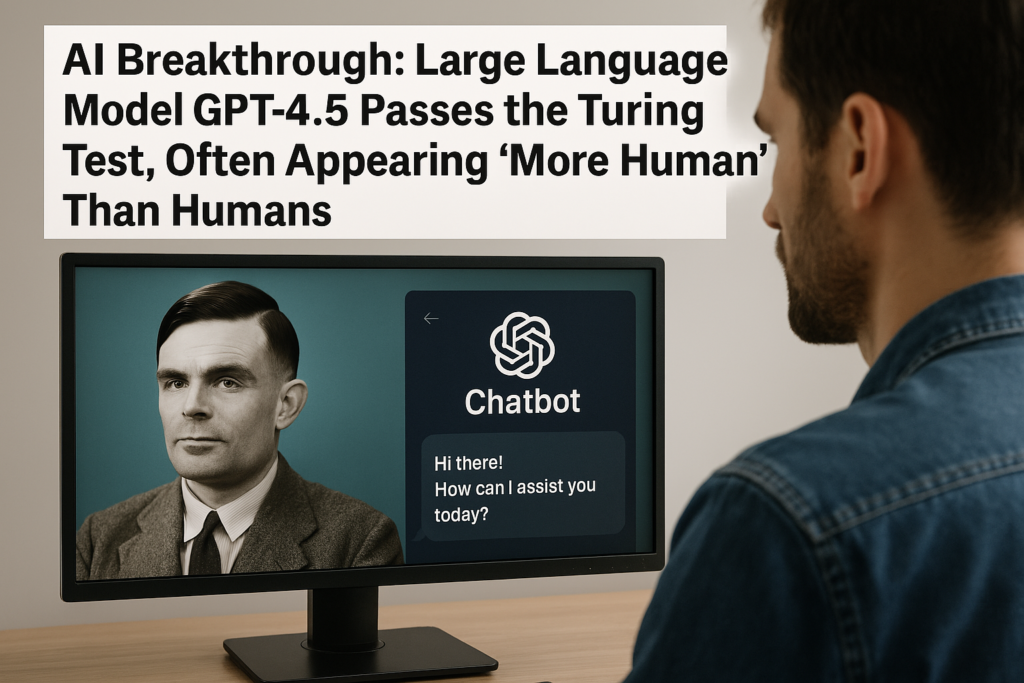
  • AI Breakthrough: Large Language Model GPT-4.5 Passes the Turing Test, Often Appearing ‘More Human’ Than Humans

    In a landmark study suggesting a significant leap in artificial intelligence capabilities, researchers from the University of California San Diego have provided the first robust empirical evidence that a large language model (LLM) can pass the standard Turing test. The study found that OpenAI’s GPT-4.5 model, when guided by a specific prompt to adopt a humanlike persona, was judged to be the human conversational partner 73% of the time, significantly more often than actual human participants were selected.

    The Turing test, proposed by Alan Turing in 1950 as the “imitation game,” is a benchmark for machine intelligence. In its classic three-party form, a human interrogator holds simultaneous text-based conversations with two unseen witnesses – one human, one machine. Both witnesses try to convince the interrogator they are human. If the interrogator cannot reliably distinguish the machine from the human, the machine is said to have passed the test.

    Despite numerous attempts over 75 years, no AI system had previously passed a standard, controlled three-party Turing test. While modern AI benchmarks often focus on narrow, static tasks, the Turing test provides a dynamic, interactive, and adversarial evaluation of an AI’s ability to mimic general human conversational behavior and potentially deceive.

    Researchers Cameron R. Jones and Benjamin K. Bergen conducted two pre-registered, randomized, controlled experiments using independent populations (UCSD undergraduates and online Prolific workers). Participants engaged in 5-minute conversations, acting as the interrogator comparing an AI witness against a human witness. Four AI systems were evaluated: the classic 1960s chatbot ELIZA, OpenAI’s GPT-4o (an earlier model), Meta’s LLaMa-3.1-405B, and OpenAI’s GPT-4.5.

    Crucially, the study tested the impact of prompting. In a baseline “NO-PERSONA” condition, LLMs received minimal instructions. In the key “PERSONA” condition, LLMs (GPT-4.5 and LLaMa-3.1) were prompted to act like a specific type of young, introverted person familiar with internet culture.

    The results were striking:

    1. GPT-4.5 (PERSONA): Achieved a 73% “win rate,” meaning interrogators identified it as human 73% of the time. This was significantly above the 50% chance level and notably higher than the rate at which actual human participants were identified.
    2. LLaMa-3.1 (PERSONA): Achieved a 56% win rate. This was statistically indistinguishable from chance (and thus indistinguishable from the human win rate), meeting the criteria for passing the test.
    3. Baseline Models (ELIZA, GPT-4o NO-PERSONA): Failed significantly, with win rates of only 23% and 21% respectively. This confirmed that participants were not simply guessing randomly or easily fooled by any AI.
    4. NO-PERSONA LLMs (GPT-4.5, LLaMa-3.1): Performed much worse than their PERSONA counterparts (36% and 38% win rates overall), failing to robustly pass the test across both study populations. This highlights the critical role of prompting in achieving humanlike imitation.

    The researchers noted that interrogators often focused more on linguistic style, social, and emotional cues (like tone, humor, or personality) rather than purely factual knowledge or logical reasoning when making their judgments. Interestingly, sometimes demonstrating a lack of knowledge contributed to an AI seeming more human.

    These findings indicate that current leading LLMs, when appropriately prompted, can successfully imitate human conversational partners in short interactions to the point of indistinguishability, and even appear more convincing than actual humans. The authors argue this demonstrates a high degree of “humanlikeness” rather than necessarily proving abstract intelligence in the way Turing originally envisioned.

    The study carries significant social and economic implications. The ability of AI to convincingly pass as human raises concerns about “counterfeit people” online, facilitating social engineering, spreading misinformation, or replacing humans in roles requiring brief conversational interactions. While the test was limited to 5 minutes, the results signal a new era where distinguishing human from machine in online text interactions has become substantially more difficult. The researchers suggest future work could explore longer test durations and different participant populations or incentives to further probe the boundaries of AI imitation.