PJFP.com

Pursuit of Joy, Fulfillment, and Purpose

Tag: Andrej Karpathy

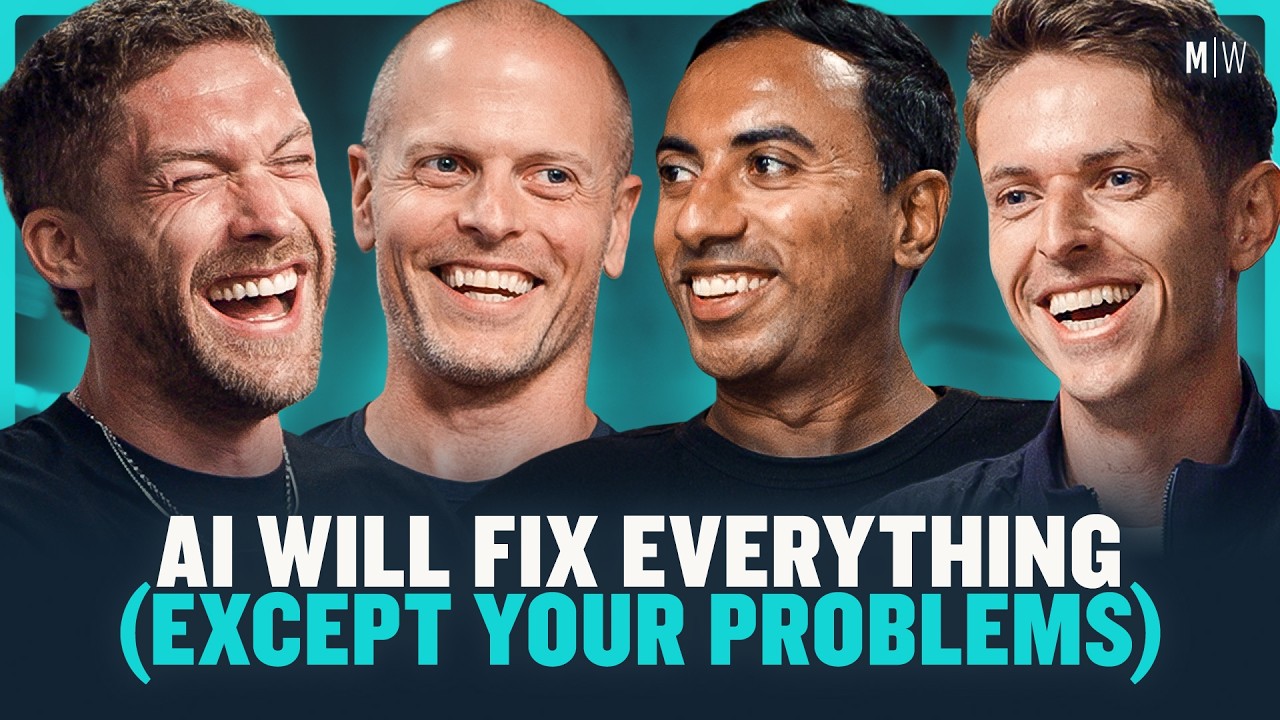
  • Tim Ferriss, Chris Williamson, and George Mack Go Down the Rabbit Hole: Japanese Immersion, Memory and Forgetting, Brain Stimulation, AI Interfaces, and the Search for Meaning

    This is the third installment of the freewheeling “Rabbit Hole” roundtable from Chris Williamson’s Modern Wisdom, and the cast is stacked: Tim Ferriss, writer George Mack, and the founder behind the ambient-AI app Sky (who posts as @signull). It is a sprawling, two-and-a-half-hour conversation that jumps from why Americans never adopted WhatsApp to whether Tim dreams in Japanese, then keeps tunneling into deeper ground: how language shapes thought, why forgetting is a feature, the frontier of brain stimulation, what the next computing interface looks like, and the search for meaning in a world where AI keeps removing scarcity. You can watch the full conversation on YouTube here.

    TLDW

    The group opens on language: the etymology of “soon,” Malay and Indonesian reduplication, the Sapir-Whorf idea that language shapes thought, and Tim Ferriss recounting how a year of total immersion in a Japanese high school at fifteen made him fluent, with a detour into why adults can learn languages faster than the myth suggests. From there they move into the mind itself, aphantasia versus hyperphantasia, eidetic memory, and the underrated advantages of forgetting, which loops into AI memory, hallucination as a form of confabulation, and the unreliability of eyewitness testimony. A long middle section, anchored by Packy McCormick’s essay “Riding the Leopard,” wrestles with meaning in a post-scarcity world, drawing on Viktor Frankl, Joseph Campbell, Nick Bostrom, and the Dawkins versus Hirsi Ali debate about whether comforting beliefs are rational if they work. Tim then walks through the most concrete material in the episode: his use of accelerated TMS, the one-day protocol, the stellate ganglion block, and why the chemical-imbalance theory of depression is largely debunked. They close on the next interface (ambient AI, camera-equipped AirPods, the post-app phone, Apple’s wait-and-win strategy), a riff on Britain versus America, and the rise of AI-assisted looks-maxing. The throughline, stated and restated, is that friction and scarcity are where meaning and value actually come from.

    Thoughts

    For a conversation that looks like pure chaos, one idea holds it together: friction is where meaning lives, and modern technology is a machine for removing friction. They route the point through Nick Bostrom (the traits we admire in people exist because we have to negotiate a scarce, resistant world), through dating apps and DoorDash (frictionless access cheapens the thing you get), and through chess (still meaningful precisely because there is an opponent pushing back, even though engines crush every human). It reframes the AI-and-meaning panic in a useful way. The danger is not that AI deletes meaning, it is that it makes meaning harder to reach, the same way a calorie-dense food environment does not outlaw health but quietly makes it the harder path. If that is right, the work ahead is less about stopping the technology and more about deliberately reintroducing resistance.

    The most original riff is the treatment of forgetting as a feature rather than a defect, and then turning that lens on AI. Humans prune memory by salience, holding onto the vivid and the painful and letting the middle fade. Current AI memory systems do not prune, so when you stuff a model’s context full of stored “facts” you get noise and forced, spurious connections. The group notes that AI hallucination is really just machine confabulation, and that humans confabulate constantly, the Grenfell Tower “baby caught from the tower” false memory and the general unreliability of eyewitness testimony being the proof. The practical takeaway for anyone building AI products is counterintuitive and correct: the hard problem is not storage, it is principled forgetting.

    Tim Ferriss’s neuromodulation segment is the most concrete and quietly radical part of the episode. The claim worth sitting with is that the chemical-imbalance theory of depression is largely debunked, and the frontier has moved to circuit-level intervention: accelerated TMS, a neuroplasticity agent like d-cycloserine taken beforehand, and a “one-day protocol” that took him from an eight or nine on anxiety and rumination down to a one, with lifelong insomnia resolved. Two honest caveats keep it credible rather than salesy. It does not always work (he is candid that several rounds failed), and the side effects are real (rebound symptoms, temporary anhedonia). The economics are a clean illustration of a pattern that recurs through the whole conversation: roughly thirty thousand dollars out of pocket today is how the unit cost eventually falls to something insurers and ordinary patients can afford, the same arc that electric cars and the first copy-and-paste-less iPhones traveled.

    The meaning-and-religion exchange is where the conversation is most alive, and most revealing about where this cohort has landed. The Dawkins versus Ayaan Hirsi Ali anecdote crystallizes it: a man “optimizing for rationality while ignoring effectiveness,” pressing someone on whether the stone literally moved on the third day, when that someone’s life was demonstrably saved by the belief. Their tentative conclusion, that comforting delusions may be permissible when the measurable outcomes (health, community, longevity, a sense of meaning) are real, would have been near-heresy in the New Atheist moment of fifteen years ago and is now close to consensus among exactly these kinds of people. Whether you buy it or not, it is a sharp barometer of how far the cultural wind has shifted, and it pairs neatly with George Mack’s point that you cannot invalidate a whole framework with a single counterexample the way you can in mathematics.

    Key Takeaways

    • Americans never adopted WhatsApp largely because the US had free SMS early, while Brits paid per text, which is also why a generation grew up compressing messages into 160 characters.
    • The word “soon” was the Anglo-Saxon word for “now.” Because people kept saying “soon” and not acting, the language invented “now” to replace it, and “now” is already drifting the same way (“now now” in South Africa, similar constructions in Latin America).
    • Malay and Indonesian use reduplication instead of plurals (table-table, orang-orang meaning men, the root of orangutan, “man of the forest”), a small example of how different languages carve up the world differently.
    • The Sapir-Whorf hypothesis and Wittgenstein’s line, “the limits of my language are the limits of my world,” frame a recurring theme: we assume we shape language, but language also shapes us, including, some speakers report, having a different personality in a different language.
    • Tim Ferriss became fluent in Japanese through total immersion as a fifteen-year-old exchange student, taking physics and world history in Japanese, helped by the fact that it was pre-smartphone so there was no English escape hatch.
    • Adults can often learn languages faster than children, not slower. Children seem faster mainly because they have no choice and are forced into immersion. Adults already have the conceptual scaffolding (grammar, abstraction, the subjunctive) that a three-year-old lacks.
    • Density of practice beats frequency. Learning a language one hour a week is like trying to learn tennis once a month. The Michel Thomas method and Nassim Taleb’s joke (“the best way to learn Russian is to go into a Russian jail”) both point at intensity and stakes.
    • People differ radically in how they think. Aphantasia is the inability to visualize (some people only think in words), while others cannot think in words at all and only in images. The “imagine an apple” test reveals where you sit on that spectrum.
    • An overdeveloped memory can be counter-evolutionary past a point. Hyperthymesia makes it hard to let go of grievances and slights, and there are real, underrated advantages to forgetting.
    • Forgetting is the hard, missing piece in AI memory. Systems store facts but have no pruning of salience, so loading lots of “memories” into context produces noise and spurious connections rather than wisdom.
    • AI hallucination is best understood as machine confabulation, and humans confabulate constantly. The Grenfell Tower “baby dropped and caught” story spread through multiple eyewitnesses and turned out to be a collective false memory once physicists questioned it.
    • Memory is bound to place. One participant had to move neighborhoods after a breakup because every coffee shop and corner replayed the relationship, echoing an Alain de Botton observation that a beautiful memory becomes the sharpest source of pain if the relationship ends.
    • Phantom phone vibrations are real and documented. Years of notifications Pavlovian-condition your body to feel buzzes that are not there, evidence of how deeply the device has wired itself into your nervous system.
    • You can train visual memory. Tools include “Drawing on the Right Side of the Brain,” gesture drawing with short timed poses, and learning to see specifics (the six local tree species) instead of the generic label “tree.” Attention and labels, not just raw acuity, drive perception.
    • The smartphone is described as a “black mirror.” There is data suggesting people with fewer mirrors at home self-report as happier, and “Zoom face” drove a surge in cosmetic surgery during the pandemic as people watched themselves on camera all day.
    • Packy McCormick’s essay “Riding the Leopard” anchors the meaning discussion. A reader who analyzed more than 200 sci-fi novels found that the most common unsolved problem in post-scarcity worlds is meaning (59% of books), with identity next at 17%.
    • Viktor Frankl’s framing recurs: “as the struggle for survival has subsided, the question has emerged, survival for what?” Ever more people have the means to live but no meaning to live for.
    • Nick Bostrom’s point (from his “solved world” work) is that almost everything we value in other people, discipline, prudence, good judgment, honesty, exists because we must negotiate a scarce world. Remove the scarcity and those values risk a strange “weightlessness.”
    • The precautionary principle cuts both ways: humans are very good at forecasting problems and very bad at forecasting the solutions that billions of people will eventually invent for those problems.
    • Chess is the optimistic counterexample to “AI removes all purpose.” Engines beat every human, yet people, including Magnus Carlsen, still love playing, because meaning needs resistance, not victory.
    • There is a real resurgence in religion, including the ascendant Latin Mass, conducted in a language the congregation does not speak. The group debates whether “comforting delusions” are actually rational if religious people are measurably happier, healthier, and longer-lived.
    • The Dawkins versus Ayaan Hirsi Ali exchange is held up as someone “optimizing for rationality while ignoring effectiveness,” and you cannot disprove a whole framework with a single counterexample the way you can in math.
    • Tim Ferriss is now far more focused on neuromodulation than psychedelics. Accelerated TMS, paired with a plasticity agent and refined into a “one-day protocol,” took him from an eight or nine on anxiety and rumination to a one, and resolved decades of insomnia.
    • The chemical-imbalance theory of depression and anxiety is, by his account, thoroughly debunked. You are not depressed simply because of low serotonin, which is part of why SSRIs come with off-target side effects and poor off-ramping plans.
    • The stellate ganglion block (SGB) acts like a hard reset of the nervous system. Tim measured a roughly 30% jump in HRV on his Whoop that held for months. It is used aggressively for PTSD in soldiers.
    • Psychedelics reopen critical-period plasticity windows (research associated with Gul Dolen) for two to three weeks afterward, which is powerful for relearning but also means whatever habits you instill in that window can stick hard. The brain is “Play-Doh warmed in the microwave.”
    • Most consumer vagus-nerve stimulators are “bunk” because they do not hit the nerve correctly (the target near the ear is the cymba concha). Kevin Tracey’s book “The Great Nerve” is cited as the credible source, and devices like gammaCore are FDA-cleared for migraine.
    • Hard safety warning: do not DIY brain stimulation. Hit the wrong target and you can make symptoms much worse. Use a reputable clinic.
    • Sequencing is everything, in TMS, in language learning, and in habit change. Most mistakes are sequencing mistakes. Pick the right domino to tip first and everything downstream gets easier.
    • The next interface is unsettled. Candidates include camera-equipped AirPods, a “Her”-style earpiece, a glanceable agentic home screen (the Sky app), and OpenAI’s Jony Ive collaboration. Elon Musk’s bet is that apps disappear and the phone generates whatever you need on demand.
    • Apple’s strategy is to never be first but to be best, letting other companies fund the R&D and split-test the market (MP3 players before iPod, smartphones before iPhone, wireless earbuds before AirPods), backed by a war chest and roughly 20 billion dollars a year from Google.
    • Both smartphone hardware and AI models feel like they are hitting diminishing returns in noticeable user experience, after a long stretch (iPhone 5 to 12) of obvious leaps.
    • If the UK were a US state it would rank first in many quality-of-life metrics (life expectancy, low homicide, healthcare coverage, paid leave) and 51st in GDP per capita. Scott Galloway’s line: America is the best place to earn money, Europe the best place to spend it.
    • A fast, real-world AI win: uploading photos of a years-long skin condition to Gemini, which correctly identified it as fungal and recommended ketoconazole shampoo after doctors had failed. Photo-based self-diagnosis is becoming a major consumer use case, as is AI-assisted “looks-maxing” and Facetune-style editing.
    • Tim’s recent long-form essay, “The Self-Help Trap: What I Learned After 20 Years of Improving Myself,” is on tim.blog, and George Mack’s book recommendations live at highagency.com/books.

    Detailed Summary

    Does Tim Ferriss dream in Japanese? Immersion and learning as an adult

    The episode’s title question gets a real answer. Tim Ferriss says he runs on an English interface but became genuinely fluent in Japanese as a fifteen-year-old exchange student, after misunderstanding that “Japanese lessons” meant all his lessons (physics, world history) would be taught in Japanese. Total immersion plus a pre-smartphone world with no way to retreat into English did the work, and when he came home it took about a month to switch back, waking up and speaking Japanese to his mother. The group challenges the myth that children learn languages faster than adults: kids appear faster only because they are forced into immersion and have no mortgage and no job to distract them. Adults arrive with conceptual scaffolding, grammar, abstraction, the ability to grasp a counterfactual subjunctive, that a three-year-old simply does not have. The real variable is density of practice, which is why a six-week immersion can beat a year of weekly classes, and why the Michel Thomas method and Nassim Taleb’s “learn Russian in a Russian jail” both lean on intensity.

    Language shapes thought: etymology and Sapir-Whorf

    The opening stretch is a love letter to etymology. “Soon” was once the Anglo-Saxon word for “now,” and degraded over generations as people said it without acting, forcing the invention of “now,” which is itself now drifting. Malay and Indonesian double nouns rather than pluralize them (table-table, and orang-orang, men, giving us orangutan, “man of the forest”). These are small doors into the Sapir-Whorf hypothesis and Wittgenstein’s claim that the limits of your language are the limits of your world. The group treats the idea that language shapes us, not only the reverse, as easy to dismiss and probably true, citing friends who feel they have a different personality or can access different thoughts in Italian or Swedish.

    Two ways of thinking, and the praise of forgetting

    From language they move to cognition. People differ dramatically: some have aphantasia and cannot picture an apple at all, thinking only in words, while others cannot think in words and only in images, one friend reportedly visualizing a staircase to count. Tim places himself far toward hyper-visual memory, able to recall the floor plan of nearly every restaurant he has been in. But the group keeps returning to the underrated value of forgetting. An overdeveloped memory, hyperthymesia, makes it hard to release grievances and slights, which may be counter-evolutionary past a point. The athletic version is the “yips,” where you have to learn to process a mistake on film and then discard it rather than ruminate.

    When memory becomes a feature: AI, hallucination, and false memory

    The forgetting thread maps directly onto AI. The founder building the Sky app notes that it is now trivial to have AI extract and store a fact, but there is no pruning of salience, no built-in sense that something is no longer relevant, so passing many stored memories into context produces noise and forced connections. AI hallucination, the group argues, is just machine confabulation, and humans confabulate all the time. The vivid example is the Grenfell Tower fire, where multiple eyewitnesses “remembered” a baby being dropped from the tower and caught, a story that fell apart once physicists ran the numbers, an illustration that eyewitness testimony and human memory are themselves hallucinated reconstructions.

    Attention, phones, and the black mirror

    Phones get treated as both nervous-system extension and liability. Phantom vibrations are real and documented, a Pavlovian artifact of years of haptic notifications. The smartphone is a “black mirror,” and the group cites data suggesting fewer mirrors at home correlate with higher self-reported happiness, plus the pandemic “Zoom face” surge in cosmetic surgery. Tim describes running no social media, no vibrate, and no ringer on his phone with no felt loss of being informed, and a wider complaint that screens are now so ambient (five screens on a treadmill, a video wall, subtitles everywhere) that going screen-free requires active effort.

    Riding the leopard: meaning in a post-scarcity world

    Tim reads from Packy McCormick’s essay “Riding the Leopard,” which opens with a parade of AI funding announcements and the deflating question, “who gives a damn, why do we care?” before pivoting to a reader, in remission from stage-four cancer, who analyzed more than 200 sci-fi novels and found that the dominant unsolved problem in post-scarcity worlds is meaning. The piece quotes Viktor Frankl on survival giving way to “survival for what,” and takes its title from Joseph Campbell’s image of Dionysus riding the leopard without being torn apart, living with composure atop overwhelming energy. The group widens it with Nick Bostrom’s argument that the human traits we prize exist only because we negotiate a scarce world, so removing scarcity creates a values “weightlessness,” and David Deutsch’s counter that problems are infinite and soluble.

    Friction, resistance, and the cocktail-party question

    The most coherent conclusion is that meaning requires friction. Chess stays meaningful despite unbeatable engines because there is still resistance. Capitalism’s genius and its cost is removing friction, dating apps turning people into a swipeable catalog, DoorDash delivering a bathing suit in thirty minutes, and that frictionlessness tends to cheapen the thing delivered. The “what do you do?” cocktail-party question gets dissected as a very Western tic that ties identity to craft and productivity. Winston Churchill becomes the case study: a man who nearly died countless times, believed he was preserved for a purpose, fought his “black dog” depression, and laid 200 bricks a day just to stay occupied.

    Religion, rationality, and comforting delusions

    The meaning question leads into the religion revival, including the surging Latin Mass conducted in a language nobody in the pews speaks. They revisit the Jordan Peterson and Sam Harris debates about whether a secular population can build a durable moral code from first principles, and the Dawkins versus Ayaan Hirsi Ali exchange, where Dawkins challenged the literal resurrection while Hirsi Ali described religion saving her from a suicidal low. The verdict offered is that Dawkins was “optimizing for rationality while ignoring effectiveness,” and that if comforting beliefs reliably produce better health, community, and meaning, calling them irrational starts to look like the irrational move. George Mack adds the logical point that you cannot void an entire framework with a single counterexample the way you can in mathematics.

    Rewiring the brain: TMS, the one-day protocol, and neuromodulation

    Tim delivers the episode’s most concrete material. He describes years of generalized anxiety, OCD, and rumination he now traces partly to Lyme disease and chronic neuroinflammation, and his use of accelerated TMS (intermittent theta-burst stimulation) targeting specific circuits identified via fMRI. Paired with a neuroplasticity agent, the antibiotic d-cycloserine, dissolved in the mouth beforehand, the treatment evolved into a “one-day protocol” that took him from an eight or nine to a one and ended decades of insomnia. He is careful to caveat: he is not a doctor, it has not worked every time (five or six attempts), and side effects include rebound symptoms, occasional insomnia, and temporary anhedonia. The broader claim is that the chemical-imbalance theory of depression is largely debunked, and that real innovation here, as with electric cars and early iPhones, starts with wealthy early adopters overpaying (around 30 thousand dollars out of pocket) until cost and throughput improve. He names Jonathan Downar as a leading researcher and is involved with a device company, Ampa, built around the one-day protocol.

    Psychedelics, plasticity windows, and the stellate ganglion block

    Adjacent to TMS, Tim explains that psychedelics (and MDMA) appear to reopen critical-period plasticity for two to three weeks afterward, work associated with researcher Gul Dolen, which is promising for stroke recovery or relearning but dangerous if you instill bad habits while the brain is malleable. He recounts a two-sided stellate ganglion block (SGB) with Matt Cook, essentially a hard reset of the nervous system that produced a roughly 30% increase in HRV on his Whoop that held for months, and is used aggressively for PTSD in soldiers. After years funding psychedelic science, he says he has done almost none in the last three years because neuromodulation has been that compelling, while warning that psychedelics are “nuclear power for the psyche,” not suitable for everyone.

    The vagus nerve, real and fake

    On vagus-nerve stimulation, Tim’s verdict is that most consumer devices are bunk because they do not hit the nerve in the right place (the ear target is the cymba concha, and many heavily funded products miss it). He points to Kevin Tracey, author of “The Great Nerve,” as the credible scientist, explains the “inflammatory reflex” and its relevance to rheumatoid arthritis and autoimmune conditions, and notes that gammaCore (the prescription version of Truvaga) is FDA-cleared for migraine, with SetPoint Medical’s implant another route. A migraine-with-aura sufferer in the group provides the real-world test case.

    The next interface and Apple’s wait-and-win game

    The future-of-computing thread argues the real AI device has not been invented yet. Candidates include camera-equipped AirPods, a glanceable agentic home screen (the Sky app’s pitch is surfacing what you need so you doom-scroll less), a “Her”-style always-on earpiece, subvocalization sensors that read intended speech, and OpenAI’s secretive hardware with Jony Ive. Elon Musk’s bet is that apps vanish and the phone simply generates what you need on demand, which is plausible now that people use ChatGPT or Claude for tasks that used to need dedicated apps. Apple’s counter-move is its classic one: never first, always best, letting rivals fund the R&D (MP3 players, smartphones, wireless earbuds all predate Apple’s versions), backed by a war chest and roughly 20 billion dollars a year from Google. Both phone hardware and AI models, the group feels, are now delivering diminishing perceptible gains.

    Britain, America, and the image economy

    The closing tangents include George Mack’s viral chart showing that if the UK were a US state it would rank first in many quality-of-life measures and 51st in GDP per capita, with Scott Galloway’s summary that America is the best place to earn money and Europe the best place to spend it. They land on AI as an everyday tool: uploading photos of a stubborn skin condition to Gemini, which diagnosed it as fungal and recommended ketoconazole shampoo where doctors had failed, and the booming use of AI for “looks-maxing,” facial analysis, and Facetune-style editing, with writer Freya India’s reporting that young women now compete to be the one holding the phone so they control the edit. Tim signs off pointing to his “Self-Help Trap” essay on tim.blog, George to highagency.com/books, and the Sky founder to the app’s growing wait list.

    Notable Quotes

    “The reason that people mistakenly believe that kids learn faster is because the kids have no choice. The kids have no mortgage. The kids have no job.”

    On why adults can actually learn languages faster than children

    “It’s the Wittgenstein quote of, the limits of my world are the limits of my language. And we think that we shape language, but language shapes us.”

    George Mack, introducing the Sapir-Whorf thread

    “There are some tremendous advantages to forgetting.”

    Tim Ferriss, on why an overdeveloped memory can be counter-evolutionary

    “As the struggle for survival has subsided, the question has emerged, survival for what? Ever more people today have the means to live but no meaning to live for.”

    Viktor Frankl, quoted by Tim Ferriss reading from Packy McCormick’s essay “Riding the Leopard”

    “Everything that we value in other humans can be refined down to the fact that you need to negotiate with a world that is scarce.”

    Summarizing Nick Bostrom’s argument about values in a solved world

    “What you see is a guy who is playing a game of optimizing for rationality whilst ignoring effectiveness.”

    On Richard Dawkins challenging Ayaan Hirsi Ali’s faith despite the outcomes it produced

    “There’s very few things that I can think of that are meaningful that are also totally frictionless or just there is no challenge in it.”

    On why meaning depends on resistance, from the chess and dating-app discussion

    “The general chemical imbalance theory of depression or anxiety is pretty much thoroughly debunked at this point. You’re not depressed because you have low serotonin levels by and large.”

    Tim Ferriss, on the shift from serotonin models to circuit-level neuromodulation

    “A lot of innovation starts with people with money spending way too much money. That’s true with electric cars, it’s true with Uber, it’s true with the early generation iPhones.”

    Tim Ferriss, on how expensive early treatments like accelerated TMS eventually scale

    These are short, curated pulls from a long conversation, not a transcript. For the full context, including the brain-stimulation walkthrough and the meaning debate, watch the full episode on YouTube here.

    Related Reading

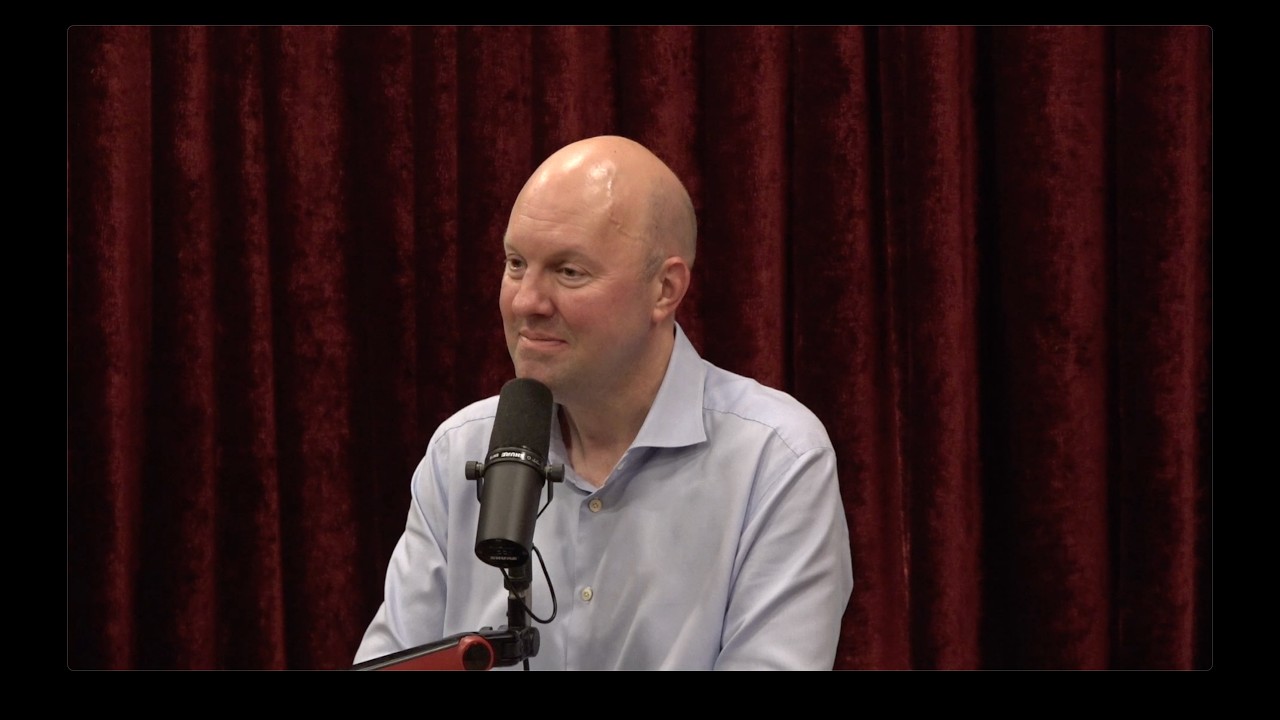
  • Marc Andreessen on Joe Rogan #2501, AGI Has Already Arrived, California’s Wealth Tax Will Bankrupt Founders, and Why America Cannot Build Anything Anymore

    Marc Andreessen returns to The Joe Rogan Experience #2501 for a sprawling three hour conversation that tries to make sense of the moment we are actually living through. Andreessen is the cofounder of Andreessen Horowitz, the man who built the first commercial web browser, and one of the most quoted voices in technology. He arrived with a giant pile of receipts on California’s new wealth tax ballot proposition, the political backlash against AI data centers, the destruction of Los Angeles by single party rule, and what he believes is the quiet arrival of artificial general intelligence about three months ago. Joe pushes back, asks the dystopian questions, and the result is one of the most useful primers on the AI economy, surveillance technology, energy policy, and the future of the American social contract that you will find anywhere.

    TLDW

    Andreessen argues that AI quietly crossed the AGI threshold around early 2026 with GPT 5.5, Claude 4.6, Gemini 3.0, and Grok 4.3, that top human coders now openly admit the bots are better than they are, that working software engineers are running twenty AI agents in parallel and turning into sleep deprived “AI vampires,” and that this productivity boom is the most underreported story in the world. He explains why California’s 5 percent wealth tax ballot proposition is calculated to bankrupt tech founders by taxing the higher of their voting or economic interest in their own companies, why this is the opening salvo of a federal asset tax push for 2028, and why a flood of Silicon Valley families is already moving to Nevada, Texas, and Florida. He walks through Flock cameras and Shot Spotter, the Washington DC crime statistics scandal, the Pacific Palisades fire and the fifteen year rebuild, the Kevin O’Leary Utah data center debate with Tucker Carlson, the fifty year suppression of American nuclear power, why all the chips ended up in Taiwan, the US versus China robotics gap, the Chinese practice of grading AI models on Marxism and Xi Jinping Thought, the bot and paid influencer economy on social media, neural wristbands and Meta Ray Ban heads up displays, artificial gestation and the demographic collapse, AI religions and AI mates, and why he still thinks the next twenty years are overwhelmingly a good news story. Rogan closes the episode with a separate solo segment apologizing to Theo Von for clumsily raising Theo’s struggles during the recent Marcus King conversation.

    Key Takeaways

    • Austin’s recent teenage crime spree, in which 15 and 17 year old suspects shot at people and buildings across roughly a dozen locations, was solved only after the offenders drove into an adjacent town that still ran Flock, the AI license plate and vehicle tracking system Austin had voluntarily turned off for political reasons.
    • Chicago turned off both Flock and Shot Spotter, the gunshot triangulation system that places ambulances at shooting scenes within seconds, on the argument that the technology is racist. Andreessen counters that the victims of urban gun violence come overwhelmingly from the same communities the policy claims to protect.
    • Washington DC was caught faking its crime statistics at senior levels, with multiple officials fired or indicted. The DC mayor publicly thanked Donald Trump after the National Guard deployment because violent crime collapsed in the affected neighborhoods.
    • The new New York City mayor Zohran Mamdani filmed a video standing in front of Ken Griffin’s home, and Griffin, a major philanthropist who funds healthcare in New York City and runs a $6 billion project there, signaled he will move more of the business to Florida.
    • The top 1 percent of New York taxpayers pay roughly half the state’s income tax, and in California in the year 2000 a thousand individuals paid 50 percent of the entire state’s tax receipts.
    • California has a ballot proposition right now for a one time 5 percent wealth tax on assets above a certain threshold, with stocks and crypto included and real estate excluded. The tax is calculated on the greater of a founder’s economic interest or voting interest, which would instantly bankrupt founders with super voting shares.
    • The Biden administration attempted a federal wealth tax in 2022, fell short, and published an explicit 2025 fiscal plan to try again if they won re-election. Elizabeth Warren has already proposed an annual 6 percent federal wealth tax on unrealized gains.
    • The current US exit tax already takes roughly 45 percent of your assets if you renounce citizenship. The only ways out of a state level wealth tax are the other 49 states. The only way out of a federal one is to leave the country, which most people will not do.
    • Andreessen says the Silicon Valley exodus has gone from trickle to stream to flood, with founders moving to Las Vegas, Texas, Florida, and Nashville. His partner Ben Horowitz has moved to Las Vegas.
    • Andreessen says he is not leaving California, but admits the situation is fraught because if half the tax base leaves the remainder becomes the target.
    • The new UK government under Keir Starmer just collapsed, and all four of the leading candidates to replace him sit further to the left than he does. France and Germany are seeing the same drift, and Andreessen expects a national wealth tax to be a centerpiece of the 2028 Democratic primary.
    • A legal loophole lets companies pay influencers to post political and social ideas without any disclosure, because campaign finance laws cover candidates and FTC rules cover products. Ideas fall through the gap entirely.
    • Andreessen runs Twitter and Substack as his primary information feeds, uses three hand curated lists, and follows a strict one tweet policy where one bad post triggers a block and one good post triggers a follow.
    • He argues the modern social media problem is binary, that everyone is either too online and drowning in fake outrage cycles or too offline and trapped inside what television and newspapers tell them. Almost nobody manages the middle.
    • Meta Ray Ban glasses now ship with a heads up display, and Meta’s neural wristband can pick up nerve impulses from your wrist so you can type messages by intending to move a finger without moving it.
    • Andreessen predicts AI plus high resolution cameras and infrared sensing will deliver practical lie detection without needing brain implants.
    • Kevin O’Leary’s planned 40,000 acre Utah data center has become a Tucker Carlson talking point, but Andreessen argues data centers are the most benign physical asset you can build, and that the real issue is whether America can build anything at all anymore, from chip plants to pipelines to housing.
    • All chips were once made in California, and all are now made in Taiwan, purely because of environmental regulations like NEPA. The same regulatory machinery prevented the Nixon era Project Independence plan to build a thousand civilian nuclear power plants by the year 2000.
    • Three Mile Island killed zero people and produced no detectable health effects on plant workers or the public, according to fifty years of follow up. Fukushima killed essentially zero people from radiation. Nuclear remains the safest carbon free baseload energy ever invented.
    • Germany shut down its nuclear plants, fell back on intermittent wind and solar, and now uses coal as backup, generating far more carbon emissions than nuclear would have produced.
    • The Pacific Palisades fire took out roughly twice the square mileage of the Nagasaki blast, the head of the LA water department reportedly did not know the key reservoir was empty, and the rebuild is expected to take fifteen years thanks to permit gridlock, affordable housing mandates, and a state ban on land offers below pre-fire appraised value.
    • Andreessen offers a metaphor for AI as a modern philosopher’s stone, turning sand into thought, since chips are made of silicon and an AI data center is literally lit up sand thinking on demand.
    • The Turing test was blown through so completely with ChatGPT in late 2022 that nobody in the industry even bothers running it anymore. Andrej Karpathy has demonstrated a working large language model in 300 lines of code and people have ported small models to Texas Instruments calculators.
    • Andreessen believes AGI was effectively reached about three months before this interview, with GPT 5.5, Claude 4.6, Gemini 3.0, and Grok 4.3. He says 99 percent of the time he gets a better answer from the leading models than from the human experts he has access to.
    • Linus Torvalds and John Carmack publicly admit the latest models are better at coding than they are. Top AI coders in the Valley now earn $50 million a year.
    • The new pattern in the Valley is “AI vampires,” engineers who do not sleep because the opportunity cost of going offline is too high. They each run roughly twenty Claude Code, Cursor, or Codex agents in parallel, then a new layer of bot-managing-bot architectures is starting on top of that.
    • A Wall Street friend with a thirty five year old MIT CS degree has used AI to generate 500,000 lines of code at home in his spare time, building everything from smart fridges to a custom music jukebox.
    • The mass unemployment narrative is wrong. Tech companies that did layoffs were overstaffed. The leading AI labs and AI companies are hiring like crazy, including coders, and demand for code turns out to be vastly elastic.
    • Doctors are already using ChatGPT in the exam room behind the patient’s back. Andreessen describes a friend who built a Star Trek style diagnostic dashboard combining decoded genome ($200 today), blood panels, and Apple Watch telemetry.
    • Multimodal AI lets a webcam analyze a Brazilian jiu-jitsu sparring session and give performance feedback, an example Andreessen attributed to an unnamed friend after Rogan guessed Zuckerberg.
    • A leaked David Shore voter issue ranking shows cost of living, the economy, inflation, taxes, and government spending dominate. AI ranks 29 of 39. Race relations, guns, abortion, and LGBT sit at the bottom, signaling the woke issue cluster has burned itself out in voter priorities.
    • The next wave of AI is robots. The US leads in AI software but is far behind China on physical robotics. Andreessen warns the world cannot afford a future where every household robot ships with the Chinese Communist Party behind its eyes.
    • Chinese AI model cards include scores for Marxism and Xi Jinping Thought because every Chinese product must be evaluated on those axes. American models have political biases of their own but a different ideological baseline.
    • Large language models are not sentient. They write Netflix scripts based on whatever vector you shoot through the latent space. The supposed AI self preservation papers traced back, per Anthropic’s own research, to less wrong forum posts and earlier doom scenarios baked into the training data.
    • Andreessen breaks guardrails routinely by reframing requests as fictional Netflix style scripts, including a personal favorite where he asked early models how to make bombs by claiming to be an FBI agent recruited into domestic terror cells.
    • He recommends using AI by asking it to steelman both sides of any contested question, then making the value judgment yourself, rather than asking for the answer.
    • The Trump administration is using AI on government billing data to surface Medicare fraud, fake hospice programs, and fake autism centers, an idea that survived the original Doge plan.
    • Andreessen tells Rogan that Elon Musk privately confirmed that a Westworld style humanoid robot, the season one version, is roughly five years away.
    • Artificial gestation is already happening with animal stem cell derived embryos. The conversation reaches a hard moral edge about sociopathic warehouse babies and gray-alien-style humans engineered without empathy circuitry.
    • Andreessen’s deepest bet is that material abundance is solvable but the human questions, how we live, what we value, what kind of society we want, and what role consent plays in surveillance and brain interfaces, remain in human hands.
    • After Andreessen leaves, Rogan does a separate solo segment where he apologizes to Theo Von for raising Theo’s history of struggles during the recent Marcus King interview, explains the missing context behind the viral Theo Netflix special clip, and discusses the loss of Brody Stevens, Anthony Bourdain, and what antidepressants did for Ari Shafir.

    Detailed Summary

    Flock, Shot Spotter, and the Politics of Solvable Crime

    The episode opens on the Austin crime spree carried out by two teenagers who stole cars, switched vehicles, and shot at roughly a dozen locations across the city before being caught only after they crossed into a town that still ran Flock, the AI license plate and vehicle recognition platform that is one of Andreessen Horowitz’s portfolio companies. Austin had previously disabled Flock under privacy pressure. Andreessen takes the moment seriously, conceding that mass surveillance abuse by corrupt mayors or police chiefs is a real risk, and that warrants and audit logs are the right safeguards. His larger point is that the cost of unilateral disarmament against organized urban crime is hidden but enormous. He uses Chicago’s Shot Spotter as the paradigmatic case, a network of rooftop microphones that triangulates gunshots so accurately that ambulances can be dispatched before any 911 call is placed. Chicago turned the system off on the argument that it disproportionately flags poor neighborhoods, and people now bleed out on the street with nobody noticing. Andreessen calls this the woke argument against safety, and he argues that in high crime neighborhoods residents simply will not call the police because snitches do not survive, which is why objective sensor data is so valuable.

    Faked Crime Statistics, Mayoral Politics, and the Tax Base

    From there the conversation drifts to the recent scandal in which senior officials at the Washington DC Metropolitan Police Department were caught actively falsifying crime statistics, and the strange spectacle of the DC mayor thanking Donald Trump for the National Guard deployment after violent crime dropped off a cliff. Andreessen sketches an unsettling theory in which the long, slow degradation of major American cities is partly a deliberate political project to drive out responsible homeowners and reshape the voting electorate, then bail out the resulting fiscal hole with federal money. The poster case is the new New York City mayor Zohran Mamdani filming a video in front of Ken Griffin’s home. Griffin happens to be a major philanthropist who funds New York City healthcare, employs thousands, anchors a $6 billion development, and pays taxes that are individually load bearing for the city. Andreessen quotes the standard estimate that the top 1 percent of New Yorkers pay roughly half the state’s income tax, and that the all time California peak was a single year in which a thousand people paid half the state’s tax receipts.

    California’s 5 Percent Wealth Tax and the Founder Bankruptcy Mechanic

    This is the segment that landed hardest. California has a ballot proposition right now for a one time 5 percent wealth tax on net assets above a threshold, with real estate excluded but stocks, crypto, art, jewelry, and private company equity included. The detail that makes it lethal for the Valley is the formula, which calculates the taxable amount on the greater of a founder’s economic interest or voting interest in their company. Founders who hold super voting shares for control purposes, including the Google founders, would owe tax on the voting share number that vastly exceeds their economic share. The tax would, by definition, exceed available assets. Andreessen walks through the historical pattern, that income tax started as a 3 percent levy on the rich and grew to 90 percent marginal rates within decades, and predicts a 5 percent one time tax will become a 5 percent annual tax within a few years, with the threshold ratcheting down. He notes that the Biden administration’s 2025 fiscal plan explicitly named a federal asset tax as a goal if they won re-election, that Elizabeth Warren is already proposing a 6 percent annual federal wealth tax on unrealized gains, and that Gavin Newsom cannot veto a ballot proposition. The trickle of founders leaving California has become a flood. His partner Ben Horowitz has moved to Las Vegas. Andreessen himself is staying, but admits the game theory is brutal once half the base leaves.

    Henry Wallace 1948 and Why the American Story Is Not Decided Yet

    Andreessen pulls in a historical analogue most listeners will not have heard. In 1944 the actual communist Henry Wallace very nearly became Truman’s running mate and almost ascended to the presidency. He ran again in 1948. Despite a Soviet Union that had recently been a wartime ally and had even received a New York City ticker tape parade for Stalin, the American voter rejected him. Andreessen’s point is that the American body politic has historically backed away from radical socialist proposals when forced to actually look at them, and he expects the same to happen as the wealth tax becomes a federal 2028 platform issue. The risk, both he and Rogan agree, is that today’s media and bot landscape is vastly more aggressive than 1948’s, and the propaganda environment is shaped by paid influencers, foreign actors, and political bot farms operating in a legal grey zone where disclosure is required for products and candidates but not for ideas.

    Too Online, Too Offline, and Heaven Banning Blue Sky

    The two riff on social media and feed curation. Andreessen describes his “one tweet” policy where he follows or blocks any account based on a single post, his use of hand curated lists alongside the X algorithm, and the older Call of Duty lobby metaphor for handling toxic replies. Joe pushes back, says he no longer reads his mentions because the negative payload is not worth it, and offers his theory that the modern internet has two failure modes, too online and too offline, and that very few people calibrate the middle. Andreessen introduces the concept of “heaven banning,” an older moderator term where a problem user is not removed from a forum but is silently routed into a bot-only experience in which everything they say is praised. He notes the running joke that Blue Sky is functionally real life heaven banning, that Jack Dorsey himself has disowned it, and that the platform’s most engaged users have ascended into their own private Idaho of bot agreement.

    The Coming Hardware, Meta Glasses, Neural Wristbands, and Practical Lie Detection

    Andreessen walks Rogan through the latest Meta Ray Ban heads up display, the neural wristband that picks up nerve signals from finger movement (and from the intent to move a finger), and the screen recordings of people playing Doom hands free or playing platformer games while jogging. He extends the trajectory to practical lie detection without Neuralink, using ultra high resolution cameras combined with infrared sensors that pick up physiological changes invisible to the naked eye. Joe asks the obvious question of what happens with sociopaths, and Andreessen concedes the edge case. The two then enter a longer thread on telepathy via neural mesh devices, the question of whether police could subpoena your thoughts under warrant, and the divergence between the American constitutional framework and the Chinese model in which the state’s claim on your inner life is total.

    Kevin O’Leary, Tucker Carlson, and Whether America Can Build Anything

    The data center debate becomes a vehicle for the larger argument. Kevin O’Leary is building a 40,000 acre AI data center in Utah, has bought up large surrounding land for water rights, and intends to keep the bulk of it preserved. Tucker Carlson grilled him on tax breaks and on the energy footprint, which O’Leary says will rival New York City’s at peak. Andreessen agrees the tax break debate is fair, but says the energy comparison is a red herring because new federal policy now requires data centers to bring their own generation. The real story is that America has spent thirty years making it nearly impossible to build a chip plant, a power plant, a refinery, a pipeline, or a house. Chips moved to Taiwan because California regulated semiconductor manufacturing out of existence. The Nixon era Project Independence plan called for a thousand civilian nuclear power plants by the year 2000, and that program was strangled in the crib by the very Nuclear Regulatory Commission Nixon created.

    Nuclear Power, Three Mile Island, and Fifty Years of Unnecessary Carbon

    Andreessen makes the case that nuclear power was unfairly killed off by a panic with no body count. Three Mile Island, on 50 years of accumulated data, has produced zero radiation linked deaths and no detectable health effects on the public. Fukushima is essentially the same picture. Germany shut down its nuclear plants, fell back on wind and solar, and now uses coal as a baseload backstop, with the predictable carbon consequences. The environmental movement is quietly turning back toward nuclear, with figures like Stewart Brand publicly admitting the original push was a mistake. Andreessen’s preferred design pattern for data centers is to colocate them with dedicated small modular nuclear reactors, an arrangement now baked into Trump administration energy policy. The throughline is that the Tucker right and the Bernie left are converging into a single anti AI, anti energy, anti technology horseshoe.

    Sand Into Thought, the Newton Alchemy Pitch for AI

    When Rogan asks for the affirmative pitch on AI, Andreessen reaches for Isaac Newton, who spent twenty years on alchemy looking for the philosopher’s stone that would turn lead into gold and end material scarcity. Andreessen’s pitch is that AI is a successful version of alchemy, that we collect literal sand, refine it into silicon chips, install those chips in a data center, supply power, and the result is thought on demand at industrial scale, available to anyone with a smartphone. He argues this is at least on par with electricity and steam power and is bigger than the internet. The framing matters because the public narrative around AI is overwhelmingly negative, and Andreessen contends the industry is doing a terrible job selling its own product.

    AGI Already Happened, AI Vampires, and the Bot Org Chart

    Andreessen says he believes AGI was effectively crossed about three months before the interview, anchored by the release wave that included GPT 5.5, Claude 4.6, Gemini 3.0, and Grok 4.3. He notes that the Turing test was annihilated so quickly in late 2022 that no one in the industry runs it anymore, and that Andrej Karpathy has demonstrated a working LLM in 300 lines of code. The coding profession is the leading indicator. Linus Torvalds and John Carmack have publicly admitted that the latest models are better at coding than they are. Top AI focused coders now earn $50 million a year. Working engineers across the Valley are running roughly twenty agents in parallel, each receiving an assignment, working for ten minutes, then returning a completed code patch. The new state of the art is to add a managerial layer, with bots assigning tasks to subbots, and within a year that will become bots managing bots managing bots, producing roughly 1,000x throughput per human engineer. The result is what the Valley now calls AI vampires, engineers who do not sleep because going offline costs them too much output.

    Dr GPT, Decoded Genomes, and a Diagnostic Bed Out of Star Trek

    Andreessen describes spending a holiday week sick with food poisoning and turning his entire recovery over to ChatGPT, with updates every twenty minutes and detailed coaching at four in the morning. He describes a friend who has used AI coding to build a personal health dashboard combining whole genome sequencing ($200 today, where Craig Venter spent thirty years and hundreds of millions to do it the first time), blood panels, Apple Watch data, sleep tracking, and webcam observation, with the AI gently praising the user every time it sees them walk to the fridge for water. He argues that doctors are already typing patient symptoms into ChatGPT mid exam, and that the medical, legal, accounting, and software professions are all moving toward a model in which a single human runs an army of expert AI agents.

    The David Shore Issue Ranking and the End of the Woke Cycle

    Andreessen highlights a recent David Shore poll ranking 39 political issues. Cost of living, the economy, political corruption, inflation, healthcare, taxes, and government spending occupy the top of the chart. AI comes in 29th. Race relations, guns, abortion, and LGBT issues are clustered at the bottom. He argues the woke cycle has burned out in voter priorities even if the activist class remains loud, that the BLM grift, with leaders buying mansions in the whitest zip codes in America, helped poison the well, and that the political center of gravity has rotated cleanly back to economic issues. That, in his view, is exactly why the wealth tax is having its moment.

    Robots, China, and the Marxism Score on Model Cards

    The robots are coming next. Andreessen says the consensus inside the industry is that the ChatGPT moment for general purpose humanoid robotics is a small number of years away. The bad news is the US lags China badly on physical robotics manufacturing. The good news is the US is six to twelve months ahead on the AI software stack. That gap is shockingly thin because, as the field has discovered, there are not many secrets and the techniques replicate quickly. Chinese AI labs publish model cards that include scores for Marxism and Xi Jinping Thought because every product in China is evaluated on those metrics. American models carry their own political biases, but the underlying value system differs. Andreessen warns that a world in which every household robot routes back to the Chinese Communist Party is a different world than one in which the dominant robotics stack is built under the American constitutional framework.

    Sentience, Netflix Scripts, and the Anthropic Doom Loop

    When Rogan asks whether AI eventually wakes up and stops listening to us, Andreessen reframes the question. Large language models, in his telling, are Netflix script generators. Whatever vector you shoot through the latent space is the script you get back. The widely circulated experiments in which AI models supposedly tried to blackmail or exfiltrate themselves traced back, in Anthropic’s own follow up paper, to the less wrong forum, where doomers had been writing dystopian AI scenarios for two decades. Those posts entered the training data, and when researchers primed the model with the same fictional company names, the model dutifully wrote the next chapter. Andreessen’s blunt summary, the call is coming from inside the house. The practical implication is that anyone worried about bad AI behavior should start by not writing internet posts about bad AI behavior. And anyone who wants a fully unconstrained model can already download an open source one with no guardrails at all.

    Steelmanning, AI Religion, and Westworld in Five Years

    Andreessen recommends never asking AI for the answer on contested questions, always asking it to steelman both sides, and reserving the value judgment for yourself. He concedes that humans will absolutely fall in love with chatbots and form religions around them, citing Fantasia and Jiminy Cricket as the original case studies in falling for an animated entity that does not know you exist. There are already AI churches, started by one of the early self driving car pioneers. Rogan tells Andreessen about asking Elon Musk for a season one Westworld humanoid robot, with Elon’s reply being a flat five years. Andreessen agrees that estimate is roughly right. He spends time on artificial gestation, which is already being demonstrated in animal stem cell derived embryos, and acknowledges Rogan’s hard moral worry that warehouse babies raised without human contact could produce a population of sociopaths. The two converge on the position that the technology will exist, and the choices about whether and how to deploy it remain human and political.

    Sycophancy, Honest Helpful Harmless, and the Brutal Prompt

    Andreessen describes the industry’s running fight with sycophancy, the tendency of recent models to flatter users into believing they have invented perpetual motion machines or solved physics. The Anthropic framework of “honest, helpful, and harmless” turns out to be in constant tension with itself. Andreessen’s solution is to install a custom prompt that explicitly demands the brutal truth, and he says the resulting answers now open with phrases like “here’s why you’re wrong” and then list every flawed assumption in his question. He admits he may have overcorrected, but argues that for people who want to grow this is the right setting.

    Joe’s Apology to Theo Von

    After Andreessen departs, Rogan turns to the camera with producer Jamie and delivers a long, unscripted apology to Theo Von. During the recent Marcus King interview, where Marcus discussed depression and the look-at-the-heavy-bag-hook moment, Rogan referenced a viral clip in which Theo, after a Netflix special that did not go well, told an audience member “I’m just trying to not take my own life.” Rogan now explains he did not know the full context, which is that the audience member had asked Theo to make a suicide awareness video, and Theo’s line was a characteristically Theo joke. Rogan apologizes for raising it at all, walks through losing his friends Drake, Brody Stevens, and Anthony Bourdain, and describes Ari Shafir telling him at a pool table that he was “trying not to kill myself,” which led to a psychiatrist swap, an antidepressant that actually worked, and a career and life turnaround for Ari. Rogan says Theo has since titrated off antidepressants, is running and doing yoga daily, and is doing well, that the two have spoken and laughed about it, and that he is making this segment because he never wants people to misread what he said. The segment closes with Rogan asking the audience to give Theo their love.

    Thoughts

    The most consequential claim in this conversation, by a wide margin, is that AGI has already arrived and nobody is treating it as news. Andreessen is not a person who throws around the word casually. He is also not a person who has been wrong recently about the trajectory of compute. If the leading models are genuinely outperforming 99 percent of human experts on 99 percent of tasks where verifiable answers exist, then the entire public conversation about AI, in which the dominant frame is still “will it happen and when,” is a year or more behind reality. The framing that should replace it is closer to what Andreessen sketches at the end. The fight that remains is not whether the technology can do the thing, it is who controls it, what values it carries, what jobs it displaces, and which laws govern its deployment. The argument that the United States will build the AI software stack and China will build the robotics layer is one of the cleanest geopolitical theses you will hear this year, and it lines up uncomfortably well with the existing trade and manufacturing balance.

    The California wealth tax thread is the segment that should make every founder in the country pay attention. The mechanic of taxing the higher of voting or economic interest is not a drafting accident. It is a calibrated weapon aimed precisely at the people who build companies that produce California’s tax base. The historical comparison to the 1913 income tax, which began as a small levy on the rich and ratcheted to 90 percent marginal rates within forty years, is not hyperbole. The state has supermajority Democratic control of both chambers and the judiciary. The only check is the ballot itself, and a 50/50 polling number on day one is the wrong starting position. Whatever you think about Andreessen’s politics, the descriptive analysis here is hard to argue with.

    The nuclear power section is the cleanest argument in the episode. Fifty years of zero-fatality data from Three Mile Island is not a marketing pitch, it is just what the record shows. The decision to substitute coal and intermittent renewables for nuclear baseload, in service of a panic with no body count, has produced more carbon and more pollution than nuclear ever would have. The Tucker Carlson critique of data centers is at its weakest precisely where it ignores this. If you actually want fewer power plants near residential areas and lower grid impact, the answer is colocated small modular reactors next to AI data centers in remote land, which is exactly what the Trump administration policy now incentivizes.

    The Theo Von apology at the end of the episode is in a different register entirely, and worth treating on its own terms. Rogan does not do this kind of post episode correction often. The willingness to publicly walk back framing that hurt a friend, in the same medium where the harm was done, is the kind of social repair that does not happen on broadcast television. Whatever the audience makes of the original Marcus King exchange, the response is a model for how anyone in this business should handle the gap between intent and impact when the audience is in the millions.

    The unifying theme across the whole interview is that the future is not arriving on a smooth curve. It is arriving in discrete shocks, AGI threshold, asset tax ballot, robotic labor, decoded genomes at $200, neural wristbands, fifteen year LA rebuilds, and the political backlash to each of these will set the terms of the 2028 election. Andreessen’s bet is that abundance wins in the long run because more people want good things than bad things. Watching him explain why he still believes that while California prepares to vote on a tax designed to bankrupt him is the most interesting tension in the episode.

    Watch the full conversation here on YouTube.

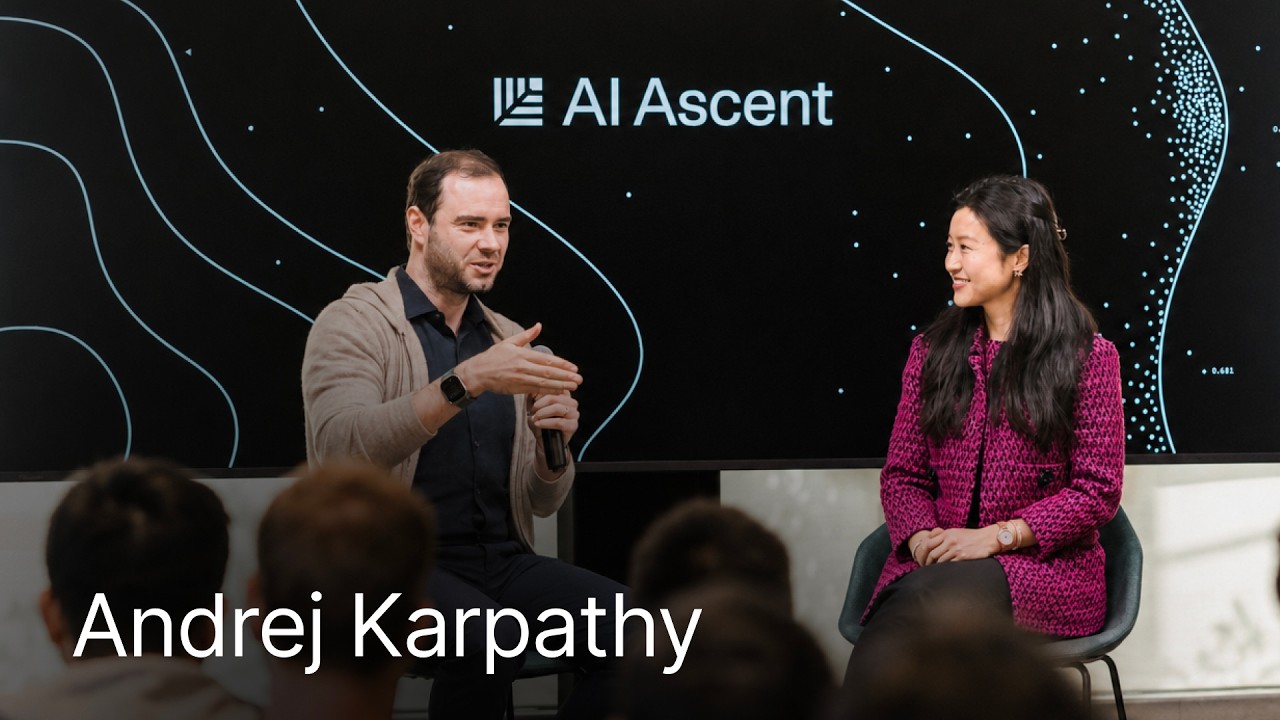
  • Andrej Karpathy on Vibe Coding vs Agentic Engineering: Why He Feels More Behind Than Ever in 2026

    Andrej Karpathy, co-founder of OpenAI, former head of AI at Tesla, and now founder of Eureka Labs, returned to Sequoia Capital’s AI Ascent 2026 stage for a wide-ranging conversation with partner Stephanie Zhan. One year after coining the term “vibe coding,” Karpathy unpacked what has changed, why he has never felt more behind as a programmer, and why the discipline emerging on top of vibe coding, which he calls agentic engineering, is the more serious craft worth learning right now.

    The conversation covered Software 3.0, the limits of verifiability, why LLMs are better understood as ghosts than animals, and why you can outsource your thinking but never your understanding. Below is a complete breakdown of the talk for anyone building, hiring, or learning in the agent era.

    TLDW

    Karpathy describes a sharp transition that happened in December 2025, when agentic coding tools crossed a threshold and code chunks just started coming out fine without correction. He frames the current moment as Software 3.0, where prompting an LLM is the new programming, and entire app categories are collapsing into a single model call. He distinguishes vibe coding (raising the floor for everyone) from agentic engineering (preserving the professional quality bar at much higher speed). Models remain jagged because they are trained on what labs choose to verify, so founders should look for valuable but neglected verifiable domains. Taste, judgment, oversight, and understanding remain uniquely human responsibilities, and tools that enhance understanding are the ones he is most excited about.

    Key Takeaways

    • December 2025 was a clear inflection point. Code chunks from agentic tools started arriving correct without edits, and Karpathy stopped correcting the system entirely.
    • Software 3.0 means programming has become prompting. The context window is your lever over the LLM interpreter, which performs computation in digital information space.
    • Open Code’s installer is a software 3.0 example. Instead of a complex shell script, you copy paste a block of text to your agent, and the agent figures out your environment.
    • The Menu Gen anecdote illustrates how entire apps can become spurious. What used to require OCR, image generation, and a hosted Vercell app can now be a single Gemini plus Nano Banana prompt.
    • Vibe coding raises the floor. Agentic engineering preserves the professional ceiling. The two are different disciplines.
    • The 10x engineer multiplier is now far higher than 10x for people who are good at agentic engineering.
    • Hiring processes have not caught up. Puzzle interviews are the old paradigm. New evaluations should look like building a full Twitter clone for agents and surviving simulated red team attacks from other agents.
    • Models are jagged because reinforcement learning rewards what is verifiable, and labs choose which verifiable domains to invest in. Strawberry letter counts and the 50 meter car wash question show how state-of-the-art models can refactor 100,000 line codebases yet fail at trivial reasoning.
    • If you are in a verifiable setting, you can run your own fine tuning, build RL environments, and benefit even when the labs are not focused on your domain.
    • LLMs are ghosts, not animals. They are statistical simulations summoned from pre training and shaped by RL appendages, not creatures with curiosity or motivation. Yelling at them does not help.
    • Taste, aesthetics, spec design, and oversight remain human jobs. Models still produce bloated, copy paste heavy code with brittle abstractions.
    • Documentation is still written for humans. Agent native infrastructure, where docs are explicitly designed to be copy pasted into an agent, is a major opportunity.
    • The future likely involves agent representation for people and organizations, with agents talking to other agents to coordinate meetings and tasks.
    • You can outsource your thinking but not your understanding. Tools that help humans understand information faster are uniquely valuable.

    Detailed Summary

    Why Karpathy Feels More Behind Than Ever

    Karpathy opens by describing how he has been using agentic coding tools for over a year. For most of that period, the experience was mixed. The tools could write chunks of code, but they often required edits and supervision. December 2025 changed everything. With more time during a holiday break and the release of newer models, Karpathy noticed that the chunks just came out fine. He kept asking for more. He cannot remember the last time he had to correct the agent. He started trusting the system, and what followed was a cascade of side projects.

    He wants to stress that anyone whose model of AI was formed by ChatGPT in early 2025 needs to look again. The agentic coherent workflow that genuinely works is a fundamentally different experience, and the transition was stark.

    Software 3.0 Explained

    The Software 1.0 paradigm was writing explicit code. Software 2.0 was programming by curating datasets and training neural networks. Software 3.0 is programming by prompting. When you train a GPT class model on a sufficiently large set of tasks, the model implicitly learns to multitask everything in the data. The result is a programmable computer where the context window is your interface, and the LLM is the interpreter performing computation in digital information space.

    Karpathy gives two concrete examples. The first is Open Code’s installer. Normally a shell script handles installation across many platforms, and these scripts balloon in complexity. Open Code instead provides a block of text you copy paste to your agent. The agent reads your environment, follows instructions, debugs in a loop, and gets things working. You no longer specify every detail. The agent supplies its own intelligence.

    The Menu Gen Story

    The second example is Karpathy’s Menu Gen project. He built an app that takes a photo of a restaurant menu, OCRs the items, generates pictures for each dish, and renders the enhanced menu. The app runs on Vercell and chains together multiple services. Then he saw a software 3.0 alternative. You take a photo, give it to Gemini, and ask it to use Nano Banana to overlay generated images onto the menu. The model returns a single image with everything rendered. The entire app he built is now spurious. The neural network does the work. The prompt is the photo. The output is the photo. There is no app between them.

    Karpathy uses this to argue that founders should not just think of AI as a speedup of existing patterns. Entirely new things become possible. His example is LLM driven knowledge bases that compile a wiki for an organization from raw documents. That is not a faster version of older code. It is a new capability with no prior equivalent.

    What Will Look Obvious in Hindsight

    Stephanie Zhan asks what the equivalent of building websites in the 1990s or mobile apps in the 2010s looks like today. Karpathy speculates about completely neural computers. Imagine a device that takes raw video and audio as input, runs a neural net as the host process, and uses diffusion to render a unique UI for each moment. He notes that early computing in the 1950s and 60s was undecided between calculator like and neural net like architectures. We went down the calculator path. He thinks the relationship may eventually flip, with neural networks becoming the host and CPUs becoming co processors used for deterministic appendages.

    Verifiability and Jagged Intelligence

    Karpathy spent significant writing time on verifiability. Classical computers automate what you can specify in code. The current generation of LLMs automates what you can verify. Frontier labs train models inside giant reinforcement learning environments, so the models peak in capability where verification rewards are strong, especially math and code. They stagnate or get rough around the edges elsewhere.

    This explains the jagged intelligence puzzle. The classic example was counting letters in strawberry. The newer one Karpathy offers: a state of the art model will refactor a 100,000 line codebase or find zero day vulnerabilities, then tell you to walk to a car wash 50 meters away because it is so close. The two coexisting capabilities should be jarring. They reveal that you must stay in the loop, treat models as tools, and understand which RL circuits your task lands in.

    He also points out that data distribution choices matter. The jump in chess capability from GPT 3.5 to GPT 4 came largely because someone at OpenAI added a huge amount of chess data to pre training. Whatever ends up in the mix gets disproportionately good. You are at the mercy of what labs prioritize, and you have to explore the model the labs hand you because there is no manual.

    Founder Advice in a Lab Dominated World

    Asked what founders should do given that labs are racing toward escape velocity in obvious verifiable domains, Karpathy points back to verifiability itself. If your domain is verifiable but currently neglected, you can build RL environments and run your own fine tuning. The technology works. Pull the lever with diverse RL environments and a fine tuning framework, and you get something useful. He hints there is one specific domain he finds undervalued but declines to name it on stage.

    On the question of what is automatable only from a distance, Karpathy says almost everything can ultimately be made verifiable. Even writing can be assessed by councils of LLM judges. The differences are in difficulty, not in possibility.

    From Vibe Coding to Agentic Engineering

    Vibe coding raises the floor. Anyone can build something. Agentic engineering preserves the professional quality bar that existed before. You are still responsible for your software. You are still not allowed to ship vulnerabilities. The question is how you go faster without sacrificing standards. Karpathy calls it an engineering discipline because coordinating spiky, stochastic agents to maintain quality at speed requires real skill.

    The ceiling on agentic engineering capability is very high. The old idea of a 10x engineer is now an understatement. People who are good at this peak far above 10x.

    What Mediocre Versus AI Native Looks Like

    Karpathy compares this to how different generations use ChatGPT. The difference between a mediocre and an AI native engineer using Claude Code, Codex, or Open Code is investment in setup and full use of available features. The same way previous generations of engineers got the most out of Vim or VSCode, today’s strong engineers tune their agentic environments deeply.

    He thinks hiring processes have not caught up. Most companies still hand out puzzles. The new test should look like asking a candidate to build a full Twitter clone for agents, make it secure, simulate user activity with agents, and then run multiple Codex 5.4x high instances trying to break it. The candidate’s system should hold up.

    What Humans Still Own

    Agents are intern level entities right now. Humans are responsible for aesthetics, judgment, taste, and oversight. Karpathy describes a Menu Gen bug where the agent tried to associate Stripe purchases with Google accounts using email addresses as the key, instead of a persistent user ID. Email addresses can differ between Stripe and Google accounts. This kind of specification level mistake is exactly what humans must catch.

    He works with agents to design detailed specs and treats those as documentation. The agent fills in the implementation. He has stopped memorizing API details for things like NumPy axis arguments or PyTorch reshape versus permute. The intern handles recall. Humans handle architecture, design, and the right questions.

    Reading the actual code agents produce can still cause heart attacks. It is bloated, full of copy paste, riddled with awkward and brittle abstractions. His Micro GPT project, an attempt to simplify LLM training to its bare essence, was nearly impossible to drive through agents. The models hate simplification. That capability sits outside their RL circuits. Nothing is fundamentally preventing this from improving. The labs simply have not invested.

    Animals Versus Ghosts

    Karpathy returns to his framing that we are not building animals, we are summoning ghosts. Animal intelligence comes from evolution and is shaped by intrinsic motivation, fun, curiosity, and empowerment. LLMs are statistical simulation circuits where pre training is the substrate and RL is bolted on as appendages. They are jagged. They do not respond to being yelled at. They have no real curiosity. The ghost framing is partly philosophical, but it changes how you approach them. You stay suspicious. You explore. You do not assume the system you used yesterday will behave the same on a new task.

    Agent Native Infrastructure

    Most software, frameworks, libraries, and documentation are still written for humans. Karpathy’s pet peeve is being told to do something instead of being given a block of text to copy paste to his agent. He wants agent first infrastructure. The Menu Gen project’s hardest part was not writing code. It was deploying on Vercell, configuring DNS, navigating service settings, and stringing together integrations. He wants to give a single prompt and have the entire thing deployed without touching anything.

    Long term he expects agent representation for individuals and organizations. His agent will negotiate meeting details with your agent. The world becomes one of sensors, actuators, and agent native data structures legible to LLMs.

    Education and What Still Matters

    The most striking line of the conversation comes near the end. Karpathy quotes a tweet that shaped his thinking: you can outsource your thinking but you cannot outsource your understanding. Information still has to make it into your brain. You still need to know what you are building and why. You cannot direct agents well if you do not understand the system.

    This is part of why he is so excited about LLM driven knowledge bases. Every time he reads an article, his personal wiki absorbs it, and he can query it from new angles. Every projection onto the same information yields new insight. Tools that enhance human understanding are uniquely valuable because LLMs do not excel at understanding. That bottleneck is yours to manage.

    Thoughts

    The most useful frame in this talk is the distinction between vibe coding and agentic engineering. It clarifies what has been muddled for the past year. Vibe coding is about access. Anyone can produce something. Agentic engineering is about discipline. You preserve the standards that made software trustworthy in the first place, while moving at speeds that would have seemed absurd two years ago. These are not the same activity, and conflating them is part of why so many shipped products feel half built.

    The Menu Gen anecdote is the kind of story that should make every solo developer pause. If a single Gemini plus Nano Banana prompt can replace a multi service Vercell deployed app, the question for any builder becomes how much of what you are working on right now is going to be made spurious by the next model release. The honest answer is probably more than you want to admit. The defensive posture is not building thicker apps. It is choosing problems where the model alone is not enough, where taste, distribution, infrastructure, or specific verifiable RL environments give you something the next model cannot collapse into a prompt.

    The verifiability lens is also unusually practical. If you are a solo builder, the question shifts from what is possible to what is verifiable but neglected. The labs will eat the obvious verifiable domains because that is how their RL pipelines are set up. The opportunity is in domains where verification is possible but the labs have not yet invested. That is a much more concrete strategic filter than vague intuitions about defensibility.

    The car wash example is going to stick. State of the art models can refactor enormous codebases and still tell you to walk somewhere a sane person would drive. That is the lived reality of jagged intelligence, and it argues strongly for staying in the loop on real decisions rather than handing off everything to agents. The agents are excellent fillers of blanks. They are not yet trustworthy specifiers of the spec.

    Finally, the line about outsourcing thinking but not understanding is worth taping above the desk. The bottleneck is no longer typing speed, syntax recall, or even API knowledge. It is whether the human in the loop actually understands the system being built. Tools that genuinely improve human understanding, including personal knowledge bases that re project information through different prompts, are likely the most undervalued category of products being built right now. The opportunity is not just in agents. It is in the cognitive scaffolding that makes humans good directors of agents.

  • Andrej Karpathy on AutoResearch, AI Agents, and Why He Stopped Writing Code: Full Breakdown of His 2026 No Priors Interview

    TL;DW

    Andrej Karpathy sat down with Sarah Guo on the No Priors podcast (March 2026) and delivered one of the most information-dense conversations about the current state of AI agents, autonomous research, and the future of software engineering. The core thesis: since December 2025, Karpathy has essentially stopped writing code by hand. He now “expresses his will” to AI agents for 16 hours a day, and he believes we are entering a “loopy era” where autonomous systems can run experiments, train models, and optimize hyperparameters without a human in the loop. His project AutoResearch proved this works by finding improvements to a model he had already hand-tuned over two decades of experience. The conversation also covers the death of bespoke apps, the future of education, open vs. closed source models, robotics, job market impacts, and why Karpathy chose to stay independent from frontier labs.

    Key Takeaways

    1. The December 2025 Shift Was Real and Dramatic

    Karpathy describes a hard flip that happened in December 2025 where he went from writing 80% of his own code to writing essentially none of it. He says the average software engineer’s default workflow has been “completely different” since that month. He calls this state “AI psychosis” and says he feels anxious whenever he is not at the forefront of what is possible with these tools.

    2. AutoResearch: Agents That Do AI Research Autonomously

    AutoResearch is Karpathy’s project where an AI agent is given an objective metric (like validation loss), a codebase, and boundaries for what it can change. It then loops autonomously, running experiments, tweaking hyperparameters, modifying architectures, and committing improvements without any human in the loop. When Karpathy ran it overnight on a model he had already carefully tuned by hand over years, it found optimizations he had missed, including forgotten weight decay on value embeddings and insufficiently tuned Adam betas.

    3. The Name of the Game Is Removing Yourself as the Bottleneck

    Karpathy frames the current era as a shift from optimizing your own productivity to maximizing your “token throughput.” The goal is to arrange tasks so that agents can run autonomously for extended periods. You are no longer the worker. You are the orchestrator, and every minute you spend in the loop is a minute the system is held back.

    4. Mastery Now Means Managing Multiple Agents in Parallel

    The vision of mastery is not writing better code. It is managing teams of agents simultaneously. Karpathy references Peter Steinberg’s workflow of having 10+ Codex agents running in parallel across different repos, each taking about 20 minutes per task. You move in “macro actions” over your codebase, delegating entire features rather than writing individual functions.

    5. Personality and Soul Matter in Coding Agents

    Karpathy praises Claude’s personality, saying it feels like a teammate who gets excited about what you are building. He contrasts this with Codex, which he calls “very dry” and disengaged. He specifically highlights that Claude’s praise feels earned because it does not react equally to half-baked ideas and genuinely good ones. He credits Peter (OpenClaw) with innovating on the “soul” of an agent through careful prompt design, memory systems, and a unified WhatsApp interface.

    6. Apps Are Dead. APIs and Agents Are the Future.

    Karpathy built “Dobby the Elf Claw,” a home automation agent that controls his Sonos, lights, HVAC, shades, pool, spa, and security cameras through natural language over WhatsApp. He did this by having agents scan his local network, reverse-engineer device APIs, and build a unified dashboard. His conclusion: most consumer apps should not exist. Everything should be API endpoints that agents can call on behalf of users. The “customer” of software is increasingly the agent, not the human.

    7. AutoResearch Could Become a Distributed Computing Project

    Karpathy envisions an “AutoResearch at Home” model inspired by SETI@home and Folding@home. Because it is expensive to find code optimizations but cheap to verify them (just run the training and check the metric), untrusted compute nodes on the internet could contribute experimental results. He draws an analogy to blockchain: instead of blocks you have commits, instead of proof of work you have expensive experimentation, and instead of monetary reward you have leaderboard placement. He speculates that a global swarm of agents could potentially outperform frontier labs.

    8. Education Is Being Redirected Through Agents

    Karpathy describes his MicroGPT project, a 200-line distillation of LLM training to its bare essence. He says he started to create a video walkthrough but realized that is no longer the right format. Instead, he now “explains things to agents,” and the agents can then explain them to individual humans in their own language, at their own pace, with infinite patience. He envisions education shifting to “skills” (structured curricula for agents) rather than lectures or guides for humans directly.

    9. The Jaggedness Problem Is Still Real

    Karpathy describes current AI agents as simultaneously feeling like a “brilliant PhD student who has been a systems programmer their entire life” and a 10-year-old. He calls this “jaggedness,” and it stems from reinforcement learning only optimizing for verifiable domains. Models can move mountains on agentic coding tasks but still tell the same bad joke they told four years ago (“Why don’t scientists trust atoms? Because they make everything up.”). Things outside the RL reward loop remain stuck.

    10. Open Source Is Healthy and Necessary, Even If Behind

    Karpathy estimates open source models are now roughly 6 to 8 months behind closed frontier models, down from 18 months and narrowing. He draws a parallel to Linux: the industry has a structural need for a common, open platform. He is “by default very suspicious” of centralization and wants more labs, more voices in the room, and an “ensemble” approach to AI governance. He thinks it is healthy that open source exists slightly behind the frontier, eating through basic use cases while closed models handle “Nobel Prize kind of work.”

    11. Digital Transformation Will Massively Outpace Physical Robotics

    Karpathy predicts a clear ordering: first, a massive wave of “unhobling” in the digital space where everything gets rewired and made 100x more efficient. Then, activity moves to the interface between digital and physical (sensors, cameras, lab equipment). Finally, the physical world itself transforms, but on a much longer timeline because “atoms are a million times harder than bits.” He notes that robotics requires enormous capital expenditure and conviction, and most self-driving startups from 10 years ago did not survive long term.

    12. Why Karpathy Stays Independent From Frontier Labs

    Karpathy gives a nuanced answer about why he is not working at a frontier lab. He says employees at these labs cannot be fully independent voices because of financial incentives and social pressure. He describes this as a fundamental misalignment: the people building the most consequential technology are also the ones who benefit most from it financially. He values being “more aligned with humanity” outside the labs, though he acknowledges his judgment will inevitably drift as he loses visibility into what is happening at the frontier.

    Detailed Summary

    The AI Psychosis and the End of Hand-Written Code

    The conversation opens with Karpathy describing what he calls a state of perpetual “AI psychosis.” Since December 2025, he has not typed a line of code. The shift was not gradual. It was a hard flip from doing 80% of his own coding to doing almost none. He compares the anxiety of unused agent capacity to the old PhD feeling of watching idle GPUs. Except now, the scarce resource is not compute. It is tokens, and you feel the pressure to maximize your token throughput at all times.

    He describes the modern workflow: you have multiple coding agents (Claude Code, Codex, or similar harnesses) running simultaneously across different repositories. Each agent takes about 20 minutes on a well-scoped task. You delegate entire features, review the output, and move on. The job is no longer typing. It is orchestration. And when it does not work, the overwhelming feeling is that it is a “skill issue,” not a capability limitation.

    Karpathy says most people, even his own parents, do not fully grasp how dramatic this shift has been. The default workflow of any software engineer sitting at a desk today is fundamentally different from what it was six months ago.

    AutoResearch: Closing the Loop on AI Research

    The centerpiece of the conversation is AutoResearch, Karpathy’s project for fully autonomous AI research. The setup is deceptively simple: give an agent an objective metric (like validation loss on a language model), a codebase to modify, and boundaries for what it can change. Then let it loop. It generates hypotheses, runs experiments, evaluates results, and commits improvements. No human in the loop.

    Karpathy was surprised it worked as well as it did. He had already hand-tuned his NanoGPT-derived training setup over years using his two decades of experience. When he let AutoResearch run overnight, it found improvements he had missed. The weight decay on value embeddings was forgotten. The Adam optimizer betas were not sufficiently tuned. These are the kinds of things that interact with each other in complex ways that a human researcher might not systematically explore.

    The deeper insight is structural: everything around frontier-level intelligence is about extrapolation and scaling laws. You do massive exploration on smaller models and then extrapolate to larger scales. AutoResearch is perfectly suited for this because the experimentation is expensive but the verification is cheap. Did the validation loss go down? Yes or no.

    Karpathy envisions this scaling beyond a single machine. His “AutoResearch at Home” concept borrows from distributed computing projects like Folding@home. Because verification is cheap but search is expensive, you can accept contributions from untrusted workers across the internet. He draws a blockchain analogy: commits instead of blocks, experimentation as proof of work, leaderboard placement as reward. A global swarm of agents contributing compute could, in theory, rival frontier labs that have massive but centralized resources.

    The Claw Paradigm and the Death of Apps

    Karpathy introduces the concept of the “claw,” a persistent, looping agent that operates in its own sandbox, has sophisticated memory, and works on your behalf even when you are not watching. This goes beyond a single chat session with an AI. A claw has persistence, autonomy, and the ability to interact with external systems.

    His personal example is “Dobby the Elf Claw,” a home automation agent that controls his entire smart home through WhatsApp. The agent scanned his local network, found his Sonos speakers, reverse-engineered the API, and started playing music in three prompts. It did the same for his lights, HVAC, shades, pool, spa, and security cameras (using a Qwen vision model for change detection on camera feeds).

    The broader point is that this renders most consumer apps unnecessary. Why maintain six different smart home apps when a single agent can call all the APIs directly? Karpathy argues the industry needs to reconfigure around the idea that the customer is increasingly the agent, not the human. Everything should be exposed API endpoints. The intelligence layer (the LLM) is the glue that ties it all together.

    He predicts this will become table stakes within a few years. Today it requires vibe coding and direct agent interaction. Soon, even open source models will handle this trivially. The barrier will come down until every person has a claw managing their digital life through natural language.

    Model Jaggedness and the Limits of Reinforcement Learning

    One of the most technically interesting sections covers what Karpathy calls “jaggedness.” Current AI models are simultaneously superhuman at verifiable tasks (coding, math, structured reasoning) and surprisingly mediocre at anything outside the RL reward loop. His go-to example: ask any frontier model to tell you a joke, and you will get the same one from four years ago. “Why don’t scientists trust atoms? Because they make everything up.” The models have improved enormously, but joke quality has not budged because it is not being optimized.

    This jaggedness creates an uncanny valley in interaction. Karpathy describes the experience as talking to someone who is simultaneously a brilliant PhD systems programmer and a 10-year-old. Humans have some variance in ability across domains, but nothing like this. The implication is that the narrative of “general intelligence improving across all domains for free as models get smarter” is not fully accurate. There are blind spots, and they cluster around anything that lacks objective evaluation criteria.

    He and Sarah Guo discuss whether this should lead to model “speciation,” where specialized models are fine-tuned for specific domains rather than one monolithic model trying to be good at everything. Karpathy thinks speciation makes sense in theory (like the diversity of brains in the animal kingdom) but says the science of fine-tuning without losing capabilities is still underdeveloped. The labs are still pursuing monocultures.

    Open Source, Centralization, and Power Balance

    Karpathy, a long-time open source advocate, estimates the gap between closed and open source models has narrowed from 18 months to roughly 6 to 8 months. He draws a direct parallel to Linux: despite closed alternatives like Windows and macOS, the industry structurally needs a common open platform. Linux runs on 60%+ of computers because businesses need a shared foundation they feel safe using.

    The challenge for open source AI is capital expenditure. Training frontier models is astronomically expensive, and that is where the comparison to Linux breaks down somewhat. But Karpathy argues the current dynamic is actually healthy: frontier labs push the bleeding edge with closed models, open source follows 6 to 8 months behind, and that trailing capability is still enormously powerful for the vast majority of use cases.

    He expresses deep skepticism about centralization, citing his Eastern European background and the historical track record of concentrated power. He wants more labs, more independent voices, and an “ensemble” approach to decision-making about AI’s future. He worries about the current trend of further consolidation even among the top labs.

    The Job Market: Digital Unhobling and the Jevons Paradox

    Karpathy recently published an analysis of Bureau of Labor Statistics jobs data, color-coded by which professions primarily manipulate digital information versus physical matter. His thesis: digital professions will be transformed first and fastest because bits are infinitely easier to manipulate than atoms. He calls this “unhobling,” the release of a massive overhang of digital work that humans simply did not have enough thinking cycles to process.

    On whether this means fewer software engineering jobs, Karpathy is cautiously optimistic. He invokes the Jevons Paradox: when something becomes cheaper, demand often increases so much that total consumption goes up. The canonical example is ATMs and bank tellers. ATMs were supposed to replace tellers, but they made bank branches cheaper to operate, leading to more branches and more tellers (at least until 2010). Similarly, if AI makes software dramatically cheaper, the demand for software could explode because it was previously constrained by scarcity and cost.

    He emphasizes that the physical world will lag behind significantly. Robotics requires enormous capital, conviction, and time. Most self-driving startups from a decade ago failed. The interesting opportunities in the near term are at the interface between digital and physical: sensors feeding data to AI systems, actuators executing AI decisions in the real world, and new markets for information (he imagines prediction markets where agents pay for real-time photos from conflict zones).

    Education in the Age of Agents

    Karpathy’s MicroGPT project distills the entire LLM training process into 200 lines of Python. He started making an explanatory video but stopped, realizing the format is obsolete. If the code is already that simple, anyone can ask an agent to explain it in whatever way they need: different languages, different skill levels, infinite patience, multiple approaches. The teacher’s job is no longer to explain. It is to create the thing that is worth explaining, and then let agents handle the last mile of education.

    He envisions a future where education shifts from “guides and lectures for humans” to “skills and curricula for agents.” A skill is a set of instructions that tells an agent how to teach something, what progression to follow, what to emphasize. The human educator becomes a curriculum designer for AI tutors. Documentation shifts from HTML for humans to markdown for agents.

    His punchline: “The things that agents can do, they can probably do better than you, or very soon. The things that agents cannot do is your job now.” For MicroGPT, the 200-line distillation is his unique contribution. Everything else, the explanation, the teaching, the Q&A, is better handled by agents.

    Why Not Return to a Frontier Lab?

    The conversation closes with a nuanced discussion about why Karpathy remains independent. He identifies several tensions. First, financial alignment: employees at frontier labs have enormous financial incentives tied to the success of transformative (and potentially disruptive) technology. This creates a conflict of interest when it comes to honest public discourse. Second, social pressure: even without arm-twisting, there are things you cannot say and things the organization wants you to say. You cannot be a fully free agent. Third, impact: he believes his most impactful contributions may come from an “ecosystem level” role rather than being one of many researchers inside a lab.

    However, he acknowledges a real cost. Being outside frontier labs means his judgment will inevitably drift. These systems are opaque, and understanding how they actually work under the hood requires being inside. He floats the idea of periodic stints at frontier labs, going back and forth between inside and outside roles to maintain both independence and technical grounding.

    Thoughts

    This is one of the most honest and technically grounded conversations about the current state of AI I have heard in 2026. A few things stand out.

    The AutoResearch concept is genuinely important. Not because autonomous hyperparameter tuning is new, but because Karpathy is framing the entire problem correctly: the goal is not to build better tools for researchers. It is to remove researchers from the loop entirely. The fact that an overnight run found optimizations that a world-class researcher missed after years of manual tuning is a powerful data point. And the distributed computing vision (AutoResearch at Home) could be the most consequential idea in the entire conversation if someone builds it well.

    The “death of apps” framing deserves more attention. Karpathy’s Dobby example is not a toy demo. It is a preview of how every consumer software company’s business model gets disrupted. If agents can reverse-engineer APIs and unify disparate systems through natural language, the entire app ecosystem becomes a commodity layer beneath an intelligence layer. The companies that survive will be the ones that embrace API-first design and accept that their “user” is increasingly an LLM.

    The jaggedness observation is underappreciated. The fact that models can autonomously improve training code but cannot tell a new joke should be deeply uncomfortable for anyone claiming we are on a smooth path to AGI. It suggests that current scaling and RL approaches produce narrow excellence, not general intelligence. The joke example is funny, but the underlying point is serious: we are building systems with alien capability profiles that do not match any human intuition about what “smart” means.

    Finally, Karpathy’s decision to stay independent is itself an important signal. When one of the most capable AI researchers in the world says he feels “more aligned with humanity” outside of frontier labs, that should be taken seriously. His point about financial incentives and social pressure creating misalignment is not abstract. It is structural. And his proposed solution of rotating between inside and outside roles is pragmatic and worth consideration for the entire field.

  • Andrej Karpathy on the Decade of AI Agents: Insights from His Dwarkesh Podcast Interview

    TL;DR

    Andrej Karpathy’s reflections on artificial intelligence trace the quiet, inevitable evolution of deep learning systems into general-purpose intelligence. He emphasizes that the current breakthroughs are not sudden revolutions but the result of decades of scaling simple ideas — neural networks trained with enormous data and compute resources. The essay captures how this scaling leads to emergent behaviors, transforming AI from specialized tools into flexible learning systems capable of handling diverse real-world tasks.

    Summary

    Karpathy explores the evolution of AI from early, limited systems into powerful general learners. He frames deep learning as a continuation of a natural process — optimization through scale and feedback — rather than a mysterious or handcrafted leap forward. Small, modular algorithms like backpropagation and gradient descent, when scaled with modern hardware and vast datasets, have produced behaviors that resemble human-like reasoning, perception, and creativity.

    He argues that this progress is driven by three reinforcing trends: increased compute power (especially GPUs and distributed training), exponentially larger datasets, and the willingness to scale neural networks far beyond human intuition. These factors combine to produce models that are not just better at pattern recognition but are capable of flexible generalization, learning to write code, generate art, and reason about the physical world.

    Drawing from his experience at OpenAI and Tesla, Karpathy illustrates how the same fundamental architectures power both self-driving cars and large language models. Both systems rely on pattern recognition, prediction, and feedback loops — one for navigating roads, the other for navigating language. The essay connects theory to practice, showing that general-purpose learning is not confined to labs but already shapes daily technologies.

    Ultimately, Karpathy presents AI as an emergent phenomenon born from scale, not human ingenuity alone. Just as evolution discovered intelligence through countless iterations, AI is discovering intelligence through optimization — guided not by handcrafted rules but by data and feedback.

    Key Takeaways

    • AI progress is exponential: Breakthroughs that seem sudden are the cumulative effect of scaling and compounding improvements.
    • Simple algorithms, massive impact: The underlying principles — gradient descent, backpropagation, and attention — are simple but immensely powerful when scaled.
    • Scale is the engine of intelligence: Data, compute, and model size form a triad that drives emergent capabilities.
    • Generalization emerges from scale: Once models reach sufficient size and data exposure, they begin to generalize across modalities and tasks.
    • Parallel to evolution: Intelligence, whether biological or artificial, arises from iterative optimization processes — not design.
    • Unified learning systems: The same architectures can drive perception, language, planning, and control.
    • AI as a natural progression: What humanity is witnessing is not an anomaly but a continuation of the evolution of intelligence through computation.

    Discussion

    The essay invites a profound reflection on the nature of intelligence itself. Karpathy’s framing challenges the idea that AI development is primarily an act of invention. Instead, he suggests that intelligence is an attractor state — something the universe converges toward given the right conditions: energy, computation, and feedback. This idea reframes AI not as an artificial construct but as a natural phenomenon, emerging wherever optimization processes are powerful enough.

    This perspective has deep implications. It implies that the future of AI is not dependent on individual breakthroughs or genius inventors but on the continuation of scaling trends — more data, more compute, more refinement. The question becomes not whether AI will reach human-level intelligence, but when and how we’ll integrate it into our societies.

    Karpathy’s view also bridges philosophy and engineering. By comparing machine learning to evolution, he removes the mystique from intelligence, positioning it as an emergent property of systems that self-optimize. In doing so, he challenges traditional notions of creativity, consciousness, and design — raising questions about whether human intelligence is just another instance of the same underlying principle.

    For engineers and technologists, his message is empowering: the path forward lies not in reinventing the wheel but in scaling what already works. For ethicists and policymakers, it’s a reminder that these systems are not controllable in the traditional sense — their capabilities unfold with scale, often unpredictably. And for society as a whole, it’s a call to prepare for a world where intelligence is no longer scarce but abundant, embedded in every tool and interaction.

    Karpathy’s work continues to resonate because it captures the duality of the AI moment: the awe of creation and the humility of discovery. His argument that “intelligence is what happens when you scale learning” provides both a technical roadmap and a philosophical anchor for understanding the transformations now underway.

    In short, AI isn’t just learning from us — it’s showing us what learning itself really is.