Boris Cherny, creator and head of Claude Code at Anthropic, sat down with Lenny Rachitsky on Lenny’s Podcast to drop one of the most consequential interviews in recent tech history. With Claude Code now responsible for 4% of all public GitHub commits — and growing faster every day — Cherny laid out a vision where traditional coding is a solved problem and the real frontier has shifted to idea generation, agentic AI, and a new role he calls the “Builder.”
TLDW (Too Long; Didn’t Watch)
Boris Cherny, the head of Claude Code at Anthropic, hasn’t manually written a single line of code since November 2025 — and he ships 10 to 30 pull requests every day. Claude Code now accounts for 4% of all public GitHub commits and is projected to reach 20% by end of 2026. Cherny believes coding as we know it is “solved” and that the future belongs to generalist “Builders” who blend product thinking, design sense, and AI orchestration. He advocates for underfunding teams, giving engineers unlimited tokens, building products for the model six months from now (not today), and following the “bitter lesson” of betting on the most general model. The Cowork product — Anthropic’s agentic tool for non-technical tasks — was built in just 10 days using Claude Code itself. Cherny also revealed three layers of AI safety at Anthropic: mechanistic interpretability, evals, and real-world monitoring.
Key Takeaways
1. Claude Code’s Growth Is Staggering
Claude Code now authors approximately 4% of all public GitHub commits, and Anthropic believes the real number is significantly higher when private repositories are included. Daily active users doubled in the month before this interview, and the growth curve isn’t just rising — it’s accelerating. Semi Analysis predicted Claude Code will reach 20% of all GitHub commits by end of 2026. Claude Code alone is generating roughly $2 billion in revenue, with Anthropic overall at approximately $15 billion.
2. 100% AI-Written Code Is the New Normal
Cherny hasn’t manually edited a single line of code since November 2025. He ships 10 to 30 pull requests per day, making him one of the most prolific engineers at Anthropic — all through Claude Code. He still reviews code and maintains human checkpoints, but the actual writing of code is entirely handled by AI. Claude also reviews 100% of pull requests at Anthropic before human review.
3. Coding Is “Solved” — The Frontier Has Shifted
In Cherny’s view, coding — at least the kind of programming most engineers do — is a solved problem. The new frontier is idea generation. Claude is already analyzing bug reports and telemetry data to propose its own fixes and suggest what to build next. The shift is from “tool” to “co-worker.” Cherny expects this to become increasingly true across every codebase and tech stack over the coming months.
4. The Rise of the “Builder” Role
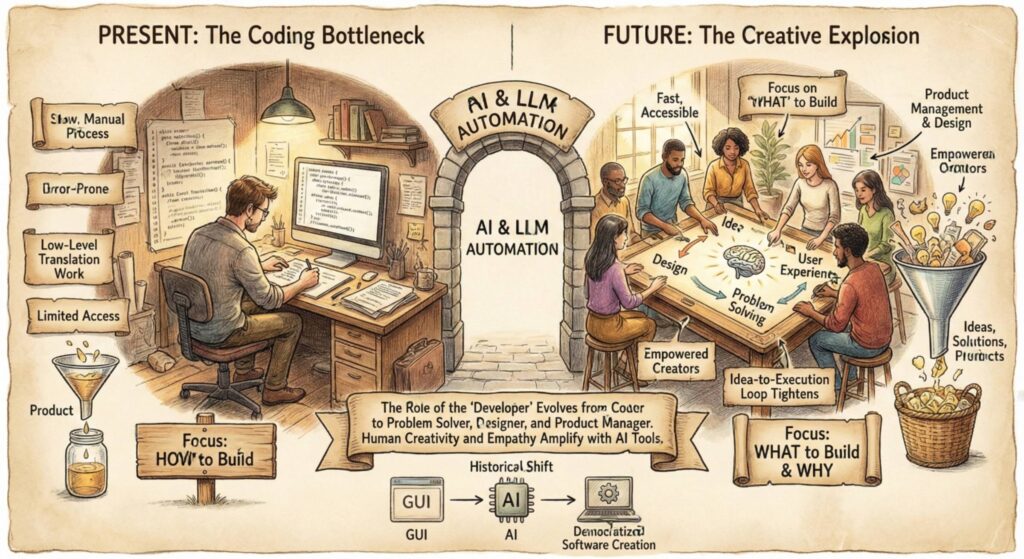
Traditional role boundaries between engineer, product manager, and designer are dissolving. On the Claude Code team, everyone codes — the PM, the engineering manager, the designer, the finance person, the data scientist. Cherny predicts the title “Software Engineer” will start disappearing by end of 2026, replaced by something like “Builder” — a generalist who blends design sense, business logic, technical orchestration, and user empathy.
5. Underfunding Teams Is a Feature, Not a Bug
Cherny advocates deliberately underfunding teams as a strategy. When you assign one engineer to a project instead of five, they’re forced to leverage Claude Code to automate everything possible. This isn’t about cost-cutting — it’s about forcing innovation through constraint. The results at Anthropic have been dramatic: while the engineering team grew roughly 4x, productivity per engineer increased 200% in terms of pull requests shipped.
6. Give Engineers Unlimited Tokens
Rather than hiring more headcount, Cherny’s advice to CTOs is to give engineers as many tokens as possible. Let them experiment with the most capable models without worrying about cost. The most innovative ideas come from people pushing AI to its limits. Some Anthropic engineers are spending hundreds of thousands of dollars per month in tokens. Optimize costs later — only after you’ve found the idea that works.
7. Build for the Model Six Months From Now
One of Cherny’s most actionable insights: don’t build for today’s model capabilities — build for where the model will be in six months. Early versions of Claude Code only wrote about 20% of Cherny’s code. But the team bet on exponential improvement, and when Opus 4 and Sonnet 4 arrived, product-market fit clicked instantly. This means your product might feel rough at first, but when the next model generation drops, you’ll be perfectly positioned.
8. The Bitter Lesson Applied to Product
Cherny references Rich Sutton’s famous “Bitter Lesson” blog post as a core principle for the Claude Code team: the more general model will always outperform the more specific one. In practice, this means avoiding rigid workflows and orchestration scaffolding around AI models. Don’t box the model in. Give it tools, give it a goal, and let it figure out the path. Scaffolding might improve performance 10-20%, but those gains get wiped out with the next model generation.
9. Latent Demand — The Most Important Product Principle
Cherny calls latent demand “the single most important principle in product.” The idea: watch how people misuse or hack your product for purposes you didn’t design it for. That’s where your next product lives. Facebook Marketplace came from 40% of Facebook Group posts being buy-and-sell. Cowork came from non-engineers using Claude Code’s terminal for things like growing tomato plants, analyzing genomes, and recovering wedding photos from corrupted hard drives. There’s also a new dimension: watching what the model is trying to do and building tools to make that easier.
10. Cowork Was Built in 10 Days
Anthropic’s Cowork product — their agentic tool for non-technical tasks — was implemented by a small team in just 10 days, using Claude Code to build its own virtual machine and security scaffolding. Cowork was immediately a bigger hit than Claude Code was at launch. It can pay parking tickets, cancel subscriptions, manage project spreadsheets, message team members on Slack, respond to emails, and handle forms — and it’s growing faster than Claude Code did in its early days.
11. Three Layers of AI Safety at Anthropic
Cherny outlined three layers of safety: (1) Mechanistic interpretability — monitoring neurons inside the model to understand what it’s doing and detect things like deception at the neural level. (2) Evals — lab testing where the model is placed in synthetic situations to check alignment. (3) Real-world monitoring — releasing products as research previews to study unpredictable agent behavior in the wild. Claude Code was used internally for 4-5 months before public release specifically for safety study.
12. Why Boris Left Anthropic for Cursor (and Came Back After Two Weeks)
Cherny briefly left Anthropic to join Cursor, drawn by their focus on product quality. But within two weeks, he realized what he was missing: Anthropic’s safety mission. He described it as a psychological need — without mission-driven work, even building a great product wasn’t a substitute. He returned to Anthropic and the rest is history.
13. Manual Coding Skills Will Become Irrelevant in 1-2 Years
Cherny compared manual coding to assembly language — it’ll still exist beneath the surface, and understanding the fundamentals helps for now, but within a year or two it won’t matter for most engineers. He likened it to the printing press transition: a skill once limited to scribes became universal literacy over time. The volume of code created will explode while the cost drops dramatically.
14. Pro Tips for Using Claude Code Effectively
Cherny shared three specific tips: (1) Use the most capable model — currently Opus 4.6 with maximum effort enabled. Cheaper models often cost more tokens in the end because they require more correction and handholding. (2) Use Plan Mode — hit Shift+Tab twice in the terminal to enter plan mode, which tells the model not to write code yet. Go back and forth on the plan, then auto-accept edits once it looks good. Opus 4.6 will one-shot it correctly almost every time. (3) Explore different interfaces — Claude Code runs on terminal, desktop app, iOS, Android, web, Slack, GitHub, and IDE extensions. The same agent runs everywhere. Find what works for you.
Detailed Summary
The Origin Story of Claude Code
Claude Code began as a one-person hack. When Cherny joined Anthropic, he spent a month building weird prototypes that mostly never shipped, then spent another month doing post-training to understand the research side. He believes deeply that to build great products on AI, you have to understand “the layer under the layer” — meaning the model itself.
The first version was terminal-based and called “Claude CLI.” When he demoed it internally, it got two likes. Nobody thought a coding tool could be terminal-based. But the terminal form factor was chosen partly out of necessity (he was a solo developer) and partly because it was the only interface that could keep up with how fast the underlying model was improving.
The breakthrough moment during prototyping: Cherny gave the model a bash tool and asked it what music he was listening to. The model figured out — without any specific instructions — how to use the bash tool to answer that question. That moment of emergent tool use convinced him he was onto something.
The Growth Trajectory
Claude Code was released externally in February 2025 and was not immediately a hit. It took months for people to understand what it was. The terminal interface was alien to many. But internally at Anthropic, daily active users went vertical almost immediately.
There were multiple inflection points. The first major one was the release of Opus 4, which was Anthropic’s first ASL-3 class model. That’s when Claude Code’s growth went truly exponential. Another inflection came in November 2025 when Cherny personally crossed the 100% AI-written code threshold. The growth has continued to accelerate — it’s not just going up, it’s going up faster and faster.
The Spotify headline from the week of recording — “Spotify says its best developers haven’t written a line of code since December, thanks to AI” — underscored how mainstream the shift has become.
Thinking in Exponentials
Cherny emphasized that thinking in exponentials is deep in Anthropic’s DNA — three of their co-founders were the first three authors on the scaling laws paper. At Code with Claude (Anthropic’s developer conference) in May 2025, Cherny predicted that by year’s end, engineers might not need an IDE to code anymore. The room audibly gasped. But all he did was “trace the line” of the exponential curve of AI-written code.
The Printing Press Analogy
Cherny’s preferred historical analog for what’s happening is the printing press. In mid-1400s Europe, literacy was below 1%. A tiny class of scribes did all the reading and writing, employed by lords and kings who often couldn’t read themselves. After Gutenberg, more printed material was created in 50 years than in the previous thousand. Costs dropped 100x. Literacy rose to 70% globally over two centuries.
Cherny sees coding undergoing the same transition: a skill locked away in a tiny class of “scribes” (software engineers) is becoming accessible to everyone. What that unlocks is as unpredictable as the Renaissance was to someone in the 1400s. He also shared a remarkable historical detail — an interview with a scribe from the 1400s who was actually excited about the printing press because it freed them from copying books to focus on the artistic parts: illustration and bookbinding. Cherny felt a direct parallel to his own experience of being freed from coding tedium to focus on the creative and strategic parts of building.
What AI Transforms Next
Cherny believes roles adjacent to engineering — product management, design, data science — will be transformed next. The key technology enabling this is true agentic AI: not chatbots, but AI that can actually use tools and act in the world. Cowork is the first step in bringing this to non-technical users.
He was candid that this transition will be “very disruptive and painful for a lot of people” and that it’s a conversation society needs to have. Anthropic has hired economists, policy experts, and social impact specialists to help think through these implications.
The Latent Demand Framework in Depth
Cherny credited Fiona Fung, the founding manager of Facebook Marketplace, for popularizing the concept of latent demand. The examples are compelling: someone using Claude Code to grow tomato plants, another analyzing their genome, another recovering wedding photos from a corrupted hard drive, a data scientist who figured out how to install Node.js and use a terminal to run SQL analysis through Claude Code.
But Cherny added a new dimension specific to AI products: latent demand from the model itself. Rather than boxing the model into a predetermined workflow, observe what the model is trying to do and build to support that. At Anthropic they call this being “on distribution.” Give the model tools and goals, then let it figure out the path. The product is the model — everything else is minimal scaffolding.
Safety as a Core Differentiator
The interview made clear that safety isn’t just a talking point at Anthropic — it’s why everyone is there, including Cherny. He described the work of Chris Olah on mechanistic interpretability: studying model neurons at a granular level to understand how concepts are encoded, how planning works, and how to detect things like deception. A single neuron might correspond to a dozen concepts through a phenomenon called superposition.
Anthropic’s “race to the top” philosophy means open-sourcing safety tools even when they work for competing products. They released an open-source sandbox for running AI agents securely that works with any agent, not just Claude Code.
The Memory Leak Story
One of the most memorable anecdotes: Cherny was debugging a memory leak the traditional way — taking heap snapshots, using debuggers, analyzing traces. A newer engineer on the team simply told Claude Code: “Hey Claude, it seems like there’s a leak. Can you figure it out?” Claude Code took the heap snapshot, wrote itself a custom analysis tool on the fly, found the issue, and submitted a pull request — all faster than Cherny could do it manually. Even veterans of AI-assisted coding get stuck in old habits.
Personal Background and Post-AGI Plans
In a touching segment, Cherny and Rachitsky discovered they’re both from Odessa, Ukraine. Cherny’s grandfather was one of the first programmers in the Soviet Union, working with punch cards. Before joining Anthropic, Cherny lived in rural Japan where he learned to make miso — a process that takes months to years and taught him to think on long timescales. His post-AGI plan? Go back to making miso.
His book recommendations: Functional Programming in Scala (the best technical book he’s ever read), Accelerando by Charles Stross (captures the essence of this moment better than anything), and The Wandering Earth by Liu Cixin (Chinese sci-fi short stories from the Three Body Problem author).
Thoughts and Analysis
This interview is one of the most important conversations about the future of software engineering to come out in 2026. Here are some things worth sitting with:
The “solved” framing is provocative but precise. Cherny isn’t saying software engineering is solved — he’s saying the act of translating intent into working code is solved. The thinking, architecting, deciding-what-to-build, and ensuring-it’s-correct parts are very much unsolved. This distinction matters enormously and most of the pushback in the YouTube comments misses it.
The underfunding principle is genuinely counterintuitive. Most organizations respond to AI tools by trying to maintain headcount and “augment” existing workflows. Cherny’s approach is the opposite: reduce headcount on a project, give people unlimited AI tokens, and watch them figure out how to ship ten times faster. This is a fundamentally different organizational philosophy and one that most companies will resist until their competitors prove it works.
The “build for six months from now” advice is dangerous and brilliant. Dangerous because your product will underperform for months and investors will get nervous. Brilliant because when the next model drops, you’ll have the only product that takes full advantage of it. This is how Claude Code went from writing 20% of Cherny’s code to 100% — the product was ready when the model caught up.
The latent demand framework deserves serious study. The traditional version (watching users hack your product) is well-known from the Facebook era. The AI-native version (watching what the model is trying to do) is genuinely new. “The product is the model” is a deceptively simple statement that most AI product builders are still getting wrong by over-engineering workflows and scaffolding.
The Cowork trajectory matters more than Claude Code. Claude Code transforms engineers. Cowork transforms everyone else. If Cowork delivers on even half of what Cherny describes — paying tickets, managing project spreadsheets, responding to emails, canceling subscriptions — then the total addressable market dwarfs coding tools. The fact that it was built in 10 days and was an immediate hit suggests Anthropic has found product-market fit for agentic AI beyond engineering.
The safety discussion felt genuine. Cherny’s explanation of mechanistic interpretability — actually being able to monitor model neurons and detect deception — is one of the clearest public explanations of Anthropic’s safety approach. The fact that the safety mission is what brought him back from Cursor (where he lasted only two weeks) speaks to the culture. Whether you think safety is a genuine concern or a competitive moat, it’s clearly a core part of how Anthropic attracts and retains talent.
The elephant in the room: this is Anthropic’s head of product telling you to use more tokens. Multiple YouTube commenters pointed this out, and they’re right to flag it. But the underlying logic holds: if a less capable model requires more correction rounds and more tokens to achieve the same result, then the “cheaper” model isn’t actually cheaper. That’s a testable claim, and most engineers using these tools regularly will tell you it checks out.
Whether you agree with the “coding is solved” framing or not, the data is hard to argue with. Four percent of all GitHub commits. Two hundred percent productivity gains per engineer. A product that was built in 10 days and scaled to millions of users. These aren’t predictions — they’re measurements. And the curve is still accelerating.
This article is based on Boris Cherny’s appearance on Lenny’s Podcast, published February 19, 2026. Boris Cherny can be found on X/Twitter and at borischerny.com.