PJFP.com

Pursuit of Joy, Fulfillment, and Purpose

Tag: Anthropic valuation

  • OpenAI’s Leaked 2025 Financials: $34 Billion in Spending, a $38.5 Billion Net Loss, and a $17 Billion Microsoft Bill Ahead of Its IPO

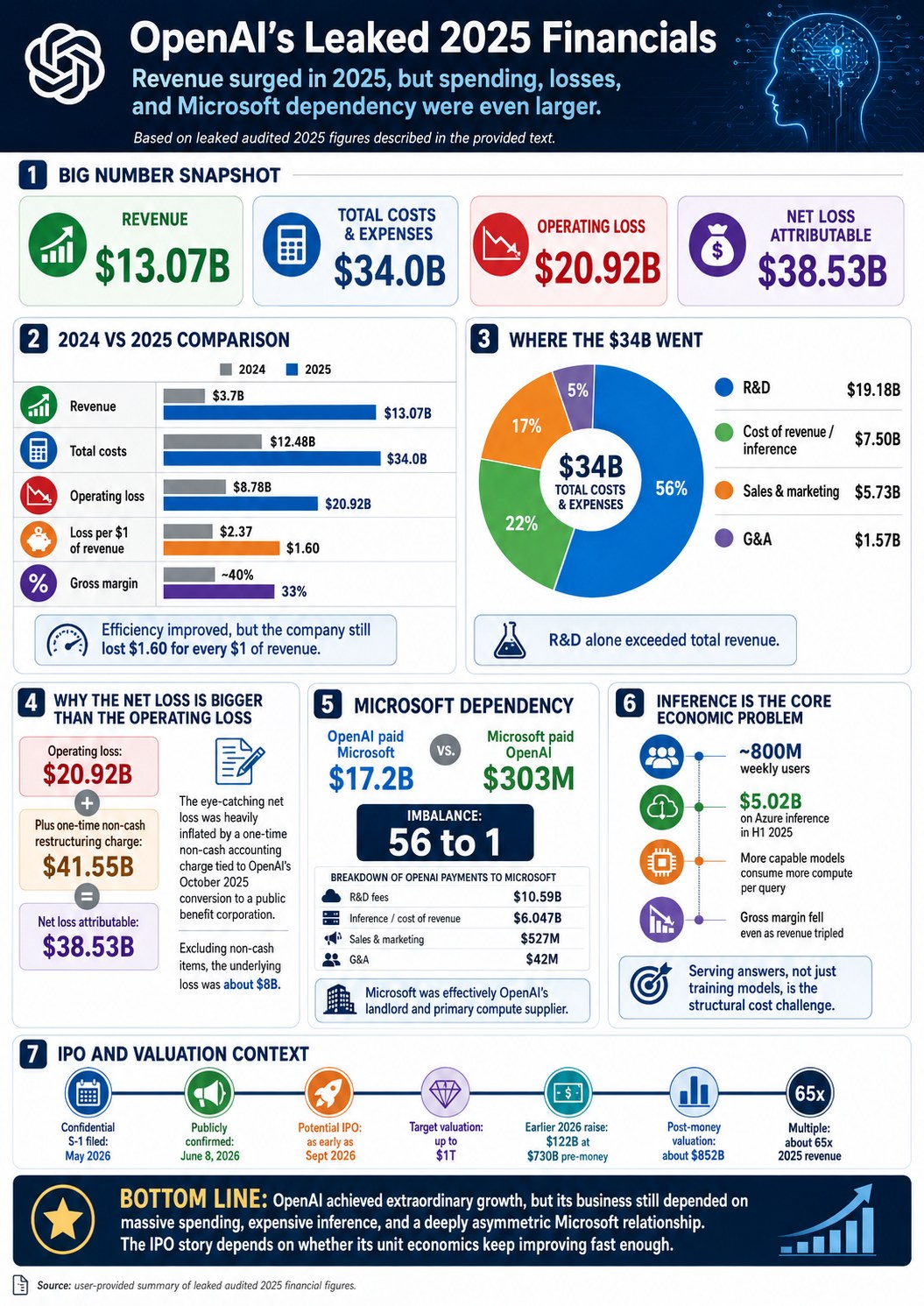
    Infographic summarizing OpenAI leaked 2025 financials: $13.07B revenue, $34B total costs, $20.92B operating loss, $38.53B net loss, where the $34B went, the $17.2B paid to Microsoft versus $303M paid back, inference costs, and IPO valuation context

    OpenAI’s audited 2025 financials leaked this week, and they are the clearest picture yet of what it actually costs to run the company behind ChatGPT. Independent journalist Ed Zitron first published the documents, and the Financial Times independently confirmed them. The headline: OpenAI spent $34 billion last year, booked $13.07 billion in revenue, and reported a net loss attributable to the company of $38.5 billion. The disclosure lands just days after OpenAI confidentially filed for an IPO that could value it north of $1 trillion.

    TLDR

    OpenAI’s audited 2025 numbers, leaked by Ed Zitron and confirmed by the Financial Times, show revenue tripling to $13.07 billion while total costs reached $34 billion, producing a $20.92 billion operating loss and a $38.53 billion net loss attributable to the company. The much larger net loss is inflated by a one-time $41.55 billion non-cash charge tied to OpenAI’s October 2025 conversion from a nonprofit to a public benefit corporation; strip the non-cash items and the loss is closer to $8 billion. R&D alone was $19.18 billion, cost of revenue (inference) was $7.5 billion, and sales and marketing ballooned to $5.73 billion. OpenAI paid Microsoft $17.2 billion in 2025 while Microsoft paid OpenAI only $303 million, exposing a deep Azure dependency. The company burned $1.60 for every dollar of revenue, down from $2.37 in 2024, and gross margin slipped from roughly 40% to 33% as more capable models consumed more compute per query. The leak arrives as OpenAI files a confidential S-1, targets a listing as early as September 2026 at up to a $1 trillion valuation, and races rival Anthropic, which is more valuable on paper and claims it is already turning an operating profit.

    Thoughts

    The most important thing to understand about these numbers is that there are two loss figures and the press will conflate them. The $38.53 billion net loss is the scary headline, but $41.55 billion of it is a non-cash accounting charge from converting investor convertible interests into equity during the for-profit restructuring. That charge is real on the audited statement and it will show up in the eventual S-1, but it is a one-time artifact of OpenAI’s unusual corporate history, not money that left the building. The number that describes the actual business is the $20.92 billion operating loss. That is the one to watch, and it is still enormous.

    The genuinely encouraging line in the whole release is the loss-per-dollar ratio. In 2024 OpenAI spent $2.37 to generate a dollar of revenue. In 2025 that fell to $1.60. A company that is still losing $1.60 on every dollar is not a healthy business, but a company whose efficiency improved by a third in a single year while tripling its top line is at least pointed in a defensible direction. The bull case for OpenAI lives entirely in the slope of that line. If it keeps improving at that rate, the math eventually crosses over. If it stalls, the valuation is a fantasy.

    The Microsoft relationship is the single most revealing disclosure, and it is wildly asymmetric. OpenAI paid Microsoft $17.2 billion in 2025. Microsoft paid OpenAI $303 million. That is a 56-to-1 ratio, and it reframes the partnership: Microsoft is not really a peer or even just an investor, it is OpenAI’s landlord and primary supplier, collecting rent on every model trained and every query answered. The April 2026 renegotiation that capped revenue-share payments at $38 billion through 2030, down from a projected $135 billion, suddenly looks less like a favor and more like OpenAI desperately trying to lower its single largest cost. The dependency cuts both ways, but right now Microsoft holds the better hand.

    The structural problem hiding inside the cost of revenue line is inference. Training a model is a fixed, one-time cost. Serving it is a recurring cost that scales with every one of ChatGPT’s roughly 800 million weekly users. OpenAI spent $5.02 billion on Azure inference in the first half of 2025 alone, and the more capable its reasoning models get, the more compute each answer burns. That is why gross margin went down even as revenue went up. It is the opposite of how software is supposed to work, where the marginal cost of one more user trends toward zero. OpenAI’s marginal cost is real, large, and growing. The counterargument is that per-token inference costs have been falling roughly tenfold a year, so the unit economics could still flip. That is the entire wager.

    Finally, the timing matters more than the numbers. OpenAI’s confidential S-1 means these audited figures were going to become public regardless, since the SEC requires the full prospectus at least 15 days before a roadshow. What the leak changes is who gets to study them first. Prospective IPO buyers, enterprise customers signing multi-year API contracts, and competitors now have the audited books weeks or months early, and they are reading them against Anthropic, which filed at a higher valuation and claims an operating profit. For a company asking the public markets to underwrite a $1 trillion bet on a monopoly outcome that does not yet exist, losing control of the narrative this early is not a small thing.

    Key Takeaways

    • OpenAI’s audited 2025 financials were first published by independent journalist Ed Zitron and independently confirmed by the Financial Times, the first verified look at the company’s books before its planned IPO.
    • Revenue grew from $3.7 billion in 2024 to $13.07 billion in 2025, more than tripling year over year, making OpenAI one of the fastest-growing businesses in history.
    • By the end of 2025 OpenAI was generating roughly $2 billion in monthly revenue, up from about $1 billion a quarter at the end of 2024.
    • Total costs and expenses hit $34 billion in 2025, up from $12.48 billion in 2024.
    • Research and development was the single largest expense at $19.18 billion, up from $7.81 billion, and exceeded total revenue on its own.
    • Of that R&D spend, $10.59 billion went to Microsoft, almost certainly the GPU compute cost of training frontier models on Azure.
    • Cost of revenue, the expense of serving ChatGPT responses (inference), rose from $2.65 billion to $7.5 billion.
    • Sales and marketing jumped from $1.11 billion to $5.73 billion, a 418% increase.
    • General and administrative costs rose from $907 million to $1.57 billion.
    • The operating loss, the truest measure of day-to-day economics, grew from $8.78 billion to $20.92 billion.
    • The net loss attributable to OpenAI was $38.53 billion, up nearly eightfold from $5.09 billion in 2024.
    • The bulk of that jump was a one-time, non-cash $41.55 billion charge from OpenAI’s October 28, 2025 conversion to a public benefit corporation, reflecting the changing fair value of convertible interests and warrant liabilities.
    • Stripping out the restructuring charge and other non-cash items such as stock-based compensation and Microsoft computing credits, the underlying loss was about $8 billion.
    • Including all factors, gross net loss reached $60.35 billion, lowered to the $38.53 billion attributable figure by removing $21.82 billion attributed to noncontrolling and redeemable noncontrolling interests.
    • OpenAI burned $1.60 for every $1 of revenue in 2025, an improvement from $2.37 in 2024, the clearest data point in the bull case.
    • Measured as a percentage of revenue, the operating loss improved from 237% in 2024 to 160% in 2025.
    • In total, OpenAI paid Microsoft $17.2 billion in 2025: $10.59 billion in R&D fees, $6.047 billion in cost of revenue, $527 million in sales and marketing, and $42 million in G&A.
    • Microsoft paid OpenAI just $303 million in the same year, a 56-to-1 imbalance underscoring OpenAI’s Azure dependency.
    • SoftBank paid OpenAI $867 million in 2025.
    • At year-end OpenAI carried $3.64 billion in outstanding payables to Microsoft, plus tens of millions more in accrued and non-current liabilities.
    • OpenAI spent $5.02 billion on Azure inference in just the first half of 2025; Azure inference from 2024 through Q3 2025 totaled $12.43 billion.
    • ChatGPT serves roughly 800 million weekly users, meaning billions of queries a week, each one burning GPU time at Azure’s pricing of about $6.98 per H100 GPU-hour.
    • Gross margin fell from roughly 40% in 2024 to 33% in 2025, because more capable reasoning models consume more compute per query.
    • Research firm Sacra estimates OpenAI’s inference costs reached $8.4 billion in 2025 and will rise to $14.1 billion in 2026, a 68% increase.
    • At year-end OpenAI held just over $50 billion in assets, with almost half in cash.
    • The April 2026 Microsoft renegotiation ended exclusivity and capped revenue-share payments at $38 billion through 2030, down from a projected $135 billion, potentially saving OpenAI up to $97 billion over five years.
    • OpenAI filed a confidential draft S-1 with the SEC around May 22, 2026 and confirmed it publicly on June 8, naming Goldman Sachs and Morgan Stanley as underwriters.
    • The company is targeting a listing as early as September 2026 at a valuation that could exceed $1 trillion, though Sam Altman has said a public offering “may be a while.”
    • OpenAI raised $122 billion earlier in 2026 at a $730 billion pre-money valuation, putting its post-money value around $852 billion.
    • At an $852 billion valuation, OpenAI trades at roughly 65 times its 2025 revenue.
    • Rival Anthropic also filed IPO paperwork this month after raising $65 billion at a $900-$965 billion valuation, making it more valuable on paper than OpenAI, and says it expects to report an operating profit of $559 million in the June quarter.
    • HSBC analysts estimate OpenAI may need more than $207 billion in additional capital through 2030 even under optimistic projections.
    • OpenAI projects profitability by 2029 or 2030; independent analysts put the more likely date at 2031 or later.
    • Bridgewater partner Greg Jensen reportedly told clients the implied revenue multiples price OpenAI for “a monopoly outcome that does not yet exist.”
    • Zitron separately reported OpenAI had a negative 122% non-GAAP operating margin in Q1 2026 and that ChatGPT growth has stalled, with the company projecting paid ChatGPT Plus subscriptions to fall from 44 million in 2025 toward cheaper tiers in 2026.

    Detailed Summary

    How the leak happened and why it matters now

    The audited documents were obtained and first published by Ed Zitron on his newsletter Where’s Your Ed At, then independently verified by the Financial Times, which reviewed the same materials. That dual sourcing matters: this is not a rumor or a model, it is OpenAI’s actual audited financial statement. The timing is the story. OpenAI filed a confidential draft S-1 with the SEC around May 22, 2026 and confirmed it publicly on June 8. Under SEC rules the full prospectus must be released at least 15 days before an investor roadshow, so the 2025 numbers were going to be public soon regardless. The leak simply moved that disclosure forward, handing prospective investors, enterprise customers, and competitors an early look at the books.

    Revenue tripled, costs grew faster

    OpenAI’s revenue rose from $3.7 billion in 2024 to $13.07 billion in 2025, and monthly revenue reached nearly $2 billion by year-end. By almost any normal standard that is spectacular growth. The problem is that costs grew faster, reaching $34 billion against $12.48 billion the year before. The gap between what OpenAI earns and what it spends has widened every year since its founding, and 2025 is the starkest example yet. Revenue alone was outpaced by research and development as a single line item in both of the last two years.

    Two loss numbers, and why both matter

    There are two figures that get cited interchangeably and should not be. The operating loss of $20.92 billion is what the business spent beyond what it earned from operations: training models, serving ChatGPT, paying engineers, running marketing. The net loss attributable to OpenAI of $38.53 billion is far larger because 2025 was the year OpenAI completed its conversion from a nonprofit to a for-profit public benefit corporation, finalized on October 28, 2025. That restructuring triggered a $41.55 billion non-cash charge reflecting the changing fair value of convertible equity interests and warrant liabilities. Before the conversion, investors held convertible interest rights treated as liabilities under US accounting rules and revalued upward as OpenAI’s valuation climbed, creating the charge. It is not expected to recur. Including all minor items, gross net loss reached $60.35 billion, reduced to the $38.53 billion attributable figure after removing $21.82 billion tied to noncontrolling and redeemable noncontrolling interests, primarily the OpenAI Foundation’s stake. Strip the non-cash noise and the underlying loss was about $8 billion.

    Where the $34 billion went

    The spending breaks into four lines. Research and development was $19.18 billion, the largest category, with $10.59 billion of it flowing to Microsoft for training compute. Cost of revenue, the expense of serving responses to users, was $7.5 billion and captures inference, the compute consumed every time someone prompts ChatGPT or calls the API. Sales and marketing reached $5.73 billion, up 418% year over year, a striking jump for a product that grew largely by word of mouth. General and administrative costs added $1.57 billion. The shape of the spending tells you OpenAI is simultaneously racing to build better models, serve a massive and growing user base, and aggressively defend market share through marketing.

    The Microsoft dependency

    The most striking single disclosure is the scale of the Microsoft relationship. OpenAI paid Microsoft $17.2 billion in 2025: $10.59 billion in R&D fees for model training, $6.047 billion in cost-of-revenue for inference serving, $527 million in sales and marketing, and $42 million in G&A. Microsoft paid OpenAI just $303 million the same year. SoftBank paid OpenAI $867 million. The 56-to-1 ratio between what OpenAI pays Microsoft and what Microsoft pays back makes the structural reality plain: Microsoft is OpenAI’s largest landlord. The dynamic began shifting in April 2026, when the two renegotiated, ending Microsoft’s exclusivity and capping revenue-share payments at $38 billion through 2030, down from a projected $135 billion. That could save OpenAI up to $97 billion over five years, though Microsoft keeps its IP license through 2032 and remains the primary cloud partner.

    Why inference is the core problem

    Training happens once. Serving happens billions of times a day. When OpenAI releases a model it spends months and billions on training compute, a fixed cost that falls away when training ends. Inference is the opposite: every ChatGPT message runs through the model on Azure GPU hardware, consuming electricity and compute to generate a response. With roughly 800 million weekly users, that is billions of queries a week, each burning GPU time at roughly $6.98 per H100 GPU-hour on demand. OpenAI spent $5.02 billion on Azure inference in the first six months of 2025 alone. Sacra estimates full-year inference costs of $8.4 billion in 2025, rising to $14.1 billion in 2026. This is why gross margin fell from about 40% to 33% even as revenue tripled: more capable reasoning models consume far more compute per query, and revenue has not kept pace with the cost growth that capability generates.

    What it means for the IPO and the race with Anthropic

    OpenAI was last valued around $852 billion post-money after raising $122 billion in early 2026, which puts it at roughly 65 times 2025 revenue. It has named Goldman Sachs and Morgan Stanley as underwriters and is targeting a listing as early as September 2026 at up to a $1 trillion valuation, though Altman has hedged that it “may be a while” and that staying private might be the better course. HSBC estimates the company may need more than $207 billion in additional capital through 2030. The race is with Anthropic, which filed paperwork the same month after raising $65 billion at a $900-$965 billion valuation, making it more valuable on paper, and which says it expects a $559 million operating profit in the June quarter. The contrast is sharp: the two leading AI labs heading toward public markets at the same time, one bleeding cash at scale, the other claiming profitability, both asking investors to bet on a future that has not arrived.

    Notable Quotes

    “The financial condition of OpenAI is deeply concerning. $38.53 billion in losses are astronomical, and far higher than most believed it would be. Losses also appear to be mounting year-over-year at a dramatic rate, and I’m not sure how this company finds a way toward any kind of sustainability or profitability.”

    Ed Zitron, the independent journalist who published the leaked audited financials

    “It’s unclear what this means, nor how OpenAI reconciled the removal of $3.74 billion in costs. I will not speculate further.”

    Ed Zitron, on a discrepancy he found in the restated 2024 figures

    “OpenAI’s two biggest expenses are R&D and marketing. Budget cuts there, coupled with an ability to raise prices or win new sources of revenue, could see the company move into the black over time. Cutting R&D would be the most difficult part of that, given that AI companies can only hold onto their customers by generating the best-performing models.”

    Jim Edwards, Fortune, on whether OpenAI has a realistic path to profitability

    “What the audited documents make impossible to argue is that the path to profitability is short, clear, or cheap.”

    TechTimes analysis of the leaked OpenAI financials

    The implied revenue multiples price OpenAI for “a monopoly outcome that does not yet exist.”

    Bridgewater partner Greg Jensen, reportedly telling clients how to read OpenAI’s valuation

    “OpenAI spent $34bn last year as the ChatGPT maker poured money into a race to dominate the fast-growing AI market ahead of a planned stock market listing.”

    George Hammond and Bryce Elder, Financial Times, framing the audited 2025 spend

    Read Ed Zitron’s original reporting with the full breakdown here, and the Financial Times confirmation here.

    Related Reading

    • Ed Zitron, Where’s Your Ed At the primary source that broke the audited 2025 financials with the full line-by-line breakdown.
    • OpenAI (Wikipedia) background on the company’s history, structure, and the nonprofit-to-for-profit conversion that drives the non-cash charge.
    • Inference (Wikipedia) on the recurring compute cost that explains why OpenAI’s gross margin shrinks as usage grows.
    • Anthropic the rival lab that filed IPO paperwork the same month at a higher valuation and claims it is already operating at a profit.
    • SEC on confidential filings context for why OpenAI’s audited numbers were headed for public disclosure regardless of the leak.
  • Whale Rock Capital Founder Alex Sacerdote on S-Curve Investing, Why Anthropic Is His Highest Conviction Bet, and the Decommoditization of AI Hardware

    Alex Sacerdote built Whale Rock Capital into one of the most respected technology hedge funds in the world by treating markets through a single disciplined lens: the technology adoption S-curve. In this long conversation on Invest Like the Best with Patrick O’Shaughnessy, he lays out the full framework that has carried him through internet 1.0, mobile, cloud, e-commerce, and now AI, and he explains why Anthropic became his highest conviction position, why his fund went net short application software, and why the least glamorous corner of the market, the hardware and chips that build out data centers, may be one of the best ways to play artificial intelligence right now. What follows is the working theory of a money manager who has spent twenty years trying to think exponentially while the rest of the market thinks one quarter at a time.

    TLDW

    Sacerdote walks through Whale Rock’s three-part investment framework: find the right part of an S-curve, identify the company with a durable competitive advantage, and buy when long-term earnings power is underappreciated. He tells the story of investing in Anthropic at a 180 billion dollar valuation in August 2025 after Claude Code made coding the true unlock of AI, and frames the foundational model market as a three-horse race between Anthropic, OpenAI, and Google that resolved from sixty startups into an oligopoly. He argues enterprise AI is less than 1 percent penetrated, calls the adoption shape an L curve rather than an S-curve, and warns there is not enough compute in the world. He explains why he sold almost all of his application software and went net short, why he loves the decommoditization of AI hardware (Celestica, Corning, Elite Materials, Delta, Advanced Energy, high bandwidth memory, 40-layer PCBs), introduces a modified rule of 40 for chip investing, surveys the moats that let leaders win (network effects, industry standard, scale, critical IP, brand, recursive self-improvement), discusses moving from public markets into private deals like Stripe and Anthropic, lays out Whale Rock’s fund products including the new Mega Cap Tech Fund, defends old-fashioned scuttlebutt research in an AI age, and closes on the kindest thing anyone ever did for him, his father joining the firm after 41 years at Goldman Sachs.

    Thoughts

    The most useful idea in this conversation is not the bullishness on AI, which is everywhere now, but the discipline underneath it. Sacerdote’s framework forces a separation that most investors collapse. A great market is not a great investment. A great company is not a great investment. You need a tall S-curve, a company with a moat that survives the curve, and a price that does not yet reflect the earnings power. He says the quiet part out loud: he has repeatedly bought the best companies in the world at four or five times earnings precisely because the market refuses to extrapolate exponential growth. Nvidia at four times earnings in 2023, Tesla at five times in 2019, Amazon where AWS came free. The edge is not information, it is the willingness to underwrite two to four years out when the consensus cannot see past the next quarter.

    The Anthropic story is the framework applied in real time, and it is worth noting how late and how cautious he was. Whale Rock passed on the 60 billion dollar round because gross margins were negative and coding had not yet exploded. They only got conviction once Claude Code flipped from autocomplete to agentic work, once they heard Anthropic engineers were burning 100 dollars a day in tokens, and once the math on twenty million coders implied a half trillion dollar market from coding alone. The lesson he repeats throughout, that it is okay to be late, that you can miss the first 100 percent if the curve is tall enough, is a direct rebuke to the fear of missing out that drives most AI investing. He waited for the moat to be visible before he paid up.

    His most contrarian and most actionable call is on hardware. The consensus reflex is that chips and components are commodities that get competed to zero. Sacerdote argues the opposite is happening: AI workloads growing 10x a year are pushing every layer of the server to its physical limits, and that pressure is decommoditizing the entire stack. A liquid-cooled AI server is a 300,000 dollar piece of critical infrastructure, not a 5,000 dollar throwaway box, which means the supplier becomes a permanent fixture like a parts vendor on a plane. The Celestica example is the template: a contract manufacturer left for dead since 1999 that turned out to be the sole supplier of Google’s TPU server and a leader in liquid cooling and Ethernet switching, trading at eight times earnings. If he is right that we are 30 percent short on DRAM, NAND, and PCBs, the picks-and-shovels trade has years left to run regardless of which model company wins.

    The software bear case deserves the most scrutiny because it is the most consequential and the least certain. Going from 40 to 50 percent of the portfolio in software to net short is a violent reallocation, and his reasons are layered: AI products that nobody will pay for, CIO budgets being raided to fund Anthropic tokens, pricing power evaporating, and the long-term threat that AI-native startups rebuild incumbents from scratch. But he is honest that the bull case is real too, that old technology is sticky, that companies prefer to buy rather than build, and that AI might actually make platforms like Slack or CRM more important if agents end up operating inside them. This is the genuine uncertainty in the whole AI trade. The bottom of Jensen’s cake, chips and models, is where the value has accrued so far, but historically the application layer captured most of the market cap. Sacerdote is betting that this time the infrastructure and model layers hold the value longer, and he admits the application ecosystem is still unclear and a little bit dangerous. That admission is more valuable than any of his confident calls.

    Finally, the section on research in an AI age is a quiet refutation of the idea that this work automates away. Sacerdote runs a Philip Fisher scuttlebutt operation, 2,500 to 3,000 face-to-face management meetings a year, two decades of compounding relationships, the tripod of conviction where he, his analyst, and a respected outsider all independently like an idea. AI writes better notes now, but the paragraph on top, the wisdom about what it means and how it fits the thesis, is still human. The durable moat in his own business is the same one he looks for in the companies he buys: an accumulated advantage that newcomers cannot replicate quickly. That consistency between how he invests and how he operates is the most credible thing in the interview.

    Key Takeaways

    • Whale Rock’s framework has three legs: identify the right part of a technology S-curve, find the company with a powerful competitive advantage, and invest when long-term earnings power is underappreciated.
    • The core insight is exponential, not linear. Strong tech business models grow earnings exponentially, and because the market refuses to extrapolate, you can buy elite companies at very low multiples.
    • Concrete examples of buying exponential growth cheaply: Nvidia at four times earnings in 2023, Tesla at five times in 2019, Apple at four times, and Amazon where AWS was effectively free.
    • When ChatGPT launched in November 2022, Whale Rock did a firm-wide deep dive and chose to invest in chips and infrastructure first, because demand arrives there first and the winners are knowable regardless of who wins the model layer.
    • The foundational model market went from roughly 60 startups to a three-horse race: Anthropic, OpenAI, and Google. Most startups died, Amazon never showed up, and Meta faltered and had to reboot.
    • Anthropic was the dark horse that focused purely on enterprise while OpenAI won consumer. Whale Rock made it their highest conviction position.
    • Coding is the true unlock of AI. The progression went from Microsoft Copilot at 20 dollars a month (fixing grammar, finding a bug) to Claude running agentically and writing most of the code.
    • The market math: Anthropic engineers were reportedly spending 100 dollars a day on tokens, roughly 20 to 30 thousand dollars a year, and with about 20 million coders in the world that implies a half trillion dollar market from coding alone.
    • Whale Rock invested in Anthropic at the 180 billion dollar valuation in August 2025, when the company hoped to reach 9 billion in revenue and nobody yet knew what 2026 could be.
    • Andrej Karpathy and Linus Torvalds both flipped on AI coding. Karpathy went from 80 percent handwritten code to writing almost no code except in English.
    • Models are not pure commodities. There is real differentiation: Anthropic is strong for private equity and finance, Google is strong at ingesting PDFs, and routers that switch between models mask but do not erase that differentiation.
    • Anthropic is building an ecosystem around the API (SDK, orchestration, the harness, tools), echoing how AWS built lock-in with products around commodity servers starting in 2013.
    • The 800 million people using AI are mostly using AI 1.0, a search engine on steroids. Sundar Pichai estimated only about 10 basis points of knowledge workers are truly using AI’s new capabilities.
    • Enterprise AI is less than 1 percent penetrated. Whale Rock calls the adoption shape an L curve or backwards L curve because it goes straight up, unlike the slower 30 to 50 percent growth of cloud and SaaS.
    • There is not enough compute in the world. Anthropic reportedly has half of what it needs, and Marc Andreessen said the one thing he is sure of is that there will not be enough compute for the next four years.
    • The infrastructure S-curve is only about 10 percent penetrated and remains one of the best ways to play AI.
    • Getting into private deals requires a double opt-in. Whale Rock did a 90-page deck (built with Claude Code) on the coding market to win their Anthropic allocation, and their first private was Stripe in 2020 at a 35 billion dollar valuation.
    • The unicorn private market is now bigger than most European stock markets, larger than Germany or the UK individually. Whale Rock does 2,500 to 3,000 management meetings a year, 10 to 15 percent with privates.
    • S-curves come in two sizes: mega S-curves (internet, mobile, cloud, e-commerce, AI) and sub S-curves within them. AI is the biggest of all and each curve builds on the last.
    • Adoption inflects when barriers fall. Steve Jobs cut the smartphone price to 200 dollars on a 3G touchscreen, Elon cut the EV price to 40,000 with 300-mile range and a working supply chain. Remove the barriers and you get the tornado of demand.
    • Knowing how tall the curve is tells you when to sell. Growth stops being exponential around 30 to 40 percent penetration, when the sell side catches up and big beats end. EVs hit a wall at 10 to 15 percent instead of the expected 40 to 50 percent.
    • Selling Apple in 2012 at roughly 50 percent US smartphone penetration was a mistake, because the moat let it keep compounding around 20 percent even after the explosive phase ended.
    • At strategic inflection points you cannot trust the data (Andy Grove). The signal is intuition and anecdote: a 12-year-old in China on a giant phone playing a real game, or standing-room-only sessions at the Gartner IT Symposium for AWS, VMware, and Splunk.
    • Adoption slope varies. The radio curve hit near-full penetration in about 7 years, while B2B and infrastructure (the dishwasher that has to be plugged in) take far longer. AI is fast because you just open a browser.
    • The moats that let leaders win: network effects, becoming an industry standard, rapid scale, critical intellectual property, brand, and platform lock-in. Anthropic appears to have critical IP, enterprise brand, escape velocity, and recursive self-improvement from using its own code on its own models.
    • On the internet, the leader usually goes bigger, faster, and wins, and compounds on itself (Amazon, Shopify). Exceptions come at paradigm shifts, like AOL failing to make the dialup-to-broadband transition.
    • Whale Rock went from 40 to 50 percent in software five years ago to net short entering this year, which helped performance in the first quarter. AI products were not good enough to charge for and were not moving the needle.
    • Software faces a stack of headaches: falling priority on CIO to-do lists, budget pressure from token spend, lost pricing power, hiring freezes that hurt seat-based models, and the long-term threat of AI-native replacements.
    • The classic rule of 40 is growth rate plus operating margin. Whale Rock’s modified rule of 40 for chip investing is percent of sales that are AI plus market share in that category. Software AI exposure is still only 1 to 2 percent.
    • AI may make some platforms more important. The first thing you do with Claude is plug it into Slack, which could make Slack a permanent repository, and agents may end up operating inside incumbent tools like CRM, solidifying rather than killing them.
    • The data center stood still for 40 years on Intel x86, with every component commoditized. AI changed that. Workloads growing 10x a year are driving the decommoditization of the hardware industry.
    • Celestica is the template: a contract manufacturer left for dead since 1999, sole supplier of the Google TPU server, strong in liquid cooling and Ethernet white-box switching, with 50 to 60 percent share of the cloud Ethernet switch market, once trading at eight times earnings.
    • The whole supply chain is rerating: high bandwidth memory stacked 10 chips high, 40-layer PCBs (versus 10 for a normal server), Elite Materials copper clad laminate, Corning fiber (enough to circle the world four and a half times in one Microsoft data center), and Delta and Advanced Energy power supplies seeing ASPs rise 40 percent a year.
    • Networking has three layers: scale out (racks together), scale across (data centers together), and scale up (every GPU in a rack, currently copper, eventually fiber). The copper-to-fiber shift could two-to-three-x Corning’s opportunity.
    • Whale Rock estimates the market is roughly 30 percent short on DRAM, NAND, and PCBs even at today’s 10 basis points of real AI usage.
    • Rate of change matters more than absolute level. When Claude plotted market share data it missed the rate of change, the thing that drives accelerating growth and margins as a company moves from 10 to 30 percent share.
    • Key risks: public and government negativity toward AI (Maine reportedly banned data centers, only 20 percent of people are optimistic), models hitting a wall and letting open source catch up into a race to the bottom, and a major player faltering and stranding compute.
    • Chip companies do not care who wins the token war, which makes them a relatively safe way to play AI. Jensen Huang actively wants open source to take off.
    • Research is still human work. Whale Rock runs a Philip Fisher scuttlebutt process, the tripod of conviction (Alex, the analyst, and a respected outsider), and 20 years of compounding knowledge. AI writes better notes but cannot supply the wisdom paragraph on top or pick stocks.
    • The firm’s product evolution: 15 years as a long short fund, a long only fund in 2020 that is now larger than the long short, opt-in privates formalized around 2015 and activated in 2020, an 80 percent privates hybrid fund in 2021, and the new Whale Rock Mega Cap Tech Fund.
    • The Mega Cap Tech Fund thesis: endowments are structurally underweight the largest tech companies because they believe there is no alpha in large cap. Whale Rock takes the top 30 global market caps and picks the best 12 or 13, arguing it takes 100 diversified PMs to realize Google is a winner.
    • The kindest thing anyone ever did for Sacerdote: his father, after 41 years at Goldman Sachs, joined Whale Rock as chairman and the gray hair for six years until he passed away in 2011.

    Detailed Summary

    The Anthropic Investment and the Three-Horse Race

    When ChatGPT launched in November 2022, Whale Rock immediately took its 10-person team and ran a firm-wide deep dive. Sacerdote’s first principle is that every new compute paradigm creates a new stack with new winners and losers, and in this stack the layers run from power and chips at the bottom, to the clouds, to the foundational models, to the applications on top. In early 2023 the firm deliberately positioned in chips and infrastructure first, reasoning that demand arrives there first and the winners are knowable no matter who wins above. At an April 2023 webinar they framed the model layer as a coin flip between winner-take-all, total commodity, a race to zero, or an oligopoly of three or four. Over the next three years the answer became clear: of roughly 60 startups, almost all died, Amazon never really showed up, Meta came in strong then faltered and rebooted, and Anthropic emerged as the dark horse focused purely on enterprise while OpenAI won consumer and Google remained a perennial threat. The result looked like the cloud market, where three companies underpin the entire SaaS world with excellent businesses.

    The decisive factor was code. Sacerdote says the firm was initially skeptical AI could replace labor, given the negative corporate feedback on early models. That changed in 2025 when Claude Code and the agentic coding tools exploded. The progression ran from Microsoft Copilot at 20 dollars a month, which could improve coding grammar or find a bug, to Claude running agentically and doing far more. The token economics were staggering: Anthropic engineers reportedly spending 100 dollars a day, which annualizes to 20 to 30 thousand dollars, and with 20 million coders worldwide that implied a half trillion dollar market from coding alone, on technology that was only 7 to 9 months old. Whale Rock made the investment at the 180 billion dollar valuation in August 2025, writing in their letter that the company hoped to reach 9 billion in revenue, with growth like nothing they had ever seen, 100 million to a billion on the way to 9 billion, and no one yet knowing what 2026 could bring.

    Why the Models Are Not Commodities

    Everyone expected the foundational models to be pure commodities, but Sacerdote argues there is tremendous differentiation within them. Different training methods produce different skills: Anthropic excels at anything touching private equity and finance, Google is strong at ingesting PDFs. Routers that switch between models make them look like commodities but mask genuine, critical IP. Beyond the model itself, Anthropic is building a whole ecosystem around the API: the SDK, the orchestration layer, the tools, and the harness, the software wrapped around the API that gets the most out of the model. He compares this directly to AWS in 2013, when people dismissed cloud as commodity servers in a warehouse and missed that Amazon was inventing products that slowly built lock-in. The open-source risk from China is real, but Sacerdote got comfortable that leading-edge token quality is superior, because going from 80 to 85 percent of benchmark performance is a huge unlock and the open-source players lack the compute to leapfrog the frontier.

    The S-Curve Framework in Full

    Whale Rock’s whole edge is thinking exponentially when the world thinks linearly. Sacerdote argues very few people believe you can accurately predict two, three, or four years out, but if you understand the S-curve, the moats, and how to model, you can. Every technology follows the same pattern: it exists hidden for years (smartphones 10 years before the iPhone, the internet 20 years before Netscape, EVs 15 years before Tesla went vertical in 2019) until the barriers to adoption fall and demand inflects into a tornado. Knowing how tall the curve is tells you when to sell, because exponential growth stops around 30 to 40 percent penetration when the sell side catches up. Curves can also be dynamic: AWS turned out to address a far larger TAM than expected once it became clear cloud was not actually deflationary. There are mega S-curves (internet, mobile, cloud, e-commerce, AI) and sub S-curves within them. AI is the biggest. And slope varies enormously by the nature of the technology, the radio curve hitting full penetration in 7 years, B2B and infrastructure taking decades because, like a dishwasher, they have to be plugged into existing systems.

    On timing, Sacerdote is relaxed about being late. Citing Peter Lynch, who mentored him at Fidelity and told him to white out the chart because it is all about the future, he argues it is fine to miss the first one, two, or three years and even the first 100 percent if the top of the curve is half a trillion. At strategic inflection points, per Andy Grove, you cannot trust the data, so the firm relies on intuition and anecdote: a 12-year-old in China playing a real video game on a huge phone, or the AWS session at the Gartner IT Symposium that was standing-room-only at 9, 10, and 11 in the morning. Spotting the leader pulling away matters because, on the internet, the leader usually goes bigger, faster, and wins, compounding on itself, with exceptions only at paradigm shifts like AOL missing the move from dialup to broadband.

    The Software Bear Case

    Five years ago Whale Rock had 40 to 50 percent of its portfolio in software. Their April 2023 thesis was that incumbents with huge sales forces and proprietary data would take the AI APIs and build great products. Instead, the AI products were not good enough to charge for and did not move the needle, so the firm sold almost all of its application software and entered this year net short, which helped in the first quarter. The bear case is layered: software has fallen down the CIO priority list, budgets are being raided to fund Anthropic tokens with faster ROI, annual price increases look risky, and hiring freezes hurt seat-based models. The deeper threat is that AI-native startups could rebuild any incumbent from scratch, obviating the data advantage. The bull case is genuine too: old tech is sticky (mobile games did not kill consoles, tablets did not kill the PC), companies prefer to buy rather than build, and an ERP is hard to replace. Sacerdote also floats an optimistic twist, that AI could make platforms like Slack more important as agent repositories, and that agents operating inside CRM could solidify rather than destroy it, even as the bear case is that CRM goes headless and gets relegated to a database.

    The Decommoditization of AI Hardware

    This is Sacerdote’s most differentiated call. For 40 years nothing changed in the data center; Intel x86 became the standard, compute grew 25 to 40 percent a year in line with Moore’s law, and every component, from the printed circuit board to memory to enclosures to networking, commoditized. AI broke that. Workloads now grow 10x a year and push every aspect of the hardware to its physical limits, creating both tremendous unit growth and what Whale Rock calls the decommoditization of the hardware industry. He cites Sean Maguire wishing he could run a hardware hedge fund because all the companies are public with powerful IP, and compares it to Sequoia’s best early hardware investments in Apple and Cisco. The economics flip because an AI server is a liquid-cooled, 200 to 300 thousand dollar piece of critical infrastructure where a single failure brings the whole thing down, so suppliers become permanent like a critical part on a plane.

    Celestica is the marquee example: a contract manufacturer that had been a disaster industry since 1999 and went offshore to China, but kept its IBM supercomputing heritage and talent, became the sole supplier of the Google TPU server, and was trading at eight times earnings three years ago. It turned out to be excellent at liquid cooling where others failed, holds 50 to 60 percent share of the crucial cloud Ethernet switch market, and its engineers helped write the open-source SONiC software, working closely with Broadcom. The same dynamic runs up and down the chain: high bandwidth memory stacked 10 chips high that took Samsung years to master, 40-layer PCBs versus 10 for a normal server with very few suppliers able to make them, Elite Materials supplying the copper clad laminate, and Corning’s fiber, thinner and more bendable, with enough in a single Microsoft data center to circle the world four and a half times. Networking splits into scale out, scale across, and scale up, with the eventual copper-to-fiber shift in scale up potentially two-to-three-x-ing Corning’s opportunity. Power supplies from Delta and Advanced Energy are seeing ASPs rise 40 percent a year at higher margins because each Nvidia rack uses 50 to 125 percent more power. Visibility has gone from we’ll call you next week to design this roadmap with us for four years, turning 5 percent low-margin businesses into 35 to 50 percent topline growers with rising margins, and the whole market is roughly 30 percent short on DRAM, NAND, and PCBs.

    Private Markets, Risks, and the Research Machine

    Moving from public markets into privates meant adapting to a double opt-in, where the company has to choose to let you in. Whale Rock won its Anthropic allocation partly by building a 90-page deck with Claude Code scouring the internet for feedback on the coding market. Their first private was Stripe in April 2020 at a 35 billion dollar valuation, which they could only underwrite because they knew the public comp Adyen cold, and they upsized to a 100 million dollar block. The unicorn market is now bigger than most European stock markets combined. On risk, Sacerdote worries about public and government negativity (Maine reportedly banning data centers, only 20 percent of people optimistic), the possibility that models hit a wall and open source catches up into a race to the bottom, and a major player faltering and stranding compute, though he notes someone else (like Meta stepping into a cancelled Oracle deal) would likely absorb it, and that chip companies benefit regardless of who wins the token war. He explains his caution on the application layer by noting it always comes later, the iPhone took years to spawn its app economy, and the ecosystem is still unclear and a little dangerous, while pointing to Brett Taylor’s Sierra as the kind of company that could prove it out.

    On the research itself, Sacerdote insists AI has not supplanted the analyst. Whale Rock runs the scuttlebutt approach straight out of Philip Fisher’s Common Stocks and Uncommon Profits, doing 2,500 to 3,000 face-to-face management meetings a year and talking to suppliers, customers, and competitors. AI now writes much better notes and gets the team up to speed quickly on complex areas like ABF substrates, but there must be a wisdom paragraph on top, and it cannot pick stocks or replicate the work two analysts did building conviction in AppLovin and a relationship with Adam Foroughi. He calls the firm the Whale Rock learning machine, a group of 10 highly experienced people compounding knowledge for 20 years, with the tripod of conviction (himself, his analyst, and a respected outside investor all liking an idea) as the test. The firm’s products evolved from a 15-year long short fund to a 2020 long only fund now larger than the original, opt-in privates, an 80 percent privates hybrid in 2021, and the new Mega Cap Tech Fund built on the thesis that endowments are structurally underweight the largest tech companies because they wrongly believe large cap has no alpha. He closes on his father, who left Goldman after 41 years to join Whale Rock as chairman and the gray hair until his death in 2011, a mentor remembered by countless people for his humility and grace.

    Notable Quotes

    “When you get the right part of the S-curve, you get exponential unit growth. If you have a very strong business model, your earnings don’t grow linearly, they grow exponentially.”

    Alex Sacerdote, stating the core of the Whale Rock investment framework

    “The world doesn’t think exponentially. Very few people believe you can accurately predict two, three, four years out. But if you follow and understand the S-curve and you know the moats and you know how to model, you really can predict these great things.”

    Alex Sacerdote, on why the market consistently underprices long-term earnings power

    “The enterprise AI or enterprise application AI market is less than 1 percent penetrated, and we’ve never seen, you know, we talk about S-curves, we call this an L curve, just straight up.”

    Alex Sacerdote, on why AI adoption looks different from every prior technology curve

    “We’re at 10 basis points of people really using AI and we’re already sold out. There’s not enough compute in the world. So Anthropic has half of what they need right now, and that’s before this huge takeup.”

    Alex Sacerdote, on the scale of the compute shortage relative to actual adoption

    “It’s okay to be late. It’s okay to miss the first one, two, three years in a lot of cases, because if the top of the S-curve is half a trillion, the growth can go on for a long time. It’s okay to miss the first 100 percent.”

    Alex Sacerdote, on why fear of missing out is the wrong instinct in a tall S-curve

    “The old way of software is like using a pen and paper or a horse and buggy. The new way of software is like a jet engine or frankly like the transporter from Star Trek. It’s so revolutionary it feels like it has to be disruptive.”

    Alex Sacerdote, explaining why Whale Rock went net short application software

    “You become like critical infrastructure, like selling a critical part on a plane. You’ll never get swapped out.”

    Alex Sacerdote, on how liquid-cooled AI servers turned commodity hardware suppliers into permanent fixtures

    “Why do you tell everyone your secret? It’s like why does the casino teach people how to play blackjack? It’s harder. It’s really hard to do.”

    Alex Sacerdote, quoting his mother on why a public framework does not erase the edge

    “He said, you know, I’ve been at Goldman for 41 years. How about I come and join you? I’ll be the gray hair. I’ll be the oversight. I’ll be the chairman. You do what you do.”

    Alex Sacerdote, recalling his father joining Whale Rock, the kindest thing anyone ever did for him

    Watch the full conversation here: Whale Rock Capital Founder on Investing in the Age of Exponential AI.

    Related Reading

  • Anthropic Raises $65 Billion Series H at $965 Billion Valuation to Fund AI Safety Research and Massive Compute Expansion

    Anthropic has closed one of the largest private financing rounds in the history of technology, raising $65 billion in Series H funding at a $965 billion post-money valuation. The round, announced on May 28, 2026, lands as demand for Claude reaches what the company calls historic levels, and it positions Anthropic to pour fresh capital into safety research, compute, and the products that enterprises now lean on every day.

    TLDR

    Anthropic raised $65 billion in its Series H at a $965 billion post-money valuation, with Altimeter Capital, Dragoneer, Greenoaks, and Sequoia Capital leading and Capital Group, Coatue, D1 Capital Partners, GIC, ICONIQ, and XN co-leading, alongside $15 billion in previously committed hyperscaler investment that includes $5 billion from Amazon. The raise follows Anthropic crossing $47 billion in run-rate revenue earlier in May 2026, and it funds three priorities named by CFO Krishna Rao: advancing safety and interpretability research, expanding compute capacity to meet growing Claude demand, and scaling the products and partnerships customers depend on. On the infrastructure side, the company is locking in gigawatt-scale compute through 5 gigawatts with Amazon, 5 gigawatts of TPU capacity via Google and Broadcom, GPU access from SpaceX, and supply from partners Micron, Samsung, and SK hynix, while Claude remains available across all three major cloud platforms, AWS, Google Cloud, and Microsoft Azure, with widespread enterprise adoption across industries.

    Thoughts

    Start with the number that everyone will fixate on. A $965 billion post-money valuation against $47 billion in run-rate revenue is roughly 20 times sales, and for a company growing this fast that multiple is not the interesting part. The interesting part is that run-rate revenue crossed $47 billion earlier this month, which means the denominator is moving so quickly that the multiple is already stale. Investors are not pricing the business Anthropic is today. They are pricing the slope. A 20x multiple on a number that may double again inside a year is a very different bet than 20x on a flat line, and the lead names here (Altimeter, Dragoneer, Greenoaks, Sequoia, with Capital Group, Coatue, GIC and others co-leading) are not the kind of capital that pays for nostalgia. They are paying for the second derivative.

    But the real story is not the valuation. It is the compute. Read the infrastructure list carefully and you see the actual problem this round solves: 5 gigawatts from Amazon, 5 gigawatts of TPU capacity through Google and Broadcom, GPU access from SpaceX, and memory supply locked down with Micron, Samsung, and SK hynix. That is more than 10 gigawatts of secured power and silicon. The constraint on frontier AI in 2026 is no longer talent or even algorithms. It is electricity, land, and the multi-year queue for advanced packaging and high-bandwidth memory. You cannot buy 10 gigawatts on a quarterly basis. You reserve it years out, and you need the balance sheet to make those commitments credible. A $65 billion raise is, in plain terms, the down payment that lets Anthropic sign for capacity nobody can conjure on demand. The money is downstream of the megawatts.

    The diversification across that compute stack matters as much as the size. By splitting between Amazon’s infrastructure, Google and Broadcom’s custom TPUs, and SpaceX-supplied GPUs, Anthropic is refusing to become hostage to any single supplier’s roadmap or pricing. Custom silicon through Broadcom in particular is a bet on bending the cost curve, because the long-term economics of serving Claude at this scale depend on dollars per token, not just on raw availability. Anyone who has watched cloud lock-in play out over the last decade understands the move. Optionality at the hardware layer is leverage, and leverage is what keeps margins from being dictated by whoever owns the only fab slot you can reach.

    It is worth pausing on the fact that the round explicitly funds safety and interpretability research alongside scaling, and not as a footnote. Most companies treat safety spend as a cost center to be minimized once growth kicks in. Naming it first, ahead of compute and products, is a statement about where Anthropic believes its durable advantage sits. If models keep getting more capable, the binding constraint on deployment inside regulated industries (finance, healthcare, government) becomes trust, not intelligence. Interpretability is the work that turns a black box into something an enterprise risk committee can actually sign off on. Framed that way, safety research is not philanthropy subtracted from the bottom line. It is the thing that unlocks the most lucrative and defensible parts of the market, and pairing it with the scaling budget is the tell.

    Finally, look at distribution. Claude now ships on all three major clouds at once: AWS, Google Cloud, and Microsoft Azure. In a market where most frontier labs are tethered to a single hyperscaler, being available everywhere enterprises already run their workloads is a structural edge. It removes the procurement friction of asking a customer to adopt a new vendor relationship, and it means Anthropic competes on the merits of the model rather than on which cloud a buyer happened to standardize on years ago. Combine that omnipresent distribution with the compute reservations and the explicit safety mandate, and the shape of the strategy is clear. This is not a company buying time. It is a company buying the three things that actually compound: capacity that cannot be rushed, trust that cannot be faked, and reach into every place where work already happens.

    Key Takeaways

    • Anthropic raised $65 billion in its Series H funding round, one of the largest private financings in the history of the technology industry.
    • The round set Anthropic’s post-money valuation at $965 billion, placing the company within reach of the $1 trillion mark.
    • Altimeter Capital, Dragoneer, Greenoaks, and Sequoia Capital led the Series H round.
    • Capital Group, Coatue, D1 Capital Partners, GIC, ICONIQ, and XN served as co-leads on the investment.
    • The new capital builds on $15 billion in previously committed hyperscaler investments, which includes $5 billion from Amazon.
    • Anthropic crossed $47 billion in run-rate revenue earlier in May 2026, reflecting the surging commercial demand for Claude.
    • A core priority for the funding is to advance Anthropic’s safety and interpretability research.
    • The company will use the capital to expand compute capacity in order to meet growing demand for Claude.
    • Anthropic plans to scale the products and partnerships that customers depend on across its business.
    • CFO Krishna Rao said the funding will help Anthropic serve the historic demand it is experiencing, stay at the research frontier, and bring Claude to more of the places where work happens.
    • Amazon is providing 5 gigawatts of compute capacity as part of Anthropic’s infrastructure expansion.
    • Google and Broadcom are supplying 5 gigawatts of TPU capacity to power Claude’s growth.
    • SpaceX is contributing GPU access to Anthropic’s compute footprint.
    • Micron, Samsung, and SK hynix are partnering with Anthropic on memory and infrastructure to support its scaling needs.
    • Claude is available on all three major cloud platforms, AWS, Google Cloud, and Microsoft Azure.
    • Anthropic reports widespread enterprise adoption of Claude across a broad range of industries.

    Detailed Summary

    The Raise and the Valuation

    Anthropic has raised $65 billion in Series H funding, a round that values the company at $965 billion on a post-money basis. The size of the raise places it among the largest private financing events the technology industry has ever seen, and the valuation pushes Anthropic to the doorstep of the trillion dollar mark. The capital arrives at a moment when demand for the company’s Claude models has accelerated sharply, and the round is built to fund the response to that demand rather than simply mark a milestone. Anthropic framed the financing in its Series H announcement as the fuel for staying at the research frontier while scaling the infrastructure and products that customers increasingly rely on.

    Who Put In the Money

    The Series H was led by Altimeter Capital, Dragoneer, Greenoaks, and Sequoia Capital, a group that combines deep growth-stage technology experience with conviction in Anthropic’s long-term trajectory. Joining as co-leads were Capital Group, Coatue, D1 Capital Partners, GIC, ICONIQ, and XN, a roster that spans crossover funds, sovereign wealth, and institutional investors. Beyond the new equity, Anthropic pointed to $15 billion in previously committed hyperscaler investment, including $5 billion from Amazon. Taken together, the investor base reflects a mix of financial backers and strategic partners with a direct stake in seeing Claude reach more customers and more compute.

    Revenue at $47 Billion Run-Rate

    Underpinning the valuation is a business that has scaled with unusual speed. Anthropic crossed a $47 billion run-rate revenue figure earlier in May 2026, a number that signals how quickly enterprises and developers have adopted Claude across their workflows. Run-rate revenue annualizes the company’s most recent performance, and at this level it puts Anthropic firmly among the fastest growing software businesses on record. That financial momentum is the practical justification for both the round’s size and the near trillion dollar valuation investors were willing to support.

    The Compute Buildout

    A large share of the strategy behind the raise centers on securing compute at enormous scale. Anthropic detailed a set of infrastructure partnerships designed to keep pace with Claude demand. Amazon is providing 5 gigawatts of capacity, while Google and Broadcom together are supplying 5 gigawatts of TPU capacity. SpaceX is contributing GPU access, broadening the range of silicon Anthropic can draw on. Supporting the buildout on the hardware supply side are Micron, Samsung, and SK hynix, the memory and component partners whose output is essential to standing up data centers at this magnitude. The combined picture is a company assembling power, chips, and supply chain commitments measured in gigawatts rather than racks.

    Where the Money Goes

    Anthropic outlined three priorities for the new capital. The first is to advance safety and interpretability research, continuing the work of understanding how models behave and ensuring they remain reliable as they grow more capable. The second is to expand compute capacity to meet the growing demand for Claude, the practical engine behind the infrastructure commitments above. The third is to scale the products and partnerships that customers depend on, deepening the company’s reach into the tools and platforms where work actually happens. Krishna Rao, Anthropic’s chief financial officer, said the funding “will help us serve the historic demand we are experiencing, stay at the research frontier, and bring Claude to more of the places where work happens.”

    Claude Everywhere

    The funding lands on top of a distribution footprint that already spans the major cloud ecosystems. Claude is available on all three leading cloud platforms, AWS, Google Cloud, and Microsoft Azure, which means enterprises can reach the models through whichever provider they have standardized on. That availability has translated into widespread enterprise adoption across industries, from software and finance to healthcare and beyond. By being present everywhere developers and businesses already operate, Anthropic positions Claude not as a destination customers must travel to but as a capability woven into the platforms they use every day.

    Notable Quotes

    This funding will help us serve the historic demand we are experiencing, stay at the research frontier, and bring Claude to more of the places where work happens.

    Krishna Rao, CFO at Anthropic, on the purpose of the Series H round.

    Advance safety and interpretability research, expand compute capacity to meet growing Claude demand, and scale products and partnerships customers depend on.

    How Anthropic describes its use of funds from the round.

    For the full details on the round, the lead and co-lead investors, and how Anthropic plans to deploy the capital across safety research, compute, and products, read the full announcement here.

    Related Reading

    • Anthropic, the AI safety and research company behind Claude that raised this Series H round.
    • Sequoia Capital, one of the lead investors anchoring the financing.
    • Amazon Web Services, one of the three major cloud platforms where Claude is available and the source of a $5 billion investment.
    • Google Cloud TPUs, the tensor processing units behind the 5 gigawatts of TPU capacity in the Google and Broadcom partnership.
    • AI safety, the research field at the center of how Anthropic says it will use the new funding.