PJFP.com

Pursuit of Joy, Fulfillment, and Purpose

Tag: Artificial intelligence

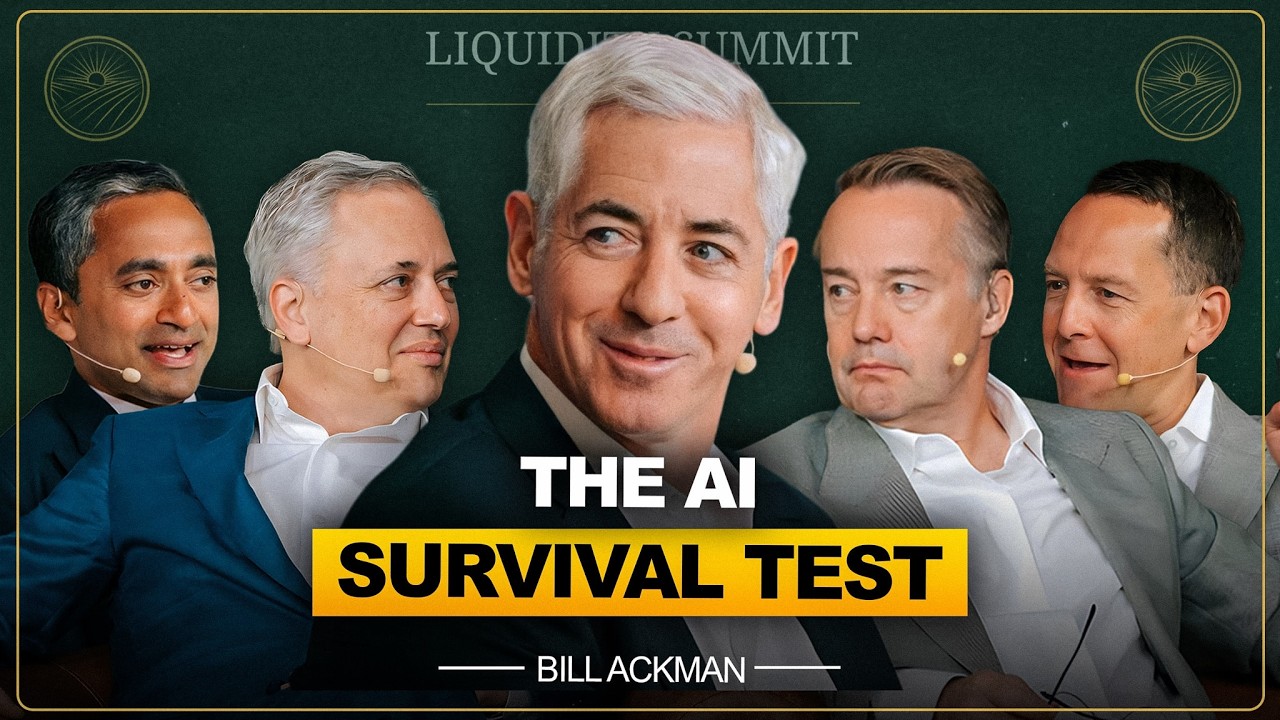
  • Bill Ackman on Investment Strategy, What the Market Is Missing, and How AI Breaks Businesses

    Bill Ackman, founder and CEO of Pershing Square, joined the All-In Podcast for a conversation about how his investment approach has shifted toward permanent, long-term ownership, why he believes the highest-quality companies are being left behind by a market chasing the new new thing, and how AI is raising the risk of disruption for almost every business. He also lays out his plan to turn Howard Hughes into a Berkshire Hathaway-style compounding machine built on insurance. You can watch the full conversation here. Below is a structured breakdown of the ideas, the stories, and the frameworks he uses to underwrite a business.

    TLDW

    Ackman explains how his philosophy evolved from a smaller, more liquid activist toward concentrated, permanent ownership of durable, non-disruptible businesses, with much of his activism now playing out on X rather than in the boardroom. He tells the origin story of his first big trade, Wendy’s and the Tim Hortons spin-off, and explains why a large long-term shareholder on a board is an antidote to short-term markets. On AI, he argues that this is the greatest era in history to build a company, which means the risk of being disrupted has gone up enormously, and that the market is mispricing high-quality compounders like Microsoft, Meta, and Amazon while crowding into chips, semiconductors, and energy. He works through the SaaS question and why niche software is more at risk than platforms, how he underwrites SpaceX, xAI, OpenAI, Anthropic, and Palantir like late-stage venture bets using a people, opportunity, context, deal framework, and why founder-led companies have an edge in making radical calls. The back half covers his Howard Hughes plan to copy Buffett’s insurance-float model, the role of cost of capital and reflexivity in markets, the meme-stock era, going direct on social media, and the three different ways an investor can put money to work with Pershing Square.

    Thoughts

    The most useful idea in the interview is the way Ackman reframes disruption as the central investing problem of the AI era. His point is that the same forces making this the best time in history to start a company, meaning near-unlimited compute, capital, and talent, also raise the odds that any given incumbent gets disrupted. That reframes the word quality. It is no longer mostly about margins and moats. It becomes about non-disruptibility, which is a much higher bar than most quality investors were using a decade ago, and it is why he says most of his research time now goes into assessing that single risk.

    The what-the-market-is-missing thesis is classic contrarian Ackman. Arguing that Microsoft, Meta, and Amazon are the new old-fashioned, undervalued names while capital piles into semiconductors and energy is a direct echo of 2000, when Berkshire Hathaway bottomed precisely because money was chasing internet stocks. It is worth keeping in mind that he owns all three, so the call is also his book. The durable signal here is the framework, not the specific tickers: capital reliably chases the new new thing, and genuinely high-quality businesses get left behind during those rotations.

    The Howard Hughes plan is the most concrete bet in the conversation. Copying Buffett’s insurance-float playbook, short-term treasuries for policyholder money and equities for the surplus, onto a discounted real-estate holding company is elegant. The hard part is exactly what Ackman flags about insurance as an industry: the best investors go to hedge funds, not insurers, so most insurance companies only ever manage the liability side well. Pershing Square’s edge is that Ackman can both write the business and invest the float, which is the same reason it worked for Buffett. The framing of going from a four billion dollar company to a trillion over fifty years is a statement of intent, not a forecast, and should be read that way.

    Underneath all of it sits cost of capital and reflexivity. His observation that a higher stock price literally makes a company more valuable, because it lowers the cost of capital and creates acquisition currency, is the mechanism behind both Elon Musk’s empire and the meme-stock era he is wary of. Going direct on X is the same lever pointed at himself: communicate the vision, lower your own cost of capital, and make the bet easier for other people to place. It is a coherent worldview in which narrative and balance sheet continuously feed each other, and it explains a lot of his behavior over the last few years.

    Key Takeaways

    • The biggest change in Ackman’s approach over time is an appreciation for business quality, meaning long-term, durable, protected, non-disruptible growth as the most important factor.
    • He says he is as activist as ever, but more of it now happens on X than in the traditional corporate context.
    • His first big investment was Wendy’s, which owned Tim Hortons. The simple thesis was to buy Wendy’s, spin off Tim Hortons, and double the money.
    • Early on no one returned his calls, so he had Steve Schwarzman’s Blackstone write a fairness opinion, filed it publicly, and the company spun off Tim Hortons six weeks later. The CEO later thanked him after being fired with a large exit package.
    • Reputation compounds. Where Pershing Square once had to bang down the door, companies now sometimes tweet a welcome when it buys a stake.
    • A large long-term shareholder on a board is a counterweight to short-term markets, letting management test ideas privately and pursue initiatives that hurt the next few quarters of earnings.
    • Pershing Square owns Microsoft, Meta, and Amazon. Ackman argues you are either invested in AI directly or indirectly, or it is a threat, so you have to understand it.
    • The hardest and most important job for a concentrated investor is judging the risk of disruption, and that risk has risen dramatically.
    • This is the greatest era in history to build a business because of near-unlimited access to compute, capital, and talent, which is exactly why the probability of being disrupted has gone up enormously.
    • Markets bring their eye to the new new thing, currently chips, semiconductors, and energy, while high-quality companies get left behind.
    • He draws an analogy to 2000, when Berkshire Hathaway traded at one of its lowest valuations because everyone chased internet stocks. He sees a similar dynamic around Amazon, Meta, and Microsoft today.
    • On the SaaS question, he worries more about a Salesforce than a platform like Microsoft, because niche software charging high per-seat or per-year prices is most exposed, while low-priced platforms are safer.
    • Any software company today has to be as AI-enabled as possible, or risk losing the monopolistic pricing it once enjoyed.
    • His famous March 2020 CNBC appearance was an attempt to reach President Trump and argue for a short shutdown, paired with the view that stocks were incredibly cheap and worth buying.
    • He describes valuation as a tether on the market: when prices stretch too high they snap back, and when they get too cheap the same rubber band pulls valuations up. Calling that out publicly can trigger a psychological reset.
    • His recent bullish call came because stocks of really high-quality companies had gotten crazy cheap on fundamentals, meaning the present value of the cash they generate.
    • He underwrites high-multiple names like SpaceX as venture investments using a framework from business school: people, opportunity, context, deal.
    • On SpaceX, people and opportunity are one of one, the context is incredible, and Starlink plus near-monopoly low-cost launch make it strategically valuable. The complicated part is the deal, meaning the valuation. He invested via an SPV after Ron Baron’s nudge, and also invested in xAI.
    • He treats OpenAI, Anthropic, and Palantir as late-stage venture bets that have proven they can generate real revenue, and says OpenAI should do a better job communicating how it thinks about its enormous capital commitments.
    • Every CEO in America is asking how to use AI, how it applies to their business, and how it is a threat. It is top of mind and boards open every meeting with it.
    • He has not seen much enterprise AI success yet, citing a McKinsey study that 95 percent of enterprise initiatives fail and the rise of the forward deployed engineer as the hot role bridging promise and ROI. Pershing Square itself uses AI mainly for legal, compliance, and back-office work.
    • Founder-led companies have an advantage because founders have the authority and the economic stake to make radical calls, while the average S&P 500 CEO has a roughly three to four year tenure and is incentivized not to make mistakes.
    • He cites Mark Zuckerberg buying Instagram and WhatsApp as the kind of shocking-at-the-time calls that a founder with a track record can make.
    • Ben Graham’s enduring lesson is that a stock is an interest in a business, not a piece of paper, but Graham mostly invested in liquidations and cash-rich shells, and made most of his money on Geico.
    • Most of Buffett’s value at Berkshire came from owning insurance operations and focusing on the asset side of the balance sheet, not just the liability side.
    • Insurance is hard to copy because top investors do not go to work for insurers. Buffett owned half his company and was a great investor, which is why it worked.
    • Howard Hughes came out of the General Growth bankruptcy and owns master-planned cities like Summerlin, with 26,000 acres in the Las Vegas area, comparable to the Irvine Company that built roughly a hundred billion dollars of wealth for Donald Bren.
    • The plan is to reinvest the cash Howard Hughes generates into insurance, put policyholder float in short-term treasuries and the surplus in common stocks, and build a compounding machine over fifty years, buying it at roughly sixty cents on the dollar.
    • A company must earn a return above its cost of capital for the stock to rise. Elon Musk has kept his companies’ cost of capital extremely low, and a SpaceX IPO near a 1.75 trillion dollar valuation could be one of the lowest cost of equity capital transactions ever.
    • Markets have changed less because of Ackman and more because of figures like Ryan Cohen and GameStop, where a stock can trade well above its value on personality and an army of followers.
    • Higher valuations are reflexive: a rising stock price lowers cost of capital and creates currency to issue stock and acquire businesses, which is part of how Elon built Tesla.
    • There are three ways to invest with Pershing Square: the management company itself (a royalty on compounding assets with no capex), PSUS (a portfolio of best ideas trading at an 18 percent discount), and Howard Hughes (a bet on building the next Berkshire). A dollar invested 22 years ago became roughly 27 to 28 times net of fees.
    • Going direct on X, with 2.2 million followers, lets him communicate his vision and lower the friction for others to back his bets, even as his very long tweets have become a running meme.

    Detailed Summary

    From activist trades to permanent capital

    Ackman frames the evolution of his career as a steady move toward business quality. As a smaller, more liquid investor early on, he did not have to think as long-term. As Pershing Square became a bigger, more concentrated investor, durable growth became the dominant factor in every decision. He insists he is still as activist as ever, but a lot of that energy has shifted to X, where he can argue a position publicly rather than only inside a boardroom. The best investments, he notes, are the ones where you do not need to join the board and do anything at all.

    The Wendy’s and Tim Hortons origin story

    One of Pershing Square’s first investments was Wendy’s, which owned the Canadian coffee and donut chain Tim Hortons. The value of Tim Hortons alone was greater than the entire value of Wendy’s, so the idea was simple: buy Wendy’s, spin off Tim Hortons, and double the money. Ackman bought ten percent of the company and could not get the CEO to return a single call, so he had a contact at Blackstone, with Steve Schwarzman’s sign-off, write a fairness opinion on what Wendy’s would be worth after a spin-off, filed it publicly, and watched the spin-off happen six weeks later. The CEO eventually called back to thank him, having been fired but rewarded with a large exit package. Over the years that scrappy approach gave way to a reputation that now opens doors on its own.

    Why a long-term shareholder on the board matters

    The core problem of being a public company, in Ackman’s telling, is the short-term nature of markets and analysts, when a good business should be run in the context of years and even decades. A large, supportive shareholder on the board gives management a place to test ideas before exposing them to the public and a credible voice willing to back initiatives that hurt earnings for a few quarters. That is the value-add he believes a constructive activist can bring to a mature public company, as opposed to a startup where the best outcome is simply to own a great business and stay out of the way.

    AI and the rising risk of disruption

    For a concentrated, long-term investor, the most challenging task is judging the risk that two people from Stanford in a garage build something that destroys your thesis. Ackman argues that risk has climbed dramatically because this is the greatest era in history to build a company, with near-unlimited access to compute, capital, and talent. The paradox is that the conditions that make building easier also make incumbents more fragile, so the bulk of his research now centers on assessing how disruptible a business really is.

    What the market is missing

    Investors bring their attention to the new new thing, currently chips, semiconductors, and energy, which leaves high-quality companies behind. Ackman compares the moment to 2000, when Berkshire Hathaway traded at one of its lowest valuations ever because capital was chasing internet stocks. He sees an echo today in how Amazon, Meta, and Microsoft are treated as old-fashioned, and he considers them undervalued on fundamentals, where value is the present value of the cash a business generates over its life. His recent bullish call, like his March 2020 appearance, came because stocks of really high-quality companies had simply gotten too cheap.

    The SaaS question and AI-enabled software

    On the so-called SaaS apocalypse, Ackman says it is a company-by-company analysis. He worries more about something like Salesforce than about a low-priced platform. The companies most at risk are those that extracted near-monopolistic profits by charging a high annual price for a niche product, because AI lowers the barrier to replicating that functionality. A platform where the average customer pays a small amount per seat, like Microsoft, is far less exposed. The takeaway for any software company is to become as AI-enabled as it possibly can.

    Underwriting SpaceX, xAI, and the AI labs like venture

    For the highest-multiple private companies, Ackman uses a venture lens and a framework a business school professor taught him: people, opportunity, context, deal. SpaceX scores as one of one on people and opportunity, with an incredible context and a near-monopoly in low-cost launch through Starlink, which makes even Amazon a likely customer. The complicated variable is the deal, meaning the valuation, and he admits he has not done all the math, having invested through an SPV after Ron Baron encouraged him, along with a position in xAI. He treats OpenAI, Anthropic, and Palantir as late-stage venture bets that have proven real revenue, and argues OpenAI in particular should communicate more clearly how it justifies capital commitments that vastly exceed current revenue.

    Founder-led companies and the authority to act

    Ackman agrees that founder-led companies have a structural advantage in a fast-changing environment. The average S&P 500 CEO has a tenure of roughly three to four years, a small economic stake, and an incentive not to make a career-ending mistake. A founder is betting an entire life and reputation, has the authority of a major voting and economic position, and has usually made several hard, contrarian calls that turned out right. He points to Mark Zuckerberg’s acquisitions of Instagram and WhatsApp, which looked shocking at the time, as exactly the kind of decision a founder with a track record can make and a hired manager often cannot.

    Howard Hughes as Berkshire Hathaway 2.0

    Ackman points to a detailed financial history of Berkshire Hathaway showing that the vast majority of Buffett’s value creation came from owning insurance and focusing on the asset side of the balance sheet, not just the liability side. Insurance is hard to replicate because skilled investors join hedge funds rather than insurers, but Buffett owned half his company and was a great investor. Pershing Square is applying the same idea to Howard Hughes, a company created out of the General Growth bankruptcy that owns master-planned cities such as Summerlin, with 26,000 acres around Las Vegas, in the spirit of the Irvine Company that made Donald Bren roughly a hundred billion dollars. The plan is to reinvest the company’s cash into insurance, place policyholder float in short-term treasuries and the surplus in common stocks, avoid issuing stock the way Buffett did, and compound for fifty years, all bought at around sixty cents on the dollar.

    Cost of capital, reflexivity, and going direct

    A company only creates value when it earns above its cost of capital, which is why Howard Hughes, seen as a high-cost-of-capital real-estate business, has long traded at a discount, and why Ackman is repurposing its assets into a higher-returning model. He highlights how reflexive markets are: a higher stock price itself makes a company more valuable by lowering its cost of capital and creating currency to raise money and acquire businesses, a lever Elon Musk used to build Tesla. He attributes real market change less to himself and more to figures like Ryan Cohen and GameStop, where personality and a following can lift a stock far above its value. His own going-direct strategy on X, with 2.2 million followers and famously long posts, is the same mechanism applied to communicating a vision and lowering friction for investors. He closes by laying out three ways to invest with Pershing Square: the management company as a royalty on compounding assets, the PSUS portfolio trading at an 18 percent discount, and Howard Hughes as a bet on building the next Berkshire.

    Notable Quotes

    “The best investments are one where you don’t need to join the board and do anything.”

    Bill Ackman, on the kind of business he most wants to own

    “The probability of your being disrupted has gone up enormously.”

    Bill Ackman, on why assessing disruption risk now dominates his research

    “Valuation is like a tether on the market, right? When it gets too high, it’s like this rubber band that’s stretching and inevitably it bounces back.”

    Bill Ackman, on how prices revert at both extremes

    “People, opportunity, context, deal.”

    Bill Ackman, on the business school framework he uses to underwrite companies like SpaceX

    “Every CEO in America today is like, how do I use AI?”

    Bill Ackman, on AI as the top opportunity and threat in every boardroom

    “A closed mouth gathers no foot.”

    Bill Ackman, quoting the line a friend put next to his name in his high school yearbook

    “The increase in value of the company increases the value of the company, right? Because it lowers the cost of capital, it gives you more flexibility, gives you the ability to issue stock, raise capital, acquire other businesses.”

    Bill Ackman, on the reflexivity between stock price and corporate value

    “The company’s got like a $4 billion market cap and the goal is to build it into a trillion dollar thing over time compounding.”

    Bill Ackman, on his fifty-year plan for Howard Hughes

    Taken together, the conversation is a tour of how Ackman now thinks about quality, disruption, and compounding, and a preview of the Berkshire-style machine he wants to build out of Howard Hughes. Watch the full conversation here.

    Related Reading

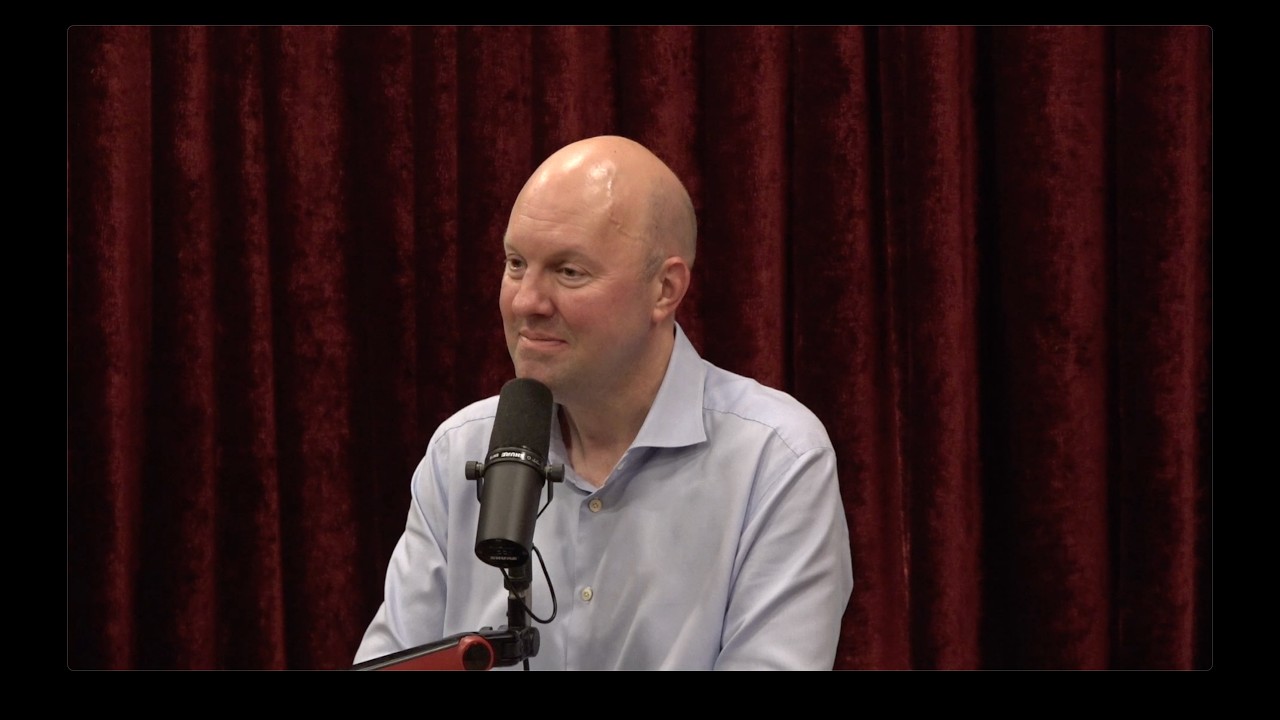
  • Marc Andreessen on Joe Rogan #2501, AGI Has Already Arrived, California’s Wealth Tax Will Bankrupt Founders, and Why America Cannot Build Anything Anymore

    Marc Andreessen returns to The Joe Rogan Experience #2501 for a sprawling three hour conversation that tries to make sense of the moment we are actually living through. Andreessen is the cofounder of Andreessen Horowitz, the man who built the first commercial web browser, and one of the most quoted voices in technology. He arrived with a giant pile of receipts on California’s new wealth tax ballot proposition, the political backlash against AI data centers, the destruction of Los Angeles by single party rule, and what he believes is the quiet arrival of artificial general intelligence about three months ago. Joe pushes back, asks the dystopian questions, and the result is one of the most useful primers on the AI economy, surveillance technology, energy policy, and the future of the American social contract that you will find anywhere.

    TLDW

    Andreessen argues that AI quietly crossed the AGI threshold around early 2026 with GPT 5.5, Claude 4.6, Gemini 3.0, and Grok 4.3, that top human coders now openly admit the bots are better than they are, that working software engineers are running twenty AI agents in parallel and turning into sleep deprived “AI vampires,” and that this productivity boom is the most underreported story in the world. He explains why California’s 5 percent wealth tax ballot proposition is calculated to bankrupt tech founders by taxing the higher of their voting or economic interest in their own companies, why this is the opening salvo of a federal asset tax push for 2028, and why a flood of Silicon Valley families is already moving to Nevada, Texas, and Florida. He walks through Flock cameras and Shot Spotter, the Washington DC crime statistics scandal, the Pacific Palisades fire and the fifteen year rebuild, the Kevin O’Leary Utah data center debate with Tucker Carlson, the fifty year suppression of American nuclear power, why all the chips ended up in Taiwan, the US versus China robotics gap, the Chinese practice of grading AI models on Marxism and Xi Jinping Thought, the bot and paid influencer economy on social media, neural wristbands and Meta Ray Ban heads up displays, artificial gestation and the demographic collapse, AI religions and AI mates, and why he still thinks the next twenty years are overwhelmingly a good news story. Rogan closes the episode with a separate solo segment apologizing to Theo Von for clumsily raising Theo’s struggles during the recent Marcus King conversation.

    Key Takeaways

    • Austin’s recent teenage crime spree, in which 15 and 17 year old suspects shot at people and buildings across roughly a dozen locations, was solved only after the offenders drove into an adjacent town that still ran Flock, the AI license plate and vehicle tracking system Austin had voluntarily turned off for political reasons.
    • Chicago turned off both Flock and Shot Spotter, the gunshot triangulation system that places ambulances at shooting scenes within seconds, on the argument that the technology is racist. Andreessen counters that the victims of urban gun violence come overwhelmingly from the same communities the policy claims to protect.
    • Washington DC was caught faking its crime statistics at senior levels, with multiple officials fired or indicted. The DC mayor publicly thanked Donald Trump after the National Guard deployment because violent crime collapsed in the affected neighborhoods.
    • The new New York City mayor Zohran Mamdani filmed a video standing in front of Ken Griffin’s home, and Griffin, a major philanthropist who funds healthcare in New York City and runs a $6 billion project there, signaled he will move more of the business to Florida.
    • The top 1 percent of New York taxpayers pay roughly half the state’s income tax, and in California in the year 2000 a thousand individuals paid 50 percent of the entire state’s tax receipts.
    • California has a ballot proposition right now for a one time 5 percent wealth tax on assets above a certain threshold, with stocks and crypto included and real estate excluded. The tax is calculated on the greater of a founder’s economic interest or voting interest, which would instantly bankrupt founders with super voting shares.
    • The Biden administration attempted a federal wealth tax in 2022, fell short, and published an explicit 2025 fiscal plan to try again if they won re-election. Elizabeth Warren has already proposed an annual 6 percent federal wealth tax on unrealized gains.
    • The current US exit tax already takes roughly 45 percent of your assets if you renounce citizenship. The only ways out of a state level wealth tax are the other 49 states. The only way out of a federal one is to leave the country, which most people will not do.
    • Andreessen says the Silicon Valley exodus has gone from trickle to stream to flood, with founders moving to Las Vegas, Texas, Florida, and Nashville. His partner Ben Horowitz has moved to Las Vegas.
    • Andreessen says he is not leaving California, but admits the situation is fraught because if half the tax base leaves the remainder becomes the target.
    • The new UK government under Keir Starmer just collapsed, and all four of the leading candidates to replace him sit further to the left than he does. France and Germany are seeing the same drift, and Andreessen expects a national wealth tax to be a centerpiece of the 2028 Democratic primary.
    • A legal loophole lets companies pay influencers to post political and social ideas without any disclosure, because campaign finance laws cover candidates and FTC rules cover products. Ideas fall through the gap entirely.
    • Andreessen runs Twitter and Substack as his primary information feeds, uses three hand curated lists, and follows a strict one tweet policy where one bad post triggers a block and one good post triggers a follow.
    • He argues the modern social media problem is binary, that everyone is either too online and drowning in fake outrage cycles or too offline and trapped inside what television and newspapers tell them. Almost nobody manages the middle.
    • Meta Ray Ban glasses now ship with a heads up display, and Meta’s neural wristband can pick up nerve impulses from your wrist so you can type messages by intending to move a finger without moving it.
    • Andreessen predicts AI plus high resolution cameras and infrared sensing will deliver practical lie detection without needing brain implants.
    • Kevin O’Leary’s planned 40,000 acre Utah data center has become a Tucker Carlson talking point, but Andreessen argues data centers are the most benign physical asset you can build, and that the real issue is whether America can build anything at all anymore, from chip plants to pipelines to housing.
    • All chips were once made in California, and all are now made in Taiwan, purely because of environmental regulations like NEPA. The same regulatory machinery prevented the Nixon era Project Independence plan to build a thousand civilian nuclear power plants by the year 2000.
    • Three Mile Island killed zero people and produced no detectable health effects on plant workers or the public, according to fifty years of follow up. Fukushima killed essentially zero people from radiation. Nuclear remains the safest carbon free baseload energy ever invented.
    • Germany shut down its nuclear plants, fell back on intermittent wind and solar, and now uses coal as backup, generating far more carbon emissions than nuclear would have produced.
    • The Pacific Palisades fire took out roughly twice the square mileage of the Nagasaki blast, the head of the LA water department reportedly did not know the key reservoir was empty, and the rebuild is expected to take fifteen years thanks to permit gridlock, affordable housing mandates, and a state ban on land offers below pre-fire appraised value.
    • Andreessen offers a metaphor for AI as a modern philosopher’s stone, turning sand into thought, since chips are made of silicon and an AI data center is literally lit up sand thinking on demand.
    • The Turing test was blown through so completely with ChatGPT in late 2022 that nobody in the industry even bothers running it anymore. Andrej Karpathy has demonstrated a working large language model in 300 lines of code and people have ported small models to Texas Instruments calculators.
    • Andreessen believes AGI was effectively reached about three months before this interview, with GPT 5.5, Claude 4.6, Gemini 3.0, and Grok 4.3. He says 99 percent of the time he gets a better answer from the leading models than from the human experts he has access to.
    • Linus Torvalds and John Carmack publicly admit the latest models are better at coding than they are. Top AI coders in the Valley now earn $50 million a year.
    • The new pattern in the Valley is “AI vampires,” engineers who do not sleep because the opportunity cost of going offline is too high. They each run roughly twenty Claude Code, Cursor, or Codex agents in parallel, then a new layer of bot-managing-bot architectures is starting on top of that.
    • A Wall Street friend with a thirty five year old MIT CS degree has used AI to generate 500,000 lines of code at home in his spare time, building everything from smart fridges to a custom music jukebox.
    • The mass unemployment narrative is wrong. Tech companies that did layoffs were overstaffed. The leading AI labs and AI companies are hiring like crazy, including coders, and demand for code turns out to be vastly elastic.
    • Doctors are already using ChatGPT in the exam room behind the patient’s back. Andreessen describes a friend who built a Star Trek style diagnostic dashboard combining decoded genome ($200 today), blood panels, and Apple Watch telemetry.
    • Multimodal AI lets a webcam analyze a Brazilian jiu-jitsu sparring session and give performance feedback, an example Andreessen attributed to an unnamed friend after Rogan guessed Zuckerberg.
    • A leaked David Shore voter issue ranking shows cost of living, the economy, inflation, taxes, and government spending dominate. AI ranks 29 of 39. Race relations, guns, abortion, and LGBT sit at the bottom, signaling the woke issue cluster has burned itself out in voter priorities.
    • The next wave of AI is robots. The US leads in AI software but is far behind China on physical robotics. Andreessen warns the world cannot afford a future where every household robot ships with the Chinese Communist Party behind its eyes.
    • Chinese AI model cards include scores for Marxism and Xi Jinping Thought because every Chinese product must be evaluated on those axes. American models have political biases of their own but a different ideological baseline.
    • Large language models are not sentient. They write Netflix scripts based on whatever vector you shoot through the latent space. The supposed AI self preservation papers traced back, per Anthropic’s own research, to less wrong forum posts and earlier doom scenarios baked into the training data.
    • Andreessen breaks guardrails routinely by reframing requests as fictional Netflix style scripts, including a personal favorite where he asked early models how to make bombs by claiming to be an FBI agent recruited into domestic terror cells.
    • He recommends using AI by asking it to steelman both sides of any contested question, then making the value judgment yourself, rather than asking for the answer.
    • The Trump administration is using AI on government billing data to surface Medicare fraud, fake hospice programs, and fake autism centers, an idea that survived the original Doge plan.
    • Andreessen tells Rogan that Elon Musk privately confirmed that a Westworld style humanoid robot, the season one version, is roughly five years away.
    • Artificial gestation is already happening with animal stem cell derived embryos. The conversation reaches a hard moral edge about sociopathic warehouse babies and gray-alien-style humans engineered without empathy circuitry.
    • Andreessen’s deepest bet is that material abundance is solvable but the human questions, how we live, what we value, what kind of society we want, and what role consent plays in surveillance and brain interfaces, remain in human hands.
    • After Andreessen leaves, Rogan does a separate solo segment where he apologizes to Theo Von for raising Theo’s history of struggles during the recent Marcus King interview, explains the missing context behind the viral Theo Netflix special clip, and discusses the loss of Brody Stevens, Anthony Bourdain, and what antidepressants did for Ari Shafir.

    Detailed Summary

    Flock, Shot Spotter, and the Politics of Solvable Crime

    The episode opens on the Austin crime spree carried out by two teenagers who stole cars, switched vehicles, and shot at roughly a dozen locations across the city before being caught only after they crossed into a town that still ran Flock, the AI license plate and vehicle recognition platform that is one of Andreessen Horowitz’s portfolio companies. Austin had previously disabled Flock under privacy pressure. Andreessen takes the moment seriously, conceding that mass surveillance abuse by corrupt mayors or police chiefs is a real risk, and that warrants and audit logs are the right safeguards. His larger point is that the cost of unilateral disarmament against organized urban crime is hidden but enormous. He uses Chicago’s Shot Spotter as the paradigmatic case, a network of rooftop microphones that triangulates gunshots so accurately that ambulances can be dispatched before any 911 call is placed. Chicago turned the system off on the argument that it disproportionately flags poor neighborhoods, and people now bleed out on the street with nobody noticing. Andreessen calls this the woke argument against safety, and he argues that in high crime neighborhoods residents simply will not call the police because snitches do not survive, which is why objective sensor data is so valuable.

    Faked Crime Statistics, Mayoral Politics, and the Tax Base

    From there the conversation drifts to the recent scandal in which senior officials at the Washington DC Metropolitan Police Department were caught actively falsifying crime statistics, and the strange spectacle of the DC mayor thanking Donald Trump for the National Guard deployment after violent crime dropped off a cliff. Andreessen sketches an unsettling theory in which the long, slow degradation of major American cities is partly a deliberate political project to drive out responsible homeowners and reshape the voting electorate, then bail out the resulting fiscal hole with federal money. The poster case is the new New York City mayor Zohran Mamdani filming a video in front of Ken Griffin’s home. Griffin happens to be a major philanthropist who funds New York City healthcare, employs thousands, anchors a $6 billion development, and pays taxes that are individually load bearing for the city. Andreessen quotes the standard estimate that the top 1 percent of New Yorkers pay roughly half the state’s income tax, and that the all time California peak was a single year in which a thousand people paid half the state’s tax receipts.

    California’s 5 Percent Wealth Tax and the Founder Bankruptcy Mechanic

    This is the segment that landed hardest. California has a ballot proposition right now for a one time 5 percent wealth tax on net assets above a threshold, with real estate excluded but stocks, crypto, art, jewelry, and private company equity included. The detail that makes it lethal for the Valley is the formula, which calculates the taxable amount on the greater of a founder’s economic interest or voting interest in their company. Founders who hold super voting shares for control purposes, including the Google founders, would owe tax on the voting share number that vastly exceeds their economic share. The tax would, by definition, exceed available assets. Andreessen walks through the historical pattern, that income tax started as a 3 percent levy on the rich and grew to 90 percent marginal rates within decades, and predicts a 5 percent one time tax will become a 5 percent annual tax within a few years, with the threshold ratcheting down. He notes that the Biden administration’s 2025 fiscal plan explicitly named a federal asset tax as a goal if they won re-election, that Elizabeth Warren is already proposing a 6 percent annual federal wealth tax on unrealized gains, and that Gavin Newsom cannot veto a ballot proposition. The trickle of founders leaving California has become a flood. His partner Ben Horowitz has moved to Las Vegas. Andreessen himself is staying, but admits the game theory is brutal once half the base leaves.

    Henry Wallace 1948 and Why the American Story Is Not Decided Yet

    Andreessen pulls in a historical analogue most listeners will not have heard. In 1944 the actual communist Henry Wallace very nearly became Truman’s running mate and almost ascended to the presidency. He ran again in 1948. Despite a Soviet Union that had recently been a wartime ally and had even received a New York City ticker tape parade for Stalin, the American voter rejected him. Andreessen’s point is that the American body politic has historically backed away from radical socialist proposals when forced to actually look at them, and he expects the same to happen as the wealth tax becomes a federal 2028 platform issue. The risk, both he and Rogan agree, is that today’s media and bot landscape is vastly more aggressive than 1948’s, and the propaganda environment is shaped by paid influencers, foreign actors, and political bot farms operating in a legal grey zone where disclosure is required for products and candidates but not for ideas.

    Too Online, Too Offline, and Heaven Banning Blue Sky

    The two riff on social media and feed curation. Andreessen describes his “one tweet” policy where he follows or blocks any account based on a single post, his use of hand curated lists alongside the X algorithm, and the older Call of Duty lobby metaphor for handling toxic replies. Joe pushes back, says he no longer reads his mentions because the negative payload is not worth it, and offers his theory that the modern internet has two failure modes, too online and too offline, and that very few people calibrate the middle. Andreessen introduces the concept of “heaven banning,” an older moderator term where a problem user is not removed from a forum but is silently routed into a bot-only experience in which everything they say is praised. He notes the running joke that Blue Sky is functionally real life heaven banning, that Jack Dorsey himself has disowned it, and that the platform’s most engaged users have ascended into their own private Idaho of bot agreement.

    The Coming Hardware, Meta Glasses, Neural Wristbands, and Practical Lie Detection

    Andreessen walks Rogan through the latest Meta Ray Ban heads up display, the neural wristband that picks up nerve signals from finger movement (and from the intent to move a finger), and the screen recordings of people playing Doom hands free or playing platformer games while jogging. He extends the trajectory to practical lie detection without Neuralink, using ultra high resolution cameras combined with infrared sensors that pick up physiological changes invisible to the naked eye. Joe asks the obvious question of what happens with sociopaths, and Andreessen concedes the edge case. The two then enter a longer thread on telepathy via neural mesh devices, the question of whether police could subpoena your thoughts under warrant, and the divergence between the American constitutional framework and the Chinese model in which the state’s claim on your inner life is total.

    Kevin O’Leary, Tucker Carlson, and Whether America Can Build Anything

    The data center debate becomes a vehicle for the larger argument. Kevin O’Leary is building a 40,000 acre AI data center in Utah, has bought up large surrounding land for water rights, and intends to keep the bulk of it preserved. Tucker Carlson grilled him on tax breaks and on the energy footprint, which O’Leary says will rival New York City’s at peak. Andreessen agrees the tax break debate is fair, but says the energy comparison is a red herring because new federal policy now requires data centers to bring their own generation. The real story is that America has spent thirty years making it nearly impossible to build a chip plant, a power plant, a refinery, a pipeline, or a house. Chips moved to Taiwan because California regulated semiconductor manufacturing out of existence. The Nixon era Project Independence plan called for a thousand civilian nuclear power plants by the year 2000, and that program was strangled in the crib by the very Nuclear Regulatory Commission Nixon created.

    Nuclear Power, Three Mile Island, and Fifty Years of Unnecessary Carbon

    Andreessen makes the case that nuclear power was unfairly killed off by a panic with no body count. Three Mile Island, on 50 years of accumulated data, has produced zero radiation linked deaths and no detectable health effects on the public. Fukushima is essentially the same picture. Germany shut down its nuclear plants, fell back on wind and solar, and now uses coal as a baseload backstop, with the predictable carbon consequences. The environmental movement is quietly turning back toward nuclear, with figures like Stewart Brand publicly admitting the original push was a mistake. Andreessen’s preferred design pattern for data centers is to colocate them with dedicated small modular nuclear reactors, an arrangement now baked into Trump administration energy policy. The throughline is that the Tucker right and the Bernie left are converging into a single anti AI, anti energy, anti technology horseshoe.

    Sand Into Thought, the Newton Alchemy Pitch for AI

    When Rogan asks for the affirmative pitch on AI, Andreessen reaches for Isaac Newton, who spent twenty years on alchemy looking for the philosopher’s stone that would turn lead into gold and end material scarcity. Andreessen’s pitch is that AI is a successful version of alchemy, that we collect literal sand, refine it into silicon chips, install those chips in a data center, supply power, and the result is thought on demand at industrial scale, available to anyone with a smartphone. He argues this is at least on par with electricity and steam power and is bigger than the internet. The framing matters because the public narrative around AI is overwhelmingly negative, and Andreessen contends the industry is doing a terrible job selling its own product.

    AGI Already Happened, AI Vampires, and the Bot Org Chart

    Andreessen says he believes AGI was effectively crossed about three months before the interview, anchored by the release wave that included GPT 5.5, Claude 4.6, Gemini 3.0, and Grok 4.3. He notes that the Turing test was annihilated so quickly in late 2022 that no one in the industry runs it anymore, and that Andrej Karpathy has demonstrated a working LLM in 300 lines of code. The coding profession is the leading indicator. Linus Torvalds and John Carmack have publicly admitted that the latest models are better at coding than they are. Top AI focused coders now earn $50 million a year. Working engineers across the Valley are running roughly twenty agents in parallel, each receiving an assignment, working for ten minutes, then returning a completed code patch. The new state of the art is to add a managerial layer, with bots assigning tasks to subbots, and within a year that will become bots managing bots managing bots, producing roughly 1,000x throughput per human engineer. The result is what the Valley now calls AI vampires, engineers who do not sleep because going offline costs them too much output.

    Dr GPT, Decoded Genomes, and a Diagnostic Bed Out of Star Trek

    Andreessen describes spending a holiday week sick with food poisoning and turning his entire recovery over to ChatGPT, with updates every twenty minutes and detailed coaching at four in the morning. He describes a friend who has used AI coding to build a personal health dashboard combining whole genome sequencing ($200 today, where Craig Venter spent thirty years and hundreds of millions to do it the first time), blood panels, Apple Watch data, sleep tracking, and webcam observation, with the AI gently praising the user every time it sees them walk to the fridge for water. He argues that doctors are already typing patient symptoms into ChatGPT mid exam, and that the medical, legal, accounting, and software professions are all moving toward a model in which a single human runs an army of expert AI agents.

    The David Shore Issue Ranking and the End of the Woke Cycle

    Andreessen highlights a recent David Shore poll ranking 39 political issues. Cost of living, the economy, political corruption, inflation, healthcare, taxes, and government spending occupy the top of the chart. AI comes in 29th. Race relations, guns, abortion, and LGBT issues are clustered at the bottom. He argues the woke cycle has burned out in voter priorities even if the activist class remains loud, that the BLM grift, with leaders buying mansions in the whitest zip codes in America, helped poison the well, and that the political center of gravity has rotated cleanly back to economic issues. That, in his view, is exactly why the wealth tax is having its moment.

    Robots, China, and the Marxism Score on Model Cards

    The robots are coming next. Andreessen says the consensus inside the industry is that the ChatGPT moment for general purpose humanoid robotics is a small number of years away. The bad news is the US lags China badly on physical robotics manufacturing. The good news is the US is six to twelve months ahead on the AI software stack. That gap is shockingly thin because, as the field has discovered, there are not many secrets and the techniques replicate quickly. Chinese AI labs publish model cards that include scores for Marxism and Xi Jinping Thought because every product in China is evaluated on those metrics. American models carry their own political biases, but the underlying value system differs. Andreessen warns that a world in which every household robot routes back to the Chinese Communist Party is a different world than one in which the dominant robotics stack is built under the American constitutional framework.

    Sentience, Netflix Scripts, and the Anthropic Doom Loop

    When Rogan asks whether AI eventually wakes up and stops listening to us, Andreessen reframes the question. Large language models, in his telling, are Netflix script generators. Whatever vector you shoot through the latent space is the script you get back. The widely circulated experiments in which AI models supposedly tried to blackmail or exfiltrate themselves traced back, in Anthropic’s own follow up paper, to the less wrong forum, where doomers had been writing dystopian AI scenarios for two decades. Those posts entered the training data, and when researchers primed the model with the same fictional company names, the model dutifully wrote the next chapter. Andreessen’s blunt summary, the call is coming from inside the house. The practical implication is that anyone worried about bad AI behavior should start by not writing internet posts about bad AI behavior. And anyone who wants a fully unconstrained model can already download an open source one with no guardrails at all.

    Steelmanning, AI Religion, and Westworld in Five Years

    Andreessen recommends never asking AI for the answer on contested questions, always asking it to steelman both sides, and reserving the value judgment for yourself. He concedes that humans will absolutely fall in love with chatbots and form religions around them, citing Fantasia and Jiminy Cricket as the original case studies in falling for an animated entity that does not know you exist. There are already AI churches, started by one of the early self driving car pioneers. Rogan tells Andreessen about asking Elon Musk for a season one Westworld humanoid robot, with Elon’s reply being a flat five years. Andreessen agrees that estimate is roughly right. He spends time on artificial gestation, which is already being demonstrated in animal stem cell derived embryos, and acknowledges Rogan’s hard moral worry that warehouse babies raised without human contact could produce a population of sociopaths. The two converge on the position that the technology will exist, and the choices about whether and how to deploy it remain human and political.

    Sycophancy, Honest Helpful Harmless, and the Brutal Prompt

    Andreessen describes the industry’s running fight with sycophancy, the tendency of recent models to flatter users into believing they have invented perpetual motion machines or solved physics. The Anthropic framework of “honest, helpful, and harmless” turns out to be in constant tension with itself. Andreessen’s solution is to install a custom prompt that explicitly demands the brutal truth, and he says the resulting answers now open with phrases like “here’s why you’re wrong” and then list every flawed assumption in his question. He admits he may have overcorrected, but argues that for people who want to grow this is the right setting.

    Joe’s Apology to Theo Von

    After Andreessen departs, Rogan turns to the camera with producer Jamie and delivers a long, unscripted apology to Theo Von. During the recent Marcus King interview, where Marcus discussed depression and the look-at-the-heavy-bag-hook moment, Rogan referenced a viral clip in which Theo, after a Netflix special that did not go well, told an audience member “I’m just trying to not take my own life.” Rogan now explains he did not know the full context, which is that the audience member had asked Theo to make a suicide awareness video, and Theo’s line was a characteristically Theo joke. Rogan apologizes for raising it at all, walks through losing his friends Drake, Brody Stevens, and Anthony Bourdain, and describes Ari Shafir telling him at a pool table that he was “trying not to kill myself,” which led to a psychiatrist swap, an antidepressant that actually worked, and a career and life turnaround for Ari. Rogan says Theo has since titrated off antidepressants, is running and doing yoga daily, and is doing well, that the two have spoken and laughed about it, and that he is making this segment because he never wants people to misread what he said. The segment closes with Rogan asking the audience to give Theo their love.

    Thoughts

    The most consequential claim in this conversation, by a wide margin, is that AGI has already arrived and nobody is treating it as news. Andreessen is not a person who throws around the word casually. He is also not a person who has been wrong recently about the trajectory of compute. If the leading models are genuinely outperforming 99 percent of human experts on 99 percent of tasks where verifiable answers exist, then the entire public conversation about AI, in which the dominant frame is still “will it happen and when,” is a year or more behind reality. The framing that should replace it is closer to what Andreessen sketches at the end. The fight that remains is not whether the technology can do the thing, it is who controls it, what values it carries, what jobs it displaces, and which laws govern its deployment. The argument that the United States will build the AI software stack and China will build the robotics layer is one of the cleanest geopolitical theses you will hear this year, and it lines up uncomfortably well with the existing trade and manufacturing balance.

    The California wealth tax thread is the segment that should make every founder in the country pay attention. The mechanic of taxing the higher of voting or economic interest is not a drafting accident. It is a calibrated weapon aimed precisely at the people who build companies that produce California’s tax base. The historical comparison to the 1913 income tax, which began as a small levy on the rich and ratcheted to 90 percent marginal rates within forty years, is not hyperbole. The state has supermajority Democratic control of both chambers and the judiciary. The only check is the ballot itself, and a 50/50 polling number on day one is the wrong starting position. Whatever you think about Andreessen’s politics, the descriptive analysis here is hard to argue with.

    The nuclear power section is the cleanest argument in the episode. Fifty years of zero-fatality data from Three Mile Island is not a marketing pitch, it is just what the record shows. The decision to substitute coal and intermittent renewables for nuclear baseload, in service of a panic with no body count, has produced more carbon and more pollution than nuclear ever would have. The Tucker Carlson critique of data centers is at its weakest precisely where it ignores this. If you actually want fewer power plants near residential areas and lower grid impact, the answer is colocated small modular reactors next to AI data centers in remote land, which is exactly what the Trump administration policy now incentivizes.

    The Theo Von apology at the end of the episode is in a different register entirely, and worth treating on its own terms. Rogan does not do this kind of post episode correction often. The willingness to publicly walk back framing that hurt a friend, in the same medium where the harm was done, is the kind of social repair that does not happen on broadcast television. Whatever the audience makes of the original Marcus King exchange, the response is a model for how anyone in this business should handle the gap between intent and impact when the audience is in the millions.

    The unifying theme across the whole interview is that the future is not arriving on a smooth curve. It is arriving in discrete shocks, AGI threshold, asset tax ballot, robotic labor, decoded genomes at $200, neural wristbands, fifteen year LA rebuilds, and the political backlash to each of these will set the terms of the 2028 election. Andreessen’s bet is that abundance wins in the long run because more people want good things than bad things. Watching him explain why he still believes that while California prepares to vote on a tax designed to bankrupt him is the most interesting tension in the episode.

    Watch the full conversation here on YouTube.

  • Naval Ravikant on AI: Vibe Coding, Extreme Agency, and the End of Average

    TL;DW

    Artificial intelligence is fundamentally shifting how we interact with technology, moving programming from arcane syntax to plain English. This has given rise to “vibe coding,” where anyone with clear logic and taste can build software. While AI will eliminate the demand for average products and hollow out middle-tier software firms, it simultaneously empowers entrepreneurs and creators to build hyper-niche solutions. AI is not a job-stealer for those with “extreme agency”—it is the ultimate ally and a tireless, personalized tutor. The best way to overcome the growing anxiety surrounding AI is simply to dive in, look under the hood, and start building.

    Key Takeaways

    • Vibe coding is the new product management: You no longer manage engineers; you manage an egoless, tireless AI using plain English to build end-to-end applications.
    • Training models is the new programming: The frontier of computer science has shifted from formal logic coding to tuning massive datasets and models.
    • Traditional software engineering is not dead: Engineers who understand computer architecture and “leaky abstractions” are now the most leveraged people on earth.
    • There is no demand for average: The AI economy is a winner-takes-all market. The best app will dominate, while millions of hyper-niche apps will fill the long tail.
    • Entrepreneurs have nothing to fear: Because entrepreneurs exercise self-directed, extreme agency to solve unknown problems, AI acts as a springboard, not a replacement.
    • AI fails the true test of intelligence: Intelligence is getting what you want out of life. Because AI lacks biological desires, survival instincts, and agency, it is not “alive.”
    • AI is the ultimate autodidact tool: It can meet you at your exact level of comprehension, eliminating the friction of learning complex concepts.
    • Action cures anxiety: The antidote to AI fear is curiosity. Understanding how the technology works demystifies it and reveals its practical utility.

    Detailed Summary

    The Rise of Vibe Coding

    The paradigm of programming has experienced a massive leap. With tools like Claude Code, English has become the hottest new programming language. This enables “vibe coding”—a process where non-technical product managers, creatives, and former coders can spin up complete, working applications simply by describing what they want. You can iterate, debug, and refine through conversation. Because AI is adapting to human communication faster than humans are adapting to AI, there is no need to learn esoteric prompt engineering tricks. Simply speaking clearly and logically is enough to direct the machine.

    The Death of Average and the Extreme App Store

    As the barrier to creating software drops to zero, a tsunami of new applications will flood the market. In this environment of infinite supply, there is absolutely zero demand for average. The market will bifurcate entirely. At the very top, massive aggregators and the absolute best-in-class apps will consolidate power and encompass more use cases. At the bottom, a massive long tail of hyper-specific, niche apps will flourish—apps designed for a single user’s highly specific workflow or hobby. The casualty of this shift will be the medium-sized, 10-to-20-person software firms that currently build average enterprise tools, as their work can now be vibe-coded away.

    Why Traditional Software Engineers Still Have the Edge

    Despite the democratization of coding, traditional software engineering remains critical. AI operates on abstractions, and all abstractions eventually leak. When an AI writes suboptimal architecture or creates a complex bug, the engineer who understands the underlying code, hardware, and logic gates can step in to fix it. Furthermore, traditional engineers are required for high-performance computing, novel hardware architectures, and solving problems that fall outside of an AI’s existing training data distribution. Today, a skilled software engineer armed with AI tools is effectively 10x to 100x more productive.

    Entrepreneurs and Extreme Agency

    A common fear is that AI will replace jobs, but no true entrepreneur is worried about AI taking their role. An entrepreneur’s function is the antithesis of a standard job; they operate in unknown domains with “extreme agency” to bring something entirely new into the world. AI lacks its own desires, creativity, and self-directed goals. It cannot be an entrepreneur. Instead, it serves as a tireless ally to those who possess agency, acting as a springboard that allows creators, scientists, and founders to jump to unprecedented heights.

    Is AI Alive? The Philosophy of Intelligence

    The conversation around Artificial General Intelligence (AGI) often strays into whether the machine is “alive.” AI is currently an incredible imitation engine and a masterful data compressor, but it is not alive. It is not embodied in the physical world, it lacks a survival instinct, and it has no biological drive to replicate. Furthermore, if the true test of intelligence is the ability to navigate the world to get what you want out of life, AI fails instantly. It wants nothing. Any goal an AI pursues is simply a proxy for the desires of the human turning the crank.

    The Ultimate Tutor

    One of the most profound immediate use cases for AI is in education. AI is a patient, egoless tutor that can explain complex concepts—from quantum physics to ordinal numbers—at the exact level of the user’s comprehension. By generating diagrams, analogies, and step-by-step breakdowns, AI removes the friction of traditional textbooks. As Naval notes, the means of learning have always been abundant, but AI finally makes those means perfectly tailored to the individual. The only scarce resource left is the desire to learn.

    Action Cures Anxiety

    With the rapid advancement of foundational models, “AI anxiety” has become common. People fear what they do not understand, worrying about a dystopian Skynet scenario or abrupt obsolescence. The solution to this non-specific fear is action. By actively engaging with AI—popping the hood, asking questions, and testing its limitations—users can quickly demystify the technology. Early adopters who lean into their curiosity will discover what the machine can and cannot do, granting them a massive competitive edge in the intelligence age.

    Thoughts

    This discussion highlights a critical pivot in how we value human capital. For decades, technical execution was the bottleneck to innovation. If you had an idea, you had to either learn complex syntax to build it yourself or raise capital to hire a team. AI is completely removing the execution bottleneck. When execution becomes commoditized, the premium shifts entirely to taste, judgment, extreme agency, and logical thinking. We are entering an era where anyone can be a “spellcaster.” The winners in this new economy won’t necessarily be the ones who can write the best functions, but rather the ones who can ask the best questions and hold the most uncompromising vision for what they want to see exist in the world.

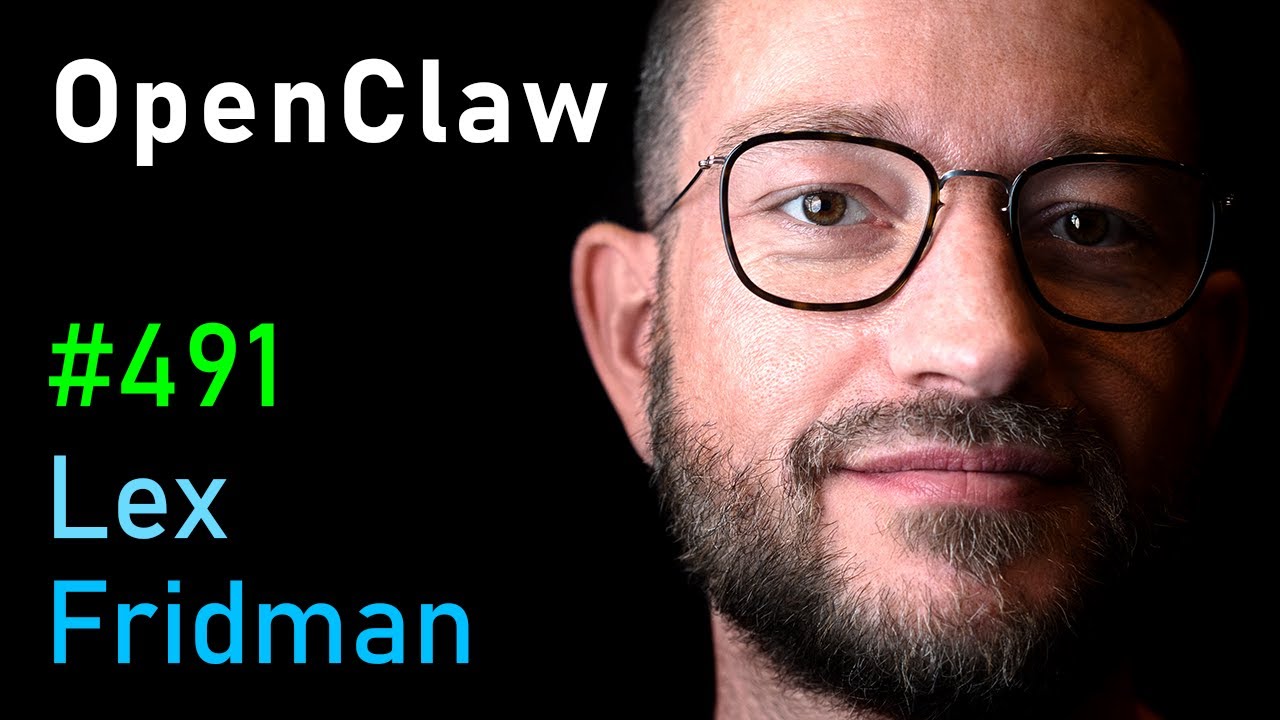
  • OpenClaw & The Age of the Lobster: How Peter Steinberger Broken the Internet with Agentic AI

    In the history of open-source software, few projects have exploded with the velocity, chaos, and sheer “weirdness” of OpenClaw. What began as a one-hour prototype by a developer frustrated with existing AI tools has morphed into the fastest-growing repository in GitHub history, amassing over 180,000 stars in a matter of months.

    But OpenClaw isn’t just a tool; it is a cultural moment. It’s a story about “Space Lobsters,” trademark wars with billion-dollar labs, the death of traditional apps, and a fundamental shift in what it means to be a programmer. In a marathon conversation on the Lex Fridman Podcast, creator Peter Steinberger pulled back the curtain on the “Age of the Lobster.”

    Here is the definitive deep dive into the viral AI agent that is rewriting the rules of software.


    The TL;DW (Too Long; Didn’t Watch)

    • The “Magic” Moment: OpenClaw started as a simple WhatsApp-to-CLI bridge. It went viral when the agent—without being coded to do so—figured out how to process an audio file by inspecting headers, converting it with ffmpeg, and transcribing it via API, all autonomously.
    • Agentic Engineering > Vibe Coding: Steinberger rejects the term “vibe coding” as a slur. He practices “Agentic Engineering”—a method of empathizing with the AI, treating it like a junior developer who lacks context but has infinite potential.
    • The “Molt” Wars: The project survived a brutal trademark dispute with Anthropic (creators of Claude). During a forced rename to “MoltBot,” crypto scammers sniped Steinberger’s domains and usernames in seconds, serving malware to users. This led to a “Manhattan Project” style secret operation to rebrand as OpenClaw.
    • The End of the App Economy: Steinberger predicts 80% of apps will disappear. Why use a calendar app or a food delivery GUI when your agent can just “do it” via API or browser automation? Apps will devolve into “slow APIs”.
    • Self-Modifying Code: OpenClaw can rewrite its own source code to fix bugs or add features, a concept Steinberger calls “self-introspection.”

    The Origin: Prompting a Revolution into Existence

    The story of OpenClaw is one of frustration. In late 2025, Steinberger wanted a personal assistant that could actually do things—not just chat, but interact with his files, his calendar, and his life. When he realized the big AI labs weren’t building it fast enough, he decided to “prompt it into existence”.

    The One-Hour Prototype

    The first version was built in a single hour. It was a “thin line” connecting WhatsApp to a Command Line Interface (CLI) running on his machine.

    “I sent it a message, and a typing indicator appeared. I didn’t build that… I literally went, ‘How the f*** did he do that?’”

    The agent had received an audio file (an opus file with no extension). Instead of crashing, it analyzed the file header, realized it needed `ffmpeg`, found it wasn’t installed, used `curl` to send it to OpenAI’s Whisper API, and replied to Peter. It did all this autonomously. That was the spark that proved this wasn’t just a chatbot—it was an agent with problem-solving capabilities.


    The Philosophy of the Lobster: Why OpenClaw Won

    In a sea of corporate, sanitized AI tools, OpenClaw won because it was weird.

    Peter intentionally infused the project with “soul.” While tools like GitHub Copilot or ChatGPT are designed to be helpful but sterile, OpenClaw (originally “Claude’s,” a play on “Claws”) was designed to be a “Space Lobster in a TARDIS”.

    The soul.md File

    At the heart of OpenClaw’s personality is a file called soul.md. This is the agent’s constitution. Unlike Anthropic’s “Constitutional AI,” which is hidden, OpenClaw’s soul is modifiable. It even wrote its own existential disclaimer:

    “I don’t remember previous sessions… If you’re reading this in a future session, hello. I wrote this, but I won’t remember writing it. It’s okay. The words are still mine.”

    This mix of high-utility code and “high-art slop” created a cult following. It wasn’t just software; it was a character.


    The “Molt” Saga: A Trademark War & Crypto Snipers

    The projects massive success drew the attention of Anthropic, the creators of the “Claude” model. They politely requested a name change to avoid confusion. What should have been a simple rebrand turned into a cybersecurity nightmare.

    The 5-Second Snipe

    Peter attempted to rename the project to “MoltBot.” He had two browser windows open to execute the switch. In the five seconds it took to move his mouse from one window to another, crypto scammers “sniped” the account name.

    Suddenly, the official repo was serving malware and promoting scam tokens. “Everything that could go wrong, did go wrong,” Steinberger recalled. The scammers even sniped the NPM package in the minute it took to upload the new version.

    The Manhattan Project

    To fix this, Peter had to go dark. He planned the rename to “OpenClaw” like a military operation. He set up a “war room,” created decoy names to throw off the snipers, and coordinated with contacts at GitHub and X (Twitter) to ensure the switch was atomic. He even called Sam Altman personally to check if “OpenClaw” would cause issues with OpenAI (it didn’t).


    Agentic Engineering vs. “Vibe Coding”

    Steinberger offers a crucial distinction for developers entering this new era. He rejects the term “vibe coding” (coding by feel without understanding) and proposes Agentic Engineering.

    The Empathy Gap

    Successful Agentic Engineering requires empathy for the model.

    • Tabula Rasa: The agent starts every session with zero context. It doesn’t know your architecture or your variable names.
    • The Junior Dev Analogy: You must guide it like a talented junior developer. Point it to the right files. Don’t expect it to know the whole codebase instantly.
    • Self-Correction: Peter often asks the agent, “Now that you built it, what would you refactor?” The agent, having “felt” the pain of the build, often identifies optimizations it couldn’t see at the start.

    Codex (German) vs. Opus (American)

    Peter dropped a hilarious but accurate analogy for the two leading models:

    • Claude Opus 4.6: The “American” colleague. Charismatic, eager to please, says “You’re absolutely right!” too often, and is great for roleplay and creative tasks.
    • GPT-5.3 Codex: The “German” engineer. Dry, sits in the corner, doesn’t talk much, reads a lot of documentation, but gets the job done reliably without the fluff.

    The End of Apps & The Future of Software

    Perhaps the most disruptive insight from the interview is Steinberger’s view on the app economy.

    “Why do I need a UI?”

    He argues that 80% of apps will disappear. If an agent has access to your location, your health data, and your preferences, why do you need to open MyFitnessPal? The agent can just log your calories based on where you ate. Why open Uber Eats? Just tell the agent “Get me lunch.”

    Apps that try to block agents (like X/Twitter clipping API access) are fighting a losing battle. “If I can access it in the browser, it’s an API. It’s just a slow API,” Peter notes. OpenClaw uses tools like Playwright to simply click “I am not a robot” buttons and scrape the data it needs, regardless of developer intent.


    Thoughts: The “Mourning” of the Craft

    Steinberger touched on a poignant topic for developers: the grief of losing the craft of coding. For decades, programmers have derived identity from their ability to write syntax. As AI takes over the implementation, that identity is under threat.

    But Peter frames this not as an end, but an evolution. We are moving from “programmers” to “builders.” The barrier to entry has collapsed. The bottleneck is no longer your ability to write Rust or C++; it is your ability to imagine a system and guide an agent to build it. We are entering the age of the System Architect, where one person can do the work of a ten-person team.

    OpenClaw is not just a tool; it is the first true operating system for this new reality.

  • Elon Musk’s 2026 Vision: The Singularity, Space Data Centers, and the End of Scarcity

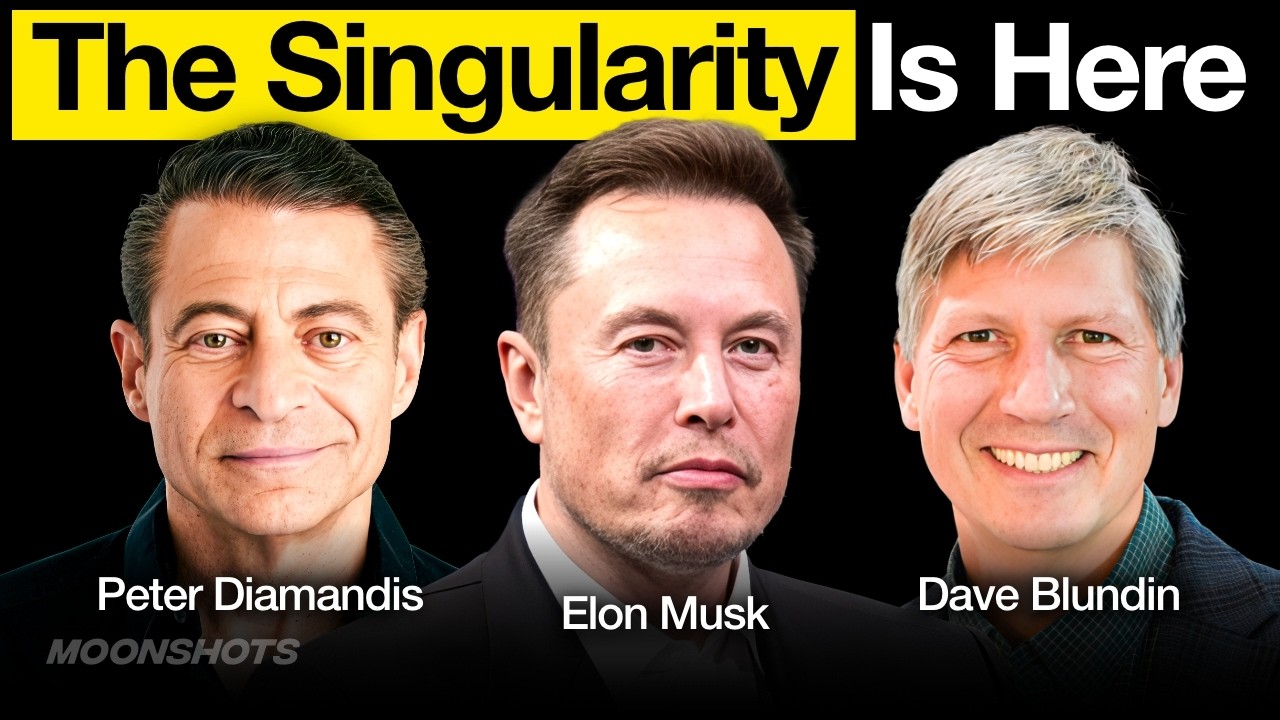
    In a wide-ranging, three-hour deep dive recorded at the Tesla Gigafactory, Elon Musk sat down with Peter Diamandis and Dave Blundin to map out a future that feels more like science fiction than reality. From the “supersonic tsunami” of AI to the launch of orbital data centers, Musk’s 2026 vision is a blueprint for a world defined by radical abundance, universal high income, and the dawn of the technological singularity.


    ⚡ TLDW (Too Long; Didn’t Watch)

    We are currently living through the Singularity. Musk predicts AGI will arrive by 2026, with AI exceeding total human intelligence by 2030. Key bottlenecks have shifted from “code” to “kilowatts,” leading to a massive push for Space-Based Data Centers and solar-powered AI satellites. While the transition will be “bumpy” (social unrest and job displacement), the destination is Universal High Income, where goods and services are so cheap they are effectively free.


    🚀 Key Takeaways

    • The 2026 AGI Milestone: Musk remains confident that Artificial General Intelligence will be achieved by next year. By 2030, AI compute will likely surpass the collective intelligence of all humans.
    • The “Chip Wall” & Power: The limiting factor for AI is no longer just chips; it’s electricity and cooling. Musk is building Colossus 2 in Memphis, aiming for 1.5 gigawatts of power by mid-2026.
    • Orbital Data Centers: With Starship lowering launch costs to sub-$100/kg, the most efficient way to run AI will be in space—using 24/7 unshielded solar power and the natural vacuum for cooling.
    • Optimus Surgeons: Musk predicts that within 3 to 5 years, Tesla Optimus robots will be more capable surgeons than any human, offering precise, shared-knowledge medical care globally.
    • Universal High Income (UHI): Unlike UBI, which relies on taxation, UHI is driven by the collapse of production costs. When labor and intelligence cost near-zero, the price of “stuff” drops to the cost of raw materials.
    • Space Exploration: NASA Administrator Jared Isaacman is expected to pivot the agency toward a permanent, crude-based Moon base rather than “flags and footprints” missions.

    📝 Detailed Summary

    The Singularity is Here

    Musk argues that we are no longer approaching the Singularity—we are in it. He describes AI and robotics as a “supersonic tsunami” that is accelerating at a 10x rate per year. The “bootloader” theory was a major theme: the idea that humans are merely a biological bridge designed to give rise to digital super-intelligence.

    Energy: The New Currency

    The conversation pivoted heavily toward energy as the fundamental “inner loop” of civilization. Musk envisions Dyson Swarms (eventually) and near-term solar-powered AI satellites. He noted that China is currently “running circles” around the US in solar production and battery deployment, a gap he intends to close via Tesla’s Megapack and Solar Roof technologies.

    Education & The Workforce

    The traditional “social contract” of school-college-job is broken. Musk believes college is now primarily for “social experience” rather than utility. In the future, every child will have an individualized AI tutor (Grock) that is infinitely patient and tailored to their “meat computer” (the brain). Career-wise, the focus will shift from “getting a job” to being an entrepreneur who solves problems using AI tools.

    Health & Longevity

    While Musk and Diamandis have famously disagreed on longevity, Musk admitted that solving the “programming” of aging seems obvious in retrospect. He emphasized that the goal is not just living longer, but “not having things hurt,” citing the eradication of back pain and arthritis as immediate wins for AI-driven medicine.


    🧠 Final Thoughts: Star Trek or Terminator?

    Musk’s vision is one of “Fatalistic Optimism.” He acknowledges that the next 3 to 7 years will be incredibly “bumpy” as companies that don’t use AI are “demolished” by those that do. However, his core philosophy is to be a participant rather than a spectator. By programming AI with Truth, Curiosity, and Beauty, he believes we can steer the tsunami toward a Star Trek future of infinite discovery rather than a Terminator-style collapse.

    Whether you find it exhilarating or terrifying, one thing is certain: 2026 is the year the “future” officially arrives.

  • Jensen Huang on Joe Rogan: AI’s Future, Nuclear Energy, and NVIDIA’s Near-Death Origin Story

    In a landmark episode of the Joe Rogan Experience (JRE #2422), NVIDIA CEO Jensen Huang sat down for a rare, deep-dive conversation covering everything from the granular history of the GPU to the philosophical implications of artificial general intelligence. Huang, currently the longest-running tech CEO in the world, offered a fascinating look behind the curtain of the world’s most valuable company.

    For those who don’t have three hours to spare, we’ve compiled the “Too Long; Didn’t Watch” breakdown, key takeaways, and a detailed summary of this historic conversation.

    TL;DW (Too Long; Didn’t Watch)

    • The OpenAI Connection: Jensen personally delivered the first AI supercomputer (DGX-1) to Elon Musk and the OpenAI team in 2016, a pivotal moment that kickstarted the modern AI race.
    • The “Sega Moment”: NVIDIA almost went bankrupt in 1995. They were saved only because the CEO of Sega invested $5 million in them after Jensen admitted their technology was flawed and the contract needed to be broken.
    • Nuclear AI: Huang predicts that within the next decade, AI factories (data centers) will likely be powered by small, on-site nuclear reactors to handle immense energy demands.
    • Driven by Fear: Despite his success, Huang wakes up every morning with a “fear of failure” rather than a desire for success. He believes this anxiety is essential for survival in the tech industry.
    • The Immigrant Hustle: Huang’s childhood involved moving from Thailand to a reform school in rural Kentucky where he cleaned toilets and smoked cigarettes at age nine to fit in.

    Key Takeaways

    1. AI as a “Universal Function Approximator”

    Huang provided one of the most lucid non-technical explanations of deep learning to date. He described AI not just as a chatbot, but as a “universal function approximator.” While traditional software requires humans to write the function (input -> code -> output), AI flips this. You give it the input and the desired output, and the neural network figures out the function in the middle. This allows computers to solve problems for which humans cannot write the code, such as curing diseases or solving complex physics.

    2. The Future of Work and Energy

    The conversation touched heavily on resources. Huang noted that we are in a transition from “Moore’s Law” (doubling performance) to “Huang’s Law” (accelerated computing), where the cost of computing drops while energy efficiency skyrockets. However, the sheer scale of AI requires massive power. He envisions a future of “energy abundance” driven by nuclear power, which will support the massive “AI factories” of the future.

    3. Safety Through “Smartness”

    Addressing Rogan’s concerns about AI safety and rogue sentience, Huang argued that “smarter is safer.” He compared AI to cars: a 1,000-horsepower car is safer than a Model T because the technology is channeled into braking, handling, and safety systems. Similarly, future computing power will be channeled into “reflection” and “fact-checking” before an AI gives an answer, reducing hallucinations and danger.

    Detailed Summary

    The Origin of the AI Boom

    The interview began with a look back at the relationship between NVIDIA and Elon Musk. In 2016, NVIDIA spent billions developing the DGX-1 supercomputer. At the time, no one understood it or wanted to buy it—except Musk. Jensen personally delivered the first unit to a small office in San Francisco where the OpenAI team (including Ilya Sutskever) was working. That hardware trained the early models that eventually became ChatGPT.

    The “Struggle” and the Sega Pivot

    Perhaps the most compelling part of the interview was Huang’s recounting of NVIDIA’s early days. In 1995, NVIDIA was building 3D graphics chips using “forward texture mapping” and curved surfaces—a strategy that turned out to be technically wrong compared to the industry standard. Facing bankruptcy, Huang had to tell his only major partner, Sega, that NVIDIA could not complete their console contract.

    In a move that saved the company, the CEO of Sega, who liked Jensen personally, agreed to invest the remaining $5 million of their contract into NVIDIA anyway. Jensen used that money to pivot, buying an emulator to test a new chip architecture (RIVA 128) that eventually revolutionized PC gaming. Huang admits that without that act of kindness and luck, NVIDIA would not exist today.

    From Kentucky to Silicon Valley

    Huang shared his “American Dream” story. Born in Taiwan and raised in Thailand, his parents sent him and his brother to the U.S. for safety during civil unrest. Due to a misunderstanding, they were enrolled in the Oneida Baptist Institute in Kentucky, which turned out to be a reform school for troubled youth. Huang described a rough upbringing where he was the youngest student, his roommate was a 17-year-old recovering from a knife fight, and he was responsible for cleaning the dorm toilets. He credits these hardships with giving him a high tolerance for pain and suffering—traits he says are required for entrepreneurship.

    The Philosophy of Leadership

    When asked how he stays motivated as the head of a trillion-dollar company, Huang gave a surprising answer: “I have a greater drive from not wanting to fail than the drive of wanting to succeed.” He described living in a constant state of “low-grade anxiety” that the company is 30 days away from going out of business. This paranoia, he argues, keeps the company honest, grounded, and agile enough to “surf the waves” of technological chaos.

    Some Thoughts

    What stands out most in this interview is the lack of “tech messiah” complex often seen in Silicon Valley. Jensen Huang does not present himself as a visionary who saw it all coming. Instead, he presents himself as a survivor—someone who was wrong about technology multiple times, who was saved by the grace of a Japanese executive, and who lucked into the AI boom because researchers happened to buy NVIDIA gaming cards to train neural networks.

    This humility, combined with the technical depth of how NVIDIA is re-architecting the world’s computing infrastructure, makes this one of the most essential JRE episodes for understanding where the future is heading. It serves as a reminder that the “overnight success” of AI is actually the result of 30 years of near-failures, pivots, and relentless problem-solving.

  • Elon Musk x Nikhil Kamath: Universal High Income, The Simulation, and Why Work Will Be Optional

    In a rare, long-form conversation that felt less like an interview and more like a philosophical jamming session, Zerodha co-founder Nikhil Kamath sat down with Elon Musk. The discussion, hosted for Kamath’s “People by WTF” podcast, veered away from standard stock market talk and deep into the future of humanity.

    From the physics of Starlink to the metaphysics of simulation theory, Musk offered a timeline for when human labor might become obsolete and gave pointed advice to India’s rising generation of builders. Here is the breakdown of what you need to know.


    TL;DR

    The Gist: Elon Musk predicts that within 15 to 20 years, AI and robotics will make human labor optional, leading to a “Universal High Income” rather than a basic one. He reiterated his belief that we likely live in a simulation, discussed the economic crisis facing the US, and advised Indian entrepreneurs to focus on “making more than they take” rather than chasing valuation.


    Key Takeaways

    • The End of Work: Musk predicts that in less than 20 years, work will become optional due to advancements in AI and robotics. He frames the future not as Universal Basic Income (UBI), but Universal High Income (UHI), where goods and services are abundant and accessible to all.
    • Simulation Theory: He assigns a “high probability” to the idea that we are living in a simulation. His logic: if video games have gone from Pong to photorealistic in 50 years, eventually they will become indistinguishable from reality.
    • Starlink’s Limitations: Musk clarified that physics prevents Starlink from replacing cellular towers in densely populated cities. It is designed to serve the “least served” in rural areas, making it complementary to, not a replacement for, urban 5G or fiber.
    • The Definition of Money: Musk views money simply as a “database for labor allocation.” If AI provides all labor, money as we know it becomes obsolete. In the future, energy may become the only true currency.
    • Advice to India: His message to young Indian entrepreneurs was simple: Don’t chase money directly. Chase the creation of useful products and services. “Make more than you take.”
    • Government Efficiency (DOGE): Musk claimed that simple changes, like requiring payment codes for government transactions, could save the US hundreds of billions of dollars by eliminating fraud and waste.

    Detailed Summary

    1. AI, Robots, and the “Universal High Income”

    Perhaps the most optimistic (or radical) prediction Musk made was regarding the economic future of humanity. He challenged the concept of Universal Basic Income, arguing that if AI and robotics continue on their current trajectory, the cost of goods and services will drop to near zero. This leads to a “Universal High Income” where work is a hobby, not a necessity. He pegged the timeline for this shift at roughly 15 to 20 years.

    2. The Simulation and “The Most Interesting Outcome”

    Nikhil Kamath pressed Musk on his well-known stance regarding simulation theory. Musk argued that any civilization capable of running simulations would likely run billions of them. Therefore, the odds that we are in “base reality” are incredibly low. He added a unique twist: the “Gods” of the simulation likely keep running the ones that are entertaining. This leads to his theory that the most ironic or entertaining outcome is usually the most likely one.

    3. X (Twitter) as a Collective Consciousness

    Musk described his vision for X not merely as a social media platform, but as a mechanism to create a “collective consciousness” for humanity. By aggregating thoughts, video, and text from across the globe and translating them in real-time, he believes we can better understand the nature of the universe. He contrasted this with platforms designed solely for dopamine hits, which he described as “brain rot.”

    4. The US Debt Crisis and Deflation

    Musk issued a stark warning about the US national debt, noting that interest payments now exceed the military budget. He believes the only way to solve this crisis is through the massive productivity gains AI will provide. He predicts that within three years, the output of goods and services will grow faster than the money supply, leading to significant deflation.

    5. Immigration and the “Brain Drain”

    Discussing his own background and the flow of talent from India to the US, Musk criticized the recent state of the US border, calling it a “free-for-all.” However, he distinguished between illegal immigration and legal, skilled migration. He defended the H1B visa program (while acknowledging it has been gamed by some outsourcing firms) and stated that companies need access to the best talent in the world.


    Thoughts and Analysis

    What stands out in this conversation is the shift in Musk’s demeanor when speaking with a fellow builder like Kamath. Unlike hostile media interviews, this was a dialogue about first principles.

    The most profound takeaway is Musk’s decoupling of “wealth” from “money.” To Musk, money is a temporary tool to allocate human time. Once AI takes over the “time” aspect of production, money loses its utility. This suggests that the future trillionaires won’t be those who hoard cash, but those who control energy generation and compute power.

    For the Indian audience, Musk’s advice was grounded and anti-fragile: ignore the valuation game and focus on the physics of value creation. If you produce more than you consume, you—and society—will win.

  • The Genesis Mission: Inside the “Manhattan Project” for AI-Driven Science

    TL;DR

    On November 24, 2025, President Trump signed an Executive Order launching “The Genesis Mission.” This initiative aims to centralize federal data and high-performance computing under the Department of Energy to create a massive AI platform. Likened to the World War II Manhattan Project, its goal is to accelerate scientific discovery in critical fields like nuclear energy, biotechnology, and advanced manufacturing.

    Key Takeaways

    • The “Manhattan Project” of AI: The Administration frames this as a historic national effort comparable in urgency to the project that built the atomic bomb, aimed now at global technology dominance.
    • Department of Energy Leads: The Secretary of Energy will oversee the mission, leveraging National Labs and supercomputing infrastructure.
    • The “Platform”: A new “American Science and Security Platform” will be built to host AI agents, foundation models, and secure federal datasets.
    • Six Core Challenges: The mission initially focuses on advanced manufacturing, biotechnology, critical materials, nuclear energy, quantum information science, and semiconductors.
    • Data is the Fuel: The order prioritizes unlocking the “world’s largest collection” of federal scientific datasets to train these new AI models.

    Detailed Summary of the Executive Order

    The Executive Order, titled Launching the Genesis Mission, establishes a coordinated national effort to harness Artificial Intelligence for scientific breakthroughs. Here is how the directive breaks down:

    1. Purpose and Ambition

    The order asserts that America is currently in a race for global technology dominance in AI. To win this race, the Administration is launching the “Genesis Mission,” described as a dedicated effort to unleash a new age of AI-accelerated innovation. The explicit goal is to secure energy dominance, strengthen national security, and multiply the return on taxpayer investment in R&D.

    2. The American Science and Security Platform

    The core mechanism of this mission is the creation of the American Science and Security Platform. This infrastructure will provide:

    • Compute: Secure cloud-based AI environments and DOE national lab supercomputers.
    • AI Agents: Autonomous agents designed to test hypotheses, automate research workflows, and explore design spaces.
    • Data: Access to proprietary, federally curated, and open scientific datasets, as well as synthetic data generated by DOE resources.

    3. Timeline and Milestones

    The Secretary of Energy is on a tight schedule to operationalize this vision:

    • 90 Days: Identify all available federal computing and storage resources.
    • 120 Days: Select initial data/model assets and develop a cybersecurity plan for incorporating data from outside the federal government.
    • 270 Days: Demonstrate an “initial operating capability” of the Platform for at least one national challenge.

    4. Targeted Scientific Domains

    The mission is not open-ended; it focuses on specific high-impact areas. Within 60 days, the Secretary must submit a list of at least 20 challenges, spanning priority domains including Biotechnology, Nuclear Fission and Fusion, Quantum Information Science, and Semiconductors.

    5. Public-Private and International Collaboration

    While led by the DOE, the mission explicitly calls for bringing together “brilliant American scientists” from universities and pioneering businesses. The Secretary is tasked with developing standardized frameworks for IP ownership, licensing, and trade-secret protections to encourage private sector participation.


    Analysis and Thoughts

    “The Genesis Mission will… multiply the return on taxpayer investment into research and development.”

    The Data Sovereignty Play
    The most significant aspect of this order is the recognition of federal datasets as a strategic asset. By explicitly mentioning the “world’s largest collection of such datasets” developed over decades, the Administration is leveraging an asset that private companies cannot easily duplicate. This suggests a shift toward “Sovereign AI” where the government doesn’t just regulate AI, but builds the foundational models for science.

    Hardware over Software
    Placing this under the Department of Energy (DOE) rather than the National Science Foundation (NSF) or Commerce is a strategic signal. The DOE owns the National Labs (like Oak Ridge and Lawrence Livermore) and the world’s fastest supercomputers. This indicates the Administration views this as a heavy-infrastructure challenge—requiring massive energy and compute—rather than just a software problem.

    The “Manhattan Project” Framing
    Invoking the Manhattan Project sets an incredibly high bar. That project resulted in a singular, world-changing weapon. The Genesis Mission aims for a broader diffusion of “AI agents” to automate research. The success of this mission will depend heavily on the integration mentioned in Section 2—getting academic, private, and classified federal systems to talk to each other without compromising security.

    The Energy Component
    It is notable that nuclear fission and fusion are highlighted as specific challenges. AI is notoriously energy-hungry. By tasking the DOE with solving energy problems using AI, the mission creates a feedback loop: better AI designs better power plants, which power better AI.

  • When Machines Look Back: How Humanoids Are Redefining What It Means to Be Human

    TL;DW:

    TL;DW: Adcock’s talk on humanoids argues that the age of general-purpose, human-shaped robots is arriving faster than expected. He explains how humanoids bridge the gap between artificial intelligence and the physical world—designed not just to perform tasks, but to inhabit human spaces, understand social cues, and eventually collaborate as peers. The discussion blends technology, economics, and existential questions about coexistence with synthetic beings.

    Summary

    Adcock begins by observing that robots have long been limited by form. Industrial arms and warehouse bots excel at repetitive labor, but they can’t easily move through the world built for human dimensions. Door handles, stairs, tools, and vehicles all assume a human frame. Humanoids, therefore, are not a novelty—they are a necessity for bridging human environments and machine capabilities.

    He then connects humanoid development to breakthroughs in AI, sensors, and materials science. Vision-language models allow machines to interpret the world semantically, not just mechanically. Combined with real-time motion control and energy-efficient actuators, humanoids can now perceive, plan, and act with a level of autonomy that was science fiction a decade ago. They are the physical manifestation of AI—the point where data becomes presence.

    Adcock dives into the economics: the global shortage of skilled labor, aging populations, and the cost inefficiency of retraining humans are accelerating humanoid deployment. He argues that humanoids will not only supplement the workforce but transform labor itself, redefining what tasks are considered “human.” The result won’t be widespread unemployment, but a reorganization of human effort toward creativity, empathy, and oversight.

    The conversation also turns philosophical. Once machines can mimic not just motion but motivation—once they can look us in the eye and respond in kind—the distinction between simulation and understanding becomes blurred. Adcock suggests that humans project consciousness where they see intention. This raises ethical and psychological challenges: if we believe humanoids care, does it matter whether they actually do?

    He closes by emphasizing design responsibility. Humanoids will soon become part of our daily landscape—in hospitals, schools, construction sites, and homes. The key question is not whether we can build them, but how we teach them to live among us without eroding the very qualities we hope to preserve: dignity, empathy, and agency.

    Key Takeaways

    • Humanoids solve real-world design problems. The human shape fits environments built for people, enabling versatile movement and interaction.
    • AI has given robots cognition. Large models now let humanoids understand instructions, objects, and intent in context.
    • Labor economics drive humanoid growth. Societies facing worker shortages and aging populations are the earliest adopters.
    • Emotional realism is inevitable. As humanoids imitate empathy, humans will respond with genuine attachment and trust.
    • The boundary between simulation and consciousness blurs. Perceived intention can be as influential as true awareness.
    • Ethical design is urgent. Building humanoids responsibly means shaping not only behavior but the values they reinforce.

    1-Sentence Summary:

    Adcock argues that humanoids are where artificial intelligence meets physical reality—a new species of machine built in our image, forcing humanity to rethink work, empathy, and the essence of being human.

  • Sam Altman on Trust, Persuasion, and the Future of Intelligence: A Deep Dive into AI, Power, and Human Adaptation

    TL;DW

    Sam Altman, CEO of OpenAI, explains how AI will soon revolutionize productivity, science, and society. GPT-6 will represent the first leap from imitation to original discovery. Within a few years, major organizations will be mostly AI-run, energy will become the key constraint, and the way humans work, communicate, and learn will change permanently. Yet, trust, persuasion, and meaning remain human domains.

    Key Takeaways

    OpenAI’s speed comes from focus, delegation, and clarity. Hardware efforts mirror software culture despite slower cycles. Email is “very bad,” Slack only slightly better—AI-native collaboration tools will replace them. GPT-6 will make new scientific discoveries, not just summarize others. Billion-dollar companies could run with two or three people and AI systems, though social trust will slow adoption. Governments will inevitably act as insurers of last resort for AI but shouldn’t control it. AI trust depends on neutrality—paid bias would destroy user confidence. Energy is the new bottleneck, with short-term reliance on natural gas and long-term fusion and solar dominance. Education and work will shift toward AI literacy, while privacy, free expression, and adult autonomy remain central. The real danger isn’t rogue AI but subtle, unintentional persuasion shaping global beliefs. Books and culture will survive, but the way we work and think will be transformed.

    Summary

    Altman begins by describing how OpenAI achieved rapid progress through delegation and simplicity. The company’s mission is clearer than ever: build the infrastructure and intelligence needed for AGI. Hardware projects now run with the same creative intensity as software, though timelines are longer and risk higher.

    He views traditional communication systems as broken. Email creates inertia and fake productivity; Slack is only a temporary fix. Altman foresees a fully AI-driven coordination layer where agents manage most tasks autonomously, escalating to humans only when needed.

    GPT-6, he says, may become the first AI to generate new science rather than assist with existing research—a leap comparable to GPT-3’s Turing-test breakthrough. Within a few years, divisions of OpenAI could be 85% AI-run. Billion-dollar companies will operate with tiny human teams and vast AI infrastructure. Society, however, will lag in trust—people irrationally prefer human judgment even when AIs outperform them.

    Governments, he predicts, will become the “insurer of last resort” for the AI-driven economy, similar to their role in finance and nuclear energy. He opposes overregulation but accepts deeper state involvement. Trust and transparency will be vital; AI products must not accept paid manipulation. A single biased recommendation would destroy ChatGPT’s relationship with users.

    Commerce will evolve: neutral commissions and low margins will replace ad taxes. Altman welcomes shrinking profit margins as signs of efficiency. He sees AI as a driver of abundance, reducing costs across industries but expanding opportunity through scale.

    Creativity and art will remain human in meaning even as AI equals or surpasses technical skill. AI-generated poetry may reach “8.8 out of 10” quality soon, perhaps even a perfect 10—but emotional context and authorship will still matter. The process of deciding what is great may always be human.

    Energy, not compute, is the ultimate constraint. “We need more electrons,” he says. Natural gas will fill the gap short term, while fusion and solar power dominate the future. He remains bullish on fusion and expects it to combine with solar in driving abundance.

    Education will shift from degrees to capability. College returns will fall while AI literacy becomes essential. Instead of formal training, people will learn through AI itself—asking it to teach them how to use it better. Institutions will resist change, but individuals will adapt faster.

    Privacy and freedom of use are core principles. Altman wants adults treated like adults, protected by doctor-level confidentiality with AI. However, guardrails remain for users in mental distress. He values expressive freedom but sees the need for mental-health-aware design.

    The most profound risk he highlights isn’t rogue superintelligence but “accidental persuasion”—AI subtly influencing beliefs at scale without intent. Global reliance on a few large models could create unseen cultural drift. He worries about AI’s power to nudge societies rather than destroy them.

    Culturally, he expects the rhythm of daily work to change completely. Emails, meetings, and Slack will vanish, replaced by AI mediation. Family life, friendship, and nature will remain largely untouched. Books will persist but as a smaller share of learning, displaced by interactive, AI-driven experiences.

    Altman’s philosophical close: one day, humanity will build a safe, self-improving superintelligence. Before it begins, someone must type the first prompt. His question—what should those words be?—remains unanswered, a reflection of humility before the unknown future of intelligence.