PJFP.com

Pursuit of Joy, Fulfillment, and Purpose

Tag: Bitcoin

  • Raoul Pal: Why the Crypto Bull Run Is Just Starting, the AI Economic Singularity, and Why You Should Never Sell Bitcoin

    Macro investor and Real Vision co-founder Raoul Pal returned to the When Shift Happens podcast for episode 173 to argue that the recent crypto drawdown is a nasty correction inside a much larger bull market, not the end of the cycle. Across an hour and a half he ties together the AI capital race, the coming economic singularity, why layer one blockchains are a kind of universal basic equity, and the deceptively simple discipline that actually compounds wealth: buy, hold, and almost never sell.

    TLDW

    Pal frames everything through what he calls the universal code, the conversion of units of energy into units of intelligence, and says the global race to fund AI is so large that no government or company can stop feeding it capital. That liquidity, plus relentless currency debasement, is the engine under both the AI stocks going vertical and the crypto market that has lagged them. He calls the Bitcoin slide from 126K toward 60K a normal correction in a bull market, says liquidity is now reaccelerating, and argues smart contract layer ones (Ethereum, Solana, Sui) are the best risk-adjusted bet because the entire financial system and a coming swarm of AI agents will run on those rails, giving crypto an effectively infinite total addressable market. He explains why he added Zcash as a Bitcoin-with-privacy and quantum-proof trade, lays out his plan to launch an NFT fund built around grail digital art and NFT-backed lending, and makes a data-backed case that buying oversold dips and never selling beats trying to trade cycles. The conversation closes on a 70/30 bullish framework for 2026 and 2027 and a reflection on kindness.

    Thoughts

    The strongest idea in this conversation is not a price target, it is a reframe. Pal keeps pulling the camera back from “what will Bitcoin do this quarter” to “what is the organizing principle of the entire economy right now,” and his answer is the funneling of all available capital into anything that produces intelligence. Once you accept that frame, the buy-the-dip behavior in both AI equities and crypto stops looking like mania and starts looking like a rational response to a one-way game. The part worth sitting with is his game-theory claim that neither the US nor China can stop, and that even a spectacular failure like an OpenAI blowup would simply trigger an instant asset auction rather than a collapse, because no single player can be allowed to win outright. Whether or not that is fully true, it is a genuinely different mental model than the recession-and-bust cycle most investors carry around.

    His layer-one thesis is the most actionable takeaway and also the most quietly radical. The pitch is that for the first time ordinary people can own a piece of the core infrastructure that the machine economy will be built on, the way you never got to own a slice of TCP/IP or the open web. He calls this universal basic equity and treats it as humanity’s pension plan. The honest tension he admits is that the racy returns may not be in the boring base layer at all, and that the truly investable winners of this era, the private stablecoin companies, are largely closed off to retail. So the layer-one trade is partly a consolation prize for the fact that the best businesses are unreachable. That is a more candid admission than most crypto bulls will make.

    The behavioral core of the episode is the most useful for a normal reader, and it is almost embarrassingly simple. Pal has been in markets for 35 years and says he does not know a single person who reliably buys bottoms and sells tops, including the legends, who he points out made most of their money on management fees rather than heroic trades. His prescription is to add only when the asset is one to two standard deviations oversold on its long-term log trend, otherwise do nothing, and to treat patience as an action rather than inaction. The line that does the most work is “the market owes you nothing.” It quietly dismantles the entitlement that drives people to overtrade, chase, and burn emotional energy on a strategy that the data says underperforms simply holding.

    Where a reader should keep some skepticism is the certainty. Pal assigns the bull case a 70 percent probability and the bear case 30, but the bear case he sketches (Middle East war reignites, inflation forces tightening, liquidity gets starved, the intelligence buildout slows) is not a minor footnote, it is the whole structure failing at once. The thesis also leans hard on the assumption that AI agents will become massive on-chain economic actors, which is plausible but still mostly forward-looking rather than observed. The value here is the framework, not the forecast. If you take one thing, take the energy-into-intelligence lens and the standard-deviation discipline, and hold the specific tickers and timelines loosely.

    Key Takeaways

    • Pal’s central frame is the universal code: the universe, and now the economy, continuously converts units of energy into units of intelligence, and capital flows to whatever produces the most intelligence.
    • The AI buildout is a race of nations and corporations that nobody can exit. Game theory means neither the US nor China can stop, because the other side would gain a decisive advantage.
    • Even a catastrophic AI failure would not break the trend. If OpenAI ran out of money, its assets would be auctioned instantly to multiple buyers so no single company could double its compute and win the whole game.
    • The economic singularity is the point where institutions and the way we measure the economy can no longer keep up with the speed of technology, made worse when AI and robots are added to the population as economic actors.
    • AI is the first real-world example of Reed’s law, the exponential of the exponential, where most past technology followed the slower Metcalfe’s law log channel.
    • By around 2028, roughly five to six years after AI went mainstream, AI will have produced more words than all of humanity has produced in sum total since the Gutenberg press.
    • The current run is funded by cash flow, not debt. Unlike the late-1990s tech boom, the buildout is paid for out of the earnings of the most cash-generative firms in history.
    • Chips and energy are the binding constraints. Companies report being booked out three years and beyond, and xAI is reportedly handing older data centers to Anthropic because no one can get enough compute.
    • Pal expects the Fed to run a Greenspan-style playbook, cut rates and then get out of the way, letting a productivity miracle grow the economy faster than the debt pile so debt to GDP falls.
    • Bitcoin falling from 126K toward 60K is a nasty correction in a bull market, not a bear market. Pal has seen many 50 percent Bitcoin drawdowns since 2013, and altcoins always fall further on the risk curve.
    • The 2025 to 2026 correction has been choppy and slow rather than the fast V-shape of 2021, which is part of why sentiment feels so bad.
    • Crypto lagged because liquidity is finite. The government shutdown withdrew liquidity, which hits crypto with about a three-month lag, while AI capex and Chinese gold buying sucked capital away.
    • Liquidity is now reaccelerating in the US, China, and globally, which Pal sees as the reason the worst is likely over for crypto.
    • The birth of economic agents in late 2024 gives crypto an effectively infinite total addressable market, since agents will be economic actors that hold treasuries, make payments, and transact on-chain.
    • Smart contract layer ones are Pal’s preferred bet. He compares the structure to operating systems and cloud, where value concentrates into three to five major players plus a few specialists.
    • He calls owning layer ones universal basic equity and humanity’s pension plan, the chance to own the rails the agentic economy will run on, something the internet never offered retail.
    • Discounted cash flow analysis is the wrong tool for valuing a blockchain. The whole purpose of the network is to be the cheapest, fastest, and most programmable, so high fees are a bug, not a strength.
    • Pal measures layer ones by intelligence density: number of developers, programmability, speed to finality, applications per user, and the ratio of stablecoins to total value locked as stored energy.
    • Only three tokens maintained economic density when the market fell 80 percent: Ethereum, Solana, and Sui. ETH is the safe Microsoft-like choice, Solana is faster and cheaper, Sui is earlier but extremely fast and programmable.
    • Pal added Zcash in the correction as a Bitcoin-with-privacy trade. The left-curve case is simple privacy value, the right-curve case is that it is also quantum-proof and a hedge against AI-enabled state surveillance.
    • He admits he did not execute the Zcash buy well, kept meaning to add more while traveling, and watched it run up 50 percent. He treats it as a small position, not a portfolio overhaul.
    • On Hyperliquid he is complimentary but uninvested, because he does not trade, use perps, or use leverage, and he expects Robinhood and Coinbase to compete hard for that niche.
    • DeFi is better suited to machines than humans. Agents may not even need front ends or websites, just low-friction access to swap across multiple stablecoins and currencies instantly.
    • DeFi is not dead despite mega-hacks. Pal argues hacks force better products, and notes that banks quietly absorb theft losses too, so the answer is to build more secure systems.
    • The entire financial system is moving to blockchain rails because they are the most efficient way to operate, a prediction Pal first made in 2014 before smart contracts existed.
    • Pal is launching an NFT fund focused on grail assets (one-of-one alien CryptoPunks, top artists) trading from roughly 600K to tens of millions, plus a convex middle tier of artists with social consensus.
    • He names artists like Dies with the most likes (whom he compares to a Hunter S. Thompson of art) and Kim Asendorf, whose work uses tokens at the pixel level.
    • The fund will also lend against NFTs for yields around 15 percent or more, acquiring assets cheaply if borrowers default and recycling yield into emerging artists.
    • His real estate analogy: a smaller NFT in a great collection is like a modest apartment in a billionaire neighborhood, while grails are the 20 million dollar penthouses that actually compound.
    • Bitcoin is partly an AI proxy because global savings should rise as AI lifts economic growth, and Bitcoin targets a share of those savings as a digital store of value.
    • The core mindset shift: if you know where the world is going and roughly where market cap is heading on the log trend, you would never sell, you would only ever accumulate.
    • Selling well is nearly impossible. Even if you take profit at two standard deviations overbought, adding it back at the bottom is something almost no one actually manages.
    • The people who made the most money in crypto are the ones who did not trade it. Pal cites holders who profited by doing essentially nothing while active traders lost their edge.
    • Pal’s discipline requires roughly two to three actions every five years: add when one to two standard deviations oversold, optionally trim when two standard deviations overbought, otherwise nothing.
    • By his standard deviation measure, Bitcoin and crypto are as cheap as they have been in their long-term uptrend versus the NASDAQ, which he reads as a signal to allocate more to crypto.
    • Fear and greed sat below 10 for the longest stretch in the index’s history during this correction, hitting its lowest reading ever, a classic oversold extreme.
    • His 2026 to 2027 bull case stacks stablecoin explosion, the Clarity Act getting signed, rising global liquidity, debt rollovers forcing money printing, a strong business cycle, AI agents, and a cheap entry point. He puts it at roughly 70/30 to the upside.

    Detailed Summary

    Two economies and the money illusion

    The conversation opens loosely with travel, stablecoin spending, and a riff on why people agonize over a 75 dollar airport breakfast but happily lose money on an NFT that drops 80 percent. Pal’s explanation is that we live in two economies at once. The crypto and tech economy can grow 50 to 150 percent in a good year, while the real economy grows around 2 percent. Money earned in the fast economy does not feel real, which is why people spend and speculate so freely with it. This sets up the rest of the episode, where Pal treats the fast economy as the place serious capital is being forced to go.

    The AI capital race nobody can stop

    Asked why the stock market only seems to go up, Pal gives two reasons: liquidity expansion and the most extraordinary capital event in human history, the funneling of all capital into intelligence. He frames it as a race of nations, corporations, and individuals that cannot be slowed because of game theory. No superpower can let another reach AGI alone, only the US and China can afford the race, and neither can stop without ceding the advantage. He even games out an OpenAI bankruptcy and concludes the US would instantly auction the assets across many buyers rather than let one firm double its compute and win, which is why he calls the whole thing too big to fail. The practical conclusion is blunt: buy the dip, because the structure forces capital to keep flowing.

    The economic singularity, Reed’s law, and electricity through sand

    Pal defines the economic singularity as the moment when institutions and our economic measurements can no longer cope with the speed of technology, especially once AI and robots count as population. He explains that almost all past technology adoption followed Metcalfe’s law, a log channel visible in the charts of Google, Facebook, and the NASDAQ, but AI is the first observed example of Reed’s law, the exponential of the exponential. To make it concrete he cites ARK research showing AI will, by roughly 2028, have produced more words per year than all of humanity, and notes Anthropic expected 10x growth and got 80x in a quarter. He marvels that we are putting electricity through silicon, the second most common element on Earth, and producing intelligence six orders of magnitude faster than a human neuron.

    Why crypto lagged and why the worst is over

    Pal explains the crypto underperformance mechanically. There is only so much liquidity, the government shutdown withdrew it, and that hits crypto with roughly a three-month lag, landing right in the middle of the October drawdown. At the same time, the AI buildout and Chinese gold buying pulled capital toward the longest-duration assets, leaving SaaS and crypto with nearly identical charts as they got left behind. His read for 2026 is that liquidity is now reaccelerating across the US, China, and the world, so there is nothing to worry about yet. The Bitcoin move from 126K toward 60K is, in his framing, a normal correction, comparable in length to the roughly six-month 2021 pullback that resolved into new highs.

    Layer ones as universal basic equity

    The heart of the investment thesis is that smart contract layer ones will accrue a growing share of crypto value as the investable infrastructure layer. Pal argues the entire financial system plus a coming swarm of AI agents will use these rails, giving crypto an infinite total addressable market. Like operating systems and cloud, value will concentrate into three to five chains plus specialists. He measures them by intelligence density rather than discounted cash flow, since the point of the network is to be cheapest and fastest. By his analysis only Ethereum, Solana, and Sui held economic density through an 80 percent drawdown. ETH wins on developers, security, and Lindy effects (the Microsoft you do not get fired for owning), Solana is faster and cheaper, and Sui is earlier but offers a different order of magnitude on speed, finality, and programmability. He frames owning a basket of four or five as humanity’s pension plan.

    Zcash, privacy, and the quantum hedge

    Pal reveals he added Zcash during the correction, alongside buying more Sui. He had said in December he would wait for it to pull back, and he did, though he admits he did not buy enough as it ran up 50 percent. His left-curve case is that privacy has real value and people will understand it more, making it essentially Bitcoin with privacy that could plausibly reach 5 to 10 percent of Bitcoin’s value. His right-curve case is that it is also quantum-proof and a hedge against governments wielding AI-enabled control over people. He dismisses the mid-curve worry that it will be banned, noting that the ban fear has shadowed crypto his entire career and never materialized.

    Agents, DeFi, and financial rails

    Pal argues the biggest future users of DeFi and crypto payments will be AI agents, whose scale is effectively infinite. Setting up agents himself, he keeps hitting walls that require small payments, and sees agents making endless micro-payments plus larger transactions, holding treasuries across multiple stablecoins and currencies, and rebalancing through DeFi instantly without any human involved. DeFi, he says, is actually better suited to machines than people, and may not even need front ends. On the wave of mega-hacks he is unbothered, arguing they force better products, that banks quietly absorb theft too, and that the financial system always migrates to the most efficient rails because that is how you make more money. He first predicted blockchain would become the financial industry’s infrastructure rail back in 2014.

    The NFT fund and grail digital art

    Pal is launching an NFT fund because so many people told him they want exposure but do not know how. The fund targets grail assets, the scarce one-of-one pieces with proven social consensus that trade from around 600K into the tens of millions, plus a convex middle tier of artists who have long-term proven value and could be wildly re-rated. He names Dies with the most likes, an Indiana artist cataloging the decline of middle America whom he likens to Hunter S. Thompson, and German artist Kim Asendorf, whose 3D works are built from individually tokenized pixels. The math of convexity is the draw: an artist re-rating from 20 to 200 ETH while ETH itself multiplies could compound into a 100x. The fund will also lend against NFTs for yields above 15 percent, acquiring assets cheaply on default and recycling yield into emerging artists, and will build a club connecting investors to artists. His real estate framing reassures smaller holders: owning a lesser piece in a top collection is like a modest flat in a billionaire neighborhood.

    Never sell, and the math of patience

    The behavioral spine of the episode is Pal’s argument that buying, holding, and accumulating beats trading cycles. He has built a Real Vision indicator that signals a buy when an asset is one to two standard deviations oversold on its log regression channel, and says it compounds at a stupid rate. The problem with selling is deciding how much and then having the discipline to buy it back at the bottom, which almost no one does. In 35 years he says he has never met anyone who reliably buys bottoms and sells tops, and notes the trading legends made most of their money on management fees. The people who made the most in crypto are the ones who did nothing. He reframes holding as patience, an active stance, and ties it back to the universal code: buying Bitcoin and doing nothing is the most energy-efficient trade you can make, while overtrading burns mental and emotional energy for a worse outcome. His advice to those tempted by AI’s vertical charts is to go play with AI and just hold your Bitcoin.

    The 2026 to 2027 outlook

    Pal closes the macro case by stacking the bull factors: a massive stablecoin expansion over the next 24 months, the Clarity Act getting signed and freeing builders, rising global liquidity, trillions in interest payments that force more money printing, a strong business cycle recycling earnings into speculative assets, the arrival of AI agents, and a cheap entry point with fear and greed at historic lows. He even floats a permanent resolution of Middle East conflict as part of the upside. The bear case is the mirror image: war reignites, inflation runs hotter, tightening starves capital, and the intelligence buildout slows. He puts the odds at roughly 70 percent bullish, 30 percent bearish, and says he does not see the bear case yet. The episode ends on a personal note about kindness, with Pal unable to name a single kindest act because, he says, everything is made of kindness.

    Notable Quotes

    “We’re going through the most extraordinary time in human history. Nothing else matters. This whole funneling of all capital into intelligence is the biggest race that’s ever happened.”

    Raoul Pal, on why capital keeps flooding into AI

    “The game is so big that nobody will stop.”

    Raoul Pal, on the game theory of the US and China AI race

    “This is how amazing it is. We’re putting electricity through sand and creating intelligence.”

    Raoul Pal, on silicon and the universal code

    “It’s a nasty correction in a bull market. I’ve been in crypto since 2013. I’ve seen many corrections, non-bear markets of 50% in Bitcoin.”

    Raoul Pal, on Bitcoin falling from 126K toward 60K

    “The market owes you nothing. You would just have to be better at doing a job.”

    Raoul Pal, on the entitlement that ruins crypto investors

    “This is humanity’s pension plan. We get to invest in the infrastructure rails of which all the agentic economy will run.”

    Raoul Pal, on owning layer one blockchains

    “The people who’ve made the most money out of crypto are the people who don’t trade it.”

    Raoul Pal, on why holding beats trading

    “Your job is to be a mercenary for your own capital. You want to make the most money over time.”

    Raoul Pal, on why no one has to stay loyal to crypto

    “Bitcoin and crypto is as cheap as it has been in its long-term uptrend versus NASDAQ.”

    Raoul Pal, on the relative value signal he watches

    This is a compressed look at a wide-ranging conversation. Watch the full episode on When Shift Happens here for Pal’s complete reasoning, the charts he references, and the back-and-forth that the summary above leaves out.

    Related Reading

    • Real Vision the financial media platform Raoul Pal co-founded, where his Global Macro Investor research and exponential age thesis live.
    • Metcalfe’s law (Wikipedia) the network-value relationship Pal uses to model the log regression channel for crypto.
    • Reed’s law (Wikipedia) background on the exponential-of-the-exponential growth Pal says AI is the first real-world example of.
    • Technological singularity (Wikipedia) context for the economic singularity Pal argues is now only about four years away.
    • Zcash the privacy coin Pal added in the correction as a Bitcoin-with-privacy and quantum-proof trade.
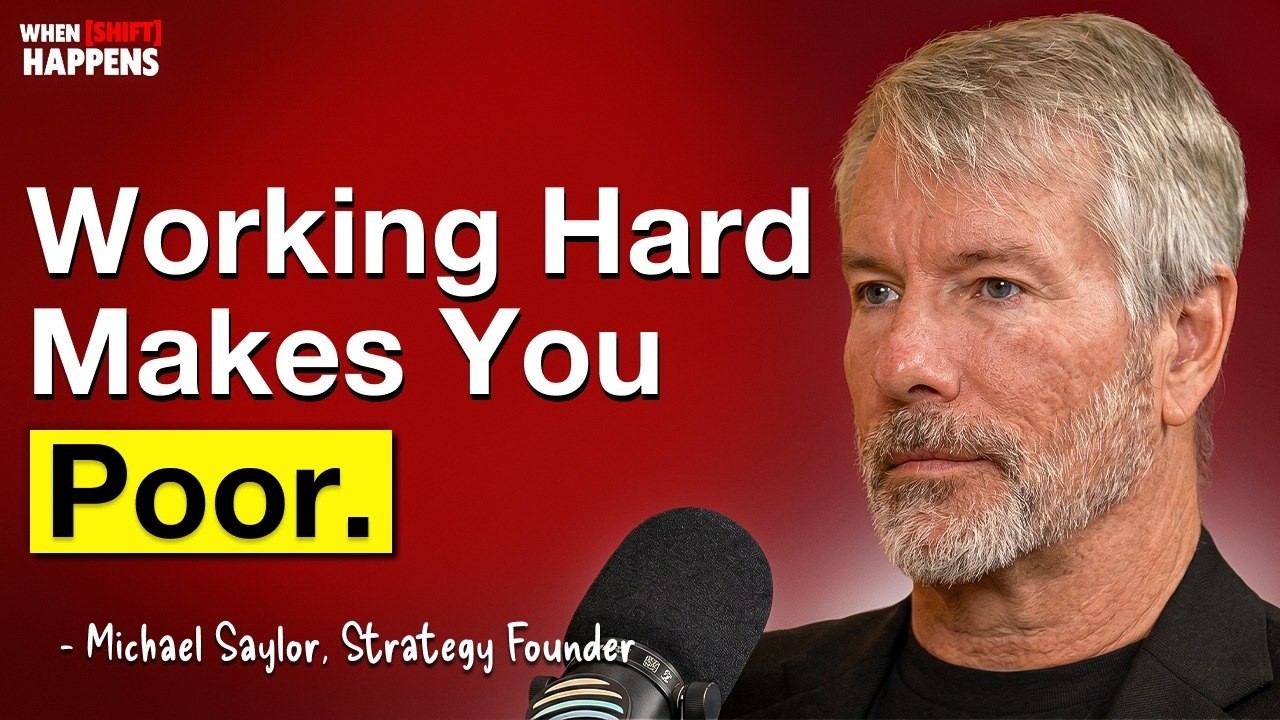
  • Michael Saylor on Strategy’s Bitcoin Playbook, the 11.5% Stretch Preferred Stock, Why Working Hard Is Bad Advice, and Bitcoin as Cyber Manhattan

    Michael Saylor, founder and executive chairman of Strategy (formerly MicroStrategy), sits down for Episode 172 of the When Shift Happens podcast for a wide-ranging, two-hour conversation on how a near-bankrupt enterprise software company became the world’s largest corporate holder of Bitcoin, why he calls his new preferred stock STRC “stretch” the most successful credit instrument in the world, and what 40 years of trial and error taught him about focus, leverage, time horizons, and the difference between working hard and working smart. This one is essential listening for anyone trying to understand Bitcoin as a protocol, Strategy as a capital markets machine, and what an “AI-pilled” 61-year-old founder actually does with his time.

    TLDW

    Saylor walks through his MIT-trained engineer’s framing of money as an adiabatic thermodynamic system, where the dollar loses roughly 7% of its energy per year, gold loses 2%, and Bitcoin loses zero, giving it an infinite half-life. He explains how COVID-era zero interest rates “rent controlled” the cash on Strategy’s balance sheet and forced him to search for a Facebook-of-money, leading to a $62 billion Bitcoin position across 818,000 coins. He details Strategy’s evolution from buying Bitcoin with cash, to convertibles, to senior bonds, to the equity ATM, to the new preferred stock family (Strike, Strife, Stride, and now Stretch), and argues that STRC is “rocket fuel kerosene” distilled from Bitcoin’s pure economic energy: an 11.5% monthly dividend, tax-deferred return of capital, designed to trade tightly around $100. He returns repeatedly to focus, the lesson he says he learned the hard way after spinning up alarm.com, voice.com, angel.com, and a half-dozen other ventures in his 30s. He argues working hard is now bad advice in an era where AI demonetizes labor, that volatility is vitality and the only honest time horizon is four to ten years, and that Bitcoin is to money what English is to language and Arabic numerals are to math: the protocol that won the network effect contest, and the place “all the money and power” now lives.

    Thoughts

    The most useful part of this conversation is not the Bitcoin maximalism, which is by now a fully formed Saylor genre. It is the brutal honesty about the decade he wasted launching alarm.com, voice.com, angel.com, michael.com, hope.com, and a half-dozen others while a billion-dollar MicroStrategy sat at the center of his portfolio asking for more attention. He admits the “imaginary future business is always more fun than struggling with the existing mature business,” which is one of the cleanest descriptions of founder ADHD I have read. The fact that someone at his level of intelligence and pattern recognition still required 20 years and a near-death experience to learn focus should make every operator under 40 reread that section twice. The single takeaway worth tattooing on a wall is his rule: “Just because you can do a thing doesn’t mean you should do a thing.”

    The engineering framing of money is the strongest intellectual move in the episode. Saylor is treating monetary supply expansion as energy loss in a thermodynamic system, with the dollar at a 10-year half-life, weak currencies at 3 to 5 years, gold at 36 years, and Bitcoin at infinity. Whether or not you accept the conclusion, the model is internally consistent in a way most macroeconomic arguments are not, and it gives him a vocabulary for talking about scarcity that economists trained on continuous-supply commodities literally do not have. The Max Planck quote he leans on, “science advances one funeral at a time,” is doing real work here. He is not saying he is smarter than the old guard. He is saying the old guard has no incentive to update because they already have money and power, and that the paradigm shift will be carried by the people with everything to gain. That is a more humble and more accurate version of the maximalist line.

    The Strategy capital markets machine is the part that deserves more scrutiny than it usually gets. The pitch for Stretch is genuinely interesting on its merits: a preferred stock that trades around $100, pays 11.5% monthly as return-of-capital dividends that defer all tax for roughly nine years, gets a step-up in basis on inheritance, and is positioned as a digital money market for people who believe in Bitcoin but do not want 40% volatility. If you take Saylor’s network-effect thesis seriously, this is the natural product to build, and his Standard Oil analogy (“distill the kerosene out of the crude oil”) is the right mental model. The risk that does not get discussed is what happens to the entire instrument family in a 99.8% drawdown of the kind he himself lived through with MicroStrategy in 2002. He waves it off by saying Strategy has 10x the enterprise value over the preferred, but in a deep enough Bitcoin winter, that cushion compresses fast. Worth holding both ideas at once: this is the most elegant Bitcoin-native fixed income product yet built, and it is still fundamentally a leveraged Bitcoin bet wearing a money-market mask.

    The “working hard is bad advice” thread is going to be the most controversial clip, and it is also the most important. Saylor is not saying do not work. He is saying do not be John Henry. Do not race the steam drill with a hammer. In a world where AI can translate, draft legal briefings, write books in 100 languages, and out-produce any individual professional by orders of magnitude, the marginal value of pure human labor is collapsing, and the right move is to ask “what tool can do this for me” before “how do I get better at this.” That is the same logic that took him from “I would have fired anyone who suggested Zoom in 2019” to running a global operation from a Florida studio. The unsubtle implication, especially for the 34-year-old host he is talking to, is that the 10,000-hour mastery model your parents grew up with is increasingly a status symbol with no underlying economics, like learning to compose Shakespearean sonnets in 2026.

    The single underrated line in the whole episode is “everything you own in the physical world you own at the pleasure of someone more powerful than you.” He is using it to make the Bitcoin self-custody case, but it generalizes to a much broader political and historical observation about property rights, minorities, and the steady drumbeat of expropriation events across 10,000 years of recorded history. Whether or not Bitcoin is the answer, the framing of “where do you store value such that nobody can decide to take it from you” is the right question to ask in the current decade, and most people are not asking it.

    Key Takeaways

    • Strategy now holds roughly 818,000 Bitcoin worth $62 billion, making it the world’s largest corporate Bitcoin holder and effectively a reserve bank built on a hard-capped digital monetary network.
    • Saylor’s working definition of an investor: anyone willing to hold a position for at least four years. Anyone with a shorter horizon is a trader, and most traders are fools who do not know they are fools.
    • His core advice to a 40-year-old Uber driver who cannot afford a house: own assets that appreciate faster than the 7% annual US dollar debasement rate. Anything slower means you are getting poorer in real terms while working harder every year.
    • The MIT-trained engineer’s framing of money: gold has a 36-year half-life because supply inflates ~2% a year, the dollar has a ~10-year half-life at ~7% debasement, weak currencies have 3 to 5-year half-lives, and Bitcoin’s half-life is infinite because supply growth is zero.
    • The 2020 pivot was forced, not chosen. When the Fed took rates to zero and signaled no hikes, Strategy’s $500 million in cash became, in Saylor’s metaphor, a rent-controlled building paying zero. They were forced to look for a way out and ended up at Bitcoin.
    • Saylor’s aha moment was recognizing Bitcoin as the only commodity in history with absolute scarcity. Gold inflates, silver inflates, even land can be reclaimed from the sea. Only Bitcoin’s 21 million cap is mathematically fixed.
    • The biggest lesson of his 30s and 40s: focus. He launched alarm.com, voice.com, angel.com, michael.com, hope.com, and several others while running MicroStrategy, and none of them matched the original. The line he leaves with is “just because you can do a thing doesn’t mean you should do a thing.”
    • By the time he was 55, he had been humbled enough to take someone else’s billion-dollar idea (Satoshi’s) instead of trying to generate his own.
    • Strategy’s evolution as an issuer: cash purchases, then convertibles, then senior bonds, then asset-backed loans (Silvergate failure ended that path), then the equity ATM, then the preferred-stock family Strike, Strife, Stride, and now Stretch.
    • Stretch (STRC) is a preferred stock targeted to trade around $100 with about 1 unit of volatility, paying 11.5% monthly as return-of-capital dividends, tax-deferred for roughly nine years until the basis is fully recovered.
    • STRC pairs with a step-up in basis on inheritance, meaning heirs can receive another nine years of tax-deferred dividends on top of what the original holder collected, an arrangement neither bonds nor most preferred stocks allow.
    • Strategy can create roughly 10 to 20 cents of digital credit per dollar of Bitcoin held, which positions a trillion dollars of future Bitcoin holdings to support $200 to $400 billion of credit instruments.
    • The addressable market for STRC-style instruments, in Saylor’s framing, is the roughly $300 trillion global credit market currently delivering about 350 basis points after tax. A product offering three times that yield is targeting trillions of dollars of demand.
    • Standard Oil analogy: Rockefeller called his company “Standard” because impure kerosene blew up engines and houses. Strategy is in the business of distilling pure financial instruments out of the raw economic energy of Bitcoin, the way refineries distill kerosene from crude.
    • Four-letter NASDAQ ticker discipline. Saylor specifically chose STRC over MSTR.P because retail can search, remember, and trade four-letter symbols on Robinhood and Schwab. About 80% of STRC is held by retail.
    • Bitcoin as a lifeboat thesis: in any country with a collapsing currency (Argentina, Brazil, most of Africa, historical Germany), no physical asset is safe because property is held at the pleasure of whoever has power. Bitcoin allows wealth to cross borders inside someone’s head.
    • The Saylor leverage example: a 2.5% mortgage in 2021 plus a 40% appreciating asset is a roughly 37.5% net spread on borrowed money, equivalent to a real after-tax salary of several hundred thousand dollars in a high-tax city, earned for nothing more than paperwork.
    • Volatility is the feature, not the bug. Bitcoin reacts in real time to events in every country, every hour, which is why 500 million people care about it and almost nobody cares about the value of Tokyo imperial real estate.
    • Saylor’s litmus test for trading: if you would not hold it for ten years, you should not hold it for ten minutes. Anything less than a four-year horizon means you are doing entertainment, not investing.
    • He spends “thousands of hours a year” thinking about Bitcoin’s first, second, third, and fourth-order effects, and runs a stochastic risk model that updates every 15 seconds, refusing to diversify because adding silver, gold, or real estate would shatter the model.
    • Bitcoin as protocol: the same network-effect logic that made English the default global language, Arabic numerals the default math, TCP/IP the default networking protocol, and the shipping container the default freight format. Once a protocol locks in, only an asteroid-strike-level event can dislodge it.
    • “There is no second best language” is the analogy he keeps returning to. Bitcoin is to money what English is to communication. Wishing it were Swahili or Esperanto does not change where the wealth concentrates.
    • The Newtonian network effect: when Rupert Murdoch joins Facebook he brings 50 friends. When he joins Bitcoin he brings $50 million. Monetary networks compound faster than social networks because billionaires bring billions.
    • “Don’t sell the thing that will make your children’s children wealthy” is the operating heuristic. He uses the great-great-grandfather analogy: if your ancestor sold Bitcoin to buy velvet for a horse-and-buggy, you would not be rich today.
    • Working hard is not the path. The forklift outperforms the strongest worker with a shovel. John Henry beat the steel drill once and his heart burst doing it.
    • AI is now the forklift for white-collar work. Saylor uses it to draft 25-page legal briefings, translate content into 100 languages, and avoid going back to law school. “It would take 10 years and a million dollars to do what the AI does in two minutes.”
    • Personal communication leverage: a single Lex Fridman appearance has reached more than 11 million views, more people than a 30-year teaching career could reach.
    • Saylor was inspired into engineering as a child by Robert Heinlein’s “Have Space Suit, Will Travel,” in which the hero saves Earth and is rewarded with a full scholarship to MIT. The same Heinlein-Asimov-Clarke pipeline shaped Elon Musk and Jeff Bezos.
    • His mother imprinted on him that he was expected to do great things while he was a 9-year-old paper boy in Dayton, Ohio. He credits the combination of literature plus maternal expectation with his early ambition.
    • He calls himself a late bloomer and “the Colonel Sanders of crypto,” noting that more interesting things have happened in the last 12 months of his career than in the entire previous 35 years.
    • Strategy’s succession is already in motion. CEO Phong Le, Andrew Kang, and CJ are running operational layers, and Saylor expects Strategy to outlast him the way Lloyd’s of London has outlasted its founders by hundreds of years.
    • The Bitcoin price path he is willing to articulate publicly: “We’ll buy it at 100,000, we’ll buy it at 200,000. We’ll buy it at 500,000, we’ll buy it at a million, 2 million, 4 million, 8 million.” The business is “drive Bitcoin to millions of dollars.”
    • He survived a 99.8% drawdown in MicroStrategy from $333 to $0.42 between 2000 and 2002, three days from bankruptcy. He says current Bitcoin volatility does not feel like stress by comparison.
    • He has no children, is not married, and describes himself as singularly married to the business, which he expects to keep doing as long as the civilization needs the money fixed.

    Detailed Summary

    Who Saylor is and why MicroStrategy became Strategy

    Saylor grew up in an Air Force family, lived on bases across Japan, New Zealand, Nebraska, Florida, and Ohio, and won a US Air Force scholarship to MIT, where he studied aerospace engineering and the history of science. He founded MicroStrategy at 24, took it public on the NASDAQ in 1998, and built it into a billion-dollar business intelligence company with about 2,000 employees. By 2020 the business was being slowly crushed by Microsoft Power BI, and lockdowns plus zero interest rates eliminated the natural return on the company’s $500 million cash position. The frustration drove Strategy into Bitcoin: $250 million, then another $250 million, then a billion, then two, until the company became the world’s largest corporate holder with ~$62 billion across 818,000 coins.

    The hard-earned lesson of focus

    Saylor’s defining career mistake was the period between his mid-30s and mid-40s when he launched ten other businesses on the side of MicroStrategy: alarm.com (now a public multi-billion-dollar company spun off), angel.com (sold for about $110 million), voice.com (sold for about $30 million), and several others including michael.com, frank.com, emma.com, hope.com, and usher.com. He concedes that almost none of these matched the original, that the imaginary future business is always more fun than the mature one, and that he wishes he had instead poured 150% of his energy into MicroStrategy. The crystallized lesson, repeated several times: “Just because you can do a thing doesn’t mean you should do a thing.”

    Money as a thermodynamic system

    The intellectual core of the conversation is Saylor’s framing of money as energy in an adiabatic system. Gold inflates ~2% a year and therefore has a 36-year half-life. The dollar debases at ~7% a year and has roughly a 10-year half-life. Weaker currencies have half-lives of 3 to 5 years. Bitcoin’s hard cap of 21 million coins means zero supply inflation, which produces an infinite half-life. He learned thermodynamics designing aircraft wings at MIT and applies the same closed-system logic to money: any system with energy lapse cannot be a long-term store of value, and Bitcoin is the first asset in human history with no lapse.

    Bitcoin as a global lifeboat

    For people in collapsing currency regimes, Saylor argues no domestic instrument holds value. Argentinian and Brazilian hyperinflations destroy 99.9% of purchasing power on familiar cycles. German marks were used in wheelbarrows to buy soap. Buying local real estate, bonds, or currency in those environments is useless because the underlying economy decays around them. The only escape historically has been gold or paintings, which then need to be smuggled across borders. Bitcoin solves the same problem digitally: it crosses borders inside someone’s head via private keys, and it cannot be expropriated by whoever currently holds power. Saylor’s broader point, “everything you own in the physical world you own at the pleasure of someone more powerful than you,” is the philosophical anchor of the entire Bitcoin maximalist case.

    Strategy’s capital markets evolution

    Strategy has run through every available capital structure to keep buying Bitcoin: cash, tender offers, equity issuance, convertible bonds (where Strategy became the largest issuer in the world), senior bonds (abandoned because covenants choked growth), asset-backed loans (Silvergate’s failure ended that channel), the equity ATM, and finally the preferred-stock family. Strike, Strife, Stride, and Stretch were each iterations toward what Saylor calls “the perfect credit instrument,” refined the way Standard Oil refined crude into kerosene. Stretch (STRC) is the current state of the art: a preferred stock targeted to $100, with about 1 unit of volatility, paying 11.5% monthly as return-of-capital dividends that defer all tax for roughly nine years.

    Why STRC matters as a product

    Saylor argues STRC is the first credit instrument that lets a retiree treat a Bitcoin-backed yield as a money-market alternative. The mechanics: a $100 share generates roughly $10/year in monthly dividends, each of which reduces the cost basis instead of triggering current income tax. After about nine years, basis is exhausted and the instrument becomes a qualified-dividend security taxed at long-term capital gains rates. On inheritance, the heir receives a step-up in basis to $100, and another nine-year cycle of tax-deferred dividends restarts. Eighty percent of the issue is held by retail through Robinhood and Schwab, and the company actively manages the price by issuing or buying back to hold the $100 anchor. The mission for the rest of the decade, Saylor says, is to scale this to $200, then $400, then $600, then $800 billion in outstanding credit, with Bitcoin as the underlying capital base.

    Working smart, not hard, in the age of AI

    Saylor’s most pointed advice to younger founders and operators is that hard work is becoming a low-return strategy. AI now drafts legal briefings, translates content into 100 languages, writes books, and outperforms most professional output by orders of magnitude. The 10,000-hour mastery model that built his generation’s careers, he says, will not produce equivalent results in the next one. The right move is to ask what tool can do the thing for you before asking how to do the thing yourself. He uses himself as the example: working 70 hours a week for ten years built MicroStrategy, but it felt easy compared to MIT, and the leverage from AI plus podcasts plus digital distribution lets him now reach more people in a single sitting than a 30-year teaching career could reach.

    Volatility, time horizon, and the trader-versus-investor split

    Saylor refuses to be rattled by short-term Bitcoin moves and uses his 99.8% MicroStrategy drawdown in 2002 as a baseline for what real volatility feels like. He argues that Bitcoin’s price swings are evidence of its utility: it is the only globally-tradable asset where a regulatory rumor in China at 2am can move price in real time, which is why it absorbs all attention. His rules are blunt: an investor holds for at least four years (40% volatility, 40% expected return for Bitcoin), the right indicator is the 200-week moving average, and the Buffett rule “if you would not hold it for ten years you should not hold it for ten minutes” still applies. Everything shorter is trading, which is fine if you are an expert, foolish if you are not.

    Bitcoin as protocol, not as bet

    The closing intellectual frame is that Bitcoin won the network-effect competition the same way English won language, Arabic numerals won math, TCP/IP won networking, and the standard shipping container won freight. None of these became dominant because they were objectively perfect. They became dominant because critical mass locked in, the wealthy and powerful coordinated around them, and any alternative now has to dislodge a $1.5 trillion incumbent. The protocols that win do so because “people aren’t stupid” and a billion small coordination decisions converge on the same standard. Bitcoin, on this read, is not an investment to be allocated against silver or real estate. It is the digital capital protocol that the rest of the financial world is going to be denominated in, and choosing not to participate is closer to refusing to learn English than it is to skipping a stock pick.

    Notable Quotes

    “Just because you can do a thing doesn’t mean you should do a thing.”

    Michael Saylor, distilling 20 years of side-business mistakes into one line

    “Bitcoin is a lifeboat tossed on a stormy sea, offering hope to anyone in the world that needs to get off their sinking ship.”

    Saylor’s framing of Bitcoin as a solution for collapsing-currency regimes

    “There is no second best crypto asset. There’s only one crypto asset and that’s Bitcoin. Human civilization settles on protocols.”

    The closing thesis of the conversation, in Saylor’s own words

    “Don’t sell the thing that will make your children’s children wealthy.”

    Saylor on holding Bitcoin through volatility and selling something else instead

    “Everything you own in the physical world you own at the pleasure of someone more powerful than you.”

    Saylor on why physical assets are not real property rights

    “Volatility is vitality. Bitcoin’s volatile because it’s useful.”

    Saylor reframing Bitcoin price swings as a feature

    “Don’t try to outwork a forklift.”

    Saylor on why “work harder” is increasingly bad advice in the AI era

    “I’m like the Colonel Sanders of crypto. But it’s okay. At least I found a mission at some point in my life.”

    Saylor on being a late bloomer at 55

    “Bitcoin is cyber Manhattan. A thousand years from now, your children’s children’s great-great-great 10x grandchildren will be rich, if you kept it.”

    Saylor on Bitcoin as multi-generational real estate

    “The world doesn’t care whether I’m a good manager of a hundred different things. The world wants me to be the best manager of one thing.”

    Saylor on focus as the only durable professional posture

    Watch the full conversation here: When Shift Happens E172: Michael Saylor on How To Get Rich With Crypto (Without Working Hard).

    Related Reading

  • The Great Decentralization: David Friedberg and Balaji Srinivasan on the Fractal Frontier, Freedom Cities, and the American Reboot

    TL;DW

    In a wide-ranging conversation on The Network State Podcast, David Friedberg and Balaji Srinivasan diagnose the terminal inefficiencies of the modern Western state and propose a radical alternative: the “Fractal Frontier.” They argue that the path to re-industrialization lies not in capital, but in the creation of “Freedom Cities” and decentralized economic zones that prioritize the “speed of physics” over the “speed of permits.”


    Key Takeaways

    • The State as an Organism: The modern state has become a self-preserving entity that consumes capital to grow its own influence, leading to “political billionaires” who allocate billions without market accountability.
    • The Fractal Frontier: Pioneering is no longer geographic; it is “fractal,” consisting of special economic zones (SEZs), cloud-coordinated communities, and startup cities.
    • Regulatory Croft: U.S. infrastructure costs (especially in nuclear energy) are 100x higher than China’s due to bureaucratic layers and permitting, rather than material or labor shortages.
    • “Go Broke, Go Woke”: Economic stagnation is the root of cultural division. When individuals lose the ability to progress by 10% annually, they pivot to “oppressor vs. oppressed” narratives to rationalize their decline.
    • 10th Amendment Activism: The solution to federal overreach is returning regulatory authority to the states to create competitive “Elon Zones” for robotics, biotech, and energy.

    Detailed Summary

    1. The Meta-Organism and the “Homeless Industrial Complex”

    David Friedberg describes the state as a biological organism competing for survival. In cities like San Francisco, this manifests as a “homeless industrial complex” where nonprofits receive massive state funding to manage, rather than solve, social issues. Because these organizations are funded based on the scale of the problem, they have no market incentive for the problem to disappear. This leads to administrative bloat where “political billionaires” allocate more cash per year than the net worth of most market-driven entrepreneurs, yet produce fewer tangible results.

    2. Closing the 100x Cost Gap: Physics vs. Permits

    The conversation highlights the staggering industrial disparity between the U.S. and China. While the U.S. is bogged down in decades of permitting for a single reactor, China is building 400 nuclear plants and pioneering Gen-4 thorium technology. Friedberg argues that regulation acts as a binary “0 or 1” gate; if the state says no, no amount of capital can fix the problem. To compete, America must establish zones where the “speed of physics” dictates the pace of building, bypassing the labyrinthine “croft” of federal agencies like the EPA and FDA.

    3. Ascending vs. Descending Worlds

    Balaji introduces the concept of “ascending” and “descending” worlds. The legacy West is currently a descending world, where the younger generation graduates into “negative capital”—saddled with debt and locked out of homeownership. This reality triggers the “Happiness Hypothesis”: humans require a visible 10% annual improvement in their standard of living to remain satisfied. When that growth disappears, society cannibalizes itself through tribalism and culture wars. In contrast, the “ascending world” (Asia and the Internet) is characterized by rapid physical and digital growth.

    4. The Blueprint for Freedom Cities

    The proposed “reboot” involves the creation of Freedom Cities on barren, low-incumbency land. These zones would utilize 10th Amendment activism to return power to the states, allowing for the rapid deployment of drones, robotics, and biotech. By creating “Special Economic Zones” (SEZs) that offer more efficient regulatory terms than the federal government, these cities can attract global talent and capital. This model offers a path to re-industrialization by allowing builders to “opt-in” to new social and economic contracts.


    Analysis & Final Thoughts

    The most profound takeaway is that exit is a form of fighting. By leaving dysfunctional systems to build new ones, innovators are not surrendering; they are preserving the startup spirit that founded America. The “Fractal Frontier” is the necessary response to a centralized state that has reached its point of no return. Whether through “Special Elon Zones” or startup cities in Singapore, the builders of the next century will be those who prioritize the “speed of physics” over the “speed of permits.”

    For more insights on startup societies and the future of the network state, visit ns.com.

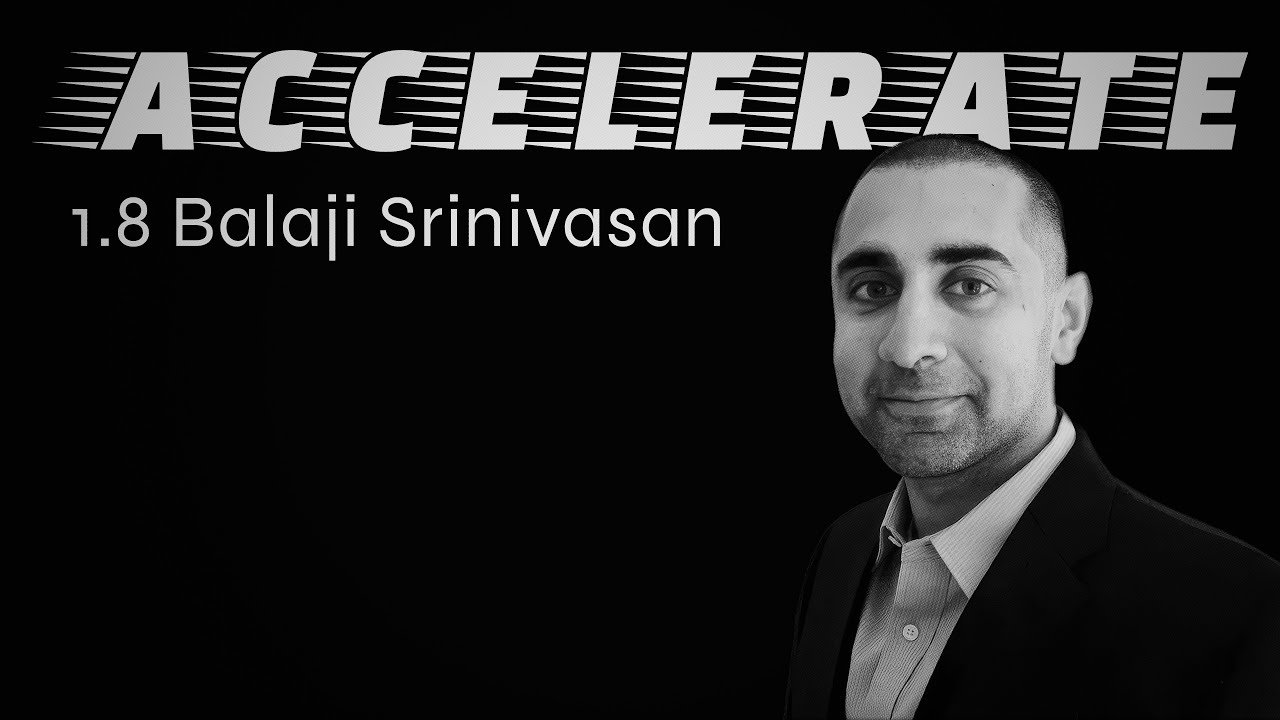
  • Balaji Srinivasan: The Future of Crypto Is Private – ACC 1.8

    TL;DW (Too Long; Didn’t Watch)

    In this insightful podcast episode from “Accelerate with Mert,” Balaji Srinivasan explores the shifting global landscape, contrasting the declining Western powers—particularly America as an invisible empire—with the rising centralized might of China. He frames the future as a dynamic tension between China’s vertically integrated “Apple-like” system (nation, state, and network in one) and the decentralized, open “Android” of the internet. Crypto emerges as a crucial “backup” for core American values like freedom, capitalism, and self-sovereignty, evolving from Bitcoin’s foundational role to Ethereum’s programmability, and now prioritizing privacy through zero-knowledge (ZK) technologies. Balaji stresses that crypto’s ideological essence—providing an exit from failed banks and political systems, with privacy as the missing piece—is as vital as its commercial applications. He envisions network states as physical manifestations of online communities, rebooting civilization amid Western collapse.

    Introduction

    The podcast “Accelerate with Mert,” hosted by Mert Kurttutan, delivers thought-provoking discussions on technology, geopolitics, and innovation. In episode ACC 1.8, released on November 12, 2025, Mert welcomes Balaji Srinivasan, a renowned entrepreneur, investor, and futurist known for his roles as former CTO of Coinbase, co-founder of Earn.com (acquired by Coinbase), and author of “The Network State.” With over 2,367 views shortly after release, the episode titled “Balaji Srinivasan: The Future of Crypto Is Private” weaves personal stories, macroeconomic analysis, and a deep dive into cryptocurrency’s role in a multipolar world. Balaji’s signature blend of historical analogies, technological optimism, and geopolitical realism makes this a must-listen for anyone interested in the intersection of tech and global power dynamics.

    Personal Connections and the Catalyst for Change

    The conversation begins on a personal note, highlighting the real-world impact of Balaji’s influence. Mert recounts how Balaji was the first notable figure to DM him on Twitter (now X) in 2020 or 2021, responding to a tweet about Balaji’s 1729 bounty platform—a now-defunct initiative that rewarded users for completing tasks related to technology and innovation. This interaction boosted Mert’s confidence in building an online presence, proving that insightful content could attract attention regardless of follower count.

    Adding another layer, Mert shares how a discussion with Balaji and investor Naval Ravikant convinced him to leave Canada for Dubai. They warned of Canada’s downward trajectory—citing issues like economic stagnation, overregulation, and political instability—contrasting it with Dubai’s rapid growth, business-friendly environment, and appeal to global talent. Balaji reinforces this by noting the broader trend: the East (including Dubai and Riyadh) is ascending, while the West copes with decline. This personal anecdote sets the tone for the episode’s exploration of global shifts, emphasizing how individual decisions mirror larger geopolitical movements.

    Framing the World: East vs. West, State vs. Internet

    Balaji introduces a compelling framework inspired by Ray Dalio’s analysis of empires and the ideas in “The Sovereign Individual.” He argues that the postwar Western order is crumbling, with the future defined by “China plus/versus the internet.” China represents a centralized, vertically integrated powerhouse—akin to Apple—where nation (Han Chinese culture), state (Communist Party), and network (Great Firewall-insulated apps) align seamlessly under one authority. With 1.4 billion people, China operates as a self-sufficient civilization, immune to external disruptions like Anglo-internet trends.

    In contrast, the West is decentralizing into “American anarchy,” marked by internal divisions (blue, red, and tech America) and a sovereign debt crisis. Balaji points to financial indicators: rising U.S. Treasury yields signaling eroding creditworthiness, while investors flock to Chinese bonds, gold, and “digital gold” (crypto). Militarily, he cites U.S. admissions of inferiority, such as China’s hypersonic missiles outpacing American defenses and a single Chinese shipyard outproducing the entire U.S. Navy.

    Drawing historical parallels, Balaji likens the internet’s disruption of the West to Christianity’s role in Rome’s fall. Social media embodies “ultra-democracy” (like Gorbachev’s glasnost), and crypto “ultra-capitalism” (perestroika), unleashing forces that fragment established powers. Yet, just as Christianity rebooted civilization via the Holy Roman Empire, the internet could synthesize a new order. China, meanwhile, has “inactivated” communism’s destructive elements post-Deng Xiaoping, fusing it with 5,000 years of tradition to create a stable alloy—nationalist in practice, communist in name only.

    Balaji warns of China’s “monkey’s paw” foreign policy: non-interference abroad, but exporting surveillance tech to prop up regimes in places like Venezuela or Iran, ensuring resource extraction without ideological meddling. This contrasts sharply with Western neoconservatism/neoliberalism, which he critiques for overreach.

    America as the Greatest Empire: Rise, Achievements, and Inevitable Decline

    Challenging conventional narratives, Balaji defends America as not merely a country but “the greatest empire of all time”—invisible yet omnipresent. With 750 military bases, the UN headquartered in New York, and exported regulations (e.g., FDA, SEC standards), America shaped global norms. Culturally, it dominated via Hollywood, McDonald’s, and blue jeans; economically, through the dollar’s reserve status.

    He traces this to World War II: Pre-1939, America avoided empire-building, focusing inward. But with Britain faltering against Nazis, FDR’s administration pivoted to global dominance to prevent fascist or Soviet hegemony. The result? A “rules-based order” where America made the rules, promoting democratic capitalism over alternatives.

    Yet, Balaji argues, this empire is fading. Economic defeat is evident in the flight from U.S. bonds; military setbacks include failed decoupling from China and dependencies on Chinese suppliers for weapons. Politically, fragmentation erodes unity. He rebuffs accusations of anti-Americanism, praising innovations in science, technology, culture, and politics, but insists on facing reality: Empires rise and fall, and denial (e.g., on inflation, COVID origins, or Biden’s decline) accelerates collapse.

    The Ideological Heart of Crypto: Beyond Commerce to Self-Sovereignty

    Transitioning to crypto, Balaji echoes the episode’s title: “Crypto isn’t just about the commercial part. It’s about the ideological part.” It’s a response to systemic failures—banks, politics—and a tool for exit and self-sovereignty. Privacy, he asserts, is the missing link.

    He outlines crypto’s evolution: Bitcoin as the base layer (2009-2017), proving digital scarcity; Ethereum introducing programmability (2017-2025), enabling smart contracts, DEXes, NFTs, stablecoins, and scalability solutions like L2s. Today, crypto banks the unbanked globally—in Bolivia, prices are quoted in Tether; in Nigeria, savings in Bitcoin—operating 24/7 on smartphones.

    Looking ahead (2025-2033), privacy takes center stage via Zcash-inspired ZK tech. This encrypts transactions while proving validity, enabling ZKYC (zero-knowledge know-your-customer), private DEXes, and minimal data disclosure. Balaji references Coinbase’s 40-page PDF on replacing traditional KYC, highlighting how ZK could overhaul compliance without sacrificing privacy.

    Ideologically, crypto upgrades American values: From British common law to U.S. Constitution to smart contracts—global, equal access via “TCP/IP visas” over H-1Bs. It’s “version 3.0” of freedom, accessible to all regardless of nationality.

    Network States: Printing the Cloud onto the Land

    Balaji’s vision culminates in “network states”—physical embodiments of online communities, as detailed in his book. Examples include Zuzalu (Ethereum-inspired), Network School, Prospera’s zones in Honduras, and initiatives like Coinbase’s Base Camp or SpaceX’s Starbase. These “print out” digital networks into real-world societies, providing order amid chaos.

    As the West faces debt crises and anarchy, the internet—designed to withstand nuclear attacks—endures. Crypto ensures property rights and identity in the cloud, enabling a mammalian reboot after the “dinosaur” empires fall. Balaji urges accelerating this: Privacy isn’t optional; it’s essential for resilient, sovereign communities.

    Audience Reactions and Broader Context

    The episode has sparked positive feedback in comments. Viewers like @aseideman praise Balaji’s insights, while @Shaqir plans to buy more $ZEC (Zcash), aligning with the privacy focus. @remsee1608 shouts out Monero, another privacy coin, and @sigma_brethren notes AI’s lag behind Balaji’s intellect. These reactions underscore crypto’s community-driven ethos.

    Balaji’s ideas build on his prior work, such as interviews with Tim Ferriss (e.g., on Bitcoin’s future and non-cancelability) and his book “The Network State,” which expands on decentralized societies. Similar themes appear in podcasts like “Venture Stories” with Naval Ravikant, discussing blockchains as alternatives to traditional governance.

    Closing Thoughts: Creativity and Wordsmithing

    Mert wraps by asking about Balaji’s (and Naval’s) prowess in wordplay. Balaji describes it as intuitive crafting—constantly refining concepts like a woodworker shapes figurines. This creative process mirrors his broader approach: Iterating on ideas to navigate complex futures.

    Why This Matters Now

    In a world of escalating U.S.-China tensions and crypto’s maturation, Balaji’s analysis is timely. As privacy coins and ZK tech gain traction, they offer tools for sovereignty amid surveillance. This episode challenges listeners to think beyond borders, embracing crypto not just for profit but as a ideological lifeline. For policymakers, investors, and innovators, it’s a roadmap to a decentralized tomorrow.

    Follow Mert on X: @0xmert_.

    Follow Balaji on X: @balajis.

  • Bitcoin’s Final Form: Fidelity’s Report Declares It the Ultimate Digital Asset

    TL;DR

    The Fidelity Digital Assets Bitcoin (BTC) Coin Report offers an in-depth analysis of Bitcoin as a monetary asset. It positions Bitcoin as the most secure, decentralized, and censorship-resistant digital asset with unmatched scarcity due to its hardcoded 21 million cap. The report argues that Bitcoin is unlikely to be replaced due to its first-mover advantage, robust network effects, and proven monetary properties. Despite volatility and scalability limitations, it remains the leading digital monetary good and a potential hedge against macroeconomic instability.

    Detailed Summary

    1. What Is Bitcoin?
    Bitcoin is both a decentralized network and a native token. Launched in 2009, it introduced a revolutionary peer-to-peer electronic cash system, combining digital signatures with proof-of-work (PoW) to eliminate intermediaries and prevent double-spending.

    2. Bitcoin’s Value Proposition
    Bitcoin serves dual purposes: as a store of value and a medium of exchange. Its fixed supply, transparency, and neutrality make it appealing to individuals, institutions, and even nation-states.

    3. Strengths
    Bitcoin is the most decentralized and secure digital asset. Its issuance is programmatic and transparent. It is censorship-resistant and has emerged as a monetary good with characteristics such as scarcity, portability, verifiability, and durability.

    4. Weaknesses
    Bitcoin trades speed and complexity for security and decentralization. Its base layer is slower and more costly than newer chains. It has no cash flows and is inherently volatile.

    5. Network Effects & Trilemma
    Bitcoin benefits from strong network effects. Competing digital assets that attempt to optimize speed or scalability must compromise on decentralization or security—a dynamic known as the “Blockchain Trilemma.”

    6. Halving & Supply
    Bitcoin’s supply is capped at 21 million, and issuance is halved approximately every four years. Historical halvings have preceded major bull runs, due to reduced new supply and increasing demand.

    7. Investment Thesis
    Bitcoin is positioned as a macroeconomic hedge, offering protection against inflation and fiat currency debasement. It’s increasingly seen as “digital gold” and an alternative to hard commodities.

    8. Valuation
    Without cash flow, Bitcoin valuation depends on scarcity and network growth. Models like Metcalfe’s Law and S-curve adoption are applied to forecast price appreciation.

    9. Risks
    Risks include regulatory uncertainty, competition, protocol vulnerabilities, and potential investor apathy. Despite these, Bitcoin’s longevity and security make it a resilient asset.


    Fidelity Digital Assets Report: Why Bitcoin Stands Alone

    In a world reshaped by digitization and economic uncertainty, Bitcoin emerges not just as an alternative asset but as a paradigm shift in how we understand money. The Fidelity Digital Assets Coin Report delivers a robust defense of Bitcoin’s long-term value, utility, and staying power.

    Bitcoin: Network vs. Asset

    The report begins by clarifying the dual identity of Bitcoin: the capitalized “Bitcoin” refers to the network, while lowercase “bitcoin” refers to the native token. This decentralized protocol enables trustless peer-to-peer transactions without intermediaries—a revolutionary concept when launched in 2009.

    Monetary Good in a Digital Age

    Bitcoin fulfills essential monetary characteristics: it’s durable, divisible, fungible, portable, verifiable, scarce, and has a proven track record. As a programmable, finite, and global monetary good, it surpasses both fiat currency and gold in several dimensions, especially when viewed through a modern lens.

    Enforceable Scarcity and Game Theory

    With a hard cap of 21 million, Bitcoin’s scarcity is unmatched in the digital realm. Changing this cap would require broad consensus across a decentralized and incentive-aligned network, making such a change extremely unlikely.

    The Halving Cycle and Supply Economics

    Bitcoin’s issuance is halved every 210,000 blocks (~4 years). Historical data shows significant post-halving price increases, as supply-side shocks meet growing demand. The current inflation rate is under 1%, adding deflationary pressure over time.

    The Blockchain Trilemma

    Vitalik Buterin’s “Blockchain Trilemma” is used to explain why Bitcoin prioritizes decentralization and security over speed. It sacrifices transaction throughput (3–7 tx/s) compared to Visa (up to 9,000 tx/s), but this is a trade-off Fidelity sees as deliberate and beneficial.

    Network Effects and the Lindy Advantage

    Network effects are self-reinforcing. As more users hold and transact in bitcoin, its security improves via increased miner participation. This “virtuous cycle” compounds Bitcoin’s dominance, making replacement unlikely. Bitcoin’s 15+ year history also invokes the Lindy Effect: the longer it survives, the more likely it persists indefinitely.

    Competitors: Ethereum and Litecoin

    While Ethereum extends blockchain capabilities via smart contracts, it introduces complexity and risks. Litecoin attempted to be a faster Bitcoin clone but failed to capture network effects. Fidelity argues that neither asset offers the same pure monetary value proposition as Bitcoin.

    Macroeconomic Hedge

    Bitcoin is increasingly seen as a hedge against inflation and fiat currency debasement. As institutional investors seek store-of-value assets, Bitcoin’s scarcity and neutrality position it as “digital gold.” Its market cap has grown to nearly 10% of gold’s as of late 2024.

    Valuation Models

    With no cash flow, Bitcoin valuation relies on supply-demand models and network metrics like Metcalfe’s Law. Bitcoin’s current ~52 million unique wallets suggest it is still in early adoption stages. Historical halving patterns and user growth form the basis for bullish projections.

    Risks and Roadmap

    The report covers multiple risks: software bugs, evolving regulations, potential competitors, and investor apathy. However, Bitcoin’s “fair launch,” governance via Bitcoin Improvement Proposals (BIPs), and cautious roadmap provide a stable foundation. Proposed network upgrades prioritize security and decentralization.

    Final Thoughts

    The Fidelity report positions Bitcoin not just as an investment but as a generational innovation. Its unique blend of scarcity, decentralization, and resilience makes it the leading contender for digital money. While volatility and regulatory hurdles remain, Bitcoin’s trajectory suggests a durable role in the global financial system.

    Disclosure: This article is for informational purposes only and does not constitute investment advice. Always consult a qualified financial advisor before making investment decisions.

  • Deep Dive: Meltem Demirors on Crypto’s Future, Infrastructure’s Rise, and the Evolution of Finance

    Meltem Demirors is not merely a commentator in the cryptocurrency and digital asset space; she’s a builder, an investor, and a visionary. Her insights into the convergence of technology, finance, and infrastructure offer a compelling perspective on the future of our digital world. This article delves into her career, investment philosophy, and key observations, providing a detailed exploration of her impact on the evolving financial landscape.

    A Career Forged in the Digital Frontier:

    Demirors’ journey into the world of digital assets began with a pragmatic understanding of Bitcoin’s potential for facilitating global transactions. This early exposure sparked a deep interest in the underlying technology and its transformative power. Her time at Digital Currency Group (DCG) provided invaluable experience, allowing her to witness the nascent stages of the crypto industry’s growth. This foundation has shaped her current perspective, which emphasizes the importance of building robust infrastructure to support the digital economy.

    Infrastructure as the Cornerstone:

    A defining characteristic of Demirors’ investment philosophy is her focus on infrastructure. She believes that the true value of the digital asset space lies in the foundational layers that enable its operation. This includes:

    • Compute: The increasing demand for processing power to support blockchain networks, artificial intelligence, and other data-intensive applications.
    • Energy: The critical role of sustainable and efficient energy sources in powering the digital asset ecosystem, particularly in the context of mining and data centers.
    • Semiconductors: The essential hardware components that form the backbone of digital infrastructure.

    Demirors emphasizes the interconnectedness of these elements, highlighting the need for a holistic approach to infrastructure development. She recognizes that the convergence of physical and digital infrastructure is essential for the seamless integration of emerging technologies into our daily lives.

    Market Dynamics and Evolving Trends:

    Demirors possesses a keen understanding of market dynamics, recognizing the interplay of technology, psychology, and finance. She observes:

    • The Influence of Institutional Investors: The growing presence of institutional investors and the introduction of cryptocurrency ETFs are transforming the market, leading to increased liquidity and maturity.
    • The Power of Narratives: Market movements are often driven by narratives and psychological factors, with social media playing a significant role in amplifying volatility.
    • The Impact of Artificial Intelligence: Demirors sees significant potential for AI to accelerate cryptocurrency adoption, simplifying user experiences and expanding access to digital assets.

    The Importance of Self-Sovereignty:

    A core principle that Demirors champions is the importance of self-sovereignty. She advocates for self-custody of digital assets, emphasizing the use of hardware wallets and other security measures to protect against vulnerabilities. This commitment to individual control underscores her belief in the empowering potential of decentralized technologies.

    Crypto Culture and its Significance:

    Demirors acknowledges the unique culture of the cryptocurrency community, including its use of memes, humor, and digital art. She views these cultural expressions as a reflection of the innovative and disruptive nature of the space. Her willingness to engage with these aspects of crypto culture demonstrates her understanding of the community’s importance.

    Crucible Capital: A New Chapter:

    With the founding of Crucible Capital, Demirors is putting her investment philosophy into action. The firm’s focus on infrastructure reflects her belief in the long-term value of building the foundations of the digital economy.

    Wrap Up:

    Meltem Demirors is a vital voice in the digital asset space, offering a unique blend of technical expertise, market insight, and visionary thinking. Her focus on infrastructure, commitment to self-sovereignty, and understanding of crypto culture make her a key figure in shaping the future of finance.

  • Navigating Economic Headwinds: Insights from Ray Dalio on the US Economy and Global Landscape

    Ray Dalio, the esteemed investor and founder of Bridgewater Associates, recently engaged in a comprehensive discussion with David Friedberg on the All-In Podcast, offering valuable insights into the current state of the US economy and its interconnectedness with the global landscape. Dalio, renowned for his deep understanding of economic cycles and historical patterns, provided a nuanced perspective on the challenges and opportunities that lie ahead.

    Understanding the Debt Cycle

    Central to Dalio’s analysis is the concept of the “Big Debt Cycle,” a recurring pattern observed throughout history where economies experience prolonged periods of rising debt levels followed by inevitable deleveraging events. He argues that the US is currently navigating one such cycle, with debt-to-GDP ratios reaching historically significant levels.  

    Dalio explains that while debt can be a useful tool for stimulating economic growth, excessive debt accumulation can lead to instability and ultimately a debt crisis. He points to several factors that contribute to this dynamic, including expansionary monetary policies, government spending, and the inherent tendency for debt to compound over time.  

    Proactive Measures for a Healthy Economy

    While acknowledging the potential risks associated with high debt levels, Dalio maintains an optimistic outlook, emphasizing that proactive measures can mitigate the likelihood of a severe debt crisis. He suggests a multi-pronged approach that includes fiscal responsibility, monetary policy adjustments, and structural reforms.  

    On the fiscal front, Dalio advocates for a “3% solution,” urging policymakers to reduce the annual budget deficit to 3% of GDP. This would involve a combination of spending cuts and revenue increases, potentially through tax reforms or tariffs. He emphasizes the importance of achieving a sustainable fiscal trajectory to maintain confidence in the US economy and its currency.  

    In terms of monetary policy, Dalio suggests that central banks need to carefully navigate the delicate balance between supporting economic growth and managing inflation. He notes that while expansionary policies can be beneficial in the short term, they can also contribute to debt accumulation and asset bubbles if not managed prudently.  

    Furthermore, Dalio highlights the importance of structural reforms to enhance productivity and competitiveness. He suggests that investments in education, infrastructure, and innovation can foster long-term economic growth and resilience.  

    Navigating the Investment Landscape

    Dalio’s insights also provide valuable guidance for investors. He cautions against complacency in the current market environment, noting that high asset valuations and rising interest rates create potential risks. He advises investors to diversify their portfolios, considering a range of asset classes and geographies to mitigate risk.  

    He also emphasizes the importance of focusing on “real returns,” that is, returns adjusted for inflation. He notes that even when markets appear to be performing well in nominal terms, inflation can significantly erode purchasing power, leading to disappointing real returns.  

    Dalio suggests that alternative assets, such as gold, Bitcoin, and other commodities, can play a role in portfolio diversification, offering potential hedges against inflation and economic uncertainty. He also encourages investors to consider the long-term implications of their investment decisions, aligning their portfolios with their financial goals and risk tolerance.  

    The Evolving Global Landscape

    Beyond the domestic economic outlook, Dalio also provides insights into the evolving global landscape. He discusses the complex relationship between the US and China, highlighting the growing competition between the two superpowers. He emphasizes the need for both countries to engage in constructive dialogue and cooperation to address global challenges such as climate change, economic inequality, and geopolitical tensions.  

    Dalio also touches on the rise of other emerging markets and the shifting balance of economic power. He suggests that investors and policymakers need to adapt to this evolving landscape, recognizing the growing importance of understanding and engaging with different cultures and economic systems.  

    Embracing Technological Transformation

    Dalio also addresses the transformative potential of artificial intelligence (AI) and its impact on the economy and society. He acknowledges the potential for AI to drive productivity gains, create new industries, and improve living standards. However, he also cautions about the potential for job displacement and social disruption, urging policymakers to proactively address these challenges.  

    He suggests that investing in education and training programs can help workers adapt to the changing demands of the labor market and ensure that the benefits of AI are shared broadly. He also emphasizes the importance of ethical considerations in the development and deployment of AI, ensuring that it is used responsibly and for the benefit of humanity.

    Wrapping up

    Ray Dalio’s interview offers a comprehensive and insightful perspective on the US economy and its place in the global landscape. He provides a balanced assessment of the challenges and opportunities that lie ahead, emphasizing the importance of proactive measures, prudent investment strategies, and international cooperation. By embracing innovation, adapting to change, and engaging in constructive dialogue, the US can navigate the complexities of the 21st century and ensure a prosperous future for all.

  • Michael Saylor on Bitcoin at $100K and the Future of MicroStrategy

    When Bitcoin crossed the $100,000 price threshold for the first time, it represented more than just a numerical landmark. For many, it marked a profound shift in global markets, signaling that Bitcoin—a once-marginalized digital asset—had solidified its place in the mainstream financial ecosystem. On the day of this historic event, Michael Saylor, Founder and Chairman of MicroStrategy, joined Alex Thorn, Head of Firmwide Research at Galaxy, for a wide-ranging conversation on the “Galaxy Brains” podcast. The discussion offered a front-row seat to Saylor’s vision for Bitcoin’s future, MicroStrategy’s evolving treasury strategy, and the broader implications of a world gradually embracing a digital standard of value.

    A Milestone Moment for Bitcoin

    Saylor opened by acknowledging the significance of Bitcoin’s six-figure milestone. For over a decade, Bitcoin has been through cycles of skepticism, regulatory uncertainty, and market volatility. Crossing $100,000, in Saylor’s view, represented an emphatic declaration that Bitcoin had moved beyond speculation into the realm of institutional-grade capital.

    For institutional players that once remained lukewarm or outright hostile, this price level has become a symbolic line in the sand. The psychological impact is profound. Once seen as a fringe technology, Bitcoin at $100K underscores that the world’s largest cryptocurrency is here to stay and poised to become a permanent fixture in the global financial landscape.

    MicroStrategy’s All-In Bitcoin Strategy

    No company better embodies the transition from curiosity to conviction in Bitcoin than MicroStrategy. Since 2020, the enterprise software firm led by Saylor has undergone a dramatic reinvention of its balance sheet, reallocating its treasury reserves into Bitcoin. As the largest corporate holder of Bitcoin worldwide, MicroStrategy effectively transformed itself into a pioneering “Bitcoin strategic reserve” company.

    By year’s end 2024, MicroStrategy’s Bitcoin holdings have grown so immense that their stock has become one of the best performers in global equity markets. According to Saylor, this performance is no accident. The company’s laser-focused capital strategy—eschewing traditional assets like bonds or gold in favor of Bitcoin—resonates deeply in a world searching for reliable, inflation-resistant stores of value. Each market crisis and regulatory crackdown that once threatened to derail Bitcoin has, in retrospect, strengthened its foundation.

    The Crypto Winter Stress Test

    Saylor looked back at the tumultuous period from late 2021 through 2023—a time often referred to as the “crypto winter”—when Bitcoin’s price plummeted from around $66,000 to $16,000 amidst a series of catastrophic events. From the China mining ban to the collapse of platforms like FTX and pressure campaigns like “Chokepoint 2.0,” this era tested the resilience and risk management capabilities of every participant in the ecosystem.

    MicroStrategy, steadfast in its conviction, did not capitulate. Instead, it weathered the storm by holding firmly to its Bitcoin position. While many companies and projects folded under leverage and mismanagement, MicroStrategy’s disciplined approach to capital structure and its single-minded commitment to Bitcoin paid dividends. Emerging from the crypto winter, Saylor’s firm stood more confident and better positioned than ever. By not selling, hedging, or wavering, MicroStrategy proved its thesis and gained credibility in the eyes of institutional investors.

    Institutional Validation and the Evolving Regulatory Climate

    As Saylor pointed out, Bitcoin’s journey into the mainstream was catalyzed by a number of key events. Chief among them was the wave of spot Bitcoin ETF approvals in 2024. Major asset managers and traditional financial institutions—once skeptics—launched products that allowed pension funds, endowments, and large capital pools to gain long exposure without the complexities of direct custody.

    The result was a flood of capital into Bitcoin, which validated its institutional-grade credentials. Jerome Powell’s favorable commentary about Bitcoin as a commodity resembling “digital gold” helped to cement this perspective. Meanwhile, political winds shifted, particularly after the U.S. election in November 2024. A new administration more receptive to crypto-innovation, combined with a clear regulatory framework, unlocked enormous pools of demand.

    Saylor also highlighted the profound impact of Trump’s campaign warming to Bitcoin and the crypto community. The political embrace from a major U.S. figure effectively signaled that the tide had turned. No longer a marginal pet project of Silicon Valley elites, Bitcoin was something that aspiring world leaders and Central Bankers could no longer afford to ignore.

    MicroStrategy’s 21-21 Plan: Engineering a Capital Engine

    In a significant strategic move, MicroStrategy unveiled its “21-21 Plan”—a bold initiative to raise and deploy capital into Bitcoin at an unprecedented scale. With a $21 billion equity shelf registration and a $21 billion fixed income plan over three years, this was capital markets innovation on a grand scale. By continually issuing securities—ranging from convertible bonds to structured debt instruments—MicroStrategy effectively turned its corporate structure into a “crypto reactor” fueled by Bitcoin.

    Saylor described MicroStrategy’s treasury as a complex engine converting the “energy” (volatility and upside potential) of Bitcoin into various custom instruments appealing to distinct investor bases. Some investors crave low volatility, coupon-bearing investments. Others seek equity-like upside. By slicing and structuring the Bitcoin exposure in novel ways, MicroStrategy can attract vast pools of capital that would otherwise never touch raw Bitcoin. This approach, according to Saylor, generates a powerful positive feedback loop—more capital, more Bitcoin, greater liquidity, and higher valuations.

    Rethinking the Corporate Treasury: Lessons for the World’s Largest Companies

    One of the most provocative elements of Saylor’s vision is his challenge to other large corporations. Instead of holding billions of dollars in depreciating bonds or engaging in risky mergers and acquisitions, why not convert a portion of corporate treasury into Bitcoin? Even a fraction of a percent in Bitcoin, if intelligently leveraged and combined with shareholder-friendly capital structures, can outperform conventional strategies.

    Saylor took his message directly to corporate America’s upper echelons, notably pitching the “Bitcoin for Corporations” concept to the likes of Microsoft’s Board. He argued that by holding Bitcoin, companies can improve the efficiency of their balance sheets, reduce complexity, and potentially double their enterprise values. Eventually, as more firms recognize Bitcoin as digital capital rather than a volatile “currency,” Saylor believes we’ll witness a sweeping transformation of corporate treasuries worldwide.

    Bitcoin as Strategic Reserve

    At the governmental level, Saylor envisions nations adopting Bitcoin as a strategic reserve—an idea far more feasible now that the asset has institutional legitimacy. He points out that central banks currently hold gold, an asset whose settlement network and scarcity are archaic in a digital era. By rotating out of gold and into Bitcoin, nations can solidify their global economic influence and ensure they stay ahead in a rapidly digitalizing financial environment.

    Such a strategy would not only benefit the U.S. (if it chose to lead the charge) but would also create a more efficient, stable, and equitable financial ecosystem globally. Bitcoin, free from border constraints and political manipulation, could serve as a universal benchmark for economic value.

    Slow and Steady on Bitcoin Protocol Development

    Amid this enthusiasm, Saylor remains cautious about one aspect: changes to Bitcoin’s protocol. He urges restraint and consensus-based decision-making for any updates, emphasizing the importance of maintaining Bitcoin’s unparalleled stability and security. In a world where altcoins constantly pivot and upgrade, Bitcoin’s reliability is a crucial feature, not a bug.

    Better to evolve slowly, Saylor suggests, than to chase “cool” features that could inadvertently weaken the network’s foundational principles. For Bitcoin, the less reckless experimentation with consensus rules, the better.

    Converting Skeptics and Nocoiners

    For the perpetual skeptics—“nocoiners” who have long denounced Bitcoin as a bubble or tulip mania—Saylor’s message is simple: ignore them or give them time. History shows that every groundbreaking innovation, from the cardiovascular system’s understanding to the internet, faced pushback from established interests. Younger generations and open-minded individuals will embrace Bitcoin because it offers real solutions, not because everyone agrees at first.

    Saylor points out that one doesn’t have to win over entrenched critics. As more capital flows into Bitcoin and more institutions integrate it, the market and societal outcome will speak for itself. Over time, resistant voices may fade or quietly adopt the new paradigm.

    The Road Ahead

    Michael Saylor’s conversation with Alex Thorn took place at a watershed moment for Bitcoin and MicroStrategy. In a span of just four years, Bitcoin ascended from a misunderstood innovation to an institutional staple. MicroStrategy pioneered the corporate Bitcoin standard, orchestrating financial market instruments previously unimaginable—zero-coupon convertible bonds with substantial Bitcoin upside, $21 billion shelf registrations, and the ability to raise capital at record speeds.

    As the next chapter of Bitcoin’s saga unfolds, Saylor’s vision offers a compelling roadmap: Bitcoin as reserve capital for corporations and countries alike, stablecoins issued under clear regulation to strengthen dollar dominance, and an economy that increasingly acknowledges Bitcoin as the world’s best store of long-term value.

    In a future measured not in weeks or months, but in decades, Saylor’s convictions will be tested anew. But for now, in the afterglow of Bitcoin at six figures, his unwavering belief that Bitcoin is “digital capital” seems not only prescient, but instructive for anyone charting the course of the 21st-century financial order.

  • Bitcoin in the Vault: Securing America’s Financial Future in a Digital Age

    Bitcoin in the Vault: Securing America's Financial Future in a Digital Age

    From a strategic and game-theoretic perspective, incorporating Bitcoin into the United States’ reserve assets would be a forward-looking move that positions the nation at the forefront of a rapidly evolving global financial landscape. In an era where economic influence increasingly hinges on digital technology, adopting Bitcoin reserves alongside traditional gold holdings can bolster U.S. monetary sovereignty, enhance strategic leverage, and preserve America’s role as the principal architect of international financial order.

    1. Strengthening Financial Sovereignty Through Diversification
    Gold reserves have long underpinned confidence in national solvency and economic discipline, but today’s environment of digital innovation and shifting global power dynamics calls for a more adaptive approach. By allocating a portion of its reserves to Bitcoin—a decentralized, universally accessible, and inherently scarce digital asset—the U.S. gains a hedge against both inflationary pressures and overreliance on foreign financial policies. This diversification ensures the U.S. will not be caught flat-footed if global faith in fiat currencies erodes or if adversaries seek to circumvent American influence through alternative monetary arrangements.

    2. Gaining a Strategic Edge in the Digital Currency Race
    As rival nations experiment with central bank digital currencies (CBDCs) and explore avenues to reduce reliance on the U.S. dollar, America must not stand idle. Embracing Bitcoin secures a critical foothold in a domain where technological prowess and early adoption can confer lasting competitive advantages. Should Bitcoin evolve into a widely recognized reserve asset, the United States would be positioned as a key stakeholder—not a latecomer forced to react to the strategic moves of others. By establishing credible involvement now, the U.S. can guide global standards, influence regulatory frameworks, and ensure that American values, institutions, and priorities shape the rules of digital finance.

    3. Mitigating Vulnerability to Adversarial Maneuvers
    A purely gold- and dollar-based reserve system, while time-tested, leaves the U.S. open to strategic surprises if competitors adopt innovative forms of digital wealth. Bitcoin’s decentralized nature means it cannot be easily controlled, sanctioned, or manipulated by any single foreign state. By holding Bitcoin, the U.S. deters scenarios in which rivals could exploit its absence from the digital asset sphere. Just as nuclear deterrence prevented hostile powers from claiming dominant positions in past eras, holding Bitcoin discourages adversarial states from gaining asymmetrical advantage in the emerging financial order. In game-theoretic terms, it is a preemptive strategy: claiming the high ground before anyone else can.

    4. Preserving the Dollar’s International Prestige
    Far from undermining the dollar’s status, a Bitcoin reserve can reinforce U.S. monetary leadership. Rather than resisting Bitcoin’s rise, the U.S. can harness it to support dollar liquidity, market stability, and global financial connectivity. Should Bitcoin become a complementary global asset—akin to a digital gold—the U.S. would be the primary influencer of its narrative and use cases. This influence would maintain the centrality of American institutions in global finance and ensure that the world’s transition to digital money unfolds on terms consistent with U.S. strategic interests, democratic values, and the rule of law.

    5. Ensuring Strategic Optionality and Future-Readiness
    Reserves are not merely symbolic; they are tools that grant a state the flexibility to respond swiftly to unpredictable economic shifts. Bitcoin’s programmability, portability, and liquidity offer new channels of maneuver. In a crisis scenario, the U.S. could leverage its Bitcoin holdings to stabilize markets, assist allies, or discourage adversarial financial behavior. In more ordinary times, strategic Bitcoin reserves would send a powerful signal to investors, innovators, and entrepreneurs that the U.S. welcomes financial technology, encouraging robust private-sector growth in the digital economy. Such forward-leaning policies foster a climate of leadership rather than reactive adaptation.

    The Final Word

    Adopting Bitcoin as part of U.S. reserve assets is a strategic investment in the nation’s economic future. It balances traditional gold holdings with an innovative, digital alternative that aligns with the trajectory of global finance. Rather than ceding ground to rivals or clinging to outdated conventions, the U.S. can consolidate its position as the preeminent force shaping the next generation of monetary policy and technology. In doing so, America not only hedges against emerging risks but also ensures that its values, influence, and interests remain preeminent in an increasingly digital world.

  • Fuck You Money: The Ultimate Expression of Financial Independence and Personal Autonomy

    Fuck You Money: The Ultimate Expression of Financial Independence and Personal Autonomy

    There’s a certain kind of power that comes when you have enough money that you no longer need to abide by the constraints of convention. It’s the point at which your financial security transcends mere comfort and graduates into a potent form of autonomy and influence. This is the realm of what has often been called “Fuck You money”—a phrase as blunt as it is revealing. Beyond its colorful name, Fuck You money represents a rarefied state of existence in which your bank balance provides more than just material luxuries. It grants you the ability to walk away from bad deals, to chart your own course, to speak your mind freely, and to make bold moves that defy expectation. In essence, it is the economic equivalent of personal sovereignty.

    Defining “Fuck You Money”
    The term “Fuck You money” first found its way into the American lexicon in the late 20th century, bubbling up from the cultural ferment of Hollywood, Wall Street, and Silicon Valley—worlds where fortunes were often made quickly and dramatically. To have Fuck You money means achieving a pinnacle of self-sufficiency. You’re beholden to no corporation, no boss, and no critic whose opinions might otherwise stifle your ambitions. You have outgrown the fear that losing one source of income will send your life into disarray. The essence is freedom—freedom to live on your own terms, freedom to pursue purpose over paychecks, and, above all, freedom to decline any request with complete impunity.

    It’s worth emphasizing that Fuck You money isn’t defined by a single static amount. What constitutes Fuck You money for a multi-billionaire differs profoundly from what it means to a modest wage-earner who has socked away enough cash to take a year off between jobs. It’s highly subjective and deeply personal. For some, it may be the yield on a well-managed trust fund, for others a modest but consistent passive income from investment properties, and still others might achieve that confidence with a cryptocurrency wallet—symbolizing newfound digital sovereignty that transcends traditional financial systems.

    The Quiet Power of Not Needing Anyone’s Approval
    One of the most striking aspects of Fuck You money is the sense of quiet power it confers. Imagine no longer tiptoeing around egomaniacal bosses or toxic workplace politics. Imagine telling a client who makes unreasonable demands, “No,” without worrying about how the next mortgage payment will be made. Fuck You money transforms employment from a necessity into an option, allowing you to choose projects, positions, and even entire industries based on passion rather than desperation.

    With Fuck You money, you can take risks that would otherwise seem reckless—because the traditional safety net of a steady paycheck ceases to be a life-or-death matter. If you fail, you can afford to learn from that failure rather than be crushed by it. It’s a kind of enforced authenticity. You are no longer constrained to be anything other than yourself, and that is a form of liberation that few ever experience.

    Grand Examples of Fuck You Money in Action
    Throughout modern history, we’ve seen extraordinary examples of individuals using their financial independence to orchestrate grand—and sometimes controversial—gestures. One high-profile contemporary case is Elon Musk’s acquisition of Twitter (now X). While the details and motivations are complex, Musk’s purchase was, in many ways, an Fuck You money move on a global stage. Freed by his immense fortune from the norms that corral most CEOs, Musk decided to buy an influential social media platform and reshape it according to his own vision. Whether you laud his entrepreneurial audacity or criticize his methods, it’s hard to deny that such a move is only possible when you have the type of wealth that, quite literally, lets you do as you please.

    Consider also the case of professional athletes, top-tier entertainers, or hedge fund managers who, after making fortunes, turn their backs on their original fields to pursue philanthropy, activism, or eccentric hobbies. There’s the musician who tells a record label “no” because they refuse to compromise on their artistic vision; the investor who decides to bail out of a promising deal because it conflicts with their personal ethics; or the magnate who buys massive tracts of land for conservation purposes, indifferent to critics who say it’s unprofitable. Fuck You money can fund private space races, personal theme parks, or maverick political campaigns that spring into existence outside the traditional corridors of power.

    Another compelling example lies in the billionaire class funding their own escapades into outer space. Jeff Bezos and Richard Branson didn’t just invest in rockets for profit—they took them for personal joyrides. Such vanity projects might seem frivolous, but they demonstrate the unshackled freedom these individuals possess. One can argue about their moral and ethical dimensions, but on a functional level, they are the pinnacle of “I’ll do what I want” made manifest.

    Traditional Wealth vs. Modern Complexity
    Of course, amassing conventional wealth typically leads to an intricate web of responsibilities, dependencies, and liabilities. Traditional millionaires and billionaires protect their fortunes through elaborate financial structures—trusts, offshore accounts, shell companies—and spend small fortunes on elite legal counsel. For the ultra-wealthy, wealth management can feel like a never-ending chess game, a high-stakes match played out in boardrooms and courtrooms worldwide. Their fortunes become so complex that “Fuck You” might still be possible, but comes burdened with administrative baggage. The frictionless freedom one might imagine is often weighed down by the practicalities of maintaining, defending, and growing that wealth.

    The Rise of Bitcoin as a New Kind of Fuck You Money
    In a piece published in Forbes by Jameson Lopp—CTO and co-founder of Casa—he explores the idea that Bitcoin and other cryptocurrencies have introduced a novel paradigm into the world of personal finance and sovereignty. Bitcoin, Lopp argues, is not simply another volatile digital investment. Rather, it offers a method of asset protection previously available only to the elite. By leveraging cryptography and decentralized networks, individuals can hold wealth that resists censorship, confiscation, and arbitrary regulations in ways that traditional fiat currencies and physical assets cannot.

    This technological shift lowers the barrier to entry for achieving a level of Fuck You independence. Bitcoin allows ordinary individuals to construct their own “digital banks,” fortified by cryptographic protocols that not even nation-states can easily breach. It’s no longer necessary to pay teams of lawyers and accountants to ensure your wealth remains secure. In the Bitcoin model, defensive asymmetry means it’s more costly to attack the system than it is to defend what you own. You hold the keys—literally. It’s a form of empowerment that levels the playing field, giving regular people a foothold in the sovereignty arena once reserved for the super-rich.

    With Bitcoin, someone can create time-locked “vaults,” ensure inheritance directly via multisignature setups, or lock funds away for generations without relying on trust companies or legal jurisdictions. As Lopp points out, Bitcoin allows any sum, however modest, to be transformed into a form of Fuck You money. No gatekeepers, no arbitrary closure of your accounts, no dependency on a banker’s whim. While complexities and learning curves exist, the radical promise is undeniable: financial freedom and sovereignty are now accessible to anyone who cares to learn the ropes.

    The Human Element: What Will You Do With Your Freedom?
    At its core, Fuck You money isn’t merely about telling off a bad boss or funding quirky projects. It’s about having the freedom to align your actions with your values. When financial chains are lifted, what remains are the principles you hold dear and the goals you want to pursue. Perhaps you’ll become a patron of the arts, a benefactor for environmental initiatives, or an entrepreneur working to solve world hunger. Or maybe you’ll just buy a yacht and sail around the world, discovering yourself along the way. The ethical dimension of this freedom is a personal choice—Fuck You money gives you the capacity to do immense good or indulge in frivolity, to build new institutions or tear down old ones.

    The Promise and Paradox of Financial Autonomy
    Fuck You money is alluring because it represents an escape from the mundane. It is the endgame for those who believe that true freedom lies at the intersection of wealth and individual will. Yet it also poses questions about responsibility, ethics, and one’s place in society. As new tools like Bitcoin democratize access to forms of wealth sovereignty, the possibility that more people could achieve some level of Fuck You independence grows tantalizingly real. What would our world look like if more people had the capacity to walk away from the systems and power structures that currently hold them in place?

    One thing is certain: Fuck You money, whether measured in billions of dollars, slivers of cryptocurrency, or simply a well-rounded portfolio, is ultimately about empowerment. It’s the capacity to say “no” when everyone else must say “yes.” It’s the audacity to be guided by choice rather than constraint. And in a world still largely shaped by hierarchical economic pressures, that kind of freedom can feel like the rarest commodity of all.