PJFP.com

Pursuit of Joy, Fulfillment, and Purpose

Tag: capitalism

  • Lloyd Blankfein on the 3 Sectors Where He Puts His Money Now: Big Tech, Energy, and Financial Services, Day Trading From an iPad, and the Warren Buffett Handshake That Backed Goldman in 2008

    Lloyd Blankfein spent almost 40 years at Goldman Sachs, the last dozen as its chairman and chief executive, and he still trades almost every day from an iPad. In this wide ranging conversation on the My First Million podcast, the former Goldman boss lays out exactly where he is putting his own money right now, why a supportive spouse beats nearly any investment, how Warren Buffett wired five billion dollars into Goldman on a handshake during the 2008 crisis, and why he reads medieval history to stay calm about the present. It is part stock picking, part risk philosophy, and part a frank accounting of money, marriage, and the scars of growing up in the projects.

    TLDW

    Blankfein says he is roughly 98 percent in risky assets, almost all equities, and concentrated in three sectors he knows cold: big tech, energy, and financial services. His personal book leans heavily into single stocks over ETFs, weighted toward the big hyperscalers and a few second tier names, and he trades daily, alone, from an iPad and a phone, using calls and texts as his research network. Yet the advice he gives a normal investor is the boring opposite: a diversified S&P 500 fund like VOO, more risk when you are young because you will outlive your mistakes, the same thing Warren Buffett would tell you. The conversation ranges across the 2008 Buffett investment in Goldman, the cost of trying to legislate risk out of markets, the thin margin between the best and the rest, luck and the myth of the genius, why reputation is the real contract on Wall Street, why a supportive spouse is the highest return asset he knows, the money anxiety he carried out of a Brooklyn housing project, the dignity of a 500 dollar financial aid check, giving with a warm hand versus a cold one, the dangers of gamified investing, the big misses like SpaceX and early cellular, the obituary test a senior partner once gave him, and why reading history keeps the present in proportion.

    Thoughts

    The most useful tension in this interview is the gap between what Blankfein practices and what he preaches. He tells young people to buy a diversified S&P 500 index fund, he holds VOO himself, and he calls the host’s plain 90 percent stocks and 10 percent bonds split sensible. Then he admits his own portfolio is something like 90 percent single stocks that he trades by hand every day. The honest read is that his edge is not a transferable tip. It is a 40 year information network of phone calls and a tolerance for risk that most people neither have nor should want. The replicable lesson is the boring half, not the day trading half.

    The most contrarian idea here is not a stock pick, it is his defense of risk itself. His argument that regulators trying to prevent the hundred year storm also forfeit the 99 normal years of growth in between is a serious claim about the price of safety, and it travels far beyond Wall Street. The same goes for his point that a good risk manager sometimes has to push people to take more risk, not less. The moment after a loss, when everyone goes gunshy, is exactly when the best operators lean back in. That is an uncomfortable thing for a former bank CEO to say out loud, and it is the part of the conversation most worth sitting with.

    The Warren Buffett story is a master class in what actually moves markets, and it is not cash. Goldman did not need the five billion dollars. Blankfein says the money was almost irrelevant because the firm already had money. What it could not manufacture was confidence, and Buffett’s name supplied it. The handshake, the commitment with no paperwork, the line about worrying enough for the both of us, all point to the same thing. At the top, reputation is the collateral. His aside that most trades are never written down because you will never eat lunch in this town again is the same idea wearing street clothes.

    Quietly, the personal finance thread may be the most valuable part for a normal listener. A former Goldman CEO saying that a supportive partner is more game changing than any investment, that a bad marriage is financially worse than being lonely, and that he has not paid a bill in over 40 years because his wife runs the household economy, is a reminder that household stability is itself an asset class. The 500 dollar financial aid check he still remembers half a century later, and his give with your warm hand philosophy, reframe wealth as something measured by how it feels to give and to receive, not just by the size of a pie chart.

    Finally, the history obsession is not a side hobby, it is his risk model. Reading about the black plague, the McCarthy era, and the Vietnam draft is how he keeps the present in proportion. His Mark Twain line, that history does not repeat but it rhymes, is the direct antidote to the in this economy defeatism he and the host both complain about. For an investor, that long view is close to the whole game. It is what lets you hold through the drawdowns that scare everyone else out of the market.

    Key Takeaways

    • Blankfein estimates he is about 98 percent in risky assets, with roughly 95 of those 98 points in equities, and the rest spread thin. He invests in risky assets because, in his words, that is what is fun for him.
    • Within his equities, he is heavily tilted toward single stocks rather than ETFs. He frames it as roughly a quarter to a third in ETFs and the rest in single names, and concedes it could be as lopsided as 90 percent single stocks because picking names is what he enjoys.
    • The three sectors he has concentrated in for years are big tech, energy, and financial services, and he says his outperformance comes from where he focused, not from any special genius.
    • On tech he owns the big hyperscalers, the Googles, Microsofts, and Nvidias of the world, plus a tier just below them, naming Oracle and Larry Ellison as an example of a slightly riskier second tier name. He thinks in categories, not fixed tickers, because he changes positions constantly.
    • He says he has a background in trading energy, which is why energy is a core sleeve, and he knows financial services from the inside after almost 40 years at Goldman, so those are natural areas of edge.
    • He still owns a lot of Goldman Sachs stock, out of affection for the firm he spent his career building.
    • He is bullish on big tech and plans to stay bullish until it stops going up. His foreseeable future, he jokes, lasts until he finishes the conversation and checks the screen again.
    • He trades every single day, alone, with no team. He does it from an iPad and a phone, not a computer, and treats the market like background music rather than a job.
    • His research is human, not algorithmic. He chats and texts with people, then calls them because he is tired of fixing typos, and he reads the New York Post, the Wall Street Journal, the New York Times, the Financial Times, and Bloomberg.
    • The advice he gives ordinary investors is deliberately boring and different from his own behavior: hold a diversified equity portfolio like an S&P 500 fund, with VOO as his own example, and tilt more aggressively when you are young because you have time to outlive mistakes.
    • He notes that broad indexes are already heavily weighted toward tech because of market cap, so a plain index gives meaningful tech exposure, and a tech focused ETF on top can add a disproportionate tilt for believers.
    • He calls the host’s simple 90 percent index and 10 percent bonds allocation sensible, and says this is essentially the same advice Warren Buffett would give a normal person.
    • The older you get, the more conservative you should become, shifting from maximizing gains toward not losing what you have. Young people can afford more risk precisely because they will outlive their errors.
    • During the 2008 financial crisis, Warren Buffett invested about five billion dollars in Goldman through a preferred stock structure, essentially on a phone call and a handshake, with no demand for due diligence.
    • Buffett’s real value was confidence, not capital. Goldman already had money, but it had lost the confidence of the market while peers were failing. Buffett’s name signaled the firm was a good investment being beaten down by circumstances that would reverse.
    • Buffett asked for a verbal commitment that Goldman would not sell shares before he did, and declined to put it in writing. He waved off the worry with the line that five billion dollars going bad would not even be a bad hurricane for Berkshire, an insurer.
    • Most trading is done on reputation, not paper. Blankfein says people buy and sell bonds worth enormous sums without written contracts, relying on probity, because anyone who reneges will never eat lunch in this town again.
    • On risk and regulation, he argues you cannot legislate risk away. Trying to prevent the hundred year storm also forgoes the 99 in between years of growth, and a good risk manager sometimes has to encourage people to take risk, not suppress it.
    • The best traders have resilience. They bounce back, focus on new information rather than the past, and adapt quickly instead of staying gunshy after a loss.
    • The difference between someone who is really good and someone who cannot make it is small. He compares it to a golf tournament won by one stroke with six people tied for second, and notes much of life is winner take all at razor thin margins.
    • Luck matters enormously. He became Goldman CEO partly because his predecessor was nominated to be Treasury Secretary, a reference to Hank Paulson, and the timing of opportunities is often out of your control.
    • He is skeptical of the word genius. He says he can usually see how successful people do what they do, with Elon Musk as a rare exception, and that powerful people are more normal, more insecure, and more flawed than outsiders assume.
    • On democratized investing, he thinks apps that make markets accessible are good in their own terms, but gamifying trading with confetti and high fives can mask real danger for people who can lose more than they can afford.
    • He has missed plenty. He thought SpaceX was overpriced at a 100 billion dollar valuation, now discussed near a trillion and three quarters, and passed on early cellular because he could not imagine why anyone would carry a bulky phone when payphones existed. He says he missed far more than he got.
    • He frames a supportive spouse as more game changing than almost any investment, and warns that a bad marriage, with custody fights and property settlements, is financially and personally worse than being lonely.
    • He has not paid a bill in over 40 years. His wife Laura, a former lawyer he says now chairs Barnard College, runs a bill paying service and manages the household economy. He generates the money, she distributes it.
    • He grew up in an East New York, Brooklyn housing project, the son of a postal worker, and carried money anxiety well into his 30s. He recalls buying a vacation home that cost more than all their savings, with his wife unable to make the math work until they remembered the down payment.
    • A 500 dollar financial aid check, handed to him without shame as a college freshman around 1971, shaped his philosophy on giving. He learned it is not enough to give people what they need, you have to give it in a way that feels dignified.
    • He embraces the give with your warm hand, not your cold hand idea, the notion of giving while alive so you can experience the joy, which connects to the spirit of the book Die With Zero.
    • He admits ambivalence about giving to his kids, the strange feeling of resenting that they have what he provided, and notes the heavy burden carried by children of prominent people who must prove they earned their place.
    • He describes himself as wired for anxiety, inherited from his father, and says looking around corners for what could go wrong actually suited a career in a risky business with a big balance sheet.
    • When he made partner, a senior partner gave him rules of the road, including avoiding misconduct, being conservative on taxes, setting up a charitable foundation, and living so that no more than three of the nine paragraphs in his eventual obituary would be about Goldman. He says he stayed too long to pass that test.
    • He reads history as a discipline, favoring Barbara Tuchman, Robert Caro’s The Power Broker, Ron Chernow, Rick Atkinson, and Stephen Ambrose. His core belief, borrowed from Mark Twain, is that history does not repeat but it rhymes, which is why he would not bet against America.

    Detailed Summary

    The three sectors he actually invests in

    The headline answer to where the former Goldman CEO is putting his money is simple: big tech, energy, and financial services. He says he has been focused on those three areas for a long time, and that his outperformance is a function of where he aimed rather than any unusual investing gift. Energy is natural because he has a background trading it. Financial services is natural because he spent nearly 40 years inside the industry. Tech is where he is most heavily concentrated, and he expects to stay there for good reason, citing the threshold of large changes in technology. He owns the major hyperscalers by category, the Googles, Microsofts, and Nvidias, plus a tier just below, offering Oracle and Larry Ellison as a polite example of a slightly riskier second tier name. He is careful to say he thinks in categories rather than fixed tickers because he changes his positions all the time.

    How the portfolio is really built: single stocks over ETFs

    Asked to describe his portfolio as a pie chart, Blankfein says he is about 98 percent in risky assets, with roughly 95 of those points in equities. He pushes back on the idea that index funds are safe, pointing out that a diversified equity ETF is still equities and still risky, just spread out, and very different from debt or short term money markets. Within his equity sleeve he leans into single stocks, framing it as somewhere between a quarter and a third in ETFs and the rest in individual names, and conceding it might be as extreme as 10 percent ETFs and 90 percent single stocks. The reason is preference, not theory. Picking and trading names is what he likes to do, and he is honest that this is a hobby pursued by a professional, not a model for someone investing for a living.

    How he actually trades: an iPad, a phone, and a network

    He trades every day, by himself, with no team. There is no Bloomberg terminal and no desk of analysts. He uses an iPad and a phone, and admits it takes discipline not to glance at his screen mid conversation. The market, he says, is like music playing in the background while he does other things. His information edge is relational. People text him, he texts back, and then he calls because he is tired of fixing typos with what he calls his fat fingers. He follows general and business news, reads a stack of newspapers starting with the New York Post, and treats companies like little stories, almost like gossip. He even notes, with some delight, that he still watches commercials on Netflix, a small window into a frugality that never fully left him.

    The advice he gives young investors, and what Buffett would say

    For a normal person, his counsel is the opposite of his own behavior. He would hold a diversified portfolio of equities like an S&P 500 fund, naming the SPY and VOO tickers and saying he personally uses VOO. Because of the importance of technology, he might add a tech oriented ETF for extra tilt, while noting the broad index is already tech heavy by market cap. He endorses the host’s plain 90 percent index and 10 percent bonds split as sensible and says it mirrors what Warren Buffett would advise. His one piece of age based guidance is that younger investors should accept more risk through equities, because they have time to recover, while older investors should grow more conservative and focus on not losing what they have rather than maximizing returns.

    The Warren Buffett handshake that backed Goldman in 2008

    The most cinematic story in the conversation is Buffett’s roughly five billion dollar investment in Goldman during the financial crisis, structured as a preferred stock that sits between a loan and equity. Blankfein describes a deal done largely on trust. When he offered to walk Buffett through everything he was worried about, Buffett replied that he knew Lloyd well enough to know he worried enough for the both of them. Buffett also asked, verbally and without writing, for a commitment that Goldman would not sell shares before he did. Blankfein is clear that the cash itself was almost irrelevant, since Goldman had money. What the firm lacked was the confidence of a frightened market, and Buffett’s willingness to invest before things improved supplied exactly that signal. Buffett, he stresses, was acting for his own shareholders, not as a rescuer, which is precisely what made the vote of confidence credible.

    Why you cannot legislate risk out of the system

    Reflecting on the post crisis regulatory push to make sure 2008 never happened again, Blankfein makes a careful argument about the price of safety. Once you are in the business of taking risk, anything can happen, and trying to legislate it away has a hidden cost. You may think you are protecting the world from the hundred year storm, but you also forgo the 99 years of growth in between. He extends this inside the firm too. After a period of big losses, partners had become gunshy and were talking themselves out of every idea. A good risk manager, he argues, sometimes has to promote risk taking rather than repress it, because without risk there is no growth, no entrepreneurship, and no progress. The flip side is real: take risk and there is a meaningful chance you fail and lose other people’s money, which is a terrible outcome. But the alternative, never risking anything, buys comfort at the cost of ever moving forward.

    Small margins, big outcomes, and the role of luck

    Asked what separated the traders who could not outperform from the rest, Blankfein says the gap between the very good and those who cannot make it is surprisingly small. He likens it to a golf tournament decided by a single stroke with six players tied for second, and to acting, where the best performer gets every role and the second best waits tables. Much of life, he says, is winner take all at tiny margins. Luck compounds this. He freely credits fortune for his own rise, noting he became CEO in part because his predecessor was tapped to be Treasury Secretary. He is also skeptical of the genius label. He can usually see how accomplished people do what they do, with Elon Musk a rare exception, and insists the powerful are more normal, more insecure, and more driven by their flaws than outsiders imagine.

    Reputation is the real contract

    A recurring theme is that the financial world runs on reputation more than paperwork. Blankfein notes that most of what traders do is not written down. People buy and sell bonds and other instruments that settle days later, relying on probity rather than signed contracts, because anyone who lies or reneges will never eat lunch in this town again. He references the casual texts between Elon Musk and Larry Ellison around the Twitter acquisition as proof that big does not mean complicated. There are big things that are simple and little things that are complicated. Documentation is good when execution is far off, but when a deal will be performed in two days, dotting every i is often pointless. The point is not that documents do not matter, it is that trust and reputation are the load bearing structure.

    A supportive spouse as the highest return asset

    The conversation turns personal when both men agree that a supportive partner may be the single most game changing factor in a life, more than any investment. Blankfein adds the inverse warning: a bad marriage, with breakups, custody battles, and property settlements, is worse than loneliness. He credits his wife Laura, a former big firm lawyer he says now chairs Barnard College, with handling everything when his career moved the family overseas, from the car to the house to the kids’ schooling, while he took the visible victory laps at work. He has not paid a bill in over 40 years. Laura manages a bill paying service and runs the household finances. As he puts it, he is in charge of generating the money and she is in charge of distributing it. The host contrasts this with his own monthly money meetings with his wife, a discipline he picked up from a personal finance author friend.

    Money scars, the 500 dollar check, and giving with a warm hand

    Blankfein grew up in an East New York housing project, the son of a postal worker who had earlier lost a job, in a household where rent was scarce. He calls himself an urban hick who barely left Brooklyn as a kid. That scarcity left a mark that lasted into his 30s. He tells the story of buying a small beach house that cost more than all their savings, and of his wife driving 30 miles while failing to make the closing math work, until they realized she had forgotten to count the 10 percent down payment. The most resonant memory is a 500 dollar financial aid check handed to him as a freshman around 1971, made out on the spot by a clerk with a generosity of spirit that let him receive it without shame. That experience shaped a lifelong view that giving well means preserving dignity, and he now co chairs a financial aid campaign at his university. It also connects to his embrace of the idea of giving with your warm hand rather than your cold hand, giving while alive so you can feel the joy, the same spirit as the book Die With Zero. He is candid about a strange ambivalence, the way he can resent that his kids enjoy what he himself gave them.

    Robinhood, confetti, and the misses

    On apps like Robinhood, Blankfein takes a balanced view. Democratizing investing and making assets accessible is good in its own terms, and advertising can pull people toward markets they would otherwise ignore. But if you make trading too much like a video game, with confetti and high fives, you can mask the danger and lure people who cannot afford to lose into losing more than they can. He is equally frank about his own misses. He thought SpaceX was overpriced at a 100 billion dollar valuation, a figure now discussed near a trillion and three quarters. He passed on early cellular because he could not imagine why anyone would carry a bulky phone with payphones everywhere. His blunt summary is that he missed far more than he got, and that nobody is great at predicting the future.

    The obituary test, thick skin, and staying too long

    When Blankfein made partner, a senior partner assigned to acculturate new partners gave him rules of the road: avoid anything that would today be called misconduct, be rigorous and conservative on taxes, set up and actually use a charitable foundation, and keep enough balance that, if your obituary runs nine paragraphs, no more than three are about Goldman. Blankfein says he failed that last test by staying too long, even titling his memoir around the firm. He also reflects on having a thick skin, recalling unflattering press and concluding that he could take a punch, a trait not everyone has and one he did not know he possessed until he was tested. He is careful to say this does not make people who cannot take a punch bad, just differently wired.

    Why he reads history: it rhymes

    The final stretch is a love letter to reading history. Blankfein favors Barbara Tuchman, whose A Distant Mirror he has read twice and whose Guns of August he calls fantastic and influential, along with Robert Caro’s The Power Broker on Robert Moses, Ron Chernow’s biographies, Rick Atkinson’s Revolution series, and Stephen Ambrose’s Undaunted Courage. He describes rereading the Robert Moses book after 40 years of trying to get things done and finding his appreciation for the achievements rise, even as the flaws stayed the same, because he had changed. He ties history directly to markets through the Mark Twain line that history does not repeat but it rhymes. Patterns recur, every generation maximizes its own crises and minimizes resolved ones, and reading about the black plague, the McCarthy era, or the Vietnam draft is how he stays calm. His conclusion, echoing a sentiment often attributed to Buffett, is that he would not bet against America, a country he describes as mostly good and able to improve.

    Notable Quotes

    “I invest in risky assets. That’s what’s fun for me.”

    Lloyd Blankfein, describing his own portfolio, which he says is roughly 98 percent risky assets

    “It’s been good to be bullish on big tech, and I’ll stop being bullish on it when it stops going up.”

    Lloyd Blankfein, on why he stays concentrated in technology

    “I’m not at a computer. I don’t have a computer. I have an iPad.”

    Lloyd Blankfein, on how he day trades every day, alone and with no team

    “To me, the market is like music. It’s out there. It’s going on.”

    Lloyd Blankfein, on why trading daily feels like a hobby rather than work

    “Look, $5 billion if it all goes bad, that’s not even a bad hurricane on the East Coast.”

    Warren Buffett to Lloyd Blankfein, waving off the risk of his 2008 investment in Goldman Sachs

    “The difference between somebody who’s really, really good and somebody who can’t make it is not that great.”

    Lloyd Blankfein, on the thin margin between the best and the rest

    “You may think you’re protecting the world from the hundred-year storm, but you’re also going to forego the 99 years of in between when there was growth.”

    Lloyd Blankfein, on the cost of trying to legislate risk out of markets after 2008

    “I’m in charge of generating the money, and she’s in charge of distributing it.”

    Lloyd Blankfein, on his 40-plus-year marriage to Laura and why he has not paid a bill in decades

    “History doesn’t repeat, but to paraphrase Mark Twain, it rhymes.”

    Lloyd Blankfein, on why reading history keeps the present in proportion

    Watch the full conversation with Lloyd Blankfein on the My First Million podcast here.

    Related Reading

    • Lloyd Blankfein (Wikipedia) background on the former Goldman Sachs chairman and CEO whose investing views anchor the conversation.
    • My First Million podcast the show where this interview took place, for the full back catalog of investor and founder conversations.
    • Berkshire Hathaway primary source on Warren Buffett’s company, which made the roughly five billion dollar Goldman investment in 2008.
    • Vanguard S&P 500 ETF (VOO) the diversified index fund Blankfein names as the sensible core holding for a normal investor.
    • Die With Zero by Bill Perkins the book behind the give with your warm hand, not your cold hand philosophy discussed near the end.

  • Charles Koch and Chase Koch on Koch Industries: 130K Employees, 60 Countries, and a $150B Private Empire Built on Principle-Based Management

    Charles Koch and his son Chase Koch sat down with David Friedberg for a long, candid Forbes/All-In conversation about how a small crude-oil gathering operation in southern Oklahoma became Koch Industries, a privately held company with more than 130,000 employees across 60 countries and revenue that would land it comfortably in the top 25 of the Fortune 500 if it were public. They walked through the founding story, the management principles that drove a 9,000x increase in value since the early 1960s, the failures that almost wiped out the company, and the philanthropic and political work being done through Stand Together. Watch the full conversation on YouTube.

    TLDW

    Charles Koch took over a roughly 300-person family business in 1961 at age 25, fired the bureaucratic president, and built it into one of the most profitable private companies in the world by applying what he calls Principle-Based Management. The core insight is to be capability bounded rather than industry bounded, to run an internal “republic of science” that rewards contribution over credentials, and to treat failure as the price of experimental discovery. Koch grew through both organic capability extension and large acquisitions like Georgia Pacific in 2005 and Molex in 2013, mostly by replacing top-down hierarchies with bottom-up empowerment. The conversation covers the founding by Fred Koch, the near-death failures of the late 1990s “gas to bread spread,” the Pine Bend Minnesota refinery turnaround, the role of Wichita as a competitive advantage, Chase Koch’s path from feed-yard laborer to leader of Koch Disruptive Technologies, the launch of Stand Together as a long-running social-change platform, the rejection of single-party politics, the case against entitlements and occupational licensing, and the principles for using AI as a permissionless empowerment tool rather than a top-down control system. The throughline is Viktor Frankl: more people have the means to live and less meaning to live for, and the remedy is helping every individual find a gift and apply it in a way that creates value for others.

    Key Takeaways

    • Koch Industries today has more than 130,000 employees across 60 countries and has increased in value roughly 9,000 times since Charles took over in the early 1960s, when headcount was about 300.
    • Founded in 1940 by Fred Koch in Wichita, Kansas. The two starting businesses were designing fractionating trays (separating liquids by boiling point) and crude oil gathering in Oklahoma.
    • Charles got three engineering degrees at MIT, worked at Arthur D. Little, and reluctantly came back at 25 only after his father said he would otherwise sell the company. His father gave him full autonomy over every decision except selling.
    • His first move was firing the controlling, memo-driven president and replacing protectionism with three pillars: create value for customers, empower employees, and own end-to-end execution. They built their own plant in Italy instead of stitching together European subcontractors.
    • The defining mental model is “capability bounded, not industry bounded.” You expand into adjacent industries where the capabilities you have already proven (operations, logistics, trading, refining, branding) create more value than incumbents, not because the new industry is in the same SIC code.
    • Wholly owned business platforms today include engineered projects and construction, solar plants, commodity trading and distribution, fertilizers, refined products, chemicals and polymers, glass, forest and consumer products, electrical products (Molex), and management software, plus four distinct investment firms.
    • Koch is explicitly not a Berkshire-style conglomerate of independent silos. Chase frames it as an integrated republic of science, an integrated set of capabilities that share knowledge and people across business lines.
    • “If you are not failing at anything, you are not doing anything new.” Failure is treated as the cost of experimental discovery, but only when the learning value exceeds the cost.
    • The worst failures came from violating the hiring rule. Hire on values first, talent second. People with destructive motivation (power and control over contribution) hide failures and invent successes, and the damage compounds when those people get promoted into leadership.
    • The 1973 trading blowup nearly bankrupted the company. The late 1990s “gas to bread spread” strategy, an attempt to vertically integrate from natural gas through fertilizer to pizza crust, nearly wiped out all of Koch’s earnings. Lesson repeated, then internalized.
    • One acquisition shipped hundreds of millions of dollars in out-of-the-money hog feed contracts that nobody bothered to read before closing. Apply the scientific method: try as hard to disprove your hypothesis as to prove it.
    • Georgia Pacific was acquired in 2005 for roughly $20 billion when Koch was much smaller. They originally tried to buy only the commodity pulp piece so GP could re-rate as a pure consumer-products company at a higher P/E. When legal blockers killed that path, they bought the whole thing.
    • The Georgia Pacific culture change started with sending Joe Moeller in as CEO. He gutted the 51st-floor coat-and-tie executive suite, fired the most bureaucratic managers, moved everyone to working floors, and converted the executive floor into open meeting rooms. Signals like that drive culture more than memos do.
    • The Pine Bend, Minnesota refinery, bought in 1969, was one of the hardest cultural turnarounds. The union strike was violent (rifles fired, switch engines used to ram units), Charles ran it nine months without union labor on his honeymoon, the work rules finally changed, and once empowered, the workforce built its own machine shop, cut spare-part costs, and grew capacity tenfold. It is now one of the best refineries in the country.
    • Molex, bought in 2013, took years to transform. The dominant paradigm was top-line growth rather than bottom-line value creation, partly because it had been public for 30 years and the market rewarded the wrong things. Almost every successful turnaround required swapping in leadership with a bottom-up empowerment paradigm.
    • Sheep-dipping does not work. Pushing 130,000 people through the same seminar will not rewire habits. Coaching one struggling team until it succeeds creates social mimicry. Other teams ask to be next. Demand for Principle-Based Management coaches now exceeds supply inside the company.
    • The talent doctrine is values first, skills second, credentials last. Wichita and the farm-team labor pool are deliberate competitive advantages because farm kids tend to show up contribution-motivated rather than entitlement-motivated.
    • The current Koch CIO, Jared Benson, joined as a contractor striping lines in the parking lot and has no college degree. He learned data science, built the cyber-security capability, and ran circles around credentialed peers.
    • Public-company pressure to IPO was the biggest external threat. Charles refused. Staying private was the only way to keep reinvesting roughly 90 percent of profits, to maintain the capability-bounded model that no analyst would underwrite, and to keep accepting low P/E optics on commodity businesses inside the portfolio.
    • Three things any lasting partnership requires (marriage, business, employment): shared vision, shared values, and complementary capabilities. Miss any one and it does not last.
    • Chase Koch started at age 15 throwing tennis matches to escape practice, got shipped to a feed yard the next morning, shared a single-wide trailer with his boss, shoveled manure, and discovered the “glorious feeling of accomplishment” that his grandfather Fred had written about in his famous letter to the next generation.
    • At one point Chase was promoted to president of Koch Fertilizer, realized after nine months he was a builder and not an optimization operator, walked into his boss’s office, and fired himself. The role went to someone with the right comparative advantage and the business grew faster. Chase went on to launch Koch Disruptive Technologies (KDT).
    • KDT would have been shut down on a normal three-to-four-year venture timeline. Koch kept investing through the losses because of two principles: experimental discovery and creative destruction. They also valued the knowledge inflow about disruptive technologies that might one day eat the core business.
    • Comparative advantage applies to careers. The job of 20,000 plus Koch supervisors is to keep moving people into roles where they can actually contribute. Beating people up in the wrong seat is destructive.
    • Viktor Frankl frames the moral problem of the era: ever more people have the means to live and no meaning to live for. Without meaning, people default to either power or pleasure. Both lead, at scale, to totalitarianism, authoritarianism, or socialism.
    • Charles credits Maslow’s Eupsychian Management, Polanyi’s Personal Knowledge, Hayek’s price-signal work, and Frankl’s logotherapy as the intellectual foundations of Principle-Based Management. The five dimensions: vision, virtue and talents, knowledge processes, decision rights, and incentives.
    • Stand Together, founded in 2003, is a community of close to a thousand business leaders pooling effort on social change rather than working in philanthropic silos. The thesis: every human has a gift and the institutions are putting up barriers (broken schools, broken criminal justice, bad policy, occupational licensing).
    • Education is one of Stand Together’s biggest fronts. Pre-COVID, around 20 percent of families were open to a new model. Post-COVID, it is 70 to 80 percent. They back Alpha School (Joe Liemandt), Khan Academy (Sal Khan), and the VELA Education Fund alongside the Walton family. Roughly 5,000 micro-schools have been seeded.
    • The model for social change mirrors the business model: bet on the person closest to the problem who already shows results. Scott Strode and The Phoenix gym went from a couple of Colorado locations to one million people overcoming addiction, with relapse rates under 10 percent, by combining community and exercise rather than top-down treatment programs.
    • Charles says the biggest mistake of the first 50 years was trying to drive social change through a single political party, first the Libertarians and later just the Republicans. The current rule, from Frederick Douglass, is “I will unite with anybody to do right and with nobody to do wrong.”
    • His policy critique cuts in every direction: occupational licensing locks out newcomers, the treatment of working illegal immigrants is wrong, tariffs undermine division of labor by comparative advantage and raise prices, and entitlements once created are nearly impossible to dismantle.
    • Asked whether capitalism inevitably compounds into monopoly, Charles answers that the fix is removing barriers to others realizing their potential, not capping the winners.
    • On AI: the principle is permissionless innovation. Cost is collapsing, access is widening, and the right use is empowering individuals to learn 1000x faster, not concentrating power.
    • Koch backs Cosmos and other AI efforts that apply market-based management principles. Internally, they launched an AI app called Principal Companion that uses the Socratic method to walk users through problems using the book’s principles, from business to parenting.
    • Writing the new book (Charles’s fifth, Chase’s first) was the most important project Chase has worked on. They went through 27 versions of the stewardship chapter. Charles still corrects Koch leaders who say “the proof is in the pudding” instead of “the proof of the pudding is in the eating.”
    • When asked about legacy, Charles answered in one sentence: he wants the country to more fully live up to the promise in the Declaration of Independence.

    Detailed Summary

    From 300 Employees to 130,000 Across 60 Countries

    Koch Industries was founded in 1940 by Fred Koch in Wichita, Kansas. When Charles took over full-time in 1961, the company had about 300 employees and two main businesses: designing fractionating trays for separating liquids by boiling point, and a crude oil gathering system in Oklahoma. Today the company has more than 130,000 employees in 60 countries and has grown in value roughly 9,000 times over that period. If Koch were public, revenue would put it easily in the top 25 of the Fortune 500. The portfolio spans engineered projects and construction, solar plants, commodity trading and distribution, fertilizers, refined products, chemicals and polymers, glass, forest and consumer products, electrical products through Molex, management software, and four distinct investment vehicles. Roughly 90 percent of profits are reinvested.

    Charles Coming In at 25

    Charles describes himself as a poor engineer who happened to be good at math, science, and theory and bad at making or operating things. After three MIT degrees and a stint at Arthur D. Little doing what he calls “absurd” management consulting at 25, his father called and said the company was struggling and his health was failing. Either Charles came back or it would be sold. He came back. The condition was full autonomy: Charles could run it any way he wanted, the only decision requiring approval was selling. Within a short time he fired the previous president, a top-down memo-writer obsessed with controlling spending, and rewrote the operating philosophy around three things: create value for customers, empower employees, and own the value chain end to end. Instead of farming European fractionating trays out to multiple subcontractors and then re-assembling, Koch built its own plant in Italy.

    Capability Bounded, Not Industry Bounded

    This is the single most important strategic idea in the interview. Conventional advice told Koch to become an integrated oil major because they were in crude oil gathering. Charles rejected that and ran on Hayek and Adam Smith instead: division of labor by comparative advantage. Be in the part of any value chain where you can create more value than anyone else. From crude oil gathering, Koch leveraged operations, logistics, and trading into pipelines, refineries, natural gas, chemicals, fertilizers. Georgia Pacific looked like a non sequitur, wood products, but the underlying capability set transferred, and the acquisition also added branding as a new capability that fed back into the system. Chase calls the result not a Berkshire-style conglomerate of independent businesses but a republic of science: an integrated set of capabilities that share talent, knowledge, and laboratories.

    The Failures That Almost Killed the Company

    Charles spends a long stretch on failures, because he says the strength is in them. The 1973 trading blowup tied to the Middle East war could have bankrupted the company. The late 1990s “gas to bread spread” was an attempt to control the entire chain from natural gas to nitrogen fertilizer to grain to pizza crust. It violated almost every principle in the book at once and wiped out most of Koch Industries earnings for the decade. One acquisition closed before anyone read the hog-feed contracts, and on closing day they discovered hundreds of millions of dollars of out-of-the-money positions. Every failure traced back to two violations: hiring leaders with destructive motivation (power and control instead of contribution), and skipping the scientific method (trying to prove a hypothesis instead of disprove it). Charles says “repetition penetrates even the dullest of minds,” and he had to be punished enough times before the lesson took.

    Georgia Pacific, Molex, and the Pine Bend Refinery

    Three acquisition stories show how Koch transfers culture into businesses ten times larger than the corporate playbook would normally allow. Georgia Pacific in 2005 was a $20 billion bet on a company much larger than Koch at the time. Joe Moeller, sent in as CEO, immediately fired the most bureaucratic managers, gutted the 51st-floor private-elevator executive suite (coat and tie required to visit), moved everyone to working floors, and turned the old executive floor into open meeting rooms. Molex, bought in 2013, had been public for 30 years and ran on top-line growth thinking because that is what the market rewarded. Changing the paradigm to bottom-up empowerment and bottom-line value creation took years and required new leadership. Pine Bend, Minnesota, bought in 1969, was the hardest. The union ran the refinery, ignored work rules, and went on a violent strike when Koch tried to change them, firing rifles and ramming switch engines into units. Charles ran the refinery nine months without union labor (during his honeymoon), eventually got the work rules changed, then spent years rebuilding the culture. The empowered workforce designed and built its own machine shop, cut spare-part costs, and grew capacity tenfold. Pine Bend is now one of the best refineries in the country.

    How Principle-Based Management Actually Diffuses

    Charles is blunt that they tried “sheep dipping” first, hauling everyone through a seminar. It did not work, because changing a habit means rewiring the brain through work at intensity over time, the way a weightlifter has to retrain to become a marathoner. The model that did work was small. Find one team that is struggling, coach them with principles, let them succeed, and the rest of the company asks to be next. Social mimicry replaces top-down rollout. Internally the Principle-Based Management group is now in higher demand than any other function.

    Talent: Values First, Skills Second, Credentials Last

    Koch deliberately stayed in Wichita partly to access a “farm team” labor pool of people who grew up contribution-motivated. Chase tells the story of Jared Benson, who started as a contractor striping lines in the Koch parking lot, taught himself data science, built the company’s cyber-security capability, and is now CIO with no college degree. The lesson runs against the prestige-school default of most large companies. Contribution motivation, not credentials, predicts long-run output, and Charles is willing to “hire slow and stupid” for anyone with bad values so the company can flush them quickly. Aligning incentives matters as much as hiring: reward people on overall long-run contribution to Koch’s future, including the value of what was learned from a failed experiment, not on near-term P&L.

    Why Koch Stayed Private

    Multiple parties pushed hard for an IPO over the decades. Charles refused. Going public would have made the capability-bounded model impossible to communicate to analysts, would have forced a higher payout ratio and broken the reinvestment compounding, and would have introduced the short-termism that wrecks bottom-up empowerment. Buffett gets credit, but Berkshire does not try to integrate its businesses the way Koch does. Asked whether a non-owner public CEO could ever apply the principles, Charles allows it is possible if they can sell a different durable story (as Buffett did), but it is much harder.

    Chase Koch’s Path

    Chase tells two formative stories. The first is being shipped to a feed yard at 15, sharing a single-wide trailer with his boss, shoveling manure for minimum wage, and finding, for the first time, what his grandfather Fred had called “the glorious feeling of accomplishment.” The second is firing himself as president of Koch Fertilizer after nine months because he realized he was a builder, not an operator. The business outgrew where he would have taken it, and he went on to launch Koch Disruptive Technologies, the venture and innovation arm that now feeds technological insight back into every Koch business line. The comparative-advantage principle applied to a career, in public, by the boss’s son.

    Stand Together and Social Change

    Stand Together, founded in 2003, is the Koch family’s social-change platform. It now includes close to a thousand aligned business leaders. The animating belief is that every human has a gift and institutional barriers (broken schools, broken criminal justice, occupational licensing, bad policy) prevent most people from finding and applying it. The Phoenix gym founded by Scott Strode is the canonical Stand Together bet: a person closest to the problem, with results (relapse rates under 10 percent), funded to scale. In seven or eight years it has gone from a couple of Colorado locations to one million people. On education, post-COVID openness to new models jumped from roughly 20 percent of families to 70 to 80 percent. Stand Together backs Alpha School, Khan Academy, and the VELA Education Fund alongside the Walton family, and has helped seed roughly 5,000 micro-schools.

    Politics: The Single-Party Mistake

    Charles says for the first 50 of his 60 years in this work he avoided major-party politics, then concluded the country needed principle-based policies badly enough that engagement was required. The mistake was trying to do it through one party. The Libertarian Party turned into purity tests reminiscent of the early Communist Party. Doing it through Republicans blew up too. The rule going forward is Frederick Douglass’s: unite with anybody to do right and with nobody to do wrong. He is openly critical of both parties on occupational licensing, immigration policy, tariffs, entitlements, and the treatment of working illegal immigrants. He invokes Jefferson on slavery to describe his current mood: “If God is just, I despair for the future of our country.”

    Capitalism, Compounding, and AI

    Asked whether capitalism inevitably ends in monopoly because successful operators compound, Charles flips the framing. The remedy is not to cap the winners, it is to remove the barriers preventing everyone else from realizing their potential. Occupational licensing, immigration restriction on contributors, tariffs that undermine comparative advantage. On AI, Koch’s principle is permissionless innovation: cost is collapsing, access is widening, and the right outcome is individual empowerment and 1000x faster learning, not power concentration. Internally they launched Principal Companion, an AI app built on the principles in the book that uses the Socratic method to walk users through problems rather than handing out answers. Koch backs Cosmos and other AI ventures applying market-based management.

    The Philosophical Spine

    Charles cites four foundational thinkers. Polanyi’s Personal Knowledge gave him the model for how habits encode knowledge in the brain and why retraining is bodily work. Maslow’s Eupsychian Management supplied the empirical link between self-actualization and organizational performance. Hayek supplied the price system and the case against central planning. Frankl supplied the diagnosis: more means to live, less meaning to live for, and in that vacuum people drift to either power or pleasure, both paths to the slippery slope of authoritarianism and socialism. The Principle-Based Management answer is to design the company (and the country) so that everyone can find a gift and apply it to help others succeed.

    Thoughts

    The most useful concept in the conversation, the one worth stealing for any operator regardless of industry, is “capability bounded, not industry bounded.” Most companies define their addressable market by SIC code or competitive set. Koch defines it by the actual transferable skills they have demonstrated: operations, logistics, trading, refining, branding, cyber-security. Each acquisition is a probe to see whether the capability set creates more value than incumbents, and each acquisition that works hands back new capabilities (branding from Georgia Pacific, electronic-components engineering from Molex) that compound the option space. This is the same logic that makes Amazon’s AWS, advertising, and logistics businesses adjacent rather than diversifications. Industry conglomerates collapse. Capability conglomerates do not, because the capabilities reinforce each other.

    The honest treatment of failure is rarer than it sounds. Most CEOs who say “we celebrate failure” mean something performative. Charles’s version has teeth because the failures he names (the 1973 trade, the late 1990s vertical-integration push, the unread hog contracts) were almost terminal, and the lesson he draws is not “fail fast” but a specific causal claim about hiring leaders with destructive motivation. The asymmetry between contribution-motivated and destructively motivated employees, with the latter capable of hiding losses and inventing successes until the damage compounds, is the kind of insight that only comes from forty years of post-mortems. The remedy, hire slow and dumb if values are bad so you can purge fast, is uncomfortable enough to be real advice.

    The case for staying private is also harder than the founder-flex version usually heard from private operators. Charles is not arguing that private is better for everyone. He is arguing that a specific operating model (high reinvestment, cross-business capability sharing, willingness to take long P/E hits on commodity legs, leadership succession over decades) cannot be communicated to public markets without distortion. If you do not run that model, going public is fine. If you do, going public would have killed the system. That distinction is worth holding on to when reading the founder-control discourse in tech, because most “stay private forever” arguments do not actually meet that bar.

    The political reflection is the most surprising part of the conversation, particularly given the public reputation. Charles plainly says the biggest mistake of his life in social change was trying to do it through one party, that the Libertarians collapsed into purity-test factionalism, that the Republican approach failed in similar ways, and that the current operating rule is the one Frederick Douglass actually wrote down. He criticizes the current administration’s treatment of working illegal immigrants and the tariff regime by name. Whether one agrees or disagrees on policy, the willingness to grade your own past work in public, decades after the bets were placed, is rare at this level.

    Finally, the Frankl framing deserves a longer hearing than a podcast can give it. “Ever more people have the means to live and no meaning to live for” is the most economical statement of the malaise running through politics, addiction, education, and labor data right now. Koch’s bet is that the answer is not policy alone but a design problem: build institutions (companies, schools, philanthropies, AI tools) that let each individual find a gift and apply it in a way that creates value for others. That is the through-line connecting Principle-Based Management, Stand Together, the Alpha School partnership, The Phoenix gym, and Principal Companion. Whether it scales is an open question. The fact that one family business has spent 60 years pressure-testing it makes the experiment worth paying attention to.

    Watch the full Charles Koch and Chase Koch conversation on All-In and Forbes.

  • Peter Thiel’s Warning: Why Capitalism is Failing the Youth and Fueling Socialism’s Rise

    Peter Thiel's Warning: Why Capitalism is Failing the Youth and Fueling Socialism's Rise

    Based on the original article: Peter Thiel: Capitalism Isn’t Working for Young People by Sean Fischer, published in The Free Press.

    In a recent interview with The Free Press, billionaire investor Peter Thiel revisited his prescient 2020 email to Facebook executives, which has resurfaced amid the surprising victory of self-proclaimed democratic socialist Zohran Mamdani in the New York City mayoral race. Thiel, known for co-founding PayPal and Palantir, argues that the growing appeal of socialism among millennials isn’t mere entitlement—it’s a rational response to a broken economic system stacked against them. As of November 2025, with student debt surpassing $2 trillion and housing prices out of reach in major cities, Thiel’s insights feel more urgent than ever.

    The 2020 Email That Saw the Future

    Thiel’s email, sent in January 2020 to figures like Mark Zuckerberg and Sheryl Sandberg, urged tech leaders to stop dismissing young people’s pro-socialist leanings as ignorance. “When 70% of Millennials say they are pro-socialist,” he wrote, “we need to do better than simply dismiss them by saying that they are stupid or entitled or brainwashed; we should try and understand why.” This message, now viral, was inspired by Thiel’s long-standing concerns, dating back to his Thiel Fellowship program in 2010, which encouraged students to skip college amid skyrocketing tuition costs.

    In the interview, conducted by Sean Fischer on November 7, 2025, Thiel ties this generational discontent to core economic issues. He points to student debt as a “generational conflict,” noting how graduates from the 1970s left college debt-free, while today’s millennials face burdensome loans after often unfulfilling educations. National student debt has ballooned from $300 billion in 2000 to over $2 trillion today, creating a system that proletarianizes the young and pushes them toward radical alternatives.

    Thiel extends this critique to housing, which he sees as central to 80% of economic debates and culture wars. Strict zoning laws and building restrictions inflate property values for boomers while locking millennials out of homeownership. “If you proletarianize the young people, you shouldn’t be surprised if they eventually become communist,” Thiel quips, framing the issue as a ruptured “generational compact”—the promise that following the same path as previous generations will yield similar success.

    Mamdani’s Win: A Symptom of Systemic Failure

    Mamdani’s landslide in the NYC mayoral election, driven by voters under 30 burdened by high rents and student debt, validates Thiel’s thesis. Exit polls showed his support from college-educated renters and city transplants, groups alienated by unaffordable living. Thiel, while biased against socialism, credits Mamdani for at least addressing these problems head-on, unlike establishment figures who tinker at the margins.

    Thiel doesn’t endorse Mamdani’s policies—rent controls, he argues, could worsen housing shortages—but sees the victory as a wake-up call. “Capitalism doesn’t work for me,” he says, capturing the sentiment of disillusioned youth who view the system as a “racket.” This shift isn’t absolute pro-socialism but a relative rejection of capitalism’s failures. Thiel warns that ignoring these issues invites solutions “outside the Overton Window,” the acceptable range of political discourse.

    Parallels to Trump and the Intensification of Politics

    Drawing comparisons to Donald Trump, Thiel notes both leaders ran “vibes-based” campaigns fueled by grievance and charisma, attracting unlikely allies. Trump’s 2016 rise stemmed from economic despair in the Midwest, ravaged by globalization, much like Mamdani’s appeal in Brooklyn amid urban inequality. Both expose the “fakeness” of establishment politicians—figures like Jeb Bush or Andrew Cuomo, whom Thiel criticizes for lacking authenticity.

    This points to a broader trend: politics as class warfare in a zero-sum economy. Thiel laments a “multi-decade political bull market” where engagement intensifies because stakes feel existential. He provocatively suggests lower voter turnout would signal a healthier society, where government matters less because prosperity is widespread. High turnout, as in NYC, reflects desperation when growth is uneven and problems fester.

    Thiel traces this back to post-1988 complacency under presidents from George H.W. Bush to Barack Obama, who overlooked rust belt decline and urban affordability crises. Today, with millennials facing dashed expectations—projected by boomer parents onto a harsher reality—the gap between generations is unprecedented.

    Revolution or Gerontocracy? Thiel’s Outlook

    Thiel draws historical parallels to revolutions led by frustrated elites, like Robespierre or Lenin, seeing echoes in downwardly mobile millennials. Yet he doubts a full-blown uprising, citing demographics: fewer young people due to declining birth rates mean any “socialism” might resemble “old people’s socialism,” focused on healthcare rather than youthful upheaval.

    If America surprises positively in a decade, Thiel says, it would mean leaders finally tackle these issues—solving student debt and housing without endless media cycles. Ironically, the interview itself signals ongoing dysfunction: “The reason we’re having this conversation is that we both suspect that this is going to be the first of many.”

    Thiel’s message is clear: Dismiss young socialists at your peril. Capitalism’s flaws—unaffordable education, inaccessible housing, and unequal growth—are breeding discontent. Whether through reform or radicalism, change is coming. As Thiel puts it, if the establishment’s best retort is name-calling, “you are going to keep losing.”

  • The BG2 Pod: A Deep Dive into Tech, Tariffs, and TikTok on Liberation Day

    In the latest episode of the BG2 Pod, hosted by tech luminaries Bill Gurley and Brad Gerstner, the duo tackled a whirlwind of topics that dominated headlines on April 3, 2025. Recorded just after President Trump’s “Liberation Day” tariff announcement, this bi-weekly open-source conversation offered a verbose, insightful exploration of market uncertainty, global trade dynamics, AI advancements, and corporate maneuvers. With their signature blend of wit, data-driven analysis, and insider perspectives, Gurley and Gerstner unpacked the implications of a rapidly shifting economic and technological landscape. Here’s a detailed breakdown of the episode’s key discussions.

    Liberation Day and the Tariff Shockwave

    The episode kicked off with a dissection of President Trump’s tariff announcement, dubbed “Liberation Day,” which sent shockwaves through global markets. Gerstner, who had recently spoken at a JP Morgan Tech conference, framed the tariffs as a doctrinal move by the Trump administration to level the trade playing field—a philosophy he’d predicted as early as February 2025. The initial market reaction was volatile: S&P and NASDAQ futures spiked 2.5% on a rumored 10% across-the-board tariff, only to plummet 600 basis points as details emerged, including a staggering 54% tariff on China (on top of an existing 20%) and 25% auto tariffs targeting Mexico, Canada, and Germany.

    Gerstner highlighted the political theater, noting Trump’s invite to UAW members and his claim that these tariffs flipped Michigan red. The administration also introduced a novel “reciprocal tariff” concept, factoring in non-tariff barriers like currency manipulation, which Gurley critiqued for its ambiguity. Exemptions for pharmaceuticals and semiconductors softened the blow, potentially landing the tariff haul closer to $600 billion—still a hefty leap from last year’s $77 billion. Yet, both hosts expressed skepticism about the economic fallout. Gurley, a free-trade advocate, warned of reduced efficiency and higher production costs, while Gerstner relayed CEOs’ fears of stalled hiring and canceled contracts, citing a European-Asian backlash already brewing.

    US vs. China: The Open-Source Arms Race

    Shifting gears, the duo explored the escalating rivalry between the US and China in open-source AI models. Gurley traced China’s decade-long embrace of open source to its strategic advantage—sidestepping IP theft accusations—and highlighted DeepSeek’s success, with over 1,500 forks on Hugging Face. He dismissed claims of forced open-sourcing, arguing it aligns with China’s entrepreneurial ethos. Meanwhile, Gerstner flagged Washington’s unease, hinting at potential restrictions on Chinese models like DeepSeek to prevent a “Huawei Belt and Road” scenario in AI.

    On the US front, OpenAI’s announcement of a forthcoming open-weight model stole the spotlight. Sam Altman’s tease of a “powerful” release, free of Meta-style usage restrictions, sparked excitement. Gurley praised its defensive potential—leveling the playing field akin to Google’s Kubernetes move—while Gerstner tied it to OpenAI’s consumer-product focus, predicting it would bolster ChatGPT’s dominance. The hosts agreed this could counter China’s open-source momentum, though global competition remains fierce.

    OpenAI’s Mega Funding and Coreweave’s IPO

    The conversation turned to OpenAI’s staggering $40 billion funding round, led by SoftBank, valuing the company at $260 billion pre-money. Gerstner, an investor, justified the 20x revenue multiple (versus Anthropic’s 50x and X.AI’s 80x) by emphasizing ChatGPT’s market leadership—20 million paid subscribers, 500 million weekly users—and explosive demand, exemplified by a million sign-ups in an hour. Despite a projected $5-7 billion loss, he drew parallels to Uber’s turnaround, expressing confidence in future unit economics via advertising and tiered pricing.

    Coreweave’s IPO, meanwhile, weathered a “Category 5 hurricane” of market turmoil. Priced at $40, it dipped to $37 before rebounding to $60 on news of a Google-Nvidia deal. Gerstner and Gurley, shareholders, lauded its role in powering AI labs like OpenAI, though they debated GPU depreciation—Gurley favoring a shorter schedule, Gerstner citing seven-year lifecycles for older models like Nvidia’s V100s. The IPO’s success, they argued, could signal a thawing of the public markets.

    TikTok’s Tangled Future

    The episode closed with rumors of a TikTok US deal, set against the April 5 deadline and looming 54% China tariffs. Gerstner, a ByteDance shareholder since 2015, outlined a potential structure: a new entity, TikTok US, with ByteDance at 19.5%, US investors retaining stakes, and new players like Amazon and Oracle injecting fresh capital. Valued potentially low due to Trump’s leverage, the deal hinges on licensing ByteDance’s algorithm while ensuring US data control. Gurley questioned ByteDance’s shift from resistance to cooperation, which Gerstner attributed to preserving global value—90% of ByteDance’s worth lies outside TikTok US. Both saw it as a win for Trump and US investors, though China’s approval remains uncertain amid tariff tensions.

    Broader Implications and Takeaways

    Throughout, Gurley and Gerstner emphasized uncertainty’s chilling effect on markets and innovation. From tariffs disrupting capex to AI’s open-source race reshaping tech supremacy, the episode painted a world in flux. Yet, they struck an optimistic note: fear breeds buying opportunities, and Trump’s dealmaking instincts might temper the tariff storm, especially with China. As Gurley cheered his Gators and Gerstner eyed Stargate’s compute buildout, the BG2 Pod delivered a masterclass in navigating chaos with clarity.

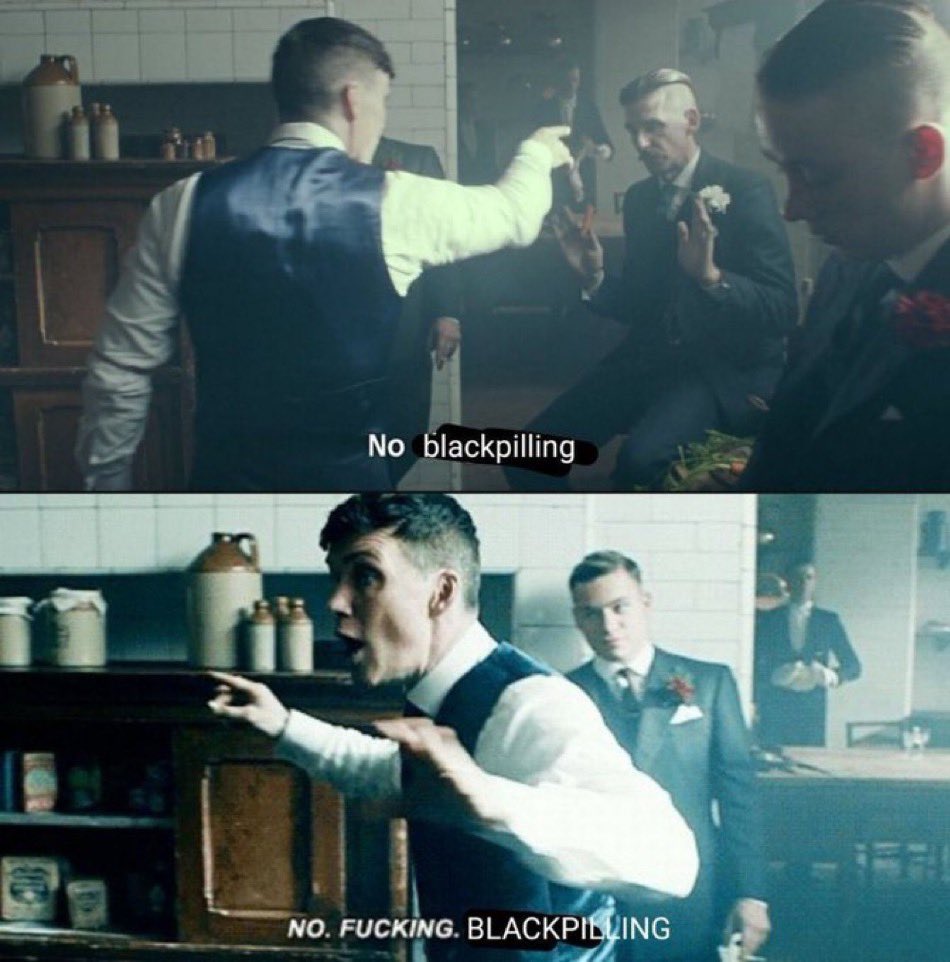
  • No. Fucking. BLACKPILLING


    In a striking visual call to action, a meme with its roots in the e/acc movement—a branch of Accelerationism focused on the digital realm—has gone viral for its strong condemnation of ‘blackpilling,’ a term synonymous with a defeatist or pessimistic worldview.

    In the realm of internet culture, memes are more than just vehicles for humor—they are the language of a generation that often communicates complex ideas through imagery and succinct text. Recently, a meme featuring a scene from a popular television series, modified to include the text “No blackpilling” and “NO. FUCKING. BLACKPILLING.”, has resonated deeply within online communities, particularly those discussing the future of society and technology.

    The meme is a snapshot of the larger conversation surrounding Accelerationism, a philosophy that advocates for the acceleration of capitalist forces to hasten the arrival of a new societal structure. This perspective does not inherently lean towards pessimism; rather, it proposes that the rapid intensification of capitalism’s dynamics could eventually lead to a radical transformation.

    The imagery of the meme—a man vehemently rejecting the notion of ‘blackpilling’—captures a sense of urgency and resistance. It symbolizes a broader rejection of nihilism and inaction, encouraging a proactive engagement with the challenges posed by the modern world. The term ‘blackpilling’ itself draws from the cultural lexicon of the “red pill” and “blue pill” dichotomy presented in “The Matrix,” where it represents the acceptance of a grim, inevitable decline.

    Within the context of e/acc and similar movements, this meme serves as a critique of passive negativity. It promotes an active response to the accelerating pace of technological and capitalist change, pushing back against the tendency to succumb to despair.

    The dual format of the meme—the statement first issued as a prohibition, then repeated with increased intensity—allows for a layered interpretation. It can be seen as either an escalation of the initial command or a self-aware, ironic exaggeration, reflecting the complexities of the sentiments it conveys.

    On a broader scale, the meme epitomizes the tension between taking action and resigning to passivity. It serves as a digital rallying cry within e/acc discussions, encouraging critical thinking and strategic action in the face of seemingly insurmountable systems.

    By spreading this meme, participants within the e/acc movement aim to foster resilience and an active stance against the complacency implied by ‘blackpilling.’ It reflects a facet of Accelerationist thought that encourages the strategic use of existing systems to shape the future, despite the uncertainties and controversial nature of such methods.