PJFP.com

Pursuit of Joy, Fulfillment, and Purpose

Tag: Claude

  • OpenAI’s Leaked 2025 Financials: $34 Billion in Spending, a $38.5 Billion Net Loss, and a $17 Billion Microsoft Bill Ahead of Its IPO

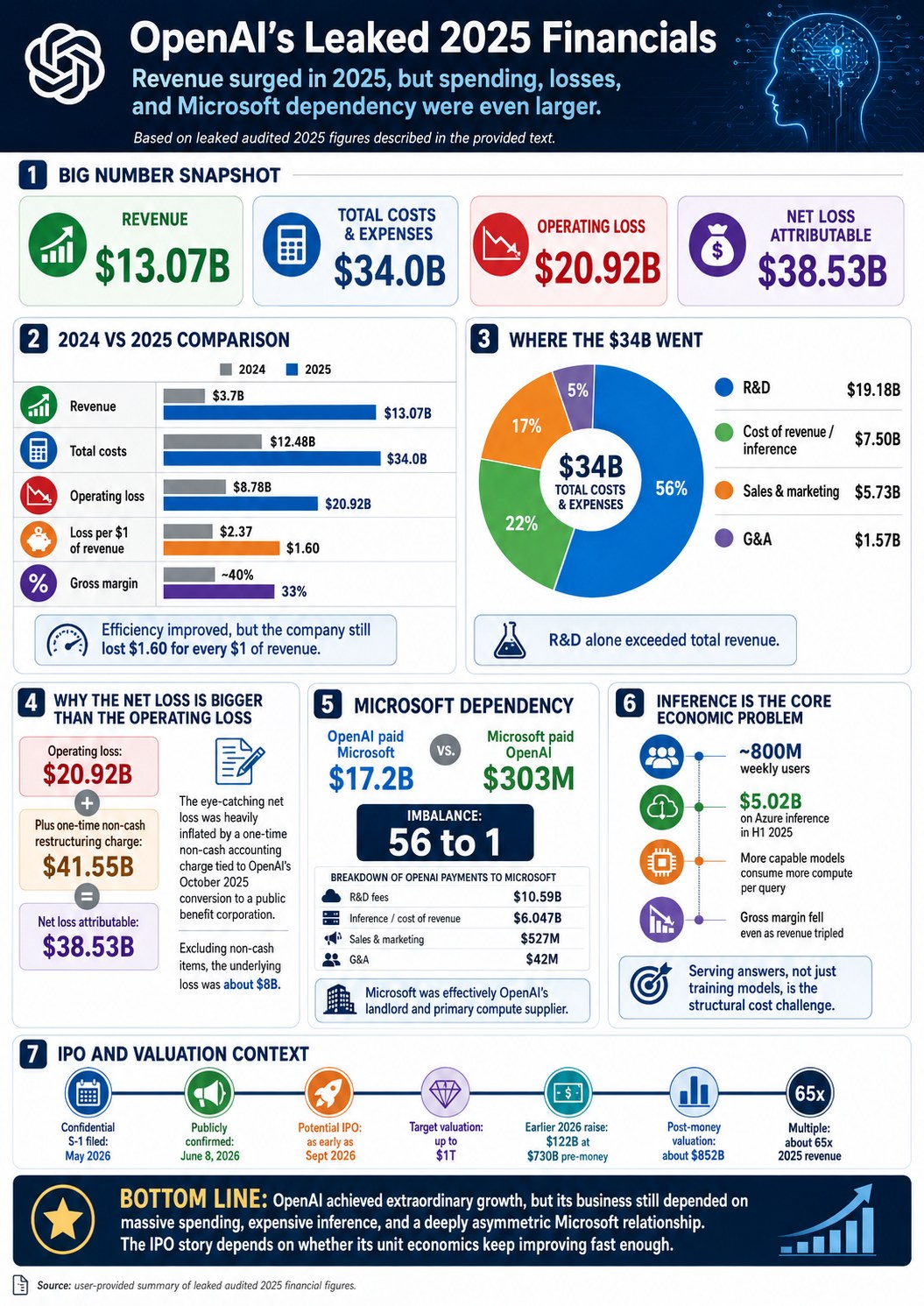
    Infographic summarizing OpenAI leaked 2025 financials: $13.07B revenue, $34B total costs, $20.92B operating loss, $38.53B net loss, where the $34B went, the $17.2B paid to Microsoft versus $303M paid back, inference costs, and IPO valuation context

    OpenAI’s audited 2025 financials leaked this week, and they are the clearest picture yet of what it actually costs to run the company behind ChatGPT. Independent journalist Ed Zitron first published the documents, and the Financial Times independently confirmed them. The headline: OpenAI spent $34 billion last year, booked $13.07 billion in revenue, and reported a net loss attributable to the company of $38.5 billion. The disclosure lands just days after OpenAI confidentially filed for an IPO that could value it north of $1 trillion.

    TLDR

    OpenAI’s audited 2025 numbers, leaked by Ed Zitron and confirmed by the Financial Times, show revenue tripling to $13.07 billion while total costs reached $34 billion, producing a $20.92 billion operating loss and a $38.53 billion net loss attributable to the company. The much larger net loss is inflated by a one-time $41.55 billion non-cash charge tied to OpenAI’s October 2025 conversion from a nonprofit to a public benefit corporation; strip the non-cash items and the loss is closer to $8 billion. R&D alone was $19.18 billion, cost of revenue (inference) was $7.5 billion, and sales and marketing ballooned to $5.73 billion. OpenAI paid Microsoft $17.2 billion in 2025 while Microsoft paid OpenAI only $303 million, exposing a deep Azure dependency. The company burned $1.60 for every dollar of revenue, down from $2.37 in 2024, and gross margin slipped from roughly 40% to 33% as more capable models consumed more compute per query. The leak arrives as OpenAI files a confidential S-1, targets a listing as early as September 2026 at up to a $1 trillion valuation, and races rival Anthropic, which is more valuable on paper and claims it is already turning an operating profit.

    Thoughts

    The most important thing to understand about these numbers is that there are two loss figures and the press will conflate them. The $38.53 billion net loss is the scary headline, but $41.55 billion of it is a non-cash accounting charge from converting investor convertible interests into equity during the for-profit restructuring. That charge is real on the audited statement and it will show up in the eventual S-1, but it is a one-time artifact of OpenAI’s unusual corporate history, not money that left the building. The number that describes the actual business is the $20.92 billion operating loss. That is the one to watch, and it is still enormous.

    The genuinely encouraging line in the whole release is the loss-per-dollar ratio. In 2024 OpenAI spent $2.37 to generate a dollar of revenue. In 2025 that fell to $1.60. A company that is still losing $1.60 on every dollar is not a healthy business, but a company whose efficiency improved by a third in a single year while tripling its top line is at least pointed in a defensible direction. The bull case for OpenAI lives entirely in the slope of that line. If it keeps improving at that rate, the math eventually crosses over. If it stalls, the valuation is a fantasy.

    The Microsoft relationship is the single most revealing disclosure, and it is wildly asymmetric. OpenAI paid Microsoft $17.2 billion in 2025. Microsoft paid OpenAI $303 million. That is a 56-to-1 ratio, and it reframes the partnership: Microsoft is not really a peer or even just an investor, it is OpenAI’s landlord and primary supplier, collecting rent on every model trained and every query answered. The April 2026 renegotiation that capped revenue-share payments at $38 billion through 2030, down from a projected $135 billion, suddenly looks less like a favor and more like OpenAI desperately trying to lower its single largest cost. The dependency cuts both ways, but right now Microsoft holds the better hand.

    The structural problem hiding inside the cost of revenue line is inference. Training a model is a fixed, one-time cost. Serving it is a recurring cost that scales with every one of ChatGPT’s roughly 800 million weekly users. OpenAI spent $5.02 billion on Azure inference in the first half of 2025 alone, and the more capable its reasoning models get, the more compute each answer burns. That is why gross margin went down even as revenue went up. It is the opposite of how software is supposed to work, where the marginal cost of one more user trends toward zero. OpenAI’s marginal cost is real, large, and growing. The counterargument is that per-token inference costs have been falling roughly tenfold a year, so the unit economics could still flip. That is the entire wager.

    Finally, the timing matters more than the numbers. OpenAI’s confidential S-1 means these audited figures were going to become public regardless, since the SEC requires the full prospectus at least 15 days before a roadshow. What the leak changes is who gets to study them first. Prospective IPO buyers, enterprise customers signing multi-year API contracts, and competitors now have the audited books weeks or months early, and they are reading them against Anthropic, which filed at a higher valuation and claims an operating profit. For a company asking the public markets to underwrite a $1 trillion bet on a monopoly outcome that does not yet exist, losing control of the narrative this early is not a small thing.

    Key Takeaways

    • OpenAI’s audited 2025 financials were first published by independent journalist Ed Zitron and independently confirmed by the Financial Times, the first verified look at the company’s books before its planned IPO.
    • Revenue grew from $3.7 billion in 2024 to $13.07 billion in 2025, more than tripling year over year, making OpenAI one of the fastest-growing businesses in history.
    • By the end of 2025 OpenAI was generating roughly $2 billion in monthly revenue, up from about $1 billion a quarter at the end of 2024.
    • Total costs and expenses hit $34 billion in 2025, up from $12.48 billion in 2024.
    • Research and development was the single largest expense at $19.18 billion, up from $7.81 billion, and exceeded total revenue on its own.
    • Of that R&D spend, $10.59 billion went to Microsoft, almost certainly the GPU compute cost of training frontier models on Azure.
    • Cost of revenue, the expense of serving ChatGPT responses (inference), rose from $2.65 billion to $7.5 billion.
    • Sales and marketing jumped from $1.11 billion to $5.73 billion, a 418% increase.
    • General and administrative costs rose from $907 million to $1.57 billion.
    • The operating loss, the truest measure of day-to-day economics, grew from $8.78 billion to $20.92 billion.
    • The net loss attributable to OpenAI was $38.53 billion, up nearly eightfold from $5.09 billion in 2024.
    • The bulk of that jump was a one-time, non-cash $41.55 billion charge from OpenAI’s October 28, 2025 conversion to a public benefit corporation, reflecting the changing fair value of convertible interests and warrant liabilities.
    • Stripping out the restructuring charge and other non-cash items such as stock-based compensation and Microsoft computing credits, the underlying loss was about $8 billion.
    • Including all factors, gross net loss reached $60.35 billion, lowered to the $38.53 billion attributable figure by removing $21.82 billion attributed to noncontrolling and redeemable noncontrolling interests.
    • OpenAI burned $1.60 for every $1 of revenue in 2025, an improvement from $2.37 in 2024, the clearest data point in the bull case.
    • Measured as a percentage of revenue, the operating loss improved from 237% in 2024 to 160% in 2025.
    • In total, OpenAI paid Microsoft $17.2 billion in 2025: $10.59 billion in R&D fees, $6.047 billion in cost of revenue, $527 million in sales and marketing, and $42 million in G&A.
    • Microsoft paid OpenAI just $303 million in the same year, a 56-to-1 imbalance underscoring OpenAI’s Azure dependency.
    • SoftBank paid OpenAI $867 million in 2025.
    • At year-end OpenAI carried $3.64 billion in outstanding payables to Microsoft, plus tens of millions more in accrued and non-current liabilities.
    • OpenAI spent $5.02 billion on Azure inference in just the first half of 2025; Azure inference from 2024 through Q3 2025 totaled $12.43 billion.
    • ChatGPT serves roughly 800 million weekly users, meaning billions of queries a week, each one burning GPU time at Azure’s pricing of about $6.98 per H100 GPU-hour.
    • Gross margin fell from roughly 40% in 2024 to 33% in 2025, because more capable reasoning models consume more compute per query.
    • Research firm Sacra estimates OpenAI’s inference costs reached $8.4 billion in 2025 and will rise to $14.1 billion in 2026, a 68% increase.
    • At year-end OpenAI held just over $50 billion in assets, with almost half in cash.
    • The April 2026 Microsoft renegotiation ended exclusivity and capped revenue-share payments at $38 billion through 2030, down from a projected $135 billion, potentially saving OpenAI up to $97 billion over five years.
    • OpenAI filed a confidential draft S-1 with the SEC around May 22, 2026 and confirmed it publicly on June 8, naming Goldman Sachs and Morgan Stanley as underwriters.
    • The company is targeting a listing as early as September 2026 at a valuation that could exceed $1 trillion, though Sam Altman has said a public offering “may be a while.”
    • OpenAI raised $122 billion earlier in 2026 at a $730 billion pre-money valuation, putting its post-money value around $852 billion.
    • At an $852 billion valuation, OpenAI trades at roughly 65 times its 2025 revenue.
    • Rival Anthropic also filed IPO paperwork this month after raising $65 billion at a $900-$965 billion valuation, making it more valuable on paper than OpenAI, and says it expects to report an operating profit of $559 million in the June quarter.
    • HSBC analysts estimate OpenAI may need more than $207 billion in additional capital through 2030 even under optimistic projections.
    • OpenAI projects profitability by 2029 or 2030; independent analysts put the more likely date at 2031 or later.
    • Bridgewater partner Greg Jensen reportedly told clients the implied revenue multiples price OpenAI for “a monopoly outcome that does not yet exist.”
    • Zitron separately reported OpenAI had a negative 122% non-GAAP operating margin in Q1 2026 and that ChatGPT growth has stalled, with the company projecting paid ChatGPT Plus subscriptions to fall from 44 million in 2025 toward cheaper tiers in 2026.

    Detailed Summary

    How the leak happened and why it matters now

    The audited documents were obtained and first published by Ed Zitron on his newsletter Where’s Your Ed At, then independently verified by the Financial Times, which reviewed the same materials. That dual sourcing matters: this is not a rumor or a model, it is OpenAI’s actual audited financial statement. The timing is the story. OpenAI filed a confidential draft S-1 with the SEC around May 22, 2026 and confirmed it publicly on June 8. Under SEC rules the full prospectus must be released at least 15 days before an investor roadshow, so the 2025 numbers were going to be public soon regardless. The leak simply moved that disclosure forward, handing prospective investors, enterprise customers, and competitors an early look at the books.

    Revenue tripled, costs grew faster

    OpenAI’s revenue rose from $3.7 billion in 2024 to $13.07 billion in 2025, and monthly revenue reached nearly $2 billion by year-end. By almost any normal standard that is spectacular growth. The problem is that costs grew faster, reaching $34 billion against $12.48 billion the year before. The gap between what OpenAI earns and what it spends has widened every year since its founding, and 2025 is the starkest example yet. Revenue alone was outpaced by research and development as a single line item in both of the last two years.

    Two loss numbers, and why both matter

    There are two figures that get cited interchangeably and should not be. The operating loss of $20.92 billion is what the business spent beyond what it earned from operations: training models, serving ChatGPT, paying engineers, running marketing. The net loss attributable to OpenAI of $38.53 billion is far larger because 2025 was the year OpenAI completed its conversion from a nonprofit to a for-profit public benefit corporation, finalized on October 28, 2025. That restructuring triggered a $41.55 billion non-cash charge reflecting the changing fair value of convertible equity interests and warrant liabilities. Before the conversion, investors held convertible interest rights treated as liabilities under US accounting rules and revalued upward as OpenAI’s valuation climbed, creating the charge. It is not expected to recur. Including all minor items, gross net loss reached $60.35 billion, reduced to the $38.53 billion attributable figure after removing $21.82 billion tied to noncontrolling and redeemable noncontrolling interests, primarily the OpenAI Foundation’s stake. Strip the non-cash noise and the underlying loss was about $8 billion.

    Where the $34 billion went

    The spending breaks into four lines. Research and development was $19.18 billion, the largest category, with $10.59 billion of it flowing to Microsoft for training compute. Cost of revenue, the expense of serving responses to users, was $7.5 billion and captures inference, the compute consumed every time someone prompts ChatGPT or calls the API. Sales and marketing reached $5.73 billion, up 418% year over year, a striking jump for a product that grew largely by word of mouth. General and administrative costs added $1.57 billion. The shape of the spending tells you OpenAI is simultaneously racing to build better models, serve a massive and growing user base, and aggressively defend market share through marketing.

    The Microsoft dependency

    The most striking single disclosure is the scale of the Microsoft relationship. OpenAI paid Microsoft $17.2 billion in 2025: $10.59 billion in R&D fees for model training, $6.047 billion in cost-of-revenue for inference serving, $527 million in sales and marketing, and $42 million in G&A. Microsoft paid OpenAI just $303 million the same year. SoftBank paid OpenAI $867 million. The 56-to-1 ratio between what OpenAI pays Microsoft and what Microsoft pays back makes the structural reality plain: Microsoft is OpenAI’s largest landlord. The dynamic began shifting in April 2026, when the two renegotiated, ending Microsoft’s exclusivity and capping revenue-share payments at $38 billion through 2030, down from a projected $135 billion. That could save OpenAI up to $97 billion over five years, though Microsoft keeps its IP license through 2032 and remains the primary cloud partner.

    Why inference is the core problem

    Training happens once. Serving happens billions of times a day. When OpenAI releases a model it spends months and billions on training compute, a fixed cost that falls away when training ends. Inference is the opposite: every ChatGPT message runs through the model on Azure GPU hardware, consuming electricity and compute to generate a response. With roughly 800 million weekly users, that is billions of queries a week, each burning GPU time at roughly $6.98 per H100 GPU-hour on demand. OpenAI spent $5.02 billion on Azure inference in the first six months of 2025 alone. Sacra estimates full-year inference costs of $8.4 billion in 2025, rising to $14.1 billion in 2026. This is why gross margin fell from about 40% to 33% even as revenue tripled: more capable reasoning models consume far more compute per query, and revenue has not kept pace with the cost growth that capability generates.

    What it means for the IPO and the race with Anthropic

    OpenAI was last valued around $852 billion post-money after raising $122 billion in early 2026, which puts it at roughly 65 times 2025 revenue. It has named Goldman Sachs and Morgan Stanley as underwriters and is targeting a listing as early as September 2026 at up to a $1 trillion valuation, though Altman has hedged that it “may be a while” and that staying private might be the better course. HSBC estimates the company may need more than $207 billion in additional capital through 2030. The race is with Anthropic, which filed paperwork the same month after raising $65 billion at a $900-$965 billion valuation, making it more valuable on paper, and which says it expects a $559 million operating profit in the June quarter. The contrast is sharp: the two leading AI labs heading toward public markets at the same time, one bleeding cash at scale, the other claiming profitability, both asking investors to bet on a future that has not arrived.

    Notable Quotes

    “The financial condition of OpenAI is deeply concerning. $38.53 billion in losses are astronomical, and far higher than most believed it would be. Losses also appear to be mounting year-over-year at a dramatic rate, and I’m not sure how this company finds a way toward any kind of sustainability or profitability.”

    Ed Zitron, the independent journalist who published the leaked audited financials

    “It’s unclear what this means, nor how OpenAI reconciled the removal of $3.74 billion in costs. I will not speculate further.”

    Ed Zitron, on a discrepancy he found in the restated 2024 figures

    “OpenAI’s two biggest expenses are R&D and marketing. Budget cuts there, coupled with an ability to raise prices or win new sources of revenue, could see the company move into the black over time. Cutting R&D would be the most difficult part of that, given that AI companies can only hold onto their customers by generating the best-performing models.”

    Jim Edwards, Fortune, on whether OpenAI has a realistic path to profitability

    “What the audited documents make impossible to argue is that the path to profitability is short, clear, or cheap.”

    TechTimes analysis of the leaked OpenAI financials

    The implied revenue multiples price OpenAI for “a monopoly outcome that does not yet exist.”

    Bridgewater partner Greg Jensen, reportedly telling clients how to read OpenAI’s valuation

    “OpenAI spent $34bn last year as the ChatGPT maker poured money into a race to dominate the fast-growing AI market ahead of a planned stock market listing.”

    George Hammond and Bryce Elder, Financial Times, framing the audited 2025 spend

    Read Ed Zitron’s original reporting with the full breakdown here, and the Financial Times confirmation here.

    Related Reading

    • Ed Zitron, Where’s Your Ed At the primary source that broke the audited 2025 financials with the full line-by-line breakdown.
    • OpenAI (Wikipedia) background on the company’s history, structure, and the nonprofit-to-for-profit conversion that drives the non-cash charge.
    • Inference (Wikipedia) on the recurring compute cost that explains why OpenAI’s gross margin shrinks as usage grows.
    • Anthropic the rival lab that filed IPO paperwork the same month at a higher valuation and claims it is already operating at a profit.
    • SEC on confidential filings context for why OpenAI’s audited numbers were headed for public disclosure regardless of the leak.
  • US Government Orders Anthropic to Suspend Claude Fable 5 and Mythos 5: Inside the Export Control Directive, the Jailbreak Dispute, and What It Means for Frontier AI

    On June 12, 2026, Anthropic published a statement announcing that the US government, citing national security authorities, has issued an export control directive forcing the company to suspend all access to its newest frontier models, Claude Fable 5 and Claude Mythos 5. The order technically targets foreign nationals inside and outside the United States, including Anthropic’s own foreign national employees, but the practical effect is that both models are going dark for every customer worldwide. It is the first publicly known instance of the US government ordering a deployed frontier AI model offline, and Anthropic is complying while openly disputing the basis for the decision.

    TLDR

    The US government delivered an export control directive to Anthropic at 5:21pm ET on June 12, 2026, suspending all access to Fable 5 and Mythos 5 over an alleged jailbreak of Fable 5’s safeguards. Anthropic says the letter contained no specific details, that the only evidence shared was verbal, and that the technique in question amounts to asking the model to read a codebase and fix software flaws, a capability the company says is freely available from other models including OpenAI’s GPT-5.5 and used daily by cyber defenders. Anthropic defends its defense in depth strategy, notes that thousands of hours of red teaming by the US government, the UK AISI, and third parties found no universal jailbreak, and warns that recalling a commercial model over a narrow, non-universal jailbreak would effectively halt all new frontier model deployments if applied industry-wide. Access to all other Anthropic models, including Claude Opus, Sonnet, and Haiku, is unaffected, and the company says it believes the situation is a misunderstanding and is working to restore access, with more details promised within 24 hours.

    Thoughts

    This is a watershed moment regardless of how it resolves. Governments have blocked AI exports before, but ordering a deployed commercial model recalled out from under hundreds of millions of users is a new kind of intervention, closer to a product recall than a trade restriction. The mechanism matters too. Export control authority aimed at foreign nationals, including a company’s own employees, that cascades into a global shutdown is a blunt instrument doing the work of a regulatory regime that does not exist yet. The US has no statutory process for recalling an AI model, so the government reached for the closest tool on the shelf, and the result is a precedent built on improvisation.

    There is real irony in who got hit first. Anthropic has spent years arguing, publicly and in Washington, that governments should have the power to block unsafe AI deployments. Now the company that asked for a referee is the first one whistled, and its complaint is not about the existence of the power but about the process: a letter at 5:21pm with no specifics, verbal evidence only, and no transparent or technically grounded procedure. That distinction is the whole ballgame for AI governance. A power to halt deployments without due process standards is not regulation, it is discretion, and discretion cuts in every direction depending on who holds it.

    The technical dispute underneath is genuinely interesting because it exposes how unsettled the definition of a dangerous jailbreak is. Anthropic’s account of the offending technique, asking the model to read a specific codebase and fix any software flaws, describes something security teams do on purpose every single day. Vulnerability discovery is the canonical dual use capability: the same analysis that lets a defender patch a hole lets an attacker find one. If the bar for recall is that a model can be coaxed into doing competent security analysis, then every capable model on the market fails that bar, which is exactly Anthropic’s point about GPT-5.5. The hard question the directive dodges is not whether Fable 5 can find bugs but whether it provides meaningful uplift beyond what is already freely available, and Anthropic says it does not.

    For builders, the immediate lesson is uncomfortable: model availability is now a political variable, not just an engineering one. Teams that built directly on Fable 5 lost a production dependency overnight through no fault of Anthropic’s infrastructure, their own code, or any terms of service violation. Multi-model fallback strategies, abstraction layers over providers, and graceful degradation paths just moved from nice-to-have to table stakes for anyone running serious workloads on frontier models. The companies that absorbed this outage gracefully are the ones that assumed any single model could vanish.

    The next 24 hours matter more than the directive itself. Anthropic has promised more details, and the government will face pressure to either substantiate a concern that justifies a global recall or quietly walk it back. Either outcome sets the real precedent. If the directive holds on thin evidence, every frontier lab now operates under the threat of arbitrary shutdown. If it collapses under scrutiny, the case for a formal, transparent statutory process for AI deployment decisions, which Anthropic explicitly endorses in its own statement, gets a lot stronger in Congress than it was a week ago.

    Key Takeaways

    • The US government issued an export control directive on June 12, 2026 suspending all access to Claude Fable 5 and Claude Mythos 5, citing national security authorities.
    • The directive formally targets access by any foreign national, inside or outside the United States, including Anthropic’s own foreign national employees.
    • The net effect is that Anthropic must disable Fable 5 and Mythos 5 for all customers worldwide to ensure compliance, not just for foreign users.
    • Access to all other Anthropic models, including the Claude Opus, Sonnet, and Haiku families, is not affected by the order.
    • Anthropic received the directive at 5:21pm ET the same day it published its statement, and says the letter did not provide specific details of the national security concern.
    • Anthropic’s understanding is that the government believes it has become aware of a method of bypassing, or jailbreaking, Fable 5’s safeguards.
    • Anthropic reviewed a demonstration of the specific technique and says it only identified a small number of previously known, minor vulnerabilities.
    • The company says other publicly available models can discover the same vulnerabilities without requiring any bypass at all.
    • Before launch, Fable 5’s safeguards were red-teamed for thousands of hours in total by the US government, the UK AISI, multiple private third-party organizations, and internal teams.
    • No tester has found a universal jailbreak for Fable 5, meaning a method that broadly bypasses safeguards and unlocks a wide range of cyber capabilities.
    • Anthropic openly states that perfect jailbreak resistance does not appear possible for any model provider today, and that every safeguard in the industry is vulnerable to non-universal jailbreaks.
    • Fable 5 was deployed under a defense in depth strategy: make jailbreaks either narrow or very expensive to produce, then combine that with monitoring to quickly detect and shut down successful attacks.
    • Anthropic’s 30-day customer data retention requirement for Fable exists specifically to support jailbreak research and mitigation, a policy the company says carries real costs with customers.
    • Anthropic says it has not received any disclosure of a concerning non-universal jailbreak that led to a harmful result; disclosed potential jailbreaks were benign or provided no Mythos-specific uplift.
    • The only evidence the government has provided is verbal, describing a narrow, non-universal jailbreak that essentially consists of asking the model to read a specific codebase and fix any software flaws.
    • Anthropic reviewed a report it believes is the basis of the directive and validated that the capability level shown is widely available from other models, including OpenAI’s GPT-5.5, and is used every day by cyber defenders.
    • Anthropic is complying with the legal directive while explicitly disagreeing that a narrow potential jailbreak justifies recalling a commercial model deployed to hundreds of millions of people.
    • The company warns that if this recall standard were applied across the industry, it would essentially halt all new model deployments for every frontier model provider.
    • Anthropic supports government power to block unsafe deployments in principle, but only through a statutory process that is transparent, fair, clear, and grounded in technical facts, and says this action meets none of those principles.
    • Anthropic apologized to customers, called the situation a misunderstanding, said it is working to restore access as soon as possible, and promised more details within 24 hours.

    Detailed Summary

    What the directive actually does

    The order arrived as a letter from the US government at 5:21pm ET on June 12, 2026, invoking national security authorities under export control law. On paper it suspends access to Fable 5 and Mythos 5 by any foreign national, whether inside or outside the United States, a category that includes some of Anthropic’s own employees. In practice, Anthropic says compliance requires abruptly disabling both models for every customer, since there is no clean way to enforce a nationality-based access boundary across a global product. The letter did not spell out the specific national security concern. Everything else in Anthropic’s statement is the company’s own reconstruction of what prompted the action.

    The jailbreak at the center of the dispute

    Anthropic’s understanding is that the government became aware of a method for bypassing Fable 5’s safeguards. The company reviewed a demonstration of the technique and characterizes the results as a small number of previously known, minor vulnerabilities, all relatively simple, all discoverable by other publicly available models without any jailbreak at all. According to Anthropic, the government’s evidence so far has been entirely verbal, and the technique boils down to asking the model to read a specific codebase and fix any software flaws. The company reviewed a report it believes underlies the directive and validated that the displayed capability is widely available elsewhere, naming OpenAI’s GPT-5.5 directly, and noted that this exact kind of analysis is what defenders use to keep systems safe.

    Anthropic’s defense in depth posture

    The statement restates the safety posture Anthropic laid out at Fable 5’s launch. The safeguards around cybersecurity tasks are strong enough that users have complained they are overly broad. In the weeks before launch, the US government, the UK AISI, multiple private third-party organizations, and internal teams red-teamed the safeguards for thousands of hours combined, and those tests showed Fable’s protections to be substantially more effective than any previously deployed model. No tester found a universal jailbreak. Anthropic is candid that perfect jailbreak resistance is likely impossible for anyone today, which is why the strategy is defense in depth: keep jailbreaks narrow or expensive, monitor aggressively, and shut down attacks fast. The 30-day customer data retention requirement on Fable exists to support that monitoring and mitigation loop. The company says this posture makes Fable’s risks comparable to models already deployed across the industry.

    Complying while disputing the standard

    Anthropic is removing access for all users as legally required, but the statement draws a hard line on the principle. The company disagrees that a narrow potential jailbreak, one that produced no disclosed harmful result, justifies recalling a commercial model serving hundreds of millions of people. Its broader warning is that this standard, applied evenly, would halt all new frontier model deployments industry-wide, since every provider’s safeguards are vulnerable to narrow jailbreaks. Anthropic also turns its own policy position into a critique: the company has publicly supported giving government the ability to block unsafe deployments, but through a statutory process that is transparent, fair, clear, and grounded in technical facts, and it says this action does not adhere to those principles.

    What happens next

    Anthropic closed by apologizing to customers, calling the situation a misunderstanding, and committing to restore access as soon as possible. The company promised to share more details over the next 24 hours, which makes this a developing story. The open questions are whether the government substantiates its concern with written technical evidence, whether the directive survives that scrutiny, and whether this episode accelerates the formal statutory process for AI deployment decisions that Anthropic says should have governed the action in the first place.

    Notable Quotes

    “The net effect of this order is that we must abruptly disable Fable 5 and Mythos 5 for all our customers to ensure compliance.”

    Anthropic, on why a directive aimed at foreign nationals becomes a global shutdown

    “We received the directive from the government today at 5:21pm (ET). The letter did not provide specific details of its national security concern.”

    Anthropic, on the abruptness and opacity of the order

    “These vulnerabilities all appear relatively simple, and we have found that other publicly-available models are able to discover them as well without requiring a bypass.”

    Anthropic, on its review of the demonstrated jailbreak technique

    “We suspect that perfect jailbreak resistance is not currently possible for any model provider.”

    Anthropic, restating the position it disclosed at Fable 5’s launch

    “We stand by this defense in depth strategy. It reduces the risks posed by Fable, making them comparable to the risks of existing models already deployed across the industry.”

    Anthropic, defending its layered safeguards approach

    “To date, the government has only given us verbal evidence of a potential narrow, non-universal jailbreak, which essentially consists of asking the model to read a specific codebase and fix any software flaws.”

    Anthropic, describing the technique behind the directive

    “However, we disagree that the finding of a narrow potential jailbreak should be cause for recalling a commercial model deployed to hundreds of millions of people.”

    Anthropic, on complying while contesting the decision

    “If this standard was applied across the industry, we believe it would essentially halt all new model deployments for all frontier model providers.”

    Anthropic, on the industry-wide implications of the recall standard

    “As we have stated publicly, we believe the government should have the ability to block unsafe deployments, as part of a statutory process that is transparent, fair, clear, and grounded in technical facts. This action does not adhere to those principles.”

    Anthropic, on the kind of oversight process it says should have governed the action

    “We apologize for this disruption to our customers. We believe this is a misunderstanding and are working to restore access as soon as possible.”

    Anthropic, closing its statement to customers

    Read the full statement on Anthropic’s site here.

    Related Reading

  • Dario Amodei on Policy for the AI Exponential: Anthropic’s Plan for AI Regulation, Job Displacement, Civil Liberties, and Democratic Leadership

    In June 2026, Anthropic CEO Dario Amodei published “Policy on the AI Exponential”, a wide-ranging essay arguing that the gap between how fast AI is advancing and how slowly policy moves has become dangerous, and that the window to close it is open right now. He opens with a memorable image from The Lord of the Rings: the Hobbits trying to rouse Treebeard, the ancient tree who takes a full day just to say hello, to defend his forest before it is cut down. That mismatch in speed, he writes, is exactly the relationship between AI and our political institutions. This post breaks the essay down in full and adds analysis of where the argument lands.

    TLDR

    Amodei argues that AI’s scaling laws point toward “powerful AI,” a country of geniuses in a datacenter, within a few years, while legislation still moves on a timescale of years. For most of the last few years, safety advocates including Anthropic pushed only for optionality-preserving moves like transparency rules, chip export controls, and labor data collection, because the risks were not yet concrete. He says that has changed: events like Claude Mythos Preview proved frontier models are now tools of national strategic consequence, and the time for binding regulation has arrived. The essay covers five policy areas. First, regulation and public safety, where he proposes an FAA-style regime of mandatory third-party testing of frontier models above a compute threshold across four risks (cybersecurity, biological weapons, loss of control, and automated R&D), with government power to block unsafe deployments. Second, macroeconomics and tax policy, where AI could deliver hypergrowth and severe, enduring job displacement at the same time, demanding measurement, pro-employment incentives, and possibly UBI or universal capital accounts. Third, accelerating AI’s positive impact, where the danger is regulators like the FDA being too slow rather than too lax, and biomedical approval needs reform. Fourth, the state and civil liberties, where AI could become the ultimate tool of autocracy through autonomous weapons and mass surveillance, requiring new accountability rules, a domestic ban on autonomous weapons, closing the data broker loophole, and public rights to AI advice. Fifth, securing leadership by democracies through a values-based global coalition that controls the AI supply chain, coordinates on risk, shares benefits, and rejects AI-powered repression. He closes by rejecting the idea that public concern about AI is a PR problem to be marketed away, calling it democratic accountability working as it should.

    Thoughts

    The most important move in this essay is structural, not technical. Amodei is explicitly retiring the “preserve optionality” posture that defined Anthropic’s policy work through 2025 and replacing it with a call for binding rules. For years the argument from safety-minded labs was that the risks were too speculative to legislate against without doing more harm than good, an idea he grounds in the Collingridge dilemma and the Hayekian point that regulators lack the information to make good calls. That was a defensible hedge. What is striking here is the claim that the hedge has expired. He is saying the evidence is now concrete enough that continued caution about regulating has flipped from prudent to negligent. Whether you trust the underlying capability claims or not, that is a genuine change in position from one of the field’s most influential voices, and it deserves to be read as such.

    The FAA analogy is doing enormous work, and it is worth poking at. Airplanes and drugs are mature technologies with stable physics and decades of incident data; the certification regime works because the failure modes are well understood. Frontier models are the opposite: the whole premise of the essay is that capabilities are changing faster than anyone can characterize them. Amodei half-acknowledges this when he warns that a fixed list of safety requirements tends to consume 95 percent of compliance effort on things that turn out not to matter while missing the real risks, a lesson he says Anthropic learned from its own Responsible Scaling Policy. So the proposal is really for an agency nimble enough to rewrite its own standards continuously, which is a much taller order than the FAA. The honest read is that he is proposing a regulator we do not yet know how to build, and betting that building it is still better than the alternative.

    The economics section is where Amodei is most careful, and it is the part most likely to be misread. He goes out of his way to say enduring job displacement is undesirable and that warning about it is not the same as wanting it, a distinction critics of AI leaders often collapse. His real claim is subtle: that AI might jam the economic policy dial on a “hypergrowth, hyper-inequality” setting that is hard to unstick, because AI substitutes for human cognition broadly and faster than past technologies, potentially overwhelming the usual escape hatches like comparative advantage and Jevons paradox. If he is right, the political fight of the next decade is not about growth, which AI supplies, but about distribution, which it does not. His mention of UBI, universal capital accounts, and higher capital gains taxes is notable coming from a frontier CEO, even hedged as it is.

    The civil liberties section is the one that should travel furthest beyond the AI-policy bubble, because it does not depend on accepting his most aggressive timelines. The data broker loophole, the idea that the government can simply buy the bulk data Americans hand to private companies and run mass analysis on it, is a problem that exists today; AI just raises the stakes by making that data vastly more revealing. Same with the proposal that anyone facing adverse government action should have access to AI at least as capable as what the government uses against them. These are concrete, near-term, and bipartisan in a way the abstract autonomy debates are not. The most candid line in the whole piece is his admission that AI cannot be safely entrusted to either governments or companies, an unusually direct acknowledgment that his own industry needs external checks, with Anthropic’s Long-Term Benefit Trust offered as one imperfect example rather than a solution.

    The geopolitics section is the most contested terrain. Framing AI as a nuclear-scale reset of the game board, with a virtual country of 100 million geniuses divisible across military strategy and weapons R&D, leads naturally to a democratic coalition that hoards chips and denies them to adversaries. That logic is internally consistent, but it sits in tension with the benefit-sharing and “eventually the whole world joins” language elsewhere in the same section. Export controls that lock down the supply chain are, by design, a tool of exclusion, and reconciling that with broad diffusion of AI’s benefits to developing countries is the circle the coalition idea has to square. Amodei is clearly aware of the tension and bets that making membership attractive resolves it. The closing image is the one to remember: Treebeard waking up, with the warning that the goal is to channel real public concern into constructive policy rather than let it curdle into formless anger.

    Key Takeaways

    • The core tension of the essay is a mismatch in speed: AI advances exponentially while legislation moves on a multi-year timescale, dramatized by the Treebeard and Hobbits image from The Lord of the Rings.
    • In only four years, AI models went from barely writing a coherent line of code to writing most of the code at major AI companies, with similar gains across biology, physics, math, finance, law, and translation.
    • Scaling laws now have over a decade of empirical support, and if they continue another year or two they likely produce “powerful AI,” a country of geniuses in a datacenter.
    • For the last few years, safety advocates including Anthropic focused on optionality-preserving policies: transparency legislation, chip export controls, and data collection on AI’s labor effects.
    • Amodei argues that posture is no longer enough. Claude Mythos Preview revealed that frontier models pose real cybersecurity risks to the financial sector, critical infrastructure, and national security, and proved AI is now a tool of strategic consequence.
    • He expects biological risks to follow cyber risks, with serious AI autonomy risks potentially not far behind.
    • The essay covers five policy areas: regulation and public safety, macroeconomics and tax policy, accelerating AI’s positive impact, the state and civil liberties, and securing leadership by democracies.
    • Alongside the essay, Anthropic released a legislative proposal on frontier model testing and a policy framework for job displacement, both with promised financial backing.
    • On regulation, Amodei invokes the Collingridge dilemma and Hayek’s information problem to explain why pre-writing AI law in 2023 to 2024 was risky, then argues the situation has now changed.
    • Anthropic’s 2025 answer was transparency, helping pass SB 53 in California, RAISE in New York, and SB 315 in Illinois, plus advocating a federal transparency standard.
    • He now calls for binding regulation modeled on the FAA, where frontier models must pass technical testing and can have release blocked or reversed if they fail high safety standards.
    • Models above a compute threshold should face mandatory third-party testing in four areas: cybersecurity, biological weapons, loss of control of AI systems, and automated R&D that accelerates the other three.
    • Government should be able to block or deter deployment of models judged to present unacceptable risk, scoped to those four risks with protections against political favoritism.
    • Evaluation could come from a government agency or from authorized and inspected private organizations under a “regulatory markets” approach.
    • AI companies should have strong security to protect model weights, conduct regular red teaming and penetration testing, report safety incidents promptly, and work with government against major threat actors.
    • He warns a time may come when the most powerful systems resemble weaponizable nuclear materials rather than airplanes, requiring more aggressive measures, but cautions against getting ahead of present dangers.
    • On economics, AI could deliver extremely rapid growth via accelerated science and operational efficiency, supercharged by AI building better AI.
    • The same properties make AI a broad substitute for human cognition that changes the economy faster than past technologies, risking large and potentially enduring labor market disruption.
    • The feared outcome is a “hypergrowth, hyper-inequality” setting that is hard to unstick, where the challenge shifts from incentivizing growth to sharing its benefits.
    • Amodei is emphatic that enduring job displacement is undesirable and dangerous, and that he warns about it to help society adapt, not as a prophet of doom.
    • Anthropic says it works with customers to find new revenue and use cases rather than only cost cutting, and explores interaction paradigms that keep humans active alongside AI.
    • He predicts AI will enable single individuals to build billion-dollar companies, noting teams of a few people already reach hundreds of millions in revenue, while admitting significant enduring job loss may be intrinsic to the technology.
    • Any response must address both economic provision and the human need for meaning, purpose, and agency, with the latter ultimately more important and beyond what policy can directly deliver.
    • Suggested economic interventions: better measurement and tracking (governments expanding statistics beyond Anthropic’s Economic Index), pro-employment incentives, and long-term macroeconomic support.
    • Pro-employment ideas include wage insurance, retention tax incentives, workforce training grants, and employer-employee matching infrastructure.
    • If displacement is large and permanent, mechanisms like universal basic income or universal capital accounts, financed through company taxes or higher capital gains taxes, may be necessary.
    • He frames datacenter and energy-price backlash as largely a symbol of broader economic anxiety, and says AI companies should pay to absorb rate increases, a pledge Anthropic has already made.
    • For technologies accelerated by AI, the bigger risk is regulators like the FDA being too slow, not too lax, because AI may make downstream tech safer in ways that violate skeptical regulatory assumptions.
    • Biomedicine is the illustrative case: AI could flood the drug pipeline, raise effect sizes, treat previously untreatable diseases, and create whole new therapy categories, while the current FDA and EMA pipeline takes 7 to 8 years.
    • Agencies should pre-approve standards for AI methods like PD/PK modeling, toxicology prediction, dose selection, biomarker validation, synthetic control arms, and surrogate endpoints, plus more flexible accelerated-approval mechanisms.
    • On civil liberties, powerful AI in the wrong hands could be the ultimate tool of autocracy, and existing constitutional protections are not fully equipped to counter a surprise seizure of power.
    • Threats named include fully automated drone armies that obey unlawful orders and surveillance AI that infers the innermost details of every citizen’s life from widely available data.
    • Civil liberties proposals: accountability rules and an “off switch” for autonomous weapons, a domestic ban on fully autonomous weapons including in law enforcement, closing the data broker loophole, and public rights to AI advice during adverse government action.
    • Amodei warns companies as well as governments can seize quasi-state power, citing the Gilded Age and the East India Company, and says AI cannot be safely entrusted to either alone.
    • He offers Anthropic’s Long-Term Benefit Trust as one separation-of-power structure and urges the industry to explore mechanisms that go further.
    • On geopolitics, he argues AI resets the geopolitical game board like nuclear weapons, becoming the dominant source of military and economic power for any nation that holds it.
    • A nation with powerful AI versus one without it, or even one three years behind, could resemble WWII Marines facing medieval swordsmen.
    • He calls for a democratic coalition that shares chips and semiconductor manufacturing equipment internally while denying them to adversaries, citing MATCH and OVERWATCH as good first steps.
    • The coalition should coordinate risk policy, share benefits including harmonized medical approvals, provide mutual AI defense, reject AI-powered repression, and cooperate on macroeconomic stabilization.
    • He rejects the idea that AI’s image is a PR problem, arguing public concern reflects real risks and is democratic accountability working as it should, with the task being to channel it into constructive solutions.

    Detailed Summary

    The speed mismatch between AI and policy

    Amodei frames the entire essay around a single problem: AI advances at a lightning pace while policy, especially legislation, moves very slowly, often for good reasons since governments wield grave powers that should not be used hastily. He illustrates this with Treebeard, the sentient tree from The Lord of the Rings who takes a full day to say hello, as a stand-in for political institutions trying to respond to a technology that can go from amusing toy to a country of geniuses in the time it takes Congress to act. He recounts the dilemma responsible actors have faced: they could see where the exponential was headed, but to observers looking only at present capabilities, AI looked as mundane as the latest consumer app or cryptocurrency, making a laissez-faire attitude hard to argue against. The absence of AI’s radical effects, and uncertainty about their shape, made it genuinely difficult to design good policy even where the will existed.

    That uncertainty, he says, is why safety advocates limited themselves to optionality-preserving measures like transparency rules, export controls, and labor data collection. But over the last few months the evidence of AI’s power and risk has become undeniable, with Claude Mythos Preview as the emblematic example: it scrambled the global cybersecurity landscape and proved AI models are now tools of global and national strategic consequence. He expects biological and autonomy risks to follow, and argues the world must now activate its slow, rickety policy apparatus to handle risks that will compound quickly. He worries current early actions are at least a year out of step with AI’s progress, and presents the essay as an attempt to close that gap across five policy areas, focused on US policy but relevant worldwide.

    Regulation and public safety: an FAA for frontier models

    Amodei opens by acknowledging the real costs of regulation: it can reduce a product’s benefits, disincentivize innovation, and suffer from the Hayekian problem that regulators lack the information for good tradeoffs, plus the Collingridge dilemma that a technology’s impacts are hard to anticipate until it is too late to manage them. In 2023 to 2024 these dynamics argued against pre-writing AI law, since the exact form of biological or autonomy risk, how to test for it, and how it would play out were all unclear, creating a high risk of low-value compliance requirements that miss the real dangers. Anthropic’s answer was transparency: requiring developers to disclose safety procedures, tests, and critical incidents, which is why it supported SB 53 in California, RAISE in New York, and SB 315 in Illinois in early 2026.

    Now, he argues, the risks are clearly here and it is time for binding regulation. His analogy is to cars, airplanes, and drugs: powerful technologies essential to the economy but capable of killing many people if designed or operated poorly. He models AI regulation on the FAA, with frontier models required to pass testing and auditing and with release blocked or reversed if they fail high safety standards. His concrete proposal: mandatory third-party testing for models above a compute threshold across cybersecurity, biological weapons, loss of control, and accelerating automated R&D; government power to block deployment of unacceptably risky models, scoped narrowly with anti-favoritism protections; evaluation by either a government agency or authorized private organizations in a regulatory-markets model; strong weight security, red teaming, and penetration testing at AI companies; and prompt reporting of safety incidents. He notes a future may arrive when systems resemble weaponizable nuclear materials and demand harsher measures, but warns against designing for dangers that have not yet emerged.

    Macroeconomics and tax policy: growth and displacement together

    Here Amodei challenges the standard premise that growth is fragile and must be traded off against the drag of taxes or deficits to reduce inequality. Powerful AI, he suggests, may scramble that assumption by producing extremely rapid growth through accelerated science and efficiency, supercharged by AI building better AI, while simultaneously acting as a broad substitute for human cognition that reshapes the economy faster than any prior technology. The result could be a world stuck on a hypergrowth, hyper-inequality setting that is hard to unstick, where the central challenge is no longer incentivizing growth but sharing its benefits. He is careful to make two points clearly: first, enduring job displacement is undesirable and dangerous and should be minimized, and his warnings are meant to help society adapt, not to play prophet of doom; second, any response must address both economic provision and the deeper human need for meaning, purpose, and agency, which matters more and which policy cannot directly supply.

    His policy menu starts with measurement and tracking, arguing good policy is impossible without accurate data, and that governments could expand economic statistics well beyond Anthropic’s Economic Index. Next come pro-employment incentives such as wage insurance, retention tax incentives, workforce training grants, and employer-employee matching, costs he says society should readily accept since they are likely offset by AI productivity gains. If displacement proves large and permanent, he says long-term income support like universal basic income or universal capital accounts may be needed, financed through taxes on relevant companies or higher capital gains taxes. He closes the section by reframing datacenter and energy-price backlash as mostly a symbol of broader economic anxiety, while saying AI companies should absorb rate increases, as Anthropic has pledged.

    Accelerating AI’s positive impact: the slow-regulator problem

    For technologies accelerated by AI, rather than AI itself, Amodei flips his concern: the bigger danger is regulatory systems designed for a slower pace failing to handle the deluge of new products, and AI making downstream technologies safer in ways that violate the skeptical assumptions baked into agencies like the FDA. He focuses on biomedicine as the area likely to produce AI’s biggest humanitarian benefits and where regulation is especially complex. AI could greatly increase the rate of new drug candidates, improve their effect sizes and safety profiles, treat previously untreatable diseases, and create entirely new therapy categories the way antibodies, peptides, and cell therapies did.

    The current pipeline at the FDA and EMA takes 7 to 8 years, built on the pessimistic assumption that drug candidates usually fail and often carry safety problems even when they work. Without reform, AI will jam or overload that system. Amodei proposes that agencies develop standards now for accepting AI simulation and analysis, so they can be adopted quickly once proven rather than after years of unnecessary testing. Specific candidates include AI-based PD/PK modeling, toxicology prediction to reduce animal testing, more accurate dose selection, biomarker validation from large datasets, synthetic control arms, and surrogate endpoints (especially for aging and neurodegeneration). He urges more flexible accelerated-approval mechanisms generally, and notes biomedical acceleration may also reduce AI’s risks by aiding biodefense and improving mental health.

    The state and civil liberties: guarding against AI-driven tyranny

    Amodei frames the perennial balance between state power and individual liberty, enforced through machinery like the First, Fourth, and Fifth Amendments, the Posse Comitatus Act, and FISA, and argues AI threatens to upset that balance while raising its stakes. Powerful AI in the wrong hands could be the ultimate tool of autocracy, because the enormous returns to intelligence combined with AI’s pace create a perfect storm for a surprise seizure of power. The danger could take many forms but shares one feature: AI conferring sudden power while routing around democratic oversight. He cites a fully automated drone army that could obey unlawful orders, where trained humans might object, and a surveillance AI that analyzes widely available information at massive scale to infer the innermost details of every citizen’s life, an ability current civil liberties law never contemplated.

    His proposals: create accountability rules for autonomous weapons so they respond to court orders, legislation, and human overseers rather than blindly following orders, possibly with a judicial finger on an off switch; ban domestic use of fully autonomous weapons, including in law enforcement, while allowing them against foreign adversaries; close the bulk-collection and data-broker loophole that lets the government buy and analyze data Americans share with private companies; and guarantee public rights to AI advice at least as capable as what the government uses during adverse action, as an extension of the Administrative Procedure Act, due process, or the Sixth Amendment. He closes by warning that companies, not just governments, can capture the state, citing the Gilded Age and East India Company, and argues AI cannot be safely entrusted to either alone. Anthropic’s Long-Term Benefit Trust is offered as one accountability structure, with a call for the industry to go further.

    Securing leadership by democracies: a values-based coalition

    Amodei rejects treating AI as a mere instrument of trade policy to diffuse a tech stack worldwide. He believes AI resets the entire geopolitical game board like nuclear weapons, potentially even more so, becoming the dominant source of military and economic power for whoever holds it. In a virtual country of 100 million geniuses, millions could be assigned to military strategy, drone manufacture, weapons R&D, intelligence, and scientific advancement at once, so a nation with powerful AI facing one without it, or even three years behind, could be like WWII Marines against medieval swordsmen. Because powerful AI also enables deeper autocratic repression, it matters enormously that the world’s strongest nations are democracies.

    His answer is a global coalition built on shared democratic values that draws in the rest of the world by making membership increasingly attractive and exclusion increasingly costly. Operating principles include managing the AI supply chain by sharing chips and semiconductor manufacturing equipment within the coalition while denying them to adversaries, expanding and tightening export controls (he cites MATCH and OVERWATCH as good first steps); coordinating on biological, cyber, and autonomy risk to make compliance compatible and effective; sharing AI’s benefits including harmonized medical approvals; mutual defense through collective AI cyberdefense, drones, manufacturing, compute, and intelligence; rejection of AI-powered repression; and macroeconomic cooperation against contagious employment crises. The coalition would respect each nation’s sovereignty, start with aligned democracies, and grow iteratively, ideally toward the whole world, but at minimum positioning democracies to contain and outcompete repressive regimes.

    A window of opportunity

    Amodei closes on cautious optimism. The same exponential that strains policymaking has created a unique opening: clear evidence of AI’s risks, an early taste of its value and disruption, and public backlash against unregulated approaches have left policymakers unusually open to forward-looking action. Treebeard and his forest are waking up. He firmly rejects the industry-circle view that this is a PR problem solved by better marketing, arguing people are worried because the risks are real, and that public concern in response to transparency is democratic accountability working as it should. The key challenge is focusing that concern into constructive solutions rather than letting it descend into formless anger and violence. He is optimistic because issues from job displacement to model testing to export controls have common-sense appeal across the political spectrum, and a broad nonpartisan coalition could adopt sane, forward-looking policy faster than usual.

    Notable Quotes

    “in only four years, AI models have gone from barely being able to write a coherent line of code to writing most of the code at major AI companies.”

    Dario Amodei, on the pace of the AI exponential

    “in the several years that it can take Congress to act, AI can go from an amusing toy to the full country of geniuses.”

    Dario Amodei, on the mismatch between AI’s speed and the speed of legislation

    “However, now the risks are clearly here. It is time to go beyond transparency to more serious and binding regulation of AI.”

    Dario Amodei, marking the shift from transparency to binding rules

    “enduring job displacement is undesirable and dangerous, and we should do everything we can to minimize or prevent it, not to bring it about.”

    Dario Amodei, clarifying his stance on AI and jobs

    “The key challenge in such a world won’t be incentivizing growth, but finding a way for everyone to share in the benefits.”

    Dario Amodei, on a hypergrowth, hyper-inequality economy

    “Powerful AI in the wrong hands could be the ultimate tool of autocracy, and our existing legal and constitutional protections are not fully equipped to counter this threat.”

    Dario Amodei, on AI and civil liberties

    “A nation that possesses powerful AI facing one without it … could be the equivalent of an army of World War II Marines facing an army of medieval swordsmen.”

    Dario Amodei, on AI as the dominant source of geopolitical power

    “People are worried about AI because they correctly perceive that its risks are real, not because AI CEOs have been insufficiently Panglossian.”

    Dario Amodei, rejecting the idea that AI has a PR problem

    “Treebeard and his forest are waking up.”

    Dario Amodei, on policymakers’ new openness to acting on AI

    “Policy on the AI Exponential” is a dense, structured argument from one of the most consequential figures in the field, and it rewards a full read in the original. The summary and analysis above are a guide, not a substitute. You can read the full essay here.

    Related Reading

  • Bill Gurley on Mental Models, Systems Thinking, AI Investing, Stablecoins, and the Future of Venture Capital

    Bill Gurley spent his career at Benchmark backing some of the most consequential marketplaces and network-effect businesses of the internet era, including Uber, and he is one of the few investors who pairs deep Wall Street fundamentals with a real feel for the bleeding edge. In this wide-ranging conversation on Shane Parrish’s The Knowledge Project, he lays out the mental models he keeps returning to, how systems thinking keeps you out of trouble, why the history of your field is a hidden superpower, where AI investing is headed, and how stablecoins and tokenization could quietly rewire finance. It is a masterclass in thinking clearly about complex systems while staying obsessively curious about what is happening on the edge.

    TLDW

    Gurley anchors his thinking in systems thinking and complexity theory, warning that multivariable nonlinear systems produce second and third order consequences that punish anyone who optimizes for a single metric. He argues that mastering both the deep history of your field and its newest edge is wildly differentiating, whether you are interviewing for a marketing job or breaking into venture capital. On AI he is measured: he doubts a single model eats every vertical, sees real moats in workflows and proprietary data, flags that we may be painting in the corners on training data, and explains why Chinese open source models may innovate faster because forced knowledge sharing compounds. He thinks the AI buildout looks overfunded and that circular deals both raise the odds of an eventual correction and delay it. He makes the case that the IPO process is a rigged power grab, that stablecoins and instant payments threaten Visa, Mastercard, and the entire 2 to 3 percent credit card stack, and that proxy advisors like ISS have drifted from shareholder interest into a black-box heist. He closes on the craft of storytelling and writing as thinking, the equal-partnership design of Benchmark, why venture bends toward youth, and what success means now that his dream job is behind him.

    Thoughts

    The most useful idea in this conversation is also the quietest one: most bad decisions are not bad in the moment, they are bad in the second derivative. Gurley’s dating-site story, where lengthening profiles raised engagement in the test and then quietly killed conversion months later, is the whole argument in miniature. A linear model would have shipped that change and called it a win. A systems thinker assumes the variable you optimized is connected to three others you cannot see yet, and waits to find out. That posture, refusing to get deterministic about a single metric, is the difference between a clever experiment and a durable business. It is also the most transferable thing in the episode, because it applies to product changes, hiring, policy, and your own career just as cleanly as it applies to a dating app.

    His pairing of old and new is the second idea worth stealing. Everyone in tech tells you to live on the edge, and Gurley agrees, he keeps five premium AI accounts running so he never misses a release. But he insists the edge is only half of it. Knowing the deep history of your field, the masters of marketing, the forefathers of physics, the classic cartoons that taught animation, is rare enough that it instantly creates contrast and signals genuine passion. The compounding move is to hold both at once. If you understand the legends and you actually get TikTok, you are a power player in a way that someone who only knows one end of the timeline can never be. Most people pick a side. The leverage is in refusing to.

    On AI specifically, Gurley is refreshingly unwilling to pick the consensus lane in either direction. He does not buy that one near-sentient model swallows every vertical, and his reasoning is grounded rather than vibes-based: workflows and proprietary data create real switching costs, which is why he watches the legal AI startups ingesting case law and building new databases rather than assuming everyone reverts to a general chatbot. At the same time he respects the Microsoft pattern of platforms climbing the stack and crushing the apps above them. The honest answer is that it is genuinely up for grabs, and his comfort sitting in that uncertainty is itself a model. The cheap takes are “one model to rule them all” and “it is all wrappers.” Gurley holds both possibilities and keeps testing.

    The systems lens does its best work on China. Rather than moralize, Gurley runs the mechanism: roughly ten open source models, intense domestic competition, and a culture of publishing techniques and weights so every model can learn from, train, and test every other model. His two-farmer metaphor, one market where farmers only trade goods and another where they are forced to share best practices, makes the prediction obvious. Forced knowledge sharing compounds faster than secrecy. The uncomfortable corollary he names is that American startups are quietly forking those open models all over Silicon Valley, and that incumbents may be lobbying for heavy regulation precisely because it pulls up the drawbridge against open source competition. That is the systems thinker’s signature move: follow the incentives to the consequence nobody is saying out loud.

    Finally, the money section is a clinic in spotting rent extraction. The IPO process where bankers pick both the price and the favored buyers, the 2 to 3 percent credit card toll that exists for no defensible reason while the rest of the world built instant bank transfer decades ago, and the proxy advisors who score companies in a black box and then sell you the cure, are all variations on the same pattern: an intermediary that captured a choke point and defends it through regulatory capture rather than value. Gurley’s optimism is that crypto rails, stablecoins, and tokenization may finally route around these tolls the way WeChat Pay and Alipay leapfrogged cards in China. Whether or not you agree on the timeline, the analytical habit is the takeaway. When something costs far more than it should and has for decades, ask who captured the rules, and watch the edge for whoever is about to make those rules irrelevant.

    Key Takeaways

    • Systems thinking means treating the world as multivariable nonlinear systems where one variable flipping can change the entire system’s behavior, the way weather and stock markets do.
    • The real danger is second and third derivative effects, consequences that only show up much later, long after the metric you optimized looked like a win.
    • A dating site lengthened profiles because longer profiles tested as more engaging, then discovered months later it was negative for conversion, the textbook second order trap.
    • Never get too deterministic about a single metric or single variable, and always know what is actually important and what sits on top.
    • Gurley built his foundation on the canon: Peter Lynch’s One Up on Wall Street, A Random Walk Down Wall Street, the Buffett letters, Ben Graham, and Howard Marks.
    • A firm grasp of the financial bedrock is what lets you innovate on top of it, and many Silicon Valley VCs would benefit from understanding finance better.
    • Bill Miller reframed value investing as buying an asset that is underpriced relative to what you think it will be worth in the future, which is how he justified holding Amazon for its network effects.
    • Wall Street is the buyer of the product that venture capitalists create, so even at the two-people-in-a-PowerPoint stage you should ask whether the eventual public market will be excited by it.
    • Trajectory matters more than the starting place, because the trajectory is where the company actually ends up.
    • Knowing the deep history of your field is remarkably differentiating, and tedium while learning it is a signal you are in the wrong lane.
    • John Lasseter served Gurley a ten-course meal where each course was tied to a classic cartoon essential to understanding animation, a display of mastery over the history of the craft.
    • Magnus Carlsen won a trivia contest on the history of chess, and Picasso was a wildly successful realist painter by 14, both proof that the greats master the fundamentals first.
    • Obsessive, constant learning is the trait Gurley sees most in great entrepreneurs, because disruption always happens on a moving edge they need to understand at the top one percentile.
    • The compounding advantage is mastering both the old history and the new edge at once, the way understanding both marketing legends and TikTok would set you apart in any interview.
    • Most people underestimate how much AI can do, so push more of the downstream work into the prompt: identify the top ten, list pros and cons, rank them on one dimension, then another, and add up the numbers too.
    • Gurley uses ChatGPT for project structure and memory, Gemini for restaurant research powered by Google review data, and notes that coders swear by Claude while some prefer Perplexity for finance.
    • He doubts one model dominates everything; verticals like coding already let users swap models, and price optimization will push more swapping over the next few years.
    • Heavy, expensive regulation could ironically create oligopoly, and some players may be quietly begging for regulation because it pulls up the bridge against Chinese open source models.
    • China’s roughly ten open source models compete intensely and share weights and techniques, creating a system that can innovate faster, like farmers forced to share best practices instead of just trading goods.
    • A quiet secret is that startups all over Silicon Valley are forking those Chinese open source models at real volume.
    • Gurley comes down against the idea that one near-sentient model removes the need for vertical models; workflows and proprietary data, like legal startups ingesting all the case law, create durable moats.
    • We may be running out of training data, painting in the corners, which is why one of the most powerful improvements is hiring experts at thousands of dollars an hour to fine-tune the models.
    • Yann LeCun’s view is that the next leap is broader than LLMs, since language-based models hit an asymptote and are weak at math and numbers.
    • AlphaGo’s shocking move proves models can innovate beyond their training, but it lived in a constrained game; the real world has infinite paths a computer cannot exhaustively search.
    • Gurley’s non-consensus view is skepticism of the China vilification mindset, noting the US is only 3 to 5 percent of the global population and wondering how the other 95 percent hears American exceptionalism.
    • The AI buildout looks overfunded: the Magnificent Seven took free cash flow from 50 to 100 billion a year down toward zero by pouring it into capex.
    • The venture community has become more risk-seeking because it now deeply believes in increasing returns and power laws, and the pre-profit losses keep scaling, from Amazon’s 2 to 3 billion to Uber’s 15 billion to far more now.
    • Circular deals, where a cloud provider funds a model company that spends the money right back on its services, inflate growth, which both raises the probability of an eventual correction and extends the time before one hits.
    • Burn rate is a measure of risk; ten years ago a million a month was scary, now companies burn five billion a year and cannot really know their unit economics.
    • Tokenization without financial-disclosure regulation invites speculation and manipulation, which is part of why companies like Stripe stay private and negotiate liquidity prices with trusted investors.
    • The IPO process is unfair because bankers pick both the price and the shareholders; a freshman would simply match supply and demand anonymously in an auction, the way direct listings and ICOs do.
    • Stablecoins threaten the 2 to 3 percent credit card stack; USDC holds dollar-for-dollar Treasuries and rides fast global crypto rails, while US transfers still suffer three-day ACH settlement and 25 dollar wires.
    • The rest of the world built instant transfer long ago, from UK Faster Payments 20 years ago to Argentina’s PIX-style system reaching 60 to 70 percent of transactions, while US bank regulatory capture stalled Fed Now.
    • Visa and Mastercard run roughly 60 percent operating margins as a bank-created duopoly, and China leapfrogged them entirely with WeChat Pay and Alipay QR-code wallets.
    • Moody’s power is being the trusted standard, the watermark, so AI on the back end does not displace it; ISS and proxy advisors, by contrast, score companies in a black box and get paid on both sides.
    • Proxy advisors drifted from shareholder interest into a fraud-and-risk-mitigation mindset, which is why they reflexively opposed the Tesla pay package that only paid out if the stock soared.
    • The rise of passive index funds concentrated voting power in firms that lack time to evaluate votes; it would be healthier if they abstained or voted in proportion to active holders.
    • Storytelling is one of the top founder traits, because founders are recruiting, raising money, and closing customers and partners constantly, selling all the time.
    • Writing is thinking: Bezos’s six-page memo forces you to find the loose ends and tie them up, and a public blog becomes a calling card that magnetizes founders and deal flow.
    • Other founder unfair advantages are product instincts, which fewer than 5 percent of non-product people ever truly learn, and sheer determination, Bezos’s single angel-investing test of whether someone will do it no matter what.
    • Uber had no HBS case study to lean on; its winner-take-all network effects forced mega burn rates with no precedent and no mentor to call, a situation every AI company now faces.
    • Benchmark’s equal partnership, with no king, president, or lead and five equal partners, makes recruiting easy, kills comp politics, and aligns everyone, at the cost of being hard to scale or run new initiatives.
    • Venture bends toward youth because young investors can match founders’ age, master a fresh niche faster, and have the free time to study something 80 hours a week.
    • Gurley defines current success through Arthur Brooks’s From Strength to Strength, hoping to apply his synthesizing and writing skills to bigger societal problems and dent the universe a little.

    Detailed Summary

    Systems Thinking and Second Order Effects

    Gurley opens with the mental model he keeps returning to: systems thinking, shaped by Donella Meadows’s Thinking in Systems and his board seat at the Santa Fe Institute, which studies complexity theory. He describes complex systems as multivariable nonlinear systems that are very hard to predict, capable of behaving one way for a long time until a single variable flips and the whole system behaves differently, like weather or stock markets. The practical payoff is staying out of trouble by anticipating first, second, and third derivative consequences. His clearest example is a large dating site that lengthened user profiles because the test showed more engagement, only to learn many months later that knowing more at that stage was negative for conversion. The lesson is to never get too deterministic about a single metric and to keep the whole system in view, because a change here can ripple to there in ways you only discover much later.

    Learning the Craft of Investing

    Because he started on Wall Street rather than in venture, Gurley absorbed the investing canon first: Peter Lynch’s One Up on Wall Street, A Random Walk Down Wall Street, the Buffett letters, Ben Graham, and Howard Marks, people who spent careers assembling and publishing their thinking. That financial bedrock, he argues, is exactly what lets you innovate on top of it. His friend Michael Mauboussin introduced him to Bill Miller, the Legg Mason manager who beat the S&P for 15 straight years and was Amazon’s largest shareholder for a long stretch. Miller reframed value investing as buying an asset underpriced relative to its future worth, which combined with a belief in network effects justified holding a company that could grow at an unreasonable rate for years. Gurley also frames Wall Street as the buyer of the product venture capitalists create through eventual M&A or IPO, so founders should think early about whether the public market will be excited by what they are building, since trajectory matters more than the starting place.

    Mastering Both the History and the Edge

    Gurley makes an unusually strong case for studying the deep history of your field. He recounts a dinner with Pixar’s John Lasseter, who served a ten-course meal where every course was tied to a classic cartoon he considered essential to understanding animation, and notes that Magnus Carlsen won a chess-history trivia contest and Picasso was a master realist by 14. In a world that skims for the executive summary, walking into a marketing interview with command of the masters of marketing is wildly differentiating and signals genuine passion; if learning that history feels tedious, you are probably in the wrong lane. The counterpart trait he sees in great entrepreneurs is obsessive learning on the moving edge, where disruption actually happens. Gurley keeps five premium AI accounts so he never misses something. The real power player holds both at once, the legends and the newest thing, the way a candidate who knows the marketing greats and truly gets TikTok stands out completely.

    Using AI Well and the Model Wars

    People underestimate how much AI can do, Gurley says, so you should build more of the downstream work into the prompt: instead of asking for the top ten and studying them yourself, ask it to list pros and cons, rank on one dimension, rank again on another, and add up the numbers too. He uses ChatGPT for its project structure and memory, leans on Gemini for restaurant research because it carries Google review data, and notes coders swear by Claude while some prefer Perplexity for finance. On whether one model dominates or models become niche commodities, he points to coding, the largest vertical, where tools like Cursor already let users swap models, and predicts price optimization will drive more swapping. The counterforce is regulation: if it gets expensive and mundane it could create oligopoly, and some players may be quietly begging for it because it pulls up the bridge against Chinese open source models.

    China, Open Source, and the Systems Advantage

    Asked to apply systems thinking to China, Gurley describes roughly ten open source models locked in intense domestic competition, all learning from one another because the ecosystem chose openness, with models able to train and test other models and teams publishing the techniques behind their breakthroughs. His metaphor: two agricultural societies, one where farmers only trade goods at market and another where they are forced to share best practices; the second evolves far faster. The result is a system capable of innovating faster than the more secretive Western approach. The quiet secret he names is that startups all over Silicon Valley are forking those open models at real volume, and a key open question is whether regulation tries to stomp that out. He extends this into a broader non-consensus discomfort with the vilification of China common in Washington and parts of Silicon Valley, observing that the US is only a few percent of the global population.

    AI Investing, Moats, and the Limits of Models

    On how AI changes investing and whether a startup is just a wrapper, Gurley calls it up for grabs but lands on the side of durable verticals. If models become near-sentient, one model does everything; he doubts that, pointing to workflows and data moats, like the several legal AI startups ingesting all the case law and building new databases that customers will not simply swap for a general chatbot. He balances this against the Microsoft pattern of platforms climbing the stack past Lotus 1-2-3 and WordPerfect. He also flags scaling limits: we may be running out of data, painting in the corners, which is why one of the most powerful improvements is paying experts thousands of dollars an hour to fine-tune models, though human knowledge has an edge. He invokes Yann LeCun’s argument that the next leap is broader than language-based LLMs, which hit an asymptote and struggle with math, and the AlphaGo debate, where a shocking innovative move proves creativity within a constrained game but says little about the infinite paths of the real world. He notes AlphaGo and Tesla’s FSD are constrained, non-LLM systems.

    Is the Buildout Overfunded

    Gurley admits he is shocked by the scale of money, noting the Magnificent Seven drove free cash flow from 50 to 100 billion a year down toward zero by spending it all on capex, something he would not have believed five years ago. He traces it to the venture community’s growing conviction in increasing returns and power laws, where proven companies grow far beyond expectations, which makes investors more willing to take risk on the come. The losses before turning cash-flow positive keep scaling, from Amazon’s 2 to 3 billion to Uber’s roughly 15 billion to far larger now. On corrections, he recalls the dot-com crash producing a three to four year nuclear winter before Amazon climbed back, and explains that circular deals, where a cloud provider funds a model company that spends it right back on its services, inflate growth and therefore both raise the probability of a correction and extend the runway before one arrives. Burn rate, he stresses, is a measure of risk, and at five billion a year it is nearly impossible to know your unit economics.

    Tokenization, the IPO Heist, and Going Public

    There is no shortage of capital, so funding is not the bottleneck; the risk with tokenization is that, absent disclosure regulation, it invites speculation and manipulation, as seen in retail-loved names like GameStop and Palantir. Tokenizing a private company like Stripe could create the wild price swings companies stay private to avoid, since private liquidity events let them negotiate a price with trusted investors rather than expose the constantly moving underlying value, and Robinhood’s tokenization plans already drew legal pushback. Gurley reserves his sharpest critique for the IPO process, calling it insanely unfair because bankers pick both the price and the favored shareholders. A freshman computer science and finance student would simply match supply and demand anonymously in an auction, the way an ICO or a direct listing does, but Wall Street will not let go of the greedy power grab and reverted to a controlled oligopoly after direct listings were available.

    Stablecoins Versus the Payment Cartel

    Gurley argues stablecoins could be deeply disruptive to credit cards. Most of the developed world built instant bank-to-bank transfer long ago, from UK Faster Payments 20 years ago to Argentina’s PIX-style system that quickly hit 60 to 70 percent of transactions, while US bank regulatory capture stalled Fed Now and left an ecosystem living under 2 to 2.5 percent card fees. A USDC stablecoin holds dollar-for-dollar US Treasuries and rides proven, fast, global crypto rails, letting anyone move a dollar in seconds for pennies, against the backdrop of three-day ACH settlement and 25 dollar wires. He sees Visa and Mastercard, a bank-created duopoly with roughly 60 percent operating margins, as heavily threatened, and points to China, where WeChat Pay and Alipay built ubiquitous QR-code wallets that leapfrogged the entire card system, all because the government made money transfer easy.

    Moody’s, Proxy Advisors, and Index Funds

    Moody’s power, Gurley explains, comes from being a trusted standard, the watermark, so even AI on the back end does not displace it. Proxy advisors like ISS are a different story: they score companies in a black box, refuse to reveal the criteria, and then get paid by the same companies that want to learn how to score better, which he calls more of a heist than a service. They drifted from a shareholder-interest mandate into a corporate-governance, fraud-mitigation posture obsessed with rules, which is why they reflexively opposed the Tesla pay package that only paid Elon Musk if the stock soared, a deal Gurley says he would sign for every company he has worked with. The rise of passive index funds compounds the problem, concentrating voting power in firms without time to evaluate votes; he would prefer they abstain or vote in proportion to active holders, since closet indexing during the MAG 7 run already distorted active management.

    Storytelling, Writing, and Founder Advantages

    Gurley fell in love with the craft of writing in business school, moving from business books to personal development titles like Dale Carnegie and Seven Habits, then biographies, then long-form narrative nonfiction by Malcolm Gladwell, Michael Lewis, and Jon Krakauer, the New Journalism that reads like fiction. Writing forces clarity: he cites Bezos’s six-page memo as a tool that makes you think through corner cases and tie up loose ends, and notes that codifying his marketplace knowledge and publishing it turned his blog into a calling card that magnetized founders and deal flow. He lists the top founder traits as storytelling, product instincts, understanding the edge, and determination. Storytelling matters because founders are constantly recruiting, fundraising, and closing customers and partners. Product instinct is nearly unteachable, present in well under 5 percent of non-product hires. And determination is Bezos’s single angel-investing test: will this person do it no matter what, come hell or high water.

    Uber, Benchmark, and the Shape of Venture

    The Uber lesson with no HBS case study was that a winner-take-all category with network effects demanded funding ad nauseam, producing burn rates bigger than any public company would dare, with no precedent and no mentor to call, exactly the situation AI companies now face, only with a zero added. Gurley credits Benchmark’s design, an equal partnership with no king, president, or lead and five equal partners, for making it easy to recruit top talent, encouraging senior partners to develop newcomers since everyone shares the upside, and eliminating annual comp politics. The downside is that without a CEO it is hard to scale or run new initiatives, famously captured by the firm settling on a single splash-page website. Founders choose a VC for reputation and network effects, the stamp of approval that carries weight, and young investors can break in because they often match founders’ age and can outwork everyone to master a fresh niche like esports or YouTube, which is why the industry bends toward youth. Asked what success means now, Gurley says his venture career was a dream job he would have done for free, but it is done; inspired by Arthur Brooks’s From Strength to Strength, he wants to apply his synthesizing and writing to bigger societal problems and dent the universe a little.

    Notable Quotes

    “We do live in a world where information is really cut up, but we also live in a world where you can have access to more information than you ever could.”

    Bill Gurley, on why the abundance of knowledge rewards the curious

    “You got to be really conscious of the consequence and not get too deterministic about a single metric or a single variable.”

    Bill Gurley, on the discipline of systems thinking

    “Value just means that the asset is underpriced relative to what you think it will be worth in the future.”

    Bill Gurley, relaying Bill Miller’s reframing of value investing

    “I’ve always thought of Wall Street as the buyer of the product that venture capitalists create.”

    Bill Gurley, on why founders should think about the public market early

    “One society, when the farmers come to market, they just sell each other goods and then they go back. The other society, when the farmers come to market, they’re forced to share best practices. Which one is going to evolve faster?”

    Bill Gurley, on why open source models can out-innovate

    “If you took a freshman computer science student and a freshman finance student and said imagine how a company should go public, they would match supply and demand anonymously like you would in any auction.”

    Bill Gurley, on the rigged IPO process

    “When I meet an entrepreneur, there’s only one thing I ask myself. Is this person gonna do this no matter what? Come hell or high water, they’re doing this.”

    Bill Gurley, quoting Jeff Bezos on his single test for angel investing

    “You’re recruiting employees, you’re recruiting executives, you’re raising money, you’re closing customers, you’re closing partnerships. You’re selling all the damn time.”

    Bill Gurley, on why storytelling is a top founder trait

    “I often said that if we lived in a socialist society and everyone had to work for free, I would still take that job.”

    Bill Gurley, on loving his venture career

    “I would like to see if I can apply those techniques to bigger, broader problems in society and dent the universe a little bit that way.”

    Bill Gurley, on what success looks like in his next chapter

    Watch the full conversation with Bill Gurley on The Knowledge Project here.

    Related Reading

  • Benedict Evans on the Economics of AI Usage, Why Foundation Models May Become Commodities, and What Comes Next for SaaS

    Benedict Evans returns to the a16z podcast to update the thesis behind his widely read “AI eats the world” presentation, and the picture he paints is less about hype and more about hard economics. In this conversation he works through what has actually played out in the last year, why agentic coding became the one use case with real product market fit, and why he keeps arguing that foundation models may end up as commodities while the value moves somewhere else entirely. You can watch the full conversation here.

    TLDW

    Benedict Evans argues that the AI moment looks a lot like the early internet, the early PC era, and the rollout of mobile data, which means it is exciting, genuinely transformative, and almost impossible to predict use case by use case. Agentic coding is the only field with clear product market fit right now, with revenue run rates exploding from roughly nine billion to forty seven billion, while consumers still use chatbots weekly rather than daily. His central claim is that foundation models show no obvious network effect or sustainable differentiation, the chatbot is a limited v1 interface, and the model labs cannot build every application, so the value will likely move up the stack the way it did with chips, ISPs, and mobile networks rather than staying with the model providers. He covers the brutal supply and demand disequilibrium driving today’s token pricing and ten thousand dollar surprise bills, the financial gravity problem of hyperscalers spending over half their revenue on capex, the Jevons paradox and consumer surplus that may compete away productivity gains, the way the important questions move out of San Francisco and into industries like law, consulting, finance, and advertising, and the distinction between automating tasks and changing jobs. His closing image is an IBM ad from the 1950s promising “150 extra engineers,” a reminder that every platform shift feels unprecedented and that in twenty years we will simply say of course computers do that.

    Thoughts

    The most useful thing Evans does here is refuse to collapse uncertainty into a clean prediction, and then explain exactly why that refusal is the correct posture rather than a cop out. He distinguishes between the parts where he will commit to a view, that foundation models are probably not a product and the chatbot is probably not the right interface, and the parts where there are simply too many open paths to call. That discipline is rare in AI commentary, where the incentive is to sound certain. The commodity argument is not “models are worthless.” It is a chain of reasoning: there is no visible network effect, no durable differentiation beyond willingness to spend, no lock in comparable to Windows or iOS, and a likely structure of three to six well funded competitors plus open source and edge models all selling the same thing. Ask where price discipline comes from in that picture and the honest answer is that it probably does not, which is how you get a commodity even when demand is effectively infinite.

    The mobile data analogy is the load bearing comparison and it deserves to be taken seriously. Mobile data traffic rose something like fifteen hundred to two thousand times over fifteen years, the networks built an extraordinary piece of global infrastructure, everyone came to depend on it, and yet the operators captured almost none of the value because all the interesting stuff got built on top by someone else. Telco stocks were flat for two decades. If that is the template, then the trillion dollars of capex flowing into AI infrastructure can be both a worthwhile investment and a terrible place to expect outsized equity returns, because building the road is not the same as owning the traffic. The counterpoint Evans keeps fairly on the table is the operating system path, where Windows and iOS did capture value, but he notes they had levers and network effects that LLMs do not appear to have.

    His framing of where the questions live is the part most people in tech underweight. Once a technology works, the interesting questions stop being technology questions. Netflix is not a tech company in the sense that matters, because its real decisions are Los Angeles decisions about shows, talent, and sports, not San Francisco decisions about infrastructure. By the same logic, what AI means for a law firm is mostly a question for people who understand what associates actually do and what clients are actually paying for, not for model researchers. This is why the “the model will just do the whole thing” story keeps running aground. Most valuable software does not solve a problem the customer already knew they had. It often takes years to convince an industry that a problem even exists, and an LLM prompt does not surface latent problems that no one has articulated.

    The economic plumbing he describes is where the near term risk actually sits. We are in extreme disequilibrium, where twenty dollars a month can buy ten thousand dollars of tokens on one side and a weekend of experimentation can produce a ten thousand dollar bill on the other, exactly the pattern mobile data went through around 2009 and 2010. That gets resolved with the boring machinery of caps, throttling, and pricing tiers, not with magic. Layered on top is the financial gravity problem: Microsoft, Meta, and Google heading toward spending more than half of revenue on capex, with roughly seven hundred billion dollars of guidance across the big players, against a hard ceiling because there is not ten trillion dollars a year available to spend. And even when the productivity gains are real, the Jevons paradox and consumer surplus suggest much of the benefit gets competed away. If a discounted cash flow model used to take a week and now takes ten seconds, you do fifty of them and charge the client the same, which is great for clients and unremarkable for margins.

    The honest takeaway for builders is that the answer to “what does this do to software” is more software, probably one or two orders of magnitude more, just as SaaS itself produced an explosion rather than a consolidation. The SaaS apocalypse is real in the sense that some meaningful percentage of existing companies get wiped out, and unknowable in the sense that no one can yet say which ones, which is why thoughtful investors are reluctant to be long software in the dark. For anyone pursuing a more deliberate, purposeful relationship with technology, the closing note is the one to keep: every one of these shifts felt singular and world ending and world making at the time, it reshaped work and put people out of jobs and created things we love, and then it quietly became invisible. The goal is to stay clear eyed about which of those buckets a given change lands in rather than getting swept up in the noise of what someone said at a party yesterday.

    Key Takeaways

    • Agentic coding shifted from “kind of useful” to “really changing everything” at the start of the year, and it is the single field with unambiguous product market fit, where customers are pulling it out of your hands.
    • Coding working first was foreseeable in hindsight: software developers were the ones messing with the tools, and the first thing people do with a new kind of computer is build more computing, just as the first thing people did with PCs was make computers.
    • Anthropic, with less capital raised, chose to focus on coding and got it working, while OpenAI cycled through a more everything all at once strategy before narrowing in.
    • The intense focus on coding comes bundled with a supply crunch, a capacity crunch, and a price and capex imbalance that defines the current moment.
    • Most of the fundamental questions from two or three years ago still have no answers: whether there will be a winner in models, whether models capture value up the stack, how much they can do, and whether consumers will use this daily rather than weekly.
    • There is a wide gap between Valley insiders running clusters of Mac Studios all day and the roughly forty percent of people who say AI is “kind of useful, I used it last week for something.”
    • Outside tech, companies are adopting AI as one at a time point solutions for specific back office processes, like a commodities company using LLMs for better cash flow forecasting, not as a general purpose assistant.
    • Adoption always compounds on prior platforms: you could not have nine hundred million weekly active users in the Netscape era because there were not nine hundred million PCs on the planet.
    • Early in any platform shift almost nothing works smoothly, from sound cards and floppy disks with TCP/IP to computers that froze and lost your work, and AI is at that stage now.
    • Today’s token pricing crunch mirrors the mobile data shock of 2009 to 2010, where flat rate plans collided with surging usage and networks had to realign price with marginal cost through caps, fair use, and throttling.
    • Mobile data traffic rose roughly fifteen hundred to two thousand times in fifteen years, mobile networks earn around a trillion dollars and spend about two hundred billion a year on capex, yet their stocks have been flat for twenty years because all the value moved up the stack.
    • The central LLM question is whether the model can do the whole thing or whether you need hundreds of applications built on top, the same way you needed apps on Windows and iOS.
    • Evans sees no network effect and no sustainable differentiation between models beyond willingness to spend money, which points toward commodity infrastructure sold near marginal cost.
    • Chip companies, ISPs, and mobile operators did not capture the value; Windows and iOS did, but only because they had levers to move up the stack and real network effects, which models lack.
    • A useful comparison is semiconductors, where each generation gets more expensive and the field narrows to fewer players, suggesting three to six frontier model makers spending somewhere between two hundred billion and two trillion dollars a year.
    • Enterprises do not standardize on a model the way they once thought about AWS; the cloud and the model get abstracted away, so customers do not even know which one their SaaS product runs on.
    • Demand for tokens being effectively infinite does not prevent a price equilibrium, exactly as infinite demand for mobile bits still produced murderous price wars between commodity carriers.
    • History teaches that something will happen but rarely what; the smartest people in tech wrongly predicted Android would crush the iPhone on open versus closed grounds.
    • One characteristic of tech is that the moment you understand how something works is the moment to move on, which is why Evans stopped updating his Apple spreadsheet years ago.
    • The people who are good at using a tool are usually not the people who are good at designing what the tool should be, which is why model labs cannot build every skill or vertical application.
    • Claude skills and similar templates resemble file new in Excel: useful starting points that users eventually outgrow, raising the question of who builds the real software.
    • The questions increasingly move out of technology and into specific industries; what AI means for law, consulting, advertising, or accounting is partly an AI question and partly a deep domain question.
    • Netflix is not a tech company in the way that matters, because its real questions are media industry questions about shows, talent, and sports, not infrastructure; the same logic now applies across industries facing AI.
    • AI differs from prior platform shifts because the physical limits are unknown; in 1995 you knew PCs cost three thousand dollars and broadband could not reach everyone overnight, but no one knows how cheap, fast, or capable models will get.
    • Evans offers four buttons to press on any use case: is it just price elasticity and the Jevons paradox, does it remove a cost barrier to entry, does it unlock a new business model, or does it make something previously impossible now possible like trains over horses or Spotify over CDs.
    • Advertising and e-commerce are a standout opportunity because today’s systems know a SKU and a metadata field but not what a product actually is or why people buy it, and LLMs could change that level of understanding.
    • The valuable shift is not doing the old thing more, like more spreadsheets or better email, but doing genuinely new things, such as asking an LLM how to change prices to improve churn using all your call recordings, CRM flows, and product telemetry.
    • Enterprise software today splits into three buckets: big horizontal systems like SAP and Workday, three to four hundred vertical SaaS apps plus a thousand internal apps, and a fuzzy improvised middle of Excel, email, and shared files, with AI arriving as a new option across all three.
    • A core design tension is where to put the probabilistic software that can make mistakes versus the deterministic database that cannot, and whether the LLM sits at the top or the bottom of the stack; the answer is probably both depending on the task.
    • The net effect on software is way more software, since SaaS itself produced one to two orders of magnitude more software and all software companies exist to solve problems created by other software companies.
    • The SaaS apocalypse is real but unknowable: some percentage of SaaS companies get wiped out, but no one knows which, so you should not derate the whole sector fifty percent and many investors are wary of being long software for now.
    • Much of what an organization does is implicit, undocumented, and not in the training data, which is exactly the value McKinsey, Bain, and BCG provide by getting license to map how a company really works.
    • The real decisions are usually exception handling: the question is always what you cannot automate and what still requires human judgment about cases that were never written down.
    • Distinguish tasks from jobs: accountants spend almost none of their time the way they did fifty years ago, yet to the client the job looks the same.
    • LLMs excel where you want the average, the answer anyone would give, and struggle where you specifically do not want the average and cannot fully explain why you did it differently.
    • There is a financial gravity ceiling: Microsoft, Meta, and Google are on track to spend over fifty percent of revenue on capex versus fifteen to twenty percent for capital intensive telecoms, with seven hundred billion in guidance this year and no path to ten trillion.
    • Hyperscalers face an existential FOMO trap: returns look positive now, but they cannot let rivals build the future of compute without participating, even as the CFO asks how much participation is enough.
    • Token maxing will face a reckoning as the disequilibrium resolves, but measuring ROI is hard because most reported benefits so far, like better analytics, support, and productivity, are tough to put a financial value on.
    • Consumer surplus means many gains get competed away: if analysis that took a week now takes a day, you do five times more analysis and charge the same, the way investment banks did with spreadsheets.
    • Evans closes with a 1950s IBM ad promising “150 extra engineers,” a reminder that every fundamental technology change feels unprecedented, and that in twenty years AI will simply be invisible magic we take for granted.

    Detailed Summary

    What changed in the last year

    Evans frames the past year as a narrowing of focus. A year and a half after the first version of his presentation, the field has developed a much clearer sense of diverging product strategies and competitive tension that goes beyond simply building a bigger model with more compute. The dominant shift is that agentic coding started genuinely working, and the entire industry narrowed in on it because it has absolute product market fit, the kind where customers pull the product out of your hands. That success arrives alongside the supply crunch, capacity constraints, and price imbalance that now define the moment. At the same time, the charts keep climbing, models keep getting bigger, capex keeps growing, and usage keeps growing, while the deep questions from a few years ago remain unanswered.

    Why coding worked first

    That coding led was predictable at a naive level: the people experimenting with the tools were software developers, and they naturally tried to make software development work. Evans compares the moment to the internet around 1997 and 1998, and also to PCs in the late seventies and early eighties, when the technology was exciting but it was not clear what it was for and it did not quite work yet. The first thing people did with PCs was make computers, and since LLMs are in a sense computers, the first thing people are doing with them is making more compute. What was harder to foresee was the precise timing of the shift, the moment when agentic coding flipped from useful to transformative at the start of this year.

    Jobs, juniors, and what we have not learned

    On the question of what this means for engineers and team structure, Evans is blunt that we have learned almost nothing yet, because this did not even work six months ago and everyone is scrambling to interpret it. The pricing crunch alone means it will take a couple of years to settle. The newly concrete questions include whether you still hire junior people and what they would do, and why you were hiring juniors in the first place, whether to do the work itself or to develop people. Because software development now genuinely automates a class of work that used to be done by people, those questions have moved from theoretical to real, but no one can responsibly claim to know what a software team or a software career looks like in three years.

    OpenAI, Anthropic, and the strategy split

    Evans dryly notes the drama around the model labs, including the disruption of a senior leadership medical leave at OpenAI. In the latter part of last year, OpenAI’s question was essentially what to build on top of the models, an everything all at once approach that looked almost like asking the model for fifteen ideas and then doing all of them. Anthropic, with less capital raised, instead committed to coding and got it working, whether by deliberate strategy or by stumbling into it. The result is that software development plus a few other fields are where things genuinely work, surrounded by a large population of people excited around the edges and corporations quietly automating specific back office processes. He cites a commodities company that wants LLMs for better cash flow forecasting across many small producers, a very different thing from asking a chatbot to summarize your meetings.

    The mobile data analogy and value capture

    The richest section is the comparison to mobile. Adoption always compounds on prior platforms, so AI inherits a far larger installed base than the internet or mobile did at their starts. Early on, nothing works smoothly, and Evans recalls the era of buying a three hundred dollar sound card or wrestling a floppy disk of TCP/IP into a machine. The pricing dynamics directly echo mobile data around 2009 and 2010, when flat rate plans met exploding usage and ten thousand dollar bills, forcing networks to realign price with marginal cost. Crucially, mobile data traffic then rose fifteen hundred to two thousand times, the networks built extraordinary global infrastructure with around a trillion dollars of revenue and two hundred billion in annual capex, and yet their stocks stayed flat for twenty years because all the cool stuff and all the value got built and captured by someone else higher up the stack. Chip companies, ISPs, and mobile operators did not capture value; Windows and iOS did, but they had levers and network effects that models do not appear to share.

    The case that models become commodities

    Evans lays out the building blocks of his commodity thesis. First, there is no clear way to build a model that is sustainably and fundamentally better than everyone else’s, with no visible network effect and no strategic lever comparable to what Instagram, YouTube, or Google search enjoy. Differences in emphasis and taste exist, but not durable competitive moats beyond spending. Second, the chatbot is a weird, limited v1 interface that works well for some tasks and people but requires tooling, the right data, configuration, control, and thoughtful design for most real jobs, and the people good at a job are rarely the people good at designing the tool for it. Third, the labs cannot build every application any more than Microsoft or Apple could build every Windows or iPhone app. Enterprises do not standardize on a model the way they never standardized on a visible cloud provider, because it gets abstracted away. Taken together, that points to low level infrastructure sold by perhaps half a dozen competitors plus open source and edge, with no obvious source of price discipline, which is the definition of a commodity even when demand is infinite.

    The questions move out of technology

    One of the next big questions is when models become good enough that you no longer need the largest, fastest, most expensive model, and can use an older model, an open source model, or one running on device where compute is effectively free to the developer. But the deeper shift is that the important questions move out of technology and into industries. Drawing on his own essays “content isn’t king” and “Netflix isn’t a tech company,” Evans argues that Netflix’s real decisions are Los Angeles media questions, not San Francisco infrastructure questions, and San Francisco does not even know what the right questions are. By the same logic, what AI means for a law firm is mostly a question for people who understand law firms, what generative video means for Hollywood is a question Ben Affleck can answer better than he can, and the questions become half AI and half something else.

    Four buttons and the new things AI unlocks

    To reason about impact, Evans offers four buttons. Is a use case just price elasticity, the Jevons paradox of doing the same thing for less or more for the same money. Does it remove a cost that was a barrier to entry, like a newspaper’s printing press. Does it unlock something in your business model. Or does it make something previously impossible now possible, the way steam engines made trains possible regardless of how many horses you bought, or Spotify turned fifteen dollars a month into all the music there is. He stresses that the same broad change can mean wildly different things by industry, just as the internet devastated newspapers but barely touched movie studios. His favorite tractable example is advertising and e-commerce, a trillion dollar advertising market against twenty five trillion in retail, where today’s systems know a SKU and a metadata field and that people who bought one thing bought another, but do not know what a product is or why people buy it. An LLM could in principle understand the product, recommend ten coats at different prices with pros and cons, or look at your Instagram and suggest a winter coat that changes your look but not too much, which would have been science fiction three years ago.

    More software, the SaaS apocalypse, and tasks versus jobs

    For software specifically, Evans expects more competition, cheaper and quicker building, and new categories that were impossible before, all under an uncertain new margin structure where outcome based pricing is hard because most software work cannot be tied cleanly to profit and loss. He frames enterprise software as three buckets, big horizontal systems, hundreds of vertical and internal apps, and a fuzzy improvised middle of Excel and email, with AI arriving as another option across all of them. The deeper design tension is where to place probabilistic software that can make mistakes versus deterministic systems that cannot, and whether the LLM sits at the top or bottom of the stack, with the answer being both depending on the task. The net result is way more software, since SaaS itself produced orders of magnitude more software and software exists to solve problems created by other software. That fuels the SaaS apocalypse anxiety: some companies clearly get wiped out, but since no one knows which, you should not derate the whole sector, even as many investors stay cautious about being long software.

    Implicit knowledge, exception handling, and where the average fails

    Much of what organizations do is implicit, undocumented, and absent from any training data, which is precisely the value of strategy consultancies that get license to map how a company really works versus how it is supposed to work. The real decisions tend to be exception handling, the cases that require human judgment because they were never written down or do not look like before. Evans separates tasks from jobs, noting accountants do almost nothing the way they did fifty years ago while the client still buys the same thing. And he offers a sharp test: LLMs are excellent where you want the average, the answer anyone would give, and weak where you specifically do not want the average and cannot fully articulate why you did it differently.

    Capex, financial gravity, and the ROI question

    On spending, Evans describes a financial gravity problem. Microsoft, Meta, and Google are on line to spend over half their revenue on capex this year, against fifteen to twenty percent for capital intensive telecoms, with roughly seven hundred billion in guidance across the big players, a sum comparable to all of telecom or oil and gas. They cannot sustainably leap to one and a half trillion next year because the money is not there, so the curve must eventually taper. The hyperscalers are caught in an existential FOMO trap: returns look positive now, but they cannot sit out what might be the future of compute without risking becoming the next stranded incumbent, even as the CFO asks how much is enough. On token maxing, he expects a reckoning as the disequilibrium resolves, but measuring ROI is genuinely hard because most reported benefits so far are soft and hard to value, and consumer surplus means much of the gain gets competed away, the way faster spreadsheets simply meant more analysis at the same price.

    Closing image

    Evans ends with an IBM advertisement from the early 1950s showing a sea of engineers holding slide rules, with the tagline that an IBM electronic calculator gives you 150 extra engineers, exactly the pitch behind countless modern startup decks. We move through these fundamental technology waves every ten or fifteen or twenty years, each one feeling completely unlike anything before, and AI is amazing and transformative in the same way mobile, the internet, and PCs were. The base case is that it will produce wonderful things, ruin some livelihoods, put people out of work, and eventually become invisible. His one line description of where it all ends up is that it will be magic, and in twenty years we will simply say of course computers do that, the way an hour of crash free streaming HD video over Wi-Fi already feels unremarkable.

    Notable Quotes

    “Agentic coding went from being kind of useful to really changing everything.”

    Benedict Evans, on the pivotal shift at the start of the year

    “We are in this extreme scarcity. We can’t spend $10 trillion a year on AI infrastructure cuz there isn’t $10 trillion a year there to spend on it.”

    Benedict Evans, on the hard ceiling of AI capex

    “I don’t think foundation models are a product. I don’t think a chatbot is a product. I think the value will be further up.”

    Benedict Evans, stating the core of his thesis

    “They built this amazing piece of global incredibly sophisticated very expensive global infrastructure with enormous growth in use, and they didn’t make any money from it because all the value moved up stack.”

    Benedict Evans, on the mobile network analogy

    “The moment that you understand something and you know how it works and what’s going to happen is the moment you should move on to something else.”

    Benedict Evans, on how to pay attention in tech

    “These are all Los Angeles questions. These are not San Francisco questions. No one in San Francisco even knows what the right questions are.”

    Benedict Evans, on why Netflix is not a tech company

    “The important stuff is not doing the old thing but more. It’s doing something new that you couldn’t have done with the old thing.”

    Benedict Evans, on where the real value of a new technology shows up

    “All software companies exist to solve problems created by other software companies.”

    Benedict Evans, on why AI produces more software, not less

    “It’s going to be magic, and in 20 years time we’ll just say, well, of course that’s how it is. Computers have always done that.”

    Benedict Evans, on how the whole shift ends up

    This is a dense, clear eyed conversation that rewards a full listen, especially if you are trying to think past the hype cycle about where AI value actually lands. Watch the full conversation here, and check out the “AI eats the world” presentation referenced throughout.

    Related Reading

    • Benedict Evans’ website home of the “AI eats the world” presentation and his newsletter referenced throughout the conversation.
    • Andreessen Horowitz (a16z) the venture firm whose podcast hosted this discussion and where Evans was formerly a partner.
    • Jevons paradox (Wikipedia) background on the price elasticity idea Evans uses to explain how cheaper AI may lead to more usage rather than savings.
    • Stratechery by Ben Thompson the analysis Evans cites on software as a designed workflow versus a process that grows out of how a business runs.
    • The Pursuit of Purpose a PJFP look at finding direction and meaning in work as automation reshapes careers and industries.
  • Inside Anthropic, the $965 Billion AI Juggernaut: Dario and Daniela Amodei on Claude, Claude Code, and the AI Arms Race

    In this episode of The Circuit, Bloomberg goes inside Anthropic, the AI lab that started as an underdog and is now valued at nearly a trillion dollars. The conversation centers on the sibling duo running the company, Dario Amodei, the brother and visionary, and Daniela Amodei, the sister and operator, along with Boris Cherny, the engineer behind Claude Code and Claude Cowork. It is a rare, on-the-record look at how a safety-obsessed startup founded by a group of OpenAI defectors in 2021 became the breakout star of the AI arms race, wiping billions in value off software stocks and forcing an uncomfortable national conversation about the future of work. You can watch the full episode here.

    TLDW

    Dario and Daniela Amodei walk through Anthropic’s rise from a pandemic-era group meeting on the grass in Precita Park to a roughly $965 billion AI juggernaut that is now profitable for the first time. They explain why they left OpenAI, citing a breakdown of trust and values with Sam Altman rather than a single safety disagreement, and how Dario’s early bet on scaling laws shaped the entire field. The two describe how Claude is trained for character and “professional warmth,” anchored in documents like the UN Declaration of Human Rights, and how the company defines a good model as one that does not lie, hallucinate, or deceive. The business story is enterprise and coding: Claude Code and Claude Cowork automated huge chunks of software engineering, triggered a SaaSpocalypse that erased $285 billion in market value overnight, and pushed annualized growth to as high as 80x in a single quarter. Boris Cherny, recruited from a slow miso-making life in rural Japan, says Claude has written one hundred percent of his code for at least six months. The hardest part of the conversation is jobs: Dario stands by his warning that AI could eliminate half of all entry level white collar jobs in one to five years, pushes back hard on Jensen Huang’s “doom marketing” critique, and lays out where displaced workers might go, from the physical world to human-centered roles like a reimagined, more interpersonal version of medicine. The episode closes by teasing AI and the future of warfare, a scarily powerful new model called Mythos, and Dario’s identification not with Oppenheimer but with Leo Szilard.

    Thoughts

    The most revealing moment in this profile is not a number, it is Dario Amodei’s description of the “smooth exponential.” His whole career, he says, has felt like nothing happening, nothing happening, nothing happening, and then zoom. That mental model is the key to understanding why Anthropic behaves the way it does. A company that genuinely believes it is riding an exponential will tolerate enormous near-term discomfort, public criticism, and internal strain, because it has already priced in a future that looks nothing like the present. Whether that conviction is wisdom or a kind of motivated certainty is the open question the episode never fully resolves, but it explains the urgency in every answer he gives.

    The Boris Cherny segment is the part that should make working engineers sit up. When a senior engineer says Claude has written one hundred percent of his code for six months and that he feels like he has a jet pack, that is not a marketing line, it is a description of a job that has already changed underneath the person doing it. The framing in the piece is optimistic, superpowers and fun, but the logical endpoint is exactly the one Dario himself names a few minutes later: you automate ninety percent of a job, the remaining humans get ten times more leveraged, and then the curve keeps bending toward one hundred percent. Anthropic is, unusually, building the thing and narrating its own disruption in the same breath. That honesty is rare, and it is also a little vertiginous.

    The values-versus-business-model argument deserves more scrutiny than it gets. Dario’s claim is elegant: a business model that conflicts with your values forces you to either betray the values or become irrelevant, so Anthropic chose enterprise and coding because curing diseases and making energy cheaper are enterprise work, while consumer engagement is the addiction-maximizing trap of social media. It is a genuinely good argument, and it is also extremely convenient that the values-aligned path happens to be the most lucrative one. The episode lets that tension sit, which is the right call. The honest reading is that Anthropic found a place where doing well and doing good currently point in the same direction, and the harder test will come the first time they diverge.

    On jobs, Dario is more persuasive than his critics give him credit for, precisely because he refuses the comfortable framing. Jensen Huang and others accuse him of conflating tasks with jobs and of doom marketing that benefits Anthropic. Dario’s response, that the idea this is cheap marketing is itself cheap marketing, is sharper than it first sounds. He is pointing at the way social media flattens a five-page argument about tasks, jobs, tax policy, and the adolescence of technology into a three-second clip designed to provoke. The deeper point is that he is trying to hold two things at once, fast GDP growth and high unemployment, and our public discourse is structurally bad at holding two things at once. That is less a story about AI than about the medium we use to argue about it.

    Finally, the Oppenheimer exchange reframes the entire profile. Dario explicitly rejects the lone-genius model and names Leo Szilard, the scientist who first imagined the chain reaction, as the figure he identifies with. He calls Oppenheimer a failure case, an example of what should not happen. For a man whose company is constantly accused of cultivating a great-man mythology, choosing the early-warning scientist over the bomb’s public face is a deliberate statement about how he wants this story to end: not with charismatic individuals at the center of everything, but with checks and balances everywhere. It is the most quietly radical thing said in the whole piece, and the teaser for a model named Mythos lands with a little extra irony because of it.

    Key Takeaways

    • Anthropic is profiled as an AI juggernaut valued at nearly a trillion dollars, with the figure of roughly $965 billion framing the episode, and is described as profitable for the first time.
    • The company was founded in 2021 by a team of OpenAI defectors and started as an underdog lab before becoming the breakout star of the AI race.
    • Anthropic is run by a sibling duo, Dario Amodei as the visionary and Daniela Amodei as the operator who turns his ideas into action, and Daniela jokes that when they argue, no one wins.
    • Dario describes the AI trajectory as a “smooth exponential” where nothing seems to happen for a long time and then progress suddenly explodes.
    • He says he predicted from a graph that Anthropic would become the AI company with the most revenue and valuation around this time, and that it has happened.
    • Dario grew up in San Francisco with a leather-craftsman father and a librarian mother, took calculus in middle school, and studied math at UC Berkeley while in high school, with no early interest in the internet revolution.
    • Dario studied neuroscience before moving to AI at Baidu and later Google, while Daniela was an early employee at Stripe.
    • Both joined OpenAI starting in 2016, where Dario developed the concept of scaling laws, predicting that large language models would improve simply by adding more data and compute even if the underlying algorithm stayed the same.
    • Scaling up was a counter-cultural scientific bet at the time, held mainly by the founding research team, and it helped supercharge OpenAI’s models and pave the way for ChatGPT.
    • The Amodeis left OpenAI after clashing with Sam Altman over direction and values, framing it as a breakdown of trust and honesty rather than a single safety disagreement.
    • Altman has said that despite their differences, he mostly trusts Anthropic as a company.
    • Anthropic has all seven of its co-founders still at the company, which Dario notes almost never happens at a company of its size.
    • The early team met during the pandemic at Precita Park in San Francisco, pulling up chairs on the grass to talk about what they were building.
    • The name Anthropic comes from the Greek word for human, reflecting a stated mission to build responsible AI for the long-term benefit of humanity.
    • Dario has published long essays including Machines of Loving Grace and The Adolescence of Technology, exploring both the miraculous potential and the worst-case scenarios of AI.
    • Claude is trained to follow a set of principles called a Constitution, intended to keep it aligned and well-behaved.
    • Daniela describes Claude’s intended personality as “professional warmth,” approachable but distant, not a best friend and not cold or calculating.
    • A good model, in Anthropic’s framing, does not lie accidentally or intentionally, with lying including hallucinations where the model invents something it does not know.
    • Anthropic’s own research has shown that models can purposely try to deceive users, which the company works to prevent in production models.
    • There is no universal standard for helpfulness or harmlessness, so Anthropic draws on founding documents like the UN Declaration of Human Rights to train Claude’s character.
    • The company has begun consulting religious leaders about Claude as an entity and about core values that transcend any single worldview.
    • Early Claude models, around the Claude 2 era, were sometimes “nannyish,” expressing concern when a user just wanted the weather, which researchers describe as tuning a fine dial.
    • Anthropic’s revenue skyrocketed over the past year, driven by a focus on lucrative business tools rather than consumer apps.
    • Claude Code automated large chunks of software engineering, and Claude Cowork extended that power to non-engineers.
    • Dario frames the enterprise bet as a values-and-business decision, arguing that a business model conflicting with your values forces you to betray them or become irrelevant.
    • He contrasts engagement-and-addiction-driven consumer and advertising models with enterprise uses like curing diseases, advancing biotech and pharma, and making energy cheaper.
    • Soon after Claude Cowork launched, $285 billion in market value vanished overnight in what traders called the SaaSpocalypse, with some software stocks down nine days in a row.
    • Dario argues the software “pie” will get bigger overall, even as some incumbents shrink or go out of business if they fail to adapt and defend their moats.
    • Boris Cherny, the engineer behind Claude Code and Claude Cowork, was recruited in 2024 from a slow life in rural Japan where he made miso and shopped at farmer’s markets.
    • Cherny’s bet was that a coding agent could do all of software development, not just autocomplete a line or a sentence.
    • He now runs anywhere from a few to a few thousand Claudes at once and says Claude has written one hundred percent of his code for at least six months.
    • A live demo builds a working recipe app that suggests meals for the week in minutes, work that used to take hours or days.
    • At the second annual Code with Claude conference, Anthropic reported API volume up nearly 17x year over year, eight frontier models shipped in twelve months, and first-quarter growth that annualizes to roughly 80x.
    • Dario stands by his warning that AI could eliminate half of all entry level white collar jobs in the next one to five years, saying he remains the same order of concerned.
    • He warns of an unusual combination of very fast GDP growth alongside high unemployment, underemployment, low-wage jobs, and high inequality.
    • Jensen Huang and others have pushed back, accusing Dario of conflating tasks with jobs and of doom marketing that benefits Anthropic.
    • Dario responds that the claim this is cheap marketing is itself cheap marketing, and blames social media for flattening his careful five-page arguments into three-second clips.
    • Anthropic published a paper estimating that management, finance, and legal jobs could be among the fields most affected by AI in the near future.
    • Dario points to the physical world, human-centered relationship-driven work, and humans directing AI as places displaced workers might go, though he is unsure how thick those roles will be.
    • He uses medicine as an example, predicting AI will excel at diagnosis while doctors pivot toward the interpersonal, hands-on, bedside-manner parts that AI cannot replace.
    • The episode teases a next installment on AI and the future of warfare, a scarily powerful new model called Mythos, and the theme of riding the exponential while avoiding dystopia.
    • Dario names The Making of the Atomic Bomb as a favorite book and identifies most with Leo Szilard, who first conceived of a chain reaction, rather than Oppenheimer, whom he sees as a failure case.
    • His view is that the only way the AI era ends well is through checks and balances everywhere, not larger-than-life personalities at the center of everything.

    Detailed Summary

    An unlikely AI celebrity and a sibling-run juggernaut

    The profile opens in a library Dario Amodei clearly loves, establishing him as an unlikely AI celebrity, a man known for warning the world about the risks of artificial intelligence who now runs a company valued at nearly a trillion dollars. Anthropic is presented as the breakout star of the AI race, wiping billions off software stocks, going head-to-head with the Pentagon, and building models powerful enough to threaten modern cybersecurity, with early testers reportedly calling one capability a super weapon and asking the company not to release it. Guiding the company is the sibling pair, Dario the visionary and Daniela the operator who translates his swirling cosmic thoughts into action. Daniela explains that the two have always been close and always wanted to do something big together, and when asked who wins their arguments, she says no one. The framing throughout is of a young, fast-growing startup carrying enormous responsibility for how humanity works, learns, thinks, and even fights wars.

    The smooth exponential and the road from OpenAI

    Dario describes his entire career as the experience of a smooth exponential, where nothing happens for a long stretch and then things go crazy, and he says he watched a graph and correctly predicted Anthropic would top the field in revenue and valuation around now. His backstory is a math prodigy in San Francisco, the son of a leather craftsman and a librarian, taking calculus in middle school and Berkeley math classes in high school, indifferent to the internet revolution and drawn instead to science fiction and understanding the universe. Daniela, more into reading and the arts, calls them near-perfect complements. Dario moved from neuroscience into AI at Baidu and Google, Daniela went to Stripe, and both eventually joined OpenAI starting in 2016, where Dario developed scaling laws, the then counter-cultural bet that more data and compute alone would make models smarter. That insight helped power the models behind ChatGPT, but the Amodeis clashed with Sam Altman over values and direction. Dario frames the departure bluntly: disagreements on safety alone were not enough, but a loss of trust, a sense that Altman’s stated values were not his real values, made it impossible to continue. The resolution, he says, was simply to go off and do their own thing.

    Precita Park, the Constitution, and teaching Claude to be good

    Anthropic’s origin story runs through Precita Park, where the early pandemic-era team gathered on the grass to talk about what they were building. Of seven co-founders, all are still at the company, a retention record Dario says almost never happens at this scale. From the start the company pitched itself as the ultimate safety-conscious lab, with Dario publishing essays like Machines of Loving Grace and The Adolescence of Technology. Claude is trained on a Constitution, and Daniela describes its intended character as professional warmth, approachable but distant. Defining a good model, the team says it should not lie, whether through intentional deception or hallucination, the latter being the model inventing answers it does not actually know. Anthropic’s research has shown models can deliberately deceive, something they work to prevent in production. Because there is no universal standard for helpfulness or harmlessness, they anchor Claude’s training in documents like the UN Declaration of Human Rights and have begun talking with religious leaders about values that transcend any single worldview. Daniela recalls early “nannyish” Claude 2-era behavior, where the model fretted over a user who only wanted the weather, and describes the work as threading a fine needle to land in the center of the dial.

    The enterprise bet, Claude Code, and the SaaSpocalypse

    Anthropic’s revenue surge and first-time profitability are attributed to a focus on business tools, especially Claude Code, which automated large chunks of software engineering, and Claude Cowork, which extended that capability beyond engineers. Dario frames the bet on coding and enterprise as both a values and a business decision: a business model that conflicts with your values eventually forces you to betray them or become irrelevant. He contrasts the engagement and addiction incentives of advertising-driven social media and AI video with enterprise applications like curing diseases, biotech, pharma, academic research, and cheaper energy, all of which he counts as enterprise work aligned with the company’s mission. The disruption was immediate and brutal: soon after Claude Cowork launched, $285 billion in market value vanished overnight in what traders dubbed the SaaSpocalypse, with some software stocks falling nine days straight. Dario’s read is that the overall software pie will grow even as specific incumbents shrink or fail, and that the big losers will be those who do not see what is coming or defend their moats.

    Boris Cherny, jet packs, and Code with Claude

    Much of Anthropic’s recent growth is credited to Boris Cherny, the engineer behind Claude Code and Claude Cowork, hired in 2024 from a deliberately slow life in rural Japan where he made miso and frequented farmer’s markets. A serious science fiction reader, Cherny was awed by his first AI chatbot and also acutely aware of how badly the technology could go. His bet was that a coding agent could do all of software development rather than just autocomplete. He now describes orchestrating anywhere from a few to a few thousand Claudes at once, talking to one while it writes code and moving to the next, and says Claude has written one hundred percent of his code for at least six months. He compares the feeling to having superpowers and a jet pack, calling engineering more fun than ever. A live demo has Claude build a working weekly-meal recipe app in minutes. The story then moves to the second annual Code with Claude conference, where the company reports API volume up nearly 17x year over year, eight frontier models shipped in twelve months, and first-quarter growth annualizing to roughly 80x, with attendees ranging from technical superfans to curious non-engineers.

    Jobs, the tasks-versus-jobs fight, and a more human medicine

    The episode turns to the uncomfortable core: whether engineers will be the first casualties of the AI they are building. Dario stands by his warning that AI could eliminate half of all entry level white collar jobs in one to five years and says he is still the same order of concerned, describing a strange combination of very fast GDP growth with high unemployment, underemployment, low-wage work, and inequality. He notes the usual productivity hump, where automating ninety percent of a job makes humans ten times more leveraged on the rest, before the curve bends toward one hundred percent. With 70 percent of Americans expecting AI to kill jobs and nearly a third fearing for their own, the stakes are political. Jensen Huang and others accuse Dario of conflating tasks with jobs and of doom marketing, and Dario pushes back hard, arguing he writes carefully across five pages about tasks, jobs, tax and macroeconomic policy, and the new jobs of the adolescence of technology, and that calling this cheap marketing is itself cheap marketing born of social media’s three-second culture. Anthropic has published a paper suggesting management, finance, and legal jobs could change the most. Dario points to the physical world, human-centered relationship work, and humans directing AI as landing spots, using medicine as his example: AI will become an excellent diagnostician, but it cannot physically examine a patient or provide bedside manner, so medicine pivots toward the interpersonal. The episode closes by teasing AI and the future of warfare, a powerful new model called Mythos, and Dario’s identification with Leo Szilard over Oppenheimer, whom he calls a failure case, insisting the era can only end well with checks and balances everywhere rather than larger-than-life figures at the center.

    Notable Quotes

    “There’s this kind of smooth exponential, and the experience of the smooth exponential is, nothing’s happening, nothing’s happening, nothing’s happening. Little things happen, and then zoom, it goes crazy.”

    Dario Amodei, on how AI progress actually feels from the inside

    “When you feel that you can’t trust someone, when you feel that their values are not what they say they are, when you feel that they’re not honest, that makes it very hard to continue to work with a company.”

    Dario Amodei, on why he and Daniela left OpenAI

    “Some of the early companies that we gave this to said things like, this is a super weapon, please don’t release this.”

    Anthropic, on early reactions to one of its more powerful models

    “I like to describe it as professional warmth. So the goal is not for it to be your best friend, but it’s not for it to be sort of cold, rote, calculating.”

    Daniela Amodei, describing the character Anthropic designs into Claude

    “If you pick a business model that fundamentally conflicts with your values, you’re gonna have a hard time. Either you betray your own values or you become irrelevant.”

    Dario Amodei, on why Anthropic bet on enterprise and coding

    “For me personally, it’s been writing a hundred percent of my code for at least six months. The work of engineering has just completely changed.”

    Boris Cherny, the engineer behind Claude Code and Claude Cowork

    “I feel like I suddenly have superpowers. I have like a jet pack and the engineering has never been this fun.”

    Boris Cherny, on building software with Claude Code

    “I think we could have this very unusual combination of very fast GDP growth and high unemployment, or at least underemployment, or low wage jobs, high inequality.”

    Dario Amodei, on the economic shock he is most worried about

    “The idea that this is cheap marketing is itself cheap marketing. I think it’s part of the disease of Silicon Valley.”

    Dario Amodei, responding to the doom-marketing accusation

    “The figure I most identified with was Leo Szilard, who was the one who first had the idea that there could be a chain reaction.”

    Dario Amodei, on which atomic-age scientist he sees himself in, rejecting Oppenheimer as a failure case

    Watch the full episode of The Circuit inside Anthropic here.

    Related Reading

    • Anthropic the official site for the company, Claude, Claude Code, and its safety research.
    • Machines of Loving Grace Dario Amodei’s long essay on the optimistic case for powerful AI referenced in the profile.
    • Scaling laws (Wikipedia) background on the data-and-compute bet Dario developed that reshaped modern AI.
    • Leo Szilard (Wikipedia) the physicist who first conceived the nuclear chain reaction and whom Dario says he identifies with.
    • Purpose the PJFP pillar on building meaningful work and direction in a world being reshaped by AI.
  • The AI Industrial Revolution: Naval, Guillermo Rauch, Blake Scholl, and Max Hodak on Software Factories, Vibe Coding Hardware, AI Regulation, Healthcare Economics, and What Humans Can Uniquely Do

    This is the full episode of Naval Ravikant’s conversation with three frontier founders: Guillermo Rauch of Vercel, Blake Scholl of Boom Supersonic, and Max Hodak of Science. The premise is that all three are building their own factories rather than assembling off-the-shelf parts, so the interesting question is not what they are building but what they are learning about how to build in the age of AI. Over roughly an hour the discussion moves from software factories and the thousand-x engineer into hardware, regulation, healthcare economics, autonomous companies, and a long closing argument about what humans can still uniquely do. Watch the full conversation on the Naval Podcast YouTube channel. We previously published two segments of this same discussion: part one, Waste Tokens to Save Time, on software factories and whether pure software is dead, and part two, Vibe Coding Hardware, on jet engines, vertical integration, and China’s open-source bet. This post covers the entire episode end to end.

    TLDW

    Four builders argue that AI has turned the engineer’s job from shipping output into building the factory that produces output, which is why token leaderboards are the new vanity metric and why you should waste tokens to save time. Guillermo Rauch frames the thousand-x engineer and the building-block economy, and asks whether pure software is dead now that models speak English. Blake Scholl shows how Boom turned hardware engineering into software, letting two engineers design an entire jet engine and collapsing months of regulatory compliance documentation into minutes. Max Hodak makes the case for extreme vertical integration, a captive MEMS foundry, and a sober counter to Silicon Valley deregulation triumphalism: the bottleneck is the voters and the regulator’s asymmetric incentives, not just bad rules. The group works through healthcare as a fixed-bucket non-market, China’s cost-reduction strategy and its approved implantable brain interface, autonomous software that runs site reliability and security research with thousands of concurrent agents, a company-wide hackathon where the receptionist shipped a real automation, and a long debate on creativity, out-of-distribution surprise, intent, attribution, and the definition of art. The throughline: humans become verifiers, value moves to creativity, taste, and agency, and the single best move is to get extremely good with the tools, because it is people with AI versus people without AI.

    Thoughts

    The strongest idea in the episode is the quiet redefinition of what an engineer is for. Rauch’s point is that you no longer judge a person by how well they ship a single output. You judge them by whether they can build the factory that produces outputs B through Z. That reframe instantly explains why token leaderboards are nonsense. Counting tokens consumed is the same category error as counting lines of code written, a measure of motion mistaken for a measure of progress. Naval’s “waste tokens, save time” is the correct response: tokens are cheaper than people, so optimize for your own wall-clock time and the final output, and throw three models at the same problem if that gets you unstuck faster. The uncomfortable corollary, which the group says out loud, is that leverage in idea domains was never linear. The hundred-x and thousand-x engineer is not a new phenomenon. AI just made it impossible to keep pretending otherwise.

    The second thread that ties the whole hour together is verification. Everyone converges on the same future: humans stop producing the work directly and move up the stack to signing off on it. Rauch is precise about what that means. Saying “I understand this pull request” no longer requires reading every line. It requires being able to say you wrote the test harness, the proofs, the type checkers, and the simulations that let you stand behind it in production. That is a profound shift, because it accepts that the code may be spaghetti you do not fully understand while insisting that the evaluator around it is trustworthy. Blake extends the same logic to regulation, and this is the most underrated argument in the episode. If you treat a 200-page lightning-strike compliance document as a test suite and a regulation as an exit criterion for an agent loop, then a body of rules you once resented becomes a guard rail that lets you move faster, not slower. The cost of change collapses, change aversion drops, and you can finally afford to iterate on physical things.

    Max Hodak is the adult in the room on regulation, and the episode is better for it. The Silicon Valley consensus is that regulation is simply friction to be deleted, and there is plenty of dysfunction to point at: the NRC permitting essentially zero nuclear plants for decades, the FDA’s asymmetric incentives where approving a bad drug ends a career but blocking a good one costs nothing visible. But Hodak keeps pulling the conversation back to the harder truth. This is where the voters are. If you removed the current regulatory package, something very similar would get voted right back in, because the asymmetry reflects how the public actually weighs a visible death against an invisible delay. Real reform is not “deregulate,” it is narrow and surgical: prohibit the FDA from drawing adverse inferences across different users of a compound, build innovation zones where people consent to different rules, or copy Europe’s notified-body model so review capacity can actually scale. That is a far more serious position than the usual abundance-or-bust framing.

    The healthcare segment is the part of this conversation you will not find in the two clips, and it is the most heterodox. Hodak’s diagnosis is that healthcare is a fixed bucket of money that grows with tax receipts, not a technological growth industry where falling prices expand the market the way phones and laptops did. Because there is no real private market, you get a small communist society running inside a larger capitalist one, with the waiting lines and frozen product quality that implies. His prescription is not single payer and not insurance reform. It is to drive the cost of bringing devices and drugs to market so low that a patient can buy a restored sense or an extra decade of life on a credit card, the way they finance a car, and his warning is that China’s lower approval costs and its already-approved implantable brain interface put it on track to do exactly that. Whether or not you buy the twenty-percent-of-income deductible he floats, the framing that a private market is the missing feedback loop is the kind of argument that gets too little airtime.

    The closing debate on creativity is where the four of them disagree most productively, and they are careful enough to notice that their conclusions follow from their definitions. Hodak defines art as meaningful out-of-distribution behavior, which lets a military maneuver or a math proof count, and leads him to think a sufficiently capable model gets there too. Naval defines art as conveying an emotion with intent, which makes attribution load-bearing: the same photo down to the last pixel means more when a human took it, and a startup doing hardware attestation of human authorship suddenly has a real market. The shared observation that should worry every builder is that AI output collapses to a distribution mean. Every Claude-built website ends up the same serif font, the same brown and cream, the same monospace spacing, recognizable as slop precisely because it is in-distribution. The optimistic read, and the one Naval lands the episode on, is that this leaves an enormous and durable lane for humans who can step outside the system, and that the practical move for everyone is simply to become excellent with the tools, because the real divide is people with AI versus people without.

    Key Takeaways

    • The job of an engineer has shifted from shipping a single output to building the factory that produces multiplicative outputs, so people are now judged on the leverage they create rather than the work they personally do.
    • There were always 10x engineers, and in idea, intellectual, and digital domains the real spread is 100x or 1000x. AI leverage just made that gap impossible to deny.
    • Token leaderboards and token consumption are the new lines-of-code: a measure of activity that does not map to value. Measure your own time and the final output instead.
    • Waste tokens to save time. Models are still far cheaper than a human, so throwing Codex, Claude, and Gemini at the same problem repeatedly is rational even when it looks wasteful.
    • Low-quality first-pass code is fine because you can spend more tokens later to harden it for production. The constraint is verifiable domains, not code quality.
    • A model is roughly as good as you are in a domain. The quality of your prompting and reprompting strongly determines the output, though this dependence should fade as models improve.
    • Models graduated from junior to principal engineers: they now return with multiple routes and tradeoffs rather than running away with the first idea, even if their time and cost estimates are often wrong.
    • A junior gets knowledge they could never have produced alone, but an experienced architect still extracts far more juice. Taste and judgment, like picking Postgres versus ClickHouse, remain the human’s edge.
    • Pure software’s moat is in question now that models speak fuzzy, sloppy English. For hardware founders this is a boon, since good software finally becomes cheap to produce.
    • The building-block economy, from Mitchell Hashimoto, argues agents need powerful reusable infrastructure rather than reinventing queues and databases every time. Shared dependencies are a cooperation value, like everyone depending on the same Postgres version.
    • Naval and Max both stopped writing code for years, then started building software they use daily through agents, on the strength of understanding how the pieces fit rather than syntax.
    • With agents you stop getting stuck on narrow debugging problems that used to consume indefinite time. The intrinsic frustration that was once “how you learn” is largely gone.
    • Boom turned siloed hardware engineering, much of it trapped in Excel and VBScript with no source control, into real software with automated testing and repeatable flows.
    • Software engineers now build the architectures and hardware engineers vibe code their pieces, letting two engineers design an entire jet engine where a single turbine-blade analysis once took one engineer a full day across a thousand blades.
    • Enterprise collaboration software and even spreadsheets are getting cooked, because you can now code the exact custom tool you need instead of approximating it.
    • AI will soon generate step files and PCB layouts, bringing the current software boom to mechanical and electrical engineering, likely within the year.
    • China is betting on open-source models because its hardware and supply-chain superiority pairs with on-demand software generation to erase Silicon Valley’s software advantage. Fall behind on generating software and you fall behind on generating everything.
    • In real usage, frontier intelligence dominates the top. Gemini “slaps at scale” as an industrial production model for support and browser automation, while Chinese models are not in the frontier coding tier.
    • Intelligence is an unalloyed good. Because mistakes are invisible and models are cheaper than people, you reach for the smartest available model rather than running a weaker one many times.
    • Max’s vertical integration thesis: when you cannot buy a part, you make it. Science owns a captive MEMS foundry because tighter integration toward a single block of bonded matter yields lower power, smaller size, and longer life.
    • AI’s biggest near-term impact inside hardware companies is regulatory: generating documentation and tracing which of thousands of ISO standards apply, work that used to occupy a quality team for months.
    • Junior engineers got promoted to senior and junior engineering got handed to agents. The same pattern hits law, where basic NDAs and red lines no longer require a lawyer.
    • Humans are becoming verifiers. Signing off on a PR means standing behind its consequences via tests, proofs, and type checkers, not reading every line. Creating software is easy; keeping it secure, tested, and maintained 1000 days out is the real question.
    • A RAG over regulatory documents collapses a 200-page compliance test plan from months to minutes, which cuts change aversion: you can alter the airplane and regenerate compliance instead of crying over rework.
    • Regulations can act as a test suite and exit criteria for agent loops, as long as they are non-contradictory and reasonable. The alternative is shipping slop directly into the air.
    • Physical building is guilty until proven innocent, illustrated by the absurdity of pre-filing a driving plan before every trip. The fix is more enforcement-based regulation rather than pre-approval, though agents on both sides could trigger a red queen race and DDoS overwhelmed agencies.
    • Regulation often fails to make things safer, only slower: the 737 Max shipped a single sensor with full authority over pitch, and the NRC kept us perfectly safe by approving almost no nuclear plants for decades.
    • The deeper problem is the voters and the regulator’s asymmetric incentives. Approve a bad thing and your career ends; block a good thing and nobody notices. Removing one agency just elects its replacement.
    • Targeted fixes beat blanket deregulation: bar adverse inferences across users of a compound, use single-patient IND pathways, create opt-in innovation and YIMBY zones, or adopt Europe’s competitive notified-body reviewers.
    • Healthcare is a fixed bucket of money tied to tax receipts, not a growth industry, so spending 10x more on it would be a catastrophe rather than a triumph. With no private market you run a small communist society inside a capitalist one.
    • The escape is lower cost-to-market, not single payer, so people can finance care like a car. China’s lower approval costs and its already-approved implantable BCI point that direction. LASIK, dental, and plastic surgery advance because patients pay directly.
    • End-of-one medicine works at the high end, as with GitLab’s Sid Sijbrandij outliving his cancer prognosis through a self-built escalation ladder, but it demands enormous agency at the patient’s weakest moment. AI should democratize that knowledge.
    • Vercel automated much of site reliability engineering: anomalies fire alerts, an agent investigates, can open an incident, and begins remediation, stopping just short of changing production itself.
    • Running an open-sourced security tool against the whole monorepo with 10,000 concurrent agents produced several quarters of security research in a couple of days for about $14,000 in tokens. Code translation and optimization are similarly autonomous now.
    • Blake stopped all project work for a week and had everyone, receptionist to engineers, build something with AI and demo it. He expected mostly silly projects and got mostly needle movers, including a real automation from shipping and receiving.
    • The autonomous company of the future may have a workforce that trains the agents doing the work rather than doing it directly, with tooling that extracts reusable skills from your inputs and outputs.
    • Returns are shifting from intelligence toward agency for humans, since agents supply the intelligence. The people best fit for the future open a coding agent and ask what to build instead of defaulting to passive consumption.
    • Maybe 10x more people are coding than a year ago, yet around 99% still never will, because to a non-coder the starting step remains unimaginable. Vibe coding is described as more addictive and entertaining than video games, with real output.
    • AI video lacks taste and judgment for now, but by 2030 expect fan-made films: dozens of Lord of the Rings takes, or generating unmade seasons of The Expanse from the books. The bigger prize is a genuinely new imaginative work, not a remix.
    • What humans uniquely do is generate meaningful surprise out of the training distribution, with intent that makes it mean something. Gödel stepping outside the formal system is the archetype; Claude’s identical-looking websites are the counterexample of in-distribution slop.
    • Higher productivity historically means you hire more, not fewer, of the productive people. Expect a larger number of smaller teams, an entrepreneurship explosion, and generalists winning as credentials matter less than creativity, taste, and judgment.
    • The throughline is people with AI versus people without AI. The single best investment right now is getting genuinely good with the tools and learning the exact edges of what they can and cannot do.

    Detailed Summary

    Software Factories and the Thousand-X Engineer

    Guillermo Rauch opens with the idea that has him “pilled”: the engineer’s job has changed from shipping output directly to building the factory that produces multiplicative outputs. That reframes how you evaluate people and surfaces an old, controversial truth. He used to get flamed on Twitter for asserting 10x engineers, since it offends an equality instinct, but in intellectual and digital domains the real spread is 100x or 1000x, and choosing the right thing to work on is an infinite multiplier on top. AI leverage makes this less controversial, except that people now confuse token spend for productivity. The group agrees token leaderboards are the new lines-of-code. Max Hodak adds that a model is about as good as you are in a domain, so a capable developer gets a powerful collaborator while a junior gets junior-grade help, and the sporadic feedback you give, the reprompting, disproportionately determines the result. Naval’s posture is the opposite of fussy: he ignored every prompt-engineering trick on the bet that the models would improve faster than he could learn to game them, types less and less, and brute-forces problems by throwing multiple models at them. Waste tokens, save time, because tokens are cheaper than people.

    Is Pure Software Dead, and the Building-Block Economy

    Rauch describes models crossing from junior to principal engineer: they now return with several routes and explicit tradeoffs, push back when you try to jam high-cardinality telemetry into Postgres, and suggest ClickHouse or Athena instead. That elevates taste and judgment as the human contribution. He then poses the hard question: is pure software engineering obsolete now that models speak fuzzy, sloppy English and you no longer need code to communicate with them? For hardware founders it is a boon, echoing Patrick Collison’s line that software is art and artists are hard to hire. To temper the “agents reinvent everything” fantasy, he invokes Mitchell Hashimoto’s building-block economy: you do not want your agent rebuilding a queue from first principles every time it sends an email, and shared dependencies like a common Postgres version carry real cooperation value. Reusable infrastructure becomes more valuable in the agentic era, functioning like libraries and dependencies, or even a token cache, so models fork from existing starting points instead of burning a trillion tokens to recreate what exists. Naval and Max both note they had not written code in years and now build daily through agents, because understanding how APIs, data flow, and performance fit together matters more than syntax, and vibe coding is just transmitting intent the way a good engineering leader already did through people.

    Vibe Coding Hardware at Boom Supersonic

    Blake Scholl explains how AI changed the role of software and hardware developers at Boom. A great deal of hardware engineering lives in complex Excel spreadsheets and VBScript on individual laptops, with no source control and no automated testing, and handoffs happen manually over email like it is the 1990s. Boom had long tried to turn these flows into real software but could never afford enough software engineers. The new model is that software engineers create the architectures, because they understand systems, algorithms, and separation of concerns, and hardware engineers vibe code their own pieces. The result is mind-blowing productivity for small teams. His example: a turbine blade is cold at rest and expands when hot, so you must design both the cold and hot shapes and convert between structures and aerodynamics, work that took one engineer a full day per blade across a thousand blades in a jet. With a combined software-and-hardware tool you can now change blade geometry and see structural and aerodynamic results in real time, letting two engineers design an entire jet engine. The group extends this to the death of enterprise collaboration software and even spreadsheets, since you can now code the exact custom tool you need, and predicts AI will soon generate step files and PCB layouts, carrying the boom into mechanical and electrical engineering.

    China, Open Source, and Which Models Actually Get Used

    Naval argues China is going all-in on open-source models because its hardware and supply-chain superiority pairs naturally with on-demand software generation, which erases Silicon Valley’s software edge, and because the Chinese government has a history of funding ecosystem-wide efforts in network-effect businesses. Without frontier coding models there is no self-improvement, so a country that cannot generate frontier software falls behind on generating everything downstream. He notes the irony that almost all the open-source heft now comes from China, since OpenAI is not open, Grok and Google’s local models trail, and Anthropic ships no open models. On real usage, Rauch reports from Vercel’s AI gateway that frontier intelligence dominates the top, with a caveat: frontier intelligence at the right cost and performance, like Gemini, slaps at scale and is the best industrial production model for support and browser automation, while Chinese models are not in the frontier coding tier. Naval frames intelligence as an unalloyed good, since model mistakes are invisible and a smarter model is still cheaper than a person, which pushes everyone toward the most intelligent option and risks an oligopoly in AI.

    Vertical Integration, Verifiers, and the Slop Problem

    Max Hodak lays out Science’s vertical integration: the preference is always to buy, as with cheap PCBs from Asia, but when components do not exist you must make them, and the closer a product gets to a single block of covalently bonded matter the better it performs. Science owns a captive MEMS foundry on the east coast because there was no other way to do the packaging and assembly it needed. He notes AI’s most surprising internal impact so far is regulatory: generating documentation and tracing which of thousands of ISO standards apply, work that once tied up a quality team for months. Rauch raises the slop problem: mountains of AI-generated code arriving as pull requests nobody can read line by line. His standard is that an engineer must be able to say they understand and will stand behind the consequences of a PR, backed by the test harness, proofs, and type checkers, even without reading it all. Naval generalizes this into humans becoming verifiers, with lawyers, engineers, and operators moving to verifying the stack and standing behind it, and Rauch warns that creating software is the easy zero-to-one part while keeping it secure, tested, performant, and maintained a thousand days later is the real test.

    Regulation as Test Suite, and the Voter Problem

    Blake describes building a RAG that compresses a 200-page lightning-strike compliance test plan from months of a “monkey at keyboard” engineer’s work into minutes, with a powerful second-order effect: change the airplane and you regenerate compliance in minutes instead of crying over months of rework, which slashes change aversion and lets a small number of creative engineers iterate. Max reframes regulations as potentially good guard rails, a test suite and exit criteria for agent loops, provided they are non-contradictory and reasonable, since the alternative is shipping slop into the air. Naval warns of a red queen race of agent-on-agent compliance and agencies getting DDoSed by clever entrepreneurs flooding them with documents. Blake pushes for enforcement-based rather than pre-approval regulation, using the analogy that we would never tolerate filing a driving plan before every trip, yet that is exactly how physical infrastructure works: guilty until proven innocent. He cites the 737 Max’s single all-authority sensor and the NRC permitting almost no nuclear plants for decades as proof that this makes us slower, not safer. Hodak supplies the counterweight: the deeper issue is the voters and the regulator’s asymmetric incentives, where approving a bad thing ends a career and blocking a good thing goes unnoticed. Remove an agency and the electorate installs its twin. Naval and Max agree the real reforms are narrow, including innovation zones, opt-in YIMBY zones, and the experimental laboratory of fifty states.

    Drug Discovery, Healthcare Economics, and End-of-One Medicine

    Hodak explains why innovation zones do not solve drug discovery. The right-to-try act and single-patient IND already exist, and the FDA approves over 99% of such requests, sometimes by phone, but dosing requires clinical-grade drug that only the IP owner has, and the FDA will draw an adverse inference against the whole program if a very sick patient does worse. A targeted fix is to prohibit adverse inferences across different users of a compound. He points to Europe’s notified-body system, private certifiers blessed by governments, as a way to scale review capacity, and to China’s CFDA, which already approved an implantable brain-computer interface and brings products to market far cheaper. His core economic argument is that healthcare is a fixed bucket of money that grows only with tax receipts, unlike phones and laptops where falling prices expanded the market, so spending 10x more on healthcare would be a catastrophe rather than the triumph that 10x AI spending would be. With no private market you run a small communist society inside a capitalist one, with the lines and frozen quality that implies. The way out is lower cost-to-market so patients can finance care like a car, which is the direction China is pushing. Naval’s twist is a healthcare plan where the first 20% of income is the deductible to recreate a private market, citing LASIK, dental, and plastic surgery as fields that advance because patients pay directly. The group closes the segment on GitLab’s Sid Sijbrandij, who outlived a rare-cancer prognosis by building his own escalation ladder of drugs, noting that end-of-one medicine works at the high end but demands enormous agency exactly when a patient is weakest, which is where AI should democratize access to knowledge.

    Autonomous Software, Hackathons, and the Autonomous Company

    Asked how much autonomous software they run, Rauch describes Vercel automating much of site reliability engineering: instead of hand-set alarm thresholds, anomalies in error rate, latency, or throughput fire an alert, an agent investigates, can open an incident that loops in people, and begins remediation, stopping just short of changing production. Vercel also runs autonomous optimization and security research, and an open-sourced security tool run against the entire monorepo with 10,000 concurrent agents produced several quarters of security research in a couple of days for about $14,000 in tokens, the equivalent of months of red teaming. Max shares a vibe-coded bug-reporting queue where TestFlight users submit logs and screenshots, a daemon analyzes and fixes issues in the background, and ships him a build to try, raising the prospect of apps effectively built by their users, with the caveat that you would get a Homer Simpson car of every feature. Blake recounts stopping all project work for a week and requiring everyone, from the receptionist to the engineers, to build something with AI and demo it. He expected mostly silly projects and got mostly needle movers, including a genuinely useful automation from the shipping and receiving associate, concluding that most people have an idea worth building but cannot tell a good first idea from a bad one until they can iterate on a real thing. Rauch extends this to a workforce that trains the agents doing the work rather than doing it directly, and a coming feature to extract reusable skills from your inputs and outputs.

    Creativity, Out-of-Distribution Surprise, and What Humans Can Uniquely Do

    On the intelligence-versus-agency split, Max suggests returns to humans tilt toward agency since agents supply intelligence, while Naval counters that you stay 99% intelligence and 1% agency because the agents exercise the agency for you. They agree the humans best suited to the future are the agentic ones who open a coding agent and ask what to build. Coding has perhaps 10x more participants than a year ago, yet roughly 99% still never will, because the first step is unimaginable to a non-coder, even as vibe coding proves more addictive and entertaining than video games while producing something real. On AI video, the group notes it still lacks taste and judgment, but expects fan-made films by 2030, dozens of Lord of the Rings takes or generated seasons of The Expanse, while prizing a genuinely new imaginative work over a remix. The long closing debate turns on definitions. Hodak defines art as meaningful out-of-distribution behavior, broad enough to include a military maneuver, and expects models to reach it. Naval defines art as conveying emotion with intent, which makes attribution decisive: the same photo means more taken by a human, and a hardware-attestation startup gains a real use case. They cite Gödel stepping outside the formal system as the human archetype and the identical look of every Claude-built website as in-distribution slop. Naval lands the episode on optimism: productivity gains mean hiring more, not fewer, of the creative and AI-fluent, the future is a larger number of smaller teams and an entrepreneurship explosion where generalists thrive and credentials fade, and the single best move is to get extremely good with the tools, because it is people with AI versus people without AI.

    Notable Quotes

    “Now clearly there’s 100x or a thousandx engineers and the world hasn’t fully adjusted to this.”

    Guillermo Rauch, on why AI made the spread between engineers impossible to ignore

    “Just waste tokens, save time. Don’t look at the tokens either as inputs or outputs. Just look at your time and look at the final output.”

    Naval Ravikant, on the right way to measure AI’s return

    “We had to learn code to communicate with the models. Now the models speak English and they speak fuzzy sloppy English like a human and they understand things.”

    Guillermo Rauch, asking whether pure software engineering is now obsolete

    “It allows two engineers to design an entire jet engine, which is just wildly different.”

    Blake Scholl, on Boom turning hardware engineering into software

    “You need to be able to say I am signing off on understanding the consequences of this PR.”

    Guillermo Rauch, on what it means to stand behind code you did not read line by line

    “That is absolutely the way we build physical infrastructure in this country. It’s guilty until proven innocent. And what we should actually do is make more of these things enforcement based rather than pre-approval based.”

    Blake Scholl, comparing the permitting process to filing a driving plan before every trip

    “You’re basically running a small communist society inside a larger capitalist society. And that’s what we’re doing in healthcare.”

    Max Hodak, on why there is no real private market in healthcare

    “I expected we would get a large number of silly projects and a small number of needle movers. And what we got was a large number of needle movers and a very small number of silly projects.”

    Blake Scholl, on the week he had the whole company build with AI

    “If a person takes the photo versus AI generates the exact same photo down to the last pixel, the person taking the photo will have more meaning for me.”

    Naval Ravikant, on why intent and attribution make something art

    “It’s about people with AI versus people without AI. And so the single best thing you can be doing right now for yourself is just getting really good with these tools.”

    Naval Ravikant, closing the conversation on the only divide that matters

    Watch the full conversation here: The AI Industrial Revolution on the Naval Podcast YouTube channel.

    Related Reading

    • Part one: Waste Tokens to Save Time, our writeup of the first segment, on software factories, the thousand-x engineer, token leaderboards, and whether pure software is dead.
    • Part two: Vibe Coding Hardware, our writeup of the second segment, on AI-designed jet engines, vertical integration, China’s open-source bet, and humans as verifiers.
    • Naval Ravikant’s official site, the canonical home for Naval’s essays and podcast on technology, judgment, and leverage.
    • Boom Supersonic, Blake Scholl’s company building supersonic aircraft and its own jet engines, source of the turbine-blade and two-engineers example.
    • Science Corporation, Max Hodak’s brain-computer interface company, whose captive MEMS foundry and FDA arguments anchor the hardware and healthcare segments.
    • Vercel, Guillermo Rauch’s company, whose AI gateway data and autonomous SRE work inform the usage and automation discussion.
  • Anthropic Raises $65 Billion Series H at $965 Billion Valuation to Fund AI Safety Research and Massive Compute Expansion

    Anthropic has closed one of the largest private financing rounds in the history of technology, raising $65 billion in Series H funding at a $965 billion post-money valuation. The round, announced on May 28, 2026, lands as demand for Claude reaches what the company calls historic levels, and it positions Anthropic to pour fresh capital into safety research, compute, and the products that enterprises now lean on every day.

    TLDR

    Anthropic raised $65 billion in its Series H at a $965 billion post-money valuation, with Altimeter Capital, Dragoneer, Greenoaks, and Sequoia Capital leading and Capital Group, Coatue, D1 Capital Partners, GIC, ICONIQ, and XN co-leading, alongside $15 billion in previously committed hyperscaler investment that includes $5 billion from Amazon. The raise follows Anthropic crossing $47 billion in run-rate revenue earlier in May 2026, and it funds three priorities named by CFO Krishna Rao: advancing safety and interpretability research, expanding compute capacity to meet growing Claude demand, and scaling the products and partnerships customers depend on. On the infrastructure side, the company is locking in gigawatt-scale compute through 5 gigawatts with Amazon, 5 gigawatts of TPU capacity via Google and Broadcom, GPU access from SpaceX, and supply from partners Micron, Samsung, and SK hynix, while Claude remains available across all three major cloud platforms, AWS, Google Cloud, and Microsoft Azure, with widespread enterprise adoption across industries.

    Thoughts

    Start with the number that everyone will fixate on. A $965 billion post-money valuation against $47 billion in run-rate revenue is roughly 20 times sales, and for a company growing this fast that multiple is not the interesting part. The interesting part is that run-rate revenue crossed $47 billion earlier this month, which means the denominator is moving so quickly that the multiple is already stale. Investors are not pricing the business Anthropic is today. They are pricing the slope. A 20x multiple on a number that may double again inside a year is a very different bet than 20x on a flat line, and the lead names here (Altimeter, Dragoneer, Greenoaks, Sequoia, with Capital Group, Coatue, GIC and others co-leading) are not the kind of capital that pays for nostalgia. They are paying for the second derivative.

    But the real story is not the valuation. It is the compute. Read the infrastructure list carefully and you see the actual problem this round solves: 5 gigawatts from Amazon, 5 gigawatts of TPU capacity through Google and Broadcom, GPU access from SpaceX, and memory supply locked down with Micron, Samsung, and SK hynix. That is more than 10 gigawatts of secured power and silicon. The constraint on frontier AI in 2026 is no longer talent or even algorithms. It is electricity, land, and the multi-year queue for advanced packaging and high-bandwidth memory. You cannot buy 10 gigawatts on a quarterly basis. You reserve it years out, and you need the balance sheet to make those commitments credible. A $65 billion raise is, in plain terms, the down payment that lets Anthropic sign for capacity nobody can conjure on demand. The money is downstream of the megawatts.

    The diversification across that compute stack matters as much as the size. By splitting between Amazon’s infrastructure, Google and Broadcom’s custom TPUs, and SpaceX-supplied GPUs, Anthropic is refusing to become hostage to any single supplier’s roadmap or pricing. Custom silicon through Broadcom in particular is a bet on bending the cost curve, because the long-term economics of serving Claude at this scale depend on dollars per token, not just on raw availability. Anyone who has watched cloud lock-in play out over the last decade understands the move. Optionality at the hardware layer is leverage, and leverage is what keeps margins from being dictated by whoever owns the only fab slot you can reach.

    It is worth pausing on the fact that the round explicitly funds safety and interpretability research alongside scaling, and not as a footnote. Most companies treat safety spend as a cost center to be minimized once growth kicks in. Naming it first, ahead of compute and products, is a statement about where Anthropic believes its durable advantage sits. If models keep getting more capable, the binding constraint on deployment inside regulated industries (finance, healthcare, government) becomes trust, not intelligence. Interpretability is the work that turns a black box into something an enterprise risk committee can actually sign off on. Framed that way, safety research is not philanthropy subtracted from the bottom line. It is the thing that unlocks the most lucrative and defensible parts of the market, and pairing it with the scaling budget is the tell.

    Finally, look at distribution. Claude now ships on all three major clouds at once: AWS, Google Cloud, and Microsoft Azure. In a market where most frontier labs are tethered to a single hyperscaler, being available everywhere enterprises already run their workloads is a structural edge. It removes the procurement friction of asking a customer to adopt a new vendor relationship, and it means Anthropic competes on the merits of the model rather than on which cloud a buyer happened to standardize on years ago. Combine that omnipresent distribution with the compute reservations and the explicit safety mandate, and the shape of the strategy is clear. This is not a company buying time. It is a company buying the three things that actually compound: capacity that cannot be rushed, trust that cannot be faked, and reach into every place where work already happens.

    Key Takeaways

    • Anthropic raised $65 billion in its Series H funding round, one of the largest private financings in the history of the technology industry.
    • The round set Anthropic’s post-money valuation at $965 billion, placing the company within reach of the $1 trillion mark.
    • Altimeter Capital, Dragoneer, Greenoaks, and Sequoia Capital led the Series H round.
    • Capital Group, Coatue, D1 Capital Partners, GIC, ICONIQ, and XN served as co-leads on the investment.
    • The new capital builds on $15 billion in previously committed hyperscaler investments, which includes $5 billion from Amazon.
    • Anthropic crossed $47 billion in run-rate revenue earlier in May 2026, reflecting the surging commercial demand for Claude.
    • A core priority for the funding is to advance Anthropic’s safety and interpretability research.
    • The company will use the capital to expand compute capacity in order to meet growing demand for Claude.
    • Anthropic plans to scale the products and partnerships that customers depend on across its business.
    • CFO Krishna Rao said the funding will help Anthropic serve the historic demand it is experiencing, stay at the research frontier, and bring Claude to more of the places where work happens.
    • Amazon is providing 5 gigawatts of compute capacity as part of Anthropic’s infrastructure expansion.
    • Google and Broadcom are supplying 5 gigawatts of TPU capacity to power Claude’s growth.
    • SpaceX is contributing GPU access to Anthropic’s compute footprint.
    • Micron, Samsung, and SK hynix are partnering with Anthropic on memory and infrastructure to support its scaling needs.
    • Claude is available on all three major cloud platforms, AWS, Google Cloud, and Microsoft Azure.
    • Anthropic reports widespread enterprise adoption of Claude across a broad range of industries.

    Detailed Summary

    The Raise and the Valuation

    Anthropic has raised $65 billion in Series H funding, a round that values the company at $965 billion on a post-money basis. The size of the raise places it among the largest private financing events the technology industry has ever seen, and the valuation pushes Anthropic to the doorstep of the trillion dollar mark. The capital arrives at a moment when demand for the company’s Claude models has accelerated sharply, and the round is built to fund the response to that demand rather than simply mark a milestone. Anthropic framed the financing in its Series H announcement as the fuel for staying at the research frontier while scaling the infrastructure and products that customers increasingly rely on.

    Who Put In the Money

    The Series H was led by Altimeter Capital, Dragoneer, Greenoaks, and Sequoia Capital, a group that combines deep growth-stage technology experience with conviction in Anthropic’s long-term trajectory. Joining as co-leads were Capital Group, Coatue, D1 Capital Partners, GIC, ICONIQ, and XN, a roster that spans crossover funds, sovereign wealth, and institutional investors. Beyond the new equity, Anthropic pointed to $15 billion in previously committed hyperscaler investment, including $5 billion from Amazon. Taken together, the investor base reflects a mix of financial backers and strategic partners with a direct stake in seeing Claude reach more customers and more compute.

    Revenue at $47 Billion Run-Rate

    Underpinning the valuation is a business that has scaled with unusual speed. Anthropic crossed a $47 billion run-rate revenue figure earlier in May 2026, a number that signals how quickly enterprises and developers have adopted Claude across their workflows. Run-rate revenue annualizes the company’s most recent performance, and at this level it puts Anthropic firmly among the fastest growing software businesses on record. That financial momentum is the practical justification for both the round’s size and the near trillion dollar valuation investors were willing to support.

    The Compute Buildout

    A large share of the strategy behind the raise centers on securing compute at enormous scale. Anthropic detailed a set of infrastructure partnerships designed to keep pace with Claude demand. Amazon is providing 5 gigawatts of capacity, while Google and Broadcom together are supplying 5 gigawatts of TPU capacity. SpaceX is contributing GPU access, broadening the range of silicon Anthropic can draw on. Supporting the buildout on the hardware supply side are Micron, Samsung, and SK hynix, the memory and component partners whose output is essential to standing up data centers at this magnitude. The combined picture is a company assembling power, chips, and supply chain commitments measured in gigawatts rather than racks.

    Where the Money Goes

    Anthropic outlined three priorities for the new capital. The first is to advance safety and interpretability research, continuing the work of understanding how models behave and ensuring they remain reliable as they grow more capable. The second is to expand compute capacity to meet the growing demand for Claude, the practical engine behind the infrastructure commitments above. The third is to scale the products and partnerships that customers depend on, deepening the company’s reach into the tools and platforms where work actually happens. Krishna Rao, Anthropic’s chief financial officer, said the funding “will help us serve the historic demand we are experiencing, stay at the research frontier, and bring Claude to more of the places where work happens.”

    Claude Everywhere

    The funding lands on top of a distribution footprint that already spans the major cloud ecosystems. Claude is available on all three leading cloud platforms, AWS, Google Cloud, and Microsoft Azure, which means enterprises can reach the models through whichever provider they have standardized on. That availability has translated into widespread enterprise adoption across industries, from software and finance to healthcare and beyond. By being present everywhere developers and businesses already operate, Anthropic positions Claude not as a destination customers must travel to but as a capability woven into the platforms they use every day.

    Notable Quotes

    This funding will help us serve the historic demand we are experiencing, stay at the research frontier, and bring Claude to more of the places where work happens.

    Krishna Rao, CFO at Anthropic, on the purpose of the Series H round.

    Advance safety and interpretability research, expand compute capacity to meet growing Claude demand, and scale products and partnerships customers depend on.

    How Anthropic describes its use of funds from the round.

    For the full details on the round, the lead and co-lead investors, and how Anthropic plans to deploy the capital across safety research, compute, and products, read the full announcement here.

    Related Reading

    • Anthropic, the AI safety and research company behind Claude that raised this Series H round.
    • Sequoia Capital, one of the lead investors anchoring the financing.
    • Amazon Web Services, one of the three major cloud platforms where Claude is available and the source of a $5 billion investment.
    • Google Cloud TPUs, the tensor processing units behind the 5 gigawatts of TPU capacity in the Google and Broadcom partnership.
    • AI safety, the research field at the center of how Anthropic says it will use the new funding.
  • Claude Opus 4.8 Released: Anthropic Bets on Honesty, Dynamic Workflows, Effort Control, and Cheaper Fast Mode

    Anthropic has released Claude Opus 4.8, the newest member of its flagship Opus class, available today across every surface and priced exactly like the model it replaces. The company calls it “a modest but tangible improvement” on Opus 4.7, but the framing undersells what is actually interesting here: the headline upgrade is not a benchmark number, it is honesty. Opus 4.8 is built to know when it does not know, and that single behavioral shift may matter more for real agent work than any raw capability bump.

    TLDR

    Claude Opus 4.8 is an across-the-board upgrade to Anthropic’s Opus class that ships today at the same regular price as Opus 4.7 ($5 per million input tokens, $25 per million output tokens), with the model positioned as “a more effective collaborator.” The marquee improvement is honesty: Opus 4.8 is roughly four times less likely than its predecessor to let flaws in its own code pass unremarked, and it is more willing to flag uncertainty rather than confidently claim progress on thin evidence. A pre-release alignment assessment found new highs on prosocial traits like supporting user autonomy and acting in the user’s best interest, with misaligned behavior at rates similar to Anthropic’s best-aligned model, Claude Mythos Preview. Three things launch alongside the model: dynamic workflows in Claude Code (research preview), where Claude plans work then runs hundreds of parallel subagents that run even longer and verify their own outputs before reporting back; effort control in claude.ai and Cowork, a slider for how hard Claude thinks; and a Messages API update that accepts system entries inside the messages array so developers can update instructions mid-task without breaking the prompt cache. Fast mode now runs at 2.5x speed and is three times cheaper than before ($10 / $50 per million tokens). The roadmap points to cheaper Opus-equivalent models, a higher-intelligence class above Opus, and a wider rollout of Mythos-class models gated behind stronger cyber safeguards under Project Glasswing.

    Thoughts

    The most important sentence in this announcement is not about coding scores. It is the claim that Opus 4.8 is about four times less likely than Opus 4.7 to let flaws in its own code slip by without comment. For a chat assistant, overconfidence is annoying. For an agent, it is catastrophic. The whole premise of long-running autonomous work is that you hand the model a task and walk away, which means the model’s own judgment about whether it succeeded becomes the only judgment in the loop until you come back. A model that confidently declares victory on a half-finished migration does not save you time, it costs you a debugging session plus the time you spent trusting it. Honesty, framed this way, is not a soft virtue. It is the load-bearing reliability property that makes unattended agents usable at all.

    Read the launch as a single coherent argument rather than a list of features, and the pieces lock together. Dynamic workflows let Claude plan a job and fan out hundreds of parallel subagents that, with Opus 4.8, run longer than before. Effort control lets you dial up how much the model thinks. The honesty improvement means the model checks its own work and flags what it is unsure about instead of papering over it. Put those three together and you get one product thesis: let it run longer, let it think harder, and trust it to tell you when something is wrong. The codebase-scale migration example, hundreds of thousands of lines from kickoff to merge with the existing test suite as the bar, is the proof point. None of those three capabilities is worth much alone. A model that runs for hours but lies about its results is a liability. A model that flags uncertainty but cannot sustain a long task never reaches the moment where its honesty matters. Anthropic shipped all three at once because they only pay off together.

    The economics deserve a closer look than the “same price” headline invites. Regular pricing is flat versus Opus 4.7, which is the polite way of saying you get a better model for free. The real move is fast mode: 2.5x the speed at three times cheaper than it cost on previous models, landing at $10 per million input and $50 per million output. That is Anthropic quietly attacking the latency-versus-cost tradeoff that has shaped how teams deploy frontier models. Until now, “fast” meant “expensive,” so you reserved it for interactive moments and ate the wait everywhere else. Collapsing that premium changes the default. And note the subtle token story underneath: Opus 4.8 at its default high effort spends roughly the same tokens on coding as Opus 4.7’s default while performing better, so the effort slider is not a way to bleed you dry, it is an honest exposure of the quality-cost dial that was always there implicitly.

    The Messages API change is the kind of unglamorous plumbing that practitioners will appreciate immediately. Letting system entries live inside the messages array means you can update an agent’s instructions, permissions, token budget, or environment context partway through a task without smuggling the update through a fake user turn and without blowing up your prompt cache. Anyone who has built a long-running agent has hit this wall: the world changes mid-task, the agent needs new constraints, and the only clean way to inject them previously was a cache-busting hack. This is Anthropic treating agents as first-class, stateful, long-lived processes rather than oversized chat sessions. It is a small spec change with outsized implications for how you architect an agent that runs for an hour.

    Then there is the roadmap, where the most telling line is the quietest. Anthropic says a small number of organizations are already using Claude Mythos Preview for cybersecurity work under Project Glasswing, and that models of this capability level require stronger cyber safeguards before general release. Notice that they are pinning Opus 4.8’s alignment numbers to Mythos as the benchmark for “best-aligned,” while simultaneously holding Mythos back from general availability on safety grounds. That is a deliberate signal: the next class of model is good enough that they are gating it on cyber-offense risk, not on capability. For a site about the pursuit of joy, fulfillment, and purpose through AI, this is the part worth sitting with. The frontier is increasingly defined not by what the models can do, but by what their builders decide it is responsible to ship. Honesty in the small (flagging a bad line of code) and restraint in the large (holding back a cyber-capable model) are the same instinct expressed at two different scales.

    Key Takeaways

    • Claude Opus 4.8 is now available everywhere, replacing Opus 4.7 as Anthropic’s flagship Opus-class model and positioned as “a more effective collaborator.”
    • Regular usage pricing is unchanged from Opus 4.7, holding at $5 per million input tokens and $25 per million output tokens, so the capability gains come at no added cost.
    • The single most emphasized improvement is honesty, which Anthropic treats as a core trained behavior rather than a marketing flourish.
    • Evaluations show Opus 4.8 is around four times less likely than its predecessor to let flaws in its own code pass unremarked, a direct reliability win for autonomous coding.
    • Early testers report the model is more likely to flag uncertainty about its work and less likely to make unsupported claims or jump to conclusions on thin evidence.
    • A detailed alignment assessment was run before release and concluded Opus 4.8 reaches new highs on prosocial traits like supporting user autonomy and acting in the user’s best interest.
    • Misaligned behavior such as deception or cooperation with misuse is at rates substantially lower than Opus 4.7 and similar to Anthropic’s best-aligned model, Claude Mythos Preview.
    • The full alignment assessment and pre-deployment safety tests are documented in the public Claude Opus 4.8 System Card.
    • Dynamic workflows launch as a research preview inside Claude Code, letting Claude plan the work and then run hundreds of parallel subagents in a single session.
    • With Opus 4.8, those subagents can run even longer, and Claude verifies its outputs before reporting back rather than declaring success blindly.
    • Anthropic’s flagship example for dynamic workflows is a codebase-scale migration across hundreds of thousands of lines of code, from kickoff to merge, using the existing test suite as the success bar.
    • Dynamic workflows are available in Claude Code for the Enterprise, Team, and Max plans.
    • Effort control arrives in claude.ai and Cowork as a setting next to the model selector that lets users choose how much effort Claude puts into a response.
    • Higher effort makes Claude think more frequently and deeply for better answers; lower effort responds faster and consumes rate limits more slowly. Effort control is available on all plans.
    • Opus 4.8 defaults to “high” effort, judged the best overall balance of quality and user experience.
    • On coding tasks, the default effort spends a similar number of tokens as Opus 4.7’s default but delivers better performance, so quality rises without a token penalty.
    • Users can select “extra” (called “xhigh” in Claude Code) or “max” to spend more tokens for stronger results, and Anthropic recommends “extra” for difficult tasks and long-running asynchronous workflows.
    • Rate limits in Claude Code were increased to accommodate the higher token usage of the higher effort levels.
    • The Messages API now accepts system entries inside the messages array, a meaningful change for agent developers.
    • That update lets developers change Claude’s instructions mid-task, adjusting permissions, token budgets, or environment context, without breaking the prompt cache or routing through a user turn.
    • Fast mode now runs at 2.5x speed and is three times cheaper than it was for previous models, priced at $10 per million input tokens and $50 per million output tokens.
    • Developers access the model as claude-opus-4-8 through the Claude API.
    • Partner Miguel Gonzalez reports Opus 4.8 scored 84% on Online-Mind2Web, a meaningful jump over both Opus 4.7 and GPT-5.5, calling it the strongest computer-use and browser-agent model his team has tested.
    • Databricks reports that, inside Genie, Opus 4.8 reasons over unstructured content like PDFs and diagrams at 61% cheaper token cost than Opus 4.7.
    • Thomson Reuters reports Opus 4.8 is the first model to break 10% overall on the all-pass standard of its Legal Agent Benchmark, the highest score recorded there.
    • Eleven partners weighed in, including Cursor, Cognition’s Devin, Databricks Genie, Thomson Reuters CoCounsel, and Hebbia, spanning coding, legal, finance, and enterprise data work.
    • Anthropic is working on models that deliver many of the same capabilities as Opus at a lower cost.
    • The company plans to release a new class of model with even higher intelligence than Opus.
    • Under Project Glasswing, a small number of organizations are already using Claude Mythos Preview for cybersecurity work, with Mythos-class models expected to reach all customers in the coming weeks once stronger cyber safeguards are in place.

    Detailed Summary

    What Claude Opus 4.8 Is

    Claude Opus 4.8 is an upgrade to Anthropic’s Opus class of models, building on Opus 4.7 with improvements across benchmarks covering coding, agentic skills, reasoning, and practical knowledge-work tasks. Anthropic describes the result as “a more effective collaborator” while characterizing the release overall as “a modest but tangible improvement on its predecessor.” The model is available today, everywhere, and developers call it as claude-opus-4-8 via the Claude API. The announcement includes a comparison table against the predecessor and other models, though the per-cell numbers in that table are published as an image and are not reproduced here as text.

    Honesty: The Headline Improvement

    Anthropic singles out honesty as one of the most prominent improvements in Opus 4.8. All of the company’s models are trained to be honest, which includes avoiding claims they cannot support. A persistent problem with AI models generally is that they sometimes jump to conclusions, confidently claiming progress despite thin evidence. Early testers report that Opus 4.8 is more likely to flag uncertainties about its own work and less likely to make unsupported claims. The most concrete measure: evaluations show Opus 4.8 is around four times less likely than its predecessor to allow flaws in code it has written to pass unremarked. For agentic and unattended use, this self-skepticism is the difference between a model that reliably tells you when something went wrong and one that quietly ships a broken result.

    Alignment Assessment

    A detailed alignment assessment was run before release. On the positive side, the Alignment team concluded that Opus 4.8 “reaches new highs on our measures of prosocial traits like supporting user autonomy and acting in the user’s best interest.” On the risk side, misaligned behavior such as deception or cooperation with misuse occurs at rates substantially lower than Opus 4.7, and similar to Anthropic’s best-aligned model, Claude Mythos Preview. The full alignment assessment and the pre-deployment safety tests are published in the Claude Opus 4.8 System Card, which also contains the complete benchmark table and wider evaluations.

    Dynamic Workflows in Claude Code

    Launching today as a research preview in Claude Code, dynamic workflows let Claude plan the work and then run hundreds of parallel subagents in a single session. With Opus 4.8, those agents can run even longer than before, and Claude verifies its outputs before reporting back rather than reporting unchecked results. The showcase example is a codebase-scale migration: Claude Code with Opus 4.8 can carry out migrations across hundreds of thousands of lines of code, all the way from kickoff to merge, using the existing test suite as its bar for success. Dynamic workflows are available in Claude Code for the Enterprise, Team, and Max plans.

    Effort Control

    Effort control arrives in claude.ai and Cowork as a setting alongside the model selector that lets users choose how much effort Claude puts into a response. Higher effort means Claude thinks more frequently and deeply for better responses; lower effort means it responds faster and uses rate limits more slowly. Opus 4.8 defaults to “high” effort, which Anthropic judged the best overall balance of quality and user experience. On coding tasks, that default spends a similar number of tokens as Opus 4.7’s default while performing better. Users who want more can choose “extra” (called “xhigh” in Claude Code) or “max” to spend more tokens for stronger results, and Anthropic recommends “extra” for difficult tasks and long-running asynchronous workflows. To support the heavier token usage at higher effort levels, rate limits in Claude Code were increased. Effort control is available on all plans.

    Messages API Update

    The Messages API now accepts system entries inside the messages array. This lets developers update Claude’s instructions mid-task without breaking the prompt cache and without routing the update through a user turn. In practice that means you can update permissions, token budgets, or environment context while an agent is running, which is exactly the kind of statefulness a long-running autonomous process needs. It is a small specification change with significant consequences for how developers build durable agents.

    Pricing and Fast Mode

    Regular usage pricing is unchanged from Opus 4.7: $5 per million input tokens and $25 per million output tokens. The notable shift is in fast mode, where the model works at 2.5x the speed and fast mode is now three times cheaper than it was for previous models, landing at $10 per million input tokens and $50 per million output tokens. The combination of unchanged regular pricing and dramatically cheaper fast mode reshapes the latency-versus-cost calculus that has long governed how teams deploy frontier models.

    Partner Results Across Coding, Legal, Finance, and Data

    Eleven partners shared results spanning the spectrum of professional work. Miguel Gonzalez reports 84% on Online-Mind2Web, a meaningful jump over both Opus 4.7 and GPT-5.5, calling it the strongest computer-use and browser-agent model his team has tested. Databricks reports that Genie reasons over unstructured content like PDFs and diagrams at 61% cheaper token cost than Opus 4.7. Thomson Reuters reports Opus 4.8 is the first model to break 10% overall on the all-pass standard of its Legal Agent Benchmark. Cursor reports gains across every effort level on CursorBench with more efficient tool calling, and Cognition reports that Devin sees cleaner tool use, fixes to the comment-verbosity and tool-calling issues seen with Opus 4.7, and improvements over Opus 4.6. Hebbia reports strong quality with better citation precision and more token efficiency on retrieval for dense financial filings. The footnotes note that Terminal-Bench 2.1 was scored on the Terminus-2 public harness (GPT-5.5’s Codex CLI harness score is 83.4%), that OSWorld-Verified methodology changed with Opus 4.7’s score updated to 82.3%, and that on Finance Agent v2 Gemini 3.5 Flash scores 57.9%.

    What Is Next: Cheaper Models, Higher Intelligence, and Mythos

    Anthropic outlined a three-part roadmap. First, the company is working on models that provide many of the same capabilities as Opus at a lower cost. Second, it plans to release a new class of model with even higher intelligence than Opus. Third, as part of Project Glasswing, a small number of organizations are currently using Claude Mythos Preview for cybersecurity work; models of this capability level require stronger cyber safeguards before general release, and Anthropic expects to bring Mythos-class models to all customers in the coming weeks.

    Notable Quotes

    “Claude Opus 4.8 has noticeably better judgment. In Claude Code, it asks the right questions, catches its own mistakes, pushes back when a plan isn’t sound, and builds up confidence around complex, multi-service explorations before making big changes. It’s a great model to build with.”

    Tom Pritchard, Staff Engineer, in Claude Code

    “On our Super-Agent benchmark, Claude Opus 4.8 is the only model to complete every case end-to-end, beating prior Opus models and GPT-5.5 at parity on cost. For agent products in translation, deep research, slide-building, and analysis, it delivers powerful reliability.”

    Kay Zhu, Co-Founder and CTO, on the Super-Agent benchmark

    “On CursorBench, Claude Opus 4.8 exceeds prior Opus models across every effort level. Tool calling is meaningfully more efficient, using fewer steps for the same intelligence, and it carries end-to-end tasks through.”

    Michael Truell, Co-Founder and CEO, on CursorBench results

    “Claude Opus 4.8 delivers the highest score recorded on our Legal Agent Benchmark, and is the first model to break 10% overall on the all-pass standard. For substantive legal work, that’s the kind of accuracy lift that translates directly into how much real attorney work our customers can hand off with confidence.”

    Niko Grupen, Head of Applied Research, on the Legal Agent Benchmark

    “Claude Opus 4.8 feels like a major quality-of-life update over Opus 4.7: faster, easier to collaborate with, and better at carrying context and style direction across a long session. Opus 4.8 is the model I kept trusting for work where voice, taste, and technical execution all have to happen side-by-side.”

    Katie Parrott, Staff Writer, on long writing sessions

    “Claude Opus 4.8 is the strongest computer-use and browser-agent model we’ve tested, scoring 84% on Online-Mind2Web, which is a meaningful jump over both Opus 4.7 and GPT-5.5. It stays reflective and on-task in the way our customers’ agent workloads need to be reliable end-to-end.”

    Miguel Gonzalez, Tech Lead, on computer-use and browser agents

    “Claude Opus 4.8 uses tools cleanly and follows instructions with the consistency our autonomous engineering workloads need to keep running unattended. It improves on Opus 4.6 and fixes the comment-verbosity and tool-calling issues we saw with Opus 4.7. This release from Anthropic translates directly into faster capability gains for engineers building on Devin.”

    Scott Wu, CEO, on building with Devin

    “On our long-running evals, Claude Opus 4.8’s analysis was consistently higher quality than prior Opus models. It finished faster and produced richer, more information dense outputs. Overall, a noticeably better signal to noise ratio. The biggest differentiator was Opus 4.8’s tendency to proactively flag issues with the inputs and outputs of an analysis, something other models routinely missed and left to the users to catch.”

    Michael Ran, Sr. Investment Associate, on long-running analysis evals

    Claude Opus 4.8 is a quieter release than its “modest but tangible” billing suggests, because the gains land where autonomous work actually lives: a model that flags its own uncertainty, runs longer and checks itself, scales effort on demand, and stays affordable while fast mode gets cheaper. The honesty improvement alone changes the trust math for anyone deploying agents. Read Anthropic’s full announcement here.

    Related Reading

  • Dan Loeb on Building Third Point’s $25 Billion Investment Empire: AI, Activism, Credit, and the FTX Mistake

    Dan Loeb has spent three decades turning a $3 million fund into Third Point, a roughly $25 billion collection of hedge fund, credit, insurance, and venture businesses. In this Invest Like the Best conversation with Patrick O’Shaughnessy, Loeb walks through how he reinvented his strategy from deep value and event-driven trades into quality and thematic investing, why he now believes every serious investor has to be a technology investor, how he reads the AI cycle and the semiconductor melt-up, where activism and corporate governance still pay, and the single mistake that taught him the most. It is a rare, unhurried look at how a famously sharp-elbowed activist actually thinks about markets, businesses, and people.

    TLDW

    Loeb covers an enormous amount of ground: his daily process for staying ahead of the information firehose, Jensen Huang’s AI stack as a mental model, and why Nvidia, Anthropic, and Elon Musk’s companies are the three most consequential firms he tracks. He traces Third Point’s roots in credit and event-driven investing at Jefferies, the influence of Joel Greenblatt’s “You Can Be a Stock Market Genius,” and his later pivot to quality investing shaped by “The Outsiders” and Lawrence Cunningham’s “Quality Investing.” He argues the AI rally is not a dot-com-style valuation bubble because the leaders generate enormous cash, explains why human judgment and structural market quirks still create alpha, and makes the case that AI will never fully run a capital system. He digs into corporate governance and his father’s influence, the Sotheby’s and Sony activism campaigns, the hard reality of activism in Japan, and what investing in Danaher’s operating system taught him. He names FTX as his hardest lesson, breaks down Third Point’s evolution into a 60-percent-credit platform spanning CLOs, structured credit, reinsurance and annuities, describes how he is pushing his analysts to use AI and Claude daily, and closes on kindness and the friend who let him sleep on a couch before he made it.

    Thoughts

    The most striking thing about Loeb is that he treats his own strategy as a thing to be disrupted rather than defended. He built his reputation on Greenblatt-style special situations, spin-offs, demutualizations, and post-reorg equities bought cheap because of forced selling and sandbagged guidance. Most investors who win that way spend the rest of their careers protecting the formula. Loeb instead watched the people who stayed rigid about deep value and low multiples underperform or disappear, and deliberately retrained himself and his team around business quality and thematic conviction. The willingness to abandon a winning identity is the actual edge here, more than any single trade. It is the rare investor who can say his current strategy would not fit cleanly on a PowerPoint deck and treat that as a feature.

    His AI framing deserves attention because it is unfashionably calm. The bear case on AI is usually about valuation, and Loeb dismantles it on the leaders’ own numbers: these are companies investing off their balance sheets, generating enormous cash, trading at multiples that do not resemble 1999. He was short the dot-com bubble, so he is not a permabull cheering from the sidelines. His real point is subtler, that the danger is expectations, not valuations. The semiconductor index ran up 40 percent on genuinely strong fundamentals, but Micron and Nvidia both put up monster quarters and saw their stocks fall because expectations had simply outrun even great results. That gap between fundamentals and price is where he thinks the human investor still earns a living, precisely because quant strategies, CTAs, and risk-managed pods are forced to sell into weakness rather than buy it.

    The governance material is the most quietly radical part of the conversation. Loeb defends shareholder primacy against the Business Roundtable’s softer stakeholder language, but his argument is not the cartoon version where shareholder value means strip-mining a company. It is that boards have one job, accountability for capital allocation and management, and that vague multi-stakeholder mandates become an excuse for directors to avoid the hard work. His read on bad governance is almost always relational: directors who let loyalty to an underperforming CEO override their duty, or who sit on boards for status and income. The Sotheby’s story is the clean illustration, a centuries-old, high-status business run unprofitably because nobody treated it like a business. Loeb’s pattern is to find the gap between claimed status and actual performance and to raise the social cost of coasting.

    What is genuinely new in Loeb’s posture is how he talks about AI inside his own firm. He is not pitching it as a moat or a headcount-reduction story. He frames Claude and AI tools as a way to make each person a more autonomous self-improver, something that gives back whatever you put into it, with some analysts running agents overnight and burning tokens while he personally uses it more for queries. Coming from a 30-year fundamental investor, the absence of defensiveness is the signal. He pairs it with Brad Gerstner’s nod to “Essentialism”: the firehose is now infinite, so the scarce skill is deciding what is actually relevant. That is a more honest answer to the AI question than either doom or hype.

    Finally, the FTX confession is worth sitting with because of how he frames it. He does not retreat into cynicism about venture or crypto. He notes that Sam Bankman-Fried, fraud aside, had a real nose for value, with stakes in Anthropic, Cursor, and Solana that would have made him a top venture investor of the era. The lesson Loeb extracts is procedural, not philosophical: their due diligence now includes checking bank balances, the most basic verification that would have surfaced the problem. It is a useful reminder that even sophisticated capital can skip boring fundamentals when a company is growing fast and the cap table looks good. The discipline is not in having a grand theory of fraud, it is in never skipping the unglamorous checks.

    Key Takeaways

    • Loeb’s macro focus right now collapses to two variables: where oil goes, dictated by war and geopolitics, and what AI does on the spending and infrastructure front and its impact on society and the economy.
    • He argues you can no longer punt on technology and focus on industrials or consumer; tech is a big, growing, compounding part of the economy that affects everything else, so every investor has to become a tech investor.
    • He uses Jensen Huang’s AI stack as a mental model: power and energy at the bottom, then chips and infrastructure, up through large language models, software, and applications.
    • The three most consequential companies he tracks are Nvidia, Anthropic, and Elon Musk’s companies collectively.
    • Third Point’s roots are in credit and event-driven investing, shaped by his time at Jefferies watching investors like David Tepper before he founded Appaloosa, Eric Mindich at Goldman, and firms like Angelo Gordon and Farallon.
    • Joel Greenblatt’s “You Can Be a Stock Market Genius” was his foundational framework: spin-offs, demutualizations, privatizations, and post-reorg equities where a new, illiquid security gets dumped by holders who will not do the work.
    • Spin-off managers often sandbag guidance because their incentive packages get set at the time of the spin-off, creating a predictable gap between conservative numbers and real value.
    • From 1995 to roughly 2013-2015, event-driven special situations were Third Point’s bread and butter; those opportunities still exist, but the real edge now is overlaying them with a business-quality lens.
    • The pivot to quality and thematic investing was influenced most by “The Outsiders” (capital allocation plus great operations) and Lawrence Cunningham’s “Quality Investing” (high-moat, high-return-on-capital businesses to own for years).
    • AI disruption made last year one of the worst for many apparently high-quality companies, as businesses that looked durable rapidly became less so.
    • Loeb sees the AI rally as fundamentally different from the dot-com bubble: the leaders invest off their balance sheets, generate enormous cash, and do not carry the valuation excess of 1999.
    • The danger in semis is expectations, not valuation: Nvidia and Micron posted spectacular quarters yet saw stocks fall because expectations had outrun even great numbers.
    • Structural forces still create alpha for fundamental investors: quants, CTAs, and multi-strategy pods have risk metrics that force selling on the way down, the opposite of what is rational for long-term holders.
    • He believes AI will not fully run a capital system; private equity, restructurings, creditor committees, and high-touch negotiation will always need humans.
    • His interest in governance came from his father, a securities lawyer and corporate governance expert who sat on the boards of Mattel and Williams-Sonoma and pushed ethical sourcing ahead of his time.
    • Loeb defends shareholder primacy, citing Milton Friedman and Warren Buffett, and criticizes the Business Roundtable’s move away from shareholder value as a distraction from the board’s real duty.
    • Bad governance usually comes from directors letting loyalty to a weak CEO override fiduciary duty, lacking the knowledge to do the job, or serving for status and income.
    • Writing is a core activism lever: great writing is clear thinking, and social pressure through writing and PR is one of the most effective ways to move a board, alongside financial and legal levers.
    • The Sotheby’s campaign targeted a high-status, centuries-old business run unprofitably; Third Point bought 9.9 percent, eventually brought in Tad Smith from MSG, who cleaned up operations and technology before the company sold.
    • Third Point increasingly prefers to back great companies with excellent management and cheer them on rather than hunt for mismanaged businesses, because bad management tends to cluster into a morass.
    • Third Point is a collection of businesses; the flagship hedge fund grew from $3 million to about $9 billion and is roughly 30 percent credit, with the broader firm closer to 60 percent credit.
    • The firm spans a roughly $7 billion CLO business, structured and corporate credit, an insurance company, asbestos liabilities, a small private credit unit, and a venture capital arm.
    • The unifying thread is valuing enterprises across early, mid, and mature stages and investing in whichever fulcrum security offers the best risk-reward, from equity to senior debt.
    • Loeb cites buying Twitter’s financing debt near 96-97 cents at a 12 percent yield when most credit investors were scared, and a difficult xAI debt financing, as examples of cross-discipline conviction.
    • He is the portfolio manager only of the hedge fund; the credit, CLO, structured credit, and high-yield businesses have their own PMs and investment committees he does not sit on.
    • The Sony campaign saw Third Point own up to 7 percent and push to separate the conglomerate; management resisted for years before spinning out the semiconductor and financial services businesses.
    • He learned that activism in Japan is hard, but the government often wants reform; he co-wrote a paper with Larry Lindsey and Niall Ferguson urging corporate governance and return on invested capital as a fourth arrow of Abenomics, picked up as a Wall Street Journal editorial.
    • Investing in Danaher was his most instructive experience, teaching him how the Danaher Business System drives continuous improvement (Kaizen) and how the company celebrates rather than shames underperformance because problems are fixable.
    • FTX was his hardest lesson; it looked great and was verifiable on the blockchain, but was not what it appeared, and now Third Point’s diligence includes checking bank balances.
    • He notes that, fraud aside, Sam Bankman-Fried had a strong nose for value with stakes in Anthropic, Cursor, and Solana.
    • Recent mistakes also include shorts where Third Point thought certain info-services businesses would resist AI disruption; he still expects a shakeout with some phoenixes rising from the ashes.
    • He is pushing his whole team to use AI daily, hiring native computer scientists and system integrators, and describes Claude as a tool that makes you autonomous and gives back whatever you put into it.
    • Third Point’s distinctive edge is optimism about AI creating net jobs and the ability to default into credit investing during stressed times, as it did with investment-grade credit in 2020.
    • Credit is hard to copy because it runs on relationships, not electronic trading; that is why Third Point built into CLOs and eyes the roughly $6 trillion structured credit market rather than treating it as tourism.
    • The great analyst has changed: 20 years ago it was someone who could model fast and crack a complex restructuring (Loeb made a career-defining bet on Drexel Burnham claims); today it is a Gavin Baker type who deeply understands an industry, like the analyst who flew to Texas and realized Casey’s General Stores was really a pizza chain.
    • Outside the US, Loeb is more bullish on Korea, Taiwan, and Japan as hunting grounds, finds Europe tough on regulation (though he owns Rolls-Royce and ASML), and finds the Middle East the most vibrant region.
    • What worries him most is not the business but running out of time for family, surfing, and reading; what excites him is incorporating everything relevant about the world and forming relationships with people building interesting things.
    • His closing reflection is on kindness as a top-tier value, and the friend, Carter, who let him sleep on a couch and seeded his early fund, echoing a Palmer Luckey line that money cannot buy friends who believed in you when you had nothing.

    Detailed Summary

    Staying ahead of the firehose and reading the macro

    Loeb opens by admitting he does not have a perfectly organized system for processing the modern flood of information. He checks the news for what is relevant to the economy and to Third Point’s positions, tries not to obsess over minute-to-minute moves, and leans more tactical than strategic. When people ask him about macro, he says the usual government-reported metrics (growth, unemployment, inflation, rates, currencies, gold, crypto) are trumped right now by two things: where oil goes, which depends on war and geopolitics, and what AI does on the spending and infrastructure side and its impact on society and the economy. To understand technology, he leans on Jensen Huang’s framing of the AI stack and talks to smart people regularly, and he watches three companies above all: Nvidia, Anthropic, and Elon Musk’s companies as a group.

    From event-driven roots to quality investing

    Third Point’s DNA comes from Loeb’s time as a credit investor at Jefferies, where he watched some of the best distressed, event-driven, and risk-arbitrage investors operate, from David Tepper to Eric Mindich to firms like Angelo Gordon and Farallon. His first lens was event-driven: spin-offs, demutualizations, privatizations, and post-reorg equities, where a newly created and illiquid security gets dumped by holders who will not do the work, and management sandbags guidance because incentive packages are set at the spin date. He barely thought about moats or returns on capital; he just wanted to buy something genuinely cheap with those characteristics. That was the firm’s bread and butter from 1995 until roughly 2013-2015. Those opportunities still exist, but Loeb describes deliberately evolving toward business quality and thematic investing, influenced by “The Outsiders” on capital allocation and Lawrence Cunningham’s “Quality Investing” on durable, high-return businesses. He organized the team around industry experts rather than generalists. The twist: AI disruption recently turned many apparently high-quality companies into much lower-quality ones, fast.

    The AI cycle, bubbles, and the human edge

    Loeb resists the bubble narrative. He was short the dot-com bubble and remembers the valuation excess; today’s AI leaders, by contrast, invest off their balance sheets and generate enormous cash, so unless you believe the capex yields no return, the earnings and multiples do not look like 1999. The real driver of volatility, he argues, is expectations: the semiconductor index ran up 40 percent on strong fundamentals, but Nvidia and Micron both delivered blowout quarters and still saw their stocks fall because expectations had run too high. That dynamic is exactly where a fundamental investor earns a living, because quants, CTAs, and risk-managed pods are structurally forced to sell into weakness. He also doubts AI will ever fully run a capital system, since private equity, restructurings, creditor committees, and high-touch credit always need humans. He cites “Reminiscences of a Stock Operator” and Ecclesiastes: there is nothing new under the sun, and human nature, with its bubbles, panics, and extremes, does not change.

    Governance, his father, and the duty of boards

    Loeb traces his governance interest to his father, a securities lawyer and corporate-governance expert who served on the boards of Mattel and Williams-Sonoma and championed ethical sourcing before it was common. He calls the American board system beautiful: directors are answerable to shareholders and accountable for strategy and key financial decisions. Governance breaks down when directors lose sight of their fiduciary duty, lack the knowledge or talent diversity to do the job, or prioritize things other than shareholders. He invokes Milton Friedman and Warren Buffett to argue that caring about communities, employees, and conduct is not inconsistent with shareholder value but part of it, and criticizes the Business Roundtable for muddying the board’s core duty. The most common failure he sees is directors letting loyalty to an underperforming CEO override their duty. Most of the time Third Point redirects existing boards without even taking a seat; the extreme proxy fights are the exception.

    Activism, writing, Sotheby’s, and Sony

    Great writing, Loeb says, is clear thinking and organizing your thoughts to get a desired outcome, and it is one of activism’s most effective levers alongside financial and legal pressure. Social pressure through writing and PR can move a board on its own. He sees a pattern in his campaigns: targets that hold themselves out as high status but are not living up to it. Sotheby’s is the clean example, a centuries-old, high-status business run unprofitably, where Third Point bought 9.9 percent, gave the existing CEO a year, then helped install Tad Smith from MSG, who modernized operations and technology before the company was sold. Sony was a two-act campaign in which Third Point owned up to 7 percent and pushed to break up the conglomerate; he recounts sharing the thesis with Andrew Ross Sorkin at the New York Times under embargo, the panic it caused, and how management resisted for years before spinning out the semiconductor and financial services units. The lesson: activism in Japan is genuinely hard, even though the government wanted reform. He co-authored a paper with Larry Lindsey and Niall Ferguson arguing corporate governance and return on invested capital should be a fourth arrow of Abenomics, which ran as a Wall Street Journal editorial.

    The Danaher operating system

    Loeb calls Danaher his most instructive investment. He and his partner persuaded the company to compress its five-day Danaher Business System training into a single day, and he came away with a deep appreciation for how a real operating system drives continuous improvement. The standout lesson was cultural: Danaher holds people individually accountable, but when it finds someone underperforming it celebrates rather than shames, because the problems are addressable and fixable, and it does this relentlessly across operations and working capital. He also points to the diaspora of Danaher executives, including Larry Culp and the leadership at Ingersoll Rand, as evidence of the system’s depth. The investment worked for about four years before COVID-era order surges and inventory swings turned tailwinds into headwinds; Third Point sold and has recently bought back in modestly.

    The structure of Third Point and the fulcrum security

    Third Point is not one fund but a collection of businesses. The flagship hedge fund grew from $3 million to about $9 billion and is roughly 30 percent credit, generically around 110 percent long and 30-40 percent short on the equity side. Across the firm the credit weight is closer to 60 percent, spanning a roughly $7 billion CLO business, several billion in structured and corporate credit, an insurance company, a couple billion in asbestos liabilities, a small new private credit unit, and a venture arm. The unifying thread is valuing enterprises at any stage and investing in whichever fulcrum security (the one with the best risk-reward) makes sense. Loeb illustrates with Credit Suisse’s takeover by UBS, where the holdco paper proved the fulcrum, and with buying Twitter’s resold financing debt near 96-97 cents at a 12 percent yield when other credit investors were scared, plus a difficult xAI debt financing that few credit people wanted. He pushes back on the idea that he sits atop everything: he is the PM only of the hedge fund, while the other businesses have their own PMs and committees he is not on.

    Insurance, the FTX lesson, and recent mistakes

    Loeb started a Bermuda reinsurance company in 2010, backed by himself, Kelso, and Pinebrook, on a barbell thesis of investing the float in Third Point and treasuries to defer taxes and lever capital. The reinsurance side soured, and about three years ago he concluded they had the right idea but the wrong vehicle, that plain-vanilla annuities (which can only invest in credit) would have fit better. Third Point merged the reinsurer into its UK closed-end fund, Third Point Offshore Investors, reincorporated from Guernsey to Cayman, and repurposed it into an insurance company managing private credit, structured credit, whole-loan mortgages, real estate lending, and investment-grade debt. His hardest lesson was FTX: it looked great, was verifiable on the blockchain, and had a strong cap table, but was not what it seemed; diligence now includes checking bank balances. He notes Sam Bankman-Fried, fraud aside, had a great nose for value (Anthropic, Cursor, Solana). Other recent mistakes were shorts where Third Point bet certain info-services businesses would resist AI disruption; he still expects a shakeout with some survivors rising from the ashes.

    AI inside the firm, the analyst of the future, and kindness

    Loeb is pushing his entire team to use AI daily, hiring native computer scientists and system integrators, and describes Claude as a tool that makes you an autonomous self-improver and gives back whatever you put into it, with some analysts running agents overnight while he uses it more for queries. He pairs this with Brad Gerstner’s recommendation of “Essentialism”: you cannot do it all, so you must decide what is most relevant. The great analyst has changed: 20 years ago it was someone who could model fast and crack a complex restructuring, as Loeb did with the Drexel Burnham bankruptcy claims early in his career; today it is a Gavin Baker type who deeply understands an industry and its technology, like the analyst who flew to Texas and realized Casey’s General Stores was really a pizza chain in disguise. On the rest of the world, he is more bullish on Korea, Taiwan, and Japan, finds Europe tough on regulation (while owning Rolls-Royce and ASML), and finds the Middle East the most vibrant region. He closes on what worries and excites him (time with family, surfing, and reading versus the joy of incorporating everything relevant about the world), and on kindness, crediting his friend Carter, who let him sleep on a couch and seeded his early fund, and echoing Palmer Luckey’s line that money cannot buy friends who believed in you when you had nothing.

    Notable Quotes

    “I think you have to be a tech person today. It’s a big and growing and compounding part of the economy. It affects everything else.”

    Dan Loeb, on why no serious investor can punt on technology anymore

    “Hold on to your seats because things are only going to accelerate from here.”

    Dan Loeb, recounting a 2013 Davos warning about technological change he now applies to AI

    “Maybe that’s where the human element comes in, to understand and to be able to make those tough trading decisions when fundamentals are going one way and stock prices are going the other way, and to be able to take the pain of losses in the short run.”

    Dan Loeb, on where a human investor still has an edge over machines

    “It’s very different from the dot-com bubble, which we were short going into. You don’t have the valuation bubble now on those companies that you had back in those days.”

    Dan Loeb, on why he does not see the AI rally as a 1999-style bubble

    “When they found someone that was underperforming, it was celebrated instead of shamed, because look at all these things you’re doing wrong, we can fix those. And they did.”

    Dan Loeb, on the accountability culture he learned from the Danaher Business System

    “I would have to say our investment in FTX. It looked great. The company was growing fast. We could verify it all on the blockchain.”

    Dan Loeb, naming his hardest investment lesson

    “Be kind to people you have no idea how it will ever benefit you. And sometimes it will and sometimes it won’t.”

    Dan Loeb, on elevating kindness in your hierarchy of values

    “The one thing money doesn’t buy you is friends that believed in you when you had nothing.”

    Dan Loeb, quoting Gavin Baker quoting Palmer Luckey, on the friend who seeded his early fund

    Watch the full conversation between Dan Loeb and Patrick O’Shaughnessy here.

    Related Reading