PJFP.com

Pursuit of Joy, Fulfillment, and Purpose

Tag: Creativity

  • The AI Industrial Revolution: Naval, Guillermo Rauch, Blake Scholl, and Max Hodak on Software Factories, Vibe Coding Hardware, AI Regulation, Healthcare Economics, and What Humans Can Uniquely Do

    This is the full episode of Naval Ravikant’s conversation with three frontier founders: Guillermo Rauch of Vercel, Blake Scholl of Boom Supersonic, and Max Hodak of Science. The premise is that all three are building their own factories rather than assembling off-the-shelf parts, so the interesting question is not what they are building but what they are learning about how to build in the age of AI. Over roughly an hour the discussion moves from software factories and the thousand-x engineer into hardware, regulation, healthcare economics, autonomous companies, and a long closing argument about what humans can still uniquely do. Watch the full conversation on the Naval Podcast YouTube channel. We previously published two segments of this same discussion: part one, Waste Tokens to Save Time, on software factories and whether pure software is dead, and part two, Vibe Coding Hardware, on jet engines, vertical integration, and China’s open-source bet. This post covers the entire episode end to end.

    TLDW

    Four builders argue that AI has turned the engineer’s job from shipping output into building the factory that produces output, which is why token leaderboards are the new vanity metric and why you should waste tokens to save time. Guillermo Rauch frames the thousand-x engineer and the building-block economy, and asks whether pure software is dead now that models speak English. Blake Scholl shows how Boom turned hardware engineering into software, letting two engineers design an entire jet engine and collapsing months of regulatory compliance documentation into minutes. Max Hodak makes the case for extreme vertical integration, a captive MEMS foundry, and a sober counter to Silicon Valley deregulation triumphalism: the bottleneck is the voters and the regulator’s asymmetric incentives, not just bad rules. The group works through healthcare as a fixed-bucket non-market, China’s cost-reduction strategy and its approved implantable brain interface, autonomous software that runs site reliability and security research with thousands of concurrent agents, a company-wide hackathon where the receptionist shipped a real automation, and a long debate on creativity, out-of-distribution surprise, intent, attribution, and the definition of art. The throughline: humans become verifiers, value moves to creativity, taste, and agency, and the single best move is to get extremely good with the tools, because it is people with AI versus people without AI.

    Thoughts

    The strongest idea in the episode is the quiet redefinition of what an engineer is for. Rauch’s point is that you no longer judge a person by how well they ship a single output. You judge them by whether they can build the factory that produces outputs B through Z. That reframe instantly explains why token leaderboards are nonsense. Counting tokens consumed is the same category error as counting lines of code written, a measure of motion mistaken for a measure of progress. Naval’s “waste tokens, save time” is the correct response: tokens are cheaper than people, so optimize for your own wall-clock time and the final output, and throw three models at the same problem if that gets you unstuck faster. The uncomfortable corollary, which the group says out loud, is that leverage in idea domains was never linear. The hundred-x and thousand-x engineer is not a new phenomenon. AI just made it impossible to keep pretending otherwise.

    The second thread that ties the whole hour together is verification. Everyone converges on the same future: humans stop producing the work directly and move up the stack to signing off on it. Rauch is precise about what that means. Saying “I understand this pull request” no longer requires reading every line. It requires being able to say you wrote the test harness, the proofs, the type checkers, and the simulations that let you stand behind it in production. That is a profound shift, because it accepts that the code may be spaghetti you do not fully understand while insisting that the evaluator around it is trustworthy. Blake extends the same logic to regulation, and this is the most underrated argument in the episode. If you treat a 200-page lightning-strike compliance document as a test suite and a regulation as an exit criterion for an agent loop, then a body of rules you once resented becomes a guard rail that lets you move faster, not slower. The cost of change collapses, change aversion drops, and you can finally afford to iterate on physical things.

    Max Hodak is the adult in the room on regulation, and the episode is better for it. The Silicon Valley consensus is that regulation is simply friction to be deleted, and there is plenty of dysfunction to point at: the NRC permitting essentially zero nuclear plants for decades, the FDA’s asymmetric incentives where approving a bad drug ends a career but blocking a good one costs nothing visible. But Hodak keeps pulling the conversation back to the harder truth. This is where the voters are. If you removed the current regulatory package, something very similar would get voted right back in, because the asymmetry reflects how the public actually weighs a visible death against an invisible delay. Real reform is not “deregulate,” it is narrow and surgical: prohibit the FDA from drawing adverse inferences across different users of a compound, build innovation zones where people consent to different rules, or copy Europe’s notified-body model so review capacity can actually scale. That is a far more serious position than the usual abundance-or-bust framing.

    The healthcare segment is the part of this conversation you will not find in the two clips, and it is the most heterodox. Hodak’s diagnosis is that healthcare is a fixed bucket of money that grows with tax receipts, not a technological growth industry where falling prices expand the market the way phones and laptops did. Because there is no real private market, you get a small communist society running inside a larger capitalist one, with the waiting lines and frozen product quality that implies. His prescription is not single payer and not insurance reform. It is to drive the cost of bringing devices and drugs to market so low that a patient can buy a restored sense or an extra decade of life on a credit card, the way they finance a car, and his warning is that China’s lower approval costs and its already-approved implantable brain interface put it on track to do exactly that. Whether or not you buy the twenty-percent-of-income deductible he floats, the framing that a private market is the missing feedback loop is the kind of argument that gets too little airtime.

    The closing debate on creativity is where the four of them disagree most productively, and they are careful enough to notice that their conclusions follow from their definitions. Hodak defines art as meaningful out-of-distribution behavior, which lets a military maneuver or a math proof count, and leads him to think a sufficiently capable model gets there too. Naval defines art as conveying an emotion with intent, which makes attribution load-bearing: the same photo down to the last pixel means more when a human took it, and a startup doing hardware attestation of human authorship suddenly has a real market. The shared observation that should worry every builder is that AI output collapses to a distribution mean. Every Claude-built website ends up the same serif font, the same brown and cream, the same monospace spacing, recognizable as slop precisely because it is in-distribution. The optimistic read, and the one Naval lands the episode on, is that this leaves an enormous and durable lane for humans who can step outside the system, and that the practical move for everyone is simply to become excellent with the tools, because the real divide is people with AI versus people without.

    Key Takeaways

    • The job of an engineer has shifted from shipping a single output to building the factory that produces multiplicative outputs, so people are now judged on the leverage they create rather than the work they personally do.
    • There were always 10x engineers, and in idea, intellectual, and digital domains the real spread is 100x or 1000x. AI leverage just made that gap impossible to deny.
    • Token leaderboards and token consumption are the new lines-of-code: a measure of activity that does not map to value. Measure your own time and the final output instead.
    • Waste tokens to save time. Models are still far cheaper than a human, so throwing Codex, Claude, and Gemini at the same problem repeatedly is rational even when it looks wasteful.
    • Low-quality first-pass code is fine because you can spend more tokens later to harden it for production. The constraint is verifiable domains, not code quality.
    • A model is roughly as good as you are in a domain. The quality of your prompting and reprompting strongly determines the output, though this dependence should fade as models improve.
    • Models graduated from junior to principal engineers: they now return with multiple routes and tradeoffs rather than running away with the first idea, even if their time and cost estimates are often wrong.
    • A junior gets knowledge they could never have produced alone, but an experienced architect still extracts far more juice. Taste and judgment, like picking Postgres versus ClickHouse, remain the human’s edge.
    • Pure software’s moat is in question now that models speak fuzzy, sloppy English. For hardware founders this is a boon, since good software finally becomes cheap to produce.
    • The building-block economy, from Mitchell Hashimoto, argues agents need powerful reusable infrastructure rather than reinventing queues and databases every time. Shared dependencies are a cooperation value, like everyone depending on the same Postgres version.
    • Naval and Max both stopped writing code for years, then started building software they use daily through agents, on the strength of understanding how the pieces fit rather than syntax.
    • With agents you stop getting stuck on narrow debugging problems that used to consume indefinite time. The intrinsic frustration that was once “how you learn” is largely gone.
    • Boom turned siloed hardware engineering, much of it trapped in Excel and VBScript with no source control, into real software with automated testing and repeatable flows.
    • Software engineers now build the architectures and hardware engineers vibe code their pieces, letting two engineers design an entire jet engine where a single turbine-blade analysis once took one engineer a full day across a thousand blades.
    • Enterprise collaboration software and even spreadsheets are getting cooked, because you can now code the exact custom tool you need instead of approximating it.
    • AI will soon generate step files and PCB layouts, bringing the current software boom to mechanical and electrical engineering, likely within the year.
    • China is betting on open-source models because its hardware and supply-chain superiority pairs with on-demand software generation to erase Silicon Valley’s software advantage. Fall behind on generating software and you fall behind on generating everything.
    • In real usage, frontier intelligence dominates the top. Gemini “slaps at scale” as an industrial production model for support and browser automation, while Chinese models are not in the frontier coding tier.
    • Intelligence is an unalloyed good. Because mistakes are invisible and models are cheaper than people, you reach for the smartest available model rather than running a weaker one many times.
    • Max’s vertical integration thesis: when you cannot buy a part, you make it. Science owns a captive MEMS foundry because tighter integration toward a single block of bonded matter yields lower power, smaller size, and longer life.
    • AI’s biggest near-term impact inside hardware companies is regulatory: generating documentation and tracing which of thousands of ISO standards apply, work that used to occupy a quality team for months.
    • Junior engineers got promoted to senior and junior engineering got handed to agents. The same pattern hits law, where basic NDAs and red lines no longer require a lawyer.
    • Humans are becoming verifiers. Signing off on a PR means standing behind its consequences via tests, proofs, and type checkers, not reading every line. Creating software is easy; keeping it secure, tested, and maintained 1000 days out is the real question.
    • A RAG over regulatory documents collapses a 200-page compliance test plan from months to minutes, which cuts change aversion: you can alter the airplane and regenerate compliance instead of crying over rework.
    • Regulations can act as a test suite and exit criteria for agent loops, as long as they are non-contradictory and reasonable. The alternative is shipping slop directly into the air.
    • Physical building is guilty until proven innocent, illustrated by the absurdity of pre-filing a driving plan before every trip. The fix is more enforcement-based regulation rather than pre-approval, though agents on both sides could trigger a red queen race and DDoS overwhelmed agencies.
    • Regulation often fails to make things safer, only slower: the 737 Max shipped a single sensor with full authority over pitch, and the NRC kept us perfectly safe by approving almost no nuclear plants for decades.
    • The deeper problem is the voters and the regulator’s asymmetric incentives. Approve a bad thing and your career ends; block a good thing and nobody notices. Removing one agency just elects its replacement.
    • Targeted fixes beat blanket deregulation: bar adverse inferences across users of a compound, use single-patient IND pathways, create opt-in innovation and YIMBY zones, or adopt Europe’s competitive notified-body reviewers.
    • Healthcare is a fixed bucket of money tied to tax receipts, not a growth industry, so spending 10x more on it would be a catastrophe rather than a triumph. With no private market you run a small communist society inside a capitalist one.
    • The escape is lower cost-to-market, not single payer, so people can finance care like a car. China’s lower approval costs and its already-approved implantable BCI point that direction. LASIK, dental, and plastic surgery advance because patients pay directly.
    • End-of-one medicine works at the high end, as with GitLab’s Sid Sijbrandij outliving his cancer prognosis through a self-built escalation ladder, but it demands enormous agency at the patient’s weakest moment. AI should democratize that knowledge.
    • Vercel automated much of site reliability engineering: anomalies fire alerts, an agent investigates, can open an incident, and begins remediation, stopping just short of changing production itself.
    • Running an open-sourced security tool against the whole monorepo with 10,000 concurrent agents produced several quarters of security research in a couple of days for about $14,000 in tokens. Code translation and optimization are similarly autonomous now.
    • Blake stopped all project work for a week and had everyone, receptionist to engineers, build something with AI and demo it. He expected mostly silly projects and got mostly needle movers, including a real automation from shipping and receiving.
    • The autonomous company of the future may have a workforce that trains the agents doing the work rather than doing it directly, with tooling that extracts reusable skills from your inputs and outputs.
    • Returns are shifting from intelligence toward agency for humans, since agents supply the intelligence. The people best fit for the future open a coding agent and ask what to build instead of defaulting to passive consumption.
    • Maybe 10x more people are coding than a year ago, yet around 99% still never will, because to a non-coder the starting step remains unimaginable. Vibe coding is described as more addictive and entertaining than video games, with real output.
    • AI video lacks taste and judgment for now, but by 2030 expect fan-made films: dozens of Lord of the Rings takes, or generating unmade seasons of The Expanse from the books. The bigger prize is a genuinely new imaginative work, not a remix.
    • What humans uniquely do is generate meaningful surprise out of the training distribution, with intent that makes it mean something. Gödel stepping outside the formal system is the archetype; Claude’s identical-looking websites are the counterexample of in-distribution slop.
    • Higher productivity historically means you hire more, not fewer, of the productive people. Expect a larger number of smaller teams, an entrepreneurship explosion, and generalists winning as credentials matter less than creativity, taste, and judgment.
    • The throughline is people with AI versus people without AI. The single best investment right now is getting genuinely good with the tools and learning the exact edges of what they can and cannot do.

    Detailed Summary

    Software Factories and the Thousand-X Engineer

    Guillermo Rauch opens with the idea that has him “pilled”: the engineer’s job has changed from shipping output directly to building the factory that produces multiplicative outputs. That reframes how you evaluate people and surfaces an old, controversial truth. He used to get flamed on Twitter for asserting 10x engineers, since it offends an equality instinct, but in intellectual and digital domains the real spread is 100x or 1000x, and choosing the right thing to work on is an infinite multiplier on top. AI leverage makes this less controversial, except that people now confuse token spend for productivity. The group agrees token leaderboards are the new lines-of-code. Max Hodak adds that a model is about as good as you are in a domain, so a capable developer gets a powerful collaborator while a junior gets junior-grade help, and the sporadic feedback you give, the reprompting, disproportionately determines the result. Naval’s posture is the opposite of fussy: he ignored every prompt-engineering trick on the bet that the models would improve faster than he could learn to game them, types less and less, and brute-forces problems by throwing multiple models at them. Waste tokens, save time, because tokens are cheaper than people.

    Is Pure Software Dead, and the Building-Block Economy

    Rauch describes models crossing from junior to principal engineer: they now return with several routes and explicit tradeoffs, push back when you try to jam high-cardinality telemetry into Postgres, and suggest ClickHouse or Athena instead. That elevates taste and judgment as the human contribution. He then poses the hard question: is pure software engineering obsolete now that models speak fuzzy, sloppy English and you no longer need code to communicate with them? For hardware founders it is a boon, echoing Patrick Collison’s line that software is art and artists are hard to hire. To temper the “agents reinvent everything” fantasy, he invokes Mitchell Hashimoto’s building-block economy: you do not want your agent rebuilding a queue from first principles every time it sends an email, and shared dependencies like a common Postgres version carry real cooperation value. Reusable infrastructure becomes more valuable in the agentic era, functioning like libraries and dependencies, or even a token cache, so models fork from existing starting points instead of burning a trillion tokens to recreate what exists. Naval and Max both note they had not written code in years and now build daily through agents, because understanding how APIs, data flow, and performance fit together matters more than syntax, and vibe coding is just transmitting intent the way a good engineering leader already did through people.

    Vibe Coding Hardware at Boom Supersonic

    Blake Scholl explains how AI changed the role of software and hardware developers at Boom. A great deal of hardware engineering lives in complex Excel spreadsheets and VBScript on individual laptops, with no source control and no automated testing, and handoffs happen manually over email like it is the 1990s. Boom had long tried to turn these flows into real software but could never afford enough software engineers. The new model is that software engineers create the architectures, because they understand systems, algorithms, and separation of concerns, and hardware engineers vibe code their own pieces. The result is mind-blowing productivity for small teams. His example: a turbine blade is cold at rest and expands when hot, so you must design both the cold and hot shapes and convert between structures and aerodynamics, work that took one engineer a full day per blade across a thousand blades in a jet. With a combined software-and-hardware tool you can now change blade geometry and see structural and aerodynamic results in real time, letting two engineers design an entire jet engine. The group extends this to the death of enterprise collaboration software and even spreadsheets, since you can now code the exact custom tool you need, and predicts AI will soon generate step files and PCB layouts, carrying the boom into mechanical and electrical engineering.

    China, Open Source, and Which Models Actually Get Used

    Naval argues China is going all-in on open-source models because its hardware and supply-chain superiority pairs naturally with on-demand software generation, which erases Silicon Valley’s software edge, and because the Chinese government has a history of funding ecosystem-wide efforts in network-effect businesses. Without frontier coding models there is no self-improvement, so a country that cannot generate frontier software falls behind on generating everything downstream. He notes the irony that almost all the open-source heft now comes from China, since OpenAI is not open, Grok and Google’s local models trail, and Anthropic ships no open models. On real usage, Rauch reports from Vercel’s AI gateway that frontier intelligence dominates the top, with a caveat: frontier intelligence at the right cost and performance, like Gemini, slaps at scale and is the best industrial production model for support and browser automation, while Chinese models are not in the frontier coding tier. Naval frames intelligence as an unalloyed good, since model mistakes are invisible and a smarter model is still cheaper than a person, which pushes everyone toward the most intelligent option and risks an oligopoly in AI.

    Vertical Integration, Verifiers, and the Slop Problem

    Max Hodak lays out Science’s vertical integration: the preference is always to buy, as with cheap PCBs from Asia, but when components do not exist you must make them, and the closer a product gets to a single block of covalently bonded matter the better it performs. Science owns a captive MEMS foundry on the east coast because there was no other way to do the packaging and assembly it needed. He notes AI’s most surprising internal impact so far is regulatory: generating documentation and tracing which of thousands of ISO standards apply, work that once tied up a quality team for months. Rauch raises the slop problem: mountains of AI-generated code arriving as pull requests nobody can read line by line. His standard is that an engineer must be able to say they understand and will stand behind the consequences of a PR, backed by the test harness, proofs, and type checkers, even without reading it all. Naval generalizes this into humans becoming verifiers, with lawyers, engineers, and operators moving to verifying the stack and standing behind it, and Rauch warns that creating software is the easy zero-to-one part while keeping it secure, tested, performant, and maintained a thousand days later is the real test.

    Regulation as Test Suite, and the Voter Problem

    Blake describes building a RAG that compresses a 200-page lightning-strike compliance test plan from months of a “monkey at keyboard” engineer’s work into minutes, with a powerful second-order effect: change the airplane and you regenerate compliance in minutes instead of crying over months of rework, which slashes change aversion and lets a small number of creative engineers iterate. Max reframes regulations as potentially good guard rails, a test suite and exit criteria for agent loops, provided they are non-contradictory and reasonable, since the alternative is shipping slop into the air. Naval warns of a red queen race of agent-on-agent compliance and agencies getting DDoSed by clever entrepreneurs flooding them with documents. Blake pushes for enforcement-based rather than pre-approval regulation, using the analogy that we would never tolerate filing a driving plan before every trip, yet that is exactly how physical infrastructure works: guilty until proven innocent. He cites the 737 Max’s single all-authority sensor and the NRC permitting almost no nuclear plants for decades as proof that this makes us slower, not safer. Hodak supplies the counterweight: the deeper issue is the voters and the regulator’s asymmetric incentives, where approving a bad thing ends a career and blocking a good thing goes unnoticed. Remove an agency and the electorate installs its twin. Naval and Max agree the real reforms are narrow, including innovation zones, opt-in YIMBY zones, and the experimental laboratory of fifty states.

    Drug Discovery, Healthcare Economics, and End-of-One Medicine

    Hodak explains why innovation zones do not solve drug discovery. The right-to-try act and single-patient IND already exist, and the FDA approves over 99% of such requests, sometimes by phone, but dosing requires clinical-grade drug that only the IP owner has, and the FDA will draw an adverse inference against the whole program if a very sick patient does worse. A targeted fix is to prohibit adverse inferences across different users of a compound. He points to Europe’s notified-body system, private certifiers blessed by governments, as a way to scale review capacity, and to China’s CFDA, which already approved an implantable brain-computer interface and brings products to market far cheaper. His core economic argument is that healthcare is a fixed bucket of money that grows only with tax receipts, unlike phones and laptops where falling prices expanded the market, so spending 10x more on healthcare would be a catastrophe rather than the triumph that 10x AI spending would be. With no private market you run a small communist society inside a capitalist one, with the lines and frozen quality that implies. The way out is lower cost-to-market so patients can finance care like a car, which is the direction China is pushing. Naval’s twist is a healthcare plan where the first 20% of income is the deductible to recreate a private market, citing LASIK, dental, and plastic surgery as fields that advance because patients pay directly. The group closes the segment on GitLab’s Sid Sijbrandij, who outlived a rare-cancer prognosis by building his own escalation ladder of drugs, noting that end-of-one medicine works at the high end but demands enormous agency exactly when a patient is weakest, which is where AI should democratize access to knowledge.

    Autonomous Software, Hackathons, and the Autonomous Company

    Asked how much autonomous software they run, Rauch describes Vercel automating much of site reliability engineering: instead of hand-set alarm thresholds, anomalies in error rate, latency, or throughput fire an alert, an agent investigates, can open an incident that loops in people, and begins remediation, stopping just short of changing production. Vercel also runs autonomous optimization and security research, and an open-sourced security tool run against the entire monorepo with 10,000 concurrent agents produced several quarters of security research in a couple of days for about $14,000 in tokens, the equivalent of months of red teaming. Max shares a vibe-coded bug-reporting queue where TestFlight users submit logs and screenshots, a daemon analyzes and fixes issues in the background, and ships him a build to try, raising the prospect of apps effectively built by their users, with the caveat that you would get a Homer Simpson car of every feature. Blake recounts stopping all project work for a week and requiring everyone, from the receptionist to the engineers, to build something with AI and demo it. He expected mostly silly projects and got mostly needle movers, including a genuinely useful automation from the shipping and receiving associate, concluding that most people have an idea worth building but cannot tell a good first idea from a bad one until they can iterate on a real thing. Rauch extends this to a workforce that trains the agents doing the work rather than doing it directly, and a coming feature to extract reusable skills from your inputs and outputs.

    Creativity, Out-of-Distribution Surprise, and What Humans Can Uniquely Do

    On the intelligence-versus-agency split, Max suggests returns to humans tilt toward agency since agents supply intelligence, while Naval counters that you stay 99% intelligence and 1% agency because the agents exercise the agency for you. They agree the humans best suited to the future are the agentic ones who open a coding agent and ask what to build. Coding has perhaps 10x more participants than a year ago, yet roughly 99% still never will, because the first step is unimaginable to a non-coder, even as vibe coding proves more addictive and entertaining than video games while producing something real. On AI video, the group notes it still lacks taste and judgment, but expects fan-made films by 2030, dozens of Lord of the Rings takes or generated seasons of The Expanse, while prizing a genuinely new imaginative work over a remix. The long closing debate turns on definitions. Hodak defines art as meaningful out-of-distribution behavior, broad enough to include a military maneuver, and expects models to reach it. Naval defines art as conveying emotion with intent, which makes attribution decisive: the same photo means more taken by a human, and a hardware-attestation startup gains a real use case. They cite Gödel stepping outside the formal system as the human archetype and the identical look of every Claude-built website as in-distribution slop. Naval lands the episode on optimism: productivity gains mean hiring more, not fewer, of the creative and AI-fluent, the future is a larger number of smaller teams and an entrepreneurship explosion where generalists thrive and credentials fade, and the single best move is to get extremely good with the tools, because it is people with AI versus people without AI.

    Notable Quotes

    “Now clearly there’s 100x or a thousandx engineers and the world hasn’t fully adjusted to this.”

    Guillermo Rauch, on why AI made the spread between engineers impossible to ignore

    “Just waste tokens, save time. Don’t look at the tokens either as inputs or outputs. Just look at your time and look at the final output.”

    Naval Ravikant, on the right way to measure AI’s return

    “We had to learn code to communicate with the models. Now the models speak English and they speak fuzzy sloppy English like a human and they understand things.”

    Guillermo Rauch, asking whether pure software engineering is now obsolete

    “It allows two engineers to design an entire jet engine, which is just wildly different.”

    Blake Scholl, on Boom turning hardware engineering into software

    “You need to be able to say I am signing off on understanding the consequences of this PR.”

    Guillermo Rauch, on what it means to stand behind code you did not read line by line

    “That is absolutely the way we build physical infrastructure in this country. It’s guilty until proven innocent. And what we should actually do is make more of these things enforcement based rather than pre-approval based.”

    Blake Scholl, comparing the permitting process to filing a driving plan before every trip

    “You’re basically running a small communist society inside a larger capitalist society. And that’s what we’re doing in healthcare.”

    Max Hodak, on why there is no real private market in healthcare

    “I expected we would get a large number of silly projects and a small number of needle movers. And what we got was a large number of needle movers and a very small number of silly projects.”

    Blake Scholl, on the week he had the whole company build with AI

    “If a person takes the photo versus AI generates the exact same photo down to the last pixel, the person taking the photo will have more meaning for me.”

    Naval Ravikant, on why intent and attribution make something art

    “It’s about people with AI versus people without AI. And so the single best thing you can be doing right now for yourself is just getting really good with these tools.”

    Naval Ravikant, closing the conversation on the only divide that matters

    Watch the full conversation here: The AI Industrial Revolution on the Naval Podcast YouTube channel.

    Related Reading

    • Part one: Waste Tokens to Save Time, our writeup of the first segment, on software factories, the thousand-x engineer, token leaderboards, and whether pure software is dead.
    • Part two: Vibe Coding Hardware, our writeup of the second segment, on AI-designed jet engines, vertical integration, China’s open-source bet, and humans as verifiers.
    • Naval Ravikant’s official site, the canonical home for Naval’s essays and podcast on technology, judgment, and leverage.
    • Boom Supersonic, Blake Scholl’s company building supersonic aircraft and its own jet engines, source of the turbine-blade and two-engineers example.
    • Science Corporation, Max Hodak’s brain-computer interface company, whose captive MEMS foundry and FDA arguments anchor the hardware and healthcare segments.
    • Vercel, Guillermo Rauch’s company, whose AI gateway data and autonomous SRE work inform the usage and automation discussion.
  • Sam Altman on Trust, Persuasion, and the Future of Intelligence: A Deep Dive into AI, Power, and Human Adaptation

    TL;DW

    Sam Altman, CEO of OpenAI, explains how AI will soon revolutionize productivity, science, and society. GPT-6 will represent the first leap from imitation to original discovery. Within a few years, major organizations will be mostly AI-run, energy will become the key constraint, and the way humans work, communicate, and learn will change permanently. Yet, trust, persuasion, and meaning remain human domains.

    Key Takeaways

    OpenAI’s speed comes from focus, delegation, and clarity. Hardware efforts mirror software culture despite slower cycles. Email is “very bad,” Slack only slightly better—AI-native collaboration tools will replace them. GPT-6 will make new scientific discoveries, not just summarize others. Billion-dollar companies could run with two or three people and AI systems, though social trust will slow adoption. Governments will inevitably act as insurers of last resort for AI but shouldn’t control it. AI trust depends on neutrality—paid bias would destroy user confidence. Energy is the new bottleneck, with short-term reliance on natural gas and long-term fusion and solar dominance. Education and work will shift toward AI literacy, while privacy, free expression, and adult autonomy remain central. The real danger isn’t rogue AI but subtle, unintentional persuasion shaping global beliefs. Books and culture will survive, but the way we work and think will be transformed.

    Summary

    Altman begins by describing how OpenAI achieved rapid progress through delegation and simplicity. The company’s mission is clearer than ever: build the infrastructure and intelligence needed for AGI. Hardware projects now run with the same creative intensity as software, though timelines are longer and risk higher.

    He views traditional communication systems as broken. Email creates inertia and fake productivity; Slack is only a temporary fix. Altman foresees a fully AI-driven coordination layer where agents manage most tasks autonomously, escalating to humans only when needed.

    GPT-6, he says, may become the first AI to generate new science rather than assist with existing research—a leap comparable to GPT-3’s Turing-test breakthrough. Within a few years, divisions of OpenAI could be 85% AI-run. Billion-dollar companies will operate with tiny human teams and vast AI infrastructure. Society, however, will lag in trust—people irrationally prefer human judgment even when AIs outperform them.

    Governments, he predicts, will become the “insurer of last resort” for the AI-driven economy, similar to their role in finance and nuclear energy. He opposes overregulation but accepts deeper state involvement. Trust and transparency will be vital; AI products must not accept paid manipulation. A single biased recommendation would destroy ChatGPT’s relationship with users.

    Commerce will evolve: neutral commissions and low margins will replace ad taxes. Altman welcomes shrinking profit margins as signs of efficiency. He sees AI as a driver of abundance, reducing costs across industries but expanding opportunity through scale.

    Creativity and art will remain human in meaning even as AI equals or surpasses technical skill. AI-generated poetry may reach “8.8 out of 10” quality soon, perhaps even a perfect 10—but emotional context and authorship will still matter. The process of deciding what is great may always be human.

    Energy, not compute, is the ultimate constraint. “We need more electrons,” he says. Natural gas will fill the gap short term, while fusion and solar power dominate the future. He remains bullish on fusion and expects it to combine with solar in driving abundance.

    Education will shift from degrees to capability. College returns will fall while AI literacy becomes essential. Instead of formal training, people will learn through AI itself—asking it to teach them how to use it better. Institutions will resist change, but individuals will adapt faster.

    Privacy and freedom of use are core principles. Altman wants adults treated like adults, protected by doctor-level confidentiality with AI. However, guardrails remain for users in mental distress. He values expressive freedom but sees the need for mental-health-aware design.

    The most profound risk he highlights isn’t rogue superintelligence but “accidental persuasion”—AI subtly influencing beliefs at scale without intent. Global reliance on a few large models could create unseen cultural drift. He worries about AI’s power to nudge societies rather than destroy them.

    Culturally, he expects the rhythm of daily work to change completely. Emails, meetings, and Slack will vanish, replaced by AI mediation. Family life, friendship, and nature will remain largely untouched. Books will persist but as a smaller share of learning, displaced by interactive, AI-driven experiences.

    Altman’s philosophical close: one day, humanity will build a safe, self-improving superintelligence. Before it begins, someone must type the first prompt. His question—what should those words be?—remains unanswered, a reflection of humility before the unknown future of intelligence.

  • How AI is Revolutionizing Writing: Insights from Tyler Cowen and David Perell

    TLDW/TLDR

    Tyler Cowen, an economist and writer, shares practical ways AI transforms writing and research in a conversation with David Perell. He uses AI daily as a “secondary literature” tool to enhance reading and podcast prep, predicts fewer books due to AI’s rapid evolution, and emphasizes the enduring value of authentic, human-centric writing like memoirs and personal narratives.

    Detailed Summary of Video

    In a 68-minute YouTube conversation uploaded on March 5, 2025, economist Tyler Cowen joins writer David Perell to explore AI’s impact on writing and research. Cowen details his daily AI use—replacing stacks of books with large language models (LLMs) like o1 Pro, Claude, and DeepSeek for podcast prep and leisure reading, such as Shakespeare and Wuthering Heights. He highlights AI’s ability to provide context quickly, reducing hallucinations in top models by over tenfold in the past year (as of February 2025).

    The discussion shifts to writing: Cowen avoids AI for drafting to preserve his unique voice, though he uses it for legal background or critiquing drafts (e.g., spotting obnoxious tones). He predicts fewer books as AI outpaces long-form publishing cycles, favoring high-frequency formats like blogs or Substack. However, he believes “truly human” works—memoirs, biographies, and personal experience-based books—will persist, as readers crave authenticity over AI-generated content.

    Cowen also sees AI decentralizing into a “Republic of Science,” with models self-correcting and collaborating, though this remains speculative. For education, he integrates AI into his PhD classes, replacing textbooks with subscriptions to premium models. He warns academia lags in adapting, predicting AI will outstrip researchers in paper production within two years. Perell shares his use of AI for Bible study, praising its cross-referencing but noting experts still excel at pinpointing core insights.

    Practical tips emerge: use top-tier models (o1 Pro, Claude, DeepSeek), craft detailed prompts, and leverage AI for travel or data visualization. Cowen also plans an AI-written biography by “open-sourcing” his life via blog posts, showcasing AI’s potential to compile personal histories.

    Article Itself

    How AI is Revolutionizing Writing: Insights from Tyler Cowen and David Perell

    Artificial Intelligence is no longer a distant sci-fi dream—it’s a tool reshaping how we write, research, and think. In a recent YouTube conversation, economist Tyler Cowen and writer David Perell unpack the practical implications of AI for writers, offering a roadmap for navigating this seismic shift. Recorded on March 5, 2025, their discussion blends hands-on advice with bold predictions, grounded in Cowen’s daily AI use and Perell’s curiosity about its creative potential.

    Cowen, a prolific author and podcaster, doesn’t just theorize about AI—he lives it. He’s swapped towering stacks of secondary literature for LLMs like o1 Pro, Claude, and DeepSeek. Preparing for a podcast on medieval kings Richard II and Henry V, he once ordered 20-30 books; now, he interrogates AI for context, cutting prep time and boosting quality. “It’s more fun,” he says, describing how he queries AI about Shakespearean puzzles or Wuthering Heights chapters, treating it as a conversational guide. Hallucinations? Not a dealbreaker—top models have slashed errors dramatically since 2024, and as an interviewer, he prioritizes context over perfect accuracy.

    For writing, Cowen draws a line: AI informs, but doesn’t draft. His voice—cryptic, layered, parable-like—remains his own. “I don’t want the AI messing with that,” he insists, rejecting its smoothing tendencies. Yet he’s not above using it tactically—checking legal backgrounds for columns or flagging obnoxious tones in drafts (a tip from Agnes Callard). Perell nods, noting AI’s knack for softening managerial critiques, though Cowen prefers his weirdness intact.

    The future of writing, Cowen predicts, is bifurcated. Books, with their slow cycles, face obsolescence—why write a four-year predictive tome when AI evolves monthly? He’s shifted to “ultra high-frequency” outputs like blogs and Substack, tackling AI’s rapid pace. Yet “truly human” writing—memoirs, biographies, personal narratives—will endure. Readers, he bets, want authenticity over AI’s polished slop. His next book, Mentors, leans into this, drawing on lived experience AI can’t replicate.

    Perell, an up-and-coming writer, feels the tension. AI’s prowess deflates his hard-earned skills, yet he’s excited to master it. He uses it to study the Bible, marveling at its cross-referencing, though it lacks the human knack for distilling core truths. Both agree: AI’s edge lies in specifics—detailed prompts yield gold, vague ones yield “mid” mush. Cowen’s tip? Imagine prompting an alien, not a human—literal, clear, context-rich.

    Educationally, Cowen’s ahead of the curve. His PhD students ditch textbooks for AI subscriptions, weaving it into papers to maximize quality. He laments academia’s inertia—AI could outpace researchers in two years, yet few adapt. Perell’s takeaway? Use the best models. “You’re hopeless without o1 Pro,” Cowen warns, highlighting the gap between free and cutting-edge tools.

    Beyond writing, AI’s horizon dazzles. Cowen envisions a decentralized “Republic of Science,” where models self-correct and collaborate, mirroring human progress. Large context windows (Gemini’s 2 million tokens, soon 10-20 million) will decode regulatory codes and historical archives, birthing jobs in data conversion. Inside companies, he suspects AI firms lead secretly, turbocharging their own models.

    Practically, Cowen’s stack—o1 Pro for queries, Claude for thoughtful prose, DeepSeek for wild creativity, Perplexity for citations—offers a playbook. He even plans an AI-crafted biography, “open-sourcing” his life via blog posts about childhood in Fall River or his dog, Spinosa. It’s low-cost immortality, a nod to AI’s archival power.

    For writers, the message is clear: adapt or fade. AI won’t just change writing—it’ll redefine what it means to create. Human quirks, stories, and secrets will shine amid the deluge of AI content. As Cowen puts it, “The truly human books will stand out all the more.” The revolution’s here—time to wield it.

  • Why Curiosity Is Your Secret Weapon to Thrive as a Generalist in the Age of AI (And How to Master It)

    Why Curiosity Is Your Secret Weapon to Thrive as a Generalist in the Age of AI (And How to Master It)

    In a world where artificial intelligence is rewriting the rules—taking over industries, automating jobs, and outsmarting specialists at their own game—one human trait remains untouchable: curiosity. It’s not just a charming quirk; it’s the ultimate edge for anyone aiming to become a successful generalist in today’s whirlwind of change. Here’s the real twist: curiosity isn’t a fixed gift you’re born with or doomed to lack. It’s a skill you can sharpen, a mindset you can build, and a superpower you can unleash to stay one step ahead of the machines.

    Let’s dive deep into why curiosity is more critical than ever, how it fuels the rise of the modern generalist, and—most importantly—how you can master it to unlock a life of endless possibilities. This isn’t a quick skim; it’s a full-on exploration. Get ready to rethink everything.


    Curiosity: The Human Edge AI Can’t Replicate

    AI is relentless. It’s coding software, analyzing medical scans, even drafting articles—all faster and cheaper than humans in many cases. If you’re a specialist—like a tax preparer or a data entry clerk—AI is already knocking on your door, ready to take over the repetitive, predictable stuff. So where does that leave you?

    Enter curiosity, your personal shield against obsolescence. AI is a master of execution, but it’s clueless when it comes to asking “why,” “what if,” or “how could this be different?” Those questions belong to the curious mind—and they’re your ticket to thriving as a generalist. While machines optimize the “how,” you get to own the “why” and “what’s next.” That’s not just survival; that’s dominance.

    Curiosity is your rebellion against a world of algorithms. It pushes you to explore uncharted territory, pick up new skills, and spot opportunities where others see walls. In an era where AI handles the mundane, the curious generalist becomes the architect of the extraordinary.


    The Curious Generalist: A Modern Renaissance Rebel

    Look back at history’s game-changers. Leonardo da Vinci didn’t just slap paint on a canvas—he dissected bodies, designed machines, and scribbled wild ideas. Benjamin Franklin wasn’t satisfied printing newspapers; he messed with lightning, shaped nations, and wrote witty essays. These weren’t specialists boxed into one lane—they were curious souls who roamed freely, driven by a hunger to know more.

    Today’s generalist isn’t the old-school “jack-of-all-trades, master of none.” They’re a master of adaptability, a weaver of ideas, a relentless learner. Curiosity is their engine. While AI drills deep into single domains, the generalist dances across them, connecting dots and inventing what’s next. That’s the magic of a wandering mind in a world of rigid code.

    Take someone like Elon Musk. He’s not the world’s best rocket scientist, coder, or car designer—he’s a guy who asks outrageous questions, dives into complex fields, and figures out how to make the impossible real. His curiosity doesn’t stop at one industry; it spans galaxies. That’s the kind of generalist you can become when you let curiosity lead.


    Why Curiosity Feels Rare (But Is More Vital Than Ever)

    Here’s the irony: we’re drowning in information—endless Google searches, X debates, YouTube rabbit holes—yet curiosity often feels like a dying art. Algorithms trap us in cozy little bubbles, feeding us more of what we already like. Social media thrives on hot takes, not deep questions. And the pressure to “pick a lane” and specialize can kill the urge to wander.

    But that’s exactly why curiosity is your ace in the hole. In a world of instant answers, the power lies in asking better questions. AI can spit out facts all day, but it can’t wonder. It can crunch numbers, but it can’t dream. That’s your territory—and it starts with making curiosity a habit, not a fluke.


    How to Train Your Curiosity Muscle: 7 Game-Changing Moves

    Want to turn curiosity into your superpower? Here’s how to build it, step by step. These aren’t vague platitudes—they’re practical, gritty ways to rewire your brain and become a generalist who thrives.

    1. Ask Dumb Questions (And Own It)

    Kids ask “why” a hundred times a day because they don’t care about looking smart. “Why do birds fly?” “What’s rain made of?” As adults, we clam up, scared of seeming clueless. Break that habit. Start asking basic, even ridiculous questions about everything—your job, your hobbies, the universe. The answers might crack open doors you didn’t know existed.

    Try This: Jot down five “dumb” questions daily and hunt down the answers. You’ll be amazed what sticks.

    2. Chase the Rabbit Holes

    Curiosity loves a detour. Next time you’re reading or watching something, don’t just nod and move on—dig into the weird stuff. See a strange word? Look it up. Stumble on a wild fact? Follow it. This turns you from a passive consumer into an active explorer.

    Example: A video on AI might lead you to machine learning, then neuroscience, then the ethics of consciousness—suddenly, you’re thinking bigger than ever.

    3. Bust Out of Your Bubble

    Your phone’s algorithm wants you comfortable, not curious. Fight back. Pick a podcast on a topic you’ve never cared about. Scroll X for voices you’d normally ignore. The friction is where the good stuff hides.

    Twist: Mix it up weekly—physics one day, ancient history the next. Your brain will thank you.

    4. Play “What If” Like a Mad Scientist

    Imagination turbocharges curiosity. Pick a crazy scenario—”What if time ran backward?” “What if animals could vote?”—and let your mind go nuts. It’s not about being right; it’s about stretching your thinking.

    Bonus: Rope in a friend and brainstorm together. The wilder, the better.

    5. Learn Something New Every Quarter

    Curiosity without action is just daydreaming. Pick a skill—knitting, coding, juggling—and commit to learning it every three months. You don’t need mastery; you need momentum. Each new skill proves you can tackle anything.

    Proof: Research says jumping between skills boosts your brain’s agility—perfect for a generalist.

    6. Reverse-Engineer the Greats

    Pick a legend—Steve Jobs, Cleopatra, whoever—and dissect their path. What questions did they ask? What risks did they chase? How did curiosity shape their wins? This isn’t hero worship; it’s a blueprint you can remix.

    Hook: Steal their tricks and make them yours.

    7. Get Bored on Purpose

    Curiosity needs space to breathe. Ditch your screen, sit still, and let your mind wander. Boredom is where the big questions sneak in. Keep a notebook ready—they’ll hit fast.

    Truth Bomb: Some of history’s best ideas came from idle moments. Yours could too.


    The Payoff: Why Curiosity Wins Every Time

    This isn’t just self-help fluff—curiosity delivers. Here’s how it turns you into a generalist who doesn’t just survive but dominates:

    • Adaptability: You learn quick, shift quicker, and stay relevant no matter what.
    • Creativity: You’ll mash up ideas no one else sees, out-innovating the one-trick ponies.
    • Problem-Solving: Better questions mean better fixes—AI’s got nothing on that.
    • Opportunities: The more you poke around, the more gold you find—new gigs, passions, paths.

    In an AI-driven world, machines rule the predictable. Curious generalists rule the chaos. You’ll be the one who spots trends, bridges worlds, and builds a life that’s bulletproof and bold.


    Your Curious Next Step

    Here’s your shot: pick one trick from this list and run with it today. Ask something dumb. Dive down a rabbit hole. Learn a random skill. Then check back in—did it light a spark? Did it wake you up? That’s curiosity doing its thing, and it’s yours to keep.

    In an age where AI cranks out answers, the real winners are the ones who never stop asking. Specialists might fade, but the curious generalist? They’re the future. So go on—get nosy. The world’s waiting.


  • 🤯 Naval Ravikant Just DESTROYED Conventional Thinking! (And It’s All Thanks to THIS Physicist) 🤯


    Naval Ravikant and Arjun Khemani discuss David Deutsch’s ideas, emphasizing the importance of seeking explanations, critical thinking, and creativity. They criticize the slowdown in scientific progress and warn against censorship, centralization, and the erosion of individual freedoms. Ravikant controversially links societal structures to violence, highlighting the need for individual rights. The discussion champions knowledge, technological advancement, and open inquiry as crucial for progress.


    Forget everything you thought you knew about knowledge, progress, and reality itself.

    In a mind-blowing new interview, tech investor and philosopher Naval Ravikant dives deep into the groundbreaking ideas of physicist David Deutsch, author of “The Beginning of Infinity.” Prepare to have your worldview shattered as they explore these key concepts:

    The REAL reason science is slowing down: Ravikant challenges the notion that we’ve simply picked all the “low-hanging fruit” in science. He argues that the slowdown is due to systemic issues like groupthink in academia, over-reliance on expensive equipment, suppression of unorthodox ideas, and bureaucratic hurdles. He calls for a return to bold conjecture and creative problem-solving, echoing Deutsch’s emphasis on the importance of generating new explanations.

    The 4 pillars of reality: Deutsch proposes four fundamental theories that form the basis of our understanding of the world: epistemology (how we know what we know), evolution by natural selection, quantum theory, and computation. These interconnected strands offer a comprehensive framework for understanding reality and highlight the importance of critical thinking and the pursuit of better explanations.  

    Why “knowledge” is like a crystal: Ravikant uses the analogy of a crystal to illustrate the interconnected nature of knowledge. Just as a crystal has a specific structure with each atom connected to others, knowledge is not simply a collection of facts but a network of interconnected ideas. This highlights the importance of creativity in generating new knowledge and making connections between seemingly disparate concepts.

    The SHOCKING truth about violence and society: In a controversial statement, Ravikant argues that all societies are ultimately structured around the ability to do violence. He claims that those who control the means of violence ultimately hold power. This underscores the importance of individual rights, self-defense, and decentralization of power to prevent tyranny.

    How to protect yourself from the REAL threats to freedom: Ravikant identifies censorship, centralization of power, and the erosion of individual freedoms as the biggest threats to Western civilization. He warns against the dangers of collectivism and emphasizes the importance of free speech, decentralized technologies (like cryptography and personal computing), and the right to bear arms as safeguards against these threats.

    This is NOT your typical interview. Ravikant and Khemani engage in a deep and thought-provoking conversation that challenges conventional wisdom and encourages viewers to think critically about the world around them.

  • 44 Brutal Truths to Transform Your Life Before It’s Too Late

    Life lessons often come too late, after we’ve stumbled through mistakes or missed opportunities. But what if you could learn 44 life-altering truths now? These insights, distilled from Dan Martell’s wisdom, offer a blueprint for personal growth, success, and fulfillment. Here’s your guide to mastering life before it masters you:

    1. True Humility Elevates Others

    Humility isn’t about belittling yourself but shining a light on others’ strengths. Embracing humility allows you to uplift those around you, fostering trust and collaboration rather than self-centeredness.

    2. Adversity Builds Strength

    Smooth seas don’t make skilled sailors. Embrace challenges as opportunities to grow. Overcoming adversity develops resilience, teaching you how to navigate future difficulties with greater ease.

    3. Discipline Fixes 80% of Problems

    Consistency is the secret weapon for overcoming obstacles and building momentum. Developing daily habits can resolve many of life’s uncertainties and create a foundation for success.

    4. Believe Actions Over Words

    When people show you who they are, believe them the first time. Trust in what you observe rather than what you hear to avoid unnecessary complications.

    5. Red Flags Don’t Disappear

    Trust your instincts. Ignoring early warning signs leads to avoidable regrets. Red flags often indicate underlying issues that won’t resolve on their own.

    6. Freedom Lies in Needing Nothing

    Detach from outcomes and external validation to reclaim control over your life. Releasing attachment to material or emotional needs fosters independence and inner peace.

    7. Your Insecurities Are Your Superpower

    What you fear most about yourself often holds the key to your uniqueness. Embracing vulnerabilities can connect you with others and reveal untapped strengths.

    8. Pain Fuels Growth

    Behind every strong person is a story of resilience forged through necessity. Transforming pain into motivation allows you to rise above hardships and inspire others.

    9. Banish “Could” and “Would” From Your Vocabulary

    These words signal doubt. Commit to actions with confidence. Speak decisively to project assurance and build trust in your abilities.

    10. Quiet Confidence Speaks Louder

    True confidence isn’t loud. It’s rooted in self-worth and authenticity. Silent assurance often conveys more strength than brash declarations.

    11. Build a Strong Foundation

    Don’t try to launch massive efforts on shaky ground. Solidify your base first. Establishing a robust foundation ensures sustainable growth and success.

    12. Create Your Own Map

    Others’ blueprints can inspire but not define your journey. Discover your path. Authenticity in your direction leads to fulfillment.

    13. Growth Requires Contradictions

    If you’re not outgrowing old beliefs, you’re not growing fast enough. Accepting contradictions in your evolving mindset signifies progress and adaptability.

    14. Abundance Starts With Gratitude

    Appreciate what you have while striving for more. True abundance begins within. Gratitude fosters a positive mindset and amplifies your ability to achieve.

    15. Assume Positive Intent

    Trust others until they give you a reason not to. Most issues stem from personal fears, not others’ intentions. Optimism in relationships creates deeper connections.

    16. Fear is a Terrible Advisor

    Fear distorts reality and keeps you anchored in the past. Let go and move forward. Embracing courage allows for growth beyond limitations.

    17. Comfort Zones Kill Dreams

    Dreams require you to stretch beyond what feels safe. Stepping into discomfort opens doors to unexpected opportunities.

    18. Surround Yourself With Challengers

    Seek people who question your beliefs and push you to think bigger. Diverse perspectives foster innovation and personal evolution.

    19. Be Extra to Be Extraordinary

    Embrace being “too much.” Exceptional results demand exceptional efforts. Going above and beyond distinguishes you in a crowded world.

    20. Fulfillment Outlasts Happiness

    Happiness is fleeting. Focus on fulfillment, which stems from purpose and contribution. A meaningful life offers deeper satisfaction than temporary pleasures.

    21. Prioritize Yourself First

    You can’t help others effectively without ensuring your own stability. Self-care isn’t selfish; it’s necessary for sustained impact.

    22. No One Needs to Change for You to Win

    Take full responsibility for your success. Don’t rely on others to change. Empower yourself by focusing on what you can control.

    23. Happiness is an Inside Job

    Your stories and perspective determine your happiness, not external events. Cultivating an internal locus of control leads to lasting joy.

    24. Filter Feedback Carefully

    Not all advice is valuable. Evaluate its source and intention. Constructive criticism from credible sources should guide your decisions.

    25. Stop Justifying Your Choices

    Live for yourself, not for the approval of others. It’s your life to lead. Confidence in your decisions fosters authenticity and peace.

    26. Love From a Distance

    Protect your energy by setting boundaries, even with those you care about. Distance can preserve relationships that might otherwise drain you.

    27. Discomfort Signals Growth

    Lean into discomfort. It’s often a sign you’re on the right path. Growth requires enduring and overcoming initial resistance.

    28. Perfection is Procrastination

    Don’t let the pursuit of perfection delay progress. Take action now. Imperfect efforts often yield better results than waiting for ideal conditions.

    29. Purpose Over Possessions

    Material success feels hollow without a deeper sense of purpose. Aligning actions with values creates meaningful achievements.

    30. Set Boundaries Without Guilt

    Others’ discomfort with your boundaries is their problem, not yours. Healthy limits protect your well-being and respect your priorities.

    31. Some Pain Should Be Felt, Not Fixed

    Allow yourself to process emotions instead of rushing to resolve them. Emotional honesty leads to healing and clarity.

    32. Conformity Stifles Creativity

    Break the mold and challenge norms to innovate and grow. Unconventional thinking drives progress and originality.

    33. Success Will Trigger Envy

    Not everyone will celebrate your wins, and that’s okay. Understanding this frees you to focus on your journey without seeking universal approval.

    34. Failure Often Leads to Greater Success

    Rejection can be redirection. Learn from failure and move forward. Every setback contains a lesson that can propel future growth.

    35. Relationships Have Seasons

    Some connections are temporary. Cherish them for what they teach you. Recognizing the role of each relationship fosters clarity and gratitude.

    36. Focus is a Superpower

    What you give attention to grows. Be intentional with your energy. Concentrated effort magnifies results and accelerates progress.

    37. Secrets Weigh You Down

    Living transparently frees you from the burden of hiding. Honesty with yourself and others fosters inner peace and authenticity.

    38. Don’t Excel at What You Hate

    Focus on what you love and delegate the rest. Passion breeds excellence. Channeling energy into fulfilling pursuits maximizes your impact.

    39. Pain is Inevitable; Suffering is Optional

    Purpose turns pain into growth, while suffering stems from resistance. Embracing challenges with a clear goal transforms hardship into progress.

    40. Stay Dissatisfied, Yet Grateful

    Balance ambition with gratitude for where you are now. Acknowledging progress while striving for more creates a powerful growth mindset.

    41. Work Ethic Reflects Gratitude

    Effort is a testament to your appreciation for life’s opportunities. Hard work honors the gifts and potential you’ve been given.

    42. Love the Process

    The journey is more rewarding than the destination. Embrace it. Enjoying the steps along the way ensures sustained motivation and joy.

    43. Release Expectations for Peace

    Inner peace comes when you let go of how things “should” be. Freeing yourself from rigid expectations opens space for acceptance and contentment.

    44. Don’t Compare Chapters

    Measure your progress against your own past, not someone else’s timeline. Comparison detracts from joy and obscures personal achievements.

    By embracing these 44 truths, you’ll unlock a life of purpose, resilience, and fulfillment. Don’t wait for hindsight to teach you these lessons—start applying them today and rewrite your future.

  • Balancing Dreams and Reality: The Power and Pitfalls of Optimism vs. Realism

    Balancing Dreams and Reality: The Power and Pitfalls of Optimism vs. Realism
    Balancing Dreams and Reality: The Power and Pitfalls of Optimism vs. Realism

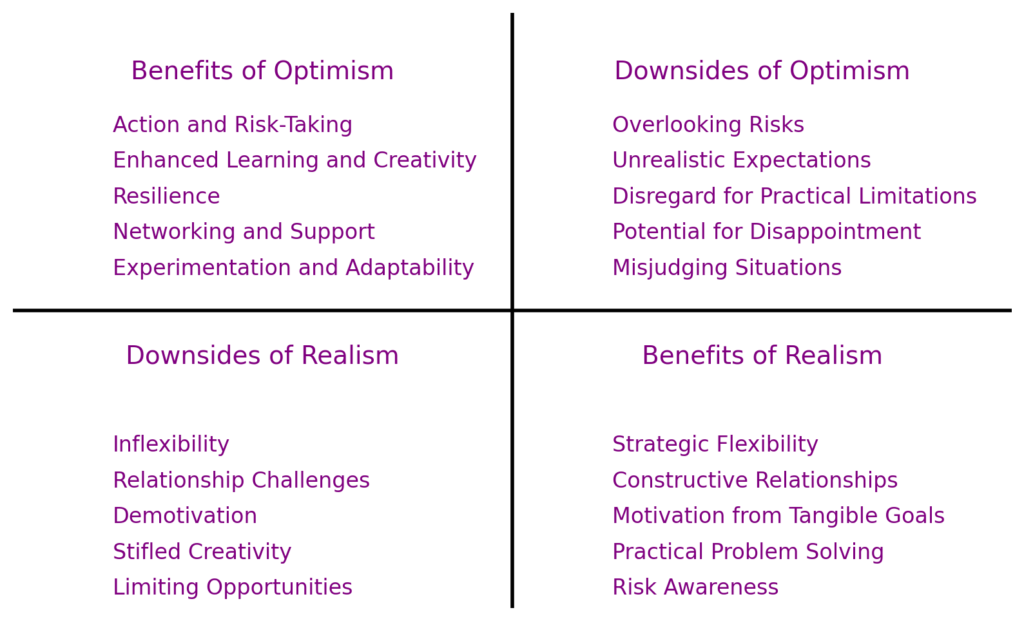
    Benefits of Optimism

    1. Action and Risk-Taking: Optimists often dive into projects with enthusiasm, willing to take risks that might intimidate others. This bold approach can lead to significant breakthroughs and innovations.

    2. Enhanced Learning and Creativity: Optimism fuels a positive mindset that is conducive to learning and creativity. Optimists are more likely to engage in creative problem-solving, seeing potential where others might see dead-ends.

    3. Resilience: Optimism is a key component of resilience. It allows individuals to bounce back from setbacks and maintain a positive outlook, even in the face of adversity.

    4. Networking and Support: Optimists tend to attract a network of supportive and like-minded individuals. This positive energy not only fosters personal growth but also creates a support system that can be crucial in challenging times.

    5. Experimentation and Adaptability: An optimistic disposition encourages experimentation and adaptability. Optimists are more likely to try new things and adapt to changes, viewing them as opportunities rather than threats.

    Downsides of Realism

    1. Limiting Opportunities: Realists might miss out on opportunities due to their focus on practicalities and limitations. This perspective can sometimes prevent them from taking chances that could lead to significant gains.

    2. Stifled Creativity: A realistic viewpoint might inhibit creativity. By focusing too much on what is practical or probable, realists may overlook innovative solutions.

    3. Demotivation: Realism can lead to demotivation, especially if the focus is constantly on the hurdles or the less-than-ideal aspects of a situation.

    4. Relationship Challenges: Realists might face challenges in relationships, particularly with more optimistic counterparts, due to their pragmatic and sometimes pessimistic outlook.

    5. Inflexibility: A strong focus on realism can result in inflexibility, as adapting to new or unforeseen circumstances may be more difficult for those who are deeply rooted in practical realities.

    Downsides of Optimism

    1. Overlooking Risks: Optimists might overlook or underestimate risks, leading to decisions that are not well-informed or prepared for potential challenges.

    2. Unrealistic Expectations: Excessive optimism can foster unrealistic expectations, setting one up for disappointment if things do not pan out as hoped.

    3. Disregard for Practical Limitations: Optimists may sometimes disregard practical limitations, leading to overcommitment or the pursuit of unfeasible goals.

    4. Potential for Disappointment: High expectations fueled by optimism can lead to disappointment if outcomes do not match the optimistic projections.

    5. Misjudging Situations: A highly optimistic outlook can sometimes lead to misjudging situations, underestimating difficulties, or failing to plan adequately for possible setbacks.

    Benefits of Realism

    1. Risk Awareness: Realists are typically more aware of risks, allowing for better preparedness and contingency planning.

    2. Practical Problem Solving: A realistic approach fosters practical problem-solving skills. Realists tend to focus on tangible solutions that are feasible and grounded in reality.

    3. Motivation from Tangible Goals: Realists are often motivated by tangible, achievable goals. This focus on realistic objectives can drive consistent progress and achievement.

    4. Constructive Relationships: Realism can lead to more constructive relationships, particularly in professional settings, as realists tend to set clear, achievable expectations.

    5. Strategic Flexibility: Realism does not necessarily mean rigidity. In fact, a realistic outlook can foster strategic flexibility, allowing individuals to adjust plans and strategies based on practical assessments of changing circumstances.

    Both optimism and realism have their distinct advantages and disadvantages. Striking a balance between the two can lead to a more well-rounded approach to life and decision-making, combining the best of both worlds: the hope and drive of optimism with the groundedness and practicality of realism.


    INVERT:

    Charlie Munger, the renowned investor and vice chairman of Berkshire Hathaway, is well-known for his concept of “inversion,” a problem-solving strategy. Inversion involves approaching a problem backward or from the opposite end of the traditional starting point. It’s about looking at what you want to avoid and then figuring out how to avoid it. This concept can be applied to the balance between optimism and realism, particularly in decision-making and strategic planning.

    Applying Inversion to Optimism and Realism

    For the Overly Optimistic:

    • Inversion Focus: Instead of focusing on what could go right, they should consider what could go wrong. This helps in identifying potential pitfalls and risks they might typically overlook.
    • Risk Management: By considering the worst-case scenarios, optimists can create contingency plans, thus grounding their optimism with a dose of realism.
    • Setting Realistic Goals: By inverting their tendency to set overly ambitious goals, they can aim for targets that are challenging yet achievable, reducing potential disappointment.

    For the Overly Realistic:

    • Inversion Focus: Instead of constantly looking at the limitations and risks, they should contemplate what opportunities might be missed by being too cautious.
    • Encouraging Creativity: By considering the best-case scenarios, realists can open themselves up to more creative and innovative solutions, breaking free from the confines of their usual pragmatism.
    • Expanding Comfort Zones: Inverting their focus on practicality can lead to taking calculated risks, potentially leading to greater rewards.

    Practical Steps for Inversion

    • Reflection and Self-Awareness: Acknowledge your natural inclination towards either optimism or realism. Self-awareness is key in understanding how to apply inversion.
    • Seeking Alternative Perspectives: Engage with individuals who hold a different outlook. For optimists, this means consulting with more pragmatic individuals, and vice versa for realists.
    • Scenario Analysis: Actively practice thinking through both positive and negative outcomes of any given situation. For optimists, emphasize the negative outcomes more, and for realists, the positive ones.
    • Balance in Decision Making: Strive for decisions that incorporate both the hopefulness of optimism and the groundedness of realism. This might mean tempering high expectations with practical considerations or infusing a realistic plan with a bit more ambition and vision.

    In essence, Munger’s inversion idea, when applied to the dichotomy of optimism and realism, encourages individuals to step outside their comfort zones and adopt a more balanced, comprehensive approach to thinking and problem-solving. This can lead to more robust, well-rounded decisions and strategies, both in personal and professional contexts.


  • Divergent Thinking: Unlocking Creative Potential

    Divergent Thinking: Unlocking Creative Potential

    What is divergent thinking and why is it so important in today’s world? Divergent thinking is a cognitive process that involves generating many ideas or solutions to a problem. Unlike convergent thinking, which focuses on finding a single correct answer, divergent thinking is open-ended and encourages exploration and experimentation. It is the ability to think outside the box, to connect seemingly unrelated ideas, and to come up with innovative solutions to complex problems.

    Divergent thinking is crucial for creativity and innovation, and is a key component of many successful businesses and industries. It is the driving force behind some of the most groundbreaking and game-changing inventions of our time, from the first airplane to the first iPhone. It is also a valuable skill for individuals looking to excel in their careers, as it allows them to approach challenges with fresh perspectives and to come up with new and unique ideas.

    So how does divergent thinking work? It starts with an open mind and a willingness to explore and experiment. It involves brainstorming, idea generation, and exploring all possible avenues for solving a problem. It requires breaking free from conventional thinking and embracing new and unconventional ideas. It also involves a willingness to take risks and try new things, even if they may not initially seem like the best solution.

    There are many benefits to cultivating divergent thinking skills. For one, it can lead to greater creativity and innovation, as it allows individuals to approach problems from different angles and to come up with unique solutions. It can also improve problem-solving skills, as it encourages individuals to think critically and analytically about complex issues. Additionally, divergent thinking can help individuals to become more adaptable and flexible, as it requires them to be comfortable with ambiguity and uncertainty.

    To develop divergent thinking skills, there are a few key strategies that can be employed. One is to practice brainstorming regularly, either alone or in groups. This involves generating as many ideas as possible, without judgement or criticism. Another strategy is to engage in creative activities such as drawing, painting, or writing, as these can help to spark new ideas and encourage experimentation. Finally, it can be helpful to expose oneself to new and diverse experiences, such as traveling, trying new foods, or learning a new skill.

    Divergent thinking is a powerful tool for unlocking creative potential and for approaching challenges with fresh perspectives. By cultivating divergent thinking skills, individuals can become more creative, innovative, and adaptable, and can achieve greater success in their personal and professional lives.

    Topics for further exploration and study:

    1. The relationship between divergent thinking and entrepreneurship
    2. How to cultivate divergent thinking skills in the workplace
    3. The impact of divergent thinking on the arts and creative industries
    4. The role of divergent thinking in addressing complex social and environmental issues
  • Mastering the Art of Asking Questions: The Key to Successful Communication and Understanding

    Mastering the Art of Asking Questions: The Key to Successful Communication and Understanding

    Asking questions is one of the most fundamental forms of communication, yet it is often overlooked and undervalued. However, mastering the art of asking questions can be the key to successful communication and understanding in a wide range of scenarios, from personal and professional relationships to teaching and learning. This article will explore the importance of asking questions and the benefits that come with mastering this vital skill.

    First and foremost, asking questions is essential for engagement. When people are asked questions, they feel valued and heard, which can help to foster a sense of connection and understanding. Good questions can also help to encourage others to open up and share their thoughts and ideas, which can lead to increased collaboration and teamwork. When people feel engaged, they are more likely to be invested in the conversation and more willing to share their ideas, making it easier to reach a solution or consensus.

    Another important aspect of asking questions is relevance. Questions that are relevant to the topic at hand can help to guide the conversation and ensure that everyone is on the same page. Relevant questions can also help to clarify misunderstandings and ensure that everyone has a clear understanding of the topic. Asking relevant questions can help to create a more productive and efficient conversation, as it helps to avoid unnecessary detours and keep the conversation focused on the most important issues.

    Feedback is another important aspect of asking questions. By asking questions, you can receive feedback from others, which can help you to improve and grow. Feedback can also help you to better understand how others perceive you and your ideas, which can be particularly valuable in a professional context. Good questions can also help to create a more open and honest dialogue, which can foster a sense of trust and respect.

    Confidence is another benefit of mastering the art of asking questions. When you are confident in your ability to ask questions, you are more likely to participate in conversations and engage with others. This can help to build your reputation as someone who is knowledgeable, curious, and interested in others. Confidence in your questioning skills can also help to reduce anxiety and stress in social situations, which can make it easier to connect with others and build meaningful relationships.

    In addition to these benefits, asking questions can also help to promote deeper understanding and insight. By asking questions, you can gain a better understanding of the topic at hand and the perspectives of others. Good questions can also help you to uncover hidden information and gain new insights into a topic. Asking questions can also help to stimulate critical thinking and problem solving, as it encourages you to think more deeply and creatively about a topic.

    Another important aspect of asking questions is active listening. Asking questions is not just about asking the right questions, but also about listening to the answers. Good questions can help to encourage active listening, which is the process of truly paying attention to what others are saying. Active listening can help to build empathy and understanding, which can be particularly important in personal and professional relationships.

    Asking questions can also be useful in a variety of other contexts, including interviewing, research, teaching, and learning. Interviews, for example, are a great opportunity to ask questions and gain a better understanding of a person’s experiences, skills, and perspectives. In a research context, asking questions can help to identify gaps in knowledge and guide further investigation. When it comes to teaching and learning, asking questions can help to clarify concepts and encourage students to engage with the material more deeply.

    In a professional context, asking questions can be useful in a variety of scenarios, including negotiation, facilitation, mentoring, coaching, and leadership. Asking questions can help to facilitate more productive and effective negotiations by encouraging open communication and helping to identify common goals. In a facilitation context, asking questions can help to encourage participation and ensure that all voices are heard. In a mentoring or coaching context, asking questions can help to encourage growth and development by providing guidance and feedback. Finally, in a leadership context, asking questions can help to build trust and encourage collaboration by showing that you are open to hearing different perspectives and ideas.

    Mastering the art of asking questions is a vital skill that can bring many benefits, including increased engagement, deeper understanding, relevance, feedback, and confidence. Whether in a personal or professional context, asking questions can help to foster meaningful relationships and encourage critical thinking, problem solving, and creativity. Whether you are looking to improve your interpersonal skills, build better relationships, or simply become a better communicator, focusing on your questioning skills can be a great place to start.

    Further topics for exploration:

    The role of empathy in asking questions
    The impact of body language and nonverbal communication on asking questions
    The impact of cultural differences on asking questions
    The impact of technology on asking questions in a digital age
    Techniques for asking more effective questions in different contexts.

  • The Cathedral and the Bazaar: A Comparative Study of Software Development Models

    The Cathedral and the Bazaar: A Comparative Study of Software Development Models

    Introduction: In the world of software development, there are two main models that have been widely adopted: the “cathedral” model and the “bazaar” model. The cathedral model is characterized by a closed and centralized approach, where software is developed behind closed doors by a small group of developers. On the other hand, the bazaar model is characterized by an open and decentralized approach, where software is developed openly and collaboratively by a large community of volunteers. In this article, we will take a detailed look at these two models and examine their pros and cons, as well as provide practical advice for developers and organizations that want to adopt the bazaar model.

    The Cathedral Model: The cathedral model of software development is based on the traditional, hierarchical approach of building a software project. In this model, a small group of developers, usually employed by a company or organization, work together to develop the software. The development process is usually closed, meaning that the source code is not publicly available, and access to the development team is limited. The development team is usually led by a project manager who is responsible for the overall direction of the project. The project is usually divided into several phases, such as design, development, testing, and deployment. The development team works on each phase in isolation, and the final product is released to the public only when it is considered complete and stable.

    The Bazaar Model: The bazaar model of software development is based on the idea of open-source software development. In this model, the source code is publicly available and the development process is open to anyone who wants to participate. The development team is usually composed of a large number of volunteers who work together to develop the software. The development process is decentralized, meaning that there is no central authority controlling the project. Instead, the development team is self-organized and relies on the collective intelligence of the community to make decisions. The bazaar model is characterized by a high degree of collaboration, communication, and transparency. The development process is often divided into several stages, such as planning, development, testing, and deployment. The final product is released to the public as soon as it is considered usable, and updates and bug fixes are released regularly.

    Pros and Cons: The cathedral model has its advantages and disadvantages. One of the advantages of this model is that it allows for a high degree of control and predictability. The development team is usually led by a project manager who is responsible for the overall direction of the project, and the development process is usually divided into several phases. This allows for a clear and structured approach to software development. Another advantage of the cathedral model is that it allows for a high degree of quality control. The development team is usually composed of experienced developers who are trained to follow best practices and standards. This allows for the development of high-quality software that meets the needs of the users.

    The bazaar model also has its advantages and disadvantages. One of the advantages of this model is that it allows for a high degree of innovation and creativity. The development team is usually composed of a large number of volunteers who work together to develop the software. This allows for a wide range of perspectives and ideas to be brought to the table. Another advantage of the bazaar model is that it allows for a high degree of flexibility and adaptability. The development process is decentralized, meaning that there is no central authority controlling the project. This allows for the project to adapt and evolve as the needs of the users change.

    The cathedral and bazaar models of software development are two distinct approaches to software development. The cathedral model is based on a closed and centralized approach, while the bazaar model is based on an open and decentralized approach. Both models have their advantages and disadvantages, and the choice of which model to use depends on the specific needs and goals of the project. The cathedral model is best suited for projects that require a high degree of control and predictability, while the bazaar model is best suited for projects that require a high degree of innovation and adaptability.

    However, the bazaar model has been gaining popularity in recent years, thanks to the success of open-source software projects such as Linux, Apache, and Firefox. These projects have shown that the bazaar model can be just as effective, efficient, and innovative as the cathedral model. Moreover, the bazaar model has been proven to be more cost-effective, as it relies on the collective intelligence of the community rather than on a small group of paid developers.

    For developers and organizations that want to adopt the bazaar model, the key is to foster a culture of collaboration, communication, and transparency. This can be achieved by using open-source development tools, such as version control systems, bug tracking systems, and mailing lists, and by encouraging participation from the community. Additionally, it is important to have a clear vision and goals for the project, and to establish a clear and transparent process for making decisions.

    In summary, the Cathedral and the Bazaar is a 1997 essay by Eric S. Raymond that compares two models of software development: the “cathedral” model, in which software is developed behind closed doors by a small group of developers, and the “bazaar” model, in which software is developed openly and collaboratively by a large community of volunteers. The essay argues that the bazaar model is more effective, efficient, and innovative than the cathedral model. It also provides practical advice for developers and organizations that want to adopt the bazaar model. The essay is widely considered a seminal work in the open-source software movement.