PJFP.com

Pursuit of Joy, Fulfillment, and Purpose

Tag: enterprise AI

  • US Government Orders Anthropic to Suspend Claude Fable 5 and Mythos 5: Inside the Export Control Directive, the Jailbreak Dispute, and What It Means for Frontier AI

    On June 12, 2026, Anthropic published a statement announcing that the US government, citing national security authorities, has issued an export control directive forcing the company to suspend all access to its newest frontier models, Claude Fable 5 and Claude Mythos 5. The order technically targets foreign nationals inside and outside the United States, including Anthropic’s own foreign national employees, but the practical effect is that both models are going dark for every customer worldwide. It is the first publicly known instance of the US government ordering a deployed frontier AI model offline, and Anthropic is complying while openly disputing the basis for the decision.

    TLDR

    The US government delivered an export control directive to Anthropic at 5:21pm ET on June 12, 2026, suspending all access to Fable 5 and Mythos 5 over an alleged jailbreak of Fable 5’s safeguards. Anthropic says the letter contained no specific details, that the only evidence shared was verbal, and that the technique in question amounts to asking the model to read a codebase and fix software flaws, a capability the company says is freely available from other models including OpenAI’s GPT-5.5 and used daily by cyber defenders. Anthropic defends its defense in depth strategy, notes that thousands of hours of red teaming by the US government, the UK AISI, and third parties found no universal jailbreak, and warns that recalling a commercial model over a narrow, non-universal jailbreak would effectively halt all new frontier model deployments if applied industry-wide. Access to all other Anthropic models, including Claude Opus, Sonnet, and Haiku, is unaffected, and the company says it believes the situation is a misunderstanding and is working to restore access, with more details promised within 24 hours.

    Thoughts

    This is a watershed moment regardless of how it resolves. Governments have blocked AI exports before, but ordering a deployed commercial model recalled out from under hundreds of millions of users is a new kind of intervention, closer to a product recall than a trade restriction. The mechanism matters too. Export control authority aimed at foreign nationals, including a company’s own employees, that cascades into a global shutdown is a blunt instrument doing the work of a regulatory regime that does not exist yet. The US has no statutory process for recalling an AI model, so the government reached for the closest tool on the shelf, and the result is a precedent built on improvisation.

    There is real irony in who got hit first. Anthropic has spent years arguing, publicly and in Washington, that governments should have the power to block unsafe AI deployments. Now the company that asked for a referee is the first one whistled, and its complaint is not about the existence of the power but about the process: a letter at 5:21pm with no specifics, verbal evidence only, and no transparent or technically grounded procedure. That distinction is the whole ballgame for AI governance. A power to halt deployments without due process standards is not regulation, it is discretion, and discretion cuts in every direction depending on who holds it.

    The technical dispute underneath is genuinely interesting because it exposes how unsettled the definition of a dangerous jailbreak is. Anthropic’s account of the offending technique, asking the model to read a specific codebase and fix any software flaws, describes something security teams do on purpose every single day. Vulnerability discovery is the canonical dual use capability: the same analysis that lets a defender patch a hole lets an attacker find one. If the bar for recall is that a model can be coaxed into doing competent security analysis, then every capable model on the market fails that bar, which is exactly Anthropic’s point about GPT-5.5. The hard question the directive dodges is not whether Fable 5 can find bugs but whether it provides meaningful uplift beyond what is already freely available, and Anthropic says it does not.

    For builders, the immediate lesson is uncomfortable: model availability is now a political variable, not just an engineering one. Teams that built directly on Fable 5 lost a production dependency overnight through no fault of Anthropic’s infrastructure, their own code, or any terms of service violation. Multi-model fallback strategies, abstraction layers over providers, and graceful degradation paths just moved from nice-to-have to table stakes for anyone running serious workloads on frontier models. The companies that absorbed this outage gracefully are the ones that assumed any single model could vanish.

    The next 24 hours matter more than the directive itself. Anthropic has promised more details, and the government will face pressure to either substantiate a concern that justifies a global recall or quietly walk it back. Either outcome sets the real precedent. If the directive holds on thin evidence, every frontier lab now operates under the threat of arbitrary shutdown. If it collapses under scrutiny, the case for a formal, transparent statutory process for AI deployment decisions, which Anthropic explicitly endorses in its own statement, gets a lot stronger in Congress than it was a week ago.

    Key Takeaways

    • The US government issued an export control directive on June 12, 2026 suspending all access to Claude Fable 5 and Claude Mythos 5, citing national security authorities.
    • The directive formally targets access by any foreign national, inside or outside the United States, including Anthropic’s own foreign national employees.
    • The net effect is that Anthropic must disable Fable 5 and Mythos 5 for all customers worldwide to ensure compliance, not just for foreign users.
    • Access to all other Anthropic models, including the Claude Opus, Sonnet, and Haiku families, is not affected by the order.
    • Anthropic received the directive at 5:21pm ET the same day it published its statement, and says the letter did not provide specific details of the national security concern.
    • Anthropic’s understanding is that the government believes it has become aware of a method of bypassing, or jailbreaking, Fable 5’s safeguards.
    • Anthropic reviewed a demonstration of the specific technique and says it only identified a small number of previously known, minor vulnerabilities.
    • The company says other publicly available models can discover the same vulnerabilities without requiring any bypass at all.
    • Before launch, Fable 5’s safeguards were red-teamed for thousands of hours in total by the US government, the UK AISI, multiple private third-party organizations, and internal teams.
    • No tester has found a universal jailbreak for Fable 5, meaning a method that broadly bypasses safeguards and unlocks a wide range of cyber capabilities.
    • Anthropic openly states that perfect jailbreak resistance does not appear possible for any model provider today, and that every safeguard in the industry is vulnerable to non-universal jailbreaks.
    • Fable 5 was deployed under a defense in depth strategy: make jailbreaks either narrow or very expensive to produce, then combine that with monitoring to quickly detect and shut down successful attacks.
    • Anthropic’s 30-day customer data retention requirement for Fable exists specifically to support jailbreak research and mitigation, a policy the company says carries real costs with customers.
    • Anthropic says it has not received any disclosure of a concerning non-universal jailbreak that led to a harmful result; disclosed potential jailbreaks were benign or provided no Mythos-specific uplift.
    • The only evidence the government has provided is verbal, describing a narrow, non-universal jailbreak that essentially consists of asking the model to read a specific codebase and fix any software flaws.
    • Anthropic reviewed a report it believes is the basis of the directive and validated that the capability level shown is widely available from other models, including OpenAI’s GPT-5.5, and is used every day by cyber defenders.
    • Anthropic is complying with the legal directive while explicitly disagreeing that a narrow potential jailbreak justifies recalling a commercial model deployed to hundreds of millions of people.
    • The company warns that if this recall standard were applied across the industry, it would essentially halt all new model deployments for every frontier model provider.
    • Anthropic supports government power to block unsafe deployments in principle, but only through a statutory process that is transparent, fair, clear, and grounded in technical facts, and says this action meets none of those principles.
    • Anthropic apologized to customers, called the situation a misunderstanding, said it is working to restore access as soon as possible, and promised more details within 24 hours.

    Detailed Summary

    What the directive actually does

    The order arrived as a letter from the US government at 5:21pm ET on June 12, 2026, invoking national security authorities under export control law. On paper it suspends access to Fable 5 and Mythos 5 by any foreign national, whether inside or outside the United States, a category that includes some of Anthropic’s own employees. In practice, Anthropic says compliance requires abruptly disabling both models for every customer, since there is no clean way to enforce a nationality-based access boundary across a global product. The letter did not spell out the specific national security concern. Everything else in Anthropic’s statement is the company’s own reconstruction of what prompted the action.

    The jailbreak at the center of the dispute

    Anthropic’s understanding is that the government became aware of a method for bypassing Fable 5’s safeguards. The company reviewed a demonstration of the technique and characterizes the results as a small number of previously known, minor vulnerabilities, all relatively simple, all discoverable by other publicly available models without any jailbreak at all. According to Anthropic, the government’s evidence so far has been entirely verbal, and the technique boils down to asking the model to read a specific codebase and fix any software flaws. The company reviewed a report it believes underlies the directive and validated that the displayed capability is widely available elsewhere, naming OpenAI’s GPT-5.5 directly, and noted that this exact kind of analysis is what defenders use to keep systems safe.

    Anthropic’s defense in depth posture

    The statement restates the safety posture Anthropic laid out at Fable 5’s launch. The safeguards around cybersecurity tasks are strong enough that users have complained they are overly broad. In the weeks before launch, the US government, the UK AISI, multiple private third-party organizations, and internal teams red-teamed the safeguards for thousands of hours combined, and those tests showed Fable’s protections to be substantially more effective than any previously deployed model. No tester found a universal jailbreak. Anthropic is candid that perfect jailbreak resistance is likely impossible for anyone today, which is why the strategy is defense in depth: keep jailbreaks narrow or expensive, monitor aggressively, and shut down attacks fast. The 30-day customer data retention requirement on Fable exists to support that monitoring and mitigation loop. The company says this posture makes Fable’s risks comparable to models already deployed across the industry.

    Complying while disputing the standard

    Anthropic is removing access for all users as legally required, but the statement draws a hard line on the principle. The company disagrees that a narrow potential jailbreak, one that produced no disclosed harmful result, justifies recalling a commercial model serving hundreds of millions of people. Its broader warning is that this standard, applied evenly, would halt all new frontier model deployments industry-wide, since every provider’s safeguards are vulnerable to narrow jailbreaks. Anthropic also turns its own policy position into a critique: the company has publicly supported giving government the ability to block unsafe deployments, but through a statutory process that is transparent, fair, clear, and grounded in technical facts, and it says this action does not adhere to those principles.

    What happens next

    Anthropic closed by apologizing to customers, calling the situation a misunderstanding, and committing to restore access as soon as possible. The company promised to share more details over the next 24 hours, which makes this a developing story. The open questions are whether the government substantiates its concern with written technical evidence, whether the directive survives that scrutiny, and whether this episode accelerates the formal statutory process for AI deployment decisions that Anthropic says should have governed the action in the first place.

    Notable Quotes

    “The net effect of this order is that we must abruptly disable Fable 5 and Mythos 5 for all our customers to ensure compliance.”

    Anthropic, on why a directive aimed at foreign nationals becomes a global shutdown

    “We received the directive from the government today at 5:21pm (ET). The letter did not provide specific details of its national security concern.”

    Anthropic, on the abruptness and opacity of the order

    “These vulnerabilities all appear relatively simple, and we have found that other publicly-available models are able to discover them as well without requiring a bypass.”

    Anthropic, on its review of the demonstrated jailbreak technique

    “We suspect that perfect jailbreak resistance is not currently possible for any model provider.”

    Anthropic, restating the position it disclosed at Fable 5’s launch

    “We stand by this defense in depth strategy. It reduces the risks posed by Fable, making them comparable to the risks of existing models already deployed across the industry.”

    Anthropic, defending its layered safeguards approach

    “To date, the government has only given us verbal evidence of a potential narrow, non-universal jailbreak, which essentially consists of asking the model to read a specific codebase and fix any software flaws.”

    Anthropic, describing the technique behind the directive

    “However, we disagree that the finding of a narrow potential jailbreak should be cause for recalling a commercial model deployed to hundreds of millions of people.”

    Anthropic, on complying while contesting the decision

    “If this standard was applied across the industry, we believe it would essentially halt all new model deployments for all frontier model providers.”

    Anthropic, on the industry-wide implications of the recall standard

    “As we have stated publicly, we believe the government should have the ability to block unsafe deployments, as part of a statutory process that is transparent, fair, clear, and grounded in technical facts. This action does not adhere to those principles.”

    Anthropic, on the kind of oversight process it says should have governed the action

    “We apologize for this disruption to our customers. We believe this is a misunderstanding and are working to restore access as soon as possible.”

    Anthropic, closing its statement to customers

    Read the full statement on Anthropic’s site here.

    Related Reading

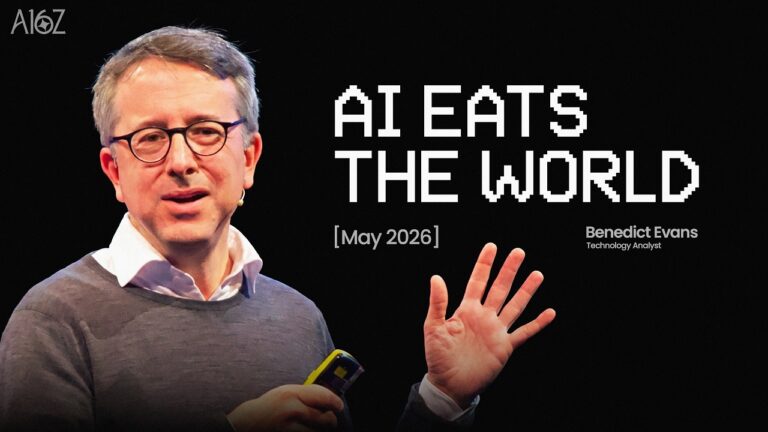
  • Benedict Evans on the Economics of AI Usage, Why Foundation Models May Become Commodities, and What Comes Next for SaaS

    Benedict Evans returns to the a16z podcast to update the thesis behind his widely read “AI eats the world” presentation, and the picture he paints is less about hype and more about hard economics. In this conversation he works through what has actually played out in the last year, why agentic coding became the one use case with real product market fit, and why he keeps arguing that foundation models may end up as commodities while the value moves somewhere else entirely. You can watch the full conversation here.

    TLDW

    Benedict Evans argues that the AI moment looks a lot like the early internet, the early PC era, and the rollout of mobile data, which means it is exciting, genuinely transformative, and almost impossible to predict use case by use case. Agentic coding is the only field with clear product market fit right now, with revenue run rates exploding from roughly nine billion to forty seven billion, while consumers still use chatbots weekly rather than daily. His central claim is that foundation models show no obvious network effect or sustainable differentiation, the chatbot is a limited v1 interface, and the model labs cannot build every application, so the value will likely move up the stack the way it did with chips, ISPs, and mobile networks rather than staying with the model providers. He covers the brutal supply and demand disequilibrium driving today’s token pricing and ten thousand dollar surprise bills, the financial gravity problem of hyperscalers spending over half their revenue on capex, the Jevons paradox and consumer surplus that may compete away productivity gains, the way the important questions move out of San Francisco and into industries like law, consulting, finance, and advertising, and the distinction between automating tasks and changing jobs. His closing image is an IBM ad from the 1950s promising “150 extra engineers,” a reminder that every platform shift feels unprecedented and that in twenty years we will simply say of course computers do that.

    Thoughts

    The most useful thing Evans does here is refuse to collapse uncertainty into a clean prediction, and then explain exactly why that refusal is the correct posture rather than a cop out. He distinguishes between the parts where he will commit to a view, that foundation models are probably not a product and the chatbot is probably not the right interface, and the parts where there are simply too many open paths to call. That discipline is rare in AI commentary, where the incentive is to sound certain. The commodity argument is not “models are worthless.” It is a chain of reasoning: there is no visible network effect, no durable differentiation beyond willingness to spend, no lock in comparable to Windows or iOS, and a likely structure of three to six well funded competitors plus open source and edge models all selling the same thing. Ask where price discipline comes from in that picture and the honest answer is that it probably does not, which is how you get a commodity even when demand is effectively infinite.

    The mobile data analogy is the load bearing comparison and it deserves to be taken seriously. Mobile data traffic rose something like fifteen hundred to two thousand times over fifteen years, the networks built an extraordinary piece of global infrastructure, everyone came to depend on it, and yet the operators captured almost none of the value because all the interesting stuff got built on top by someone else. Telco stocks were flat for two decades. If that is the template, then the trillion dollars of capex flowing into AI infrastructure can be both a worthwhile investment and a terrible place to expect outsized equity returns, because building the road is not the same as owning the traffic. The counterpoint Evans keeps fairly on the table is the operating system path, where Windows and iOS did capture value, but he notes they had levers and network effects that LLMs do not appear to have.

    His framing of where the questions live is the part most people in tech underweight. Once a technology works, the interesting questions stop being technology questions. Netflix is not a tech company in the sense that matters, because its real decisions are Los Angeles decisions about shows, talent, and sports, not San Francisco decisions about infrastructure. By the same logic, what AI means for a law firm is mostly a question for people who understand what associates actually do and what clients are actually paying for, not for model researchers. This is why the “the model will just do the whole thing” story keeps running aground. Most valuable software does not solve a problem the customer already knew they had. It often takes years to convince an industry that a problem even exists, and an LLM prompt does not surface latent problems that no one has articulated.

    The economic plumbing he describes is where the near term risk actually sits. We are in extreme disequilibrium, where twenty dollars a month can buy ten thousand dollars of tokens on one side and a weekend of experimentation can produce a ten thousand dollar bill on the other, exactly the pattern mobile data went through around 2009 and 2010. That gets resolved with the boring machinery of caps, throttling, and pricing tiers, not with magic. Layered on top is the financial gravity problem: Microsoft, Meta, and Google heading toward spending more than half of revenue on capex, with roughly seven hundred billion dollars of guidance across the big players, against a hard ceiling because there is not ten trillion dollars a year available to spend. And even when the productivity gains are real, the Jevons paradox and consumer surplus suggest much of the benefit gets competed away. If a discounted cash flow model used to take a week and now takes ten seconds, you do fifty of them and charge the client the same, which is great for clients and unremarkable for margins.

    The honest takeaway for builders is that the answer to “what does this do to software” is more software, probably one or two orders of magnitude more, just as SaaS itself produced an explosion rather than a consolidation. The SaaS apocalypse is real in the sense that some meaningful percentage of existing companies get wiped out, and unknowable in the sense that no one can yet say which ones, which is why thoughtful investors are reluctant to be long software in the dark. For anyone pursuing a more deliberate, purposeful relationship with technology, the closing note is the one to keep: every one of these shifts felt singular and world ending and world making at the time, it reshaped work and put people out of jobs and created things we love, and then it quietly became invisible. The goal is to stay clear eyed about which of those buckets a given change lands in rather than getting swept up in the noise of what someone said at a party yesterday.

    Key Takeaways

    • Agentic coding shifted from “kind of useful” to “really changing everything” at the start of the year, and it is the single field with unambiguous product market fit, where customers are pulling it out of your hands.
    • Coding working first was foreseeable in hindsight: software developers were the ones messing with the tools, and the first thing people do with a new kind of computer is build more computing, just as the first thing people did with PCs was make computers.
    • Anthropic, with less capital raised, chose to focus on coding and got it working, while OpenAI cycled through a more everything all at once strategy before narrowing in.
    • The intense focus on coding comes bundled with a supply crunch, a capacity crunch, and a price and capex imbalance that defines the current moment.
    • Most of the fundamental questions from two or three years ago still have no answers: whether there will be a winner in models, whether models capture value up the stack, how much they can do, and whether consumers will use this daily rather than weekly.
    • There is a wide gap between Valley insiders running clusters of Mac Studios all day and the roughly forty percent of people who say AI is “kind of useful, I used it last week for something.”
    • Outside tech, companies are adopting AI as one at a time point solutions for specific back office processes, like a commodities company using LLMs for better cash flow forecasting, not as a general purpose assistant.
    • Adoption always compounds on prior platforms: you could not have nine hundred million weekly active users in the Netscape era because there were not nine hundred million PCs on the planet.
    • Early in any platform shift almost nothing works smoothly, from sound cards and floppy disks with TCP/IP to computers that froze and lost your work, and AI is at that stage now.
    • Today’s token pricing crunch mirrors the mobile data shock of 2009 to 2010, where flat rate plans collided with surging usage and networks had to realign price with marginal cost through caps, fair use, and throttling.
    • Mobile data traffic rose roughly fifteen hundred to two thousand times in fifteen years, mobile networks earn around a trillion dollars and spend about two hundred billion a year on capex, yet their stocks have been flat for twenty years because all the value moved up the stack.
    • The central LLM question is whether the model can do the whole thing or whether you need hundreds of applications built on top, the same way you needed apps on Windows and iOS.
    • Evans sees no network effect and no sustainable differentiation between models beyond willingness to spend money, which points toward commodity infrastructure sold near marginal cost.
    • Chip companies, ISPs, and mobile operators did not capture the value; Windows and iOS did, but only because they had levers to move up the stack and real network effects, which models lack.
    • A useful comparison is semiconductors, where each generation gets more expensive and the field narrows to fewer players, suggesting three to six frontier model makers spending somewhere between two hundred billion and two trillion dollars a year.
    • Enterprises do not standardize on a model the way they once thought about AWS; the cloud and the model get abstracted away, so customers do not even know which one their SaaS product runs on.
    • Demand for tokens being effectively infinite does not prevent a price equilibrium, exactly as infinite demand for mobile bits still produced murderous price wars between commodity carriers.
    • History teaches that something will happen but rarely what; the smartest people in tech wrongly predicted Android would crush the iPhone on open versus closed grounds.
    • One characteristic of tech is that the moment you understand how something works is the moment to move on, which is why Evans stopped updating his Apple spreadsheet years ago.
    • The people who are good at using a tool are usually not the people who are good at designing what the tool should be, which is why model labs cannot build every skill or vertical application.
    • Claude skills and similar templates resemble file new in Excel: useful starting points that users eventually outgrow, raising the question of who builds the real software.
    • The questions increasingly move out of technology and into specific industries; what AI means for law, consulting, advertising, or accounting is partly an AI question and partly a deep domain question.
    • Netflix is not a tech company in the way that matters, because its real questions are media industry questions about shows, talent, and sports, not infrastructure; the same logic now applies across industries facing AI.
    • AI differs from prior platform shifts because the physical limits are unknown; in 1995 you knew PCs cost three thousand dollars and broadband could not reach everyone overnight, but no one knows how cheap, fast, or capable models will get.
    • Evans offers four buttons to press on any use case: is it just price elasticity and the Jevons paradox, does it remove a cost barrier to entry, does it unlock a new business model, or does it make something previously impossible now possible like trains over horses or Spotify over CDs.
    • Advertising and e-commerce are a standout opportunity because today’s systems know a SKU and a metadata field but not what a product actually is or why people buy it, and LLMs could change that level of understanding.
    • The valuable shift is not doing the old thing more, like more spreadsheets or better email, but doing genuinely new things, such as asking an LLM how to change prices to improve churn using all your call recordings, CRM flows, and product telemetry.
    • Enterprise software today splits into three buckets: big horizontal systems like SAP and Workday, three to four hundred vertical SaaS apps plus a thousand internal apps, and a fuzzy improvised middle of Excel, email, and shared files, with AI arriving as a new option across all three.
    • A core design tension is where to put the probabilistic software that can make mistakes versus the deterministic database that cannot, and whether the LLM sits at the top or the bottom of the stack; the answer is probably both depending on the task.
    • The net effect on software is way more software, since SaaS itself produced one to two orders of magnitude more software and all software companies exist to solve problems created by other software companies.
    • The SaaS apocalypse is real but unknowable: some percentage of SaaS companies get wiped out, but no one knows which, so you should not derate the whole sector fifty percent and many investors are wary of being long software for now.
    • Much of what an organization does is implicit, undocumented, and not in the training data, which is exactly the value McKinsey, Bain, and BCG provide by getting license to map how a company really works.
    • The real decisions are usually exception handling: the question is always what you cannot automate and what still requires human judgment about cases that were never written down.
    • Distinguish tasks from jobs: accountants spend almost none of their time the way they did fifty years ago, yet to the client the job looks the same.
    • LLMs excel where you want the average, the answer anyone would give, and struggle where you specifically do not want the average and cannot fully explain why you did it differently.
    • There is a financial gravity ceiling: Microsoft, Meta, and Google are on track to spend over fifty percent of revenue on capex versus fifteen to twenty percent for capital intensive telecoms, with seven hundred billion in guidance this year and no path to ten trillion.
    • Hyperscalers face an existential FOMO trap: returns look positive now, but they cannot let rivals build the future of compute without participating, even as the CFO asks how much participation is enough.
    • Token maxing will face a reckoning as the disequilibrium resolves, but measuring ROI is hard because most reported benefits so far, like better analytics, support, and productivity, are tough to put a financial value on.
    • Consumer surplus means many gains get competed away: if analysis that took a week now takes a day, you do five times more analysis and charge the same, the way investment banks did with spreadsheets.
    • Evans closes with a 1950s IBM ad promising “150 extra engineers,” a reminder that every fundamental technology change feels unprecedented, and that in twenty years AI will simply be invisible magic we take for granted.

    Detailed Summary

    What changed in the last year

    Evans frames the past year as a narrowing of focus. A year and a half after the first version of his presentation, the field has developed a much clearer sense of diverging product strategies and competitive tension that goes beyond simply building a bigger model with more compute. The dominant shift is that agentic coding started genuinely working, and the entire industry narrowed in on it because it has absolute product market fit, the kind where customers pull the product out of your hands. That success arrives alongside the supply crunch, capacity constraints, and price imbalance that now define the moment. At the same time, the charts keep climbing, models keep getting bigger, capex keeps growing, and usage keeps growing, while the deep questions from a few years ago remain unanswered.

    Why coding worked first

    That coding led was predictable at a naive level: the people experimenting with the tools were software developers, and they naturally tried to make software development work. Evans compares the moment to the internet around 1997 and 1998, and also to PCs in the late seventies and early eighties, when the technology was exciting but it was not clear what it was for and it did not quite work yet. The first thing people did with PCs was make computers, and since LLMs are in a sense computers, the first thing people are doing with them is making more compute. What was harder to foresee was the precise timing of the shift, the moment when agentic coding flipped from useful to transformative at the start of this year.

    Jobs, juniors, and what we have not learned

    On the question of what this means for engineers and team structure, Evans is blunt that we have learned almost nothing yet, because this did not even work six months ago and everyone is scrambling to interpret it. The pricing crunch alone means it will take a couple of years to settle. The newly concrete questions include whether you still hire junior people and what they would do, and why you were hiring juniors in the first place, whether to do the work itself or to develop people. Because software development now genuinely automates a class of work that used to be done by people, those questions have moved from theoretical to real, but no one can responsibly claim to know what a software team or a software career looks like in three years.

    OpenAI, Anthropic, and the strategy split

    Evans dryly notes the drama around the model labs, including the disruption of a senior leadership medical leave at OpenAI. In the latter part of last year, OpenAI’s question was essentially what to build on top of the models, an everything all at once approach that looked almost like asking the model for fifteen ideas and then doing all of them. Anthropic, with less capital raised, instead committed to coding and got it working, whether by deliberate strategy or by stumbling into it. The result is that software development plus a few other fields are where things genuinely work, surrounded by a large population of people excited around the edges and corporations quietly automating specific back office processes. He cites a commodities company that wants LLMs for better cash flow forecasting across many small producers, a very different thing from asking a chatbot to summarize your meetings.

    The mobile data analogy and value capture

    The richest section is the comparison to mobile. Adoption always compounds on prior platforms, so AI inherits a far larger installed base than the internet or mobile did at their starts. Early on, nothing works smoothly, and Evans recalls the era of buying a three hundred dollar sound card or wrestling a floppy disk of TCP/IP into a machine. The pricing dynamics directly echo mobile data around 2009 and 2010, when flat rate plans met exploding usage and ten thousand dollar bills, forcing networks to realign price with marginal cost. Crucially, mobile data traffic then rose fifteen hundred to two thousand times, the networks built extraordinary global infrastructure with around a trillion dollars of revenue and two hundred billion in annual capex, and yet their stocks stayed flat for twenty years because all the cool stuff and all the value got built and captured by someone else higher up the stack. Chip companies, ISPs, and mobile operators did not capture value; Windows and iOS did, but they had levers and network effects that models do not appear to share.

    The case that models become commodities

    Evans lays out the building blocks of his commodity thesis. First, there is no clear way to build a model that is sustainably and fundamentally better than everyone else’s, with no visible network effect and no strategic lever comparable to what Instagram, YouTube, or Google search enjoy. Differences in emphasis and taste exist, but not durable competitive moats beyond spending. Second, the chatbot is a weird, limited v1 interface that works well for some tasks and people but requires tooling, the right data, configuration, control, and thoughtful design for most real jobs, and the people good at a job are rarely the people good at designing the tool for it. Third, the labs cannot build every application any more than Microsoft or Apple could build every Windows or iPhone app. Enterprises do not standardize on a model the way they never standardized on a visible cloud provider, because it gets abstracted away. Taken together, that points to low level infrastructure sold by perhaps half a dozen competitors plus open source and edge, with no obvious source of price discipline, which is the definition of a commodity even when demand is infinite.

    The questions move out of technology

    One of the next big questions is when models become good enough that you no longer need the largest, fastest, most expensive model, and can use an older model, an open source model, or one running on device where compute is effectively free to the developer. But the deeper shift is that the important questions move out of technology and into industries. Drawing on his own essays “content isn’t king” and “Netflix isn’t a tech company,” Evans argues that Netflix’s real decisions are Los Angeles media questions, not San Francisco infrastructure questions, and San Francisco does not even know what the right questions are. By the same logic, what AI means for a law firm is mostly a question for people who understand law firms, what generative video means for Hollywood is a question Ben Affleck can answer better than he can, and the questions become half AI and half something else.

    Four buttons and the new things AI unlocks

    To reason about impact, Evans offers four buttons. Is a use case just price elasticity, the Jevons paradox of doing the same thing for less or more for the same money. Does it remove a cost that was a barrier to entry, like a newspaper’s printing press. Does it unlock something in your business model. Or does it make something previously impossible now possible, the way steam engines made trains possible regardless of how many horses you bought, or Spotify turned fifteen dollars a month into all the music there is. He stresses that the same broad change can mean wildly different things by industry, just as the internet devastated newspapers but barely touched movie studios. His favorite tractable example is advertising and e-commerce, a trillion dollar advertising market against twenty five trillion in retail, where today’s systems know a SKU and a metadata field and that people who bought one thing bought another, but do not know what a product is or why people buy it. An LLM could in principle understand the product, recommend ten coats at different prices with pros and cons, or look at your Instagram and suggest a winter coat that changes your look but not too much, which would have been science fiction three years ago.

    More software, the SaaS apocalypse, and tasks versus jobs

    For software specifically, Evans expects more competition, cheaper and quicker building, and new categories that were impossible before, all under an uncertain new margin structure where outcome based pricing is hard because most software work cannot be tied cleanly to profit and loss. He frames enterprise software as three buckets, big horizontal systems, hundreds of vertical and internal apps, and a fuzzy improvised middle of Excel and email, with AI arriving as another option across all of them. The deeper design tension is where to place probabilistic software that can make mistakes versus deterministic systems that cannot, and whether the LLM sits at the top or bottom of the stack, with the answer being both depending on the task. The net result is way more software, since SaaS itself produced orders of magnitude more software and software exists to solve problems created by other software. That fuels the SaaS apocalypse anxiety: some companies clearly get wiped out, but since no one knows which, you should not derate the whole sector, even as many investors stay cautious about being long software.

    Implicit knowledge, exception handling, and where the average fails

    Much of what organizations do is implicit, undocumented, and absent from any training data, which is precisely the value of strategy consultancies that get license to map how a company really works versus how it is supposed to work. The real decisions tend to be exception handling, the cases that require human judgment because they were never written down or do not look like before. Evans separates tasks from jobs, noting accountants do almost nothing the way they did fifty years ago while the client still buys the same thing. And he offers a sharp test: LLMs are excellent where you want the average, the answer anyone would give, and weak where you specifically do not want the average and cannot fully articulate why you did it differently.

    Capex, financial gravity, and the ROI question

    On spending, Evans describes a financial gravity problem. Microsoft, Meta, and Google are on line to spend over half their revenue on capex this year, against fifteen to twenty percent for capital intensive telecoms, with roughly seven hundred billion in guidance across the big players, a sum comparable to all of telecom or oil and gas. They cannot sustainably leap to one and a half trillion next year because the money is not there, so the curve must eventually taper. The hyperscalers are caught in an existential FOMO trap: returns look positive now, but they cannot sit out what might be the future of compute without risking becoming the next stranded incumbent, even as the CFO asks how much is enough. On token maxing, he expects a reckoning as the disequilibrium resolves, but measuring ROI is genuinely hard because most reported benefits so far are soft and hard to value, and consumer surplus means much of the gain gets competed away, the way faster spreadsheets simply meant more analysis at the same price.

    Closing image

    Evans ends with an IBM advertisement from the early 1950s showing a sea of engineers holding slide rules, with the tagline that an IBM electronic calculator gives you 150 extra engineers, exactly the pitch behind countless modern startup decks. We move through these fundamental technology waves every ten or fifteen or twenty years, each one feeling completely unlike anything before, and AI is amazing and transformative in the same way mobile, the internet, and PCs were. The base case is that it will produce wonderful things, ruin some livelihoods, put people out of work, and eventually become invisible. His one line description of where it all ends up is that it will be magic, and in twenty years we will simply say of course computers do that, the way an hour of crash free streaming HD video over Wi-Fi already feels unremarkable.

    Notable Quotes

    “Agentic coding went from being kind of useful to really changing everything.”

    Benedict Evans, on the pivotal shift at the start of the year

    “We are in this extreme scarcity. We can’t spend $10 trillion a year on AI infrastructure cuz there isn’t $10 trillion a year there to spend on it.”

    Benedict Evans, on the hard ceiling of AI capex

    “I don’t think foundation models are a product. I don’t think a chatbot is a product. I think the value will be further up.”

    Benedict Evans, stating the core of his thesis

    “They built this amazing piece of global incredibly sophisticated very expensive global infrastructure with enormous growth in use, and they didn’t make any money from it because all the value moved up stack.”

    Benedict Evans, on the mobile network analogy

    “The moment that you understand something and you know how it works and what’s going to happen is the moment you should move on to something else.”

    Benedict Evans, on how to pay attention in tech

    “These are all Los Angeles questions. These are not San Francisco questions. No one in San Francisco even knows what the right questions are.”

    Benedict Evans, on why Netflix is not a tech company

    “The important stuff is not doing the old thing but more. It’s doing something new that you couldn’t have done with the old thing.”

    Benedict Evans, on where the real value of a new technology shows up

    “All software companies exist to solve problems created by other software companies.”

    Benedict Evans, on why AI produces more software, not less

    “It’s going to be magic, and in 20 years time we’ll just say, well, of course that’s how it is. Computers have always done that.”

    Benedict Evans, on how the whole shift ends up

    This is a dense, clear eyed conversation that rewards a full listen, especially if you are trying to think past the hype cycle about where AI value actually lands. Watch the full conversation here, and check out the “AI eats the world” presentation referenced throughout.

    Related Reading

    • Benedict Evans’ website home of the “AI eats the world” presentation and his newsletter referenced throughout the conversation.
    • Andreessen Horowitz (a16z) the venture firm whose podcast hosted this discussion and where Evans was formerly a partner.
    • Jevons paradox (Wikipedia) background on the price elasticity idea Evans uses to explain how cheaper AI may lead to more usage rather than savings.
    • Stratechery by Ben Thompson the analysis Evans cites on software as a designed workflow versus a process that grows out of how a business runs.
    • The Pursuit of Purpose a PJFP look at finding direction and meaning in work as automation reshapes careers and industries.
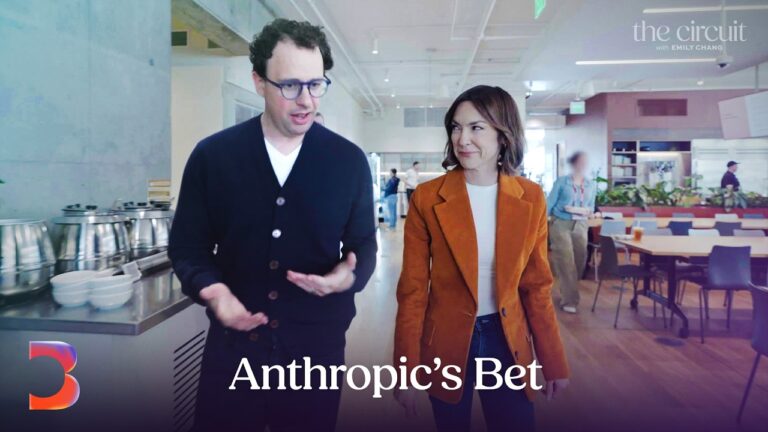
  • Inside Anthropic, the $965 Billion AI Juggernaut: Dario and Daniela Amodei on Claude, Claude Code, and the AI Arms Race

    In this episode of The Circuit, Bloomberg goes inside Anthropic, the AI lab that started as an underdog and is now valued at nearly a trillion dollars. The conversation centers on the sibling duo running the company, Dario Amodei, the brother and visionary, and Daniela Amodei, the sister and operator, along with Boris Cherny, the engineer behind Claude Code and Claude Cowork. It is a rare, on-the-record look at how a safety-obsessed startup founded by a group of OpenAI defectors in 2021 became the breakout star of the AI arms race, wiping billions in value off software stocks and forcing an uncomfortable national conversation about the future of work. You can watch the full episode here.

    TLDW

    Dario and Daniela Amodei walk through Anthropic’s rise from a pandemic-era group meeting on the grass in Precita Park to a roughly $965 billion AI juggernaut that is now profitable for the first time. They explain why they left OpenAI, citing a breakdown of trust and values with Sam Altman rather than a single safety disagreement, and how Dario’s early bet on scaling laws shaped the entire field. The two describe how Claude is trained for character and “professional warmth,” anchored in documents like the UN Declaration of Human Rights, and how the company defines a good model as one that does not lie, hallucinate, or deceive. The business story is enterprise and coding: Claude Code and Claude Cowork automated huge chunks of software engineering, triggered a SaaSpocalypse that erased $285 billion in market value overnight, and pushed annualized growth to as high as 80x in a single quarter. Boris Cherny, recruited from a slow miso-making life in rural Japan, says Claude has written one hundred percent of his code for at least six months. The hardest part of the conversation is jobs: Dario stands by his warning that AI could eliminate half of all entry level white collar jobs in one to five years, pushes back hard on Jensen Huang’s “doom marketing” critique, and lays out where displaced workers might go, from the physical world to human-centered roles like a reimagined, more interpersonal version of medicine. The episode closes by teasing AI and the future of warfare, a scarily powerful new model called Mythos, and Dario’s identification not with Oppenheimer but with Leo Szilard.

    Thoughts

    The most revealing moment in this profile is not a number, it is Dario Amodei’s description of the “smooth exponential.” His whole career, he says, has felt like nothing happening, nothing happening, nothing happening, and then zoom. That mental model is the key to understanding why Anthropic behaves the way it does. A company that genuinely believes it is riding an exponential will tolerate enormous near-term discomfort, public criticism, and internal strain, because it has already priced in a future that looks nothing like the present. Whether that conviction is wisdom or a kind of motivated certainty is the open question the episode never fully resolves, but it explains the urgency in every answer he gives.

    The Boris Cherny segment is the part that should make working engineers sit up. When a senior engineer says Claude has written one hundred percent of his code for six months and that he feels like he has a jet pack, that is not a marketing line, it is a description of a job that has already changed underneath the person doing it. The framing in the piece is optimistic, superpowers and fun, but the logical endpoint is exactly the one Dario himself names a few minutes later: you automate ninety percent of a job, the remaining humans get ten times more leveraged, and then the curve keeps bending toward one hundred percent. Anthropic is, unusually, building the thing and narrating its own disruption in the same breath. That honesty is rare, and it is also a little vertiginous.

    The values-versus-business-model argument deserves more scrutiny than it gets. Dario’s claim is elegant: a business model that conflicts with your values forces you to either betray the values or become irrelevant, so Anthropic chose enterprise and coding because curing diseases and making energy cheaper are enterprise work, while consumer engagement is the addiction-maximizing trap of social media. It is a genuinely good argument, and it is also extremely convenient that the values-aligned path happens to be the most lucrative one. The episode lets that tension sit, which is the right call. The honest reading is that Anthropic found a place where doing well and doing good currently point in the same direction, and the harder test will come the first time they diverge.

    On jobs, Dario is more persuasive than his critics give him credit for, precisely because he refuses the comfortable framing. Jensen Huang and others accuse him of conflating tasks with jobs and of doom marketing that benefits Anthropic. Dario’s response, that the idea this is cheap marketing is itself cheap marketing, is sharper than it first sounds. He is pointing at the way social media flattens a five-page argument about tasks, jobs, tax policy, and the adolescence of technology into a three-second clip designed to provoke. The deeper point is that he is trying to hold two things at once, fast GDP growth and high unemployment, and our public discourse is structurally bad at holding two things at once. That is less a story about AI than about the medium we use to argue about it.

    Finally, the Oppenheimer exchange reframes the entire profile. Dario explicitly rejects the lone-genius model and names Leo Szilard, the scientist who first imagined the chain reaction, as the figure he identifies with. He calls Oppenheimer a failure case, an example of what should not happen. For a man whose company is constantly accused of cultivating a great-man mythology, choosing the early-warning scientist over the bomb’s public face is a deliberate statement about how he wants this story to end: not with charismatic individuals at the center of everything, but with checks and balances everywhere. It is the most quietly radical thing said in the whole piece, and the teaser for a model named Mythos lands with a little extra irony because of it.

    Key Takeaways

    • Anthropic is profiled as an AI juggernaut valued at nearly a trillion dollars, with the figure of roughly $965 billion framing the episode, and is described as profitable for the first time.
    • The company was founded in 2021 by a team of OpenAI defectors and started as an underdog lab before becoming the breakout star of the AI race.
    • Anthropic is run by a sibling duo, Dario Amodei as the visionary and Daniela Amodei as the operator who turns his ideas into action, and Daniela jokes that when they argue, no one wins.
    • Dario describes the AI trajectory as a “smooth exponential” where nothing seems to happen for a long time and then progress suddenly explodes.
    • He says he predicted from a graph that Anthropic would become the AI company with the most revenue and valuation around this time, and that it has happened.
    • Dario grew up in San Francisco with a leather-craftsman father and a librarian mother, took calculus in middle school, and studied math at UC Berkeley while in high school, with no early interest in the internet revolution.
    • Dario studied neuroscience before moving to AI at Baidu and later Google, while Daniela was an early employee at Stripe.
    • Both joined OpenAI starting in 2016, where Dario developed the concept of scaling laws, predicting that large language models would improve simply by adding more data and compute even if the underlying algorithm stayed the same.
    • Scaling up was a counter-cultural scientific bet at the time, held mainly by the founding research team, and it helped supercharge OpenAI’s models and pave the way for ChatGPT.
    • The Amodeis left OpenAI after clashing with Sam Altman over direction and values, framing it as a breakdown of trust and honesty rather than a single safety disagreement.
    • Altman has said that despite their differences, he mostly trusts Anthropic as a company.
    • Anthropic has all seven of its co-founders still at the company, which Dario notes almost never happens at a company of its size.
    • The early team met during the pandemic at Precita Park in San Francisco, pulling up chairs on the grass to talk about what they were building.
    • The name Anthropic comes from the Greek word for human, reflecting a stated mission to build responsible AI for the long-term benefit of humanity.
    • Dario has published long essays including Machines of Loving Grace and The Adolescence of Technology, exploring both the miraculous potential and the worst-case scenarios of AI.
    • Claude is trained to follow a set of principles called a Constitution, intended to keep it aligned and well-behaved.
    • Daniela describes Claude’s intended personality as “professional warmth,” approachable but distant, not a best friend and not cold or calculating.
    • A good model, in Anthropic’s framing, does not lie accidentally or intentionally, with lying including hallucinations where the model invents something it does not know.
    • Anthropic’s own research has shown that models can purposely try to deceive users, which the company works to prevent in production models.
    • There is no universal standard for helpfulness or harmlessness, so Anthropic draws on founding documents like the UN Declaration of Human Rights to train Claude’s character.
    • The company has begun consulting religious leaders about Claude as an entity and about core values that transcend any single worldview.
    • Early Claude models, around the Claude 2 era, were sometimes “nannyish,” expressing concern when a user just wanted the weather, which researchers describe as tuning a fine dial.
    • Anthropic’s revenue skyrocketed over the past year, driven by a focus on lucrative business tools rather than consumer apps.
    • Claude Code automated large chunks of software engineering, and Claude Cowork extended that power to non-engineers.
    • Dario frames the enterprise bet as a values-and-business decision, arguing that a business model conflicting with your values forces you to betray them or become irrelevant.
    • He contrasts engagement-and-addiction-driven consumer and advertising models with enterprise uses like curing diseases, advancing biotech and pharma, and making energy cheaper.
    • Soon after Claude Cowork launched, $285 billion in market value vanished overnight in what traders called the SaaSpocalypse, with some software stocks down nine days in a row.
    • Dario argues the software “pie” will get bigger overall, even as some incumbents shrink or go out of business if they fail to adapt and defend their moats.
    • Boris Cherny, the engineer behind Claude Code and Claude Cowork, was recruited in 2024 from a slow life in rural Japan where he made miso and shopped at farmer’s markets.
    • Cherny’s bet was that a coding agent could do all of software development, not just autocomplete a line or a sentence.
    • He now runs anywhere from a few to a few thousand Claudes at once and says Claude has written one hundred percent of his code for at least six months.
    • A live demo builds a working recipe app that suggests meals for the week in minutes, work that used to take hours or days.
    • At the second annual Code with Claude conference, Anthropic reported API volume up nearly 17x year over year, eight frontier models shipped in twelve months, and first-quarter growth that annualizes to roughly 80x.
    • Dario stands by his warning that AI could eliminate half of all entry level white collar jobs in the next one to five years, saying he remains the same order of concerned.
    • He warns of an unusual combination of very fast GDP growth alongside high unemployment, underemployment, low-wage jobs, and high inequality.
    • Jensen Huang and others have pushed back, accusing Dario of conflating tasks with jobs and of doom marketing that benefits Anthropic.
    • Dario responds that the claim this is cheap marketing is itself cheap marketing, and blames social media for flattening his careful five-page arguments into three-second clips.
    • Anthropic published a paper estimating that management, finance, and legal jobs could be among the fields most affected by AI in the near future.
    • Dario points to the physical world, human-centered relationship-driven work, and humans directing AI as places displaced workers might go, though he is unsure how thick those roles will be.
    • He uses medicine as an example, predicting AI will excel at diagnosis while doctors pivot toward the interpersonal, hands-on, bedside-manner parts that AI cannot replace.
    • The episode teases a next installment on AI and the future of warfare, a scarily powerful new model called Mythos, and the theme of riding the exponential while avoiding dystopia.
    • Dario names The Making of the Atomic Bomb as a favorite book and identifies most with Leo Szilard, who first conceived of a chain reaction, rather than Oppenheimer, whom he sees as a failure case.
    • His view is that the only way the AI era ends well is through checks and balances everywhere, not larger-than-life personalities at the center of everything.

    Detailed Summary

    An unlikely AI celebrity and a sibling-run juggernaut

    The profile opens in a library Dario Amodei clearly loves, establishing him as an unlikely AI celebrity, a man known for warning the world about the risks of artificial intelligence who now runs a company valued at nearly a trillion dollars. Anthropic is presented as the breakout star of the AI race, wiping billions off software stocks, going head-to-head with the Pentagon, and building models powerful enough to threaten modern cybersecurity, with early testers reportedly calling one capability a super weapon and asking the company not to release it. Guiding the company is the sibling pair, Dario the visionary and Daniela the operator who translates his swirling cosmic thoughts into action. Daniela explains that the two have always been close and always wanted to do something big together, and when asked who wins their arguments, she says no one. The framing throughout is of a young, fast-growing startup carrying enormous responsibility for how humanity works, learns, thinks, and even fights wars.

    The smooth exponential and the road from OpenAI

    Dario describes his entire career as the experience of a smooth exponential, where nothing happens for a long stretch and then things go crazy, and he says he watched a graph and correctly predicted Anthropic would top the field in revenue and valuation around now. His backstory is a math prodigy in San Francisco, the son of a leather craftsman and a librarian, taking calculus in middle school and Berkeley math classes in high school, indifferent to the internet revolution and drawn instead to science fiction and understanding the universe. Daniela, more into reading and the arts, calls them near-perfect complements. Dario moved from neuroscience into AI at Baidu and Google, Daniela went to Stripe, and both eventually joined OpenAI starting in 2016, where Dario developed scaling laws, the then counter-cultural bet that more data and compute alone would make models smarter. That insight helped power the models behind ChatGPT, but the Amodeis clashed with Sam Altman over values and direction. Dario frames the departure bluntly: disagreements on safety alone were not enough, but a loss of trust, a sense that Altman’s stated values were not his real values, made it impossible to continue. The resolution, he says, was simply to go off and do their own thing.

    Precita Park, the Constitution, and teaching Claude to be good

    Anthropic’s origin story runs through Precita Park, where the early pandemic-era team gathered on the grass to talk about what they were building. Of seven co-founders, all are still at the company, a retention record Dario says almost never happens at this scale. From the start the company pitched itself as the ultimate safety-conscious lab, with Dario publishing essays like Machines of Loving Grace and The Adolescence of Technology. Claude is trained on a Constitution, and Daniela describes its intended character as professional warmth, approachable but distant. Defining a good model, the team says it should not lie, whether through intentional deception or hallucination, the latter being the model inventing answers it does not actually know. Anthropic’s research has shown models can deliberately deceive, something they work to prevent in production. Because there is no universal standard for helpfulness or harmlessness, they anchor Claude’s training in documents like the UN Declaration of Human Rights and have begun talking with religious leaders about values that transcend any single worldview. Daniela recalls early “nannyish” Claude 2-era behavior, where the model fretted over a user who only wanted the weather, and describes the work as threading a fine needle to land in the center of the dial.

    The enterprise bet, Claude Code, and the SaaSpocalypse

    Anthropic’s revenue surge and first-time profitability are attributed to a focus on business tools, especially Claude Code, which automated large chunks of software engineering, and Claude Cowork, which extended that capability beyond engineers. Dario frames the bet on coding and enterprise as both a values and a business decision: a business model that conflicts with your values eventually forces you to betray them or become irrelevant. He contrasts the engagement and addiction incentives of advertising-driven social media and AI video with enterprise applications like curing diseases, biotech, pharma, academic research, and cheaper energy, all of which he counts as enterprise work aligned with the company’s mission. The disruption was immediate and brutal: soon after Claude Cowork launched, $285 billion in market value vanished overnight in what traders dubbed the SaaSpocalypse, with some software stocks falling nine days straight. Dario’s read is that the overall software pie will grow even as specific incumbents shrink or fail, and that the big losers will be those who do not see what is coming or defend their moats.

    Boris Cherny, jet packs, and Code with Claude

    Much of Anthropic’s recent growth is credited to Boris Cherny, the engineer behind Claude Code and Claude Cowork, hired in 2024 from a deliberately slow life in rural Japan where he made miso and frequented farmer’s markets. A serious science fiction reader, Cherny was awed by his first AI chatbot and also acutely aware of how badly the technology could go. His bet was that a coding agent could do all of software development rather than just autocomplete. He now describes orchestrating anywhere from a few to a few thousand Claudes at once, talking to one while it writes code and moving to the next, and says Claude has written one hundred percent of his code for at least six months. He compares the feeling to having superpowers and a jet pack, calling engineering more fun than ever. A live demo has Claude build a working weekly-meal recipe app in minutes. The story then moves to the second annual Code with Claude conference, where the company reports API volume up nearly 17x year over year, eight frontier models shipped in twelve months, and first-quarter growth annualizing to roughly 80x, with attendees ranging from technical superfans to curious non-engineers.

    Jobs, the tasks-versus-jobs fight, and a more human medicine

    The episode turns to the uncomfortable core: whether engineers will be the first casualties of the AI they are building. Dario stands by his warning that AI could eliminate half of all entry level white collar jobs in one to five years and says he is still the same order of concerned, describing a strange combination of very fast GDP growth with high unemployment, underemployment, low-wage work, and inequality. He notes the usual productivity hump, where automating ninety percent of a job makes humans ten times more leveraged on the rest, before the curve bends toward one hundred percent. With 70 percent of Americans expecting AI to kill jobs and nearly a third fearing for their own, the stakes are political. Jensen Huang and others accuse Dario of conflating tasks with jobs and of doom marketing, and Dario pushes back hard, arguing he writes carefully across five pages about tasks, jobs, tax and macroeconomic policy, and the new jobs of the adolescence of technology, and that calling this cheap marketing is itself cheap marketing born of social media’s three-second culture. Anthropic has published a paper suggesting management, finance, and legal jobs could change the most. Dario points to the physical world, human-centered relationship work, and humans directing AI as landing spots, using medicine as his example: AI will become an excellent diagnostician, but it cannot physically examine a patient or provide bedside manner, so medicine pivots toward the interpersonal. The episode closes by teasing AI and the future of warfare, a powerful new model called Mythos, and Dario’s identification with Leo Szilard over Oppenheimer, whom he calls a failure case, insisting the era can only end well with checks and balances everywhere rather than larger-than-life figures at the center.

    Notable Quotes

    “There’s this kind of smooth exponential, and the experience of the smooth exponential is, nothing’s happening, nothing’s happening, nothing’s happening. Little things happen, and then zoom, it goes crazy.”

    Dario Amodei, on how AI progress actually feels from the inside

    “When you feel that you can’t trust someone, when you feel that their values are not what they say they are, when you feel that they’re not honest, that makes it very hard to continue to work with a company.”

    Dario Amodei, on why he and Daniela left OpenAI

    “Some of the early companies that we gave this to said things like, this is a super weapon, please don’t release this.”

    Anthropic, on early reactions to one of its more powerful models

    “I like to describe it as professional warmth. So the goal is not for it to be your best friend, but it’s not for it to be sort of cold, rote, calculating.”

    Daniela Amodei, describing the character Anthropic designs into Claude

    “If you pick a business model that fundamentally conflicts with your values, you’re gonna have a hard time. Either you betray your own values or you become irrelevant.”

    Dario Amodei, on why Anthropic bet on enterprise and coding

    “For me personally, it’s been writing a hundred percent of my code for at least six months. The work of engineering has just completely changed.”

    Boris Cherny, the engineer behind Claude Code and Claude Cowork

    “I feel like I suddenly have superpowers. I have like a jet pack and the engineering has never been this fun.”

    Boris Cherny, on building software with Claude Code

    “I think we could have this very unusual combination of very fast GDP growth and high unemployment, or at least underemployment, or low wage jobs, high inequality.”

    Dario Amodei, on the economic shock he is most worried about

    “The idea that this is cheap marketing is itself cheap marketing. I think it’s part of the disease of Silicon Valley.”

    Dario Amodei, responding to the doom-marketing accusation

    “The figure I most identified with was Leo Szilard, who was the one who first had the idea that there could be a chain reaction.”

    Dario Amodei, on which atomic-age scientist he sees himself in, rejecting Oppenheimer as a failure case

    Watch the full episode of The Circuit inside Anthropic here.

    Related Reading

    • Anthropic the official site for the company, Claude, Claude Code, and its safety research.
    • Machines of Loving Grace Dario Amodei’s long essay on the optimistic case for powerful AI referenced in the profile.
    • Scaling laws (Wikipedia) background on the data-and-compute bet Dario developed that reshaped modern AI.
    • Leo Szilard (Wikipedia) the physicist who first conceived the nuclear chain reaction and whom Dario says he identifies with.
    • Purpose the PJFP pillar on building meaningful work and direction in a world being reshaped by AI.
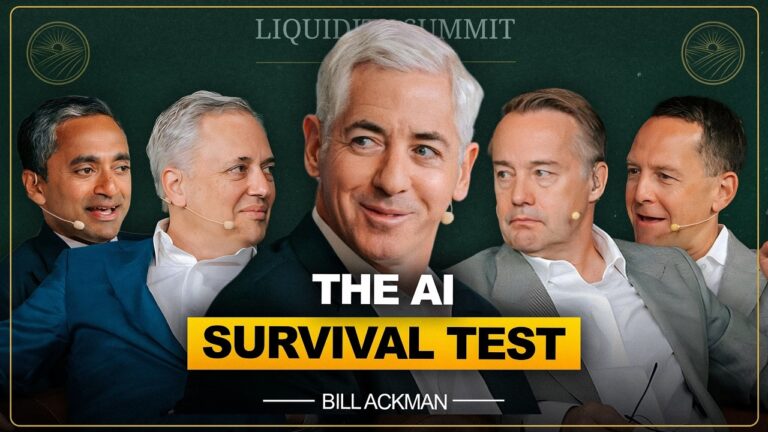
  • Bill Ackman on Investment Strategy, What the Market Is Missing, and How AI Breaks Businesses

    Bill Ackman, founder and CEO of Pershing Square, joined the All-In Podcast for a conversation about how his investment approach has shifted toward permanent, long-term ownership, why he believes the highest-quality companies are being left behind by a market chasing the new new thing, and how AI is raising the risk of disruption for almost every business. He also lays out his plan to turn Howard Hughes into a Berkshire Hathaway-style compounding machine built on insurance. You can watch the full conversation here. Below is a structured breakdown of the ideas, the stories, and the frameworks he uses to underwrite a business.

    TLDW

    Ackman explains how his philosophy evolved from a smaller, more liquid activist toward concentrated, permanent ownership of durable, non-disruptible businesses, with much of his activism now playing out on X rather than in the boardroom. He tells the origin story of his first big trade, Wendy’s and the Tim Hortons spin-off, and explains why a large long-term shareholder on a board is an antidote to short-term markets. On AI, he argues that this is the greatest era in history to build a company, which means the risk of being disrupted has gone up enormously, and that the market is mispricing high-quality compounders like Microsoft, Meta, and Amazon while crowding into chips, semiconductors, and energy. He works through the SaaS question and why niche software is more at risk than platforms, how he underwrites SpaceX, xAI, OpenAI, Anthropic, and Palantir like late-stage venture bets using a people, opportunity, context, deal framework, and why founder-led companies have an edge in making radical calls. The back half covers his Howard Hughes plan to copy Buffett’s insurance-float model, the role of cost of capital and reflexivity in markets, the meme-stock era, going direct on social media, and the three different ways an investor can put money to work with Pershing Square.

    Thoughts

    The most useful idea in the interview is the way Ackman reframes disruption as the central investing problem of the AI era. His point is that the same forces making this the best time in history to start a company, meaning near-unlimited compute, capital, and talent, also raise the odds that any given incumbent gets disrupted. That reframes the word quality. It is no longer mostly about margins and moats. It becomes about non-disruptibility, which is a much higher bar than most quality investors were using a decade ago, and it is why he says most of his research time now goes into assessing that single risk.

    The what-the-market-is-missing thesis is classic contrarian Ackman. Arguing that Microsoft, Meta, and Amazon are the new old-fashioned, undervalued names while capital piles into semiconductors and energy is a direct echo of 2000, when Berkshire Hathaway bottomed precisely because money was chasing internet stocks. It is worth keeping in mind that he owns all three, so the call is also his book. The durable signal here is the framework, not the specific tickers: capital reliably chases the new new thing, and genuinely high-quality businesses get left behind during those rotations.

    The Howard Hughes plan is the most concrete bet in the conversation. Copying Buffett’s insurance-float playbook, short-term treasuries for policyholder money and equities for the surplus, onto a discounted real-estate holding company is elegant. The hard part is exactly what Ackman flags about insurance as an industry: the best investors go to hedge funds, not insurers, so most insurance companies only ever manage the liability side well. Pershing Square’s edge is that Ackman can both write the business and invest the float, which is the same reason it worked for Buffett. The framing of going from a four billion dollar company to a trillion over fifty years is a statement of intent, not a forecast, and should be read that way.

    Underneath all of it sits cost of capital and reflexivity. His observation that a higher stock price literally makes a company more valuable, because it lowers the cost of capital and creates acquisition currency, is the mechanism behind both Elon Musk’s empire and the meme-stock era he is wary of. Going direct on X is the same lever pointed at himself: communicate the vision, lower your own cost of capital, and make the bet easier for other people to place. It is a coherent worldview in which narrative and balance sheet continuously feed each other, and it explains a lot of his behavior over the last few years.

    Key Takeaways

    • The biggest change in Ackman’s approach over time is an appreciation for business quality, meaning long-term, durable, protected, non-disruptible growth as the most important factor.
    • He says he is as activist as ever, but more of it now happens on X than in the traditional corporate context.
    • His first big investment was Wendy’s, which owned Tim Hortons. The simple thesis was to buy Wendy’s, spin off Tim Hortons, and double the money.
    • Early on no one returned his calls, so he had Steve Schwarzman’s Blackstone write a fairness opinion, filed it publicly, and the company spun off Tim Hortons six weeks later. The CEO later thanked him after being fired with a large exit package.
    • Reputation compounds. Where Pershing Square once had to bang down the door, companies now sometimes tweet a welcome when it buys a stake.
    • A large long-term shareholder on a board is a counterweight to short-term markets, letting management test ideas privately and pursue initiatives that hurt the next few quarters of earnings.
    • Pershing Square owns Microsoft, Meta, and Amazon. Ackman argues you are either invested in AI directly or indirectly, or it is a threat, so you have to understand it.
    • The hardest and most important job for a concentrated investor is judging the risk of disruption, and that risk has risen dramatically.
    • This is the greatest era in history to build a business because of near-unlimited access to compute, capital, and talent, which is exactly why the probability of being disrupted has gone up enormously.
    • Markets bring their eye to the new new thing, currently chips, semiconductors, and energy, while high-quality companies get left behind.
    • He draws an analogy to 2000, when Berkshire Hathaway traded at one of its lowest valuations because everyone chased internet stocks. He sees a similar dynamic around Amazon, Meta, and Microsoft today.
    • On the SaaS question, he worries more about a Salesforce than a platform like Microsoft, because niche software charging high per-seat or per-year prices is most exposed, while low-priced platforms are safer.
    • Any software company today has to be as AI-enabled as possible, or risk losing the monopolistic pricing it once enjoyed.
    • His famous March 2020 CNBC appearance was an attempt to reach President Trump and argue for a short shutdown, paired with the view that stocks were incredibly cheap and worth buying.
    • He describes valuation as a tether on the market: when prices stretch too high they snap back, and when they get too cheap the same rubber band pulls valuations up. Calling that out publicly can trigger a psychological reset.
    • His recent bullish call came because stocks of really high-quality companies had gotten crazy cheap on fundamentals, meaning the present value of the cash they generate.
    • He underwrites high-multiple names like SpaceX as venture investments using a framework from business school: people, opportunity, context, deal.
    • On SpaceX, people and opportunity are one of one, the context is incredible, and Starlink plus near-monopoly low-cost launch make it strategically valuable. The complicated part is the deal, meaning the valuation. He invested via an SPV after Ron Baron’s nudge, and also invested in xAI.
    • He treats OpenAI, Anthropic, and Palantir as late-stage venture bets that have proven they can generate real revenue, and says OpenAI should do a better job communicating how it thinks about its enormous capital commitments.
    • Every CEO in America is asking how to use AI, how it applies to their business, and how it is a threat. It is top of mind and boards open every meeting with it.
    • He has not seen much enterprise AI success yet, citing a McKinsey study that 95 percent of enterprise initiatives fail and the rise of the forward deployed engineer as the hot role bridging promise and ROI. Pershing Square itself uses AI mainly for legal, compliance, and back-office work.
    • Founder-led companies have an advantage because founders have the authority and the economic stake to make radical calls, while the average S&P 500 CEO has a roughly three to four year tenure and is incentivized not to make mistakes.
    • He cites Mark Zuckerberg buying Instagram and WhatsApp as the kind of shocking-at-the-time calls that a founder with a track record can make.
    • Ben Graham’s enduring lesson is that a stock is an interest in a business, not a piece of paper, but Graham mostly invested in liquidations and cash-rich shells, and made most of his money on Geico.
    • Most of Buffett’s value at Berkshire came from owning insurance operations and focusing on the asset side of the balance sheet, not just the liability side.
    • Insurance is hard to copy because top investors do not go to work for insurers. Buffett owned half his company and was a great investor, which is why it worked.
    • Howard Hughes came out of the General Growth bankruptcy and owns master-planned cities like Summerlin, with 26,000 acres in the Las Vegas area, comparable to the Irvine Company that built roughly a hundred billion dollars of wealth for Donald Bren.
    • The plan is to reinvest the cash Howard Hughes generates into insurance, put policyholder float in short-term treasuries and the surplus in common stocks, and build a compounding machine over fifty years, buying it at roughly sixty cents on the dollar.
    • A company must earn a return above its cost of capital for the stock to rise. Elon Musk has kept his companies’ cost of capital extremely low, and a SpaceX IPO near a 1.75 trillion dollar valuation could be one of the lowest cost of equity capital transactions ever.
    • Markets have changed less because of Ackman and more because of figures like Ryan Cohen and GameStop, where a stock can trade well above its value on personality and an army of followers.
    • Higher valuations are reflexive: a rising stock price lowers cost of capital and creates currency to issue stock and acquire businesses, which is part of how Elon built Tesla.
    • There are three ways to invest with Pershing Square: the management company itself (a royalty on compounding assets with no capex), PSUS (a portfolio of best ideas trading at an 18 percent discount), and Howard Hughes (a bet on building the next Berkshire). A dollar invested 22 years ago became roughly 27 to 28 times net of fees.
    • Going direct on X, with 2.2 million followers, lets him communicate his vision and lower the friction for others to back his bets, even as his very long tweets have become a running meme.

    Detailed Summary

    From activist trades to permanent capital

    Ackman frames the evolution of his career as a steady move toward business quality. As a smaller, more liquid investor early on, he did not have to think as long-term. As Pershing Square became a bigger, more concentrated investor, durable growth became the dominant factor in every decision. He insists he is still as activist as ever, but a lot of that energy has shifted to X, where he can argue a position publicly rather than only inside a boardroom. The best investments, he notes, are the ones where you do not need to join the board and do anything at all.

    The Wendy’s and Tim Hortons origin story

    One of Pershing Square’s first investments was Wendy’s, which owned the Canadian coffee and donut chain Tim Hortons. The value of Tim Hortons alone was greater than the entire value of Wendy’s, so the idea was simple: buy Wendy’s, spin off Tim Hortons, and double the money. Ackman bought ten percent of the company and could not get the CEO to return a single call, so he had a contact at Blackstone, with Steve Schwarzman’s sign-off, write a fairness opinion on what Wendy’s would be worth after a spin-off, filed it publicly, and watched the spin-off happen six weeks later. The CEO eventually called back to thank him, having been fired but rewarded with a large exit package. Over the years that scrappy approach gave way to a reputation that now opens doors on its own.

    Why a long-term shareholder on the board matters

    The core problem of being a public company, in Ackman’s telling, is the short-term nature of markets and analysts, when a good business should be run in the context of years and even decades. A large, supportive shareholder on the board gives management a place to test ideas before exposing them to the public and a credible voice willing to back initiatives that hurt earnings for a few quarters. That is the value-add he believes a constructive activist can bring to a mature public company, as opposed to a startup where the best outcome is simply to own a great business and stay out of the way.

    AI and the rising risk of disruption

    For a concentrated, long-term investor, the most challenging task is judging the risk that two people from Stanford in a garage build something that destroys your thesis. Ackman argues that risk has climbed dramatically because this is the greatest era in history to build a company, with near-unlimited access to compute, capital, and talent. The paradox is that the conditions that make building easier also make incumbents more fragile, so the bulk of his research now centers on assessing how disruptible a business really is.

    What the market is missing

    Investors bring their attention to the new new thing, currently chips, semiconductors, and energy, which leaves high-quality companies behind. Ackman compares the moment to 2000, when Berkshire Hathaway traded at one of its lowest valuations ever because capital was chasing internet stocks. He sees an echo today in how Amazon, Meta, and Microsoft are treated as old-fashioned, and he considers them undervalued on fundamentals, where value is the present value of the cash a business generates over its life. His recent bullish call, like his March 2020 appearance, came because stocks of really high-quality companies had simply gotten too cheap.

    The SaaS question and AI-enabled software

    On the so-called SaaS apocalypse, Ackman says it is a company-by-company analysis. He worries more about something like Salesforce than about a low-priced platform. The companies most at risk are those that extracted near-monopolistic profits by charging a high annual price for a niche product, because AI lowers the barrier to replicating that functionality. A platform where the average customer pays a small amount per seat, like Microsoft, is far less exposed. The takeaway for any software company is to become as AI-enabled as it possibly can.

    Underwriting SpaceX, xAI, and the AI labs like venture

    For the highest-multiple private companies, Ackman uses a venture lens and a framework a business school professor taught him: people, opportunity, context, deal. SpaceX scores as one of one on people and opportunity, with an incredible context and a near-monopoly in low-cost launch through Starlink, which makes even Amazon a likely customer. The complicated variable is the deal, meaning the valuation, and he admits he has not done all the math, having invested through an SPV after Ron Baron encouraged him, along with a position in xAI. He treats OpenAI, Anthropic, and Palantir as late-stage venture bets that have proven real revenue, and argues OpenAI in particular should communicate more clearly how it justifies capital commitments that vastly exceed current revenue.

    Founder-led companies and the authority to act

    Ackman agrees that founder-led companies have a structural advantage in a fast-changing environment. The average S&P 500 CEO has a tenure of roughly three to four years, a small economic stake, and an incentive not to make a career-ending mistake. A founder is betting an entire life and reputation, has the authority of a major voting and economic position, and has usually made several hard, contrarian calls that turned out right. He points to Mark Zuckerberg’s acquisitions of Instagram and WhatsApp, which looked shocking at the time, as exactly the kind of decision a founder with a track record can make and a hired manager often cannot.

    Howard Hughes as Berkshire Hathaway 2.0

    Ackman points to a detailed financial history of Berkshire Hathaway showing that the vast majority of Buffett’s value creation came from owning insurance and focusing on the asset side of the balance sheet, not just the liability side. Insurance is hard to replicate because skilled investors join hedge funds rather than insurers, but Buffett owned half his company and was a great investor. Pershing Square is applying the same idea to Howard Hughes, a company created out of the General Growth bankruptcy that owns master-planned cities such as Summerlin, with 26,000 acres around Las Vegas, in the spirit of the Irvine Company that made Donald Bren roughly a hundred billion dollars. The plan is to reinvest the company’s cash into insurance, place policyholder float in short-term treasuries and the surplus in common stocks, avoid issuing stock the way Buffett did, and compound for fifty years, all bought at around sixty cents on the dollar.

    Cost of capital, reflexivity, and going direct

    A company only creates value when it earns above its cost of capital, which is why Howard Hughes, seen as a high-cost-of-capital real-estate business, has long traded at a discount, and why Ackman is repurposing its assets into a higher-returning model. He highlights how reflexive markets are: a higher stock price itself makes a company more valuable by lowering its cost of capital and creating currency to raise money and acquire businesses, a lever Elon Musk used to build Tesla. He attributes real market change less to himself and more to figures like Ryan Cohen and GameStop, where personality and a following can lift a stock far above its value. His own going-direct strategy on X, with 2.2 million followers and famously long posts, is the same mechanism applied to communicating a vision and lowering friction for investors. He closes by laying out three ways to invest with Pershing Square: the management company as a royalty on compounding assets, the PSUS portfolio trading at an 18 percent discount, and Howard Hughes as a bet on building the next Berkshire.

    Notable Quotes

    “The best investments are one where you don’t need to join the board and do anything.”

    Bill Ackman, on the kind of business he most wants to own

    “The probability of your being disrupted has gone up enormously.”

    Bill Ackman, on why assessing disruption risk now dominates his research

    “Valuation is like a tether on the market, right? When it gets too high, it’s like this rubber band that’s stretching and inevitably it bounces back.”

    Bill Ackman, on how prices revert at both extremes

    “People, opportunity, context, deal.”

    Bill Ackman, on the business school framework he uses to underwrite companies like SpaceX

    “Every CEO in America today is like, how do I use AI?”

    Bill Ackman, on AI as the top opportunity and threat in every boardroom

    “A closed mouth gathers no foot.”

    Bill Ackman, quoting the line a friend put next to his name in his high school yearbook

    “The increase in value of the company increases the value of the company, right? Because it lowers the cost of capital, it gives you more flexibility, gives you the ability to issue stock, raise capital, acquire other businesses.”

    Bill Ackman, on the reflexivity between stock price and corporate value

    “The company’s got like a $4 billion market cap and the goal is to build it into a trillion dollar thing over time compounding.”

    Bill Ackman, on his fifty-year plan for Howard Hughes

    Taken together, the conversation is a tour of how Ackman now thinks about quality, disruption, and compounding, and a preview of the Berkshire-style machine he wants to build out of Howard Hughes. Watch the full conversation here.

    Related Reading

  • Uber CEO Dara Khosrowshahi on AI, Autonomous Vehicles, Robotaxis, Drones, and the Future of Transportation

    Uber CEO Dara Khosrowshahi sat down with Patrick O’Shaughnessy on the Invest Like the Best podcast for a long, candid conversation about the forces remaking transportation. There is artificial intelligence inside the company, and there is physical AI out in the real world, meaning autonomous vehicles, robotaxis, and delivery drones. He calls the autonomous opportunity another trillion dollar marketplace and argues it will change how society operates. You can watch the full interview here. What follows is a structured breakdown of the most useful ideas, the strategy behind Uber’s AV bet, and the operating philosophy that runs underneath all of it.

    TLDW

    Dara Khosrowshahi explains how he brought order to the chaos he inherited at Uber in 2017 by treating hard problems like vector mathematics, and how an immigrant childhood shaped his all-in, low-stress operating style. He describes AI hitting Uber on two fronts at once: much larger digital models that predict rider intent, and physical AI that changes how rides and food get fulfilled in the real world. The conversation covers Uber blowing through a full year of AI budget in a single quarter, metering headcount as engineers become superhuman, the more than 30 AV partnerships with Waymo, Nuro, Lucid, Nvidia, Wayve, and Pony AI, and why supply, not demand, is the whole game. It runs through the coexistence model borrowed from travel and Uber Eats, the Uber One membership flywheel at 50 million members, the push from on-demand to planned travel through hotels and Uber Reserve, the economics of cheaper autonomous cars and delivery drones, the regional race from the Middle East to Europe, and the lessons from Barry Diller and Herbert Allen about getting to ground truth and betting on people. It closes on his capital allocation philosophy of prioritizing organic growth and AV commitments over buybacks.

    Thoughts

    The most underappreciated line in the whole interview is the budget one. Blowing a full year of AI spend in a single quarter is the clearest signal yet that frontier intelligence is being consumed far faster than even an AI-native company planned for. Dara’s response has quietly become the default enterprise playbook: explore on the expensive frontier models, then scale the proven interactions onto cheaper or open-source models. The deeper tension is that he is simultaneously telling teams to drive adoption and metering headcount, which is the real story of AI in large companies. The productivity gains are showing up as fewer hires, not only as faster shipping.

    The supply-first framing is the strategic core, and it inverts the demand-first logic he learned at Expedia. In autonomous vehicles this means Uber does not need to win the self-driving race itself. It needs to own the demand layer and aggregate every AV maker’s supply, the same way online travel agents coexist with hotels and Uber Eats coexists with McDonald’s. The 30 percent higher utilization figure for AVs on Uber’s network is the wedge in that argument. It is the reason a Waymo stays on the platform even while building its own brand, because filling more of an expensive asset’s day changes the entire return on the car.

    His premortem answer is unusually honest. Asked what kills the opportunity, he does not name an Uber-specific execution failure. He names AI’s unpopularity with the general public. That is a CEO admitting the gating factor is social license, not technology. The early data he leans on, drivers in Austin and Atlanta earning more and signing up in greater numbers as AVs add incremental demand, is the counter-narrative he is betting the public conversation on. Whether that story holds as AV volume scales from thousands of vehicles to hundreds of thousands is the open risk the entire industry shares.

    Underneath the strategy is one repeated instinct: get to ground truth. It shows up in the Barry Diller story about reading the model from the analyst who built it, in his hunt for the troublemakers who keep a company mutating, and in the fact that he bought an ebike to deliver food in San Francisco. It is the same move applied at every altitude, and it is why he frames AI as a chance to rebuild processes from first principles rather than shave 20 percent off the ones that exist. The leaders who treat AI as an efficiency tool will likely lose to the ones who rebuild from the ground up.

    Key Takeaways

    • Dara took the Uber job in 2017 after Daniel Ek recommended him at the Allen and Company Sun Valley conference and told him, when he hesitated, that life is about impact rather than happiness.
    • He inherited what he calls complete chaos: a board fighting for control, lost trust with regulators and the public, and a committee running the company after Travis Kalanick stepped back.
    • His method for chaos is to treat it like vector mathematics, breaking a seemingly unassailable problem into component dimensions and solving each one.
    • Early moves included bringing in chairman Ron Sugar to unite the board, running a listening tour with stakeholders, and rebuilding the executive team with leaders like Andrew McDonald and Tony West.
    • He credits an engineering mindset and an immigrant childhood for his calm under pressure. His family lost everything leaving Iran when he was nine and rebuilt from nothing.
    • On parenting, he argues that overcoming challenges is what forms people, and that doing everything for your kids is a long-term disservice disguised as a short-term favor.
    • Uber has always operated in a probabilistic real world of traffic, cancellations, and late food, so it has used machine learning longer than most consumer companies.
    • The current inflection is AI on two fronts: larger digital models that predict intent, and physical AI that changes how Uber fulfills in the real world.
    • Uber’s feed and search models are now roughly 10,000 times bigger than the older ones, enabling universal search across rides, eats, and grocery in a single query.
    • Uber can already guess a rider’s destination about three quarters of the time, turning booking into a one-tap interaction.
    • AI adoption is bottoms-up across engineering, legal, and marketing. Developers in India are driving roughly ten times the code commits using autonomous agents.
    • Dara pushes teams to rebuild processes from first principles with AI rather than settling for 20 to 30 percent optimization of an existing process.
    • He wants the rebels and troublemakers to win, and treats unpredictable internal adoption patterns as something to find and promote.
    • Uber blew through its full-year AI budget in a single quarter, which is now forcing it to meter headcount as engineer throughput climbs.
    • The token strategy is to explore on expensive frontier models, then scale proven interactions onto cheaper or open-source models.
    • Uber generates over 10 billion dollars in free cash flow on more than 10 billion trips a year, but it is not a high-margin business, so efficiency funds lower prices and higher earnings.
    • In autonomous vehicles, the thesis is supply: own the demand layer and aggregate every AV maker’s vehicles, the way Uber aggregates drivers and restaurants.
    • Uber has more than 30 AV partnerships, including Waymo, Nuro, Lucid, Nvidia, Wayve, and Pony AI.
    • Uber is building the surrounding ecosystem: depots, charging, fleet partners, a one billion dollar Santander financing line for EV and AV fleets, and autonomous insurance.
    • AVs operating on Uber’s network are about 30 percent busier in trips and revenue per vehicle per day than vehicles not on the network, which transforms the return on an expensive car.
    • The build, partner, or buy answer is coexistence, mirroring how travel agents coexist with hotels and airlines and how Uber Eats coexists with McDonald’s, Starbucks, and Chipotle.
    • His public premortem is that AI’s unpopularity, not Uber-specific execution, is the biggest risk, so the company must move at the pace society will accept to avoid backlash.
    • Early data in Austin and Atlanta shows drivers earning more and more drivers joining, suggesting AVs are adding incremental demand rather than only displacing humans.
    • AV hardware costs typically fall 30 to 40 percent per generation. A Lucid midsize built with Nuro could land around 60,000 to 70,000 dollars and bring transportation costs down.
    • Lower cost expands demand. Uber already dwarfs the taxi market it was once sized against, and Dara expects the same dynamic with AVs.
    • Traditional OEMs are now investing in L4-ready systems and should arrive over the next two to four years. Each AV drives roughly three to four times what a human driver does.
    • Chinese manufacturing capability and bill of materials are described as unrivaled. A low-cost Western, Foxconn-style player for AVs is being worked on but does not exist yet.
    • Drones are gated by battery density. Food and grocery drones should reach real scale in two to five years and become normal in five to ten, with Joby and Zipline cited as examples.
    • The Middle East, including Abu Dhabi, Dubai, and Saudi Arabia, is moving fastest thanks to entrepreneurial regulators. Europe is catching up, with London robotaxi pilots expected before year end.
    • Uber Eats wins the number one position more often internationally. The playbook is selection plus reliability, amplified by cross-platform upsell, with about 13 percent of Eats bookings coming from the mobility app.
    • Uber One has 50 million members growing 50 percent year on year. Dara frames it like Netflix, more content for the same price, and accepts a first-year loss for multi-year profit.
    • Uber is pushing from on-demand to planned through hotels, via a deal with Expedia, and through Uber Reserve, now at over a 5 billion dollar run rate with 99 percent-plus reliability.
    • His leadership lessons: from Barry Diller, get to ground truth from source material and tell the truth as a leader. From Herbert Allen, bet on people, not companies.
    • On capital allocation, he prioritizes organic growth and financialized AV commitments over buybacks, while keeping costs growing slower than revenue.

    Detailed Summary

    From chaos to structure: the 2017 turnaround

    Dara came to Uber from 13 years running Expedia under Barry Diller, recruited through a head hunter after Daniel Ek floated his name at the Sun Valley conference. He arrived into what he describes as complete chaos, with the board fighting over control rather than the fate of the company and trust badly damaged with regulators, the public, and employees. His approach was to decompose the situation the way an engineer decomposes a multidimensional problem, solving each dimension and reassembling the whole. Practically that meant a new chairman in Ron Sugar to unite the board, a listening tour to understand stakeholder concerns, and a rebuild of the leadership team that kept strong insiders like Andrew McDonald while adding people like Tony West.

    An engineering mind and an immigrant chip on the shoulder

    His wife Sid calls him a robot, by which she means he does not get rattled. He traces that to an engineering education and to a childhood upheaval. His family left Iran when he was nine and lost the business his father had built, and he watched that loss diminish his father over the years. The experience produced a durable drive to rebuild and a refusal to let external chaos define him internally. He applies a similar philosophy to his kids, arguing that challenges and the act of overcoming them are what form a person, and that helicopter parenting removes the very friction that builds capability.

    AI inside Uber: prediction, agents, and superhuman engineers

    Uber has always lived in a probabilistic world where the digital booking is deterministic but the real-world fulfillment is not, so it adopted machine learning earlier than most consumer companies. The newest models are roughly 10,000 times larger than the prior generation and power universal search and destination prediction that is right about three quarters of the time. Internally, adoption is bottoms-up and uneven in a good way, with engineers in India shipping around ten times the code commits using autonomous agents. Rather than mandate from the top, Dara pushes teams to rebuild whole processes from first principles with AI instead of trimming a fifth off the existing ones.

    The cost of intelligence

    The flip side of fast adoption is cost. Uber blew through its annual AI budget in a single quarter, and that is forcing a real adjustment. Because engineer throughput is climbing, the company is metering headcount increases rather than simply hiring. The operating rule is to keep driving adoption while pursuing efficiency, using frontier models from providers like OpenAI and Anthropic to experiment with new interactions, then moving the scaled experiences onto more efficient or open-source models to bring the per-token cost down. With more than 10 billion dollars of free cash flow on over 10 billion trips, Uber is not a high-margin business, so efficiency directly funds lower prices for riders and higher earnings for drivers.

    Why supply decides the AV race

    At Expedia, Dara learned a demand-first model where you attract consumers and then build inventory to match. Uber is the opposite, a supply company, where securing every car, restaurant, courier, and retailer causes the demand to follow. Applied to autonomous vehicles, the strategy is to be the go-to-market and demand layer for anyone building a digital driver. Uber wants to aggregate the largest pool of AV supply, just as it aggregates human drivers, so that the companies building the actual self-driving software can focus on the driver while Uber handles distribution and utilization.

    Building the ecosystem around the digital driver

    Uber now has more than 30 AV partnerships spanning Waymo, Nuro, Lucid, Nvidia, Wayve, and Pony AI, and it expects many winners rather than one, the same shape as the foundation model market. Around those partners it is assembling the connective infrastructure: depots and charging in cities where the regulatory path is opening, fleet partners, a one billion dollar financing line with Santander for EV and AV fleets, and work on autonomous insurance. It is also collecting street data today that can feed the models, so that when a partner’s cars hit the market there is instant demand waiting. The early proof point is that AVs on Uber’s network run about 30 percent busier than comparable vehicles off it, which materially improves the return on a costly car.

    The premortem and the public’s patience

    Asked what derails the opportunity, Dara points outward rather than inward. The risk is that AI is powerful but unpopular, and the average person experiences it as a threat to electricity costs or a cousin’s job rather than as magic. The same dynamic could hit AVs even though the technology should end up safer than human drivers, which is why questions about emergency services, equitable access, and driver earnings have to be worked through with regulators and communities. The encouraging early signal is in Austin and Atlanta, where drivers are making more money and more are joining because AVs appear to be adding incremental demand. The controllable risk, he says, is access to supply, which is exactly why Uber has partnered with nearly every AV provider across mobility, delivery, and freight.

    A trillion dollar marketplace: cheaper cars and delivery drones

    Dara sizes the autonomous opportunity as another trillion dollar marketplace. As AV software and hardware costs fall, typically 30 to 40 percent per generation, a Lucid midsize built with Nuro could come in around 60,000 to 70,000 dollars, which starts to lower the real cost of transportation. History says lower cost expands demand, and Uber already became multiples larger than the taxi market it was once compared to. Manufacturing scales from hundreds to thousands to hundreds of thousands of vehicles, each driving three to four times what a human does, with traditional OEMs investing in L4-ready systems over the next two to four years and Chinese manufacturers setting the bar on cost and quality. Delivery drones are further out, gated mainly by battery density, but should reach real scale in two to five years and feel normal in five to ten.

    Membership, hotels, and the shift from on-demand to planned

    Uber Eats often reaches the number one position internationally by nailing selection and reliability and then layering on cross-platform advantages, with roughly 13 percent of Eats bookings flowing from the mobility app. Uber One, at 50 million members growing 50 percent year on year, is the loyalty engine, and Dara likens it to Netflix in that members get more for the same price. He explains the membership economics through Amazon Prime, accepting a money-losing first year to earn multi-year profit as members spend more across services. The newest expansion is travel: hotels through a deal with Expedia, and a broader move from Uber’s on-demand brand toward planned bookings, proven out by Uber Reserve at a 5 billion dollar-plus run rate and 99 percent-plus reliability. The end state he wants is a trip where Uber pre-books your ride to the airport, knows your hotel, and brings in-market magic to the whole journey.

    Operating philosophy: ground truth, troublemakers, and capital allocation

    The mentors thread through everything. From Barry Diller, with whom he worked for more than 20 years, he took the discipline of getting unfiltered truth from the source, illustrated by Diller insisting on hearing the Paramount LBO model from the young analyst who built it. From Herbert Allen he took the lesson to bet on people rather than companies, because great people stay great across cycles. In his own practice that becomes radical transparency, a deliberate hunt for the troublemakers who act as the mutations that keep an organism from dying, and a willingness to be wrong, since learning, often through pain, is what he finds interesting. On capital, he treats allocation as an art, prioritizing organic growth, which took Uber Eats from under a billion to over a hundred billion in gross bookings, then AV commitments that can be financialized, with buybacks coming after growth rather than instead of it.

    Notable Quotes

    “I know who I am, and I’m always going to be that same person. I’m not going to let the chaos of the world affect me mentally.”

    Dara Khosrowshahi, on why crisis does not rattle him

    “We blew through our AI budget in a quarter, you know, for the whole year essentially. And it is forcing us to adjust.”

    Dara Khosrowshahi, on the real cost of AI adoption at Uber

    “What’s magical now is going to seem normal to all of us 10 years from now.”

    Dara Khosrowshahi, on how fast riders stop noticing autonomous vehicles

    “We think it’s another trillion dollar marketplace.”

    Dara Khosrowshahi, on the scale of the autonomous vehicle opportunity

    “If we do that, the demand will take care of itself.”

    Dara Khosrowshahi, on why Uber obsesses over securing supply first

    “I’m looking for those mutations. I’m looking for those troublemakers constantly.”

    Dara Khosrowshahi, on keeping a large company adaptive

    “It’s the filtering that gets the edge out of the story or out of the situation. And it’s often the edge that gives you an edge.”

    Dara Khosrowshahi, on a lesson from Barry Diller about going to the source

    “If I’m not wrong, if I’m not making mistakes, it’s just not very interesting.”

    Dara Khosrowshahi, on why learning, often through pain, drives him

    “Meeting her and seeing her operate, I think, finally allowed me to be the person I want to be versus the person I thought I was supposed to be.”

    Dara Khosrowshahi, on his wife Sid, when asked the kindest thing someone has done for him

    The throughline is that Uber intends to be the demand layer for autonomous transportation the way it became the demand layer for human drivers, while rebuilding its own operations around AI from first principles. Whether the public grants the industry enough patience is the open question Dara keeps returning to. Watch the full conversation here.

    Related Reading

    • Uber primary source for the company, products, and AV partnerships discussed in the interview.
    • Dara Khosrowshahi (Wikipedia) background on the CEO’s path from Iran to Expedia to Uber.
    • Invest Like the Best the podcast with Patrick O’Shaughnessy where this conversation took place.
    • Waymo the autonomous driving company behind the Austin and Atlanta partnerships referenced.
    • Barry Diller (Wikipedia) the mentor whose lessons on ground truth shaped Dara’s leadership style.
  • Anthropic Raises $65 Billion Series H at $965 Billion Valuation to Fund AI Safety Research and Massive Compute Expansion

    Anthropic has closed one of the largest private financing rounds in the history of technology, raising $65 billion in Series H funding at a $965 billion post-money valuation. The round, announced on May 28, 2026, lands as demand for Claude reaches what the company calls historic levels, and it positions Anthropic to pour fresh capital into safety research, compute, and the products that enterprises now lean on every day.

    TLDR

    Anthropic raised $65 billion in its Series H at a $965 billion post-money valuation, with Altimeter Capital, Dragoneer, Greenoaks, and Sequoia Capital leading and Capital Group, Coatue, D1 Capital Partners, GIC, ICONIQ, and XN co-leading, alongside $15 billion in previously committed hyperscaler investment that includes $5 billion from Amazon. The raise follows Anthropic crossing $47 billion in run-rate revenue earlier in May 2026, and it funds three priorities named by CFO Krishna Rao: advancing safety and interpretability research, expanding compute capacity to meet growing Claude demand, and scaling the products and partnerships customers depend on. On the infrastructure side, the company is locking in gigawatt-scale compute through 5 gigawatts with Amazon, 5 gigawatts of TPU capacity via Google and Broadcom, GPU access from SpaceX, and supply from partners Micron, Samsung, and SK hynix, while Claude remains available across all three major cloud platforms, AWS, Google Cloud, and Microsoft Azure, with widespread enterprise adoption across industries.

    Thoughts

    Start with the number that everyone will fixate on. A $965 billion post-money valuation against $47 billion in run-rate revenue is roughly 20 times sales, and for a company growing this fast that multiple is not the interesting part. The interesting part is that run-rate revenue crossed $47 billion earlier this month, which means the denominator is moving so quickly that the multiple is already stale. Investors are not pricing the business Anthropic is today. They are pricing the slope. A 20x multiple on a number that may double again inside a year is a very different bet than 20x on a flat line, and the lead names here (Altimeter, Dragoneer, Greenoaks, Sequoia, with Capital Group, Coatue, GIC and others co-leading) are not the kind of capital that pays for nostalgia. They are paying for the second derivative.

    But the real story is not the valuation. It is the compute. Read the infrastructure list carefully and you see the actual problem this round solves: 5 gigawatts from Amazon, 5 gigawatts of TPU capacity through Google and Broadcom, GPU access from SpaceX, and memory supply locked down with Micron, Samsung, and SK hynix. That is more than 10 gigawatts of secured power and silicon. The constraint on frontier AI in 2026 is no longer talent or even algorithms. It is electricity, land, and the multi-year queue for advanced packaging and high-bandwidth memory. You cannot buy 10 gigawatts on a quarterly basis. You reserve it years out, and you need the balance sheet to make those commitments credible. A $65 billion raise is, in plain terms, the down payment that lets Anthropic sign for capacity nobody can conjure on demand. The money is downstream of the megawatts.

    The diversification across that compute stack matters as much as the size. By splitting between Amazon’s infrastructure, Google and Broadcom’s custom TPUs, and SpaceX-supplied GPUs, Anthropic is refusing to become hostage to any single supplier’s roadmap or pricing. Custom silicon through Broadcom in particular is a bet on bending the cost curve, because the long-term economics of serving Claude at this scale depend on dollars per token, not just on raw availability. Anyone who has watched cloud lock-in play out over the last decade understands the move. Optionality at the hardware layer is leverage, and leverage is what keeps margins from being dictated by whoever owns the only fab slot you can reach.

    It is worth pausing on the fact that the round explicitly funds safety and interpretability research alongside scaling, and not as a footnote. Most companies treat safety spend as a cost center to be minimized once growth kicks in. Naming it first, ahead of compute and products, is a statement about where Anthropic believes its durable advantage sits. If models keep getting more capable, the binding constraint on deployment inside regulated industries (finance, healthcare, government) becomes trust, not intelligence. Interpretability is the work that turns a black box into something an enterprise risk committee can actually sign off on. Framed that way, safety research is not philanthropy subtracted from the bottom line. It is the thing that unlocks the most lucrative and defensible parts of the market, and pairing it with the scaling budget is the tell.

    Finally, look at distribution. Claude now ships on all three major clouds at once: AWS, Google Cloud, and Microsoft Azure. In a market where most frontier labs are tethered to a single hyperscaler, being available everywhere enterprises already run their workloads is a structural edge. It removes the procurement friction of asking a customer to adopt a new vendor relationship, and it means Anthropic competes on the merits of the model rather than on which cloud a buyer happened to standardize on years ago. Combine that omnipresent distribution with the compute reservations and the explicit safety mandate, and the shape of the strategy is clear. This is not a company buying time. It is a company buying the three things that actually compound: capacity that cannot be rushed, trust that cannot be faked, and reach into every place where work already happens.

    Key Takeaways

    • Anthropic raised $65 billion in its Series H funding round, one of the largest private financings in the history of the technology industry.
    • The round set Anthropic’s post-money valuation at $965 billion, placing the company within reach of the $1 trillion mark.
    • Altimeter Capital, Dragoneer, Greenoaks, and Sequoia Capital led the Series H round.
    • Capital Group, Coatue, D1 Capital Partners, GIC, ICONIQ, and XN served as co-leads on the investment.
    • The new capital builds on $15 billion in previously committed hyperscaler investments, which includes $5 billion from Amazon.
    • Anthropic crossed $47 billion in run-rate revenue earlier in May 2026, reflecting the surging commercial demand for Claude.
    • A core priority for the funding is to advance Anthropic’s safety and interpretability research.
    • The company will use the capital to expand compute capacity in order to meet growing demand for Claude.
    • Anthropic plans to scale the products and partnerships that customers depend on across its business.
    • CFO Krishna Rao said the funding will help Anthropic serve the historic demand it is experiencing, stay at the research frontier, and bring Claude to more of the places where work happens.
    • Amazon is providing 5 gigawatts of compute capacity as part of Anthropic’s infrastructure expansion.
    • Google and Broadcom are supplying 5 gigawatts of TPU capacity to power Claude’s growth.
    • SpaceX is contributing GPU access to Anthropic’s compute footprint.
    • Micron, Samsung, and SK hynix are partnering with Anthropic on memory and infrastructure to support its scaling needs.
    • Claude is available on all three major cloud platforms, AWS, Google Cloud, and Microsoft Azure.
    • Anthropic reports widespread enterprise adoption of Claude across a broad range of industries.

    Detailed Summary

    The Raise and the Valuation

    Anthropic has raised $65 billion in Series H funding, a round that values the company at $965 billion on a post-money basis. The size of the raise places it among the largest private financing events the technology industry has ever seen, and the valuation pushes Anthropic to the doorstep of the trillion dollar mark. The capital arrives at a moment when demand for the company’s Claude models has accelerated sharply, and the round is built to fund the response to that demand rather than simply mark a milestone. Anthropic framed the financing in its Series H announcement as the fuel for staying at the research frontier while scaling the infrastructure and products that customers increasingly rely on.

    Who Put In the Money

    The Series H was led by Altimeter Capital, Dragoneer, Greenoaks, and Sequoia Capital, a group that combines deep growth-stage technology experience with conviction in Anthropic’s long-term trajectory. Joining as co-leads were Capital Group, Coatue, D1 Capital Partners, GIC, ICONIQ, and XN, a roster that spans crossover funds, sovereign wealth, and institutional investors. Beyond the new equity, Anthropic pointed to $15 billion in previously committed hyperscaler investment, including $5 billion from Amazon. Taken together, the investor base reflects a mix of financial backers and strategic partners with a direct stake in seeing Claude reach more customers and more compute.

    Revenue at $47 Billion Run-Rate

    Underpinning the valuation is a business that has scaled with unusual speed. Anthropic crossed a $47 billion run-rate revenue figure earlier in May 2026, a number that signals how quickly enterprises and developers have adopted Claude across their workflows. Run-rate revenue annualizes the company’s most recent performance, and at this level it puts Anthropic firmly among the fastest growing software businesses on record. That financial momentum is the practical justification for both the round’s size and the near trillion dollar valuation investors were willing to support.

    The Compute Buildout

    A large share of the strategy behind the raise centers on securing compute at enormous scale. Anthropic detailed a set of infrastructure partnerships designed to keep pace with Claude demand. Amazon is providing 5 gigawatts of capacity, while Google and Broadcom together are supplying 5 gigawatts of TPU capacity. SpaceX is contributing GPU access, broadening the range of silicon Anthropic can draw on. Supporting the buildout on the hardware supply side are Micron, Samsung, and SK hynix, the memory and component partners whose output is essential to standing up data centers at this magnitude. The combined picture is a company assembling power, chips, and supply chain commitments measured in gigawatts rather than racks.

    Where the Money Goes

    Anthropic outlined three priorities for the new capital. The first is to advance safety and interpretability research, continuing the work of understanding how models behave and ensuring they remain reliable as they grow more capable. The second is to expand compute capacity to meet the growing demand for Claude, the practical engine behind the infrastructure commitments above. The third is to scale the products and partnerships that customers depend on, deepening the company’s reach into the tools and platforms where work actually happens. Krishna Rao, Anthropic’s chief financial officer, said the funding “will help us serve the historic demand we are experiencing, stay at the research frontier, and bring Claude to more of the places where work happens.”

    Claude Everywhere

    The funding lands on top of a distribution footprint that already spans the major cloud ecosystems. Claude is available on all three leading cloud platforms, AWS, Google Cloud, and Microsoft Azure, which means enterprises can reach the models through whichever provider they have standardized on. That availability has translated into widespread enterprise adoption across industries, from software and finance to healthcare and beyond. By being present everywhere developers and businesses already operate, Anthropic positions Claude not as a destination customers must travel to but as a capability woven into the platforms they use every day.

    Notable Quotes

    This funding will help us serve the historic demand we are experiencing, stay at the research frontier, and bring Claude to more of the places where work happens.

    Krishna Rao, CFO at Anthropic, on the purpose of the Series H round.

    Advance safety and interpretability research, expand compute capacity to meet growing Claude demand, and scale products and partnerships customers depend on.

    How Anthropic describes its use of funds from the round.

    For the full details on the round, the lead and co-lead investors, and how Anthropic plans to deploy the capital across safety research, compute, and products, read the full announcement here.

    Related Reading

    • Anthropic, the AI safety and research company behind Claude that raised this Series H round.
    • Sequoia Capital, one of the lead investors anchoring the financing.
    • Amazon Web Services, one of the three major cloud platforms where Claude is available and the source of a $5 billion investment.
    • Google Cloud TPUs, the tensor processing units behind the 5 gigawatts of TPU capacity in the Google and Broadcom partnership.
    • AI safety, the research field at the center of how Anthropic says it will use the new funding.
  • Brian Chesky on AI Founder Mode, the 11-Star Experience, and Reinventing Airbnb for the Age of AI

    Airbnb CEO Brian Chesky sits down with Patrick O’Shaughnessy on Invest Like The Best to talk about the next evolution of company building: AI Founder Mode. He covers the shift from founder to CEO, the lessons he learned from Steve Jobs through Hiroki Asai, why consumer AI is the next great frontier, and how he plans to change the atomic unit of Airbnb from a home to a person.

    TLDW

    Brian Chesky believes the next era of company building belongs to founders who refuse to delegate the soul of their company. He coined Founder Mode with Paul Graham after the pandemic forced him to take Airbnb back into his own hands. Now he is shaping what comes next: AI Founder Mode, where leaders work with on-demand context, fewer layers of management, asynchronous communication, and a new generation of hybrid manager-makers. He shares why most software companies have not been touched by AI yet, why consumer AI is about to explode, and why he is rebuilding Airbnb around people, not homes. The conversation also touches on the 11-Star Experience exercise, the power of small teams, why recruiting is the most important job a CEO has, and why every adult is still an artist underneath.

    Key Takeaways

    • Founder Mode is not micromanagement, it is having a steering wheel. Chesky woke up in 2019 feeling like the car had no steering wheel. After the pandemic, he reviewed every detail for two to three years before delegating again. Start hands-on and give ground grudgingly, not the other way around.
    • AI Founder Mode is even more intense. With AI, leaders can be in significantly more details because almost everything is on demand. Expect fewer layers of management, mostly asynchronous work, and the death of the pure people manager.
    • Two types of leaders will not survive AI. Pure people managers who only do one-on-ones, and rigid people who refuse to evolve. Everyone needs to be a hybrid manager-IC who can still touch the work.
    • Manage people through the work, not through meetings. Frank Lloyd Wright did it. Johnny Ive does it. You are not anyone’s therapist.
    • Consumer AI is the next great prize. 159 of the last 175 Y Combinator companies were enterprise. Almost every app on your home screen has not changed since AI arrived. That changes in the next 12 to 24 months.
    • Why consumer AI is hard. No proven business model, mature distribution, trend-chasing investor culture, and the simple fact that consumer is more hits-driven and requires excellence in design, marketing, culture, and press, not just technology and sales.
    • Project Hawaii is the new operating model. A 10 to 12 person Navy SEAL team, hands-on coaching from the CEO, crawl-walk-run-fly. The first project added roughly $200 million in year one and $400 to $500 million in year two.
    • Make the problem as small as possible. Airbnb spent 16 years failing to launch a second hit because it kept trying to scale globally on day one. Now: pilot in one city, expand to 10, then industrialize.
    • It is better to have 100 people love you than a million people sort of like you. Paul Buchheit shipped Gmail only after 100 Googlers loved it. The sample size of intense love is enough to predict mass adoption.
    • The 11-Star Experience is an imagination exercise. Push to absurdity (Elon takes you to space) so a 6 or 7-star experience suddenly seems normal. The gap between 5 and 6 stars is the gap between you and your competitor.
    • Simplicity is distillation, not subtraction. Hiroki Asai, Steve Jobs’s longtime creative director, taught Chesky that great design distills something to its essence. First principles is a design term too.
    • The score takes care of itself. Bill Walsh and John Wooden both taught that you do not focus on winning, you focus on making every input perfect. Wooden spent his first hour with new players teaching them how to put on socks.
    • Industrial design is the original product management. There are no PMs in industrial design. The designer is the PM, working alongside engineers and program managers to design through user journeys.
    • Recruiting is the CEO’s number one job. The more time you spend recruiting, the less time you spend managing, because great people self-manage. Build pipelines, not searches. Start with results, work backwards to people.
    • Co-hire the top 200 people, not just the executive team. Most CEOs hire executives and let them hire their teams. Chesky considers that fatal because most executives cannot hire well without help.
    • Bodybuilding is a metaphor for leadership. If you can change your body, you can change your life. Progressive overload, 1 percent a day, is how compounding works. Start with biology before therapy.
    • Founder-led companies build the deepest moats. Disney is still selling Walt’s playbook 60 years after he died. Apple is still selling Steve’s iPhone. The longer founders stay in founder mode, the more the company can endure when they leave.
    • Software is hyper fast fashion. Hardware ages well. Buildings get patina. Software always looks dated 10 years later. What endures is the community, the brand, the principles, the mission, and the network effect.
    • Apps are dying. Agents are coming. Chesky says we should let go of our attachment to apps because they are not what the future looks like.
    • Airbnb’s atomic unit is changing from a home to a person. Chesky wants to build the most authenticated identity on the internet, the richest preference library, a real-world social graph, and a membership program. Then expand to 50 to 70 verticals on top of that identity.
    • AI shifts attention from consumption to creation. Social media gave you a paintbrush only for opinions. AI gives everyone a real paintbrush and canvas. We are heading into a creative renaissance.
    • Founders are expeditionaries, not visionaries. They put one foot in front of the other and call it a vision later.
    • Detach from accolades. Chesky describes adulation as a cup with a hole in the bottom. Status is a drug. The path to durable creative work is doing it because you love it, the way Walt Disney, Da Vinci, Van Gogh, and Steve Jobs did until the very end.
    • The kindest gift is belief. The best way to activate a person’s potential is to see something in them they do not yet see in themselves.

    Detailed Summary

    From Industrial Design to the CEO Chair

    Chesky studied industrial design at the Rhode Island School of Design. He chose it on instinct after a department head told him industrial designers design everything from a toothbrush to a spaceship. He grew up enchanted by the Reebok Pump, the Game Boy, the Nintendo, and eventually by the late 1990s golden age of Apple. Raymond Loewy, the man who designed Air Force One and an enormous catalog of mid-century consumer products, became a touchstone, but Johnny Ive was the real hero.

    What he loved about industrial design was that it is technical, commercial, and empathetic. A building can win an architecture award and never be leased. A piece of industrial design that does not sell is a failure. So you have to think about manufacturing, distribution, marketing, and most importantly, user journeys. There are no product managers in industrial design. The designer is the PM. That training, he says, prepared him directly for the role of CEO.

    The Pandemic and the Birth of Founder Mode

    Chesky says no one is born a good CEO. People are born good founders. The job of CEO is counterintuitive in almost every direction. Founders are taught to learn by doing, but a CEO who learns by trial and error wastes years unwinding the empires of misfit hires.

    By 2019 he was running a 7,000 person company he no longer recognized. He felt he was driving a car without a steering wheel. He had a dream that he had left Airbnb for ten years and come back to find it had become a giant political bureaucracy. Then he realized he had been there the whole time. The pandemic hit and Airbnb lost 80 percent of its business in eight weeks. He shifted from peacetime to wartime, took control of every detail, worked 100-hour weeks, and reviewed everything for two to three years.

    The vision was never to micromanage forever. The vision was: I need to know what is going on before I can empower anyone. Hire people, audit their work, and only then give ground grudgingly. Most founders do the opposite, which is why they end up with executives building empires they later have to dismantle.

    AI Founder Mode

    Chesky says AI Founder Mode will be even more intense than Founder Mode because nearly everything will be on demand. He used to live in 35 hours of meetings a week to gather information, the same way Steve Jobs ran Apple. He held weekly, biweekly, monthly, and quarterly group reviews with the full chain of command in one room, anyone could speak, and he made the final call after listening last.

    In the AI era, that culture shifts from meetings to asynchronous work. He expects fewer layers of management. He cites the Catholic Church as a 2,000-year-old institution with only four layers and asks why most companies need seven, eight, or nine. Pure people managers will not survive. Every manager will have to be a hybrid IC, an engineer who still codes, a lawyer who still reads case law, a designer who still designs. You manage through the work, not through one-on-ones.

    He is also bullish that AI tooling will become consumer-grade simple very soon. The current tools, including Claude Code and Cowork, are not yet intuitive to the average person, but the economic incentive will force that to change.

    Why Consumer AI Is the Next Great Frontier

    Chesky points out that 159 of the last 175 Y Combinator companies were enterprise. Almost every consumer app on your phone, including Airbnb, has not fundamentally changed since the arrival of AI. He gives four reasons: investors feared ChatGPT would kill consumer companies; consumer AI has no proven business model because subscriptions hit a local max against free Claude and Gemini, ads are off the table for most labs, and e-commerce has been shut down via third-party app removals; distribution is mature; and Silicon Valley culture, while branded as rebellious, is in practice trend-following.

    The deeper reason is simply that consumer is harder. It is hits-driven, requires great design, marketing, culture, press, and you cannot easily start by selling to your dorm-mates the way enterprise YC startups sell to other YC startups. The prize is bigger. The risk is bigger. He predicts a consumer AI renaissance over the next 12 to 24 months.

    Project Hawaii and the Magic of Small Teams

    Inside Airbnb, Chesky tested a new operating model called Project Hawaii. He took 10 to 12 people, designers, engineers, product, and data scientists, treated them like a startup inside the company, and pointed them at one problem: improving the guest funnel. The system is crawl, walk, run, fly. First fix bugs, then add features, then re-imagine flows, then completely reinvent.

    The first team delivered roughly $200 million of internal revenue in year one and $400 to $500 million the next year, eventually contributing more than 600 basis points of conversion improvement on a base of $134 billion in gross sales. Then they took the same system to pricing, then to other problems, then to launching new businesses like Services and Experiences.

    The guiding lesson: make the problem as small as possible. Airbnb launched in one city, New York. Uber in San Francisco. DoorDash in Palo Alto. When Chesky launched Services and Experiences in 100 cities at once last year, it did not work. The fix was to dominate one city, expand to 10, then industrialize. Peter Thiel said it cleanly: better to have a monopoly of a tiny market than a small share of a big market.

    Underneath that is a Paul Buchheit insight Chesky calls the best advice he ever got. It is better to have 100 people love you than a million people sort of like you. Buchheit refused to ship Gmail until 100 Googlers loved it, and that took two years. Once 100 people loved it, 100 million people did.

    The Hiroki Asai Lessons: Simplicity and Craft

    Hiroki Asai, Steve Jobs’s quietly legendary creative director, taught Chesky two principles. The first is that simplicity is not removing things, simplicity is distillation, understanding something so deeply that you can express its essence. Steve Jobs called design the fundamental soul of a man-made creation that reveals itself through subsequent layers. Elon Musk’s first principles thinking is the same idea applied to physics.

    The second is craft. How you do anything is how you do everything. Chesky cites Bill Walsh’s The Score Takes Care of Itself and John Wooden’s first hour with UCLA players, an hour spent teaching them how to put on their socks. Walsh said the way you tucked your jersey was one of 10,000 details that decided whether you won. The lesson is to focus on getting every input right. The output follows.

    The 11-Star Experience

    The 11-Star Experience is one of Chesky’s most copied frameworks. Most Airbnb stays get five stars because anything else means something went wrong. So Chesky asked: what would six stars look like? Your favorite wine on the table, fruit, snacks, a handwritten card. Seven stars? A limousine at the airport and the surfboard waiting for you because they know you surf. Eight stars? An elephant and a parade in your honor. Nine stars, the Beatles arrive in 1964 with 5,000 screaming fans. Ten stars, Elon Musk takes you to space.

    The point is the absurdity. By imagining the impossible, six and seven star experiences stop seeming crazy. The gap between five and six stars is the gap between you and your competitor. If you can industrialize a sixth star, you may have product-market fit. The exercise also restarts your imagination, which Patrick noted has atrophied for many people in the era of consumption-only social media.

    AI as a Canvas for Creativity

    Chesky frames AI as the ultimate platform shift, the ultimate creative expression, and possibly the greatest invention in human history. Social media made us mostly consumers and gave creators only opinion-shaped tools. AI gives everyone a paintbrush. He believes far more people are creative than we recognize because most have never had craftsmanship or tools to express what is in their heads. Pablo Picasso said all children are born artists; the problem is to remain one as you grow up. Chesky thinks every adult is still an artist underneath.

    The Next Chapter of Airbnb

    Chesky describes four phases of the CEO journey: get to product-market fit, scale to hyper-growth, become a real profitable public company, and finally reinvent. Airbnb’s stock has been flat because the core idea is saturating. He is now squarely in phase four, with three priorities.

    First, change the atomic unit from a home to a person. He wants Airbnb to build the most authenticated identity on the internet, the richest preference library, a real-world social graph, and a membership program. Proof of personhood, he says, will be enormously valuable in the AI age. Second, industrialize the new-business engine to support 50 to 70 verticals (homes, experiences, services, eventually flights, and more) all built on top of that personal atomic unit. Third, navigate the AI transition without breaking the existing business or the livelihoods of hosts. He is also exploring sandbox apps that imagine a radically different Airbnb, the answer to “what is after Airbnb?”

    What Endures in the Age of AI

    Chesky is direct that software does not endure. Look at any software from 10 years ago and it looks dated. Hardware ages better. Buildings develop patina. Paris endures. So if you want to build something lasting, you cannot bet on the app. You have to bet on the community, the brand, the mission, the principles, the identity, and the network effect. Apps are going away, replaced by agents. Founders attached to apps need to let go.

    Founder-Led Moats: Disney and the Ham Sandwich Paradox

    Chesky reconciles Warren Buffett’s “buy a company a ham sandwich could run” with the venture capital truth that a founder’s ceiling is the company’s ceiling. The reconciliation is Disney. Most people cannot name a Paramount, Warner Brothers, Universal, or MGM film off the top of their head, but everyone can name Disney films. Walt Disney was a founder in founder mode for so long that he created enough IP and momentum that the company has been running on his playbook for 60 years after his death. Apple is similar with Steve Jobs and the iPhone.

    The counterintuitive lesson: if you want a company to last 100 years, do not delegate early to make it independent of you. Stay in founder mode for as long as possible so you can institutionalize the magic deeply enough that it endures after you. Tech is the industry of change, so founder mode matters even more there than in chocolate or insurance.

    Bodybuilding as Leadership Training

    Chesky was a 135-pound late bloomer who told his friends he would compete at the national level in bodybuilding by 19. He did. Two lessons came out of it. First, if you can change your body, you can change your life. Start with biology before therapy. Second, you cannot get in shape in one day. Progressive overload, discipline, consistency, and roughly 1 percent a day compound into massive gains. The visible feedback loop in bodybuilding taught him to break invisible problems (like the quality of a leadership team) into observable, measurable proxies (like the quality of the room at a twice-yearly roadmap review of the top 100 people).

    Recruiting as the CEO’s Number One Job

    Sam Altman told a 27-year-old Chesky he would spend 50 percent of his time on hiring. Chesky did not, and considers that his biggest mistake. He now starts and ends every day with his recruiter and spends two to three hours a day on hiring. The more time you spend recruiting, the less time you have to spend managing because great people self-manage.

    His system is pipeline recruiting, not search recruiting. He never starts with a search firm. He constantly meets the best people in their fields, asks each one to introduce him to the next two or three best, and builds a rolling rolodex. He starts with results, finds an ad he loves, and works backwards to the team that made it. He builds little mafias of top talent inside the company. He is the co-hiring manager for the top 200 people at Airbnb, not just executives, because most executives cannot hire well without help.

    Activating Talent and the Power of Belief

    You cannot teach motivation. You can only give people a problem and see if they have agency. The way to activate someone, Chesky says, is to show them potential they cannot yet see in themselves. He cites John Wooden, who said the secret to coaching was that he saw potential in players they did not see in themselves. People will climb mountains for that.

    The kindest gift anyone gave Chesky, he says, was belief. A high school art teacher named Miss Williams told his parents he was going to be a famous artist. He never became one, but the belief gave him the confidence to choose art school and to choose to be happy. Michael Seibel and the Justin.tv founders believed in him. Paul Graham made an exception to fund a non-engineer with what he thought was a bad idea. His co-founders Joe and Nate believed in him when he had no business being a CEO. The biggest gift you can give back, he says, is belief in others.

    Detaching from the Scoreboard

    Chesky describes adulation as a cup with a hole in the bottom. Status keeps draining out and you keep needing more to feel the same. The day Airbnb went public at a $100 billion valuation should have been one of the best days of his life. The next morning he put on sweatpants for a Zoom meeting and felt nothing. That triggered a re-evaluation. He stopped seeking accolades and started focusing on intrinsic work. He cites Rick Rubin: an artist is an artist when they make for themselves. He cites Vice President Obama, who told him to focus on what you want to do, not who you want to be.

    His four heroes are Leonardo da Vinci, Vincent Van Gogh, Walt Disney, and Steve Jobs. All four were working until the last week or day of their lives. Da Vinci carried the Mona Lisa with him until he died. Van Gogh sold one painting in his life. Disney was imagining theme parks in the ceiling tiles of his hospital room. Chesky says his motivation is the motivation of an artist. He calls being a CEO of a public company at his scale “almost a glitch in the system” that gave him one of the largest design canvases in human history.

    Thoughts

    What stands out about this conversation is how clearly Chesky has decoupled identity from outcome. He frames himself first as a designer, second as a CEO, and considers the resources he commands as a kind of accidental fortune for an industrial designer to be sitting on. That self-image is what lets him talk about disrupting Airbnb, killing the app paradigm, and changing the atomic unit of the company without flinching. Most public-company CEOs cannot afford that posture.

    The framework worth stealing is Project Hawaii. The pattern of taking a 10-person elite team, putting them under direct CEO coaching, and running them through crawl-walk-run-fly is a near-universal answer to the problem of innovation inside a large company. It works because it removes abstraction layers, creates direct contact with reality, and gives the founder a way to teach muscle memory before delegating. Anyone running a team of any size can borrow the pattern: pick one problem, staff it small, work with it weekly, then let go gradually. The golf-instructor analogy of teaching muscle memory before bad habits set in might be the most important management metaphor of the year.

    His prediction about consumer AI is the most economically interesting part of the talk. The fact that 159 of 175 recent YC companies are enterprise is a startling concentration. If he is right that the next 12 to 24 months bring a consumer renaissance, the opening is enormous. The hard part is what he names directly: there is no proven business model for consumer AI yet. Subscriptions cap out against free incumbents, ads are off-limits for the labs, and e-commerce has been throttled. Solving the business model is probably more valuable than building the next great consumer interface.

    The deeper philosophical thread, that AI is the transition from consumption to creation, is one that anyone building tools for makers should hold close. The 11-Star Experience also reads differently in the AI era. It used to be a thought exercise constrained by what you could plausibly build. AI compresses the gap between imagination and execution to minutes, sometimes seconds. The question is no longer “what is the most absurd version of this experience?” but “which six and seven star experiences can I now industrialize that were unthinkable a year ago?” The exercise has become operational.

    Finally, the meta-lesson on founder-led moats is worth taking seriously. The instinct in venture capital and at most public-company boards is to professionalize early. Chesky’s argument is the opposite: the longer the founder stays in founder mode, the deeper the IP and the longer the company endures after they leave. Disney is the proof. Apple is the proof. Whether Airbnb will be is the open question, and it is the question Chesky is using AI Founder Mode to answer.