PJFP.com

Pursuit of Joy, Fulfillment, and Purpose

Tag: Financial Times

  • Howard Marks, Shall We Repeal the Laws of Economics Part III: Treasury Bond Buybacks, the 5.3% 30-Year Yield, $40 Trillion in Debt, Dollar Debasement, and Why Selling Your Stocks Isn’t the Answer

    Howard Marks, co-founder of Oaktree Capital Management, has published the third installment of his series on governments trying to override markets, dated September 22, 2026. Shall We Repeal the Laws of Economics? Part III takes aim at Treasury Secretary Scott Bessent’s decision to double, then triple, the size of the Treasury’s long-dated bond buybacks after the 30-year Treasury yield closed above 5.3%, a 19-year high. Marks argues that buying bonds to push yields down treats the symptom rather than the disease, walks through why US rates are rising in the first place, asks whether the $40 trillion national debt is really a problem, lays out the only fix he believes exists, and answers the question every investor is asking: should I sell my stocks? You can find the memo in Oaktree’s memo archive.

    TLDR

    After the 30-year Treasury yield hit 5.3% on August 17, the Treasury raised its maximum long-dated buyback from $2 billion to $4 billion per operation (and later $6 billion), with Bessent hinting at a “whatever-it-takes” posture. Marks calls this a cosmetic fix. Market support fades when the buying stops (his image is a ball held up by a column of pumped water), it ignores the root causes, and its effect is mostly psychological, which is why yields bounced back within a day and rose again after the September expansion. The real drivers are sticky inflation (PCE at 3.7% versus a 2% target, with Iran-war oil prices on top), deficits near 6% of GDP during full employment, net interest above $1 trillion and larger than the defense budget, buybacks funded by T-bills that shorten the debt’s maturity, roughly $2 trillion in new net Treasury issuance, and a $5 trillion-plus AI data center buildout competing for the same pool of capital. Marks doesn’t expect default, because the US borrows in a currency it prints and the dollar has no real rival as a reserve currency, but he warns the risk shows up as debasement instead. His only solution is behavioral: forget paying down the debt, raise revenue (including higher top marginal tax rates and fewer tax preferences), hold spending growth below GDP growth, and lean on AI-driven productivity, provided the new revenue isn’t spent. For investors, he argues that selling US stocks doesn’t escape a dollar problem and that fleeing the US carries risks of its own.

    Thoughts

    The sharpest line in the memo is the direct rebuttal of Bessent. The Treasury Secretary claimed that “yields don’t reflect the underlying fundamentals.” Marks answers, in effect, that they reflect them perfectly well, and then lists the fundamentals. That flips the usual framing of the bond market as a panicky crowd that needs calming. In Marks’s telling, the 30-year at 5.3% is a well-informed price for lending to a government that runs 6% deficits at 4% unemployment, while inflation sits nearly double its target and the Fed has just raised rates. Seen that way, the buyback program is an argument with the thermometer, and his ice-pack-on-a-fever analogy lands because it’s so plain. Lower the reading and the patient still isn’t well.

    The underappreciated point, and the one most relevant to anyone following the AI trade, is buried in the fourth bullet on rising rates. The AI buildout isn’t just an equity story. McKinsey’s estimate of more than $5 trillion in AI data center spending through 2030 is a claim on the same finite pool of savings the Treasury must tap to roll its debt and fund about $2 trillion in new net issuance. Marks notes that even equity-funded capex draws from total available capital. That makes AI capex, fiscal deficits, and ordinary economic growth three large borrowers bidding for the same money, and the “simplest rule of economics” says the price of money goes up. Few commentators connect the hyperscaler capex boom to the long end of the Treasury curve, but the link is direct. It’s also a reason to doubt that rates fall meaningfully anytime soon.

    Marks is admirably honest about his own track record on debasement. In 2008 he worried in public that the Fed’s balance sheet expansion would weaken the dollar and fuel inflation, and neither happened. Rather than use that as a reason for complacency now, he explains why the situations differ. The 2008 liquidity largely replaced money and credit that the crisis had destroyed. Today’s deficits are self-inflicted and being run during prosperity, when extra spending adds straight to aggregate demand. That distinction, between emergency liquidity that offsets a contraction and structural deficits that stack on top of a hot economy, is the right lens for anyone who tuned out debasement warnings because the last round of them proved wrong.

    The framing that should stick is Druckenmiller’s line, which Marks adopts: a 30-year at 5.5% “isn’t a crisis. It is an invoice.” Much of the fiscal-doom genre waits for a dramatic moment, like a failed auction or a buyers’ strike, and Marks calls that improbable. The real cost is chronic and already arriving through higher servicing costs, which widen the deficit, which pushes rates higher. His prescription is notable for coming from a billionaire investor: raise revenue as a share of GDP, including higher income tax rates at the top, where he says the top federal marginal rate is low by postwar standards, and eliminate tax preferences. He pairs that with holding spending growth below GDP growth and an AI productivity dividend, with the crucial caveat that the added revenue can’t simply be spent. It’s the least ideological way to put it. A country that won’t cut spending has to look at revenue.

    The closing section on portfolios is where Marks is most useful, because it refuses the obvious trade. If the risk is a weaker dollar, then selling US stocks and holding cash, money market funds, or Treasurys keeps you exposed to exactly that risk. The only real hedges are non-dollar assets, hard assets such as gold, non-US companies, or crypto. Each brings its own problems: slower-growing and more heavily regulated companies abroad, uncertain emerging markets, and other currencies that are being debased too. His conclusion is that this is a political problem that happens to affect investors, not an investment problem, and that trading on a reckoning of unknown timing “could easily look like a big mistake for a very long time.” Buffett’s “two years or 20 years” is the key uncertainty, and the memo is built around it.

    Key Takeaways

    • This is the third memo in a series that began in September 2024 and continued in June 2025, all critical of governments trying to override the laws of economics.
    • Marks views economies as naturally functioning organisms. Steering them usually distorts how they work and worsens the overall result, so intervention should be selective and cautious.
    • His analogy is the “Circle of Life” from The Lion King: suppressing a predator to protect prey can send other species out of control and throw the whole ecosystem out of balance.
    • On August 17 the 30-year US Treasury yield closed above 5.3%, a 19-year high.
    • Higher long-term rates depress growth, make cars and houses less affordable, raise the cost of servicing a federal debt that has reached $40 trillion, and signal lost market confidence.
    • The Fed can’t directly set long-term rates the way the FOMC sets the federal funds rate. The Treasury can influence them through issuance and buybacks.
    • On August 19 the Treasury said it would at least double its maximum long-dated buyback, from $2 billion to $4 billion per operation, and Bessent signaled something close to a “whatever-it-takes” commitment.
    • Long rates fell right after the announcement and bounced back the next day.
    • Marks calls the move a cosmetic fix that responds to the effects of rising rates without solving the underlying problem.
    • Objection one: any effect is likely temporary. Once the buying stops, the market tends to return to where it would have gone anyway, like a ball that falls when the column of water pushing it up is shut off.
    • Stanley Druckenmiller, who ran Soros’s Quantum Fund during the 1992 bet against the Bank of England’s defense of the pound, wrote in the WSJ that governments defending prices against fundamentals always lose.
    • Objection two: the buybacks ignore the root causes of the rate rise, which isn’t random.
    • Root cause: inflation is stubborn, with PCE at 3.7% in July against the Fed’s 2% target. The Fed raised its benchmark rate last week, and elevated oil prices from the war with Iran threaten to keep inflation high.
    • Long-term lenders demand an inflation-protection component in yields to preserve the purchasing power of the money they get back.
    • Root cause: a total lack of fiscal discipline. The dollar’s reserve status gives the US a “golden credit card” with no limit, no bill, and a low rate, and the US is using it unwisely.
    • Keynes advocated deficits during slowdowns, repaid in good times. The US is running massive deficits during prosperity, with no talk of balanced budgets.
    • The deficit is about 6% of GDP with unemployment at 4%. Net interest outlays are projected above $1 trillion this year, more than the defense budget.
    • Large deficits near full capacity are inflationary, because government adds more liquidity through spending than it removes through taxes, which feeds back into higher rates.
    • If the credit card is limited, rates rise, servicing costs grow, and the deficit widens further, a negative spiral.
    • Root cause: buybacks are ultimately funded by new issuance. If long bonds are retired with T-bills, total debt doesn’t change, but its maturity shortens and it has to be refinanced more often at whatever rates prevail.
    • Root cause: demand for capital is surging from deficits, normal economic growth, and the AI buildout, and higher demand raises the price of money.
    • McKinsey estimates more than $5 trillion will be spent worldwide on AI-related data centers through 2030. Even the equity-funded share draws on the total supply of capital.
    • The Treasury must roll an enormous volume of maturing debt while adding roughly $2 trillion in new net issuance.
    • Bessent said yields don’t reflect fundamentals. Marks says they reflect them exactly.
    • Objection three: Treasury and Fed announcements work mostly through psychology, and that effect fades if root causes are ignored. After the Treasury tripled the maximum buyback to $6 billion on September 9, Evercore ISI noted that markets looked underwhelmed as yields moved higher.
    • The goal shouldn’t be lower rates. It should be addressing whatever is pushing rates up.
    • Marks sees no serious probability of a US default, because the debt is denominated in dollars the US issues.
    • The dollar was involved in 89% of FX transactions in 2025 and made up 57% of allocated official reserves in Q1 2026. The euro hasn’t closed the gap, the renminbi is about 2% of reserves, and crypto’s reserve role is negligible.
    • According to MUFG Bank, gold recently passed the dollar as the leading central bank reserve asset, though it isn’t used much in transactions.
    • The real risk is to exchange rates and purchasing power: the “debasement trade,” or paying debts back with dollars that buy fewer goats.
    • Distorting markets to cap borrowing costs can backfire, because creditors worried about debasement demand higher yields on new dollar debt.
    • Marks admits his 2008 fears of dollar debasement didn’t come true. He argues the Fed’s balance sheet expansion then offset destroyed credit, while today’s deficits are self-made and come during prosperity.
    • Warren Buffett at the 2025 Berkshire meeting: the fiscal deficit is unsustainable, but nobody knows whether the reckoning is two years or 20 years away.
    • A failed auction or buyers’ strike is improbable. The cost is chronic and already being paid, an “invoice” rather than a crisis.
    • The only real solution is changed behavior: stop talking about paying off the debt, accept that it will never be smaller, care about budgets, and “flatten the curve.”
    • Marks backs raising revenue as a share of GDP through higher income tax rates, especially at the top, and eliminating tax preferences.
    • Spending growth should stay below GDP growth, which means treating resources as finite.
    • Faster GDP growth through productivity (solid growth, AI adoption, and less unneeded regulation) would help, as long as the added revenue isn’t spent.
    • Selling US stocks isn’t the answer. The problem is fiscal management and potentially the dollar, not US companies, and cash, money market funds, and dollar bonds keep the same exposure.
    • Real hedges mean non-dollar assets, gold or non-US real estate, non-US companies, or crypto, each with its own risks.
    • US advantages remain intact: free markets, innovation, rule of law, moderate regulation, strong universities, and deep capital markets. Other countries run deficits too.
    • Modest diversification away from the dollar makes sense for investors with non-dollar needs, but not on a large scale.

    Detailed Summary

    The Circle of Life and the Case Against Steering Markets

    Marks opens by restating the thesis of his September 2024 and June 2025 memos: economies are naturally functioning organisms, and attempts to override the laws of economics are likely to be ineffective and potentially harmful. He allows that intervention is sometimes necessary to prevent outcomes society won’t accept, such as widespread poverty or unemployment, but says it should be selective and cautious. His analogy is nature’s “Circle of Life.” Survival of the fittest has its harsh side, but it keeps the system in balance, and well-meaning human efforts such as suppressing a predator can have second-order effects that send other species out of control.

    Bessent’s Bigger Buybacks

    The trigger for Part III is the Treasury’s response to rising long rates. The 30-year yield closed above 5.3% on August 17, a 19-year high. Higher long rates slow growth, make loan-financed purchases like houses and cars less affordable, raise the cost of servicing a $40 trillion federal debt, and suggest falling confidence. The Fed can’t set long rates directly, but the Treasury can nudge them. On August 19 it announced it would at least double its maximum long-dated buyback to $4 billion per operation, framing the move as liquidity support. The next day Bessent signaled willingness to go further. Rates fell and then rebounded a day later.

    Three Reasons It Won’t Work

    First, the effect is temporary. You can lift a price by buying, but when you stop, the market goes back to what it would have done anyway. Marks pictures a ball held above the ocean by a pumped column of water. He quotes Druckenmiller’s WSJ piece, which calls yield suppression “a subsidy to procrastination,” and notes Druckenmiller’s credentials: he ran the Quantum Fund day to day in 1992 when it bet successfully against the Bank of England’s defense of the pound and reportedly made about $1 billion.

    Second, buybacks don’t address why rates are rising. Marks lists four causes. Inflation is stubborn, with PCE at 3.7%, which is why the Fed just raised rates, and Iran-war oil prices threaten to keep it there. There is no fiscal discipline: the US has a “golden credit card” thanks to the dollar’s reserve status, runs deficits of about 6% of GDP at 4% unemployment, and faces net interest above $1 trillion, more than defense. The buybacks themselves are funded by issuance, so swapping long bonds for T-bills shortens the debt’s maturity and increases refinancing risk. And demand for capital is booming from deficits, normal growth, and AI, with McKinsey projecting more than $5 trillion of AI data center spending through 2030 while the Treasury adds about $2 trillion in net new supply. Marks rejects Bessent’s claim that yields don’t reflect fundamentals.

    Third, the impact is mostly psychological and fades without follow-through on root causes. When the Treasury tripled the maximum operation to $6 billion on September 9, Evercore ISI reported that markets looked underwhelmed and yields rose. Marks’s conclusion is that the goal should be to respond to the forces pushing rates up, not to push rates down. Buying bonds to lower yields is an ice pack on a fever.

    Is the Debt Actually a Problem?

    Marks takes both sides. Herbert Stein’s rule applies: if it can’t go on forever, it will stop. But it’s hard to identify what would actually stop the US from financing deficits. He sees no serious default risk, since the debt is in dollars the US issues. He recalls a Weimar 1,000 mark note overprinted “One Million Marks” as a reminder of where money-financed deficits can lead. The dollar still dominates, with 89% of FX transactions and 57% of allocated official reserves. The euro has stalled in second place, the renminbi is held back by capital controls at about 2%, there’s some talk of a China, Russia, and Iran alternative, gold has reportedly passed the dollar as the leading central bank reserve asset, and crypto barely registers. The world is probably stuck with the dollar for now.

    So the risk isn’t nominal default. It’s debasement. Printing more currency can lower its value against goods and other currencies, a point Marks made in his 2008 memo The Limits to Negativism with the goat that a million-mark note still buys. He quotes the Financial Times on the US being willing to distort markets and let its currency fall rather than tame spending, and notes that such moves can be self-defeating by raising the yields creditors demand. He admits that his 2008 worries about the dollar and inflation didn’t come true, and explains that the Fed’s crisis-era expansion offset destroyed credit, while today’s deficits are self-inflicted and inflationary because they arrive during prosperity. He gives Warren Buffett the last word: the fiscal deficit is unsustainable, over a timeframe nobody can know.

    The Only Solution: Change Behavior

    Marks calls the problem “just math”: spending exceeds revenue, debt is rising relative to GDP, and interest costs are climbing. It won’t fix itself and nobody has stepped up. A sudden crisis is improbable, but the chronic cost is already arriving, Druckenmiller’s “invoice.” His prescription is to stop talking about paying off the debt, accept that it won’t shrink, adopt real budgeting, flatten the curve, raise revenue as a share of GDP through higher income tax rates (especially at the top) and fewer tax preferences, and keep spending growth below GDP growth. Productivity growth from solid economic expansion, AI adoption, and pro-business deregulation would help, provided the extra revenue isn’t spent. Done together, these could shrink deficits relative to GDP and possibly lower the debt-to-GDP ratio, which Marks calls the best we can hope for.

    What Investors Should Do in the Meantime

    A nationally known entrepreneur asked Marks whether he should sell his stocks. Marks said no. The problem lies with US fiscal management and potentially the dollar, not US companies, and moving into cash, money market funds, or bonds that are still in dollars doesn’t escape it. A real hedge means non-dollar assets, non-financial assets like gold or foreign real estate, or non-US companies and crypto. Those bring other risks: slower growth and less scale among many developed-market companies, heavier regulation, uncertain emerging markets, and the fact that other countries’ currencies face debasement too. The reasons behind US outperformance remain largely intact. Modest diversification makes sense for investors with non-dollar needs, but not at large scale. His bottom line: this is a political problem that poses risks for investors, selling dollar assets probably won’t solve it and could look wrong for a long time, and the one real question is whether the US will face the problem and act.

    Notable Quotes

    “Every basis point of artificial yield suppression is a subsidy to procrastination.”

    Stanley Druckenmiller, in the Wall Street Journal responding to Bessent’s buyback announcement, quoted by Marks

    “Governments defending prices against fundamentals always lose. The only variable is how much they spend before conceding.”

    Stanley Druckenmiller, drawing on the 1992 trade against the Bank of England

    “Forcing rates down by buying bonds is like a doctor applying an ice pack to a patient with a fever.”

    Howard Marks, on why the goal should be the causes of rising rates, not the rates themselves

    “Today, the U.S. is incurring massive deficits during prosperity, and we hear no talk of balanced budgets (and really of budgets at all).”

    Howard Marks, contrasting current policy with what Keynes actually prescribed

    “You can easily turn a 1,000 mark note into a 1,000,000 mark note, but it’s likely to still buy just one goat.”

    Howard Marks, revisiting his 2008 memo The Limits to Negativism to explain debasement

    “We don’t know whether that means two years or 20 years, because there’s never been a country like the United States.”

    Warren Buffett at the May 2025 Berkshire Hathaway annual meeting, quoted by Marks on the unsustainable fiscal deficit

    “If the 30-year must trade at 5.5% to clear, that isn’t a crisis. It is an invoice.”

    Stanley Druckenmiller, the line Marks uses to frame the cost of the debt as chronic rather than acute

    “The problem we face isn’t a problem with the U.S. stock market or with U.S. companies. It’s a problem with U.S. fiscal management, and ultimately a potential problem with the U.S. dollar.”

    Howard Marks, answering a friend who asked whether to sell his stocks

    “This isn’t an investment problem. It’s a political problem, but it poses a problem for investors.”

    Howard Marks, in the memo’s bottom line

    Read the full memo and the rest of Howard Marks’s archive on Oaktree Capital’s memos page.

    Related Reading

  • OpenAI’s Leaked 2025 Financials: $34 Billion in Spending, a $38.5 Billion Net Loss, and a $17 Billion Microsoft Bill Ahead of Its IPO

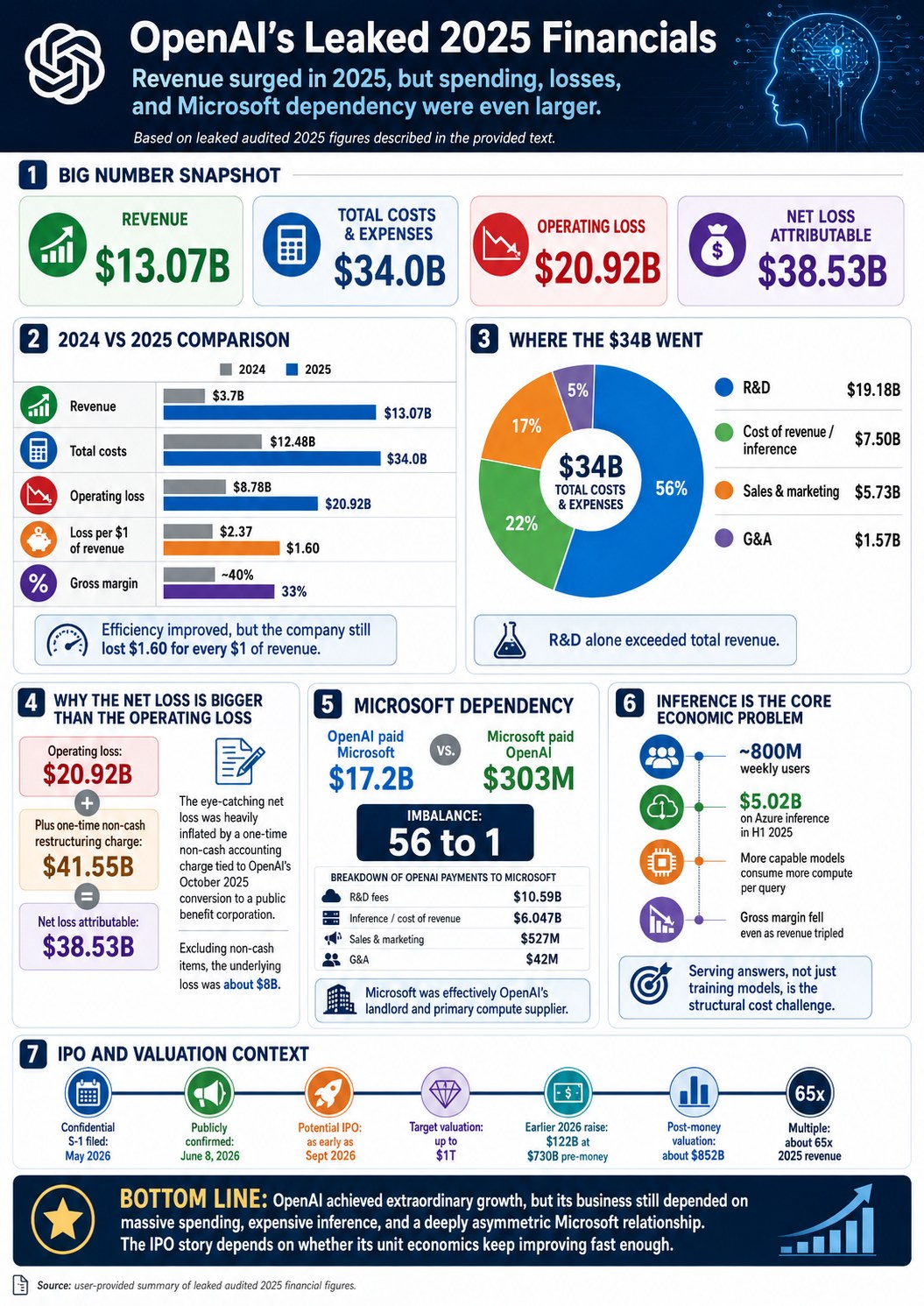
    Infographic summarizing OpenAI leaked 2025 financials: $13.07B revenue, $34B total costs, $20.92B operating loss, $38.53B net loss, where the $34B went, the $17.2B paid to Microsoft versus $303M paid back, inference costs, and IPO valuation context

    OpenAI’s audited 2025 financials leaked this week, and they are the clearest picture yet of what it actually costs to run the company behind ChatGPT. Independent journalist Ed Zitron first published the documents, and the Financial Times independently confirmed them. The headline: OpenAI spent $34 billion last year, booked $13.07 billion in revenue, and reported a net loss attributable to the company of $38.5 billion. The disclosure lands just days after OpenAI confidentially filed for an IPO that could value it north of $1 trillion.

    TLDR

    OpenAI’s audited 2025 numbers, leaked by Ed Zitron and confirmed by the Financial Times, show revenue tripling to $13.07 billion while total costs reached $34 billion, producing a $20.92 billion operating loss and a $38.53 billion net loss attributable to the company. The much larger net loss is inflated by a one-time $41.55 billion non-cash charge tied to OpenAI’s October 2025 conversion from a nonprofit to a public benefit corporation; strip the non-cash items and the loss is closer to $8 billion. R&D alone was $19.18 billion, cost of revenue (inference) was $7.5 billion, and sales and marketing ballooned to $5.73 billion. OpenAI paid Microsoft $17.2 billion in 2025 while Microsoft paid OpenAI only $303 million, exposing a deep Azure dependency. The company burned $1.60 for every dollar of revenue, down from $2.37 in 2024, and gross margin slipped from roughly 40% to 33% as more capable models consumed more compute per query. The leak arrives as OpenAI files a confidential S-1, targets a listing as early as September 2026 at up to a $1 trillion valuation, and races rival Anthropic, which is more valuable on paper and claims it is already turning an operating profit.

    Thoughts

    The most important thing to understand about these numbers is that there are two loss figures and the press will conflate them. The $38.53 billion net loss is the scary headline, but $41.55 billion of it is a non-cash accounting charge from converting investor convertible interests into equity during the for-profit restructuring. That charge is real on the audited statement and it will show up in the eventual S-1, but it is a one-time artifact of OpenAI’s unusual corporate history, not money that left the building. The number that describes the actual business is the $20.92 billion operating loss. That is the one to watch, and it is still enormous.

    The genuinely encouraging line in the whole release is the loss-per-dollar ratio. In 2024 OpenAI spent $2.37 to generate a dollar of revenue. In 2025 that fell to $1.60. A company that is still losing $1.60 on every dollar is not a healthy business, but a company whose efficiency improved by a third in a single year while tripling its top line is at least pointed in a defensible direction. The bull case for OpenAI lives entirely in the slope of that line. If it keeps improving at that rate, the math eventually crosses over. If it stalls, the valuation is a fantasy.

    The Microsoft relationship is the single most revealing disclosure, and it is wildly asymmetric. OpenAI paid Microsoft $17.2 billion in 2025. Microsoft paid OpenAI $303 million. That is a 56-to-1 ratio, and it reframes the partnership: Microsoft is not really a peer or even just an investor, it is OpenAI’s landlord and primary supplier, collecting rent on every model trained and every query answered. The April 2026 renegotiation that capped revenue-share payments at $38 billion through 2030, down from a projected $135 billion, suddenly looks less like a favor and more like OpenAI desperately trying to lower its single largest cost. The dependency cuts both ways, but right now Microsoft holds the better hand.

    The structural problem hiding inside the cost of revenue line is inference. Training a model is a fixed, one-time cost. Serving it is a recurring cost that scales with every one of ChatGPT’s roughly 800 million weekly users. OpenAI spent $5.02 billion on Azure inference in the first half of 2025 alone, and the more capable its reasoning models get, the more compute each answer burns. That is why gross margin went down even as revenue went up. It is the opposite of how software is supposed to work, where the marginal cost of one more user trends toward zero. OpenAI’s marginal cost is real, large, and growing. The counterargument is that per-token inference costs have been falling roughly tenfold a year, so the unit economics could still flip. That is the entire wager.

    Finally, the timing matters more than the numbers. OpenAI’s confidential S-1 means these audited figures were going to become public regardless, since the SEC requires the full prospectus at least 15 days before a roadshow. What the leak changes is who gets to study them first. Prospective IPO buyers, enterprise customers signing multi-year API contracts, and competitors now have the audited books weeks or months early, and they are reading them against Anthropic, which filed at a higher valuation and claims an operating profit. For a company asking the public markets to underwrite a $1 trillion bet on a monopoly outcome that does not yet exist, losing control of the narrative this early is not a small thing.

    Key Takeaways

    • OpenAI’s audited 2025 financials were first published by independent journalist Ed Zitron and independently confirmed by the Financial Times, the first verified look at the company’s books before its planned IPO.
    • Revenue grew from $3.7 billion in 2024 to $13.07 billion in 2025, more than tripling year over year, making OpenAI one of the fastest-growing businesses in history.
    • By the end of 2025 OpenAI was generating roughly $2 billion in monthly revenue, up from about $1 billion a quarter at the end of 2024.
    • Total costs and expenses hit $34 billion in 2025, up from $12.48 billion in 2024.
    • Research and development was the single largest expense at $19.18 billion, up from $7.81 billion, and exceeded total revenue on its own.
    • Of that R&D spend, $10.59 billion went to Microsoft, almost certainly the GPU compute cost of training frontier models on Azure.
    • Cost of revenue, the expense of serving ChatGPT responses (inference), rose from $2.65 billion to $7.5 billion.
    • Sales and marketing jumped from $1.11 billion to $5.73 billion, a 418% increase.
    • General and administrative costs rose from $907 million to $1.57 billion.
    • The operating loss, the truest measure of day-to-day economics, grew from $8.78 billion to $20.92 billion.
    • The net loss attributable to OpenAI was $38.53 billion, up nearly eightfold from $5.09 billion in 2024.
    • The bulk of that jump was a one-time, non-cash $41.55 billion charge from OpenAI’s October 28, 2025 conversion to a public benefit corporation, reflecting the changing fair value of convertible interests and warrant liabilities.
    • Stripping out the restructuring charge and other non-cash items such as stock-based compensation and Microsoft computing credits, the underlying loss was about $8 billion.
    • Including all factors, gross net loss reached $60.35 billion, lowered to the $38.53 billion attributable figure by removing $21.82 billion attributed to noncontrolling and redeemable noncontrolling interests.
    • OpenAI burned $1.60 for every $1 of revenue in 2025, an improvement from $2.37 in 2024, the clearest data point in the bull case.
    • Measured as a percentage of revenue, the operating loss improved from 237% in 2024 to 160% in 2025.
    • In total, OpenAI paid Microsoft $17.2 billion in 2025: $10.59 billion in R&D fees, $6.047 billion in cost of revenue, $527 million in sales and marketing, and $42 million in G&A.
    • Microsoft paid OpenAI just $303 million in the same year, a 56-to-1 imbalance underscoring OpenAI’s Azure dependency.
    • SoftBank paid OpenAI $867 million in 2025.
    • At year-end OpenAI carried $3.64 billion in outstanding payables to Microsoft, plus tens of millions more in accrued and non-current liabilities.
    • OpenAI spent $5.02 billion on Azure inference in just the first half of 2025; Azure inference from 2024 through Q3 2025 totaled $12.43 billion.
    • ChatGPT serves roughly 800 million weekly users, meaning billions of queries a week, each one burning GPU time at Azure’s pricing of about $6.98 per H100 GPU-hour.
    • Gross margin fell from roughly 40% in 2024 to 33% in 2025, because more capable reasoning models consume more compute per query.
    • Research firm Sacra estimates OpenAI’s inference costs reached $8.4 billion in 2025 and will rise to $14.1 billion in 2026, a 68% increase.
    • At year-end OpenAI held just over $50 billion in assets, with almost half in cash.
    • The April 2026 Microsoft renegotiation ended exclusivity and capped revenue-share payments at $38 billion through 2030, down from a projected $135 billion, potentially saving OpenAI up to $97 billion over five years.
    • OpenAI filed a confidential draft S-1 with the SEC around May 22, 2026 and confirmed it publicly on June 8, naming Goldman Sachs and Morgan Stanley as underwriters.
    • The company is targeting a listing as early as September 2026 at a valuation that could exceed $1 trillion, though Sam Altman has said a public offering “may be a while.”
    • OpenAI raised $122 billion earlier in 2026 at a $730 billion pre-money valuation, putting its post-money value around $852 billion.
    • At an $852 billion valuation, OpenAI trades at roughly 65 times its 2025 revenue.
    • Rival Anthropic also filed IPO paperwork this month after raising $65 billion at a $900-$965 billion valuation, making it more valuable on paper than OpenAI, and says it expects to report an operating profit of $559 million in the June quarter.
    • HSBC analysts estimate OpenAI may need more than $207 billion in additional capital through 2030 even under optimistic projections.
    • OpenAI projects profitability by 2029 or 2030; independent analysts put the more likely date at 2031 or later.
    • Bridgewater partner Greg Jensen reportedly told clients the implied revenue multiples price OpenAI for “a monopoly outcome that does not yet exist.”
    • Zitron separately reported OpenAI had a negative 122% non-GAAP operating margin in Q1 2026 and that ChatGPT growth has stalled, with the company projecting paid ChatGPT Plus subscriptions to fall from 44 million in 2025 toward cheaper tiers in 2026.

    Detailed Summary

    How the leak happened and why it matters now

    The audited documents were obtained and first published by Ed Zitron on his newsletter Where’s Your Ed At, then independently verified by the Financial Times, which reviewed the same materials. That dual sourcing matters: this is not a rumor or a model, it is OpenAI’s actual audited financial statement. The timing is the story. OpenAI filed a confidential draft S-1 with the SEC around May 22, 2026 and confirmed it publicly on June 8. Under SEC rules the full prospectus must be released at least 15 days before an investor roadshow, so the 2025 numbers were going to be public soon regardless. The leak simply moved that disclosure forward, handing prospective investors, enterprise customers, and competitors an early look at the books.

    Revenue tripled, costs grew faster

    OpenAI’s revenue rose from $3.7 billion in 2024 to $13.07 billion in 2025, and monthly revenue reached nearly $2 billion by year-end. By almost any normal standard that is spectacular growth. The problem is that costs grew faster, reaching $34 billion against $12.48 billion the year before. The gap between what OpenAI earns and what it spends has widened every year since its founding, and 2025 is the starkest example yet. Revenue alone was outpaced by research and development as a single line item in both of the last two years.

    Two loss numbers, and why both matter

    There are two figures that get cited interchangeably and should not be. The operating loss of $20.92 billion is what the business spent beyond what it earned from operations: training models, serving ChatGPT, paying engineers, running marketing. The net loss attributable to OpenAI of $38.53 billion is far larger because 2025 was the year OpenAI completed its conversion from a nonprofit to a for-profit public benefit corporation, finalized on October 28, 2025. That restructuring triggered a $41.55 billion non-cash charge reflecting the changing fair value of convertible equity interests and warrant liabilities. Before the conversion, investors held convertible interest rights treated as liabilities under US accounting rules and revalued upward as OpenAI’s valuation climbed, creating the charge. It is not expected to recur. Including all minor items, gross net loss reached $60.35 billion, reduced to the $38.53 billion attributable figure after removing $21.82 billion tied to noncontrolling and redeemable noncontrolling interests, primarily the OpenAI Foundation’s stake. Strip the non-cash noise and the underlying loss was about $8 billion.

    Where the $34 billion went

    The spending breaks into four lines. Research and development was $19.18 billion, the largest category, with $10.59 billion of it flowing to Microsoft for training compute. Cost of revenue, the expense of serving responses to users, was $7.5 billion and captures inference, the compute consumed every time someone prompts ChatGPT or calls the API. Sales and marketing reached $5.73 billion, up 418% year over year, a striking jump for a product that grew largely by word of mouth. General and administrative costs added $1.57 billion. The shape of the spending tells you OpenAI is simultaneously racing to build better models, serve a massive and growing user base, and aggressively defend market share through marketing.

    The Microsoft dependency

    The most striking single disclosure is the scale of the Microsoft relationship. OpenAI paid Microsoft $17.2 billion in 2025: $10.59 billion in R&D fees for model training, $6.047 billion in cost-of-revenue for inference serving, $527 million in sales and marketing, and $42 million in G&A. Microsoft paid OpenAI just $303 million the same year. SoftBank paid OpenAI $867 million. The 56-to-1 ratio between what OpenAI pays Microsoft and what Microsoft pays back makes the structural reality plain: Microsoft is OpenAI’s largest landlord. The dynamic began shifting in April 2026, when the two renegotiated, ending Microsoft’s exclusivity and capping revenue-share payments at $38 billion through 2030, down from a projected $135 billion. That could save OpenAI up to $97 billion over five years, though Microsoft keeps its IP license through 2032 and remains the primary cloud partner.

    Why inference is the core problem

    Training happens once. Serving happens billions of times a day. When OpenAI releases a model it spends months and billions on training compute, a fixed cost that falls away when training ends. Inference is the opposite: every ChatGPT message runs through the model on Azure GPU hardware, consuming electricity and compute to generate a response. With roughly 800 million weekly users, that is billions of queries a week, each burning GPU time at roughly $6.98 per H100 GPU-hour on demand. OpenAI spent $5.02 billion on Azure inference in the first six months of 2025 alone. Sacra estimates full-year inference costs of $8.4 billion in 2025, rising to $14.1 billion in 2026. This is why gross margin fell from about 40% to 33% even as revenue tripled: more capable reasoning models consume far more compute per query, and revenue has not kept pace with the cost growth that capability generates.

    What it means for the IPO and the race with Anthropic

    OpenAI was last valued around $852 billion post-money after raising $122 billion in early 2026, which puts it at roughly 65 times 2025 revenue. It has named Goldman Sachs and Morgan Stanley as underwriters and is targeting a listing as early as September 2026 at up to a $1 trillion valuation, though Altman has hedged that it “may be a while” and that staying private might be the better course. HSBC estimates the company may need more than $207 billion in additional capital through 2030. The race is with Anthropic, which filed paperwork the same month after raising $65 billion at a $900-$965 billion valuation, making it more valuable on paper, and which says it expects a $559 million operating profit in the June quarter. The contrast is sharp: the two leading AI labs heading toward public markets at the same time, one bleeding cash at scale, the other claiming profitability, both asking investors to bet on a future that has not arrived.

    Notable Quotes

    “The financial condition of OpenAI is deeply concerning. $38.53 billion in losses are astronomical, and far higher than most believed it would be. Losses also appear to be mounting year-over-year at a dramatic rate, and I’m not sure how this company finds a way toward any kind of sustainability or profitability.”

    Ed Zitron, the independent journalist who published the leaked audited financials

    “It’s unclear what this means, nor how OpenAI reconciled the removal of $3.74 billion in costs. I will not speculate further.”

    Ed Zitron, on a discrepancy he found in the restated 2024 figures

    “OpenAI’s two biggest expenses are R&D and marketing. Budget cuts there, coupled with an ability to raise prices or win new sources of revenue, could see the company move into the black over time. Cutting R&D would be the most difficult part of that, given that AI companies can only hold onto their customers by generating the best-performing models.”

    Jim Edwards, Fortune, on whether OpenAI has a realistic path to profitability

    “What the audited documents make impossible to argue is that the path to profitability is short, clear, or cheap.”

    TechTimes analysis of the leaked OpenAI financials

    The implied revenue multiples price OpenAI for “a monopoly outcome that does not yet exist.”

    Bridgewater partner Greg Jensen, reportedly telling clients how to read OpenAI’s valuation

    “OpenAI spent $34bn last year as the ChatGPT maker poured money into a race to dominate the fast-growing AI market ahead of a planned stock market listing.”

    George Hammond and Bryce Elder, Financial Times, framing the audited 2025 spend

    Read Ed Zitron’s original reporting with the full breakdown here, and the Financial Times confirmation here.

    Related Reading

    • Ed Zitron, Where’s Your Ed At the primary source that broke the audited 2025 financials with the full line-by-line breakdown.
    • OpenAI (Wikipedia) background on the company’s history, structure, and the nonprofit-to-for-profit conversion that drives the non-cash charge.
    • Inference (Wikipedia) on the recurring compute cost that explains why OpenAI’s gross margin shrinks as usage grows.
    • Anthropic the rival lab that filed IPO paperwork the same month at a higher valuation and claims it is already operating at a profit.
    • SEC on confidential filings context for why OpenAI’s audited numbers were headed for public disclosure regardless of the leak.
  • Lloyd Blankfein on the 3 Sectors Where He Puts His Money Now: Big Tech, Energy, and Financial Services, Day Trading From an iPad, and the Warren Buffett Handshake That Backed Goldman in 2008

    Lloyd Blankfein spent almost 40 years at Goldman Sachs, the last dozen as its chairman and chief executive, and he still trades almost every day from an iPad. In this wide ranging conversation on the My First Million podcast, the former Goldman boss lays out exactly where he is putting his own money right now, why a supportive spouse beats nearly any investment, how Warren Buffett wired five billion dollars into Goldman on a handshake during the 2008 crisis, and why he reads medieval history to stay calm about the present. It is part stock picking, part risk philosophy, and part a frank accounting of money, marriage, and the scars of growing up in the projects.

    TLDW

    Blankfein says he is roughly 98 percent in risky assets, almost all equities, and concentrated in three sectors he knows cold: big tech, energy, and financial services. His personal book leans heavily into single stocks over ETFs, weighted toward the big hyperscalers and a few second tier names, and he trades daily, alone, from an iPad and a phone, using calls and texts as his research network. Yet the advice he gives a normal investor is the boring opposite: a diversified S&P 500 fund like VOO, more risk when you are young because you will outlive your mistakes, the same thing Warren Buffett would tell you. The conversation ranges across the 2008 Buffett investment in Goldman, the cost of trying to legislate risk out of markets, the thin margin between the best and the rest, luck and the myth of the genius, why reputation is the real contract on Wall Street, why a supportive spouse is the highest return asset he knows, the money anxiety he carried out of a Brooklyn housing project, the dignity of a 500 dollar financial aid check, giving with a warm hand versus a cold one, the dangers of gamified investing, the big misses like SpaceX and early cellular, the obituary test a senior partner once gave him, and why reading history keeps the present in proportion.

    Thoughts

    The most useful tension in this interview is the gap between what Blankfein practices and what he preaches. He tells young people to buy a diversified S&P 500 index fund, he holds VOO himself, and he calls the host’s plain 90 percent stocks and 10 percent bonds split sensible. Then he admits his own portfolio is something like 90 percent single stocks that he trades by hand every day. The honest read is that his edge is not a transferable tip. It is a 40 year information network of phone calls and a tolerance for risk that most people neither have nor should want. The replicable lesson is the boring half, not the day trading half.

    The most contrarian idea here is not a stock pick, it is his defense of risk itself. His argument that regulators trying to prevent the hundred year storm also forfeit the 99 normal years of growth in between is a serious claim about the price of safety, and it travels far beyond Wall Street. The same goes for his point that a good risk manager sometimes has to push people to take more risk, not less. The moment after a loss, when everyone goes gunshy, is exactly when the best operators lean back in. That is an uncomfortable thing for a former bank CEO to say out loud, and it is the part of the conversation most worth sitting with.

    The Warren Buffett story is a master class in what actually moves markets, and it is not cash. Goldman did not need the five billion dollars. Blankfein says the money was almost irrelevant because the firm already had money. What it could not manufacture was confidence, and Buffett’s name supplied it. The handshake, the commitment with no paperwork, the line about worrying enough for the both of us, all point to the same thing. At the top, reputation is the collateral. His aside that most trades are never written down because you will never eat lunch in this town again is the same idea wearing street clothes.

    Quietly, the personal finance thread may be the most valuable part for a normal listener. A former Goldman CEO saying that a supportive partner is more game changing than any investment, that a bad marriage is financially worse than being lonely, and that he has not paid a bill in over 40 years because his wife runs the household economy, is a reminder that household stability is itself an asset class. The 500 dollar financial aid check he still remembers half a century later, and his give with your warm hand philosophy, reframe wealth as something measured by how it feels to give and to receive, not just by the size of a pie chart.

    Finally, the history obsession is not a side hobby, it is his risk model. Reading about the black plague, the McCarthy era, and the Vietnam draft is how he keeps the present in proportion. His Mark Twain line, that history does not repeat but it rhymes, is the direct antidote to the in this economy defeatism he and the host both complain about. For an investor, that long view is close to the whole game. It is what lets you hold through the drawdowns that scare everyone else out of the market.

    Key Takeaways

    • Blankfein estimates he is about 98 percent in risky assets, with roughly 95 of those 98 points in equities, and the rest spread thin. He invests in risky assets because, in his words, that is what is fun for him.
    • Within his equities, he is heavily tilted toward single stocks rather than ETFs. He frames it as roughly a quarter to a third in ETFs and the rest in single names, and concedes it could be as lopsided as 90 percent single stocks because picking names is what he enjoys.
    • The three sectors he has concentrated in for years are big tech, energy, and financial services, and he says his outperformance comes from where he focused, not from any special genius.
    • On tech he owns the big hyperscalers, the Googles, Microsofts, and Nvidias of the world, plus a tier just below them, naming Oracle and Larry Ellison as an example of a slightly riskier second tier name. He thinks in categories, not fixed tickers, because he changes positions constantly.
    • He says he has a background in trading energy, which is why energy is a core sleeve, and he knows financial services from the inside after almost 40 years at Goldman, so those are natural areas of edge.
    • He still owns a lot of Goldman Sachs stock, out of affection for the firm he spent his career building.
    • He is bullish on big tech and plans to stay bullish until it stops going up. His foreseeable future, he jokes, lasts until he finishes the conversation and checks the screen again.
    • He trades every single day, alone, with no team. He does it from an iPad and a phone, not a computer, and treats the market like background music rather than a job.
    • His research is human, not algorithmic. He chats and texts with people, then calls them because he is tired of fixing typos, and he reads the New York Post, the Wall Street Journal, the New York Times, the Financial Times, and Bloomberg.
    • The advice he gives ordinary investors is deliberately boring and different from his own behavior: hold a diversified equity portfolio like an S&P 500 fund, with VOO as his own example, and tilt more aggressively when you are young because you have time to outlive mistakes.
    • He notes that broad indexes are already heavily weighted toward tech because of market cap, so a plain index gives meaningful tech exposure, and a tech focused ETF on top can add a disproportionate tilt for believers.
    • He calls the host’s simple 90 percent index and 10 percent bonds allocation sensible, and says this is essentially the same advice Warren Buffett would give a normal person.
    • The older you get, the more conservative you should become, shifting from maximizing gains toward not losing what you have. Young people can afford more risk precisely because they will outlive their errors.
    • During the 2008 financial crisis, Warren Buffett invested about five billion dollars in Goldman through a preferred stock structure, essentially on a phone call and a handshake, with no demand for due diligence.
    • Buffett’s real value was confidence, not capital. Goldman already had money, but it had lost the confidence of the market while peers were failing. Buffett’s name signaled the firm was a good investment being beaten down by circumstances that would reverse.
    • Buffett asked for a verbal commitment that Goldman would not sell shares before he did, and declined to put it in writing. He waved off the worry with the line that five billion dollars going bad would not even be a bad hurricane for Berkshire, an insurer.
    • Most trading is done on reputation, not paper. Blankfein says people buy and sell bonds worth enormous sums without written contracts, relying on probity, because anyone who reneges will never eat lunch in this town again.
    • On risk and regulation, he argues you cannot legislate risk away. Trying to prevent the hundred year storm also forgoes the 99 in between years of growth, and a good risk manager sometimes has to encourage people to take risk, not suppress it.
    • The best traders have resilience. They bounce back, focus on new information rather than the past, and adapt quickly instead of staying gunshy after a loss.
    • The difference between someone who is really good and someone who cannot make it is small. He compares it to a golf tournament won by one stroke with six people tied for second, and notes much of life is winner take all at razor thin margins.
    • Luck matters enormously. He became Goldman CEO partly because his predecessor was nominated to be Treasury Secretary, a reference to Hank Paulson, and the timing of opportunities is often out of your control.
    • He is skeptical of the word genius. He says he can usually see how successful people do what they do, with Elon Musk as a rare exception, and that powerful people are more normal, more insecure, and more flawed than outsiders assume.
    • On democratized investing, he thinks apps that make markets accessible are good in their own terms, but gamifying trading with confetti and high fives can mask real danger for people who can lose more than they can afford.
    • He has missed plenty. He thought SpaceX was overpriced at a 100 billion dollar valuation, now discussed near a trillion and three quarters, and passed on early cellular because he could not imagine why anyone would carry a bulky phone when payphones existed. He says he missed far more than he got.
    • He frames a supportive spouse as more game changing than almost any investment, and warns that a bad marriage, with custody fights and property settlements, is financially and personally worse than being lonely.
    • He has not paid a bill in over 40 years. His wife Laura, a former lawyer he says now chairs Barnard College, runs a bill paying service and manages the household economy. He generates the money, she distributes it.
    • He grew up in an East New York, Brooklyn housing project, the son of a postal worker, and carried money anxiety well into his 30s. He recalls buying a vacation home that cost more than all their savings, with his wife unable to make the math work until they remembered the down payment.
    • A 500 dollar financial aid check, handed to him without shame as a college freshman around 1971, shaped his philosophy on giving. He learned it is not enough to give people what they need, you have to give it in a way that feels dignified.
    • He embraces the give with your warm hand, not your cold hand idea, the notion of giving while alive so you can experience the joy, which connects to the spirit of the book Die With Zero.
    • He admits ambivalence about giving to his kids, the strange feeling of resenting that they have what he provided, and notes the heavy burden carried by children of prominent people who must prove they earned their place.
    • He describes himself as wired for anxiety, inherited from his father, and says looking around corners for what could go wrong actually suited a career in a risky business with a big balance sheet.
    • When he made partner, a senior partner gave him rules of the road, including avoiding misconduct, being conservative on taxes, setting up a charitable foundation, and living so that no more than three of the nine paragraphs in his eventual obituary would be about Goldman. He says he stayed too long to pass that test.
    • He reads history as a discipline, favoring Barbara Tuchman, Robert Caro’s The Power Broker, Ron Chernow, Rick Atkinson, and Stephen Ambrose. His core belief, borrowed from Mark Twain, is that history does not repeat but it rhymes, which is why he would not bet against America.

    Detailed Summary

    The three sectors he actually invests in

    The headline answer to where the former Goldman CEO is putting his money is simple: big tech, energy, and financial services. He says he has been focused on those three areas for a long time, and that his outperformance is a function of where he aimed rather than any unusual investing gift. Energy is natural because he has a background trading it. Financial services is natural because he spent nearly 40 years inside the industry. Tech is where he is most heavily concentrated, and he expects to stay there for good reason, citing the threshold of large changes in technology. He owns the major hyperscalers by category, the Googles, Microsofts, and Nvidias, plus a tier just below, offering Oracle and Larry Ellison as a polite example of a slightly riskier second tier name. He is careful to say he thinks in categories rather than fixed tickers because he changes his positions all the time.

    How the portfolio is really built: single stocks over ETFs

    Asked to describe his portfolio as a pie chart, Blankfein says he is about 98 percent in risky assets, with roughly 95 of those points in equities. He pushes back on the idea that index funds are safe, pointing out that a diversified equity ETF is still equities and still risky, just spread out, and very different from debt or short term money markets. Within his equity sleeve he leans into single stocks, framing it as somewhere between a quarter and a third in ETFs and the rest in individual names, and conceding it might be as extreme as 10 percent ETFs and 90 percent single stocks. The reason is preference, not theory. Picking and trading names is what he likes to do, and he is honest that this is a hobby pursued by a professional, not a model for someone investing for a living.

    How he actually trades: an iPad, a phone, and a network

    He trades every day, by himself, with no team. There is no Bloomberg terminal and no desk of analysts. He uses an iPad and a phone, and admits it takes discipline not to glance at his screen mid conversation. The market, he says, is like music playing in the background while he does other things. His information edge is relational. People text him, he texts back, and then he calls because he is tired of fixing typos with what he calls his fat fingers. He follows general and business news, reads a stack of newspapers starting with the New York Post, and treats companies like little stories, almost like gossip. He even notes, with some delight, that he still watches commercials on Netflix, a small window into a frugality that never fully left him.

    The advice he gives young investors, and what Buffett would say

    For a normal person, his counsel is the opposite of his own behavior. He would hold a diversified portfolio of equities like an S&P 500 fund, naming the SPY and VOO tickers and saying he personally uses VOO. Because of the importance of technology, he might add a tech oriented ETF for extra tilt, while noting the broad index is already tech heavy by market cap. He endorses the host’s plain 90 percent index and 10 percent bonds split as sensible and says it mirrors what Warren Buffett would advise. His one piece of age based guidance is that younger investors should accept more risk through equities, because they have time to recover, while older investors should grow more conservative and focus on not losing what they have rather than maximizing returns.

    The Warren Buffett handshake that backed Goldman in 2008

    The most cinematic story in the conversation is Buffett’s roughly five billion dollar investment in Goldman during the financial crisis, structured as a preferred stock that sits between a loan and equity. Blankfein describes a deal done largely on trust. When he offered to walk Buffett through everything he was worried about, Buffett replied that he knew Lloyd well enough to know he worried enough for the both of them. Buffett also asked, verbally and without writing, for a commitment that Goldman would not sell shares before he did. Blankfein is clear that the cash itself was almost irrelevant, since Goldman had money. What the firm lacked was the confidence of a frightened market, and Buffett’s willingness to invest before things improved supplied exactly that signal. Buffett, he stresses, was acting for his own shareholders, not as a rescuer, which is precisely what made the vote of confidence credible.

    Why you cannot legislate risk out of the system

    Reflecting on the post crisis regulatory push to make sure 2008 never happened again, Blankfein makes a careful argument about the price of safety. Once you are in the business of taking risk, anything can happen, and trying to legislate it away has a hidden cost. You may think you are protecting the world from the hundred year storm, but you also forgo the 99 years of growth in between. He extends this inside the firm too. After a period of big losses, partners had become gunshy and were talking themselves out of every idea. A good risk manager, he argues, sometimes has to promote risk taking rather than repress it, because without risk there is no growth, no entrepreneurship, and no progress. The flip side is real: take risk and there is a meaningful chance you fail and lose other people’s money, which is a terrible outcome. But the alternative, never risking anything, buys comfort at the cost of ever moving forward.

    Small margins, big outcomes, and the role of luck

    Asked what separated the traders who could not outperform from the rest, Blankfein says the gap between the very good and those who cannot make it is surprisingly small. He likens it to a golf tournament decided by a single stroke with six players tied for second, and to acting, where the best performer gets every role and the second best waits tables. Much of life, he says, is winner take all at tiny margins. Luck compounds this. He freely credits fortune for his own rise, noting he became CEO in part because his predecessor was tapped to be Treasury Secretary. He is also skeptical of the genius label. He can usually see how accomplished people do what they do, with Elon Musk a rare exception, and insists the powerful are more normal, more insecure, and more driven by their flaws than outsiders imagine.

    Reputation is the real contract

    A recurring theme is that the financial world runs on reputation more than paperwork. Blankfein notes that most of what traders do is not written down. People buy and sell bonds and other instruments that settle days later, relying on probity rather than signed contracts, because anyone who lies or reneges will never eat lunch in this town again. He references the casual texts between Elon Musk and Larry Ellison around the Twitter acquisition as proof that big does not mean complicated. There are big things that are simple and little things that are complicated. Documentation is good when execution is far off, but when a deal will be performed in two days, dotting every i is often pointless. The point is not that documents do not matter, it is that trust and reputation are the load bearing structure.

    A supportive spouse as the highest return asset

    The conversation turns personal when both men agree that a supportive partner may be the single most game changing factor in a life, more than any investment. Blankfein adds the inverse warning: a bad marriage, with breakups, custody battles, and property settlements, is worse than loneliness. He credits his wife Laura, a former big firm lawyer he says now chairs Barnard College, with handling everything when his career moved the family overseas, from the car to the house to the kids’ schooling, while he took the visible victory laps at work. He has not paid a bill in over 40 years. Laura manages a bill paying service and runs the household finances. As he puts it, he is in charge of generating the money and she is in charge of distributing it. The host contrasts this with his own monthly money meetings with his wife, a discipline he picked up from a personal finance author friend.

    Money scars, the 500 dollar check, and giving with a warm hand

    Blankfein grew up in an East New York housing project, the son of a postal worker who had earlier lost a job, in a household where rent was scarce. He calls himself an urban hick who barely left Brooklyn as a kid. That scarcity left a mark that lasted into his 30s. He tells the story of buying a small beach house that cost more than all their savings, and of his wife driving 30 miles while failing to make the closing math work, until they realized she had forgotten to count the 10 percent down payment. The most resonant memory is a 500 dollar financial aid check handed to him as a freshman around 1971, made out on the spot by a clerk with a generosity of spirit that let him receive it without shame. That experience shaped a lifelong view that giving well means preserving dignity, and he now co chairs a financial aid campaign at his university. It also connects to his embrace of the idea of giving with your warm hand rather than your cold hand, giving while alive so you can feel the joy, the same spirit as the book Die With Zero. He is candid about a strange ambivalence, the way he can resent that his kids enjoy what he himself gave them.

    Robinhood, confetti, and the misses

    On apps like Robinhood, Blankfein takes a balanced view. Democratizing investing and making assets accessible is good in its own terms, and advertising can pull people toward markets they would otherwise ignore. But if you make trading too much like a video game, with confetti and high fives, you can mask the danger and lure people who cannot afford to lose into losing more than they can. He is equally frank about his own misses. He thought SpaceX was overpriced at a 100 billion dollar valuation, a figure now discussed near a trillion and three quarters. He passed on early cellular because he could not imagine why anyone would carry a bulky phone with payphones everywhere. His blunt summary is that he missed far more than he got, and that nobody is great at predicting the future.

    The obituary test, thick skin, and staying too long

    When Blankfein made partner, a senior partner assigned to acculturate new partners gave him rules of the road: avoid anything that would today be called misconduct, be rigorous and conservative on taxes, set up and actually use a charitable foundation, and keep enough balance that, if your obituary runs nine paragraphs, no more than three are about Goldman. Blankfein says he failed that last test by staying too long, even titling his memoir around the firm. He also reflects on having a thick skin, recalling unflattering press and concluding that he could take a punch, a trait not everyone has and one he did not know he possessed until he was tested. He is careful to say this does not make people who cannot take a punch bad, just differently wired.

    Why he reads history: it rhymes

    The final stretch is a love letter to reading history. Blankfein favors Barbara Tuchman, whose A Distant Mirror he has read twice and whose Guns of August he calls fantastic and influential, along with Robert Caro’s The Power Broker on Robert Moses, Ron Chernow’s biographies, Rick Atkinson’s Revolution series, and Stephen Ambrose’s Undaunted Courage. He describes rereading the Robert Moses book after 40 years of trying to get things done and finding his appreciation for the achievements rise, even as the flaws stayed the same, because he had changed. He ties history directly to markets through the Mark Twain line that history does not repeat but it rhymes. Patterns recur, every generation maximizes its own crises and minimizes resolved ones, and reading about the black plague, the McCarthy era, or the Vietnam draft is how he stays calm. His conclusion, echoing a sentiment often attributed to Buffett, is that he would not bet against America, a country he describes as mostly good and able to improve.

    Notable Quotes

    “I invest in risky assets. That’s what’s fun for me.”

    Lloyd Blankfein, describing his own portfolio, which he says is roughly 98 percent risky assets

    “It’s been good to be bullish on big tech, and I’ll stop being bullish on it when it stops going up.”

    Lloyd Blankfein, on why he stays concentrated in technology

    “I’m not at a computer. I don’t have a computer. I have an iPad.”

    Lloyd Blankfein, on how he day trades every day, alone and with no team

    “To me, the market is like music. It’s out there. It’s going on.”

    Lloyd Blankfein, on why trading daily feels like a hobby rather than work

    “Look, $5 billion if it all goes bad, that’s not even a bad hurricane on the East Coast.”

    Warren Buffett to Lloyd Blankfein, waving off the risk of his 2008 investment in Goldman Sachs

    “The difference between somebody who’s really, really good and somebody who can’t make it is not that great.”

    Lloyd Blankfein, on the thin margin between the best and the rest

    “You may think you’re protecting the world from the hundred-year storm, but you’re also going to forego the 99 years of in between when there was growth.”

    Lloyd Blankfein, on the cost of trying to legislate risk out of markets after 2008

    “I’m in charge of generating the money, and she’s in charge of distributing it.”

    Lloyd Blankfein, on his 40-plus-year marriage to Laura and why he has not paid a bill in decades

    “History doesn’t repeat, but to paraphrase Mark Twain, it rhymes.”

    Lloyd Blankfein, on why reading history keeps the present in proportion

    Watch the full conversation with Lloyd Blankfein on the My First Million podcast here.

    Related Reading

    • Lloyd Blankfein (Wikipedia) background on the former Goldman Sachs chairman and CEO whose investing views anchor the conversation.
    • My First Million podcast the show where this interview took place, for the full back catalog of investor and founder conversations.
    • Berkshire Hathaway primary source on Warren Buffett’s company, which made the roughly five billion dollar Goldman investment in 2008.
    • Vanguard S&P 500 ETF (VOO) the diversified index fund Blankfein names as the sensible core holding for a normal investor.
    • Die With Zero by Bill Perkins the book behind the give with your warm hand, not your cold hand philosophy discussed near the end.