PJFP.com

Pursuit of Joy, Fulfillment, and Purpose

Tag: focus

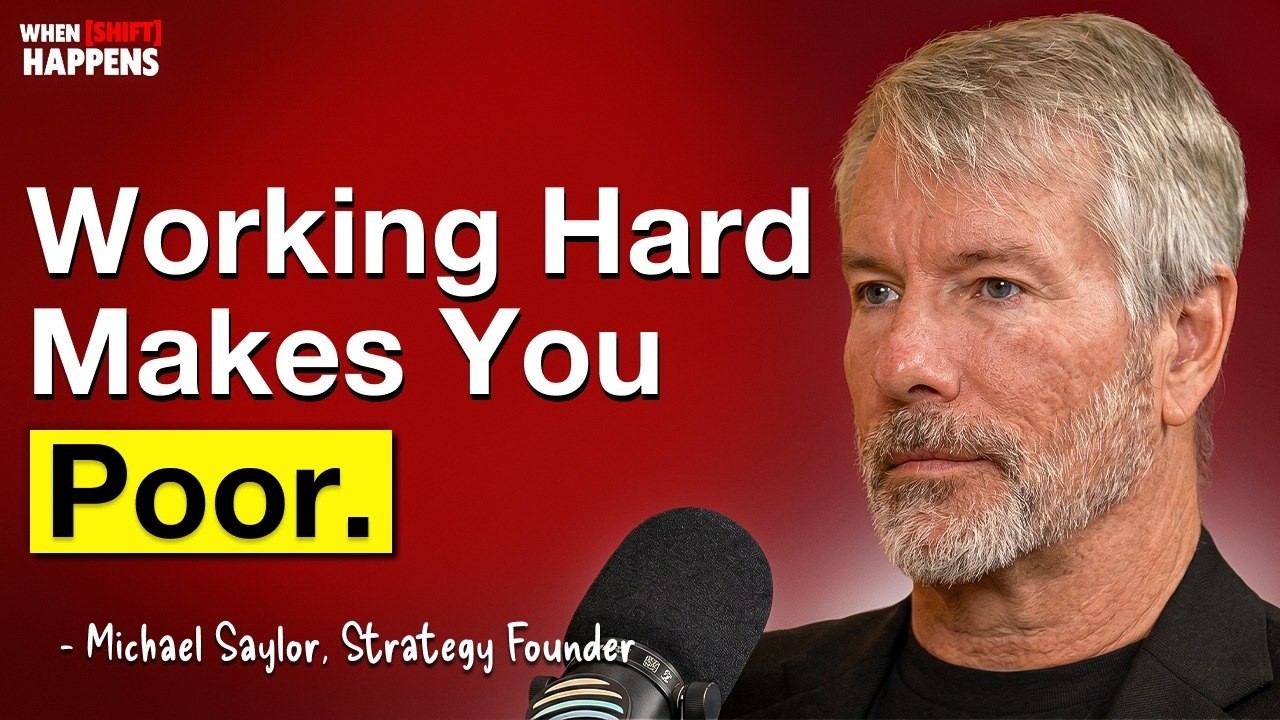
  • Michael Saylor on Strategy’s Bitcoin Playbook, the 11.5% Stretch Preferred Stock, Why Working Hard Is Bad Advice, and Bitcoin as Cyber Manhattan

    Michael Saylor, founder and executive chairman of Strategy (formerly MicroStrategy), sits down for Episode 172 of the When Shift Happens podcast for a wide-ranging, two-hour conversation on how a near-bankrupt enterprise software company became the world’s largest corporate holder of Bitcoin, why he calls his new preferred stock STRC “stretch” the most successful credit instrument in the world, and what 40 years of trial and error taught him about focus, leverage, time horizons, and the difference between working hard and working smart. This one is essential listening for anyone trying to understand Bitcoin as a protocol, Strategy as a capital markets machine, and what an “AI-pilled” 61-year-old founder actually does with his time.

    TLDW

    Saylor walks through his MIT-trained engineer’s framing of money as an adiabatic thermodynamic system, where the dollar loses roughly 7% of its energy per year, gold loses 2%, and Bitcoin loses zero, giving it an infinite half-life. He explains how COVID-era zero interest rates “rent controlled” the cash on Strategy’s balance sheet and forced him to search for a Facebook-of-money, leading to a $62 billion Bitcoin position across 818,000 coins. He details Strategy’s evolution from buying Bitcoin with cash, to convertibles, to senior bonds, to the equity ATM, to the new preferred stock family (Strike, Strife, Stride, and now Stretch), and argues that STRC is “rocket fuel kerosene” distilled from Bitcoin’s pure economic energy: an 11.5% monthly dividend, tax-deferred return of capital, designed to trade tightly around $100. He returns repeatedly to focus, the lesson he says he learned the hard way after spinning up alarm.com, voice.com, angel.com, and a half-dozen other ventures in his 30s. He argues working hard is now bad advice in an era where AI demonetizes labor, that volatility is vitality and the only honest time horizon is four to ten years, and that Bitcoin is to money what English is to language and Arabic numerals are to math: the protocol that won the network effect contest, and the place “all the money and power” now lives.

    Thoughts

    The most useful part of this conversation is not the Bitcoin maximalism, which is by now a fully formed Saylor genre. It is the brutal honesty about the decade he wasted launching alarm.com, voice.com, angel.com, michael.com, hope.com, and a half-dozen others while a billion-dollar MicroStrategy sat at the center of his portfolio asking for more attention. He admits the “imaginary future business is always more fun than struggling with the existing mature business,” which is one of the cleanest descriptions of founder ADHD I have read. The fact that someone at his level of intelligence and pattern recognition still required 20 years and a near-death experience to learn focus should make every operator under 40 reread that section twice. The single takeaway worth tattooing on a wall is his rule: “Just because you can do a thing doesn’t mean you should do a thing.”

    The engineering framing of money is the strongest intellectual move in the episode. Saylor is treating monetary supply expansion as energy loss in a thermodynamic system, with the dollar at a 10-year half-life, weak currencies at 3 to 5 years, gold at 36 years, and Bitcoin at infinity. Whether or not you accept the conclusion, the model is internally consistent in a way most macroeconomic arguments are not, and it gives him a vocabulary for talking about scarcity that economists trained on continuous-supply commodities literally do not have. The Max Planck quote he leans on, “science advances one funeral at a time,” is doing real work here. He is not saying he is smarter than the old guard. He is saying the old guard has no incentive to update because they already have money and power, and that the paradigm shift will be carried by the people with everything to gain. That is a more humble and more accurate version of the maximalist line.

    The Strategy capital markets machine is the part that deserves more scrutiny than it usually gets. The pitch for Stretch is genuinely interesting on its merits: a preferred stock that trades around $100, pays 11.5% monthly as return-of-capital dividends that defer all tax for roughly nine years, gets a step-up in basis on inheritance, and is positioned as a digital money market for people who believe in Bitcoin but do not want 40% volatility. If you take Saylor’s network-effect thesis seriously, this is the natural product to build, and his Standard Oil analogy (“distill the kerosene out of the crude oil”) is the right mental model. The risk that does not get discussed is what happens to the entire instrument family in a 99.8% drawdown of the kind he himself lived through with MicroStrategy in 2002. He waves it off by saying Strategy has 10x the enterprise value over the preferred, but in a deep enough Bitcoin winter, that cushion compresses fast. Worth holding both ideas at once: this is the most elegant Bitcoin-native fixed income product yet built, and it is still fundamentally a leveraged Bitcoin bet wearing a money-market mask.

    The “working hard is bad advice” thread is going to be the most controversial clip, and it is also the most important. Saylor is not saying do not work. He is saying do not be John Henry. Do not race the steam drill with a hammer. In a world where AI can translate, draft legal briefings, write books in 100 languages, and out-produce any individual professional by orders of magnitude, the marginal value of pure human labor is collapsing, and the right move is to ask “what tool can do this for me” before “how do I get better at this.” That is the same logic that took him from “I would have fired anyone who suggested Zoom in 2019” to running a global operation from a Florida studio. The unsubtle implication, especially for the 34-year-old host he is talking to, is that the 10,000-hour mastery model your parents grew up with is increasingly a status symbol with no underlying economics, like learning to compose Shakespearean sonnets in 2026.

    The single underrated line in the whole episode is “everything you own in the physical world you own at the pleasure of someone more powerful than you.” He is using it to make the Bitcoin self-custody case, but it generalizes to a much broader political and historical observation about property rights, minorities, and the steady drumbeat of expropriation events across 10,000 years of recorded history. Whether or not Bitcoin is the answer, the framing of “where do you store value such that nobody can decide to take it from you” is the right question to ask in the current decade, and most people are not asking it.

    Key Takeaways

    • Strategy now holds roughly 818,000 Bitcoin worth $62 billion, making it the world’s largest corporate Bitcoin holder and effectively a reserve bank built on a hard-capped digital monetary network.
    • Saylor’s working definition of an investor: anyone willing to hold a position for at least four years. Anyone with a shorter horizon is a trader, and most traders are fools who do not know they are fools.
    • His core advice to a 40-year-old Uber driver who cannot afford a house: own assets that appreciate faster than the 7% annual US dollar debasement rate. Anything slower means you are getting poorer in real terms while working harder every year.
    • The MIT-trained engineer’s framing of money: gold has a 36-year half-life because supply inflates ~2% a year, the dollar has a ~10-year half-life at ~7% debasement, weak currencies have 3 to 5-year half-lives, and Bitcoin’s half-life is infinite because supply growth is zero.
    • The 2020 pivot was forced, not chosen. When the Fed took rates to zero and signaled no hikes, Strategy’s $500 million in cash became, in Saylor’s metaphor, a rent-controlled building paying zero. They were forced to look for a way out and ended up at Bitcoin.
    • Saylor’s aha moment was recognizing Bitcoin as the only commodity in history with absolute scarcity. Gold inflates, silver inflates, even land can be reclaimed from the sea. Only Bitcoin’s 21 million cap is mathematically fixed.
    • The biggest lesson of his 30s and 40s: focus. He launched alarm.com, voice.com, angel.com, michael.com, hope.com, and several others while running MicroStrategy, and none of them matched the original. The line he leaves with is “just because you can do a thing doesn’t mean you should do a thing.”
    • By the time he was 55, he had been humbled enough to take someone else’s billion-dollar idea (Satoshi’s) instead of trying to generate his own.
    • Strategy’s evolution as an issuer: cash purchases, then convertibles, then senior bonds, then asset-backed loans (Silvergate failure ended that path), then the equity ATM, then the preferred-stock family Strike, Strife, Stride, and now Stretch.
    • Stretch (STRC) is a preferred stock targeted to trade around $100 with about 1 unit of volatility, paying 11.5% monthly as return-of-capital dividends, tax-deferred for roughly nine years until the basis is fully recovered.
    • STRC pairs with a step-up in basis on inheritance, meaning heirs can receive another nine years of tax-deferred dividends on top of what the original holder collected, an arrangement neither bonds nor most preferred stocks allow.
    • Strategy can create roughly 10 to 20 cents of digital credit per dollar of Bitcoin held, which positions a trillion dollars of future Bitcoin holdings to support $200 to $400 billion of credit instruments.
    • The addressable market for STRC-style instruments, in Saylor’s framing, is the roughly $300 trillion global credit market currently delivering about 350 basis points after tax. A product offering three times that yield is targeting trillions of dollars of demand.
    • Standard Oil analogy: Rockefeller called his company “Standard” because impure kerosene blew up engines and houses. Strategy is in the business of distilling pure financial instruments out of the raw economic energy of Bitcoin, the way refineries distill kerosene from crude.
    • Four-letter NASDAQ ticker discipline. Saylor specifically chose STRC over MSTR.P because retail can search, remember, and trade four-letter symbols on Robinhood and Schwab. About 80% of STRC is held by retail.
    • Bitcoin as a lifeboat thesis: in any country with a collapsing currency (Argentina, Brazil, most of Africa, historical Germany), no physical asset is safe because property is held at the pleasure of whoever has power. Bitcoin allows wealth to cross borders inside someone’s head.
    • The Saylor leverage example: a 2.5% mortgage in 2021 plus a 40% appreciating asset is a roughly 37.5% net spread on borrowed money, equivalent to a real after-tax salary of several hundred thousand dollars in a high-tax city, earned for nothing more than paperwork.
    • Volatility is the feature, not the bug. Bitcoin reacts in real time to events in every country, every hour, which is why 500 million people care about it and almost nobody cares about the value of Tokyo imperial real estate.
    • Saylor’s litmus test for trading: if you would not hold it for ten years, you should not hold it for ten minutes. Anything less than a four-year horizon means you are doing entertainment, not investing.
    • He spends “thousands of hours a year” thinking about Bitcoin’s first, second, third, and fourth-order effects, and runs a stochastic risk model that updates every 15 seconds, refusing to diversify because adding silver, gold, or real estate would shatter the model.
    • Bitcoin as protocol: the same network-effect logic that made English the default global language, Arabic numerals the default math, TCP/IP the default networking protocol, and the shipping container the default freight format. Once a protocol locks in, only an asteroid-strike-level event can dislodge it.
    • “There is no second best language” is the analogy he keeps returning to. Bitcoin is to money what English is to communication. Wishing it were Swahili or Esperanto does not change where the wealth concentrates.
    • The Newtonian network effect: when Rupert Murdoch joins Facebook he brings 50 friends. When he joins Bitcoin he brings $50 million. Monetary networks compound faster than social networks because billionaires bring billions.
    • “Don’t sell the thing that will make your children’s children wealthy” is the operating heuristic. He uses the great-great-grandfather analogy: if your ancestor sold Bitcoin to buy velvet for a horse-and-buggy, you would not be rich today.
    • Working hard is not the path. The forklift outperforms the strongest worker with a shovel. John Henry beat the steel drill once and his heart burst doing it.
    • AI is now the forklift for white-collar work. Saylor uses it to draft 25-page legal briefings, translate content into 100 languages, and avoid going back to law school. “It would take 10 years and a million dollars to do what the AI does in two minutes.”
    • Personal communication leverage: a single Lex Fridman appearance has reached more than 11 million views, more people than a 30-year teaching career could reach.
    • Saylor was inspired into engineering as a child by Robert Heinlein’s “Have Space Suit, Will Travel,” in which the hero saves Earth and is rewarded with a full scholarship to MIT. The same Heinlein-Asimov-Clarke pipeline shaped Elon Musk and Jeff Bezos.
    • His mother imprinted on him that he was expected to do great things while he was a 9-year-old paper boy in Dayton, Ohio. He credits the combination of literature plus maternal expectation with his early ambition.
    • He calls himself a late bloomer and “the Colonel Sanders of crypto,” noting that more interesting things have happened in the last 12 months of his career than in the entire previous 35 years.
    • Strategy’s succession is already in motion. CEO Phong Le, Andrew Kang, and CJ are running operational layers, and Saylor expects Strategy to outlast him the way Lloyd’s of London has outlasted its founders by hundreds of years.
    • The Bitcoin price path he is willing to articulate publicly: “We’ll buy it at 100,000, we’ll buy it at 200,000. We’ll buy it at 500,000, we’ll buy it at a million, 2 million, 4 million, 8 million.” The business is “drive Bitcoin to millions of dollars.”
    • He survived a 99.8% drawdown in MicroStrategy from $333 to $0.42 between 2000 and 2002, three days from bankruptcy. He says current Bitcoin volatility does not feel like stress by comparison.
    • He has no children, is not married, and describes himself as singularly married to the business, which he expects to keep doing as long as the civilization needs the money fixed.

    Detailed Summary

    Who Saylor is and why MicroStrategy became Strategy

    Saylor grew up in an Air Force family, lived on bases across Japan, New Zealand, Nebraska, Florida, and Ohio, and won a US Air Force scholarship to MIT, where he studied aerospace engineering and the history of science. He founded MicroStrategy at 24, took it public on the NASDAQ in 1998, and built it into a billion-dollar business intelligence company with about 2,000 employees. By 2020 the business was being slowly crushed by Microsoft Power BI, and lockdowns plus zero interest rates eliminated the natural return on the company’s $500 million cash position. The frustration drove Strategy into Bitcoin: $250 million, then another $250 million, then a billion, then two, until the company became the world’s largest corporate holder with ~$62 billion across 818,000 coins.

    The hard-earned lesson of focus

    Saylor’s defining career mistake was the period between his mid-30s and mid-40s when he launched ten other businesses on the side of MicroStrategy: alarm.com (now a public multi-billion-dollar company spun off), angel.com (sold for about $110 million), voice.com (sold for about $30 million), and several others including michael.com, frank.com, emma.com, hope.com, and usher.com. He concedes that almost none of these matched the original, that the imaginary future business is always more fun than the mature one, and that he wishes he had instead poured 150% of his energy into MicroStrategy. The crystallized lesson, repeated several times: “Just because you can do a thing doesn’t mean you should do a thing.”

    Money as a thermodynamic system

    The intellectual core of the conversation is Saylor’s framing of money as energy in an adiabatic system. Gold inflates ~2% a year and therefore has a 36-year half-life. The dollar debases at ~7% a year and has roughly a 10-year half-life. Weaker currencies have half-lives of 3 to 5 years. Bitcoin’s hard cap of 21 million coins means zero supply inflation, which produces an infinite half-life. He learned thermodynamics designing aircraft wings at MIT and applies the same closed-system logic to money: any system with energy lapse cannot be a long-term store of value, and Bitcoin is the first asset in human history with no lapse.

    Bitcoin as a global lifeboat

    For people in collapsing currency regimes, Saylor argues no domestic instrument holds value. Argentinian and Brazilian hyperinflations destroy 99.9% of purchasing power on familiar cycles. German marks were used in wheelbarrows to buy soap. Buying local real estate, bonds, or currency in those environments is useless because the underlying economy decays around them. The only escape historically has been gold or paintings, which then need to be smuggled across borders. Bitcoin solves the same problem digitally: it crosses borders inside someone’s head via private keys, and it cannot be expropriated by whoever currently holds power. Saylor’s broader point, “everything you own in the physical world you own at the pleasure of someone more powerful than you,” is the philosophical anchor of the entire Bitcoin maximalist case.

    Strategy’s capital markets evolution

    Strategy has run through every available capital structure to keep buying Bitcoin: cash, tender offers, equity issuance, convertible bonds (where Strategy became the largest issuer in the world), senior bonds (abandoned because covenants choked growth), asset-backed loans (Silvergate’s failure ended that channel), the equity ATM, and finally the preferred-stock family. Strike, Strife, Stride, and Stretch were each iterations toward what Saylor calls “the perfect credit instrument,” refined the way Standard Oil refined crude into kerosene. Stretch (STRC) is the current state of the art: a preferred stock targeted to $100, with about 1 unit of volatility, paying 11.5% monthly as return-of-capital dividends that defer all tax for roughly nine years.

    Why STRC matters as a product

    Saylor argues STRC is the first credit instrument that lets a retiree treat a Bitcoin-backed yield as a money-market alternative. The mechanics: a $100 share generates roughly $10/year in monthly dividends, each of which reduces the cost basis instead of triggering current income tax. After about nine years, basis is exhausted and the instrument becomes a qualified-dividend security taxed at long-term capital gains rates. On inheritance, the heir receives a step-up in basis to $100, and another nine-year cycle of tax-deferred dividends restarts. Eighty percent of the issue is held by retail through Robinhood and Schwab, and the company actively manages the price by issuing or buying back to hold the $100 anchor. The mission for the rest of the decade, Saylor says, is to scale this to $200, then $400, then $600, then $800 billion in outstanding credit, with Bitcoin as the underlying capital base.

    Working smart, not hard, in the age of AI

    Saylor’s most pointed advice to younger founders and operators is that hard work is becoming a low-return strategy. AI now drafts legal briefings, translates content into 100 languages, writes books, and outperforms most professional output by orders of magnitude. The 10,000-hour mastery model that built his generation’s careers, he says, will not produce equivalent results in the next one. The right move is to ask what tool can do the thing for you before asking how to do the thing yourself. He uses himself as the example: working 70 hours a week for ten years built MicroStrategy, but it felt easy compared to MIT, and the leverage from AI plus podcasts plus digital distribution lets him now reach more people in a single sitting than a 30-year teaching career could reach.

    Volatility, time horizon, and the trader-versus-investor split

    Saylor refuses to be rattled by short-term Bitcoin moves and uses his 99.8% MicroStrategy drawdown in 2002 as a baseline for what real volatility feels like. He argues that Bitcoin’s price swings are evidence of its utility: it is the only globally-tradable asset where a regulatory rumor in China at 2am can move price in real time, which is why it absorbs all attention. His rules are blunt: an investor holds for at least four years (40% volatility, 40% expected return for Bitcoin), the right indicator is the 200-week moving average, and the Buffett rule “if you would not hold it for ten years you should not hold it for ten minutes” still applies. Everything shorter is trading, which is fine if you are an expert, foolish if you are not.

    Bitcoin as protocol, not as bet

    The closing intellectual frame is that Bitcoin won the network-effect competition the same way English won language, Arabic numerals won math, TCP/IP won networking, and the standard shipping container won freight. None of these became dominant because they were objectively perfect. They became dominant because critical mass locked in, the wealthy and powerful coordinated around them, and any alternative now has to dislodge a $1.5 trillion incumbent. The protocols that win do so because “people aren’t stupid” and a billion small coordination decisions converge on the same standard. Bitcoin, on this read, is not an investment to be allocated against silver or real estate. It is the digital capital protocol that the rest of the financial world is going to be denominated in, and choosing not to participate is closer to refusing to learn English than it is to skipping a stock pick.

    Notable Quotes

    “Just because you can do a thing doesn’t mean you should do a thing.”

    Michael Saylor, distilling 20 years of side-business mistakes into one line

    “Bitcoin is a lifeboat tossed on a stormy sea, offering hope to anyone in the world that needs to get off their sinking ship.”

    Saylor’s framing of Bitcoin as a solution for collapsing-currency regimes

    “There is no second best crypto asset. There’s only one crypto asset and that’s Bitcoin. Human civilization settles on protocols.”

    The closing thesis of the conversation, in Saylor’s own words

    “Don’t sell the thing that will make your children’s children wealthy.”

    Saylor on holding Bitcoin through volatility and selling something else instead

    “Everything you own in the physical world you own at the pleasure of someone more powerful than you.”

    Saylor on why physical assets are not real property rights

    “Volatility is vitality. Bitcoin’s volatile because it’s useful.”

    Saylor reframing Bitcoin price swings as a feature

    “Don’t try to outwork a forklift.”

    Saylor on why “work harder” is increasingly bad advice in the AI era

    “I’m like the Colonel Sanders of crypto. But it’s okay. At least I found a mission at some point in my life.”

    Saylor on being a late bloomer at 55

    “Bitcoin is cyber Manhattan. A thousand years from now, your children’s children’s great-great-great 10x grandchildren will be rich, if you kept it.”

    Saylor on Bitcoin as multi-generational real estate

    “The world doesn’t care whether I’m a good manager of a hundred different things. The world wants me to be the best manager of one thing.”

    Saylor on focus as the only durable professional posture

    Watch the full conversation here: When Shift Happens E172: Michael Saylor on How To Get Rich With Crypto (Without Working Hard).

    Related Reading

  • Alex Becker’s Principles for Wealth and Success

    Alex Becker, claiming a net worth approaching multi-nine figures, argues that achieving significant wealth and success boils down to adopting specific principles and a particular mindset. He asserts that these principles, though sometimes counterintuitive or harsh, are highly effective. He emphasizes that conventional paths often lead to mediocrity and that true success requires a different approach focused on leverage, risk, focus, and a specific understanding of how to manage one’s own mind and efforts.


    🏛️ Core Principles for Success

    These are the foundational principles Becker identifies as crucial:

    1. Everything Is Your Fault:
      • Take absolute ownership of everything that happens in your life, both good and bad.
      • Avoid a victim mentality; blaming others removes your control over the situation.
      • Using the drunk driver analogy: while the drunk driver is legally at fault, focusing on your own decisions (driving late, not looking carefully) allows you to learn and potentially avoid similar situations in the future.
      • This mindset forces you to think ahead and strategize to avoid negative outcomes and trigger positive ones.
    2. Volume Overcomes Luck:
      • Success isn’t primarily about luck, especially in business.
      • Consistently putting in high volume of effort (e.g., 10-12 hours a day for years) inevitably leads to skill development and results.
      • If you take enough shots (e.g., try enough business ideas with full effort), one is statistically likely to succeed, overcoming the need for luck.
    3. Embrace Being Cringe:
      • Accept that the initial stages of learning or starting anything new will be awkward, embarrassing, and “cringe”.
      • Becker cites his own early videos, jiu-jitsu attempts, and guitar playing as examples.
      • Willingness to look bad, be judged, and make mistakes is essential for growth and achieving mastery.
      • Fear of looking like a beginner or being judged prevents most people from starting or persisting.
      • Consider this willingness a “superpower”; putting yourself out there forces rapid learning and improvement.
    4. Get Rich From Leverage (Not Just Hard Work):
      • Hard work alone doesn’t guarantee wealth; leverage multiplies the impact of your efforts.
      • Types of Leverage:
        • Assets: Owning assets (like a business) that generate value or appreciate.
        • Systems/Delegation: Building systems and hiring people so your decisions or processes are executed by others, multiplying your output. Example: Training a sales team vs. making calls yourself.
        • Capital: Using money (often borrowed against assets) to acquire more assets or invest.
      • Focus work efforts on activities that build leverage, not just repeatable low-leverage tasks.
      • This is the key to working fewer hours while making significant money (the “one hour a week” concept) – build leverage, then delegate its management.
    5. Understand and Take Calculated Risk:
      • Avoiding risk is the surest way to guarantee failure or mediocrity. Almost all success comes from taking risks.
      • Structure your life to enable risk-taking. This primarily means keeping personal expenses extremely low, so failures don’t ruin you.
      • View risk-taking as a skill that improves with practice. Each attempt, even failures, provides learning for the next.
      • The reward potential in business/wealth creation often vastly outweighs the downside if you can take multiple shots. Position yourself to be a “chronic risk taker”.
    6. Don’t Stay In Your Comfort Zone:
      • Comfort leads to stagnation at every level of success.
      • People plateau (e.g., at a comfortable job, or even at $2M/year income) because they become unwilling to take new risks or face discomfort.
      • Continuously ask yourself if you are comfortable; if yes, you need to push yourself into something challenging or scary to grow. Time is limited for taking big swings.
    7. Sacrifice Ruthlessly:
      • “If you fail to sacrifice for what you care about, what you care about will be the sacrifice”.
      • Audit your life: identify activities, possessions, habits, and even relationships that don’t align with your core goals.
      • Cut out the non-essentials ruthlessly (e.g., mediocre friendships, time-wasting hobbies, bad habits like excessive drinking or video games).
      • Prioritize work over social life, especially early on. Becker argues most early-life friendships fade anyway, and financial stability enables better long-term relationships.
      • Reject the justification of “living a little” for habits that hold you back; often these are just dopamine traps or addictions.
      • Live poorly initially to free up time and resources to invest in yourself and your goals.
    8. Focus: One Thing is Better Than Five:
      • To achieve exceptional results and beat competitors, intense focus on one primary objective is necessary.
      • Splitting focus leads to mediocrity in multiple areas (Tom Brady analogy).
      • Most highly successful people (billionaires) achieved their wealth through one primary business or endeavor. Identify your main thing and say no to almost everything else.
    9. Enjoy the Process (The Game Itself):
      • Peak happiness often arrives relatively early in the wealth journey (e.g., when bills are comfortably paid). More money doesn’t proportionally increase happiness.
      • Find fulfillment in the process of learning, growing, and playing the “game” of business or skill acquisition, much like leveling up in a video game.
      • Avoid “destination addiction” – thinking happiness will only come upon reaching a specific goal.
      • Recognize the ultimate pointlessness (in the grand scheme of mortality) allows you to define the point as enjoying the journey itself.

    💰 Specific Wealth Building Strategy: Equity over Income

    Becker advocates focusing on building equity (the value of your assets, primarily your business) rather than maximizing income.

    • Problem with Income: High income is heavily taxed, and much is often spent on lifestyle or agents/expenses, reducing actual wealth accumulation (Dak Prescott example). Pulling profits as income also starves the business of capital needed for growth.
    • Equity Focus:
      • Reinvest profits back into the business to fuel growth.
      • This growth increases the valuation (equity) of the business, often at a multiple (e.g., $1 reinvested might add $5 to the valuation).
      • Growth in business value (equity) is typically unrealized capital gains and not taxed until sale.
      • Live off a small salary or, more significantly, borrow against the business equity for living expenses or investments. Loans are generally not taxed as income.
      • This creates a cycle of reinvestment, equity growth, and tax-advantaged access to capital.
      • If the business is eventually sold, it’s often taxed at lower long-term capital gains rates.

    🧠 Mindset and Execution

    Beyond the core principles, Becker stresses several mindset shifts:

    • Be Unbalanced: Accept and embrace periods of extreme imbalance, prioritizing goals (especially financial stability) over a conventionally “balanced” life filled with mediocrity.
    • Value Specific Opinions: Only heed advice from people who have demonstrably achieved what you aspire to achieve. Ignore opinions from parents, friends, or the general public if they haven’t reached those goals.
    • Strategic Arrogance/Confidence: Reject forced humility. Cultivate strong self-belief and confidence (backed by work and sacrifice) as it fuels risk-taking and ambitious action. Frame life as a game where a confident “main character” mindset is more fun and effective, while acknowledging the ultimate lack of inherent superiority.
    • Embrace Dislike: Don’t fear being disliked or misunderstood, especially by those outside your target audience. Controversy can be effective marketing (Brian Johnson example).
    • Value Simplicity: Prioritize clear, simple thinking and communication over complex jargon that often masks a lack of results (contrasting Steve Jobs/Hormozi with “midwits”).
    • Ruthless Prioritization of Time/Focus: Be extremely protective of your time and mental energy. Say no often and don’t apologize for prioritizing your core objectives over others’ demands.

    ⚙️ The Engine: Optimizing Your Brain (The Sim Analogy)

    Becker argues the primary obstacle to achieving goals is the inability to consistently direct one’s own brain and actions. He suggests treating the brain like a Sim you need to program, optimizing three key areas through removal:

    1. Energy (Brain Health):
      • Remove: Bad food (sugar, inflammatory foods), poisons (alcohol, pot), poor sleep habits.
      • Add/Optimize: Clean diet (plants, meat, simple carbs), adequate sleep, exercise.
      • Result: Increased physical and mental energy, reduced brain fog.
    2. Focus:
      • Remove: All non-essential distractions. This includes financial stress (by drastically lowering living costs), unnecessary social obligations (friends, excessive family time), non-productive hobbies, politics, mental clutter (chores, complexity).
      • Result: Ability to direct mental resources intensely towards the primary goal.
    3. Motivation (Dopamine Management):
      • Understand: The brain seeks the easiest path to dopamine/reward and doesn’t prioritize long-term benefit. Modern life offers many “shortcuts” (video games, porn, social media, junk food, TV) that provide high dopamine with low effort.
      • Remove: These dopamine shortcuts. Smash the TV/game console, delete social media apps, block websites, eliminate junk food.
      • Result: By removing easy dopamine sources, the brain’s reward system recalibrates. Productive work and achieving goals become the most stimulating and rewarding activities available, making motivation natural rather than forced. Embrace the initial boredom until the baseline resets.

    By systematically optimizing energy, focus, and motivation through removal, Becker claims you can transform yourself into a highly effective individual capable of achieving ambitious goals.


    🚀 Practical Starting Advice

    • Just Start: Don’t get paralyzed by picking the “perfect” business. Start something. Skills learned are often transferable, and you’ll discover what works for you through action.
    • Find Breakage: Look for inefficiencies or problems in existing markets where businesses are losing money or customers are underserved. Solving these “breakage” points creates valuable opportunities.
    • Niche Down: In saturated markets, focus on a specific, underserved niche where you can become the best provider.
  • Stop Coasting: The 5-Step “Fall Reset” That Actually Works

    Why Fall, Not New Year, Is the Real Time to Reinvent Your Life

    Cal Newport argues that autumn, not January, is the natural time to reclaim your life. Routines stabilize, energy returns, and reflection is easier. In
    episode 373 of the Deep Questions podcast, Newport curates insights from five popular thinkers
    — Mel Robbins, Dan Koe, Jordan Peterson, Ryan Holiday, and himself — into an “all-star” reset formula.

    The All-Star Reset Plan: 5 Core Lessons

    1. Brain Dump Weekly (Mel Robbins)

    Your brain isn’t lazy; it’s overloaded. Robbins recommends a “mental vomit” session: write down every thought, task, and worry. Newport refines this — keep a
    living digital list instead of rewriting weekly. Every Friday or Sunday, review, prune, and update it. You’ll turn chaos into clarity.

    2. Audit Your Information Diet (Dan Koe)

    Just as junk food ruins your body, low-quality media ruins your mind. Koe says to track your content intake. Newport’s enhancement: log every social scroll, video, and podcast
    for 30 days. Give each day a happiness score from -2 to +2. Identify what energizes vs. drains you. Build your information nutrition plan.

    3. Choose Slayable Dragons (Jordan Peterson)

    Massive goals invite paralysis. Peterson teaches that you must lower your target until it’s still challenging but possible. Newport reframes this:
    separate your vision (the lifestyle you want) from your next goal (a winnable milestone). Conquer one dragon at a time; each win unlocks the next level.

    4. Climb the Book Complexity Ladder (Ryan Holiday)

    Holiday warns against shallow reading — chasing book counts over depth. Newport introduces a complexity ladder to deepen comprehension:

    • Step 1: Start with secondary sources explaining big ideas (At the Existentialist Café).
    • Step 2: Move to accessible primary works like Man’s Search for Meaning.
    • Step 3: Progress to approachable classics like Walden or Letters from a Stoic.
    • Step 4: Tackle advanced works (Jung, Nietzsche, Aristotle) once ready.

    The higher you climb, the richer your thinking becomes — and the stronger your sense of meaning.

    5. Master Multiscale Planning (Cal Newport)

    Goals fail without structure. Newport’s multiscale planning system aligns your long-term vision with daily action:

    • Quarterly Plan: Define 3–4 strategic objectives.
    • Weekly Plan: Review progress, schedule deep work, and refine tasks.
    • Daily Plan: Time-block your day to ensure meaningful progress.

    This layered planning method ensures you’re not just busy — you’re aligned.

    Key Takeaways

    • 1. Maintain a single, updated brain dump — clarity beats chaos.
    • 2. Curate your information diet; protect your mental bandwidth.
    • 3. Pursue winnable goals that build momentum.
    • 4. Read progressively harder books to sharpen your worldview.
    • 5. Plan across time horizons — quarterly, weekly, daily — for compound growth.

    The Meta Lesson: Control Your Life, Control Your Devices

    Newport’s final insight: the antidote to digital distraction isn’t abstinence — it’s purpose.
    When your offline life becomes richer, screens naturally lose their appeal.
    “The more interesting your life outside of screens, the less interesting the screens themselves will become.”

    Further Resources

  • Swallow That Frog: Mastering the Art of Productivity by Tackling Your Toughest Task First

    Swallow That Frog: Mastering the Art of Productivity by Tackling Your Toughest Task First

    In the modern world, where endless to-do lists and constant demands on our time can feel overwhelming, mastering productivity is key. A method that’s gained significant attention for helping people overcome procrastination and enhance focus is the “swallow that frog” approach. This powerful technique was introduced by Brian Tracy in his book Eat That Frog! available on Amazon here.

    So, what does it mean to “swallow that frog,” and how can this simple concept transform the way you work? Let’s break down the principles behind this approach and how you can implement it in your daily routine.

    What Does “Swallowing the Frog” Mean?

    The concept is based on a quote often attributed to Mark Twain: “If it’s your job to eat a frog, it’s best to do it first thing in the morning. And if it’s your job to eat two frogs, it’s best to eat the biggest one first.” In other words, the “frog” is your most challenging, important, or dreaded task. By tackling it first thing in the morning, you set a positive, productive tone for the day.

    Why Start with the Toughest Task?

    Swallowing the frog has several benefits:

    • Build Momentum: Completing a difficult task first thing boosts your confidence and gives you a psychological win early in the day.
    • Increase Focus: Tackling the hardest task when you’re fresh helps you dedicate your best focus and energy to what matters most.
    • Reduce Procrastination: By committing to complete your top priority task first, you avoid the trap of working on less impactful or easier tasks just to stay “busy.”

    Implementing the “Eat That Frog” Technique

    To put this technique into action, follow these steps:

    • Identify Your Frog: At the start of each day, pinpoint the most critical task that will move you closer to your goals.
    • Do It First: Commit to starting this task before anything else. Avoid checking emails, social media, or any other distractions until it’s done.
    • Stay Consistent: Making this a daily habit builds discipline and makes each day’s productivity feel more achievable and satisfying.

    Want to dive deeper into the technique? Brian Tracy’s book Eat That Frog! expands on these strategies and offers valuable insights into overcoming procrastination and maximizing productivity. You can check it out here.

    By implementing the “swallow that frog” technique, you can overcome procrastination, accomplish more, and stay on track toward achieving your goals—one task at a time.

  • Embrace Change: Why Embracing Impermanence Can Lead to a More Fulfilling Life

    Embrace Change: Why Embracing Impermanence Can Lead to a More Fulfilling Life

    Embracing this idea of impermanence allows us to be present in each moment, to truly see and appreciate the world around us. It also allows us to let go of the past and not cling to the future. Instead, we can focus on the present, on the beauty that surrounds us in this very moment.

    But it’s not just about appreciating the world around us, it’s also about embracing change within ourselves. When we realize that nothing is static, we can let go of the idea that we have to be a certain way all the time. We can be open to growth, to learning, and to change.

    Life can be scary when we’re trying to hold on to something that is constantly changing. But when we let go of our need for control and stability, we open ourselves up to the beauty of the present moment. We can be in awe of the constantly changing world around us, and we can be open to the changes within ourselves.

    Another way to embrace change is through mindfulness and meditation practices. By focusing on the present moment and letting go of thoughts about the past and future, we can become more aware of the ever-changing nature of the world around us and within us. This can help us to become more accepting of change and to let go of resistance.

    It’s important to remember that change doesn’t always have to be big and dramatic. Small changes can be just as impactful as big ones. It’s the accumulation of small changes that ultimately leads to growth and evolution. So don’t be afraid to take small steps towards change, whether it’s trying a new hobby or making a small change in your daily routine.

    Embracing the idea that nothing is static can be liberating. It allows us to let go of the past, focus on the present and be open to the future. It helps us to appreciate the beauty of the ever-changing world around us and to grow and evolve as individuals. Embrace change, be present and find the beauty in the impermanence of life.

  • Attract Success by Becoming the Person You Want to Be

    No matter who you are or where you come from, success is something that we all strive for. But what does it really mean to be successful? Is it money and power? Or is it something much deeper than that?

    The truth is, success is something that we attract by the person we become. It’s not about the things we do or the accomplishments we have, but rather it’s about who we are and how we live. To be successful, we must become the kind of person who is capable of achieving success. That means we must develop certain qualities and characteristics that will help us achieve our goals.

    Some of the qualities that will help you become successful include determination, resilience, focus, optimism, and self-discipline. Determination is the ability to push through even when the going gets tough. Resilience is the ability to bounce back from any setback. Focus is the ability to remain on target and stay the course. Optimism is the ability to remain positive and hopeful even in the face of adversity. And self-discipline is the ability to stay disciplined and motivated in the pursuit of our goals.

    These qualities can be developed and honed through practice, effort, and dedication. Once we have these traits, it’s important to take action and start working towards our goals. This will require hard work, dedication, and perseverance. We must be willing to take risks and make sacrifices in order to achieve success.

    Success is something that we attract by the person we become. It’s not about the things we do or the accomplishments we have, but rather it’s about who we are and how we live. We must become the kind of person who is capable of achieving success. That means we must develop certain qualities and characteristics that will help us achieve our goals. With dedication, hard work, and perseverance, success is within our reach.

  • How Becoming a Better Parent Can Lead to Positive Change in the World

    How Becoming a Better Parent Can Lead to Positive Change in the World

    Parenting can be a difficult and daunting task. We often look externally for guidance, but the most powerful change can come from within. Research has shown that when we shift our focus and energy to improving ourselves, it can have a positive ripple effect on our children, our relationships and even the world at large. This article will explore why becoming a better parent is the best way to encourage positive change in our lives and the world around us.

    It is all too easy to become frustrated by the actions of others, whether it is a parent in a store or news stories about poor parenting strategies. While it can be tempting to become angry or judgemental, this only serves to create a negative environment and does not solve the problem. Instead, we should focus our energy on becoming better parents ourselves and setting a good example.

    When we set unrealistic expectations and standards for our children, we put them under unnecessary pressure, which can cause them to feel discouraged and unmotivated. We should strive to create an environment in which our children can learn and grow without feeling judged or criticized. This may take the form of providing a safe space to express their thoughts and feelings, or simply being more mindful of our own behavior and words.

    In addition to providing a positive and supportive environment, it is important to practice self-care. This includes taking time for yourself to relax and recharge, as well as setting realistic goals and expectations. When we practice self-care, we can be more present and attentive as parents, which can lead to stronger relationships with our children.

    When we focus on improving ourselves, it can also have a positive impact on the people around us. When we become better parents, we can be a role model for others and encourage them to strive for better parenting. This is particularly important for those in our community who may not have the same resources or support.

    Ultimately, becoming a better parent is the best way to promote positive change in the world. When we focus on improving ourselves, we can create an environment in which our children can thrive and have a positive ripple effect on our relationships, our community and the world at large.

  • Mindfulness: The Key to Achieving Joy and Fulfillment

    Mindfulness: The Key to Achieving Joy and Fulfillment

    The practice of mindfulness has gained widespread popularity in recent years as more and more people have come to recognize the numerous benefits it offers. At its core, mindfulness is about paying attention to the present moment in a non-judgmental way. It involves cultivating a heightened sense of self-awareness and acceptance of one’s thoughts and emotions.

    But what does mindfulness have to do with joy and fulfillment? It turns out, quite a lot.

    First and foremost, mindfulness can help to reduce stress and anxiety. In today’s fast-paced world, it’s all too easy to get caught up in negative thoughts and worry about the future or dwell on the past. This constant state of mind can take a toll on our well-being and leave us feeling drained and unfulfilled. By practicing mindfulness, we can learn to let go of these negative thought patterns and instead focus on the present moment. This can help to alleviate stress and anxiety and allow us to feel more at peace.

    Mindfulness can also improve our ability to regulate our emotions. When we’re caught up in negative emotions like anger or sadness, it can be difficult to see things clearly and make wise decisions. By practicing mindfulness, we can learn to recognize and acknowledge our emotions without getting carried away by them. This can help us to respond to difficult situations in a more constructive and healthy way, leading to a greater sense of joy and fulfillment.

    But mindfulness isn’t just about managing negative emotions. It can also help us to cultivate positive ones like gratitude, kindness, and compassion. When we’re present in the moment, we’re more able to appreciate the beauty and abundance that surrounds us. We’re more likely to act with kindness and compassion towards others, which can bring a sense of fulfillment and happiness.

    So how do we go about practicing mindfulness? One of the most popular ways is through meditation. This can involve sitting or lying down in a comfortable position and focusing on the breath or an object. It’s important to approach meditation with an open and non-judgmental mind. It’s normal for the mind to wander, and that’s okay. When you notice your mind has wandered, simply acknowledge it and gently redirect your focus back to the present moment.

    Mindfulness can also be practiced in our daily lives through activities like paying attention to our surroundings, being present in our conversations, and focusing on the tasks at hand. By bringing awareness and attention to our actions and the present moment, we can learn to live in a more mindful way.

    Mindfulness plays a crucial role in achieving joy and fulfillment. By cultivating self-awareness, non-judgment, and acceptance, we can reduce stress and anxiety, regulate our emotions, and cultivate positive feelings like gratitude, kindness, and compassion. Whether through meditation or incorporating mindfulness into our daily lives, the practice of mindfulness can lead to a greater sense of well-being and happiness.

  • Improve Your Prospective Memory: Strategies and Techniques for Remembering Your Tasks and Intentions

    Improve Your Prospective Memory: Strategies and Techniques for Remembering Your Tasks and Intentions

    There are several strategies that can help improve prospective memory, including the following:

    • Make a list: Writing down your intentions and tasks can help you remember what you need to do and when. You can create a to-do list or use a planner or calendar to keep track of your tasks and deadlines.
    • Set reminders: Using reminders, such as alarms or notifications on your phone, can help you remember your tasks and intentions. You can also set reminders in your environment, such as placing a sticky note on your fridge or setting an alarm clock to go off at a specific time.
    • Create associations: Creating associations between your intentions and specific cues in your environment can help you remember your tasks. For example, you could associate taking your medication with a specific routine, such as brushing your teeth, or you could place a reminder note on your computer to remind you of an upcoming meeting.
    • Use visualization: Visualizing your tasks and intentions can help you remember them better. Try to create a mental image of what you need to do and when, and try to visualize the steps you need to take to complete your task.
    • Practice mindfulness: Being mindful and present in the moment can help you remember your intentions and tasks. Try to focus on one thing at a time and avoid multitasking, as this can make it more difficult to remember your tasks.

    By understanding the concept of prospective memory and using these strategies, you can improve your ability to remember your tasks and intentions, and be more productive and successful in your personal and professional life.

  • 10 Tips for Starting the New Year Off Right by Eliminating Distracting Notifications

    10 Tips for Starting the New Year Off Right by Eliminating Distracting Notifications

    Starting the new year off with a focus on productivity and self-improvement is a common resolution for many people. One way to make progress towards this goal is by eliminating distractions and interruptions in the form of notifications.

    Here are ten tips for starting the new year off right by eliminating notifications:

    1. Turn off non-essential phone notifications. Start by disabling notifications from apps that don’t need your immediate attention, such as social media or games. This will help reduce the number of alerts you receive throughout the day.
    2. Set specific times for checking email. Instead of constantly checking your inbox, set aside specific times of the day to check and respond to emails. This will help you stay focused and avoid interruptions.
    3. Use the “Do Not Disturb” function on your phone. This feature will prevent notifications from interrupting you while you’re sleeping or working. You can customize it to allow calls and texts from certain contacts to come through.
    4. Turn off desktop notifications on your computer. Similar to your phone, disabling notifications from non-essential apps on your computer can help reduce distractions and improve your focus.
    5. Use a notification blocker or mute certain social media accounts. If you find yourself constantly checking social media notifications, consider using a blocker or muting accounts that aren’t essential to your work or daily routine.
    6. Take breaks from screens. Spending too much time on screens can lead to eye strain and mental fatigue. Make a conscious effort to take breaks from screens and engage in other activities, such as going for a walk or reading a book.
    7. Practice mindfulness. Being present in the moment and focusing on your surroundings can help reduce the temptation to constantly check your phone or computer for notifications. Try incorporating mindfulness practices, such as meditation or deep breathing, into your daily routine.
    8. Prioritize self-care. Taking care of your physical and mental well-being is essential for maintaining a healthy work-life balance. Make time for activities that nourish your body and mind, such as exercising or practicing hobbies.
    9. Declutter your space. A cluttered space can lead to a cluttered mind. Take the time to declutter your workspace and get organized to improve your focus and productivity.
    10. Practice time management. By managing your time effectively, you can reduce the need to multitask and minimize interruptions. Create a schedule and prioritize your tasks to make the most of your time.

    Eliminating notifications may seem daunting at first, but the benefits for your productivity and mental well-being are worth it. By following these tips, you can start the new year off right and focus on your personal growth and self-improvement.