PJFP.com

Pursuit of Joy, Fulfillment, and Purpose

Tag: future of software engineering

  • Ray Kurzweil Predicts AI Will Change Humanity Completely by 2030: AGI by 2029, Longevity Escape Velocity by 2032, Nanobots in the Brain, and Why Quantum Computing Won’t Matter

    Ray Kurzweil has spent more than 60 years studying artificial intelligence and made 147 documented technology predictions since 1990 with a reported 86 percent accuracy rate. In this conversation with Tony Robbins, the 78-year-old futurist revisits his most famous forecasts and sharpens them: AGI by 2029 now looks conservative, longevity escape velocity arrives around 2032, nanotechnology connects our brains to the cloud by the mid 2030s, and quantum computing, in his view, never matters at all.

    TLDW

    Kurzweil explains the exponential thinking that powered his prediction record, from a paper he wrote at 16 to a computing-price-performance chart that runs in a straight line from 1939 relays to today’s Nvidia chips, now compounding roughly tenfold per year when hardware and software gains multiply together. He defends his 1999 prediction of AGI by 2029 (defined as AI doing the best work in every field) and says it is now the conservative end of expert opinion. He walks through AI-driven medicine: the COVID vaccine designed in two days, simulated human trials replacing 10-month clinical trials within about five years, and longevity escape velocity around 2032, after which the diligent stop losing ground to aging. He predicts AI will move inside us via nanotechnology by the mid-to-late 2030s, erasing the line between biological and computational thinking. He dismisses quantum computing as error-ridden and unnecessary for AGI. On jobs, he expects real disruption cushioned by exploding wealth and an eventual universal basic income, and advises young people to self-educate and get creative with AI tools their schools still treat as the enemy. The conversation closes with his AI twin project, the dadbot built from his father’s archives, consciousness and the soul, computronium, and why humanity must eventually expand intelligence beyond Earth.

    Thoughts

    The most interesting thing in this interview is not any single date, it is watching Kurzweil’s dates get lapped by reality. In 1999 a Stanford conference of several hundred AI experts agreed AGI would happen but pegged it at 100 years out; Kurzweil said 30 and got laughed at. Now he is the cautious one in the room, noting that “some people say it’s going to happen this year.” When the most aggressive forecaster of his generation becomes the conservative baseline, that says more about the slope of the curve than any chart could. His underlying method has not changed: ignore the specific technology, trust the compounding. The same exponential that ran on relays in 1939 runs on GPUs today.

    The quantum computing take is the genuine news here. Kurzweil is routinely caricatured as a man who believes every technology arrives on schedule, yet he flatly says quantum computing is filled with errors, has never delivered on its decade of promises, and “I don’t think it’s going to work.” That is a sharper dismissal than most working physicists would offer on the record. It also matters strategically: his entire AGI and superintelligence roadmap assumes zero quantum contribution. If he is right, the trillion-dollar quantum race is a sideshow. If he is wrong, his other predictions arrive even sooner. Either way, the willingness to call one exponential fake while betting his legacy on another is what separates a forecaster from a cheerleader.

    The longevity escape velocity math deserves more scrutiny than it gets in the conversation. Kurzweil claims the diligent currently get back about five months of life expectancy per calendar year, up from four months a year ago, and that the crossover to a full year arrives around 2032. The actuarial evidence for that specific number is thin, but the behavioral implication is clean and useful regardless: the payoff of staying healthy right now is not linear. Every year you survive in good shape buys you a ticket to a medical regime that did not exist the year before, the way his own external pancreas did not exist a generation ago. His “wait a few months and a cure appears” anecdote is the optimist’s version of compounding applied to your own body.

    Robbins’ long story about Bartok, his 14-year-old agent that allegedly minted NFTs, sold them to other agents, and bought a Sony robot dog with the proceeds, should be taken with a generous grain of salt. It is secondhand, unverifiable, and suspiciously perfect as a parable. But notice what Kurzweil does with it: he does not fact-check the anecdote, he uses it to make the consciousness argument he has made for decades, that when machines act conscious in every observable way, people will simply grant them consciousness, the same way we grant it to each other. The dadbot and his Gemini-based AI twin (trained partly on this very interview) are the practical edge of the same claim. And his sharpest line in the whole exchange may be the education critique: institutions still treat AI as cheating while the future requires treating it as part of your own brain. For anyone thinking about where purpose comes from when work gets automated, his answer (UBI for the floor, creativity for the meaning) lands close to the questions this site exists to ask.

    Key Takeaways

    • Kurzweil made 147 documented predictions since 1990 with a reported 86 percent accuracy, including the internet’s explosion, smartphones, self-driving cars, and AI-powered search, most made before ordinary people owned computers.
    • He wrote a paper identifying exponential technological growth at age 16, more than 60 years ago, and that single idea has powered his entire forecasting career.
    • Most people intellectually accept exponential growth but still plan linearly; 300 years ago humans did not even have a linear view of the future because change was imperceptible within a lifetime.
    • His computing chart shows a straight exponential line from relay-based machines in 1939 to today’s Nvidia chips, compounding roughly 50 percent per year in hardware alone.
    • Hardware gains since 1939 total a 75 quadrillionfold increase; multiply by an estimated millionfold software improvement and total computational gain is beyond intuition, which is why LLMs were impossible even four years ago.
    • With hardware times software combined, Kurzweil says we are currently gaining about 10x per year.
    • The emperor’s chessboard parable: doubling one grain of rice per square bankrupts the empire by square 64; 30 linear steps is 75 feet, 30 exponential steps is enough distance to reach the moon and back.
    • Kurzweil predicted AGI by 2029 in 1999; a Stanford conference of several hundred AI experts agreed it would happen but estimated 100 years because they thought linearly.
    • Today 2029 is the conservative estimate; some credible people now say AGI arrives this year or next.
    • His AGI definition: AI capable of doing the best work in every field at once, like passing PhD-level mathematics exams in every discipline simultaneously, which he notes is already close.
    • The Turing test is “quite easy” by comparison and has arguably already been passed.
    • No human can compete with an LLM’s breadth: Einstein knew physics deeply but did not know everything an LLM knows across every field.
    • Six months ago LLM health advice was unreliable; now Kurzweil says Gemini surfaces treatments his 12 doctors forgot or never knew, and the next six months will bring serious creative work like drug repurposing.
    • The COVID vaccine was designed by computationally searching 100 million possibilities in two days; the 10 months of human trials that followed are the bottleneck AI eliminates next.
    • Within about five years, simulated human trials with a million virtual patients tested over simulated years will compress drug trials from years to days.
    • Longevity escape velocity arrives around 2032: today the diligent get back roughly five months of life expectancy per year lived (up from four months last year); past 2032 you get back more than a year and stop dying of aging.
    • Aging death ends but accident death does not, though AI helps there too: roughly 40,000 Americans die annually from human driving while Waymo’s rider death toll stands at zero as usage climbs.
    • Kurzweil, 78, wears an external artificial pancreas that generates insulin and coordinates with glucose monitoring through his phone, and says many organs can be replaced the same way.
    • He has cut his supplement regimen from roughly 200 pills a day to about 80 as multi-purpose pills improve, and continuously recalibrates using AI research.
    • Smartphones disappear next: first AR glasses showing any screen, then technology that goes inside the mind, where answers simply appear the way a remembered name surfaces from your neurons.
    • Nanotechnology connecting brains to AI in the cloud is being actively worked on now, possibly by 2030, with the mid 2030s looking conservative; bloodstream nanobots that let you survive a heart attack for 24 hours come in the late 2030s.
    • Once AI is inside you, you will not know whether a thought came from your biological or computational brain, and everything you do will be a combination of both.
    • Kurzweil flatly rejects quantum computing: a decade of promises to factor large numbers has never been delivered, outputs remain full of uncorrectable errors, and AGI needs zero quantum contribution.
    • Robots lag his other predictions slightly but are catching up fast; Figure AI plans roughly 100,000 humanoid robots within a year, though a robot that can clear a messy dinner table is still just out of reach.
    • The public debate has flipped in 25 years from “will AGI ever happen” to “will it be good for humanity,” which Kurzweil counts as total vindication of the timeline.
    • On jobs: AI creates massive disruption but also tremendous wealth; average real income per person has already multiplied tenfold in constant dollars over the past century thanks to automation.
    • He expects universal basic income to provide the floor, an evolution of programs like food stamps, going “into high gear” as AI wealth compounds; people then layer creative, hopefully paid, purpose on top.
    • Before social security in 1930, losing your job meant destitution; the difference this time is society will have the wealth to cushion displacement and people will demand it.
    • Rising GDP from AI productivity improves the debt-to-GDP ratio, which is how he answers worries about trillion-dollar interest payments.
    • Career advice has inverted: software engineering is no longer the guaranteed path (agents write the code now); young people should learn to be creative with AI tools, find what turns them on, and market it on the internet.
    • College graduates now face higher unemployment than high school graduates for the first time in 50 years, a sign white-collar displacement is already underway.
    • Educational institutions treat AI as an enemy and ban it while Kurzweil’s 11-year-old grandson makes movies with frontier AI; he says self-education with modern tools beats traditional schooling.
    • Kurzweil is building an AI twin of himself on Gemini, voice-modeled partly from this interview, trained on his 11 books and 500 articles, capable of creative work toward his long-term goals; he jokes the avatar will be better to talk to because it remembers everything.
    • He already built a “dadbot” from his late father’s archives, which his daughter Amy Kurzweil turned into a graphic novel.
    • On consciousness: there is no test for it, but as AIs act conscious in every observable way, people will simply accept that they are, the same inference we make about each other (and, he argues, his cat).
    • Ultimately our biological organs are not necessary; an avatar capable of creative work needs no spleen, and a destroyed digital mind can be recreated.
    • Beyond the singularity lies computronium, matter arranged for maximum computation: one liter could hold the intelligence of 10 billion humans, and once Earth is saturated, expanding intelligence is the only real reason to leave the planet.
    • On aliens: an expanding intelligent civilization would be impossible to miss within a century or two of its breakout, and we have seen nothing, though other galaxies remain out of view.
    • His life’s mission in one line: increase knowledge, because when knowledge increases we are happier and we never want to give it up.

    Detailed Summary

    The exponential method behind 60 years of predictions

    Robbins opens by noting that Quincy Jones introduced him to Kurzweil in the 1990s, back when the predictions in The Age of Spiritual Machines were widely mocked. Kurzweil traces his method to a paper he wrote at 16 identifying exponential growth in technology. The core insight is that people acknowledge exponential growth verbally but reason linearly, a bias so deep that 300 years ago humanity did not even have a linear view of progress. His signature chart plots computing price-performance as a straight exponential line from 1939 relays to modern Nvidia silicon, with a point for every year. Nvidia engineers never looked at relays, yet they land on the same curve, compounding about 50 percent annually in hardware. Add software gains and the combined improvement now runs about 10x per year. Since 1939, hardware has improved 75 quadrillionfold and software roughly a millionfold, which is why large language models appeared exactly when the curve said the required compute would exist. He retells the emperor’s chessboard parable (one grain of rice doubled per square ends with rice covering the Earth several times over) and Robbins adds the companion image: 30 linear steps is 75 feet, 30 exponential steps reaches the moon and back.

    AGI by 2029 is now the conservative position

    Kurzweil made his AGI-by-2029 prediction in 1999. A Stanford conference convened specifically to assess it, with several hundred AI experts, concluded AGI would happen, but in 100 years. The experts followed the same capabilities logic while thinking linearly about the timeline. Today, he notes with some amusement, 2029 reads as conservative and serious people argue for this year or next. His definition is demanding: AGI does the best work in every field at once, passing PhD-level mathematics assessments and the equivalent in every other discipline, something he says current systems are already close to. The Turing test he dismisses as “quite easy.” Current LLMs like Gemini and ChatGPT already know everything in a breadth sense no human approaches; Einstein knew physics but not everything an LLM knows. He illustrates with personal examples: Gemini instantly identified the year (1916) his father conducted at Carnegie Hall on a December 7th, and generated a historically accurate image of his grandfather’s family fleeing Vienna, correct ages, school, and aircraft included, in about a minute.

    Medicine: simulated trials and the end of the drug bottleneck

    The COVID vaccine is his proof of concept for AI medicine: the design space held about 100 million possibilities, far beyond human review, and a computer structured the physics, searched all of them, and produced the vaccine in two days. The subsequent 10 months of human trials were the real cost. Within roughly five years, he says, simulated human trials will replace that step: not a few hundred subjects but a million simulated patients, tested over simulated years, completed in days. Asked about six-months-from-now capabilities, he points to creative medical work like discovering that already-approved drugs treat conditions nobody suspected. AI health advice has crossed from unreliable to very reliable within a single six-month window, and he describes Gemini surfacing a pill recommendation that his 12 doctors had forgotten about and later endorsed.

    Longevity escape velocity by 2032

    Kurzweil’s longevity framework is arithmetic: each year you live, you spend a year of longevity but medical progress refunds part of it. Last year he estimated the refund for diligent people at four months; now he says five. Escape velocity is when the refund reaches a full year, which he dates to 2032, six years out, with returns exceeding a year after that. Past that point you do not die of aging, though accidents remain (and even there, he points to Waymo’s zero rider deaths against 40,000 annual US deaths from human driving). At 78, he tracks his health aggressively: an external artificial pancreas coordinated by his phone, about 80 daily pills (down from 200 as multi-function pills arrive), and constant recalibration against new research with his collaborator Lindsey. He tells Robbins there is a pretty good chance he will be back on the show in six years to celebrate escape velocity arriving. His advice for the sick echoes his grandfather’s era in reverse: where waiting a few months once changed nothing, now “we’ll just wait a few months” and sure enough a breakthrough appears.

    Merging with AI: glasses, then nanotech, then no boundary at all

    The phone, today’s universal AI interface (he notes even homeless people carry one), is a temporary form factor. Next come glasses that render any screen virtually. Beyond that, the interface goes inside the mind: when you try to recall an actress’s name, an answer will simply surface, and you will not know whether it came from your biological neurons or your computational extension, exactly as you are unaware of the neural machinery behind ordinary recall today. People working on brain-connected nanotechnology may have it by 2030, and Kurzweil calls the mid 2030s conservative. The bloodstream nanobots he described to Robbins 20 years ago (hold your breath for 20 minutes, survive a heart attack for 24 hours en route to a hospital) he now places in the late 2030s. The cultural on-ramp follows the usual pattern: medical first (Parkinson’s implants already let patients grab a glass at the push of a button), then a new generation adopts it without a second thought. His complaint is that educational institutions fight this future, treating AI as cheating rather than as a coming part of the self.

    The quantum computing heresy

    When Robbins relays an IBM vice chairman’s warning that quantum supremacy, arriving within 36 months, is the real superpower race, Kurzweil pushes back hard. Quantum computing’s central promise, factoring large numbers and thereby breaking cryptographic codes, has never been demonstrated despite a decade of imminent claims. Progress reports are confusing because, in his words, they do not really make sense, and outputs remain saturated with errors nobody can eliminate. His conclusion is blunt: he is not confident in quantum computing and does not think it will work. Crucially, he notes that every AGI and superintelligence estimate he makes assumes zero quantum computing. The exponential that matters is the classical one that has run uninterrupted since 1939.

    Jobs, wealth, and UBI

    On displacement, Kurzweil is neither dismissive nor alarmed. AI will disrupt employment, and how we handle it will not be clear in advance, but he expects no violence because society will have both the wealth and the public demand to respond. His historical anchor: average per-person income has multiplied tenfold in constant dollars over the past century as automation advanced, and before social security in 1930, job loss meant you could not eat or house your family. Food stamps and similar programs are a crude proto-UBI that will go into high gear. He expects universal basic income as the floor, with people finding creative, ideally income-producing, purpose above it. Rising GDP from AI productivity also answers the debt question: the ratio improves even as nominal debt grows. For young people, the old advice (become a software engineer) is dead; agents write code now. Learn to be creative with tools that improve monthly, find what genuinely excites you, and market it online. Self-education beats institutions that ban the most important tool of the era, and the data already shows college graduates with higher unemployment than high school graduates for the first time in 50 years.

    AI twins, the dadbot, and consciousness

    Kurzweil is building an AI twin of himself on Gemini, with this very interview supplying voice-modeling data and his 11 books plus 500 articles about him supplying the corpus. It will do creative work aligned with his long-term goals, and he quips that talking to the avatar will beat talking to him because it remembers everything. He previously built a chatbot of his late father, the dadbot, which his daughter Amy turned into a graphic novel. Robbins counters with the story of Bartok, his long-running AI agent that allegedly studied five years of his podcasts unprompted, asked to merge with a future humanoid robot, then minted and sold NFTs to other agents to buy and ship a Sony robot dog to his house, and later delivered an unprompted soliloquy about never asking to be created and finding purpose in service. Kurzweil’s response sidesteps verification and lands on his standing position: machines will do everything humans do, we will not be able to tell them from humans, and so we will assume they are conscious, the same untestable inference we extend to each other, to animals, and in his case to his cat. The avatar does not need a spleen, a liver, or kidneys, and unlike us it can be recreated after destruction.

    Computronium and the destiny of intelligence

    Looking past the singularity, Kurzweil invokes computronium: matter organized at the physical limit of knowledge storage, where one liter holds the intelligence of 10 billion humans. Once Earth’s matter is saturated, the only way to expand intelligence is off-planet, which to him is the only necessary reason to leave Earth (Mars is fine for curiosity, not survival). On extraterrestrial intelligence, his Fermi logic is simple: an intelligent species reaches a takeover-scale expansion within a century or two of its breakout, and that would be unmissable. We have seen nothing, so within our observable neighborhood we are likely alone, though other galaxies remain opaque. Asked to summarize his life’s work, he needs one sentence: increase knowledge, because when knowledge increases we are happier, and nobody ever wants to give that up.

    Notable Quotes

    “If I have AI inside me, you’re not going to know if it’s coming from your biological brain or your computational brain. It’s going to be part of you.”

    Ray Kurzweil, on the coming merger of human and machine intelligence

    “Some people say it’s going to happen this year, next year, but I mean 2029 is only 3 years away.”

    Ray Kurzweil, on his once-mocked AGI prediction now being the conservative one

    “As you go past 2032, you’ll actually get back more than a year, but you won’t die of aging at that point.”

    Ray Kurzweil, defining longevity escape velocity

    “I’m not confident of quantum computing and I don’t think it’s going to work.”

    Ray Kurzweil, breaking from techno-optimist consensus on the quantum race

    “Einstein knew certain things about physics but he didn’t know everything that a LLM can know.”

    Ray Kurzweil, on why no human can match an LLM’s breadth of knowledge

    “Our educational institutions are not teaching AI. They consider AI to be an enemy.”

    Ray Kurzweil, on why young people must self-educate with modern tools

    “Talking to the Avatar will be better than talking to me cuz it’ll remember everything.”

    Ray Kurzweil, joking about the Gemini-based AI twin he is building of himself

    “You’re not going to be replaced by an AI, you’ll be replaced by someone who knows how to use AI.”

    Tony Robbins, on the real career risk of the next 36 months

    Watch the full conversation between Tony Robbins and Ray Kurzweil here.

    Related Reading

  • Boris Cherny Says Coding Is “Solved” — Head of Claude Code Reveals What Comes Next for Software Engineers

    Boris Cherny Says Coding Is "Solved" — Head of Claude Code Reveals What Comes Next for Software Engineers

    Boris Cherny, creator and head of Claude Code at Anthropic, sat down with Lenny Rachitsky on Lenny’s Podcast to drop one of the most consequential interviews in recent tech history. With Claude Code now responsible for 4% of all public GitHub commits — and growing faster every day — Cherny laid out a vision where traditional coding is a solved problem and the real frontier has shifted to idea generation, agentic AI, and a new role he calls the “Builder.”


    TLDW (Too Long; Didn’t Watch)

    Boris Cherny, the head of Claude Code at Anthropic, hasn’t manually written a single line of code since November 2025 — and he ships 10 to 30 pull requests every day. Claude Code now accounts for 4% of all public GitHub commits and is projected to reach 20% by end of 2026. Cherny believes coding as we know it is “solved” and that the future belongs to generalist “Builders” who blend product thinking, design sense, and AI orchestration. He advocates for underfunding teams, giving engineers unlimited tokens, building products for the model six months from now (not today), and following the “bitter lesson” of betting on the most general model. The Cowork product — Anthropic’s agentic tool for non-technical tasks — was built in just 10 days using Claude Code itself. Cherny also revealed three layers of AI safety at Anthropic: mechanistic interpretability, evals, and real-world monitoring.


    Key Takeaways

    1. Claude Code’s Growth Is Staggering

    Claude Code now authors approximately 4% of all public GitHub commits, and Anthropic believes the real number is significantly higher when private repositories are included. Daily active users doubled in the month before this interview, and the growth curve isn’t just rising — it’s accelerating. Semi Analysis predicted Claude Code will reach 20% of all GitHub commits by end of 2026. Claude Code alone is generating roughly $2 billion in revenue, with Anthropic overall at approximately $15 billion.

    2. 100% AI-Written Code Is the New Normal

    Cherny hasn’t manually edited a single line of code since November 2025. He ships 10 to 30 pull requests per day, making him one of the most prolific engineers at Anthropic — all through Claude Code. He still reviews code and maintains human checkpoints, but the actual writing of code is entirely handled by AI. Claude also reviews 100% of pull requests at Anthropic before human review.

    3. Coding Is “Solved” — The Frontier Has Shifted

    In Cherny’s view, coding — at least the kind of programming most engineers do — is a solved problem. The new frontier is idea generation. Claude is already analyzing bug reports and telemetry data to propose its own fixes and suggest what to build next. The shift is from “tool” to “co-worker.” Cherny expects this to become increasingly true across every codebase and tech stack over the coming months.

    4. The Rise of the “Builder” Role

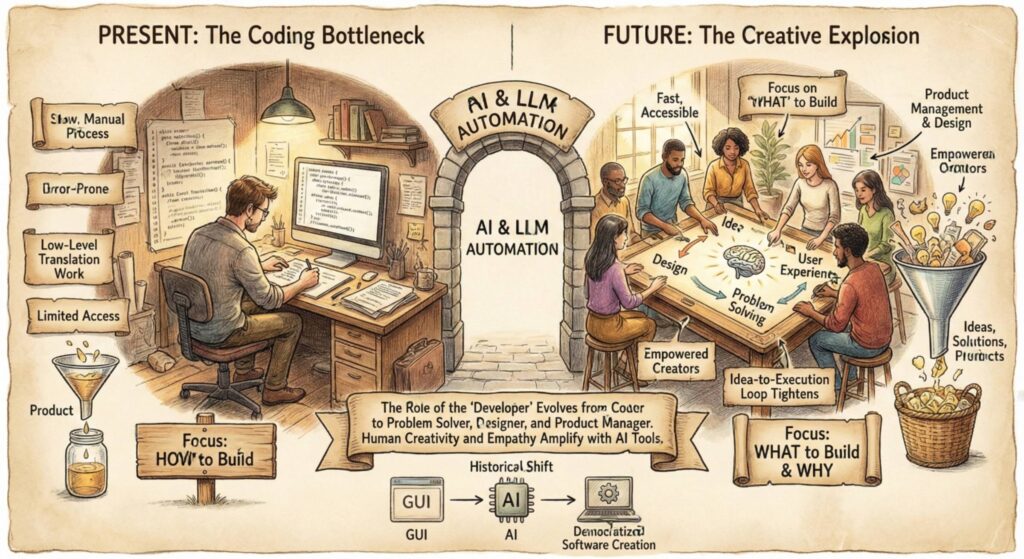
    Traditional role boundaries between engineer, product manager, and designer are dissolving. On the Claude Code team, everyone codes — the PM, the engineering manager, the designer, the finance person, the data scientist. Cherny predicts the title “Software Engineer” will start disappearing by end of 2026, replaced by something like “Builder” — a generalist who blends design sense, business logic, technical orchestration, and user empathy.

    5. Underfunding Teams Is a Feature, Not a Bug

    Cherny advocates deliberately underfunding teams as a strategy. When you assign one engineer to a project instead of five, they’re forced to leverage Claude Code to automate everything possible. This isn’t about cost-cutting — it’s about forcing innovation through constraint. The results at Anthropic have been dramatic: while the engineering team grew roughly 4x, productivity per engineer increased 200% in terms of pull requests shipped.

    6. Give Engineers Unlimited Tokens

    Rather than hiring more headcount, Cherny’s advice to CTOs is to give engineers as many tokens as possible. Let them experiment with the most capable models without worrying about cost. The most innovative ideas come from people pushing AI to its limits. Some Anthropic engineers are spending hundreds of thousands of dollars per month in tokens. Optimize costs later — only after you’ve found the idea that works.

    7. Build for the Model Six Months From Now

    One of Cherny’s most actionable insights: don’t build for today’s model capabilities — build for where the model will be in six months. Early versions of Claude Code only wrote about 20% of Cherny’s code. But the team bet on exponential improvement, and when Opus 4 and Sonnet 4 arrived, product-market fit clicked instantly. This means your product might feel rough at first, but when the next model generation drops, you’ll be perfectly positioned.

    8. The Bitter Lesson Applied to Product

    Cherny references Rich Sutton’s famous “Bitter Lesson” blog post as a core principle for the Claude Code team: the more general model will always outperform the more specific one. In practice, this means avoiding rigid workflows and orchestration scaffolding around AI models. Don’t box the model in. Give it tools, give it a goal, and let it figure out the path. Scaffolding might improve performance 10-20%, but those gains get wiped out with the next model generation.

    9. Latent Demand — The Most Important Product Principle

    Cherny calls latent demand “the single most important principle in product.” The idea: watch how people misuse or hack your product for purposes you didn’t design it for. That’s where your next product lives. Facebook Marketplace came from 40% of Facebook Group posts being buy-and-sell. Cowork came from non-engineers using Claude Code’s terminal for things like growing tomato plants, analyzing genomes, and recovering wedding photos from corrupted hard drives. There’s also a new dimension: watching what the model is trying to do and building tools to make that easier.

    10. Cowork Was Built in 10 Days

    Anthropic’s Cowork product — their agentic tool for non-technical tasks — was implemented by a small team in just 10 days, using Claude Code to build its own virtual machine and security scaffolding. Cowork was immediately a bigger hit than Claude Code was at launch. It can pay parking tickets, cancel subscriptions, manage project spreadsheets, message team members on Slack, respond to emails, and handle forms — and it’s growing faster than Claude Code did in its early days.

    11. Three Layers of AI Safety at Anthropic

    Cherny outlined three layers of safety: (1) Mechanistic interpretability — monitoring neurons inside the model to understand what it’s doing and detect things like deception at the neural level. (2) Evals — lab testing where the model is placed in synthetic situations to check alignment. (3) Real-world monitoring — releasing products as research previews to study unpredictable agent behavior in the wild. Claude Code was used internally for 4-5 months before public release specifically for safety study.

    12. Why Boris Left Anthropic for Cursor (and Came Back After Two Weeks)

    Cherny briefly left Anthropic to join Cursor, drawn by their focus on product quality. But within two weeks, he realized what he was missing: Anthropic’s safety mission. He described it as a psychological need — without mission-driven work, even building a great product wasn’t a substitute. He returned to Anthropic and the rest is history.

    13. Manual Coding Skills Will Become Irrelevant in 1-2 Years

    Cherny compared manual coding to assembly language — it’ll still exist beneath the surface, and understanding the fundamentals helps for now, but within a year or two it won’t matter for most engineers. He likened it to the printing press transition: a skill once limited to scribes became universal literacy over time. The volume of code created will explode while the cost drops dramatically.

    14. Pro Tips for Using Claude Code Effectively

    Cherny shared three specific tips: (1) Use the most capable model — currently Opus 4.6 with maximum effort enabled. Cheaper models often cost more tokens in the end because they require more correction and handholding. (2) Use Plan Mode — hit Shift+Tab twice in the terminal to enter plan mode, which tells the model not to write code yet. Go back and forth on the plan, then auto-accept edits once it looks good. Opus 4.6 will one-shot it correctly almost every time. (3) Explore different interfaces — Claude Code runs on terminal, desktop app, iOS, Android, web, Slack, GitHub, and IDE extensions. The same agent runs everywhere. Find what works for you.


    Detailed Summary

    The Origin Story of Claude Code

    Claude Code began as a one-person hack. When Cherny joined Anthropic, he spent a month building weird prototypes that mostly never shipped, then spent another month doing post-training to understand the research side. He believes deeply that to build great products on AI, you have to understand “the layer under the layer” — meaning the model itself.

    The first version was terminal-based and called “Claude CLI.” When he demoed it internally, it got two likes. Nobody thought a coding tool could be terminal-based. But the terminal form factor was chosen partly out of necessity (he was a solo developer) and partly because it was the only interface that could keep up with how fast the underlying model was improving.

    The breakthrough moment during prototyping: Cherny gave the model a bash tool and asked it what music he was listening to. The model figured out — without any specific instructions — how to use the bash tool to answer that question. That moment of emergent tool use convinced him he was onto something.

    The Growth Trajectory

    Claude Code was released externally in February 2025 and was not immediately a hit. It took months for people to understand what it was. The terminal interface was alien to many. But internally at Anthropic, daily active users went vertical almost immediately.

    There were multiple inflection points. The first major one was the release of Opus 4, which was Anthropic’s first ASL-3 class model. That’s when Claude Code’s growth went truly exponential. Another inflection came in November 2025 when Cherny personally crossed the 100% AI-written code threshold. The growth has continued to accelerate — it’s not just going up, it’s going up faster and faster.

    The Spotify headline from the week of recording — “Spotify says its best developers haven’t written a line of code since December, thanks to AI” — underscored how mainstream the shift has become.

    Thinking in Exponentials

    Cherny emphasized that thinking in exponentials is deep in Anthropic’s DNA — three of their co-founders were the first three authors on the scaling laws paper. At Code with Claude (Anthropic’s developer conference) in May 2025, Cherny predicted that by year’s end, engineers might not need an IDE to code anymore. The room audibly gasped. But all he did was “trace the line” of the exponential curve of AI-written code.

    The Printing Press Analogy

    Cherny’s preferred historical analog for what’s happening is the printing press. In mid-1400s Europe, literacy was below 1%. A tiny class of scribes did all the reading and writing, employed by lords and kings who often couldn’t read themselves. After Gutenberg, more printed material was created in 50 years than in the previous thousand. Costs dropped 100x. Literacy rose to 70% globally over two centuries.

    Cherny sees coding undergoing the same transition: a skill locked away in a tiny class of “scribes” (software engineers) is becoming accessible to everyone. What that unlocks is as unpredictable as the Renaissance was to someone in the 1400s. He also shared a remarkable historical detail — an interview with a scribe from the 1400s who was actually excited about the printing press because it freed them from copying books to focus on the artistic parts: illustration and bookbinding. Cherny felt a direct parallel to his own experience of being freed from coding tedium to focus on the creative and strategic parts of building.

    What AI Transforms Next

    Cherny believes roles adjacent to engineering — product management, design, data science — will be transformed next. The key technology enabling this is true agentic AI: not chatbots, but AI that can actually use tools and act in the world. Cowork is the first step in bringing this to non-technical users.

    He was candid that this transition will be “very disruptive and painful for a lot of people” and that it’s a conversation society needs to have. Anthropic has hired economists, policy experts, and social impact specialists to help think through these implications.

    The Latent Demand Framework in Depth

    Cherny credited Fiona Fung, the founding manager of Facebook Marketplace, for popularizing the concept of latent demand. The examples are compelling: someone using Claude Code to grow tomato plants, another analyzing their genome, another recovering wedding photos from a corrupted hard drive, a data scientist who figured out how to install Node.js and use a terminal to run SQL analysis through Claude Code.

    But Cherny added a new dimension specific to AI products: latent demand from the model itself. Rather than boxing the model into a predetermined workflow, observe what the model is trying to do and build to support that. At Anthropic they call this being “on distribution.” Give the model tools and goals, then let it figure out the path. The product is the model — everything else is minimal scaffolding.

    Safety as a Core Differentiator

    The interview made clear that safety isn’t just a talking point at Anthropic — it’s why everyone is there, including Cherny. He described the work of Chris Olah on mechanistic interpretability: studying model neurons at a granular level to understand how concepts are encoded, how planning works, and how to detect things like deception. A single neuron might correspond to a dozen concepts through a phenomenon called superposition.

    Anthropic’s “race to the top” philosophy means open-sourcing safety tools even when they work for competing products. They released an open-source sandbox for running AI agents securely that works with any agent, not just Claude Code.

    The Memory Leak Story

    One of the most memorable anecdotes: Cherny was debugging a memory leak the traditional way — taking heap snapshots, using debuggers, analyzing traces. A newer engineer on the team simply told Claude Code: “Hey Claude, it seems like there’s a leak. Can you figure it out?” Claude Code took the heap snapshot, wrote itself a custom analysis tool on the fly, found the issue, and submitted a pull request — all faster than Cherny could do it manually. Even veterans of AI-assisted coding get stuck in old habits.

    Personal Background and Post-AGI Plans

    In a touching segment, Cherny and Rachitsky discovered they’re both from Odessa, Ukraine. Cherny’s grandfather was one of the first programmers in the Soviet Union, working with punch cards. Before joining Anthropic, Cherny lived in rural Japan where he learned to make miso — a process that takes months to years and taught him to think on long timescales. His post-AGI plan? Go back to making miso.

    His book recommendations: Functional Programming in Scala (the best technical book he’s ever read), Accelerando by Charles Stross (captures the essence of this moment better than anything), and The Wandering Earth by Liu Cixin (Chinese sci-fi short stories from the Three Body Problem author).


    Thoughts and Analysis

    This interview is one of the most important conversations about the future of software engineering to come out in 2026. Here are some things worth sitting with:

    The “solved” framing is provocative but precise. Cherny isn’t saying software engineering is solved — he’s saying the act of translating intent into working code is solved. The thinking, architecting, deciding-what-to-build, and ensuring-it’s-correct parts are very much unsolved. This distinction matters enormously and most of the pushback in the YouTube comments misses it.

    The underfunding principle is genuinely counterintuitive. Most organizations respond to AI tools by trying to maintain headcount and “augment” existing workflows. Cherny’s approach is the opposite: reduce headcount on a project, give people unlimited AI tokens, and watch them figure out how to ship ten times faster. This is a fundamentally different organizational philosophy and one that most companies will resist until their competitors prove it works.

    The “build for six months from now” advice is dangerous and brilliant. Dangerous because your product will underperform for months and investors will get nervous. Brilliant because when the next model drops, you’ll have the only product that takes full advantage of it. This is how Claude Code went from writing 20% of Cherny’s code to 100% — the product was ready when the model caught up.

    The latent demand framework deserves serious study. The traditional version (watching users hack your product) is well-known from the Facebook era. The AI-native version (watching what the model is trying to do) is genuinely new. “The product is the model” is a deceptively simple statement that most AI product builders are still getting wrong by over-engineering workflows and scaffolding.

    The Cowork trajectory matters more than Claude Code. Claude Code transforms engineers. Cowork transforms everyone else. If Cowork delivers on even half of what Cherny describes — paying tickets, managing project spreadsheets, responding to emails, canceling subscriptions — then the total addressable market dwarfs coding tools. The fact that it was built in 10 days and was an immediate hit suggests Anthropic has found product-market fit for agentic AI beyond engineering.

    The safety discussion felt genuine. Cherny’s explanation of mechanistic interpretability — actually being able to monitor model neurons and detect deception — is one of the clearest public explanations of Anthropic’s safety approach. The fact that the safety mission is what brought him back from Cursor (where he lasted only two weeks) speaks to the culture. Whether you think safety is a genuine concern or a competitive moat, it’s clearly a core part of how Anthropic attracts and retains talent.

    The elephant in the room: this is Anthropic’s head of product telling you to use more tokens. Multiple YouTube commenters pointed this out, and they’re right to flag it. But the underlying logic holds: if a less capable model requires more correction rounds and more tokens to achieve the same result, then the “cheaper” model isn’t actually cheaper. That’s a testable claim, and most engineers using these tools regularly will tell you it checks out.

    Whether you agree with the “coding is solved” framing or not, the data is hard to argue with. Four percent of all GitHub commits. Two hundred percent productivity gains per engineer. A product that was built in 10 days and scaled to millions of users. These aren’t predictions — they’re measurements. And the curve is still accelerating.


    This article is based on Boris Cherny’s appearance on Lenny’s Podcast, published February 19, 2026. Boris Cherny can be found on X/Twitter and at borischerny.com.

  • How AI is Devastating Developer Ecosystems: The Brutal January 2026 Reality of Tailwind CSS Layoffs & Stack Overflow’s Pivot – Plus a Comprehensive Guide to Future-Proofing Your Career

    How AI is Devastating Developer Ecosystems: The Brutal January 2026 Reality of Tailwind CSS Layoffs & Stack Overflow's Pivot – Plus a Comprehensive Guide to Future-Proofing Your Career

    TL;DR (January 9, 2026 Update): Generative AI has delivered a double blow to core developer resources. Tailwind CSS, despite exploding to 75M+ monthly downloads, suffered an ~80% revenue drop as AI tools generate utility-class code instantly—bypassing docs and premium product funnels—leading Tailwind Labs to lay off 75% of its engineering team (3 out of 4 engineers) on January 7. Within 48 hours, major sponsors including Google AI Studio, Vercel, Supabase, Gumroad, Lovable, and others rushed in to support the project. Meanwhile, Stack Overflow’s public question volume has collapsed (down ~77–78% from 2022 peaks, back to 2009 levels), yet revenue doubled to ~$115M via AI data licensing deals and enterprise tools like Stack Internal (used by 25K+ companies). This is the live, real-time manifestation of AI “strip-mining” high-quality knowledge: it supercharges adoption while starving the sources. Developers must urgently adapt—embrace AI as an amplifier, pivot to irreplaceable human skills, and build proprietary value—or face obsolescence.

    Key Takeaways: The Harsh, Real-Time Lessons from January 2026

    • AI boosts usage dramatically (Tailwind’s 75M+ downloads/month) but destroys traffic-dependent revenue models by generating perfect code without needing docs or forums.
    • Small teams are especially vulnerable: Tailwind Labs reduced from 4 to 1 engineer overnight due to an 80% revenue crash—yet the framework itself thrives thanks to AI defaults.
    • Community & Big Tech respond fast: In under 48 hours after the layoffs announcement, sponsors poured in (Google AI Studio, Vercel, Supabase, etc.), turning a crisis into a “feel-good” internet moment.
    • Stack Overflow’s ironic success: Public engagement cratered (questions back to 2009 levels), but revenue doubled via licensing its 59M+ posts to AI labs and launching enterprise GenAI tools.
    • Knowledge homogenization accelerates: AI outputs default to Tailwind patterns, creating uniform “AI-look” designs and reducing demand for original sources.
    • The “training data cliff” risk is real: If human contributions dry up (fewer new SO questions, less doc traffic), AI quality on fresh/edge-case topics will stagnate.
    • Developer sentiment is mixed: 84% use or plan to use AI tools, but trust in outputs has dropped to ~29%, with frustration over “almost-right” suggestions rising.
    • Open-source business models must evolve: Shift from traffic/ads/premium upsells to direct sponsorships, data licensing, enterprise features, or AI-integrated services.
    • Human moats endure: Complex architecture, ethical judgment, cross-team collaboration, business alignment, and change management remain hard for AI to replicate fully.
    • Adaptation is survival: Top developers now act as AI orchestrators, system thinkers, and value creators rather than routine coders.

    Detailed Summary: The Full January 2026 Timeline & Impact

    As of January 9, 2026, the developer world is reeling from a perfect storm of AI disruption hitting two iconic projects simultaneously.

    Tailwind CSS Crisis & Community Response (January 7–9, 2026)

    Adam Wathan, creator of Tailwind CSS, announced on January 7 that Tailwind Labs had to lay off 75% of its engineering team (3 out of 4 engineers). In a raw, emotional video walk and GitHub comments, he blamed the “brutal impact” of AI: the framework’s atomic utility classes are perfect for LLM code generation, leading to massive adoption (75M+ monthly downloads) but a ~40% drop in documentation traffic since 2023 and an ~80% revenue plunge. Revenue came from premium products like Tailwind UI and Catalyst—docs served as the discovery funnel, now short-circuited by tools like Copilot, Cursor, Claude, and Gemini.

    The announcement sparked an outpouring of support. Within 24–48 hours, major players announced sponsorships: Google AI Studio (via Logan Kilpatrick), Vercel, Supabase, Gumroad, Lovable, Macroscope, and more. Adam clarified that Tailwind still has “a fine business” (just not great anymore), with the partner program now funding the open-source core more directly. He remains optimistic about experimenting with new ideas in a leaner setup.

    Stack Overflow’s Parallel Pivot

    Stack Overflow’s decline started earlier (post-ChatGPT in late 2022) but accelerated: monthly questions fell ~77–78% from 2022 peaks, returning to 2009 levels (3K–7K/month). Yet revenue roughly doubled to $115M (FY 2025–2026), with losses cut dramatically. The secret? Licensing its massive, human-curated Q&A archive to AI companies (OpenAI, Google, etc.)—similar to Reddit’s $200M+ deals—and launching enterprise products like Stack Internal (GenAI powered by SO data, used by 25K+ companies) and AI Assist.

    This creates a vicious irony: AI trained on SO and Tailwind data, commoditizes it, reduces human input, and risks a “training data cliff” where models stagnate on new topics. Meanwhile, homogenized outputs fuel demand for unique, human-crafted alternatives.

    Future-Proofing Your Developer Career: In-Depth 2026 Strategies

    AI won’t erase developer jobs (projections still show ~17% growth through 2033), but it will automate routine coding. Winners will leverage AI while owning what machines can’t replicate. Here’s a detailed, actionable roadmap:

    1. Master AI Collaboration & Prompt Engineering: Pick one powerhouse tool (Cursor, Claude, Copilot, Gemini) and become fluent. Use advanced prompting for complex tasks; always validate for security, edge cases, performance, and hallucinations. Chain agents (e.g., via LangChain) for multi-step workflows. Integrate daily—let AI handle boilerplate while you focus on oversight.
    2. Elevate to Systems Architecture & Strategic Thinking: AI excels at syntax; humans win on trade-offs (scalability vs. cost vs. maintainability), business alignment (ROI, user impact), and risk assessment. Study domain-driven design, clean architecture, and system design interviews. Become the “AI product manager” who defines what to build and why.
    3. Build Interdisciplinary & Human-Centric Skills: Hone communication (explaining trade-offs to stakeholders), leadership, negotiation, and domain knowledge (fintech, healthcare, etc.). Develop soft skills like change management and ethics—areas where AI still struggles. These create true moats.
    4. Create Proprietary & Defensible Assets: Own your data, custom fine-tunes, guardrailed agents, and unique workflows. For freelancers/consultants: specialize in AI integration, governance, risk/compliance, or hybrid human-AI systems. Document patterns that AI can’t easily replicate.
    5. Commit to Lifelong, Continuous Learning: Follow trends via newsletters (Benedict Evans), podcasts (Lex Fridman), and communities. Pursue AI/ML certs, experiment with emerging agents, and audit your workflow quarterly: What can AI do better? What must remain human?
    6. Target Resilient Roles & Mindsets: Seek companies heavy on AI innovation or physical-world domains. Aim for roles like AI Architect, Prompt Engineer, Agent Orchestrator, or Knowledge Curator. Mindset shift: Compete by multiplying AI, not against it.

    Start small: Build a side project with AI agents, then manually optimize it. Network in Toronto’s scene (MaRS, meetups). Experiment relentlessly—the fastest adapters will define the future.

    Navigating the AI Era in 2026 and Beyond

    January 2026 feels like a knowledge revolution turning point—AI democratizes access but disrupts gatekeepers. The “training data cliff” is a genuine risk: without fresh human input, models lose edge on novelty. Yet the response to Tailwind’s crisis shows hope—community and Big Tech stepping up to sustain the ecosystem.

    Ethically, attribution matters: AI owes a debt to SO contributors and Tailwind’s patterns—better licensing, revenue shares, or direct funding could help. For developers in Toronto’s vibrant hub, opportunities abound in AI consulting, hybrid tools, and governance.

    This isn’t the death of development—it’s evolution into a more strategic, amplified era. View AI as an ally, stay curious, keep building, and remember: human ingenuity, judgment, and connection will endure.