PJFP.com

Pursuit of Joy, Fulfillment, and Purpose

Tag: Goldman Sachs

  • OpenAI’s Leaked 2025 Financials: $34 Billion in Spending, a $38.5 Billion Net Loss, and a $17 Billion Microsoft Bill Ahead of Its IPO

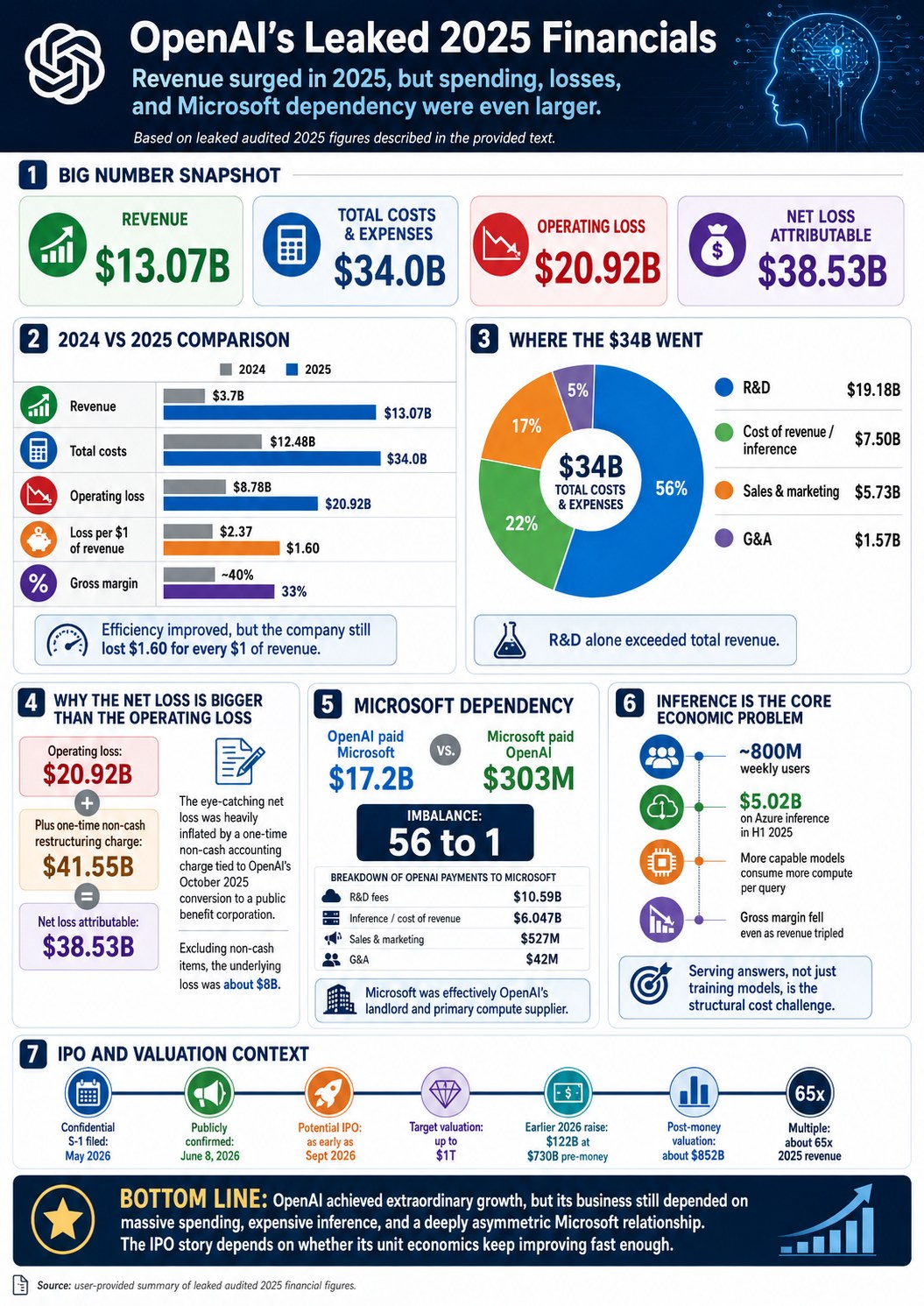
    Infographic summarizing OpenAI leaked 2025 financials: $13.07B revenue, $34B total costs, $20.92B operating loss, $38.53B net loss, where the $34B went, the $17.2B paid to Microsoft versus $303M paid back, inference costs, and IPO valuation context

    OpenAI’s audited 2025 financials leaked this week, and they are the clearest picture yet of what it actually costs to run the company behind ChatGPT. Independent journalist Ed Zitron first published the documents, and the Financial Times independently confirmed them. The headline: OpenAI spent $34 billion last year, booked $13.07 billion in revenue, and reported a net loss attributable to the company of $38.5 billion. The disclosure lands just days after OpenAI confidentially filed for an IPO that could value it north of $1 trillion.

    TLDR

    OpenAI’s audited 2025 numbers, leaked by Ed Zitron and confirmed by the Financial Times, show revenue tripling to $13.07 billion while total costs reached $34 billion, producing a $20.92 billion operating loss and a $38.53 billion net loss attributable to the company. The much larger net loss is inflated by a one-time $41.55 billion non-cash charge tied to OpenAI’s October 2025 conversion from a nonprofit to a public benefit corporation; strip the non-cash items and the loss is closer to $8 billion. R&D alone was $19.18 billion, cost of revenue (inference) was $7.5 billion, and sales and marketing ballooned to $5.73 billion. OpenAI paid Microsoft $17.2 billion in 2025 while Microsoft paid OpenAI only $303 million, exposing a deep Azure dependency. The company burned $1.60 for every dollar of revenue, down from $2.37 in 2024, and gross margin slipped from roughly 40% to 33% as more capable models consumed more compute per query. The leak arrives as OpenAI files a confidential S-1, targets a listing as early as September 2026 at up to a $1 trillion valuation, and races rival Anthropic, which is more valuable on paper and claims it is already turning an operating profit.

    Thoughts

    The most important thing to understand about these numbers is that there are two loss figures and the press will conflate them. The $38.53 billion net loss is the scary headline, but $41.55 billion of it is a non-cash accounting charge from converting investor convertible interests into equity during the for-profit restructuring. That charge is real on the audited statement and it will show up in the eventual S-1, but it is a one-time artifact of OpenAI’s unusual corporate history, not money that left the building. The number that describes the actual business is the $20.92 billion operating loss. That is the one to watch, and it is still enormous.

    The genuinely encouraging line in the whole release is the loss-per-dollar ratio. In 2024 OpenAI spent $2.37 to generate a dollar of revenue. In 2025 that fell to $1.60. A company that is still losing $1.60 on every dollar is not a healthy business, but a company whose efficiency improved by a third in a single year while tripling its top line is at least pointed in a defensible direction. The bull case for OpenAI lives entirely in the slope of that line. If it keeps improving at that rate, the math eventually crosses over. If it stalls, the valuation is a fantasy.

    The Microsoft relationship is the single most revealing disclosure, and it is wildly asymmetric. OpenAI paid Microsoft $17.2 billion in 2025. Microsoft paid OpenAI $303 million. That is a 56-to-1 ratio, and it reframes the partnership: Microsoft is not really a peer or even just an investor, it is OpenAI’s landlord and primary supplier, collecting rent on every model trained and every query answered. The April 2026 renegotiation that capped revenue-share payments at $38 billion through 2030, down from a projected $135 billion, suddenly looks less like a favor and more like OpenAI desperately trying to lower its single largest cost. The dependency cuts both ways, but right now Microsoft holds the better hand.

    The structural problem hiding inside the cost of revenue line is inference. Training a model is a fixed, one-time cost. Serving it is a recurring cost that scales with every one of ChatGPT’s roughly 800 million weekly users. OpenAI spent $5.02 billion on Azure inference in the first half of 2025 alone, and the more capable its reasoning models get, the more compute each answer burns. That is why gross margin went down even as revenue went up. It is the opposite of how software is supposed to work, where the marginal cost of one more user trends toward zero. OpenAI’s marginal cost is real, large, and growing. The counterargument is that per-token inference costs have been falling roughly tenfold a year, so the unit economics could still flip. That is the entire wager.

    Finally, the timing matters more than the numbers. OpenAI’s confidential S-1 means these audited figures were going to become public regardless, since the SEC requires the full prospectus at least 15 days before a roadshow. What the leak changes is who gets to study them first. Prospective IPO buyers, enterprise customers signing multi-year API contracts, and competitors now have the audited books weeks or months early, and they are reading them against Anthropic, which filed at a higher valuation and claims an operating profit. For a company asking the public markets to underwrite a $1 trillion bet on a monopoly outcome that does not yet exist, losing control of the narrative this early is not a small thing.

    Key Takeaways

    • OpenAI’s audited 2025 financials were first published by independent journalist Ed Zitron and independently confirmed by the Financial Times, the first verified look at the company’s books before its planned IPO.
    • Revenue grew from $3.7 billion in 2024 to $13.07 billion in 2025, more than tripling year over year, making OpenAI one of the fastest-growing businesses in history.
    • By the end of 2025 OpenAI was generating roughly $2 billion in monthly revenue, up from about $1 billion a quarter at the end of 2024.
    • Total costs and expenses hit $34 billion in 2025, up from $12.48 billion in 2024.
    • Research and development was the single largest expense at $19.18 billion, up from $7.81 billion, and exceeded total revenue on its own.
    • Of that R&D spend, $10.59 billion went to Microsoft, almost certainly the GPU compute cost of training frontier models on Azure.
    • Cost of revenue, the expense of serving ChatGPT responses (inference), rose from $2.65 billion to $7.5 billion.
    • Sales and marketing jumped from $1.11 billion to $5.73 billion, a 418% increase.
    • General and administrative costs rose from $907 million to $1.57 billion.
    • The operating loss, the truest measure of day-to-day economics, grew from $8.78 billion to $20.92 billion.
    • The net loss attributable to OpenAI was $38.53 billion, up nearly eightfold from $5.09 billion in 2024.
    • The bulk of that jump was a one-time, non-cash $41.55 billion charge from OpenAI’s October 28, 2025 conversion to a public benefit corporation, reflecting the changing fair value of convertible interests and warrant liabilities.
    • Stripping out the restructuring charge and other non-cash items such as stock-based compensation and Microsoft computing credits, the underlying loss was about $8 billion.
    • Including all factors, gross net loss reached $60.35 billion, lowered to the $38.53 billion attributable figure by removing $21.82 billion attributed to noncontrolling and redeemable noncontrolling interests.
    • OpenAI burned $1.60 for every $1 of revenue in 2025, an improvement from $2.37 in 2024, the clearest data point in the bull case.
    • Measured as a percentage of revenue, the operating loss improved from 237% in 2024 to 160% in 2025.
    • In total, OpenAI paid Microsoft $17.2 billion in 2025: $10.59 billion in R&D fees, $6.047 billion in cost of revenue, $527 million in sales and marketing, and $42 million in G&A.
    • Microsoft paid OpenAI just $303 million in the same year, a 56-to-1 imbalance underscoring OpenAI’s Azure dependency.
    • SoftBank paid OpenAI $867 million in 2025.
    • At year-end OpenAI carried $3.64 billion in outstanding payables to Microsoft, plus tens of millions more in accrued and non-current liabilities.
    • OpenAI spent $5.02 billion on Azure inference in just the first half of 2025; Azure inference from 2024 through Q3 2025 totaled $12.43 billion.
    • ChatGPT serves roughly 800 million weekly users, meaning billions of queries a week, each one burning GPU time at Azure’s pricing of about $6.98 per H100 GPU-hour.
    • Gross margin fell from roughly 40% in 2024 to 33% in 2025, because more capable reasoning models consume more compute per query.
    • Research firm Sacra estimates OpenAI’s inference costs reached $8.4 billion in 2025 and will rise to $14.1 billion in 2026, a 68% increase.
    • At year-end OpenAI held just over $50 billion in assets, with almost half in cash.
    • The April 2026 Microsoft renegotiation ended exclusivity and capped revenue-share payments at $38 billion through 2030, down from a projected $135 billion, potentially saving OpenAI up to $97 billion over five years.
    • OpenAI filed a confidential draft S-1 with the SEC around May 22, 2026 and confirmed it publicly on June 8, naming Goldman Sachs and Morgan Stanley as underwriters.
    • The company is targeting a listing as early as September 2026 at a valuation that could exceed $1 trillion, though Sam Altman has said a public offering “may be a while.”
    • OpenAI raised $122 billion earlier in 2026 at a $730 billion pre-money valuation, putting its post-money value around $852 billion.
    • At an $852 billion valuation, OpenAI trades at roughly 65 times its 2025 revenue.
    • Rival Anthropic also filed IPO paperwork this month after raising $65 billion at a $900-$965 billion valuation, making it more valuable on paper than OpenAI, and says it expects to report an operating profit of $559 million in the June quarter.
    • HSBC analysts estimate OpenAI may need more than $207 billion in additional capital through 2030 even under optimistic projections.
    • OpenAI projects profitability by 2029 or 2030; independent analysts put the more likely date at 2031 or later.
    • Bridgewater partner Greg Jensen reportedly told clients the implied revenue multiples price OpenAI for “a monopoly outcome that does not yet exist.”
    • Zitron separately reported OpenAI had a negative 122% non-GAAP operating margin in Q1 2026 and that ChatGPT growth has stalled, with the company projecting paid ChatGPT Plus subscriptions to fall from 44 million in 2025 toward cheaper tiers in 2026.

    Detailed Summary

    How the leak happened and why it matters now

    The audited documents were obtained and first published by Ed Zitron on his newsletter Where’s Your Ed At, then independently verified by the Financial Times, which reviewed the same materials. That dual sourcing matters: this is not a rumor or a model, it is OpenAI’s actual audited financial statement. The timing is the story. OpenAI filed a confidential draft S-1 with the SEC around May 22, 2026 and confirmed it publicly on June 8. Under SEC rules the full prospectus must be released at least 15 days before an investor roadshow, so the 2025 numbers were going to be public soon regardless. The leak simply moved that disclosure forward, handing prospective investors, enterprise customers, and competitors an early look at the books.

    Revenue tripled, costs grew faster

    OpenAI’s revenue rose from $3.7 billion in 2024 to $13.07 billion in 2025, and monthly revenue reached nearly $2 billion by year-end. By almost any normal standard that is spectacular growth. The problem is that costs grew faster, reaching $34 billion against $12.48 billion the year before. The gap between what OpenAI earns and what it spends has widened every year since its founding, and 2025 is the starkest example yet. Revenue alone was outpaced by research and development as a single line item in both of the last two years.

    Two loss numbers, and why both matter

    There are two figures that get cited interchangeably and should not be. The operating loss of $20.92 billion is what the business spent beyond what it earned from operations: training models, serving ChatGPT, paying engineers, running marketing. The net loss attributable to OpenAI of $38.53 billion is far larger because 2025 was the year OpenAI completed its conversion from a nonprofit to a for-profit public benefit corporation, finalized on October 28, 2025. That restructuring triggered a $41.55 billion non-cash charge reflecting the changing fair value of convertible equity interests and warrant liabilities. Before the conversion, investors held convertible interest rights treated as liabilities under US accounting rules and revalued upward as OpenAI’s valuation climbed, creating the charge. It is not expected to recur. Including all minor items, gross net loss reached $60.35 billion, reduced to the $38.53 billion attributable figure after removing $21.82 billion tied to noncontrolling and redeemable noncontrolling interests, primarily the OpenAI Foundation’s stake. Strip the non-cash noise and the underlying loss was about $8 billion.

    Where the $34 billion went

    The spending breaks into four lines. Research and development was $19.18 billion, the largest category, with $10.59 billion of it flowing to Microsoft for training compute. Cost of revenue, the expense of serving responses to users, was $7.5 billion and captures inference, the compute consumed every time someone prompts ChatGPT or calls the API. Sales and marketing reached $5.73 billion, up 418% year over year, a striking jump for a product that grew largely by word of mouth. General and administrative costs added $1.57 billion. The shape of the spending tells you OpenAI is simultaneously racing to build better models, serve a massive and growing user base, and aggressively defend market share through marketing.

    The Microsoft dependency

    The most striking single disclosure is the scale of the Microsoft relationship. OpenAI paid Microsoft $17.2 billion in 2025: $10.59 billion in R&D fees for model training, $6.047 billion in cost-of-revenue for inference serving, $527 million in sales and marketing, and $42 million in G&A. Microsoft paid OpenAI just $303 million the same year. SoftBank paid OpenAI $867 million. The 56-to-1 ratio between what OpenAI pays Microsoft and what Microsoft pays back makes the structural reality plain: Microsoft is OpenAI’s largest landlord. The dynamic began shifting in April 2026, when the two renegotiated, ending Microsoft’s exclusivity and capping revenue-share payments at $38 billion through 2030, down from a projected $135 billion. That could save OpenAI up to $97 billion over five years, though Microsoft keeps its IP license through 2032 and remains the primary cloud partner.

    Why inference is the core problem

    Training happens once. Serving happens billions of times a day. When OpenAI releases a model it spends months and billions on training compute, a fixed cost that falls away when training ends. Inference is the opposite: every ChatGPT message runs through the model on Azure GPU hardware, consuming electricity and compute to generate a response. With roughly 800 million weekly users, that is billions of queries a week, each burning GPU time at roughly $6.98 per H100 GPU-hour on demand. OpenAI spent $5.02 billion on Azure inference in the first six months of 2025 alone. Sacra estimates full-year inference costs of $8.4 billion in 2025, rising to $14.1 billion in 2026. This is why gross margin fell from about 40% to 33% even as revenue tripled: more capable reasoning models consume far more compute per query, and revenue has not kept pace with the cost growth that capability generates.

    What it means for the IPO and the race with Anthropic

    OpenAI was last valued around $852 billion post-money after raising $122 billion in early 2026, which puts it at roughly 65 times 2025 revenue. It has named Goldman Sachs and Morgan Stanley as underwriters and is targeting a listing as early as September 2026 at up to a $1 trillion valuation, though Altman has hedged that it “may be a while” and that staying private might be the better course. HSBC estimates the company may need more than $207 billion in additional capital through 2030. The race is with Anthropic, which filed paperwork the same month after raising $65 billion at a $900-$965 billion valuation, making it more valuable on paper, and which says it expects a $559 million operating profit in the June quarter. The contrast is sharp: the two leading AI labs heading toward public markets at the same time, one bleeding cash at scale, the other claiming profitability, both asking investors to bet on a future that has not arrived.

    Notable Quotes

    “The financial condition of OpenAI is deeply concerning. $38.53 billion in losses are astronomical, and far higher than most believed it would be. Losses also appear to be mounting year-over-year at a dramatic rate, and I’m not sure how this company finds a way toward any kind of sustainability or profitability.”

    Ed Zitron, the independent journalist who published the leaked audited financials

    “It’s unclear what this means, nor how OpenAI reconciled the removal of $3.74 billion in costs. I will not speculate further.”

    Ed Zitron, on a discrepancy he found in the restated 2024 figures

    “OpenAI’s two biggest expenses are R&D and marketing. Budget cuts there, coupled with an ability to raise prices or win new sources of revenue, could see the company move into the black over time. Cutting R&D would be the most difficult part of that, given that AI companies can only hold onto their customers by generating the best-performing models.”

    Jim Edwards, Fortune, on whether OpenAI has a realistic path to profitability

    “What the audited documents make impossible to argue is that the path to profitability is short, clear, or cheap.”

    TechTimes analysis of the leaked OpenAI financials

    The implied revenue multiples price OpenAI for “a monopoly outcome that does not yet exist.”

    Bridgewater partner Greg Jensen, reportedly telling clients how to read OpenAI’s valuation

    “OpenAI spent $34bn last year as the ChatGPT maker poured money into a race to dominate the fast-growing AI market ahead of a planned stock market listing.”

    George Hammond and Bryce Elder, Financial Times, framing the audited 2025 spend

    Read Ed Zitron’s original reporting with the full breakdown here, and the Financial Times confirmation here.

    Related Reading

    • Ed Zitron, Where’s Your Ed At the primary source that broke the audited 2025 financials with the full line-by-line breakdown.
    • OpenAI (Wikipedia) background on the company’s history, structure, and the nonprofit-to-for-profit conversion that drives the non-cash charge.
    • Inference (Wikipedia) on the recurring compute cost that explains why OpenAI’s gross margin shrinks as usage grows.
    • Anthropic the rival lab that filed IPO paperwork the same month at a higher valuation and claims it is already operating at a profit.
    • SEC on confidential filings context for why OpenAI’s audited numbers were headed for public disclosure regardless of the leak.
  • Lloyd Blankfein on the 3 Sectors Where He Puts His Money Now: Big Tech, Energy, and Financial Services, Day Trading From an iPad, and the Warren Buffett Handshake That Backed Goldman in 2008

    Lloyd Blankfein spent almost 40 years at Goldman Sachs, the last dozen as its chairman and chief executive, and he still trades almost every day from an iPad. In this wide ranging conversation on the My First Million podcast, the former Goldman boss lays out exactly where he is putting his own money right now, why a supportive spouse beats nearly any investment, how Warren Buffett wired five billion dollars into Goldman on a handshake during the 2008 crisis, and why he reads medieval history to stay calm about the present. It is part stock picking, part risk philosophy, and part a frank accounting of money, marriage, and the scars of growing up in the projects.

    TLDW

    Blankfein says he is roughly 98 percent in risky assets, almost all equities, and concentrated in three sectors he knows cold: big tech, energy, and financial services. His personal book leans heavily into single stocks over ETFs, weighted toward the big hyperscalers and a few second tier names, and he trades daily, alone, from an iPad and a phone, using calls and texts as his research network. Yet the advice he gives a normal investor is the boring opposite: a diversified S&P 500 fund like VOO, more risk when you are young because you will outlive your mistakes, the same thing Warren Buffett would tell you. The conversation ranges across the 2008 Buffett investment in Goldman, the cost of trying to legislate risk out of markets, the thin margin between the best and the rest, luck and the myth of the genius, why reputation is the real contract on Wall Street, why a supportive spouse is the highest return asset he knows, the money anxiety he carried out of a Brooklyn housing project, the dignity of a 500 dollar financial aid check, giving with a warm hand versus a cold one, the dangers of gamified investing, the big misses like SpaceX and early cellular, the obituary test a senior partner once gave him, and why reading history keeps the present in proportion.

    Thoughts

    The most useful tension in this interview is the gap between what Blankfein practices and what he preaches. He tells young people to buy a diversified S&P 500 index fund, he holds VOO himself, and he calls the host’s plain 90 percent stocks and 10 percent bonds split sensible. Then he admits his own portfolio is something like 90 percent single stocks that he trades by hand every day. The honest read is that his edge is not a transferable tip. It is a 40 year information network of phone calls and a tolerance for risk that most people neither have nor should want. The replicable lesson is the boring half, not the day trading half.

    The most contrarian idea here is not a stock pick, it is his defense of risk itself. His argument that regulators trying to prevent the hundred year storm also forfeit the 99 normal years of growth in between is a serious claim about the price of safety, and it travels far beyond Wall Street. The same goes for his point that a good risk manager sometimes has to push people to take more risk, not less. The moment after a loss, when everyone goes gunshy, is exactly when the best operators lean back in. That is an uncomfortable thing for a former bank CEO to say out loud, and it is the part of the conversation most worth sitting with.

    The Warren Buffett story is a master class in what actually moves markets, and it is not cash. Goldman did not need the five billion dollars. Blankfein says the money was almost irrelevant because the firm already had money. What it could not manufacture was confidence, and Buffett’s name supplied it. The handshake, the commitment with no paperwork, the line about worrying enough for the both of us, all point to the same thing. At the top, reputation is the collateral. His aside that most trades are never written down because you will never eat lunch in this town again is the same idea wearing street clothes.

    Quietly, the personal finance thread may be the most valuable part for a normal listener. A former Goldman CEO saying that a supportive partner is more game changing than any investment, that a bad marriage is financially worse than being lonely, and that he has not paid a bill in over 40 years because his wife runs the household economy, is a reminder that household stability is itself an asset class. The 500 dollar financial aid check he still remembers half a century later, and his give with your warm hand philosophy, reframe wealth as something measured by how it feels to give and to receive, not just by the size of a pie chart.

    Finally, the history obsession is not a side hobby, it is his risk model. Reading about the black plague, the McCarthy era, and the Vietnam draft is how he keeps the present in proportion. His Mark Twain line, that history does not repeat but it rhymes, is the direct antidote to the in this economy defeatism he and the host both complain about. For an investor, that long view is close to the whole game. It is what lets you hold through the drawdowns that scare everyone else out of the market.

    Key Takeaways

    • Blankfein estimates he is about 98 percent in risky assets, with roughly 95 of those 98 points in equities, and the rest spread thin. He invests in risky assets because, in his words, that is what is fun for him.
    • Within his equities, he is heavily tilted toward single stocks rather than ETFs. He frames it as roughly a quarter to a third in ETFs and the rest in single names, and concedes it could be as lopsided as 90 percent single stocks because picking names is what he enjoys.
    • The three sectors he has concentrated in for years are big tech, energy, and financial services, and he says his outperformance comes from where he focused, not from any special genius.
    • On tech he owns the big hyperscalers, the Googles, Microsofts, and Nvidias of the world, plus a tier just below them, naming Oracle and Larry Ellison as an example of a slightly riskier second tier name. He thinks in categories, not fixed tickers, because he changes positions constantly.
    • He says he has a background in trading energy, which is why energy is a core sleeve, and he knows financial services from the inside after almost 40 years at Goldman, so those are natural areas of edge.
    • He still owns a lot of Goldman Sachs stock, out of affection for the firm he spent his career building.
    • He is bullish on big tech and plans to stay bullish until it stops going up. His foreseeable future, he jokes, lasts until he finishes the conversation and checks the screen again.
    • He trades every single day, alone, with no team. He does it from an iPad and a phone, not a computer, and treats the market like background music rather than a job.
    • His research is human, not algorithmic. He chats and texts with people, then calls them because he is tired of fixing typos, and he reads the New York Post, the Wall Street Journal, the New York Times, the Financial Times, and Bloomberg.
    • The advice he gives ordinary investors is deliberately boring and different from his own behavior: hold a diversified equity portfolio like an S&P 500 fund, with VOO as his own example, and tilt more aggressively when you are young because you have time to outlive mistakes.
    • He notes that broad indexes are already heavily weighted toward tech because of market cap, so a plain index gives meaningful tech exposure, and a tech focused ETF on top can add a disproportionate tilt for believers.
    • He calls the host’s simple 90 percent index and 10 percent bonds allocation sensible, and says this is essentially the same advice Warren Buffett would give a normal person.
    • The older you get, the more conservative you should become, shifting from maximizing gains toward not losing what you have. Young people can afford more risk precisely because they will outlive their errors.
    • During the 2008 financial crisis, Warren Buffett invested about five billion dollars in Goldman through a preferred stock structure, essentially on a phone call and a handshake, with no demand for due diligence.
    • Buffett’s real value was confidence, not capital. Goldman already had money, but it had lost the confidence of the market while peers were failing. Buffett’s name signaled the firm was a good investment being beaten down by circumstances that would reverse.
    • Buffett asked for a verbal commitment that Goldman would not sell shares before he did, and declined to put it in writing. He waved off the worry with the line that five billion dollars going bad would not even be a bad hurricane for Berkshire, an insurer.
    • Most trading is done on reputation, not paper. Blankfein says people buy and sell bonds worth enormous sums without written contracts, relying on probity, because anyone who reneges will never eat lunch in this town again.
    • On risk and regulation, he argues you cannot legislate risk away. Trying to prevent the hundred year storm also forgoes the 99 in between years of growth, and a good risk manager sometimes has to encourage people to take risk, not suppress it.
    • The best traders have resilience. They bounce back, focus on new information rather than the past, and adapt quickly instead of staying gunshy after a loss.
    • The difference between someone who is really good and someone who cannot make it is small. He compares it to a golf tournament won by one stroke with six people tied for second, and notes much of life is winner take all at razor thin margins.
    • Luck matters enormously. He became Goldman CEO partly because his predecessor was nominated to be Treasury Secretary, a reference to Hank Paulson, and the timing of opportunities is often out of your control.
    • He is skeptical of the word genius. He says he can usually see how successful people do what they do, with Elon Musk as a rare exception, and that powerful people are more normal, more insecure, and more flawed than outsiders assume.
    • On democratized investing, he thinks apps that make markets accessible are good in their own terms, but gamifying trading with confetti and high fives can mask real danger for people who can lose more than they can afford.
    • He has missed plenty. He thought SpaceX was overpriced at a 100 billion dollar valuation, now discussed near a trillion and three quarters, and passed on early cellular because he could not imagine why anyone would carry a bulky phone when payphones existed. He says he missed far more than he got.
    • He frames a supportive spouse as more game changing than almost any investment, and warns that a bad marriage, with custody fights and property settlements, is financially and personally worse than being lonely.
    • He has not paid a bill in over 40 years. His wife Laura, a former lawyer he says now chairs Barnard College, runs a bill paying service and manages the household economy. He generates the money, she distributes it.
    • He grew up in an East New York, Brooklyn housing project, the son of a postal worker, and carried money anxiety well into his 30s. He recalls buying a vacation home that cost more than all their savings, with his wife unable to make the math work until they remembered the down payment.
    • A 500 dollar financial aid check, handed to him without shame as a college freshman around 1971, shaped his philosophy on giving. He learned it is not enough to give people what they need, you have to give it in a way that feels dignified.
    • He embraces the give with your warm hand, not your cold hand idea, the notion of giving while alive so you can experience the joy, which connects to the spirit of the book Die With Zero.
    • He admits ambivalence about giving to his kids, the strange feeling of resenting that they have what he provided, and notes the heavy burden carried by children of prominent people who must prove they earned their place.
    • He describes himself as wired for anxiety, inherited from his father, and says looking around corners for what could go wrong actually suited a career in a risky business with a big balance sheet.
    • When he made partner, a senior partner gave him rules of the road, including avoiding misconduct, being conservative on taxes, setting up a charitable foundation, and living so that no more than three of the nine paragraphs in his eventual obituary would be about Goldman. He says he stayed too long to pass that test.
    • He reads history as a discipline, favoring Barbara Tuchman, Robert Caro’s The Power Broker, Ron Chernow, Rick Atkinson, and Stephen Ambrose. His core belief, borrowed from Mark Twain, is that history does not repeat but it rhymes, which is why he would not bet against America.

    Detailed Summary

    The three sectors he actually invests in

    The headline answer to where the former Goldman CEO is putting his money is simple: big tech, energy, and financial services. He says he has been focused on those three areas for a long time, and that his outperformance is a function of where he aimed rather than any unusual investing gift. Energy is natural because he has a background trading it. Financial services is natural because he spent nearly 40 years inside the industry. Tech is where he is most heavily concentrated, and he expects to stay there for good reason, citing the threshold of large changes in technology. He owns the major hyperscalers by category, the Googles, Microsofts, and Nvidias, plus a tier just below, offering Oracle and Larry Ellison as a polite example of a slightly riskier second tier name. He is careful to say he thinks in categories rather than fixed tickers because he changes his positions all the time.

    How the portfolio is really built: single stocks over ETFs

    Asked to describe his portfolio as a pie chart, Blankfein says he is about 98 percent in risky assets, with roughly 95 of those points in equities. He pushes back on the idea that index funds are safe, pointing out that a diversified equity ETF is still equities and still risky, just spread out, and very different from debt or short term money markets. Within his equity sleeve he leans into single stocks, framing it as somewhere between a quarter and a third in ETFs and the rest in individual names, and conceding it might be as extreme as 10 percent ETFs and 90 percent single stocks. The reason is preference, not theory. Picking and trading names is what he likes to do, and he is honest that this is a hobby pursued by a professional, not a model for someone investing for a living.

    How he actually trades: an iPad, a phone, and a network

    He trades every day, by himself, with no team. There is no Bloomberg terminal and no desk of analysts. He uses an iPad and a phone, and admits it takes discipline not to glance at his screen mid conversation. The market, he says, is like music playing in the background while he does other things. His information edge is relational. People text him, he texts back, and then he calls because he is tired of fixing typos with what he calls his fat fingers. He follows general and business news, reads a stack of newspapers starting with the New York Post, and treats companies like little stories, almost like gossip. He even notes, with some delight, that he still watches commercials on Netflix, a small window into a frugality that never fully left him.

    The advice he gives young investors, and what Buffett would say

    For a normal person, his counsel is the opposite of his own behavior. He would hold a diversified portfolio of equities like an S&P 500 fund, naming the SPY and VOO tickers and saying he personally uses VOO. Because of the importance of technology, he might add a tech oriented ETF for extra tilt, while noting the broad index is already tech heavy by market cap. He endorses the host’s plain 90 percent index and 10 percent bonds split as sensible and says it mirrors what Warren Buffett would advise. His one piece of age based guidance is that younger investors should accept more risk through equities, because they have time to recover, while older investors should grow more conservative and focus on not losing what they have rather than maximizing returns.

    The Warren Buffett handshake that backed Goldman in 2008

    The most cinematic story in the conversation is Buffett’s roughly five billion dollar investment in Goldman during the financial crisis, structured as a preferred stock that sits between a loan and equity. Blankfein describes a deal done largely on trust. When he offered to walk Buffett through everything he was worried about, Buffett replied that he knew Lloyd well enough to know he worried enough for the both of them. Buffett also asked, verbally and without writing, for a commitment that Goldman would not sell shares before he did. Blankfein is clear that the cash itself was almost irrelevant, since Goldman had money. What the firm lacked was the confidence of a frightened market, and Buffett’s willingness to invest before things improved supplied exactly that signal. Buffett, he stresses, was acting for his own shareholders, not as a rescuer, which is precisely what made the vote of confidence credible.

    Why you cannot legislate risk out of the system

    Reflecting on the post crisis regulatory push to make sure 2008 never happened again, Blankfein makes a careful argument about the price of safety. Once you are in the business of taking risk, anything can happen, and trying to legislate it away has a hidden cost. You may think you are protecting the world from the hundred year storm, but you also forgo the 99 years of growth in between. He extends this inside the firm too. After a period of big losses, partners had become gunshy and were talking themselves out of every idea. A good risk manager, he argues, sometimes has to promote risk taking rather than repress it, because without risk there is no growth, no entrepreneurship, and no progress. The flip side is real: take risk and there is a meaningful chance you fail and lose other people’s money, which is a terrible outcome. But the alternative, never risking anything, buys comfort at the cost of ever moving forward.

    Small margins, big outcomes, and the role of luck

    Asked what separated the traders who could not outperform from the rest, Blankfein says the gap between the very good and those who cannot make it is surprisingly small. He likens it to a golf tournament decided by a single stroke with six players tied for second, and to acting, where the best performer gets every role and the second best waits tables. Much of life, he says, is winner take all at tiny margins. Luck compounds this. He freely credits fortune for his own rise, noting he became CEO in part because his predecessor was tapped to be Treasury Secretary. He is also skeptical of the genius label. He can usually see how accomplished people do what they do, with Elon Musk a rare exception, and insists the powerful are more normal, more insecure, and more driven by their flaws than outsiders imagine.

    Reputation is the real contract

    A recurring theme is that the financial world runs on reputation more than paperwork. Blankfein notes that most of what traders do is not written down. People buy and sell bonds and other instruments that settle days later, relying on probity rather than signed contracts, because anyone who lies or reneges will never eat lunch in this town again. He references the casual texts between Elon Musk and Larry Ellison around the Twitter acquisition as proof that big does not mean complicated. There are big things that are simple and little things that are complicated. Documentation is good when execution is far off, but when a deal will be performed in two days, dotting every i is often pointless. The point is not that documents do not matter, it is that trust and reputation are the load bearing structure.

    A supportive spouse as the highest return asset

    The conversation turns personal when both men agree that a supportive partner may be the single most game changing factor in a life, more than any investment. Blankfein adds the inverse warning: a bad marriage, with breakups, custody battles, and property settlements, is worse than loneliness. He credits his wife Laura, a former big firm lawyer he says now chairs Barnard College, with handling everything when his career moved the family overseas, from the car to the house to the kids’ schooling, while he took the visible victory laps at work. He has not paid a bill in over 40 years. Laura manages a bill paying service and runs the household finances. As he puts it, he is in charge of generating the money and she is in charge of distributing it. The host contrasts this with his own monthly money meetings with his wife, a discipline he picked up from a personal finance author friend.

    Money scars, the 500 dollar check, and giving with a warm hand

    Blankfein grew up in an East New York housing project, the son of a postal worker who had earlier lost a job, in a household where rent was scarce. He calls himself an urban hick who barely left Brooklyn as a kid. That scarcity left a mark that lasted into his 30s. He tells the story of buying a small beach house that cost more than all their savings, and of his wife driving 30 miles while failing to make the closing math work, until they realized she had forgotten to count the 10 percent down payment. The most resonant memory is a 500 dollar financial aid check handed to him as a freshman around 1971, made out on the spot by a clerk with a generosity of spirit that let him receive it without shame. That experience shaped a lifelong view that giving well means preserving dignity, and he now co chairs a financial aid campaign at his university. It also connects to his embrace of the idea of giving with your warm hand rather than your cold hand, giving while alive so you can feel the joy, the same spirit as the book Die With Zero. He is candid about a strange ambivalence, the way he can resent that his kids enjoy what he himself gave them.

    Robinhood, confetti, and the misses

    On apps like Robinhood, Blankfein takes a balanced view. Democratizing investing and making assets accessible is good in its own terms, and advertising can pull people toward markets they would otherwise ignore. But if you make trading too much like a video game, with confetti and high fives, you can mask the danger and lure people who cannot afford to lose into losing more than they can. He is equally frank about his own misses. He thought SpaceX was overpriced at a 100 billion dollar valuation, a figure now discussed near a trillion and three quarters. He passed on early cellular because he could not imagine why anyone would carry a bulky phone with payphones everywhere. His blunt summary is that he missed far more than he got, and that nobody is great at predicting the future.

    The obituary test, thick skin, and staying too long

    When Blankfein made partner, a senior partner assigned to acculturate new partners gave him rules of the road: avoid anything that would today be called misconduct, be rigorous and conservative on taxes, set up and actually use a charitable foundation, and keep enough balance that, if your obituary runs nine paragraphs, no more than three are about Goldman. Blankfein says he failed that last test by staying too long, even titling his memoir around the firm. He also reflects on having a thick skin, recalling unflattering press and concluding that he could take a punch, a trait not everyone has and one he did not know he possessed until he was tested. He is careful to say this does not make people who cannot take a punch bad, just differently wired.

    Why he reads history: it rhymes

    The final stretch is a love letter to reading history. Blankfein favors Barbara Tuchman, whose A Distant Mirror he has read twice and whose Guns of August he calls fantastic and influential, along with Robert Caro’s The Power Broker on Robert Moses, Ron Chernow’s biographies, Rick Atkinson’s Revolution series, and Stephen Ambrose’s Undaunted Courage. He describes rereading the Robert Moses book after 40 years of trying to get things done and finding his appreciation for the achievements rise, even as the flaws stayed the same, because he had changed. He ties history directly to markets through the Mark Twain line that history does not repeat but it rhymes. Patterns recur, every generation maximizes its own crises and minimizes resolved ones, and reading about the black plague, the McCarthy era, or the Vietnam draft is how he stays calm. His conclusion, echoing a sentiment often attributed to Buffett, is that he would not bet against America, a country he describes as mostly good and able to improve.

    Notable Quotes

    “I invest in risky assets. That’s what’s fun for me.”

    Lloyd Blankfein, describing his own portfolio, which he says is roughly 98 percent risky assets

    “It’s been good to be bullish on big tech, and I’ll stop being bullish on it when it stops going up.”

    Lloyd Blankfein, on why he stays concentrated in technology

    “I’m not at a computer. I don’t have a computer. I have an iPad.”

    Lloyd Blankfein, on how he day trades every day, alone and with no team

    “To me, the market is like music. It’s out there. It’s going on.”

    Lloyd Blankfein, on why trading daily feels like a hobby rather than work

    “Look, $5 billion if it all goes bad, that’s not even a bad hurricane on the East Coast.”

    Warren Buffett to Lloyd Blankfein, waving off the risk of his 2008 investment in Goldman Sachs

    “The difference between somebody who’s really, really good and somebody who can’t make it is not that great.”

    Lloyd Blankfein, on the thin margin between the best and the rest

    “You may think you’re protecting the world from the hundred-year storm, but you’re also going to forego the 99 years of in between when there was growth.”

    Lloyd Blankfein, on the cost of trying to legislate risk out of markets after 2008

    “I’m in charge of generating the money, and she’s in charge of distributing it.”

    Lloyd Blankfein, on his 40-plus-year marriage to Laura and why he has not paid a bill in decades

    “History doesn’t repeat, but to paraphrase Mark Twain, it rhymes.”

    Lloyd Blankfein, on why reading history keeps the present in proportion

    Watch the full conversation with Lloyd Blankfein on the My First Million podcast here.

    Related Reading

    • Lloyd Blankfein (Wikipedia) background on the former Goldman Sachs chairman and CEO whose investing views anchor the conversation.
    • My First Million podcast the show where this interview took place, for the full back catalog of investor and founder conversations.
    • Berkshire Hathaway primary source on Warren Buffett’s company, which made the roughly five billion dollar Goldman investment in 2008.
    • Vanguard S&P 500 ETF (VOO) the diversified index fund Blankfein names as the sensible core holding for a normal investor.
    • Die With Zero by Bill Perkins the book behind the give with your warm hand, not your cold hand philosophy discussed near the end.
  • Dan Loeb on Building Third Point’s $25 Billion Investment Empire: AI, Activism, Credit, and the FTX Mistake

    Dan Loeb has spent three decades turning a $3 million fund into Third Point, a roughly $25 billion collection of hedge fund, credit, insurance, and venture businesses. In this Invest Like the Best conversation with Patrick O’Shaughnessy, Loeb walks through how he reinvented his strategy from deep value and event-driven trades into quality and thematic investing, why he now believes every serious investor has to be a technology investor, how he reads the AI cycle and the semiconductor melt-up, where activism and corporate governance still pay, and the single mistake that taught him the most. It is a rare, unhurried look at how a famously sharp-elbowed activist actually thinks about markets, businesses, and people.

    TLDW

    Loeb covers an enormous amount of ground: his daily process for staying ahead of the information firehose, Jensen Huang’s AI stack as a mental model, and why Nvidia, Anthropic, and Elon Musk’s companies are the three most consequential firms he tracks. He traces Third Point’s roots in credit and event-driven investing at Jefferies, the influence of Joel Greenblatt’s “You Can Be a Stock Market Genius,” and his later pivot to quality investing shaped by “The Outsiders” and Lawrence Cunningham’s “Quality Investing.” He argues the AI rally is not a dot-com-style valuation bubble because the leaders generate enormous cash, explains why human judgment and structural market quirks still create alpha, and makes the case that AI will never fully run a capital system. He digs into corporate governance and his father’s influence, the Sotheby’s and Sony activism campaigns, the hard reality of activism in Japan, and what investing in Danaher’s operating system taught him. He names FTX as his hardest lesson, breaks down Third Point’s evolution into a 60-percent-credit platform spanning CLOs, structured credit, reinsurance and annuities, describes how he is pushing his analysts to use AI and Claude daily, and closes on kindness and the friend who let him sleep on a couch before he made it.

    Thoughts

    The most striking thing about Loeb is that he treats his own strategy as a thing to be disrupted rather than defended. He built his reputation on Greenblatt-style special situations, spin-offs, demutualizations, and post-reorg equities bought cheap because of forced selling and sandbagged guidance. Most investors who win that way spend the rest of their careers protecting the formula. Loeb instead watched the people who stayed rigid about deep value and low multiples underperform or disappear, and deliberately retrained himself and his team around business quality and thematic conviction. The willingness to abandon a winning identity is the actual edge here, more than any single trade. It is the rare investor who can say his current strategy would not fit cleanly on a PowerPoint deck and treat that as a feature.

    His AI framing deserves attention because it is unfashionably calm. The bear case on AI is usually about valuation, and Loeb dismantles it on the leaders’ own numbers: these are companies investing off their balance sheets, generating enormous cash, trading at multiples that do not resemble 1999. He was short the dot-com bubble, so he is not a permabull cheering from the sidelines. His real point is subtler, that the danger is expectations, not valuations. The semiconductor index ran up 40 percent on genuinely strong fundamentals, but Micron and Nvidia both put up monster quarters and saw their stocks fall because expectations had simply outrun even great results. That gap between fundamentals and price is where he thinks the human investor still earns a living, precisely because quant strategies, CTAs, and risk-managed pods are forced to sell into weakness rather than buy it.

    The governance material is the most quietly radical part of the conversation. Loeb defends shareholder primacy against the Business Roundtable’s softer stakeholder language, but his argument is not the cartoon version where shareholder value means strip-mining a company. It is that boards have one job, accountability for capital allocation and management, and that vague multi-stakeholder mandates become an excuse for directors to avoid the hard work. His read on bad governance is almost always relational: directors who let loyalty to an underperforming CEO override their duty, or who sit on boards for status and income. The Sotheby’s story is the clean illustration, a centuries-old, high-status business run unprofitably because nobody treated it like a business. Loeb’s pattern is to find the gap between claimed status and actual performance and to raise the social cost of coasting.

    What is genuinely new in Loeb’s posture is how he talks about AI inside his own firm. He is not pitching it as a moat or a headcount-reduction story. He frames Claude and AI tools as a way to make each person a more autonomous self-improver, something that gives back whatever you put into it, with some analysts running agents overnight and burning tokens while he personally uses it more for queries. Coming from a 30-year fundamental investor, the absence of defensiveness is the signal. He pairs it with Brad Gerstner’s nod to “Essentialism”: the firehose is now infinite, so the scarce skill is deciding what is actually relevant. That is a more honest answer to the AI question than either doom or hype.

    Finally, the FTX confession is worth sitting with because of how he frames it. He does not retreat into cynicism about venture or crypto. He notes that Sam Bankman-Fried, fraud aside, had a real nose for value, with stakes in Anthropic, Cursor, and Solana that would have made him a top venture investor of the era. The lesson Loeb extracts is procedural, not philosophical: their due diligence now includes checking bank balances, the most basic verification that would have surfaced the problem. It is a useful reminder that even sophisticated capital can skip boring fundamentals when a company is growing fast and the cap table looks good. The discipline is not in having a grand theory of fraud, it is in never skipping the unglamorous checks.

    Key Takeaways

    • Loeb’s macro focus right now collapses to two variables: where oil goes, dictated by war and geopolitics, and what AI does on the spending and infrastructure front and its impact on society and the economy.
    • He argues you can no longer punt on technology and focus on industrials or consumer; tech is a big, growing, compounding part of the economy that affects everything else, so every investor has to become a tech investor.
    • He uses Jensen Huang’s AI stack as a mental model: power and energy at the bottom, then chips and infrastructure, up through large language models, software, and applications.
    • The three most consequential companies he tracks are Nvidia, Anthropic, and Elon Musk’s companies collectively.
    • Third Point’s roots are in credit and event-driven investing, shaped by his time at Jefferies watching investors like David Tepper before he founded Appaloosa, Eric Mindich at Goldman, and firms like Angelo Gordon and Farallon.
    • Joel Greenblatt’s “You Can Be a Stock Market Genius” was his foundational framework: spin-offs, demutualizations, privatizations, and post-reorg equities where a new, illiquid security gets dumped by holders who will not do the work.
    • Spin-off managers often sandbag guidance because their incentive packages get set at the time of the spin-off, creating a predictable gap between conservative numbers and real value.
    • From 1995 to roughly 2013-2015, event-driven special situations were Third Point’s bread and butter; those opportunities still exist, but the real edge now is overlaying them with a business-quality lens.
    • The pivot to quality and thematic investing was influenced most by “The Outsiders” (capital allocation plus great operations) and Lawrence Cunningham’s “Quality Investing” (high-moat, high-return-on-capital businesses to own for years).
    • AI disruption made last year one of the worst for many apparently high-quality companies, as businesses that looked durable rapidly became less so.
    • Loeb sees the AI rally as fundamentally different from the dot-com bubble: the leaders invest off their balance sheets, generate enormous cash, and do not carry the valuation excess of 1999.
    • The danger in semis is expectations, not valuation: Nvidia and Micron posted spectacular quarters yet saw stocks fall because expectations had outrun even great numbers.
    • Structural forces still create alpha for fundamental investors: quants, CTAs, and multi-strategy pods have risk metrics that force selling on the way down, the opposite of what is rational for long-term holders.
    • He believes AI will not fully run a capital system; private equity, restructurings, creditor committees, and high-touch negotiation will always need humans.
    • His interest in governance came from his father, a securities lawyer and corporate governance expert who sat on the boards of Mattel and Williams-Sonoma and pushed ethical sourcing ahead of his time.
    • Loeb defends shareholder primacy, citing Milton Friedman and Warren Buffett, and criticizes the Business Roundtable’s move away from shareholder value as a distraction from the board’s real duty.
    • Bad governance usually comes from directors letting loyalty to a weak CEO override fiduciary duty, lacking the knowledge to do the job, or serving for status and income.
    • Writing is a core activism lever: great writing is clear thinking, and social pressure through writing and PR is one of the most effective ways to move a board, alongside financial and legal levers.
    • The Sotheby’s campaign targeted a high-status, centuries-old business run unprofitably; Third Point bought 9.9 percent, eventually brought in Tad Smith from MSG, who cleaned up operations and technology before the company sold.
    • Third Point increasingly prefers to back great companies with excellent management and cheer them on rather than hunt for mismanaged businesses, because bad management tends to cluster into a morass.
    • Third Point is a collection of businesses; the flagship hedge fund grew from $3 million to about $9 billion and is roughly 30 percent credit, with the broader firm closer to 60 percent credit.
    • The firm spans a roughly $7 billion CLO business, structured and corporate credit, an insurance company, asbestos liabilities, a small private credit unit, and a venture capital arm.
    • The unifying thread is valuing enterprises across early, mid, and mature stages and investing in whichever fulcrum security offers the best risk-reward, from equity to senior debt.
    • Loeb cites buying Twitter’s financing debt near 96-97 cents at a 12 percent yield when most credit investors were scared, and a difficult xAI debt financing, as examples of cross-discipline conviction.
    • He is the portfolio manager only of the hedge fund; the credit, CLO, structured credit, and high-yield businesses have their own PMs and investment committees he does not sit on.
    • The Sony campaign saw Third Point own up to 7 percent and push to separate the conglomerate; management resisted for years before spinning out the semiconductor and financial services businesses.
    • He learned that activism in Japan is hard, but the government often wants reform; he co-wrote a paper with Larry Lindsey and Niall Ferguson urging corporate governance and return on invested capital as a fourth arrow of Abenomics, picked up as a Wall Street Journal editorial.
    • Investing in Danaher was his most instructive experience, teaching him how the Danaher Business System drives continuous improvement (Kaizen) and how the company celebrates rather than shames underperformance because problems are fixable.
    • FTX was his hardest lesson; it looked great and was verifiable on the blockchain, but was not what it appeared, and now Third Point’s diligence includes checking bank balances.
    • He notes that, fraud aside, Sam Bankman-Fried had a strong nose for value with stakes in Anthropic, Cursor, and Solana.
    • Recent mistakes also include shorts where Third Point thought certain info-services businesses would resist AI disruption; he still expects a shakeout with some phoenixes rising from the ashes.
    • He is pushing his whole team to use AI daily, hiring native computer scientists and system integrators, and describes Claude as a tool that makes you autonomous and gives back whatever you put into it.
    • Third Point’s distinctive edge is optimism about AI creating net jobs and the ability to default into credit investing during stressed times, as it did with investment-grade credit in 2020.
    • Credit is hard to copy because it runs on relationships, not electronic trading; that is why Third Point built into CLOs and eyes the roughly $6 trillion structured credit market rather than treating it as tourism.
    • The great analyst has changed: 20 years ago it was someone who could model fast and crack a complex restructuring (Loeb made a career-defining bet on Drexel Burnham claims); today it is a Gavin Baker type who deeply understands an industry, like the analyst who flew to Texas and realized Casey’s General Stores was really a pizza chain.
    • Outside the US, Loeb is more bullish on Korea, Taiwan, and Japan as hunting grounds, finds Europe tough on regulation (though he owns Rolls-Royce and ASML), and finds the Middle East the most vibrant region.
    • What worries him most is not the business but running out of time for family, surfing, and reading; what excites him is incorporating everything relevant about the world and forming relationships with people building interesting things.
    • His closing reflection is on kindness as a top-tier value, and the friend, Carter, who let him sleep on a couch and seeded his early fund, echoing a Palmer Luckey line that money cannot buy friends who believed in you when you had nothing.

    Detailed Summary

    Staying ahead of the firehose and reading the macro

    Loeb opens by admitting he does not have a perfectly organized system for processing the modern flood of information. He checks the news for what is relevant to the economy and to Third Point’s positions, tries not to obsess over minute-to-minute moves, and leans more tactical than strategic. When people ask him about macro, he says the usual government-reported metrics (growth, unemployment, inflation, rates, currencies, gold, crypto) are trumped right now by two things: where oil goes, which depends on war and geopolitics, and what AI does on the spending and infrastructure side and its impact on society and the economy. To understand technology, he leans on Jensen Huang’s framing of the AI stack and talks to smart people regularly, and he watches three companies above all: Nvidia, Anthropic, and Elon Musk’s companies as a group.

    From event-driven roots to quality investing

    Third Point’s DNA comes from Loeb’s time as a credit investor at Jefferies, where he watched some of the best distressed, event-driven, and risk-arbitrage investors operate, from David Tepper to Eric Mindich to firms like Angelo Gordon and Farallon. His first lens was event-driven: spin-offs, demutualizations, privatizations, and post-reorg equities, where a newly created and illiquid security gets dumped by holders who will not do the work, and management sandbags guidance because incentive packages are set at the spin date. He barely thought about moats or returns on capital; he just wanted to buy something genuinely cheap with those characteristics. That was the firm’s bread and butter from 1995 until roughly 2013-2015. Those opportunities still exist, but Loeb describes deliberately evolving toward business quality and thematic investing, influenced by “The Outsiders” on capital allocation and Lawrence Cunningham’s “Quality Investing” on durable, high-return businesses. He organized the team around industry experts rather than generalists. The twist: AI disruption recently turned many apparently high-quality companies into much lower-quality ones, fast.

    The AI cycle, bubbles, and the human edge

    Loeb resists the bubble narrative. He was short the dot-com bubble and remembers the valuation excess; today’s AI leaders, by contrast, invest off their balance sheets and generate enormous cash, so unless you believe the capex yields no return, the earnings and multiples do not look like 1999. The real driver of volatility, he argues, is expectations: the semiconductor index ran up 40 percent on strong fundamentals, but Nvidia and Micron both delivered blowout quarters and still saw their stocks fall because expectations had run too high. That dynamic is exactly where a fundamental investor earns a living, because quants, CTAs, and risk-managed pods are structurally forced to sell into weakness. He also doubts AI will ever fully run a capital system, since private equity, restructurings, creditor committees, and high-touch credit always need humans. He cites “Reminiscences of a Stock Operator” and Ecclesiastes: there is nothing new under the sun, and human nature, with its bubbles, panics, and extremes, does not change.

    Governance, his father, and the duty of boards

    Loeb traces his governance interest to his father, a securities lawyer and corporate-governance expert who served on the boards of Mattel and Williams-Sonoma and championed ethical sourcing before it was common. He calls the American board system beautiful: directors are answerable to shareholders and accountable for strategy and key financial decisions. Governance breaks down when directors lose sight of their fiduciary duty, lack the knowledge or talent diversity to do the job, or prioritize things other than shareholders. He invokes Milton Friedman and Warren Buffett to argue that caring about communities, employees, and conduct is not inconsistent with shareholder value but part of it, and criticizes the Business Roundtable for muddying the board’s core duty. The most common failure he sees is directors letting loyalty to an underperforming CEO override their duty. Most of the time Third Point redirects existing boards without even taking a seat; the extreme proxy fights are the exception.

    Activism, writing, Sotheby’s, and Sony

    Great writing, Loeb says, is clear thinking and organizing your thoughts to get a desired outcome, and it is one of activism’s most effective levers alongside financial and legal pressure. Social pressure through writing and PR can move a board on its own. He sees a pattern in his campaigns: targets that hold themselves out as high status but are not living up to it. Sotheby’s is the clean example, a centuries-old, high-status business run unprofitably, where Third Point bought 9.9 percent, gave the existing CEO a year, then helped install Tad Smith from MSG, who modernized operations and technology before the company was sold. Sony was a two-act campaign in which Third Point owned up to 7 percent and pushed to break up the conglomerate; he recounts sharing the thesis with Andrew Ross Sorkin at the New York Times under embargo, the panic it caused, and how management resisted for years before spinning out the semiconductor and financial services units. The lesson: activism in Japan is genuinely hard, even though the government wanted reform. He co-authored a paper with Larry Lindsey and Niall Ferguson arguing corporate governance and return on invested capital should be a fourth arrow of Abenomics, which ran as a Wall Street Journal editorial.

    The Danaher operating system

    Loeb calls Danaher his most instructive investment. He and his partner persuaded the company to compress its five-day Danaher Business System training into a single day, and he came away with a deep appreciation for how a real operating system drives continuous improvement. The standout lesson was cultural: Danaher holds people individually accountable, but when it finds someone underperforming it celebrates rather than shames, because the problems are addressable and fixable, and it does this relentlessly across operations and working capital. He also points to the diaspora of Danaher executives, including Larry Culp and the leadership at Ingersoll Rand, as evidence of the system’s depth. The investment worked for about four years before COVID-era order surges and inventory swings turned tailwinds into headwinds; Third Point sold and has recently bought back in modestly.

    The structure of Third Point and the fulcrum security

    Third Point is not one fund but a collection of businesses. The flagship hedge fund grew from $3 million to about $9 billion and is roughly 30 percent credit, generically around 110 percent long and 30-40 percent short on the equity side. Across the firm the credit weight is closer to 60 percent, spanning a roughly $7 billion CLO business, several billion in structured and corporate credit, an insurance company, a couple billion in asbestos liabilities, a small new private credit unit, and a venture arm. The unifying thread is valuing enterprises at any stage and investing in whichever fulcrum security (the one with the best risk-reward) makes sense. Loeb illustrates with Credit Suisse’s takeover by UBS, where the holdco paper proved the fulcrum, and with buying Twitter’s resold financing debt near 96-97 cents at a 12 percent yield when other credit investors were scared, plus a difficult xAI debt financing that few credit people wanted. He pushes back on the idea that he sits atop everything: he is the PM only of the hedge fund, while the other businesses have their own PMs and committees he is not on.

    Insurance, the FTX lesson, and recent mistakes

    Loeb started a Bermuda reinsurance company in 2010, backed by himself, Kelso, and Pinebrook, on a barbell thesis of investing the float in Third Point and treasuries to defer taxes and lever capital. The reinsurance side soured, and about three years ago he concluded they had the right idea but the wrong vehicle, that plain-vanilla annuities (which can only invest in credit) would have fit better. Third Point merged the reinsurer into its UK closed-end fund, Third Point Offshore Investors, reincorporated from Guernsey to Cayman, and repurposed it into an insurance company managing private credit, structured credit, whole-loan mortgages, real estate lending, and investment-grade debt. His hardest lesson was FTX: it looked great, was verifiable on the blockchain, and had a strong cap table, but was not what it seemed; diligence now includes checking bank balances. He notes Sam Bankman-Fried, fraud aside, had a great nose for value (Anthropic, Cursor, Solana). Other recent mistakes were shorts where Third Point bet certain info-services businesses would resist AI disruption; he still expects a shakeout with some survivors rising from the ashes.

    AI inside the firm, the analyst of the future, and kindness

    Loeb is pushing his entire team to use AI daily, hiring native computer scientists and system integrators, and describes Claude as a tool that makes you an autonomous self-improver and gives back whatever you put into it, with some analysts running agents overnight while he uses it more for queries. He pairs this with Brad Gerstner’s recommendation of “Essentialism”: you cannot do it all, so you must decide what is most relevant. The great analyst has changed: 20 years ago it was someone who could model fast and crack a complex restructuring, as Loeb did with the Drexel Burnham bankruptcy claims early in his career; today it is a Gavin Baker type who deeply understands an industry and its technology, like the analyst who flew to Texas and realized Casey’s General Stores was really a pizza chain in disguise. On the rest of the world, he is more bullish on Korea, Taiwan, and Japan, finds Europe tough on regulation (while owning Rolls-Royce and ASML), and finds the Middle East the most vibrant region. He closes on what worries and excites him (time with family, surfing, and reading versus the joy of incorporating everything relevant about the world), and on kindness, crediting his friend Carter, who let him sleep on a couch and seeded his early fund, and echoing Palmer Luckey’s line that money cannot buy friends who believed in you when you had nothing.

    Notable Quotes

    “I think you have to be a tech person today. It’s a big and growing and compounding part of the economy. It affects everything else.”

    Dan Loeb, on why no serious investor can punt on technology anymore

    “Hold on to your seats because things are only going to accelerate from here.”

    Dan Loeb, recounting a 2013 Davos warning about technological change he now applies to AI

    “Maybe that’s where the human element comes in, to understand and to be able to make those tough trading decisions when fundamentals are going one way and stock prices are going the other way, and to be able to take the pain of losses in the short run.”

    Dan Loeb, on where a human investor still has an edge over machines

    “It’s very different from the dot-com bubble, which we were short going into. You don’t have the valuation bubble now on those companies that you had back in those days.”

    Dan Loeb, on why he does not see the AI rally as a 1999-style bubble

    “When they found someone that was underperforming, it was celebrated instead of shamed, because look at all these things you’re doing wrong, we can fix those. And they did.”

    Dan Loeb, on the accountability culture he learned from the Danaher Business System

    “I would have to say our investment in FTX. It looked great. The company was growing fast. We could verify it all on the blockchain.”

    Dan Loeb, naming his hardest investment lesson

    “Be kind to people you have no idea how it will ever benefit you. And sometimes it will and sometimes it won’t.”

    Dan Loeb, on elevating kindness in your hierarchy of values

    “The one thing money doesn’t buy you is friends that believed in you when you had nothing.”

    Dan Loeb, quoting Gavin Baker quoting Palmer Luckey, on the friend who seeded his early fund

    Watch the full conversation between Dan Loeb and Patrick O’Shaughnessy here.

    Related Reading