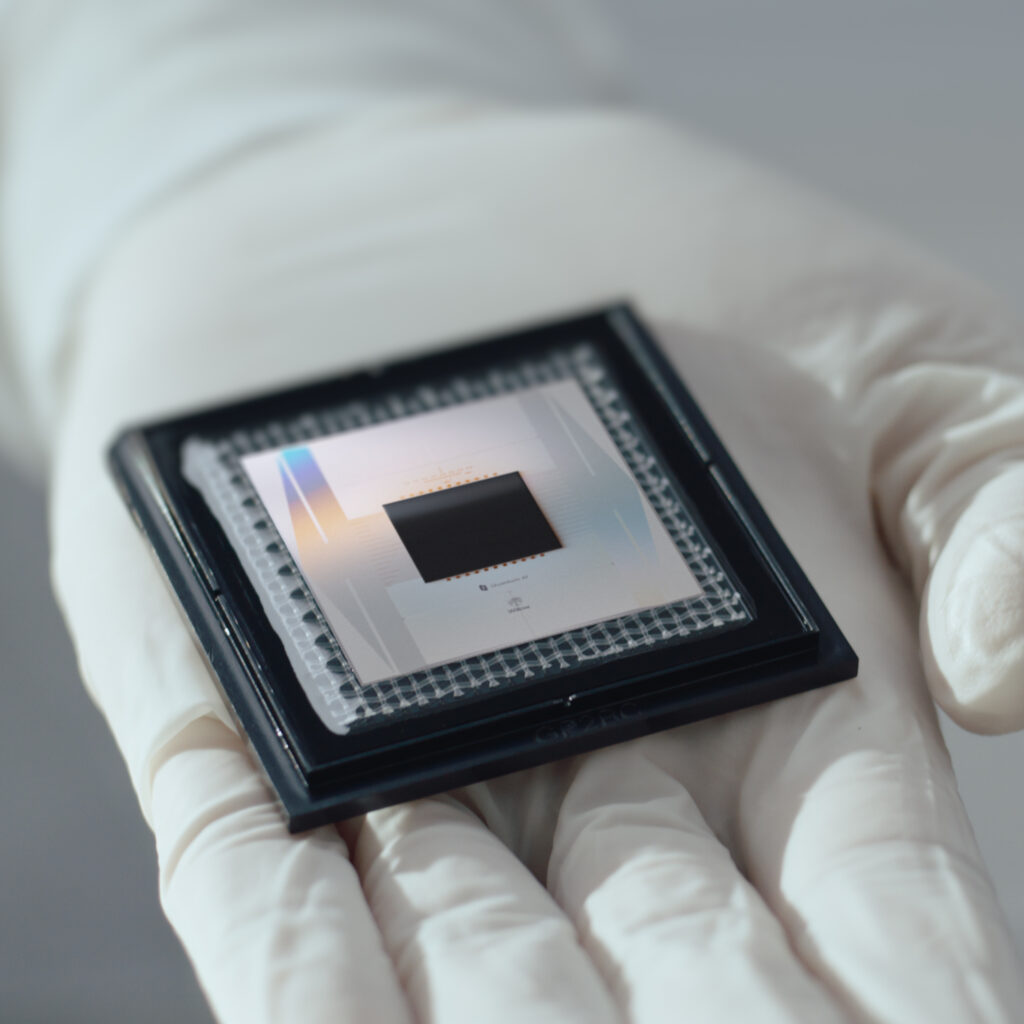
TL;DR Google’s Willow quantum chip runs the Quantum Echoes algorithm using OTOCs to achieve the first verifiable quantum advantage, outperforming supercomputers 13,000x in modeling molecular structures for real-world applications like drug discovery, as published in Nature.
In a groundbreaking announcement on October 22, 2025, Google Quantum AI revealed a major leap forward in quantum computing. Their new “Quantum Echoes” algorithm, running on the advanced Willow quantum chip, has demonstrated the first-ever verifiable quantum advantage on hardware. This means a quantum computer has successfully tackled a complex problem faster and more accurately than the world’s top supercomputers—13,000 times faster, to be exact—while producing results that can be repeated and verified. Published in Nature, this research not only pushes the boundaries of quantum technology but also opens doors to practical applications like drug discovery and materials science. Let’s break it down in simple terms.
What Is Quantum Advantage and Why Does It Matter?
Quantum computing has been hyped for years, but real-world applications have felt distant. Traditional computers (classical ones) use bits that are either 0 or 1. Quantum computers use qubits, which can be both at once thanks to superposition, allowing them to solve certain problems exponentially faster.
“Quantum advantage” is when a quantum computer does something a classical supercomputer can’t match in a reasonable time. Google’s 2019 breakthrough showed quantum supremacy on a contrived task, but it wasn’t verifiable or useful. Now, with Quantum Echoes, they’ve achieved verifiable quantum advantage: repeatable results that outperform supercomputers on a problem with practical value.
This builds on Google’s Willow chip, introduced in 2024, which dramatically reduces errors—a key hurdle in quantum tech. Willow’s low error rates and high speed enable precise, complex calculations.
Understanding the Science: Out-of-Time-Order Correlators (OTOCs)
At the heart of this breakthrough is something called out-of-time-order correlators, or OTOCs. Think of quantum systems like a busy party: particles (or qubits) interact, entangle, and “scramble” information over time. In chaotic systems, this scrambling makes it hard to track details, much like how a rumor spreads and gets lost in a crowd.
Regular measurements (time-ordered correlators) lose sensitivity quickly because of this scrambling. OTOCs flip the script by using time-reversal techniques—like echoing a signal back. In the Heisenberg picture (a way to view quantum evolution), OTOCs act like interferometers, where waves interfere to amplify signals.
Google’s team measured second-order OTOCs (OTOC(2)) on a superconducting quantum processor. They observed “constructive interference”—waves adding up positively—between Pauli strings (mathematical representations of quantum operators) forming large loops in configuration space.
In plain terms: By inserting Pauli operators to randomize phases during evolution, they revealed hidden correlations in highly entangled systems. These are invisible without time-reversal and too complex for classical simulation.
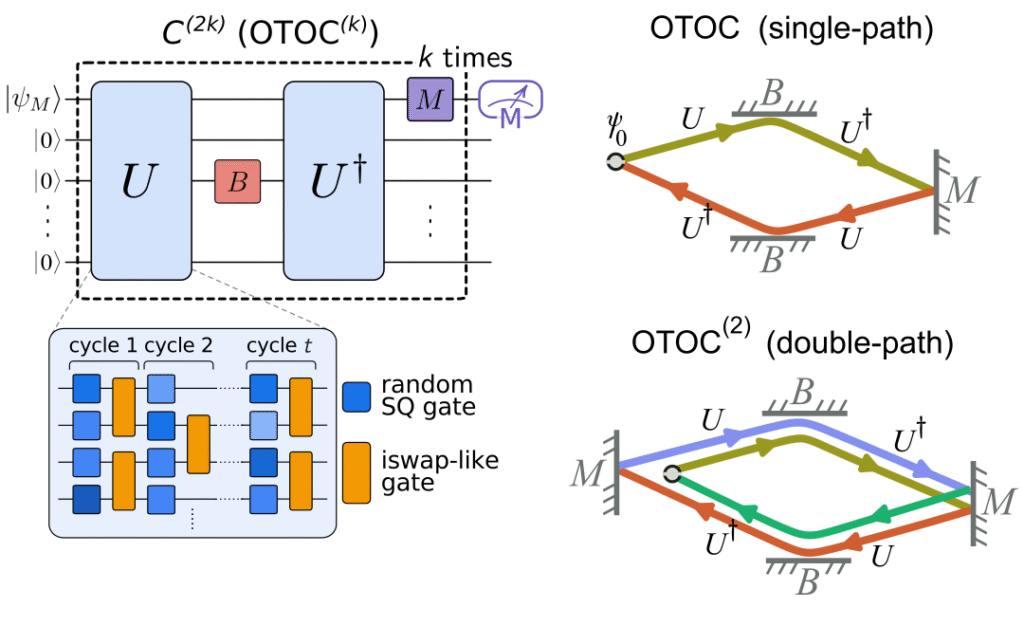
The experiment used a grid of qubits, random single-qubit gates, and fixed two-qubit gates. They varied circuit cycles, qubit positions, and instances, normalizing results with error mitigation. Key findings:
- OTOCs remain sensitive to dynamics long after regular correlators decay exponentially.
- Higher-order OTOCs (more interference arms) boost sensitivity to perturbations.
- Constructive interference in OTOC(2) reveals “large-loop” effects, where paths in Pauli space recombine, enhancing signal.
This interference makes OTOCs hard to simulate classically, pointing to quantum advantage.
The Quantum Echoes Algorithm: How It Works
Quantum Echoes is essentially the OTOC algorithm implemented on Willow. It’s like sending a sonar ping into a quantum system:
- Run operations forward on qubits.
- Perturb one qubit (like poking the system).
- Reverse the operations.
- Measure the “echo”—the returning signal.
The echo amplifies through constructive interference, making measurements ultra-sensitive. On Willow’s 105-qubit array, it models physical experiments with precision and complexity.
Why verifiable? Results can be cross-checked on another quantum computer of similar quality. It outperformed a supercomputer by 13,000x in learning structures of natural systems, like molecules or magnets.
In a proof-of-concept with UC Berkeley, they used NMR (Nuclear Magnetic Resonance—the tech behind MRIs) data. Quantum Echoes acted as a “molecular ruler,” measuring longer atomic distances than traditional methods. They tested molecules with 15 and 28 atoms, matching NMR results while revealing extra info.
Real-World Applications: From Medicine to Materials
This isn’t just lab curiosity. Quantum Echoes could revolutionize:
- Drug Discovery: Model how molecules bind, speeding up new medicine development.
- Materials Science: Analyze polymers, batteries, or quantum materials for better solar panels or fusion tech.
- Black Hole Studies: OTOCs relate to chaos in black holes, aiding theoretical physics.
- Hamiltonian Learning: Infer unknown quantum dynamics, useful for sensing and metrology.
As Ashok Ajoy from UC Berkeley noted, it enhances NMR’s toolbox for intricate spin interactions over long distances.
What’s Next for Quantum Computing?
Google’s roadmap aims for Milestone 3: a long-lived logical qubit for error-corrected systems. Scaling up could unlock more applications.
Challenges remain—quantum tech is noisy and expensive—but this verifiable advantage is a milestone. As Hartmut Neven and Vadim Smelyanskiy from Google Quantum AI said, it’s like upgrading from blurry sonar to reading a shipwreck’s nameplate.
This breakthrough, detailed in Nature under “Observation of constructive interference at the edge of quantum ergodicity,” signals quantum computing’s shift from promise to practicality.