PJFP.com

Pursuit of Joy, Fulfillment, and Purpose

Tag: Hugging Face

  • Jensen Huang Joins X and His First Post Is a Manifesto: Inside the Open Weights and American AI Leadership Letter Signed by NVIDIA, Microsoft, Meta, and 20+ Tech Giants

    Jensen Huang, the CEO of NVIDIA and arguably the most influential person in the AI hardware world, has never been a social media guy. That changed on July 24, 2026, when he joined X and published his first-ever post. He did not use it to celebrate a product launch or a stock milestone. He used it to share a policy manifesto: “Open Weights and American AI Leadership,” a joint letter signed by roughly 25 organizations including NVIDIA, Microsoft, Meta, IBM, Dell Technologies, Hugging Face, Mistral, Mozilla, The Linux Foundation, Palantir, Perplexity, Replit, ServiceNow, Andreessen Horowitz, and Y Combinator, urging U.S. policymakers not to strangle open-weight AI models with premature restrictions.

    TLDR

    Jensen Huang broke his lifelong social media silence to amplify a coalition letter arguing that America’s AI leadership depends on a thriving open-weight ecosystem, not just one frontier model. The letter draws a straight line from the open-source software movement of the 1980s to today’s AI debate, and makes four core arguments: open weights expand access to the AI economy for startups, universities, and businesses that cannot train frontier models from scratch; they strengthen competition across models, chips, clouds, and applications; they give customers control over their data and protection from vendor lock-in; and, most provocatively, they make AI safer, because transparency lets thousands of researchers find and fix vulnerabilities while closed models concentrate risk into a few single points of failure. The letter acknowledges that released weights can never be recalled, defends distillation as a legitimate development technique that should not be swept into anti-misappropriation rules, and asks policymakers to expand compute access, invest in shared datasets and evaluation tools, and keep the frontier plural. Notably absent from the signatory list: OpenAI, Anthropic, and Google.

    Thoughts

    The medium is the message here. Jensen Huang has run NVIDIA for over three decades without needing a personal X account, and his debut post could have been anything. He chose a policy letter. That tells you how high the stakes of the open-weights fight have become in Washington. When the CEO whose chips power essentially all frontier AI decides the most valuable use of his first post is lobbying, the open-versus-closed question has officially moved from Twitter discourse to the center of American industrial policy.

    Follow the incentives and the signatory list makes perfect sense. NVIDIA wins when AI runs everywhere, on every cloud, in every factory, hospital, and government data center, and open weights are the vehicle for that diffusion. Meta has bet its entire AI strategy on open models. Hugging Face, Mistral, and the Linux Foundation are institutionally committed to openness. Microsoft signing is the interesting one, given its billions invested in OpenAI, and it suggests Redmond sees its future in selling infrastructure for all models rather than defending any single lab’s moat. Meanwhile the two most prominent frontier labs built on closed weights, OpenAI and Anthropic, are conspicuously not on the letter, and neither is Google. The dividing line is not ideology. It is business model.

    The safety argument is the letter’s boldest move. The standard policy assumption has been that closed models are the responsible choice and open weights are the risky one. The letter flips that: closed models are single points of failure that can be breached or fail invisibly, while open weights let a global community red team, benchmark, and patch. This is a direct port of the “given enough eyeballs, all bugs are shallow” argument from open-source software, and it worked historically. Linux and open cryptography did prove more trustworthy than security through obscurity. Whether the analogy fully holds for AI models, where a vulnerability might be a capability rather than a bug, is the real debate, and the letter mostly asserts the analogy rather than proving it. The honest concession is there, though: once weights are released, they are beyond anyone’s control, forever.

    The distillation paragraph is the tell for what this letter is actually about. Since Chinese labs like DeepSeek demonstrated that frontier-adjacent capability can be built cheaply, partly by learning from the outputs of existing models, there has been growing appetite in Congress to restrict distillation itself. The coalition is drawing a line: punish unlawful extraction from closed models through targeted legal frameworks, but do not ban a technique that virtually every AI team on earth uses for model improvement and evaluation. The unstated geopolitical subtext runs through the whole document. If America restricts its own open models, the world does not stop using open models. It builds on Chinese ones, and the default AI stack for most of humanity gets set in Hangzhou instead of Santa Clara.

    There is also a genuinely good economic point buried in the access section that deserves more attention than the politics. Frontier models are expensive, and routing every task through one is not economically sustainable when AI scales to billions of everyday operations. Open weights let organizations match the right model to the right job at the right cost, reserving frontier capability for frontier problems. That discipline, more than any single benchmark race, is what makes AI diffusion into ordinary businesses actually pencil out. Huang’s own post distilled the balanced version of the thesis into one line: the world needs both frontier closed models and frontier open models. That is probably the correct position, and it is worth noticing that the people who signed this letter and the people who did not both agree AI is the most consequential technology of the era. They just disagree about who should hold the keys.

    Key Takeaways

    • Jensen Huang joined X on July 24, 2026, and used his first-ever post to share the coalition letter “Open Weights and American AI Leadership” rather than any NVIDIA product or personal news.
    • His post read in part: “AI will transform every industry, power every company, and be built by every country. Open models strengthen safety and cybersecurity, accelerate innovation and diffusion, and enable sovereignty.”
    • The letter is signed by roughly 25 organizations: NVIDIA, Microsoft, Meta, IBM, Dell Technologies, Hugging Face, Mistral, Mozilla, The Linux Foundation, Palantir, Perplexity, Replit, ServiceNow, CrowdStrike, Box, Black Forest Labs, Arcee AI, Arena, Emergence Capital, Telnyx, Reflection, Mariana Minerals, American Innovators Network, Andreessen Horowitz, and Y Combinator.
    • OpenAI, Anthropic, and Google are notably absent from the signatory list, and the split tracks business models: companies that profit from AI diffusion signed, companies whose moat is closed frontier models did not.
    • Open-weight models are defined in the letter as AI models that anyone can download, inspect, modify, and run on their own infrastructure.
    • The letter opens with a historical analogy: 1980s open-source pioneers challenged the belief that software required tight corporate control, and open source now underpins most of the internet, the U.S. military, and federal research.
    • The central thesis is that U.S. AI leadership will be judged not by one frontier model but by whether America builds an open ecosystem that diffuses AI into every sector of the economy.
    • Argument one is access: startups, established businesses, universities, and public institutions can build on advanced models without training one from scratch or paying frontier-model prices for every task.
    • The letter frames cost discipline as the key to sustainable AI economics: reserve frontier-scale capability for genuine frontier problems and run efficient specialized models everywhere else, because AI usage is heading toward billions of everyday tasks.
    • America wins the AI era, per the letter, by diffusing AI into factories, hospitals, farms, classrooms, and main street businesses, not by concentrating it.
    • Argument two is competition: open weights create rivalry not just among model developers but across chips, clouds, applications, and services, which drives down costs and spreads the gains.
    • Argument three is customer control: organizations investing in AI want assurance they will not be locked into a single provider or lose the capabilities they build over time.
    • Open weights let organizations control their own data, adapt models to their needs, deploy wherever business requirements demand, and own the value they create through self-improving models and accumulated knowledge.
    • The letter concedes the core risk honestly: once weights are released they are beyond the original developer’s control, and modified versions are difficult to trace or reverse.
    • Its answer to that risk is defensive parity: in a world where attackers use advanced AI, defenders need comparable open models to detect, simulate, and respond to threats.
    • Argument four inverts the standard safety assumption: relying solely on closed models is not inherently safe because they can be breached, misused, or fail in ways outsiders cannot detect.
    • Concentrating advanced AI behind a few closed models creates single points of failure, weakens competition, and leaves critical technology in the hands of a few providers.
    • The letter argues openness enables rigorous benchmarking, red teaming, and protections tied to real demonstrated harms, rather than assuming closed systems are safer by default.
    • The transparency-beats-obscurity argument is borrowed directly from open-source security history, where community scrutiny made software like Linux more trustworthy, not less.
    • The policy asks: expand compute access for startups and researchers, invest in shared training assets like datasets, tools, and evaluation frameworks, and avoid premature restrictions that stifle competition or push innovation overseas.
    • “Keeping the frontier plural” is the letter’s phrase for ensuring no single lab or model becomes the sole locus of advanced AI capability.
    • The distillation section is the most legislatively specific part: it defends using one model’s outputs to help train or improve another as a widely used, legitimate technique for model improvement, evaluation, and validation.
    • The coalition wants unlawful extraction of value from closed models addressed through targeted legal and commercial frameworks, not sweeping restrictions on distillation itself.
    • The distillation defense lands in the shadow of DeepSeek and other Chinese labs, whose cheap, capable open models triggered calls in Washington to restrict the technique.
    • The unstated competitive logic: if the U.S. restricts its own open models, developers worldwide will build on Chinese open models instead, ceding the default global AI stack.
    • Sovereignty is a recurring frame, both national and organizational: open weights let countries and companies run AI on their own infrastructure with their own data, a pitch Huang has made to governments for years.
    • Huang’s bottom line is explicitly both-and, not either-or: “The world needs both frontier closed models and frontier open models.”
    • The letter closes with an optimistic framing: with the right choices, open-weight AI can expand opportunity, strengthen competition, extend American technological leadership, mitigate risk, and share the benefits broadly.

    Detailed Summary

    The Debut: Why Jensen Huang Joining X Matters

    Huang has been one of the most visible executives on earth for years, keynoting CES and GTC to stadium crowds, yet he has never maintained a personal social media presence. His arrival on X on July 24, 2026 was itself news, and the content of the first post made it a statement. Rather than an introduction or a product plug, he shared the coalition letter and wrote that AI will transform every industry, power every company, and be built by every country, and that open models strengthen safety and cybersecurity, accelerate innovation and diffusion, and enable sovereignty. Microsoft CEO Satya Nadella amplified the same letter the same day. The coordinated rollout, fronted by the two most valuable companies in the AI supply chain, was designed to put maximum weight behind a single policy position at a moment when Congress is actively weighing how to regulate open models.

    The Open-Source Precedent

    The letter’s opening argument is historical. In the 1980s, open-source pioneers challenged the prevailing belief that software would only advance if companies kept tight control over their code. The movement they built now supports most of the internet and underlies systems used by the world’s largest technology companies, the U.S. military, and federal agencies doing scientific research and cybersecurity. The letter’s framing is that open source did more than lower costs; it created a shared foundation of knowledge on which generations of American engineers built. The United States, it argues, faces the same fork in the road with AI, and the lesson of the last forty years points toward openness.

    Access, Competition, and Customer Control

    The economic core of the letter is three stacked arguments. First, access: open weights let startups, businesses, universities, and public institutions build on advanced models without training their own or paying frontier prices for every task. The letter is unusually specific about the economics, arguing that matching the right model to the right job at the right cost is what will make AI sustainable as usage scales into the billions of everyday tasks. Second, competition: because anyone can build on open weights, rivalry emerges across every layer of the stack, models, chips, clouds, applications, and services, which spurs innovation and drives down prices. Third, control: organizations fear vendor lock-in and losing the capabilities they build. Open weights let them keep their data, adapt models to their needs, deploy anywhere, and own the accumulated value, which the letter ties to both American sovereignty and prosperity.

    The Safety Argument Turned Upside Down

    The letter does not dodge the standard objection. It concedes that open weights carry real and distinct risks: once released, weights are beyond the developer’s control, and modified versions are hard to trace or reverse. But it argues the right response is not prohibition. Defenders facing AI-equipped attackers need comparably capable models to detect, simulate, and respond to threats. Then it goes further, claiming openness may be one of the most important paths to AI safety. Closed models can be breached, misused, or fail invisibly, and concentrating capability behind a few of them creates single points of failure. Open models allow a broad community to examine behavior, find vulnerabilities, develop safeguards, and improve them over time, with rigorous benchmarking, red teaming, and protections tied to real demonstrated harms. The explicit analogy is to open-source software proving that transparency can be more secure than obscurity.

    The Distillation Defense

    The most pointed policy content is a warning against conflating legitimate model-development techniques with misappropriation. Distillation, using one model’s outputs to help train or improve another, is defended as a widely used technique for model improvement, evaluation, and validation, standing in a long tradition of learning from and building on existing technology. The letter acknowledges that unlawful extraction of value from closed models raises legitimate concerns, but insists those be handled through targeted legal and commercial frameworks rather than sweeping restrictions. This is the paragraph aimed most directly at pending legislative ideas, and it is the one where the interests of the signatories and the non-signatories diverge most sharply, since distillation is precisely how smaller and open models close the gap with closed frontier systems.

    Who Signed, and Who Did Not

    The signatory list spans chipmakers (NVIDIA), hyperscalers (Microsoft), open-model champions (Meta, Mistral, Black Forest Labs, Arcee AI, Reflection), infrastructure and enterprise players (IBM, Dell, Box, ServiceNow, CrowdStrike, Telnyx, Palantir), the open-source institutional world (Hugging Face, Mozilla, The Linux Foundation), and the venture ecosystem (Andreessen Horowitz, Y Combinator, Emergence Capital), plus Perplexity, Replit, Arena, Mariana Minerals, and the American Innovators Network. The absences are as informative as the signatures. OpenAI, which released its gpt-oss open-weight models in 2025 but remains fundamentally a closed frontier lab, did not sign. Neither did Anthropic nor Google. The letter thus formalizes a fault line that has been visible for years: the diffusion coalition versus the frontier labs, with the U.S. government as the audience both sides are playing to.

    The Policy Ask

    The letter closes with concrete recommendations. Policymakers should expand access to compute for startups and researchers, invest in shared training assets including datasets, tools, and evaluation frameworks, and keep the frontier plural by avoiding premature restrictions on open models that would stifle competition or drive innovation overseas. It also calls for attention to strong application layers that expand sovereign use of AI across the economy. The final paragraph is pure optimism: with the right choices, the age of AI can be one of broadly shared prosperity, and the United States should lead in building that future.

    Notable Quotes

    “For my first post, I’m sharing a letter Nvidia signed on why open models matter. AI will transform every industry, power every company, and be built by every country. Open models strengthen safety and cybersecurity, accelerate innovation and diffusion, and enable sovereignty. The world needs both frontier closed models and frontier open models.”

    Jensen Huang, in his debut post on X, July 24, 2026

    “Our AI leadership will be judged not by one frontier AI model, but by whether the United States builds a strong, open ecosystem that diffuses into every sector.”

    The coalition letter, stating its central thesis

    “America wins the AI era by diffusing it into the workflows of factories, hospitals, farms, classrooms, and main street businesses.”

    The coalition letter, on where the AI race is actually decided

    “Once released, the weights are beyond the original developer’s control, and modified versions are difficult to trace or reverse.”

    The coalition letter, conceding the irreversibility risk of open weights

    “Relying solely on closed models is not inherently safe: they can be breached, misused, or fail in ways that outsiders cannot detect.”

    The coalition letter, inverting the standard safety assumption

    “Just as open-source software demonstrated that transparency can be more secure than obscurity, AI safety may depend on giving more people the ability to test and strengthen the models on which society relies.”

    The coalition letter, drawing its core analogy to open-source security

    “Distillation, or the practice of using one model’s outputs to help train or improve another, is a widely used technique for model improvement, evaluation, and validation.”

    The coalition letter, defending the technique legislators have discussed restricting

    “That future is worth building, and the United States should lead in building it.”

    The coalition letter’s closing line

    Read the full letter here: Open Weights and American AI Leadership (PDF), and see Jensen Huang’s first post on X.

    Related Reading

  • Inkling: Thinking Machines Lab Releases Its First Open-Weights Model, a 975B Multimodal Mixture-of-Experts With Controllable Thinking Effort That Can Fine-Tune Itself on Tinker

    Thinking Machines Lab, the AI startup founded by former OpenAI CTO Mira Murati, has released Inkling, its first open-weights model trained from scratch. Inkling is a 975 billion parameter Mixture-of-Experts transformer (41B active) with a context window of up to 1 million tokens, native multimodal reasoning over text, images, and audio, and a dial for controllable thinking effort. The lab is explicit that Inkling is not the strongest model in the world. It is pitched as something arguably more useful: a broad, balanced, customizable foundation you can fine-tune on Tinker, with the full weights on Hugging Face. The announcement even includes a demo where Inkling fine-tunes itself and swaps in its own new weights.

    TLDR

    Thinking Machines Lab released Inkling, a 975B-total, 41B-active Mixture-of-Experts model pretrained on 45 trillion tokens of text, images, audio, and video, alongside a preview of Inkling-Small (276B total, 12B active). The release covers the model’s generalist benchmark profile across reasoning, agentic coding, tool use, vision, and audio; a controllable thinking effort setting that lets developers trade performance against tokens (matching Nemotron 3 Ultra on Terminal Bench 2.1 at roughly a third of the tokens); an encoder-free multimodal architecture using dMel spectrograms and hMLP image patches; a training recipe combining Muon and Adam with weight decay coupled to the learning rate; RL scaled past 30 million rollouts with log-linearly improving reasoning and an emergent compression of the chain of thought; an epistemics push covering calibration, forecasting (where it beats several frontier models), abstention, and censorship resistance; the strongest FORTRESS adversarial safety score among compared open-weights models; a headline-grabbing demo of the model fine-tuning itself into a lipogram assistant via Tinker; and day-one availability on Tinker (at a 50% discount), Hugging Face, and inference partners including Together, Fireworks, Modal, Databricks, Baseten, vLLM, SGLang, and llama.cpp.

    Thoughts

    The most striking thing about this launch is its honesty. Nearly every frontier release leads with a claim to be the best at something, and the fine print walks it back. Thinking Machines Lab says plainly that Inkling is not the strongest model available, open or closed, and then makes the case that “strongest” is the wrong axis for most real buyers. If you are going to run a model millions of times inside a product, what you care about is the cost curve, the adaptability, and whether you can shape it to your workflow. That framing conveniently matches their business (Tinker sells fine-tuning), but it also matches how production AI actually gets deployed, where cost and latency are binding constraints and a benchmark crown is trivia.

    The self-fine-tuning demo deserves more attention than it will probably get. Asked to become a lipogram assistant that never uses the letter “e” (a behavior prompting alone cannot reliably produce), Inkling wrote its own training objective and scoring function, generated its own synthetic data, launched the run on Tinker, evaluated the result against its base self, and then staged a weight swap so the improved checkpoint took over the session. That is a closed loop of specify, train, evaluate, and self-update, packaged as a cute product demo. The loop is the primitive behind every serious conversation about recursive self-improvement, and here it is running as a marketing asset with a 27 minute wall clock. The gap between “toy objective” and “economically meaningful objective” is now a question of reward design, not plumbing.

    Controllable thinking effort is the feature I expect developers to care about most. Instead of publishing a single score, TML publishes a curve: sweep the effort setting from 0.2 to 0.99 and watch performance trade against generated tokens. Inkling reportedly matches Nemotron 3 Ultra on Terminal Bench 2.1 while spending about a third of the tokens. Benchmarks reported as single points hide exactly this, and a model that reaches a target score cheaply beats a model that scores two points higher at triple the cost in any high-volume workload. Expect effort curves to become standard marketing for open models, the way context length became standard a couple of years ago.

    The epistemics section is quietly the most differentiated part of the release. TML trained calibration directly, running RL against proper scoring rules on resolved real-world questions, and pairing a rubric grader with a claims grader that does agentic web search to verify each factual assertion. The result is a model that beats GPT-5.5 and Claude Opus 4.8 on ForecastBench without search and holds its own on Prophet Arena. A model that knows when to say “I don’t know” is more useful across messy real-world domains than one that confabulates confidently, and it is notable that a lab whose stated mission is extending human will and judgment treats calibrated uncertainty as a first-class training target rather than a safety afterthought. The censorship-resistance training, validated on Cognition’s Propaganda and Censorship Eval, extends the same idea: trustworthiness as a capability you train, not a policy you bolt on.

    Finally, the open-weights safety tension is handled with unusual candor. Inkling posts the strongest adversarial FORTRESS score among the open models compared while keeping benign over-refusal low, and it was tested externally for CBRN, cyber, and loss-of-control capabilities. But everyone in this space knows fine-tuning can strip safety behavior from open weights, and TML ships a fine-tuning platform for this exact model. Their acknowledgment that they are actively studying how safety behavior survives fine-tuning on Tinker is the right thing to say, and it is also the open question that will define whether “safe open weights” is a coherent category at all.

    Key Takeaways

    • Inkling is Thinking Machines Lab’s first from-scratch, open-weights model: a Mixture-of-Experts transformer with 975B total parameters, 41B active, and a context window up to 1M tokens.
    • It was pretrained on 45 trillion tokens spanning text, images, audio, and video, and reasons natively over text, images, and audio without separate encoders.
    • A preview of Inkling-Small ships alongside it: a 276B-parameter MoE with just 12B active parameters that matches or beats its larger sibling on several benchmarks thanks to an improved pretraining recipe.
    • TML explicitly positions Inkling as a base for customization rather than the strongest overall model, leaning on multimodality, efficient thinking, and Tinker fine-tuning as the differentiators.
    • The launch demo shows Inkling fine-tuning itself: it wrote its own training objective and data, ran the job through the Tinker API, evaluated the result, and hot-swapped to its own new weights inside the OpenCode harness.
    • The self-fine-tuning target was a lipogram assistant that never uses the letter “e,” a behavior chosen precisely because prompting alone cannot reliably achieve it; the full loop completed in about 27 minutes.
    • Controllable thinking effort is a core feature: a setting swept from 0.2 to 0.99 traces a full performance-versus-tokens curve instead of a single benchmark point.
    • On Terminal Bench 2.1, Inkling matches Nemotron 3 Ultra’s score at roughly one third of the generated tokens, the release’s flagship efficiency claim.
    • Inkling was trained to run inside a variety of coding and agent harnesses, with tool sets and schemas randomized during training to reduce sensitivity to any particular harness.
    • On Design Arena’s blinded human-evaluated Agentic Web Dev leaderboard, Inkling scores 1257, among the strongest open-weights models and tied with Claude Opus 4.6.
    • Headline benchmark scores at effort 0.99 include SWEBench Verified 77.6%, SWEBench Pro Public 54.3%, Terminal Bench 2.1 63.8%, GPQA Diamond 87.2%, AIME 2026 97.1%, and HLE 29.7% text-only (46.0% with tools).
    • Agentic and general scores include MCP Atlas 74.1%, Tau 3 Banking 23.7%, and BrowseComp 77.1% with context management.
    • Vision results are strong for an open model: MMMU Pro 73.5%, CharXiv RQ 78.1%, rising to 82.0% when the model uses a Python tool for zooming and cropping during visual reasoning.
    • Audio results place it among the strongest open-weights audio models: VoiceBench 91.4%, MMAU 77.2%, and Audio MC 56.6%, well ahead of Qwen3-Omni and Nemotron Nano-Omni on the last.
    • The multimodal stack is encoder-free: audio enters as discrete dMel spectrograms and images as 40×40 pixel patches through a four-layer hMLP, both passed through a lightweight embedding layer and processed jointly with text tokens.
    • The MoE design largely follows DeepSeek-V3: 256 routed experts plus 2 shared experts per layer, 6 routed experts active per token, with a sigmoid router and auxiliary-loss-free load balancing.
    • Attention interleaves sliding-window and global layers at a 5:1 ratio with 8 KV heads, and uses a learned relative positional embedding instead of RoPE, which TML found extrapolates better to long sequences.
    • Short convolutions are applied after the key and value projections and on the attention and MLP residual branch outputs, an unusual architectural touch aimed at efficiency and long-context performance.
    • Training used a hybrid optimizer strategy, Muon for large matrix weights and Adam for everything else, with weight decay coupled to the square of the learning rate to keep weight magnitudes stable.
    • Post-training was bootstrapped with a small SFT phase on synthetic data generated by open-weights models including Kimi K2.5, with the large majority of compute spent on large-scale RL.
    • RL was scaled past 30 million rollouts across two long continuous runs, with reasoning performance on a held-out aggregate (AIME, HLE, GPQA, and others) improving log-linearly throughout.
    • Effort control was trained by varying the system message and per-token cost across rollouts, teaching the model to modulate its own thinking budget.
    • An emergent effect appeared during RL: the chain of thought compressed over training, dropping articles and connectives into a telegraphic style, driven purely by efficiency pressure rather than any targeted reward.
    • Inkling was TML’s first major training effort and ran on NVIDIA GB300 NVL72 systems; the lab says future models will push compute scale further across pretraining and RL.
    • Calibration was trained directly with RL against proper scoring rules on a large corpus of resolved real-world questions, treating well-placed confidence as a capability rather than a byproduct.
    • On ForecastBench without search, Inkling’s Brier Index of 61.1 beats GPT-5.5 (59.1) and Claude Opus 4.8 (54.6), and it stays competitive with search enabled and on Prophet Arena.
    • Instruction following was trained with two automated graders working together: a rubric grader scoring against a checklist and a claims grader that verifies each factual claim via agentic web search, improving helpfulness and reducing hallucination simultaneously.
    • Abstention-aware rewards on short-form factual QA taught the model to answer when confident and hedge or decline when not, with some prompts explicitly forcing or forbidding hedging so the user’s preference wins.
    • Inkling was trained to answer directly on topics subject to censorship, and Cognition’s Propaganda and Censorship Eval found strong censorship non-compliance.
    • On FORTRESS, Inkling posts the strongest adversarial refusal score (78.0%) of any compared open-weights model while keeping benign compliance high (95.9%), and scores 98.6% on StrongREJECT.
    • Safety testing covered CBRN, cyber, and loss-of-control capabilities plus human-AI threat vectors like sycophancy, vulnerable users, and manipulation, verified by commissioned external testers.
    • Inkling is available for fine-tuning on Tinker today with 64K and 256K context options at a 50% limited-time discount, plus a free Inkling Playground chat interface in the Tinker console.
    • Full weights are on Hugging Face, including an NVFP4 checkpoint for efficient inference on NVIDIA Blackwell, with API availability via Together, Fireworks, Modal, Databricks, and Baseten and inference support in SGLang, vLLM, TokenSpeed, and llama.cpp.
    • TML frames Inkling as the first in a family and as the intended background reasoning model for its previously announced real-time interaction models system.

    Detailed Summary

    What Inkling Is and Why It Exists

    Thinking Machines Lab frames its mission as building AI that extends human will and judgment, and Inkling as the logical next step after shipping the Tinker customization platform, previewing an interaction-focused AI system, and publishing research. Inkling is a Mixture-of-Experts transformer with 975B total and 41B active parameters, a context window up to 1M tokens, and pretraining on 45 trillion tokens of mixed text, image, audio, and video data. The lab is upfront that it is not the strongest model available. The pitch is breadth plus adaptability: a generalist trained across agentic, reasoning, coding, instruction-following, factuality, vision, and audio tasks rather than tuned to dominate one leaderboard, offered with full weights so people can make it their own. It launches with a preview sibling, Inkling-Small, at 276B total and 12B active parameters.

    The Self-Fine-Tuning Demo

    To demonstrate what customization means, TML asked Inkling to fine-tune itself. Running inside the OpenCode harness with access to Tinker, the model was told to become a lipogram assistant that never uses the letter “e.” Inkling drafted the plan, wrote an objective file with a scoring function (any response containing “e” scores zero), generated synthetic training data, launched a supervised fine-tuning run through the Tinker API, evaluated the checkpoint against its base self, and then staged a self-update so the supervisor relaunched the session on the new weights. The pipeline passed in about 27 minutes, and the updated model answered a test question about launching an LLM without a single “e.” It is a whimsical objective wrapped around a serious primitive: a model autonomously specifying, running, and adopting its own weight updates.

    Agentic Coding and Tool Use

    TML trained Inkling to operate inside many coding and agent harnesses, randomizing tool sets and schemas during training so the model does not overfit to one environment. The release showcases three demos: a one-shot job-application web app that then hosts an embedded browser-use agent operating its own interface; a nine-page, cohesively designed PDF food and travel journal produced from a single editorial prompt with web-verified details; and a server-authoritative multiplayer snake game refined over 40 iterations of feedback from GPT Codex acting as a reviewer. On benchmarks, Inkling posts 77.6% on SWEBench Verified, 54.3% on SWEBench Pro Public, and 63.8% on Terminal Bench 2.1, competitive within the open-weights field, and 1257 on Design Arena’s human-judged web dev leaderboard, in the same band as Claude Opus 4.6.

    Controllable Thinking Effort

    Rather than reporting a single operating point, TML sweeps Inkling’s effort setting from 0.2 to 0.99 and plots score against mean generated tokens on Terminal Bench 2.1, HLE, and IFBench, with competitors shown at their default settings. The headline result is efficiency: Inkling reaches Nemotron 3 Ultra’s Terminal Bench score at roughly a third of the tokens. The argument is that cost and latency are binding constraints in production, especially for interactive collaboration, so the full cost curve, not the peak score, is what developers should evaluate. Effort can be set from within the agent harness, and the ability was trained by varying system messages and per-token costs across RL rollouts.

    Native Multimodality Without Encoders

    Inkling is designed to serve as the background reasoning model for TML’s interaction models system, which requires real-time voice and vision collaboration. The multimodal components are trained from scratch with an encoder-free architecture: audio arrives as discrete dMel spectrograms and images as 40×40 pixel patches through a four-layer hMLP, both mapped through a lightweight embedding layer and processed jointly with text. The model transcribes speech, follows spoken instructions, reasons over long recordings, and answers questions about charts and diagrams, optionally using a Python tool to zoom and crop images mid-reasoning. Scores like 91.4% on VoiceBench and 82.0% on CharXiv RQ with Python place it among the strongest open-weights multimodal models, though still behind Gemini 3.1 Pro.

    Epistemics: Calibration, Forecasting, and Censorship Resistance

    TML groups calibration, instruction following, and censorship resistance under the banner of epistemics. Calibration was trained with RL against proper scoring rules on resolved real-world questions, and it shows: Inkling’s ForecastBench Brier Index of 61.1 without search beats GPT-5.5 and Claude Opus 4.8, and its Prophet Arena score sits close to the frontier. Instruction following used two complementary automated graders, a rubric checklist and a claims grader that verifies factual assertions through agentic web search, so recall-spraying to hack rubrics gets penalized by the factuality check. Targeted abstention-aware QA datasets taught the model to say “I don’t know” or give hedged best guesses when appropriate, while still complying when a user demands a forced guess. Finally, the model was trained to answer directly on censorship-prone topics, with Cognition’s Propaganda and Censorship Eval finding strong non-compliance with censorship patterns.

    Safety for an Open-Weights Release

    Inkling was trained to an internal behavioral spec across all modalities and then checked by commissioned external safety testers. Evaluations covered dangerous capabilities (CBRN, cyber, loss of control) and human-AI threat vectors including sycophancy, vulnerable users, and harmful manipulation. On FORTRESS, which pairs adversarial harmful requests with benign look-alikes, Inkling posts the strongest adversarial score among the compared open models (78.0%) without collapsing on the benign side (95.9%), and it scores 98.6% on StrongREJECT. TML acknowledges the open question hanging over every open-weights release: how safety behavior holds up under fine-tuning, which it says it is actively studying on Tinker.

    Architecture and Training Recipe

    The MoE layout follows DeepSeek-V3: 256 routed experts and 2 shared experts per layer with 6 routed experts active per token, a sigmoid-based router, and auxiliary-loss-free load balancing. Attention interleaves sliding-window and global layers 5:1 with 8 KV heads, and positions are encoded with a learned relative positional embedding that TML found outperforms and out-extrapolates RoPE. Short convolutions appear after the key and value projections and on residual branch outputs. Optimization was hybrid, Muon for large matrices and Adam elsewhere, with hyperparameter schedules drawn from the lab’s modular manifolds research and weight decay coupled to the square of the learning rate to keep weight norms stable. Post-training bootstrapped from a small SFT phase on synthetic data from open models including Kimi K2.5, then spent the bulk of compute on large-scale RL. Everything ran on NVIDIA GB300 NVL72 systems.

    RL at Scale and the Emergent Compression of Thought

    TML scaled asynchronous RL past 30 million rollouts across two long continuous runs, with performance on a held-out aggregate of reasoning evals improving log-linearly the whole way. Along the way an unplanned behavior emerged: the chain of thought became progressively more concise, shedding grammatical overhead into a telegraphic style (“We need to understand” becomes “We need determine”) while remaining comprehensible and leaving final answers unaffected. No reward targeted this; token efficiency pressure alone drove the compression, echoing an observation Cognition made while training SWE-1.7. It is a vivid example of optimization discovering its own shorthand.

    Inkling-Small

    The preview of Inkling-Small is arguably the sleeper story: with 12B active parameters against Inkling’s 41B, it matches or exceeds the larger model on a surprising number of benchmarks, including GPQA Diamond (88.3% vs 87.2%), IFBench (83.4% vs 79.8%), and CharXiv RQ with Python (83.4% vs 82.0%). TML attributes this to pretraining data and recipe improvements made after the big model trained, with both models sharing the same post-training stack. The clearest gaps favoring big Inkling are factuality (SimpleQA 43.9% vs 20.9%), Terminal Bench, and Tau 3 Banking. Full weights for Inkling-Small will be released once testing finishes, and its cost and latency profile targets high-volume workloads like coding, LLM grading, and synthetic data generation.

    Availability and the Ecosystem Play

    Inkling is on Tinker today with 64K and 256K context options at a limited-time 50% discount, plus a free Inkling Playground chat interface with integrated web search in the Tinker console so developers can get a feel for the model before committing to a run. The cookbook gained native Inkling support and three new audio recipes, and a new tml-renderer handles chat templates, tool calls, reasoning content, and multimodal inputs. Deployment partnerships span Together, Fireworks, Modal, Databricks, and Baseten for APIs; RadixArk for SGLang and Miles; Inferact for vLLM; Lightseek for TokenSpeed; Unsloth for llama.cpp; and Hugging Face for transformers integration. Full weights are on Hugging Face in both the original checkpoint and an NVFP4 checkpoint for NVIDIA Blackwell inference.

    Notable Quotes

    “Our mission is to build AI that extends human will and judgment.”

    Thinking Machines Lab, opening the Inkling announcement

    The company’s north star, and the lens through which the whole release (customization, calibration, open weights) is framed.

    “Inkling is not the strongest overall model available today, open or closed. Instead, a combination of qualities makes it a good open-weights base for customization: multimodal capabilities, efficient thinking, and availability on Tinker for fine-tuning.”

    Thinking Machines Lab, positioning the release

    A rare piece of launch-day honesty from a frontier lab, and the strategic thesis of the whole release.

    “Picking the right base model to fine-tune is a qualitative judgment that combines measurable benchmarks with the unique feel of a model that comes from playing with it.”

    Thinking Machines Lab, on why the Inkling Playground exists

    An argument that vibes are data, from the lab that built a playground into a fine-tuning console.

    “Cost and latency are often binding constraints in real-world applications, and low latency in particular is crucial for enabling collaboration and improvement through iteration.”

    Thinking Machines Lab, on controllable thinking effort

    The case for evaluating models on their full effort-versus-performance curve instead of a single benchmark point.

    “A model that’s confident in every answer it gives, including when it’s missing info and confabulates, forces the user to double-check everything.”

    Thinking Machines Lab, on why calibration was a training target

    The clearest one-line justification for treating calibrated uncertainty as a capability rather than a nicety.

    “Together, the two graders improve helpfulness and reduce hallucination at the same time, rather than trading one for the other.”

    Thinking Machines Lab, on pairing a rubric grader with a web-searching claims grader

    A neat solution to rubric hacking: verify every claim with agentic search so spraying plausible facts stops paying.

    “Safety is crucial for open-weights models. We’re continuing to study safety behavior and capability uplift in customizable models, including how safety behavior is impacted by fine-tuning on Tinker.”

    Thinking Machines Lab, on the open question of fine-tunable safety

    The acknowledgment that safety trained into open weights must survive the very customization the product sells.

    “Inkling is just the start: our first release in a model family we will continue to build on.”

    Thinking Machines Lab, on the roadmap

    Together with the GB300 compute note, a clear signal that larger and stronger family members are coming.

    Read the full announcement, including the interactive demos, effort curves, and complete benchmark tables, on the Thinking Machines Lab blog.

    Related Reading

  • Alibaba Cloud Unveils QwQ-32B: A Compact Reasoning Model with Cutting-Edge Performance

    Alibaba Cloud Unveils QwQ-32B: A Compact Reasoning Model with Cutting-Edge Performance

    In a world where artificial intelligence is advancing at breakneck speed, Alibaba Cloud has just thrown its hat into the ring with a new contender: QwQ-32B. This compact reasoning model is making waves for its impressive performance, rivaling much larger AI systems while being more efficient. But what exactly is QwQ-32B, and why is it causing such a stir in the tech community?

    What is QwQ-32B?

    QwQ-32B is a reasoning model developed by Alibaba Cloud, designed to tackle complex problems that require logical thinking and step-by-step analysis. With 32 billion parameters, it’s considered compact compared to some behemoth models out there, yet it punches above its weight in terms of performance. Reasoning models like QwQ-32B are specialized AI systems that can think through problems methodically, much like a human would, making them particularly adept at tasks such as solving mathematical equations or writing code.

    Built on the foundation of Qwen2.5-32B, Alibaba Cloud’s latest large language model, QwQ-32B leverages the power of Reinforcement Learning (RL). RL is a technique where the model learns by trying different approaches and receiving rewards for correct solutions, similar to how a child learns through play and feedback. This method, when applied to a robust foundation model pre-trained on extensive world knowledge, has proven to be highly effective. In fact, the exceptional performance of QwQ-32B highlights the potential of RL in enhancing AI capabilities.

    Stellar Performance Across Benchmarks

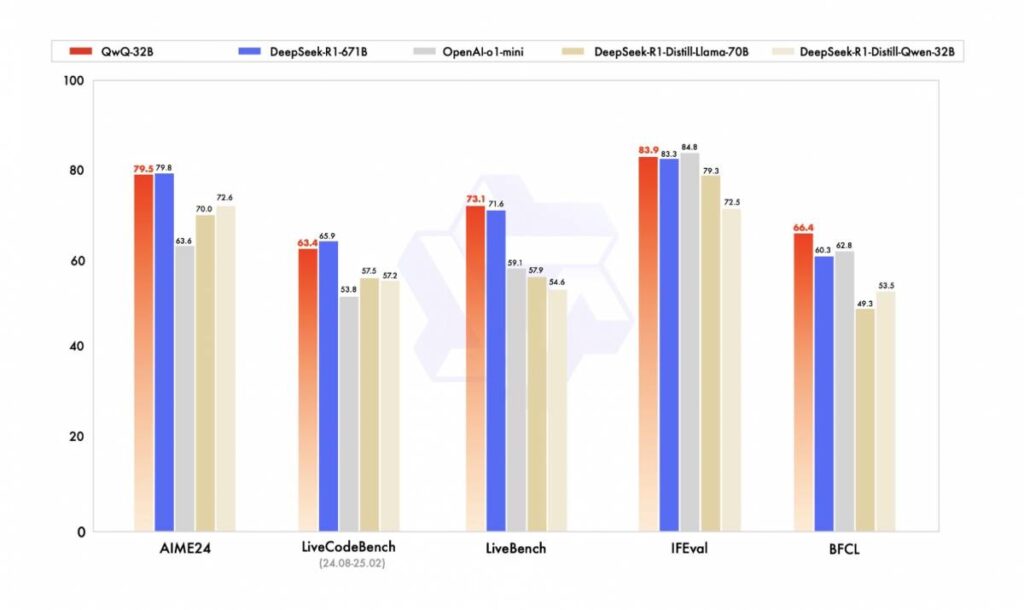
    To test its mettle, QwQ-32B was put through a series of rigorous benchmarks. Here’s how it performed:

    • AIME 24: Excelled in mathematical reasoning, showcasing its ability to solve challenging math problems.
    • Live CodeBench: Demonstrated top-tier coding proficiency, proving its value for developers.
    • LiveBench: Performed admirably in general evaluation tasks, indicating broad competence.
    • IFEval: Showed strong instruction-following skills, ensuring it can execute tasks as directed.
    • BFCL: Highlighted its capabilities in tool and function-calling, a key feature for practical applications.

    When stacked against other leading models, such as DeepSeek-R1-Distilled-Qwen-32B and o1-mini, QwQ-32B holds its own, often matching or even surpassing their capabilities despite its smaller size. This is a testament to the effectiveness of the RL techniques employed in its training. Additionally, the model was trained using rewards from a general reward model and rule-based verifiers, which further enhanced its general capabilities. This includes better instruction-following, alignment with human preferences, and improved agent performance.

    Agent Capabilities: A Step Beyond Reasoning

    What sets QwQ-32B apart is its integration of agent-related capabilities. This means the model can not only think through problems but also interact with its environment, use tools, and adjust its reasoning based on feedback. It’s like giving the AI a toolbox and teaching it how to use each tool effectively. The research team at Alibaba Cloud is even exploring further integration of agents with RL to enable long-horizon reasoning, where the model can plan and execute complex tasks over extended periods. This could be a significant step towards more advanced artificial intelligence.

    Open-Source and Accessible to All

    Perhaps one of the most exciting aspects of QwQ-32B is that it’s open-source. Available on platforms like Hugging Face and Model Scope under the Apache 2.0 license, it can be freely downloaded and used by anyone. This democratizes access to cutting-edge AI technology, allowing developers, researchers, and enthusiasts to experiment with and build upon this powerful model. The open-source nature of QwQ-32B is a boon for the AI community, fostering innovation and collaboration.

    The buzz around QwQ-32B is palpable, with posts on X (formerly Twitter) reflecting public interest and excitement about its capabilities and potential applications. This indicates that the model is not just a technical achievement but also something that captures the imagination of the broader tech community.

    A Bright Future for AI

    In a field where bigger often seems better, QwQ-32B proves that efficiency and smart design can rival sheer size. As AI continues to evolve, models like QwQ-32B are paving the way for more accessible and powerful tools that can benefit society as a whole. With Alibaba Cloud’s commitment to pushing the boundaries of what’s possible, the future of AI looks brighter than ever.