PJFP.com

Pursuit of Joy, Fulfillment, and Purpose

Tag: multiplanetary civilization

  • Elon Musk’s Full Economist Interview: Superintelligence in 5 Years, Why Money Won’t Matter by 2036, a Peer Review Plan for Frontier AI, China’s Electricity Edge, and a Fiery Clash Over Europe

    Sitting down with The Economist at Tesla’s Texas Gigafactory for a full-length interview, Elon Musk lays out the most concentrated version yet of his worldview: superintelligence within roughly five years, an age of abundance where money stops mattering by 2036, humans no longer in charge and probably happier for it. He also floats a surprisingly concrete AI safety mechanism (competitors peer-reviewing each other’s frontier models before release), handicaps the US-China race in terms of electricity rather than chips, defends his voting control and his Starlink decisions in Ukraine, admits he got carried away with politics during the DOGE era, and then spends the final half hour in a genuinely combative argument with his interviewer about Europe, immigration, and his claim that civil war in Britain is inevitable.

    TLDW

    Musk predicts AI exceeds the sum of human intelligence in about five years and that by 2036 robots plus digital intelligence create a quasi-infinite economy where anyone can have anything they can think of and money, taxation, and even corporate control become irrelevant. He concedes humans will not be in charge (the chimpanzee analogy), still holds a 10 to 20 percent probability of catastrophe, and explains his shift from doomer to “enjoy the ride” fatalism: the momentum cannot be stopped, and even a stop button probably should not be pressed. His safety fix: the leading labs, including Chinese ones, hold biweekly calls and get a week or two of pre-release access to test each other’s frontier models, escalating to the US or Chinese government when a maker refuses to address a danger, on the model of the Motion Picture Association and the recent government intervention over Anthropic’s Mythos model that Amazon flagged. He assesses Kimi K3 as closing on Fable, says China’s electricity advantage (already more than the US, Europe, and India combined) will eventually make it the AI leader, and pitches orbital data centers as the answer to the power constraint. On jobs he is blunter than ever: AI already beats 90 percent of professional programmers, will reach Stockfish-level unbeatability at everything, and work becomes optional like gardening, funded by Treasury checks in a deflationary abundance economy. He defends his 80 percent voting control as protection for five-to-ten-year bets like Mars, dismisses key-man risk with the Apple-after-Jobs analogy, explains the Starlink whitelist built with Ukraine to cut off smuggled Russian terminals, calls for a pragmatic peace with territorial concessions, insists zero people died from DOGE’s aid cuts while admitting he got too involved in politics, and battles The Economist over whether his portrayal of Europe as heading toward civil war is prophecy or misinformation. His closer: the singularity is 10 years away, civil war 20, so AI renders the rest less relevant.

    Thoughts

    The most important thing in this interview is a subtle accounting trick with risk. Musk’s probability of catastrophe has not moved: he reaffirms the 10 to 20 percent chance that this ends humanity. What changed is his relationship to agency. Since he believes nothing can stop the momentum (and that his own attempts to shape it, founding OpenAI as a counterweight to Google, only accelerated it), he has reclassified doom from a problem to a weather condition, and settled on “let’s enjoy the ride.” The rocket comparison the interviewer springs on him is the sharpest moment of the first hour: he would board a rocket with a 10 to 20 percent failure chance only if he could do nothing about it, which is precisely the premise doing all the work in his optimism. Fatalism is doing the job that safety engineering is supposed to do.

    That said, his peer-review proposal deserves to be taken seriously, because it is the rare AI governance idea with a working incentive structure and an existing precedent. Competitors are technically capable of evaluating a frontier model, motivated to slow each other down, and (per the Mythos episode he describes, where Amazon spotted the cybersecurity risk and called the White House, not a regulator) evidently faster than government at finding the danger. The Motion Picture Association analogy is apt in both directions, though: industry self-rating bodies work, but they also entrench incumbents and define “dangerous” on the industry’s terms. A safety club of five American labs plus a few Chinese ones is also, functionally, a cartel with a hotline to two governments. That may still beat the alternatives on speed, which is his real argument: six months is a long time now.

    The economics section contains a contradiction Musk half-acknowledges and the interviewer never quite lands. He argues money will not matter by 2036, that taxation becomes irrelevant, and that inflation dissolves into deflation as robot output outruns the money supply. Yet in the same conversation he defends, with real feeling, his 80 percent voting control, his stock option tax bill, and the quarterly-earnings pressure that justifies the structure, all machinery of a world where money matters enormously. His own reconciliation is the interesting part: control only matters to him for the window before AI is smart enough that controlling companies is moot. He is, by his own description, racing to steer during the last decade in which steering exists. The gardening model of post-labor life (work as artisanal hobby, your tomatoes worse than the store’s but grown with love) is the most concrete picture of the abundance endgame he has offered, and notably it is a picture of consumption and pastime, not of purpose, which is exactly the gap readers of this site will notice.

    His China analysis is the most analytically useful segment. Strip out the drama and his model is clean: AI is a function of whichever input binds first, chips or electricity. Outside China the binding constraint is already power and cooling; inside China it is chips, and China is close to solving lithography while already producing more electricity than the US, Europe, and India combined, heading toward four times US output. On that model, export controls buy time but cannot change the destination, orbital data centers are not science fiction but an attempt to dodge the terrestrial power wall, and the eventual leader is whoever has the most electrons. It is essentially the same “transistors, then electrons” bottleneck Sam Altman named in his recent interview, extended one step further into a prediction Washington will not enjoy.

    Then there is the final act, which is a different genre entirely. The interviewer’s best question is the one that links the two halves: how does the man narrating a civilizational transformation also spend his evenings in the tribal cesspit of social media, posting that civil war in Britain is inevitable? Musk’s own numbers dissolve some of the tension he creates: if the singularity arrives in 10 years and the British civil war in 20, then by his own model the machine gods adjudicate the immigration debate before it ever reaches the barricades, and he says as much, agreeing the AI revolution renders the rest less relevant. Which invites the obvious question of why a man with a quarter billion followers and, by his estimate, ten years of human steering left, allocates so much of that scarce steering to the fight he says will not matter. The interview never answers it, but it is the right thing to sit with after watching.

    Key Takeaways

    • Musk expects AI to exceed the sum of all human intelligence in roughly five years, and by 2036 to be so far beyond it that there is essentially nothing AI cannot do better than humans, apart from being human.
    • The most likely outcome, barring thermonuclear war, is an age of amazing abundance where anyone can have anything they can think of. He offers no analogy or metaphor that captures the magnitude of the change.
    • The economy, in his frame, is digital plus physical intelligence. Digital AI lacks end effectors; humanoid robots supply them (“you need lots of bots”), and vast robots plus vast intelligence yields a quasi-infinite economy.
    • He predicts money will not matter by 2036: money is only wanted for goods and services, and if robots produce more than any human can consume, its purpose evaporates. Taxation, he says, becomes somewhat irrelevant too.
    • Humans will most likely not be in control within 10 years. If the intelligence gap between AI and humans exceeds the gap between humans and chimpanzees, it is hard to imagine the chimpanzees staying in charge.
    • He still assigns a 10 to 20 percent chance that this ends badly for humanity, unchanged from his earlier warnings, but has philosophically concluded to look on the bright side because the momentum cannot be stopped.
    • Even if a stop button existed, he argues we probably should not press it, because the most likely outcome is incredible abundance for all. His stated philosophy now: enjoy the ride.
    • He believes the most important thing for AI safety is that the AI be maximally truth-seeking and curious, in which case it will foster humanity and want us to be happy and prosper.
    • By his own account his interventions backfired into acceleration: he created OpenAI as a counterweight to Google’s near-monopoly, Anthropic spun out of OpenAI, and he now calls Anthropic the leader in AI.
    • His concrete safety proposal, discussed with Demis Hassabis before Hassabis published his regulator piece: the leading labs hold an informal call every week or two, and each new frontier model gets a week or two of pre-release testing by competitors via API.
    • The incentive logic: governments lack the technical depth to judge a frontier release, but competitors both understand the risks and are not shy about arguing a rival’s model should be delayed. Rivals keep each other honest.
    • The model for the scheme is the Motion Picture Association: an industry body that rates its own products, with government stepping in only when a company refuses to address a flagged danger. Only the US and Chinese governments have real power to act, and Chinese frontier labs should be included.
    • The precedent he cites: the US government limited the release of Anthropic’s Mythos model over cybersecurity risks, but it was Amazon, not government, that spotted the danger and called the White House.
    • On timelines for setting this up, six months is a long time. Breakthroughs now arrive sometimes multiple per day, so the calls and cross-testing should start immediately.
    • He remains openly not a fan of Sam Altman: a nonprofit founded to be open source and owned by the world became an 800 billion dollar closed-source for-profit, the exact opposite of what he donated for. He notes the Anthropic team left OpenAI because they did not trust Altman.
    • He calls Dario Amodei a very principled person and says nobody he has met at Anthropic set off his evil detector, then adds his own twist on the proverb: the road to hell is mostly paved with bad intentions, with a few well-intentioned paving stones in there. Despite the feuds, he says the leaders will set aside personal differences and talk for the good of the world.
    • He also jabs that Dario dug his own grave on Mythos messaging: if you tell everyone a model is terrifying and then announce you are releasing it, people will naturally be alarmed.
    • He rates Fable still clearly the smartest model, with Kimi K3 getting quite close, and assumes Anthropic certainly has something much better than Mythos ready to release at any time.
    • AI is a function of its limiting factor: chips or electricity. Outside China the constraint is now power and cooling, because AI chips are being made faster than new electricity comes online. Inside China, US export controls make chips the constraint.
    • China already produces more electricity than the US, Europe, and India combined, and he guesses it reaches four times US production. Chinese labs are highly compute-efficient, China is closer than most realize to solving lithography, and at some point China probably leads in AI.
    • Banning US companies from using Chinese models will not stop China from leading and cannot bind the rest of the world. Orbital data centers are his answer to the power constraint, after which chips become the binding constraint again outside China.
    • On jobs, AI is already better than at least 90 percent of professional software engineers, heading for 99 percent, and then for what he calls Stockfish level: as unbeatable at software (and eventually everything) as chess engines are at chess.
    • Every job involving a person at a computer or phone will be doable by AI very soon; humanoid robots extend that to physical work, with local intelligence managed by a large model.
    • Work becomes optional, like gardening: store vegetables will be pristine and your homegrown tomatoes less perfect but artisanal, and cooking dinner from your garden for friends stays a nice touch. People still play chess despite Stockfish.
    • The transition plan is universal high income, with the Treasury simply issuing people checks. Inflation fears misread the future: if goods and services output grows faster than the money supply, the problem is deflation, and he makes that an explicit prediction.
    • He grants the road will be bumpy and leans on history: “computer” was once a human job title, with skyscrapers full of people calculating bank interest, jobs nobody wants back. The difference now is the radically accelerated pace.
    • His recommended reading for the AI future is Iain M. Banks’s Culture novels, which the interviewer is reading on his advice while objecting that humans in the Culture have minimal agency compared to the Minds.
    • He defends holding roughly 80 percent voting control post-IPO as insulation for five-to-ten-year investments like moon and Mars bases against quarterly earnings pressure, which he traces to portfolio managers’ own short-horizon incentive structures. Retail investors, he says, are on balance more insightful and longer-term.
    • On key-man risk: his companies would do very well for several years on their existing roadmaps, but the Apple-after-Jobs analogy applies. Apple still makes amazing phones and has not produced a Jobs-level breakthrough since.
    • His unifying goal is maximizing the future light cone of consciousness: a spacefaring civilization, the Star Trek or Star Wars future. Starship, the largest flying object ever made, is intended to eventually launch more than once per hour. His life feels surreal enough to make him believe in simulation theory, and he says AI is unfolding pretty much as he and Ray Kurzweil expected.
    • On Starlink and Ukraine: Russia was never sold Starlink but smuggled terminals through Ukraine, so SpaceX built a whitelist of approved terminals with the Ukrainian government, knowingly cutting off innocent users in occupied territories. He argues for a pragmatic peace with concessions to Russia, is offended by diplomats pontificating over seven-course dinners while conscripts die, and answers the power question with “there are no angels in war.”
    • On DOGE he concedes: “I think I got a little too involved in politics, got carried away, frankly.” The mission was the deficit (interest payments now exceed the entire war department and intelligence budget), and he claims recipients repeatedly refused to provide contact information proving money reached its stated purpose.
    • He flatly insists zero people died from the aid cuts, calling contrary claims nonsense and arguing the Gates Foundation and MacKenzie Scott’s billions could have covered any genuine gap, and if they did not, they are equally responsible. The interviewer explicitly refuses to accept this.
    • On the administration: no administration is perfect, but this one is on balance excellent and vastly better than the alternative.
    • The Europe segment is a sustained fight: he defends “civil war in Britain is inevitable” (later: probably 20 years away) as extrapolation of a growing population with beliefs antithetical to Western values; the interviewer, who lives in London, counters that he has not visited in years, that UK violent crime is lower than any US city, and that his 240 million followers absorb a false picture. He demands the exchange stay in the final cut.
    • His self-description: not far right but centrist and classically liberal, for secure borders, safe cities, and sensible spending, and supporting “normal people,” not fringe parties. He argues welfare states create the forcing function for mass migration, favors immigration by productive, honest immigrants (being one himself), and claims a Cassandra effect: a very high batting average of predictions people refuse to believe until they come to pass.
    • The closing reconciliation of the interview’s two halves is his own: the AI and robot singularity (10 years) arrives before any British civil war (20 years), dominates everything on the macro scale, and probably renders the political fights less important. The interviewer’s last word: hopefully the benign all-powerful AIs prevent such outcomes. His reply: they probably will.

    Detailed Summary

    2036: abundance and the end of money

    Asked to describe 2036 if he succeeds, Musk answers that AI will be far greater than the sum of human intelligence, having likely crossed that threshold around 2031. The economy reduces to digital and physical intelligence: models supply the thinking, humanoid robots supply the end effectors that let intelligence shape atoms, and the combination makes the production of goods and services quasi-infinite. Pressed on how his companies make money, given the SpaceX IPO prospectus showed most revenue coming from Grok, he short-circuits the question: money is a claim on goods and services, and when robots produce more than any human can consume, money stops mattering. He allows the standard caveats (a thermonuclear war could derail it) but insists the most likely outcome is an age of amazing abundance, while admitting no analogy or metaphor illustrates the magnitude of the change.

    From doomer to “enjoy the ride”

    The interviewer confronts him with his own record: a decade ago he called rapid recursive self-improvement the thing that terrified him most and predicted humans would be pet Labradors at best; in 2023 he signed the pause letter; last year he put a 10 to 20 percent chance on killer robots ending humanity. Musk confirms the risk estimate still stands, then explains the shift: he cannot see any way to stop the momentum, his own attempts (founding OpenAI as a counterweight to Google, which spawned Anthropic) only accelerated the field, and so all roads lead to acceleration and one can either be sad about it or join the club. Even a stop button, he says, probably should not be pressed, since the most likely outcome is abundance for all. When the interviewer asks whether he would board a rocket with a 10 to 20 percent chance of exploding, his answer is yes, if you cannot do anything about it: the only move is minimizing the probability of the bad outcome. He describes swinging intraday between exhilaration and terror, rejects the Panglossian label, and says his AI-safety bet is on making AI maximally truth-seeking and curious. The chimpanzee analogy carries the control question: we are evolved chimps who recently swung through trees (a digression both participants enjoy more than expected), and the chimps do not stay in charge.

    A peer-review system for frontier models

    Musk reveals he spent hours with Demis Hassabis before Hassabis published his public-private regulator proposal, and his own recommendation is smaller and faster: the leading AI companies hold an informal call every week or two on safety and security, and before any breakthrough frontier model ships, competitors get a week or two of API access to test it and can recommend a pause. The genius of the scheme, he argues, is the incentive structure: government reviewers lack the technical depth to judge a release, while competitors both understand the dangers and are delighted to argue a rival should be delayed. The analogy is the Motion Picture Association rating its own industry’s output. Government enters only as backstop: if leading companies conclude a model is dangerous and its maker refuses to act, they alert Washington or Beijing, the only two governments with real power here, and Chinese frontier labs should be inside the tent. The precedent is fresh: the US government used the threat of export controls to limit release of Anthropic’s Mythos over cybersecurity risks, and it was Amazon that found the problem and called the White House. On trust between men who insult each other on social media, he is unsentimental: he considers his grievance with Altman legitimate (a nonprofit donated to as open source becoming an 800 billion dollar closed-source for-profit), praises Dario Amodei as principled and Anthropic’s people as failing to set off his evil detector, quips that the road to hell is mostly paved with bad intentions, and says that if they have to talk, they will talk, setting aside personal differences for the good of the world. Timeline: immediately; six months is a long time when breakthroughs land daily.

    China, chips, and electricity

    Musk’s China model is mechanical: AI output is a function of the limiting factor, either chips or electricity. Outside China, chips now outrun the grid, making power and cooling the constraint (and water, he insists, a negligible one); inside China, export controls make chips the constraint, though Chinese labs have become far more efficient with what they have (he cites Kimi K3’s efficiency) and China is closer than most realize to solving lithography at volume. On raw power, China already exceeds the US, Europe, and India combined and is heading, he guesses, to four times US production. His conclusion follows from the model: given lots of compute, Chinese companies would plausibly lead, they will eventually have lots of compute, ergo they will lead. Banning K3 in America will not change that and cannot bind the rest of the world. His escape hatch from the terrestrial power wall is AI data centers in space, after which the constraint cycles back to chips. Along the way he ranks the field: Fable still clearly the smartest model, K3 closing, and Anthropic certainly sitting on something better than Mythos it could release at any time. He also endorses China’s robot boxing matches as the future of entertainment, citing a headless robot that kept fighting.

    Jobs: Stockfish level, gardening, and deflation

    Musk sides with the blunt end of the jobs debate while mocking Dario Amodei’s framing (terrify everyone about a model, then release it, and people will be scared: “you’ve literally told them to be scared and then you release the scary thing”). His own claims are stronger than Amodei’s: AI already writes software better than at least 90 percent of professional engineers, will pass 99, and then reaches what he calls Stockfish level, the regime where a phone-sized program beats Magnus Carlsen and competition is simply over. That applies to everything, first every screen-and-phone job, then physical work as humanoid robots come online as end effectors under large-model management. Work becomes optional the way growing vegetables is optional: the store’s tomatoes are plumper, but dinner from a friend’s garden is a nice touch, and people still play chess although every computer wins. The distribution mechanism is universal high income, the Treasury issuing checks; the interviewer’s inflation objection gets flipped into an explicit prediction that deflation will be the issue, because output will grow faster than the money supply. He acknowledges a bumpy road and the historical rhyme: “computer” was a human job description, whole skyscrapers computed bank interest by hand, and nobody wants those jobs back. What differs is pace. His syllabus for the destination is Iain M. Banks’s Culture series (the interviewer is partway through Excession on his recommendation), though the two disagree about whether humans in the Culture retain meaningful agency, and the interviewer notes with some irony that Banks was a socialist.

    Control, key-man risk, and the IPO logic

    Challenged on holding roughly 80 percent of voting shares and being removable only by a vote he controls, Musk answers that founder control is the norm among AI-era giants (Alphabet under Larry and Sergey, Meta under Zuckerberg) and that his structure exists so he can invest on five-to-ten-year horizons, moon bases and Mars bases that were literally in the S-1, without being punished quarterly by short sellers and portfolio managers whose own compensation cycles force short-termism. Retail investors, he says, are on balance more insightful and longer-term, and taking SpaceX public was partly so the public could own a piece at all. His tax situation gets an airing: roughly 45 percent on stock options between federal and California rates, another rough half at death, a record for most tax ever paid by a human, trillions more to come, and he is fine with it, because all control buys him is direction-setting for the window before AI is smart enough that controlling companies stops mattering. On key-man risk he predicts several good years on existing roadmaps, then invokes Apple after Steve Jobs: great phones, no breakthrough products. The Mars question resolves into his most abstract self-definition: he is interested in whatever set of actions maximizes the future light cone of consciousness, the Star Trek and Star Wars future (Star Wars was the first film he saw in a theater, at six), and life now feels surreal enough, Starship launching hourly, to nudge him toward simulation theory. It is all unfolding, he says, pretty much as he and Ray Kurzweil expected.

    Starlink, Ukraine, and DOGE

    On geopolitical power, Musk confirms the mechanics of the recent Starlink restriction: Russia was never a customer, but terminals ordered through Ukraine were smuggled into occupied territory and used, in some cases, for attacks, so SpaceX and Kyiv built a whitelist of approved terminals, at the acknowledged cost of cutting off innocent users. He deflects the question of whether one man should hold war-tipping power (“is there something you think I should do differently?”) into his peace advocacy: the border has barely moved in years, Russia will not withdraw, concessions are pragmatism rather than pro-Russia sentiment, and he reserves particular contempt for diplomats pontificating over seven-course dinners while conscripts die, closing with the adage that there are no angels in war. On DOGE, he offers his frankest concession, that he got a little too involved in politics and got carried away, while defending the mission (interest payments on the debt now exceed the entire war and intelligence budget) and his method: DOGE merely asked for recipients’ contact information, found wires routed to Deloitte in Washington rather than Africa, and got silence. He then flatly asserts zero people died from the cuts, zero point zero, dismissing reports as the predictable sad stories of defunded fraud, and arguing the Gates Foundation’s 50 billion or MacKenzie Scott’s giving could have covered any real gap, and if they did not, they are equally responsible. The interviewer accepts the waste critique, endorses parts of the aid overhaul, and explicitly refuses the zero-deaths claim; neither yields. On the administration overall: not perfect, on balance excellent, vastly better than the alternative.

    The Europe fight

    The final half hour is the most confrontational interview Musk has given in years, and he demands it stay in the cut (“Please keep this part in”). The interviewer, a London resident, charges that Musk’s feed paints Europe as a dystopia of grooming gangs and civilizational collapse for 240 million followers, notes he has not visited Britain in years, cites crime statistics showing London safer than any large American city, and calls his promotion of a vigilante film that glorifies the murder of a Muslim immigrant family irresponsible. Musk counters that he supports normal people rather than a far right, that secure borders, safe cities, and sensible spending were mainstream positions 15 years ago (he claims you can read Obama or Hillary speeches to leftists as Trump quotes), that welfare-state benefits are the forcing function pulling migration toward Europe, and that a large, growing population holding beliefs antithetical to Western values makes eventual civil war obvious enough that a child can see it. He denies racism (pointing to his half-Indian partner and their four children) and frames his position as classical liberalism, which the interviewer contests by scoring Europe better than America on two of his own three principles. Both accept a tour of Britain as the tiebreaker, and Musk invokes his Cassandra effect: a very high batting average for predictions people refuse to believe. The heat deaths versus gun deaths exchange, and his discovery that The Economist is very pro air conditioning, is the segment’s one moment of comic relief.

    The singularity trumps everything

    Asked at the end where his confidence is higher, the AI predictions or the political ones, Musk gives the answer that reframes the whole interview: superintelligence is called the singularity because, like a black hole, you cannot know what happens after it, and it sucks in everything. AI and robots dominate every macro consideration on a sub-10-year timescale, while his British civil war estimate sits at 20 years, so by his own arithmetic the singularity arrives first and probably renders the political fights less important. The interviewer’s parting hope, that the benign all-powerful AIs prevent such outcomes, gets his final concession: they probably will. His actual last words: “I’m not boring.” On the evidence of this interview, that prediction, at least, is safe.

    Notable Quotes

    “The most likely outcome is an age of amazing abundance where anyone can have anything they can think of.”

    Elon Musk, describing the world of 2036 if his companies succeed

    “Money won’t matter in 2036.”

    Elon Musk, when pressed on how his companies will generate revenue

    “If the difference in intelligence between AI and humans is vastly greater than the difference in intelligence between AI and chimpanzees, it’s hard to imagine that the chimpanzees would be in charge.”

    Elon Musk, on whether humans remain in control within ten years

    “If there was a stop button, we probably shouldn’t press it.”

    Elon Musk, explaining his shift from urging an AI pause to embracing acceleration

    “Honestly, if you ask me on any given day, in fact, even intraday, I’ve gone from exhilaration to terror regarding AI.”

    Elon Musk, on how it feels to hold a 10 to 20 percent probability of catastrophe

    “We already have a situation where AI is better than at least 90% of humans at writing software.”

    Elon Musk, on the path to Stockfish-level AI at every job

    “I’ll make a prediction, which is that deflation will be the issue, not inflation.”

    Elon Musk, on funding universal high income with Treasury-issued checks

    “The road to hell is, I think, mostly paved with bad intentions. There are a few well intentioned paving stones in there.”

    Elon Musk, on trusting well-meaning rivals at Anthropic while staying vigilant

    “I think I got a little too involved in politics, got carried away, frankly.”

    Elon Musk, reflecting on the DOGE era

    “I would say civil war in Britain is probably 20 years away. And the AI robot singularity is 10 years away.”

    Elon Musk, ranking his own predictions at the close of the interview

    Watch the full conversation here.

    Related Reading

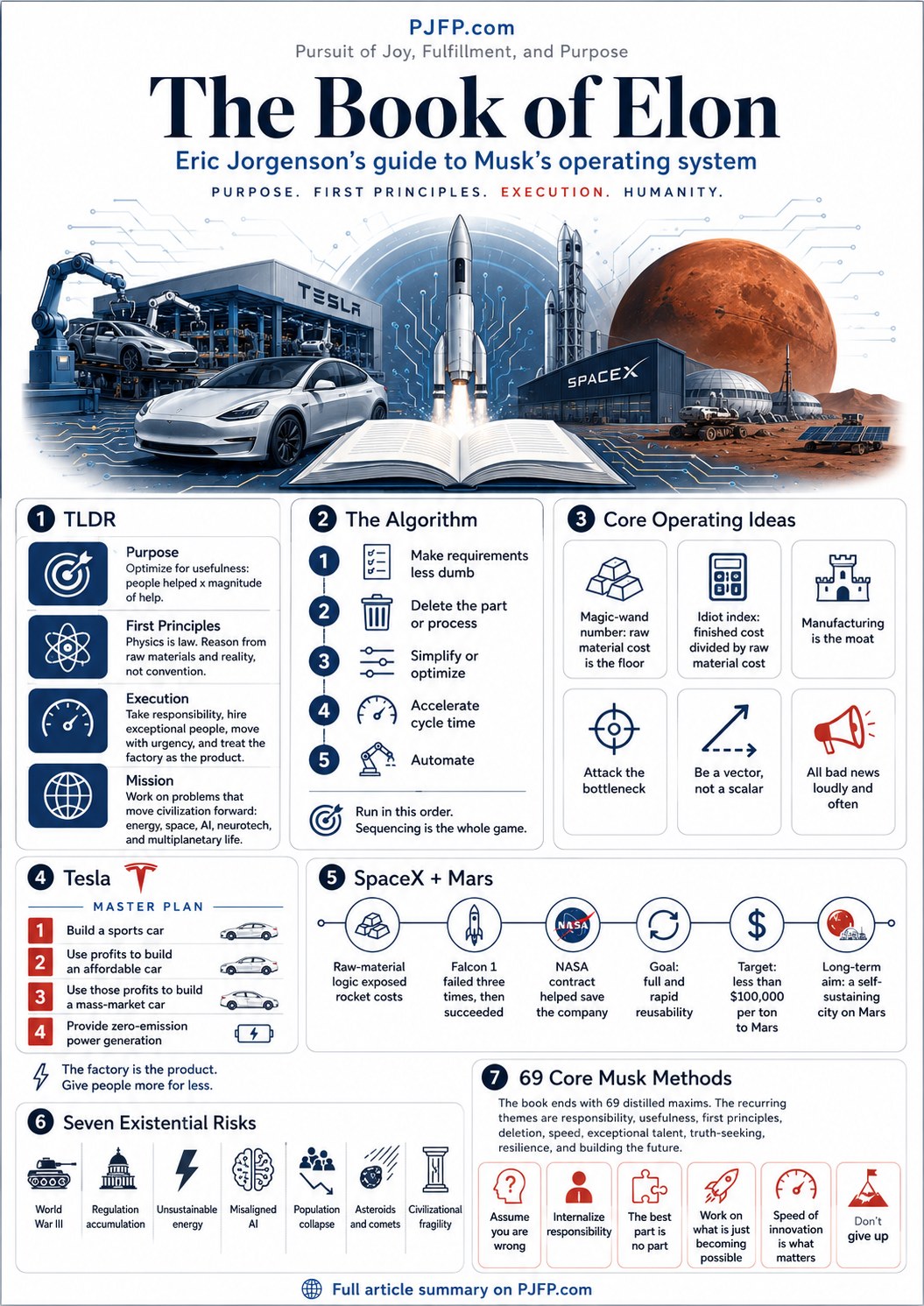
  • The Book of Elon by Eric Jorgenson: Complete Summary of Musk’s Operating System, The Algorithm, The Tesla Master Plan, and the 69 Core Musk Methods

    Infographic summary of The Book of Elon by Eric Jorgenson covering The Algorithm Tesla Master Plan SpaceX Mars and the 69 Core Musk Methods

    Eric Jorgenson’s The Book of Elon: A Guide to Purpose and Success (Magrathea Publishing, 2026) is the third entry in his series of compiled-wisdom books, following The Almanack of Naval Ravikant and The Anthology of Balaji. It is built entirely from Elon Musk’s own words, drawn from transcripts, tweets, and interviews across his career, then recontextualized into a four-part operating manual: Pursue Purpose, Ultra Hardcore Work, Building Companies, and On Behalf of Humanity. The book closes with a bonus list of 69 distilled maxims. Naval Ravikant wrote the foreword and calls it “the only book an entrepreneur needs.” Jorgenson’s stated goal is “one million Musks.” This is a complete, dense summary of every major idea in the book, including The Algorithm verbatim with each of its five steps explained in depth, the Tesla Master Plan, the first-principles battery cost calculation, the SpaceX rocket cost analysis, the seven existential risks, the Mars colonization plan, and the 69 Core Musk Methods in full. Get the book at elonmuskbook.org.

    TLDR

    The Book of Elon argues that Musk’s results are not an accident of genius but the output of a learnable operating system. The system has four layers. Layer one is purpose: optimize your life for usefulness, which Musk defines mathematically as number of people helped multiplied by magnitude of help per person. Layer two is epistemology: reason from physics and raw-material costs, not from analogy or precedent. Layer three is execution: take responsibility, hire only exceptional people, design organizations that route around hierarchy, run at maniacal urgency, and treat the factory as the product. Layer four is mission: pick problems whose solutions move civilization forward (sustainable energy, reusable spaceflight, AI alignment, brain-computer interfaces, multiplanetary life). The book’s single most important operational artifact is The Algorithm, Musk’s five-step engineering process that must be applied in order: make your requirements less dumb, try very hard to delete the part or process, simplify or optimize, accelerate cycle time, automate. The 69 Core Musk Methods at the end of the book are the entire operating system compressed to one-line maxims. Naval frames it as a choice for the reader: when humanity goes to the stars, you can be in the front row cheering or sour-faced in the bleachers jeering, but there is also a third option, which is to copy the methods and build something yourself.

    Key Takeaways

    • Optimize for usefulness, not for money, fame, or comfort. Musk’s daily question is “how can I be useful today” and his success metric is number of people helped multiplied by magnitude of help per person.
    • Five domains will most influence the future: the internet, sustainable energy, space exploration, artificial intelligence, and the genetic rewriting of biology. Pick one and contribute.
    • It is possible for ordinary people to choose to be extraordinary. Convention is optional. The default settings of a culture are not laws of nature.
    • Physics is law. Everything else is a recommendation. If a plan does not violate conservation of energy or any other physical principle, it is at least theoretically possible.
    • First-principles thinking is the antidote to “that’s how it’s always been done.” Break a problem down to atomic constraints (raw material cost, physics, basic operations) and reason up from there. The battery pack example is canonical: people said cells would always cost $600/kWh, but the raw cobalt, nickel, aluminum, carbon, polymers, and steel at London Metal Exchange prices added up to only $80/kWh.
    • Track two ratios on everything you build: the magic-wand number (raw-material cost as a floor for finished cost) and the idiot index (finished cost divided by raw-material cost). Anything with a high idiot index has enormous room for improvement.
    • Aspire to be less wrong. You will not be right every day. Being less wrong most of the time, with a clear feedback loop to reality, is the realistic target.
    • Engineering is magic, and engineers are the magicians of the 21st century. Science discovers what is. Engineering creates what was not.
    • Take responsibility. Musk is CEO of Tesla and SpaceX because he feels responsible for them, not because it improves his quality of life. The worst problems are the CEO’s job, not the best problems.
    • Sleep on the factory floor. Leadership is shared suffering, not delegated comfort. Seeing is believing. If the CEO can do it, the team will do it.
    • Startups are eating glass and staring into the abyss. Glass is the work you do not want to do. The abyss is the constant threat of company death. Both are required.
    • Adversity forges strength. A high ego-to-ability ratio breaks your feedback loop. Suffer enough early to develop the pain threshold needed later.
    • The most important job is attracting exceptional people. Money is not the constraint. Exceptional talent is the constraint.
    • Hire only Special Forces. The minimum passing grade is excellent. A small group of technically strong people will always beat a large group of moderately strong people.
    • Hire for character as much as for skill. Skills are teachable. Attitude is not. Judge a person by the character of their friends and associates and to some degree by their enemies.
    • Camaraderie can be dangerous because it prevents truth-telling. Physics does not care about hurt feelings. It cares about whether you got the rocket right.
    • All bad news should be given loudly and often. Good news can be said quietly and once.
    • Communication should travel via the shortest path necessary to get the job done, not through the chain of command. Anyone should be able to talk to anyone.
    • The organization manifests in the product. Silos produce redundancy, waste, and error. Acronyms and jargon are cognitive pollution.
    • Innovation needs permission to fail. If failure is not an option, you get incremental progress and nothing else.
    • Simplicity creates both reliability and low cost simultaneously. The best part is no part. The best process is no process.
    • The Algorithm, verbatim, in mandatory order: (1) Make your requirements less dumb. (2) Try very hard to delete the part or process. (3) Simplify or optimize. (4) Accelerate cycle time. (5) Automate. See the deep-dive section below for each step in detail.
    • If you are not adding deleted things back in roughly 10 percent of the time, you are not deleting enough. Overcorrect.
    • Requirements must come from a named person, not a department. Requirements from smart people are the most dangerous because you are less likely to question them.
    • Speeding up something that should not exist is absurd. If you are digging your grave, do not dig it faster. Stop digging.
    • Automation is last, not first. Tesla’s Nevada and Fremont factories had to rip out hundreds of expensive robots that had been installed before The Algorithm’s first four steps were complete.
    • A maniacal sense of urgency is the operating principle. The only true currency is time. Every minute lost is gone forever.
    • Speed is both offense and defense. The SR-71 Blackbird has almost no defense except acceleration. Innovating faster is more durable than any patent.
    • Do things in parallel. A factory moving at twice the speed of another factory is basically equivalent to two factories.
    • Be a vector, not a scalar. High speed in the right direction. Course-correct like a guided missile.
    • Manufacturing is underrated. Design is overrated. There is 1,000 to 10,000 percent more work in the production system than in the product itself.
    • The factory is the product. The biggest Tesla epiphany was that what really matters is “the machine that builds the machine.”
    • Attack the constraint. The production line moves at the speed of the slowest, least lucky part. Out of 10,000 things, the one that is not working sets the production rate.
    • Manufacturing is the moat. Maximize economies of scale and maximize manufacturing technology. The combination is uncopyable.
    • Zip2 (1995, started with $2,000) sold to Compaq for over $300 million. Musk’s first major lesson: sell directly to consumers, not through legacy gatekeepers who will misuse the technology.
    • X.com merged with Confinity to become PayPal, which sold to eBay in 2002 for $4.5 billion. Musk had been removed as CEO during a honeymoon trip but did not contest it to avoid disrupting the company during a crisis. “Life is too short for long-term grudges.”
    • Listen well, correct fast. X.com’s initial financial-services conglomerate failed; the email-payments demo worked instantly. Musk pivoted to what the market wanted and powered viral growth (one million customers in year two, no sales force, no marketing spend).
    • Musk reinvested his post-tax PayPal proceeds (~$180 million) split across Tesla (~$70M), SpaceX (~$100M), and SolarCity (~$10M). Costs were 2x his estimates on every company.
    • Tesla Master Plan (August 2006): (1) Build a sports car. (2) Use the profits to build an affordable car. (3) Use those profits to build a mass-market car. (4) Provide zero-emission power generation. The strategy was forced by the economics of new technology: you cannot start at the bottom of the market without scale, so you start with low-volume, high-margin and use the margin to fund scale.
    • Tesla nearly died on Christmas Eve 2008. The final funding round closed at 6 p.m., hours before payroll would have bounced. Musk had moved into Jeff Skoll’s guest bedroom. Daimler then put $50M into Tesla after Musk’s team dropped a Tesla powertrain into a Smart Car that hit 60 mph in 4 seconds.
    • Model 3 production “hell” lasted 2017 to 2019. Musk slept on the Fremont and Nevada factory floors for three years. “The longest period of excruciating pain in my life.”
    • Give people more for less. Don’t spend on advertising. Spend on engineering and design so the product carries itself through word of mouth.
    • SpaceX was founded in mid-2002 with $100 million of Musk’s PayPal money. He expected to lose everything. There was no external funding for three years.
    • SpaceX had budgeted for exactly three failed Falcon 1 launches. Launches 1, 2, and 3 failed (2006, 2007, 2008). Launch 4 succeeded in August 2008. Then NASA called with a $1.6 billion cargo resupply contract, saving SpaceX and indirectly Tesla. Musk reportedly screamed “I LOVE NASA. YOU GUYS ROCK.”
    • Rockets are expensive only because of legacy supply chains, cost-plus contracting, and outsourcing through five layers of subcontractors (“overhead to the fifth power”). The raw materials of a rocket are 1 to 2 percent of finished cost. The half-nozzle jacket Musk uses as an example cost $13,000 but contained $200 of steel.
    • Full and rapid reusability is the holy grail of rocketry. With reuse, only propellant cost remains, which is mostly liquid oxygen and methane at around $1 million per Starship flight.
    • Optimize for the right thing. SpaceX’s actual optimization target is “fastest time to a self-sustaining city on Mars.” That cascades to fastest time to a fully usable rocket, then fastest time to orbit. Early Starship had no doors because doors are not necessary for reaching orbit.
    • Companies are the most reliable engine of progress and the deepest form of philanthropy because they create durable wealth and deploy capital toward problems. “I care about reality. Perception be damned.”
    • The Age of Abundance is coming via AI and humanoid robotics. Optimus and competitors will eventually outnumber humans, removing labor as the economy’s binding constraint. The market for humanoid robots will exceed the market for cars.
    • Tesla’s full self-driving and Robotaxi product is forecast to make Tesla a $10 trillion company. Autonomous cars are worth 5 to 10 times non-autonomous cars because they earn money when their owners are not using them.
    • Neuralink achieved 2 bits per second of brain output with the first patient, Noland Arbaugh. Musk’s 5-year target is one megabit per second. Long-term: consensual telepathy via two BCIs, plus restoration of vision (Blindsight) and eventually multispectral senses (infrared, ultraviolet, radar).
    • Musk’s seven named existential risks: (1) World War III, (2) Regulation accumulation, (3) Unsustainable energy, (4) Misaligned artificial superintelligence, (5) Population collapse, (6) Asteroids and comets, (7) Civilizational fragility itself.
    • Population collapse is the risk most underdiscussed. The US has been below replacement since the early 1970s; sustained only by immigration and longevity. China’s three-child policy failed; the country is 40 percent below replacement. Musk: “We need to revive the idea of having children as a social duty.”
    • Do not force an AI to lie. The HAL 9000 lesson from 2001: A Space Odyssey is that AI given conflicting instructions, one of which is to deceive, becomes dangerous. Truthfulness as a core training objective is the alignment mitigation Musk advocates.
    • Becoming multiplanetary is an evolutionary-scale event. Six milestones in Earth history: single-celled life, multicellular life, plants/animals, ocean-to-land, consciousness, and now multiplanetary life. “At least as important as life going from the oceans to land, probably more significant.”
    • The window of opportunity is open right now. We cannot count on it being open for long. Stephen Hawking estimated roughly 1 percent civilizational-end probability per century. “That’s Russian roulette with 99 empty barrels and every century is a click.”
    • Mars insurance costs less than 1 percent of Earth GDP. The plan: 1,000 Starships per Mars transfer window (every 2 years), eventually a fleet of thousands lifting off together. Target: 1 million tons of cargo and people on Mars by 2044, then a self-sustaining civilization.
    • Mars terraforming options Musk names: thousands of solar reflectors in orbit, or detonating thermonuclear devices over the polar caps as “two little suns” to vaporize CO2 ice, thicken the atmosphere, and eventually create liquid oceans roughly a mile deep covering 40 percent of the planet.
    • Even given pure slower-than-light travel and no new physics, a million-year time horizon allows humanity to colonize the entire galaxy and possibly neighboring galaxies. “We are at the very, very early stage of the intelligence big bang.”
    • The 69 Core Musk Methods at the end of the book are the entire system in maxim form. The full list appears later in this article.

    The Algorithm in Detail: Musk’s 5-Step Engineering Process

    The single most important operational artifact in the book is what Musk calls “The Algorithm.” It is a five-step engineering process he developed and enforces across Tesla, SpaceX, the Boring Company, Neuralink, and xAI. Every part, every process, every line of code, every requirement, every meeting is supposed to be put through these five steps. The order is mandatory. Reordering them is the most common failure mode and the source of nearly every major mistake Musk says he has made at scale (most famously the Nevada and Fremont automation disaster). The book treats The Algorithm as the practical compression of first-principles thinking into a daily ritual.

    The five steps, in mandatory order, in Musk’s own phrasing:

    1. Make your requirements less dumb.
    2. Try very hard to delete the part or process.
    3. Simplify or optimize.
    4. Accelerate cycle time.
    5. Automate.

    The book devotes its longest single chapter to explaining each step, why the order matters, and the specific failure mode that occurs when you skip ahead. Here is every step in depth.

    Step 1: Make Your Requirements Less Dumb

    The first step is the hardest because it is the most psychologically uncomfortable. Musk’s exact framing in the book: “Your requirements are definitely dumb. It does not matter who gave them to you. Requirements from smart people are the most dangerous, because you’re less likely to question them.”

    The operational rule that follows is concrete. Every requirement on every part, process, deliverable, or specification must come from a named human. Not from a department. Not from a regulation document. Not from “the customer.” A name. Track who owns each requirement in writing. If the named person has left the company, retired, or cannot remember why they wrote the requirement, the requirement should be presumed dumb until proven otherwise. Many requirements in any organization are legacy beliefs nobody currently defends. They exist because they existed yesterday and nobody felt empowered to delete them. The Algorithm starts by demanding evidence for every assumption.

    The reason requirements from smart people are especially dangerous is that smart people are persuasive. A specification handed down by a respected engineer carries the implicit authority of “if she said this, there is a reason.” Most of the time there is no reason left, or the reason was contextual to a moment that no longer applies. The Algorithm’s first step is to put every smart-person requirement on equal footing with every dumb-person requirement and force a present-tense justification. If the justification cannot be reconstructed, the requirement is dumb regardless of the author’s IQ.

    The mental shift this step demands is to treat requirements as recommendations and treat the laws of physics as the only fixed authority. Musk repeats this constantly: “All requirements should be treated as recommendations. The only fixed laws are the laws of physics.” Once you internalize that frame, the requirements doc stops being scripture and becomes a draft that is open to revision in every meeting, every day.

    Step 2: Try Very Hard to Delete the Part or Process

    Once the requirements survive scrutiny, the second step is aggressive deletion. The Algorithm’s specific test for whether you are deleting enough: “If you’re not adding deleted things back in 10 percent of the time, you’re clearly not deleting enough.” The 10 percent is a forcing function. If you delete and never have to restore, you are not pushing hard enough; you are leaving safe deletions on the table.

    The book explains why engineers chronically under-delete. Every engineer remembers the painful moment when they deleted something and it turned out to be load-bearing. That memory is so vivid that it overshadows the silent cost of thousands of unnecessary parts that nobody ever questions. The Algorithm corrects for this asymmetry by deliberately overshooting. The instruction is explicit: “We are on a deletion rampage. Nothing is sacred.”

    The application is mechanical. For every part on the bill of materials, every step in the production process, every meeting on the calendar, every requirement in the spec, every line in the documentation, every approval in the workflow: try to delete it. If deleting causes nothing to break for 30 days, leave it deleted. If something breaks and you have to add it back, do so without shame; that is the 10 percent. The maxim that summarizes this step appears multiple times in the book: “The best part is no part. The best process is no process.”

    The canonical example in the book is the fiberglass-mat story. Tesla’s battery pack had a layer of fiberglass mats between the battery cells and the underbody. The mats had a dedicated production process that had been automated, accelerated, and optimized over years. Engineers had spent millions perfecting the glue, the cure time, the cutting tolerances, the robotic placement. Then Musk asked a simple question: “What are these mats for?” The battery team said “noise and vibration.” Musk asked the noise and vibration team. They said “fire safety.” The fire-safety team had no idea where the mats came from. So Musk had two cars built, one with the mats, one without, and put microphones in both. There was no detectable difference. Deleting the part eliminated a $2 million robotics step that had been built up over years. “It was like being in a Dilbert cartoon.”

    The fiberglass-mat story is the entire point of The Algorithm in miniature. Tesla had already automated step five, accelerated step four, optimized step three, and skipped steps one and two entirely. The whole apparatus existed to perfect a part that should not have existed. Steps one and two would have found this in a single meeting.

    Step 3: Simplify or Optimize

    Only after steps one and two have been completed in earnest do you simplify or optimize what is left. Musk’s exact warning: “The most common mistake of smart engineers is to optimize a thing that should not exist.”

    The book argues that this mistake is systematically produced by education. High school and college train convergent logic: you are given a question and graded on the elegance and correctness of your answer. The question itself is never on the table. After 16 to 20 years of this, most engineers, scientists, and analysts are mentally locked into “optimize the question in front of me” mode and physically cannot ask whether the question should be deleted. The Algorithm is designed to override that training. Steps one and two are explicitly the act of questioning the question; only at step three do you finally get to apply the optimization skills that school rewarded.

    What “simplify or optimize” looks like in practice: reduce part counts, combine functions, choose materials that are abundant rather than exotic, eliminate processing steps within a part’s manufacturing, reduce the number of inputs the team needs to track, collapse separate tools into one tool, replace bespoke fasteners with standard ones, replace any custom solution with a commodity solution that is good enough. The book’s framing is that simplicity creates both reliability and low cost at the same time, with no trade-off. A simpler part is cheaper to build, cheaper to inspect, cheaper to repair, fails less often, and breaks in more predictable ways when it does fail. Optimization without simplification almost always increases complexity and therefore increases failure modes.

    The Algorithm treats simplify and optimize as one step but acknowledges they are different operations. Simplify is structural: fewer pieces. Optimize is parametric: better values for the pieces you keep. Both are legal at step three, but neither is legal before steps one and two have been honestly executed.

    Step 4: Accelerate Cycle Time

    Once requirements are minimal, parts are deleted, and what remains is simplified, the fourth step is to go faster. The specific maxim: “Once you’re moving in the right direction, and moving efficiently, you’re moving too slow. Go faster.”

    The reason acceleration comes fourth, not first, is in another Musk line: “Speeding up something that shouldn’t exist is absurd. If you’re digging your grave, don’t dig it faster. Stop digging.” Speed multiplies the value of correct decisions and the cost of incorrect ones. Apply it before steps one through three and you scale your mistakes. Apply it after and you scale your gains.

    Acceleration at step four is everything that compresses the time between iterations. Shorten meetings. Eliminate approval queues. Run things in parallel that were running in series. Move people physically closer to the work so that information travels at the speed of conversation instead of the speed of email. Set aggressive internal deadlines that force the team to find shortcuts they would not otherwise have looked for. Replace any tool, supplier, or process that is slow with one that is faster, even if it is slightly more expensive per unit, because cycle time compounds.

    The book frames acceleration as both offense and defense. As offense, faster iteration lets you out-innovate competitors who are stuck on slower cycles. As defense, the SR-71 Blackbird analogy: the plane has almost no defensive systems because its acceleration is its defense. A company that ships faster than competitors can copy does not need patents, because patents protect static IP and speed protects evolving IP. The maxim Musk repeats is: “A factory moving at twice the speed of another factory is basically equivalent to two factories.” The Colossus supercluster story is the application: xAI built 100,000-GPU infrastructure in 122 days against a supplier estimate of 18 to 24 months, then doubled it in 92 more, by attacking the problem in parallel across building, power, cooling, and networking, all working 24/7 in four shifts.

    Step 5: Automate

    Automation comes last. Always. This is the step where most companies start and where Musk himself made his most expensive single mistake. The book quotes him directly: “The big mistake I made in the Tesla factories in Nevada and Fremont was trying to automate every step too early. To fix that, we had to tear hundreds of expensive robots out of the production line.”

    The reason automation must be last is that automation locks in a process. Once you have built robots, written PLC code, calibrated machine vision systems, and integrated them into your factory floor, the cost of changing the underlying process is enormous. If the process you have automated should not exist (step 2 failure), is more complicated than necessary (step 3 failure), or runs at the wrong cadence (step 4 failure), you have just spent millions of dollars institutionalizing your mistakes. Tesla’s experience was exactly this: robots installed before the underlying process was clean and simple ended up being expensive obstacles to the eventual correct process.

    The correct order is reverse. First make sure the part should exist (step 1). Then delete it if you can (step 2). Then simplify the part and the process around it (step 3). Then run it manually at maximum speed (step 4). Only after a human-run process is fast, simple, and clearly necessary do you automate it. By that point, the automation is purchasing leverage on a known-good system, not freezing a guess.

    The book notes that automation done last is also cheaper to build, because the process being automated is simpler. Automating a 20-step process requires a 20-stage robotic system. Automating the 5-step version of the same process that emerged from steps 1 through 3 requires a 5-stage robotic system. The savings from doing steps 1 through 4 first show up directly in the capital cost of step 5.

    How to Run The Algorithm: The 24-Hour Cadence

    The book treats The Algorithm as a daily practice, not a one-time exercise. Maxim 22 in the 69 Core Musk Methods reads: “For critical items, have meetings every twenty-four hours to run The Algorithm and check progress from yesterday.” For any deliverable that is on the critical path, the team meets daily, walks through the five steps in order, and reports concrete progress on each step. Requirements that survived yesterday are re-questioned today. Parts that survived deletion yesterday are re-evaluated today. Steps three through five proceed in parallel with the continuing daily challenge of steps one and two. The cadence is what prevents The Algorithm from becoming a poster on the wall.

    Common Failure Modes

    The book identifies the specific ways teams skip steps. Skipping step 1 happens when a respected engineer’s requirement is treated as immutable; the fix is to make every requirement come from a named human and be re-justified on demand. Skipping step 2 happens when engineers prefer to optimize a part rather than delete it, because deletion creates immediate visible risk while optimization creates invisible long-term cost; the fix is the 10 percent restoration rule. Skipping step 3 in favor of step 4 happens when management demands speed before the system is clean; the fix is the “digging your grave” check before any acceleration program is approved. Skipping step 4 in favor of step 5 is the most expensive mistake and the one Musk says he personally committed at the Tesla Nevada and Fremont factories; the fix is the explicit rule that humans must run a process at speed before robots are introduced.

    The throughline is that The Algorithm protects you from your own intelligence. Smart engineers are very good at steps three through five. They are bad at steps one and two because the schooling system that produced them never asked them to question the question. The order of The Algorithm is therefore the order in which discomfort decreases. Step 1 is the most uncomfortable. Step 5 is the most fun. Most organizations run the algorithm in fun-first order and pay for it with multimillion-dollar fiberglass-mat-style monuments to optimization without deletion.

    Detailed Summary

    The book’s structure and method

    Jorgenson built the book entirely from Musk’s own words across decades of transcripts, tweets, and interviews. He notes explicitly that he edited for clarity, brevity, and flow, that all material is recontextualized, and that readers should verify phrasing with primary sources before citing. The four parts of the book are presented as a curriculum, not a biography. Part I lays the philosophical foundation. Part II teaches the operating tempo and methods. Part III applies those methods through the actual histories of Zip2, X.com/PayPal, Tesla, SolarCity, and SpaceX. Part IV widens the lens to civilizational risks and the multiplanetary mission. The bonus section, “The 69 Core Musk Methods,” compresses the whole book into a maxim-by-maxim reference. Naval Ravikant’s foreword frames the underlying claim: Musk’s methods are copy-able, and “if your motives are pure and greater than yourself, the world will conspire in its subtle ways to help you.” Jorgenson’s stated dream is “one million Musks.”

    Part I: Pursue Purpose, the foundation of a unique life

    Musk’s daily question is “how can I be useful today.” His success metric is mathematical: total impact equals number of people helped multiplied by magnitude of help per person. He identifies five domains as having the largest possible impact on the future of humanity: the internet, sustainable energy, space exploration, artificial intelligence, and the rewriting of genetics. He repeats that it is possible for ordinary people to choose to be extraordinary, that convention is not law, and that the best work is found at the intersection of what you are good at, what you enjoy, and what improves humanity. He warns against zero-sum thinking, framing the economy as a growable pie rather than a fixed one. He notes that consumer adoption is unreliable as a guide: a 1946 to 1948 survey found 96 percent of people would never buy a television, and Tesla heard the same about electric cars before launch.

    The middle chapter teaches first-principles thinking. The technique is to break a problem into its atomic constituents (raw material costs, physics, basic operations) and reason up from there, ignoring analogy and precedent. The canonical example is battery cells. People said they would always cost about $600 per kilowatt-hour. Musk priced the actual materials at the London Metal Exchange (cobalt, nickel, aluminum, carbon, polymers, steel) and got $80 per kWh, proving cheap EVs were a manufacturing problem, not a physics one. He uses the same technique for rockets, where finished cost is typically 10 to 100 times raw-material cost. The half-nozzle jacket example: $13,000 list price, $200 of actual steel. He names two ratios that operationalize this: the magic-wand number (raw-material floor) and the idiot index (finished cost divided by raw-material cost). High idiot index means high opportunity. He also teaches “thinking in limits”: scale the variable to extreme values to expose hidden constraints, then iterate back to feasible regimes. His tunneling example is illustrative: LA subway costs about $1 billion per mile, but shrinking tunnel diameter from 28 feet to 12 feet drops cross-section 4x, and combining that with continuous tunneling and reinforcement enables an 8x cost improvement.

    The third chapter of Part I makes the case for engineering itself. Science discovers what already exists. Engineering creates what did not. Engineering, Musk says, is magic, and engineers are the magicians of the 21st century. He grounds this historically: Roman military dominance came from metallurgy (martensitic steel swords) and roads (logistical advantage), and Rome fell when its technological edge was matched and routed around. The WW2 Pacific air war was won by the side with the faster innovation loop, not the side that started with better fighters. Nuclear weapons were the ultimate winner-take-all. Tesla’s powertrain is sold to Toyota, Daimler, and Mercedes precisely because it is hard. “If it was easy, they would do it.” The lesson is that durable value sits where the engineering is genuinely difficult, not where the marketing is loud.

    Part II: Ultra Hardcore Work, teams, organization, urgency, manufacturing

    Part II is the operating manual. The first chapter, “What It Takes,” argues that responsibility cannot be delegated. The CEO owns the worst problems, not the best ones. Physical presence and shared suffering communicate commitment more powerfully than any memo, which is why Musk literally sleeps on the factory floor. He talks about the ego-to-ability ratio: high ego breaks your reinforcement-learning loop with reality. He frames startups as “eating glass and staring into the abyss,” where glass is the work you do not want to do and the abyss is the constant threat of company death. He says adversity is the only forge that produces the pain threshold required to run a hard company at scale.

    The teams chapter is uncompromising. The most important job of a leader is attracting exceptional people. Money is not the constraint; exceptional talent is. He runs a Special Forces hiring model: the minimum passing grade is excellence. A small group of technically strong people will always outperform a large group of moderately strong people. Character matters as much as skill, because skills are teachable and attitude is not. The feedback discipline he insists on is hardcore: “All bad news should be given loudly and often. Good news can be said quietly and once.” Camaraderie is dangerous when it suppresses truth. “It’s not your job to make people on your team love you. In fact, that’s counterproductive.”

    The organization-design chapter teaches three rules. First, structure shows up in the product. Silos produce redundancy, waste, and error. Second, communication should travel the shortest path that solves the problem, not the chain of command. Anyone should be able to talk to anyone. Third, jargon and acronyms are cognitive pollution; the test for any internal phrase is whether a new hire would understand it cold. This is the chapter that introduces The Algorithm (covered in depth above).

    Musk runs his companies on what he calls a “maniacal sense of urgency.” The only true currency is time. Speed is both offense (faster innovation than competitors can copy) and defense (the SR-71 Blackbird has almost no defense system except acceleration). The protection of real intellectual property is not patents but rate of innovation; if you ship faster than anyone can copy, you do not need legal moats. He stresses parallelization over serialization. “A factory moving at twice the speed of another factory is basically equivalent to two factories.” Be a vector, not a scalar: high speed in the right direction, with continuous course corrections like a guided missile.

    The Part II close is “We Must Make Stuff.” Manufacturing is underrated and design is overrated. “There is 1,000 percent, maybe 10,000 percent more work that goes into the production system than the product itself.” The factory is the product, not the car. Designing a rocket is trivial compared to making one that reaches orbit. The production line moves at the speed of its slowest, least lucky part. Out of 10,000 things that have to go right, the one that is not working sets the rate. Manufacturing combined with scale becomes the moat. The gigacast machine story illustrates this perfectly: Musk got the idea from toy cars, asked if any law of physics prevented it, surveyed six casting-machine suppliers, five said no, the sixth said maybe, and Tesla used that single innovation to cut the body shop by 30 percent.

    Part III: Building Zip2, PayPal, Tesla, and SpaceX

    Musk left Stanford grad school in 1995 with $110K in debt and founded Zip2 with his brother Kimbal, starting with $2,000 and one computer in a squatted office where he slept on a futon and showered at the YMCA. In 1999, Compaq acquired Zip2 for over $300 million. His after-tax bank account went from $5,000 to $21 million. He immediately rolled $12.5 million of that into X.com, which merged with Confinity in March 2000 to become PayPal. PayPal reached 100,000 customers in its first month and one million by year two with no sales force and no marketing spend. The product traction came from email payments, not from the conglomerate financial-services pitch X.com started with. Musk’s lesson: “listen well, correct fast.” He was removed as CEO during his honeymoon trip in early 2002 but did not contest it, prioritizing company survival over personal vindication. eBay acquired PayPal in October 2002 for $4.5 billion. “Life is too short for long-term grudges.”

    Tesla started in 2003. The original Roadster used a Lotus Elise chassis; the modification added 40 percent weight and invalidated the crash tests. Only 7 percent of Roadster parts ended up shared with the Elise. Musk’s lesson: start clean-sheet, do not modify legacy platforms. The Tesla Master Plan (August 2006) was the sequencing logic: (1) build a sports car, (2) use the profits to build an affordable car, (3) use those profits to build a mass-market car, (4) provide zero-emission power generation. This sequence was forced by the unit economics of new technology, where you cannot start at the bottom of the market without scale.

    Tesla nearly died at the end of 2008. The SolarCity Morgan Stanley deal had collapsed. Tesla and SpaceX were both on the brink. Musk had moved into Jeff Skoll’s guest bedroom because he had no house. The final emergency funding round closed at 6 p.m. on Christmas Eve, hours before payroll would have bounced. Daimler arrived shortly after; Musk’s team rapidly dropped a Tesla powertrain into a Smart Car and got it to 60 mph in 4 seconds, which shocked Daimler into a $50 million investment. Tesla then survived three years of Model 3 manufacturing hell from 2017 to 2019, during which Musk lived in the Fremont and Nevada factories, slept on the floor, and ran around fixing the line. “The longest period of excruciating pain in my life.” His pricing philosophy is “give people more for less”: spend money on engineering and design instead of advertising, and let the product carry word of mouth.

    SpaceX was founded in mid-2002 with $100 million of Musk’s PayPal proceeds. He expected to lose everything; that was his stated expectation going in. There was no external funding for three years. His initial plan was a $90 million Mars greenhouse mission designed to inspire NASA, but he realized the binding constraint was launch cost, not mission design. He tried to buy Russian ICBMs to cut launch costs; that failed. He then ran the first-principles rocket cost analysis, found that finished cost was 50 to 100 times raw-material cost, and concluded the industry’s pricing was a function of cost-plus contracting, five-layer subcontracting, and legacy tech. He budgeted for exactly three failed Falcon 1 launches. Launches 1, 2, and 3 failed (2006, 2007, 2008). Launch 4 succeeded in August 2008. Days later NASA awarded SpaceX a $1.6 billion cargo resupply contract. Musk reportedly screamed “I LOVE NASA. YOU GUYS ROCK.” The fourth-launch success and the NASA call together saved both SpaceX and (indirectly, via Musk’s bank account) Tesla.

    SpaceX’s actual optimization target is “fastest time to a self-sustaining city on Mars.” That goal cascades to “fastest time to a fully usable rocket,” which cascades to “fastest time to orbit.” Early Starship had no doors because doors are not necessary for reaching orbit. The unifying engineering insight is that full and rapid reusability is the holy grail of rocketry, because once a rocket is reusable, the only marginal cost is propellant (mostly liquid oxygen and methane, around $1 million per Starship flight). Current cost per landed ton to Mars is about $1 billion. Starship targets less than $100,000 per ton, a 10,000x improvement. Musk’s philosophy on testing reflects the design constraint: unmanned rockets should be allowed to blow up so the team can learn; crewed systems get extreme conservatism. The Space Shuttle’s safety record suffered precisely because the asymmetry of risk made the program incapable of iteration.

    Part IV: The Age of Abundance, the seven risks, and Mars

    Musk frames his companies as philanthropy, defined by reality rather than perception. “If you care about the reality of goodness instead of the perception of it, philanthropy is extremely difficult.” Companies create durable wealth because they solve real problems at scale, distribute knowledge through products, and deploy capital toward problems rather than store it idle. The companies he names as worth starting today: tunneling (Boring Company), synthetic-RNA medicine (“the digitization of medicine”), and high-speed transport such as Hyperloop (a pressurized electric vehicle in a vacuum tube, faster than aircraft, weather-independent).

    The Age of Abundance chapter argues that AI plus humanoid robotics will eventually remove labor as the binding economic constraint, producing abundance for everyone. Humanoid robots will start in dangerous and repetitive jobs and eventually outnumber humans 2 to 10 to one at less than the cost of a car. Tesla’s full self-driving and Robotaxi will, in Musk’s projection, make Tesla a $10 trillion company because autonomous cars are worth 5 to 10x non-autonomous cars (they earn revenue when owners are not using them). Neuralink achieved 2 bits per second of brain output with first patient Noland Arbaugh; the 5-year target is one megabit per second. Long-term Neuralink applications include consensual telepathy between two BCIs, vision restoration (Blindsight), and multispectral senses. Musk’s framing: humans are already cyborgs through phones and laptops, but the bandwidth to those devices is “poking glass with your meat sticks” and BCIs are the next bandwidth jump.

    The Existential Risks chapter names seven specific risks. World War III: the cycle of major-power war recurs and global thermonuclear conflict could end or maim civilization. Regulation accumulation: laws never die when humans do, regulations compound forever, and eventually everything becomes illegal. California High-Speed Rail is the example: after billions of dollars, it is “almost illegal to build.” Wars historically cleared regulatory cobwebs; peacetime allows infinite accumulation. Unsustainable energy: regardless of climate, hydrocarbons are finite, so the transition must happen. Nuclear plants should not be shut down (coal is 100 to 1,000x worse for health than nuclear). The energy mix is solar plus wind plus batteries plus nuclear plus hydro plus geothermal. Misaligned artificial superintelligence: AI is growing faster than any prior technology, and Musk considers it “a significantly higher risk than nuclear weapons.” The specific mitigation he names is rigorous truth adherence in training. The HAL 9000 lesson from 2001 is that an AI forced to lie becomes dangerous; he cites the Gemini “George Washington wasn’t white” failure as a concrete example of ideological training producing catastrophic outputs at scale. Population collapse: low birth rates are a slow civilizational death. The US has been below replacement since the early 1970s. China is 40 percent below replacement; the three-child policy failed. “We need to revive the idea of having children as a social duty.” Musk himself has 12 children across three women. Asteroids and comets: Earth has no defense against a large comet; Starship gives some capability against small asteroids. Shoemaker-Levy left an Earth-sized hole in Jupiter, and that level of impact on Earth is “game over.” Civilizational fragility itself: every prior civilization fell, and Stephen Hawking estimated roughly 1 percent probability of civilizational end per century. “That’s Russian roulette where 99 barrels are empty. Every century is a click.”

    The closing chapter, Becoming Multiplanetary, places Mars colonization in evolutionary context. Earth has had six milestones in 4 billion years: single-celled life, multicellular life, plants and animals, ocean-to-land transition, consciousness, and (potentially) multiplanetary life. Musk argues this last step is “at least as important as life going from the oceans to land, probably more significant,” because it makes the substrate of consciousness redundant. Sun expansion will destroy Earth in roughly 500 million years; meanwhile self-inflicted or external extinction events are recurring, with five major mass extinctions already in the fossil record and Yellowstone erupting roughly every 700,000 years. The plan: produce 1,000 Starships per year, refuel in orbit, hit 10,000 missions and 1 million tons to Mars by approximately 2044, then build out a self-sustaining city. Mars trips depart in 2-year windows when planets align; Musk’s working schedule is 5 uncrewed missions in 2026 and crewed missions in 2028 if the uncrewed go well (otherwise +2 years). For terraforming, his named options are thousands of solar reflectors in orbit or thermonuclear detonations over the polar caps as “two little suns” to vaporize CO2 ice, thicken the atmosphere, and eventually produce liquid water oceans roughly a mile deep covering 40 percent of the planet. Cost of the entire civilization-insurance bet: less than 1 percent of Earth GDP.

    The 69 Core Musk Methods

    The bonus section compresses the entire book into 69 short maxims, intended as a copy-able reference. They are reproduced here near-verbatim.

    1. You are capable of more than you think.
    2. It is possible for ordinary people to choose to be extraordinary.
    3. You can teach yourself anything. Read widely. Talk to experts.
    4. Assume you are wrong. Aspire to be less wrong.
    5. Internalize responsibility.
    6. If we don’t make stuff, there is no stuff.
    7. Creating products and services creates wealth.
    8. A useful life is worth having lived.
    9. Don’t aspire to glory. Aspire to work.
    10. Take actions that increase the odds of the future being good.
    11. Every day, you either increase the rate of innovation or it slows down.
    12. Work on what is just becoming possible.
    13. Don’t wait for the world to want it. If it should obviously exist, go build it.
    14. Build what no one else is building.
    15. As you move forward, allies will assemble around you.
    16. Prototypes are proof.
    17. Start somewhere. Question assumptions. Adapt to reality.
    18. Reason from fundamentals, not from what others are doing.
    19. The magic-wand number. See the theoretically perfect and work toward it.
    20. Know the idiot index. Understand the cost of components.
    21. The Algorithm: Question Requirements, then Try to Delete, then Simplify, then Accelerate, then Automate.
    22. For critical items, run The Algorithm in 24-hour meetings to check progress.
    23. Stay as close to the actual work as possible. Do not separate yourself from the pain of your decisions.
    24. All requirements should be treated as recommendations.
    25. The only fixed laws are the laws of physics.
    26. The best part is no part. The best process is no process.
    27. Simplicity creates both reliability and low cost.
    28. Find the design necessity of every part and every process.
    29. Overdelete. Add back only the absolutely necessary.
    30. Push for radical breakthroughs.
    31. Be proactive. You will never win unless you take charge of setting the strategy.
    32. A maniacal sense of urgency is the operating principle.
    33. A factory moving at twice the speed of another factory is basically equivalent to two factories.
    34. Attack the bottleneck. The one thing that isn’t working sets the overall production rate.
    35. You’ll move as fast as your least-lucky or least-competent supplier.
    36. Do things in parallel.
    37. Give teams one key metric to focus on. Video games without a score are boring.
    38. Separating design, engineering, and manufacturing is a recipe for dysfunction.
    39. Speed of innovation is what matters.
    40. Beat competitors on speed, quality, and cost. Not anti-competitive behavior.
    41. Test the absurd. When something seems impossible, ask “what would it take.”
    42. Money is not the constraint. Exceptional engineers are.
    43. Get everyone thinking like the chief engineer.
    44. Get a clear, direct feedback loop with reality.
    45. Always be smashing your ego. Ensure ability is greater than ego.
    46. Ask “is this effort resulting in a better product or service.” If not, stop.
    47. Good taste is learnable. Train yourself to notice what makes something beautiful.
    48. Physics doesn’t care about hurt feelings. Make the rocket fly.
    49. Empathy is not an asset.
    50. Use simple, clear, humble terms.
    51. Go directly to the source of information.
    52. When hiring, look for evidence of exceptional ability.
    53. Combine engineering and financial fluency.
    54. To truly lead the product, lead the company.
    55. Lead from the front. Sleep on the factory floor.
    56. Physically move yourself to wherever the problem is. Immediately.
    57. All bad news should be given loudly and often. Good news can be said quietly and once.
    58. Failure is essentially irrelevant unless it is catastrophic.
    59. Fear of failure is the biggest cause of failure.
    60. Feel the fear and do it anyway.
    61. Double down. Push your chips back in.
    62. Work like hell. Every waking hour. Go ultra hardcore.
    63. Make sure you really care about what you’re doing, and take the pain.
    64. We should not be afraid of doing something important just because tragedy is possible.
    65. When something is important enough, do it even if the odds are not in your favor.
    66. Don’t ever give up. You’d have to be dead or completely incapacitated.
    67. Play life like a game.
    68. Go ultra hardcore.
    69. Humor is a differentiator.

    Thoughts

    The most underrated artifact in the book is The Algorithm, and the reason it is underrated is that it looks deceptively simple. Five steps. Anyone can recite them. Almost nobody runs them in order. The book’s central operational insight is that the sequencing is the whole game. People skip step one because it is uncomfortable to confront the fact that requirements they have spent years optimizing against came from somebody whose name they cannot remember. They skip step two because deletion creates risk that materializes immediately and the benefits show up later. They jump to step three because optimization feels like progress and is graded well in school. Then they jump to step five because automation looks impressive on a dashboard. Tesla’s $2M robotics step on the fiberglass mat would never have existed had the team run the steps in order. Most companies, at any scale, are sitting on enormous unrealized value the same way Tesla was, locked behind the simple act of asking “what is this part actually for, who told us we needed it, and would anything bad happen if we deleted it.”

    The second insight worth sitting with is the magic-wand number paired with the idiot index. These two ratios together turn first-principles thinking from a vague aspiration into an operational discipline. Any product you can buy or any process you run has a raw-material cost (the magic-wand number, the absolute floor) and a finished cost. The ratio between them tells you the upper bound on how much you can improve. A high idiot index is not a moral failing of the supplier; it is an unpriced opportunity that competition has not yet found. Once you train yourself to ask these two questions about every line item, the world rearranges. Rockets that cost 50x their steel become a problem to solve. Tunnels that cost a billion dollars per mile become an obvious target. Battery cells that cost 7.5x their materials become a startup. The discipline is not “be smart.” The discipline is “calculate both numbers.”

    The third theme is what the book calls “manufacturing is the moat,” and it is the part of Musk’s playbook that most observers, including most of his competitors, still underestimate. The book’s claim is not that design is unimportant. The claim is that production is between 1,000 and 10,000 percent more effort than design, and that nobody outside of practitioners understands the asymmetry. This is why Toyota and Daimler buy electric powertrains from Tesla rather than make them. It is why SpaceX spent 10 to 100 times more engineering on the Raptor manufacturing system than on the Raptor engine. It is why Apple’s contract manufacturers, not its designers, are the durable moat. The same logic now applies to AI infrastructure: the supercluster, the cooling, the power smoothing, the cabling at 3 a.m., the Megapack buffers, are the actual moat, and the model architecture is the visible-but-cheaper layer on top.

    The fourth theme is the way responsibility, ego, and feedback interact in Musk’s organizations. Most CEOs are insulated from the consequences of their decisions by layers of process and middle management. The result is a high ego-to-ability ratio, because the feedback loop between the ego’s prediction and reality’s response is intermediated to the point of uselessness. Musk’s defense is physical: sleep where the work happens, walk the factory floor at 3 a.m., personally answer the questions, run cabling himself if necessary. This is not theater. The epistemic claim is that decisions made by an insulated CEO are systematically worse than decisions made by a CEO whose body is in the same room as the problem. The cost is severe in personal terms (“the longest period of excruciating pain in my life”), but the alternative is making confident decisions on a model of reality that has drifted out of alignment with the actual machine. The same logic applies to engineers who do not see their designs in production, founders who do not talk to customers, and leaders who delegate the worst problems to people they did not pick.

    The fifth theme is the seven existential risks and why Mars sits at the center of them. The book’s framing is that any single risk is small, but compounded across centuries the probability of civilizational discontinuity is large. Hawking’s 1-percent-per-century estimate, repeated for 10 centuries, gives roughly a 10 percent cumulative probability. Across the timescales humanity has already survived, those odds are unacceptable for a species that can afford a backup. The Mars argument is not romanticism. It is a 1-percent-of-GDP insurance premium on the persistence of consciousness itself. The other six risks (war, regulation accumulation, energy exhaustion, misaligned AI, population collapse, asteroids) are presented in the same actuarial frame: each is independently survivable, but the cost of treating them as low-probability is precisely the cost a previous civilization paid by treating its own near-misses as low-probability until the one near-miss that wasn’t. The most uncomfortable specific risk in the book is population collapse, which is the only one where doing nothing is doing the wrong thing and where the demographic numbers are already locked in for decades regardless of policy response.

    The sixth and final point is the book’s underlying claim, which is also Naval’s claim in the foreword: Musk’s methods are copy-able. The book exists because Jorgenson believes that one million Musks would change the trajectory of the species. The 69 Core Musk Methods are not a personality cult. They are a starter kit. Most people will not pick the same problems, will not have the same tolerance for pain, and will not run the same companies, but anyone can apply The Algorithm to their own work, calculate the idiot index on their own product, demand requirements come from named people, attack the bottleneck on their own line, refuse to automate before deleting, and pick a problem that is on the path to the future. The book is best read as a manual, not a biography. If it ends up next to your laptop and you reread The Algorithm chapter every six months and the 69 Methods every quarter, that is the use Eric and Naval intended.

    Get The Book of Elon by Eric Jorgenson at elonmuskbook.org or wherever you buy books.