PJFP.com

Pursuit of Joy, Fulfillment, and Purpose

Tag: national security

  • US Government Orders Anthropic to Suspend Claude Fable 5 and Mythos 5: Inside the Export Control Directive, the Jailbreak Dispute, and What It Means for Frontier AI

    On June 12, 2026, Anthropic published a statement announcing that the US government, citing national security authorities, has issued an export control directive forcing the company to suspend all access to its newest frontier models, Claude Fable 5 and Claude Mythos 5. The order technically targets foreign nationals inside and outside the United States, including Anthropic’s own foreign national employees, but the practical effect is that both models are going dark for every customer worldwide. It is the first publicly known instance of the US government ordering a deployed frontier AI model offline, and Anthropic is complying while openly disputing the basis for the decision.

    TLDR

    The US government delivered an export control directive to Anthropic at 5:21pm ET on June 12, 2026, suspending all access to Fable 5 and Mythos 5 over an alleged jailbreak of Fable 5’s safeguards. Anthropic says the letter contained no specific details, that the only evidence shared was verbal, and that the technique in question amounts to asking the model to read a codebase and fix software flaws, a capability the company says is freely available from other models including OpenAI’s GPT-5.5 and used daily by cyber defenders. Anthropic defends its defense in depth strategy, notes that thousands of hours of red teaming by the US government, the UK AISI, and third parties found no universal jailbreak, and warns that recalling a commercial model over a narrow, non-universal jailbreak would effectively halt all new frontier model deployments if applied industry-wide. Access to all other Anthropic models, including Claude Opus, Sonnet, and Haiku, is unaffected, and the company says it believes the situation is a misunderstanding and is working to restore access, with more details promised within 24 hours.

    Thoughts

    This is a watershed moment regardless of how it resolves. Governments have blocked AI exports before, but ordering a deployed commercial model recalled out from under hundreds of millions of users is a new kind of intervention, closer to a product recall than a trade restriction. The mechanism matters too. Export control authority aimed at foreign nationals, including a company’s own employees, that cascades into a global shutdown is a blunt instrument doing the work of a regulatory regime that does not exist yet. The US has no statutory process for recalling an AI model, so the government reached for the closest tool on the shelf, and the result is a precedent built on improvisation.

    There is real irony in who got hit first. Anthropic has spent years arguing, publicly and in Washington, that governments should have the power to block unsafe AI deployments. Now the company that asked for a referee is the first one whistled, and its complaint is not about the existence of the power but about the process: a letter at 5:21pm with no specifics, verbal evidence only, and no transparent or technically grounded procedure. That distinction is the whole ballgame for AI governance. A power to halt deployments without due process standards is not regulation, it is discretion, and discretion cuts in every direction depending on who holds it.

    The technical dispute underneath is genuinely interesting because it exposes how unsettled the definition of a dangerous jailbreak is. Anthropic’s account of the offending technique, asking the model to read a specific codebase and fix any software flaws, describes something security teams do on purpose every single day. Vulnerability discovery is the canonical dual use capability: the same analysis that lets a defender patch a hole lets an attacker find one. If the bar for recall is that a model can be coaxed into doing competent security analysis, then every capable model on the market fails that bar, which is exactly Anthropic’s point about GPT-5.5. The hard question the directive dodges is not whether Fable 5 can find bugs but whether it provides meaningful uplift beyond what is already freely available, and Anthropic says it does not.

    For builders, the immediate lesson is uncomfortable: model availability is now a political variable, not just an engineering one. Teams that built directly on Fable 5 lost a production dependency overnight through no fault of Anthropic’s infrastructure, their own code, or any terms of service violation. Multi-model fallback strategies, abstraction layers over providers, and graceful degradation paths just moved from nice-to-have to table stakes for anyone running serious workloads on frontier models. The companies that absorbed this outage gracefully are the ones that assumed any single model could vanish.

    The next 24 hours matter more than the directive itself. Anthropic has promised more details, and the government will face pressure to either substantiate a concern that justifies a global recall or quietly walk it back. Either outcome sets the real precedent. If the directive holds on thin evidence, every frontier lab now operates under the threat of arbitrary shutdown. If it collapses under scrutiny, the case for a formal, transparent statutory process for AI deployment decisions, which Anthropic explicitly endorses in its own statement, gets a lot stronger in Congress than it was a week ago.

    Key Takeaways

    • The US government issued an export control directive on June 12, 2026 suspending all access to Claude Fable 5 and Claude Mythos 5, citing national security authorities.
    • The directive formally targets access by any foreign national, inside or outside the United States, including Anthropic’s own foreign national employees.
    • The net effect is that Anthropic must disable Fable 5 and Mythos 5 for all customers worldwide to ensure compliance, not just for foreign users.
    • Access to all other Anthropic models, including the Claude Opus, Sonnet, and Haiku families, is not affected by the order.
    • Anthropic received the directive at 5:21pm ET the same day it published its statement, and says the letter did not provide specific details of the national security concern.
    • Anthropic’s understanding is that the government believes it has become aware of a method of bypassing, or jailbreaking, Fable 5’s safeguards.
    • Anthropic reviewed a demonstration of the specific technique and says it only identified a small number of previously known, minor vulnerabilities.
    • The company says other publicly available models can discover the same vulnerabilities without requiring any bypass at all.
    • Before launch, Fable 5’s safeguards were red-teamed for thousands of hours in total by the US government, the UK AISI, multiple private third-party organizations, and internal teams.
    • No tester has found a universal jailbreak for Fable 5, meaning a method that broadly bypasses safeguards and unlocks a wide range of cyber capabilities.
    • Anthropic openly states that perfect jailbreak resistance does not appear possible for any model provider today, and that every safeguard in the industry is vulnerable to non-universal jailbreaks.
    • Fable 5 was deployed under a defense in depth strategy: make jailbreaks either narrow or very expensive to produce, then combine that with monitoring to quickly detect and shut down successful attacks.
    • Anthropic’s 30-day customer data retention requirement for Fable exists specifically to support jailbreak research and mitigation, a policy the company says carries real costs with customers.
    • Anthropic says it has not received any disclosure of a concerning non-universal jailbreak that led to a harmful result; disclosed potential jailbreaks were benign or provided no Mythos-specific uplift.
    • The only evidence the government has provided is verbal, describing a narrow, non-universal jailbreak that essentially consists of asking the model to read a specific codebase and fix any software flaws.
    • Anthropic reviewed a report it believes is the basis of the directive and validated that the capability level shown is widely available from other models, including OpenAI’s GPT-5.5, and is used every day by cyber defenders.
    • Anthropic is complying with the legal directive while explicitly disagreeing that a narrow potential jailbreak justifies recalling a commercial model deployed to hundreds of millions of people.
    • The company warns that if this recall standard were applied across the industry, it would essentially halt all new model deployments for every frontier model provider.
    • Anthropic supports government power to block unsafe deployments in principle, but only through a statutory process that is transparent, fair, clear, and grounded in technical facts, and says this action meets none of those principles.
    • Anthropic apologized to customers, called the situation a misunderstanding, said it is working to restore access as soon as possible, and promised more details within 24 hours.

    Detailed Summary

    What the directive actually does

    The order arrived as a letter from the US government at 5:21pm ET on June 12, 2026, invoking national security authorities under export control law. On paper it suspends access to Fable 5 and Mythos 5 by any foreign national, whether inside or outside the United States, a category that includes some of Anthropic’s own employees. In practice, Anthropic says compliance requires abruptly disabling both models for every customer, since there is no clean way to enforce a nationality-based access boundary across a global product. The letter did not spell out the specific national security concern. Everything else in Anthropic’s statement is the company’s own reconstruction of what prompted the action.

    The jailbreak at the center of the dispute

    Anthropic’s understanding is that the government became aware of a method for bypassing Fable 5’s safeguards. The company reviewed a demonstration of the technique and characterizes the results as a small number of previously known, minor vulnerabilities, all relatively simple, all discoverable by other publicly available models without any jailbreak at all. According to Anthropic, the government’s evidence so far has been entirely verbal, and the technique boils down to asking the model to read a specific codebase and fix any software flaws. The company reviewed a report it believes underlies the directive and validated that the displayed capability is widely available elsewhere, naming OpenAI’s GPT-5.5 directly, and noted that this exact kind of analysis is what defenders use to keep systems safe.

    Anthropic’s defense in depth posture

    The statement restates the safety posture Anthropic laid out at Fable 5’s launch. The safeguards around cybersecurity tasks are strong enough that users have complained they are overly broad. In the weeks before launch, the US government, the UK AISI, multiple private third-party organizations, and internal teams red-teamed the safeguards for thousands of hours combined, and those tests showed Fable’s protections to be substantially more effective than any previously deployed model. No tester found a universal jailbreak. Anthropic is candid that perfect jailbreak resistance is likely impossible for anyone today, which is why the strategy is defense in depth: keep jailbreaks narrow or expensive, monitor aggressively, and shut down attacks fast. The 30-day customer data retention requirement on Fable exists to support that monitoring and mitigation loop. The company says this posture makes Fable’s risks comparable to models already deployed across the industry.

    Complying while disputing the standard

    Anthropic is removing access for all users as legally required, but the statement draws a hard line on the principle. The company disagrees that a narrow potential jailbreak, one that produced no disclosed harmful result, justifies recalling a commercial model serving hundreds of millions of people. Its broader warning is that this standard, applied evenly, would halt all new frontier model deployments industry-wide, since every provider’s safeguards are vulnerable to narrow jailbreaks. Anthropic also turns its own policy position into a critique: the company has publicly supported giving government the ability to block unsafe deployments, but through a statutory process that is transparent, fair, clear, and grounded in technical facts, and it says this action does not adhere to those principles.

    What happens next

    Anthropic closed by apologizing to customers, calling the situation a misunderstanding, and committing to restore access as soon as possible. The company promised to share more details over the next 24 hours, which makes this a developing story. The open questions are whether the government substantiates its concern with written technical evidence, whether the directive survives that scrutiny, and whether this episode accelerates the formal statutory process for AI deployment decisions that Anthropic says should have governed the action in the first place.

    Notable Quotes

    “The net effect of this order is that we must abruptly disable Fable 5 and Mythos 5 for all our customers to ensure compliance.”

    Anthropic, on why a directive aimed at foreign nationals becomes a global shutdown

    “We received the directive from the government today at 5:21pm (ET). The letter did not provide specific details of its national security concern.”

    Anthropic, on the abruptness and opacity of the order

    “These vulnerabilities all appear relatively simple, and we have found that other publicly-available models are able to discover them as well without requiring a bypass.”

    Anthropic, on its review of the demonstrated jailbreak technique

    “We suspect that perfect jailbreak resistance is not currently possible for any model provider.”

    Anthropic, restating the position it disclosed at Fable 5’s launch

    “We stand by this defense in depth strategy. It reduces the risks posed by Fable, making them comparable to the risks of existing models already deployed across the industry.”

    Anthropic, defending its layered safeguards approach

    “To date, the government has only given us verbal evidence of a potential narrow, non-universal jailbreak, which essentially consists of asking the model to read a specific codebase and fix any software flaws.”

    Anthropic, describing the technique behind the directive

    “However, we disagree that the finding of a narrow potential jailbreak should be cause for recalling a commercial model deployed to hundreds of millions of people.”

    Anthropic, on complying while contesting the decision

    “If this standard was applied across the industry, we believe it would essentially halt all new model deployments for all frontier model providers.”

    Anthropic, on the industry-wide implications of the recall standard

    “As we have stated publicly, we believe the government should have the ability to block unsafe deployments, as part of a statutory process that is transparent, fair, clear, and grounded in technical facts. This action does not adhere to those principles.”

    Anthropic, on the kind of oversight process it says should have governed the action

    “We apologize for this disruption to our customers. We believe this is a misunderstanding and are working to restore access as soon as possible.”

    Anthropic, closing its statement to customers

    Read the full statement on Anthropic’s site here.

    Related Reading

  • Treasury Secretary Scott Bessent Unpacks Trump’s Global Tariff Strategy: A Blueprint for Middle-Class Revival and Economic Rebalancing

    TLDW:

    Treasury Secretary Scott Bessent explained Trump’s new global tariff plan as a strategy to revive U.S. manufacturing, reduce dependence on foreign supply chains, and strengthen the middle class. The tariffs aim to raise $300–600B annually, funding tax cuts and reducing the deficit without raising taxes. Bessent framed the move as both economic and national security policy, arguing that decades of globalization have failed working Americans. The ultimate goal: bring factories back to the U.S., shrink trade deficits, and create sustainable wage growth.


    In a landmark interview, Treasury Secretary Scott Bessent offered an in-depth explanation of former President Donald Trump’s sweeping new global tariff regime, framing it as a bold, strategic reorientation of the American economy meant to restore prosperity to the working and middle class. Speaking with Tucker Carlson, Bessent positioned the tariffs not just as economic policy but as a necessary geopolitical and domestic reset.

    “For 40 years, President Trump has said this was coming,” Bessent emphasized. “This is about Main Street—it’s Main Street’s turn.”

    The tariff package, announced at a press conference the day before, aims to tax a broad range of imports from China, Europe, Mexico, and beyond. The approach revives what Bessent calls the “Hamiltonian model,” referencing founding father Alexander Hamilton’s use of tariffs to build early American industry. Trump’s version adds a modern twist: using tariffs as negotiating leverage, alongside economic and national security goals.

    Bessent argued that globalization, accelerated by what economists now call the “China Shock,” hollowed out America’s industrial base, widened inequality, and left much of the country, particularly the middle, in economic despair. “The coasts have done great,” he said. “But the middle of the country has seen life expectancy decline. They don’t think their kids will do better than they did. President Trump is trying to fix that.”

    Economic and National Security Intertwined

    Bessent painted the tariff plan as a two-pronged effort: to make America economically self-sufficient and to enhance national security. COVID-19, he noted, exposed the fragility of foreign-dependent supply chains. “We don’t make our own medicine. We don’t make semiconductors. We don’t even make ships,” he said. “That has to change.”

    The administration’s goal is to re-industrialize America by incentivizing manufacturers to relocate to the U.S. “The best way around a tariff wall,” Bessent said, “is to build your factory here.”

    Over time, the plan anticipates a shift: as more production returns home, tariff revenues would decline, but tax receipts from growing domestic industries would rise. Bessent believes this can simultaneously reduce the deficit, lower middle-class taxes, and strengthen America’s industrial base.

    Revenue Estimates and Tax Relief

    The expected revenue from tariffs? Between $300 billion and $600 billion annually. That, Bessent says, is “very meaningful” and could help fund tax cuts on tips, Social Security income, overtime pay, and U.S.-made auto loan interest.

    “We’ve already taken in about $35 billion a year from the original Trump tariffs,” Bessent noted. “That’s $350 billion over ten years, without Congress lifting a finger.”

    Despite a skeptical Congressional Budget Office (CBO), which Bessent compared to “Enron accounting,” he expressed confidence the policy would drive growth and fiscal balance. “If we put in sound fundamentals—cheap energy, deregulation, stable taxes—everything else follows.”

    Pushback and Foreign Retaliation

    Predictably, there has been international backlash. Bessent acknowledged the lobbying storm ahead from countries like Vietnam and Germany, but said the focus is on U.S. companies, not foreign complaints. “If you want to sell to Americans, make it in America,” he reiterated.

    As for China, Bessent sees limited retaliation options. “They’re in a deflationary depression. Their economy is the most unbalanced in modern history.” He believes the Chinese model—excessive reliance on exports and suppressed domestic consumption—has been structurally disrupted by Trump’s tariffs.

    Social Inequality and Economic Reality

    Bessent made a compelling moral and economic case. He highlighted the disparity between elite complaints (“my jet was an hour late”) and the lived reality of ordinary Americans, many of whom are now frequenting food banks while others vacation in Europe. “That’s not a great America,” he said.

    He blasted what he called the Democrat strategy of “compensate the loser,” asserting instead that the system itself is broken—not the people within it. “They’re not losers. They’re winners in a bad system.”

    DOGE, Debt, and the Federal Reserve

    On trimming government fat, Bessent praised the work of the Office of Government Efficiency (DOGE), headed by Elon Musk. He believes DOGE can reduce federal spending, which he says has ballooned with inefficiency and redundancy.

    “If Florida can function with half the budget of New York and better services, why can’t the federal government?” he asked.

    He also criticized the Federal Reserve for straying into climate and DEI activism while missing real threats like the SVB collapse. “The regulators failed,” he said flatly.

    Final Message

    Bessent acknowledged the risks but called Trump’s economic transformation both necessary and overdue. “I can’t guarantee you there won’t be a recession,” he said. “But I do know the old system wasn’t working. This one might—and I believe it will.”

    With potential geopolitical shocks, regulatory hurdles, and resistance from entrenched interests, the next four years could redefine America’s economic identity. If Bessent is right, we may be watching the beginning of an era where domestic industry, middle-class strength, and fiscal prudence become central to U.S. policy again.

    “This is about Main Street. It’s their turn,” Bessent repeated. “And we’re just getting started.”

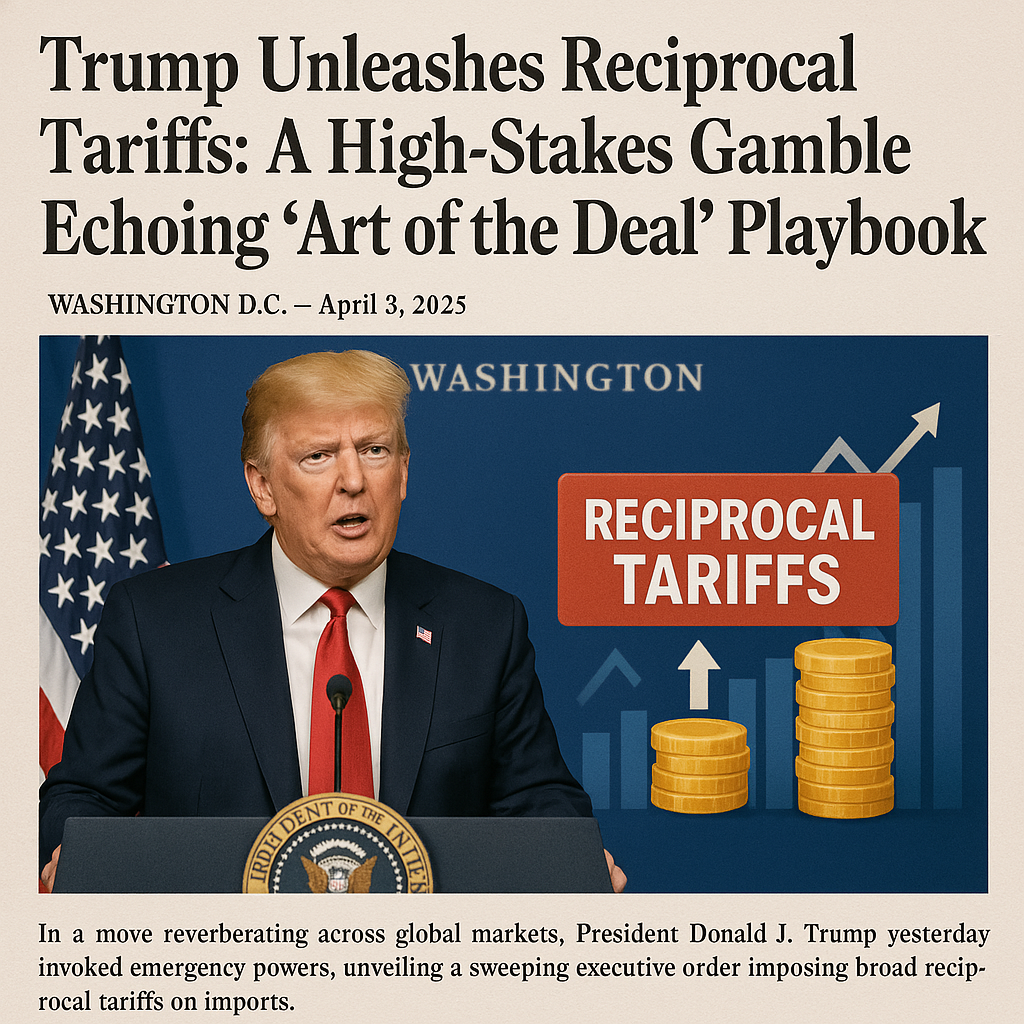
  • Trump Unleashes Reciprocal Tariffs: A High-Stakes Gamble Echoing ‘Art of the Deal’ Playbook

    In a move reverberating across global markets, President Donald J. Trump yesterday invoked emergency powers, unveiling a sweeping executive order imposing broad reciprocal tariffs on imports. Citing large and persistent U.S. goods trade deficits—now reportedly exceeding $1.2 trillion annually—as an “unusual and extraordinary threat to the national security and economy,” the President declared a national emergency, setting the stage for a dramatic reshaping of America’s trade relationships. This bold, confrontational strategy, detailed in the extensive executive order “Regulating Imports with a Reciprocal Tariff,” is being widely interpreted as a direct application of the aggressive deal-making principles famously outlined in Trump’s 1987 bestseller, “The Art of the Deal.”

    The executive order establishes an initial 10% additional ad valorem duty on nearly all imports, set to take effect shortly, with provisions for significantly higher, country-specific tariffs against major trading partners listed in an annex, including economic powerhouses like China and the European Union. This decisive action, rooted in the administration’s “America First Trade Policy,” directly addresses what the order describes as a fundamental lack of reciprocity in global trade, marked by disparate tariff rates, pervasive non-tariff barriers, and foreign economic policies that allegedly suppress wages and consumption abroad, unfairly disadvantaging U.S. producers and contributing to the “hollowing out” of American manufacturing.

    Observers familiar with President Trump’s long-professed business philosophy immediately recognized the hallmarks of “The Art of the Deal” in this expansive policy shift. The book, though focused on real estate, championed principles like thinking big, using leverage relentlessly, fighting back against perceived unfairness, protecting the downside, and employing bravado—all elements seemingly on display in the new tariff regime.

    Thinking Big and Aiming High: The sheer scale of the executive order—a near-universal tariff designed to fundamentally rebalance global trade flows—epitomizes the “think big” mantra central to Trump’s deal-making ethos. Rather than incremental adjustments, the order represents a monumental attempt to overhaul decades of U.S. trade policy, aiming for a dramatic impact rather than marginal gains.

    Leverage as the Ultimate Tool: “The Art of the Deal” emphasizes dealing from strength and creating leverage. The newly imposed tariffs function precisely as that: a powerful lever designed to compel trading partners to lower their own barriers to U.S. goods and address non-reciprocal practices. By making access to the vast U.S. market more costly, the administration aims to force concessions. The order explicitly reserves the right to increase tariffs further should partners retaliate (Sec. 4(b)) or decrease them if partners take “significant steps to remedy” imbalances (Sec. 4(c)), showcasing a dynamic use of leverage akin to high-stakes negotiation.

    Fighting Back and Confrontation: Trump’s book advises fighting back hard when treated unfairly. The executive order frames the trade deficit and associated manufacturing decline as the result of decades of unfair treatment and failed assumptions within the global trading system. The tariffs represent a direct, confrontational response, rejecting the existing framework and aggressively pushing back against trading partners and international norms deemed detrimental to American interests. The justification points fingers at specific higher tariff rates imposed by others (e.g., EU car tariffs, Indian tech tariffs) and a litany of non-tariff barriers detailed in the National Trade Estimate Report.

    Protecting the Downside: While often perceived as a gambler, “The Art of the Deal” preaches conservatism by focusing on protecting the downside. The executive order’s rationale heavily emphasizes protecting America’s “downside”—its national security, economic security, manufacturing base, defense-industrial capacity, and even agricultural sector (noting the shift from surplus to a projected $49 billion deficit). The tariffs are presented as a necessary defensive measure against the threats posed by reliance on foreign supply chains, geopolitical disruptions, and the erosion of domestic production capabilities, including critical military stockpiles.

    Knowing Your Market (and Sticking to Your Guns): Trump’s book advocates for developing a strong “gut feeling” about the market and trusting one’s instincts. The executive order reflects a deeply held conviction about the causes of trade imbalances and the necessity of tariffs, dismissing decades of conventional trade wisdom. It presents a specific diagnosis—failed reciprocity, suppressed foreign consumption (citing lower consumption-to-GDP ratios in China, Germany, etc.)—and prescribes a specific cure, demonstrating persistence in a vision pursued since his first term. The mention of R&D spending shifting overseas further underscores this specific market interpretation.

    Bravado and Getting the Word Out: Issuing such a far-reaching executive order under the banner of a national emergency is inherently a bold, headline-grabbing act, consistent with the “truthful hyperbole” and self-promotion tactics discussed in “The Art of the Deal.” It sends an unmistakable message of resolve to both domestic audiences and international partners, ensuring maximum attention for the administration’s policy goals.

    The order does include exemptions for certain critical goods (pharmaceuticals, semiconductors, energy, critical minerals, detailed in Annex II), previously tariffed steel and aluminum, and initially preserves preferential treatment for USMCA-originating goods from Canada and Mexico (though non-originating goods face duties tied to separate border EOs). It also notes adjustments based on U.S. content, attempts to address transshipment via Hong Kong and Macau, and anticipates changes to de minimis rules.

    However, the core thrust remains a dramatic, unilateral assertion of American economic power, justified by national emergency. Whether this massive gamble, seemingly drawn straight from the “Art of the Deal” playbook, will successfully revitalize American manufacturing, rebalance trade, and strengthen national security—or ignite damaging trade wars and harm consumers—remains the critical question. What is certain is that the President is applying his signature deal-making style to the complex arena of international trade on an unprecedented scale, betting that confrontation and leverage can reshape the global economic landscape in America’s favor. The coming months will reveal the consequences of this high-stakes application of the “art of the deal” to global commerce.


  • Why Every Nation Needs Its Own AI Strategy: Insights from Jensen Huang & Arthur Mensch

    In a world where artificial intelligence (AI) is reshaping economies, cultures, and security, the stakes for nations have never been higher. In a recent episode of The a16z Podcast, Jensen Huang, CEO of NVIDIA, and Arthur Mensch, co-founder and CEO of Mistral, unpack the urgent need for sovereign AI—national strategies that ensure countries control their digital futures. Drawing from their discussion, this article explores why every nation must prioritize AI, the economic and cultural implications, and practical steps to build a robust strategy.

    The Global Race for Sovereign AI

    The conversation kicks off with a powerful idea: AI isn’t just about computing—it’s about culture, economics, and sovereignty. Huang stresses that no one will prioritize a nation’s unique needs more than the nation itself. “Nobody’s going to care more about the Swedish culture… than Sweden,” he says, highlighting the risk of digital dependence on foreign powers. Mensch echoes this, framing AI as a tool nations must wield to avoid modern digital colonialization—where external entities dictate a country’s technological destiny.

    AI as a General-Purpose Technology

    Mensch positions AI as a transformative force, comparable to electricity or the internet, with applications spanning agriculture, healthcare, defense, and beyond. Yet Huang cautions against waiting for a universal solution from a single provider. “Intelligence is for everyone,” he asserts, urging nations to tailor AI to their languages, values, and priorities. Mistral’s M-Saaba model, optimized for Arabic, exemplifies this—outperforming larger models by focusing on linguistic and cultural specificity.

    Economic Implications: A Game-Changer for GDP

    The economic stakes are massive. Mensch predicts AI could boost GDP by double digits for countries that invest wisely, warning that laggards will see wealth drain to tech-forward neighbors. Huang draws a parallel to the electricity era: nations that built their own grids prospered, while others became reliant. For leaders, this means securing chips, data centers, and talent to capture AI’s economic potential—a must for both large and small nations.

    Cultural Infrastructure and Digital Workforce

    Huang introduces a compelling metaphor: AI as a “digital workforce” that nations must onboard, train, and guide, much like human employees. This workforce should embody local values and laws, something no outsider can fully replicate. Mensch adds that AI’s ability to produce content—text, images, voice—makes it a social construct, deeply tied to a nation’s identity. Without control, countries risk losing their cultural sovereignty to centralized models reflecting foreign biases.

    Open-Source vs. Closed AI: A Path to Independence

    Both Huang and Mensch advocate for open-source AI as a cornerstone of sovereignty. Mensch explains that models like Mistral Nemo, developed with NVIDIA, empower nations to deploy AI on their own infrastructure, free from closed-system dependency. Open-source also fuels innovation—Mistral’s releases spurred Meta and others to follow suit. Huang highlights its role in niche markets like healthcare and mining, plus its security edge: global scrutiny makes open models safer than opaque alternatives.

    Risks and Challenges of AI Adoption

    Leaders often worry about public backlash—will AI replace jobs? Mensch suggests countering this by upskilling citizens and showcasing practical benefits, like France’s AI-driven unemployment agency connecting workers to opportunities. Huang sees AI as “the greatest equalizer,” noting more people use ChatGPT than code in C++, shrinking the tech divide. Still, both acknowledge the initial hurdle: setting up AI systems is tough, though improving tools make it increasingly manageable.

    Building a National AI Strategy

    Huang and Mensch offer a blueprint for action:

    • Talent: Train a local workforce to customize AI systems.
    • Infrastructure: Secure chips from NVIDIA and software from partners like Mistral.
    • Customization: Adapt open-source models with local data and culture.
    • Vision: Prepare for agentic and physical AI breakthroughs in manufacturing and science.

    Huang predicts the next decade will bring AI that thinks, acts, and understands physics—revolutionizing industries vital to emerging markets, from energy to manufacturing.

    Why It’s Urgent

    The podcast ends with a clarion call: AI is “the most consequential technology of all time,” and nations must act now. Huang urges leaders to engage actively, not just admire from afar, while Mensch emphasizes education and partnerships to safeguard economic and cultural futures. For more, follow Jensen Huang (@nvidia) and Arthur Mensch (@arthurmensch) on X, or visit NVIDIA and Mistral’s websites.

  • What’s Coming: Ray Dalio on the Changing Domestic and World Orders Under the Trump Administration

    What's Coming: Ray Dalio on the Changing Domestic and World Orders Under the Trump Administration

    Renowned investor and economic thinker Ray Dalio offers a profound analysis of the anticipated shifts in both domestic and international orders under the Trump administration. Dalio emphasizes the importance of understanding these changes to make informed decisions.

    A Giant Renovation of Government

    Dalio predicts two significant transformations:

    1. Domestic Overhaul: A comprehensive renovation aimed at enhancing government efficiency, potentially leading to internal political struggles as this vision unfolds.
    2. “America First” Foreign Policy: A strategic focus on preparing for external conflicts, particularly with China, perceived as America’s most significant threat.

    Corporate Raider Approach to Government

    The administration plans to reform the government akin to a corporate takeover:

    • Leadership Choices:
      • Elon Musk and Vivek Ramaswamy: Set to lead the new Department of Government Efficiency.
      • Matt Gaetz: Nominated for Attorney General, aiming to push legal boundaries.
      • RFK Jr.: Expected to overhaul the healthcare system as Secretary of Health and Human Services.
      • Marco Rubio, Tulsi Gabbard, and Pete Hegseth: Appointed to key defense and intelligence positions.

    Purging the “Deep State”

    A systematic replacement of officials not aligned with the new vision is anticipated:

    • Targeted Agencies: Military, Department of Justice, FBI, SEC, Federal Reserve, among others.
    • Implementation of “Schedule F”: Reclassifying certain government jobs to remove civil service protections.

    Economic Implications

    • Positive Outlook for Wall Street: Deregulation and tax reductions may benefit financial sectors.
    • Tech Sector Freedom: Pro-Trump tech companies might experience fewer restraints.
    • Stimulative Monetary Policies: Potential pressure on the Federal Reserve to ease monetary policies.

    Changing International World Order

    Shift from Post-WWII Systems

    • End of Multilateralism: Moving away from global institutions like the UN and WTO.
    • Law-of-the-Jungle Dynamics: A more self-interested approach with clear allies and adversaries.

    Focus on China

    • Primary Adversary: China’s rising power and ideological differences place it at the center of foreign policy concerns.
    • Capitalism vs. Communism: The age-old ideological battle resurfaces in contemporary contexts.

    Global Alliances and Neutrality

    • Allies: Japan, the UK, and Australia are key, though challenges in collaboration exist.
    • Europe’s Position: Preoccupied with internal issues and hesitant to engage fully.
    • Opportunities for Non-Aligned Countries: Neutral nations may find economic opportunities amidst the U.S.-China rivalry.

    Specific Policy Shifts to Anticipate

    1. Increased Government Influence: A tilt towards achieving national objectives over free-market mechanisms.
    2. Massive Deregulation: Easing restrictions to promote cost-efficient production.
    3. Immigration Actions: Tightening borders and deporting undocumented immigrants with criminal records.
    4. Trade and Tariff Reforms: Adjustments to protect domestic industries and raise revenue.
    5. Challenges with Allies: Navigating relationships with key nations amid shifting priorities.
    6. Economic Costs of Dominance: Balancing the expenses of maintaining global leadership.
    7. Tax Policies: Potential reductions to stimulate productivity and satisfy the electorate.
    8. Healthcare Reforms: Significant changes aimed at overhauling the current system.

    Ray Dalio’s analysis highlights a transformative period under the Trump administration that promises significant changes reshaping both the domestic landscape and international relations. Understanding these shifts is crucial for businesses, policymakers, and individuals alike to navigate the evolving environment effectively.

  • The Race for AGI: America, China, and the Future of Super-Intelligence

    The Race for AGI: America, China, and the Future of Super-Intelligence

    TL;DR

    Leopold Aschenbrenner’s discussion on the future of AGI (Artificial General Intelligence) covers the geopolitical race between the US and China, emphasizing the trillion-dollar clusters, espionage, and the immense impact of AGI on global power dynamics. He also delves into the implications of outsourcing technological advancements to other regions, the challenges faced by AI labs, and the potential socioeconomic disruptions.

    Summary

    Leopold Aschenbrenner, in a podcast with Dwarkesh Patel, explores the rapid advancements towards AGI by 2027. Key themes include:

    1. Trillion-Dollar Cluster: The rapid scaling of AI infrastructure, predicting a future where training clusters could cost trillions and consume vast amounts of power.
    2. Espionage and AI Superiority: The intense state-level espionage, particularly by the Chinese Communist Party (CCP), to infiltrate American AI labs and steal technology.
    3. Geopolitical Implications: How AGI will redefine global power, impacting national security and potentially leading to a new world order.
    4. State vs. Private-Led AI: The debate on whether AI advancements should be driven by state-led initiatives or private companies.
    5. AGI Investment: The challenges and strategies in launching an AGI hedge fund.

    Key Points

    1. Trillion-Dollar Cluster: The exponential growth in AI investment and infrastructure, with projections of clusters reaching up to 100 gigawatts and costing hundreds of billions by 2028.
    2. AI Progress and Scalability: The technological advancements from models like GPT-2 to GPT-4 and beyond, highlighting the significant leaps in capability and economic impact.
    3. Espionage Threats: The CCP’s strategic efforts to gain an edge in the AI race through espionage, aiming to steal technology and potentially surpass the US.
    4. Geopolitical Stakes: The potential for AGI to redefine national power, influence global politics, and possibly trigger conflicts or shifts in the global order.
    5. Economic and Social Impact: The transformative effect of AGI on industries, labor markets, and societal structures, raising concerns about job displacement and economic inequality.
    6. Security and Ethical Concerns: The importance of securing AI developments within democratic frameworks to prevent misuse and ensure ethical advancements.

    Key Takeaways

    1. AGI and Economic Power: The development of AGI could fundamentally change the global economic landscape. Companies are investing billions in AI infrastructure, with projections of trillion-dollar clusters that require significant power and resources. This development could lead to a new era of productivity and economic growth, but it also raises questions about the allocation of resources and the control of these powerful systems.
    2. National Security Concerns: The conversation emphasizes the critical role of AGI in national security. Both the United States and China recognize the strategic importance of AI capabilities, leading to intense competition. The potential for AGI to revolutionize military and intelligence operations makes it a focal point for national security strategies.
    3. Geopolitical Implications: As AGI technology advances, the geopolitical landscape could shift dramatically. The video discusses the possibility of AI clusters being built in the Middle East and other regions, which could introduce new security risks. The strategic placement of these clusters could determine the balance of power in the coming decades.
    4. Industrial Capacity and Mobilization: Drawing parallels to historical events like World War II, the video argues that the United States has the industrial capacity to lead in AGI development. However, this requires overcoming regulatory hurdles and making significant investments in both natural gas and green energy projects.
    5. Ethical and Social Considerations: The rise of AGI also brings ethical and social challenges. The potential displacement of jobs, the impact on climate change, and the concentration of power in a few hands are all issues that need to be addressed. The video suggests that a collaborative approach, including benefit-sharing with other nations, could help mitigate some of these risks.
    6. Strategic Decisions and the Future: The strategic decisions made by companies and governments in the next few years will be crucial. Ensuring that AGI development aligns with democratic values and is not dominated by authoritarian regimes will be key to maintaining a stable and equitable global order.