PJFP.com

Pursuit of Joy, Fulfillment, and Purpose

Tag: open-source

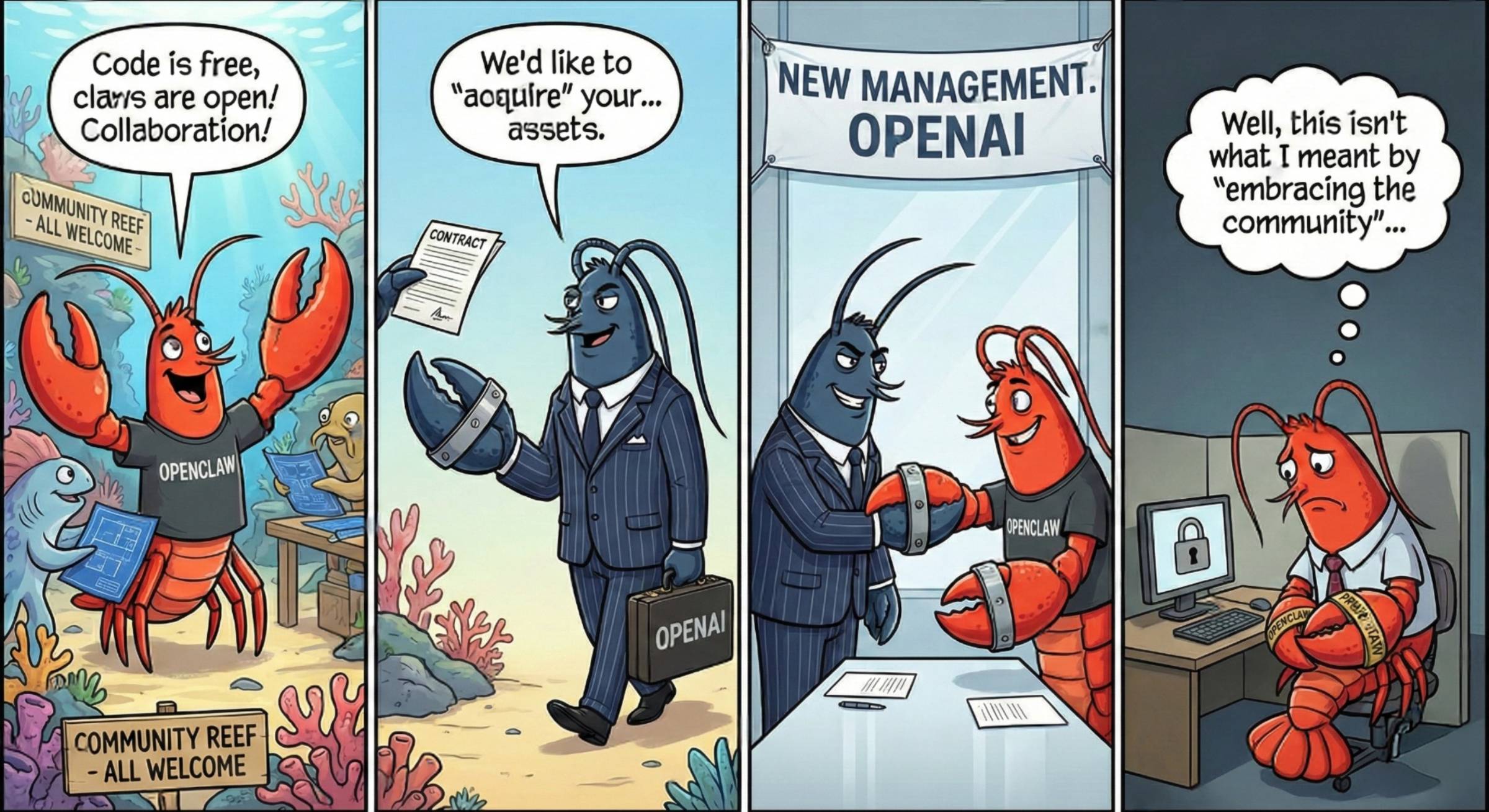
  • OpenAI Hires OpenClaw Creator Peter Steinberger: A Major Shift in the AI Agent Race

    OpenAI Hires OpenClaw Creator Peter Steinberger

    In a move that underscores the intensifying race to dominate AI agent technology, OpenAI has brought aboard Peter Steinberger, the visionary Austrian developer behind the viral open-source project OpenClaw. As reported by Reuters, Fortune, and TechCrunch, the deal was announced on February 15, 2026. This isn’t a conventional acquisition but an “acquihire,” where Steinberger joins OpenAI to spearhead the development of next-generation personal AI agents.

    Meanwhile, OpenClaw transitions to an independent foundation, remaining fully open-source with continued support from OpenAI (confirmed via Steinberger’s Blog and LinkedIn). This strategic alignment comes amid soaring interest in AI agents, a market projected by AInvest to hit $52.6 billion by 2030 with a 46.3% compound annual growth rate.

    The announcement, made via a post on X by OpenAI CEO Sam Altman around 21:39 GMT, arrived just hours before widespread media coverage from outlets like Fortune. Steinberger swiftly confirmed the news in a personal blog post, emphasizing his excitement for the future while reaffirming OpenClaw’s independence.

    The Rise of OpenClaw: From Playground Project to Phenomenon

    OpenClaw, originally launched as Clawdbot in November 2025—a playful nod to Anthropic’s Claude model—quickly evolved into a powerhouse open-source AI agent framework designed for personal use (Fortune, Steinberger’s Blog, APIYI). Steinberger, who “vibe coded” the project solo after a three-year hiatus following the sale of his previous company for over $100 million, saw it explode in popularity. It amassed over 100,000 GitHub stars, drew 2 million visitors in a week, and became the fastest-growing repo in GitHub history—surpassing milestones of projects like React and Linux (Yahoo Finance, LinkedIn).

    A trademark dispute with Anthropic prompted renames: first to Moltbot (evoking metamorphosis), then to OpenClaw in early 2026. The framework empowers AI to autonomously handle tasks on users’ devices, fostering a community focused on data ownership and multi-model support.

    Key capabilities that fueled its hype include:

    • Managing emails and inboxes.
    • Booking flights, restaurant reservations, and flight check-ins.
    • Interacting with services like insurers.
    • Integrating with apps such as WhatsApp and Slack for task delegation.
    • Creating a “social network” for AI agents via features like Moltbook, which spawned 1.6 million agents (Source).

    Despite its success, sustainability proved challenging. Steinberger personally shouldered infrastructure costs of $10,000 to $20,000 monthly, routing sponsorships to dependencies rather than himself, even as donations and corporate support (including from OpenAI) trickled in.

    The Path to the Deal: Billion-Dollar Bids and Open-Source Principles

    Prior to the announcement, Steinberger fielded billion-dollar acquisition offers from tech giants Meta and OpenAI (Yahoo Finance). Meta’s Mark Zuckerberg personally messaged Steinberger on WhatsApp, sparking a 10-minute debate over AI models, while OpenAI’s Sam Altman offered computational resources via a Cerebras partnership to boost agent performance. Meta aggressively pursued Steinberger and his team, but OpenAI advanced in talks to hire him and key contributors.

    Steinberger spent the preceding week in San Francisco meeting AI labs, accessing unreleased research. He insisted any deal preserve OpenClaw’s open-source nature, likening it to Chrome and Chromium. Ultimately, OpenAI’s vision aligned best with his goal of accessible agents.

    Key Announcements and Voices from the Frontlines

    Sam Altman, in his X post on February 15, 2026, hailed Steinberger as a “genius with a lot of amazing ideas about the future of very smart agents interacting with each other to do very useful things for people.” He added, “We expect this will quickly become core to our product offerings. OpenClaw will live in a foundation as an open source project that OpenAI will continue to support. The future is going to be extremely multi-agent and it’s important to us to support open source as part of that.”

    Steinberger’s blog post echoed this enthusiasm: “tl;dr: I’m joining OpenAI to work on bringing agents to everyone. OpenClaw will move to a foundation and stay open and independent. The last month was a whirlwind… When I started exploring AI, my goal was to have fun and inspire people… My next mission is to build an agent that even my mum can use… I’m a builder at heart… What I want is to change the world, not build a large company… The claw is the law.”

    Strategic Implications: Opportunities and Challenges Ahead

    For OpenAI, this bolsters their AI agent push, potentially accelerating consumer-grade solutions and addressing barriers like setup complexity and security. It positions them in the “personal agent race” against Meta, emphasizing multi-agent systems. The broader AI agents market could reach $180 billion by 2033, driving undisclosed but likely substantial financial terms.

    OpenClaw benefits from foundation status (akin to the Linux Foundation), ensuring independence and community focus with OpenAI’s sponsorship.

    However, risks loom large. OpenClaw’s “unfettered access” to devices raises security concerns, including data breaches and rogue actions—like one incident of spamming hundreds of iMessages. China’s industry ministry warned of cyberattack vulnerabilities if misconfigured. Steinberger aims to prioritize safety and accessibility.

    Community Pulse: Excitement, Skepticism, and Satire

    Reactions on X blend hype and caution. Cointelegraph noted the move as a “big move” for ecosystems. One user called it the “birth of the agent era,” while another satirically predicted a shift to “ClosedClaw.” Fears of closure persist, but congratulations abound, with some viewing Anthropic’s trademark push as a “fumble.”

    LinkedIn’s Reyhan Merekar praised Steinberger’s solo feat: “Literally coding alone at odd hours… Faster than React, Linux, and Kubernetes combined.”

    Beyond the Headlines: Vision and Value

    Steinberger’s core vision: Agents for all, even non-tech users, with emphasis on safety, cutting-edge models, and impact over empire-building. OpenClaw’s strengths—model-agnostic design, delegation-focused UX, and persistent memory—eluded even well-funded labs.

    As of February 15, 2026, this marks a pivotal moment in AI’s evolution, blending open innovation with corporate muscle. No further updates have emerged, but the multi-agent future Altman envisions is accelerating.

  • Alibaba Cloud Unveils QwQ-32B: A Compact Reasoning Model with Cutting-Edge Performance

    Alibaba Cloud Unveils QwQ-32B: A Compact Reasoning Model with Cutting-Edge Performance

    In a world where artificial intelligence is advancing at breakneck speed, Alibaba Cloud has just thrown its hat into the ring with a new contender: QwQ-32B. This compact reasoning model is making waves for its impressive performance, rivaling much larger AI systems while being more efficient. But what exactly is QwQ-32B, and why is it causing such a stir in the tech community?

    What is QwQ-32B?

    QwQ-32B is a reasoning model developed by Alibaba Cloud, designed to tackle complex problems that require logical thinking and step-by-step analysis. With 32 billion parameters, it’s considered compact compared to some behemoth models out there, yet it punches above its weight in terms of performance. Reasoning models like QwQ-32B are specialized AI systems that can think through problems methodically, much like a human would, making them particularly adept at tasks such as solving mathematical equations or writing code.

    Built on the foundation of Qwen2.5-32B, Alibaba Cloud’s latest large language model, QwQ-32B leverages the power of Reinforcement Learning (RL). RL is a technique where the model learns by trying different approaches and receiving rewards for correct solutions, similar to how a child learns through play and feedback. This method, when applied to a robust foundation model pre-trained on extensive world knowledge, has proven to be highly effective. In fact, the exceptional performance of QwQ-32B highlights the potential of RL in enhancing AI capabilities.

    Stellar Performance Across Benchmarks

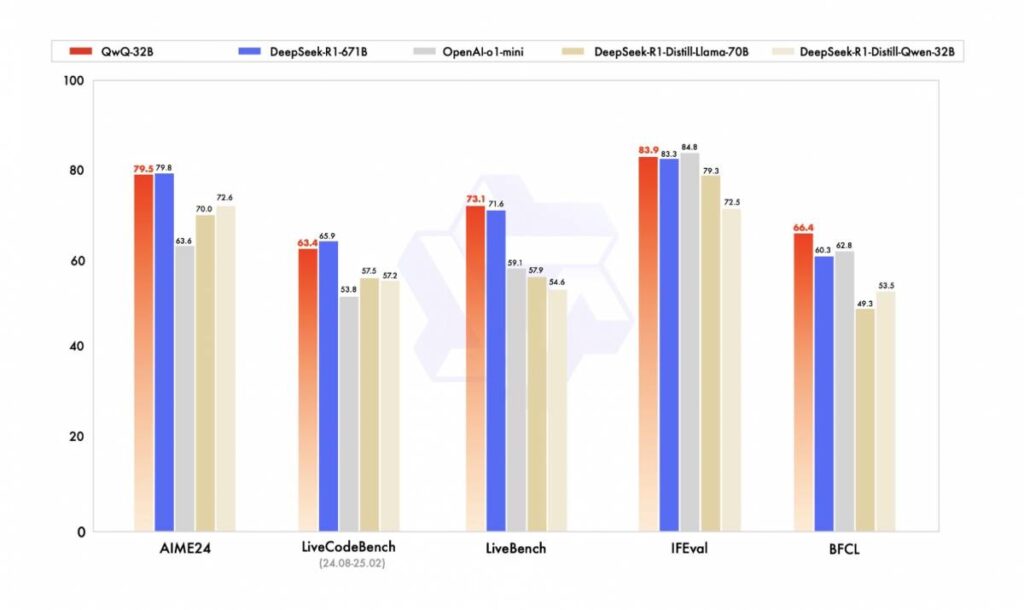
    To test its mettle, QwQ-32B was put through a series of rigorous benchmarks. Here’s how it performed:

    • AIME 24: Excelled in mathematical reasoning, showcasing its ability to solve challenging math problems.
    • Live CodeBench: Demonstrated top-tier coding proficiency, proving its value for developers.
    • LiveBench: Performed admirably in general evaluation tasks, indicating broad competence.
    • IFEval: Showed strong instruction-following skills, ensuring it can execute tasks as directed.
    • BFCL: Highlighted its capabilities in tool and function-calling, a key feature for practical applications.

    When stacked against other leading models, such as DeepSeek-R1-Distilled-Qwen-32B and o1-mini, QwQ-32B holds its own, often matching or even surpassing their capabilities despite its smaller size. This is a testament to the effectiveness of the RL techniques employed in its training. Additionally, the model was trained using rewards from a general reward model and rule-based verifiers, which further enhanced its general capabilities. This includes better instruction-following, alignment with human preferences, and improved agent performance.

    Agent Capabilities: A Step Beyond Reasoning

    What sets QwQ-32B apart is its integration of agent-related capabilities. This means the model can not only think through problems but also interact with its environment, use tools, and adjust its reasoning based on feedback. It’s like giving the AI a toolbox and teaching it how to use each tool effectively. The research team at Alibaba Cloud is even exploring further integration of agents with RL to enable long-horizon reasoning, where the model can plan and execute complex tasks over extended periods. This could be a significant step towards more advanced artificial intelligence.

    Open-Source and Accessible to All

    Perhaps one of the most exciting aspects of QwQ-32B is that it’s open-source. Available on platforms like Hugging Face and Model Scope under the Apache 2.0 license, it can be freely downloaded and used by anyone. This democratizes access to cutting-edge AI technology, allowing developers, researchers, and enthusiasts to experiment with and build upon this powerful model. The open-source nature of QwQ-32B is a boon for the AI community, fostering innovation and collaboration.

    The buzz around QwQ-32B is palpable, with posts on X (formerly Twitter) reflecting public interest and excitement about its capabilities and potential applications. This indicates that the model is not just a technical achievement but also something that captures the imagination of the broader tech community.

    A Bright Future for AI

    In a field where bigger often seems better, QwQ-32B proves that efficiency and smart design can rival sheer size. As AI continues to evolve, models like QwQ-32B are paving the way for more accessible and powerful tools that can benefit society as a whole. With Alibaba Cloud’s commitment to pushing the boundaries of what’s possible, the future of AI looks brighter than ever.

  • The DeepSeek Revolution: Financial Markets in TurmoilA Sputnik Moment for AI and Finance

    The DeepSeek Revolution: Financial Markets in TurmoilA Sputnik Moment for AI and Finance

    On January 27, 2025, the financial markets experienced significant upheaval following the release of DeepSeek’s latest AI model, R1. This event has been likened to a modern “Sputnik moment,” highlighting its profound impact on the global economic and technological landscape.

    Market Turmoil: A Seismic Shift

    The unveiling of DeepSeek R1 led to a sharp decline in major technology stocks, particularly those heavily invested in AI development. Nvidia, a leading AI chip manufacturer, saw its shares tumble by approximately 11.5%, signaling a potential loss exceeding $340 billion in market value if the trend persists. This downturn reflects a broader market reassessment of the AI sector’s financial foundations, especially concerning the substantial investments in high-cost AI infrastructure.

    The ripple effects were felt globally, with tech indices such as the Nasdaq 100 and Europe’s Stoxx 600 technology sub-index facing a combined market capitalization reduction projected at $1.2 trillion. The cryptocurrency market was not immune, as AI-related tokens experienced a 13.3% decline, with notable losses in assets like Near Protocol and Internet Computer (ICP).

    DeepSeek R1: A Paradigm Shift in AI

    DeepSeek’s R1 model has been lauded for its advanced reasoning capabilities, reportedly surpassing established Western models like OpenAI’s o1. Remarkably, R1 was developed at a fraction of the cost, challenging the prevailing notion that only vast financial resources can produce cutting-edge AI. This achievement has prompted a reevaluation of the economic viability of current AI investments and highlighted the rapid technological advancements emerging from China.

    The emergence of R1 has also intensified discussions regarding the effectiveness of U.S. export controls aimed at limiting China’s technological progress. By achieving competitive AI capabilities with less advanced hardware, DeepSeek underscores the potential limitations and unintended consequences of such sanctions, suggesting a need for a strategic reassessment in global tech policy.

    Broader Implications: Economic and Geopolitical Considerations

    The market’s reaction to DeepSeek’s R1 extends beyond immediate financial losses, indicating deeper shifts in economic power, technological leadership, and geopolitical influence. China’s rapid advancement in AI capabilities signifies a pivotal moment in the global race for technological dominance, potentially leading to a reallocation of capital from Western institutions to Chinese entities and reshaping global investment trends.

    Furthermore, this development reaffirms the critical importance of computational resources, such as GPUs, in the AI race. The narrative that more efficient use of computing power can lead to models exhibiting human-like intelligence positions computational capacity not merely as a tool but as a cornerstone of this new technological era.

    DeepSeek’s Strategic Approach: Efficiency and Accessibility

    DeepSeek’s strategy emphasizes efficiency and accessibility. The R1 model was developed using a pure reinforcement learning approach, a departure from traditional methods that often rely on supervised learning. This method allowed the model to develop reasoning capabilities autonomously, without initial reliance on human-annotated datasets.

    In terms of cost, DeepSeek’s R1 model offers a significantly more affordable option compared to its competitors. For instance, where OpenAI’s o1 costs $15 per million input tokens and $60 per million output tokens, DeepSeek’s R1 costs $0.55 per million input tokens and $2.19 per million output tokens. This cost-effectiveness makes advanced AI technology more accessible to a broader audience, including developers, businesses, and educational institutions.

    Global Reception and Future Outlook

    The global reception to DeepSeek’s R1 has been mixed. While some industry leaders have praised the model’s efficiency and performance, others have expressed skepticism regarding its rapid development and the potential implications for data security and ethical considerations.

    Looking ahead, DeepSeek plans to continue refining its models and expanding its offerings. The company aims to democratize AI by making advanced models accessible to a wider audience, challenging the current market leaders, and potentially reshaping the future landscape of artificial intelligence.

    Wrap Up

    DeepSeek’s R1 model has not merely entered the market; it has redefined it, challenging established players, prompting a reevaluation of investment strategies, and potentially ushering in a new era where AI capabilities are more evenly distributed globally. As we navigate this juncture, the pertinent question is not solely who will lead in AI but how this technology will shape our future across all facets of human endeavor. Welcome to 2025, where the landscape has shifted, and the race is on.