PJFP.com

Pursuit of Joy, Fulfillment, and Purpose

Tag: OpenAI revenue

  • OpenAI’s Leaked 2025 Financials: $34 Billion in Spending, a $38.5 Billion Net Loss, and a $17 Billion Microsoft Bill Ahead of Its IPO

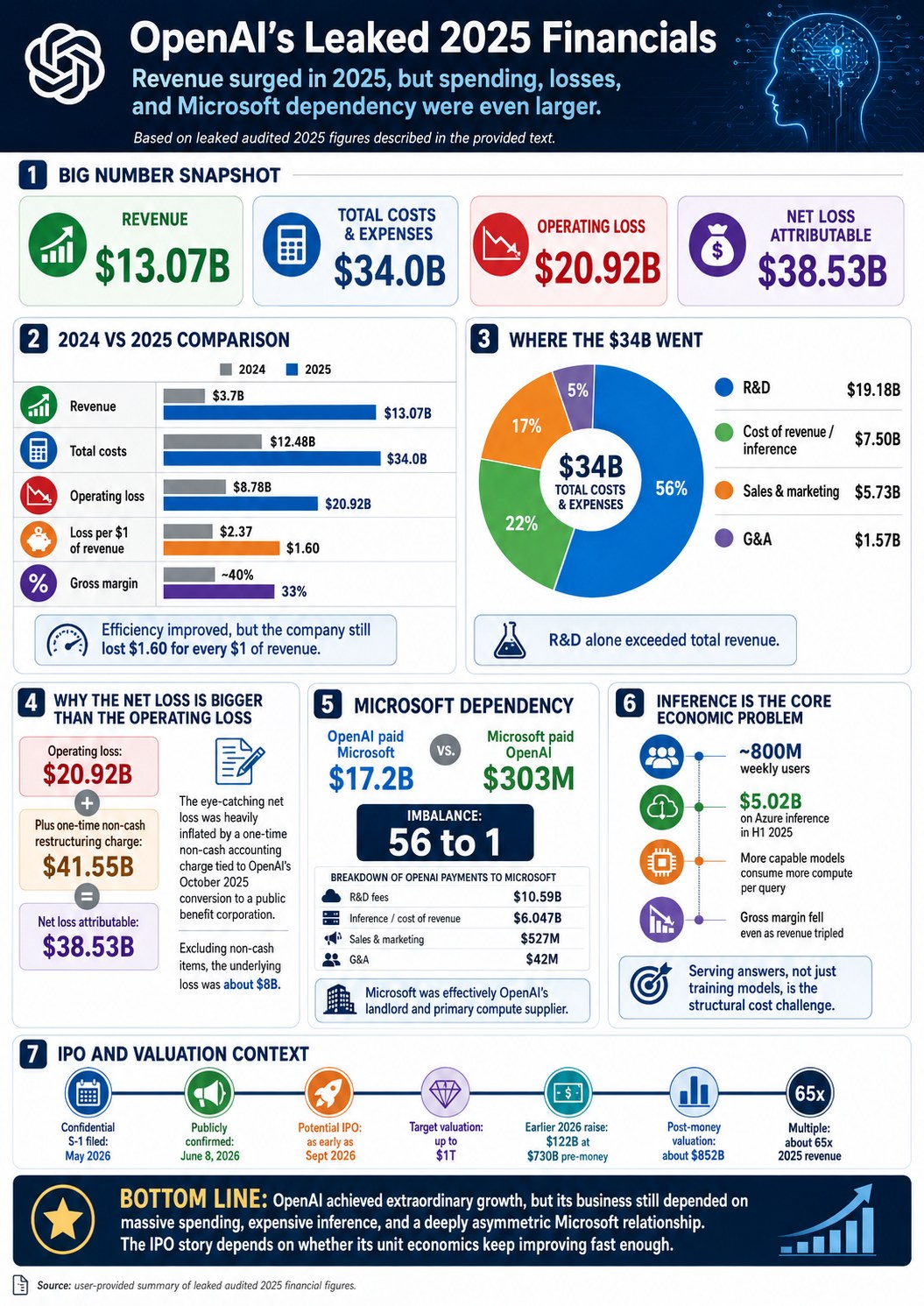
    Infographic summarizing OpenAI leaked 2025 financials: $13.07B revenue, $34B total costs, $20.92B operating loss, $38.53B net loss, where the $34B went, the $17.2B paid to Microsoft versus $303M paid back, inference costs, and IPO valuation context

    OpenAI’s audited 2025 financials leaked this week, and they are the clearest picture yet of what it actually costs to run the company behind ChatGPT. Independent journalist Ed Zitron first published the documents, and the Financial Times independently confirmed them. The headline: OpenAI spent $34 billion last year, booked $13.07 billion in revenue, and reported a net loss attributable to the company of $38.5 billion. The disclosure lands just days after OpenAI confidentially filed for an IPO that could value it north of $1 trillion.

    TLDR

    OpenAI’s audited 2025 numbers, leaked by Ed Zitron and confirmed by the Financial Times, show revenue tripling to $13.07 billion while total costs reached $34 billion, producing a $20.92 billion operating loss and a $38.53 billion net loss attributable to the company. The much larger net loss is inflated by a one-time $41.55 billion non-cash charge tied to OpenAI’s October 2025 conversion from a nonprofit to a public benefit corporation; strip the non-cash items and the loss is closer to $8 billion. R&D alone was $19.18 billion, cost of revenue (inference) was $7.5 billion, and sales and marketing ballooned to $5.73 billion. OpenAI paid Microsoft $17.2 billion in 2025 while Microsoft paid OpenAI only $303 million, exposing a deep Azure dependency. The company burned $1.60 for every dollar of revenue, down from $2.37 in 2024, and gross margin slipped from roughly 40% to 33% as more capable models consumed more compute per query. The leak arrives as OpenAI files a confidential S-1, targets a listing as early as September 2026 at up to a $1 trillion valuation, and races rival Anthropic, which is more valuable on paper and claims it is already turning an operating profit.

    Thoughts

    The most important thing to understand about these numbers is that there are two loss figures and the press will conflate them. The $38.53 billion net loss is the scary headline, but $41.55 billion of it is a non-cash accounting charge from converting investor convertible interests into equity during the for-profit restructuring. That charge is real on the audited statement and it will show up in the eventual S-1, but it is a one-time artifact of OpenAI’s unusual corporate history, not money that left the building. The number that describes the actual business is the $20.92 billion operating loss. That is the one to watch, and it is still enormous.

    The genuinely encouraging line in the whole release is the loss-per-dollar ratio. In 2024 OpenAI spent $2.37 to generate a dollar of revenue. In 2025 that fell to $1.60. A company that is still losing $1.60 on every dollar is not a healthy business, but a company whose efficiency improved by a third in a single year while tripling its top line is at least pointed in a defensible direction. The bull case for OpenAI lives entirely in the slope of that line. If it keeps improving at that rate, the math eventually crosses over. If it stalls, the valuation is a fantasy.

    The Microsoft relationship is the single most revealing disclosure, and it is wildly asymmetric. OpenAI paid Microsoft $17.2 billion in 2025. Microsoft paid OpenAI $303 million. That is a 56-to-1 ratio, and it reframes the partnership: Microsoft is not really a peer or even just an investor, it is OpenAI’s landlord and primary supplier, collecting rent on every model trained and every query answered. The April 2026 renegotiation that capped revenue-share payments at $38 billion through 2030, down from a projected $135 billion, suddenly looks less like a favor and more like OpenAI desperately trying to lower its single largest cost. The dependency cuts both ways, but right now Microsoft holds the better hand.

    The structural problem hiding inside the cost of revenue line is inference. Training a model is a fixed, one-time cost. Serving it is a recurring cost that scales with every one of ChatGPT’s roughly 800 million weekly users. OpenAI spent $5.02 billion on Azure inference in the first half of 2025 alone, and the more capable its reasoning models get, the more compute each answer burns. That is why gross margin went down even as revenue went up. It is the opposite of how software is supposed to work, where the marginal cost of one more user trends toward zero. OpenAI’s marginal cost is real, large, and growing. The counterargument is that per-token inference costs have been falling roughly tenfold a year, so the unit economics could still flip. That is the entire wager.

    Finally, the timing matters more than the numbers. OpenAI’s confidential S-1 means these audited figures were going to become public regardless, since the SEC requires the full prospectus at least 15 days before a roadshow. What the leak changes is who gets to study them first. Prospective IPO buyers, enterprise customers signing multi-year API contracts, and competitors now have the audited books weeks or months early, and they are reading them against Anthropic, which filed at a higher valuation and claims an operating profit. For a company asking the public markets to underwrite a $1 trillion bet on a monopoly outcome that does not yet exist, losing control of the narrative this early is not a small thing.

    Key Takeaways

    • OpenAI’s audited 2025 financials were first published by independent journalist Ed Zitron and independently confirmed by the Financial Times, the first verified look at the company’s books before its planned IPO.
    • Revenue grew from $3.7 billion in 2024 to $13.07 billion in 2025, more than tripling year over year, making OpenAI one of the fastest-growing businesses in history.
    • By the end of 2025 OpenAI was generating roughly $2 billion in monthly revenue, up from about $1 billion a quarter at the end of 2024.
    • Total costs and expenses hit $34 billion in 2025, up from $12.48 billion in 2024.
    • Research and development was the single largest expense at $19.18 billion, up from $7.81 billion, and exceeded total revenue on its own.
    • Of that R&D spend, $10.59 billion went to Microsoft, almost certainly the GPU compute cost of training frontier models on Azure.
    • Cost of revenue, the expense of serving ChatGPT responses (inference), rose from $2.65 billion to $7.5 billion.
    • Sales and marketing jumped from $1.11 billion to $5.73 billion, a 418% increase.
    • General and administrative costs rose from $907 million to $1.57 billion.
    • The operating loss, the truest measure of day-to-day economics, grew from $8.78 billion to $20.92 billion.
    • The net loss attributable to OpenAI was $38.53 billion, up nearly eightfold from $5.09 billion in 2024.
    • The bulk of that jump was a one-time, non-cash $41.55 billion charge from OpenAI’s October 28, 2025 conversion to a public benefit corporation, reflecting the changing fair value of convertible interests and warrant liabilities.
    • Stripping out the restructuring charge and other non-cash items such as stock-based compensation and Microsoft computing credits, the underlying loss was about $8 billion.
    • Including all factors, gross net loss reached $60.35 billion, lowered to the $38.53 billion attributable figure by removing $21.82 billion attributed to noncontrolling and redeemable noncontrolling interests.
    • OpenAI burned $1.60 for every $1 of revenue in 2025, an improvement from $2.37 in 2024, the clearest data point in the bull case.
    • Measured as a percentage of revenue, the operating loss improved from 237% in 2024 to 160% in 2025.
    • In total, OpenAI paid Microsoft $17.2 billion in 2025: $10.59 billion in R&D fees, $6.047 billion in cost of revenue, $527 million in sales and marketing, and $42 million in G&A.
    • Microsoft paid OpenAI just $303 million in the same year, a 56-to-1 imbalance underscoring OpenAI’s Azure dependency.
    • SoftBank paid OpenAI $867 million in 2025.
    • At year-end OpenAI carried $3.64 billion in outstanding payables to Microsoft, plus tens of millions more in accrued and non-current liabilities.
    • OpenAI spent $5.02 billion on Azure inference in just the first half of 2025; Azure inference from 2024 through Q3 2025 totaled $12.43 billion.
    • ChatGPT serves roughly 800 million weekly users, meaning billions of queries a week, each one burning GPU time at Azure’s pricing of about $6.98 per H100 GPU-hour.
    • Gross margin fell from roughly 40% in 2024 to 33% in 2025, because more capable reasoning models consume more compute per query.
    • Research firm Sacra estimates OpenAI’s inference costs reached $8.4 billion in 2025 and will rise to $14.1 billion in 2026, a 68% increase.
    • At year-end OpenAI held just over $50 billion in assets, with almost half in cash.
    • The April 2026 Microsoft renegotiation ended exclusivity and capped revenue-share payments at $38 billion through 2030, down from a projected $135 billion, potentially saving OpenAI up to $97 billion over five years.
    • OpenAI filed a confidential draft S-1 with the SEC around May 22, 2026 and confirmed it publicly on June 8, naming Goldman Sachs and Morgan Stanley as underwriters.
    • The company is targeting a listing as early as September 2026 at a valuation that could exceed $1 trillion, though Sam Altman has said a public offering “may be a while.”
    • OpenAI raised $122 billion earlier in 2026 at a $730 billion pre-money valuation, putting its post-money value around $852 billion.
    • At an $852 billion valuation, OpenAI trades at roughly 65 times its 2025 revenue.
    • Rival Anthropic also filed IPO paperwork this month after raising $65 billion at a $900-$965 billion valuation, making it more valuable on paper than OpenAI, and says it expects to report an operating profit of $559 million in the June quarter.
    • HSBC analysts estimate OpenAI may need more than $207 billion in additional capital through 2030 even under optimistic projections.
    • OpenAI projects profitability by 2029 or 2030; independent analysts put the more likely date at 2031 or later.
    • Bridgewater partner Greg Jensen reportedly told clients the implied revenue multiples price OpenAI for “a monopoly outcome that does not yet exist.”
    • Zitron separately reported OpenAI had a negative 122% non-GAAP operating margin in Q1 2026 and that ChatGPT growth has stalled, with the company projecting paid ChatGPT Plus subscriptions to fall from 44 million in 2025 toward cheaper tiers in 2026.

    Detailed Summary

    How the leak happened and why it matters now

    The audited documents were obtained and first published by Ed Zitron on his newsletter Where’s Your Ed At, then independently verified by the Financial Times, which reviewed the same materials. That dual sourcing matters: this is not a rumor or a model, it is OpenAI’s actual audited financial statement. The timing is the story. OpenAI filed a confidential draft S-1 with the SEC around May 22, 2026 and confirmed it publicly on June 8. Under SEC rules the full prospectus must be released at least 15 days before an investor roadshow, so the 2025 numbers were going to be public soon regardless. The leak simply moved that disclosure forward, handing prospective investors, enterprise customers, and competitors an early look at the books.

    Revenue tripled, costs grew faster

    OpenAI’s revenue rose from $3.7 billion in 2024 to $13.07 billion in 2025, and monthly revenue reached nearly $2 billion by year-end. By almost any normal standard that is spectacular growth. The problem is that costs grew faster, reaching $34 billion against $12.48 billion the year before. The gap between what OpenAI earns and what it spends has widened every year since its founding, and 2025 is the starkest example yet. Revenue alone was outpaced by research and development as a single line item in both of the last two years.

    Two loss numbers, and why both matter

    There are two figures that get cited interchangeably and should not be. The operating loss of $20.92 billion is what the business spent beyond what it earned from operations: training models, serving ChatGPT, paying engineers, running marketing. The net loss attributable to OpenAI of $38.53 billion is far larger because 2025 was the year OpenAI completed its conversion from a nonprofit to a for-profit public benefit corporation, finalized on October 28, 2025. That restructuring triggered a $41.55 billion non-cash charge reflecting the changing fair value of convertible equity interests and warrant liabilities. Before the conversion, investors held convertible interest rights treated as liabilities under US accounting rules and revalued upward as OpenAI’s valuation climbed, creating the charge. It is not expected to recur. Including all minor items, gross net loss reached $60.35 billion, reduced to the $38.53 billion attributable figure after removing $21.82 billion tied to noncontrolling and redeemable noncontrolling interests, primarily the OpenAI Foundation’s stake. Strip the non-cash noise and the underlying loss was about $8 billion.

    Where the $34 billion went

    The spending breaks into four lines. Research and development was $19.18 billion, the largest category, with $10.59 billion of it flowing to Microsoft for training compute. Cost of revenue, the expense of serving responses to users, was $7.5 billion and captures inference, the compute consumed every time someone prompts ChatGPT or calls the API. Sales and marketing reached $5.73 billion, up 418% year over year, a striking jump for a product that grew largely by word of mouth. General and administrative costs added $1.57 billion. The shape of the spending tells you OpenAI is simultaneously racing to build better models, serve a massive and growing user base, and aggressively defend market share through marketing.

    The Microsoft dependency

    The most striking single disclosure is the scale of the Microsoft relationship. OpenAI paid Microsoft $17.2 billion in 2025: $10.59 billion in R&D fees for model training, $6.047 billion in cost-of-revenue for inference serving, $527 million in sales and marketing, and $42 million in G&A. Microsoft paid OpenAI just $303 million the same year. SoftBank paid OpenAI $867 million. The 56-to-1 ratio between what OpenAI pays Microsoft and what Microsoft pays back makes the structural reality plain: Microsoft is OpenAI’s largest landlord. The dynamic began shifting in April 2026, when the two renegotiated, ending Microsoft’s exclusivity and capping revenue-share payments at $38 billion through 2030, down from a projected $135 billion. That could save OpenAI up to $97 billion over five years, though Microsoft keeps its IP license through 2032 and remains the primary cloud partner.

    Why inference is the core problem

    Training happens once. Serving happens billions of times a day. When OpenAI releases a model it spends months and billions on training compute, a fixed cost that falls away when training ends. Inference is the opposite: every ChatGPT message runs through the model on Azure GPU hardware, consuming electricity and compute to generate a response. With roughly 800 million weekly users, that is billions of queries a week, each burning GPU time at roughly $6.98 per H100 GPU-hour on demand. OpenAI spent $5.02 billion on Azure inference in the first six months of 2025 alone. Sacra estimates full-year inference costs of $8.4 billion in 2025, rising to $14.1 billion in 2026. This is why gross margin fell from about 40% to 33% even as revenue tripled: more capable reasoning models consume far more compute per query, and revenue has not kept pace with the cost growth that capability generates.

    What it means for the IPO and the race with Anthropic

    OpenAI was last valued around $852 billion post-money after raising $122 billion in early 2026, which puts it at roughly 65 times 2025 revenue. It has named Goldman Sachs and Morgan Stanley as underwriters and is targeting a listing as early as September 2026 at up to a $1 trillion valuation, though Altman has hedged that it “may be a while” and that staying private might be the better course. HSBC estimates the company may need more than $207 billion in additional capital through 2030. The race is with Anthropic, which filed paperwork the same month after raising $65 billion at a $900-$965 billion valuation, making it more valuable on paper, and which says it expects a $559 million operating profit in the June quarter. The contrast is sharp: the two leading AI labs heading toward public markets at the same time, one bleeding cash at scale, the other claiming profitability, both asking investors to bet on a future that has not arrived.

    Notable Quotes

    “The financial condition of OpenAI is deeply concerning. $38.53 billion in losses are astronomical, and far higher than most believed it would be. Losses also appear to be mounting year-over-year at a dramatic rate, and I’m not sure how this company finds a way toward any kind of sustainability or profitability.”

    Ed Zitron, the independent journalist who published the leaked audited financials

    “It’s unclear what this means, nor how OpenAI reconciled the removal of $3.74 billion in costs. I will not speculate further.”

    Ed Zitron, on a discrepancy he found in the restated 2024 figures

    “OpenAI’s two biggest expenses are R&D and marketing. Budget cuts there, coupled with an ability to raise prices or win new sources of revenue, could see the company move into the black over time. Cutting R&D would be the most difficult part of that, given that AI companies can only hold onto their customers by generating the best-performing models.”

    Jim Edwards, Fortune, on whether OpenAI has a realistic path to profitability

    “What the audited documents make impossible to argue is that the path to profitability is short, clear, or cheap.”

    TechTimes analysis of the leaked OpenAI financials

    The implied revenue multiples price OpenAI for “a monopoly outcome that does not yet exist.”

    Bridgewater partner Greg Jensen, reportedly telling clients how to read OpenAI’s valuation

    “OpenAI spent $34bn last year as the ChatGPT maker poured money into a race to dominate the fast-growing AI market ahead of a planned stock market listing.”

    George Hammond and Bryce Elder, Financial Times, framing the audited 2025 spend

    Read Ed Zitron’s original reporting with the full breakdown here, and the Financial Times confirmation here.

    Related Reading

    • Ed Zitron, Where’s Your Ed At the primary source that broke the audited 2025 financials with the full line-by-line breakdown.
    • OpenAI (Wikipedia) background on the company’s history, structure, and the nonprofit-to-for-profit conversion that drives the non-cash charge.
    • Inference (Wikipedia) on the recurring compute cost that explains why OpenAI’s gross margin shrinks as usage grows.
    • Anthropic the rival lab that filed IPO paperwork the same month at a higher valuation and claims it is already operating at a profit.
    • SEC on confidential filings context for why OpenAI’s audited numbers were headed for public disclosure regardless of the leak.
  • Bubbles, Parabolas and Speed Crashes: How AI Agents Are Ending Human Market Structure and Why This Is Not the Dot-Com Bubble

    The host opens this Saturday morning macro and AI markets video with a direct challenge to anyone calling the current move a bubble. The argument is that the market structure itself has changed, that AI agents now dominate trading and capital allocation, and that Charles Kindleberger’s Manias, Panics, and Crashes describes a world that no longer exists. The full hour-long conversation walks through earnings, PEG ratios, capex, the benchmark arbitrage trapping passive investors, the inflation regime shift, and where money is rotating now. Watch the original video here.

    TLDW

    AI is not a bubble in the Kindleberger sense because the market is no longer dominated by emotional human professionals. AI agents, retail risk-takers, and passive flows are reshaping price discovery while the spend is being funded by free cash flow from the most cash-rich companies in history, not bond-issuance manias like telecoms or oil. Earnings growth is 27 percent, semiconductor sales grew 88 percent year over year in March, OpenAI and Anthropic revenue is on near-vertical curves, Nvidia’s PE is at decade lows even as Cisco’s was 130 at the dot-com peak, and the PEG ratio for the S&P sits at 1.03 with one third of the host’s thematic basket under 1.0 while Microsoft, Amazon, Meta, Apple, and Alphabet all carry richer PEGs. The new regime brings speed crashes instead of multi-year recessions, persistent bottlenecks in power, chips, transportation, and chemicals, inflation pressure that pushes three-month bills below CPI for the first time since the inflation era, and a benchmark arbitrage forcing passive money to chase AI exposure. The host is selling two thirds of his Micron, rotating into Nvidia, Vistra, silver, Bitcoin, and Ethereum, and warning that tokenization launches scheduled for July 26 will be the next major regime change.

    Key Takeaways

    • The word bubble is being misapplied because the same people calling AI a bubble called QE, tariffs, oil, Bitcoin, and passive investing bubbles for fifteen years and were wrong every time.
    • Kindleberger’s Manias, Panics, and Crashes described a slow, linear, human-emotion-driven world. AI agents have no emotion, no memory of Druckenmiller’s 2000 top, and one goal: make money.
    • The simplest test for anyone bearish on AI is to ask how much they use artificial intelligence. If they have not used a tool like OpenClaw or similar agentic systems, they are still operating in the old market regime.
    • This buildout is funded by free cash flow and bond issuance at yields better than US Treasuries from companies with stronger balance sheets than the federal government, unlike the dot-com telecoms or 1970s oil majors.
    • The S&P 500 is up only 7 percent year to date. The bubble framing is being applied to a handful of names, not to broad indices that remain reasonably valued.
    • The agentic stage of AI started in late November and accelerated when OpenClaw went viral at the end of January. Token consumption is set to grow 15 to 50 times from the IQ stage.
    • Anthropic revenue is stair-stepping from 5 to 7 to 9 to 14 to 19 to 24 to 30 billion in annualized run rate, on pace to surpass Alphabet in revenue by mid-2028.
    • OpenAI’s backlog hit 1.3 to 1.4 trillion in the most recent earnings cycle and the company still does not have enough compute.
    • Dario Amodei told the world Anthropic was planning for 10 times growth per year. In Q1 they saw 80 times annualized growth, which is why compute is bottlenecked and Anthropic is renting from Amazon, Google, and Colossus.
    • S&P 500 earnings growth is 27.1 percent year over year. The only quarters that match are those coming out of recessions, and this is not a reopening trade.
    • 320 of 500 S&P companies have reported and the average earnings surprise is 20 percent. Forward estimates are up 25 percent year over year as analysts revise upward against the historical pattern.
    • Total semiconductor sales grew 88 percent year over year in March. Semis have moved in proportion to earnings, not in excess of them.
    • Cisco’s PE was 130 at the dot-com peak. Nvidia’s PE today is the lowest of the last decade because professionals cannot run concentrated positions in single names.
    • The Edward Yardeni PEG ratio for the S&P is 1.03. The hyperscalers are not cheap on PEG: Microsoft 1.4, Amazon 1.66, Meta 1.96, Apple 3, Alphabet near 5. Thirty of ninety-five names in the host’s thematic portfolio carry PEGs under 1.0.
    • Passive investing creates a benchmark arbitrage. Everyone long the S&P 500 through index funds is structurally underweight Intel, Nvidia, Micron, and every name actually going up. Pension funds and mutual funds are forced to chase AI exposure to keep up.
    • BlackRock’s Tony Kim at the Milken conference: compute and model layers added 8 trillion in market cap year to date while the service apps that make up two thirds of GDP lost 1.2 trillion. The benchmark arbitrage is already running.
    • Larry Fink predicted a futures market for computing power. Power plus chips is the oil of the intelligence economy.
    • Jensen Huang called this a 90 trillion dollar AI physical upgrade cycle. The one big beautiful bill bonus depreciation provision was designed to incentivize this capex magic.
    • The host is selling two thirds of his Micron position. The reasoning is the memory market started moving in September of last year, the DRAM ETF is the ninth most traded ETF with billion dollar daily volumes, and exhaustion indicators are flashing red.
    • Money from Micron is rotating into Nvidia, Vistra, silver, Bitcoin, and Ethereum. The view is that the energy and power side of the AI stack is lagging the semis and will catch up next.
    • Silver versus gold has not moved while Micron has gone parabolic. LME metals are breaking out. China is increasing gold purchases significantly month over month.
    • The expected CPI print of 3.7 percent will put three-month Treasury bills below CPI for the first time since the post-pandemic inflation era. That is when Bitcoin started its last major run.
    • Logistics Managers Index hit 69.9 in March, the fastest expansion since March 2022. Transportation prices are surging because there is no capacity. This typically only happens during tax cuts or post-COVID reopenings.
    • Payroll job creation in information, professional services, and financial activities is negative. AI is already replacing knowledge work. Job creation has shifted to mining, manufacturing, construction, trade, transportation, and utilities, which is structurally inflationary.
    • Whirlpool says appliance demand is at great financial crisis lows. The consumer PC and laptop market collapse is worse than 2008. AI is pulling capital and pricing power away from legacy consumer categories.
    • Mike Wilson’s data shows reacceleration across sectors, not just large cap tech. Small caps and median stocks are showing earnings growth too, just at smaller market caps.
    • Chevron’s CEO says global oil shortages are starting. Jeff Currie warns US storage tanks will run empty. Ships are still not transiting the Strait of Hormuz. Countries that learned this lesson will restock to higher inventory levels permanently.
    • The Renmac Bubble Watch threshold was crossed on a technical basis. The host considers technical exhaustion a stronger signal than narrative-driven bubble calls.
    • Goldman Sachs power demand reports, Guggenheim warnings on the power crunch, and BlackRock’s compute intensity research all triangulate on the same conclusion: capex needs are larger than current forecasts.
    • The thematic portfolio is up roughly 30 percent from March lows. Power, optical fiber, advanced packaging, chemicals, and rack-level infrastructure baskets are leading.
    • Sterling Infrastructure (STRL), Fluence batteries, ABB electrification, Hon Hai (Foxconn), Vistra, Eaton, and Soitec are highlighted as names lagging the megacaps but inside the same AI infrastructure trade.
    • John Roque at 22V Research is releasing weekly frozen rope charts, long-base breakouts across power, copper, grid equipment, utilities, natural gas, transportation, capital goods, and agriculture. They all map to the same AI plus inflation regime.
    • Bitcoin ETF outstanding shares hit new highs. BlackRock, Morgan Stanley, and Goldman are all running competitive products. Boomer and wealth manager allocation is accelerating into year end.
    • Tokenization rolls out July 26. Wall Street clearing has enlisted 50 firms. A16Z published their case in December 2024. The host considers this underweighted by most investors and is speaking on the topic at the II event in Fort Lauderdale.
    • Raoul Pal and Yoni Assia on the end of human trading: AI agents and crypto collide by moving finance from human speed to machine speed. Agents will trade, allocate, hedge, and shift capital through wallets and exchanges. Tokenization means ownership becomes programmable.
    • The new regime is bubbles, parabolas, and speed crashes. Corrections compress from years into months. The right strategy is to never go to cash, only to rebalance and slow down within the portfolio.
    • For traders, exhaustion indicators using 5-day and 14-day RSI plus DeMark signals identify potential speed crash setups. Intel and Micron are flashing red on those screens right now.

    Detailed Summary

    Why this is not Kindleberger’s world anymore

    The framing argument of the video is that Manias, Panics, and Crashes described a market dominated by human professionals operating with limited information and lagged feedback loops. When supply and demand fell out of sync, prices collapsed because nobody could see what was happening in real time. That world is gone. AI agents now manage a majority of professional fund flows. Information moves instantaneously. Retail investors trade differently than institutional pros, and the capital structure of the entire market has changed. The host argues that since the Great Financial Crisis, the combination of QE and exponential corporate growth produced the only companies in history worth 25 trillion dollars combined with no net debt. Their AI capex is funded by free cash flow and high-grade bonds, not panicked bond issuance like the dot-com telecoms or oil majors of the 1970s.

    The Druckenmiller anchor and why FOMO is the wrong lens

    The video reads the Stanley Druckenmiller story of buying six billion in tech at the 2000 top and losing three billion in six weeks. Every professional carries that scar. It has shaped a generation of money managers into seeing parabolic moves and immediately calling bubble. The host’s counter is that recession calls from wealthy professionals are themselves a form of hope. Cash-rich investors root for crashes because crashes give them entry points. If the bubble never breaks the way it broke in 2000, those investors stay locked out, and that is precisely what the AI regime is doing.

    Earnings, revenue, and the reality test

    The video walks through current numbers in detail. S&P 500 earnings growth is running 27.1 percent year over year, which only happens coming out of recessions. 320 companies have reported with an average 20 percent earnings surprise. Forward estimates were revised up 25 percent year over year, well above the historical pattern of starting-year estimates getting cut. Total semiconductor sales were up 88 percent year over year in March. Anthropic’s revenue trajectory is stair-stepping from 5 to 30 billion in annualized run rate on the back of Claude Opus 4.5, putting it on track to surpass Alphabet by mid-2028. OpenAI is sitting on a 1.3 to 1.4 trillion backlog and still cannot get enough compute. Dario Amodei told the public Anthropic planned for 10 times growth per year and saw 80 times in Q1.

    PE, PEG, and the valuation argument

    Cisco’s PE at the dot-com peak was 130. Nvidia, the indisputable lead dog of the AI buildout, currently has a PE at the lowest of its last decade. The S&P 500’s PE is roughly where it has been since the post-COVID money printing era, far below the dot-com peak. Edward Yardeni’s PEG ratio for the index sits at 1.03. The host built a PEG screen for his ninety-five name thematic portfolio. Thirty of those names trade at a PEG under 1.0. The hyperscalers everyone holds passively are the expensive ones: Microsoft 1.4, Amazon 1.66, Meta 1.96, Apple 3, Alphabet near 5. The capacity for forward PE compression sits in the names retail and active rotational money are buying, not in the index core.

    The benchmark arbitrage trap

    Most money is now in passive investing. By construction, an S&P 500 or MSCI World allocation is underweight the names that are actually rising. Pension funds, mutual funds, and any active manager benchmarked to those indices is forced to add AI exposure to keep pace. BlackRock’s Tony Kim made this point at Milken: 8 trillion in market cap has accrued to compute and model layers year to date, while service apps representing two thirds of GDP lost 1.2 trillion. The host calls this benchmark arbitrage and considers it the single most underappreciated driver of the current move.

    The 90 trillion dollar physical upgrade cycle

    Jensen Huang’s framing of a 90 trillion dollar AI upgrade includes autos, phones, computers, humanoids, robotics, and the military stack. The host considers this a global race between the US and China. The one big beautiful bill included bonus depreciation specifically to incentivize the capex push. Greg Brockman’s interview with Sequoia made the point that demand for intelligence is effectively unlimited, and that every company outside the hyperscalers, Morgan Stanley, Goldman, Eli Lilly, Merck, United Healthcare, needs their own data center compute or their margins will not keep up with competitors. In a capitalist system, that forces broad enterprise AI spending.

    Speed crashes replace recessions

    The new regime has corrections but they are fast. Since 2020 we have had multiple 20 percent corrections compressed into weeks instead of years. The host expects this pattern to continue for the next decade. Bottlenecks in power, chips, transportation, chemicals, and skilled labor will produce inflation spikes that trigger speed crashes, not traditional credit-cycle recessions. The Logistics Managers Index reading of 69.9 in March, with capacity contraction near record lows, signals exactly this kind of bottleneck environment. The host’s strategy in this regime is to never go to cash, only to rebalance and slow down within the portfolio.

    The inflation regime shift and the rotation out of Micron

    The expected CPI print of 3.7 percent will put three-month Treasury bills below CPI for the first time since the post-pandemic inflation era, restoring negative real yields. That was the condition under which Bitcoin first launched its major bull moves. The host has sold two thirds of his Micron position despite continued bullish conviction on the name, because the memory market is the most stretched on exhaustion indicators and the DRAM ETF is trading at unprecedented volume. The capital is rotating into Nvidia, Vistra, silver, Bitcoin, and Ethereum. Silver versus gold has not moved while semis went parabolic. LME metals are breaking out. China is increasing gold purchases. The energy and power side of the stack is the next leg up.

    AI is breaking the consumer and the labor market

    Whirlpool reports appliance demand at financial crisis lows. PCs and laptops are collapsing worse than 2008. Phones, autos, housing, all the categories Kindleberger’s framework was built around are under pressure because AI is pulling capital and pricing power into compute, power, and chemicals. Payroll job creation in information, professional services, and financial activities is negative as AI takes knowledge work. Job creation is rotating into mining, construction, manufacturing, trade, transportation, and utilities, which is structurally inflationary because those sectors require physical capacity and wages. That combination, wage inflation plus commodity inflation, makes it very difficult for the Fed to ease, even with Kevin Warsh likely taking over.

    Crypto, tokenization, and AI agents at machine speed

    The final section pivots to crypto. Bitcoin ETF outstanding shares hit new highs, BlackRock’s product remains dominant, and Morgan Stanley and Goldman have launched competing vehicles. Wealth managers and boomers are allocating. The Raoul Pal and Yoni Assia conversation on the end of human trading is the host’s headline reference: AI agents will trade, allocate, hedge, and shift capital at machine speed through programmable wallets and exchanges. Tokenization, scheduled for a major launch on July 26 with 50 Wall Street clearing firms onboarded, makes ownership programmable. A16Z laid out the case in December 2024. The host is speaking on tokenization at the II event in Fort Lauderdale May 13 through 15 and considers it the next regime-defining shift after agentic AI.

    Thoughts

    The strongest argument in this video is structural, not narrative. The shift from human professionals with anchored memories to AI agents and benchmark-driven passive flows is a real change in who sets prices. Whether or not you accept the host’s portfolio calls, the framing should make any investor pause before defaulting to dot-com pattern recognition. Cisco’s PE was 130 with no business model. Nvidia’s PE is at a decade low with a near monopoly on the picks and shovels of the largest capex cycle in industrial history. Those facts cannot both be true and produce the same outcome.

    The PEG framework is the cleanest test in the video. If you believe Nvidia, Micron, Intel, and the second-tier AI infrastructure names are bubbles, you are implicitly betting that earnings growth collapses. That bet was viable in 2000 because the companies driving the move had no earnings. It is much harder to bet against earnings growth when 320 companies have just printed a 20 percent average earnings beat and analysts are revising forward estimates up by 25 percent. The host’s argument is not that the prices are reasonable in absolute terms. It is that the bear case requires growth to fall off a cliff, and nothing in the order books, the capex commitments, or the compute backlog suggests that is imminent.

    The benchmark arbitrage point deserves more attention than it gets. If the majority of professional money is locked in passive structures that are by definition underweight the leading names, and if those managers are evaluated quarter to quarter against the benchmark they cannot match, the pressure to chase will compound. This is the opposite of the dot-com setup, where active managers were forced to add overpriced tech to keep up with the index. Here, the index itself is structurally underweight the trade, and the active managers chasing it are doing so against names with rational PEG ratios.

    The rotation thesis from Micron into power, silver, and crypto is more debatable. The energy and bottleneck story is real, but the timing of when the power trade catches up with the semi trade is the hard part. The host’s discipline of never going to cash and rebalancing through the cycle is a sensible response to a regime that produces speed crashes rather than slow drawdowns. The investors most hurt by this regime will not be the ones who are long the wrong names. They will be the ones who sit out waiting for an entry point that never comes.

    Tokenization is the most underappreciated thread in the video. If the July 26 rollout brings 50 clearing firms and real ownership programmability online, the second half of the year could produce a regime shift on top of the AI regime shift. AI agents transacting on tokenized assets at machine speed is the logical endpoint of the trends the host has been tracking, and it is the part of his framework that current market consensus has not yet priced.

    Watch the full conversation here.