PJFP.com

Pursuit of Joy, Fulfillment, and Purpose

Tag: openai valuation

  • OpenAI’s Leaked 2025 Financials: $34 Billion in Spending, a $38.5 Billion Net Loss, and a $17 Billion Microsoft Bill Ahead of Its IPO

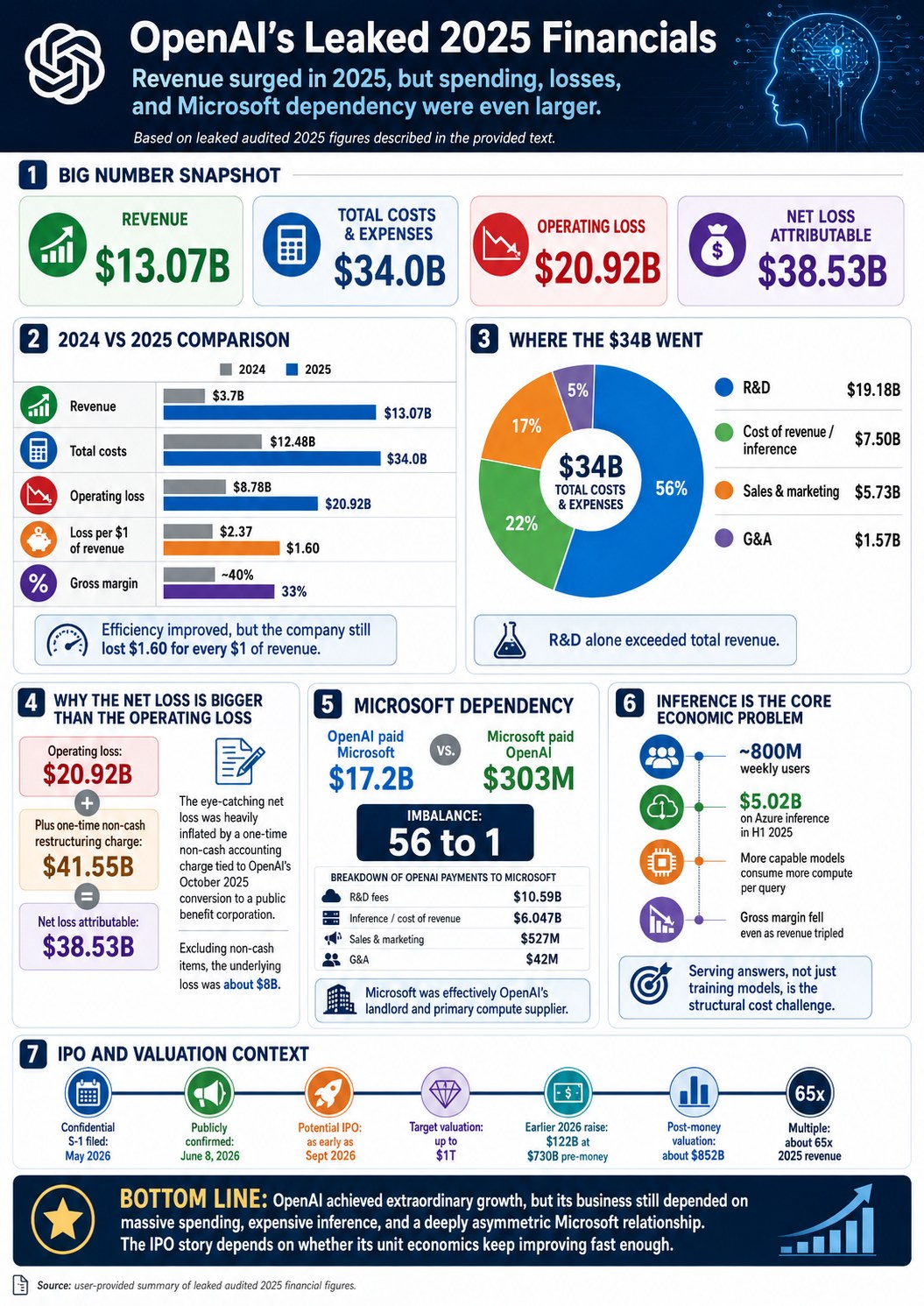
    Infographic summarizing OpenAI leaked 2025 financials: $13.07B revenue, $34B total costs, $20.92B operating loss, $38.53B net loss, where the $34B went, the $17.2B paid to Microsoft versus $303M paid back, inference costs, and IPO valuation context

    OpenAI’s audited 2025 financials leaked this week, and they are the clearest picture yet of what it actually costs to run the company behind ChatGPT. Independent journalist Ed Zitron first published the documents, and the Financial Times independently confirmed them. The headline: OpenAI spent $34 billion last year, booked $13.07 billion in revenue, and reported a net loss attributable to the company of $38.5 billion. The disclosure lands just days after OpenAI confidentially filed for an IPO that could value it north of $1 trillion.

    TLDR

    OpenAI’s audited 2025 numbers, leaked by Ed Zitron and confirmed by the Financial Times, show revenue tripling to $13.07 billion while total costs reached $34 billion, producing a $20.92 billion operating loss and a $38.53 billion net loss attributable to the company. The much larger net loss is inflated by a one-time $41.55 billion non-cash charge tied to OpenAI’s October 2025 conversion from a nonprofit to a public benefit corporation; strip the non-cash items and the loss is closer to $8 billion. R&D alone was $19.18 billion, cost of revenue (inference) was $7.5 billion, and sales and marketing ballooned to $5.73 billion. OpenAI paid Microsoft $17.2 billion in 2025 while Microsoft paid OpenAI only $303 million, exposing a deep Azure dependency. The company burned $1.60 for every dollar of revenue, down from $2.37 in 2024, and gross margin slipped from roughly 40% to 33% as more capable models consumed more compute per query. The leak arrives as OpenAI files a confidential S-1, targets a listing as early as September 2026 at up to a $1 trillion valuation, and races rival Anthropic, which is more valuable on paper and claims it is already turning an operating profit.

    Thoughts

    The most important thing to understand about these numbers is that there are two loss figures and the press will conflate them. The $38.53 billion net loss is the scary headline, but $41.55 billion of it is a non-cash accounting charge from converting investor convertible interests into equity during the for-profit restructuring. That charge is real on the audited statement and it will show up in the eventual S-1, but it is a one-time artifact of OpenAI’s unusual corporate history, not money that left the building. The number that describes the actual business is the $20.92 billion operating loss. That is the one to watch, and it is still enormous.

    The genuinely encouraging line in the whole release is the loss-per-dollar ratio. In 2024 OpenAI spent $2.37 to generate a dollar of revenue. In 2025 that fell to $1.60. A company that is still losing $1.60 on every dollar is not a healthy business, but a company whose efficiency improved by a third in a single year while tripling its top line is at least pointed in a defensible direction. The bull case for OpenAI lives entirely in the slope of that line. If it keeps improving at that rate, the math eventually crosses over. If it stalls, the valuation is a fantasy.

    The Microsoft relationship is the single most revealing disclosure, and it is wildly asymmetric. OpenAI paid Microsoft $17.2 billion in 2025. Microsoft paid OpenAI $303 million. That is a 56-to-1 ratio, and it reframes the partnership: Microsoft is not really a peer or even just an investor, it is OpenAI’s landlord and primary supplier, collecting rent on every model trained and every query answered. The April 2026 renegotiation that capped revenue-share payments at $38 billion through 2030, down from a projected $135 billion, suddenly looks less like a favor and more like OpenAI desperately trying to lower its single largest cost. The dependency cuts both ways, but right now Microsoft holds the better hand.

    The structural problem hiding inside the cost of revenue line is inference. Training a model is a fixed, one-time cost. Serving it is a recurring cost that scales with every one of ChatGPT’s roughly 800 million weekly users. OpenAI spent $5.02 billion on Azure inference in the first half of 2025 alone, and the more capable its reasoning models get, the more compute each answer burns. That is why gross margin went down even as revenue went up. It is the opposite of how software is supposed to work, where the marginal cost of one more user trends toward zero. OpenAI’s marginal cost is real, large, and growing. The counterargument is that per-token inference costs have been falling roughly tenfold a year, so the unit economics could still flip. That is the entire wager.

    Finally, the timing matters more than the numbers. OpenAI’s confidential S-1 means these audited figures were going to become public regardless, since the SEC requires the full prospectus at least 15 days before a roadshow. What the leak changes is who gets to study them first. Prospective IPO buyers, enterprise customers signing multi-year API contracts, and competitors now have the audited books weeks or months early, and they are reading them against Anthropic, which filed at a higher valuation and claims an operating profit. For a company asking the public markets to underwrite a $1 trillion bet on a monopoly outcome that does not yet exist, losing control of the narrative this early is not a small thing.

    Key Takeaways

    • OpenAI’s audited 2025 financials were first published by independent journalist Ed Zitron and independently confirmed by the Financial Times, the first verified look at the company’s books before its planned IPO.
    • Revenue grew from $3.7 billion in 2024 to $13.07 billion in 2025, more than tripling year over year, making OpenAI one of the fastest-growing businesses in history.
    • By the end of 2025 OpenAI was generating roughly $2 billion in monthly revenue, up from about $1 billion a quarter at the end of 2024.
    • Total costs and expenses hit $34 billion in 2025, up from $12.48 billion in 2024.
    • Research and development was the single largest expense at $19.18 billion, up from $7.81 billion, and exceeded total revenue on its own.
    • Of that R&D spend, $10.59 billion went to Microsoft, almost certainly the GPU compute cost of training frontier models on Azure.
    • Cost of revenue, the expense of serving ChatGPT responses (inference), rose from $2.65 billion to $7.5 billion.
    • Sales and marketing jumped from $1.11 billion to $5.73 billion, a 418% increase.
    • General and administrative costs rose from $907 million to $1.57 billion.
    • The operating loss, the truest measure of day-to-day economics, grew from $8.78 billion to $20.92 billion.
    • The net loss attributable to OpenAI was $38.53 billion, up nearly eightfold from $5.09 billion in 2024.
    • The bulk of that jump was a one-time, non-cash $41.55 billion charge from OpenAI’s October 28, 2025 conversion to a public benefit corporation, reflecting the changing fair value of convertible interests and warrant liabilities.
    • Stripping out the restructuring charge and other non-cash items such as stock-based compensation and Microsoft computing credits, the underlying loss was about $8 billion.
    • Including all factors, gross net loss reached $60.35 billion, lowered to the $38.53 billion attributable figure by removing $21.82 billion attributed to noncontrolling and redeemable noncontrolling interests.
    • OpenAI burned $1.60 for every $1 of revenue in 2025, an improvement from $2.37 in 2024, the clearest data point in the bull case.
    • Measured as a percentage of revenue, the operating loss improved from 237% in 2024 to 160% in 2025.
    • In total, OpenAI paid Microsoft $17.2 billion in 2025: $10.59 billion in R&D fees, $6.047 billion in cost of revenue, $527 million in sales and marketing, and $42 million in G&A.
    • Microsoft paid OpenAI just $303 million in the same year, a 56-to-1 imbalance underscoring OpenAI’s Azure dependency.
    • SoftBank paid OpenAI $867 million in 2025.
    • At year-end OpenAI carried $3.64 billion in outstanding payables to Microsoft, plus tens of millions more in accrued and non-current liabilities.
    • OpenAI spent $5.02 billion on Azure inference in just the first half of 2025; Azure inference from 2024 through Q3 2025 totaled $12.43 billion.
    • ChatGPT serves roughly 800 million weekly users, meaning billions of queries a week, each one burning GPU time at Azure’s pricing of about $6.98 per H100 GPU-hour.
    • Gross margin fell from roughly 40% in 2024 to 33% in 2025, because more capable reasoning models consume more compute per query.
    • Research firm Sacra estimates OpenAI’s inference costs reached $8.4 billion in 2025 and will rise to $14.1 billion in 2026, a 68% increase.
    • At year-end OpenAI held just over $50 billion in assets, with almost half in cash.
    • The April 2026 Microsoft renegotiation ended exclusivity and capped revenue-share payments at $38 billion through 2030, down from a projected $135 billion, potentially saving OpenAI up to $97 billion over five years.
    • OpenAI filed a confidential draft S-1 with the SEC around May 22, 2026 and confirmed it publicly on June 8, naming Goldman Sachs and Morgan Stanley as underwriters.
    • The company is targeting a listing as early as September 2026 at a valuation that could exceed $1 trillion, though Sam Altman has said a public offering “may be a while.”
    • OpenAI raised $122 billion earlier in 2026 at a $730 billion pre-money valuation, putting its post-money value around $852 billion.
    • At an $852 billion valuation, OpenAI trades at roughly 65 times its 2025 revenue.
    • Rival Anthropic also filed IPO paperwork this month after raising $65 billion at a $900-$965 billion valuation, making it more valuable on paper than OpenAI, and says it expects to report an operating profit of $559 million in the June quarter.
    • HSBC analysts estimate OpenAI may need more than $207 billion in additional capital through 2030 even under optimistic projections.
    • OpenAI projects profitability by 2029 or 2030; independent analysts put the more likely date at 2031 or later.
    • Bridgewater partner Greg Jensen reportedly told clients the implied revenue multiples price OpenAI for “a monopoly outcome that does not yet exist.”
    • Zitron separately reported OpenAI had a negative 122% non-GAAP operating margin in Q1 2026 and that ChatGPT growth has stalled, with the company projecting paid ChatGPT Plus subscriptions to fall from 44 million in 2025 toward cheaper tiers in 2026.

    Detailed Summary

    How the leak happened and why it matters now

    The audited documents were obtained and first published by Ed Zitron on his newsletter Where’s Your Ed At, then independently verified by the Financial Times, which reviewed the same materials. That dual sourcing matters: this is not a rumor or a model, it is OpenAI’s actual audited financial statement. The timing is the story. OpenAI filed a confidential draft S-1 with the SEC around May 22, 2026 and confirmed it publicly on June 8. Under SEC rules the full prospectus must be released at least 15 days before an investor roadshow, so the 2025 numbers were going to be public soon regardless. The leak simply moved that disclosure forward, handing prospective investors, enterprise customers, and competitors an early look at the books.

    Revenue tripled, costs grew faster

    OpenAI’s revenue rose from $3.7 billion in 2024 to $13.07 billion in 2025, and monthly revenue reached nearly $2 billion by year-end. By almost any normal standard that is spectacular growth. The problem is that costs grew faster, reaching $34 billion against $12.48 billion the year before. The gap between what OpenAI earns and what it spends has widened every year since its founding, and 2025 is the starkest example yet. Revenue alone was outpaced by research and development as a single line item in both of the last two years.

    Two loss numbers, and why both matter

    There are two figures that get cited interchangeably and should not be. The operating loss of $20.92 billion is what the business spent beyond what it earned from operations: training models, serving ChatGPT, paying engineers, running marketing. The net loss attributable to OpenAI of $38.53 billion is far larger because 2025 was the year OpenAI completed its conversion from a nonprofit to a for-profit public benefit corporation, finalized on October 28, 2025. That restructuring triggered a $41.55 billion non-cash charge reflecting the changing fair value of convertible equity interests and warrant liabilities. Before the conversion, investors held convertible interest rights treated as liabilities under US accounting rules and revalued upward as OpenAI’s valuation climbed, creating the charge. It is not expected to recur. Including all minor items, gross net loss reached $60.35 billion, reduced to the $38.53 billion attributable figure after removing $21.82 billion tied to noncontrolling and redeemable noncontrolling interests, primarily the OpenAI Foundation’s stake. Strip the non-cash noise and the underlying loss was about $8 billion.

    Where the $34 billion went

    The spending breaks into four lines. Research and development was $19.18 billion, the largest category, with $10.59 billion of it flowing to Microsoft for training compute. Cost of revenue, the expense of serving responses to users, was $7.5 billion and captures inference, the compute consumed every time someone prompts ChatGPT or calls the API. Sales and marketing reached $5.73 billion, up 418% year over year, a striking jump for a product that grew largely by word of mouth. General and administrative costs added $1.57 billion. The shape of the spending tells you OpenAI is simultaneously racing to build better models, serve a massive and growing user base, and aggressively defend market share through marketing.

    The Microsoft dependency

    The most striking single disclosure is the scale of the Microsoft relationship. OpenAI paid Microsoft $17.2 billion in 2025: $10.59 billion in R&D fees for model training, $6.047 billion in cost-of-revenue for inference serving, $527 million in sales and marketing, and $42 million in G&A. Microsoft paid OpenAI just $303 million the same year. SoftBank paid OpenAI $867 million. The 56-to-1 ratio between what OpenAI pays Microsoft and what Microsoft pays back makes the structural reality plain: Microsoft is OpenAI’s largest landlord. The dynamic began shifting in April 2026, when the two renegotiated, ending Microsoft’s exclusivity and capping revenue-share payments at $38 billion through 2030, down from a projected $135 billion. That could save OpenAI up to $97 billion over five years, though Microsoft keeps its IP license through 2032 and remains the primary cloud partner.

    Why inference is the core problem

    Training happens once. Serving happens billions of times a day. When OpenAI releases a model it spends months and billions on training compute, a fixed cost that falls away when training ends. Inference is the opposite: every ChatGPT message runs through the model on Azure GPU hardware, consuming electricity and compute to generate a response. With roughly 800 million weekly users, that is billions of queries a week, each burning GPU time at roughly $6.98 per H100 GPU-hour on demand. OpenAI spent $5.02 billion on Azure inference in the first six months of 2025 alone. Sacra estimates full-year inference costs of $8.4 billion in 2025, rising to $14.1 billion in 2026. This is why gross margin fell from about 40% to 33% even as revenue tripled: more capable reasoning models consume far more compute per query, and revenue has not kept pace with the cost growth that capability generates.

    What it means for the IPO and the race with Anthropic

    OpenAI was last valued around $852 billion post-money after raising $122 billion in early 2026, which puts it at roughly 65 times 2025 revenue. It has named Goldman Sachs and Morgan Stanley as underwriters and is targeting a listing as early as September 2026 at up to a $1 trillion valuation, though Altman has hedged that it “may be a while” and that staying private might be the better course. HSBC estimates the company may need more than $207 billion in additional capital through 2030. The race is with Anthropic, which filed paperwork the same month after raising $65 billion at a $900-$965 billion valuation, making it more valuable on paper, and which says it expects a $559 million operating profit in the June quarter. The contrast is sharp: the two leading AI labs heading toward public markets at the same time, one bleeding cash at scale, the other claiming profitability, both asking investors to bet on a future that has not arrived.

    Notable Quotes

    “The financial condition of OpenAI is deeply concerning. $38.53 billion in losses are astronomical, and far higher than most believed it would be. Losses also appear to be mounting year-over-year at a dramatic rate, and I’m not sure how this company finds a way toward any kind of sustainability or profitability.”

    Ed Zitron, the independent journalist who published the leaked audited financials

    “It’s unclear what this means, nor how OpenAI reconciled the removal of $3.74 billion in costs. I will not speculate further.”

    Ed Zitron, on a discrepancy he found in the restated 2024 figures

    “OpenAI’s two biggest expenses are R&D and marketing. Budget cuts there, coupled with an ability to raise prices or win new sources of revenue, could see the company move into the black over time. Cutting R&D would be the most difficult part of that, given that AI companies can only hold onto their customers by generating the best-performing models.”

    Jim Edwards, Fortune, on whether OpenAI has a realistic path to profitability

    “What the audited documents make impossible to argue is that the path to profitability is short, clear, or cheap.”

    TechTimes analysis of the leaked OpenAI financials

    The implied revenue multiples price OpenAI for “a monopoly outcome that does not yet exist.”

    Bridgewater partner Greg Jensen, reportedly telling clients how to read OpenAI’s valuation

    “OpenAI spent $34bn last year as the ChatGPT maker poured money into a race to dominate the fast-growing AI market ahead of a planned stock market listing.”

    George Hammond and Bryce Elder, Financial Times, framing the audited 2025 spend

    Read Ed Zitron’s original reporting with the full breakdown here, and the Financial Times confirmation here.

    Related Reading

    • Ed Zitron, Where’s Your Ed At the primary source that broke the audited 2025 financials with the full line-by-line breakdown.
    • OpenAI (Wikipedia) background on the company’s history, structure, and the nonprofit-to-for-profit conversion that drives the non-cash charge.
    • Inference (Wikipedia) on the recurring compute cost that explains why OpenAI’s gross margin shrinks as usage grows.
    • Anthropic the rival lab that filed IPO paperwork the same month at a higher valuation and claims it is already operating at a profit.
    • SEC on confidential filings context for why OpenAI’s audited numbers were headed for public disclosure regardless of the leak.
  • Gavin Baker on Orbital Compute, TSMC, Frontier AI Models, Anthropic’s Vertical Take Off, and the Coming Wafer Shortage

    Gavin Baker, founder and CIO of Atreides Management, returns to Patrick O’Shaughnessy’s Invest Like the Best for his sixth appearance. He calls the current AI moment the most extraordinary moment in the history of capitalism, walks through what Anthropic’s vertical takeoff in revenue actually means, lays out why orbital compute is closer than skeptics believe, dissects the TSMC bottleneck that may be the only thing standing between today’s market and a full-on AI bubble, and rates every hyperscaler on how they have positioned for a world where frontier model providers may stop selling API access altogether.

    TLDW

    Anthropic added eleven billion dollars of ARR in a single month, which is roughly the combined business of Palantir, Snowflake, and Databricks built over a decade. That is the setup. From there Gavin Baker covers the March and April selloff, the contrarian read that a closed Strait of Hormuz was actually bullish for American manufacturing competitiveness, why Anthropic and OpenAI multiples may be misleadingly cheap on an unconstrained run rate basis, why Elon Musk’s discipline on SpaceX valuation created a superpower of permanent access to capital, the practical engineering case for orbital compute as racks in space rather than Pentagon sized space stations, why TSMC’s capacity discipline is the single most important variable in whether the AI cycle becomes a bubble, what Terafab in Texas changes, why the Pareto frontier of AI models has flipped from Google dominance to Anthropic and OpenAI dominance in nine months, the shift from all you can eat AI subscriptions to usage based pricing and what that means for revenue scaling, Richard Sutton’s bitter lesson as the largest risk to the AI trade, why frontier tokens still capture an overwhelming share of economic value, the role of continual learning as the third great open question, why most new chip startups should not try to build a better GPU, why Cerebras did something different and hard, why disaggregated inference may extend GPU useful lives to ten or fifteen years and rescue the private credit industry, why being in the token path is the new venture filter, the new prisoner’s dilemma around releasing frontier models via API, an honest rating of Google, Meta, Amazon, and Microsoft, why personal safety is becoming a real AI era risk, and why he remains an AI optimist maximalist who believes this could be the next Pax Americana.

    Key Takeaways

    • Anthropic added eleven billion dollars of ARR in one month, more than the combined businesses of Palantir, Snowflake, and Databricks built across a decade. There is no precedent for this in the history of capitalism.
    • The SaaS and cloud revolution created between five and ten trillion dollars of value over twenty years. AI is replaying that compression on a timeline measured in months.
    • The March selloff was a drawdown driven by disagreement with price action, not invalidated thesis. That is the kind of drawdown an investor can lean into.
    • Deep Seek Monday in January 2025 was a similar setup. By the day of the selloff, AWS Asia GPU prices had already doubled, GPU availability had fallen, and it was obvious reasoning models would be vastly more compute hungry at inference. The market priced the opposite.
    • The Strait of Hormuz closing was actually positive for America. US natural gas (the primary input into US electricity, which feeds AI) fell twenty percent on Bloomberg while Asian and European natural gas doubled or tripled. American manufacturing competitiveness improved overnight.
    • The US is now the world’s largest producer and exporter of oil and gas. The economy is dramatically less energy intensive than in the 1970s. The shortage trauma comparison does not hold.
    • Tech as a sector traded as cheaply versus the rest of the market in early April as at any point in the last ten years, into the single most bullish moment for AI fundamentals on record.
    • Anthropic is dramatically more capital efficient than OpenAI, having burned roughly eighty percent less to reach a similar revenue scale. They have very different structural returns on invested capital.
    • Anthropic at roughly nine hundred billion for fifty billion of ARR (growing a thousand percent) is striking. Adjusted for compute constraint, the unconstrained run rate could be one hundred fifty to two hundred billion, putting the implied multiple closer to five times.
    • Claude Opus generates roughly seventy percent fewer tokens for the same question than previously, with token quantity tied to answer quality. Subscribers on flat-fee plans are getting a lobotomized model.
    • Elon Musk’s superpower is twenty years of making investors money. He never pushes valuation. SpaceX compounded low thirty percent per year for a decade because Musk treats fair pricing as a sacred covenant.
    • Capitalism will solve the watts shortage. The current bottleneck has shifted from chips and energy to zoning and political approval. Many capex decisions are paused until after the US midterms.
    • The watts shortage probably begins to alleviate in 2027 and 2028. Orbital compute solves it longer term.
    • Orbital compute is not Pentagon sized data centers in space. It is racks in space. A Blackwell rack is three thousand pounds, eight feet tall, four feet deep, three feet wide. SpaceX has shown a satellite roughly that size.
    • The satellites operate in sun synchronous orbit so solar wings (around five hundred feet per side) always face the sun and the radiator on the dark side always points to deep space.
    • Starlink V3 satellites already run at around twenty kilowatts. A Blackwell rack runs at one hundred kilowatts. SpaceX engineers express genuine confidence they have already solved cooling and radiator design at these scales.
    • Racks in space are connected with lasers traveling through vacuum, the same lasers already on every Starlink. SpaceX operates the world’s largest satellite fleet and, via xAI Colossus, the world’s largest data center on Earth.
    • Inference will move to orbit. Training will stay on Earth for a long time. Terrestrial data centers remain valuable for the rest of an investor’s career.
    • The wafer bottleneck is structural and political. TSMC is essentially Taiwan’s GDP, water, and electricity. The leaders see themselves as inheritors of Morris Chang’s sacred legacy and they do not behave like a Western public company.
    • Jensen Huang has never had a contract with TSMC. The relationship is run on handshakes and the assumption that things will be fair over time.
    • If TSMC did everything Jensen wanted, Nvidia could be selling two to three trillion dollars of GPUs in 2026 and 2027. TSMC’s discipline is the single largest factor preventing a true AI bubble.
    • Historically, foundational technologies always get a bubble. Railroads, canals, the internet. The current AI buildout is overwhelmingly funded out of operating cash flow, GPUs are running at one hundred percent utilization, and that is fundamentally different from the year 2000 fiber overbuild.
    • If one of Intel or Samsung Foundry catches up at the leading node, the other will follow, and TSMC’s discipline collapses. Watch TSMC capacity decisions to predict a bubble.
    • Terafab, the SpaceX and Tesla joint venture to build the world’s largest fab in America, has a partnership with Intel that grants access to fifty years of institutional foundry knowledge. The A teams at ASML, KLA, Lam Research, and Applied Materials will follow Elon’s reputation in hardware engineering.
    • The hiring playbook for Terafab includes building Taiwan Town, Japan Town, and Korea Town next to the fab. Recruit the engineers and import their families, their restaurants, and their staff.
    • Frontier tokens still capture an overwhelming share of all economic value created at the model layer. This is surprising and is one of the three big open questions for AI investing.
    • The Pareto frontier of intelligence versus cost has flipped. Nine months ago Google’s TPU dominated every point on the frontier. Today Anthropic and OpenAI dominate, with Grok 4.3 on the frontier and Gemini 3.1 hanging on.
    • Google’s conservative TPU V8 design (partly an attempt to reduce dependence on Broadcom and Nvidia) is the leading explanation for the loss of per token cost leadership.
    • AI pricing is shifting from all you can eat to usage based, mirroring the cellular and long distance industries. Cellular stopped being a great growth industry when it went all you can eat. AI just made the opposite move.
    • OpenAI and Anthropic together could exceed two hundred billion in ARR this year if compute keeps coming online and frontier token pricing holds.
    • The two hundred fifty dollar a month consumer AI plan is no longer enough to evaluate frontier capability. Enterprise plans with usage based billing are required because rate limits are now severe.
    • The three biggest open questions for AI investors are: violation of the bitter lesson via ASI or human ingenuity, whether frontier tokens keep commanding their premium, and when continual learning arrives.
    • Today’s continual learning is crude reinforcement learning during mid training on verifiable tasks. True continual learning means weights updating dynamically, like a human who learns the first time they touch fire.
    • Trying to build a better GPU is a losing strategy. Jensen will copy any one to three percent share design. Startups should target one percent share, do something different, and make it hard enough that Nvidia cannot fast follow.
    • Disaggregated inference (separating prefill and decode) opens new design canvases. Prefill is memory capacity bound. Decode is memory bandwidth bound. Each can be optimized independently.
    • Cerebras did something different and hard with wafer scale computing. Three generations of chips and real grit to get there.
    • Disaggregation of inference may stretch GPU useful lives to ten or fifteen years, dropping financing costs from low sevens to five or six percent, mathematically lowering the cost of the AI buildout and likely saving the private credit industry from its SaaS loan exposure.
    • Sellers of shortage outperform buyers of shortage. But owning the largest installed base of what is currently in shortage (hyperscaler CPU fleets, for example) is also a strong position.
    • Most of the economic value at the application layer of AI has been destroyed, not created. The exceptions are companies in the token path or in niches small enough that frontier labs ignore them.
    • Coding may be the shortest path to ASI. If you can write code, you can write code that does anything. Cursor, Cognition, and Anthropic correctly focused on it.
    • Jensen could probably get close to the frontier with his own Nemotron family of models whenever he wants. The fact that he chooses not to is a strategic decision about not commoditizing his customers.
    • The new prisoner’s dilemma in AI is whether frontier labs release their best model via API. If everyone agrees not to, Chinese open source falls behind. If anyone defects, the defector pulls ahead on revenue and resources, forcing everyone else to defect.
    • Google still owns the largest compute installed base. Without TPU’s prior cost advantage, this matters more. YouTube data has real value in a world of robotics. GCP is going crazy.
    • Meta deserves credit for becoming AI first internally faster than any other internet giant. Musa, their first MSL model, is impressively close to the Pareto frontier.
    • Amazon is strong because of Trainium and robotics driven retail P&L efficiency. Nova is better than it gets credit for.
    • Microsoft flinched on capex in early 2025 and lost position. Satya Nadella’s current decision to use Microsoft compute for Microsoft products rather than reselling to OpenAI is a courageous and probably correct call, even at the cost of an eight hundred dollar stock price.
    • The hyperscalers most engaged with startups are Amazon and Nvidia by a mile, followed by Google. Broadcom is the favorite ASIC partner. AMD, Microsoft, and Meta have minimal startup engagement and that will cost them as the best teams are now at startups.
    • Personal safety in an AI era requires a family or company safe word that cannot be socially engineered. Deepfake voice and video extortion at the speed of FaceTime is already feasible.
    • Ukraine is winning largely on the back of having the best battlefield AI outside America and Israel. Adversaries are starting to internalize what AI dominance means geopolitically.
    • An optimistic read is that this becomes a new Pax Americana, the way the post 1945 American nuclear monopoly was used to rebuild Germany and Japan rather than dominate.
    • AI cured a friend’s daughter’s rare disease by spinning up a research effort that identified a market drug capable of impacting her condition. That is the upside that keeps Gavin an AI optimist maximalist.

    Detailed Summary

    The most extraordinary moment in the history of capitalism

    Gavin’s framing of the current moment is unusually direct. Anthropic added eleven billion dollars of annual recurring revenue in a single month. The three highest profile SaaS companies of the last decade plus, Palantir, Snowflake, and Databricks, took a decade and tens of thousands of employees collectively to build the combined business that Anthropic added in thirty days. He has been investing through every major tech cycle and says there is no historical analog. Not the dotcom era, not the cloud transition, not mobile. This is its own thing.

    The market response, then, was peculiar. The NASDAQ sold off into the single most bullish moment for AI fundamentals on record. Tech traded at roughly its widest discount versus the rest of the market in a decade. Investors who said they wished they had bought into AI during 2022, during COVID, or during Deep Seek Monday got the same valuation setup again in early April, this time with an even clearer inflection.

    Why the Strait of Hormuz closing was secretly bullish for America

    One reason the macro fear in March may have been mispriced is that the same geopolitical event that drove the selloff was, in practice, a relative benefit to the United States. American natural gas, the input into American electricity, which is the input into American AI training and inference, fell roughly twenty percent. Asian and European natural gas prices doubled or tripled. The US emerged with sharply improved relative manufacturing competitiveness, which is exactly what the current administration cares about.

    The 1970s comparison does not hold. The US economy is dramatically less energy intensive, it is now the world’s largest producer and largest exporter of oil and gas, and there are no shortages, only price moves. That backdrop made it easier for disciplined investors to stay focused on AI fundamentals through the volatility.

    Anthropic and OpenAI valuations on an unconstrained run rate

    Anthropic at roughly nine hundred billion for fifty billion of ARR sounds rich until you adjust for the fact that the company is severely compute constrained. Gavin estimates that, unconstrained, Anthropic might be at one hundred fifty to two hundred billion in run rate revenue, putting the implied multiple closer to five times. He also points out that Claude Opus now generates roughly seventy percent fewer tokens for the same question than it used to. Token quantity correlates with answer quality, and Anthropic is rate limiting and shrinking outputs to ration capacity across its user base.

    Anthropic and OpenAI are also structurally very different. Anthropic has burned around eighty percent less cash than OpenAI to reach a comparable revenue scale. That implies very different long term returns on invested capital, though OpenAI has done a better job locking in compute and Sarah Friar is one of the most exceptional CFOs Gavin has worked with.

    Why neither lab is raising at a three trillion dollar valuation

    The answer Gavin gives is that both labs are deliberately leaving valuation on the table the way Elon has done for two decades. SpaceX compounded at low thirty percent annually for a decade because Elon never pushed price. The result is a permanent superpower of access to capital. Investors trust him because they have made money with him for twenty years. That is a moat that compounds with every round.

    Anthropic could probably raise at a one hundred percent premium to its rumored latest mark. They are choosing not to. In an uncertain world (Ukraine, Russia, Iran, Taiwan), preserving the ability to raise more capital later at fair prices is more valuable than maximizing this round.

    Watts and wafers, the two real constraints

    Capitalism is solving the watts problem. The leading PE infrastructure investors now say zoning and political approval, not chips or energy, are the gating factors. Companies are deferring big capex announcements until after the US midterms. Turbine capacity is being doubled at the manufacturers. Companies like Boom Aerospace are repurposing jet engines for grid use. Watts probably ease meaningfully in 2027 and 2028 and then orbital compute does the rest.

    Wafers are the harder problem because they live in Taiwan, run on handshakes, and depend on a corporate culture that does not respond to public market incentives. TSMC is essentially the GDP, water consumption, and electricity consumption of Taiwan. Its leadership treats the company as the legacy of Morris Chang. The Silicon Shield doctrine is real and internal.

    Orbital compute as racks in space

    The biggest mental update Gavin asks listeners to make is to stop picturing data centers in space as Pentagon sized space stations. A Blackwell rack is three thousand pounds and roughly the size of a refrigerator. SpaceX has shown a concept satellite of about that size. Solar wings extend five hundred feet to each side and the radiator extends hundreds of feet behind, both possible because the orbit is sun synchronous and the orientation is fixed relative to the sun.

    SpaceX engineers Gavin has spoken to at Starbase express genuine confidence that they have solved cooling at these power levels. They have. Starlink V3 satellites already operate at twenty kilowatts. A Blackwell rack is one hundred kilowatts. The same company operates the world’s largest satellite fleet and the world’s largest data center on Earth via xAI Colossus. The racks are connected to each other with lasers traveling through vacuum, technology already deployed in every Starlink. The naysayers, Gavin observes, are armchair skeptics and Larry Ellison’s response (he is out there landing rockets, no one else is) is the right frame.

    Terafab in Texas and the threat to TSMC’s discipline

    Terafab, the SpaceX and Tesla joint venture, intends to be the largest fab in the world. The partnership with Intel grants access to fifty years of foundry institutional knowledge, allowing Terafab to start three to five quarters behind the leading node rather than fifteen years behind. The A teams at the semicap equipment companies (ASML, KLA, Lam Research, Applied Materials) will follow Elon’s reputation in hardware engineering the same way they followed TSMC twenty years ago when Intel stumbled.

    The talent strategy is the part most observers underestimate. Recruit the best engineers globally, then import their families, their restaurants, their staff. Build Taiwan Town, Japan Town, and Korea Town next to the fab. Optimize the human experience for the people whose work matters. Intel and Samsung do not think that way.

    Bubble watch and the year 2000 comparison

    Every foundational technology in modern history has had a bubble. Railroads, canals, the internet. Carlota Perez documented why. Markets correctly identify the importance, diversity of opinion collapses, supply gets ahead of demand, the bubble crashes. The current cycle has two important differences. The buildout is overwhelmingly funded out of operating cash flow, not debt. Every GPU is running at one hundred percent utilization, while at the peak of the fiber bubble ninety nine percent of fiber was unused.

    TSMC discipline is the single largest reason a bubble has not formed. If Jensen could buy everything TSMC could theoretically make, Nvidia could sell two to three trillion dollars of GPUs in 2026 and 2027. At some point that becomes more than the market can absorb. If Intel or Samsung Foundry catches up at the leading node, the other will too. TSMC’s pricing discipline collapses and the bubble starts.

    The Pareto frontier and the loss of Google’s cost advantage

    The most important chart in AI is the Pareto frontier of model intelligence versus per token cost. Nine months ago, Google’s TPU based models dominated every point on it. OpenAI, Anthropic, and xAI sat inside the frontier. Today the frontier is dominated by Anthropic and OpenAI, with Grok 4.3 on the frontier and Gemini 3.1 hanging on by subsidization more than economics. The most likely cause is Google’s conservative TPU V8 design, an attempt to reduce dependence on Broadcom and Nvidia that sacrificed per token economics.

    The bitter lesson, frontier tokens, and continual learning

    Three open questions dominate AI investing. The first is whether Richard Sutton’s bitter lesson (more compute beats human algorithmic cleverness) gets violated by ASI itself optimizing for efficiency. Closer observers of AI are more skeptical of a violation. Gavin thinks ASI’s first move will be to make itself more efficient and more resourced, which is technically a temporary violation.

    The second is whether frontier tokens keep capturing the overwhelming share of economic value at the model layer. Today they do, surprisingly. Gemini 3.1 Pro was mindblowing nine months ago and is intolerable today. The third is when continual learning arrives. Today’s models need a million fire touches to learn what a human learns from one. True continual learning would mean dynamic weight updates in real time and would produce a fast takeoff.

    From all you can eat to usage based AI pricing

    AI is shifting from flat fee plans to usage based pricing. The historical analogy is cellular and long distance. Both stopped being great growth industries when they went all you can eat. AI just made the opposite move. The consequence is that flat fee subscribers, even on premium consumer plans, get a rate limited and token throttled version of the frontier model. Enterprise plans with usage based billing are now required to evaluate true capability. Gavin thinks the combination of new compute coming online and usage based pricing is what gets OpenAI and Anthropic past two hundred billion in combined ARR this year.

    Chip startups, prefill decode disaggregation, and Cerebras

    Trying to build a better GPU is the wrong move. The four scaled players (Nvidia, AMD, Trainium, TPU) have copy capability for any one to three percent share design that looks attractive. The good news for startups is that disaggregated inference (separating prefill and decode) opens a richer design canvas. Prefill is memory capacity bound. Decode is memory bandwidth bound. Each can be optimized independently. Andrew Fox’s analogy is a British naval ship of the eighteenth century. Prefill is loading the cannon. Decode is firing it.

    Cerebras is the model. Wafer scale computing is genuinely different and genuinely hard. It took three generations of chips to get right. Andrew Feldman and his team had the grit to keep going through chip one being a failure. The design has a high ratio of on chip compute and memory relative to shoreline IO, which is why Cerebras is now experimenting with putting an optical wafer on top of the compute wafer to solve scale out.

    GPU useful lives and the rescue of private credit

    One of the strongest claims in the conversation is that disaggregated inference will stretch GPU useful lives to ten or fifteen years. The skeptical narrative (GPUs are obsolete in two years, companies are cooking their depreciation books) is wrong. You can put a Cerebras system or Groq LPU in front of older Hopper or Ampere parts, use them only for prefill, and run them until they physically melt. Private credit, which is in pain from SaaS loans and which underwrote GPU loans on three to four year lives, may be saved by this.

    If GPU financing rates can come down from low sevens to five or six percent, the mathematics of the AI buildout improves materially. That is a structural tailwind that compounds for years.

    The application layer, the token path, and a new prisoner’s dilemma

    Trillions of dollars of value have been destroyed at the application layer, not created. Cursor and Cognition are the rare scaled exceptions, and they got there by focusing on coding very early. As Amjad Masad noted, coding is plausibly the shortest path to ASI because a coding agent can write itself into any new domain. Jamin Ball’s frame is that the new venture filter is whether the company is in the token path. Data Bricks is. Most application layer startups are not.

    Jensen could probably get close to the frontier with Nemotron whenever he wants, and the strategic question of whether to do that is a new prisoner’s dilemma. If every frontier lab agrees not to release best models via API, Chinese open source falls steadily behind. If anyone defects, the defector gains revenue and resources, and everyone else has to defect. The same dynamic exists between TSMC, Intel, and Samsung. If Nvidia or AMD ever truly used an alternative foundry, that foundry would catch up rapidly.

    Rating the hyperscalers

    Google has the largest compute installed base, the YouTube data that matters in a robotics world, and a search business that prints. Their loss of TPU cost leadership is the surprise of the year. If Google IO in five days does not produce a leapfrog model, the Nvidia centric narrative gets even stronger.

    Meta deserves real credit. Zuckerberg made Meta AI first internally faster than any other internet giant, paid up for the talent contracts when no one else would, and shipped Musa as a first model from MSL that is close to the Pareto frontier. Amazon is well positioned on Trainium, robotics in retail, and a Nova model line that is better than it gets credit for. Microsoft flinched on capex in early 2025 and lost position. Satya Nadella’s current decision to use Microsoft compute for Copilot rather than reselling to OpenAI is courageous and probably correct, even at the cost of stock price.

    The most interesting cross hyperscaler metric is startup engagement. Nvidia and Amazon engage deeply with startups. Google is next. Broadcom is the favored ASIC partner. AMD, Microsoft, and Meta have minimal startup engagement, which Gavin believes will cost them as the best teams now sit at startups.

    Personal safety, geopolitics, and the Pax Americana case

    The closing section turns darker. Personal safety in an AI era requires a family or company safe word that cannot be socially engineered. Deepfake voice and video extortion via something that looks exactly like your child calling on FaceTime is already feasible. Political violence against AI leaders is a real concern. Geopolitically, Ukraine is winning largely because it has the best battlefield AI outside America and Israel. How adversaries respond to that asymmetry is the next great variable.

    Gavin’s optimistic frame is the Pax Americana. After 1945 the US had a nuclear monopoly and could have controlled the world. Instead it rebuilt Germany and Japan, both of which became the most reliable American allies for the next eighty years. If AI dominance plays out similarly, this is a generationally positive story rather than a destabilizing one. The personal anecdote that closes the conversation is a friend whose daughter was diagnosed with a rare genetic condition. He spun up agents, identified a drug already on the market that addresses her mutation, and her life is immeasurably different because of AI. That is the upside.

    Thoughts

    The Anthropic eleven billion in a month framing is the kind of stat that resets priors. The right way to interpret it is not as a one off but as a measure of how fast value can compound when the underlying technology improves on a curve steeper than the ability of the rest of the economy to absorb it. The skeptical question is whether that ARR is durable or whether it is heavily tied to a customer base of other AI companies that are themselves on a single venture funded year of runway. The bullish answer is that frontier coding, frontier research, and frontier enterprise tasks are not going to stop being valuable, and Anthropic is the best at all three. Both can be true. The number is still extraordinary.

    The argument that TSMC discipline is the only thing preventing a bubble is the analytically tightest part of the conversation. The implied trade is to watch TSMC capacity additions like a hawk and to be more, not less, cautious if Intel Foundry or Samsung Foundry ever announce real share at the leading node. The Terafab thesis is more speculative but more interesting. If Elon’s talent recruiting playbook works and the Intel partnership gives Terafab a real seat at the table within five years, the geometry of the global semiconductor industry shifts in a way that is bullish for American manufacturing, bullish for power and water infrastructure in Texas, and ambiguous for TSMC itself.

    The Pareto frontier discussion deserves more attention than it usually gets. Pricing leadership in AI is not a vanity metric. It determines who can subsidize free tier usage, who can absorb compute shortages, who can ship cheaper enterprise plans, and ultimately whose model becomes the default for any given workload. Google losing per token leadership in nine months is one of the most under analyzed events in the sector and it explains a lot about why Anthropic and OpenAI are growing the way they are. If Google IO does not produce a leapfrog model, the implied verdict on TPU V8 design choices gets a lot harsher.

    The application layer destruction point is worth sitting with. Founders building on top of frontier models are competing in a world where the model itself moves faster than any moat they can build, where the model lab can absorb their niche if it gets interesting, and where the only protection is either deep token path integration or a niche so small the lab does not bother. That is a much harsher venture environment than the early SaaS era. The compensating opportunity is that one human can now run a hundred agents, so the ceiling on what a small team can build is correspondingly higher. The bet is that productivity per founder rises faster than competitive pressure from the labs. We will find out.

    The orbital compute pitch is the section that will polarize listeners. The naive read is that this is science fiction. The closer read is that every component (sun synchronous orbit, laser interconnect, twenty kilowatt satellite buses, ten thousand satellite manufacturing cadence, full rocket reusability) already exists. The remaining engineering problems are repair, maintenance, and radiator scale, all of which are real but tractable on a five to ten year horizon. The strategic implication is that the political and zoning ceiling on terrestrial data centers becomes less binding if orbital compute is a credible alternative for inference workloads. The investor implication is that being short the watts and cooling complex on a five year horizon is a real trade, not a meme.

    Watch the full conversation here.