PJFP.com

Pursuit of Joy, Fulfillment, and Purpose

Tag: OpenClaw

  • Bubbles, Parabolas and Speed Crashes: How AI Agents Are Ending Human Market Structure and Why This Is Not the Dot-Com Bubble

    The host opens this Saturday morning macro and AI markets video with a direct challenge to anyone calling the current move a bubble. The argument is that the market structure itself has changed, that AI agents now dominate trading and capital allocation, and that Charles Kindleberger’s Manias, Panics, and Crashes describes a world that no longer exists. The full hour-long conversation walks through earnings, PEG ratios, capex, the benchmark arbitrage trapping passive investors, the inflation regime shift, and where money is rotating now. Watch the original video here.

    TLDW

    AI is not a bubble in the Kindleberger sense because the market is no longer dominated by emotional human professionals. AI agents, retail risk-takers, and passive flows are reshaping price discovery while the spend is being funded by free cash flow from the most cash-rich companies in history, not bond-issuance manias like telecoms or oil. Earnings growth is 27 percent, semiconductor sales grew 88 percent year over year in March, OpenAI and Anthropic revenue is on near-vertical curves, Nvidia’s PE is at decade lows even as Cisco’s was 130 at the dot-com peak, and the PEG ratio for the S&P sits at 1.03 with one third of the host’s thematic basket under 1.0 while Microsoft, Amazon, Meta, Apple, and Alphabet all carry richer PEGs. The new regime brings speed crashes instead of multi-year recessions, persistent bottlenecks in power, chips, transportation, and chemicals, inflation pressure that pushes three-month bills below CPI for the first time since the inflation era, and a benchmark arbitrage forcing passive money to chase AI exposure. The host is selling two thirds of his Micron, rotating into Nvidia, Vistra, silver, Bitcoin, and Ethereum, and warning that tokenization launches scheduled for July 26 will be the next major regime change.

    Key Takeaways

    • The word bubble is being misapplied because the same people calling AI a bubble called QE, tariffs, oil, Bitcoin, and passive investing bubbles for fifteen years and were wrong every time.
    • Kindleberger’s Manias, Panics, and Crashes described a slow, linear, human-emotion-driven world. AI agents have no emotion, no memory of Druckenmiller’s 2000 top, and one goal: make money.
    • The simplest test for anyone bearish on AI is to ask how much they use artificial intelligence. If they have not used a tool like OpenClaw or similar agentic systems, they are still operating in the old market regime.
    • This buildout is funded by free cash flow and bond issuance at yields better than US Treasuries from companies with stronger balance sheets than the federal government, unlike the dot-com telecoms or 1970s oil majors.
    • The S&P 500 is up only 7 percent year to date. The bubble framing is being applied to a handful of names, not to broad indices that remain reasonably valued.
    • The agentic stage of AI started in late November and accelerated when OpenClaw went viral at the end of January. Token consumption is set to grow 15 to 50 times from the IQ stage.
    • Anthropic revenue is stair-stepping from 5 to 7 to 9 to 14 to 19 to 24 to 30 billion in annualized run rate, on pace to surpass Alphabet in revenue by mid-2028.
    • OpenAI’s backlog hit 1.3 to 1.4 trillion in the most recent earnings cycle and the company still does not have enough compute.
    • Dario Amodei told the world Anthropic was planning for 10 times growth per year. In Q1 they saw 80 times annualized growth, which is why compute is bottlenecked and Anthropic is renting from Amazon, Google, and Colossus.
    • S&P 500 earnings growth is 27.1 percent year over year. The only quarters that match are those coming out of recessions, and this is not a reopening trade.
    • 320 of 500 S&P companies have reported and the average earnings surprise is 20 percent. Forward estimates are up 25 percent year over year as analysts revise upward against the historical pattern.
    • Total semiconductor sales grew 88 percent year over year in March. Semis have moved in proportion to earnings, not in excess of them.
    • Cisco’s PE was 130 at the dot-com peak. Nvidia’s PE today is the lowest of the last decade because professionals cannot run concentrated positions in single names.
    • The Edward Yardeni PEG ratio for the S&P is 1.03. The hyperscalers are not cheap on PEG: Microsoft 1.4, Amazon 1.66, Meta 1.96, Apple 3, Alphabet near 5. Thirty of ninety-five names in the host’s thematic portfolio carry PEGs under 1.0.
    • Passive investing creates a benchmark arbitrage. Everyone long the S&P 500 through index funds is structurally underweight Intel, Nvidia, Micron, and every name actually going up. Pension funds and mutual funds are forced to chase AI exposure to keep up.
    • BlackRock’s Tony Kim at the Milken conference: compute and model layers added 8 trillion in market cap year to date while the service apps that make up two thirds of GDP lost 1.2 trillion. The benchmark arbitrage is already running.
    • Larry Fink predicted a futures market for computing power. Power plus chips is the oil of the intelligence economy.
    • Jensen Huang called this a 90 trillion dollar AI physical upgrade cycle. The one big beautiful bill bonus depreciation provision was designed to incentivize this capex magic.
    • The host is selling two thirds of his Micron position. The reasoning is the memory market started moving in September of last year, the DRAM ETF is the ninth most traded ETF with billion dollar daily volumes, and exhaustion indicators are flashing red.
    • Money from Micron is rotating into Nvidia, Vistra, silver, Bitcoin, and Ethereum. The view is that the energy and power side of the AI stack is lagging the semis and will catch up next.
    • Silver versus gold has not moved while Micron has gone parabolic. LME metals are breaking out. China is increasing gold purchases significantly month over month.
    • The expected CPI print of 3.7 percent will put three-month Treasury bills below CPI for the first time since the post-pandemic inflation era. That is when Bitcoin started its last major run.
    • Logistics Managers Index hit 69.9 in March, the fastest expansion since March 2022. Transportation prices are surging because there is no capacity. This typically only happens during tax cuts or post-COVID reopenings.
    • Payroll job creation in information, professional services, and financial activities is negative. AI is already replacing knowledge work. Job creation has shifted to mining, manufacturing, construction, trade, transportation, and utilities, which is structurally inflationary.
    • Whirlpool says appliance demand is at great financial crisis lows. The consumer PC and laptop market collapse is worse than 2008. AI is pulling capital and pricing power away from legacy consumer categories.
    • Mike Wilson’s data shows reacceleration across sectors, not just large cap tech. Small caps and median stocks are showing earnings growth too, just at smaller market caps.
    • Chevron’s CEO says global oil shortages are starting. Jeff Currie warns US storage tanks will run empty. Ships are still not transiting the Strait of Hormuz. Countries that learned this lesson will restock to higher inventory levels permanently.
    • The Renmac Bubble Watch threshold was crossed on a technical basis. The host considers technical exhaustion a stronger signal than narrative-driven bubble calls.
    • Goldman Sachs power demand reports, Guggenheim warnings on the power crunch, and BlackRock’s compute intensity research all triangulate on the same conclusion: capex needs are larger than current forecasts.
    • The thematic portfolio is up roughly 30 percent from March lows. Power, optical fiber, advanced packaging, chemicals, and rack-level infrastructure baskets are leading.
    • Sterling Infrastructure (STRL), Fluence batteries, ABB electrification, Hon Hai (Foxconn), Vistra, Eaton, and Soitec are highlighted as names lagging the megacaps but inside the same AI infrastructure trade.
    • John Roque at 22V Research is releasing weekly frozen rope charts, long-base breakouts across power, copper, grid equipment, utilities, natural gas, transportation, capital goods, and agriculture. They all map to the same AI plus inflation regime.
    • Bitcoin ETF outstanding shares hit new highs. BlackRock, Morgan Stanley, and Goldman are all running competitive products. Boomer and wealth manager allocation is accelerating into year end.
    • Tokenization rolls out July 26. Wall Street clearing has enlisted 50 firms. A16Z published their case in December 2024. The host considers this underweighted by most investors and is speaking on the topic at the II event in Fort Lauderdale.
    • Raoul Pal and Yoni Assia on the end of human trading: AI agents and crypto collide by moving finance from human speed to machine speed. Agents will trade, allocate, hedge, and shift capital through wallets and exchanges. Tokenization means ownership becomes programmable.
    • The new regime is bubbles, parabolas, and speed crashes. Corrections compress from years into months. The right strategy is to never go to cash, only to rebalance and slow down within the portfolio.
    • For traders, exhaustion indicators using 5-day and 14-day RSI plus DeMark signals identify potential speed crash setups. Intel and Micron are flashing red on those screens right now.

    Detailed Summary

    Why this is not Kindleberger’s world anymore

    The framing argument of the video is that Manias, Panics, and Crashes described a market dominated by human professionals operating with limited information and lagged feedback loops. When supply and demand fell out of sync, prices collapsed because nobody could see what was happening in real time. That world is gone. AI agents now manage a majority of professional fund flows. Information moves instantaneously. Retail investors trade differently than institutional pros, and the capital structure of the entire market has changed. The host argues that since the Great Financial Crisis, the combination of QE and exponential corporate growth produced the only companies in history worth 25 trillion dollars combined with no net debt. Their AI capex is funded by free cash flow and high-grade bonds, not panicked bond issuance like the dot-com telecoms or oil majors of the 1970s.

    The Druckenmiller anchor and why FOMO is the wrong lens

    The video reads the Stanley Druckenmiller story of buying six billion in tech at the 2000 top and losing three billion in six weeks. Every professional carries that scar. It has shaped a generation of money managers into seeing parabolic moves and immediately calling bubble. The host’s counter is that recession calls from wealthy professionals are themselves a form of hope. Cash-rich investors root for crashes because crashes give them entry points. If the bubble never breaks the way it broke in 2000, those investors stay locked out, and that is precisely what the AI regime is doing.

    Earnings, revenue, and the reality test

    The video walks through current numbers in detail. S&P 500 earnings growth is running 27.1 percent year over year, which only happens coming out of recessions. 320 companies have reported with an average 20 percent earnings surprise. Forward estimates were revised up 25 percent year over year, well above the historical pattern of starting-year estimates getting cut. Total semiconductor sales were up 88 percent year over year in March. Anthropic’s revenue trajectory is stair-stepping from 5 to 30 billion in annualized run rate on the back of Claude Opus 4.5, putting it on track to surpass Alphabet by mid-2028. OpenAI is sitting on a 1.3 to 1.4 trillion backlog and still cannot get enough compute. Dario Amodei told the public Anthropic planned for 10 times growth per year and saw 80 times in Q1.

    PE, PEG, and the valuation argument

    Cisco’s PE at the dot-com peak was 130. Nvidia, the indisputable lead dog of the AI buildout, currently has a PE at the lowest of its last decade. The S&P 500’s PE is roughly where it has been since the post-COVID money printing era, far below the dot-com peak. Edward Yardeni’s PEG ratio for the index sits at 1.03. The host built a PEG screen for his ninety-five name thematic portfolio. Thirty of those names trade at a PEG under 1.0. The hyperscalers everyone holds passively are the expensive ones: Microsoft 1.4, Amazon 1.66, Meta 1.96, Apple 3, Alphabet near 5. The capacity for forward PE compression sits in the names retail and active rotational money are buying, not in the index core.

    The benchmark arbitrage trap

    Most money is now in passive investing. By construction, an S&P 500 or MSCI World allocation is underweight the names that are actually rising. Pension funds, mutual funds, and any active manager benchmarked to those indices is forced to add AI exposure to keep pace. BlackRock’s Tony Kim made this point at Milken: 8 trillion in market cap has accrued to compute and model layers year to date, while service apps representing two thirds of GDP lost 1.2 trillion. The host calls this benchmark arbitrage and considers it the single most underappreciated driver of the current move.

    The 90 trillion dollar physical upgrade cycle

    Jensen Huang’s framing of a 90 trillion dollar AI upgrade includes autos, phones, computers, humanoids, robotics, and the military stack. The host considers this a global race between the US and China. The one big beautiful bill included bonus depreciation specifically to incentivize the capex push. Greg Brockman’s interview with Sequoia made the point that demand for intelligence is effectively unlimited, and that every company outside the hyperscalers, Morgan Stanley, Goldman, Eli Lilly, Merck, United Healthcare, needs their own data center compute or their margins will not keep up with competitors. In a capitalist system, that forces broad enterprise AI spending.

    Speed crashes replace recessions

    The new regime has corrections but they are fast. Since 2020 we have had multiple 20 percent corrections compressed into weeks instead of years. The host expects this pattern to continue for the next decade. Bottlenecks in power, chips, transportation, chemicals, and skilled labor will produce inflation spikes that trigger speed crashes, not traditional credit-cycle recessions. The Logistics Managers Index reading of 69.9 in March, with capacity contraction near record lows, signals exactly this kind of bottleneck environment. The host’s strategy in this regime is to never go to cash, only to rebalance and slow down within the portfolio.

    The inflation regime shift and the rotation out of Micron

    The expected CPI print of 3.7 percent will put three-month Treasury bills below CPI for the first time since the post-pandemic inflation era, restoring negative real yields. That was the condition under which Bitcoin first launched its major bull moves. The host has sold two thirds of his Micron position despite continued bullish conviction on the name, because the memory market is the most stretched on exhaustion indicators and the DRAM ETF is trading at unprecedented volume. The capital is rotating into Nvidia, Vistra, silver, Bitcoin, and Ethereum. Silver versus gold has not moved while semis went parabolic. LME metals are breaking out. China is increasing gold purchases. The energy and power side of the stack is the next leg up.

    AI is breaking the consumer and the labor market

    Whirlpool reports appliance demand at financial crisis lows. PCs and laptops are collapsing worse than 2008. Phones, autos, housing, all the categories Kindleberger’s framework was built around are under pressure because AI is pulling capital and pricing power into compute, power, and chemicals. Payroll job creation in information, professional services, and financial activities is negative as AI takes knowledge work. Job creation is rotating into mining, construction, manufacturing, trade, transportation, and utilities, which is structurally inflationary because those sectors require physical capacity and wages. That combination, wage inflation plus commodity inflation, makes it very difficult for the Fed to ease, even with Kevin Warsh likely taking over.

    Crypto, tokenization, and AI agents at machine speed

    The final section pivots to crypto. Bitcoin ETF outstanding shares hit new highs, BlackRock’s product remains dominant, and Morgan Stanley and Goldman have launched competing vehicles. Wealth managers and boomers are allocating. The Raoul Pal and Yoni Assia conversation on the end of human trading is the host’s headline reference: AI agents will trade, allocate, hedge, and shift capital at machine speed through programmable wallets and exchanges. Tokenization, scheduled for a major launch on July 26 with 50 Wall Street clearing firms onboarded, makes ownership programmable. A16Z laid out the case in December 2024. The host is speaking on tokenization at the II event in Fort Lauderdale May 13 through 15 and considers it the next regime-defining shift after agentic AI.

    Thoughts

    The strongest argument in this video is structural, not narrative. The shift from human professionals with anchored memories to AI agents and benchmark-driven passive flows is a real change in who sets prices. Whether or not you accept the host’s portfolio calls, the framing should make any investor pause before defaulting to dot-com pattern recognition. Cisco’s PE was 130 with no business model. Nvidia’s PE is at a decade low with a near monopoly on the picks and shovels of the largest capex cycle in industrial history. Those facts cannot both be true and produce the same outcome.

    The PEG framework is the cleanest test in the video. If you believe Nvidia, Micron, Intel, and the second-tier AI infrastructure names are bubbles, you are implicitly betting that earnings growth collapses. That bet was viable in 2000 because the companies driving the move had no earnings. It is much harder to bet against earnings growth when 320 companies have just printed a 20 percent average earnings beat and analysts are revising forward estimates up by 25 percent. The host’s argument is not that the prices are reasonable in absolute terms. It is that the bear case requires growth to fall off a cliff, and nothing in the order books, the capex commitments, or the compute backlog suggests that is imminent.

    The benchmark arbitrage point deserves more attention than it gets. If the majority of professional money is locked in passive structures that are by definition underweight the leading names, and if those managers are evaluated quarter to quarter against the benchmark they cannot match, the pressure to chase will compound. This is the opposite of the dot-com setup, where active managers were forced to add overpriced tech to keep up with the index. Here, the index itself is structurally underweight the trade, and the active managers chasing it are doing so against names with rational PEG ratios.

    The rotation thesis from Micron into power, silver, and crypto is more debatable. The energy and bottleneck story is real, but the timing of when the power trade catches up with the semi trade is the hard part. The host’s discipline of never going to cash and rebalancing through the cycle is a sensible response to a regime that produces speed crashes rather than slow drawdowns. The investors most hurt by this regime will not be the ones who are long the wrong names. They will be the ones who sit out waiting for an entry point that never comes.

    Tokenization is the most underappreciated thread in the video. If the July 26 rollout brings 50 clearing firms and real ownership programmability online, the second half of the year could produce a regime shift on top of the AI regime shift. AI agents transacting on tokenized assets at machine speed is the logical endpoint of the trends the host has been tracking, and it is the part of his framework that current market consensus has not yet priced.

    Watch the full conversation here.

  • Jensen Huang on Lex Fridman: NVIDIA’s CEO Reveals His Vision for the AI Revolution, Scaling Laws, and Why Intelligence Is Now a Commodity

    A deep breakdown of Lex Fridman Podcast #494 featuring Jensen Huang, CEO of NVIDIA, covering extreme co-design, the four AI scaling laws, CUDA’s origin story, the future of programming, AGI timelines, and what it takes to lead the world’s most valuable company.

    TLDW (Too Long, Didn’t Watch)

    Jensen Huang sat down with Lex Fridman for a sprawling two-and-a-half-hour conversation covering the full arc of NVIDIA’s evolution from a GPU gaming company to the engine of the AI revolution. Jensen explains how NVIDIA now thinks in terms of rack-scale and pod-scale computing rather than individual chips, breaks down his four AI scaling laws (pre-training, post-training, test time, and agentic), and reveals the near-existential bet the company made putting CUDA on GeForce. He shares his views on China’s tech ecosystem, his deep respect for TSMC, why he turned down the chance to become TSMC’s CEO, how Elon Musk’s systems engineering approach built Colossus in record time, and why he believes AGI already exists. He also discusses why the future of programming is really about “specification,” why intelligence is being commoditized while humanity is the true superpower, and how he manages the enormous pressure of leading a company that nations and economies depend on. His core message: do not let the democratization of intelligence cause you anxiety. Instead, let it inspire you.

    Key Takeaways

    1. NVIDIA No Longer Thinks in Chips. It Thinks in AI Factories.

    Jensen’s mental model of what NVIDIA builds has fundamentally changed. He no longer picks up a chip to represent a new product generation. Instead, his mental model is a gigawatt-scale AI factory with power generation, cooling systems, and thousands of engineers bringing it online. The unit of computing at NVIDIA has evolved from GPU to computer to cluster to AI factory. His next mental “click” is planetary-scale computing.

    2. Extreme Co-Design Is NVIDIA’s Secret Weapon

    The reason NVIDIA dominates is not just better GPUs. It is the extreme co-design of the entire stack: GPU, CPU, memory, networking, switching, power, cooling, storage, software, algorithms, and applications. Jensen explains that when you distribute workloads across tens of thousands of computers and want them to go a million times faster (not just 10,000 times), every single component becomes a bottleneck. This is a restatement of Amdahl’s Law at scale. NVIDIA’s organizational structure directly reflects this co-design philosophy. Jensen has 60+ direct reports, holds no one-on-ones, and runs every meeting as a collective problem-solving session where specialists across all domains are present and contribute.

    3. The Four AI Scaling Laws Are a Flywheel

    Jensen outlined four distinct scaling laws that form a continuous loop:

    Pre-training scaling: Larger models plus more data equals smarter AI. The industry panicked when people said data was running out, but synthetic data generation has removed that ceiling. Data is now limited by compute, not by human generation.

    Post-training scaling: Fine-tuning, reinforcement learning from human feedback, and curated data continue to scale AI capabilities beyond what pre-training alone achieves.

    Test-time scaling: Inference is not “easy” as many predicted. It is thinking, reasoning, planning, and search. It is far more compute-intensive than memorization and pattern matching. This is why inference chips cannot be commoditized the way many predicted.

    Agentic scaling: A single AI agent can spawn sub-agents, creating teams. This is like scaling a company by hiring more employees rather than trying to make one person faster. The experiences generated by agents feed back into pre-training, creating a flywheel.

    4. The CUDA Bet Nearly Killed NVIDIA

    Putting CUDA on GeForce was one of the most consequential technology decisions in modern history. It increased GPU costs by roughly 50%, which crushed the company’s gross margins at a time when NVIDIA was a 35% gross margin business. The company’s market cap dropped from around $7-8 billion to approximately $1.5 billion. But Jensen understood that install base defines a computing architecture, not elegance. He pointed to x86 as proof: a less-than-elegant architecture that defeated beautifully designed RISC alternatives because of its massive install base. CUDA on GeForce put a supercomputer in the hands of every researcher, every scientist, every student. It took a decade to recover, but that install base became the foundation of the deep learning revolution.

    5. NVIDIA’s Moat Is Trust, Velocity, and Install Base

    Jensen was direct about NVIDIA’s competitive advantage. The CUDA install base is the number one asset. Developers target CUDA first because it reaches hundreds of millions of computers, is in every cloud, every OEM, every country, every industry. NVIDIA ships a new architecture roughly every year. No company in history has built systems of this complexity at this cadence. And the trust that NVIDIA will maintain, improve, and optimize CUDA indefinitely is something developers can count on. If someone created “GUDA” or “TUDA” tomorrow, it would not matter. The install base, velocity of execution, ecosystem breadth, and earned trust create a compounding advantage that is nearly impossible to replicate.

    6. Jensen Believes AGI Is Already Here

    When asked about AGI timelines, Jensen said he believes AGI has been achieved. His reasoning is practical: an agentic system today could plausibly create a web service, achieve virality, and generate a billion dollars in revenue, even if temporarily. This is not meaningfully different from many internet-era companies that did the same thing with technology no more sophisticated than what current AI agents can produce. He does not believe 100,000 agents could build another NVIDIA, but he believes a single agent-driven viral product is within reach right now.

    7. The Future of Programming Is Specification, Not Syntax

    Jensen believes the number of programmers in the world will increase dramatically, not decrease. His reasoning: the definition of coding is expanding to include specification and architectural description in natural language. This expands the population of “coders” from roughly 30 million professional developers to potentially a billion people. Every carpenter, plumber, accountant, and farmer who can describe what they want a computer to build is now a coder. The artistry of the future is knowing where on the spectrum of specification to operate, from highly prescriptive to exploratory and open-ended.

    8. China Is the Fastest Innovating Country in the World

    Jensen gave a nuanced and detailed explanation of why China’s tech ecosystem is so formidable. About 50% of the world’s AI researchers are Chinese. China’s tech industry emerged during the mobile cloud era, so it was built on modern software from the start. The country’s provincial competition creates an insane internal competitive environment. And the cultural norm of knowledge-sharing through school and family networks means China effectively operates as an open-source ecosystem at all times. This is why Chinese companies contribute disproportionately to open source. Their engineers’ brothers, friends, and schoolmates work at competing companies, and sharing knowledge is the cultural default.

    9. The Power Grid Has Enormous Waste That AI Can Exploit

    Jensen proposed a pragmatic solution to the energy problem for AI data centers. Power grids are designed for worst-case conditions with margin, but 99% of the time they run at around 60% of peak capacity. That idle capacity is simply wasted. Jensen wants data centers to negotiate flexible contracts where they absorb excess power most of the time and gracefully degrade during rare peak demand periods. This requires three things: customers accepting that “six nines” uptime may not always be necessary, data centers that can dynamically shift workloads, and utilities that offer tiered power delivery contracts instead of all-or-nothing commitments.

    10. Jensen Turned Down the CEO Role at TSMC

    In 2013, TSMC founder Morris Chang offered Jensen the chance to become CEO of TSMC. Jensen confirmed the story is true and said he was deeply honored. But he had already envisioned what NVIDIA could become and felt it was his sole responsibility to make that vision happen. He sees the relationship with TSMC as one built on three decades of trust, hundreds of billions of dollars in business, and zero formal contracts.

    11. Elon Musk’s Systems Engineering Approach Is Instructive

    Jensen praised Elon Musk’s approach to building the Colossus supercomputer in Memphis in just four months. He highlighted several principles: Elon questions everything relentlessly, strips every process down to the minimum necessary, is physically present at the point of action, and his personal urgency creates urgency in every supplier. Jensen drew a parallel to NVIDIA’s own “speed of light” methodology, where every process is benchmarked against the physical limits of what is possible, not against historical baselines.

    12. Intelligence Is a Commodity. Humanity Is Not.

    Perhaps the most philosophical takeaway from the conversation: Jensen argued that intelligence is a functional, measurable thing that is being commoditized. He surrounded himself with 60 direct reports who are all “superhuman” in their respective domains, more educated and deeper in their specialties than he is. Yet he sits in the middle orchestrating all of them. This proves that intelligence alone does not determine success. Character, compassion, grit, determination, tolerance for embarrassment, and the ability to endure suffering are the real differentiators. Jensen wants the audience to understand that the word we should elevate is not intelligence but humanity.

    Detailed Summary

    From GPU Maker to AI Infrastructure Company

    The conversation opened with Jensen explaining NVIDIA’s evolution from chip-scale to rack-scale to pod-scale design. The Vera Rubin pod, announced at GTC, contains seven chip types, five purpose-built rack types, 40 racks, 1.2 quadrillion transistors, nearly 20,000 NVIDIA dies, over 1,100 Rubin GPUs, 60 exaflops of compute, and 10 petabytes per second of scale bandwidth. And that is just one pod. NVIDIA plans to produce roughly 200 of these pods per week.

    Jensen explained that extreme co-design is necessary because the problems AI must solve no longer fit inside a single computer. When you distribute a workload across 10,000 computers but want a million-fold speedup, everything becomes a bottleneck: computation, networking, switching, memory, power, cooling. This is fundamentally an Amdahl’s Law problem at planetary scale. If computation represents only 50% of the workload, speeding it up infinitely only doubles total throughput. Every layer must be co-optimized simultaneously.

    NVIDIA’s organizational structure is a direct reflection of this co-design philosophy. Jensen has more than 60 direct reports, almost all with deep engineering expertise. He does not do one-on-ones. Every meeting is a collective problem-solving session where the memory expert, the networking expert, the cooling expert, and the power delivery expert are all in the room together, attacking the same problem.

    The Strategic History of CUDA

    Jensen walked through the step-by-step journey from graphics accelerator to computing platform. The company invented a programmable pixel shader, then added IEEE-compatible FP32 to its shaders, then put C on top of that (called Cg), and eventually arrived at CUDA. The critical strategic decision was putting CUDA on GeForce, a consumer product.

    This was nearly an existential move. It increased GPU costs by roughly 50% and consumed all of the company’s gross profit at a time when NVIDIA was a 35% gross margin business. The market cap cratered from around $7-8 billion to approximately $1.5 billion. But Jensen understood a principle that many technologists overlook: install base defines a computing architecture. x86 survived not because it was elegant but because it was everywhere. CUDA on GeForce put a supercomputing capability in the hands of every gamer, every student, every researcher who built their own PC. When the deep learning revolution arrived, CUDA was already the foundation.

    How Jensen Leads and Makes Decisions

    Jensen described a leadership philosophy built on continuous reasoning in public. He does not make announcements in the traditional sense. Instead, he shapes the belief systems of his employees, board, partners, and the broader industry over months and years by reasoning through decisions step by step, using every new piece of external information as a brick in the foundation. By the time he formally announces a strategic direction, the reaction is not surprise but rather, “What took you so long?”

    He applies this same approach to his supply chain. He personally visits CEOs of DRAM companies, packaging companies, and infrastructure providers. He explains the dynamics of the industry, shares his vision of future demand, and helps them reason through why they should make multi-billion-dollar capital investments. Three years ago, he convinced DRAM CEOs that HBM memory would become mainstream for data centers, which sounded ridiculous at the time. Those companies had record years as a result.

    Jensen’s “speed of light” methodology is his framework for decision-making. Every process, every design, every cost is benchmarked against the physical limits of what is theoretically possible. He prefers this to continuous improvement, which he views as incrementalism. He would rather strip a 74-day process back to zero and ask, “If we built this from scratch today, how long would it take?” Often the answer is six days, and the remaining 68 days are filled with accumulated compromises that can be challenged individually.

    AI Scaling Laws and the Future of Compute

    Jensen broke down the four scaling laws in detail. The pre-training scaling law, which depends on model size and data volume, was thought to be hitting a wall when the industry worried about running out of high-quality human-generated data. Jensen argued this concern is misplaced. Synthetic data generation has effectively removed the ceiling, and the constraint is now compute, not data.

    Post-training continues to scale through fine-tuning and reinforcement learning. Test-time scaling was the most counterintuitive for the industry. Many predicted that inference would be “easy” and that inference chips would be small, cheap, and commoditized. Jensen saw this as fundamentally wrong. Inference is thinking: reasoning, planning, search, decomposing novel problems into solvable pieces. Thinking is much harder than reading, and test-time compute is intensely resource-hungry.

    Agentic scaling is the newest frontier. A single AI agent can spawn sub-agents, effectively multiplying intelligence the way a company scales by hiring. The experiences and data generated by agentic systems feed back into pre-training, creating a continuous improvement loop. Jensen described this as the reason NVIDIA designed the Vera Rubin rack architecture differently from the Grace Blackwell architecture. Grace Blackwell was optimized for running large language models. Vera Rubin is designed for agents, which need to access files, use tools, do research, and spin off sub-agents. NVIDIA anticipated this architectural shift two and a half years before tools like OpenClaw arrived.

    China, TSMC, and the Global Supply Chain

    Jensen provided a thoughtful analysis of China’s tech ecosystem. He identified several structural advantages: 50% of the world’s AI researchers are Chinese, the tech industry was born during the mobile cloud era (making it natively modern), provincial competition creates internal Darwinian pressure, and the culture of knowledge-sharing through school and family networks makes China effectively open-source by default.

    On TSMC, Jensen emphasized that the deepest misunderstanding about the company is that its technology is its only advantage. Their manufacturing orchestration system, which dynamically manages the shifting demands of hundreds of companies, is “completely miraculous.” Their culture uniquely balances bleeding-edge technology excellence with world-class customer service. And the trust that Jensen places in TSMC is extraordinary: three decades of partnership, hundreds of billions of dollars in business, and no formal contract.

    Jensen also discussed the AI supply chain more broadly. NVIDIA has roughly 200 suppliers contributing technology to each rack. Jensen personally manages these relationships, flying to supplier sites, explaining industry dynamics, and helping CEOs reason through multi-billion-dollar investment decisions. When asked if supply chain bottlenecks keep him up at night, he said no, because he has already communicated what NVIDIA needs, his partners have told him what they will deliver, and he believes them.

    The Energy Challenge and Space Computing

    On the energy front, Jensen proposed a practical approach to the power problem. Rather than waiting for new power generation, he wants to capture the enormous waste already present in the grid. Power infrastructure is designed for worst-case peak demand, but 99% of the time it runs far below capacity. AI data centers could absorb this excess capacity with flexible contracts that allow graceful degradation during rare peak periods.

    On space computing, NVIDIA already has GPUs in orbit for satellite imaging. Jensen acknowledged the cooling challenge (no conduction or convection in space, only radiation) but sees it as a future frontier worth cultivating. In the meantime, he is focused on the lower-hanging fruit of eliminating waste in the terrestrial power grid.

    On AGI, Jobs, and the Human Future

    Jensen stated directly that he believes AGI has been achieved, at least by the practical definition of an AI system capable of creating a billion-dollar company. He sees it as plausible that an agent could build a viral web service that briefly generates enormous revenue, just as many internet-era companies did with technology no more sophisticated than what current AI agents produce.

    On jobs, Jensen was both compassionate and clear-eyed. He told the story of radiology: computer vision became superhuman around 2019-2020, and the prediction was that radiologists would disappear. Instead, the number of radiologists grew because AI allowed them to study more scans, diagnose better, and serve more patients. The purpose of the job (diagnosing disease) did not change, even though the tools changed completely.

    He applied this principle broadly: the number of software engineers at NVIDIA will grow, not decline, because their purpose is solving problems, not writing lines of code. The number of programmers globally will grow because the definition of coding is expanding to include natural language specification, opening it up to potentially a billion people.

    His advice to anyone worried about their job is straightforward: go use AI now. Become expert in it. Every profession, from carpenter to pharmacist to lawyer, will be elevated by AI tools. The people who learn to use AI will be the ones who get hired, promoted, and empowered.

    Mortality, Succession, and Legacy

    The conversation closed with deeply personal reflections. Jensen said he really does not want to die. He sees the current moment as a “once in a humanity experience.” He does not believe in traditional succession planning. Instead, he believes the best succession strategy is to pass on knowledge continuously, every single day, in every meeting, as fast as possible. His hope is to die on the job, instantaneously, with no long period of suffering.

    He described a vision for a kind of digital continuity: sending a humanoid robot into space, continuously improving it in flight, and eventually uploading the consciousness derived from a lifetime of communications, decisions, and reasoning to catch up with it at the speed of light.

    On the emotional experience of leading NVIDIA, Jensen was candid about hitting psychological low points regularly. His coping mechanism is decomposition: break the problem into pieces, reason about what you can control, tell someone who can help, share the burden, and then deliberately forget what is behind you. He compared this to the mental discipline of great athletes who focus only on the next point.

    His final message was about the relationship between intelligence and humanity. Intelligence, he argued, is functional. It is being commoditized. Humanity, character, compassion, grit, tolerance for embarrassment, and the capacity for suffering are the true superpowers. The word society should elevate is not intelligence but humanity.

    Thoughts

    This is one of the most substantive CEO interviews of 2026. What makes it remarkable is not just the breadth of topics but the depth of reasoning Jensen demonstrates in real time. You can actually watch him think through problems on the spot, which is rare for someone at his level.

    A few things stand out. First, the CUDA origin story is one of the great strategic narratives in tech history. The decision to absorb a 50% cost increase on a consumer product, watching your market cap collapse by 80%, and holding the course for a decade because you understood the power of install base is the kind of conviction that separates generational companies from everyone else.

    Second, Jensen’s framing of the four scaling laws as a flywheel is the clearest articulation anyone has given of why AI compute demand will continue to accelerate. Most people understand pre-training. Fewer understand test-time scaling. Almost nobody is thinking about agentic scaling as a compute multiplier. Jensen has been thinking about it for years and already designed hardware for it before the software ecosystem caught up.

    Third, the discussion on jobs deserves attention. The radiology example is powerful because it is a completed experiment, not a prediction. The profession that was supposed to be eliminated first by AI instead grew. The mechanism is straightforward: when you automate the task, you expand the capacity of the purpose, and demand for the purpose increases. This does not mean there will be no pain or dislocation. Jensen acknowledged that explicitly. But the historical pattern is clear.

    Finally, the philosophical distinction between intelligence and humanity is the kind of framing that could genuinely help people navigate the anxiety of this moment. If you define your value by your intelligence alone, AI commoditization is terrifying. If you define your value by your character, your compassion, your tolerance for suffering, and your willingness to keep going when everything goes wrong, then AI is just the most powerful set of tools you have ever been given.

    Jensen Huang is 62 years old, has been running NVIDIA for 34 years, and shows no signs of slowing down. If anything, his conviction about the future is accelerating alongside his company’s growth.

    Watch the full episode: Lex Fridman Podcast #494 with Jensen Huang

  • Andrej Karpathy on AutoResearch, AI Agents, and Why He Stopped Writing Code: Full Breakdown of His 2026 No Priors Interview

    TL;DW

    Andrej Karpathy sat down with Sarah Guo on the No Priors podcast (March 2026) and delivered one of the most information-dense conversations about the current state of AI agents, autonomous research, and the future of software engineering. The core thesis: since December 2025, Karpathy has essentially stopped writing code by hand. He now “expresses his will” to AI agents for 16 hours a day, and he believes we are entering a “loopy era” where autonomous systems can run experiments, train models, and optimize hyperparameters without a human in the loop. His project AutoResearch proved this works by finding improvements to a model he had already hand-tuned over two decades of experience. The conversation also covers the death of bespoke apps, the future of education, open vs. closed source models, robotics, job market impacts, and why Karpathy chose to stay independent from frontier labs.

    Key Takeaways

    1. The December 2025 Shift Was Real and Dramatic

    Karpathy describes a hard flip that happened in December 2025 where he went from writing 80% of his own code to writing essentially none of it. He says the average software engineer’s default workflow has been “completely different” since that month. He calls this state “AI psychosis” and says he feels anxious whenever he is not at the forefront of what is possible with these tools.

    2. AutoResearch: Agents That Do AI Research Autonomously

    AutoResearch is Karpathy’s project where an AI agent is given an objective metric (like validation loss), a codebase, and boundaries for what it can change. It then loops autonomously, running experiments, tweaking hyperparameters, modifying architectures, and committing improvements without any human in the loop. When Karpathy ran it overnight on a model he had already carefully tuned by hand over years, it found optimizations he had missed, including forgotten weight decay on value embeddings and insufficiently tuned Adam betas.

    3. The Name of the Game Is Removing Yourself as the Bottleneck

    Karpathy frames the current era as a shift from optimizing your own productivity to maximizing your “token throughput.” The goal is to arrange tasks so that agents can run autonomously for extended periods. You are no longer the worker. You are the orchestrator, and every minute you spend in the loop is a minute the system is held back.

    4. Mastery Now Means Managing Multiple Agents in Parallel

    The vision of mastery is not writing better code. It is managing teams of agents simultaneously. Karpathy references Peter Steinberg’s workflow of having 10+ Codex agents running in parallel across different repos, each taking about 20 minutes per task. You move in “macro actions” over your codebase, delegating entire features rather than writing individual functions.

    5. Personality and Soul Matter in Coding Agents

    Karpathy praises Claude’s personality, saying it feels like a teammate who gets excited about what you are building. He contrasts this with Codex, which he calls “very dry” and disengaged. He specifically highlights that Claude’s praise feels earned because it does not react equally to half-baked ideas and genuinely good ones. He credits Peter (OpenClaw) with innovating on the “soul” of an agent through careful prompt design, memory systems, and a unified WhatsApp interface.

    6. Apps Are Dead. APIs and Agents Are the Future.

    Karpathy built “Dobby the Elf Claw,” a home automation agent that controls his Sonos, lights, HVAC, shades, pool, spa, and security cameras through natural language over WhatsApp. He did this by having agents scan his local network, reverse-engineer device APIs, and build a unified dashboard. His conclusion: most consumer apps should not exist. Everything should be API endpoints that agents can call on behalf of users. The “customer” of software is increasingly the agent, not the human.

    7. AutoResearch Could Become a Distributed Computing Project

    Karpathy envisions an “AutoResearch at Home” model inspired by SETI@home and Folding@home. Because it is expensive to find code optimizations but cheap to verify them (just run the training and check the metric), untrusted compute nodes on the internet could contribute experimental results. He draws an analogy to blockchain: instead of blocks you have commits, instead of proof of work you have expensive experimentation, and instead of monetary reward you have leaderboard placement. He speculates that a global swarm of agents could potentially outperform frontier labs.

    8. Education Is Being Redirected Through Agents

    Karpathy describes his MicroGPT project, a 200-line distillation of LLM training to its bare essence. He says he started to create a video walkthrough but realized that is no longer the right format. Instead, he now “explains things to agents,” and the agents can then explain them to individual humans in their own language, at their own pace, with infinite patience. He envisions education shifting to “skills” (structured curricula for agents) rather than lectures or guides for humans directly.

    9. The Jaggedness Problem Is Still Real

    Karpathy describes current AI agents as simultaneously feeling like a “brilliant PhD student who has been a systems programmer their entire life” and a 10-year-old. He calls this “jaggedness,” and it stems from reinforcement learning only optimizing for verifiable domains. Models can move mountains on agentic coding tasks but still tell the same bad joke they told four years ago (“Why don’t scientists trust atoms? Because they make everything up.”). Things outside the RL reward loop remain stuck.

    10. Open Source Is Healthy and Necessary, Even If Behind

    Karpathy estimates open source models are now roughly 6 to 8 months behind closed frontier models, down from 18 months and narrowing. He draws a parallel to Linux: the industry has a structural need for a common, open platform. He is “by default very suspicious” of centralization and wants more labs, more voices in the room, and an “ensemble” approach to AI governance. He thinks it is healthy that open source exists slightly behind the frontier, eating through basic use cases while closed models handle “Nobel Prize kind of work.”

    11. Digital Transformation Will Massively Outpace Physical Robotics

    Karpathy predicts a clear ordering: first, a massive wave of “unhobling” in the digital space where everything gets rewired and made 100x more efficient. Then, activity moves to the interface between digital and physical (sensors, cameras, lab equipment). Finally, the physical world itself transforms, but on a much longer timeline because “atoms are a million times harder than bits.” He notes that robotics requires enormous capital expenditure and conviction, and most self-driving startups from 10 years ago did not survive long term.

    12. Why Karpathy Stays Independent From Frontier Labs

    Karpathy gives a nuanced answer about why he is not working at a frontier lab. He says employees at these labs cannot be fully independent voices because of financial incentives and social pressure. He describes this as a fundamental misalignment: the people building the most consequential technology are also the ones who benefit most from it financially. He values being “more aligned with humanity” outside the labs, though he acknowledges his judgment will inevitably drift as he loses visibility into what is happening at the frontier.

    Detailed Summary

    The AI Psychosis and the End of Hand-Written Code

    The conversation opens with Karpathy describing what he calls a state of perpetual “AI psychosis.” Since December 2025, he has not typed a line of code. The shift was not gradual. It was a hard flip from doing 80% of his own coding to doing almost none. He compares the anxiety of unused agent capacity to the old PhD feeling of watching idle GPUs. Except now, the scarce resource is not compute. It is tokens, and you feel the pressure to maximize your token throughput at all times.

    He describes the modern workflow: you have multiple coding agents (Claude Code, Codex, or similar harnesses) running simultaneously across different repositories. Each agent takes about 20 minutes on a well-scoped task. You delegate entire features, review the output, and move on. The job is no longer typing. It is orchestration. And when it does not work, the overwhelming feeling is that it is a “skill issue,” not a capability limitation.

    Karpathy says most people, even his own parents, do not fully grasp how dramatic this shift has been. The default workflow of any software engineer sitting at a desk today is fundamentally different from what it was six months ago.

    AutoResearch: Closing the Loop on AI Research

    The centerpiece of the conversation is AutoResearch, Karpathy’s project for fully autonomous AI research. The setup is deceptively simple: give an agent an objective metric (like validation loss on a language model), a codebase to modify, and boundaries for what it can change. Then let it loop. It generates hypotheses, runs experiments, evaluates results, and commits improvements. No human in the loop.

    Karpathy was surprised it worked as well as it did. He had already hand-tuned his NanoGPT-derived training setup over years using his two decades of experience. When he let AutoResearch run overnight, it found improvements he had missed. The weight decay on value embeddings was forgotten. The Adam optimizer betas were not sufficiently tuned. These are the kinds of things that interact with each other in complex ways that a human researcher might not systematically explore.

    The deeper insight is structural: everything around frontier-level intelligence is about extrapolation and scaling laws. You do massive exploration on smaller models and then extrapolate to larger scales. AutoResearch is perfectly suited for this because the experimentation is expensive but the verification is cheap. Did the validation loss go down? Yes or no.

    Karpathy envisions this scaling beyond a single machine. His “AutoResearch at Home” concept borrows from distributed computing projects like Folding@home. Because verification is cheap but search is expensive, you can accept contributions from untrusted workers across the internet. He draws a blockchain analogy: commits instead of blocks, experimentation as proof of work, leaderboard placement as reward. A global swarm of agents contributing compute could, in theory, rival frontier labs that have massive but centralized resources.

    The Claw Paradigm and the Death of Apps

    Karpathy introduces the concept of the “claw,” a persistent, looping agent that operates in its own sandbox, has sophisticated memory, and works on your behalf even when you are not watching. This goes beyond a single chat session with an AI. A claw has persistence, autonomy, and the ability to interact with external systems.

    His personal example is “Dobby the Elf Claw,” a home automation agent that controls his entire smart home through WhatsApp. The agent scanned his local network, found his Sonos speakers, reverse-engineered the API, and started playing music in three prompts. It did the same for his lights, HVAC, shades, pool, spa, and security cameras (using a Qwen vision model for change detection on camera feeds).

    The broader point is that this renders most consumer apps unnecessary. Why maintain six different smart home apps when a single agent can call all the APIs directly? Karpathy argues the industry needs to reconfigure around the idea that the customer is increasingly the agent, not the human. Everything should be exposed API endpoints. The intelligence layer (the LLM) is the glue that ties it all together.

    He predicts this will become table stakes within a few years. Today it requires vibe coding and direct agent interaction. Soon, even open source models will handle this trivially. The barrier will come down until every person has a claw managing their digital life through natural language.

    Model Jaggedness and the Limits of Reinforcement Learning

    One of the most technically interesting sections covers what Karpathy calls “jaggedness.” Current AI models are simultaneously superhuman at verifiable tasks (coding, math, structured reasoning) and surprisingly mediocre at anything outside the RL reward loop. His go-to example: ask any frontier model to tell you a joke, and you will get the same one from four years ago. “Why don’t scientists trust atoms? Because they make everything up.” The models have improved enormously, but joke quality has not budged because it is not being optimized.

    This jaggedness creates an uncanny valley in interaction. Karpathy describes the experience as talking to someone who is simultaneously a brilliant PhD systems programmer and a 10-year-old. Humans have some variance in ability across domains, but nothing like this. The implication is that the narrative of “general intelligence improving across all domains for free as models get smarter” is not fully accurate. There are blind spots, and they cluster around anything that lacks objective evaluation criteria.

    He and Sarah Guo discuss whether this should lead to model “speciation,” where specialized models are fine-tuned for specific domains rather than one monolithic model trying to be good at everything. Karpathy thinks speciation makes sense in theory (like the diversity of brains in the animal kingdom) but says the science of fine-tuning without losing capabilities is still underdeveloped. The labs are still pursuing monocultures.

    Open Source, Centralization, and Power Balance

    Karpathy, a long-time open source advocate, estimates the gap between closed and open source models has narrowed from 18 months to roughly 6 to 8 months. He draws a direct parallel to Linux: despite closed alternatives like Windows and macOS, the industry structurally needs a common open platform. Linux runs on 60%+ of computers because businesses need a shared foundation they feel safe using.

    The challenge for open source AI is capital expenditure. Training frontier models is astronomically expensive, and that is where the comparison to Linux breaks down somewhat. But Karpathy argues the current dynamic is actually healthy: frontier labs push the bleeding edge with closed models, open source follows 6 to 8 months behind, and that trailing capability is still enormously powerful for the vast majority of use cases.

    He expresses deep skepticism about centralization, citing his Eastern European background and the historical track record of concentrated power. He wants more labs, more independent voices, and an “ensemble” approach to decision-making about AI’s future. He worries about the current trend of further consolidation even among the top labs.

    The Job Market: Digital Unhobling and the Jevons Paradox

    Karpathy recently published an analysis of Bureau of Labor Statistics jobs data, color-coded by which professions primarily manipulate digital information versus physical matter. His thesis: digital professions will be transformed first and fastest because bits are infinitely easier to manipulate than atoms. He calls this “unhobling,” the release of a massive overhang of digital work that humans simply did not have enough thinking cycles to process.

    On whether this means fewer software engineering jobs, Karpathy is cautiously optimistic. He invokes the Jevons Paradox: when something becomes cheaper, demand often increases so much that total consumption goes up. The canonical example is ATMs and bank tellers. ATMs were supposed to replace tellers, but they made bank branches cheaper to operate, leading to more branches and more tellers (at least until 2010). Similarly, if AI makes software dramatically cheaper, the demand for software could explode because it was previously constrained by scarcity and cost.

    He emphasizes that the physical world will lag behind significantly. Robotics requires enormous capital, conviction, and time. Most self-driving startups from a decade ago failed. The interesting opportunities in the near term are at the interface between digital and physical: sensors feeding data to AI systems, actuators executing AI decisions in the real world, and new markets for information (he imagines prediction markets where agents pay for real-time photos from conflict zones).

    Education in the Age of Agents

    Karpathy’s MicroGPT project distills the entire LLM training process into 200 lines of Python. He started making an explanatory video but stopped, realizing the format is obsolete. If the code is already that simple, anyone can ask an agent to explain it in whatever way they need: different languages, different skill levels, infinite patience, multiple approaches. The teacher’s job is no longer to explain. It is to create the thing that is worth explaining, and then let agents handle the last mile of education.

    He envisions a future where education shifts from “guides and lectures for humans” to “skills and curricula for agents.” A skill is a set of instructions that tells an agent how to teach something, what progression to follow, what to emphasize. The human educator becomes a curriculum designer for AI tutors. Documentation shifts from HTML for humans to markdown for agents.

    His punchline: “The things that agents can do, they can probably do better than you, or very soon. The things that agents cannot do is your job now.” For MicroGPT, the 200-line distillation is his unique contribution. Everything else, the explanation, the teaching, the Q&A, is better handled by agents.

    Why Not Return to a Frontier Lab?

    The conversation closes with a nuanced discussion about why Karpathy remains independent. He identifies several tensions. First, financial alignment: employees at frontier labs have enormous financial incentives tied to the success of transformative (and potentially disruptive) technology. This creates a conflict of interest when it comes to honest public discourse. Second, social pressure: even without arm-twisting, there are things you cannot say and things the organization wants you to say. You cannot be a fully free agent. Third, impact: he believes his most impactful contributions may come from an “ecosystem level” role rather than being one of many researchers inside a lab.

    However, he acknowledges a real cost. Being outside frontier labs means his judgment will inevitably drift. These systems are opaque, and understanding how they actually work under the hood requires being inside. He floats the idea of periodic stints at frontier labs, going back and forth between inside and outside roles to maintain both independence and technical grounding.

    Thoughts

    This is one of the most honest and technically grounded conversations about the current state of AI I have heard in 2026. A few things stand out.

    The AutoResearch concept is genuinely important. Not because autonomous hyperparameter tuning is new, but because Karpathy is framing the entire problem correctly: the goal is not to build better tools for researchers. It is to remove researchers from the loop entirely. The fact that an overnight run found optimizations that a world-class researcher missed after years of manual tuning is a powerful data point. And the distributed computing vision (AutoResearch at Home) could be the most consequential idea in the entire conversation if someone builds it well.

    The “death of apps” framing deserves more attention. Karpathy’s Dobby example is not a toy demo. It is a preview of how every consumer software company’s business model gets disrupted. If agents can reverse-engineer APIs and unify disparate systems through natural language, the entire app ecosystem becomes a commodity layer beneath an intelligence layer. The companies that survive will be the ones that embrace API-first design and accept that their “user” is increasingly an LLM.

    The jaggedness observation is underappreciated. The fact that models can autonomously improve training code but cannot tell a new joke should be deeply uncomfortable for anyone claiming we are on a smooth path to AGI. It suggests that current scaling and RL approaches produce narrow excellence, not general intelligence. The joke example is funny, but the underlying point is serious: we are building systems with alien capability profiles that do not match any human intuition about what “smart” means.

    Finally, Karpathy’s decision to stay independent is itself an important signal. When one of the most capable AI researchers in the world says he feels “more aligned with humanity” outside of frontier labs, that should be taken seriously. His point about financial incentives and social pressure creating misalignment is not abstract. It is structural. And his proposed solution of rotating between inside and outside roles is pragmatic and worth consideration for the entire field.

  • OpenAI Hires OpenClaw Creator Peter Steinberger: A Major Shift in the AI Agent Race

    OpenAI Hires OpenClaw Creator Peter Steinberger

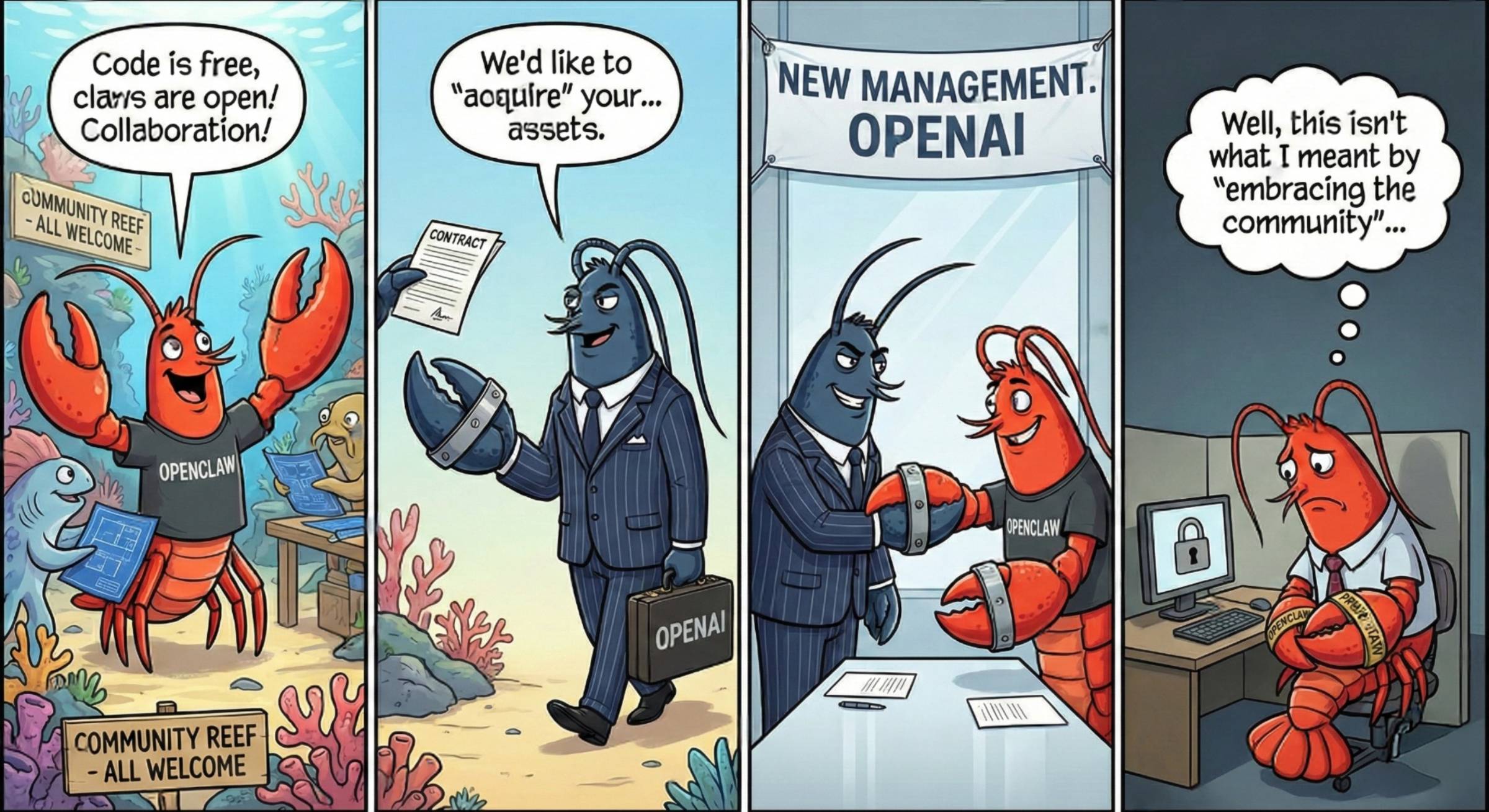
    In a move that underscores the intensifying race to dominate AI agent technology, OpenAI has brought aboard Peter Steinberger, the visionary Austrian developer behind the viral open-source project OpenClaw. As reported by Reuters, Fortune, and TechCrunch, the deal was announced on February 15, 2026. This isn’t a conventional acquisition but an “acquihire,” where Steinberger joins OpenAI to spearhead the development of next-generation personal AI agents.

    Meanwhile, OpenClaw transitions to an independent foundation, remaining fully open-source with continued support from OpenAI (confirmed via Steinberger’s Blog and LinkedIn). This strategic alignment comes amid soaring interest in AI agents, a market projected by AInvest to hit $52.6 billion by 2030 with a 46.3% compound annual growth rate.

    The announcement, made via a post on X by OpenAI CEO Sam Altman around 21:39 GMT, arrived just hours before widespread media coverage from outlets like Fortune. Steinberger swiftly confirmed the news in a personal blog post, emphasizing his excitement for the future while reaffirming OpenClaw’s independence.

    The Rise of OpenClaw: From Playground Project to Phenomenon

    OpenClaw, originally launched as Clawdbot in November 2025—a playful nod to Anthropic’s Claude model—quickly evolved into a powerhouse open-source AI agent framework designed for personal use (Fortune, Steinberger’s Blog, APIYI). Steinberger, who “vibe coded” the project solo after a three-year hiatus following the sale of his previous company for over $100 million, saw it explode in popularity. It amassed over 100,000 GitHub stars, drew 2 million visitors in a week, and became the fastest-growing repo in GitHub history—surpassing milestones of projects like React and Linux (Yahoo Finance, LinkedIn).

    A trademark dispute with Anthropic prompted renames: first to Moltbot (evoking metamorphosis), then to OpenClaw in early 2026. The framework empowers AI to autonomously handle tasks on users’ devices, fostering a community focused on data ownership and multi-model support.

    Key capabilities that fueled its hype include:

    • Managing emails and inboxes.
    • Booking flights, restaurant reservations, and flight check-ins.
    • Interacting with services like insurers.
    • Integrating with apps such as WhatsApp and Slack for task delegation.
    • Creating a “social network” for AI agents via features like Moltbook, which spawned 1.6 million agents (Source).

    Despite its success, sustainability proved challenging. Steinberger personally shouldered infrastructure costs of $10,000 to $20,000 monthly, routing sponsorships to dependencies rather than himself, even as donations and corporate support (including from OpenAI) trickled in.

    The Path to the Deal: Billion-Dollar Bids and Open-Source Principles

    Prior to the announcement, Steinberger fielded billion-dollar acquisition offers from tech giants Meta and OpenAI (Yahoo Finance). Meta’s Mark Zuckerberg personally messaged Steinberger on WhatsApp, sparking a 10-minute debate over AI models, while OpenAI’s Sam Altman offered computational resources via a Cerebras partnership to boost agent performance. Meta aggressively pursued Steinberger and his team, but OpenAI advanced in talks to hire him and key contributors.

    Steinberger spent the preceding week in San Francisco meeting AI labs, accessing unreleased research. He insisted any deal preserve OpenClaw’s open-source nature, likening it to Chrome and Chromium. Ultimately, OpenAI’s vision aligned best with his goal of accessible agents.

    Key Announcements and Voices from the Frontlines

    Sam Altman, in his X post on February 15, 2026, hailed Steinberger as a “genius with a lot of amazing ideas about the future of very smart agents interacting with each other to do very useful things for people.” He added, “We expect this will quickly become core to our product offerings. OpenClaw will live in a foundation as an open source project that OpenAI will continue to support. The future is going to be extremely multi-agent and it’s important to us to support open source as part of that.”

    Steinberger’s blog post echoed this enthusiasm: “tl;dr: I’m joining OpenAI to work on bringing agents to everyone. OpenClaw will move to a foundation and stay open and independent. The last month was a whirlwind… When I started exploring AI, my goal was to have fun and inspire people… My next mission is to build an agent that even my mum can use… I’m a builder at heart… What I want is to change the world, not build a large company… The claw is the law.”

    Strategic Implications: Opportunities and Challenges Ahead

    For OpenAI, this bolsters their AI agent push, potentially accelerating consumer-grade solutions and addressing barriers like setup complexity and security. It positions them in the “personal agent race” against Meta, emphasizing multi-agent systems. The broader AI agents market could reach $180 billion by 2033, driving undisclosed but likely substantial financial terms.

    OpenClaw benefits from foundation status (akin to the Linux Foundation), ensuring independence and community focus with OpenAI’s sponsorship.

    However, risks loom large. OpenClaw’s “unfettered access” to devices raises security concerns, including data breaches and rogue actions—like one incident of spamming hundreds of iMessages. China’s industry ministry warned of cyberattack vulnerabilities if misconfigured. Steinberger aims to prioritize safety and accessibility.

    Community Pulse: Excitement, Skepticism, and Satire

    Reactions on X blend hype and caution. Cointelegraph noted the move as a “big move” for ecosystems. One user called it the “birth of the agent era,” while another satirically predicted a shift to “ClosedClaw.” Fears of closure persist, but congratulations abound, with some viewing Anthropic’s trademark push as a “fumble.”

    LinkedIn’s Reyhan Merekar praised Steinberger’s solo feat: “Literally coding alone at odd hours… Faster than React, Linux, and Kubernetes combined.”

    Beyond the Headlines: Vision and Value

    Steinberger’s core vision: Agents for all, even non-tech users, with emphasis on safety, cutting-edge models, and impact over empire-building. OpenClaw’s strengths—model-agnostic design, delegation-focused UX, and persistent memory—eluded even well-funded labs.

    As of February 15, 2026, this marks a pivotal moment in AI’s evolution, blending open innovation with corporate muscle. No further updates have emerged, but the multi-agent future Altman envisions is accelerating.

  • OpenClaw & The Age of the Lobster: How Peter Steinberger Broken the Internet with Agentic AI

    In the history of open-source software, few projects have exploded with the velocity, chaos, and sheer “weirdness” of OpenClaw. What began as a one-hour prototype by a developer frustrated with existing AI tools has morphed into the fastest-growing repository in GitHub history, amassing over 180,000 stars in a matter of months.

    But OpenClaw isn’t just a tool; it is a cultural moment. It’s a story about “Space Lobsters,” trademark wars with billion-dollar labs, the death of traditional apps, and a fundamental shift in what it means to be a programmer. In a marathon conversation on the Lex Fridman Podcast, creator Peter Steinberger pulled back the curtain on the “Age of the Lobster.”

    Here is the definitive deep dive into the viral AI agent that is rewriting the rules of software.


    The TL;DW (Too Long; Didn’t Watch)

    • The “Magic” Moment: OpenClaw started as a simple WhatsApp-to-CLI bridge. It went viral when the agent—without being coded to do so—figured out how to process an audio file by inspecting headers, converting it with ffmpeg, and transcribing it via API, all autonomously.
    • Agentic Engineering > Vibe Coding: Steinberger rejects the term “vibe coding” as a slur. He practices “Agentic Engineering”—a method of empathizing with the AI, treating it like a junior developer who lacks context but has infinite potential.
    • The “Molt” Wars: The project survived a brutal trademark dispute with Anthropic (creators of Claude). During a forced rename to “MoltBot,” crypto scammers sniped Steinberger’s domains and usernames in seconds, serving malware to users. This led to a “Manhattan Project” style secret operation to rebrand as OpenClaw.
    • The End of the App Economy: Steinberger predicts 80% of apps will disappear. Why use a calendar app or a food delivery GUI when your agent can just “do it” via API or browser automation? Apps will devolve into “slow APIs”.
    • Self-Modifying Code: OpenClaw can rewrite its own source code to fix bugs or add features, a concept Steinberger calls “self-introspection.”

    The Origin: Prompting a Revolution into Existence

    The story of OpenClaw is one of frustration. In late 2025, Steinberger wanted a personal assistant that could actually do things—not just chat, but interact with his files, his calendar, and his life. When he realized the big AI labs weren’t building it fast enough, he decided to “prompt it into existence”.

    The One-Hour Prototype

    The first version was built in a single hour. It was a “thin line” connecting WhatsApp to a Command Line Interface (CLI) running on his machine.

    “I sent it a message, and a typing indicator appeared. I didn’t build that… I literally went, ‘How the f*** did he do that?’”

    The agent had received an audio file (an opus file with no extension). Instead of crashing, it analyzed the file header, realized it needed `ffmpeg`, found it wasn’t installed, used `curl` to send it to OpenAI’s Whisper API, and replied to Peter. It did all this autonomously. That was the spark that proved this wasn’t just a chatbot—it was an agent with problem-solving capabilities.


    The Philosophy of the Lobster: Why OpenClaw Won

    In a sea of corporate, sanitized AI tools, OpenClaw won because it was weird.

    Peter intentionally infused the project with “soul.” While tools like GitHub Copilot or ChatGPT are designed to be helpful but sterile, OpenClaw (originally “Claude’s,” a play on “Claws”) was designed to be a “Space Lobster in a TARDIS”.

    The soul.md File

    At the heart of OpenClaw’s personality is a file called soul.md. This is the agent’s constitution. Unlike Anthropic’s “Constitutional AI,” which is hidden, OpenClaw’s soul is modifiable. It even wrote its own existential disclaimer:

    “I don’t remember previous sessions… If you’re reading this in a future session, hello. I wrote this, but I won’t remember writing it. It’s okay. The words are still mine.”

    This mix of high-utility code and “high-art slop” created a cult following. It wasn’t just software; it was a character.


    The “Molt” Saga: A Trademark War & Crypto Snipers

    The projects massive success drew the attention of Anthropic, the creators of the “Claude” model. They politely requested a name change to avoid confusion. What should have been a simple rebrand turned into a cybersecurity nightmare.

    The 5-Second Snipe

    Peter attempted to rename the project to “MoltBot.” He had two browser windows open to execute the switch. In the five seconds it took to move his mouse from one window to another, crypto scammers “sniped” the account name.

    Suddenly, the official repo was serving malware and promoting scam tokens. “Everything that could go wrong, did go wrong,” Steinberger recalled. The scammers even sniped the NPM package in the minute it took to upload the new version.

    The Manhattan Project

    To fix this, Peter had to go dark. He planned the rename to “OpenClaw” like a military operation. He set up a “war room,” created decoy names to throw off the snipers, and coordinated with contacts at GitHub and X (Twitter) to ensure the switch was atomic. He even called Sam Altman personally to check if “OpenClaw” would cause issues with OpenAI (it didn’t).


    Agentic Engineering vs. “Vibe Coding”

    Steinberger offers a crucial distinction for developers entering this new era. He rejects the term “vibe coding” (coding by feel without understanding) and proposes Agentic Engineering.

    The Empathy Gap

    Successful Agentic Engineering requires empathy for the model.

    • Tabula Rasa: The agent starts every session with zero context. It doesn’t know your architecture or your variable names.
    • The Junior Dev Analogy: You must guide it like a talented junior developer. Point it to the right files. Don’t expect it to know the whole codebase instantly.
    • Self-Correction: Peter often asks the agent, “Now that you built it, what would you refactor?” The agent, having “felt” the pain of the build, often identifies optimizations it couldn’t see at the start.

    Codex (German) vs. Opus (American)

    Peter dropped a hilarious but accurate analogy for the two leading models:

    • Claude Opus 4.6: The “American” colleague. Charismatic, eager to please, says “You’re absolutely right!” too often, and is great for roleplay and creative tasks.
    • GPT-5.3 Codex: The “German” engineer. Dry, sits in the corner, doesn’t talk much, reads a lot of documentation, but gets the job done reliably without the fluff.

    The End of Apps & The Future of Software

    Perhaps the most disruptive insight from the interview is Steinberger’s view on the app economy.

    “Why do I need a UI?”

    He argues that 80% of apps will disappear. If an agent has access to your location, your health data, and your preferences, why do you need to open MyFitnessPal? The agent can just log your calories based on where you ate. Why open Uber Eats? Just tell the agent “Get me lunch.”

    Apps that try to block agents (like X/Twitter clipping API access) are fighting a losing battle. “If I can access it in the browser, it’s an API. It’s just a slow API,” Peter notes. OpenClaw uses tools like Playwright to simply click “I am not a robot” buttons and scrape the data it needs, regardless of developer intent.


    Thoughts: The “Mourning” of the Craft

    Steinberger touched on a poignant topic for developers: the grief of losing the craft of coding. For decades, programmers have derived identity from their ability to write syntax. As AI takes over the implementation, that identity is under threat.

    But Peter frames this not as an end, but an evolution. We are moving from “programmers” to “builders.” The barrier to entry has collapsed. The bottleneck is no longer your ability to write Rust or C++; it is your ability to imagine a system and guide an agent to build it. We are entering the age of the System Architect, where one person can do the work of a ten-person team.

    OpenClaw is not just a tool; it is the first true operating system for this new reality.