PJFP.com

Pursuit of Joy, Fulfillment, and Purpose

Tag: Optimism

  • Dig Through Your Couches, SpaceX Needs It: Cyan Banister on Luke Nosek’s Pitch, Going All In on SpaceX, Pokemon Go, Meditation, and Why Curiosity Is the Ultimate Investing Edge

    Angel investor Cyan Banister has one of the most remarkable track records in Silicon Valley: SpaceX, Uber, Anduril, Postmates, Niantic, Affirm, Flexport, Flock Safety, and dozens more. In this wide-ranging conversation on the Sourcery podcast with Molly O’Shea, the Long Journey Ventures co-founder tells the story behind her first check, when PayPal co-founder Luke Nosek got on the floor of her house and told her to dig through her couches because SpaceX needed every liquid dollar she had. She also covers the Founders Fund Mafia show, why personality is not fixed, the five minute meditation practice she prescribes to stuck founders, how asking “why” led her to Pokemon Go and Uber, what worries her about AI surveillance, and why free speech is her number one cause.

    TLDW

    Cyan Banister explains how Luke Nosek and her husband Scott Banister convinced her to put her entire IronPort windfall into SpaceX while rockets were still blowing up on the launch pad, a bet that became the best investment of her life. She walks through the “second believer” philosophy behind Long Journey Ventures and its bellwether logo, her run on Mike Solana’s Founders Fund Mafia show filmed at the site of the famous PayPal Mafia photo, why games like Mafia, poker, and board games are core Silicon Valley social infrastructure, and the time she bluffed Phil Hellmuth on a live stream. She then goes deep on inner work: personality is not fixed, the gap between your values and your actions is measurable, meditation is noticing that you are noticing, and mornings should start with a “why” question. That mindset produced her Niantic and Uber investments, informs her worries about centralized AI and a surveillance state, and fuels her excitement about AI as a new paintbrush, vibe manufacturing, agentized one person businesses, Substrate, Becoming Bio, and Diamond Foundry. She closes with her mentors, Peter Thiel, Marc Andreessen, Scott Cook, and Rick Rubin, and a blunt defense of curiosity and free speech over shame by association.

    Thoughts

    The most useful idea in this interview is the “second believer.” Long Journey keeps two candles on the wall: a founder lights the first flame, and someone else lights their own candle from it and holds the flame in case the founder’s goes out. That is a precise description of what early capital actually is. Luke Nosek was Elon Musk’s second believer, championing SpaceX “with more heart” than Cyan had ever seen, and Cyan’s first check existed because Nosek’s conviction was strong enough to transfer. Most people think conviction is a private mental state. This interview argues it is social infrastructure: belief propagates person to person, and the people who hold flames for others quietly shape which futures get built.

    The SpaceX story deserves a caveat Banister herself supplies. Putting one hundred percent of a liquidity event into a company whose rockets were exploding looks like genius only in hindsight; her friends told her she had lit her money on fire, and they were reasoning correctly from the information available. What made the bet rational was not the outcome but the frame Nosek and Scott Banister gave her: you are young, able-bodied, and infinitely employable, so your downside is a career, not ruin. That is the actual lesson for anyone tempted to copy the trade. Concentrated risk is a function of your recovery capacity, not your conviction level. She could afford to be the fool card. A fifty five year old with dependents cannot, and pretending otherwise is how people get hurt imitating legends.

    Her investing process is really an attention practice wearing a venture costume. The Niantic story is the cleanest example: she noticed friends chartering boats and ditching Defcon parties to capture invisible portals in Ingress, asked why Google would build such a thing, worked out that it was free mapping data, and then recognized the ticket subject lines at Hint Water as her path to the CEO the week Niantic spun out of Alphabet. Nothing in that chain requires capital or connections. It requires being awake, which is exactly why she starts coaching clients with five minutes of meditation and a “why” question every morning. The pipeline from mindfulness to alpha sounds like woo until you notice that every step of her best deals was just paying attention slightly earlier than everyone else.

    Her claim that personality is surgically alterable is more radical than it sounds, and it lands close to the core of the pursuit of joy, fulfillment, and purpose. Most self-improvement advice accepts the self as given and optimizes around it. Banister says the “I’m just like this” script is an excuse for behavior you are unwilling to change, and her values-versus-actions audit, literally listing where you lied this week, including the accidental lies of broken small commitments, is a concrete tool anyone can run tonight. She even disagrees with Marc Andreessen’s famous advice against introspection, which takes some nerve given he is one of her heroes. The through line from her homelessness to her optimism is that she treated her own character as buildable, and that is a more transferable asset than any cap table.

    The last stretch, on centralized AI, surveillance, and free speech, is where her optimism shows its edges. She is an accelerationist who backs open source and decentralized control precisely because she remembers the internet of 1999 promising the same thing and consolidating anyway. Her warning that autonomous vehicles could quietly abolish freedom of movement for dissidents is the kind of unfashionable thought experiment that her whole “question every phrase” method is built to surface. You do not have to share her politics to notice the consistency: someone who measures a nation’s health by its tolerance for comedy and rap music is applying the same test to Peter Thiel dinner parties and to AI policy, which is more than most commentators on either side can say.

    Key Takeaways

    • Cyan Banister’s first ever angel check was SpaceX, made after PayPal co-founder Luke Nosek came to her house and told her and Scott Banister to dig through their couches for anything liquid because SpaceX needed it.
    • She put everything she made from the IronPort sale to Cisco into SpaceX at a time when rockets were blowing up on the launch pad and critics said private citizens had no business in space.
    • The frame that justified the all-in bet: if you are young and able-bodied you are infinitely employable, so a total loss costs you a lifestyle, not your future. She held the position for roughly 20 years and calls it the best investment she will ever make.
    • Failure was priced in: she compares early SpaceX to early aviation, where getting planes to fly required crashing a lot of planes, and NASA veterans knew reusability would demand repeated public failure.
    • Combined with her husband Scott Banister, she believes they are the number one angel investing duo in the world, and even split individually both would sit in the top ten of the Stanford angel rankings. Married partners share capital, which rankings and lists struggle to represent.
    • Her portfolio names dropped in the episode include SpaceX, Anduril, Uber, Zappos, PayPal, Affirm, Flexport, Checkr, Density, Flock Safety, Brave, Control Labs, Depop, Substrate, Carta, Together AI, Postmates, Niantic, Diamond Foundry, Upstart, Fiverr, Forge, Opendoor, Calm, TrueMed, and Crusoe.
    • Long Journey Ventures’ logo is a bellwether, the lead sheep of a flock, looking sideways to spot the nonobvious. The firm’s “second believer” ritual uses two candles: light your candle from a founder’s flame and hold it so they can reignite if theirs goes out.
    • She was a cast member on Mike Solana’s Founders Fund Mafia show, filmed at Tosca, the same location as the famous PayPal Mafia photo, with a full reality TV production: one camera per player, table lenses, aerial cameras, and over 30 crew.
    • Her Mafia strategy is the meta game: listening for sounds, watching eye movements, tracking who protests too much and who is forming alliances, on the assumption that everyone is lying.
    • Games are Silicon Valley’s social infrastructure. Poker, Mafia, Werewolf, chess, Magic the Gathering, and Settlers of Catan nights let people skip small talk, collaborate immediately, and reveal how many turns ahead someone thinks.
    • If you get invited to a poker night or a Mafia game in tech, go. She has found founders and friends through games, and treats them like poker or golf as deal flow channels.
    • Brian Singerman got her into board games through a board game of the month club she ran for $40 a month, shipping sub-30-minute games in advance so game night starts with playing, not rule explanations. She has never met anyone better at strategy board games.
    • She beat Phil Hellmuth with her first ever bluff during a live streamed poker game she did not know was being broadcast, by convincing herself she had the best hand and acting accordingly. Hellmuth went on tilt for the rest of the session.
    • She identifies with the fool tarot card: walking off ledges expecting things to work out, and believing that on a long enough time horizon every setback turns out to have been necessary.
    • Personality is not fixed. Statements like “I’m a Scorpio, I can’t help it” or “I’m Irish, I have a temper” are excuses for behavior you are unwilling to change. With introspection, effort, and time you can surgically alter your personality.
    • Her weekly thought experiment: how wide is the space between your values and your actions? She sits down with paper and lists where she lied, including accidental lies like promising an email and not sending it.
    • She runs Awake Academy 101 classes and coaches stuck founders, starting almost everyone with five minutes of meditation a day, often in the car before starting the engine.
    • Meditation is not silencing your mind. It is noticing thoughts passing like clouds, then noticing that you are noticing, then asking who the noticer is. If you are not your thoughts, who are you?
    • Her presence toolkit: mindful showers, feeling your toes for the first minute after waking instead of launching into routines, and writing “wake up” on mirrors and windows so it appears when they fog up.
    • Humans are “why machines.” She does not start her day until she has a why question to carry through it, and says asking why about everything makes you a better investor, entrepreneur, and everything else.
    • The Niantic investment came from watching Ingress players rent helicopters and charter boats for invisible objects, realizing Google was harvesting free mapping data, then using Hint Water ticket subject lines to reach CEO John Hanke through Kara Goldin the moment Niantic spun out of Alphabet.
    • Nobody would co-invest in Niantic with her because they could not imagine people holding phones up to look at invisible Pokemon. She calls the Pokemon Go launch the closest we have come to world peace.
    • Her Uber conviction came from years of asking taxi drivers about their lives: starting each day $200 in the hole to the taxi yard explained the rushing, the crankiness, and the broken system, so when Uber appeared the pre-thinking was already done.
    • Idle time is research time. Instead of doom scrolling at a restaurant, ask why the bread is baked that way and whether robotics would improve it. Play with science fiction scenarios and they lead you to investments.
    • Her biggest worry, a question Peter Thiel used to ask her: an AI-operated surveillance state. Autonomous vehicles could end freedom of movement, with a government able to shut down your ride or lock you inside it because you are a dissident.
    • She believes the internet’s drift from open and decentralized to closed and centralized is repeating in AI, and that one company with one ideology ruling AI is dangerous. Everyone needs their own models, which is why she backs open source and decentralized control.
    • On education: unless you are pursuing medicine or another field requiring years of formal training, she questions whether school is the right move now. Artisanship and creativity will rise, and AI tutors make genuine self-teaching possible.
    • She is excited about AI as a new paintbrush unlocking dormant creativity: vibe coding, vibe manufacturing, and fully agentized businesses with no employees will mint millionaires from basements even if the businesses are not venture scale.
    • On AI art and training data: after a hundred years art enters the public domain anyway, China will train on Western IP regardless and sell it back, and today’s “slop” is the worst the tools will ever be.
    • AI still cannot replace human judgment. AI-written text has telltale signs any heavy user recognizes, so the job is to take its useful nuggets and massage them back into human form.
    • Her most exciting current investments: Substrate (the substrate of technology, bringing semiconductor manufacturing back to the Americas), Becoming Bio (the substrate of biology), and Diamond Foundry, whose real market was industrial diamonds and wafers, not rings.
    • She avoids hypercompetitive hot deals because the alpha is not in what is happening today. A good seed fund finds moonshots at low prices with meaningful ownership, in the “what’s coming” space: nanotech, biotech, and bottlenecks removed by AI.
    • She is still hunting for “the Alibaba of the Americas” and puts it out publicly in case a founder claims the idea. Wars will be fought with robots and drones, SpaceX opened the category that made Anduril and Varda imaginable, and defense primes will need competitors.
    • Her heroes: Peter Thiel (she went to “Peter Thiel University” during four years as his partner at Founders Fund and calls him tolerant, open-minded, and poorly understood), Marc Andreessen (a teenage hero she vowed to meet as an equal), Scott Cook of Intuit (the gold standard of executive function), and Rick Rubin, whom she has never met but considers a kindred mind.
    • Mentors can be far off. You can learn from people without knowing them by observing them, listening to those around them, and asking why they do what they do without assuming.
    • On shame by association: go to the events, hear all sides before deciding where you stand, and stop weaponizing accusations, because if everyone is called a racist the real ones cannot be found.
    • You can tell the health of a nation by its ability to tolerate comedy and rap music, and comedy disappearing from universities first was the warning sign. Free speech is her number one cause, and much of what she invests in serves it.

    Detailed Summary

    Inside Cyan’s Lair: Play as a Design Principle

    The interview opens in “Cyan’s Lair,” a mural-covered room at Long Journey’s headquarters painted by Brooklyn ceramicist Dave Zackin, whom Banister discovered on Instagram because he wore the same red and green glasses she needed to learn to walk again after her stroke. Zackin rescues abandoned pottery from high schools and ceramic studios, repaints and refires it, and gives it new life. Her home works the same way: thrift store finds, walls of fried eggs, bowls of fake fish people end up throwing at each other. She gauges hosting success by how many things guests touch without permission, because rummaging means they feel free to play. The candles on the wall, added by co-founder Lee Jacobs, encode the firm’s “second believer” concept: light your candle from a founder’s flame and hold it in case theirs goes out. The firm’s bellwether logo, a sheep’s eye looking sideways, comes from her habit of interrogating common phrases: when is being a sheep good, who leads the sheep, and what is the bellwether watching for that others miss?

    Mafia at Tosca: Reality TV for the PayPal Set

    Banister was a breakout player on Mike Solana’s Mafia show for Founders Fund, filmed months before release at Tosca, the location of the famous PayPal Mafia photograph. The production was serious reality television: a camera per player, lenses embedded in the table, aerial shots, and over 30 crew, with spicy moments and sushi-room banter left on the cutting room floor. Her approach was pure meta game, listening for rustling when the mafia woke at night, watching for the table jerk when players leaned on it, and asking the bar who the best players were so she could target them first. It was her first time playing the killer, and she found lying so uncomfortable she was sure everyone could tell. They could not. She hopes for a second season and notes the game should not be played with couples, since accusations have a way of outliving the game.

    Games, Poker, and the Hellmuth Bluff

    Banister argues games are how a neurodiverse industry socializes: instead of cocktail small talk, you drop straight into collaboration and watch how someone thinks, whether they plan five turns ahead, and how they handle math, psychology, and losing. Brian Singerman, whom she calls the best strategy board gamer she has ever met, subscribed to her board game of the month club, where friends paid $40 a month for sub-30-minute games shipped in advance so game nights started instantly. Her poker fame is mostly accidental: she hosts an annual charity tournament for Inflection Grants micro grants, and once stumbled into a live streamed game with Steve Aoki, Ninja, and Phil Hellmuth without realizing cameras were showing her cards to the world. Told at the break to try bluffing just once, she waited for a big pot, convinced herself she held the best hand, and played it that way until Hellmuth folded and went on tilt. The story doubles as her whole philosophy: she was only in Vegas because a portfolio company had her working undercover in a bad wig.

    The Fool Card: Optimism as a Trainable Skill

    Asked how she keeps finding herself in improbable situations, Banister says her life is a series of them, like Bill Murray in The Man Who Knew Too Little, and that if she were a tarot card she would be the fool, walking off ledges expecting things to work out. Pressed on whether ordinary people can live that way, she rejects the premise that they cannot: personality feels fixed only because we recite excuses like “I’m a Scorpio” or “I’m Irish, I have a temper.” With introspection, and here she cheerfully disagrees with Marc Andreessen’s advice against it, you can surgically alter your personality, though it takes effort, time, and facing ugly truths. Her weekly thought experiment asks how wide the space is between your values and your actions: if you claim honesty, list where you lied this week, including the accidental lies of commitments the two-hours-later version of you failed to keep. People wear masks out of fear of standing out, but everyone else is too caught up in their own noise to care, and authenticity leads to more happiness, curiosity, and wonder.

    Waking Up: Meditation, the Right Brain, and Why Machines

    Through her coaching and Awake Academy classes, Banister starts almost everyone with five minutes of meditation a day, often sitting in the car before starting it. She dismantles the perfection myth that drives people away from the practice: meditation is not silencing thought but noticing thoughts pass like clouds, noticing that you are noticing, and asking who the noticer is. From there the practice extends into ordinary life: mindful showers, feeling your toes for the first minute after waking instead of diving into routines, asking “am I awake right now?” before getting out of bed, and writing “wake up” on surfaces that fog up. The point is escaping rumination about past and future, since the present is the only thing that exists. Mind workers live in the left brain, but creativity, body sense, and intuition live in the right, and her greatest investments came with a feeling. Humans, she says, are why machines: she does not start her day without a why question to carry through it.

    Pattern Matching in the Wild: Niantic and Uber

    Her Niantic story shows the method end to end. She watched friends display irrational devotion to Ingress, renting helicopters and abandoning Defcon to capture invisible portals, immersed herself in the game, and asked why Google would build it, concluding it was free mapping data. When Alphabet spun Niantic out, she remembered support tickets at Hint Water marked “Ingress code,” asked founder Kara Goldin about the Google relationship, and was connected to CEO John Hanke within five minutes. He told her Niantic had Nintendo and Google and did not need her money; she asked for one hour and a guarantee he would not regret it, brought her best friend who was a top player (Hanke hired him nearly on the spot), and got into the round. Convincing anyone to co-invest was impossible because nobody believed people would hold up phones to look at invisible Pokemon. The Uber thesis worked the same way years earlier: asking taxi drivers about their lives revealed a system where drivers started each day $200 in debt to the yard, which explained everything riders hated about taxis. People who complain about Uber, she notes, never lived the before times.

    Worries: Surveillance States and Centralized AI

    Banister borrows a question Peter Thiel used to ask her at Founders Fund: what worries you? Her answer is an AI-operated surveillance state fused with robotics. Freedom of movement is a human right, and a future where you cannot drive yourself means someone can shut down your autonomous ride, or lock you inside it, because you said things the state dislikes. AI, like a gun, can be a paperweight or a weapon, and she is an accelerationist who still insists on thinking through what happens if it falls into the wrong hands. Having entered the industry in 1999, she watched an internet that was supposed to be open and decentralized become closed and centralized, and sees the same drift in OpenAI and Anthropic. Everyone needs their own models, she argues, because one company with one ideology ruling it all is dangerous. She also worries about children and what they should study when so much is automatable, concluding that unless a path truly requires years of schooling, like medicine, formal education may not be the answer right now.

    Excitement: The New Paintbrush and the Agentized Business

    On the hopeful side, she sees AI as a new paintbrush unlocking dormant creativity. The person with a million dollar idea who could never get on Shark Tank can now vibe code the app, put up a site, and eventually vibe manufacture the product, running an agentized business with no employees from a basement. These may not be venture scale companies, but they will mint a wave of millionaires, followed in two to three years by a consumer wave that changes signs, fashion, and manufacturing. On AI art controversies she is pragmatic: all art enters the public domain after a hundred years anyway, China will train on Western IP regardless and sell it back, and today’s tools are the worst they will ever be. She has hundreds of movies inside her and can finally make them. But AI is not a replacement for humans: its writing carries telltale signs, and the human job is to take its nuggets and massage them back into human form, agreeing with the host’s Config takeaway that AI generates the average and the human must pull the work out of the bell curve.

    The SpaceX Bet and What Risk Taught Her

    The centerpiece story: Luke Nosek, who met Scott Banister and Max Levchin in a University of Illinois computer lab and drove west with Scott communicating by walkie-talkie, became Elon Musk’s fiercest champion. He arrived at the Banisters’ house, got on the floor in his Vibram shoes, and delivered the pitch: dig through your couches, anything liquid you have, SpaceX needs it. Rockets were blowing up on the launch pad and critics said private citizens had no business in space, but Nosek and Scott argued that early aviation crashed a lot of planes too, and that a young, infinitely employable person should take the shot. Fresh off her IronPort exit to Cisco, she went all in, then immediately wondered what she had done while her own startup struggled. Twenty years later, still essentially unsold, it is the best investment she will probably ever make. The deeper lesson came from realizing angel investing was a special club she had lucked into, one most people never learn exists. Scott farmed his PayPal network while she networked relentlessly through TC40, TC50, Disrupt, and YC demo days for a decade, writing failed checks and calibrating her pattern matching, because becoming good at early stage investing requires losing.

    What’s Next, and the Mentors Behind It

    Her most exciting current bets are Substrate and Becoming Bio, the substrates of technology and biology, plus Diamond Foundry, whose skeptics saw only synthetic rings while the founder saw industrial diamonds and wafers for AI and crypto. She wants semiconductor manufacturing back in the Americas, is watching AI companion devices race toward a genuinely useful Tamagotchi, and keeps a standing public request for the Alibaba of the Americas. She avoids today’s hot hypercompetitive deals because the alpha lives in what is coming, nanotech, biotech, and the bottlenecks AI removes, not what is hot now. Her inspirations: Peter Thiel, her partner for four years at what she calls Peter Thiel University, whom she defends as tolerant, open-minded, and poorly understood; Marc Andreessen, the teenage hero she vowed to meet as an equal and eventually did; Scott Cook of Intuit, her gold standard of executive function and decency; and Rick Rubin, the one mind she compares to her own, whom she is putting out into the universe a request to meet. The closing stretch is a defense of curiosity over tribalism: go to the Thiel events, hear all sides before deciding where you stand, stop diluting real words like racism through overuse, and protect the two canaries of a free nation, comedy and rap music. Free speech, she says, is her number one cause.

    Notable Quotes

    “Banisters, I need you to dig through your couches. Anything liquid you have, I need it. SpaceX needs it.”

    Luke Nosek’s pitch, as retold by Cyan Banister, describing the night that led to her first angel check

    “Luke and Scott convinced me to put everything that I made in IronPort when we sold to Cisco into SpaceX.”

    Cyan Banister, on going all in while SpaceX rockets were still blowing up on the launch pad

    “You can actually surgically go in and alter your personality where you can actually change these things, but it takes effort and time and a lot of facing the ugly truth about yourself.”

    Cyan Banister, rejecting the idea that personality is fixed

    “Meditation is about noticing the thoughts and noticing that they’re going by like clouds and then noticing that you’re noticing. So who is that person? So if you are not your thoughts then who are you is where I would start.”

    Cyan Banister, on the five minute practice she prescribes to stuck founders

    “When you ask why about everything in the world, it’s just going to make you a better investor. It’s going to make you a better entrepreneur, a better everything.”

    Cyan Banister, on humans as why machines and the habit behind her Uber and Niantic bets

    “I always say it’s the closest we’ve come to world peace. It was one of the most magical few weeks of my life and probably many people’s lives.”

    Cyan Banister, on the launch of Pokemon Go

    “I’ve got to try to find things at lower prices that are still a moonshot that I can get a good percentage of ownership like a good seed fund should do.”

    Cyan Banister, on why she avoids hypercompetitive hot deals where the alpha is already gone

    “If you get invited to a Peter Thiel event, go. Do not shy away from it. It does not make you anything that anyone’s going to accuse you of.”

    Cyan Banister, on curiosity versus shame by association

    “You can tell the health of a nation by its ability to tolerate comedy and rap music. Those two things have to exist for freedom.”

    Cyan Banister, on the canaries of free speech, her number one cause

    Watch the full conversation with Cyan Banister on the Sourcery podcast here.

    Related Reading

    • Cyan Banister (Wikipedia) background on her path from homelessness to one of the most successful angel investors in the world.
    • Long Journey Ventures the “magically weird” seed fund she co-founded, home of the bellwether and the second believer candles.
    • Luke Nosek (Wikipedia) the PayPal co-founder and Founders Fund co-founder whose couch-digging pitch started it all.
    • The Creative Act by Rick Rubin, the book behind the openness-to-the-universe mindset Banister says mirrors her own.
    • Purpose (PJFP) our pillar page on building the kind of why-driven daily practice Banister describes.

  • Dwarkesh Patel: From Podcasting Prodigy to AI Chronicler with The Scaling Era

    TLDW (Too Long; Didn’t Watch)

    Dwarkesh Patel, a 24-year-old podcasting sensation, has made waves with his deep, unapologetically intellectual interviews on science, history, and technology. In a recent Core Memory Podcast episode hosted by Ashlee Vance, Patel announced his new book, The Scaling Era: An Oral History of AI, co-authored with Gavin Leech and published by Stripe Press. Released digitally on March 25, 2025, with a hardcover to follow in July, the book compiles insights from AI luminaries like Mark Zuckerberg and Satya Nadella, offering a vivid snapshot of the current AI revolution. Patel’s journey from a computer science student to a chronicler of the AI age, his optimistic vision for a future enriched by artificial intelligence, and his reflections on podcasting as a tool for learning and growth take center stage in this engaging conversation.


    At just 24, Dwarkesh Patel has carved out a unique niche in the crowded world of podcasting. Known for his probing interviews with scientists, historians, and tech pioneers, Patel refuses to pander to short attention spans, instead diving deep into complex topics with a gravitas that belies his age. On March 25, 2025, he joined Ashlee Vance on the Core Memory Podcast to discuss his life, his meteoric rise, and his latest venture: a book titled The Scaling Era: An Oral History of AI, published by Stripe Press. The episode, recorded in Patel’s San Francisco studio, offers a window into the mind of a young intellectual who’s become a key voice in documenting the AI revolution.

    Patel’s podcasting career began as a side project while he was a computer science student at the University of Texas. What started with interviews of economists like Bryan Caplan and Tyler Cowen has since expanded into a platform—the Lunar Society—that tackles everything from ancient DNA to military history. But it’s his focus on artificial intelligence that has garnered the most attention in recent years. Having interviewed the likes of Dario Amodei, Satya Nadella, and Mark Zuckerberg, Patel has positioned himself at the epicenter of the AI boom, capturing the thoughts of the field’s biggest players as large language models reshape the world.

    The Scaling Era, co-authored with Gavin Leech, is the culmination of these efforts. Released digitally on March 25, 2025, with a print edition slated for July, the book stitches together Patel’s interviews into a cohesive narrative, enriched with commentary, footnotes, and charts. It’s an oral history of what Patel calls the “scaling era”—the period where throwing more compute and data at AI models has yielded astonishing, often mysterious, leaps in capability. “It’s one of those things where afterwards, you can’t get the sense of how people were thinking about it at the time,” Patel told Vance, emphasizing the book’s value as a time capsule of this pivotal moment.

    The process of creating The Scaling Era was no small feat. Patel credits co-author Leech and editor Rebecca for helping weave disparate perspectives—from computer scientists to primatologists—into a unified story. The first chapter, for instance, explores why scaling works, drawing on insights from AI researchers, neuroscientists, and anthropologists. “Seeing all these snippets next to each other was a really fun experience,” Patel said, highlighting how the book connects dots he’d overlooked in his standalone interviews.

    Beyond the book, the podcast delves into Patel’s personal story. Born in India, he moved to the U.S. at age eight, bouncing between rural states like North Dakota and West Texas as his father, a doctor on an H1B visa, took jobs where domestic talent was scarce. A high school debate star—complete with a “chiseled chin” and concise extemp speeches—Patel initially saw himself heading toward a startup career, dabbling in ideas like furniture resale and a philosophy-inspired forum called PopperPlay (a name he later realized had unintended connotations). But it was podcasting that took off, transforming from a gap-year experiment into a full-fledged calling.

    Patel’s optimism about AI shines through in the conversation. He envisions a future where AI eliminates scarcity, not just of material goods but of experiences—think aesthetics, peak human moments, and interstellar exploration. “I’m a transhumanist,” he admitted, advocating for a world where humanity integrates with AI to unlock vast potential. He predicts AI task horizons doubling every seven months, potentially leading to “discontinuous” economic impacts within 18 months if models master computer use and reinforcement learning (RL) environments. Yet he remains skeptical of a “software-only singularity,” arguing that physical bottlenecks—like chip manufacturing—will temper the pace of progress, requiring a broader tech stack upgrade akin to building an iPhone in 1900.

    On the race to artificial general intelligence (AGI), Patel questions whether the first lab to get there will dominate indefinitely. He points to fast-follow dynamics—where breakthroughs are quickly replicated at lower cost—and the coalescing approaches of labs like xAI, OpenAI, and Anthropic. “The cost of training these models is declining like 10x a year,” he noted, suggesting a future where AGI becomes commodified rather than monopolized. He’s cautiously optimistic about safety, too, estimating a 10-20% “P(doom)” (probability of catastrophic outcomes) but arguing that current lab leaders are far better than alternatives like unchecked nationalized efforts or a reckless trillion-dollar GPU hoard.

    Patel’s influences—like economist Tyler Cowen, who mentored him early on—and unexpected podcast hits—like military historian Sarah Paine—round out the episode. Paine, a Naval War College scholar whose episodes with Patel have exploded in popularity, exemplifies his knack for spotlighting overlooked brilliance. “You really don’t know what’s going to be popular,” he mused, advocating for following personal curiosity over chasing trends.

    Looking ahead, Patel aims to make his podcast the go-to place for understanding the AI-driven “explosive growth” he sees coming. Writing, though a struggle, will play a bigger role as he refines his takes. “I want it to become the place where… you come to make sense of what’s going on,” he said. In a world often dominated by shallow content, Patel’s commitment to depth and learning stands out—a beacon for those who’d rather grapple with big ideas than scroll through 30-second blips.

  • Naval Ravikant and Niklas Anzinger Discuss Optimism for the Future with AI and Technological Progress

    This video is a discussion between Naval Ravikant and Niklas Anzinger, focusing on the optimistic outlook towards the future propelled by AI and technological advancements. The conversation was part of an event in Vitalia City, aimed at fostering the development of a city dedicated to advancing life extension technologies. Here are the key points and a summary of their dialogue:

    1. Optimism About the Future: Naval Ravikant expresses a strong optimism for the future, grounded in the belief that technology democratizes the power of creation, enabling individuals to become innovators, entrepreneurs, and scientists.
    2. The Legacy of the Enlightenment: The discussion credits the enlightenment era for setting the foundations of scientific discovery and innovation. It highlights the importance of error correction and the unlimited potential of human creativity when supported by freedom of thought and expression.
    3. Freedom as a Catalyst for Innovation: The conversation emphasizes that freedom is crucial for innovation. Examples include Próspera ZEDE, providing a novel legal framework aimed at accelerating biotech startups by offering a more liberal regulatory environment.
    4. Challenges of Regulatory Environments: The regulatory hurdles, especially in the healthcare sector, are discussed as significant barriers to innovation. The dialogue suggests that less restrictive frameworks could unleash entrepreneurial energy and technological advancements.
    5. Impact of Technological Progress: The overarching theme is that technological progress, when coupled with entrepreneurial spirit and less restrictive regulations, can lead to significant improvements in quality of life and accelerate advancements in critical fields like healthcare.
    6. The Role of AI and Technological Progress: AI is seen as a pivotal force in shaping a brighter future, with the potential to solve complex problems, enhance creativity, and drive unprecedented progress across various domains.

    The discussion between Naval Ravikant and Niklas Anzinger at the Vitalia City event centers on a hopeful vision of the future, underpinned by the belief in human creativity, the power of technology to solve pressing challenges, and the essential role of freedom in fostering innovation. They argue that despite the human tendency to focus on potential downsides, the capacity for scientific discovery and technological progress presents compelling reasons for optimism.

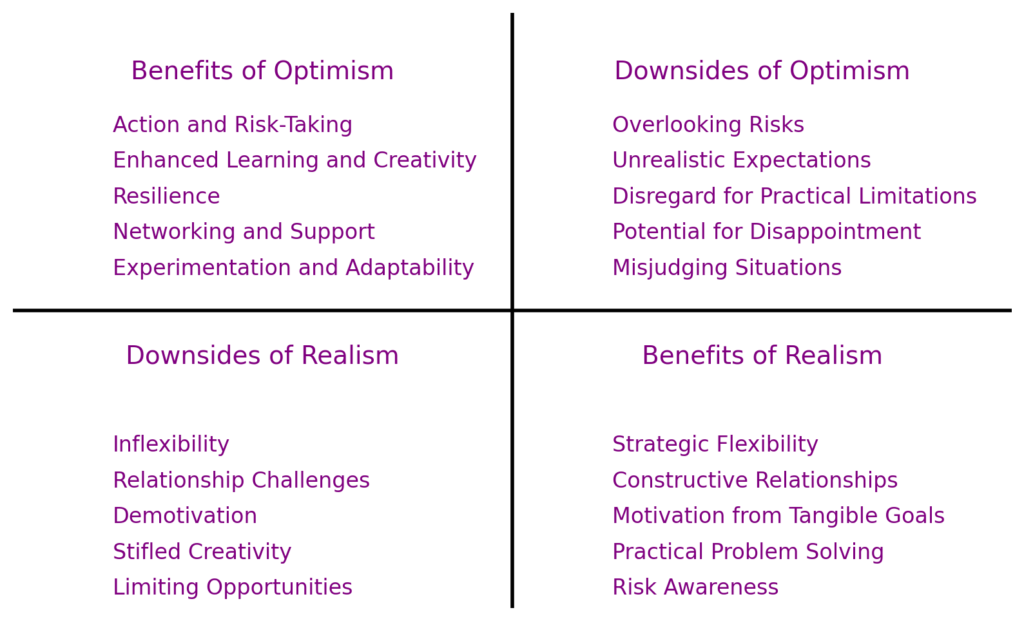
  • Balancing Dreams and Reality: The Power and Pitfalls of Optimism vs. Realism

    Balancing Dreams and Reality: The Power and Pitfalls of Optimism vs. Realism
    Balancing Dreams and Reality: The Power and Pitfalls of Optimism vs. Realism

    Benefits of Optimism

    1. Action and Risk-Taking: Optimists often dive into projects with enthusiasm, willing to take risks that might intimidate others. This bold approach can lead to significant breakthroughs and innovations.

    2. Enhanced Learning and Creativity: Optimism fuels a positive mindset that is conducive to learning and creativity. Optimists are more likely to engage in creative problem-solving, seeing potential where others might see dead-ends.

    3. Resilience: Optimism is a key component of resilience. It allows individuals to bounce back from setbacks and maintain a positive outlook, even in the face of adversity.

    4. Networking and Support: Optimists tend to attract a network of supportive and like-minded individuals. This positive energy not only fosters personal growth but also creates a support system that can be crucial in challenging times.

    5. Experimentation and Adaptability: An optimistic disposition encourages experimentation and adaptability. Optimists are more likely to try new things and adapt to changes, viewing them as opportunities rather than threats.

    Downsides of Realism

    1. Limiting Opportunities: Realists might miss out on opportunities due to their focus on practicalities and limitations. This perspective can sometimes prevent them from taking chances that could lead to significant gains.

    2. Stifled Creativity: A realistic viewpoint might inhibit creativity. By focusing too much on what is practical or probable, realists may overlook innovative solutions.

    3. Demotivation: Realism can lead to demotivation, especially if the focus is constantly on the hurdles or the less-than-ideal aspects of a situation.

    4. Relationship Challenges: Realists might face challenges in relationships, particularly with more optimistic counterparts, due to their pragmatic and sometimes pessimistic outlook.

    5. Inflexibility: A strong focus on realism can result in inflexibility, as adapting to new or unforeseen circumstances may be more difficult for those who are deeply rooted in practical realities.

    Downsides of Optimism

    1. Overlooking Risks: Optimists might overlook or underestimate risks, leading to decisions that are not well-informed or prepared for potential challenges.

    2. Unrealistic Expectations: Excessive optimism can foster unrealistic expectations, setting one up for disappointment if things do not pan out as hoped.

    3. Disregard for Practical Limitations: Optimists may sometimes disregard practical limitations, leading to overcommitment or the pursuit of unfeasible goals.

    4. Potential for Disappointment: High expectations fueled by optimism can lead to disappointment if outcomes do not match the optimistic projections.

    5. Misjudging Situations: A highly optimistic outlook can sometimes lead to misjudging situations, underestimating difficulties, or failing to plan adequately for possible setbacks.

    Benefits of Realism

    1. Risk Awareness: Realists are typically more aware of risks, allowing for better preparedness and contingency planning.

    2. Practical Problem Solving: A realistic approach fosters practical problem-solving skills. Realists tend to focus on tangible solutions that are feasible and grounded in reality.

    3. Motivation from Tangible Goals: Realists are often motivated by tangible, achievable goals. This focus on realistic objectives can drive consistent progress and achievement.

    4. Constructive Relationships: Realism can lead to more constructive relationships, particularly in professional settings, as realists tend to set clear, achievable expectations.

    5. Strategic Flexibility: Realism does not necessarily mean rigidity. In fact, a realistic outlook can foster strategic flexibility, allowing individuals to adjust plans and strategies based on practical assessments of changing circumstances.

    Both optimism and realism have their distinct advantages and disadvantages. Striking a balance between the two can lead to a more well-rounded approach to life and decision-making, combining the best of both worlds: the hope and drive of optimism with the groundedness and practicality of realism.


    INVERT:

    Charlie Munger, the renowned investor and vice chairman of Berkshire Hathaway, is well-known for his concept of “inversion,” a problem-solving strategy. Inversion involves approaching a problem backward or from the opposite end of the traditional starting point. It’s about looking at what you want to avoid and then figuring out how to avoid it. This concept can be applied to the balance between optimism and realism, particularly in decision-making and strategic planning.

    Applying Inversion to Optimism and Realism

    For the Overly Optimistic:

    • Inversion Focus: Instead of focusing on what could go right, they should consider what could go wrong. This helps in identifying potential pitfalls and risks they might typically overlook.
    • Risk Management: By considering the worst-case scenarios, optimists can create contingency plans, thus grounding their optimism with a dose of realism.
    • Setting Realistic Goals: By inverting their tendency to set overly ambitious goals, they can aim for targets that are challenging yet achievable, reducing potential disappointment.

    For the Overly Realistic:

    • Inversion Focus: Instead of constantly looking at the limitations and risks, they should contemplate what opportunities might be missed by being too cautious.
    • Encouraging Creativity: By considering the best-case scenarios, realists can open themselves up to more creative and innovative solutions, breaking free from the confines of their usual pragmatism.
    • Expanding Comfort Zones: Inverting their focus on practicality can lead to taking calculated risks, potentially leading to greater rewards.

    Practical Steps for Inversion

    • Reflection and Self-Awareness: Acknowledge your natural inclination towards either optimism or realism. Self-awareness is key in understanding how to apply inversion.
    • Seeking Alternative Perspectives: Engage with individuals who hold a different outlook. For optimists, this means consulting with more pragmatic individuals, and vice versa for realists.
    • Scenario Analysis: Actively practice thinking through both positive and negative outcomes of any given situation. For optimists, emphasize the negative outcomes more, and for realists, the positive ones.
    • Balance in Decision Making: Strive for decisions that incorporate both the hopefulness of optimism and the groundedness of realism. This might mean tempering high expectations with practical considerations or infusing a realistic plan with a bit more ambition and vision.

    In essence, Munger’s inversion idea, when applied to the dichotomy of optimism and realism, encourages individuals to step outside their comfort zones and adopt a more balanced, comprehensive approach to thinking and problem-solving. This can lead to more robust, well-rounded decisions and strategies, both in personal and professional contexts.


  • The White Pill: 10 Ideas That Will Make You Optimistic About the Future

    Have you ever heard of the term “white pill”? It’s the opposite of a “black pill,” which refers to a pessimistic outlook on life. A “white pill” is an idea or concept that promotes optimism and hope for the future. And in today’s world, we could all use a little more positivity. Here are 10 “white pill” ideas that will make you optimistic about the future.

    1. Advancements in medicine

    Advancements in medicine have been nothing short of extraordinary over the last few decades. Diseases that were once considered incurable are now treatable. Medical research and technology continue to make significant strides in the treatment and prevention of illnesses and diseases. Breakthroughs in medical technology have led to the development of life-saving drugs, treatments, and procedures, giving hope for a healthier future.

    1. Environmental protection

    More people and organizations are becoming aware of the need to protect the environment. From conservation efforts to sustainable living practices, environmental protection is at the forefront of the public’s consciousness. Advances in clean energy, renewable resources, and eco-friendly products are reducing our carbon footprint, promoting sustainable development, and ensuring a brighter future for our planet.

    1. Diversity and inclusivity

    There is growing recognition of the value of diversity and inclusivity. Diversity means more than just race or ethnicity. It encompasses differences in gender, sexual orientation, religion, culture, and socioeconomic status. Recognizing and celebrating diversity leads to greater empathy, understanding, and cooperation among different groups of people. Inclusivity ensures that everyone has a voice and that their perspectives are heard, leading to a more equitable and just society.

    1. Technology and innovation

    Advancements in technology are rapidly transforming the world. From smartphones and social media to virtual reality and artificial intelligence, technology is changing the way we work, live, and interact. New solutions to old problems are being created, and new industries and job opportunities are emerging. Technology and innovation have the potential to solve some of the world’s biggest challenges, from climate change to poverty and inequality.

    1. Education

    Education is becoming more accessible to people worldwide. From online learning platforms to community colleges, education is more accessible than ever before. Education offers greater opportunities for personal growth and professional development. Access to education can also break down barriers and promote social mobility, helping people to achieve their dreams and reach their full potential.

    1. Social progress

    Many societies are making progress on important social issues such as equality, justice, and human rights. Social progress has led to greater awareness and understanding of issues like race, gender, and sexuality. Social progress has also led to greater protections for marginalized groups and has created a more just and equitable world.

    1. Interconnectedness

    The world is becoming more interconnected, leading to greater understanding, empathy, and cooperation across borders and cultures. Thanks to social media and the internet, people are more connected than ever before. This increased connectedness has the potential to foster greater understanding and cooperation across borders, leading to a more peaceful and prosperous world.

    1. Peaceful relations

    Despite occasional conflicts, the world has seen a trend towards greater peaceful relations between countries. The Cold War ended over 30 years ago, and since then, many countries have worked towards peaceful resolutions to conflicts. This trend towards peaceful relations reduces the likelihood of major wars, which can only be good for humanity.

    1. Mental health awareness

    There is growing awareness of mental health issues and the importance of self-care. Mental health issues are common, affecting one in four people worldwide. Greater awareness of mental health issues and the importance of self-care has led to more open and supportive communities. More people are seeking treatment for mental health issues, and stigma is slowly being reduced. Mental health awareness has the potential to improve the lives of millions of people and promote a healthier, more supportive society.

    1. Personal empowerment

    People are increasingly recognizing their own power to make positive changes in their lives and communities. Personal empowerment means recognizing that you have the ability to control your own life and make positive changes. It means setting goals, taking action, and overcoming obstacles. Personal empowerment can also lead to collective empowerment, where people work together to make positive changes in their communities and the world.

    These 10 “white pill” ideas promote optimism and hope for the future. From advancements in medicine to personal empowerment, these ideas represent some of the most positive trends in the world today. They offer a glimpse of what is possible when we work together and strive for a better world. Let us embrace these ideas and continue to promote a more positive outlook on the world around us.

  • Mastering the Art of Personal Development: Exploring the Lindy Effect

    Personal development is a journey of self-discovery and growth. It is the process of acquiring new skills, improving existing ones, and learning to live a fulfilling life. While there are many different approaches to personal development, some strategies and practices have stood the test of time. These are the Lindy ideas in personal development – concepts that have been around for decades, if not centuries, and have proven to be effective time and time again.

    What is the Lindy Effect? The Lindy Effect is a concept first introduced by Nassim Nicholas Taleb in his book “The Black Swan”. It states that the longer a non-perishable item has been around, the more likely it is to continue to be around in the future. This idea can be applied to a wide range of things, from technology and ideas, to books and practices. In the context of personal development, the Lindy Effect means looking to long-standing and proven strategies and practices that have been helping people improve themselves for generations.

    Lindy Ideas in Personal Development Here are five of the most “Lindy” personal development ideas that you can incorporate into your own growth journey:

    1. Exercise: Regular physical activity has been shown to improve mental and physical health for centuries. Whether it’s going for a morning jog, hitting the gym, or practicing yoga, exercise can boost your mood, increase energy levels, and improve sleep quality. To implement this in your personal development routine, make time for exercise in your daily schedule, find an activity you enjoy, and make it a consistent habit.
    2. Sleep: Getting enough quality sleep is crucial for physical and mental well-being. Sleep is the time when our bodies and minds recharge and restore themselves. To ensure you are getting enough sleep, stick to a regular sleep schedule, create a relaxing bedtime routine, and minimize distractions in the bedroom.
    3. Reading: Reading has been a means of acquiring knowledge and developing critical thinking skills for centuries. Whether it’s reading a novel, a biography, or a self-help book, reading can broaden your horizons, increase your vocabulary, and improve your memory. To implement this in your personal development routine, set aside time each day to read, choose books that challenge and inspire you, and maintain a reading list.
    4. Mindfulness Meditation: Meditation has been practiced for thousands of years and has been shown to reduce stress and improve focus. Mindfulness meditation involves focusing on the present moment and letting go of distractions. To implement this in your personal development routine, find a quiet place to sit, focus on your breath, and clear your mind for a set period of time each day.
    5. Gratitude: Practicing gratitude has been shown to improve well-being and relationships. Gratitude involves focusing on the good things in life and being thankful for what you have. To implement this in your personal development routine, write down things you are grateful for each day, reflect on them before bed, and share them with loved ones.

    The key to making these Lindy ideas a part of your personal development routine is consistency and discipline. Stick with them, and you’ll likely see positive results. Remember that personal development is a lifelong journey, and there’s always room for improvement. Keep exploring new ideas and practices, and continue to challenge yourself to grow and evolve.

    Ideas to Explore Further:

    • Journaling: Keeping a daily journal can help you reflect on your thoughts and feelings, set goals, and track your progress.
    • Time Management: Effective time management can help you prioritize tasks, reduce stress, and increase productivity.
    • Mindset: Shifting your mindset from a fixed to a growth mindset can help you become more resilient, optimistic, and successful.
    • Relationships: Building strong relationships with friends, family, and colleagues can have a positive impact on your well-being and happiness.
    • Personal Finances: Taking control of your finances can help you achieve financial stability, reduce stress, and increase your wealth.
  • Attract Success by Becoming the Person You Want to Be

    No matter who you are or where you come from, success is something that we all strive for. But what does it really mean to be successful? Is it money and power? Or is it something much deeper than that?

    The truth is, success is something that we attract by the person we become. It’s not about the things we do or the accomplishments we have, but rather it’s about who we are and how we live. To be successful, we must become the kind of person who is capable of achieving success. That means we must develop certain qualities and characteristics that will help us achieve our goals.

    Some of the qualities that will help you become successful include determination, resilience, focus, optimism, and self-discipline. Determination is the ability to push through even when the going gets tough. Resilience is the ability to bounce back from any setback. Focus is the ability to remain on target and stay the course. Optimism is the ability to remain positive and hopeful even in the face of adversity. And self-discipline is the ability to stay disciplined and motivated in the pursuit of our goals.

    These qualities can be developed and honed through practice, effort, and dedication. Once we have these traits, it’s important to take action and start working towards our goals. This will require hard work, dedication, and perseverance. We must be willing to take risks and make sacrifices in order to achieve success.

    Success is something that we attract by the person we become. It’s not about the things we do or the accomplishments we have, but rather it’s about who we are and how we live. We must become the kind of person who is capable of achieving success. That means we must develop certain qualities and characteristics that will help us achieve our goals. With dedication, hard work, and perseverance, success is within our reach.

  • 10 Strategies for Achieving Success in 2023

    Success is a multifaceted concept that can be defined differently by each individual. Some people may define success as achieving financial stability and prosperity, while others may define it as living a fulfilling and meaningful life. Regardless of how you define success, there are certain common principles and strategies that can help you achieve your goals and be successful in 2023 and beyond.

    Here are some tips on how to be successful in 2023:

    1. Set clear and specific goals: One of the keys to success is setting clear and specific goals for yourself. This will give you a sense of direction and motivation, and help you stay focused on what you want to achieve. Make sure your goals are SMART (specific, measurable, achievable, relevant, and time-bound) and break them down into smaller, actionable tasks.
    2. Develop a growth mindset: Successful people are those who are constantly learning and growing. They have a growth mindset, which means they believe that their abilities and intelligence can be developed through hard work and learning. Adopting a growth mindset will allow you to embrace challenges and setbacks as opportunities to learn and improve, rather than seeing them as failures.
    3. Take responsibility for your actions: Successful people are those who take responsibility for their actions and outcomes. They don’t make excuses or blame others for their mistakes, but rather, they take ownership of their successes and failures and learn from them.
    4. Build a strong support system: No one becomes successful on their own. Surround yourself with people who believe in you, support you, and can help you achieve your goals. This could include friends, family, mentors, and colleagues.
    5. Be persistent and resilient: Success often requires hard work and perseverance. Don’t give up when things get tough or when you face setbacks. Instead, focus on your long-term goals and keep working towards them.
    6. Practice self-discipline and time management: Successful people are those who can manage their time effectively and prioritize their tasks. This requires self-discipline and the ability to say no to distractions and non-essential activities.
    7. Learn from others: Don’t be afraid to seek out advice and guidance from those who have already achieved success. Learning from others can help you avoid mistakes and accelerate your own journey towards success.
    8. Take care of your physical and mental health: Successful people understand the importance of taking care of their physical and mental health. This means getting enough sleep, exercising regularly, eating a healthy diet, and finding ways to reduce stress and manage your emotions.
    9. Stay positive and optimistic: Successful people have a positive attitude and believe in their own abilities. They see the glass as half full, rather than half empty, and remain optimistic even in the face of challenges and setbacks.
    10. Be adaptable and flexible: The world is constantly changing, and successful people are those who can adapt and be flexible in the face of change. This means being open to new ideas and ways of doing things, and being willing to pivot or adjust your approach as needed.

    By following these tips and strategies, you can increase your chances of success in 2023 and beyond. Remember, success is not a destination, but rather a journey, and it requires consistent effort, learning, and growth