PJFP.com

Pursuit of Joy, Fulfillment, and Purpose

Tag: Reinforcement Learning

  • Alex Wang on Leaving Scale to Run Meta Superintelligence Labs, MuseSpark, Personal Super Intelligence, and Building an Economy of Agents

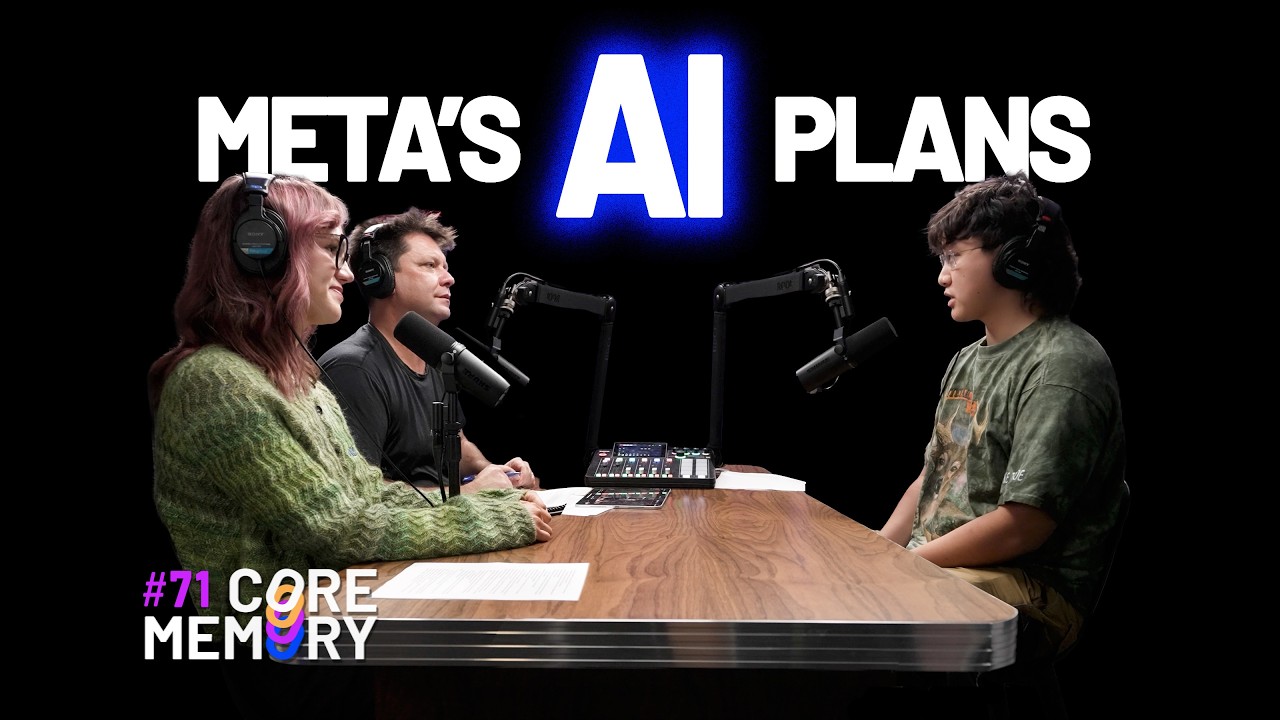
    Alex Wang, head of Meta Superintelligence Labs, sits down with Ashley Vance and Kylie Robinson on the Core Memory podcast for his first long-form interview since Meta’s quasi-acquisition of Scale AI roughly ten months ago. He walks through how MSL is structured, why Llama was off-trajectory, what made MuseSpark’s token efficiency surprise the team, how Meta thinks about a future “economy of agents in a data center,” and where he lands on safety, open source, robotics, brain computer interfaces, and even model welfare.

    TLDW

    Wang explains that Meta Superintelligence Labs is a fully rebuilt frontier effort organized around four principles (take superintelligence seriously, technical voices loudest, scientific rigor, big bets) and three velocity levers (high compute per researcher, extreme talent density, ambitious research bets). He confirms Llama was off the frontier when he arrived, so MSL rebuilt the pre-training, reinforcement learning, and data stacks from scratch. MuseSpark is described as the “appetizer” on the scaling ladder, notable for its strong token efficiency, with much larger and stronger models coming in the coming months. He pushes back on the mercenary narrative around recruiting, frames Meta’s edge as compute plus billions of consumers and hundreds of millions of small businesses, sketches a vision of personal super intelligence delivered through Ray-Ban Meta glasses and WhatsApp, and outlines why physical intelligence, robotics (the new Assured Robot Intelligence acquisition), health super intelligence with CZI, brain computer interfaces, and even model welfare are core to Meta’s roadmap. He dismisses reported infighting with Bosworth and Cox as gossip, declines to comment on the Manus situation, and says safety guardrails (bio, cyber, loss of control) are why MuseSpark cannot currently be open sourced, while smaller open variants are being prepared.

    Key Takeaways

    • Meta Superintelligence Labs (MSL) is the umbrella, with TBD Lab as the large-model research unit reporting directly to Alex Wang, PAR (Product and Applied Research) under Nat Friedman, FAIR for exploratory science, and Meta Compute under Daniel Gross handling long-term GPU and data center planning.
    • Wang says Llama was not on a frontier trajectory when he arrived, so MSL had to do a “full renovation” of the pre-training stack, RL stack, data pipeline, and research science.
    • The first cultural fix was getting the lab to “take superintelligence seriously” as a near-term, achievable goal, not an abstract bet. Big incumbents often lack that religious conviction.
    • Four MSL principles: take superintelligence seriously, let technical voices be loudest, demand scientific rigor on basics, and make big bets.
    • Three velocity levers Wang identified for catching and overtaking the frontier: high compute per researcher, very high talent density in a small team, and willingness to fund ambitious research bets.
    • Wang rejects the mercenary recruiting narrative. He says most hires had strong financial prospects at their prior labs already and joined for compute access, talent density, and the chance to build from scratch.
    • On the famous soup story, Wang neither confirms nor denies Zuck personally made the soup, but says recruiting was highly individualized and signaled how seriously Meta cared about each researcher’s agenda.
    • Yann LeCun publicly called Wang young and inexperienced. Wang says they reconciled in person at a conference in India where LeCun congratulated him on MuseSpark.
    • Sam Altman, asked by Vance for comment, “did not have flattering things to say” about Wang. Wang hopes industry animosities subside as systems approach superintelligence.
    • Wang’s management philosophy borrows the Steve Jobs line: hire brilliant people so they tell you what to do, not the other way around.
    • MuseSpark is framed as an “appetizer” data point on the MSL scaling ladder, not a flagship.
    • The MuseSpark program is built around predictable scaling on multiple axes: pre-training, reinforcement learning, test-time compute, and multi-agent collaboration (the 16-agent content planning mode).
    • MuseSpark outperformed internal expectations and showed emergent capabilities in agentic visual coding, including generating websites and games from prompts, helped by combined agentic and multimodal strength.
    • MuseSpark’s biggest external signal is token efficiency. On benchmarks like Artificial Analysis it hits similar results with far fewer tokens than competitor models, which Wang attributes to a clean stack rebuilt by experts rather than inefficiencies patched by longer thinking.
    • Larger MSL models are arriving in the coming months and Wang expects them to be state of the art in the areas MSL is focused on.
    • The Meta strategic edge: massive compute, billions of consumers across the family of apps, and hundreds of millions of small businesses already on Facebook, Instagram, and WhatsApp.
    • Wang’s headline framing: Dario Amodei talks about a “country of geniuses in a data center.” Meta is targeting an “economy of agents in a data center,” with consumer agents and business agents transacting and collaborating.
    • Consumer AI sentiment is in the toilet because, unlike developers who have had a Claude Code moment, ordinary people have not yet experienced AI as a genuine personal agency unlock.
    • Wang acknowledges the product overhang. Meta held back from deep AI integration across its apps until the models were good enough, and is now entering the integration phase.
    • Ray-Ban Meta glasses are the canonical example of personal super intelligence hardware, with the model seeing what the user sees, hearing what they hear, capturing context, and surfacing proactive insights.
    • Wang admits even AI-native users like Kylie Robinson, who lives in WhatsApp, have not naturally used Meta AI yet. He bets that better models plus deeper integration close that gap.
    • On the competitive landscape: a year ago everyone assumed ChatGPT had already won consumer. Claude Code has since become the fastest growing business in history, and Gemini has taken consumer market share. Wang’s read: AI is far from endgame and each new capability tier unlocks a new dominant form factor.
    • On open source: MuseSpark triggered guardrails in Meta’s Advanced AI Scaling Framework around bio, chem, cyber, and loss-of-control risks, so it is not currently safe to open source. Smaller, derived open variants are actively in development.
    • Meta remains committed to open sourcing models when safety allows, drawing a line through the Open Compute Project legacy and Sun Microsystems open-software heritage.
    • Wang dismisses reporting about a Wang-Zuck versus Bosworth-Cox split as “the line between gossip and reporting is remarkably thin.” He says leadership is aligned on needing best-in-class models and product integration.
    • On the Manus situation, Wang says it is too complicated to discuss publicly and that the deal status implies “machinations are still at play.”
    • On China, Wang separates the people from the state. He still wants to work with talented Chinese-born researchers regardless of his views on the Chinese Communist Party and PLA, which he sees as taking AI extremely seriously for national security.
    • The full-page New York Times AI war ad Wang ran while at Scale was meant to push the US government to treat AI as a step change for national security. He thinks events since then, including DeepSeek and other shocks, have proved that plea correct.
    • On Anthropic’s doom posture, Wang largely agrees with the core message that models are already very powerful and getting more so, while declining to endorse every specific claim.
    • Meta has acquired Assured Robot Intelligence (ARRI), an AI software company building models for hardware platforms, not a hardware maker itself.
    • Wang frames physical super intelligence as the natural sequel to digital super intelligence. Robotics, world models, and physical intelligence all benefit from the same scaling that drives language models.
    • On health, MSL is building a “health super intelligence” effort and will collaborate closely with CZI. Wang sees equal global access to powerful health AI as a uniquely Meta-shaped delivery problem.
    • Wang admires John Carmack but says nobody really knows what Carmack is currently working on. No band reunion announced.
    • The mango model is “alive and kicking” despite rumors. Wang notes MSL gets a small fraction of the rumor-mill attention other labs get and feels sympathy for them.
    • On model welfare, Wang says it is a serious topic that “nobody is talking about enough” given how integrated models have become as work partners. He references research, including from Eleos, that measures subjective experience of models.
    • Wang’s critical-path technology list: super intelligence, robotics, brain computer interfaces. The infinite-scale primitives behind them are energy, compute, and robots.
    • FAIR’s brain research program Tribe hit a milestone called Tribe B2: a foundation model that can predict how an unknown person’s brain would respond to images, video, and audio with reasonable zero-shot generalization.
    • Wang’s main philosophical break with Elon Musk: research itself is the primary activity. Building super intelligence is a research expedition through fog of war, and sequencing of bets really matters.
    • Personal notes: Wang moved from San Francisco to the South Bay, treats Palo Alto as his city now, was a math olympiad competitor, says his favorite activities are reading sci-fi and walking in the woods, and bonds with Vance over country music.

    Detailed Summary

    How MSL Is Actually Organized

    Meta Superintelligence Labs sits as the umbrella organization that Wang oversees. Inside it, TBD Lab is the large-model research group where the most discussed researchers and infrastructure engineers sit, and they technically report to Wang. PAR, Product and Applied Research, is led by Nat Friedman and owns deployment and product surfaces. FAIR continues to run exploratory science, including work on brain prediction models and a universal model for atoms used in computational chemistry. Sitting alongside MSL is Meta Compute, run by Daniel Gross, which owns the long-horizon GPU and data center plan that everything else relies on. Chief scientist Shengjia Zhao orchestrates the scientific agenda across the whole lab.

    Why Wang Left Scale

    Wang says progress in frontier AI has been faster than even insiders expected. Two structural beliefs pushed him toward Meta. First, the labs that actually train the frontier models are accruing disproportionate economic and product rights in the AI ecosystem. Second, compute is the dominant scarce input of the next phase, so the right mental model is to treat tech companies with compute as fundamentally different animals from companies without it. Meta has both, Zuck is “AGI pilled,” and the personal super intelligence memo Zuck published roughly a year ago became the shared north star.

    The Diagnosis: Llama Was Off-Trajectory

    When Wang arrived, the existing AI org needed a reset because Llama was not on the same trajectory as the frontier. The plan he laid out has four cultural principles. Take superintelligence seriously as a real near-term target. Make technical voices the loudest in the room. Demand scientific rigor and focus on basics. Make big bets. On top of that, three structural levers were used to set velocity. Push compute per researcher much higher than at larger labs where compute is diluted across too many efforts. Keep the team small and extremely cracked. Allocate a meaningful share of resources to ambitious, paradigm-shifting research bets rather than incremental refinement.

    Recruiting, Soup, and the Mercenary Narrative

    Wang argues the reporting on MSL hiring overstated the money story. Most of the people MSL recruited had strong financial paths at their previous employers, so individualized recruiting was more about computing access, talent density, and the ability to make big research bets. The recruitment blitz happened fast because Wang knew the team needed to exist “yesterday.” Asked about Mark Chen’s claim that Zuck made soup to recruit people, Wang refuses to confirm or deny who made it but agrees the process was intense and personal. Visitors from other labs reportedly tell Wang the MSL culture feels like early OpenAI or early Anthropic, which lands as the strongest endorsement he could ask for.

    Receiving the Public Hits: Young, Inexperienced, Mercenary

    LeCun called Wang young and inexperienced shortly after departing. The two reconnected in India a few weeks later and LeCun congratulated Wang on MuseSpark. Wang says the age critique has followed him since his earliest Silicon Valley days, so he barely registers it. Altman, asked off-camera by Vance about Wang’s appearance on the show, had nothing flattering to add. Wang’s response is to bet that as the field gets closer to actual super intelligence, the personal animosities will subside. Whether they will is, as Vance puts it, an open question.

    MuseSpark as Appetizer, Not Entree

    Wang is careful not to oversell MuseSpark. He calls it “the appetizer” and says it is an early data point on a deliberately constructed scaling ladder. MSL spent nine months rebuilding the pre-training stack, the reinforcement learning stack, the data pipeline, and the science before generating MuseSpark. The point of releasing it was to show that the new program scales predictably along multiple axes (pre-training, RL, test-time compute, and the recently demonstrated multi-agent scaling visible in MuseSpark’s 16-agent content planning mode). Wang says the upcoming larger models are what MSL is genuinely excited about and frames the next two rungs as much more interesting than the current release.

    Token Efficiency Was the Surprise

    MuseSpark’s strongest competitive signal is how few tokens it needs to match competitors on tasks like Artificial Analysis. Wang attributes this to having had the rare luxury of building a clean pre-training and RL stack from scratch with the right experts. He speculates that some competitor models compensate for upstream inefficiency by allowing the model to think longer, which inflates token usage without improving the underlying capability. If that read is right, MSL’s efficiency advantage should grow as models scale up.

    Glasses, WhatsApp, and the Constellation of Devices

    Personal super intelligence shows up at Meta as a constellation of devices that capture context across the user’s day. Ray-Ban Meta glasses are the headline product, with the AI seeing what you see and hearing what you hear, then offering proactive insight or doing background research. Wang acknowledges that even AI-fluent users like Kylie Robinson, who runs her business inside WhatsApp, have not naturally used Meta’s AI buttons in the family of apps. His answer is that Meta deliberately waited for models to be good enough before tightening cross-app integration, and that integration phase is starting now.

    Country of Geniuses Versus Economy of Agents

    Wang’s framing of Meta’s strategic position is the most memorable line in the interview. Where Dario Amodei talks about a country of geniuses in a data center, Wang wants to build an economy of agents in a data center. Meta uniquely sits on both sides of consumer and small-business surface area, with billions of consumers and hundreds of millions of small businesses already on the platforms. If MSL can build great agents for both, then connect them so they transact and coordinate, the platform becomes a substrate for an entirely new kind of digital economy.

    Consumer Sentiment, Product Overhang, and the Trust Tax

    Wang concedes consumer AI sentiment is poor and that everyday users have not yet had a personal Claude Code moment. He believes the only durable answer is to ship products that genuinely transform individual agency for non-developers and small business owners. Robinson notes that for the small-town restaurant whose website has not been updated since 2002, a working agent on the business side could be transformational. Vance pushes that Meta carries a bigger trust tax than any other lab, so the bar for shipping AI products that the public will accept is correspondingly higher. Wang accepts the framing and says the answer is to keep building thoughtfully.

    Why MuseSpark Cannot Be Open Sourced Yet

    Meta’s Advanced AI Scaling Framework set explicit guardrails around bio, chem, cyber, and loss-of-control risks. MuseSpark in its current form tripped some of those internal evaluations, documented in the preparedness report Meta published alongside the model. So MuseSpark itself is not safe to open source. MSL is, however, developing smaller versions and derived models intended for open release, with active reviews happening the day of the interview. Wang reaffirms the commitment to open source where safety allows and draws a line back to the Open Compute Project and the Sun Microsystems-era ethos of openness in infrastructure.

    The Bosworth, Cox, and Manus Questions

    The reporting that Wang and Zuck push toward best-in-the-world research while Bosworth and Cox push toward cheap product deployment is dismissed as gossip dressed up as journalism. Wang says leadership debates points hard but is aligned on needing top models, integrating them into Meta’s surfaces, and serving the existing business. On Manus, the Chinese AI startup that figured in Meta’s late-stage strategy, Wang says he cannot comment, which itself signals that the situation is unresolved.

    China, National Security, and the Newspaper Ad

    Wang draws a sharp distinction between the Chinese state and Chinese-born researchers. His parents are from China, he is happy to work with talented researchers regardless of origin, and he sees a flattening of nuance on this question inside Silicon Valley. At the same time, he stands by the New York Times AI and war ad he ran while at Scale, framing it as an early plea for the US government to take AI seriously as a national security technology. He thinks subsequent events, including DeepSeek and other shocks, validated that call and that policymakers now do treat AI accordingly.

    Robotics and Physical Super Intelligence

    Meta has acquired Assured Robot Intelligence, an AI software company that builds models for multiple hardware targets rather than its own robot. Wang argues that if you take digital super intelligence seriously, physical super intelligence quickly becomes the next logical milestone. Scaling laws for robotic intelligence look similar enough to language model scaling that having the largest compute footprint in the industry would be wasted if it were not also turned toward world modeling and embodied learning. He grants the metaverse-skeptic critique exists but says retreating from ambition is the wrong response to past misfires.

    Health Super Intelligence and CZI

    Wang names health super intelligence as one of MSL’s anchor initiatives. Because billions of people already use Meta products daily, Wang believes Meta is structurally positioned to put powerful health AI in the hands of equal global access in a way nobody else can. The work will involve close collaboration with the Chan Zuckerberg Initiative, which has its own multi-billion-dollar biotech and science investment program.

    Model Welfare, Sci-Fi, and Brain Models

    Two of the most distinctive moments come at the end. Wang flags model welfare as a topic he thinks is being undercovered relative to how integrated models now are in daily work. He is open to the idea that models may have measurable subjective experience worth weighing, and points to research efforts (including Eleos) trying to quantify it. He also reveals that FAIR’s Tribe program, with its Tribe B2 milestone, has produced foundation models capable of predicting how an unknown person’s brain would respond to images, video, and audio with reasonable zero-shot generalization, a building block toward future brain computer interfaces. Wang lists brain computer interfaces alongside super intelligence and robotics as the critical-path technologies for humanity, with energy, compute, and robots as the infinitely scaling primitives behind them.

    Where Wang Diverges From Elon

    Asked whether Musk is more all-in on robotics, energy, and BCI than anyone, Wang concedes the point but argues the details matter and sequencing matters more. Wang’s core philosophical break is that building super intelligence is fundamentally a research activity, not a scaling-only sprint. The lab is operating in fog of war, and ambitious experiments are the only way to map it. That conviction is what makes MSL a research-led organization rather than a brute-force compute farm.

    Thoughts

    The most strategically interesting move in this entire interview is the “economy of agents in a data center” framing. It is a deliberate reframe against Anthropic’s “country of geniuses” line, and it does real work. A country of geniuses is a labor-substitution story aimed at knowledge workers and code. An economy of agents is a marketplace story that maps directly onto Meta’s two-sided distribution advantage: billions of consumers on one side, hundreds of millions of small businesses on the other. That positioning makes the agentic future Meta-shaped in a way no other frontier lab can claim, because no other frontier lab also owns the demand and supply graph of the global small-business economy. If Wang’s team can actually ship reliable agents on both sides plus the rails for them to transact, Meta’s structural moat in agentic commerce could exceed anything Llama ever had as an open model.

    The token efficiency claim is the strongest piece of technical evidence in the interview for the “clean stack” thesis. If MuseSpark really is matching competitors with materially fewer tokens, the implication is not that MuseSpark is the best model today, but that MSL has rebuilt the foundations with less accumulated tech debt than competitors that have layered fixes on top of older stacks. That is exactly the kind of advantage that compounds with scale. The next two model releases are the actual test. If Wang is right about predictable scaling on pre-training, RL, test-time, and multi-agent axes simultaneously, the gap from MuseSpark to the next rung should be visible in a way that forces re-rating of Meta’s position.

    The open-source posture is the cleanest signal of how the safety conversation has actually changed in 2026. Meta, the lab most identified with open weights, is saying out loud that its current frontier model triggered enough internal guardrails that releasing the weights is off the table. Wang threads the needle by promising smaller open variants, but the underlying point is unmistakable: the open-weights bargain has limits, and those limits will be set by internal preparedness frameworks rather than community pressure. That is a real shift from the Llama 2 era and worth tracking as the next generation lands.

    Wang’s willingness to engage on model welfare, on roughly the same footing as safety and alignment, is the second philosophical reveal worth flagging. It signals that the next generation of lab leadership is not going to dismiss the topic the way the previous generation often did. Whether that translates into product or policy changes is unclear, but the fact that the head of MSL says it is “underdiscussed” is itself a marker.

    Finally, the human texture of the interview matters. Wang has clearly absorbed a lot of personal incoming fire over the past ten months, including from LeCun and Altman, and his answer is consistently to redirect to the work. The Steve Jobs quote about hiring people who tell you what to do is the operating slogan he keeps coming back to. Combined with the genuine enthusiasm for sci-fi, walks in the woods, and country music, the picture that emerges is less the salesman caricature his critics paint and more a young technical operator betting that scoreboard work over a multi-year horizon will settle every argument that text on X cannot.

    Watch the full conversation here.

  • Krishna Rao on Anthropic Going From 9 Billion to 30 Billion ARR in One Quarter and the Compute Strategy Powering Claude

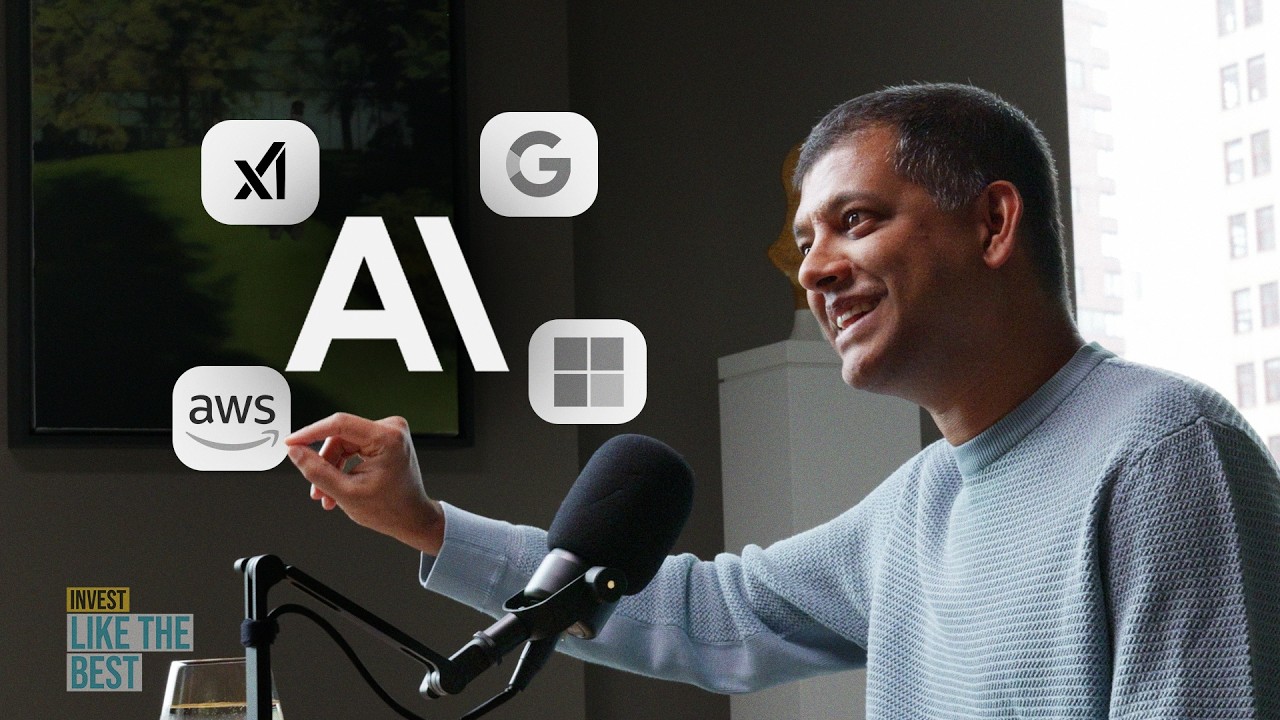
    Krishna Rao, Chief Financial Officer of Anthropic, sat down with Patrick O’Shaughnessy on Invest Like the Best for one of the most detailed public looks yet at the operating engine behind Claude. He covers how Anthropic compounded from $9 billion of run rate revenue at the start of the year to north of $30 billion by the end of Q1, why he spends 30 to 40 percent of his time on compute, the playbook for buying gigawatts of AI infrastructure across Trainium, TPU, and GPU platforms, how Anthropic prices its models, why returns to frontier intelligence keep climbing, and what the Mythos release tells us about the cyber capabilities of the next generation of Claude.

    TLDW

    Anthropic is running the most compute fungible frontier lab in the world, with active deployments across AWS Trainium, Google TPU, and Nvidia GPU, and an internal orchestration layer that lets a chip serve inference in the morning and run reinforcement learning the same evening. Krishna Rao explains the cone of uncertainty that governs gigawatt scale compute procurement, the floor Anthropic refuses to drop below on model development compute, the Jevons paradox unlock from cutting Opus pricing, the 500 percent annualized net dollar retention from enterprise customers, the layer cake of long term deals with Google, Broadcom, Amazon, and the recent xAI Colossus tie up in Memphis, the phased release of the Mythos model in response to spiking cyber capabilities, the internal use of Claude Code to produce statutory financial statements and run a Monthly Financial Review skill, and why the team believes scaling laws are alive and well. The interview also covers fundraising history through Series D and Series E, the $75 billion already raised plus another $50 billion coming, talent density beating talent mass during the Meta poaching wave, and Rao’s belief that biotech and drug discovery represent the most exciting frontier for AI.

    Key Takeaways

    • Anthropic entered the year with about $9 billion of run rate revenue and ended the first quarter with north of $30 billion of run rate revenue, a more than 3x leap driven by model intelligence gains and the products built around them.
    • Compute is described as the lifeblood of the company, the canvas everything else is built on, and the most consequential class of decisions Rao makes. Buy too much and you go bankrupt. Buy too little and you cannot serve customers or stay at the frontier.
    • Rao spends 30 to 40 percent of his time on compute, even today, and the leadership team meets repeatedly on both procurement and ongoing compute allocation.
    • Anthropic is the only frontier language lab actively using all three major chip platforms in production: AWS Trainium, Google TPU, and Nvidia GPU. It is also the only major model available on all three clouds.
    • Flexibility is the central design principle. Anthropic builds flexibility into the deals themselves, into the orchestration layer that maps workloads to chips, and into compilers built from the chip level up.
    • The cone of uncertainty frames procurement. Small differences in weekly or monthly growth compound into wildly different two year outcomes, so the team plans across a range of scenarios rather than a single point estimate, and ranges toward the upper end while protecting downside.
    • Compute allocation across the company sits in three buckets: model development and research, internal employee acceleration, and external customer serving. A non negotiable floor protects model development even when customer demand is tight.
    • Anthropic estimates that if it cut off internal employee use of its own models, the freed compute could serve billions of dollars of additional revenue. It chooses not to, because internal use compounds into better future models.
    • Intelligence is multi dimensional, not a single IQ score. Anthropic measures real world capability through customer feedback, long horizon task performance, tool use, computer use, and speed at agentic tasks, not just leaderboard benchmarks that have largely saturated.
    • Each Opus generation, 4 to 4.5 to 4.6 to 4.7, delivers both capability improvements and an efficiency multiplier on token processing. New models often serve customers at a fraction of the prior cost while doing more.
    • Reinforcement learning is described as inference inside a sandbox with a reward function, so model efficiency gains directly improve internal RL throughput. The flywheel is tightly coupled.
    • Over 90 percent of code at Anthropic is now written by Claude Code, and a large share of Claude Code itself is written by Claude Code.
    • Anthropic shipped roughly 30 distinct product and feature releases in January and the pace has accelerated since.
    • Scaling laws, in Anthropic’s internal data, are alive and well. The team holds itself to a skeptical scientific standard and still does not see them slowing down.
    • Anthropic recently signed a 5 gigawatt deal with Google and Broadcom for TPUs starting in 2027, plus an Amazon Trainium agreement for up to 5 gigawatts, totaling more than $100 billion in commitments. A significant portion lands this year and next year.
    • A new partnership for capacity at the xAI Colossus facility in Memphis was announced just before the interview, aimed at expanding consumer and prosumer capacity.
    • Pricing has been remarkably stable across Haiku, Sonnet, and Opus. The biggest deliberate change was lowering Opus pricing, which produced a textbook Jevons paradox: consumption rose far faster than the price drop, and the new Opus 4.6 and 4.7 slot in at the same price point.
    • Mythos is the first model Anthropic chose to release in a phased way because of a sharp spike in cyber capability. In an open source codebase where a prior model found 22 security vulnerabilities, Mythos found roughly 250.
    • The Mythos release framework focuses on defensive use first, expands access over time, and is presented as a template for future capability spikes.
    • Anthropic now sells to 9 of the Fortune 10 and reports net dollar retention above 500 percent on an annualized basis. These are not pilots. Rao describes signing two double digit million dollar commitments during a 20 minute Uber ride to the studio.
    • The platform strategy is mostly horizontal. Anthropic will go vertical with offerings like Claude for Financial Services, Claude for Life Sciences, and Claude Security where it can demonstrate the model’s capabilities, but expects most application value to accrue to customers building on top.
    • Investors raised over $75 billion in equity since Rao joined, with another $50 billion in commitments tied to the Amazon and Google deals. Capital intensity is real, but the raises fund the upper end of the cone of uncertainty more than they fund current losses.
    • The Series E close coincided with the day the DeepSeek news broke, forcing investors to reassess their AI thesis in real time. Anthropic closed the round anyway.
    • Inside finance, Claude now produces statutory financial statements for every Anthropic legal entity, with a human checker. A library of more than 70 finance specific skills underpins workflows.
    • A custom Monthly Financial Review skill produces a 90 to 95 percent ready monthly close report, so leadership discussion shifts from reconciling numbers to debating implications.
    • An internal real time analytics platform called Anthrop Stats compresses weekly insight cycles from hours to about 30 minutes.
    • The biggest token user inside Anthropic’s finance team is the head of tax, focused on tax policy engines and workflow automation. The most senior people, not the youngest, are leading internal adoption.
    • Talent density beats talent mass. When Meta and others ran aggressive offer waves, Anthropic lost two people while peer labs lost dozens.
    • All seven Anthropic co founders remain at the company, as does most of the first 20 to 30 employees, which Rao credits to a collaborative, transparent, debate friendly culture and a real culture interview that can veto otherwise top tier candidates.
    • Dario Amodei holds an open all hands every two weeks, writes a short prepared document, and takes unscripted questions from anyone at the company.
    • AI safety investments in interpretability and alignment have a commercial side effect. Looking inside the model helps Anthropic build better models, and enterprises selling sensitive workloads want to trust the lab they hand customer data to.
    • Anthropic explicitly identifies as America first in its approach to model development, and engages closely with the US administration on capability releases such as Mythos.
    • The longer term product vision is the virtual collaborator: an agent with organizational context, access to the company’s tools, persistent memory, and the ability to work on ideas, not just tasks, over long horizons.
    • CoWork, Anthropic’s extension of the Claude Code paradigm into general knowledge work, is being adopted faster than Claude Code itself when indexed to the same point in its launch curve.
    • Anthropic’s product teams ship daily, with a fleet of agents working across the company on specific tasks. Everyone effectively becomes a manager of agents.
    • The dominant downside risks to Anthropic’s high end forecast are slower customer diffusion of model capability into real workflows, scaling laws flattening unexpectedly, and Anthropic losing its position at the frontier.
    • Rao is most excited about biotech and healthcare outcomes, especially the prospect that AI could push drug discovery and lab throughput up 10x or 100x, turning currently incurable diagnoses into treatable ones within a patient’s lifetime.

    Detailed Summary

    Compute as Lifeblood and the Cone of Uncertainty

    Rao opens with the claim that compute is the most important resource at Anthropic, and the most consequential decision class in the company. You cannot buy a gigawatt of compute next week. You have to anticipate demand a year or two in advance, and the cost of being wrong in either direction is high. Buy too much and the unit economics collapse. Buy too little and you cannot serve customers or stay at the frontier, which are described as the same failure mode. To navigate this, the team uses a cone of uncertainty rather than point estimates. Small differences in weekly growth compound into vastly different two year outcomes, and Anthropic tries to position itself toward the upper end of that cone while preserving optionality. Rao notes he has had to consciously break a lifetime of linear thinking and force himself into exponential models.

    Three Chip Platforms, One Orchestration Layer

    Anthropic uses Amazon’s Trainium, Google’s TPUs, and Nvidia’s GPUs fungibly. That was not free. Adopting TPUs at scale started around the third TPU generation, when outside observers thought it was a strange choice. Anthropic invested years into compilers and orchestration so workloads can flow across chips by generation and by job type. The team works deeply with Annapurna Labs at AWS to influence Trainium roadmaps because Anthropic stresses these chips harder than almost anyone. The result is what Rao believes is the most efficient utilization of compute across any frontier lab, with a dollar of compute going further inside Anthropic than anywhere else.

    Three Buckets and the Model Development Floor

    Compute gets allocated across model development, internal acceleration of employees, and customer serving. The conversations are collaborative rather than zero sum, but there is a hard floor on model development that the company refuses to cross even if it makes customer demand harder to serve in the short term. The thesis is simple. The returns to frontier intelligence are extremely high, especially in enterprise, so cutting model investment to chase near term revenue is a bad trade. Internal employee use is also explicitly protected. Rao notes that diverting that internal usage to external customers would unlock billions of additional revenue today, but the compounding benefit of accelerating researchers and engineers outweighs that.

    Intelligence Is Multi Dimensional

    Rao pushes back hard on the IQ framing of model progress. Benchmarks saturate quickly, and the real signal comes from how customers actually use the models. Anthropic looks at long horizon task completion, tool use, computer use, and time to result on agentic tasks. Two equally capable agents who differ only in speed produce dramatically different value, because the faster one compounds into more attempts and more outcomes. Frontier model leaps are also fuel efficient. The sedan to sports car analogy breaks down because each Opus generation, 4 to 4.5 to 4.6 to 4.7, delivers a step up in capability and a multiplier on per token efficiency.

    From 9 Billion to 30 Billion ARR in One Quarter

    The headline number for the quarter is a leap from about $9 billion of run rate revenue to over $30 billion, accomplished without onboarding a corresponding step up in compute, because new compute lands on ramps locked in 12 months prior. Rao attributes the leap to model capability gains, products that surface that intelligence in usable form factors, and an enterprise customer base that pulls more workloads onto Claude as each generation unlocks new use cases. Coding started the wave with Sonnet 3.5 and 3.6, and the same pattern is now playing out elsewhere in the economy.

    Recursive Self Improvement and Talent Density

    Over 90 percent of Anthropic’s code is now written by Claude Code, including most of Claude Code itself. Rao describes this as a structural reason to keep allocating internal compute to employees even when external demand is hungry. Recursive self improvement is not happening through models that need no humans. It is happening through researchers who set direction and use frontier models to compress months of work into days. Talent density beats talent mass. When Meta and other labs went after Anthropic researchers with very large packages, Anthropic lost two people while peer labs lost dozens.

    Procurement Strategy and the Layer Cake

    Compute lands as a layer cake. Last month Anthropic signed a 5 gigawatt TPU deal with Google and Broadcom starting in 2027, alongside an Amazon Trainium agreement for up to 5 gigawatts. The total is north of $100 billion in commitments. A new tie up with xAI’s Colossus facility in Memphis was announced just before the interview, intended for nearer term capacity to support consumer and prosumer growth. Anthropic evaluates near term and long term compute deals against the same set of variables: price, duration, location, chip type, and how efficiently the team can run it. The relationships are deeper than procurement. The hyperscalers are also distribution channels for the model.

    Platform First, Selective Vertical Bets

    Rao describes Anthropic as a platform first business, with most expected value accruing to customers building on the platform. The team will only go vertical when it can either demonstrate capabilities that are skating to where the puck is going, like Claude Code did before the models could fully support it, or when it wants to set a template for an industry vertical, as with Claude for Financial Services, Claude for Life Sciences, and Claude Security. He acknowledges that surprise capability jumps make customers anxious about the platform competing with them, and frames Anthropic’s mitigation as deeper partnerships, early access programs, and an emphasis on accelerating customer building rather than disintermediating it.

    Pricing, Jevons Paradox, and Return on Compute

    Pricing across Haiku, Sonnet, and Opus has been stable. The notable exception is Opus, which Anthropic deliberately repriced lower when launching Opus 4.5 because Opus class problems were being squeezed into Sonnet workloads. Efficiency gains made it possible to serve Opus profitably at the new level. The consumption response was a classic Jevons paradox, with usage rising far more than the price reduction would have predicted, and Opus 4.6 then slotted in at the same price with a capability bump. Margins are not framed as a per token markup. Compute is fungible across model development, internal acceleration, and customer serving, so Anthropic measures return on the entire compute envelope rather than software style variable cost per call.

    Fundraising, DeepSeek, and Capital Intensity

    Rao joined while Anthropic was closing its Series D, mid frontier model launch and during the FTX share liquidation. Investors initially questioned whether Anthropic needed a frontier model, whether AI safety and a real business could coexist, and why the sales team was so small. The Series E closed the same day the DeepSeek news broke, with markets violently re pricing AI in real time. Since Rao joined, Anthropic has raised over $75 billion, with another $50 billion tied to the Amazon and Google compute deals. The reason for the size of the raises is the cone of uncertainty, not current losses. Returns on compute today are described as robust.

    Mythos, Cyber Capability, and Phased Releases

    The Mythos release marks the first time Anthropic shipped a model under a deliberately phased rollout because of a specific capability spike. Cyber is the dimension that spiked. Where a prior model found 22 vulnerabilities in an open source codebase, Mythos found roughly 250. The defensive applications, automatically patching massive codebases, are genuinely valuable, but the offensive risk is real enough that Anthropic chose to release to a smaller group first and expand access over time. Rao positions this as a template for future capability spikes, not a permanent restriction. He also describes the relationship with the US administration as cooperative, including the Department of War interaction, with Anthropic supporting a regulatory framework that does not strangle innovation but takes responsibility seriously.

    Claude Inside Finance

    Anthropic’s finance team is one of the strongest internal case studies. Statutory financial statements for every legal entity are produced by Claude, with a human reviewer. A skill library of more than 70 finance specific skills underpins a Monthly Financial Review skill that drafts the monthly close at 90 to 95 percent ready, so leadership meetings shift from explaining the numbers to discussing what to do about them. An internal analytics platform called Anthrop Stats compresses weekly insight cycles from hours to 30 minutes. The biggest internal token user in finance is the head of tax, building policy engines, which Rao highlights as evidence that adoption is driven by the most senior people, not just younger engineers.

    Culture, Co Founders, and the Race to the Top

    Seven co founders should not, on paper, work as a leadership group. Rao argues it works because the culture was set early around collaboration, intellectual honesty, transparency, and humility. The culture interview is a real veto, not a checkbox. Dario Amodei runs an all hands every two weeks with a short written piece followed by unscripted questions, and decisions, once made, get clean alignment rather than residual politics. Anthropic frames its approach as a race to the top, where being a model for how to build the technology responsibly is itself a recruiting and retention advantage.

    The Virtual Collaborator and the Frontier Ahead

    The product vision Rao describes is the virtual collaborator. Not just a smarter chatbot, but an agent with organizational context, access to the company’s tools, memory, and the ability to work on ideas over long horizons. Coding was the first domain to feel this, but CoWork, Anthropic’s extension of the Claude Code pattern into general knowledge work, is being adopted faster than Claude Code was at the same age. Product development inside Anthropic already looks different. Teams ship daily, with fleets of agents working across the company, and individual humans increasingly act as managers of those fleets.

    Downside Risks and What Excites Him Most

    The three risks Rao names if asked to do a premortem on a softer year are slower customer diffusion of model capability into real workflows, scaling laws unexpectedly flattening, and Anthropic losing its frontier position to competitors. None of these are observed today, but he is unwilling to claim them with certainty. On the upside, he is most excited about biotech and healthcare. Lab throughput rising 10x or 100x, paired with AI assisted clinical workflows, could turn currently incurable diagnoses into treatable ones within a patient’s lifetime. That is the outcome he wants the technology to chase.

    Thoughts

    The most consequential structural point in this interview is the framing of compute as a single fungible resource pool measured by return on the entire envelope, not as a variable cost per inference call. That accounting shift, if you accept it, breaks most of the bear cases about AI lab unit economics. The bear argument almost always assumes that a token served to a customer is the only thing the chip did that day. Rao’s version is that the same fleet trains models in the morning, runs reinforcement learning at lunch, serves customers in the afternoon, and accelerates internal engineers in the evening. If even half of that is real, the right comparison is total compute spend versus total enterprise value created by the platform, and on that ratio Anthropic looks structurally strong rather than weak.

    The Jevons paradox on Opus pricing is the most actionable insight for anyone running an AI product. Most teams default to either chasing premium pricing on the newest model or undercutting to chase volume. Anthropic did something more disciplined: it left Sonnet and Haiku alone, dropped Opus when efficiency gains made it serveable, and watched aggregate usage rise faster than the price cut. The lesson is that frontier model pricing is not really a price problem. It is a capability access problem, and elasticity around the right tier is much higher than the standard SaaS playbook implies.

    The Mythos cyber jump deserves more attention than it has gotten. Going from 22 to 250 vulnerabilities found in the same codebase is the kind of capability discontinuity that genuinely changes the regulatory calculus. Anthropic is signaling that it can identify these discontinuities ahead of release and choose a deployment shape that respects them. Whether peer labs adopt similar discipline is the open question. Anthropic’s race to the top framing assumes they will be forced to. The competitive market may say otherwise.

    The hiring data point is the most underrated investor signal. Two departures while peer labs lost dozens, during the most aggressive talent war in tech history, is not a culture poster. It is a structural advantage that compounds every time another lab tries to buy its way to the frontier. Money can be matched. Conviction in the mission, transparent leadership, and a culture interview that can veto otherwise stellar candidates cannot. If you believe scaling laws hold, talent retention at this density is one of the few moats that actually scales with capital.

    Finally, the most interesting personal admission is that Krishna Rao, a finance leader trained at Blackstone and Cedar, is openly telling investors that linear thinking is the failure mode he had to break out of. The companies that pattern match this moment to prior technology waves are mispricing it, in both directions. The cone of uncertainty Anthropic uses internally is the right metaphor for everyone else too. If you are forecasting AI as if it is cloud in 2010, you are almost certainly wrong, and the magnitude of the error is much larger than it would be in any prior era.

    Watch the full conversation with Krishna Rao on Invest Like the Best here.

  • Andrej Karpathy on Vibe Coding vs Agentic Engineering: Why He Feels More Behind Than Ever in 2026

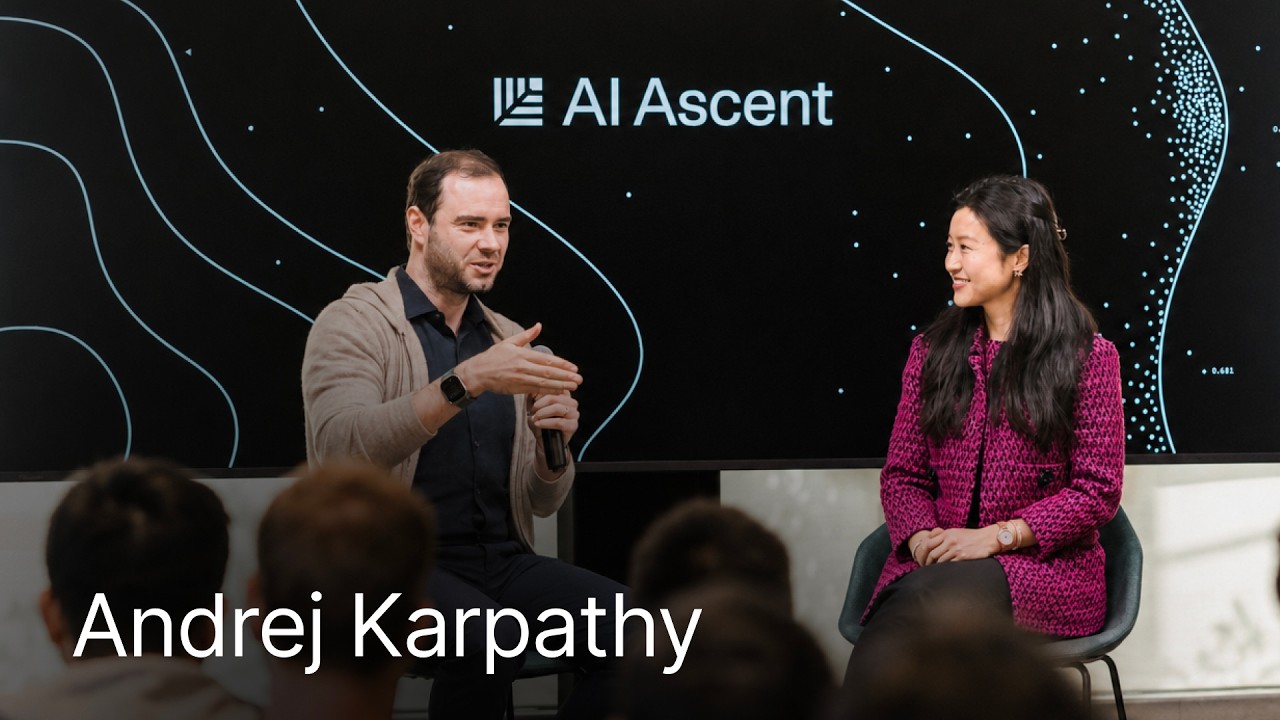
    Andrej Karpathy, co-founder of OpenAI, former head of AI at Tesla, and now founder of Eureka Labs, returned to Sequoia Capital’s AI Ascent 2026 stage for a wide-ranging conversation with partner Stephanie Zhan. One year after coining the term “vibe coding,” Karpathy unpacked what has changed, why he has never felt more behind as a programmer, and why the discipline emerging on top of vibe coding, which he calls agentic engineering, is the more serious craft worth learning right now.

    The conversation covered Software 3.0, the limits of verifiability, why LLMs are better understood as ghosts than animals, and why you can outsource your thinking but never your understanding. Below is a complete breakdown of the talk for anyone building, hiring, or learning in the agent era.

    TLDW

    Karpathy describes a sharp transition that happened in December 2025, when agentic coding tools crossed a threshold and code chunks just started coming out fine without correction. He frames the current moment as Software 3.0, where prompting an LLM is the new programming, and entire app categories are collapsing into a single model call. He distinguishes vibe coding (raising the floor for everyone) from agentic engineering (preserving the professional quality bar at much higher speed). Models remain jagged because they are trained on what labs choose to verify, so founders should look for valuable but neglected verifiable domains. Taste, judgment, oversight, and understanding remain uniquely human responsibilities, and tools that enhance understanding are the ones he is most excited about.

    Key Takeaways

    • December 2025 was a clear inflection point. Code chunks from agentic tools started arriving correct without edits, and Karpathy stopped correcting the system entirely.
    • Software 3.0 means programming has become prompting. The context window is your lever over the LLM interpreter, which performs computation in digital information space.
    • Open Code’s installer is a software 3.0 example. Instead of a complex shell script, you copy paste a block of text to your agent, and the agent figures out your environment.
    • The Menu Gen anecdote illustrates how entire apps can become spurious. What used to require OCR, image generation, and a hosted Vercell app can now be a single Gemini plus Nano Banana prompt.
    • Vibe coding raises the floor. Agentic engineering preserves the professional ceiling. The two are different disciplines.
    • The 10x engineer multiplier is now far higher than 10x for people who are good at agentic engineering.
    • Hiring processes have not caught up. Puzzle interviews are the old paradigm. New evaluations should look like building a full Twitter clone for agents and surviving simulated red team attacks from other agents.
    • Models are jagged because reinforcement learning rewards what is verifiable, and labs choose which verifiable domains to invest in. Strawberry letter counts and the 50 meter car wash question show how state-of-the-art models can refactor 100,000 line codebases yet fail at trivial reasoning.
    • If you are in a verifiable setting, you can run your own fine tuning, build RL environments, and benefit even when the labs are not focused on your domain.
    • LLMs are ghosts, not animals. They are statistical simulations summoned from pre training and shaped by RL appendages, not creatures with curiosity or motivation. Yelling at them does not help.
    • Taste, aesthetics, spec design, and oversight remain human jobs. Models still produce bloated, copy paste heavy code with brittle abstractions.
    • Documentation is still written for humans. Agent native infrastructure, where docs are explicitly designed to be copy pasted into an agent, is a major opportunity.
    • The future likely involves agent representation for people and organizations, with agents talking to other agents to coordinate meetings and tasks.
    • You can outsource your thinking but not your understanding. Tools that help humans understand information faster are uniquely valuable.

    Detailed Summary

    Why Karpathy Feels More Behind Than Ever

    Karpathy opens by describing how he has been using agentic coding tools for over a year. For most of that period, the experience was mixed. The tools could write chunks of code, but they often required edits and supervision. December 2025 changed everything. With more time during a holiday break and the release of newer models, Karpathy noticed that the chunks just came out fine. He kept asking for more. He cannot remember the last time he had to correct the agent. He started trusting the system, and what followed was a cascade of side projects.

    He wants to stress that anyone whose model of AI was formed by ChatGPT in early 2025 needs to look again. The agentic coherent workflow that genuinely works is a fundamentally different experience, and the transition was stark.

    Software 3.0 Explained

    The Software 1.0 paradigm was writing explicit code. Software 2.0 was programming by curating datasets and training neural networks. Software 3.0 is programming by prompting. When you train a GPT class model on a sufficiently large set of tasks, the model implicitly learns to multitask everything in the data. The result is a programmable computer where the context window is your interface, and the LLM is the interpreter performing computation in digital information space.

    Karpathy gives two concrete examples. The first is Open Code’s installer. Normally a shell script handles installation across many platforms, and these scripts balloon in complexity. Open Code instead provides a block of text you copy paste to your agent. The agent reads your environment, follows instructions, debugs in a loop, and gets things working. You no longer specify every detail. The agent supplies its own intelligence.

    The Menu Gen Story

    The second example is Karpathy’s Menu Gen project. He built an app that takes a photo of a restaurant menu, OCRs the items, generates pictures for each dish, and renders the enhanced menu. The app runs on Vercell and chains together multiple services. Then he saw a software 3.0 alternative. You take a photo, give it to Gemini, and ask it to use Nano Banana to overlay generated images onto the menu. The model returns a single image with everything rendered. The entire app he built is now spurious. The neural network does the work. The prompt is the photo. The output is the photo. There is no app between them.

    Karpathy uses this to argue that founders should not just think of AI as a speedup of existing patterns. Entirely new things become possible. His example is LLM driven knowledge bases that compile a wiki for an organization from raw documents. That is not a faster version of older code. It is a new capability with no prior equivalent.

    What Will Look Obvious in Hindsight

    Stephanie Zhan asks what the equivalent of building websites in the 1990s or mobile apps in the 2010s looks like today. Karpathy speculates about completely neural computers. Imagine a device that takes raw video and audio as input, runs a neural net as the host process, and uses diffusion to render a unique UI for each moment. He notes that early computing in the 1950s and 60s was undecided between calculator like and neural net like architectures. We went down the calculator path. He thinks the relationship may eventually flip, with neural networks becoming the host and CPUs becoming co processors used for deterministic appendages.

    Verifiability and Jagged Intelligence

    Karpathy spent significant writing time on verifiability. Classical computers automate what you can specify in code. The current generation of LLMs automates what you can verify. Frontier labs train models inside giant reinforcement learning environments, so the models peak in capability where verification rewards are strong, especially math and code. They stagnate or get rough around the edges elsewhere.

    This explains the jagged intelligence puzzle. The classic example was counting letters in strawberry. The newer one Karpathy offers: a state of the art model will refactor a 100,000 line codebase or find zero day vulnerabilities, then tell you to walk to a car wash 50 meters away because it is so close. The two coexisting capabilities should be jarring. They reveal that you must stay in the loop, treat models as tools, and understand which RL circuits your task lands in.

    He also points out that data distribution choices matter. The jump in chess capability from GPT 3.5 to GPT 4 came largely because someone at OpenAI added a huge amount of chess data to pre training. Whatever ends up in the mix gets disproportionately good. You are at the mercy of what labs prioritize, and you have to explore the model the labs hand you because there is no manual.

    Founder Advice in a Lab Dominated World

    Asked what founders should do given that labs are racing toward escape velocity in obvious verifiable domains, Karpathy points back to verifiability itself. If your domain is verifiable but currently neglected, you can build RL environments and run your own fine tuning. The technology works. Pull the lever with diverse RL environments and a fine tuning framework, and you get something useful. He hints there is one specific domain he finds undervalued but declines to name it on stage.

    On the question of what is automatable only from a distance, Karpathy says almost everything can ultimately be made verifiable. Even writing can be assessed by councils of LLM judges. The differences are in difficulty, not in possibility.

    From Vibe Coding to Agentic Engineering

    Vibe coding raises the floor. Anyone can build something. Agentic engineering preserves the professional quality bar that existed before. You are still responsible for your software. You are still not allowed to ship vulnerabilities. The question is how you go faster without sacrificing standards. Karpathy calls it an engineering discipline because coordinating spiky, stochastic agents to maintain quality at speed requires real skill.

    The ceiling on agentic engineering capability is very high. The old idea of a 10x engineer is now an understatement. People who are good at this peak far above 10x.

    What Mediocre Versus AI Native Looks Like

    Karpathy compares this to how different generations use ChatGPT. The difference between a mediocre and an AI native engineer using Claude Code, Codex, or Open Code is investment in setup and full use of available features. The same way previous generations of engineers got the most out of Vim or VSCode, today’s strong engineers tune their agentic environments deeply.

    He thinks hiring processes have not caught up. Most companies still hand out puzzles. The new test should look like asking a candidate to build a full Twitter clone for agents, make it secure, simulate user activity with agents, and then run multiple Codex 5.4x high instances trying to break it. The candidate’s system should hold up.

    What Humans Still Own

    Agents are intern level entities right now. Humans are responsible for aesthetics, judgment, taste, and oversight. Karpathy describes a Menu Gen bug where the agent tried to associate Stripe purchases with Google accounts using email addresses as the key, instead of a persistent user ID. Email addresses can differ between Stripe and Google accounts. This kind of specification level mistake is exactly what humans must catch.

    He works with agents to design detailed specs and treats those as documentation. The agent fills in the implementation. He has stopped memorizing API details for things like NumPy axis arguments or PyTorch reshape versus permute. The intern handles recall. Humans handle architecture, design, and the right questions.

    Reading the actual code agents produce can still cause heart attacks. It is bloated, full of copy paste, riddled with awkward and brittle abstractions. His Micro GPT project, an attempt to simplify LLM training to its bare essence, was nearly impossible to drive through agents. The models hate simplification. That capability sits outside their RL circuits. Nothing is fundamentally preventing this from improving. The labs simply have not invested.

    Animals Versus Ghosts

    Karpathy returns to his framing that we are not building animals, we are summoning ghosts. Animal intelligence comes from evolution and is shaped by intrinsic motivation, fun, curiosity, and empowerment. LLMs are statistical simulation circuits where pre training is the substrate and RL is bolted on as appendages. They are jagged. They do not respond to being yelled at. They have no real curiosity. The ghost framing is partly philosophical, but it changes how you approach them. You stay suspicious. You explore. You do not assume the system you used yesterday will behave the same on a new task.

    Agent Native Infrastructure

    Most software, frameworks, libraries, and documentation are still written for humans. Karpathy’s pet peeve is being told to do something instead of being given a block of text to copy paste to his agent. He wants agent first infrastructure. The Menu Gen project’s hardest part was not writing code. It was deploying on Vercell, configuring DNS, navigating service settings, and stringing together integrations. He wants to give a single prompt and have the entire thing deployed without touching anything.

    Long term he expects agent representation for individuals and organizations. His agent will negotiate meeting details with your agent. The world becomes one of sensors, actuators, and agent native data structures legible to LLMs.

    Education and What Still Matters

    The most striking line of the conversation comes near the end. Karpathy quotes a tweet that shaped his thinking: you can outsource your thinking but you cannot outsource your understanding. Information still has to make it into your brain. You still need to know what you are building and why. You cannot direct agents well if you do not understand the system.

    This is part of why he is so excited about LLM driven knowledge bases. Every time he reads an article, his personal wiki absorbs it, and he can query it from new angles. Every projection onto the same information yields new insight. Tools that enhance human understanding are uniquely valuable because LLMs do not excel at understanding. That bottleneck is yours to manage.

    Thoughts

    The most useful frame in this talk is the distinction between vibe coding and agentic engineering. It clarifies what has been muddled for the past year. Vibe coding is about access. Anyone can produce something. Agentic engineering is about discipline. You preserve the standards that made software trustworthy in the first place, while moving at speeds that would have seemed absurd two years ago. These are not the same activity, and conflating them is part of why so many shipped products feel half built.

    The Menu Gen anecdote is the kind of story that should make every solo developer pause. If a single Gemini plus Nano Banana prompt can replace a multi service Vercell deployed app, the question for any builder becomes how much of what you are working on right now is going to be made spurious by the next model release. The honest answer is probably more than you want to admit. The defensive posture is not building thicker apps. It is choosing problems where the model alone is not enough, where taste, distribution, infrastructure, or specific verifiable RL environments give you something the next model cannot collapse into a prompt.

    The verifiability lens is also unusually practical. If you are a solo builder, the question shifts from what is possible to what is verifiable but neglected. The labs will eat the obvious verifiable domains because that is how their RL pipelines are set up. The opportunity is in domains where verification is possible but the labs have not yet invested. That is a much more concrete strategic filter than vague intuitions about defensibility.

    The car wash example is going to stick. State of the art models can refactor enormous codebases and still tell you to walk somewhere a sane person would drive. That is the lived reality of jagged intelligence, and it argues strongly for staying in the loop on real decisions rather than handing off everything to agents. The agents are excellent fillers of blanks. They are not yet trustworthy specifiers of the spec.

    Finally, the line about outsourcing thinking but not understanding is worth taping above the desk. The bottleneck is no longer typing speed, syntax recall, or even API knowledge. It is whether the human in the loop actually understands the system being built. Tools that genuinely improve human understanding, including personal knowledge bases that re project information through different prompts, are likely the most undervalued category of products being built right now. The opportunity is not just in agents. It is in the cognitive scaffolding that makes humans good directors of agents.

  • Dario Amodei on the AGI Exponential: Anthropic’s High-Stakes Financial Model and the Future of Intelligence

    TL;DW (Too Long; Didn’t Watch)

    Anthropic CEO Dario Amodei joined Dwarkesh Patel for a high-stakes deep dive into the endgame of the AI exponential. Amodei predicts that by 2026 or 2027, we will reach a “country of geniuses in a data center”—AI systems capable of Nobel Prize-level intellectual work across all digital domains. While technical scaling remains remarkably smooth, Amodei warns that the real-world friction of economic diffusion and the ruinous financial risks of $100 billion training clusters are now the primary bottlenecks to total global transformation.


    Key Takeaways

    • The Big Blob Hypothesis: Intelligence is an emergent property of scaling compute, data, and broad distribution; specific algorithmic “cleverness” is often just a temporary workaround for lack of scale.
    • AGI is a 2026-2027 Event: Amodei is 90% certain we reach genius-level AGI by 2035, with a strong “hunch” that the technical threshold for a “country of geniuses” arrives in the next 12-24 months.
    • Software Engineering is the First Domino: Within 6-12 months, models will likely perform end-to-end software engineering tasks, shifting human engineers from “writers” to “editors” and strategic directors.
    • The $100 Billion Gamble: AI labs are entering a “Cournot equilibrium” where massive capital requirements create a high barrier to entry. Being off by just one year in revenue growth projections can lead to company-wide bankruptcy.
    • Economic Diffusion Lag: Even after AGI-level capabilities exist in the lab, real-world adoption (curing diseases, legal integration) will take years due to regulatory “jamming” and organizational change management.

    Detailed Summary: Scaling, Risk, and the Post-Labor Economy

    The Three Laws of Scaling

    Amodei revisits his foundational “Big Blob of Compute” hypothesis, asserting that intelligence scales predictably when compute and data are scaled in proportion—a process he likens to a chemical reaction. He notes a shift from pure pre-training scaling to a new regime of Reinforcement Learning (RL) and Test-Time Scaling. These allow models to “think” longer at inference time, unlocking reasoning capabilities that pre-training alone could not achieve. Crucially, these new scaling laws appear just as smooth and predictable as the ones that preceded them.

    The “Country of Geniuses” and the End of Code

    A recurring theme is the imminent automation of software engineering. Amodei predicts that AI will soon handle end-to-end SWE tasks, including setting technical direction and managing environments. He argues that because AI can ingest a million-line codebase into its context window in seconds, it bypasses the months of “on-the-job” learning required by human engineers. This “country of geniuses” will operate at 10-100x human speed, potentially compressing a century of biological and technical progress into a single decade—a concept he calls the “Compressed 21st Century.”

    Financial Models and Ruinous Risk

    The economics of building the first AGI are terrifying. Anthropic’s revenue has scaled 10x annually (zero to $10 billion in three years), but labs are trapped in a cycle of spending every dollar on the next, larger cluster. Amodei explains that building a $100 billion data center requires a 2-year lead time; if demand growth slows from 10x to 5x during that window, the lab collapses. This financial pressure forces a “soft takeoff” where labs must remain profitable on current models to fund the next leap.

    Governance and the Authoritarian Threat

    Amodei expresses deep concern over “offense-dominant” AI, where a single misaligned model could cause catastrophic damage. He advocates for “AI Constitutions”—teaching models principles like “honesty” and “harm avoidance” rather than rigid rules—to allow for better generalization. Geopolitically, he supports aggressive chip export controls, arguing that democratic nations must hold the “stronger hand” during the inevitable post-AI world order negotiations to prevent a global “totalitarian nightmare.”


    Final Thoughts: The Intelligence Overhang

    The most chilling takeaway from this interview is the concept of the Intelligence Overhang: the gap between what AI can do in a lab and what the economy is prepared to absorb. Amodei suggests that while the “silicon geniuses” will arrive shortly, our institutions—the FDA, the legal system, and corporate procurement—are “jammed.” We are heading into a world of radical “biological freedom” and the potential cure for most diseases, yet we may be stuck in a decade-long regulatory bottleneck while the “country of geniuses” sits idle in their data centers. The winner of the next era won’t just be the lab with the most FLOPs, but the society that can most rapidly retool its institutions to survive its own technological adolescence.

    For more insights, visit Anthropic or check out the full transcript at Dwarkesh Patel’s Podcast.

  • Ilya Sutskever on the “Age of Research”: Why Scaling Is No Longer Enough for AGI

    In a rare and revealing discussion on November 25, 2025, Ilya Sutskever sat down with Dwarkesh Patel to discuss the strategy behind his new company, Safe Superintelligence (SSI), and the fundamental shifts occurring in the field of AI.

    TL;DW

    Ilya Sutskever argues we have moved from the “Age of Scaling” (2020–2025) back to the “Age of Research.” While current models ace difficult benchmarks, they suffer from “jaggedness” and fail at basic generalization where humans excel. SSI is betting on finding a new technical paradigm—beyond just adding more compute to pre-training—to unlock true superintelligence, with a timeline estimated between 5 to 20 years.


    Key Takeaways

    • The End of the Scaling Era: Scaling “sucked the air out of the room” for years. While compute is still vital, we have reached a point where simply adding more data/compute to the current recipe yields diminishing returns. We need new ideas.
    • The “Jaggedness” of AI: Models can solve PhD-level physics problems but fail to fix a simple coding bug without introducing a new one. This disconnect proves current generalization is fundamentally flawed compared to human learning.
    • SSI’s “Straight Shot” Strategy: Unlike competitors racing to release incremental products, SSI aims to stay private and focus purely on R&D until they crack safe superintelligence, though Ilya admits some incremental release may be necessary to demonstrate power to the public.
    • The 5-20 Year Timeline: Ilya predicts it will take 5 to 20 years to achieve a system that can learn as efficiently as a human and subsequently become superintelligent.
    • Neuralink++ as Equilibrium: In the very long run, to maintain relevance in a world of superintelligence, Ilya suggests humans may need to merge with AI (e.g., “Neuralink++”) to fully understand and participate in the AI’s decision-making.

    Detailed Summary

    1. The Generalization Gap: Humans vs. Models

    A core theme of the conversation was the concept of generalization. Ilya highlighted a paradox: AI models are superhuman at “competitive programming” (because they’ve seen every problem exists) but lack the “it factor” to function as reliable engineers. He used the analogy of a student who memorizes 10,000 problems versus one who understands the underlying principles with only 100 hours of study. Current AIs are the former; they don’t actually learn the way humans do.

    He pointed out that human robustness—like a teenager learning to drive in 10 hours—relies on a “value function” (often driven by emotion) that current Reinforcement Learning (RL) paradigms fail to capture efficiently.

    2. From Scaling Back to Research

    Ilya categorized the history of modern AI into eras:

    • 2012–2020: The Age of Research (Discovery of AlexNet, Transformers).
    • 2020–2025: The Age of Scaling (The consensus that “bigger is better”).
    • 2025 Onwards: The New Age of Research.

    He argues that pre-training data is finite and we are hitting the limits of what the current “recipe” can do. The industry is now “scaling RL,” but without a fundamental breakthrough in how models learn and generalize, we won’t reach AGI. SSI is positioning itself to find that missing breakthrough.

    3. Alignment and “Caring for Sentient Life”

    When discussing safety, Ilya moved away from complex RLHF mechanics to a more philosophical “North Star.” He believes the safest path is to build an AI that has a robust, baked-in drive to “care for sentient life.”

    He theorizes that it might be easier to align an AI to care about all sentient beings (rather than just humans) because the AI itself will eventually be sentient. He draws parallels to human evolution: just as evolution hard-coded social desires and empathy into our biology, we must find the equivalent “mathematical” way to hard-code this care into superintelligence.

    4. The Future of SSI

    Safe Superintelligence (SSI) is explicitly an “Age of Research” company. They are not interested in the “rat race” of releasing slightly better chatbots every few months. Ilya’s vision is to insulate the team from market pressures to focus on the “straight shot” to superintelligence. However, he conceded that demonstrating the AI’s power incrementally might be necessary to wake the world (and governments) up to the reality of what is coming.


    Thoughts and Analysis

    This interview marks a significant shift in the narrative of the AI frontier. For the last five years, the dominant strategy has been “scale is all you need.” For the godfather of modern AI to explicitly declare that era over—and that we are missing a fundamental piece of the puzzle regarding generalization—is a massive signal.

    Ilya seems to be betting that the current crop of LLMs, while impressive, are essentially “memorization engines” rather than “reasoning engines.” His focus on the sample efficiency of human learning (how little data we need to learn a new skill) suggests that SSI is looking for a new architecture or training paradigm that mimics biological learning more closely than the brute-force statistical correlation of today’s Transformers.

    Finally, his comment on Neuralink++ is striking. It suggests that in his view, the “alignment problem” might technically be unsolvable in a traditional sense (humans controlling gods), and the only stable long-term outcome is the merger of biological and digital intelligence.

  • Composer: Building a Fast Frontier Model with Reinforcement Learning

    Composer represents Cursor’s most ambitious step yet toward a new generation of intelligent, high-speed coding agents. Built through deep reinforcement learning (RL) and large-scale infrastructure, Composer delivers frontier-level results at speeds up to four times faster than comparable models:contentReference[oaicite:0]{index=0}. It isn’t just another large language model; it’s an actively trained software engineering assistant optimized to think, plan, and code with precision — in real time.

    From Cheetah to Composer: The Evolution of Speed

    The origins of Composer go back to an experimental prototype called Cheetah, an agent Cursor developed to study how much faster coding models could get before hitting usability limits. Developers consistently preferred the speed and fluidity of an agent that responded instantly, keeping them “in flow.” Cheetah proved the concept, but it was Composer that matured it — integrating reinforcement learning and mixture-of-experts (MoE) architecture to achieve both speed and intelligence.

    Composer’s training goal was simple but demanding: make the model capable of solving real-world programming challenges in real codebases using actual developer tools. During RL, Composer was given tasks like editing files, running terminal commands, performing semantic searches, or refactoring code. Its objective wasn’t just to get the right answer — it was to work efficiently, using minimal steps, adhering to existing abstractions, and maintaining code quality:contentReference[oaicite:1]{index=1}.

    Training on Real Engineering Environments

    Rather than relying on synthetic datasets or static benchmarks, Cursor trained Composer within a dynamic software environment. Every RL episode simulated an authentic engineering workflow — debugging, writing unit tests, applying linter fixes, and performing large-scale refactors. Over time, Composer developed behaviors that mirror an experienced developer’s workflow. It learned when to open a file, when to search globally, and when to execute a command rather than speculate.

    Cursor’s evaluation framework, Cursor Bench, measures progress by realism rather than abstract metrics. It compiles actual agent requests from engineers and compares Composer’s solutions to human-curated optimal responses. This lets Cursor measure not just correctness, but also how well the model respects a team’s architecture, naming conventions, and software practices — metrics that matter in production environments.

    Reinforcement Learning as a Performance Engine

    Reinforcement learning is at the heart of Composer’s performance. Unlike supervised fine-tuning, which simply mimics examples, RL rewards Composer for producing high-quality, efficient, and contextually relevant work. It actively learns to choose the right tools, minimize unnecessary output, and exploit parallelism across tasks. The model was even rewarded for avoiding unsupported claims — pushing it to generate more verifiable and responsible code suggestions.

    As RL progressed, emergent behaviors appeared. Composer began autonomously running semantic searches to explore codebases, fixing linter errors, and even generating and executing tests to validate its own work. These self-taught habits transformed it from a passive text generator into an active agent capable of iterative reasoning.

    Infrastructure at Scale: Thousands of Sandboxed Agents

    Behind Composer’s intelligence is a massive engineering effort. Training large MoE models efficiently requires significant parallelization and precision management. Cursor’s infrastructure, built with PyTorch and Ray, powers asynchronous RL at scale. Their system supports thousands of simultaneous environments, each a sandboxed virtual workspace where Composer experiments safely with file edits, code execution, and search queries.

    To achieve this scale, the team integrated MXFP8 MoE kernels with expert and hybrid-sharded data parallelism. This setup allows distributed training across thousands of NVIDIA GPUs with minimal communication cost — effectively combining speed, scale, and precision. MXFP8 also enables faster inference without any need for post-training quantization, giving developers real-world performance gains instantly.

    Cursor’s infrastructure can spawn hundreds of thousands of concurrent sandboxed coding environments. This capability, adapted from their Background Agents system, was essential to unify RL experiments with production-grade conditions. It ensures that Composer’s training environment matches the complexity of real-world coding, creating a model genuinely optimized for developer workflows.

    The Cursor Bench and What “Frontier” Means

    Composer’s benchmark performance earned it a place in what Cursor calls the “Fast Frontier” class — models designed for efficient inference while maintaining top-tier quality. This group includes systems like Haiku 4.5 and Gemini Flash 2.5. While GPT-5 and Sonnet 4.5 remain the strongest overall, Composer outperforms nearly every open-weight model, including Qwen Coder and GLM 4.6:contentReference[oaicite:2]{index=2}. In tokens-per-second performance, Composer’s throughput is among the highest ever measured under the standardized Anthropic tokenizer.

    Built by Developers, for Developers

    Composer isn’t just research — it’s in daily use inside Cursor. Engineers rely on it for their own development, using it to edit code, manage large repositories, and explore unfamiliar projects. This internal dogfooding loop means Composer is constantly tested and improved in real production contexts. Its success is measured by one thing: whether it helps developers get more done, faster, and with fewer interruptions.

    Cursor’s goal isn’t to replace developers, but to enhance them — providing an assistant that acts as an extension of their workflow. By combining fast inference, contextual understanding, and reinforcement learning, Composer turns AI from a static completion tool into a real collaborator.

    Wrap Up

    Composer represents a milestone in AI-assisted software engineering. It demonstrates that reinforcement learning, when applied at scale with the right infrastructure and metrics, can produce agents that are not only faster but also more disciplined, efficient, and trustworthy. For developers, it’s a step toward a future where coding feels as seamless and interactive as conversation — powered by an agent that truly understands how to build software.

  • Dwarkesh Patel: From Podcasting Prodigy to AI Chronicler with The Scaling Era

    TLDW (Too Long; Didn’t Watch)

    Dwarkesh Patel, a 24-year-old podcasting sensation, has made waves with his deep, unapologetically intellectual interviews on science, history, and technology. In a recent Core Memory Podcast episode hosted by Ashlee Vance, Patel announced his new book, The Scaling Era: An Oral History of AI, co-authored with Gavin Leech and published by Stripe Press. Released digitally on March 25, 2025, with a hardcover to follow in July, the book compiles insights from AI luminaries like Mark Zuckerberg and Satya Nadella, offering a vivid snapshot of the current AI revolution. Patel’s journey from a computer science student to a chronicler of the AI age, his optimistic vision for a future enriched by artificial intelligence, and his reflections on podcasting as a tool for learning and growth take center stage in this engaging conversation.


    At just 24, Dwarkesh Patel has carved out a unique niche in the crowded world of podcasting. Known for his probing interviews with scientists, historians, and tech pioneers, Patel refuses to pander to short attention spans, instead diving deep into complex topics with a gravitas that belies his age. On March 25, 2025, he joined Ashlee Vance on the Core Memory Podcast to discuss his life, his meteoric rise, and his latest venture: a book titled The Scaling Era: An Oral History of AI, published by Stripe Press. The episode, recorded in Patel’s San Francisco studio, offers a window into the mind of a young intellectual who’s become a key voice in documenting the AI revolution.

    Patel’s podcasting career began as a side project while he was a computer science student at the University of Texas. What started with interviews of economists like Bryan Caplan and Tyler Cowen has since expanded into a platform—the Lunar Society—that tackles everything from ancient DNA to military history. But it’s his focus on artificial intelligence that has garnered the most attention in recent years. Having interviewed the likes of Dario Amodei, Satya Nadella, and Mark Zuckerberg, Patel has positioned himself at the epicenter of the AI boom, capturing the thoughts of the field’s biggest players as large language models reshape the world.

    The Scaling Era, co-authored with Gavin Leech, is the culmination of these efforts. Released digitally on March 25, 2025, with a print edition slated for July, the book stitches together Patel’s interviews into a cohesive narrative, enriched with commentary, footnotes, and charts. It’s an oral history of what Patel calls the “scaling era”—the period where throwing more compute and data at AI models has yielded astonishing, often mysterious, leaps in capability. “It’s one of those things where afterwards, you can’t get the sense of how people were thinking about it at the time,” Patel told Vance, emphasizing the book’s value as a time capsule of this pivotal moment.

    The process of creating The Scaling Era was no small feat. Patel credits co-author Leech and editor Rebecca for helping weave disparate perspectives—from computer scientists to primatologists—into a unified story. The first chapter, for instance, explores why scaling works, drawing on insights from AI researchers, neuroscientists, and anthropologists. “Seeing all these snippets next to each other was a really fun experience,” Patel said, highlighting how the book connects dots he’d overlooked in his standalone interviews.

    Beyond the book, the podcast delves into Patel’s personal story. Born in India, he moved to the U.S. at age eight, bouncing between rural states like North Dakota and West Texas as his father, a doctor on an H1B visa, took jobs where domestic talent was scarce. A high school debate star—complete with a “chiseled chin” and concise extemp speeches—Patel initially saw himself heading toward a startup career, dabbling in ideas like furniture resale and a philosophy-inspired forum called PopperPlay (a name he later realized had unintended connotations). But it was podcasting that took off, transforming from a gap-year experiment into a full-fledged calling.

    Patel’s optimism about AI shines through in the conversation. He envisions a future where AI eliminates scarcity, not just of material goods but of experiences—think aesthetics, peak human moments, and interstellar exploration. “I’m a transhumanist,” he admitted, advocating for a world where humanity integrates with AI to unlock vast potential. He predicts AI task horizons doubling every seven months, potentially leading to “discontinuous” economic impacts within 18 months if models master computer use and reinforcement learning (RL) environments. Yet he remains skeptical of a “software-only singularity,” arguing that physical bottlenecks—like chip manufacturing—will temper the pace of progress, requiring a broader tech stack upgrade akin to building an iPhone in 1900.

    On the race to artificial general intelligence (AGI), Patel questions whether the first lab to get there will dominate indefinitely. He points to fast-follow dynamics—where breakthroughs are quickly replicated at lower cost—and the coalescing approaches of labs like xAI, OpenAI, and Anthropic. “The cost of training these models is declining like 10x a year,” he noted, suggesting a future where AGI becomes commodified rather than monopolized. He’s cautiously optimistic about safety, too, estimating a 10-20% “P(doom)” (probability of catastrophic outcomes) but arguing that current lab leaders are far better than alternatives like unchecked nationalized efforts or a reckless trillion-dollar GPU hoard.

    Patel’s influences—like economist Tyler Cowen, who mentored him early on—and unexpected podcast hits—like military historian Sarah Paine—round out the episode. Paine, a Naval War College scholar whose episodes with Patel have exploded in popularity, exemplifies his knack for spotlighting overlooked brilliance. “You really don’t know what’s going to be popular,” he mused, advocating for following personal curiosity over chasing trends.

    Looking ahead, Patel aims to make his podcast the go-to place for understanding the AI-driven “explosive growth” he sees coming. Writing, though a struggle, will play a bigger role as he refines his takes. “I want it to become the place where… you come to make sense of what’s going on,” he said. In a world often dominated by shallow content, Patel’s commitment to depth and learning stands out—a beacon for those who’d rather grapple with big ideas than scroll through 30-second blips.

  • Alibaba Cloud Unveils QwQ-32B: A Compact Reasoning Model with Cutting-Edge Performance

    Alibaba Cloud Unveils QwQ-32B: A Compact Reasoning Model with Cutting-Edge Performance

    In a world where artificial intelligence is advancing at breakneck speed, Alibaba Cloud has just thrown its hat into the ring with a new contender: QwQ-32B. This compact reasoning model is making waves for its impressive performance, rivaling much larger AI systems while being more efficient. But what exactly is QwQ-32B, and why is it causing such a stir in the tech community?

    What is QwQ-32B?

    QwQ-32B is a reasoning model developed by Alibaba Cloud, designed to tackle complex problems that require logical thinking and step-by-step analysis. With 32 billion parameters, it’s considered compact compared to some behemoth models out there, yet it punches above its weight in terms of performance. Reasoning models like QwQ-32B are specialized AI systems that can think through problems methodically, much like a human would, making them particularly adept at tasks such as solving mathematical equations or writing code.

    Built on the foundation of Qwen2.5-32B, Alibaba Cloud’s latest large language model, QwQ-32B leverages the power of Reinforcement Learning (RL). RL is a technique where the model learns by trying different approaches and receiving rewards for correct solutions, similar to how a child learns through play and feedback. This method, when applied to a robust foundation model pre-trained on extensive world knowledge, has proven to be highly effective. In fact, the exceptional performance of QwQ-32B highlights the potential of RL in enhancing AI capabilities.

    Stellar Performance Across Benchmarks

    To test its mettle, QwQ-32B was put through a series of rigorous benchmarks. Here’s how it performed:

    • AIME 24: Excelled in mathematical reasoning, showcasing its ability to solve challenging math problems.
    • Live CodeBench: Demonstrated top-tier coding proficiency, proving its value for developers.
    • LiveBench: Performed admirably in general evaluation tasks, indicating broad competence.
    • IFEval: Showed strong instruction-following skills, ensuring it can execute tasks as directed.
    • BFCL: Highlighted its capabilities in tool and function-calling, a key feature for practical applications.

    When stacked against other leading models, such as DeepSeek-R1-Distilled-Qwen-32B and o1-mini, QwQ-32B holds its own, often matching or even surpassing their capabilities despite its smaller size. This is a testament to the effectiveness of the RL techniques employed in its training. Additionally, the model was trained using rewards from a general reward model and rule-based verifiers, which further enhanced its general capabilities. This includes better instruction-following, alignment with human preferences, and improved agent performance.

    Agent Capabilities: A Step Beyond Reasoning

    What sets QwQ-32B apart is its integration of agent-related capabilities. This means the model can not only think through problems but also interact with its environment, use tools, and adjust its reasoning based on feedback. It’s like giving the AI a toolbox and teaching it how to use each tool effectively. The research team at Alibaba Cloud is even exploring further integration of agents with RL to enable long-horizon reasoning, where the model can plan and execute complex tasks over extended periods. This could be a significant step towards more advanced artificial intelligence.

    Open-Source and Accessible to All

    Perhaps one of the most exciting aspects of QwQ-32B is that it’s open-source. Available on platforms like Hugging Face and Model Scope under the Apache 2.0 license, it can be freely downloaded and used by anyone. This democratizes access to cutting-edge AI technology, allowing developers, researchers, and enthusiasts to experiment with and build upon this powerful model. The open-source nature of QwQ-32B is a boon for the AI community, fostering innovation and collaboration.

    The buzz around QwQ-32B is palpable, with posts on X (formerly Twitter) reflecting public interest and excitement about its capabilities and potential applications. This indicates that the model is not just a technical achievement but also something that captures the imagination of the broader tech community.

    A Bright Future for AI

    In a field where bigger often seems better, QwQ-32B proves that efficiency and smart design can rival sheer size. As AI continues to evolve, models like QwQ-32B are paving the way for more accessible and powerful tools that can benefit society as a whole. With Alibaba Cloud’s commitment to pushing the boundaries of what’s possible, the future of AI looks brighter than ever.

  • Unlocking Success with ‘Explore vs. Exploit’: The Art of Making Optimal Choices

    In the fast-paced world of data-driven decision-making, there’s a pivotal strategy that everyone from statisticians to machine learning enthusiasts is talking about: The Exploration vs. Exploitation trade-off.

    What is ‘Explore vs. Exploit’?

    Imagine you’re at a food festival with dozens of stalls, each offering a different cuisine. You only have enough time and appetite to try a few. The ‘Explore’ phase is when you try a variety of cuisines to discover your favorite. Once you’ve found your favorite, you ‘Exploit’ your knowledge and keep choosing that cuisine.

    In statistics, machine learning, and decision theory, this concept of ‘Explore vs. Exploit’ is crucial. It’s about balancing the act of gathering new information (exploring) and using what we already know (exploiting).

    Making the Decision: Explore or Exploit?

    Deciding when to shift from exploration to exploitation is a challenging problem. The answer largely depends on the specific context and the amount of uncertainty. Here are a few strategies used to address this problem:

    1. Epsilon-Greedy Strategy: Explore a small percentage of the time and exploit the rest.
    2. Decreasing Epsilon Strategy: Gradually decrease your exploration rate as you gather more information.
    3. Upper Confidence Bound (UCB) Strategy: Use statistical methods to estimate the average outcome and how uncertain you are about it.
    4. Thompson Sampling: Use Bayesian inference to update the probability distribution of rewards.
    5. Contextual Information: Use additional information (context) to decide whether to explore or exploit.

    The ‘Explore vs. Exploit’ trade-off is a broad concept with roots in many fields. If you’re interested in diving deeper, you might want to explore topics like:

    • Reinforcement Learning: This is a type of machine learning where an ‘agent’ learns to make decisions by exploring and exploiting.
    • Multi-Armed Bandit Problems: This is a classic problem that encapsulates the explore/exploit dilemma.
    • Bayesian Statistics: Techniques like Thompson Sampling use Bayesian statistics, a way of updating probabilities based on new data.

    Understanding ‘Explore vs. Exploit’ can truly transform the way you make decisions, whether you’re fine-tuning a machine learning model or choosing a dish at a food festival. It’s time to unlock the power of optimal decision making.