In a world filled with distractions and ever-changing challenges, the principles of inner growth, resilience, and focus remain timeless. Ryan Holiday, a modern advocate for Stoicism and the bestselling author, delves into these principles in an episode of The Knowledge Project podcast. His conversation offers invaluable insights into mastering inner growth and achieving a life of purpose and clarity.
This article unpacks the key takeaways from this discussion, offering a deep dive into how you can adopt and implement Stoic principles in your personal and professional life.
What Is Stoicism Really About?
One of the biggest misconceptions about Stoicism is that it promotes the suppression of emotions. However, Ryan Holiday reframes this philosophy as a practice of processing emotions constructively. Stoicism teaches that while we cannot control external events, we can control how we respond to them. This idea is not about erasing emotions but channeling them toward virtuous action.
Key Insight: Stoicism encourages resilience—finding joy and contentment even amid life’s uncertainties. As Holiday puts it, happiness should not depend solely on external circumstances but should be nurtured from within.
The Power of Reflection and Journaling
Holiday emphasizes the importance of reflection, particularly through journaling. Inspired by Marcus Aurelius’ Meditations, journaling serves as a dialogue with oneself. It allows individuals to confront their thoughts, beliefs, and emotions without judgment. This process is akin to meditation in Buddhism—a daily exercise to build self-awareness.
How to Start:
Dedicate a few minutes each day to journaling your thoughts and feelings.
Use prompts such as, “What did I do well today?” and “What could I improve tomorrow?”
Focus on clarity rather than perfection.
Balancing Ambition and Contentment
A recurring theme in Holiday’s discussion is the balance between ambition and contentment. Success often involves trade-offs, whether it’s time, relationships, or mental well-being. For high achievers like Elon Musk, this balance is particularly challenging. Musk’s relentless pursuit of innovation often contrasts with the opportunity costs of his decisions.
Takeaway: Ambition is essential, but it should not come at the cost of inner peace or ethical integrity. Stoicism advises asking, “Is this essential?” to help filter out distractions and focus on meaningful pursuits.
Opportunity Cost and the Art of Saying No
Every “yes” comes with an inherent “no” to something else. Holiday highlights how the practice of saying no can lead to greater focus and efficiency. Marcus Aurelius himself championed the elimination of inessential actions, enabling him to excel as a philosopher-king.
Practical Application:
Before committing to any project or task, ask, “Does this align with my core goals?”
Create systems, such as dynamic pricing for your services, to prioritize high-value opportunities.
Emotional Mastery: Responding Without Reacting
Stoicism teaches us to distinguish between experiencing emotions and being ruled by them. Anger, for instance, is natural but acting out of anger often leads to poor decisions. Instead, Stoicism promotes emotional regulation—acknowledging emotions without letting them dictate your actions.
Example from Marcus Aurelius: Marcus never allowed anger to drive his decisions, despite the immense pressures of ruling an empire. His calm demeanor in high-stress situations exemplified Stoic discipline.
The Role of Discipline
Discipline is more than rigid routines or harsh restrictions; it’s about self-mastery. Holiday defines self-discipline as the ability to impose structure on oneself, especially when external pressures are absent.
Building Discipline:
Daily Practices: Commit to small, consistent actions, such as working out or journaling.
Accountability: Reflect on your habits and make adjustments as needed.
Balance: Recognize when to rest and recover to avoid burnout.
Resilience in Adversity
Stoicism shines in its approach to handling setbacks and failures. Whether facing criticism, losing a job, or dealing with personal challenges, Stoics like Marcus Aurelius advise focusing on the next right action rather than dwelling on blame or regret.
Modern Application:
When facing a challenge, pause and ask, “What’s the best way forward?”
Separate the uncontrollable past from the actionable present.
The Importance of Character
Character, Holiday explains, is what you do when no one is watching. It’s built through small, virtuous actions and is independent of external validation. Stoicism emphasizes acting with integrity even in situations where recognition is absent.
Guiding Principles:
Prioritize actions that align with your values.
Avoid being swayed by public opinion or fleeting rewards.
Technology, Distraction, and Focus
Holiday critiques the impact of modern technology on focus and creativity. Social media and constant feedback loops often blur the line between valuable insights and distracting noise. He advocates for intentional engagement with technology—using tools to enhance productivity without falling into the trap of mindless scrolling.
How to Combat Distraction:
Schedule focused work sessions and minimize interruptions.
Use journaling or writing to clarify your priorities.
Defining Success on Your Own Terms
Success, according to Holiday, is not about wealth or accolades but about autonomy and control over your time. True success allows you to focus on what matters most, whether that’s family, creative pursuits, or personal growth.
Reflection Questions:
Does your current definition of success align with your values?
Are you prioritizing short-term gains over long-term fulfillment?
Final Thoughts
Mastering inner growth and becoming “unbeatable” is not about suppressing emotions or achieving external milestones. Instead, it’s about cultivating resilience, discipline, and clarity in how you navigate life’s challenges. By integrating Stoic principles into your daily routine, you can build a foundation of inner strength that enables you to thrive in both success and adversity.
Start small: Reflect on your daily actions, focus on what’s essential, and practice responding to life’s uncertainties with grace and virtue. As Ryan Holiday demonstrates, the journey to mastery begins with thoughtful living and intentional action.
In the sprawling labyrinth of the digital age, where every byte pulses with potential and every click could pivot the trajectory of a life, there exists an undercurrent—a silent manifesto whispered among those who navigate the chaos with intent and purpose. It’s a doctrine not inscribed in code or chiseled into silicon but woven into the very fabric of human experience. It’s about self-reliance, the boundless reach of imagination, the relentless grind of persistence, and the intricate dance of teamwork. It’s a narrative that threads through the deserts of Baja and the unseen corridors of the mind, binding together the essence of what it means to strive, to falter, and to ultimately prevail.
Self-Reliance and Responsibility
In a world enamored with connectivity, where networks span continents and information flows unceasingly, the individual often fades into the digital noise. Yet, amidst this cacophony, the truth remains unaltered: no one else will chart your course. Satellites may beam data across the skies, algorithms may predict your next desire, but the helm of your life’s vessel rests firmly in your grasp. Katherine Hepburn once quipped about paddling one’s own canoe—a quaint metaphor in an era of autonomous vehicles and AI-driven decision-making. But the essence holds. The act of paddling, of exerting force against resistance, propels you forward. It’s a physical affirmation of intent.
Power isn’t a commodity to be bestowed; it’s an energy to be harnessed through action steeped in integrity and purpose. In the shifting sands of societal structures, true influence arises not from titles or accolades but from the consistent delivery of value. It’s about solving problems—tangible, stubborn issues that clog the gears of progress. It’s about being the person who steps into the breach, who turns chaos into order, not for the spotlight but for the quiet satisfaction of having made a difference.
Accountability, then, is the bedrock of this philosophy. In the grand tapestry of existence, life’s challenges aren’t parceled out with fairness in mind. Some are born into privilege; others wrestle with adversity from the first breath. Yet, past a certain point—the arbitrary marker of adulthood, perhaps—we each become the sole architects of our fate. Blame is a seductive escape, a siren song that lulls us into complacency. But yielding to its allure only anchors us to the past. The forward path demands that we own our choices, our missteps, and our triumphs with equal candor.
Imagination and Vision
If self-reliance is the engine, imagination is the fuel that ignites it. The ability to envision what does not yet exist is a uniquely human gift—a cognitive leap that defies the constraints of the present. It’s the spark that transforms the mundane into the extraordinary, that reconfigures the boundaries of the possible. To imagine the unimaginable isn’t merely an exercise in fanciful thinking; it’s a deliberate act of creation.
In the theater of the mind, we rehearse scenarios, test hypotheses, and explore landscapes uncharted by reality. This mental simulation is not bound by the limitations of physical resources or the inertia of entrenched systems. It allows us to iterate at the speed of thought, to fail without consequence, and to refine without cost. It’s a sandbox where the seeds of innovation are sown, nurtured by the sunlight of curiosity and the waters of relentless questioning.
Consider the pioneers who first looked at the night sky and saw more than distant lights—they saw destinations. Their imaginations leaped across the void, crafting vessels and trajectories long before the first rocket pierced the atmosphere. Imagination, in this sense, is both a compass and a catalyst, pointing the way forward and accelerating our journey toward it.
Persistence and Resilience
Yet, vision without action is a mirage—a tantalizing glimpse of what could be, forever out of reach. The bridge between conception and realization is built with the bricks of persistence, mortared by resilience. Adversity isn’t an obstacle to be feared but a crucible in which strength is forged. The deserts of Baja, with their relentless heat and unforgiving terrain, serve as a stark metaphor. They aren’t landscapes to be conquered but challenges to be embraced—a testing ground for the soul.
In the heart of such trials, quitting tempts with the promise of relief. The allure of the immediate—comfort, rest, the cessation of struggle—beckons. But true success often hinges on the capacity to endure just a little longer, to push past the breaking point where others yield. In an age where instant gratification is but a click away, the virtue of patience, of sustained effort, becomes ever more precious.
Adaptability threads through this narrative as well. Sticking to a plan provides direction, but rigidity can spell disaster when the unexpected strikes. The race doesn’t always follow the course laid out on paper; detours and obstacles emerge without warning. The key lies in the balance—holding firm to one’s objectives while remaining fluid in the methods employed to achieve them.
Teamwork and Support
No individual, no matter how capable, exists in isolation. The myth of the lone genius overlooks the myriad contributions of those who support, challenge, and collaborate. In any complex endeavor, planning becomes a communal act. It demands the synthesis of diverse perspectives, the anticipation of variables unseen by any single eye. Pre-running the course, whether literal or metaphorical, allows a team to map the terrain, to identify the pitfalls and strategize accordingly.
Leveraging the strengths of each team member transforms a collection of individuals into a cohesive unit. It’s akin to an orchestra, where each instrument plays its part, contributing to a symphony that transcends the sum of its notes. The seasoned veterans bring experience and foresight; the newcomers inject fresh energy and unbridled enthusiasm. Together, they navigate the roughest stretches, their collective will propelling them forward.
Support networks extend beyond the immediate circle of collaborators. Friends, family, mentors—they form the scaffolding upon which aspirations are built. Their roles might be subtle, a word of encouragement here, a shared burden there, but their impact is profound. Recognizing and valuing this interconnectedness enriches the journey, infusing it with a depth that solitary pursuits cannot match.
Growth Through Discomfort
Progress rarely sprouts from the soil of comfort. It’s in the uneasy spaces, where familiar footing gives way to uncertainty, that true growth germinates. Facing fears isn’t a reckless plunge into danger but a calculated step beyond the known, a deliberate challenge to self-imposed limitations. It’s the entrepreneur pitching a radical idea, the artist experimenting with a new medium, the individual choosing vulnerability over guardedness.
Self-discipline emerges as the lynchpin in this process. Willpower isn’t about dramatic gestures; it’s the quiet persistence in daily habits, the choice to continue when motivation wanes. Over long stretches, it’s this steady commitment that accumulates into significant change. The marathon, not the sprint, defines the contours of lasting achievement.
Intentionality underscores every action. Purposeful efforts, directed with clarity, cut through the noise of distraction. They align resources—time, energy, focus—toward meaningful objectives. It’s the difference between wandering aimlessly and embarking on a voyage with a defined destination, charting a course and adjusting sails as necessary.
The Power of Choices and Actions
In the interplay between thought and deed, action crystallizes potential into reality. Ideas, no matter how brilliant, remain inert without execution. Each choice, each step taken, propels us along a path that either converges with or diverges from our aspirations. Decisiveness doesn’t preclude caution; rather, it embodies a willingness to move forward despite incomplete information, trusting in the ability to adapt and learn along the way.
Consider the realm of technology startups—a landscape littered with the remnants of those who hesitated too long or acted without direction. Success stories often share a common thread: founders who didn’t just ideate but implemented, iterated, and persisted. They understood that the perfect is the enemy of the good, that progress stems from action refined over time.
Strength in Adversity
Adversity, in its relentless forms, strips away pretense and exposes the core of our character. It’s in the grueling miles of an endurance race, the sleepless nights grappling with a stubborn problem, the moments when giving up seems the sanest option, that we discover reservoirs of strength previously untapped. These experiences aren’t mere hardships to be endured but lessons to be internalized.
Preparation becomes a shield and a sword in these battles. Physical readiness bolsters endurance; mental preparedness steels the mind against doubt and fatigue. Training isn’t just about conditioning the body or honing skills—it’s about embedding responses so deeply that they become reflexive under pressure.
Value of Hard Work and Sacrifice
The narrative of the overnight success is a myth perpetuated by hindsight and selective storytelling. Behind every apparent leap lies a foundation built upon countless hours of labor, moments of doubt overcome, sacrifices made without guarantee of reward. Doing difficult things teaches us not just about the tasks at hand but about our own capacities—the boundaries of which are often far beyond what we initially perceive.
Grit surfaces as a defining attribute—the stubborn refusal to quit despite mounting challenges. It’s economizing energy, not in the sense of holding back, but in pacing oneself to endure. It’s knowing when to push hard and when to conserve, understanding that the journey is as much about endurance as it is about speed.
Gratitude and Appreciation
Amidst the striving and the toil, pausing to acknowledge the contributions of others enriches the journey. We stand atop the shoulders of those who came before—innovators, thinkers, laborers whose efforts constructed the platforms from which we leap. Recognizing this lineage fosters humility and a sense of connectedness to a larger human story.
Celebrating incremental progress injects vitality into the pursuit of grand goals. Each milestone reached, no matter how small, reinforces the trajectory and provides a tangible marker of advancement. It’s not about resting on laurels but about fueling the next phase with the satisfaction of forward motion.
Self-Improvement and Learning
The commitment to continuous learning propels us beyond the static confines of current knowledge. In a rapidly evolving world, adaptability isn’t just an asset—it’s a necessity. Embracing new information, perspectives, and skills keeps us agile, ready to pivot as circumstances dictate.
Focusing on strengths doesn’t ignore weaknesses but optimizes impact. By honing what we excel at, we contribute most effectively, while seeking collaboration or development in areas where we’re less proficient. It’s a strategic approach to personal growth, maximizing returns on effort invested.
Mindset and Attitude
Ultimately, the lens through which we view our experiences shapes their impact. A positive outlook isn’t naïve optimism but a deliberate choice to see challenges as opportunities. Believing in the possibility of success lays the groundwork for action; without that foundational faith, efforts falter before they begin.
Owning our happiness involves recognizing that external factors wield only as much influence as we permit. By cultivating purpose, aligning actions with values, and embracing gratitude, we create an internal environment resilient to external fluctuations. It’s about generating a wellspring of fulfillment that sustains us through the inevitable ebbs and flows of life.
Wrap Up
In weaving together these threads—self-reliance, imagination, persistence, teamwork, growth through discomfort, decisive action, strength in adversity, hard work, gratitude, continuous learning, and a resilient mindset—we craft a tapestry that reflects the essence of purposeful living. It’s a mosaic not of grand gestures but of daily choices, of moments seized and challenges embraced.
The deserts of Baja and the boundless expanse of the human mind are not so different. Both are terrains to be navigated, fraught with perils and possibilities. Success, in either realm, isn’t a destination but a journey—a relentless pursuit of excellence forged through action, reflection, and unwavering commitment.
In the end, it’s about paddling your own canoe, not in isolation but as part of a greater current, contributing your unique strokes to the collective movement forward. It’s about imagining the unimaginable and then rolling up your sleeves to bring it into being. It’s about standing firm when the winds howl and the sands shift, knowing that within you lies the strength to endure and the capacity to soar.
Jocko Willink, a retired Navy SEAL officer, bestselling author, and leadership expert, has gained a reputation for his hard-hitting yet practical life philosophies. His core message is simple yet profound: discipline equals freedom. By applying discipline, taking extreme ownership of one’s actions, and facing life’s hardships head-on, Willink believes anyone can create a purposeful and fulfilling life. This article explores the principles Jocko shares to help individuals improve their confidence, resilience, and leadership.
1. Discipline Equals Freedom: The Foundation of Control
Jocko Willink emphasizes that self-discipline is the ultimate gateway to freedom. This concept may seem counterintuitive—how can strict self-regulation lead to greater personal liberty? Jocko explains that discipline in key areas, such as health, finance, and time management, prevents dependency on others and allows for true independence. For instance, exercising regularly and eating well provide long-term freedom from many health issues. Financial discipline enables freedom from debt, and efficient time management ensures freedom to pursue passions or spend time with loved ones.
Discipline, according to Jocko, isn’t about restriction—it’s about control. By cultivating discipline, individuals can eliminate distractions and procrastination, which allows them to reach their full potential.
2. Extreme Ownership: Embrace Total Responsibility
At the heart of Jocko’s philosophy is “extreme ownership.” This principle means taking complete responsibility for everything in your life—successes, failures, and everything in between. Rather than blaming external circumstances, Jocko advocates looking within to identify where you can improve. When something goes wrong, he believes the key is to avoid excuses, take ownership, and focus on solutions.
Extreme ownership is a mindset that empowers people to make changes in their lives by shifting the focus from external problems to internal solutions. This shift fosters accountability, allowing people to tackle challenges directly rather than feeling victimized or helpless.
3. Building Confidence Through Small Wins
For those struggling with self-doubt, Jocko recommends a practical approach to building confidence: small, achievable tasks. He encourages starting with manageable goals that lead to quick wins, which can gradually increase a person’s confidence. Success, even in small doses, creates momentum and helps individuals build trust in their abilities.
Jocko’s approach to confidence-building aligns with a principle often used in therapy called “exposure therapy.” By consistently achieving minor goals, individuals learn to handle larger challenges with a similar mindset, gradually diminishing fears and self-doubt.
4. Leadership Through Humility and Collaboration
One of the most surprising elements of Jocko’s leadership philosophy is his focus on humility and collaboration. Rather than relying on a top-down approach, he advocates for a more decentralized, team-oriented strategy. Good leaders, in his view, aren’t dictators; instead, they empower their team members to take ownership of their responsibilities. By asking for input from others, a leader fosters a collaborative environment and helps the team feel invested in their collective success.
Jocko emphasizes that humility is crucial for any leader, as it helps maintain an open mind and adaptability. Leaders who are willing to listen, learn, and empower their team ultimately achieve better results.
5. The Importance of Brotherhood and Shared Hardship
Having spent over 20 years in the Navy SEALs, Jocko values the sense of brotherhood and shared hardship that defined his military experience. He believes that personal growth is amplified when individuals are part of a team that faces challenges together. Jocko’s advice to anyone seeking meaning and fulfillment is to find a “tribe” or community where they can experience camaraderie and shared goals.
In today’s world, people can find this connection in various ways—through sports, martial arts, fitness training, or even team projects at work. This shared struggle brings people closer and reinforces resilience, grit, and a sense of belonging.
6. Balance and Resilience: The Power of Emotional Control
Jocko believes that resilience is essential in both personal and professional life. He advocates balancing logic and emotion, especially when facing challenges or loss. Resilience, for Jocko, doesn’t mean ignoring or suppressing emotions; instead, it’s about processing feelings without letting them dictate decisions. Life is full of highs and lows, and maintaining an even-keel approach helps people navigate both success and failure without becoming overwhelmed.
For those dealing with trauma or loss, Jocko suggests allowing oneself to experience waves of emotion while staying focused on moving forward. This balanced approach to emotional management, he says, is crucial for long-term resilience and growth.
7. Serving Others as the Path to Fulfillment
Jocko’s philosophy includes a strong emphasis on serving others as a path to personal fulfillment. Whether leading a team or supporting family and friends, he believes that focusing on others ultimately leads to a more rewarding life. Rather than seeking self-promotion or accolades, Jocko advises prioritizing the team and the mission.
This focus on service reflects a core component of military life but is equally applicable in everyday settings. By helping others achieve their goals and placing the team’s success above personal gain, individuals foster a culture of trust, loyalty, and mutual respect. Jocko believes that the most successful and fulfilled people are those who put others first, as this builds stronger connections and purpose beyond self-interest.
8. Facing Hardship Head-On: Growth Through Challenge
Jocko champions the idea that facing challenges, rather than avoiding them, is essential for growth. He encourages people to embrace difficult tasks, as hardship builds character and prepares individuals for future challenges. In his view, every setback or failure is a lesson that strengthens resilience and ultimately contributes to a more fulfilling life.
For those struggling with indecision or fear, Jocko advises taking action—even small steps—toward a goal. Overthinking, he explains, leads to paralysis, whereas consistent, incremental actions move you closer to success. By confronting life’s obstacles directly, people learn to adapt, persevere, and eventually succeed.
9. The Power of Routine and Consistency
Jocko’s personal routine is famously strict, with a commitment to waking up early each day to exercise, reflect, and set goals. He emphasizes that a consistent routine, tailored to one’s personal goals and responsibilities, establishes a solid foundation for productivity and success. While his own schedule may be extreme, he encourages others to find a rhythm that works for them, allowing them to stay grounded and focused.
Creating a consistent routine, he believes, helps reduce decision fatigue and cultivates a disciplined mindset. By automating daily habits, individuals free up mental space to tackle bigger challenges and focus on long-term goals.
Living a Purposeful Life Through Discipline, Service, and Ownership
Jocko Willink’s life philosophy centers on taking ownership, embracing discipline, and serving others. His principles aren’t limited to military or professional settings; they offer a guide for anyone seeking greater purpose, fulfillment, and resilience. By incorporating extreme ownership, cultivating discipline, and contributing to a community, individuals can face challenges with strength and lead lives of meaning and impact.
Whether you’re looking to improve your personal life, career, or relationships, Jocko’s approach reminds us that true freedom and success are the results of disciplined action, resilience, and a willingness to put others first.
Learning life lessons can sometimes feel like a slow, painstaking process that unfolds over years or even decades. But what if you could accelerate that journey and fast-track your personal growth? While experience remains a powerful teacher, there are ways to speed up the process of understanding and internalizing essential life lessons without waiting for hindsight to kick in. Here are some practical strategies to help you learn faster and more effectively when it comes to the lessons that shape your life.
1. Embrace a Growth Mindset
A growth mindset is the belief that your abilities, intelligence, and qualities can be developed over time. When you adopt this mindset, you become more open to learning from experiences, mistakes, and feedback. Instead of seeing failures as setbacks, you view them as opportunities to grow. This shift in perspective accelerates learning by allowing you to approach challenges with curiosity and resilience.
How to Apply It:
Reframe Failure: Instead of fearing failure, ask yourself what you can learn from it. Each mistake is a stepping stone to growth.
Challenge Your Assumptions: Push beyond your comfort zone and question your beliefs. When you embrace discomfort, you open yourself up to new ideas and perspectives.
2. Learn from Others’ Experiences
One of the fastest ways to learn life lessons is to study the experiences of others. This can save you from having to go through every challenge yourself. By reading, listening, or talking to those who’ve walked a similar path, you can extract valuable insights and avoid common pitfalls.
How to Apply It:
Read Books and Biographies: Literature is filled with life lessons. Reading biographies of people you admire or books focused on personal growth will help you gain insights that took others years to learn.
Seek Mentorship: Connect with mentors who have more experience. They can guide you, offering practical advice on how to navigate certain situations.
Observe and Ask Questions: Don’t be afraid to ask questions from people who’ve been through similar experiences. Their reflections can help you avoid making the same mistakes.
3. Practice Reflection and Self-Awareness
Reflection accelerates the learning process by helping you make sense of your experiences. Regular self-reflection fosters self-awareness, allowing you to better understand your behaviors, beliefs, and decisions.
How to Apply It:
Keep a Journal: Writing down your thoughts and experiences helps clarify your thinking. Regular journaling encourages you to reflect on your actions and lessons learned.
Practice Mindfulness: Mindfulness helps you stay present, observe your thoughts and feelings, and respond to challenges in a balanced way. It enhances your ability to learn from everyday life.
Review Past Decisions: Periodically look back on your decisions and evaluate what worked and what didn’t. This helps identify patterns and areas for growth.
4. Accelerate Through Feedback
Feedback—whether from a trusted friend, colleague, or coach—is an essential tool for fast-tracking your learning. Constructive feedback can reveal blind spots and help you see yourself from another perspective.
How to Apply It:
Seek Feedback Regularly: Don’t wait for formal reviews. Actively ask for feedback from those you trust to give honest, constructive input.
Act on Feedback Quickly: The quicker you implement feedback, the faster you’ll see improvements in your behavior or decision-making processes.
Be Open to Criticism: Learning to take criticism without becoming defensive accelerates personal growth. Use it as a tool for learning, not as a personal attack.
5. Break Down Big Lessons into Small Steps
Many life lessons are big concepts that feel overwhelming, like learning to manage your finances, cultivate healthy relationships, or pursue a fulfilling career. The key to speeding up your learning in these areas is to break them down into smaller, more manageable tasks.
How to Apply It:
Create Actionable Goals: Instead of setting vague goals like “be financially secure,” break it down into smaller tasks such as “save $100 a month” or “invest in learning about budgeting.”
Use the Power of Habit: Life lessons often require behavioral change, and forming good habits accelerates that process. Focus on one habit at a time to create lasting change.
Track Your Progress: Use tools like habit trackers, to-do lists, or apps to monitor your progress. Small, consistent actions lead to bigger results over time.
6. Practice Active Listening
Listening attentively is a skill that can speed up the absorption of lessons from those around you. Whether in personal relationships or professional settings, active listening ensures you fully understand others’ experiences, advice, and viewpoints.
How to Apply It:
Listen Without Interrupting: Give people your full attention when they share advice or insights. Avoid jumping in with your own thoughts until they’ve finished.
Ask Clarifying Questions: If something isn’t clear, ask follow-up questions. This shows you’re engaged and helps you gain deeper understanding.
Apply What You Hear: Once you’ve absorbed information from others, look for ways to apply it in your life. Experiment with their suggestions and see what works for you.
7. Learn Through Teaching
One of the most effective ways to cement life lessons is to teach them to others. When you explain a concept, you reinforce your understanding of it and often uncover deeper insights in the process.
How to Apply It:
Share Your Knowledge: Whether through mentoring, writing, or casual conversations, share what you’ve learned with others.
Engage in Discussions: Engage in meaningful discussions about life lessons with friends, family, or colleagues. These conversations help solidify your understanding and expose you to new perspectives.
8. Be Proactive in Trying New Things
The more experiences you expose yourself to, the faster you’ll learn. Taking initiative and stepping out of your comfort zone helps you gain new insights, perspectives, and lessons.
How to Apply It:
Take Calculated Risks: Growth often comes from taking chances. Push yourself to try new experiences, whether in your career, relationships, or personal development.
Adopt a “Beginner’s Mindset”: Approach life with curiosity and humility. Being open to new experiences, even when they seem difficult or unfamiliar, accelerates learning.
Set Challenges: Regularly set challenges for yourself to develop new skills or perspectives. These challenges, no matter how small, help speed up the learning curve.
9. Foster Resilience Through Consistency
Speeding up learning doesn’t mean rushing through life. It’s about consistently applying yourself to the lessons in front of you. Resilience is built through the day-to-day effort you put into learning and growth.
How to Apply It:
Practice Daily Reflection: Dedicate time each day to reflect on your actions and lessons learned.
Stay Persistent: Even when lessons are hard to grasp, stay committed. Learning takes time, and resilience helps you stay focused.
Celebrate Small Wins: Acknowledge every step forward, no matter how small. These moments of progress keep you motivated to continue learning.
10. Take Action Immediately
Finally, the most important way to accelerate your learning of life lessons is to take action. Knowledge without application is useless. The more you act on what you’ve learned, the faster you’ll see progress.
How to Apply It:
Don’t Wait for the Perfect Moment: There’s no such thing as the “right time” to start. Act on your lessons as soon as you can.
Turn Insights into Actions: After reflecting on or receiving advice, immediately think about how you can apply it in your life.
Make Adjustments as You Go: As you act, be willing to pivot if things don’t go as expected. Flexibility is key to learning faster.
Accelerating Your Journey to Wisdom
By adopting these strategies, you can significantly speed up the process of learning valuable life lessons. A combination of mindset, self-reflection, seeking feedback, and proactive action enables you to internalize lessons faster and live a more fulfilled, intentional life. Learning is a lifelong process, but with the right approach, you can make that journey more efficient and rewarding.
We’ve all been there, right? Life’s going crazy, and you find yourself wondering, “When does it finally get easier?” Maybe you’re dealing with a never-ending pile of work, relationship drama, or just trying to survive everyday stress. It’s a question we all ask at some point, whether we say it out loud or not.
Here’s the truth (and it kinda sucks): It doesn’t get easier. That’s not the answer you were hoping for, I know. But here’s the thing—it’s actually good news once you really think about it. Instead of waiting around for things to magically smooth out, you realize something even more empowering: you get stronger.
Life Doesn’t Get Easier—But That’s Okay
The idea that life somehow hits cruise control and everything becomes easier over time is a myth. You see, new challenges keep showing up, and life doesn’t hand out “easy mode” passes. Stressful job? You’ll still have bad days. Family drama? That doesn’t go away. Unexpected health issues? They happen. The point is, waiting for everything to settle down is like waiting for it to stop raining while you’re standing in the middle of a storm—you’ll just get soaked. Instead, you need to build the resilience to keep walking in the rain, to stand taller, to carry on regardless.
That’s the key. It’s not about eliminating problems or difficulties. It’s about how you face them.
How to Build Strength and Resilience Over Time
So, how do you actually get stronger? How do you become that person who faces life’s punches with grit, keeps moving, and even thrives in tough situations? It’s not about being born resilient or having some superpower. Resilience is something you can build. It’s like a muscle—you have to work at it.
Here’s a few practical steps that can help:
1. Accept That Struggles Are Part of the Deal
The sooner you accept that life will always have problems, the sooner you can stop fighting reality and start growing. People often waste energy wishing things were easier, when in fact, the real power lies in just saying, “Okay, this is tough, but I’m tougher.” Life doesn’t hand out “easy” but it does hand out opportunities to grow stronger, every single day.
2. Change Your Mindset
One of the best ways to start getting stronger is by changing how you look at the hard stuff. Instead of thinking, “Why is this happening to me?” try reframing it as, “What is this trying to teach me?” This simple shift turns every challenge into a learning opportunity. It’s not easy to do at first, but over time, you’ll start to notice that you handle situations with less frustration and more clarity.
3. Focus on What You Can Control
You can’t control what life throws at you, but you can control how you respond. If you keep focusing on all the stuff outside your control, you’re just going to stress yourself out even more. Take a step back, breathe, and look at the situation again. Ask yourself, “What’s one thing I can do right now?” Sometimes, that one small step is all you need to start feeling more empowered.
4. Build Mental Toughness
Mental toughness isn’t built overnight. It’s something that develops when you face small challenges and push through them. Start by doing difficult things intentionally. Take that hard workout, stick through that boring task at work, or face a conversation you’ve been avoiding. Each time you come out the other side, you’ll feel a little more confident in your ability to handle what’s coming next.
5. Strengthen Your Emotional Resilience
One of the most underrated aspects of resilience is emotional strength. Life throws emotional punches too, and being able to process and handle your emotions effectively is a game-changer. Practice self-awareness by journaling, meditating, or simply giving yourself permission to feel whatever you’re feeling without judgment. Resilience doesn’t mean being emotionless—it means being in control of how your emotions impact your actions.
6. Lean on Your Support System
No one is strong alone. One of the best ways to build resilience is by having people around you who can lift you up when you’re down. Whether it’s friends, family, or even an online community, having support can be a huge boost when life gets overwhelming. Sometimes, just talking things out can remind you how capable you really are.
“You Just Get Stronger”: The Deeper Meaning
This whole idea of “you get stronger” is beautifully captured in a meme that’s been floating around. There’s this image of two guys talking—one guy asks, “When does it get easier?” and the other responds, “It doesn’t, you just get stronger.” At first glance, it’s kind of funny, but there’s a profound truth in there.
In the final image of the meme, there’s a character—Guts, from the manga Berserk—standing tall in armor against a cosmic backdrop. This dude has faced countless struggles, pain, and challenges, yet he continues to fight. Guts is the perfect example of this idea that life never gets easier, but through sheer will and perseverance, he gets stronger.
This metaphor can apply to any of us. We don’t have to be fantasy warriors to embody that same kind of strength in our everyday lives. We just need to embrace the idea that growth comes from struggle, and each challenge we overcome makes us that much more resilient.
How to Start Building Your Strength Today
You don’t have to wait for life to get easier to start feeling stronger. In fact, the real strength comes from facing challenges and pushing through them. Next time something difficult comes your way, remember that it’s not about the situation getting easier—it’s about you learning how to handle it better.
Start small. Focus on what you can control. Change your mindset. And when it feels like too much, lean on the people who care about you. Resilience is built over time, one step at a time. So keep moving forward, keep learning, and keep getting stronger.
Final Thoughts: You Can Handle More Than You Think
So, when does it get easier? It doesn’t. But that’s actually the good news. The more challenges you face, the more opportunities you have to grow stronger. Life is never going to be perfect, but you can become resilient enough to handle whatever comes your way.
Life is a complex journey, a series of decisions and experiences that shape who we become. In a world filled with endless noise and distractions, it’s easy to lose sight of what truly matters—our personal growth, fulfillment, and the legacy we leave behind. Every action we take, every boundary we set, and every risk we embrace contributes to the mosaic of our life. These 50 lessons are distilled from the essence of what it means to live fully, to learn continuously, and to evolve as a person.
This guide isn’t about chasing perfection, nor is it about striving for the impossible. Instead, it’s about understanding the profound truths that lead to meaningful progress, habits that build true happiness, and decisions that define our existence. Through self-awareness, deliberate action, and a willingness to adapt, we can transcend limitations and create the life we desire. Each principle you find here serves as a pillar, a cornerstone on which you can build your most purposeful, impactful, and fulfilling life.
1. Develop Passion Through Mastery: Passion comes from developing skills, not discovering a pre-existing interest.
2. Learn to Say No: Value your time by declining requests that don’t align with your goals.
3. Embrace Change Anytime: It’s never too late for positive change. Embrace new growth opportunities.
4. Focus on Legacy, Not Approval: True fulfillment comes from personal growth and positive impact, not seeking validation.
5. Walk Away When Needed: Don’t stay in jobs or relationships that no longer serve you. Move on to grow.
6. Avoid Gossip and Drama: Surround yourself with positive people to enhance success and happiness.
7. Say No to Distractions: Avoid distractions to focus on what truly matters.
8. Commit to Self-Improvement: Continuously work on yourself—small changes add up to big growth.
9. Life Reflects Your Growth: Your reality mirrors your personal growth. Focus on improving yourself.
10. Do Work You Love: Pursue a career you enjoy and delegate tasks you dislike.
11. Trust Your Instincts: Listen to your intuition, especially during tough decisions.
12. Be Authentic: Stay true to yourself. Authenticity attracts genuine people and opportunities.
13. Manage Money Well: Financial responsibility reduces stress and leads to long-term happiness.
14. Growth Comes From Challenges: Embrace challenges as part of growth and personal development.
15. Take Responsibility: Own your choices. Blaming others reduces your power over your own life.
16. Seek Internal Validation: True confidence comes from within, not from proving yourself to others.
17. Be Willing to Be Misunderstood: Pursuing your unique path may mean others won’t understand—stay true to your vision.
18. Study Actively: Read to learn and apply knowledge rather than passively consuming information.
19. Surround Yourself With Ambition: Be with those who challenge and inspire you to grow.
20. Set Boundaries: Clear boundaries prevent misunderstandings and protect your well-being.
21. Consistency Over Intensity: Sustainable success comes from regular, dedicated effort.
22. Get Enough Sleep: A consistent sleep schedule is vital for productivity and health.
23. Learn From Struggles: Overcoming adversity builds resilience. Embrace past challenges.
24. Help Others: Find purpose by contributing to others and giving back.
25. Commit First, Love Follows: True love is built on commitment; don’t wait for perfection.
26. Don’t Let Fear Stop You: Fear is normal, but don’t let it control your actions. Seek support when needed.
27. Prioritize Long-Term Fulfillment: Choose activities that provide lasting value over fleeting pleasures.
28. Recognize Your Patterns: If you face repeated issues, evaluate your own actions.
29. Take Big Risks in Business: Fear of failure can limit your potential. Take calculated risks for growth.
30. Impact Draws Criticism: Meaningful impact comes with criticism—focus on the positive changes you’re making.
31. Acknowledge Others: Recognize and celebrate others’ achievements.
32. Be Flexible in Self-Identity: Don’t cling to rigid identities. Allow yourself to evolve.
33. Exercise for Longevity: Treat exercise as a long-term investment in health.
34. Take Ownership: Own your problems to control your happiness—don’t blame others.
35. Limit Phone Use: Reduce screen time to engage more with activities that excite you.
36. Seek Experienced Mentors: Learn from people who have succeeded in your desired field.
37. Take Risks While Young: Consequences are lower when you’re younger—take calculated risks.
38. Practice Mindfulness: Use mindfulness to reduce stress and enhance focus.
39. See Challenges as Opportunities: Use obstacles as chances to grow.
40. Earn Respect Through Action: Self-respect comes from contributing meaningfully to the world.
41. Avoid Wasteful Spending: Redirect bar and excess spending towards investments and long-term benefits.
42. Trust Others: Approach the world with trust—the benefits often outweigh the risks.
43. Cultivate Abundance Mindset: Confidence and success start from inner security, not external approval.
44. Define Your Purpose: Know your values and contribute meaningfully to the world.
45. Maintain Work Ethic: Stay disciplined even after achieving success.
46. Take Care of Your Body: Health is foundational to pursuing your dreams.
47. Surround Yourself With Ambition: Be with those who challenge and inspire you to grow.
48. Set Boundaries to Protect Yourself: Clear boundaries protect your time and energy.
49. Prioritize Experiences Over Stuff: Memories are more valuable than material possessions.
50. Stick to a Sleep Routine: Consistent sleep is key to overall well-being.
Understanding these lessons is not enough. You must live them, breathe them, and let them shape your actions. Remember, change doesn’t happen overnight, but with persistence and dedication, your life will transform in ways you never thought possible. You have within you the power to define your reality, to grow endlessly, and to create a life that is a testament to your values and your purpose. Choose wisely, act deliberately, and commit relentlessly. The best version of yourself awaits.
In a striking visual call to action, a meme with its roots in the e/acc movement—a branch of Accelerationism focused on the digital realm—has gone viral for its strong condemnation of ‘blackpilling,’ a term synonymous with a defeatist or pessimistic worldview.
In the realm of internet culture, memes are more than just vehicles for humor—they are the language of a generation that often communicates complex ideas through imagery and succinct text. Recently, a meme featuring a scene from a popular television series, modified to include the text “No blackpilling” and “NO. FUCKING. BLACKPILLING.”, has resonated deeply within online communities, particularly those discussing the future of society and technology.
The meme is a snapshot of the larger conversation surrounding Accelerationism, a philosophy that advocates for the acceleration of capitalist forces to hasten the arrival of a new societal structure. This perspective does not inherently lean towards pessimism; rather, it proposes that the rapid intensification of capitalism’s dynamics could eventually lead to a radical transformation.
The imagery of the meme—a man vehemently rejecting the notion of ‘blackpilling’—captures a sense of urgency and resistance. It symbolizes a broader rejection of nihilism and inaction, encouraging a proactive engagement with the challenges posed by the modern world. The term ‘blackpilling’ itself draws from the cultural lexicon of the “red pill” and “blue pill” dichotomy presented in “The Matrix,” where it represents the acceptance of a grim, inevitable decline.
Within the context of e/acc and similar movements, this meme serves as a critique of passive negativity. It promotes an active response to the accelerating pace of technological and capitalist change, pushing back against the tendency to succumb to despair.
The dual format of the meme—the statement first issued as a prohibition, then repeated with increased intensity—allows for a layered interpretation. It can be seen as either an escalation of the initial command or a self-aware, ironic exaggeration, reflecting the complexities of the sentiments it conveys.
On a broader scale, the meme epitomizes the tension between taking action and resigning to passivity. It serves as a digital rallying cry within e/acc discussions, encouraging critical thinking and strategic action in the face of seemingly insurmountable systems.
By spreading this meme, participants within the e/acc movement aim to foster resilience and an active stance against the complacency implied by ‘blackpilling.’ It reflects a facet of Accelerationist thought that encourages the strategic use of existing systems to shape the future, despite the uncertainties and controversial nature of such methods.
In the complex tapestry of life, our mental and emotional approaches significantly influence our journey. The tendency to worry, for instance, often leads to a drain on our mental resources without bearing fruitful results. It is more constructive to redirect these energies into proactive actions or creative pursuits, fostering tangible progress and innovative solutions.
Understanding that challenges and failures are not the end, but rather stepping stones to success, is vital. The adage “You Don’t Drown by Falling in the Water” encapsulates this sentiment perfectly. It’s not the fall that defines us, but our refusal or inability to rise above and learn from these challenges.
Similarly, the path to innovation and progress often lies in embracing the unknown. The greatest risks often pave the way to significant opportunities, hidden behind a veil of uncertainty, waiting to be discovered by those daring enough to take a chance.
Every misstep offers a valuable lesson, guiding us closer to our goals. Success is rarely a straight path; it often involves navigating through a series of mistakes and learning from them. Similarly, relying on external validation and fearing rejection can trap us in a cycle of perpetual dissatisfaction. Building self-esteem on the foundation of self-awareness and personal values is far more enduring than depending on the ever-changing opinions of others.
Happiness, too, is a state of being that emerges from appreciating the present moment, rather than deferring joy for an uncertain future. This approach to life is augmented by the belief that our attitudes significantly influence our achievements. A positive mindset not only opens new doors but also reveals opportunities that might remain hidden under a cloud of negativity.
Furthermore, our beliefs profoundly shape our perceptions and realities. A belief in positive outcomes can illuminate paths and opportunities, whereas a negative mindset may obscure them. Patience, coupled with a positive attitude, is crucial during periods of waiting, acknowledging that some things simply take time.
A rich, fulfilling life comprises varied experiences and continuous learning. Repeating the same patterns without growth or change fails to constitute a meaningful existence. Every significant journey or achievement begins with a simple yet crucial step: the decision to try. This initial effort sets the course for what follows.
Our interactions with others also play a pivotal role in our lives. Being inclusive, kind, and choosing to surround ourselves with positive and inspiring individuals can have a profound impact on our personal and professional development.
Sometimes, the greatest blessings come from not getting what we initially wanted. Such instances often lead us to better opportunities and realizations, steering us toward a path more aligned with our true purpose.
Ultimately, a better life results from deliberate change and initiative. Each small step towards change lays the foundation for improved circumstances and personal growth. These principles underscore the significance of perspective, action, resilience, self-reliance, and embracing challenges. They advocate for valuing the present and continuously striving for personal growth and positive interactions.
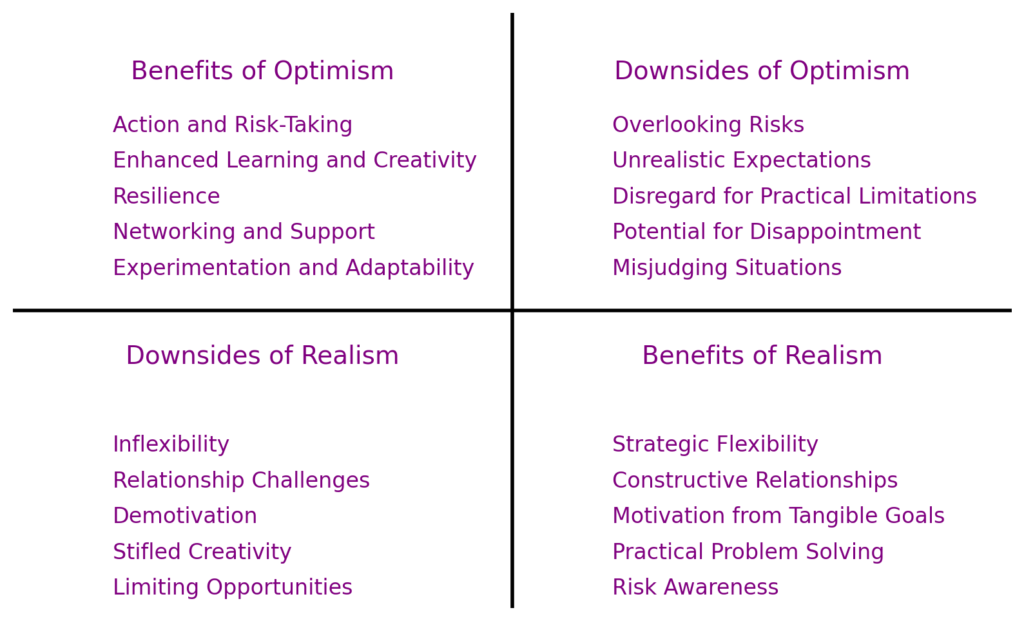
1. Action and Risk-Taking: Optimists often dive into projects with enthusiasm, willing to take risks that might intimidate others. This bold approach can lead to significant breakthroughs and innovations.
2. Enhanced Learning and Creativity: Optimism fuels a positive mindset that is conducive to learning and creativity. Optimists are more likely to engage in creative problem-solving, seeing potential where others might see dead-ends.
3. Resilience: Optimism is a key component of resilience. It allows individuals to bounce back from setbacks and maintain a positive outlook, even in the face of adversity.
4. Networking and Support: Optimists tend to attract a network of supportive and like-minded individuals. This positive energy not only fosters personal growth but also creates a support system that can be crucial in challenging times.
5. Experimentation and Adaptability: An optimistic disposition encourages experimentation and adaptability. Optimists are more likely to try new things and adapt to changes, viewing them as opportunities rather than threats.
Downsides of Realism
1. Limiting Opportunities: Realists might miss out on opportunities due to their focus on practicalities and limitations. This perspective can sometimes prevent them from taking chances that could lead to significant gains.
2. Stifled Creativity: A realistic viewpoint might inhibit creativity. By focusing too much on what is practical or probable, realists may overlook innovative solutions.
3. Demotivation: Realism can lead to demotivation, especially if the focus is constantly on the hurdles or the less-than-ideal aspects of a situation.
4. Relationship Challenges: Realists might face challenges in relationships, particularly with more optimistic counterparts, due to their pragmatic and sometimes pessimistic outlook.
5. Inflexibility: A strong focus on realism can result in inflexibility, as adapting to new or unforeseen circumstances may be more difficult for those who are deeply rooted in practical realities.
Downsides of Optimism
1. Overlooking Risks: Optimists might overlook or underestimate risks, leading to decisions that are not well-informed or prepared for potential challenges.
2. Unrealistic Expectations: Excessive optimism can foster unrealistic expectations, setting one up for disappointment if things do not pan out as hoped.
3. Disregard for Practical Limitations: Optimists may sometimes disregard practical limitations, leading to overcommitment or the pursuit of unfeasible goals.
4. Potential for Disappointment: High expectations fueled by optimism can lead to disappointment if outcomes do not match the optimistic projections.
5. Misjudging Situations: A highly optimistic outlook can sometimes lead to misjudging situations, underestimating difficulties, or failing to plan adequately for possible setbacks.
Benefits of Realism
1. Risk Awareness: Realists are typically more aware of risks, allowing for better preparedness and contingency planning.
2. Practical Problem Solving: A realistic approach fosters practical problem-solving skills. Realists tend to focus on tangible solutions that are feasible and grounded in reality.
3. Motivation from Tangible Goals: Realists are often motivated by tangible, achievable goals. This focus on realistic objectives can drive consistent progress and achievement.
4. Constructive Relationships: Realism can lead to more constructive relationships, particularly in professional settings, as realists tend to set clear, achievable expectations.
5. Strategic Flexibility: Realism does not necessarily mean rigidity. In fact, a realistic outlook can foster strategic flexibility, allowing individuals to adjust plans and strategies based on practical assessments of changing circumstances.
Both optimism and realism have their distinct advantages and disadvantages. Striking a balance between the two can lead to a more well-rounded approach to life and decision-making, combining the best of both worlds: the hope and drive of optimism with the groundedness and practicality of realism.
INVERT:
Charlie Munger, the renowned investor and vice chairman of Berkshire Hathaway, is well-known for his concept of “inversion,” a problem-solving strategy. Inversion involves approaching a problem backward or from the opposite end of the traditional starting point. It’s about looking at what you want to avoid and then figuring out how to avoid it. This concept can be applied to the balance between optimism and realism, particularly in decision-making and strategic planning.
Applying Inversion to Optimism and Realism
For the Overly Optimistic:
Inversion Focus: Instead of focusing on what could go right, they should consider what could go wrong. This helps in identifying potential pitfalls and risks they might typically overlook.
Risk Management: By considering the worst-case scenarios, optimists can create contingency plans, thus grounding their optimism with a dose of realism.
Setting Realistic Goals: By inverting their tendency to set overly ambitious goals, they can aim for targets that are challenging yet achievable, reducing potential disappointment.
For the Overly Realistic:
Inversion Focus: Instead of constantly looking at the limitations and risks, they should contemplate what opportunities might be missed by being too cautious.
Encouraging Creativity: By considering the best-case scenarios, realists can open themselves up to more creative and innovative solutions, breaking free from the confines of their usual pragmatism.
Expanding Comfort Zones: Inverting their focus on practicality can lead to taking calculated risks, potentially leading to greater rewards.
Practical Steps for Inversion
Reflection and Self-Awareness: Acknowledge your natural inclination towards either optimism or realism. Self-awareness is key in understanding how to apply inversion.
Seeking Alternative Perspectives: Engage with individuals who hold a different outlook. For optimists, this means consulting with more pragmatic individuals, and vice versa for realists.
Scenario Analysis: Actively practice thinking through both positive and negative outcomes of any given situation. For optimists, emphasize the negative outcomes more, and for realists, the positive ones.
Balance in Decision Making: Strive for decisions that incorporate both the hopefulness of optimism and the groundedness of realism. This might mean tempering high expectations with practical considerations or infusing a realistic plan with a bit more ambition and vision.
In essence, Munger’s inversion idea, when applied to the dichotomy of optimism and realism, encourages individuals to step outside their comfort zones and adopt a more balanced, comprehensive approach to thinking and problem-solving. This can lead to more robust, well-rounded decisions and strategies, both in personal and professional contexts.
“The Great Depression: A Diary” is a first-hand account of life during the Great Depression, penned by Benjamin Roth, a young lawyer from Youngstown, Ohio. Compiled as a diary, the book offers an invaluable perspective on the social, economic, and psychological impact of the Depression, not through the lens of a historian, but from someone living through it. Roth began keeping his diary in 1931, with the primary intent to create a guide for his own investment decisions, but it evolved into a detailed chronicle of a tumultuous era.
Roth’s observations cover a wide array of topics—from bank failures, foreclosures, and unemployment to the overall atmosphere of uncertainty that pervaded everyday life. His diary entries shed light on the policy decisions at the time, including the New Deal, and how they were received by ordinary citizens. Roth was critical of both governmental and public reactions to the crisis, often highlighting how policy measures were not effective in addressing the root causes.
He observed the disappearance of the middle class as small businesses collapsed and savings were wiped out. Unemployment became a chronic problem and Roth describes how even educated professionals had to resort to menial jobs or depend on government relief to survive. He does not shy away from discussing the prevalent despair, where some resorted to suicide as a way out of financial ruin.
However bleak, Roth’s diary also captures the resilience and adaptability of people. He speaks of neighbors helping each other, community solidarity, and the simple pleasures that gained importance when luxuries became unaffordable.
Roth also touched on the shifting investment landscape. He navigated through various investment vehicles, such as stocks, bonds, and real estate, reflecting on their viability during economic downturns. These insights are interspersed with his commentary on economic theories and the actions of influential figures of the era.
While the book is mostly U.S.-centric, Roth also includes observations on global events, such as the rise of Nazism in Germany, and their potential economic impact on the United States.
The diary ends in 1941, as World War II begins to reshape the economy and the global order. Although Roth’s diary was initially meant for a small audience, it was posthumously discovered by his family and published, offering an invaluable historical record.
“The Great Depression: A Diary” serves as a poignant reminder of the human costs of economic collapse and the complicated interplay between government policy, public sentiment, and economic realities. It is a rich resource for anyone interested in understanding the depths of the Great Depression, told from the point of view of someone who lived through its dire straits.