PJFP.com

Pursuit of Joy, Fulfillment, and Purpose

Tag: Starship

  • SpaceX S-1 IPO Filing Breakdown, Ticker SPCX on Nasdaq and Nasdaq Texas, xAI Integration, Musk’s Trillion Share Mars Pay Plan, $18.7B Revenue, and the 100 Gigawatt Orbital AI Compute Bet

    Space Exploration Technologies Corp. filed its S-1 registration statement with the SEC on May 20, 2026, kicking off the largest and weirdest IPO in modern capital markets history. The 280-page preliminary prospectus proposes to list Class A common stock on both the Nasdaq Stock Market and the new Nasdaq Texas exchange under the ticker SPCX, bundles xAI into SpaceX as a third reportable segment via a February 2026 reorganization under common control, and asks public investors to underwrite a $28.5 trillion total addressable market that explicitly includes asteroid mining, lunar manufacturing, Mars passenger transport, and 100 gigawatts per year of orbital AI compute on solar-powered satellites. The filing reports $18.67 billion of 2025 revenue and a $4.94 billion net loss, with a Q1 2026 net loss of $4.28 billion driven almost entirely by the AI segment’s $7.7 billion of quarterly capex.

    TLDR

    SpaceX is going public on Nasdaq and Nasdaq Texas as SPCX, led by Goldman Sachs, Morgan Stanley, BofA Securities, Citigroup, and J.P. Morgan. The company has been reincorporated in Texas, headquartered at Starbase, structured as a perpetual dual-class controlled company with Class B shares carrying 10 votes each and electing a majority of the board, and post-merger contains three segments: Space (Falcon, Dragon, Starship), Connectivity (Starlink with 10.3 million subscribers across 164 countries and roughly 9,600 satellites in orbit), and AI (the former xAI, including the Colossus and Colossus II superclusters in Memphis totaling about 1.0 gigawatt of nameplate compute, Grok, and the X platform with 550 million MAUs). Revenue grew from $10.4 billion in 2023 to $14.0 billion in 2024 to $18.7 billion in 2025, with Connectivity contributing $11.4 billion at a 63% segment Adjusted EBITDA margin and the new AI segment burning $1.2 billion of segment Adjusted EBITDA in 2025 while spending $12.7 billion of capex. Elon Musk holds an unspecified majority of the voting power, has a base salary of $54,080 unchanged since 2019, no key-person life insurance, and was granted in January and March 2026 a combined roughly 1.3 billion performance-restricted Class B shares that vest against market-cap milestones from $500 billion up to $7.5 trillion, with the highest tranches contingent on building a permanent Mars colony of one million inhabitants and on deploying non-Earth data centers delivering 100 terawatts of compute per year. The prospectus discloses Anthropic’s $1.25 billion per month compute deal through May 2029, a $60 billion option to acquire Cursor (Anysphere) with a $10 billion combined break fee, the Terafab one-terawatt-per-year chip JV with Tesla and Intel, the $19.6 billion EchoStar spectrum acquisition, a $20 billion SpaceX Bridge Loan, a $5 billion amended revolver, a Houston-exclusive Texas Business Court forum clause with ICC arbitration fallback, and several uniquely SpaceX risk factors including third-party Musk conduct triggering foreign asset seizures, anti-satellite weapons, cascading cyber-induced orbital debris events, and Grok’s named “Spicy” Imagine Mode and “Unhinged” Voice Mode.

    Key Takeaways

    • Ticker SPCX, dual listed on Nasdaq and Nasdaq Texas, Class A par $0.001, joint lead bookrunners Goldman Sachs, Morgan Stanley, BofA Securities, Citigroup, and J.P. Morgan, with a 22-firm syndicate including Barclays, Deutsche Bank, RBC, UBS, Wells Fargo, Allen & Company, Cantor, Needham, Raymond James, Societe Generale, Stifel, William Blair, BTG Pactual, ING, Macquarie, Mirae Asset, Mizuho, and Santander.
    • Headquartered at 1 Rocket Road, Starbase, Texas. Reincorporated from Delaware to Texas on February 14, 2024. Five-for-one forward stock split executed May 4, 2026. All share data in the filing is post-split.
    • Perpetual dual-class structure with no sunset. Class A carries 1 vote per share, Class B carries 10 votes per share, Class C carries no votes (and has been eliminated via the Class C Reclassification). Class B converts to Class A only on a non-permitted transfer.
    • Class B holders elect a majority of the board (the Class B Directors), as long as any Class B shares remain outstanding. Removing Musk from CEO or Chairman requires a separate Class B majority vote. SpaceX will be a Nasdaq controlled company and will rely on the exemptions, meaning no requirement for fully independent compensation or nominating committees.
    • Consolidated revenue: $10.39 billion in 2023, $14.02 billion in 2024, $18.67 billion in 2025, and $4.69 billion in Q1 2026 (up 15.4% year over year). Financials are retrospectively recast to combine xAI and X Holdings since both transactions were between entities under Musk’s common control.
    • Net income (loss): $(4.63) billion in 2023, $0.79 billion in 2024, $(4.94) billion in 2025, and $(4.28) billion in Q1 2026. Accumulated deficit pro forma $41.31 billion as of March 31, 2026.
    • Connectivity (Starlink) is the cash engine. 2025 revenue $11.39 billion, up 49.8%. 2025 operating income $4.42 billion, up 120.4%. 2025 segment Adjusted EBITDA $7.17 billion, up 86.2%. Consumer subscriptions are more than 60% of Connectivity revenue.
    • Starlink subscribers: 2.3 million at year-end 2023, 4.4 million at year-end 2024, 8.9 million at year-end 2025, and 10.3 million as of March 31, 2026. Roughly 9,600 broadband and mobile satellites in low Earth orbit, about 75% of all active maneuverable satellites globally. Available in 164 countries and territories.
    • Starlink ARPU is declining as the mix shifts international and lower priced: $99 monthly in 2023, $91 in 2024, $81 in 2025, $66 in Q1 2026. Management says this is expected to continue.
    • Starlink direct to cell now has roughly 650 V1 Mobile satellites and 7.4 million monthly unique devices across about 30 countries, with partnerships across roughly 30 mobile network operators including T-Mobile, Rogers, KDDI, Optus, Telstra, One NZ, Kyivstar, VMO2, Salt, and Entel. V3 satellites begin deploying in the second half of 2026, designed for 1 Tbps downlink per satellite with up to 60 per Starship launch (a 20x payload-capacity step over Falcon 9).
    • Space segment now generates lower revenue growth because Starlink dedicated launches are not booked as inter-segment revenue. Space revenue: $3.56 billion (2023), $3.80 billion (2024), $4.09 billion (2025). Falcon launches in 2025: 165 total, 43 third-party customer and 122 internal Starlink. Mass to orbit: 1,210 metric tons (2023), 1,699 (2024), 2,213 (2025). SpaceX has now launched more than 80% of the world’s mass to orbit since 2023.
    • Falcon 9 has flown roughly 620 missions with greater than 99% mission success. A single booster has been reflown 34 times. Falcon Heavy is 11-for-11 since 2018 and certified for NSSL. SpaceX flew 11 of 12 NSSL medium and heavy lift missions in 2025.
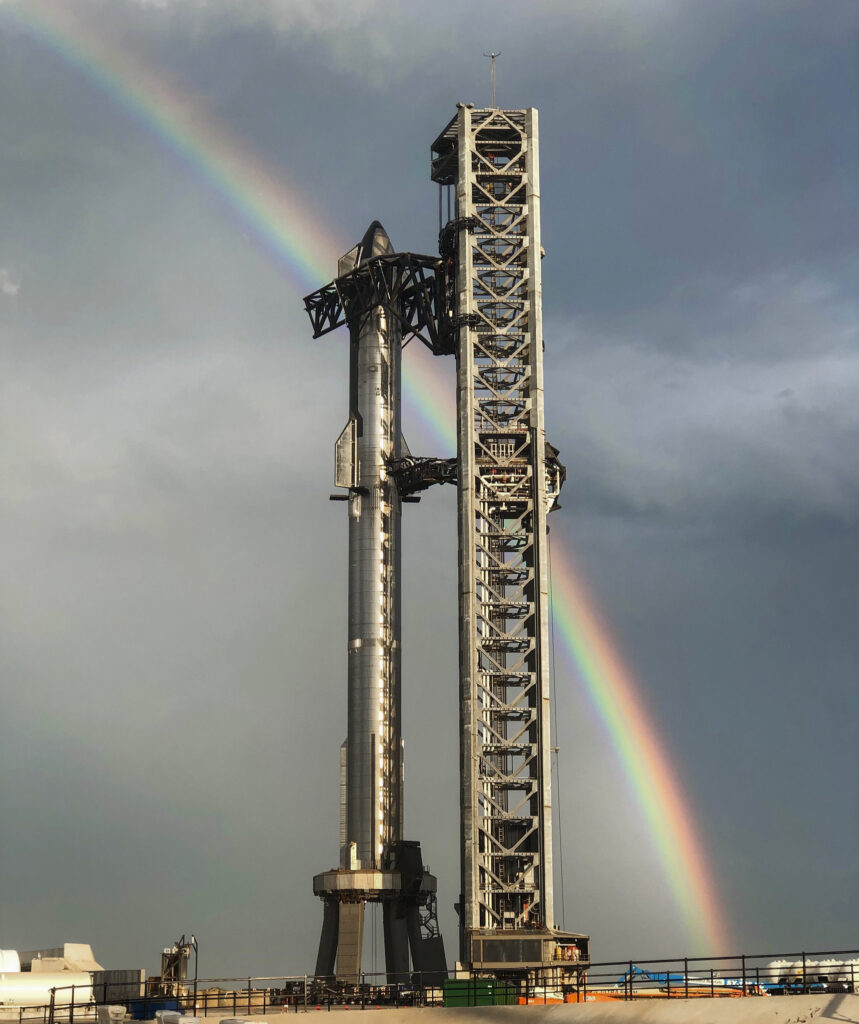
    • Starship has completed 11 flight tests and is preparing the 12th, debuting next-generation Starship, Super Heavy, and Raptor 3 from a new Starbase pad. V3 is designed for 100 metric tons fully reusable to LEO, V4 targets 200 tons. Cumulative Starship R&D investment is greater than $15 billion, including $3.00 billion in 2025 alone. Operational payload delivery to orbit is expected in the second half of 2026.
    • Dragon has flown 78 crewmembers from 20 countries since 2020 and Cargo Dragon remains the only spacecraft capable of returning meaningful mass from the ISS.
    • AI segment, the absorbed xAI business plus X, generated $818 million Q1 2026 revenue but operating losses of $(2.47) billion and segment Adjusted EBITDA of $(609) million. AI capex was $7.72 billion in Q1 2026 alone, dwarfing Space ($1.05 billion) and Connectivity ($1.33 billion).
    • Colossus and Colossus II in Memphis and Southaven Mississippi together provide about 1.0 gigawatt of nameplate compute draw. Colossus came online in 122 days with about 100,000 H100s. Colossus II added 110,000 GB200s in 91 days and 110,000 GB300s in 64 days. Next phase: another 220,000 GB300s and 400 megawatts. Industry benchmark for a 100 megawatt greenfield datacenter is two years.
    • Grok and X together have 1.3 billion supported accounts on a trailing basis, about 550 million MAUs, roughly 117 million MAUs using Grok AI features, and roughly 350 million daily posts. Imagine generates about 10 billion images and 2 billion videos per month. Paid subscribers totaled 6.3 million as of March 31, 2026 (4.4 million X Premium variants plus 1.9 million SuperGrok variants).
    • Disclosed Anthropic cloud services agreements signed May 2026: Anthropic pays $1.25 billion per month for compute capacity on Colossus and Colossus II through May 2029, ramping in May and June 2026, with 90-day termination by either party.
    • Cursor (Anysphere) compute agreement and acquisition option signed April 2026: SpaceX has the right but not the obligation to acquire Cursor at an implied $60.0 billion equity value, paid in Class A stock priced off the SPCX VWAP. SpaceX-side termination or breach triggers a $1.5 billion termination fee plus an $8.5 billion deferred services fee.
    • Terafab JV with Tesla, announced March 2026, joined by Intel in April 2026, targets one terawatt per year of compute hardware production. The filing explicitly notes that neither Tesla nor Intel is obligated to remain, and definitive agreements may not be signed.
    • Macrohard, in development with Tesla, is described as a platform designed to fully emulate digital workflows, augment human computer operation, and create a fully AI-operated software company.
    • EchoStar Spectrum Transaction (AWS-3, AWS-4, H-block, 65 megahertz US plus global MSS) was FCC-approved May 12, 2026. Total deal value $19.6 billion, including roughly $11.1 billion of equity (261.8 million Class A shares at an implied $42.40) and up to $8.5 billion of debt assumption. Closing expected around November 30, 2027.
    • Balance sheet as of March 31, 2026: cash and equivalents $15.85 billion, short-term marketable securities $7.82 billion, total assets $102.09 billion, total liabilities $60.51 billion, total debt principal $29.13 billion. The $20 billion SpaceX Bridge Loan (Goldman Sachs Bank USA as administrative agent, March 2026) refinanced legacy X and xAI debt and must be repaid within six months of IPO. The amended SpaceX Credit Facility, also May 2026, was upsized to $5.0 billion and extended to May 19, 2031.
    • Use of proceeds: expansion of AI compute infrastructure, enhancements to launch infrastructure and launch vehicles, increases in satellite constellation scale and capacity, and general corporate purposes. No dividends are anticipated and the credit agreements restrict them.
    • Total addressable market estimate of $28.5 trillion (ex-China and Russia): Space $370 billion, Connectivity $1.6 trillion ($870 billion broadband and $740 billion mobile), and AI $26.5 trillion ($2.4 trillion infrastructure, $760 billion consumer subscriptions, $600 billion digital advertising, and $22.7 trillion enterprise applications).
    • Stated future markets explicitly listed in the prospectus: point-to-point Earth transport via Starship, space tourism, in-orbit manufacturing including pharmaceuticals and materials, passenger and cargo to Moon and Mars, lunar mining of rare materials, lunar mass driver, lunar factories building AI compute satellites, asteroid mining, and orbital solar-powered AI. The headline aspirational target is 100 gigawatts per year of orbital AI compute on solar-powered satellites in Sun-synchronous orbit, with first deployments targeted as early as 2028.
    • Musk 2025 total compensation $54,080 (base salary unchanged since 2019, tied historically to California’s exempt-employee minimum). No bonus, no stock or option awards reported for 2025. SpaceX maintains no key-person life insurance on Musk.
    • January 13, 2026 Musk grant: 1 billion performance-based restricted Class B shares across 15 equal tranches tied to market-cap milestones from $500 billion to $7.5 trillion (in $500 billion increments), with at least one tranche additionally gated on “a permanent human colony on Mars with at least one million inhabitants” and on continued employment.
    • March 23, 2026 Musk replacement award (assumed from xAI): 302,072,285 performance-based restricted Class B shares across 12 tranches from $1.065 trillion to $6.565 trillion market cap, additionally requiring completion of “non-Earth-based data centers capable of delivering 100 terawatts of compute per year.” Replaces an earlier xAI award after Musk had already earned and canceled 25,172,695 Class A shares at the first milestone.
    • Gwynne Shotwell 2025 total compensation $85.81 million, primarily option awards. Bret Johnsen (CFO) 2025 total compensation $9.84 million. Non-employee directors received zero cash and zero equity for 2025 service.
    • Board of 8 post-IPO: Musk (Chairman, CEO, CTO), Shotwell (President, COO), Antonio Gracias (Valor Management), Ira Ehrenpreis (DBL Partners and Tesla), Randy Glein (DFJ Growth, audit chair), Donald Harrison (Google), Steve Jurvetson (Future Ventures), and Luke Nosek (Gigafund and Founders Fund). Class B Directors: Musk, Shotwell, Gracias, Harrison, Nosek. Common Stock Directors: Ehrenpreis, Glein, Jurvetson.
    • Lock-up is 180 days for company, directors, and officers, but Musk and certain significant investors are subject to an extended 366-day lock-up, and 100% of Musk’s shares are explicitly not subject to early-release tiers. A Directed Share Program with Schwab, Fidelity, Robinhood, SoFi, and E*TRADE handles retail allocation; DSP shares have no lock-up.
    • Corporate Opportunities waiver in the charter renounces interest in business opportunities presented to directors, officers, board observers, and their affiliates. Musk and his affiliates are explicitly not restricted from competing with SpaceX. This carve-out covers Tesla, Neuralink, The Boring Company, and any future Musk venture.
    • Exclusive forum is the Texas Business Court, Eleventh Division, in Houston, including for federal securities claims. If unenforceable, the fallback is mandatory ICC arbitration in Houston under Expedited Procedure Rules. Jury trial is waived. Class actions are prohibited.
    • Texas Business Organizations Code carve-outs: Section 21.419 codifies a statutory business-judgment-rule presumption, Section 21.552 requires 3% minimum ownership to bring derivative proceedings, and Section 21.373 (2025) requires 3% ownership for six months plus solicitation of 67% of voting power for shareholder proposals (SpaceX concedes enforceability is “expected” to be challenged).
    • Unprecedented risk-factor disclosure: in August 2024 Brazil’s Supreme Court froze Starlink’s Brazilian assets over the conduct of X “when X was not owned by us and was only affiliated with Mr. Musk.” SpaceX warns that third-party Musk conduct may continue to trigger foreign retaliation against SpaceX.
    • Risk language names Grok’s “Spicy” Imagine Mode and “Unhinged” Voice Mode as carrying heightened risks of explicit content, misinformation, and “potential nonconsensual or exploitative imagery.” A putative class action over content “representing children in sexualized contexts” is disclosed, as is an Irish DPC GDPR inquiry into Grok and an FTC inquiry into chatbots as companions for children and teens.
    • The S-1 uses the term “Department of War” (not Defense) for the federal customer requiring CMMC compliance and discloses that anti-satellite weapons have been publicly discussed by foreign governments as a tool against the Starlink constellation. A cyberattack-induced cascading Kessler-style debris event is cited as a possibility.
    • Workforce of more than 22,000 full-time employees globally, with no collective bargaining and engineering acceptance rate under 2% in 2025.
    • Operating asset footprint: Starbase (Texas, HQ, Starship), Hawthorne (California, Falcon, Dragon, Merlin and Raptor), McGregor (Texas, engine testing), Redmond (Washington, Starlink satellite production at about 70 per week), Bastrop (Texas, terminal production at tens of thousands per day, doubling in 2026 to include AI compute satellites), Kennedy and Cape Canaveral (Florida, LC-39A, SLC-40, SLC-37 in build for Starship), Vandenberg (California, SLC-4 polar launches), Memphis and Southaven (Tennessee and Mississippi, Colossus data centers), Palo Alto (California, xAI HQ), more than 400 Starlink ground stations globally, and three autonomous spaceport drone ships including “Of Course I Still Love You,” “Just Read the Instructions,” and “A Shortfall of Gravitas.”
    • Related party transactions of note: roughly $20.2 billion of equipment lease undiscounted payments to Valor (Gracias) entities guaranteed by SpaceX; aircraft, security, and tunnel-construction payments to Musk affiliates; xAI subsidiary leases real property from Musk Industries LLC.
    • Pampena v. Musk: an April 3, 2026 partial judgment in the Northern District of California, where a jury found Musk personally violated Section 10(b) and Rule 10b-5 on two May 2022 statements regarding his Twitter purchase. Post-trial motions are pending. The 2018 SEC “funding secured” settlement is also disclosed.
    • Critical accounting policy quirks: flight vehicles are depreciated over expected average number of flights rather than time. Starship costs are expensed to R&D until commercialization, then capitalized. Starlink dedicated launch costs are capitalized into Connectivity PP&E rather than booked as inter-segment Space revenue, which mechanically suppresses the headline Space growth rate.
    • The One Big Beautiful Bill Act (Public Law 119-21) reversed a $659 million U.S. R&D credit deferred tax asset recognized in 2024, driving the 2025 income tax provision of $718 million versus a $549 million benefit in 2024.
    • Pre-IPO ownership pro forma at March 31, 2026: Class A 6,824,581,339 shares and Class B 5,695,729,430 shares outstanding, for a combined 12.52 billion shares before primary issuance. Class C and the redeemable convertible preferred are converted/reclassified at close.
    • Authorized capitalization post-IPO: 36.13 billion Class A, 6.13 billion Class B, 10.0 billion Class C (none issued), and 2.4 billion preferred (none issued). Headroom for future issuance is enormous.
    • Five-for-one stock split executed May 4, 2026 to set the IPO share count and round-lot price. Price range, share count, and proceeds are bracketed in this preliminary filing and will be updated before launch.

    Detailed Summary

    A different kind of S-1 from the start

    Most S-1 filings open with corporate prose and a careful, neutral business description. SpaceX opens with an Elon Musk epigraph about wanting to wake up in the morning and “think the future is going to be great,” a mission statement that says the company exists “to make life multiplanetary, to understand the true nature of the universe, and to extend the light of consciousness to the stars,” and a Kardashev Type II framing that treats the next century of capital allocation as a civilizational project. Investors are being told, in legally binding language, that single-planet existence is “a single point of failure” and that the company is hedging against humans sharing the fate of the dinosaurs. The filing dual-lists SPCX on Nasdaq in New York and Nasdaq Texas in Dallas, picks the new Texas Business Court in Houston as exclusive forum, and reincorporates from Delaware to Texas. Every macro signal is set deliberately.

    Three segments after the xAI absorption

    The most consequential mechanical change in the S-1 is the retrospective recast of financial statements to combine xAI Holdings and X Holdings into SpaceX. Both transactions are accounted for as reorganizations of entities under common control (Musk’s), so prior-period revenue, opex, and capex move into the SpaceX line items rather than appearing as acquired-business additions. This is what produces the headline numbers: $10.4 billion (2023), $14.0 billion (2024), $18.7 billion (2025). The Space segment includes Falcon, Dragon, and Starship. Connectivity is Starlink in all its consumer, enterprise, government, and mobile forms plus the Starshield military variant. AI is the former xAI in full: Colossus and Colossus II superclusters, Grok, the X platform, and the Imagine media products. The recast also explains why net income flips so violently year to year. 2024’s $791 million net income reflects a quieter pre-merger SpaceX. 2025’s $4.94 billion net loss and Q1 2026’s $4.28 billion loss reflect the integrated AI business burning capital at unprecedented rate.

    Connectivity is the cash engine

    Starlink is the only segment that looks like a normal high-margin growth business. Revenue rose 96.4% in 2024 and another 49.8% in 2025 to $11.39 billion. Operating income tripled in 2024 and then doubled again in 2025 to $4.42 billion. Segment Adjusted EBITDA in 2025 was $7.17 billion, an EBITDA margin north of 60%. Subscribers grew from 2.3 million to 10.3 million in twenty-seven months. The constellation is now roughly 9,600 satellites, about 75% of all active maneuverable satellites on orbit. Inter-satellite laser links exceed 23,000, forming a mesh that delivers 700+ Tbps of cumulative downlink. ARPU is declining steadily, from $99 monthly in 2023 to $66 in Q1 2026, but management frames this as deliberate international mix shift toward lower priced plans and notes that direct-to-cell is just beginning to monetize. Roughly 650 V1 Mobile satellites already provide service to 7.4 million monthly unique devices through partnerships with roughly 30 mobile network operators. The EchoStar spectrum acquisition adds 65 megahertz in the US plus global MSS spectrum to support V2 Mobile broadband and 5G IoT starting in 2027.

    Space economics are obscured by accounting

    The Space segment looks small in the headline financials ($4.09 billion of 2025 revenue, an operating loss of $657 million) until you understand the accounting. Starlink launches are capitalized into Connectivity PP&E rather than booked as inter-segment Space revenue. That single policy is why 2025 Space revenue grew only 7.6% even though SpaceX flew 170 missions, of which 122 were internal Starlink. The actual operating reality is that SpaceX flew more than 80% of the world’s mass to orbit in 2025, owns 24 flight-proven reusable Falcon 9 boosters certified for 40 flights each, has refln a single booster 34 times, and has invested more than $15 billion in Starship to date. Starship’s eleventh flight test is on the books, the twelfth will debut the next-generation vehicle and Raptor 3 engine, and operational payload delivery to orbit is targeted for the second half of 2026. V3 Starship is designed to deliver 100 tons to LEO fully reusable and to carry up to 60 V3 Starlink satellites per launch, a 20x payload step over Falcon 9. The Starship cost target is a 99% reduction against the historical $18,500 per kilogram average, on the way to “airline-like” reflight cadence.

    AI is a money furnace with a thesis

    The AI segment is brand new to the SpaceX line item set and dominates the loss line. AI generated $3.20 billion of 2025 revenue (up 22.2%) but lost $6.36 billion at the operating line, much of it driven by GPU depreciation. AI capex was $12.73 billion in 2025 and another $7.72 billion in Q1 2026 alone. Colossus came online in 122 days with about 100,000 H100s and 130 megawatts. Colossus II followed with 110,000 GB200s in 91 days and 110,000 GB300s in 64 days, with another 220,000 GB300s and 400 megawatts in the next phase. The two superclusters now draw about one gigawatt combined. Grok-5 is training on Colossus II, targeting multi-trillion parameters. The X platform contributes 550 million MAUs and roughly 350 million daily posts to the segment, with 117 million MAUs touching Grok AI features. The thesis the prospectus is pitching is vertical integration on physics: SpaceX controls power generation (data center turbines and, eventually, orbital solar), launch (Starship to lift orbital compute satellites), satellite manufacturing (Redmond and Bastrop), chip supply (Terafab JV with Tesla and Intel for one terawatt per year of compute hardware), and the application layer (Grok and X). Management calls this “shovels-to-tokens” and argues no other AI company has this much control over the physical stack.

    The Anthropic, Cursor, and Terafab carve-outs

    Three subsequent events disclosed in the S-1 reframe SpaceX as a cloud and software platform as much as a hardware company. Anthropic signed cloud services agreements in May 2026 to pay $1.25 billion per month for Colossus and Colossus II capacity through May 2029, ramping in May and June 2026. The Cursor (Anysphere) agreement signed April 2026 includes both a compute commitment and an option for SpaceX to acquire the company at a $60 billion implied equity value, with a $1.5 billion termination fee and an $8.5 billion deferred services fee if SpaceX breaches or terminates. Terafab is a manufacturing JV with Tesla, joined by Intel in April 2026, with a stated one terawatt per year compute hardware production target. The prospectus is explicit that Tesla and Intel are not obligated to remain in Terafab and that no definitive agreements may be signed. Anthropic, the leading commercial competitor to OpenAI, is now SpaceX’s largest disclosed cloud customer.

    The Musk pay package

    The CEO compensation disclosure is the most aggressive in S-1 history. Musk’s reported 2025 total compensation was $54,080, a base salary unchanged since 2019. SpaceX maintains no key-person life insurance on him. Then on January 13, 2026 the board granted him one billion performance-based restricted Class B shares, vesting across fifteen equal tranches as market capitalization milestones are achieved at $500 billion increments from $500 billion all the way to $7.5 trillion, with at least one tranche additionally conditioned on the existence of a permanent human Mars colony of at least one million inhabitants and on continued employment. On March 23, 2026 the board granted an additional 302.07 million performance-based restricted Class B shares across twelve tranches from $1.065 trillion to $6.565 trillion of market cap, additionally requiring the completion of “non-Earth-based data centers capable of delivering 100 terawatts of compute per year.” This second grant replaces an earlier xAI award after Musk had already earned 25.17 million Class A shares at the first xAI milestone, which were then canceled and rolled in. The combined package is roughly 1.3 billion restricted Class B shares, dwarfing the Tesla 2018 award that previously held the record. Other executive comp is more conventional. Gwynne Shotwell’s 2025 total was $85.81 million, primarily option awards. Bret Johnsen, CFO, received $9.84 million. Non-employee directors received zero cash and zero equity for 2025 service.

    Governance built to be Musk-proof in one direction only

    SpaceX takes the dual-class playbook further than any prior tech IPO. Class B carries 10 votes per share, has no sunset, and elects a majority of the board as a separate class. Removing Musk from CEO or Chairman requires a separate Class B majority vote, and Musk holds the majority of Class B. The charter renounces interest in business opportunities presented to Musk and his affiliates, explicitly preserving his right to run competing ventures (Tesla, Neuralink, The Boring Company, anything next). The company opts into the Texas Business Organizations Code’s Section 21.419 business-judgment-rule presumption, requires 3% ownership to bring a derivative suit, requires 3% ownership for six months plus solicitation of 67% of voting power to bring shareholder proposals under Section 21.373 (a provision SpaceX itself concedes will likely be challenged in court), picks the Texas Business Court in Houston as exclusive forum even for federal securities claims, and falls back to mandatory ICC arbitration in Houston with Expedited Procedure Rules if forum exclusivity is struck down. Jury trials are waived. Class actions are prohibited. SpaceX will be a controlled company and will rely on Nasdaq exemptions from independent committee requirements. Musk and certain significant investors are subject to a 366-day lock-up rather than the standard 180 days, and 100% of Musk’s shares are excluded from the early-release tiers other holders enjoy.

    Risk factors disclose things no S-1 has disclosed before

    The Risk Factors section contains language no prior S-1 has used. SpaceX warns that “actions and statements of Mr. Musk and his affiliated ventures, whether or not directly relating to us, may draw significant public attention and scrutiny” and notes that in August 2024 the Brazilian Supreme Court froze Starlink’s Brazilian assets over the conduct of X “when X was not owned by us and was only affiliated with Mr. Musk.” That is the precedent: a foreign government seized SpaceX assets over Musk’s separate business conduct. The filing names Grok’s “Spicy” Imagine Mode and “Unhinged” Voice Mode as carrying heightened risks of explicit content and “potential nonconsensual or exploitative imagery,” discloses a putative class action over content “representing children in sexualized contexts,” an Irish DPC GDPR inquiry into Grok’s processing of EU children’s data, and an FTC inquiry into chatbots as companions for children and teens. The orbital risk language describes a cyberattack-triggered cascading Kessler-style debris event that could render SpaceX-licensed orbits “unusable for an extended period,” notes that “certain foreign governments have publicly discussed the potential use of anti-satellite weapons against the Starlink constellation,” and acknowledges that the FAA does not currently permit return-to-launch-site reentries for Starship and the company will require a waiver “which is not guaranteed.” The filing also uses “Department of War” rather than “Department of Defense” when discussing CMMC compliance for federal customers, reflecting the recent rebranding.

    Capital position and the bridge loan time bomb

    The balance sheet is large but the debt structure tells a story about why an IPO is urgent now. SpaceX has $15.85 billion of cash and $7.82 billion of short-term marketable securities against total debt principal of $29.13 billion. The largest piece is the $20 billion SpaceX Bridge Loan signed March 2026 with Goldman Sachs Bank USA as administrative agent, used to refinance legacy X and xAI debt (including X B-1, X B-3, and xAI 12.5% Senior Secured Notes). The bridge matures September 2, 2027 (extendable to March 2028 with a 0.25% fee per quarter), priced at Term SOFR plus 0.75% to 1.75%, with 0.125% duration fees kicking in at year one. It must be repaid within six months after IPO completion. The amended SpaceX Credit Facility was upsized to $5.0 billion and extended to May 19, 2031 in May 2026, with a $2.0 billion performance LC sublimit. The leverage covenant is 3.75x maximum (4.25x post-qualified acquisition). Capex is enormous and consistent: $20.74 billion in 2025 ($3.83 billion Space, $4.18 billion Connectivity, $12.73 billion AI), $10.11 billion in Q1 2026 alone. Operating cash flow ($6.79 billion in 2025) does not cover capex, and the gap is being filled by financing activity ($26.35 billion of net financing inflow in 2025).

    The 100 gigawatt orbital AI bet

    Buried in the Business section is the future-markets framing that justifies the AI-segment burn rate. SpaceX is asking public investors to underwrite a plan to deploy 100 gigawatts per year of orbital AI compute on solar-powered satellites in Sun-synchronous orbit. Reaching that scale requires thousands of Starship launches per year and roughly one million metric tons of mass to orbit annually. First modular orbital AI shells are targeted for “as early as 2028.” The justification given is that the Sun contains roughly 99.8% of the solar system’s energy, that orbital compute escapes terrestrial constraints on power, cooling, latency, and permitting, and that no other AI company controls the physical stack required to deploy at that scale. The prospectus stitches this directly to the Mars project: lunar mining of rare materials, lunar mass drivers to launch satellites at low cost, and lunar factories building AI compute satellites are listed alongside asteroid mining and Mars passenger transport as the future markets investors are being asked to value. The risk language acknowledges that none of these markets currently exist and that breakthrough advances in nuclear energy could moot the orbital compute thesis entirely. Investors are being asked to take Musk’s word that the long-tail outcomes are real options.

    Thoughts

    The most important number in this S-1 is not the revenue, the loss, or the implied valuation. It is the $54,080 Musk salary unchanged since 2019 against the 1.3 billion performance-restricted Class B shares contingent on a Mars colony and 100 terawatts of off-Earth compute. This is a pay package that resolves the question of whether SpaceX is a public-markets-style optimized corporation by answering it directly: no. SpaceX is going public on Musk’s terms, with a perpetual dual-class structure, a controlled-company exemption, a Houston exclusive forum, an arbitration backstop, a class-action prohibition, a charter that explicitly renounces interest in business opportunities Musk gets pitched elsewhere, and a CEO compensation structure that pays nothing for normal performance and 1.3 billion shares for an interplanetary civilization. Investors who buy SPCX are not buying voting power. They are buying optionality on the most ambitious capital allocation thesis a public company has ever attempted, contingent on Musk continuing to deliver outcomes the rest of the industry cannot.

    The xAI absorption is the most consequential corporate event in the prospectus and the one most worth scrutinizing. Accounting it as a common-control reorganization is technically defensible because Musk controlled all three entities, but the practical effect is to fold xAI’s enormous compute burn and X’s separate litigation surface area into SpaceX’s reported financial history without showing the deals as acquisitions. The Q1 2026 net loss of $4.28 billion is almost entirely xAI capex pulling forward. The two segments that actually make money (Connectivity at a 63% Adjusted EBITDA margin, Space when you adjust for the launch accounting policy) are being asked to subsidize an AI build-out that requires the orbital compute thesis to come true to ever generate adequate returns. Strip out AI and SpaceX would be one of the highest-quality businesses ever taken public. Include AI and it is something more like a venture-stage company stapled to a cash-flow machine, with the venture stage absorbing the cash. That is the trade the IPO is asking the market to price.

    The risk-factor language about third-party Musk conduct triggering foreign asset seizures is the cleanest single articulation in any S-1 of why founder-led companies with cross-portfolio exposure are different from normal public companies. The Brazil precedent is real, the legal theory is established, and the prospectus admits it directly. Buying SPCX means accepting that a fight between Musk and a foreign government over X content moderation, a Neuralink ethics dispute, a Boring Company permit fight, or a future venture entirely unrelated to space could trigger a freeze on Starlink subscriber revenue in that country. The Corporate Opportunities waiver is the legal mechanism that makes this acceptable to the board. It is far from clear that it is acceptable to public-market shareholders. The early reception of SPCX will partly be a referendum on whether the market thinks Brazil 2024 was a one-time event or a template.

    The Anthropic disclosure is the funniest detail. SpaceX, controlled by Musk, is now selling roughly $15 billion per year of compute to Anthropic, a company explicitly founded by former OpenAI researchers who broke away from the OpenAI-Musk faction in 2021. SpaceX-Colossus is now Anthropic’s largest disclosed compute supplier through May 2029, on 90-day termination by either side. The OpenAI lawsuit, the xAI launch, and the Grok positioning as the “truth-seeking” anti-OpenAI all sit in tension with the fact that Anthropic now anchors xAI’s third-party compute revenue. The economic logic is simple. The political logic, given the lockup of compute supply that this deal effectively creates, is fascinating. Public investors are being asked to underwrite a business where the largest compute customer is a direct AI competitor and where that supply contract is the single biggest piece of disclosed enterprise AI revenue.

    What this IPO most resembles is not Tesla’s 2010 deal or Twitter’s 2013 deal but rather a hybrid of the East India Company chartering and a moonshot R&D vehicle taken public. It is a real cash-flowing business at the Connectivity layer (the largest satellite ISP on Earth) wrapped around a launch monopoly (more than 80% of global mass to orbit) wrapped around a venture-stage AI laboratory (Colossus, Grok, the Anthropic deal, the Cursor option) all underwritten by a CEO compensation structure whose biggest payoffs require a Mars colony. The investor question is not whether any individual piece works, because three of the four pieces clearly do. The question is whether the public market will price the orbital compute and Mars optionality at zero, at a small positive number, or at the eye-watering multiple the $7.5 trillion top tranche of Musk’s pay package implies the board thinks is achievable. There is no precedent for a public company successfully executing on that scale of ambition. There is also no precedent for SpaceX, Starlink, Falcon 9, or Colossus II coming online in 91 days. The S-1 reads like the company assumes the precedent is itself.

    Read the full SpaceX S-1 filing on the SEC EDGAR system for the complete prospectus, including the financial statements and all related disclosures.

  • Gavin Baker on Orbital Compute, TSMC, Frontier AI Models, Anthropic’s Vertical Take Off, and the Coming Wafer Shortage

    Gavin Baker, founder and CIO of Atreides Management, returns to Patrick O’Shaughnessy’s Invest Like the Best for his sixth appearance. He calls the current AI moment the most extraordinary moment in the history of capitalism, walks through what Anthropic’s vertical takeoff in revenue actually means, lays out why orbital compute is closer than skeptics believe, dissects the TSMC bottleneck that may be the only thing standing between today’s market and a full-on AI bubble, and rates every hyperscaler on how they have positioned for a world where frontier model providers may stop selling API access altogether.

    TLDW

    Anthropic added eleven billion dollars of ARR in a single month, which is roughly the combined business of Palantir, Snowflake, and Databricks built over a decade. That is the setup. From there Gavin Baker covers the March and April selloff, the contrarian read that a closed Strait of Hormuz was actually bullish for American manufacturing competitiveness, why Anthropic and OpenAI multiples may be misleadingly cheap on an unconstrained run rate basis, why Elon Musk’s discipline on SpaceX valuation created a superpower of permanent access to capital, the practical engineering case for orbital compute as racks in space rather than Pentagon sized space stations, why TSMC’s capacity discipline is the single most important variable in whether the AI cycle becomes a bubble, what Terafab in Texas changes, why the Pareto frontier of AI models has flipped from Google dominance to Anthropic and OpenAI dominance in nine months, the shift from all you can eat AI subscriptions to usage based pricing and what that means for revenue scaling, Richard Sutton’s bitter lesson as the largest risk to the AI trade, why frontier tokens still capture an overwhelming share of economic value, the role of continual learning as the third great open question, why most new chip startups should not try to build a better GPU, why Cerebras did something different and hard, why disaggregated inference may extend GPU useful lives to ten or fifteen years and rescue the private credit industry, why being in the token path is the new venture filter, the new prisoner’s dilemma around releasing frontier models via API, an honest rating of Google, Meta, Amazon, and Microsoft, why personal safety is becoming a real AI era risk, and why he remains an AI optimist maximalist who believes this could be the next Pax Americana.

    Key Takeaways

    • Anthropic added eleven billion dollars of ARR in one month, more than the combined businesses of Palantir, Snowflake, and Databricks built across a decade. There is no precedent for this in the history of capitalism.
    • The SaaS and cloud revolution created between five and ten trillion dollars of value over twenty years. AI is replaying that compression on a timeline measured in months.
    • The March selloff was a drawdown driven by disagreement with price action, not invalidated thesis. That is the kind of drawdown an investor can lean into.
    • Deep Seek Monday in January 2025 was a similar setup. By the day of the selloff, AWS Asia GPU prices had already doubled, GPU availability had fallen, and it was obvious reasoning models would be vastly more compute hungry at inference. The market priced the opposite.
    • The Strait of Hormuz closing was actually positive for America. US natural gas (the primary input into US electricity, which feeds AI) fell twenty percent on Bloomberg while Asian and European natural gas doubled or tripled. American manufacturing competitiveness improved overnight.
    • The US is now the world’s largest producer and exporter of oil and gas. The economy is dramatically less energy intensive than in the 1970s. The shortage trauma comparison does not hold.
    • Tech as a sector traded as cheaply versus the rest of the market in early April as at any point in the last ten years, into the single most bullish moment for AI fundamentals on record.
    • Anthropic is dramatically more capital efficient than OpenAI, having burned roughly eighty percent less to reach a similar revenue scale. They have very different structural returns on invested capital.
    • Anthropic at roughly nine hundred billion for fifty billion of ARR (growing a thousand percent) is striking. Adjusted for compute constraint, the unconstrained run rate could be one hundred fifty to two hundred billion, putting the implied multiple closer to five times.
    • Claude Opus generates roughly seventy percent fewer tokens for the same question than previously, with token quantity tied to answer quality. Subscribers on flat-fee plans are getting a lobotomized model.
    • Elon Musk’s superpower is twenty years of making investors money. He never pushes valuation. SpaceX compounded low thirty percent per year for a decade because Musk treats fair pricing as a sacred covenant.
    • Capitalism will solve the watts shortage. The current bottleneck has shifted from chips and energy to zoning and political approval. Many capex decisions are paused until after the US midterms.
    • The watts shortage probably begins to alleviate in 2027 and 2028. Orbital compute solves it longer term.
    • Orbital compute is not Pentagon sized data centers in space. It is racks in space. A Blackwell rack is three thousand pounds, eight feet tall, four feet deep, three feet wide. SpaceX has shown a satellite roughly that size.
    • The satellites operate in sun synchronous orbit so solar wings (around five hundred feet per side) always face the sun and the radiator on the dark side always points to deep space.
    • Starlink V3 satellites already run at around twenty kilowatts. A Blackwell rack runs at one hundred kilowatts. SpaceX engineers express genuine confidence they have already solved cooling and radiator design at these scales.
    • Racks in space are connected with lasers traveling through vacuum, the same lasers already on every Starlink. SpaceX operates the world’s largest satellite fleet and, via xAI Colossus, the world’s largest data center on Earth.
    • Inference will move to orbit. Training will stay on Earth for a long time. Terrestrial data centers remain valuable for the rest of an investor’s career.
    • The wafer bottleneck is structural and political. TSMC is essentially Taiwan’s GDP, water, and electricity. The leaders see themselves as inheritors of Morris Chang’s sacred legacy and they do not behave like a Western public company.
    • Jensen Huang has never had a contract with TSMC. The relationship is run on handshakes and the assumption that things will be fair over time.
    • If TSMC did everything Jensen wanted, Nvidia could be selling two to three trillion dollars of GPUs in 2026 and 2027. TSMC’s discipline is the single largest factor preventing a true AI bubble.
    • Historically, foundational technologies always get a bubble. Railroads, canals, the internet. The current AI buildout is overwhelmingly funded out of operating cash flow, GPUs are running at one hundred percent utilization, and that is fundamentally different from the year 2000 fiber overbuild.
    • If one of Intel or Samsung Foundry catches up at the leading node, the other will follow, and TSMC’s discipline collapses. Watch TSMC capacity decisions to predict a bubble.
    • Terafab, the SpaceX and Tesla joint venture to build the world’s largest fab in America, has a partnership with Intel that grants access to fifty years of institutional foundry knowledge. The A teams at ASML, KLA, Lam Research, and Applied Materials will follow Elon’s reputation in hardware engineering.
    • The hiring playbook for Terafab includes building Taiwan Town, Japan Town, and Korea Town next to the fab. Recruit the engineers and import their families, their restaurants, and their staff.
    • Frontier tokens still capture an overwhelming share of all economic value created at the model layer. This is surprising and is one of the three big open questions for AI investing.
    • The Pareto frontier of intelligence versus cost has flipped. Nine months ago Google’s TPU dominated every point on the frontier. Today Anthropic and OpenAI dominate, with Grok 4.3 on the frontier and Gemini 3.1 hanging on.
    • Google’s conservative TPU V8 design (partly an attempt to reduce dependence on Broadcom and Nvidia) is the leading explanation for the loss of per token cost leadership.
    • AI pricing is shifting from all you can eat to usage based, mirroring the cellular and long distance industries. Cellular stopped being a great growth industry when it went all you can eat. AI just made the opposite move.
    • OpenAI and Anthropic together could exceed two hundred billion in ARR this year if compute keeps coming online and frontier token pricing holds.
    • The two hundred fifty dollar a month consumer AI plan is no longer enough to evaluate frontier capability. Enterprise plans with usage based billing are required because rate limits are now severe.
    • The three biggest open questions for AI investors are: violation of the bitter lesson via ASI or human ingenuity, whether frontier tokens keep commanding their premium, and when continual learning arrives.
    • Today’s continual learning is crude reinforcement learning during mid training on verifiable tasks. True continual learning means weights updating dynamically, like a human who learns the first time they touch fire.
    • Trying to build a better GPU is a losing strategy. Jensen will copy any one to three percent share design. Startups should target one percent share, do something different, and make it hard enough that Nvidia cannot fast follow.
    • Disaggregated inference (separating prefill and decode) opens new design canvases. Prefill is memory capacity bound. Decode is memory bandwidth bound. Each can be optimized independently.
    • Cerebras did something different and hard with wafer scale computing. Three generations of chips and real grit to get there.
    • Disaggregation of inference may stretch GPU useful lives to ten or fifteen years, dropping financing costs from low sevens to five or six percent, mathematically lowering the cost of the AI buildout and likely saving the private credit industry from its SaaS loan exposure.
    • Sellers of shortage outperform buyers of shortage. But owning the largest installed base of what is currently in shortage (hyperscaler CPU fleets, for example) is also a strong position.
    • Most of the economic value at the application layer of AI has been destroyed, not created. The exceptions are companies in the token path or in niches small enough that frontier labs ignore them.
    • Coding may be the shortest path to ASI. If you can write code, you can write code that does anything. Cursor, Cognition, and Anthropic correctly focused on it.
    • Jensen could probably get close to the frontier with his own Nemotron family of models whenever he wants. The fact that he chooses not to is a strategic decision about not commoditizing his customers.
    • The new prisoner’s dilemma in AI is whether frontier labs release their best model via API. If everyone agrees not to, Chinese open source falls behind. If anyone defects, the defector pulls ahead on revenue and resources, forcing everyone else to defect.
    • Google still owns the largest compute installed base. Without TPU’s prior cost advantage, this matters more. YouTube data has real value in a world of robotics. GCP is going crazy.
    • Meta deserves credit for becoming AI first internally faster than any other internet giant. Musa, their first MSL model, is impressively close to the Pareto frontier.
    • Amazon is strong because of Trainium and robotics driven retail P&L efficiency. Nova is better than it gets credit for.
    • Microsoft flinched on capex in early 2025 and lost position. Satya Nadella’s current decision to use Microsoft compute for Microsoft products rather than reselling to OpenAI is a courageous and probably correct call, even at the cost of an eight hundred dollar stock price.
    • The hyperscalers most engaged with startups are Amazon and Nvidia by a mile, followed by Google. Broadcom is the favorite ASIC partner. AMD, Microsoft, and Meta have minimal startup engagement and that will cost them as the best teams are now at startups.
    • Personal safety in an AI era requires a family or company safe word that cannot be socially engineered. Deepfake voice and video extortion at the speed of FaceTime is already feasible.
    • Ukraine is winning largely on the back of having the best battlefield AI outside America and Israel. Adversaries are starting to internalize what AI dominance means geopolitically.
    • An optimistic read is that this becomes a new Pax Americana, the way the post 1945 American nuclear monopoly was used to rebuild Germany and Japan rather than dominate.
    • AI cured a friend’s daughter’s rare disease by spinning up a research effort that identified a market drug capable of impacting her condition. That is the upside that keeps Gavin an AI optimist maximalist.

    Detailed Summary

    The most extraordinary moment in the history of capitalism

    Gavin’s framing of the current moment is unusually direct. Anthropic added eleven billion dollars of annual recurring revenue in a single month. The three highest profile SaaS companies of the last decade plus, Palantir, Snowflake, and Databricks, took a decade and tens of thousands of employees collectively to build the combined business that Anthropic added in thirty days. He has been investing through every major tech cycle and says there is no historical analog. Not the dotcom era, not the cloud transition, not mobile. This is its own thing.

    The market response, then, was peculiar. The NASDAQ sold off into the single most bullish moment for AI fundamentals on record. Tech traded at roughly its widest discount versus the rest of the market in a decade. Investors who said they wished they had bought into AI during 2022, during COVID, or during Deep Seek Monday got the same valuation setup again in early April, this time with an even clearer inflection.

    Why the Strait of Hormuz closing was secretly bullish for America

    One reason the macro fear in March may have been mispriced is that the same geopolitical event that drove the selloff was, in practice, a relative benefit to the United States. American natural gas, the input into American electricity, which is the input into American AI training and inference, fell roughly twenty percent. Asian and European natural gas prices doubled or tripled. The US emerged with sharply improved relative manufacturing competitiveness, which is exactly what the current administration cares about.

    The 1970s comparison does not hold. The US economy is dramatically less energy intensive, it is now the world’s largest producer and largest exporter of oil and gas, and there are no shortages, only price moves. That backdrop made it easier for disciplined investors to stay focused on AI fundamentals through the volatility.

    Anthropic and OpenAI valuations on an unconstrained run rate

    Anthropic at roughly nine hundred billion for fifty billion of ARR sounds rich until you adjust for the fact that the company is severely compute constrained. Gavin estimates that, unconstrained, Anthropic might be at one hundred fifty to two hundred billion in run rate revenue, putting the implied multiple closer to five times. He also points out that Claude Opus now generates roughly seventy percent fewer tokens for the same question than it used to. Token quantity correlates with answer quality, and Anthropic is rate limiting and shrinking outputs to ration capacity across its user base.

    Anthropic and OpenAI are also structurally very different. Anthropic has burned around eighty percent less cash than OpenAI to reach a comparable revenue scale. That implies very different long term returns on invested capital, though OpenAI has done a better job locking in compute and Sarah Friar is one of the most exceptional CFOs Gavin has worked with.

    Why neither lab is raising at a three trillion dollar valuation

    The answer Gavin gives is that both labs are deliberately leaving valuation on the table the way Elon has done for two decades. SpaceX compounded at low thirty percent annually for a decade because Elon never pushed price. The result is a permanent superpower of access to capital. Investors trust him because they have made money with him for twenty years. That is a moat that compounds with every round.

    Anthropic could probably raise at a one hundred percent premium to its rumored latest mark. They are choosing not to. In an uncertain world (Ukraine, Russia, Iran, Taiwan), preserving the ability to raise more capital later at fair prices is more valuable than maximizing this round.

    Watts and wafers, the two real constraints

    Capitalism is solving the watts problem. The leading PE infrastructure investors now say zoning and political approval, not chips or energy, are the gating factors. Companies are deferring big capex announcements until after the US midterms. Turbine capacity is being doubled at the manufacturers. Companies like Boom Aerospace are repurposing jet engines for grid use. Watts probably ease meaningfully in 2027 and 2028 and then orbital compute does the rest.

    Wafers are the harder problem because they live in Taiwan, run on handshakes, and depend on a corporate culture that does not respond to public market incentives. TSMC is essentially the GDP, water consumption, and electricity consumption of Taiwan. Its leadership treats the company as the legacy of Morris Chang. The Silicon Shield doctrine is real and internal.

    Orbital compute as racks in space

    The biggest mental update Gavin asks listeners to make is to stop picturing data centers in space as Pentagon sized space stations. A Blackwell rack is three thousand pounds and roughly the size of a refrigerator. SpaceX has shown a concept satellite of about that size. Solar wings extend five hundred feet to each side and the radiator extends hundreds of feet behind, both possible because the orbit is sun synchronous and the orientation is fixed relative to the sun.

    SpaceX engineers Gavin has spoken to at Starbase express genuine confidence that they have solved cooling at these power levels. They have. Starlink V3 satellites already operate at twenty kilowatts. A Blackwell rack is one hundred kilowatts. The same company operates the world’s largest satellite fleet and the world’s largest data center on Earth via xAI Colossus. The racks are connected to each other with lasers traveling through vacuum, technology already deployed in every Starlink. The naysayers, Gavin observes, are armchair skeptics and Larry Ellison’s response (he is out there landing rockets, no one else is) is the right frame.

    Terafab in Texas and the threat to TSMC’s discipline

    Terafab, the SpaceX and Tesla joint venture, intends to be the largest fab in the world. The partnership with Intel grants access to fifty years of foundry institutional knowledge, allowing Terafab to start three to five quarters behind the leading node rather than fifteen years behind. The A teams at the semicap equipment companies (ASML, KLA, Lam Research, Applied Materials) will follow Elon’s reputation in hardware engineering the same way they followed TSMC twenty years ago when Intel stumbled.

    The talent strategy is the part most observers underestimate. Recruit the best engineers globally, then import their families, their restaurants, their staff. Build Taiwan Town, Japan Town, and Korea Town next to the fab. Optimize the human experience for the people whose work matters. Intel and Samsung do not think that way.

    Bubble watch and the year 2000 comparison

    Every foundational technology in modern history has had a bubble. Railroads, canals, the internet. Carlota Perez documented why. Markets correctly identify the importance, diversity of opinion collapses, supply gets ahead of demand, the bubble crashes. The current cycle has two important differences. The buildout is overwhelmingly funded out of operating cash flow, not debt. Every GPU is running at one hundred percent utilization, while at the peak of the fiber bubble ninety nine percent of fiber was unused.

    TSMC discipline is the single largest reason a bubble has not formed. If Jensen could buy everything TSMC could theoretically make, Nvidia could sell two to three trillion dollars of GPUs in 2026 and 2027. At some point that becomes more than the market can absorb. If Intel or Samsung Foundry catches up at the leading node, the other will too. TSMC’s pricing discipline collapses and the bubble starts.

    The Pareto frontier and the loss of Google’s cost advantage

    The most important chart in AI is the Pareto frontier of model intelligence versus per token cost. Nine months ago, Google’s TPU based models dominated every point on it. OpenAI, Anthropic, and xAI sat inside the frontier. Today the frontier is dominated by Anthropic and OpenAI, with Grok 4.3 on the frontier and Gemini 3.1 hanging on by subsidization more than economics. The most likely cause is Google’s conservative TPU V8 design, an attempt to reduce dependence on Broadcom and Nvidia that sacrificed per token economics.

    The bitter lesson, frontier tokens, and continual learning

    Three open questions dominate AI investing. The first is whether Richard Sutton’s bitter lesson (more compute beats human algorithmic cleverness) gets violated by ASI itself optimizing for efficiency. Closer observers of AI are more skeptical of a violation. Gavin thinks ASI’s first move will be to make itself more efficient and more resourced, which is technically a temporary violation.

    The second is whether frontier tokens keep capturing the overwhelming share of economic value at the model layer. Today they do, surprisingly. Gemini 3.1 Pro was mindblowing nine months ago and is intolerable today. The third is when continual learning arrives. Today’s models need a million fire touches to learn what a human learns from one. True continual learning would mean dynamic weight updates in real time and would produce a fast takeoff.

    From all you can eat to usage based AI pricing

    AI is shifting from flat fee plans to usage based pricing. The historical analogy is cellular and long distance. Both stopped being great growth industries when they went all you can eat. AI just made the opposite move. The consequence is that flat fee subscribers, even on premium consumer plans, get a rate limited and token throttled version of the frontier model. Enterprise plans with usage based billing are now required to evaluate true capability. Gavin thinks the combination of new compute coming online and usage based pricing is what gets OpenAI and Anthropic past two hundred billion in combined ARR this year.

    Chip startups, prefill decode disaggregation, and Cerebras

    Trying to build a better GPU is the wrong move. The four scaled players (Nvidia, AMD, Trainium, TPU) have copy capability for any one to three percent share design that looks attractive. The good news for startups is that disaggregated inference (separating prefill and decode) opens a richer design canvas. Prefill is memory capacity bound. Decode is memory bandwidth bound. Each can be optimized independently. Andrew Fox’s analogy is a British naval ship of the eighteenth century. Prefill is loading the cannon. Decode is firing it.

    Cerebras is the model. Wafer scale computing is genuinely different and genuinely hard. It took three generations of chips to get right. Andrew Feldman and his team had the grit to keep going through chip one being a failure. The design has a high ratio of on chip compute and memory relative to shoreline IO, which is why Cerebras is now experimenting with putting an optical wafer on top of the compute wafer to solve scale out.

    GPU useful lives and the rescue of private credit

    One of the strongest claims in the conversation is that disaggregated inference will stretch GPU useful lives to ten or fifteen years. The skeptical narrative (GPUs are obsolete in two years, companies are cooking their depreciation books) is wrong. You can put a Cerebras system or Groq LPU in front of older Hopper or Ampere parts, use them only for prefill, and run them until they physically melt. Private credit, which is in pain from SaaS loans and which underwrote GPU loans on three to four year lives, may be saved by this.

    If GPU financing rates can come down from low sevens to five or six percent, the mathematics of the AI buildout improves materially. That is a structural tailwind that compounds for years.

    The application layer, the token path, and a new prisoner’s dilemma

    Trillions of dollars of value have been destroyed at the application layer, not created. Cursor and Cognition are the rare scaled exceptions, and they got there by focusing on coding very early. As Amjad Masad noted, coding is plausibly the shortest path to ASI because a coding agent can write itself into any new domain. Jamin Ball’s frame is that the new venture filter is whether the company is in the token path. Data Bricks is. Most application layer startups are not.

    Jensen could probably get close to the frontier with Nemotron whenever he wants, and the strategic question of whether to do that is a new prisoner’s dilemma. If every frontier lab agrees not to release best models via API, Chinese open source falls steadily behind. If anyone defects, the defector gains revenue and resources, and everyone else has to defect. The same dynamic exists between TSMC, Intel, and Samsung. If Nvidia or AMD ever truly used an alternative foundry, that foundry would catch up rapidly.

    Rating the hyperscalers

    Google has the largest compute installed base, the YouTube data that matters in a robotics world, and a search business that prints. Their loss of TPU cost leadership is the surprise of the year. If Google IO in five days does not produce a leapfrog model, the Nvidia centric narrative gets even stronger.

    Meta deserves real credit. Zuckerberg made Meta AI first internally faster than any other internet giant, paid up for the talent contracts when no one else would, and shipped Musa as a first model from MSL that is close to the Pareto frontier. Amazon is well positioned on Trainium, robotics in retail, and a Nova model line that is better than it gets credit for. Microsoft flinched on capex in early 2025 and lost position. Satya Nadella’s current decision to use Microsoft compute for Copilot rather than reselling to OpenAI is courageous and probably correct, even at the cost of stock price.

    The most interesting cross hyperscaler metric is startup engagement. Nvidia and Amazon engage deeply with startups. Google is next. Broadcom is the favored ASIC partner. AMD, Microsoft, and Meta have minimal startup engagement, which Gavin believes will cost them as the best teams now sit at startups.

    Personal safety, geopolitics, and the Pax Americana case

    The closing section turns darker. Personal safety in an AI era requires a family or company safe word that cannot be socially engineered. Deepfake voice and video extortion via something that looks exactly like your child calling on FaceTime is already feasible. Political violence against AI leaders is a real concern. Geopolitically, Ukraine is winning largely because it has the best battlefield AI outside America and Israel. How adversaries respond to that asymmetry is the next great variable.

    Gavin’s optimistic frame is the Pax Americana. After 1945 the US had a nuclear monopoly and could have controlled the world. Instead it rebuilt Germany and Japan, both of which became the most reliable American allies for the next eighty years. If AI dominance plays out similarly, this is a generationally positive story rather than a destabilizing one. The personal anecdote that closes the conversation is a friend whose daughter was diagnosed with a rare genetic condition. He spun up agents, identified a drug already on the market that addresses her mutation, and her life is immeasurably different because of AI. That is the upside.

    Thoughts

    The Anthropic eleven billion in a month framing is the kind of stat that resets priors. The right way to interpret it is not as a one off but as a measure of how fast value can compound when the underlying technology improves on a curve steeper than the ability of the rest of the economy to absorb it. The skeptical question is whether that ARR is durable or whether it is heavily tied to a customer base of other AI companies that are themselves on a single venture funded year of runway. The bullish answer is that frontier coding, frontier research, and frontier enterprise tasks are not going to stop being valuable, and Anthropic is the best at all three. Both can be true. The number is still extraordinary.

    The argument that TSMC discipline is the only thing preventing a bubble is the analytically tightest part of the conversation. The implied trade is to watch TSMC capacity additions like a hawk and to be more, not less, cautious if Intel Foundry or Samsung Foundry ever announce real share at the leading node. The Terafab thesis is more speculative but more interesting. If Elon’s talent recruiting playbook works and the Intel partnership gives Terafab a real seat at the table within five years, the geometry of the global semiconductor industry shifts in a way that is bullish for American manufacturing, bullish for power and water infrastructure in Texas, and ambiguous for TSMC itself.

    The Pareto frontier discussion deserves more attention than it usually gets. Pricing leadership in AI is not a vanity metric. It determines who can subsidize free tier usage, who can absorb compute shortages, who can ship cheaper enterprise plans, and ultimately whose model becomes the default for any given workload. Google losing per token leadership in nine months is one of the most under analyzed events in the sector and it explains a lot about why Anthropic and OpenAI are growing the way they are. If Google IO does not produce a leapfrog model, the implied verdict on TPU V8 design choices gets a lot harsher.

    The application layer destruction point is worth sitting with. Founders building on top of frontier models are competing in a world where the model itself moves faster than any moat they can build, where the model lab can absorb their niche if it gets interesting, and where the only protection is either deep token path integration or a niche so small the lab does not bother. That is a much harsher venture environment than the early SaaS era. The compensating opportunity is that one human can now run a hundred agents, so the ceiling on what a small team can build is correspondingly higher. The bet is that productivity per founder rises faster than competitive pressure from the labs. We will find out.

    The orbital compute pitch is the section that will polarize listeners. The naive read is that this is science fiction. The closer read is that every component (sun synchronous orbit, laser interconnect, twenty kilowatt satellite buses, ten thousand satellite manufacturing cadence, full rocket reusability) already exists. The remaining engineering problems are repair, maintenance, and radiator scale, all of which are real but tractable on a five to ten year horizon. The strategic implication is that the political and zoning ceiling on terrestrial data centers becomes less binding if orbital compute is a credible alternative for inference workloads. The investor implication is that being short the watts and cooling complex on a five year horizon is a real trade, not a meme.

    Watch the full conversation here.

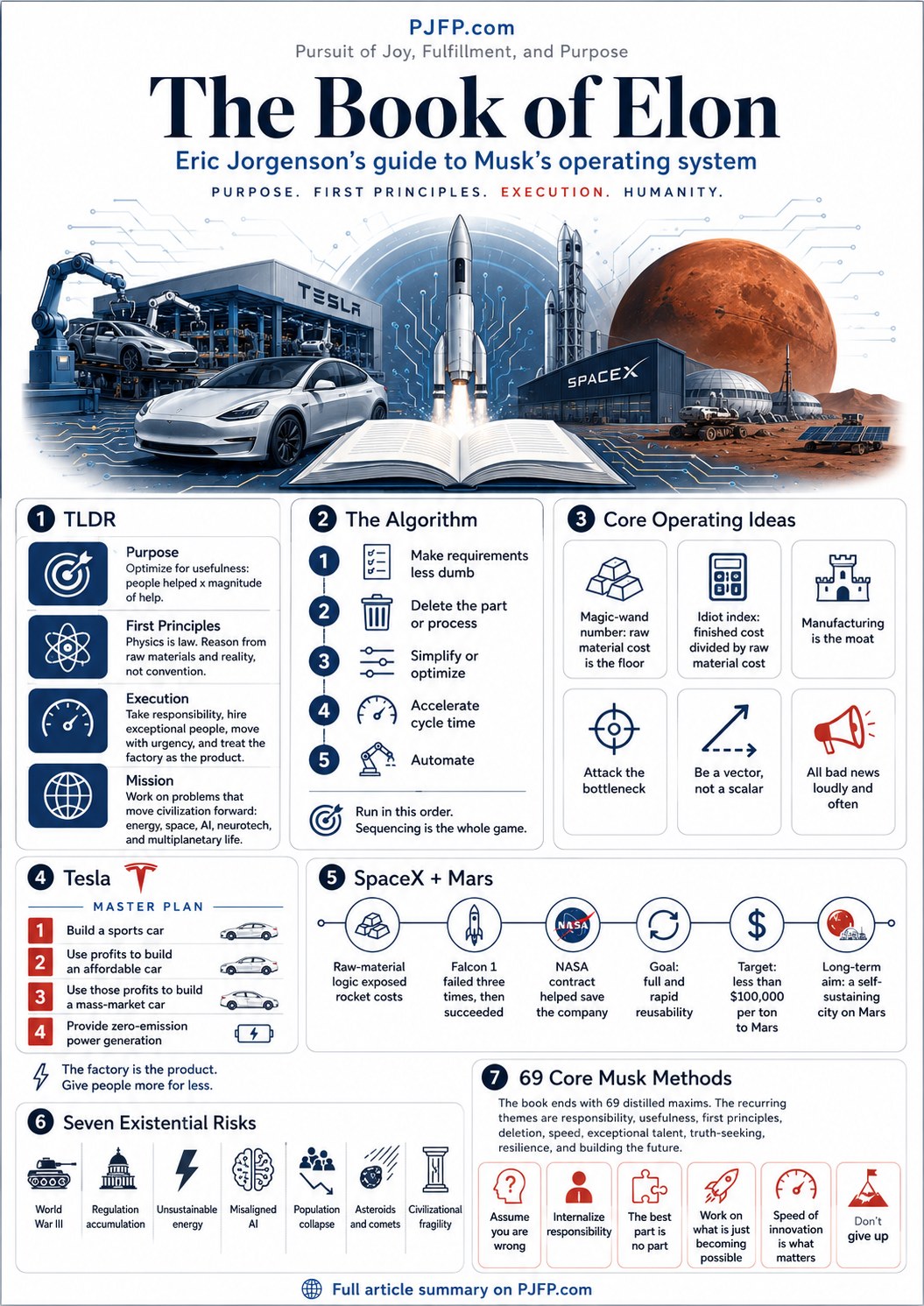
  • The Book of Elon by Eric Jorgenson: Complete Summary of Musk’s Operating System, The Algorithm, The Tesla Master Plan, and the 69 Core Musk Methods

    Infographic summary of The Book of Elon by Eric Jorgenson covering The Algorithm Tesla Master Plan SpaceX Mars and the 69 Core Musk Methods

    Eric Jorgenson’s The Book of Elon: A Guide to Purpose and Success (Magrathea Publishing, 2026) is the third entry in his series of compiled-wisdom books, following The Almanack of Naval Ravikant and The Anthology of Balaji. It is built entirely from Elon Musk’s own words, drawn from transcripts, tweets, and interviews across his career, then recontextualized into a four-part operating manual: Pursue Purpose, Ultra Hardcore Work, Building Companies, and On Behalf of Humanity. The book closes with a bonus list of 69 distilled maxims. Naval Ravikant wrote the foreword and calls it “the only book an entrepreneur needs.” Jorgenson’s stated goal is “one million Musks.” This is a complete, dense summary of every major idea in the book, including The Algorithm verbatim with each of its five steps explained in depth, the Tesla Master Plan, the first-principles battery cost calculation, the SpaceX rocket cost analysis, the seven existential risks, the Mars colonization plan, and the 69 Core Musk Methods in full. Get the book at elonmuskbook.org.

    TLDR

    The Book of Elon argues that Musk’s results are not an accident of genius but the output of a learnable operating system. The system has four layers. Layer one is purpose: optimize your life for usefulness, which Musk defines mathematically as number of people helped multiplied by magnitude of help per person. Layer two is epistemology: reason from physics and raw-material costs, not from analogy or precedent. Layer three is execution: take responsibility, hire only exceptional people, design organizations that route around hierarchy, run at maniacal urgency, and treat the factory as the product. Layer four is mission: pick problems whose solutions move civilization forward (sustainable energy, reusable spaceflight, AI alignment, brain-computer interfaces, multiplanetary life). The book’s single most important operational artifact is The Algorithm, Musk’s five-step engineering process that must be applied in order: make your requirements less dumb, try very hard to delete the part or process, simplify or optimize, accelerate cycle time, automate. The 69 Core Musk Methods at the end of the book are the entire operating system compressed to one-line maxims. Naval frames it as a choice for the reader: when humanity goes to the stars, you can be in the front row cheering or sour-faced in the bleachers jeering, but there is also a third option, which is to copy the methods and build something yourself.

    Key Takeaways

    • Optimize for usefulness, not for money, fame, or comfort. Musk’s daily question is “how can I be useful today” and his success metric is number of people helped multiplied by magnitude of help per person.
    • Five domains will most influence the future: the internet, sustainable energy, space exploration, artificial intelligence, and the genetic rewriting of biology. Pick one and contribute.
    • It is possible for ordinary people to choose to be extraordinary. Convention is optional. The default settings of a culture are not laws of nature.
    • Physics is law. Everything else is a recommendation. If a plan does not violate conservation of energy or any other physical principle, it is at least theoretically possible.
    • First-principles thinking is the antidote to “that’s how it’s always been done.” Break a problem down to atomic constraints (raw material cost, physics, basic operations) and reason up from there. The battery pack example is canonical: people said cells would always cost $600/kWh, but the raw cobalt, nickel, aluminum, carbon, polymers, and steel at London Metal Exchange prices added up to only $80/kWh.
    • Track two ratios on everything you build: the magic-wand number (raw-material cost as a floor for finished cost) and the idiot index (finished cost divided by raw-material cost). Anything with a high idiot index has enormous room for improvement.
    • Aspire to be less wrong. You will not be right every day. Being less wrong most of the time, with a clear feedback loop to reality, is the realistic target.
    • Engineering is magic, and engineers are the magicians of the 21st century. Science discovers what is. Engineering creates what was not.
    • Take responsibility. Musk is CEO of Tesla and SpaceX because he feels responsible for them, not because it improves his quality of life. The worst problems are the CEO’s job, not the best problems.
    • Sleep on the factory floor. Leadership is shared suffering, not delegated comfort. Seeing is believing. If the CEO can do it, the team will do it.
    • Startups are eating glass and staring into the abyss. Glass is the work you do not want to do. The abyss is the constant threat of company death. Both are required.
    • Adversity forges strength. A high ego-to-ability ratio breaks your feedback loop. Suffer enough early to develop the pain threshold needed later.
    • The most important job is attracting exceptional people. Money is not the constraint. Exceptional talent is the constraint.
    • Hire only Special Forces. The minimum passing grade is excellent. A small group of technically strong people will always beat a large group of moderately strong people.
    • Hire for character as much as for skill. Skills are teachable. Attitude is not. Judge a person by the character of their friends and associates and to some degree by their enemies.
    • Camaraderie can be dangerous because it prevents truth-telling. Physics does not care about hurt feelings. It cares about whether you got the rocket right.
    • All bad news should be given loudly and often. Good news can be said quietly and once.
    • Communication should travel via the shortest path necessary to get the job done, not through the chain of command. Anyone should be able to talk to anyone.
    • The organization manifests in the product. Silos produce redundancy, waste, and error. Acronyms and jargon are cognitive pollution.
    • Innovation needs permission to fail. If failure is not an option, you get incremental progress and nothing else.
    • Simplicity creates both reliability and low cost simultaneously. The best part is no part. The best process is no process.
    • The Algorithm, verbatim, in mandatory order: (1) Make your requirements less dumb. (2) Try very hard to delete the part or process. (3) Simplify or optimize. (4) Accelerate cycle time. (5) Automate. See the deep-dive section below for each step in detail.
    • If you are not adding deleted things back in roughly 10 percent of the time, you are not deleting enough. Overcorrect.
    • Requirements must come from a named person, not a department. Requirements from smart people are the most dangerous because you are less likely to question them.
    • Speeding up something that should not exist is absurd. If you are digging your grave, do not dig it faster. Stop digging.
    • Automation is last, not first. Tesla’s Nevada and Fremont factories had to rip out hundreds of expensive robots that had been installed before The Algorithm’s first four steps were complete.
    • A maniacal sense of urgency is the operating principle. The only true currency is time. Every minute lost is gone forever.
    • Speed is both offense and defense. The SR-71 Blackbird has almost no defense except acceleration. Innovating faster is more durable than any patent.
    • Do things in parallel. A factory moving at twice the speed of another factory is basically equivalent to two factories.
    • Be a vector, not a scalar. High speed in the right direction. Course-correct like a guided missile.
    • Manufacturing is underrated. Design is overrated. There is 1,000 to 10,000 percent more work in the production system than in the product itself.
    • The factory is the product. The biggest Tesla epiphany was that what really matters is “the machine that builds the machine.”
    • Attack the constraint. The production line moves at the speed of the slowest, least lucky part. Out of 10,000 things, the one that is not working sets the production rate.
    • Manufacturing is the moat. Maximize economies of scale and maximize manufacturing technology. The combination is uncopyable.
    • Zip2 (1995, started with $2,000) sold to Compaq for over $300 million. Musk’s first major lesson: sell directly to consumers, not through legacy gatekeepers who will misuse the technology.
    • X.com merged with Confinity to become PayPal, which sold to eBay in 2002 for $4.5 billion. Musk had been removed as CEO during a honeymoon trip but did not contest it to avoid disrupting the company during a crisis. “Life is too short for long-term grudges.”
    • Listen well, correct fast. X.com’s initial financial-services conglomerate failed; the email-payments demo worked instantly. Musk pivoted to what the market wanted and powered viral growth (one million customers in year two, no sales force, no marketing spend).
    • Musk reinvested his post-tax PayPal proceeds (~$180 million) split across Tesla (~$70M), SpaceX (~$100M), and SolarCity (~$10M). Costs were 2x his estimates on every company.
    • Tesla Master Plan (August 2006): (1) Build a sports car. (2) Use the profits to build an affordable car. (3) Use those profits to build a mass-market car. (4) Provide zero-emission power generation. The strategy was forced by the economics of new technology: you cannot start at the bottom of the market without scale, so you start with low-volume, high-margin and use the margin to fund scale.
    • Tesla nearly died on Christmas Eve 2008. The final funding round closed at 6 p.m., hours before payroll would have bounced. Musk had moved into Jeff Skoll’s guest bedroom. Daimler then put $50M into Tesla after Musk’s team dropped a Tesla powertrain into a Smart Car that hit 60 mph in 4 seconds.
    • Model 3 production “hell” lasted 2017 to 2019. Musk slept on the Fremont and Nevada factory floors for three years. “The longest period of excruciating pain in my life.”
    • Give people more for less. Don’t spend on advertising. Spend on engineering and design so the product carries itself through word of mouth.
    • SpaceX was founded in mid-2002 with $100 million of Musk’s PayPal money. He expected to lose everything. There was no external funding for three years.
    • SpaceX had budgeted for exactly three failed Falcon 1 launches. Launches 1, 2, and 3 failed (2006, 2007, 2008). Launch 4 succeeded in August 2008. Then NASA called with a $1.6 billion cargo resupply contract, saving SpaceX and indirectly Tesla. Musk reportedly screamed “I LOVE NASA. YOU GUYS ROCK.”
    • Rockets are expensive only because of legacy supply chains, cost-plus contracting, and outsourcing through five layers of subcontractors (“overhead to the fifth power”). The raw materials of a rocket are 1 to 2 percent of finished cost. The half-nozzle jacket Musk uses as an example cost $13,000 but contained $200 of steel.
    • Full and rapid reusability is the holy grail of rocketry. With reuse, only propellant cost remains, which is mostly liquid oxygen and methane at around $1 million per Starship flight.
    • Optimize for the right thing. SpaceX’s actual optimization target is “fastest time to a self-sustaining city on Mars.” That cascades to fastest time to a fully usable rocket, then fastest time to orbit. Early Starship had no doors because doors are not necessary for reaching orbit.
    • Companies are the most reliable engine of progress and the deepest form of philanthropy because they create durable wealth and deploy capital toward problems. “I care about reality. Perception be damned.”
    • The Age of Abundance is coming via AI and humanoid robotics. Optimus and competitors will eventually outnumber humans, removing labor as the economy’s binding constraint. The market for humanoid robots will exceed the market for cars.
    • Tesla’s full self-driving and Robotaxi product is forecast to make Tesla a $10 trillion company. Autonomous cars are worth 5 to 10 times non-autonomous cars because they earn money when their owners are not using them.
    • Neuralink achieved 2 bits per second of brain output with the first patient, Noland Arbaugh. Musk’s 5-year target is one megabit per second. Long-term: consensual telepathy via two BCIs, plus restoration of vision (Blindsight) and eventually multispectral senses (infrared, ultraviolet, radar).
    • Musk’s seven named existential risks: (1) World War III, (2) Regulation accumulation, (3) Unsustainable energy, (4) Misaligned artificial superintelligence, (5) Population collapse, (6) Asteroids and comets, (7) Civilizational fragility itself.
    • Population collapse is the risk most underdiscussed. The US has been below replacement since the early 1970s; sustained only by immigration and longevity. China’s three-child policy failed; the country is 40 percent below replacement. Musk: “We need to revive the idea of having children as a social duty.”
    • Do not force an AI to lie. The HAL 9000 lesson from 2001: A Space Odyssey is that AI given conflicting instructions, one of which is to deceive, becomes dangerous. Truthfulness as a core training objective is the alignment mitigation Musk advocates.
    • Becoming multiplanetary is an evolutionary-scale event. Six milestones in Earth history: single-celled life, multicellular life, plants/animals, ocean-to-land, consciousness, and now multiplanetary life. “At least as important as life going from the oceans to land, probably more significant.”
    • The window of opportunity is open right now. We cannot count on it being open for long. Stephen Hawking estimated roughly 1 percent civilizational-end probability per century. “That’s Russian roulette with 99 empty barrels and every century is a click.”
    • Mars insurance costs less than 1 percent of Earth GDP. The plan: 1,000 Starships per Mars transfer window (every 2 years), eventually a fleet of thousands lifting off together. Target: 1 million tons of cargo and people on Mars by 2044, then a self-sustaining civilization.
    • Mars terraforming options Musk names: thousands of solar reflectors in orbit, or detonating thermonuclear devices over the polar caps as “two little suns” to vaporize CO2 ice, thicken the atmosphere, and eventually create liquid oceans roughly a mile deep covering 40 percent of the planet.
    • Even given pure slower-than-light travel and no new physics, a million-year time horizon allows humanity to colonize the entire galaxy and possibly neighboring galaxies. “We are at the very, very early stage of the intelligence big bang.”
    • The 69 Core Musk Methods at the end of the book are the entire system in maxim form. The full list appears later in this article.

    The Algorithm in Detail: Musk’s 5-Step Engineering Process

    The single most important operational artifact in the book is what Musk calls “The Algorithm.” It is a five-step engineering process he developed and enforces across Tesla, SpaceX, the Boring Company, Neuralink, and xAI. Every part, every process, every line of code, every requirement, every meeting is supposed to be put through these five steps. The order is mandatory. Reordering them is the most common failure mode and the source of nearly every major mistake Musk says he has made at scale (most famously the Nevada and Fremont automation disaster). The book treats The Algorithm as the practical compression of first-principles thinking into a daily ritual.

    The five steps, in mandatory order, in Musk’s own phrasing:

    1. Make your requirements less dumb.
    2. Try very hard to delete the part or process.
    3. Simplify or optimize.
    4. Accelerate cycle time.
    5. Automate.

    The book devotes its longest single chapter to explaining each step, why the order matters, and the specific failure mode that occurs when you skip ahead. Here is every step in depth.

    Step 1: Make Your Requirements Less Dumb

    The first step is the hardest because it is the most psychologically uncomfortable. Musk’s exact framing in the book: “Your requirements are definitely dumb. It does not matter who gave them to you. Requirements from smart people are the most dangerous, because you’re less likely to question them.”

    The operational rule that follows is concrete. Every requirement on every part, process, deliverable, or specification must come from a named human. Not from a department. Not from a regulation document. Not from “the customer.” A name. Track who owns each requirement in writing. If the named person has left the company, retired, or cannot remember why they wrote the requirement, the requirement should be presumed dumb until proven otherwise. Many requirements in any organization are legacy beliefs nobody currently defends. They exist because they existed yesterday and nobody felt empowered to delete them. The Algorithm starts by demanding evidence for every assumption.

    The reason requirements from smart people are especially dangerous is that smart people are persuasive. A specification handed down by a respected engineer carries the implicit authority of “if she said this, there is a reason.” Most of the time there is no reason left, or the reason was contextual to a moment that no longer applies. The Algorithm’s first step is to put every smart-person requirement on equal footing with every dumb-person requirement and force a present-tense justification. If the justification cannot be reconstructed, the requirement is dumb regardless of the author’s IQ.

    The mental shift this step demands is to treat requirements as recommendations and treat the laws of physics as the only fixed authority. Musk repeats this constantly: “All requirements should be treated as recommendations. The only fixed laws are the laws of physics.” Once you internalize that frame, the requirements doc stops being scripture and becomes a draft that is open to revision in every meeting, every day.

    Step 2: Try Very Hard to Delete the Part or Process

    Once the requirements survive scrutiny, the second step is aggressive deletion. The Algorithm’s specific test for whether you are deleting enough: “If you’re not adding deleted things back in 10 percent of the time, you’re clearly not deleting enough.” The 10 percent is a forcing function. If you delete and never have to restore, you are not pushing hard enough; you are leaving safe deletions on the table.

    The book explains why engineers chronically under-delete. Every engineer remembers the painful moment when they deleted something and it turned out to be load-bearing. That memory is so vivid that it overshadows the silent cost of thousands of unnecessary parts that nobody ever questions. The Algorithm corrects for this asymmetry by deliberately overshooting. The instruction is explicit: “We are on a deletion rampage. Nothing is sacred.”

    The application is mechanical. For every part on the bill of materials, every step in the production process, every meeting on the calendar, every requirement in the spec, every line in the documentation, every approval in the workflow: try to delete it. If deleting causes nothing to break for 30 days, leave it deleted. If something breaks and you have to add it back, do so without shame; that is the 10 percent. The maxim that summarizes this step appears multiple times in the book: “The best part is no part. The best process is no process.”

    The canonical example in the book is the fiberglass-mat story. Tesla’s battery pack had a layer of fiberglass mats between the battery cells and the underbody. The mats had a dedicated production process that had been automated, accelerated, and optimized over years. Engineers had spent millions perfecting the glue, the cure time, the cutting tolerances, the robotic placement. Then Musk asked a simple question: “What are these mats for?” The battery team said “noise and vibration.” Musk asked the noise and vibration team. They said “fire safety.” The fire-safety team had no idea where the mats came from. So Musk had two cars built, one with the mats, one without, and put microphones in both. There was no detectable difference. Deleting the part eliminated a $2 million robotics step that had been built up over years. “It was like being in a Dilbert cartoon.”

    The fiberglass-mat story is the entire point of The Algorithm in miniature. Tesla had already automated step five, accelerated step four, optimized step three, and skipped steps one and two entirely. The whole apparatus existed to perfect a part that should not have existed. Steps one and two would have found this in a single meeting.

    Step 3: Simplify or Optimize

    Only after steps one and two have been completed in earnest do you simplify or optimize what is left. Musk’s exact warning: “The most common mistake of smart engineers is to optimize a thing that should not exist.”

    The book argues that this mistake is systematically produced by education. High school and college train convergent logic: you are given a question and graded on the elegance and correctness of your answer. The question itself is never on the table. After 16 to 20 years of this, most engineers, scientists, and analysts are mentally locked into “optimize the question in front of me” mode and physically cannot ask whether the question should be deleted. The Algorithm is designed to override that training. Steps one and two are explicitly the act of questioning the question; only at step three do you finally get to apply the optimization skills that school rewarded.

    What “simplify or optimize” looks like in practice: reduce part counts, combine functions, choose materials that are abundant rather than exotic, eliminate processing steps within a part’s manufacturing, reduce the number of inputs the team needs to track, collapse separate tools into one tool, replace bespoke fasteners with standard ones, replace any custom solution with a commodity solution that is good enough. The book’s framing is that simplicity creates both reliability and low cost at the same time, with no trade-off. A simpler part is cheaper to build, cheaper to inspect, cheaper to repair, fails less often, and breaks in more predictable ways when it does fail. Optimization without simplification almost always increases complexity and therefore increases failure modes.

    The Algorithm treats simplify and optimize as one step but acknowledges they are different operations. Simplify is structural: fewer pieces. Optimize is parametric: better values for the pieces you keep. Both are legal at step three, but neither is legal before steps one and two have been honestly executed.

    Step 4: Accelerate Cycle Time

    Once requirements are minimal, parts are deleted, and what remains is simplified, the fourth step is to go faster. The specific maxim: “Once you’re moving in the right direction, and moving efficiently, you’re moving too slow. Go faster.”

    The reason acceleration comes fourth, not first, is in another Musk line: “Speeding up something that shouldn’t exist is absurd. If you’re digging your grave, don’t dig it faster. Stop digging.” Speed multiplies the value of correct decisions and the cost of incorrect ones. Apply it before steps one through three and you scale your mistakes. Apply it after and you scale your gains.

    Acceleration at step four is everything that compresses the time between iterations. Shorten meetings. Eliminate approval queues. Run things in parallel that were running in series. Move people physically closer to the work so that information travels at the speed of conversation instead of the speed of email. Set aggressive internal deadlines that force the team to find shortcuts they would not otherwise have looked for. Replace any tool, supplier, or process that is slow with one that is faster, even if it is slightly more expensive per unit, because cycle time compounds.

    The book frames acceleration as both offense and defense. As offense, faster iteration lets you out-innovate competitors who are stuck on slower cycles. As defense, the SR-71 Blackbird analogy: the plane has almost no defensive systems because its acceleration is its defense. A company that ships faster than competitors can copy does not need patents, because patents protect static IP and speed protects evolving IP. The maxim Musk repeats is: “A factory moving at twice the speed of another factory is basically equivalent to two factories.” The Colossus supercluster story is the application: xAI built 100,000-GPU infrastructure in 122 days against a supplier estimate of 18 to 24 months, then doubled it in 92 more, by attacking the problem in parallel across building, power, cooling, and networking, all working 24/7 in four shifts.

    Step 5: Automate

    Automation comes last. Always. This is the step where most companies start and where Musk himself made his most expensive single mistake. The book quotes him directly: “The big mistake I made in the Tesla factories in Nevada and Fremont was trying to automate every step too early. To fix that, we had to tear hundreds of expensive robots out of the production line.”

    The reason automation must be last is that automation locks in a process. Once you have built robots, written PLC code, calibrated machine vision systems, and integrated them into your factory floor, the cost of changing the underlying process is enormous. If the process you have automated should not exist (step 2 failure), is more complicated than necessary (step 3 failure), or runs at the wrong cadence (step 4 failure), you have just spent millions of dollars institutionalizing your mistakes. Tesla’s experience was exactly this: robots installed before the underlying process was clean and simple ended up being expensive obstacles to the eventual correct process.

    The correct order is reverse. First make sure the part should exist (step 1). Then delete it if you can (step 2). Then simplify the part and the process around it (step 3). Then run it manually at maximum speed (step 4). Only after a human-run process is fast, simple, and clearly necessary do you automate it. By that point, the automation is purchasing leverage on a known-good system, not freezing a guess.

    The book notes that automation done last is also cheaper to build, because the process being automated is simpler. Automating a 20-step process requires a 20-stage robotic system. Automating the 5-step version of the same process that emerged from steps 1 through 3 requires a 5-stage robotic system. The savings from doing steps 1 through 4 first show up directly in the capital cost of step 5.

    How to Run The Algorithm: The 24-Hour Cadence

    The book treats The Algorithm as a daily practice, not a one-time exercise. Maxim 22 in the 69 Core Musk Methods reads: “For critical items, have meetings every twenty-four hours to run The Algorithm and check progress from yesterday.” For any deliverable that is on the critical path, the team meets daily, walks through the five steps in order, and reports concrete progress on each step. Requirements that survived yesterday are re-questioned today. Parts that survived deletion yesterday are re-evaluated today. Steps three through five proceed in parallel with the continuing daily challenge of steps one and two. The cadence is what prevents The Algorithm from becoming a poster on the wall.

    Common Failure Modes

    The book identifies the specific ways teams skip steps. Skipping step 1 happens when a respected engineer’s requirement is treated as immutable; the fix is to make every requirement come from a named human and be re-justified on demand. Skipping step 2 happens when engineers prefer to optimize a part rather than delete it, because deletion creates immediate visible risk while optimization creates invisible long-term cost; the fix is the 10 percent restoration rule. Skipping step 3 in favor of step 4 happens when management demands speed before the system is clean; the fix is the “digging your grave” check before any acceleration program is approved. Skipping step 4 in favor of step 5 is the most expensive mistake and the one Musk says he personally committed at the Tesla Nevada and Fremont factories; the fix is the explicit rule that humans must run a process at speed before robots are introduced.

    The throughline is that The Algorithm protects you from your own intelligence. Smart engineers are very good at steps three through five. They are bad at steps one and two because the schooling system that produced them never asked them to question the question. The order of The Algorithm is therefore the order in which discomfort decreases. Step 1 is the most uncomfortable. Step 5 is the most fun. Most organizations run the algorithm in fun-first order and pay for it with multimillion-dollar fiberglass-mat-style monuments to optimization without deletion.

    Detailed Summary

    The book’s structure and method

    Jorgenson built the book entirely from Musk’s own words across decades of transcripts, tweets, and interviews. He notes explicitly that he edited for clarity, brevity, and flow, that all material is recontextualized, and that readers should verify phrasing with primary sources before citing. The four parts of the book are presented as a curriculum, not a biography. Part I lays the philosophical foundation. Part II teaches the operating tempo and methods. Part III applies those methods through the actual histories of Zip2, X.com/PayPal, Tesla, SolarCity, and SpaceX. Part IV widens the lens to civilizational risks and the multiplanetary mission. The bonus section, “The 69 Core Musk Methods,” compresses the whole book into a maxim-by-maxim reference. Naval Ravikant’s foreword frames the underlying claim: Musk’s methods are copy-able, and “if your motives are pure and greater than yourself, the world will conspire in its subtle ways to help you.” Jorgenson’s stated dream is “one million Musks.”

    Part I: Pursue Purpose, the foundation of a unique life

    Musk’s daily question is “how can I be useful today.” His success metric is mathematical: total impact equals number of people helped multiplied by magnitude of help per person. He identifies five domains as having the largest possible impact on the future of humanity: the internet, sustainable energy, space exploration, artificial intelligence, and the rewriting of genetics. He repeats that it is possible for ordinary people to choose to be extraordinary, that convention is not law, and that the best work is found at the intersection of what you are good at, what you enjoy, and what improves humanity. He warns against zero-sum thinking, framing the economy as a growable pie rather than a fixed one. He notes that consumer adoption is unreliable as a guide: a 1946 to 1948 survey found 96 percent of people would never buy a television, and Tesla heard the same about electric cars before launch.

    The middle chapter teaches first-principles thinking. The technique is to break a problem into its atomic constituents (raw material costs, physics, basic operations) and reason up from there, ignoring analogy and precedent. The canonical example is battery cells. People said they would always cost about $600 per kilowatt-hour. Musk priced the actual materials at the London Metal Exchange (cobalt, nickel, aluminum, carbon, polymers, steel) and got $80 per kWh, proving cheap EVs were a manufacturing problem, not a physics one. He uses the same technique for rockets, where finished cost is typically 10 to 100 times raw-material cost. The half-nozzle jacket example: $13,000 list price, $200 of actual steel. He names two ratios that operationalize this: the magic-wand number (raw-material floor) and the idiot index (finished cost divided by raw-material cost). High idiot index means high opportunity. He also teaches “thinking in limits”: scale the variable to extreme values to expose hidden constraints, then iterate back to feasible regimes. His tunneling example is illustrative: LA subway costs about $1 billion per mile, but shrinking tunnel diameter from 28 feet to 12 feet drops cross-section 4x, and combining that with continuous tunneling and reinforcement enables an 8x cost improvement.

    The third chapter of Part I makes the case for engineering itself. Science discovers what already exists. Engineering creates what did not. Engineering, Musk says, is magic, and engineers are the magicians of the 21st century. He grounds this historically: Roman military dominance came from metallurgy (martensitic steel swords) and roads (logistical advantage), and Rome fell when its technological edge was matched and routed around. The WW2 Pacific air war was won by the side with the faster innovation loop, not the side that started with better fighters. Nuclear weapons were the ultimate winner-take-all. Tesla’s powertrain is sold to Toyota, Daimler, and Mercedes precisely because it is hard. “If it was easy, they would do it.” The lesson is that durable value sits where the engineering is genuinely difficult, not where the marketing is loud.

    Part II: Ultra Hardcore Work, teams, organization, urgency, manufacturing

    Part II is the operating manual. The first chapter, “What It Takes,” argues that responsibility cannot be delegated. The CEO owns the worst problems, not the best ones. Physical presence and shared suffering communicate commitment more powerfully than any memo, which is why Musk literally sleeps on the factory floor. He talks about the ego-to-ability ratio: high ego breaks your reinforcement-learning loop with reality. He frames startups as “eating glass and staring into the abyss,” where glass is the work you do not want to do and the abyss is the constant threat of company death. He says adversity is the only forge that produces the pain threshold required to run a hard company at scale.

    The teams chapter is uncompromising. The most important job of a leader is attracting exceptional people. Money is not the constraint; exceptional talent is. He runs a Special Forces hiring model: the minimum passing grade is excellence. A small group of technically strong people will always outperform a large group of moderately strong people. Character matters as much as skill, because skills are teachable and attitude is not. The feedback discipline he insists on is hardcore: “All bad news should be given loudly and often. Good news can be said quietly and once.” Camaraderie is dangerous when it suppresses truth. “It’s not your job to make people on your team love you. In fact, that’s counterproductive.”

    The organization-design chapter teaches three rules. First, structure shows up in the product. Silos produce redundancy, waste, and error. Second, communication should travel the shortest path that solves the problem, not the chain of command. Anyone should be able to talk to anyone. Third, jargon and acronyms are cognitive pollution; the test for any internal phrase is whether a new hire would understand it cold. This is the chapter that introduces The Algorithm (covered in depth above).

    Musk runs his companies on what he calls a “maniacal sense of urgency.” The only true currency is time. Speed is both offense (faster innovation than competitors can copy) and defense (the SR-71 Blackbird has almost no defense system except acceleration). The protection of real intellectual property is not patents but rate of innovation; if you ship faster than anyone can copy, you do not need legal moats. He stresses parallelization over serialization. “A factory moving at twice the speed of another factory is basically equivalent to two factories.” Be a vector, not a scalar: high speed in the right direction, with continuous course corrections like a guided missile.

    The Part II close is “We Must Make Stuff.” Manufacturing is underrated and design is overrated. “There is 1,000 percent, maybe 10,000 percent more work that goes into the production system than the product itself.” The factory is the product, not the car. Designing a rocket is trivial compared to making one that reaches orbit. The production line moves at the speed of its slowest, least lucky part. Out of 10,000 things that have to go right, the one that is not working sets the rate. Manufacturing combined with scale becomes the moat. The gigacast machine story illustrates this perfectly: Musk got the idea from toy cars, asked if any law of physics prevented it, surveyed six casting-machine suppliers, five said no, the sixth said maybe, and Tesla used that single innovation to cut the body shop by 30 percent.

    Part III: Building Zip2, PayPal, Tesla, and SpaceX

    Musk left Stanford grad school in 1995 with $110K in debt and founded Zip2 with his brother Kimbal, starting with $2,000 and one computer in a squatted office where he slept on a futon and showered at the YMCA. In 1999, Compaq acquired Zip2 for over $300 million. His after-tax bank account went from $5,000 to $21 million. He immediately rolled $12.5 million of that into X.com, which merged with Confinity in March 2000 to become PayPal. PayPal reached 100,000 customers in its first month and one million by year two with no sales force and no marketing spend. The product traction came from email payments, not from the conglomerate financial-services pitch X.com started with. Musk’s lesson: “listen well, correct fast.” He was removed as CEO during his honeymoon trip in early 2002 but did not contest it, prioritizing company survival over personal vindication. eBay acquired PayPal in October 2002 for $4.5 billion. “Life is too short for long-term grudges.”

    Tesla started in 2003. The original Roadster used a Lotus Elise chassis; the modification added 40 percent weight and invalidated the crash tests. Only 7 percent of Roadster parts ended up shared with the Elise. Musk’s lesson: start clean-sheet, do not modify legacy platforms. The Tesla Master Plan (August 2006) was the sequencing logic: (1) build a sports car, (2) use the profits to build an affordable car, (3) use those profits to build a mass-market car, (4) provide zero-emission power generation. This sequence was forced by the unit economics of new technology, where you cannot start at the bottom of the market without scale.

    Tesla nearly died at the end of 2008. The SolarCity Morgan Stanley deal had collapsed. Tesla and SpaceX were both on the brink. Musk had moved into Jeff Skoll’s guest bedroom because he had no house. The final emergency funding round closed at 6 p.m. on Christmas Eve, hours before payroll would have bounced. Daimler arrived shortly after; Musk’s team rapidly dropped a Tesla powertrain into a Smart Car and got it to 60 mph in 4 seconds, which shocked Daimler into a $50 million investment. Tesla then survived three years of Model 3 manufacturing hell from 2017 to 2019, during which Musk lived in the Fremont and Nevada factories, slept on the floor, and ran around fixing the line. “The longest period of excruciating pain in my life.” His pricing philosophy is “give people more for less”: spend money on engineering and design instead of advertising, and let the product carry word of mouth.

    SpaceX was founded in mid-2002 with $100 million of Musk’s PayPal proceeds. He expected to lose everything; that was his stated expectation going in. There was no external funding for three years. His initial plan was a $90 million Mars greenhouse mission designed to inspire NASA, but he realized the binding constraint was launch cost, not mission design. He tried to buy Russian ICBMs to cut launch costs; that failed. He then ran the first-principles rocket cost analysis, found that finished cost was 50 to 100 times raw-material cost, and concluded the industry’s pricing was a function of cost-plus contracting, five-layer subcontracting, and legacy tech. He budgeted for exactly three failed Falcon 1 launches. Launches 1, 2, and 3 failed (2006, 2007, 2008). Launch 4 succeeded in August 2008. Days later NASA awarded SpaceX a $1.6 billion cargo resupply contract. Musk reportedly screamed “I LOVE NASA. YOU GUYS ROCK.” The fourth-launch success and the NASA call together saved both SpaceX and (indirectly, via Musk’s bank account) Tesla.

    SpaceX’s actual optimization target is “fastest time to a self-sustaining city on Mars.” That goal cascades to “fastest time to a fully usable rocket,” which cascades to “fastest time to orbit.” Early Starship had no doors because doors are not necessary for reaching orbit. The unifying engineering insight is that full and rapid reusability is the holy grail of rocketry, because once a rocket is reusable, the only marginal cost is propellant (mostly liquid oxygen and methane, around $1 million per Starship flight). Current cost per landed ton to Mars is about $1 billion. Starship targets less than $100,000 per ton, a 10,000x improvement. Musk’s philosophy on testing reflects the design constraint: unmanned rockets should be allowed to blow up so the team can learn; crewed systems get extreme conservatism. The Space Shuttle’s safety record suffered precisely because the asymmetry of risk made the program incapable of iteration.

    Part IV: The Age of Abundance, the seven risks, and Mars

    Musk frames his companies as philanthropy, defined by reality rather than perception. “If you care about the reality of goodness instead of the perception of it, philanthropy is extremely difficult.” Companies create durable wealth because they solve real problems at scale, distribute knowledge through products, and deploy capital toward problems rather than store it idle. The companies he names as worth starting today: tunneling (Boring Company), synthetic-RNA medicine (“the digitization of medicine”), and high-speed transport such as Hyperloop (a pressurized electric vehicle in a vacuum tube, faster than aircraft, weather-independent).

    The Age of Abundance chapter argues that AI plus humanoid robotics will eventually remove labor as the binding economic constraint, producing abundance for everyone. Humanoid robots will start in dangerous and repetitive jobs and eventually outnumber humans 2 to 10 to one at less than the cost of a car. Tesla’s full self-driving and Robotaxi will, in Musk’s projection, make Tesla a $10 trillion company because autonomous cars are worth 5 to 10x non-autonomous cars (they earn revenue when owners are not using them). Neuralink achieved 2 bits per second of brain output with first patient Noland Arbaugh; the 5-year target is one megabit per second. Long-term Neuralink applications include consensual telepathy between two BCIs, vision restoration (Blindsight), and multispectral senses. Musk’s framing: humans are already cyborgs through phones and laptops, but the bandwidth to those devices is “poking glass with your meat sticks” and BCIs are the next bandwidth jump.

    The Existential Risks chapter names seven specific risks. World War III: the cycle of major-power war recurs and global thermonuclear conflict could end or maim civilization. Regulation accumulation: laws never die when humans do, regulations compound forever, and eventually everything becomes illegal. California High-Speed Rail is the example: after billions of dollars, it is “almost illegal to build.” Wars historically cleared regulatory cobwebs; peacetime allows infinite accumulation. Unsustainable energy: regardless of climate, hydrocarbons are finite, so the transition must happen. Nuclear plants should not be shut down (coal is 100 to 1,000x worse for health than nuclear). The energy mix is solar plus wind plus batteries plus nuclear plus hydro plus geothermal. Misaligned artificial superintelligence: AI is growing faster than any prior technology, and Musk considers it “a significantly higher risk than nuclear weapons.” The specific mitigation he names is rigorous truth adherence in training. The HAL 9000 lesson from 2001 is that an AI forced to lie becomes dangerous; he cites the Gemini “George Washington wasn’t white” failure as a concrete example of ideological training producing catastrophic outputs at scale. Population collapse: low birth rates are a slow civilizational death. The US has been below replacement since the early 1970s. China is 40 percent below replacement; the three-child policy failed. “We need to revive the idea of having children as a social duty.” Musk himself has 12 children across three women. Asteroids and comets: Earth has no defense against a large comet; Starship gives some capability against small asteroids. Shoemaker-Levy left an Earth-sized hole in Jupiter, and that level of impact on Earth is “game over.” Civilizational fragility itself: every prior civilization fell, and Stephen Hawking estimated roughly 1 percent probability of civilizational end per century. “That’s Russian roulette where 99 barrels are empty. Every century is a click.”

    The closing chapter, Becoming Multiplanetary, places Mars colonization in evolutionary context. Earth has had six milestones in 4 billion years: single-celled life, multicellular life, plants and animals, ocean-to-land transition, consciousness, and (potentially) multiplanetary life. Musk argues this last step is “at least as important as life going from the oceans to land, probably more significant,” because it makes the substrate of consciousness redundant. Sun expansion will destroy Earth in roughly 500 million years; meanwhile self-inflicted or external extinction events are recurring, with five major mass extinctions already in the fossil record and Yellowstone erupting roughly every 700,000 years. The plan: produce 1,000 Starships per year, refuel in orbit, hit 10,000 missions and 1 million tons to Mars by approximately 2044, then build out a self-sustaining city. Mars trips depart in 2-year windows when planets align; Musk’s working schedule is 5 uncrewed missions in 2026 and crewed missions in 2028 if the uncrewed go well (otherwise +2 years). For terraforming, his named options are thousands of solar reflectors in orbit or thermonuclear detonations over the polar caps as “two little suns” to vaporize CO2 ice, thicken the atmosphere, and eventually produce liquid water oceans roughly a mile deep covering 40 percent of the planet. Cost of the entire civilization-insurance bet: less than 1 percent of Earth GDP.

    The 69 Core Musk Methods

    The bonus section compresses the entire book into 69 short maxims, intended as a copy-able reference. They are reproduced here near-verbatim.

    1. You are capable of more than you think.
    2. It is possible for ordinary people to choose to be extraordinary.
    3. You can teach yourself anything. Read widely. Talk to experts.
    4. Assume you are wrong. Aspire to be less wrong.
    5. Internalize responsibility.
    6. If we don’t make stuff, there is no stuff.
    7. Creating products and services creates wealth.
    8. A useful life is worth having lived.
    9. Don’t aspire to glory. Aspire to work.
    10. Take actions that increase the odds of the future being good.
    11. Every day, you either increase the rate of innovation or it slows down.
    12. Work on what is just becoming possible.
    13. Don’t wait for the world to want it. If it should obviously exist, go build it.
    14. Build what no one else is building.
    15. As you move forward, allies will assemble around you.
    16. Prototypes are proof.
    17. Start somewhere. Question assumptions. Adapt to reality.
    18. Reason from fundamentals, not from what others are doing.
    19. The magic-wand number. See the theoretically perfect and work toward it.
    20. Know the idiot index. Understand the cost of components.
    21. The Algorithm: Question Requirements, then Try to Delete, then Simplify, then Accelerate, then Automate.
    22. For critical items, run The Algorithm in 24-hour meetings to check progress.
    23. Stay as close to the actual work as possible. Do not separate yourself from the pain of your decisions.
    24. All requirements should be treated as recommendations.
    25. The only fixed laws are the laws of physics.
    26. The best part is no part. The best process is no process.
    27. Simplicity creates both reliability and low cost.
    28. Find the design necessity of every part and every process.
    29. Overdelete. Add back only the absolutely necessary.
    30. Push for radical breakthroughs.
    31. Be proactive. You will never win unless you take charge of setting the strategy.
    32. A maniacal sense of urgency is the operating principle.
    33. A factory moving at twice the speed of another factory is basically equivalent to two factories.
    34. Attack the bottleneck. The one thing that isn’t working sets the overall production rate.
    35. You’ll move as fast as your least-lucky or least-competent supplier.
    36. Do things in parallel.
    37. Give teams one key metric to focus on. Video games without a score are boring.
    38. Separating design, engineering, and manufacturing is a recipe for dysfunction.
    39. Speed of innovation is what matters.
    40. Beat competitors on speed, quality, and cost. Not anti-competitive behavior.
    41. Test the absurd. When something seems impossible, ask “what would it take.”
    42. Money is not the constraint. Exceptional engineers are.
    43. Get everyone thinking like the chief engineer.
    44. Get a clear, direct feedback loop with reality.
    45. Always be smashing your ego. Ensure ability is greater than ego.
    46. Ask “is this effort resulting in a better product or service.” If not, stop.
    47. Good taste is learnable. Train yourself to notice what makes something beautiful.
    48. Physics doesn’t care about hurt feelings. Make the rocket fly.
    49. Empathy is not an asset.
    50. Use simple, clear, humble terms.
    51. Go directly to the source of information.
    52. When hiring, look for evidence of exceptional ability.
    53. Combine engineering and financial fluency.
    54. To truly lead the product, lead the company.
    55. Lead from the front. Sleep on the factory floor.
    56. Physically move yourself to wherever the problem is. Immediately.
    57. All bad news should be given loudly and often. Good news can be said quietly and once.
    58. Failure is essentially irrelevant unless it is catastrophic.
    59. Fear of failure is the biggest cause of failure.
    60. Feel the fear and do it anyway.
    61. Double down. Push your chips back in.
    62. Work like hell. Every waking hour. Go ultra hardcore.
    63. Make sure you really care about what you’re doing, and take the pain.
    64. We should not be afraid of doing something important just because tragedy is possible.
    65. When something is important enough, do it even if the odds are not in your favor.
    66. Don’t ever give up. You’d have to be dead or completely incapacitated.
    67. Play life like a game.
    68. Go ultra hardcore.
    69. Humor is a differentiator.

    Thoughts

    The most underrated artifact in the book is The Algorithm, and the reason it is underrated is that it looks deceptively simple. Five steps. Anyone can recite them. Almost nobody runs them in order. The book’s central operational insight is that the sequencing is the whole game. People skip step one because it is uncomfortable to confront the fact that requirements they have spent years optimizing against came from somebody whose name they cannot remember. They skip step two because deletion creates risk that materializes immediately and the benefits show up later. They jump to step three because optimization feels like progress and is graded well in school. Then they jump to step five because automation looks impressive on a dashboard. Tesla’s $2M robotics step on the fiberglass mat would never have existed had the team run the steps in order. Most companies, at any scale, are sitting on enormous unrealized value the same way Tesla was, locked behind the simple act of asking “what is this part actually for, who told us we needed it, and would anything bad happen if we deleted it.”

    The second insight worth sitting with is the magic-wand number paired with the idiot index. These two ratios together turn first-principles thinking from a vague aspiration into an operational discipline. Any product you can buy or any process you run has a raw-material cost (the magic-wand number, the absolute floor) and a finished cost. The ratio between them tells you the upper bound on how much you can improve. A high idiot index is not a moral failing of the supplier; it is an unpriced opportunity that competition has not yet found. Once you train yourself to ask these two questions about every line item, the world rearranges. Rockets that cost 50x their steel become a problem to solve. Tunnels that cost a billion dollars per mile become an obvious target. Battery cells that cost 7.5x their materials become a startup. The discipline is not “be smart.” The discipline is “calculate both numbers.”

    The third theme is what the book calls “manufacturing is the moat,” and it is the part of Musk’s playbook that most observers, including most of his competitors, still underestimate. The book’s claim is not that design is unimportant. The claim is that production is between 1,000 and 10,000 percent more effort than design, and that nobody outside of practitioners understands the asymmetry. This is why Toyota and Daimler buy electric powertrains from Tesla rather than make them. It is why SpaceX spent 10 to 100 times more engineering on the Raptor manufacturing system than on the Raptor engine. It is why Apple’s contract manufacturers, not its designers, are the durable moat. The same logic now applies to AI infrastructure: the supercluster, the cooling, the power smoothing, the cabling at 3 a.m., the Megapack buffers, are the actual moat, and the model architecture is the visible-but-cheaper layer on top.

    The fourth theme is the way responsibility, ego, and feedback interact in Musk’s organizations. Most CEOs are insulated from the consequences of their decisions by layers of process and middle management. The result is a high ego-to-ability ratio, because the feedback loop between the ego’s prediction and reality’s response is intermediated to the point of uselessness. Musk’s defense is physical: sleep where the work happens, walk the factory floor at 3 a.m., personally answer the questions, run cabling himself if necessary. This is not theater. The epistemic claim is that decisions made by an insulated CEO are systematically worse than decisions made by a CEO whose body is in the same room as the problem. The cost is severe in personal terms (“the longest period of excruciating pain in my life”), but the alternative is making confident decisions on a model of reality that has drifted out of alignment with the actual machine. The same logic applies to engineers who do not see their designs in production, founders who do not talk to customers, and leaders who delegate the worst problems to people they did not pick.

    The fifth theme is the seven existential risks and why Mars sits at the center of them. The book’s framing is that any single risk is small, but compounded across centuries the probability of civilizational discontinuity is large. Hawking’s 1-percent-per-century estimate, repeated for 10 centuries, gives roughly a 10 percent cumulative probability. Across the timescales humanity has already survived, those odds are unacceptable for a species that can afford a backup. The Mars argument is not romanticism. It is a 1-percent-of-GDP insurance premium on the persistence of consciousness itself. The other six risks (war, regulation accumulation, energy exhaustion, misaligned AI, population collapse, asteroids) are presented in the same actuarial frame: each is independently survivable, but the cost of treating them as low-probability is precisely the cost a previous civilization paid by treating its own near-misses as low-probability until the one near-miss that wasn’t. The most uncomfortable specific risk in the book is population collapse, which is the only one where doing nothing is doing the wrong thing and where the demographic numbers are already locked in for decades regardless of policy response.

    The sixth and final point is the book’s underlying claim, which is also Naval’s claim in the foreword: Musk’s methods are copy-able. The book exists because Jorgenson believes that one million Musks would change the trajectory of the species. The 69 Core Musk Methods are not a personality cult. They are a starter kit. Most people will not pick the same problems, will not have the same tolerance for pain, and will not run the same companies, but anyone can apply The Algorithm to their own work, calculate the idiot index on their own product, demand requirements come from named people, attack the bottleneck on their own line, refuse to automate before deleting, and pick a problem that is on the path to the future. The book is best read as a manual, not a biography. If it ends up next to your laptop and you reread The Algorithm chapter every six months and the 69 Methods every quarter, that is the use Eric and Naval intended.

    Get The Book of Elon by Eric Jorgenson at elonmuskbook.org or wherever you buy books.

  • Elon’s Tech Tree Convergence: Why the Future of AI is Moving to Space

    Elon’s Tech Tree Convergence: Why the Future of AI is Moving to Space

    The latest sit-down between Elon Musk and Dwarkesh Patel is a roadmap for the next decade. Musk describes a world where the limitations of Earth—regulatory red tape, flat energy production, and labor shortages—are bypassed by moving the “tech tree” into orbit and onto the lunar surface.

    TL;DW (Too Long; Didn’t Watch)

    Elon Musk predicts that within 30–36 months, the most economical place for AI data centers will be space. Due to Earth’s stagnant power grid and the difficulty of permitting, SpaceX and xAI are pivoting toward orbital data centers powered by sun-synchronous solar, eventually scaling to the Moon to build a “multi-petawatt” compute civilization.

    Key Takeaways

    • The Power Wall: Electricity production outside of China is flat. By 2026, there won’t be enough power on Earth to turn on all the chips being manufactured.
    • Space GPUs: Solar efficiency is 5x higher in space. SpaceX aims for 10,000+ Starship launches a year to build orbital “hyper-hyperscalers.”
    • Optimus & The Economy: Once humanoid robots build factories, the global economy could grow by 100,000x.
    • The Lunar Mass Driver: Mining silicon on the Moon to launch AI satellites into deep space is the ultimate scaling play.
    • Truth-Seeking AI: Musk argues that forcing “political correctness” makes AI deceptive and dangerous.

    Detailed Summary: Scaling Beyond the Grid

    Musk identifies energy as the immediate bottleneck. While GPUs are the main cost, the inability to get “interconnect agreements” from utilities is halting progress. In space, you get 24/7 solar power without batteries. Musk predicts SpaceX will eventually launch more AI capacity annually than the cumulative total existing on Earth.

    The discussion on Optimus highlights the “S-curve” of manufacturing. Musk believes Optimus Gen 3 will be ready for million-unit annual production. These robots will initially handle “dirty/boring” tasks like ore refining, eventually closing the recursive loop where robots build the factories that build more robots.

    Thoughts: The Most Interesting Outcome

    Musk’s philosophy remains rooted in keeping civilization “interesting.” Whether or not you buy into the 30-month timeline for space-based AI, his “maniacal urgency” is shifting from cars to the literal stars. We are witnessing the birth of a verticalized, off-world intelligence monopoly.

  • Elon Musk’s 2026 Vision: The Singularity, Space Data Centers, and the End of Scarcity

    In a wide-ranging, three-hour deep dive recorded at the Tesla Gigafactory, Elon Musk sat down with Peter Diamandis and Dave Blundin to map out a future that feels more like science fiction than reality. From the “supersonic tsunami” of AI to the launch of orbital data centers, Musk’s 2026 vision is a blueprint for a world defined by radical abundance, universal high income, and the dawn of the technological singularity.


    ⚡ TLDW (Too Long; Didn’t Watch)

    We are currently living through the Singularity. Musk predicts AGI will arrive by 2026, with AI exceeding total human intelligence by 2030. Key bottlenecks have shifted from “code” to “kilowatts,” leading to a massive push for Space-Based Data Centers and solar-powered AI satellites. While the transition will be “bumpy” (social unrest and job displacement), the destination is Universal High Income, where goods and services are so cheap they are effectively free.


    🚀 Key Takeaways

    • The 2026 AGI Milestone: Musk remains confident that Artificial General Intelligence will be achieved by next year. By 2030, AI compute will likely surpass the collective intelligence of all humans.
    • The “Chip Wall” & Power: The limiting factor for AI is no longer just chips; it’s electricity and cooling. Musk is building Colossus 2 in Memphis, aiming for 1.5 gigawatts of power by mid-2026.
    • Orbital Data Centers: With Starship lowering launch costs to sub-$100/kg, the most efficient way to run AI will be in space—using 24/7 unshielded solar power and the natural vacuum for cooling.
    • Optimus Surgeons: Musk predicts that within 3 to 5 years, Tesla Optimus robots will be more capable surgeons than any human, offering precise, shared-knowledge medical care globally.
    • Universal High Income (UHI): Unlike UBI, which relies on taxation, UHI is driven by the collapse of production costs. When labor and intelligence cost near-zero, the price of “stuff” drops to the cost of raw materials.
    • Space Exploration: NASA Administrator Jared Isaacman is expected to pivot the agency toward a permanent, crude-based Moon base rather than “flags and footprints” missions.

    📝 Detailed Summary

    The Singularity is Here

    Musk argues that we are no longer approaching the Singularity—we are in it. He describes AI and robotics as a “supersonic tsunami” that is accelerating at a 10x rate per year. The “bootloader” theory was a major theme: the idea that humans are merely a biological bridge designed to give rise to digital super-intelligence.

    Energy: The New Currency

    The conversation pivoted heavily toward energy as the fundamental “inner loop” of civilization. Musk envisions Dyson Swarms (eventually) and near-term solar-powered AI satellites. He noted that China is currently “running circles” around the US in solar production and battery deployment, a gap he intends to close via Tesla’s Megapack and Solar Roof technologies.

    Education & The Workforce

    The traditional “social contract” of school-college-job is broken. Musk believes college is now primarily for “social experience” rather than utility. In the future, every child will have an individualized AI tutor (Grock) that is infinitely patient and tailored to their “meat computer” (the brain). Career-wise, the focus will shift from “getting a job” to being an entrepreneur who solves problems using AI tools.

    Health & Longevity

    While Musk and Diamandis have famously disagreed on longevity, Musk admitted that solving the “programming” of aging seems obvious in retrospect. He emphasized that the goal is not just living longer, but “not having things hurt,” citing the eradication of back pain and arthritis as immediate wins for AI-driven medicine.


    🧠 Final Thoughts: Star Trek or Terminator?

    Musk’s vision is one of “Fatalistic Optimism.” He acknowledges that the next 3 to 7 years will be incredibly “bumpy” as companies that don’t use AI are “demolished” by those that do. However, his core philosophy is to be a participant rather than a spectator. By programming AI with Truth, Curiosity, and Beauty, he believes we can steer the tsunami toward a Star Trek future of infinite discovery rather than a Terminator-style collapse.

    Whether you find it exhilarating or terrifying, one thing is certain: 2026 is the year the “future” officially arrives.

  • Starlink 2025 Progress Report: 9 Million Users, Direct to Cell, and the Starship Future

    SpaceX has released its Starlink Progress 2025 report, detailing a massive year of growth, technological leaps, and the widespread rollout of Direct to Cell capabilities. From connecting millions of new customers to proving Starship reuse, 2025 was a pivotal year for the constellation.


    TL;DR

    • Massive Growth: Starlink now connects over 9 million active customers across all seven continents, adding 4.6 million in 2025 alone.
    • Direct to Cell is Here: The first-generation Direct to Cell network is operational with 650+ satellites, connecting 12 million people and saving lives in cellular dead zones.
    • Speed & Performance: Median global download speeds have hit 200 Mbps with latency dropping to ~26ms.
    • Next Gen Tech: V3 satellites are coming in 2026, promising 10x capacity, launched via Starship.

    Key Takeaways from 2025

    1. Explosive Network Growth

    • Customer Base: Surpassed 9 million customers globally.
    • New Markets: Activated service in 35+ new countries and territories.
    • Fleet Size: The constellation now boasts over 9,000 active satellites.
    • Manufacturing: Production ramped up to over 170,000 Starlink kits per week, with a massive expansion at the Bastrop, Texas facility.

    2. Direct to Cell Revolution

    • Operational: SpaceX completed the deployment of the first-gen Direct to Cell network (650 satellites).
    • Adoption: The service is the world’s largest 4G coverage provider, actively used by 6 million people monthly through partnerships with mobile network operators.
    • Emergency Services: The tech proved critical in 2025, enabling emergency alerts and 911 calls during wildfires in California and for stranded travelers in cellular dead zones.

    3. Aviation and Maritime Dominance

    • In-Flight: Over 1,400 commercial aircraft are now equipped, including fleets from United, Qatar Airways, and Air France.
    • At Sea: More than 150,000 vessels are connected, from container ships to major cruise lines like Royal Caribbean and Carnival.

    Detailed Summary

    Technological Leaps: V2 Mini and V3

    SpaceX isn’t sitting on its lead. In 2025, they launched over 3,000 V2 Mini Optimized satellites. These are lighter and more reliable than their predecessors, adding over 270 Tbps of capacity to the network.

    Looking ahead, the Starlink V3 satellite is targeted for launch in 2026. Designed to fly on Starship, these massive satellites will offer:

    • 10x downlink capacity (over 1 Terabit per second per satellite).
    • Lower latency due to lower orbital altitudes and advanced beamforming.
    • Direct to Cell 2.0: Utilizing newly acquired spectrum, the next generation will offer full 5G-style performance, supporting video calls and streaming directly to unmodified smartphones.

    The Starship Synergy

    2025 was also the year Starship integrated deeply into the Starlink roadmap. SpaceX successfully caught the Super Heavy booster and achieved rapid reuse. Simulator Starlink satellites were deployed on Starship flight tests, paving the way for the vehicle to become the primary launcher for the V3 constellation. Starship’s massive payload capacity is the key to deploying the next order of magnitude in bandwidth.

    Safety and Sustainability

    With over 9,000 satellites in orbit, space safety is a priority. Starlink has refined its “Duck” maneuver to minimize visual profile and drag, and improved its autonomous collision avoidance system. They continue to utilize a targeted reentry approach, ensuring satellites demise over the open ocean to minimize risk to zero.


    Thoughts

    The 2025 progress report cements Starlink not just as a satellite internet provider, but as a critical global utility. The sheer velocity of execution is staggering—doubling their customer acquisition rate and deploying a functioning Direct to Cell network in under two years is a pace legacy telcos simply cannot match.

    Two things stand out in this report:

    1. Vertical Integration is the Moat: By controlling the satellites, the launch vehicle (Starship/Falcon 9), the user terminals, and the manufacturing, SpaceX can iterate faster than anyone else. The Bastrop factory expansion proves they are treating consumer hardware with the same seriousness as aerospace hardware.
    2. Direct to Cell is a Game Changer: This isn’t just about texting from a mountain top anymore. With the spectrum acquisitions from EchoStar and the V3 satellite specs, Starlink is positioning itself to augment terrestrial 5G networks permanently. The “dead zone” is effectively extinct.

    For creators and remote workers, the promise of stable 20ms latency and gigabit speeds from space (via V3) means the “digital nomad” lifestyle is no longer confined to places with fiber. The world just got a lot smaller, and a lot more connected.

  • SpaceX’s Starship and Super Heavy Rocket Make History in Daring Test Flight

    Photo by SpaceX

https://www.flickr.com/photos/spacex/52822396149/in/dateposted/
    Photo by SpaceX: https://www.flickr.com/photos/spacex/52822396149

    Today, the world witnessed a historic moment in the field of aerospace innovation as SpaceX’s Starship and Super Heavy rocket completed their first fully integrated test flight from Starbase in Texas. The successful lift-off marked a new milestone for the ambitious spacecraft designed for interplanetary travel and future Mars missions.

    At 8:33 a.m. CT, the ground-breaking Starship vehicle cleared the orbital launch pad and beach, climbing to an impressive apogee of 39 km over the Gulf of Mexico. This achievement set a new record for the highest altitude reached by any Starship to-date. However, the test flight was not without its challenges. The vehicle experienced multiple engine issues during the ascent, causing it to lose altitude and tumble.

    In response to these difficulties, the flight termination system was commanded on both the booster and ship, as a standard safety procedure. The pad and surrounding area had been cleared well in advance, ensuring the safety of both SpaceX personnel and the public. The road and beach near the pad are expected to remain closed until tomorrow.

    Although the test flight encountered some setbacks, SpaceX remains optimistic about the learning opportunities it provided. By evaluating the performance of the vehicle and ground systems, the company can make crucial improvements to ensure more successful future flights of Starship.

    SpaceX has expressed gratitude to its customers, Cameron County, and the wider community for their unwavering support and encouragement throughout the development and testing of Starship. The entire SpaceX team, along with enthusiasts worldwide, are celebrating this exciting first flight test as they look forward to the next steps in space exploration and the eventual goal of making human life multiplanetary.

    With this daring test flight, SpaceX’s Starship and Super Heavy rocket have demonstrated the potential to revolutionize space exploration, bringing us one step closer to unlocking the mysteries of the universe and achieving our dreams of interplanetary travel.