PJFP.com

Pursuit of Joy, Fulfillment, and Purpose

Tag: startups

  • Bill Gurley on Mental Models, Systems Thinking, AI Investing, Stablecoins, and the Future of Venture Capital

    Bill Gurley spent his career at Benchmark backing some of the most consequential marketplaces and network-effect businesses of the internet era, including Uber, and he is one of the few investors who pairs deep Wall Street fundamentals with a real feel for the bleeding edge. In this wide-ranging conversation on Shane Parrish’s The Knowledge Project, he lays out the mental models he keeps returning to, how systems thinking keeps you out of trouble, why the history of your field is a hidden superpower, where AI investing is headed, and how stablecoins and tokenization could quietly rewire finance. It is a masterclass in thinking clearly about complex systems while staying obsessively curious about what is happening on the edge.

    TLDW

    Gurley anchors his thinking in systems thinking and complexity theory, warning that multivariable nonlinear systems produce second and third order consequences that punish anyone who optimizes for a single metric. He argues that mastering both the deep history of your field and its newest edge is wildly differentiating, whether you are interviewing for a marketing job or breaking into venture capital. On AI he is measured: he doubts a single model eats every vertical, sees real moats in workflows and proprietary data, flags that we may be painting in the corners on training data, and explains why Chinese open source models may innovate faster because forced knowledge sharing compounds. He thinks the AI buildout looks overfunded and that circular deals both raise the odds of an eventual correction and delay it. He makes the case that the IPO process is a rigged power grab, that stablecoins and instant payments threaten Visa, Mastercard, and the entire 2 to 3 percent credit card stack, and that proxy advisors like ISS have drifted from shareholder interest into a black-box heist. He closes on the craft of storytelling and writing as thinking, the equal-partnership design of Benchmark, why venture bends toward youth, and what success means now that his dream job is behind him.

    Thoughts

    The most useful idea in this conversation is also the quietest one: most bad decisions are not bad in the moment, they are bad in the second derivative. Gurley’s dating-site story, where lengthening profiles raised engagement in the test and then quietly killed conversion months later, is the whole argument in miniature. A linear model would have shipped that change and called it a win. A systems thinker assumes the variable you optimized is connected to three others you cannot see yet, and waits to find out. That posture, refusing to get deterministic about a single metric, is the difference between a clever experiment and a durable business. It is also the most transferable thing in the episode, because it applies to product changes, hiring, policy, and your own career just as cleanly as it applies to a dating app.

    His pairing of old and new is the second idea worth stealing. Everyone in tech tells you to live on the edge, and Gurley agrees, he keeps five premium AI accounts running so he never misses a release. But he insists the edge is only half of it. Knowing the deep history of your field, the masters of marketing, the forefathers of physics, the classic cartoons that taught animation, is rare enough that it instantly creates contrast and signals genuine passion. The compounding move is to hold both at once. If you understand the legends and you actually get TikTok, you are a power player in a way that someone who only knows one end of the timeline can never be. Most people pick a side. The leverage is in refusing to.

    On AI specifically, Gurley is refreshingly unwilling to pick the consensus lane in either direction. He does not buy that one near-sentient model swallows every vertical, and his reasoning is grounded rather than vibes-based: workflows and proprietary data create real switching costs, which is why he watches the legal AI startups ingesting case law and building new databases rather than assuming everyone reverts to a general chatbot. At the same time he respects the Microsoft pattern of platforms climbing the stack and crushing the apps above them. The honest answer is that it is genuinely up for grabs, and his comfort sitting in that uncertainty is itself a model. The cheap takes are “one model to rule them all” and “it is all wrappers.” Gurley holds both possibilities and keeps testing.

    The systems lens does its best work on China. Rather than moralize, Gurley runs the mechanism: roughly ten open source models, intense domestic competition, and a culture of publishing techniques and weights so every model can learn from, train, and test every other model. His two-farmer metaphor, one market where farmers only trade goods and another where they are forced to share best practices, makes the prediction obvious. Forced knowledge sharing compounds faster than secrecy. The uncomfortable corollary he names is that American startups are quietly forking those open models all over Silicon Valley, and that incumbents may be lobbying for heavy regulation precisely because it pulls up the drawbridge against open source competition. That is the systems thinker’s signature move: follow the incentives to the consequence nobody is saying out loud.

    Finally, the money section is a clinic in spotting rent extraction. The IPO process where bankers pick both the price and the favored buyers, the 2 to 3 percent credit card toll that exists for no defensible reason while the rest of the world built instant bank transfer decades ago, and the proxy advisors who score companies in a black box and then sell you the cure, are all variations on the same pattern: an intermediary that captured a choke point and defends it through regulatory capture rather than value. Gurley’s optimism is that crypto rails, stablecoins, and tokenization may finally route around these tolls the way WeChat Pay and Alipay leapfrogged cards in China. Whether or not you agree on the timeline, the analytical habit is the takeaway. When something costs far more than it should and has for decades, ask who captured the rules, and watch the edge for whoever is about to make those rules irrelevant.

    Key Takeaways

    • Systems thinking means treating the world as multivariable nonlinear systems where one variable flipping can change the entire system’s behavior, the way weather and stock markets do.
    • The real danger is second and third derivative effects, consequences that only show up much later, long after the metric you optimized looked like a win.
    • A dating site lengthened profiles because longer profiles tested as more engaging, then discovered months later it was negative for conversion, the textbook second order trap.
    • Never get too deterministic about a single metric or single variable, and always know what is actually important and what sits on top.
    • Gurley built his foundation on the canon: Peter Lynch’s One Up on Wall Street, A Random Walk Down Wall Street, the Buffett letters, Ben Graham, and Howard Marks.
    • A firm grasp of the financial bedrock is what lets you innovate on top of it, and many Silicon Valley VCs would benefit from understanding finance better.
    • Bill Miller reframed value investing as buying an asset that is underpriced relative to what you think it will be worth in the future, which is how he justified holding Amazon for its network effects.
    • Wall Street is the buyer of the product that venture capitalists create, so even at the two-people-in-a-PowerPoint stage you should ask whether the eventual public market will be excited by it.
    • Trajectory matters more than the starting place, because the trajectory is where the company actually ends up.
    • Knowing the deep history of your field is remarkably differentiating, and tedium while learning it is a signal you are in the wrong lane.
    • John Lasseter served Gurley a ten-course meal where each course was tied to a classic cartoon essential to understanding animation, a display of mastery over the history of the craft.
    • Magnus Carlsen won a trivia contest on the history of chess, and Picasso was a wildly successful realist painter by 14, both proof that the greats master the fundamentals first.
    • Obsessive, constant learning is the trait Gurley sees most in great entrepreneurs, because disruption always happens on a moving edge they need to understand at the top one percentile.
    • The compounding advantage is mastering both the old history and the new edge at once, the way understanding both marketing legends and TikTok would set you apart in any interview.
    • Most people underestimate how much AI can do, so push more of the downstream work into the prompt: identify the top ten, list pros and cons, rank them on one dimension, then another, and add up the numbers too.
    • Gurley uses ChatGPT for project structure and memory, Gemini for restaurant research powered by Google review data, and notes that coders swear by Claude while some prefer Perplexity for finance.
    • He doubts one model dominates everything; verticals like coding already let users swap models, and price optimization will push more swapping over the next few years.
    • Heavy, expensive regulation could ironically create oligopoly, and some players may be quietly begging for regulation because it pulls up the bridge against Chinese open source models.
    • China’s roughly ten open source models compete intensely and share weights and techniques, creating a system that can innovate faster, like farmers forced to share best practices instead of just trading goods.
    • A quiet secret is that startups all over Silicon Valley are forking those Chinese open source models at real volume.
    • Gurley comes down against the idea that one near-sentient model removes the need for vertical models; workflows and proprietary data, like legal startups ingesting all the case law, create durable moats.
    • We may be running out of training data, painting in the corners, which is why one of the most powerful improvements is hiring experts at thousands of dollars an hour to fine-tune the models.
    • Yann LeCun’s view is that the next leap is broader than LLMs, since language-based models hit an asymptote and are weak at math and numbers.
    • AlphaGo’s shocking move proves models can innovate beyond their training, but it lived in a constrained game; the real world has infinite paths a computer cannot exhaustively search.
    • Gurley’s non-consensus view is skepticism of the China vilification mindset, noting the US is only 3 to 5 percent of the global population and wondering how the other 95 percent hears American exceptionalism.
    • The AI buildout looks overfunded: the Magnificent Seven took free cash flow from 50 to 100 billion a year down toward zero by pouring it into capex.
    • The venture community has become more risk-seeking because it now deeply believes in increasing returns and power laws, and the pre-profit losses keep scaling, from Amazon’s 2 to 3 billion to Uber’s 15 billion to far more now.
    • Circular deals, where a cloud provider funds a model company that spends the money right back on its services, inflate growth, which both raises the probability of an eventual correction and extends the time before one hits.
    • Burn rate is a measure of risk; ten years ago a million a month was scary, now companies burn five billion a year and cannot really know their unit economics.
    • Tokenization without financial-disclosure regulation invites speculation and manipulation, which is part of why companies like Stripe stay private and negotiate liquidity prices with trusted investors.
    • The IPO process is unfair because bankers pick both the price and the shareholders; a freshman would simply match supply and demand anonymously in an auction, the way direct listings and ICOs do.
    • Stablecoins threaten the 2 to 3 percent credit card stack; USDC holds dollar-for-dollar Treasuries and rides fast global crypto rails, while US transfers still suffer three-day ACH settlement and 25 dollar wires.
    • The rest of the world built instant transfer long ago, from UK Faster Payments 20 years ago to Argentina’s PIX-style system reaching 60 to 70 percent of transactions, while US bank regulatory capture stalled Fed Now.
    • Visa and Mastercard run roughly 60 percent operating margins as a bank-created duopoly, and China leapfrogged them entirely with WeChat Pay and Alipay QR-code wallets.
    • Moody’s power is being the trusted standard, the watermark, so AI on the back end does not displace it; ISS and proxy advisors, by contrast, score companies in a black box and get paid on both sides.
    • Proxy advisors drifted from shareholder interest into a fraud-and-risk-mitigation mindset, which is why they reflexively opposed the Tesla pay package that only paid out if the stock soared.
    • The rise of passive index funds concentrated voting power in firms that lack time to evaluate votes; it would be healthier if they abstained or voted in proportion to active holders.
    • Storytelling is one of the top founder traits, because founders are recruiting, raising money, and closing customers and partners constantly, selling all the time.
    • Writing is thinking: Bezos’s six-page memo forces you to find the loose ends and tie them up, and a public blog becomes a calling card that magnetizes founders and deal flow.
    • Other founder unfair advantages are product instincts, which fewer than 5 percent of non-product people ever truly learn, and sheer determination, Bezos’s single angel-investing test of whether someone will do it no matter what.
    • Uber had no HBS case study to lean on; its winner-take-all network effects forced mega burn rates with no precedent and no mentor to call, a situation every AI company now faces.
    • Benchmark’s equal partnership, with no king, president, or lead and five equal partners, makes recruiting easy, kills comp politics, and aligns everyone, at the cost of being hard to scale or run new initiatives.
    • Venture bends toward youth because young investors can match founders’ age, master a fresh niche faster, and have the free time to study something 80 hours a week.
    • Gurley defines current success through Arthur Brooks’s From Strength to Strength, hoping to apply his synthesizing and writing skills to bigger societal problems and dent the universe a little.

    Detailed Summary

    Systems Thinking and Second Order Effects

    Gurley opens with the mental model he keeps returning to: systems thinking, shaped by Donella Meadows’s Thinking in Systems and his board seat at the Santa Fe Institute, which studies complexity theory. He describes complex systems as multivariable nonlinear systems that are very hard to predict, capable of behaving one way for a long time until a single variable flips and the whole system behaves differently, like weather or stock markets. The practical payoff is staying out of trouble by anticipating first, second, and third derivative consequences. His clearest example is a large dating site that lengthened user profiles because the test showed more engagement, only to learn many months later that knowing more at that stage was negative for conversion. The lesson is to never get too deterministic about a single metric and to keep the whole system in view, because a change here can ripple to there in ways you only discover much later.

    Learning the Craft of Investing

    Because he started on Wall Street rather than in venture, Gurley absorbed the investing canon first: Peter Lynch’s One Up on Wall Street, A Random Walk Down Wall Street, the Buffett letters, Ben Graham, and Howard Marks, people who spent careers assembling and publishing their thinking. That financial bedrock, he argues, is exactly what lets you innovate on top of it. His friend Michael Mauboussin introduced him to Bill Miller, the Legg Mason manager who beat the S&P for 15 straight years and was Amazon’s largest shareholder for a long stretch. Miller reframed value investing as buying an asset underpriced relative to its future worth, which combined with a belief in network effects justified holding a company that could grow at an unreasonable rate for years. Gurley also frames Wall Street as the buyer of the product venture capitalists create through eventual M&A or IPO, so founders should think early about whether the public market will be excited by what they are building, since trajectory matters more than the starting place.

    Mastering Both the History and the Edge

    Gurley makes an unusually strong case for studying the deep history of your field. He recounts a dinner with Pixar’s John Lasseter, who served a ten-course meal where every course was tied to a classic cartoon he considered essential to understanding animation, and notes that Magnus Carlsen won a chess-history trivia contest and Picasso was a master realist by 14. In a world that skims for the executive summary, walking into a marketing interview with command of the masters of marketing is wildly differentiating and signals genuine passion; if learning that history feels tedious, you are probably in the wrong lane. The counterpart trait he sees in great entrepreneurs is obsessive learning on the moving edge, where disruption actually happens. Gurley keeps five premium AI accounts so he never misses something. The real power player holds both at once, the legends and the newest thing, the way a candidate who knows the marketing greats and truly gets TikTok stands out completely.

    Using AI Well and the Model Wars

    People underestimate how much AI can do, Gurley says, so you should build more of the downstream work into the prompt: instead of asking for the top ten and studying them yourself, ask it to list pros and cons, rank on one dimension, rank again on another, and add up the numbers too. He uses ChatGPT for its project structure and memory, leans on Gemini for restaurant research because it carries Google review data, and notes coders swear by Claude while some prefer Perplexity for finance. On whether one model dominates or models become niche commodities, he points to coding, the largest vertical, where tools like Cursor already let users swap models, and predicts price optimization will drive more swapping. The counterforce is regulation: if it gets expensive and mundane it could create oligopoly, and some players may be quietly begging for it because it pulls up the bridge against Chinese open source models.

    China, Open Source, and the Systems Advantage

    Asked to apply systems thinking to China, Gurley describes roughly ten open source models locked in intense domestic competition, all learning from one another because the ecosystem chose openness, with models able to train and test other models and teams publishing the techniques behind their breakthroughs. His metaphor: two agricultural societies, one where farmers only trade goods at market and another where they are forced to share best practices; the second evolves far faster. The result is a system capable of innovating faster than the more secretive Western approach. The quiet secret he names is that startups all over Silicon Valley are forking those open models at real volume, and a key open question is whether regulation tries to stomp that out. He extends this into a broader non-consensus discomfort with the vilification of China common in Washington and parts of Silicon Valley, observing that the US is only a few percent of the global population.

    AI Investing, Moats, and the Limits of Models

    On how AI changes investing and whether a startup is just a wrapper, Gurley calls it up for grabs but lands on the side of durable verticals. If models become near-sentient, one model does everything; he doubts that, pointing to workflows and data moats, like the several legal AI startups ingesting all the case law and building new databases that customers will not simply swap for a general chatbot. He balances this against the Microsoft pattern of platforms climbing the stack past Lotus 1-2-3 and WordPerfect. He also flags scaling limits: we may be running out of data, painting in the corners, which is why one of the most powerful improvements is paying experts thousands of dollars an hour to fine-tune models, though human knowledge has an edge. He invokes Yann LeCun’s argument that the next leap is broader than language-based LLMs, which hit an asymptote and struggle with math, and the AlphaGo debate, where a shocking innovative move proves creativity within a constrained game but says little about the infinite paths of the real world. He notes AlphaGo and Tesla’s FSD are constrained, non-LLM systems.

    Is the Buildout Overfunded

    Gurley admits he is shocked by the scale of money, noting the Magnificent Seven drove free cash flow from 50 to 100 billion a year down toward zero by spending it all on capex, something he would not have believed five years ago. He traces it to the venture community’s growing conviction in increasing returns and power laws, where proven companies grow far beyond expectations, which makes investors more willing to take risk on the come. The losses before turning cash-flow positive keep scaling, from Amazon’s 2 to 3 billion to Uber’s roughly 15 billion to far larger now. On corrections, he recalls the dot-com crash producing a three to four year nuclear winter before Amazon climbed back, and explains that circular deals, where a cloud provider funds a model company that spends it right back on its services, inflate growth and therefore both raise the probability of a correction and extend the runway before one arrives. Burn rate, he stresses, is a measure of risk, and at five billion a year it is nearly impossible to know your unit economics.

    Tokenization, the IPO Heist, and Going Public

    There is no shortage of capital, so funding is not the bottleneck; the risk with tokenization is that, absent disclosure regulation, it invites speculation and manipulation, as seen in retail-loved names like GameStop and Palantir. Tokenizing a private company like Stripe could create the wild price swings companies stay private to avoid, since private liquidity events let them negotiate a price with trusted investors rather than expose the constantly moving underlying value, and Robinhood’s tokenization plans already drew legal pushback. Gurley reserves his sharpest critique for the IPO process, calling it insanely unfair because bankers pick both the price and the favored shareholders. A freshman computer science and finance student would simply match supply and demand anonymously in an auction, the way an ICO or a direct listing does, but Wall Street will not let go of the greedy power grab and reverted to a controlled oligopoly after direct listings were available.

    Stablecoins Versus the Payment Cartel

    Gurley argues stablecoins could be deeply disruptive to credit cards. Most of the developed world built instant bank-to-bank transfer long ago, from UK Faster Payments 20 years ago to Argentina’s PIX-style system that quickly hit 60 to 70 percent of transactions, while US bank regulatory capture stalled Fed Now and left an ecosystem living under 2 to 2.5 percent card fees. A USDC stablecoin holds dollar-for-dollar US Treasuries and rides proven, fast, global crypto rails, letting anyone move a dollar in seconds for pennies, against the backdrop of three-day ACH settlement and 25 dollar wires. He sees Visa and Mastercard, a bank-created duopoly with roughly 60 percent operating margins, as heavily threatened, and points to China, where WeChat Pay and Alipay built ubiquitous QR-code wallets that leapfrogged the entire card system, all because the government made money transfer easy.

    Moody’s, Proxy Advisors, and Index Funds

    Moody’s power, Gurley explains, comes from being a trusted standard, the watermark, so even AI on the back end does not displace it. Proxy advisors like ISS are a different story: they score companies in a black box, refuse to reveal the criteria, and then get paid by the same companies that want to learn how to score better, which he calls more of a heist than a service. They drifted from a shareholder-interest mandate into a corporate-governance, fraud-mitigation posture obsessed with rules, which is why they reflexively opposed the Tesla pay package that only paid Elon Musk if the stock soared, a deal Gurley says he would sign for every company he has worked with. The rise of passive index funds compounds the problem, concentrating voting power in firms without time to evaluate votes; he would prefer they abstain or vote in proportion to active holders, since closet indexing during the MAG 7 run already distorted active management.

    Storytelling, Writing, and Founder Advantages

    Gurley fell in love with the craft of writing in business school, moving from business books to personal development titles like Dale Carnegie and Seven Habits, then biographies, then long-form narrative nonfiction by Malcolm Gladwell, Michael Lewis, and Jon Krakauer, the New Journalism that reads like fiction. Writing forces clarity: he cites Bezos’s six-page memo as a tool that makes you think through corner cases and tie up loose ends, and notes that codifying his marketplace knowledge and publishing it turned his blog into a calling card that magnetized founders and deal flow. He lists the top founder traits as storytelling, product instincts, understanding the edge, and determination. Storytelling matters because founders are constantly recruiting, fundraising, and closing customers and partners. Product instinct is nearly unteachable, present in well under 5 percent of non-product hires. And determination is Bezos’s single angel-investing test: will this person do it no matter what, come hell or high water.

    Uber, Benchmark, and the Shape of Venture

    The Uber lesson with no HBS case study was that a winner-take-all category with network effects demanded funding ad nauseam, producing burn rates bigger than any public company would dare, with no precedent and no mentor to call, exactly the situation AI companies now face, only with a zero added. Gurley credits Benchmark’s design, an equal partnership with no king, president, or lead and five equal partners, for making it easy to recruit top talent, encouraging senior partners to develop newcomers since everyone shares the upside, and eliminating annual comp politics. The downside is that without a CEO it is hard to scale or run new initiatives, famously captured by the firm settling on a single splash-page website. Founders choose a VC for reputation and network effects, the stamp of approval that carries weight, and young investors can break in because they often match founders’ age and can outwork everyone to master a fresh niche like esports or YouTube, which is why the industry bends toward youth. Asked what success means now, Gurley says his venture career was a dream job he would have done for free, but it is done; inspired by Arthur Brooks’s From Strength to Strength, he wants to apply his synthesizing and writing to bigger societal problems and dent the universe a little.

    Notable Quotes

    “We do live in a world where information is really cut up, but we also live in a world where you can have access to more information than you ever could.”

    Bill Gurley, on why the abundance of knowledge rewards the curious

    “You got to be really conscious of the consequence and not get too deterministic about a single metric or a single variable.”

    Bill Gurley, on the discipline of systems thinking

    “Value just means that the asset is underpriced relative to what you think it will be worth in the future.”

    Bill Gurley, relaying Bill Miller’s reframing of value investing

    “I’ve always thought of Wall Street as the buyer of the product that venture capitalists create.”

    Bill Gurley, on why founders should think about the public market early

    “One society, when the farmers come to market, they just sell each other goods and then they go back. The other society, when the farmers come to market, they’re forced to share best practices. Which one is going to evolve faster?”

    Bill Gurley, on why open source models can out-innovate

    “If you took a freshman computer science student and a freshman finance student and said imagine how a company should go public, they would match supply and demand anonymously like you would in any auction.”

    Bill Gurley, on the rigged IPO process

    “When I meet an entrepreneur, there’s only one thing I ask myself. Is this person gonna do this no matter what? Come hell or high water, they’re doing this.”

    Bill Gurley, quoting Jeff Bezos on his single test for angel investing

    “You’re recruiting employees, you’re recruiting executives, you’re raising money, you’re closing customers, you’re closing partnerships. You’re selling all the damn time.”

    Bill Gurley, on why storytelling is a top founder trait

    “I often said that if we lived in a socialist society and everyone had to work for free, I would still take that job.”

    Bill Gurley, on loving his venture career

    “I would like to see if I can apply those techniques to bigger, broader problems in society and dent the universe a little bit that way.”

    Bill Gurley, on what success looks like in his next chapter

    Watch the full conversation with Bill Gurley on The Knowledge Project here.

    Related Reading

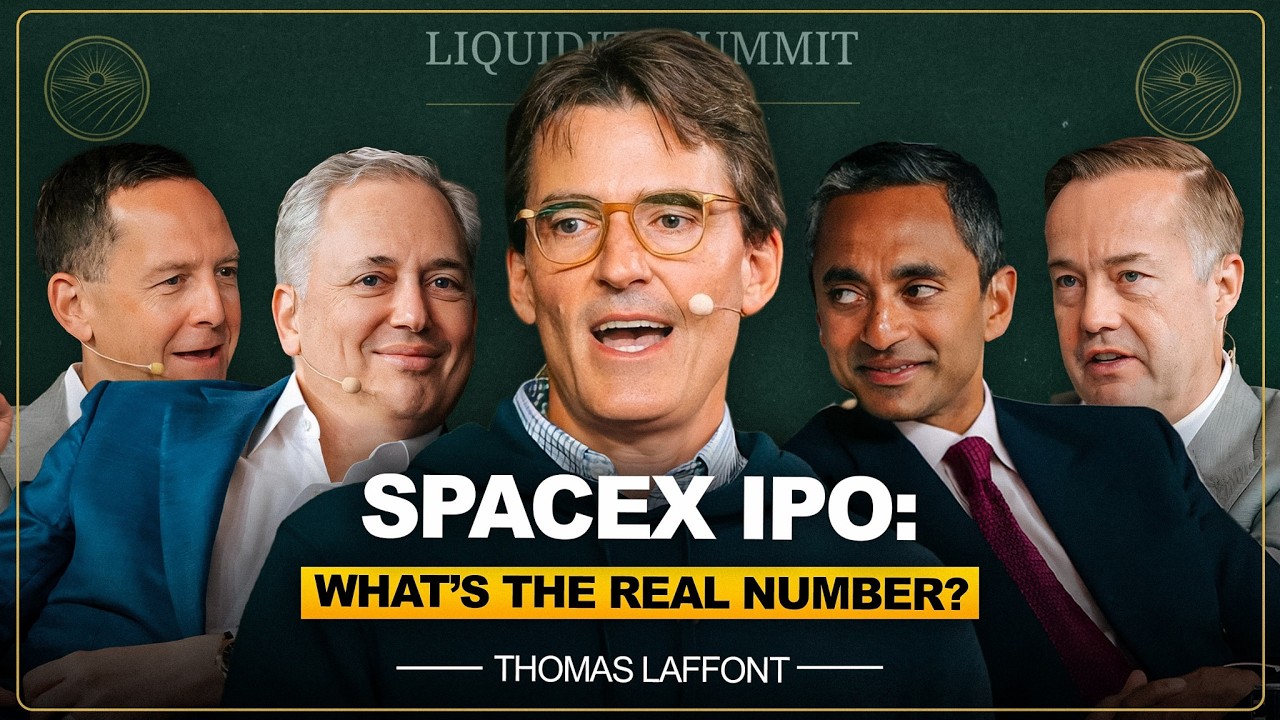
  • Thomas Laffont of Coatue on the $4 Trillion AI IPO Wave: SpaceX, Anthropic, OpenAI, and Why the New Unicorn Economy Is Healthier

    Thomas Laffont, co-founder of the $55 billion hedge fund Coatue Management, made his All-In Podcast premiere with a data-dense walk through what he calls a once-in-a-generation moment for the unicorn economy. In front of Chamath Palihapitiya, Jason Calacanis, David Sacks, and David Friedberg, he argued that a roughly $4 trillion wave of private value is about to hit the public markets, led by SpaceX, Anthropic, and OpenAI, and that the new AI-driven unicorn economy is actually healthier than the one that came before it. You can watch the full presentation and Q&A on YouTube.

    TLDW

    Laffont presents Coatue’s slide deck on the state of the unicorn economy and argues it has rebalanced after the excesses of 2021. The average unicorn is up about 70 percent since September 2024, AI keeps taking a bigger share of all fundraising, and the model has shifted from many small unicorns to fewer companies each raising far more, with funding per unicorn up roughly 5x since 2021. He introduces a “Magnificent 8” private index (SpaceX, Stripe, Anthropic, Databricks, Revolut, ByteDance, Anduril, and more) worth nearly $4 trillion that has crushed the public Mag 7, then shows that exits are finally thawing as SpaceX heads to an IPO in weeks and Anthropic confidentially files its S1. He lays out Coatue’s “CODE” framework for why SpaceX gets more valuable the more it launches, a counterintuitive finding that the odds of a 10x actually rise as companies get bigger (31 percent for $100 billion-plus centicorns), the explosive revenue ramp of OpenAI and Anthropic past Workday, ServiceNow, Adobe, Salesforce, and now the hyperscalers, a three-pillar map of where AI revenue comes from (consumer, ads, enterprise), and the AI memory thesis. The Q&A with Chamath and Calacanis digs into the power law, K-shaped outcomes, whether these valuations are disconnected from reality, the public market as the great antiseptic, and what happens when trillions in private value finally recycles back through GPs and LPs.

    Thoughts

    The most useful idea in the talk is not the $4 trillion headline, it is the cohort-health chart. Laffont splits unicorns into eras and shows that the pre-2021 cohort was healthy, roughly 80 percent had raised again or exited 20 quarters after minting, while the giant 2021 ZIRP cohort of 479 companies is stuck with under 20 percent doing either. That single comparison reframes the whole AI boom. The bullish read is that the 2024 AI cohort is small, concentrated, and cash-generative, so it looks more like the healthy pre-ZIRP group than the 2021 hangover. The bearish read is that we are watching the same movie with bigger numbers, and the test only comes when these companies face public markets. Laffont is honest that we do not yet know which cohort the AI class resembles, and that intellectual humility is what makes the deck credible rather than promotional.

    The SpaceX “CODE” framework is the sharpest analytical move of the presentation. Most people would assume a launch business gets cheaper per launch as it scales. Laffont shows the opposite, the market pays more per launch as cadence rises, and explains it as a phase change in business quality: from one-time government launch revenue, to a single recurring-revenue constellation, to multiple constellations, to a platform with optional upside in space data centers, the moon, and Mars. It is a clean way to think about any company that climbs from a project business to a platform business, and it applies far beyond rockets. The lesson for investors is that valuation can rationally expand even as unit economics look like they should compress, because the nature of the revenue underneath is changing.

    The counterintuitive 10x odds finding deserves more attention than it got in the room. Conventional wisdom says the bigger you are, the harder it is to grow, so a $100 billion company should be less likely to 10x than a $10 billion one. Coatue’s data says the reverse: centicorns have a 31 percent shot at a 10x, far higher than the 8 percent a unicorn has at becoming a decacorn. Laffont’s explanation is a filtering mechanism, every step up validates a compounding advantage and durability of earnings, so survivors are increasingly the kind of business that keeps compounding. This is essentially a quantitative restatement of quality investing, and it is the intellectual backbone of the LP strategy the besties tease out, just buy whoever reaches $100 billion and hold.

    Where the argument gets genuinely contested is valuation, and the panel does not let it slide. The pushback that “these are not fake companies” is true and important, OpenAI and Anthropic are growing faster than any software company in history, and Anthropic reportedly had a profitable month. But growth and reality do not settle the question of price when you are paying 50 to 100 times revenue for trillion-dollar private companies, as Bill Ackman pointed out earlier in the day. Laffont’s answer is the most grounded thing he says all session: the public market is the great antiseptic, it will not care about anyone’s slide deck, and he wants to see these names withstand short sellers and skeptics. That is the right posture. The deck is a thesis, not a verdict, and the verdict arrives roughly six months and one day after the IPOs, once passive flows and supply have washed through.

    The closing thread, that almost every sector is being transformed at once and we still do not have superintelligence, is the part worth sitting with. The risk in a presentation this bullish is treating the trend as destiny. The value is in the framing tools Laffont hands you, cohort health, phase-change business quality, the filtering odds, the three revenue pillars, and the antiseptic of public scrutiny. Use those to interrogate each name rather than to buy the index on faith, and the talk earns its premiere billing.

    Key Takeaways

    • Coatue Management is one of the most successful hedge funds of the last two decades with about $55 billion under management, and is raising roughly another billion dollars specifically to invest in AI.
    • The unicorn economy is up about 70 percent on average since September 2024, and the public market has made a similar move up over the same period.
    • The unicorn economy’s share of the NASDAQ rose significantly after 2015 but has plateaued in recent years, reflecting strong performance from public companies.
    • AI keeps increasing its wallet share of all venture fundraising, multiple years in a row now.
    • The composition of funding has changed. The unicorn “factory” peaked in the ZIRP era of 2021 and has normalized at a much lower level since.
    • Funding per unicorn has increased roughly 5x since 2021. There are fewer unicorns, and each one is raising more.
    • Cohort health, pre-ZIRP group: of about 73 unicorns, 20 quarters after minting roughly 80 percent had either raised a new round or exited, which is healthy.
    • Cohort health, 2021 group: of about 479 unicorns, 20 quarters in, fewer than 20 percent had exited or raised again. Far larger cohort, far worse outcomes.
    • The open question is which cohort the new 2024 AI cohort will resemble.
    • Funding is concentrating: the top 10 companies capture a large share, and it is a small number of AI companies, not all of them, with Anthropic and OpenAI raising massive rounds.
    • Laffont proposes a “Magnificent 8” private index: SpaceX, Stripe, Anthropic, Databricks, Revolut, ByteDance, Anduril, and more, spanning internet, AI, fintech, and space tech.
    • That private index represents almost $4 trillion of value and has crushed the traditional public Mag 7, with almost every name outperforming.
    • Exits are thawing. 2026 is on a good trend for cash returned versus consumed, not quite 2021 levels, with half a year still to go.
    • That trend does not yet include three imminent liquidity events: SpaceX (IPO expected in weeks) and Anthropic (confidentially filed its S1), whose combined value could exceed the prior decade of exits combined.
    • The ecosystem is far more balanced than when Laffont first presented at the 2024 All-In Summit, when it was consuming much more cash than it returned.
    • OpenAI and Anthropic revenue growth is unlike anything previously seen. Starting from January 2025, they passed Workday, then ServiceNow, then Adobe, then Salesforce, and are now bigger than Google Cloud and Azure.
    • On current forecasts, that revenue could pass AWS by the end of the year and exceed all of Microsoft by 2028.
    • Hyperscalers are not sitting still. The largest companies in the world are funding the disruption, investing unprecedented sums to enable the ChatGPT moment.
    • The SpaceX “CODE” framework: the number one driver correlated to SpaceX’s valuation is cadence of launches, and valuation per launch rises as launches increase.
    • Why per-launch value rises: business quality improves through phases, pre-constellation (one-time government revenue), initial ramp (one recurring-revenue constellation), scale (multiple constellations), and platform (space data centers, moon and Mars optionality).
    • Anthropic in particular is scaling like no company seen across the PC, internet, or mobile eras.
    • Counterintuitive 10x odds: a unicorn has about an 8 percent chance of becoming a decacorn, a decacorn has 8 to 13 percent odds of reaching $100 billion, but a centicorn ($100 billion-plus) has a 31 percent chance of a 10x.
    • Value creation has accelerated. It typically takes years to go from $500 billion to $1 trillion in market cap, yet recently three companies did it in one year and two did it in a matter of weeks.
    • Cerebras is the counterexample of slow success: years of dark periods and no new capital developing its technology, then a massive OpenAI contract that quintupled the company’s value ahead of its IPO.
    • Semiconductors are on a generational run, with the sector dramatically outperforming the index since the 2024 All-In Summit.
    • AI memory thesis: the more an AI system knows about you, the more useful it is, so memory per user could quintuple, which helps explain recent moves in memory companies.
    • Where the revenue is: the AI ecosystem is roughly $140 billion today, about $300 billion this year, and is expected to double in 2027.
    • Three revenue pillars: consumer (subscribers times ARPU), ads (about a quarter of Meta and Google ads are AI-enabled today, heading toward 100 percent and roughly $150 billion), and enterprise (tools like Claude Code and Codex inside businesses).
    • Disruption is hitting every sector: software, telco (Starlink-powered global phone calls), semis, energy (data centers reshaping Pennsylvania’s grid), auto (Ferrari’s electric and autonomous stumble), and consumer (GLP-1s reshaping food, alcohol, and wellness).
    • Final takeaways: the new unicorn economy is healthier thanks to AI, winners are compounding faster so the cost of not owning a winner is higher than ever, disruption is everywhere, and we do not even have superintelligence yet.
    • In the Q&A, both Anthropic and OpenAI publicly say they want to be public, and big outcomes now look likely to become liquid within roughly a 12-month window.
    • The valuation pushback: these are not fake companies, they generate substantial revenue at scale and grow faster than anything before, and Anthropic reportedly even had a profitable month.
    • The public market is framed as the great equalizer and antiseptic, but with passive buying the true price discovery may not land on day one, more like six months and a day after listing.
    • A floated LP strategy: wait for whoever reaches $100 billion and concentrate capital there as the least brittle, quickest-return bet, tempered by the warning that valuations are disconnecting from any historical metric (50x to 100x revenue).
    • An open risk: with so much capital, OpenAI and Anthropic could rationally start a price war, the way ride-sharing and food-delivery players once did, though heavy infrastructure spend complicates it.

    Detailed Summary

    The unicorn economy has rebalanced after 2021

    Laffont opens by reframing a market many assume is frothy. The average unicorn is up about 70 percent since September 2024, and the public market has tracked a similar climb, so private and public value are moving together rather than diverging. The unicorn economy’s share of the NASDAQ rose sharply after 2015 and then plateaued, which he reads as a sign of how strong public companies have become. Underneath the headline, the structure of funding has changed. The 2021 ZIRP era was a unicorn factory that minted enormous numbers of companies, and that machine has since normalized to a much lower level. The result is a barbell: fewer new unicorns, but each raising far more, with funding per unicorn up roughly 5x since 2021. AI sits at the center of this, taking a steadily larger share of all venture dollars for several years running.

    Cohort health is the real story

    The deck’s most important slide measures the health of the ecosystem by cohort. The pre-ZIRP cohort, about 73 unicorns, looks healthy: 20 quarters after becoming unicorns, roughly 80 percent had either raised a new round or exited. The 2021 cohort tells the opposite story. It is enormous, about 479 unicorns, and 20 quarters in, fewer than 20 percent had raised again or exited. That contrast sets up the central question of the talk. A new 2024 cohort of AI companies is forming, and no one yet knows whether it will resemble the healthy pre-ZIRP group or the bloated, stuck 2021 group. Laffont’s framing leans optimistic because the AI cohort is small and concentrated, but he is careful not to declare the answer.

    The Magnificent 8 and a $4 trillion private index

    Funding is not just flowing to AI, it is flowing to a handful of AI names, with the top 10 capturing a large share and Anthropic and OpenAI raising the biggest rounds. From this concentration Laffont builds a private index he half-jokingly calls the Magnificent 8, a number he expects to shrink as companies go public. The members span sectors: SpaceX, Stripe, Anthropic, Databricks, Revolut, ByteDance, and Anduril, covering internet, AI, fintech, and space tech. He says he would be comfortable owning that index for the next decade-plus. Collectively it represents almost $4 trillion of value and has outperformed the public Mag 7, with nearly every constituent beating that benchmark.

    Exits are thawing and a wall of liquidity is coming

    One of Laffont’s recurring concerns at past summits has been balance: the unicorn economy is great at consuming cash, but a healthy ecosystem must also return it. On that score 2026 is trending well, not quite 2021, but solid with half a year left. Crucially, that figure does not yet include three imminent events. SpaceX is expected to go public within weeks, and Anthropic confidentially filed its S1 the day of the talk. Adding those up, just a few companies could deliver more liquidity than the prior ten years combined. The takeaway is that the ecosystem that was dangerously out of balance in 2024 is now meaningfully more balanced, and improving.

    The revenue ramp past the hyperscalers

    The growth rates of OpenAI and Anthropic, Laffont argues, are unlike anything previously seen. Charting from January 2025, the leading AI labs passed Workday, then ServiceNow, then Adobe by year end, then Salesforce by January, and are now bigger than Google Cloud and Azure. On forecast, that revenue could surpass AWS by the end of the year and exceed all of Microsoft by 2028. He stresses that the hyperscalers are not passive bystanders, they are actively funding the disruption, pouring unprecedented capital into enabling the change that began with the ChatGPT moment.

    The SpaceX CODE framework

    Laffont devotes real time to how Coatue thinks about SpaceX. The single factor most correlated with SpaceX’s valuation is cadence of launches, which is intuitive for a launch business. The surprise is that valuation per launch has risen rather than fallen as cadence climbed. His explanation, the CODE framework, is that the quality of the business model improves the more SpaceX launches. In phase one, pre-constellation, you are simply proving rockets, with a few government customers and lumpy, unpredictable one-time revenue. In the initial ramp you stand up a constellation, which is an end market and a recurring-revenue business that grows with every satellite and subscriber. At scale you operate multiple constellations, and Laffont expects companies, governments, and militaries to want to own their own. Ultimately it becomes a platform, with new businesses layered on top, from space data centers to the optionality of the moon and Mars.

    Counterintuitive odds and the speed of value creation

    Coatue bucketed companies and asked the odds of a 10x within each. A unicorn has roughly an 8 percent chance of becoming a decacorn. A decacorn has 8 to 13 percent odds of reaching $100 billion. But a centicorn, $100 billion or more, has a 31 percent chance of a 10x, counting both public and private companies. The bigger you are, the better your odds, which inverts intuition. Laffont pairs this with the sheer speed of recent value creation. Going from $500 billion to $1 trillion in market cap normally takes years, yet three companies did it in a single year and two did it in a matter of weeks. He also offers Cerebras as the patient counterexample, a chip company that endured years of dark periods and no new capital before a massive OpenAI contract quintupled its value ahead of IPO, part of a broader generational run for semiconductors.

    AI memory and where the revenue actually comes from

    A throughline from the day’s other speakers is that the more an AI knows about you, the more useful it is, from your restaurant preferences to your work context. Laffont turns that into a thesis: memory per user could quintuple based on what these systems require, which helps explain recent moves in memory companies. He then tackles the most contested question, where is the revenue. He sizes the AI ecosystem at about $140 billion today, roughly $300 billion this year, and doubling in 2027, built on three pillars. Consumer is subscribers times ARPU. Ads are the pillar people forget, with about a quarter of Meta and Google ads already AI-enabled and penetration heading toward 100 percent, a roughly $150 billion opportunity. Enterprise is the breakthrough category, exemplified by tools like Claude Code and Codex operating inside businesses.

    Every sector is being transformed at once

    What makes this era different, Laffont says, is that nearly every sector is being transformed simultaneously. Software is obvious, but look at telco, where he believes Starlink will soon power a device that lets you make a phone call anywhere on earth, attacking the global telco and broadband profit pool with a better product. Compute is driving massive change in semis, data centers are reshaping the energy equation in places like Pennsylvania, and the auto business is being upended, as Ferrari’s stumble introducing electric and autonomous technology showed. In consumer, GLP-1 drugs are profoundly changing consumption of food and alcohol and the broader focus on wellness. His takeaways close the loop: the new unicorn economy is healthier thanks to AI, winners are compounding faster so the cost of missing them is higher than ever, disruption is everywhere, and superintelligence has not even arrived yet.

    The Q&A: power law, valuation, and the public market test

    Chamath and Jason Calacanis press Laffont on what this means for allocators. The recurring theme is the power law and K-shaped outcomes, with gains consolidating into a small number of companies. The positive side, Laffont notes, is that outcomes are enormous and increasingly liquid within a 12-month window, and both Anthropic and OpenAI say they want to be public. The hard part is valuation. The besties cite Bill Ackman’s framing that investors are making venture bets on trillion-dollar companies at 50 to 100 times revenue. Laffont’s pushback is that these are not fake companies, they generate substantial revenue at scale and grow faster than anything before, and Anthropic reportedly had a profitable month. But he embraces the discipline ahead: the public market is the great antiseptic and will not care about anyone’s presentation, though with heavy passive buying, true price discovery may take roughly six months and a day rather than landing on day one. Asked whether the compounding is a market inefficiency or survivor bias, he declines to over-read a small sample, noting that Anthropic before Claude Code was a completely different company than after. The conversation closes on what happens when trillions recycle from GPs to LPs, the case for simply owning whoever crosses $100 billion, the risk of everyone crowding into three names, and the possibility of an eventual OpenAI versus Anthropic price war.

    Notable Quotes

    “So we have fewer unicorns that are each raising more.”

    Thomas Laffont, summarizing how funding per unicorn has risen roughly 5x since 2021

    “The reason is that the quality of SpaceX’s business model increases the more you launch.”

    Thomas Laffont, explaining the CODE framework and why valuation per launch rises with cadence

    “The winners are compounding faster than ever, which means the costs of not being in a winner are higher than ever.”

    Thomas Laffont, on the central risk of a power-law market

    “And by the way, we don’t even have super intelligence yet.”

    Thomas Laffont, closing his takeaways on how early the transformation still is

    “These are companies generating substantial revenue at scale that are growing faster than anything we’ve ever seen.”

    Thomas Laffont, pushing back on the idea that AI valuations rest on fake companies

    “It will be the great antiseptic. It will not care about my presentation.”

    Thomas Laffont, on the public market as the ultimate test for SpaceX, OpenAI, and Anthropic

    “Anthropic pre-cloud code was a completely different company than post cloud code.”

    Thomas Laffont, on why he won’t over-read a small sample of hyper-compounders

    “The power law rules our lives. All the great gains are being consolidated into small numbers of companies.”

    An All-In host, framing the Q&A on concentration in private markets

    This is a curated set of highlights. To hear the full presentation, the slide walkthrough, and the complete Q&A with Chamath and Jason Calacanis, watch the full conversation here.

    Related Reading

    • Coatue Management. Primary source for Thomas Laffont’s firm and the technology investing strategy behind the deck.
    • The All-In Podcast. The show and summit where Laffont made this premiere presentation.
    • Power law (Wikipedia). Background on the distribution Laffont and the hosts say governs venture and public-market returns.
    • The Magnificent Seven (Wikipedia). The public-market benchmark Laffont’s private “Magnificent 8” index is measured against.
    • Cerebras Systems. The AI chipmaker Laffont cites as the slow-grind IPO that was eventually transformed by a major OpenAI contract.
  • Inside X with Nikita Bier: Viral Growth, Elon Musk, and “Doing the Hard Thing”

    In a recent episode of the Out of Office podcast, Lightspeed partner Michael Mignano sat down with Nikita Bier, the Head of Product at X (formerly Twitter). Filmed in Bier’s hometown of Redondo Beach, California, the interview offers a rare, candid look into the chaotic, high-stakes world of running product at one of the world’s most influential platforms.

    Bier, famous for founding the viral apps TBH and Gas, discusses everything from his unorthodox hiring by Elon Musk to the specific growth hacks being used to revitalize a 20-year-old platform. Here is a breakdown of the conversation.


    TL;DW (Too Long; Didn’t Watch)

    • The Hire: Elon Musk hired Nikita via DM. The “interview” was a 48-hour sprint to redesign the app’s onboarding flow, which Nikita presented to Elon at 2:00 AM.
    • The Role: Bier describes his job as “customer support for 500 million people” and admits he acts as the company mascot/punching bag.
    • The Culture: X runs like a seed-stage startup. There are roughly 30 core product engineers, very few managers, and a flat hierarchy.
    • Growth Strategy: The team is focusing on “Starter Packs” to help new users find niche communities (like Peruvian politics or plumbing) rather than just general tech/news content.
    • Elon’s Management: Musk is deeply involved in engineering reviews and consistently pushes the team to “do the hard thing” rather than take shortcuts for quick growth.

    Key Takeaways

    1. Think Like an Adversary

    Bier credits his early days as a “script kiddie” hacking AOL and building phishing sites (for educational purposes, mostly) as the foundation for his product sense. He argues that understanding how to break a system is essential for building consumer products. This “adversarial” mindset helps in preventing spam, but it is also the secret to growth—understanding exactly how funnels work and how to optimize them to the extreme.

    2. The “Build in Public” Double-Edged Sword

    Nikita is a prolific poster on X, often testing feature ideas in real-time. This creates an incredibly tight feedback loop where bugs are reported seconds after launch. However, it also makes him a target. He recounted the “Crypto Twitter” incident where a critique of “GM” (Good Morning) posts led to him being meme-d as a pig for a week. The sentiment only flipped when X shipped useful features like anti-spam measures and financial charts.

    3. Fixing the Link Problem

    One of the biggest recent product changes involved how X handles external links. Historically, social platforms downrank links to keep users on-site. Bier helped design a new UI where the engagement buttons (Like, Repost) remain visible while the user reads the article in the in-app browser. This allows X to capture engagement signals on external content, meaning the algorithm can finally properly rank high-quality news and articles without penalizing creators.

    4. Identity and Verification

    To combat political misinformation without compromising free speech, X launched “Country of Origin” labels. Bier explained that this allows users to see if a political opinion is coming from a local citizen or a “grifter” farm in a different country, providing context rather than censorship.


    Detailed Summary

    From TBH to X

    The interview traces Bier’s history of building viral hits. He famously sold his app TBH (a positive polling app for teens) to Facebook, and years later, built Gas (effectively the same concept) and sold it to Discord. He dispelled the myth that he simply “sold the same app twice,” noting that while the mechanics were similar, the growth engines and social graph integrations had to be completely reinvented for a new generation.

    The Musk Methodology

    Bier provides a fascinating look at Elon Musk’s leadership style. Contrary to the idea of a distant executive, Musk conducts weekly reviews with engineers where they present their code and progress directly. Bier noted that Musk has a high tolerance for pain if it means long-term stability. For example, rewriting the entire recommendation algorithm or moving data centers in mere months—projects that would take years at Meta or Google—were executed rapidly because Musk insisted on “doing the hard thing.”

    Reviving a 20-Year-Old Platform

    The core challenge at X is growth. The app has billions of dormant accounts. Bier’s strategy relies on “resurrection”—bringing old users back by showing them that X isn’t just for news, but for specific interests. This led to the creation of Starter Packs, which curate lists of accounts for specific niches. The result has been a doubling of time spent for new users.

    The Financial Future

    Bier teased upcoming features that align with Musk’s vision of an “everything app.” This includes Smart Cashtags, which allow users to pull up real-time financial data and charts within the timeline. The long-term goal is to enable transactions directly on the platform, allowing users to buy products or tip creators seamlessly.


    Thoughts

    What stands out most in this interview is the sheer precariousness of Nikita Bier’s position. He is attempting to apply “growth hacking” principles—usually reserved for fresh, nimble startups—to a massive, entrenched legacy platform. The fact that the core engineering team is only around 30 people is staggering when compared to the thousands of engineers at Meta or TikTok.

    Bier represents a new breed of product executive: the “poster-operator.” He doesn’t hide behind corporate comms; he engages in the muddy waters of the platform he builds. While this invites toxicity (and the occasional death threat, which he mentions casually), it affords X a speed of iteration that is unmatched in the industry. If X succeeds in revitalizing its growth, it will likely be because they treated the platform not as a museum of the internet, but as a product that still needs to find product-market fit every single day.

  • The Gundo: A Thriving Hub for Hard Tech Startups

    The Gundo: A Thriving Hub for Hard Tech Startups

    El Segundo, California, a coastal city located in the South Bay region of Los Angeles County, is often considered a distinct area with its own unique identity. While renowned for its beautiful beaches and laid-back atmosphere, El Segundo is rapidly emerging as a hotbed for hard tech startups. This burgeoning hub, affectionately dubbed “The Gundo,” is attracting a new generation of entrepreneurs and engineers who are pushing the boundaries of technology and reshaping the future of industries.

    What is Hard Tech?

    Hard tech, also known as deep tech, refers to companies that are developing technology solutions based on significant scientific or engineering challenges. These companies often require extensive research and development (R&D), substantial capital investment, and lengthy periods before achieving commercial success. Unlike software startups that primarily focus on digital products and services, hard tech companies are involved in creating tangible, physical products that often involve complex engineering and manufacturing processes. Examples of hard tech include advanced materials, robotics, aerospace, artificial intelligence, and biotechnology.

    This distinction between hard tech and the traditional software focus of Silicon Valley highlights a crucial shift in the technology landscape. While software continues to play a vital role, the future of technology lies in the convergence of software and hardware, with hard tech companies leading the charge in developing solutions to real-world problems.

    Why El Segundo?

    El Segundo’s transformation into a hard tech hub is driven by a confluence of factors. Its proximity to Los Angeles International Airport (LAX) and major aerospace and defense companies Boeing and SpaceX provides access to a highly skilled workforce and a robust supply chain. This legacy in aerospace has laid the foundation for the Gundo’s emergence, providing a fertile ground for and a pool of experienced engineers and entrepreneurs.

    The city’s relatively affordable real estate compared to Silicon Valley and its attractive coastal lifestyle make it an appealing location for startups and their employees. Moreover, El Segundo offers a “small-town” vibe that fosters a strong sense of community among its hard tech entrepreneurs. This collaborative environment encourages the exchange of ideas, mentorship, and partnerships, creating a fertile ground for and growth.

    California has experienced an exodus of firms and families, including Fortune 1000 companies and smaller ones. El Segundo has managed to attract a new wave of companies focused on “atoms, not bits.” This emphasis on tangible products and solutions, coupled with a “hardcore ethos” that prioritizes ambitious technological advancement, sets the Gundo apart from other hubs.

    With its unique advantages, El Segundo has attracted a diverse range of hard tech startups.

    Key Players in The Gundo

    The Gundo is home to a diverse range of hard tech startups that are developing groundbreaking technologies across various sectors. This diversity fosters within individual companies and creates opportunities for cross-industry collaboration and the development of integrated solutions. Here are a few examples:

    • Parallel Systems: Founded by Matt Soule, John Howard, and Ben Stabler, Parallel Systems is building an autonomous and decarbonized freight system with zero-emissions rail vehicles. This approach to transportation aims to revolutionize the logistics industry by reducing emissions and improving efficiency.
    • Epsilon3: Epsilon3 is developing next-generation manufacturing systems software for rapid, iterative, and data-driven hardware manufacturing. Their software solutions empower businesses to optimize their production processes and accelerate in manufacturing.
    • Rainmaker: Founded by Augustus Doricko, Rainmaker is focused on drone-enabled cloud seeding technology to modify the weather and address water scarcity for farms and ecosystems. This endeavor tackles a critical global challenge by leveraging cutting-edge technology to increase rainfall and combat drought.
    • Castelion: Co-founded by Bryon Hargis, Sean Pitt, and Andrew Kreitz, Castelion is designing, building, and testing next-generation long-range strike weapons systems. With a focus on in defense technology, Castelion has raised $15 million in funding to develop advanced weaponry.
    • Picogrid: Founded by Zane Mountcastle and Martin Slosarik, Picogrid builds a common platform to connect defense and autonomous systems. Their technology enables seamless integration and communication between various defense systems, improving coordination and real-time intelligence. Picogrid has raised $12 million in funding.
    • Mach Industries: Founded by Ethan Thornton and Ana Saldana, Mach Industries is developing a suite of hydrogen-powered platforms and munitions for the military. This focus on alternative energy sources in defense technology aims to reduce reliance on fossil fuels and promote sustainability in military operations. Mach Industries has raised $85 million in funding.
    • AeroDome: Co-founded by Rahul Sidhu and Kenaniah Cerny, AeroDome provides drone air support to law enforcement, wildfire protection, and search and rescue. Their drone technology enhances public safety and emergency response efforts by providing rapid aerial surveillance and support. AeroDome has raised $6.5 million in funding.
    • TEN TECH LLC: TEN TECH LLC is a mechanical engineering consulting company specializing in structural dynamics and thermal analysis & management for aerospace & defense, hi-tech electronics, automotive, medical, and renewable energy applications. Their expertise in these areas supports the development of and reliable products across various industries.

    The Broader Los Angeles Hard Tech Ecosystem

    The Gundo is a key component of a larger hard tech ecosystem that is emerging across Los Angeles. This ecosystem includes companies SpaceX, Anduril, Rocket Lab, Relativity, and Shield AI, among many others. These companies are pushing the boundaries of space exploration, defense technology, robotics, and advanced manufacturing, contributing to a resurgence of technological in the region.

    Challenges and Opportunities

    While The Gundo is experiencing rapid growth and attracting significant attention, it also faces challenges. A major concern is the rising cost of real estate, which could make it difficult for startups to afford space in El Segundo. This challenge highlights the need for policies and initiatives that support affordable workspace for startups and encourage the development of a diverse and inclusive entrepreneurial ecosystem.

    Another challenge is the need to maintain the city’s “small-town” vibe while accommodating the influx of new businesses and residents. Balancing growth with preservation of the city’s character will be crucial for ensuring the long-term sustainability and appeal of the Gundo.

    As the Gundo gains more visibility and attracts more investment, it faces the challenge of maintaining its ethos and avoiding the potential pitfalls of hype and overheated expectations. Staying true to its core values of community, collaboration, and a focus on solving real-world problems will be essential for the Gundo’s continued success.

    Despite these challenges, The Gundo has tremendous potential to become a leading hub for hard tech . Its strong community, access to talent, and proximity to key industries provide a solid foundation for continued growth. As The Gundo matures, it is likely to attract more investment, create more jobs, and contribute significantly to the advancement of technology.

    The Gundo: Shaping the Future of Hard Tech

    The Gundo is a of community, collaboration, and a focus on solving real-world problems. This thriving hard tech hub is about building products; it’s about creating a sustainable ecosystem where entrepreneurs, engineers, and investors can come together to shape the future. By fostering a culture of , embracing technological advancement, and prioritizing tangible solutions, the Gundo is poised to become a driving force in the global hard tech landscape. Its success could contribute to a resurgence of American technological leadership and economic growth, demonstrating the potential of regional hubs to drive economic prosperity and address critical global challenges.

  • Michael Dell on Building a Tech Empire and Embracing Innovation: Insights from “In Good Company”

    In the December 11, 2024 episode of “In Good Company,” hosted by Nicolai Tangen of Norges Bank Investment Management, Michael Dell, the visionary founder and CEO of Dell Technologies, offers an intimate glimpse into his remarkable career and the strategic decisions that have shaped one of the world’s leading technology companies. This interview not only chronicles Dell’s entrepreneurial journey but also provides profound insights into leadership, innovation, and the future of technology.

    From Bedroom Enthusiast to Tech Titan

    Michael Dell’s fascination with computers began in his teenage years. At 16, instead of using his IBM PC conventionally, he chose to dismantle it to understand its inner workings. This hands-on curiosity led him to explore microprocessors, memory chips, and other hardware components. Dell discovered that IBM’s pricing was exorbitant—charging roughly six times the cost of the parts—sparking his determination to offer better value to customers through a more efficient business model.

    Balancing his academic pursuits at the University of Texas, where he was initially a biology major, Dell engaged in various entrepreneurial activities. From working in a Chinese restaurant to trading stocks and selling newspapers, these early ventures provided him with the capital and business acumen to invest in his burgeoning interest in technology. Despite familial pressures to follow a medical career, Dell’s passion for computers prevailed, leading him to fully commit to his business aspirations.

    The Birth and Explosive Growth of Dell Technologies

    In May 1984, Dell Computer Corporation was officially incorporated. The company experienced meteoric growth, with revenues skyrocketing from $6 million in its first year to $33 million in the second. This impressive 80% annual growth rate continued for eight years, followed by a sustained 60% growth for six more years. Dell’s success was largely driven by his innovative direct-to-consumer sales model, which eliminated intermediaries like retail stores. This approach not only reduced costs but also provided Dell with real-time insights into customer demand, allowing for precise inventory management and rapid scaling.

    Dell attributes this entrepreneurial mindset to curiosity and a relentless pursuit of better performance and value. He believes that America’s culture of embracing risk, supported by accessible capital and inspirational role models like Bill Gates and Steve Jobs, fosters a robust environment for entrepreneurs.

    Revolutionizing Supply Chains and Strategic Business Moves

    A cornerstone of Dell’s strategy was revolutionizing the supply chain through direct sales. This model allowed the company to respond swiftly to customer demands, minimizing inventory costs and enhancing capital efficiency. By maintaining close relationships with a diverse customer base—including individual consumers, large enterprises, and governments—Dell ensured high demand fidelity, enabling the company to scale efficiently.

    In 2013, facing declining stock prices and skepticism about the relevance of PCs amid the rise of smartphones and tablets, Dell made the bold decision to take the company private. This move involved a massive $67 billion buyback of shares, the largest technology acquisition at the time. Going private allowed Dell to focus on long-term transformation without the pressures of quarterly earnings reports.

    The acquisition of EMC, a major player in data storage and cloud computing, was a landmark deal that significantly expanded Dell’s capabilities. Despite initial uncertainties and challenges, the merger proved successful, resulting in substantial organic revenue growth and enhanced offerings for enterprise customers. Dell credits this acquisition for accelerating the company’s transformation and broadening its technological expertise.

    Leadership Philosophy: “Play Nice but Win”

    Dell’s leadership philosophy is encapsulated in his motto, “Play Nice but Win.” This principle emphasizes ethical behavior, fairness, and a strong results orientation. He fosters a culture of open debate and diverse perspectives, believing that surrounding oneself with intelligent individuals who can challenge ideas leads to better decision-making. Dell encourages his team to engage in rigorous discussions, ensuring that decisions are well-informed and adaptable to changing circumstances.

    He advises against being the smartest person in the room, advocating instead for inviting smarter people or finding environments that foster continuous learning and adaptation. This approach not only drives innovation but also ensures that Dell Technologies remains agile and forward-thinking.

    Embracing the Future: AI and Technological Innovation

    Discussing the future of technology, Dell highlights the transformative impact of artificial intelligence (AI) and large language models. He views current AI advancements as the initial phase of a significant technological revolution, predicting substantial improvements and widespread adoption over the next few years. Dell envisions AI enhancing productivity and enabling businesses to reimagine their processes, ultimately driving human progress.

    He also touches upon the evolving landscape of personal computing. While the physical appearance of PCs may not change drastically, their capabilities are significantly enhanced through AI integration. Innovations such as neural processing units (NPUs) are making PCs more intelligent and efficient, ensuring continued demand for new devices.

    Beyond Dell Technologies: MSD Capital and Investment Ventures

    Beyond his role at Dell Technologies, Michael Dell oversees MSD Capital, an investment firm that has grown into a prominent investment boutique on Wall Street. Initially established to manage investments for his family and foundation, MSD Capital has expanded through mergers and strategic partnerships, including a significant merger with BDT. Dell remains actively involved in guiding the firm’s strategic direction, leveraging his business acumen to provide aligned investment solutions for multiple families and clients.

    Balancing Success with Personal Well-being

    Despite his demanding roles, Dell emphasizes the importance of maintaining a balanced lifestyle. He adheres to a disciplined daily routine that includes early waking hours, regular exercise, and sufficient sleep. Dell advocates for a balanced approach to work and relaxation to sustain long-term productivity and well-being. He also underscores the role of humor in the workplace, believing that the ability to laugh and joke around fosters a positive and creative work environment.

    Advice to Aspiring Entrepreneurs

    Addressing the younger audience, Dell offers invaluable advice to aspiring entrepreneurs: experiment, take risks, and embrace failure as part of the learning process. He encourages tackling challenging problems, creating value, and being bold in endeavors. While acknowledging the value of parental guidance, Dell emphasizes the importance of forging one’s own path to achieve success, highlighting that innovation often requires stepping outside conventional expectations.

    Wrap Up

    Michael Dell’s conversation on “In Good Company” provides a deep dive into the strategic decisions, leadership philosophies, and forward-thinking approaches that have propelled Dell Technologies to its current stature. His insights into entrepreneurship, innovation, and the future of technology offer valuable lessons for business leaders and aspiring entrepreneurs alike. Dell’s unwavering commitment to understanding customer needs, fostering a culture of open debate, and leveraging technological advancements underscores his enduring influence in the technology sector.