TL;DR:
On November 17, 2025, Valar Atomics and Los Alamos National Laboratory announced that the NOVA Core – a HALEU TRISO-fueled, graphite-moderated HTGR test assembly – successfully reached zero-power (“cold”) criticality at the National Criticality Experiments Research Center (NCERC) in Nevada. This marks the first time a venture-backed private nuclear company has ever achieved criticality, validating the physics of Valar’s upcoming Ward250 reactor and clearing a major technical de-risking milestone on the path to gigawatt-scale carbon-free power.
Key Takeaways
- Zero-power criticality achieved at 11:45 AM PT on November 17, 2025
- First criticality ever achieved by a venture-funded nuclear startup
- Conducted at the United States’ only general-purpose critical experiments facility (NCERC, Nevada National Security Site)
- Uses the exact same HALEU TRISO fuel, graphite moderator, and reactivity control scheme as the commercial Ward250 reactor
- Directly validates Valar Atomics’ proprietary neutronics models and simulation stack
- Builds on the 2024 Deimos critical assembly; NOVA is the high-fidelity physics twin of Ward250
- Clears the path for hot (powered) criticality and full-temperature testing in 2026
- Supported by DOE’s Advanced Reactor Pilot Program (target: full criticality by July 4, 2026) and Executive Order 14301
- Strong public endorsement of the Trump administration’s “make nuclear great again” push
Detailed Summary of the Announcement
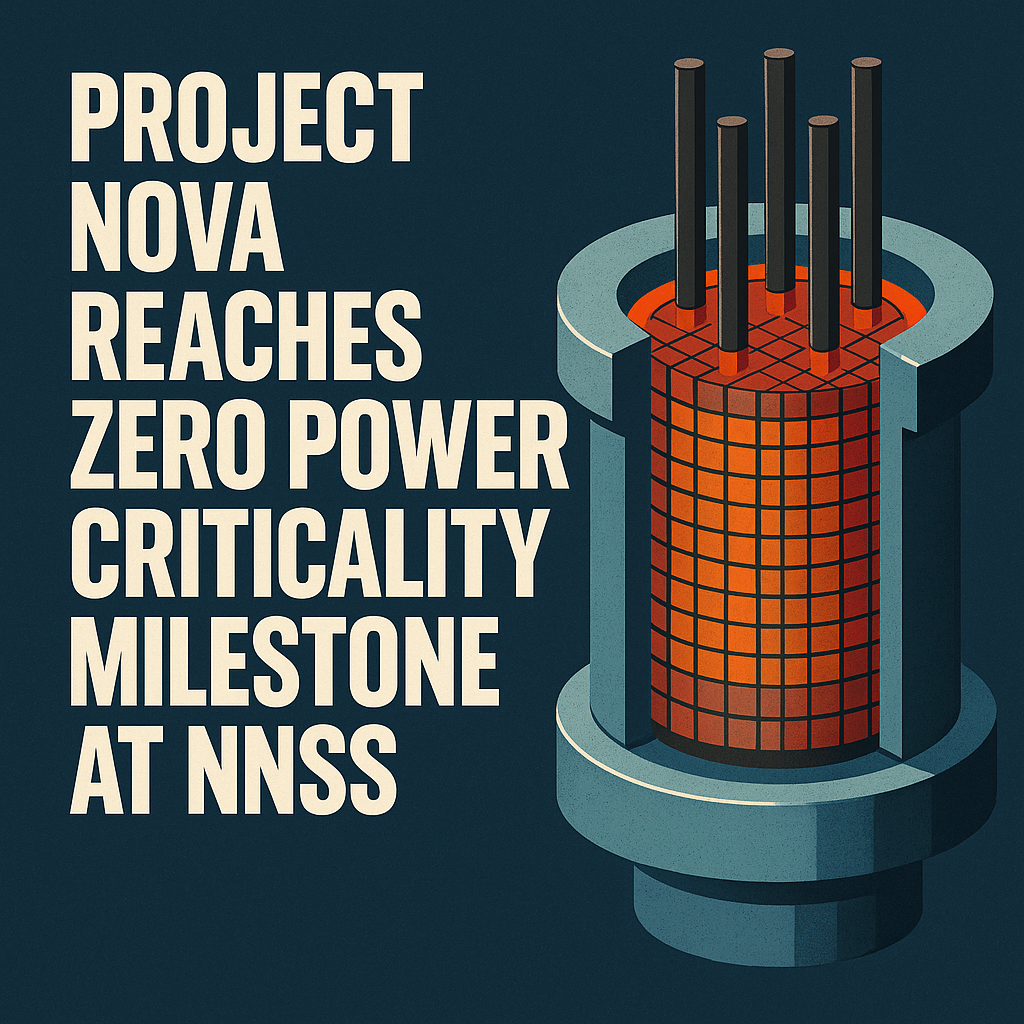
On November 17, 2025, Los Alamos National Laboratory (LANL) and Valar Atomics jointly announced that the NOVA Core, operating on LANL’s Comet critical assembly machine at the National Criticality Experiments Research Center (NCERC) inside the Nevada National Security Site (NNSS), had achieved zero-power criticality at exactly 11:45 AM Pacific Time.
Approach-to-critical experiments began on November 12, 2025, and the core went critical five days later – an impressively rapid and safe execution that highlights both Valar’s engineering maturity and NCERC’s world-class operational capability.
What is zero-power (“cold”) criticality?
Cold criticality is the moment when a nuclear core sustains a stable neutron chain reaction (k_eff = 1.000) without external neutron sources, but at room temperature and with essentially zero fission power (typically microwatts to a few watts). No heat is removed by coolant flow, and temperatures remain ambient. It is the nuclear equivalent of “first breath” or “first heartbeat” – proof that the fundamental physics of the core design works exactly as modeled.
Project NOVA (Nuclear Observations of Valar Atomics) is a multi-week campaign of criticality experiments designed to:
- Measure integral neutronics parameters (reactivity coefficients, control rod worth, burnable poison performance, etc.)
- Validate Valar’s in-house Monte Carlo and deterministic neutronics codes
- Provide high-fidelity benchmark data for the Ward250 reactor currently under construction in Utah
The NOVA Core is a graphite-moderated, helium-cooled-concept test bed fueled with High-Assay Low-Enriched Uranium (HALEU) TRISO particles – the same fuel form and enrichment Valar will use commercially. Reactivity control is provided by boron-carbide elements in stainless-steel cladding, mirroring the Ward250 design.
The central portion of the core was designed and fabricated entirely by Valar Atomics, while LANL provided the Comet universal assembly machine, reflectors, instrumentation, safety envelope, and decades of criticality-safety expertise.
Quotes from Leadership
- Isaiah Taylor (Founder & CEO, Valar Atomics): “Zero power criticality is a reactor’s first heartbeat, proof the physics holds… This moment marks the dawn of a new era in American nuclear engineering — one defined by speed, scale, and private-sector execution with closer federal partnership.”
- Max Ukropina (Head of Projects): “President Trump asked industry and the labs to make nuclear great again. We got together and decided to start with the basics of fission. This team delivered incredible results safely so we can keep moving up the technical ladder.”
- Sonat Sen (Lead Core Designer): “Project NOVA provides us with real-world data which will help us answer key questions about TRISO fuel performance in our core and validate our proprietary software stack.”
Why This Milestone Matters – Technical & Strategic Context
Reaching criticality in a national-lab critical facility is widely regarded as the single biggest technical de-risking event for any new reactor design. Before today, no venture-backed nuclear company had ever achieved criticality on their own core. Legacy players (NuScale, TerraPower, Kairos Power, X-energy, etc.) have either used legacy government assemblies or have not yet gone critical with their exact commercial fuel and geometry.
Valar Atomics has now leapfrogged the field by:
- Using actual commercial-spec HALEU TRISO (not surrogates)
- Replicating the exact Ward250 moderator-to-fuel ratio and control scheme
- Collecting integral data months ahead of first fuel load at Ward250
- Demonstrating that a small private team can execute at national-lab speed and safety standards
This positions Valar to move aggressively into hot zero-power testing, helium loop commissioning, and ultimately full-power, full-temperature operation of Ward250 in 2026 – aligning perfectly with the DOE’s goal of new reactor criticality by Independence Day 2026.
My Thoughts & Broader Implications
1. Speed is the new moat. From Deimos (2024) → NOVA criticality (2025) → Ward250 power operations (2026) in roughly 24 months is an absolutely blistering pace by historical nuclear standards. Valar is proving that private capital + national lab partnership + focused scope can compress decades into years.
2. TRISO + Graphite + Helium is having its moment. The combination of walk-away-safe TRISO fuel, high-temperature capability (>750°C), and modular factory fabrication is rapidly becoming the consensus Gen-IV architecture for private deployment. NOVA just added the strongest data point yet that the neutronics actually work as advertised.
3. National labs are back as force multipliers. NCERC’s ability to take a private core, insert it into the Comet machine, and go critical in under a week with zero safety incidents is a national strategic asset. The close LANL–Valar collaboration is exactly the model the Trump administration appears to want: labs providing capability, private sector providing speed and capital.
4. AI + Nuclear inflection point. Valar has been explicit that their ultimate product is gigasites – clusters of thousands of HTGRs powering hyperscale data centers, hydrogen electrolysis, and desalination. Today’s criticality is concrete evidence that the energy bottleneck for the AI build-out may actually be solvable in this decade.
5. First of many. If Valar can replicate this model – design core → validate at NCERC → deploy Ward250 → scale factory production – we are looking at a genuine nuclear renaissance led by American startups rather than slow-moving utilities or foreign state-owned entities.
Wrap Up
November 17, 2025, will be remembered as the day a venture-backed nuclear company first split the atom under its own design. Project NOVA’s successful cold criticality is not just a technical checkbox – it is a cultural and strategic turning point for the entire industry.
The physics works. The team can execute. The labs are partnering at speed. The policy tailwinds are strong.
We are witnessing the birth of the next era of American nuclear dominance – and it’s moving a lot faster than anyone predicted.