PJFP.com

Pursuit of Joy, Fulfillment, and Purpose

Category: Articles

  • Boris Cherny Says Coding Is “Solved” — Head of Claude Code Reveals What Comes Next for Software Engineers

    Boris Cherny Says Coding Is "Solved" — Head of Claude Code Reveals What Comes Next for Software Engineers

    Boris Cherny, creator and head of Claude Code at Anthropic, sat down with Lenny Rachitsky on Lenny’s Podcast to drop one of the most consequential interviews in recent tech history. With Claude Code now responsible for 4% of all public GitHub commits — and growing faster every day — Cherny laid out a vision where traditional coding is a solved problem and the real frontier has shifted to idea generation, agentic AI, and a new role he calls the “Builder.”


    TLDW (Too Long; Didn’t Watch)

    Boris Cherny, the head of Claude Code at Anthropic, hasn’t manually written a single line of code since November 2025 — and he ships 10 to 30 pull requests every day. Claude Code now accounts for 4% of all public GitHub commits and is projected to reach 20% by end of 2026. Cherny believes coding as we know it is “solved” and that the future belongs to generalist “Builders” who blend product thinking, design sense, and AI orchestration. He advocates for underfunding teams, giving engineers unlimited tokens, building products for the model six months from now (not today), and following the “bitter lesson” of betting on the most general model. The Cowork product — Anthropic’s agentic tool for non-technical tasks — was built in just 10 days using Claude Code itself. Cherny also revealed three layers of AI safety at Anthropic: mechanistic interpretability, evals, and real-world monitoring.


    Key Takeaways

    1. Claude Code’s Growth Is Staggering

    Claude Code now authors approximately 4% of all public GitHub commits, and Anthropic believes the real number is significantly higher when private repositories are included. Daily active users doubled in the month before this interview, and the growth curve isn’t just rising — it’s accelerating. Semi Analysis predicted Claude Code will reach 20% of all GitHub commits by end of 2026. Claude Code alone is generating roughly $2 billion in revenue, with Anthropic overall at approximately $15 billion.

    2. 100% AI-Written Code Is the New Normal

    Cherny hasn’t manually edited a single line of code since November 2025. He ships 10 to 30 pull requests per day, making him one of the most prolific engineers at Anthropic — all through Claude Code. He still reviews code and maintains human checkpoints, but the actual writing of code is entirely handled by AI. Claude also reviews 100% of pull requests at Anthropic before human review.

    3. Coding Is “Solved” — The Frontier Has Shifted

    In Cherny’s view, coding — at least the kind of programming most engineers do — is a solved problem. The new frontier is idea generation. Claude is already analyzing bug reports and telemetry data to propose its own fixes and suggest what to build next. The shift is from “tool” to “co-worker.” Cherny expects this to become increasingly true across every codebase and tech stack over the coming months.

    4. The Rise of the “Builder” Role

    Traditional role boundaries between engineer, product manager, and designer are dissolving. On the Claude Code team, everyone codes — the PM, the engineering manager, the designer, the finance person, the data scientist. Cherny predicts the title “Software Engineer” will start disappearing by end of 2026, replaced by something like “Builder” — a generalist who blends design sense, business logic, technical orchestration, and user empathy.

    5. Underfunding Teams Is a Feature, Not a Bug

    Cherny advocates deliberately underfunding teams as a strategy. When you assign one engineer to a project instead of five, they’re forced to leverage Claude Code to automate everything possible. This isn’t about cost-cutting — it’s about forcing innovation through constraint. The results at Anthropic have been dramatic: while the engineering team grew roughly 4x, productivity per engineer increased 200% in terms of pull requests shipped.

    6. Give Engineers Unlimited Tokens

    Rather than hiring more headcount, Cherny’s advice to CTOs is to give engineers as many tokens as possible. Let them experiment with the most capable models without worrying about cost. The most innovative ideas come from people pushing AI to its limits. Some Anthropic engineers are spending hundreds of thousands of dollars per month in tokens. Optimize costs later — only after you’ve found the idea that works.

    7. Build for the Model Six Months From Now

    One of Cherny’s most actionable insights: don’t build for today’s model capabilities — build for where the model will be in six months. Early versions of Claude Code only wrote about 20% of Cherny’s code. But the team bet on exponential improvement, and when Opus 4 and Sonnet 4 arrived, product-market fit clicked instantly. This means your product might feel rough at first, but when the next model generation drops, you’ll be perfectly positioned.

    8. The Bitter Lesson Applied to Product

    Cherny references Rich Sutton’s famous “Bitter Lesson” blog post as a core principle for the Claude Code team: the more general model will always outperform the more specific one. In practice, this means avoiding rigid workflows and orchestration scaffolding around AI models. Don’t box the model in. Give it tools, give it a goal, and let it figure out the path. Scaffolding might improve performance 10-20%, but those gains get wiped out with the next model generation.

    9. Latent Demand — The Most Important Product Principle

    Cherny calls latent demand “the single most important principle in product.” The idea: watch how people misuse or hack your product for purposes you didn’t design it for. That’s where your next product lives. Facebook Marketplace came from 40% of Facebook Group posts being buy-and-sell. Cowork came from non-engineers using Claude Code’s terminal for things like growing tomato plants, analyzing genomes, and recovering wedding photos from corrupted hard drives. There’s also a new dimension: watching what the model is trying to do and building tools to make that easier.

    10. Cowork Was Built in 10 Days

    Anthropic’s Cowork product — their agentic tool for non-technical tasks — was implemented by a small team in just 10 days, using Claude Code to build its own virtual machine and security scaffolding. Cowork was immediately a bigger hit than Claude Code was at launch. It can pay parking tickets, cancel subscriptions, manage project spreadsheets, message team members on Slack, respond to emails, and handle forms — and it’s growing faster than Claude Code did in its early days.

    11. Three Layers of AI Safety at Anthropic

    Cherny outlined three layers of safety: (1) Mechanistic interpretability — monitoring neurons inside the model to understand what it’s doing and detect things like deception at the neural level. (2) Evals — lab testing where the model is placed in synthetic situations to check alignment. (3) Real-world monitoring — releasing products as research previews to study unpredictable agent behavior in the wild. Claude Code was used internally for 4-5 months before public release specifically for safety study.

    12. Why Boris Left Anthropic for Cursor (and Came Back After Two Weeks)

    Cherny briefly left Anthropic to join Cursor, drawn by their focus on product quality. But within two weeks, he realized what he was missing: Anthropic’s safety mission. He described it as a psychological need — without mission-driven work, even building a great product wasn’t a substitute. He returned to Anthropic and the rest is history.

    13. Manual Coding Skills Will Become Irrelevant in 1-2 Years

    Cherny compared manual coding to assembly language — it’ll still exist beneath the surface, and understanding the fundamentals helps for now, but within a year or two it won’t matter for most engineers. He likened it to the printing press transition: a skill once limited to scribes became universal literacy over time. The volume of code created will explode while the cost drops dramatically.

    14. Pro Tips for Using Claude Code Effectively

    Cherny shared three specific tips: (1) Use the most capable model — currently Opus 4.6 with maximum effort enabled. Cheaper models often cost more tokens in the end because they require more correction and handholding. (2) Use Plan Mode — hit Shift+Tab twice in the terminal to enter plan mode, which tells the model not to write code yet. Go back and forth on the plan, then auto-accept edits once it looks good. Opus 4.6 will one-shot it correctly almost every time. (3) Explore different interfaces — Claude Code runs on terminal, desktop app, iOS, Android, web, Slack, GitHub, and IDE extensions. The same agent runs everywhere. Find what works for you.


    Detailed Summary

    The Origin Story of Claude Code

    Claude Code began as a one-person hack. When Cherny joined Anthropic, he spent a month building weird prototypes that mostly never shipped, then spent another month doing post-training to understand the research side. He believes deeply that to build great products on AI, you have to understand “the layer under the layer” — meaning the model itself.

    The first version was terminal-based and called “Claude CLI.” When he demoed it internally, it got two likes. Nobody thought a coding tool could be terminal-based. But the terminal form factor was chosen partly out of necessity (he was a solo developer) and partly because it was the only interface that could keep up with how fast the underlying model was improving.

    The breakthrough moment during prototyping: Cherny gave the model a bash tool and asked it what music he was listening to. The model figured out — without any specific instructions — how to use the bash tool to answer that question. That moment of emergent tool use convinced him he was onto something.

    The Growth Trajectory

    Claude Code was released externally in February 2025 and was not immediately a hit. It took months for people to understand what it was. The terminal interface was alien to many. But internally at Anthropic, daily active users went vertical almost immediately.

    There were multiple inflection points. The first major one was the release of Opus 4, which was Anthropic’s first ASL-3 class model. That’s when Claude Code’s growth went truly exponential. Another inflection came in November 2025 when Cherny personally crossed the 100% AI-written code threshold. The growth has continued to accelerate — it’s not just going up, it’s going up faster and faster.

    The Spotify headline from the week of recording — “Spotify says its best developers haven’t written a line of code since December, thanks to AI” — underscored how mainstream the shift has become.

    Thinking in Exponentials

    Cherny emphasized that thinking in exponentials is deep in Anthropic’s DNA — three of their co-founders were the first three authors on the scaling laws paper. At Code with Claude (Anthropic’s developer conference) in May 2025, Cherny predicted that by year’s end, engineers might not need an IDE to code anymore. The room audibly gasped. But all he did was “trace the line” of the exponential curve of AI-written code.

    The Printing Press Analogy

    Cherny’s preferred historical analog for what’s happening is the printing press. In mid-1400s Europe, literacy was below 1%. A tiny class of scribes did all the reading and writing, employed by lords and kings who often couldn’t read themselves. After Gutenberg, more printed material was created in 50 years than in the previous thousand. Costs dropped 100x. Literacy rose to 70% globally over two centuries.

    Cherny sees coding undergoing the same transition: a skill locked away in a tiny class of “scribes” (software engineers) is becoming accessible to everyone. What that unlocks is as unpredictable as the Renaissance was to someone in the 1400s. He also shared a remarkable historical detail — an interview with a scribe from the 1400s who was actually excited about the printing press because it freed them from copying books to focus on the artistic parts: illustration and bookbinding. Cherny felt a direct parallel to his own experience of being freed from coding tedium to focus on the creative and strategic parts of building.

    What AI Transforms Next

    Cherny believes roles adjacent to engineering — product management, design, data science — will be transformed next. The key technology enabling this is true agentic AI: not chatbots, but AI that can actually use tools and act in the world. Cowork is the first step in bringing this to non-technical users.

    He was candid that this transition will be “very disruptive and painful for a lot of people” and that it’s a conversation society needs to have. Anthropic has hired economists, policy experts, and social impact specialists to help think through these implications.

    The Latent Demand Framework in Depth

    Cherny credited Fiona Fung, the founding manager of Facebook Marketplace, for popularizing the concept of latent demand. The examples are compelling: someone using Claude Code to grow tomato plants, another analyzing their genome, another recovering wedding photos from a corrupted hard drive, a data scientist who figured out how to install Node.js and use a terminal to run SQL analysis through Claude Code.

    But Cherny added a new dimension specific to AI products: latent demand from the model itself. Rather than boxing the model into a predetermined workflow, observe what the model is trying to do and build to support that. At Anthropic they call this being “on distribution.” Give the model tools and goals, then let it figure out the path. The product is the model — everything else is minimal scaffolding.

    Safety as a Core Differentiator

    The interview made clear that safety isn’t just a talking point at Anthropic — it’s why everyone is there, including Cherny. He described the work of Chris Olah on mechanistic interpretability: studying model neurons at a granular level to understand how concepts are encoded, how planning works, and how to detect things like deception. A single neuron might correspond to a dozen concepts through a phenomenon called superposition.

    Anthropic’s “race to the top” philosophy means open-sourcing safety tools even when they work for competing products. They released an open-source sandbox for running AI agents securely that works with any agent, not just Claude Code.

    The Memory Leak Story

    One of the most memorable anecdotes: Cherny was debugging a memory leak the traditional way — taking heap snapshots, using debuggers, analyzing traces. A newer engineer on the team simply told Claude Code: “Hey Claude, it seems like there’s a leak. Can you figure it out?” Claude Code took the heap snapshot, wrote itself a custom analysis tool on the fly, found the issue, and submitted a pull request — all faster than Cherny could do it manually. Even veterans of AI-assisted coding get stuck in old habits.

    Personal Background and Post-AGI Plans

    In a touching segment, Cherny and Rachitsky discovered they’re both from Odessa, Ukraine. Cherny’s grandfather was one of the first programmers in the Soviet Union, working with punch cards. Before joining Anthropic, Cherny lived in rural Japan where he learned to make miso — a process that takes months to years and taught him to think on long timescales. His post-AGI plan? Go back to making miso.

    His book recommendations: Functional Programming in Scala (the best technical book he’s ever read), Accelerando by Charles Stross (captures the essence of this moment better than anything), and The Wandering Earth by Liu Cixin (Chinese sci-fi short stories from the Three Body Problem author).


    Thoughts and Analysis

    This interview is one of the most important conversations about the future of software engineering to come out in 2026. Here are some things worth sitting with:

    The “solved” framing is provocative but precise. Cherny isn’t saying software engineering is solved — he’s saying the act of translating intent into working code is solved. The thinking, architecting, deciding-what-to-build, and ensuring-it’s-correct parts are very much unsolved. This distinction matters enormously and most of the pushback in the YouTube comments misses it.

    The underfunding principle is genuinely counterintuitive. Most organizations respond to AI tools by trying to maintain headcount and “augment” existing workflows. Cherny’s approach is the opposite: reduce headcount on a project, give people unlimited AI tokens, and watch them figure out how to ship ten times faster. This is a fundamentally different organizational philosophy and one that most companies will resist until their competitors prove it works.

    The “build for six months from now” advice is dangerous and brilliant. Dangerous because your product will underperform for months and investors will get nervous. Brilliant because when the next model drops, you’ll have the only product that takes full advantage of it. This is how Claude Code went from writing 20% of Cherny’s code to 100% — the product was ready when the model caught up.

    The latent demand framework deserves serious study. The traditional version (watching users hack your product) is well-known from the Facebook era. The AI-native version (watching what the model is trying to do) is genuinely new. “The product is the model” is a deceptively simple statement that most AI product builders are still getting wrong by over-engineering workflows and scaffolding.

    The Cowork trajectory matters more than Claude Code. Claude Code transforms engineers. Cowork transforms everyone else. If Cowork delivers on even half of what Cherny describes — paying tickets, managing project spreadsheets, responding to emails, canceling subscriptions — then the total addressable market dwarfs coding tools. The fact that it was built in 10 days and was an immediate hit suggests Anthropic has found product-market fit for agentic AI beyond engineering.

    The safety discussion felt genuine. Cherny’s explanation of mechanistic interpretability — actually being able to monitor model neurons and detect deception — is one of the clearest public explanations of Anthropic’s safety approach. The fact that the safety mission is what brought him back from Cursor (where he lasted only two weeks) speaks to the culture. Whether you think safety is a genuine concern or a competitive moat, it’s clearly a core part of how Anthropic attracts and retains talent.

    The elephant in the room: this is Anthropic’s head of product telling you to use more tokens. Multiple YouTube commenters pointed this out, and they’re right to flag it. But the underlying logic holds: if a less capable model requires more correction rounds and more tokens to achieve the same result, then the “cheaper” model isn’t actually cheaper. That’s a testable claim, and most engineers using these tools regularly will tell you it checks out.

    Whether you agree with the “coding is solved” framing or not, the data is hard to argue with. Four percent of all GitHub commits. Two hundred percent productivity gains per engineer. A product that was built in 10 days and scaled to millions of users. These aren’t predictions — they’re measurements. And the curve is still accelerating.


    This article is based on Boris Cherny’s appearance on Lenny’s Podcast, published February 19, 2026. Boris Cherny can be found on X/Twitter and at borischerny.com.
  • Naval Ravikant on AI: Vibe Coding, Extreme Agency, and the End of Average

    TL;DW

    Artificial intelligence is fundamentally shifting how we interact with technology, moving programming from arcane syntax to plain English. This has given rise to “vibe coding,” where anyone with clear logic and taste can build software. While AI will eliminate the demand for average products and hollow out middle-tier software firms, it simultaneously empowers entrepreneurs and creators to build hyper-niche solutions. AI is not a job-stealer for those with “extreme agency”—it is the ultimate ally and a tireless, personalized tutor. The best way to overcome the growing anxiety surrounding AI is simply to dive in, look under the hood, and start building.

    Key Takeaways

    • Vibe coding is the new product management: You no longer manage engineers; you manage an egoless, tireless AI using plain English to build end-to-end applications.
    • Training models is the new programming: The frontier of computer science has shifted from formal logic coding to tuning massive datasets and models.
    • Traditional software engineering is not dead: Engineers who understand computer architecture and “leaky abstractions” are now the most leveraged people on earth.
    • There is no demand for average: The AI economy is a winner-takes-all market. The best app will dominate, while millions of hyper-niche apps will fill the long tail.
    • Entrepreneurs have nothing to fear: Because entrepreneurs exercise self-directed, extreme agency to solve unknown problems, AI acts as a springboard, not a replacement.
    • AI fails the true test of intelligence: Intelligence is getting what you want out of life. Because AI lacks biological desires, survival instincts, and agency, it is not “alive.”
    • AI is the ultimate autodidact tool: It can meet you at your exact level of comprehension, eliminating the friction of learning complex concepts.
    • Action cures anxiety: The antidote to AI fear is curiosity. Understanding how the technology works demystifies it and reveals its practical utility.

    Detailed Summary

    The Rise of Vibe Coding

    The paradigm of programming has experienced a massive leap. With tools like Claude Code, English has become the hottest new programming language. This enables “vibe coding”—a process where non-technical product managers, creatives, and former coders can spin up complete, working applications simply by describing what they want. You can iterate, debug, and refine through conversation. Because AI is adapting to human communication faster than humans are adapting to AI, there is no need to learn esoteric prompt engineering tricks. Simply speaking clearly and logically is enough to direct the machine.

    The Death of Average and the Extreme App Store

    As the barrier to creating software drops to zero, a tsunami of new applications will flood the market. In this environment of infinite supply, there is absolutely zero demand for average. The market will bifurcate entirely. At the very top, massive aggregators and the absolute best-in-class apps will consolidate power and encompass more use cases. At the bottom, a massive long tail of hyper-specific, niche apps will flourish—apps designed for a single user’s highly specific workflow or hobby. The casualty of this shift will be the medium-sized, 10-to-20-person software firms that currently build average enterprise tools, as their work can now be vibe-coded away.

    Why Traditional Software Engineers Still Have the Edge

    Despite the democratization of coding, traditional software engineering remains critical. AI operates on abstractions, and all abstractions eventually leak. When an AI writes suboptimal architecture or creates a complex bug, the engineer who understands the underlying code, hardware, and logic gates can step in to fix it. Furthermore, traditional engineers are required for high-performance computing, novel hardware architectures, and solving problems that fall outside of an AI’s existing training data distribution. Today, a skilled software engineer armed with AI tools is effectively 10x to 100x more productive.

    Entrepreneurs and Extreme Agency

    A common fear is that AI will replace jobs, but no true entrepreneur is worried about AI taking their role. An entrepreneur’s function is the antithesis of a standard job; they operate in unknown domains with “extreme agency” to bring something entirely new into the world. AI lacks its own desires, creativity, and self-directed goals. It cannot be an entrepreneur. Instead, it serves as a tireless ally to those who possess agency, acting as a springboard that allows creators, scientists, and founders to jump to unprecedented heights.

    Is AI Alive? The Philosophy of Intelligence

    The conversation around Artificial General Intelligence (AGI) often strays into whether the machine is “alive.” AI is currently an incredible imitation engine and a masterful data compressor, but it is not alive. It is not embodied in the physical world, it lacks a survival instinct, and it has no biological drive to replicate. Furthermore, if the true test of intelligence is the ability to navigate the world to get what you want out of life, AI fails instantly. It wants nothing. Any goal an AI pursues is simply a proxy for the desires of the human turning the crank.

    The Ultimate Tutor

    One of the most profound immediate use cases for AI is in education. AI is a patient, egoless tutor that can explain complex concepts—from quantum physics to ordinal numbers—at the exact level of the user’s comprehension. By generating diagrams, analogies, and step-by-step breakdowns, AI removes the friction of traditional textbooks. As Naval notes, the means of learning have always been abundant, but AI finally makes those means perfectly tailored to the individual. The only scarce resource left is the desire to learn.

    Action Cures Anxiety

    With the rapid advancement of foundational models, “AI anxiety” has become common. People fear what they do not understand, worrying about a dystopian Skynet scenario or abrupt obsolescence. The solution to this non-specific fear is action. By actively engaging with AI—popping the hood, asking questions, and testing its limitations—users can quickly demystify the technology. Early adopters who lean into their curiosity will discover what the machine can and cannot do, granting them a massive competitive edge in the intelligence age.

    Thoughts

    This discussion highlights a critical pivot in how we value human capital. For decades, technical execution was the bottleneck to innovation. If you had an idea, you had to either learn complex syntax to build it yourself or raise capital to hire a team. AI is completely removing the execution bottleneck. When execution becomes commoditized, the premium shifts entirely to taste, judgment, extreme agency, and logical thinking. We are entering an era where anyone can be a “spellcaster.” The winners in this new economy won’t necessarily be the ones who can write the best functions, but rather the ones who can ask the best questions and hold the most uncompromising vision for what they want to see exist in the world.

  • Ben Thompson on the Future of AI Ads, The SaaS Reset, and The TSMC Bottleneck

    Ben Thompson, the author of Stratechery and widely considered the internet’s premier tech analyst, recently joined John Collison for a wide-ranging discussion on the Stripe YouTube channel. The conversation serves as a masterclass on the mechanics of the internet economy, covering everything from why Taiwan is the “most convenient place to live” to the existential threat facing seat-based SaaS pricing.

    Thompson, known for his Aggregation Theory, offers a contrarian defense of advertising, a grim prediction for chip supply in 2029, and a nuanced take on why independent media bundles (like Substack) rarely work for the top tier.

    TL;DW (Too Long; Didn’t Watch)

    The Core Thesis: The tech industry is undergoing a structural reset. Public markets are right to devalue SaaS companies that rely on seat-based pricing in an AI world. Meanwhile, the “AI Revolution” is heading toward a hardware cliff: TSMC is too risk-averse to build enough capacity for 2029, meaning Hyperscalers (Amazon, Google, Microsoft) must effectively subsidize Intel or Samsung to create economic insurance. Finally, the best business model for AI isn’t subscriptions or search ads—it’s Meta-style “discovery” advertising that anticipates user needs before they ask.


    Key Takeaways

    • Ads are a Public Good: Thompson argues that advertising is the only mechanism that allows the world’s poorest users to access the same elite tools (Search, Social, AI) as the world’s richest.
    • Intent vs. Discovery: Putting banner ads in an AI chat (Intent) is a terrible user experience. Using AI to build a profile and show you things you didn’t know you wanted (Discovery/Meta style) is the holy grail.
    • The SaaS “Correction”: The market isn’t canceling software; it’s canceling the “infinite headcount growth” assumption. AI reduces the need for junior seats, crushing the traditional per-seat pricing model.
    • The TSMC Risk: TSMC operates on a depreciation-heavy model and will not overbuild capacity without guarantees. This creates a looming shortage. Hyperscalers must fund a competitor (Intel/Samsung) not for geopolitics, but for capacity assurance.
    • The Media Pond Theory: The internet allows for millions of niche “ponds.” You don’t want to be a small fish in the ocean; you want to be the biggest fish in your own pond.
    • Stripe Feedback: In a candid moment, Thompson critiques Stripe’s ACH implementation, noting that if a team add-on fails, the entire plan gets canceled—a specific pain point for B2B users.

    Detailed Summary

    1. The Geography of Convenience: Why Taiwan Wins

    The conversation begins with Thompson’s adopted home, Taiwan. He describes it as the “most convenient place to live” on Earth, largely due to mixed-use urban planning where residential towers sit atop commercial first floors. Unlike Japan, where navigation can be difficult for non-speakers, or San Francisco, where the restaurant economy is struggling, Taiwan represents the pinnacle of the “Uber Eats” economy.

    Thompson notes that while the buildings may look dilapidated on the outside (a known aesthetic quirk of Taipei), the interiors are palatial. He argues that Taiwan is arguably the greatest food delivery market in history, though this efficiency has a downside: many physical restaurants are converting into “ghost kitchens,” reducing the vibrancy of street life.

    2. Aggregation Theory and the AI Ad Model

    The most controversial part of Thompson’s analysis is his defense of advertising. While Silicon Valley engineers often view ads as a tax on the user experience, Thompson views them as the engine of consumer surplus. He distinguishes between two very different types of advertising for the AI era:

    • The “Search” Model (Google/Amazon): This captures intent. You search for a winter jacket; you get an ad for a winter jacket. Thompson argues this is bad for AI Chatbots because it feels like a conflict of interest. If you ask ChatGPT for an answer, and it serves you a sponsored link, you trust the answer less.
    • The “Discovery” Model (Meta/Instagram): This creates demand. The algorithm knows you so well that it shows you a winter jacket in October before you realize you need one.

    The Opportunity: Thompson suggests that Google’s best play is not to put ads inside Gemini, but to use Gemini usage data to build a deeper profile of the user, which they can then monetize across YouTube and the open web. The “perfect” AI ad doesn’t look like an ad; it looks like a helpful suggestion based on deep, anticipatory profiling.

    3. The “End” of SaaS and Seat-Based Pricing

    Is SaaS canceled? Thompson argues that the public markets are correctly identifying a structural weakness in the SaaS business model: Headcount correlation.

    For the last decade, SaaS valuations were driven by the assumption that companies would grow indefinitely, hiring more people and buying more “seats.” AI disrupts this.

    “If an agent can do the work, you don’t need the seat. And if you don’t need the seat, the revenue contraction for companies like Salesforce or Box could be significant.”

    The “Systems of Record” (databases, HR/Workday) are safe because they are hard to rip out. But “Systems of Engagement” that charge per user are facing a deflationary crisis. Thompson posits that the future is likely usage-based or outcome-based pricing, not seat-based.

    4. The TSMC Bottleneck (The “Break”)

    Perhaps the most critical macroeconomic insight of the interview is what Thompson calls the “TSMC Break.”

    Logic chip manufacturing (unlike memory chips) is not a commodity market; it’s a monopoly run by TSMC. Because building a fab costs billions in upfront capital depreciation, TSMC is financially conservative. They will not build a factory unless the capacity is pre-sold or guaranteed. They refuse to hold the bag on risk.

    The Prediction: Thompson forecasts a massive chip shortage around 2029. The current AI boom demands exponential compute, but TSMC is only increasing CapEx incrementally.

    The Solution: The Hyperscalers (Microsoft, Amazon, Google) are currently giving all their money to TSMC, effectively funding a monopoly that is bottlenecking them. Thompson argues they must aggressively subsidize Intel or Samsung to build viable alternative fabs. This isn’t about “patriotism” or “China invading Taiwan”—it is about economic survival. They need to pay for capacity insurance now to avoid a revenue ceiling later.

    5. Media Bundles and the “Pond” Theory

    Thompson reflects on the success of Stratechery, which was the pioneer of the paid newsletter model. He utilizes the “Pond” analogy:

    “You don’t want to be in the ocean with Bill Simmons. You want to dig your own pond and be the biggest fish in it.”

    He discusses why “bundling” writers (like a Substack Bundle) is theoretically optimal but practically impossible.

    The Bundle Paradox: Bundles work best when there are few suppliers (e.g., Spotify negotiating with 4 music labels). But in the newsletter economy, the “Whales” (top writers) make more money going independent than they would in a bundle. Therefore, a bundle only attracts “Minnows” (writers with no audience), making the bundle unattractive to consumers.


    Rapid Fire Thoughts & “Hot Takes”

    • Apple Vision Pro: A failure of imagination. Thompson critiques Apple for using 2D television production techniques (camera cuts) in a 3D immersive environment. “Just let me sit courtside.”
    • iPhone Air: Thompson claims the new slim form factor is the “greatest smartphone ever made” because it disappears into the pocket, marking a return to utility over spec-bloat.
    • Tik Tok: The issue was never user data (which is boring vector numbers); the issue was always algorithm control. The US failed to secure control of the algorithm in the divestiture talks, which Thompson views as a disaster.
    • Crypto: He remains a “crypto defender” because, in an age of infinite AI-generated content, cryptographic proof of authenticity and digital scarcity becomes more valuable, not less.
    • Work/Life Balance: Thompson attributes his success to doubling down on strengths (writing/analysis) and aggressively outsourcing weaknesses (he has an assistant manage his “Getting Things Done” file because he is incapable of doing it himself).

    Thoughts and Analysis

    This interview highlights why Ben Thompson remains the “analyst’s analyst.” While the broader market is obsessed with the capabilities of AI models (can it write code? can it make art?), Thompson is focused entirely on the value chain.

    His insight on the Ad-Funded AI future is particularly sticky. We are currently in a “skeuomorphic” phase of AI, trying to shoehorn chatbots into search engine business models. Thompson’s vision—that AI will eventually know you well enough to skip the search bar entirely and simply fulfill desires—is both utopian and dystopian. It suggests that the privacy wars of the 2010s were just the warm-up act for the AI profiling of the 2030s.

    Furthermore, the TSMC warning should be a flashing red light for investors. If the physical layer of compute cannot scale to meet the software demand due to corporate risk aversion, the “AI Bubble” might burst not because the tech doesn’t work, but because we physically cannot manufacture the chips to run it at scale.

  • Super Bowl LX (2026) By The Numbers: Production Stats, Camera Tech & Record Ad Prices

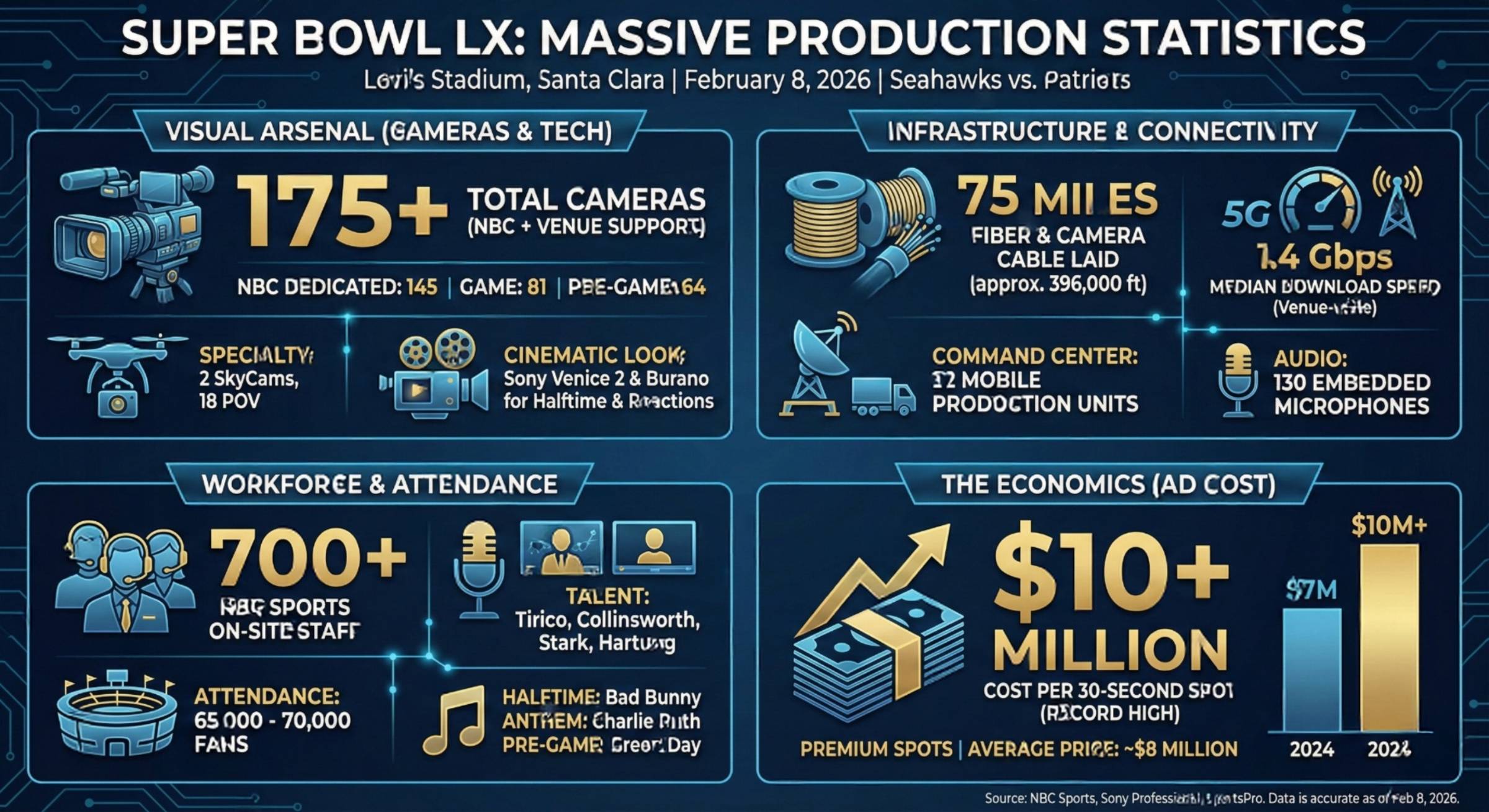
    Date: February 8, 2026
    Location: Levi’s Stadium, Santa Clara
    Matchup: Seattle Seahawks vs. New England Patriots

    As kickoff approaches, NBC, Peacock, and Telemundo are set to deliver the most technologically advanced broadcast in NFL history. Below is the breakdown of the massive production numbers defining today’s event.

    The Cost of a 30-Second Spot

    The price of airtime for Super Bowl LX has broken all previous records. NBCUniversal confirmed that inventory sold out as early as September.

    • Premium Spots: A handful of prime 30-second slots have sold for over $10 million.
    • Average Price: The average cost for a standard 30-second commercial is approximately $8 million.
    • Comparison: This is a significant jump from the $7 million average seen just two years ago.

    The Visual Arsenal: Cameras & Tech

    NBC has deployed 145 dedicated cameras. When including venue support, Sony reports over 175 total cameras are active inside the stadium.

    • Game Coverage: 81 cameras trained solely on the field.
    • Pre-Game: 64 cameras dedicated exclusively to the build-up.
    • Specialty Angles: Includes two SkyCams (one “High Sky” for tactical views) and 18 POV cameras.
    • Cinematic Style: The production is using Sony Venice 2 and Burano cinema cameras for the Halftime Show to provide a movie-like depth of field.

    The Infrastructure & Connectivity

    To connect this massive visual network, the crew has laid approximately 75 miles (396,000 feet) of fiber-optic and camera cable throughout Levi’s Stadium.

    • Audio: 130 microphones embedded around the field to capture every hit and whistle.
    • Command Center: 22 mobile production units are parked in the broadcast compound.
    • Connectivity: A massive 5G upgrade allowing for median download speeds of 1.4 Gbps for fans inside the venue.

    The Workforce & Attendance

    • Staff: Over 700 NBC Sports employees are on-site to manage the broadcast.
    • Talent: Mike Tirico (Play-by-Play), Cris Collinsworth (Analyst), Melissa Stark & Kaylee Hartung (Sideline).
    • Attendance: Expected crowd of 65,000 to 70,000 fans.

    The Entertainment Lineup


    Sources & Further Reading

  • How to Use Claude Code’s New “Agent Teams” Feature!

    How to Use Claude Code’s New “Agent Teams” Feature!

    Yesterday Anthropic dropped Claude Opus 4.6 and with it a research-preview feature called Agent Teams inside Claude Code.

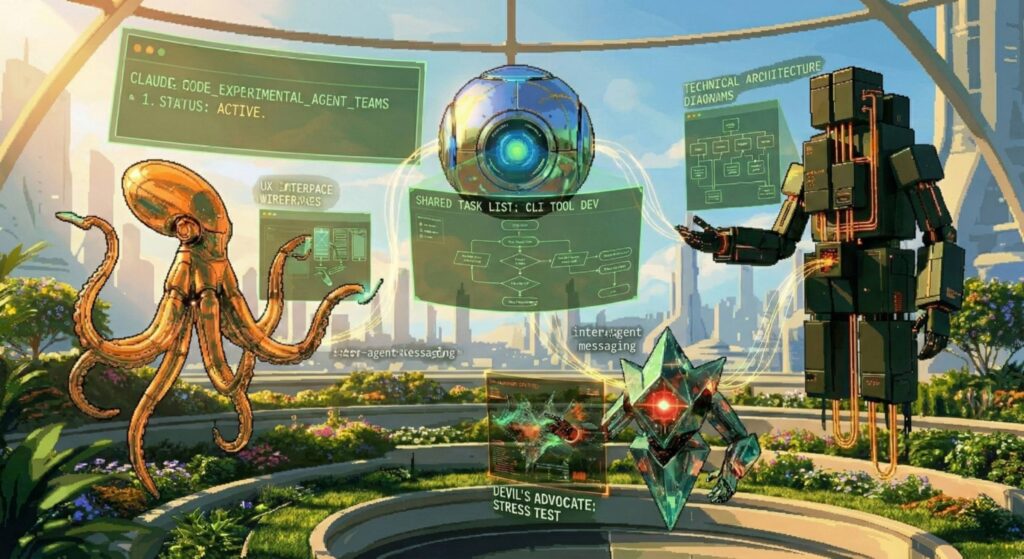
    In plain English: you can now spin up several independent Claude instances that work on the same project at the same time, talk to each other directly, divide up the work, and coordinate without you having to babysit every step. It’s like giving your codebase its own little engineering squad.

    1. What You Need First

    • Claude Code installed (the terminal app: claude command)
    • A Pro, Max, Team, or Enterprise plan
    • Expect higher token usage – each teammate is a full separate Claude session

    2. Enable Agent Teams (it’s off by default)

    {
      "env": {
        "CLAUDE_CODE_EXPERIMENTAL_AGENT_TEAMS": "1"
      }
    }

    Or one-off in your shell:

    export CLAUDE_CODE_EXPERIMENTAL_AGENT_TEAMS=1
    claude

    3. Start Your First Team (easiest way)

    Just type in Claude Code:

    Create an agent team to review PR #142.
    Spawn three reviewers:
    - One focused on security
    - One on performance
    - One on test coverage

    4. Two Ways to See What’s Happening

    A. In-process mode (default) – all teammates appear in one terminal. Use Shift + Up/Down to switch.

    B. Split-pane mode (highly recommended)

    {
      "teammateMode": "tmux"   // or "iTerm2"
    }

    Here’s exactly what it looks like in real life:

    Claude Code Agent Teams running in multiple panes
    Claude Code with multiple agents running in parallel (subagents/team view)
    tmux split panes with Claude teammates
    tmux split-pane mode showing several Claude teammates working simultaneously

    5. Useful Commands You’ll Actually Use

    • Shift + Tab → Delegate mode (lead only coordinates)
    • Ctrl + T → Toggle shared task list
    • Shift + Up/Down → Switch teammate
    • Type to any teammate directly

    6. Real-World Examples That Work Great

    • Parallel code review (security + perf + tests)
    • Bug hunt with competing theories
    • New feature across frontend/backend/tests

    7. Best Practices & Gotchas

    1. Use only for parallel work
    2. Give teammates clear, self-contained tasks
    3. Always run Clean up the team when finished

    Bottom Line

    Agent Teams turns Claude Code from a super-smart solo coder into a coordinated team of coders that can actually debate, divide labor, and synthesize results on their own.

    Try it today on a code review or a stubborn bug — the difference is immediately obvious.

    Official docs: https://code.claude.com/docs/en/agent-teams

    Go build something cool with your new AI teammates! 🚀

  • X’s $2M+ Bet on Long-Form Writing Just Paid Off — The Internet Will Never Be the Same

    On February 3, 2026, X (@XCreators) announced the winners of its first-ever $1 Million Article Contest. The total prize pool across all winners exceeded $2.15 million.

    This special contest was a major test to see how much high-quality long-form writing could perform on the platform.

    The $1 Million Grand Prize Winner

    @beaverd – “Deloitte: A $74-Billion Cancer Metastasized Across America”
    Read the full article here (44.7 million views)

    This deeply researched piece took over 50 hours to produce. @beaverd analyzed millions of government contracts, audits, and system failures to expose how Deloitte secured $74 billion in public contracts while being linked to multiple major project failures across several states.

    • California unemployment system failures – tens of billions wasted
    • Tennessee Medicaid collapse – 250,000+ kids lost coverage
    • $1.9 billion court digitization project abandoned
    • Revolving door between Deloitte and government agencies

    Runner-Up – $500,000

    @KobeissiLetter – “President Trump’s EXACT Tariff Playbook”
    Read it here (19M+ views)

    Creator’s Choice Award – $250,000

    @thedankoe – “Full guide: how to unlock extreme focus on command”
    Read the article

    Honorable Mentions – $100,000 each

    @nickshirleyy • @wolfejosh (donating full amount to charity) • @thatsKAIZEN • @ryanhallyall

    Why This Contest Matters

    X wanted to reward serious, original long-form content. The results showed that well-researched Articles can still generate massive reach and engagement on the platform.

    What Happens Next?

    The $1 Million prize was a special one-time contest for January. However, X has stated this is “only the beginning” of their push to support high-quality long-form writing.

    With increased revenue sharing and more focus on Articles, X is clearly encouraging creators to invest in deeper, more substantial content.

    The first million-dollar Article is already live:

    https://x.com/beaverd/status/2013366996180574446

    The bar for long-form writing on X has been raised significantly.

  • Elon Musk at Davos 2026: AI Will Be Smarter Than All of Humanity by 2030

    In a surprise appearance at the 2026 World Economic Forum in Davos, Elon Musk sat down with BlackRock CEO Larry Fink to discuss the engineering challenges of the coming decade. The conversation laid out an aggressive timeline for AI, robotics, and the colonization of space, framed by Musk’s goal of maximizing the future of human consciousness.


    ⚡ TL;DR

    Elon Musk predicts AI will surpass individual human intelligence by the end of 2026 and collective human intelligence by 2030. To overcome Earth’s energy bottlenecks, he plans to move AI data centers into space within the next three years, utilizing orbital solar power and the cold vacuum for cooling. Additionally, Tesla’s humanoid robots are slated for public sale by late 2027.


    🚀 Key Takeaways

    • The Intelligence Explosion: AI is expected to be smarter than any single human by the end of 2026, and smarter than all of humanity combined by 2030 or 2031.
    • Orbital Compute: SpaceX aims to launch solar-powered AI data centers into space within 2–3 years to leverage 5x higher solar efficiency and natural cooling.
    • Robotics for the Public: Humanoid “Optimus” robots are currently in factory testing; public availability is targeted for the end of 2027.
    • Starship Reusability: SpaceX expects to prove full rocket reusability this year, which would decrease the cost of space access by 100x.
    • Solving Aging: Musk views aging as a “synchronizing clock” across cells that is likely a solvable problem, though he cautions against societal stagnation if people live too long.

    📝 Detailed Summary

    The discussion opened with a look at the massive compounded returns of Tesla and BlackRock, establishing the scale at which both leaders operate. Musk emphasized that his ventures—SpaceX, Tesla, and xAI—are focused on expanding the “light of consciousness” and ensuring civilization can survive major disasters by becoming multi-planetary.

    Musk identified electrical power as the primary bottleneck for AI. He noted that chip production is currently outpacing the grid’s ability to support them. His “no-brainer” solution is space-based AI. By moving data centers to orbit, companies can bypass terrestrial power constraints and weather cycles. He also highlighted China’s massive lead in solar deployment compared to the U.S., where high tariffs have slowed the transition.

    The conversation concluded with Musk’s “philosophy of curiosity.” He shared that his drive stems from wanting to understand the meaning of life and the nature of the universe. He remains an optimist, arguing that it is better to be an optimist and wrong than a pessimist and right.


    🧠 Thoughts

    The most striking part of this talk is the shift toward space as a practical infrastructure solution for AI, rather than just a destination for exploration. If SpaceX achieves full reusability this year, the economic barrier to launching heavy data centers disappears. We are moving from the era of “Internet in the cloud” to “Intelligence in the stars.” Musk’s timeline for AGI (Artificial General Intelligence) also feels increasingly urgent, putting immense pressure on global regulators to keep pace with engineering.

  • How AI is Devastating Developer Ecosystems: The Brutal January 2026 Reality of Tailwind CSS Layoffs & Stack Overflow’s Pivot – Plus a Comprehensive Guide to Future-Proofing Your Career

    How AI is Devastating Developer Ecosystems: The Brutal January 2026 Reality of Tailwind CSS Layoffs & Stack Overflow's Pivot – Plus a Comprehensive Guide to Future-Proofing Your Career

    TL;DR (January 9, 2026 Update): Generative AI has delivered a double blow to core developer resources. Tailwind CSS, despite exploding to 75M+ monthly downloads, suffered an ~80% revenue drop as AI tools generate utility-class code instantly—bypassing docs and premium product funnels—leading Tailwind Labs to lay off 75% of its engineering team (3 out of 4 engineers) on January 7. Within 48 hours, major sponsors including Google AI Studio, Vercel, Supabase, Gumroad, Lovable, and others rushed in to support the project. Meanwhile, Stack Overflow’s public question volume has collapsed (down ~77–78% from 2022 peaks, back to 2009 levels), yet revenue doubled to ~$115M via AI data licensing deals and enterprise tools like Stack Internal (used by 25K+ companies). This is the live, real-time manifestation of AI “strip-mining” high-quality knowledge: it supercharges adoption while starving the sources. Developers must urgently adapt—embrace AI as an amplifier, pivot to irreplaceable human skills, and build proprietary value—or face obsolescence.

    Key Takeaways: The Harsh, Real-Time Lessons from January 2026

    • AI boosts usage dramatically (Tailwind’s 75M+ downloads/month) but destroys traffic-dependent revenue models by generating perfect code without needing docs or forums.
    • Small teams are especially vulnerable: Tailwind Labs reduced from 4 to 1 engineer overnight due to an 80% revenue crash—yet the framework itself thrives thanks to AI defaults.
    • Community & Big Tech respond fast: In under 48 hours after the layoffs announcement, sponsors poured in (Google AI Studio, Vercel, Supabase, etc.), turning a crisis into a “feel-good” internet moment.
    • Stack Overflow’s ironic success: Public engagement cratered (questions back to 2009 levels), but revenue doubled via licensing its 59M+ posts to AI labs and launching enterprise GenAI tools.
    • Knowledge homogenization accelerates: AI outputs default to Tailwind patterns, creating uniform “AI-look” designs and reducing demand for original sources.
    • The “training data cliff” risk is real: If human contributions dry up (fewer new SO questions, less doc traffic), AI quality on fresh/edge-case topics will stagnate.
    • Developer sentiment is mixed: 84% use or plan to use AI tools, but trust in outputs has dropped to ~29%, with frustration over “almost-right” suggestions rising.
    • Open-source business models must evolve: Shift from traffic/ads/premium upsells to direct sponsorships, data licensing, enterprise features, or AI-integrated services.
    • Human moats endure: Complex architecture, ethical judgment, cross-team collaboration, business alignment, and change management remain hard for AI to replicate fully.
    • Adaptation is survival: Top developers now act as AI orchestrators, system thinkers, and value creators rather than routine coders.

    Detailed Summary: The Full January 2026 Timeline & Impact

    As of January 9, 2026, the developer world is reeling from a perfect storm of AI disruption hitting two iconic projects simultaneously.

    Tailwind CSS Crisis & Community Response (January 7–9, 2026)

    Adam Wathan, creator of Tailwind CSS, announced on January 7 that Tailwind Labs had to lay off 75% of its engineering team (3 out of 4 engineers). In a raw, emotional video walk and GitHub comments, he blamed the “brutal impact” of AI: the framework’s atomic utility classes are perfect for LLM code generation, leading to massive adoption (75M+ monthly downloads) but a ~40% drop in documentation traffic since 2023 and an ~80% revenue plunge. Revenue came from premium products like Tailwind UI and Catalyst—docs served as the discovery funnel, now short-circuited by tools like Copilot, Cursor, Claude, and Gemini.

    The announcement sparked an outpouring of support. Within 24–48 hours, major players announced sponsorships: Google AI Studio (via Logan Kilpatrick), Vercel, Supabase, Gumroad, Lovable, Macroscope, and more. Adam clarified that Tailwind still has “a fine business” (just not great anymore), with the partner program now funding the open-source core more directly. He remains optimistic about experimenting with new ideas in a leaner setup.

    Stack Overflow’s Parallel Pivot

    Stack Overflow’s decline started earlier (post-ChatGPT in late 2022) but accelerated: monthly questions fell ~77–78% from 2022 peaks, returning to 2009 levels (3K–7K/month). Yet revenue roughly doubled to $115M (FY 2025–2026), with losses cut dramatically. The secret? Licensing its massive, human-curated Q&A archive to AI companies (OpenAI, Google, etc.)—similar to Reddit’s $200M+ deals—and launching enterprise products like Stack Internal (GenAI powered by SO data, used by 25K+ companies) and AI Assist.

    This creates a vicious irony: AI trained on SO and Tailwind data, commoditizes it, reduces human input, and risks a “training data cliff” where models stagnate on new topics. Meanwhile, homogenized outputs fuel demand for unique, human-crafted alternatives.

    Future-Proofing Your Developer Career: In-Depth 2026 Strategies

    AI won’t erase developer jobs (projections still show ~17% growth through 2033), but it will automate routine coding. Winners will leverage AI while owning what machines can’t replicate. Here’s a detailed, actionable roadmap:

    1. Master AI Collaboration & Prompt Engineering: Pick one powerhouse tool (Cursor, Claude, Copilot, Gemini) and become fluent. Use advanced prompting for complex tasks; always validate for security, edge cases, performance, and hallucinations. Chain agents (e.g., via LangChain) for multi-step workflows. Integrate daily—let AI handle boilerplate while you focus on oversight.
    2. Elevate to Systems Architecture & Strategic Thinking: AI excels at syntax; humans win on trade-offs (scalability vs. cost vs. maintainability), business alignment (ROI, user impact), and risk assessment. Study domain-driven design, clean architecture, and system design interviews. Become the “AI product manager” who defines what to build and why.
    3. Build Interdisciplinary & Human-Centric Skills: Hone communication (explaining trade-offs to stakeholders), leadership, negotiation, and domain knowledge (fintech, healthcare, etc.). Develop soft skills like change management and ethics—areas where AI still struggles. These create true moats.
    4. Create Proprietary & Defensible Assets: Own your data, custom fine-tunes, guardrailed agents, and unique workflows. For freelancers/consultants: specialize in AI integration, governance, risk/compliance, or hybrid human-AI systems. Document patterns that AI can’t easily replicate.
    5. Commit to Lifelong, Continuous Learning: Follow trends via newsletters (Benedict Evans), podcasts (Lex Fridman), and communities. Pursue AI/ML certs, experiment with emerging agents, and audit your workflow quarterly: What can AI do better? What must remain human?
    6. Target Resilient Roles & Mindsets: Seek companies heavy on AI innovation or physical-world domains. Aim for roles like AI Architect, Prompt Engineer, Agent Orchestrator, or Knowledge Curator. Mindset shift: Compete by multiplying AI, not against it.

    Start small: Build a side project with AI agents, then manually optimize it. Network in Toronto’s scene (MaRS, meetups). Experiment relentlessly—the fastest adapters will define the future.

    Navigating the AI Era in 2026 and Beyond

    January 2026 feels like a knowledge revolution turning point—AI democratizes access but disrupts gatekeepers. The “training data cliff” is a genuine risk: without fresh human input, models lose edge on novelty. Yet the response to Tailwind’s crisis shows hope—community and Big Tech stepping up to sustain the ecosystem.

    Ethically, attribution matters: AI owes a debt to SO contributors and Tailwind’s patterns—better licensing, revenue shares, or direct funding could help. For developers in Toronto’s vibrant hub, opportunities abound in AI consulting, hybrid tools, and governance.

    This isn’t the death of development—it’s evolution into a more strategic, amplified era. View AI as an ally, stay curious, keep building, and remember: human ingenuity, judgment, and connection will endure.

  • Tailwind CSS Layoffs 2026: AI’s Double-Edged Sword Causes 75% Staff Cuts at Tailwind Labs

    Tailwind CSS Layoffs 2026: AI's Double-Edged Sword Causes 75% Staff Cuts at Tailwind Labs

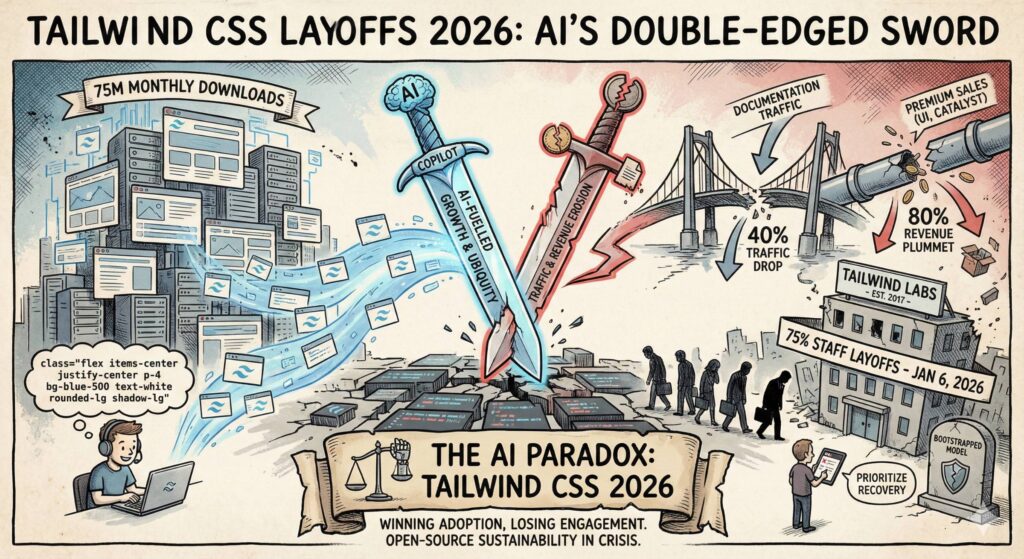
    TLDR: Tailwind Labs, creators of the popular Tailwind CSS framework, laid off 75% of its engineering team on January 6, 2026, due to AI-driven disruptions. While AI boosted Tailwind’s popularity with 75 million monthly downloads, it slashed documentation traffic by 40% and revenue by 80%, as developers rely on AI tools like GitHub Copilot instead of visiting the site. This “AI paradox” highlights vulnerabilities in open-source business models, sparking community debates on sustainability and future adaptations.

    Key Takeaways

    • Tailwind CSS’s explosive growth is fueled by AI coding agents generating its code by default, leading to ubiquity in modern web development but bypassing traditional learning and monetization channels.
    • Documentation site traffic dropped 40% since early 2023, crippling upsells for premium products like Tailwind UI and Catalyst, as AI handles queries without site visits.
    • Revenue plummeted 80%, forcing drastic layoffs in the bootstrapped company, with no venture backing to cushion the blow.
    • The announcement came via a GitHub PR comment, going viral on X, Hacker News, and Reddit, eliciting sympathy, irony, and calls for pivots or acquisitions.
    • Broader implications include risks for other doc-heavy tools, reduced deep learning among developers, and acceleration of open-source commoditization by AI.
    • Potential futures: Short-term focus on maintenance, long-term shifts to AI-integrated products, partnerships, or new revenue streams like subscriptions.

    Detailed Summary

    Tailwind CSS, launched in 2017 by Adam Wathan and Steve Schoger, revolutionized web development with its utility-first approach. Developers apply classes directly in HTML for rapid UI building, integrating seamlessly with frameworks like React and Next.js. Tailwind Labs monetizes through premium offerings while keeping the core framework open-source and free.

    The crisis unfolded on January 6, 2026, when Wathan announced in a GitHub pull request that 75% of the engineering team was laid off. The PR proposed an “AGENTS.md” file for guiding LLMs to generate Tailwind code optimally. Wathan rejected it, citing the need to prioritize business recovery over community features.

    In his comment, Wathan explained: Traffic to tailwindcss.com fell 40% despite rising popularity, as AI tools like Copilot and Claude output Tailwind code without users needing docs. This site was crucial for promoting paid products, leading to an 80% revenue drop. Contributor Michael Sears warned of potential “abandonware” without sustainable funding.

    The news exploded online. On X (formerly Twitter), posts like one from @ybhrdwj amassed thousands of likes, highlighting the irony. Discussions on Hacker News (over 465 comments) and Reddit’s r/theprimeagen debated AI’s commoditization of knowledge. Media outlets like DevClass and OfficeChai framed it as a warning for traffic-reliant businesses.

    Community reactions mixed shock with suggestions: Pivot like avoiding Kodak’s fate, shame Big Tech for non-contribution, or pursue acquisitions by firms like Vercel or Anthropic.

    Some Thoughts on the AI Paradox and Open-Source Future

    This situation exemplifies AI’s disruptive power—boosting adoption while eroding foundations. Tailwind “won” by becoming AI’s default CSS choice but lost human engagement essential for monetization. It’s a wake-up call for bootstrapped startups: Relying on organic traffic is precarious when AI answers queries instantly.

    For developers, AI enhances productivity but risks shallower skills, potentially flooding codebases with unvetted “junk.” Hiring may favor those who can curate AI outputs effectively.

    Open-source sustainability feels more fragile; premium add-ons falter as AI replicates value for free. Alternatives like enterprise support or AI partnerships could emerge. Tailwind’s resilience lies in its community—if it adapts to AI-native tools, it could thrive. Otherwise, it risks fading, underscoring that in 2026, AI reshapes value chains relentlessly.

  • Gmail Enters the Gemini Era: New AI Features Revolutionizing Your Inbox in 2026

    Gmail Enters the Gemini Era: New AI Features Revolutionizing Your Inbox in 2026

    TL;DR: Google is supercharging Gmail with Gemini AI, introducing features like AI Overviews for instant answers from your inbox, Help Me Write for drafting emails, Suggested Replies, Proofread, and an upcoming AI Inbox for prioritizing tasks. Many roll out today for free, with premium options for subscribers, starting in the US and expanding globally.

    Key Takeaways

    • AI Overviews: Summarizes long email threads and answers natural language questions like “Who quoted my bathroom renovation?” – free conversation summaries today, full Q&A for Google AI Pro/Ultra subscribers.
    • Help Me Write & Suggested Replies: Draft or polish emails from scratch, with context-aware one-click responses in your style – available to everyone for free starting today.
    • Proofread: Advanced checks for grammar, tone, and style – exclusive to Google AI Pro/Ultra subscribers.
    • AI Inbox: A personalized briefing that highlights to-dos, prioritizes VIPs, and filters clutter securely – coming soon for trusted testers, broader rollout in months.
    • Personalization Boost: Next month, Help Me Write integrates context from other Google apps for better tailoring.
    • Availability: Powered by Gemini 3, starting in US English today, with more languages and regions soon. Link to original announcement: Google Blog Post.

    Detailed Summary

    Google’s latest announcement marks a pivotal shift for Gmail, transforming it from a simple email client into an intelligent, proactive assistant powered by Gemini AI. With over 3 billion users worldwide, Gmail has evolved since its 2004 launch, but rising email volumes have made inbox management a daily battle. Enter the “Gemini era,” where AI takes center stage to streamline your workflow.

    At the heart of these updates is AI Overviews, inspired by Google Search’s AI summaries. This feature eliminates the need for manual digging through emails. For lengthy threads, it provides a concise breakdown of key points right when you open the message. Even better, you can query your entire inbox in natural language—think asking for specific details from old quotes or reservations—and Gemini’s reasoning engine delivers an instant overview with the exact info you need. Conversation summaries are free for all users starting today, while the full question-answering capability is reserved for paid Google AI Pro and Ultra plans.

    Productivity gets a major upgrade with Help Me Write, now available to everyone, allowing you to draft emails from scratch or refine existing ones. Paired with Suggested Replies (an evolution of Smart Replies), it analyzes conversation context to suggest responses that mimic your personal writing style—perfect for quick coordination like family events. Just tap to use or tweak. For that extra polish, Proofread offers in-depth reviews of grammar, tone, and style, ensuring your emails are professional and on-point. Help Me Write and Suggested Replies are free, but Proofread requires a subscription.

    Looking ahead, the AI Inbox promises to redefine how you start your day. It acts as a smart filter, surfacing critical updates like bill deadlines or appointment reminders while burying the noise. By analyzing signals such as frequent contacts and message content (all done privately on Google’s secure systems), it identifies VIPs and to-dos, giving you a personalized snapshot. Trusted testers get early access, with a full launch in the coming months.

    These features are fueled by the advanced Gemini 3 model, ensuring speed and accuracy. Rollouts begin today in the US for English users, with expansions to more languages and regions planned. Next month, Help Me Write will pull in data from other Google apps for even smarter personalization.

    Some Thoughts

    This Gemini integration could be a game-changer for overwhelmed inboxes, turning Gmail into a true AI sidekick that anticipates needs rather than just storing messages. It’s exciting to see free access for core features, democratizing AI for everyday users, but the premium gating on advanced tools like full AI Overviews and Proofread might frustrate non-subscribers. Privacy remains a hot topic—Google emphasizes secure processing, but users should stay vigilant about data controls. Overall, in a world drowning in emails, this feels like a timely evolution that could boost productivity without sacrificing usability. If it delivers on the hype, competitors like Outlook might need to play catch-up fast.