PJFP.com

Pursuit of Joy, Fulfillment, and Purpose

Day: May 28, 2026

  • Anthropic Raises $65 Billion Series H at $965 Billion Valuation to Fund AI Safety Research and Massive Compute Expansion

    Anthropic has closed one of the largest private financing rounds in the history of technology, raising $65 billion in Series H funding at a $965 billion post-money valuation. The round, announced on May 28, 2026, lands as demand for Claude reaches what the company calls historic levels, and it positions Anthropic to pour fresh capital into safety research, compute, and the products that enterprises now lean on every day.

    TLDR

    Anthropic raised $65 billion in its Series H at a $965 billion post-money valuation, with Altimeter Capital, Dragoneer, Greenoaks, and Sequoia Capital leading and Capital Group, Coatue, D1 Capital Partners, GIC, ICONIQ, and XN co-leading, alongside $15 billion in previously committed hyperscaler investment that includes $5 billion from Amazon. The raise follows Anthropic crossing $47 billion in run-rate revenue earlier in May 2026, and it funds three priorities named by CFO Krishna Rao: advancing safety and interpretability research, expanding compute capacity to meet growing Claude demand, and scaling the products and partnerships customers depend on. On the infrastructure side, the company is locking in gigawatt-scale compute through 5 gigawatts with Amazon, 5 gigawatts of TPU capacity via Google and Broadcom, GPU access from SpaceX, and supply from partners Micron, Samsung, and SK hynix, while Claude remains available across all three major cloud platforms, AWS, Google Cloud, and Microsoft Azure, with widespread enterprise adoption across industries.

    Thoughts

    Start with the number that everyone will fixate on. A $965 billion post-money valuation against $47 billion in run-rate revenue is roughly 20 times sales, and for a company growing this fast that multiple is not the interesting part. The interesting part is that run-rate revenue crossed $47 billion earlier this month, which means the denominator is moving so quickly that the multiple is already stale. Investors are not pricing the business Anthropic is today. They are pricing the slope. A 20x multiple on a number that may double again inside a year is a very different bet than 20x on a flat line, and the lead names here (Altimeter, Dragoneer, Greenoaks, Sequoia, with Capital Group, Coatue, GIC and others co-leading) are not the kind of capital that pays for nostalgia. They are paying for the second derivative.

    But the real story is not the valuation. It is the compute. Read the infrastructure list carefully and you see the actual problem this round solves: 5 gigawatts from Amazon, 5 gigawatts of TPU capacity through Google and Broadcom, GPU access from SpaceX, and memory supply locked down with Micron, Samsung, and SK hynix. That is more than 10 gigawatts of secured power and silicon. The constraint on frontier AI in 2026 is no longer talent or even algorithms. It is electricity, land, and the multi-year queue for advanced packaging and high-bandwidth memory. You cannot buy 10 gigawatts on a quarterly basis. You reserve it years out, and you need the balance sheet to make those commitments credible. A $65 billion raise is, in plain terms, the down payment that lets Anthropic sign for capacity nobody can conjure on demand. The money is downstream of the megawatts.

    The diversification across that compute stack matters as much as the size. By splitting between Amazon’s infrastructure, Google and Broadcom’s custom TPUs, and SpaceX-supplied GPUs, Anthropic is refusing to become hostage to any single supplier’s roadmap or pricing. Custom silicon through Broadcom in particular is a bet on bending the cost curve, because the long-term economics of serving Claude at this scale depend on dollars per token, not just on raw availability. Anyone who has watched cloud lock-in play out over the last decade understands the move. Optionality at the hardware layer is leverage, and leverage is what keeps margins from being dictated by whoever owns the only fab slot you can reach.

    It is worth pausing on the fact that the round explicitly funds safety and interpretability research alongside scaling, and not as a footnote. Most companies treat safety spend as a cost center to be minimized once growth kicks in. Naming it first, ahead of compute and products, is a statement about where Anthropic believes its durable advantage sits. If models keep getting more capable, the binding constraint on deployment inside regulated industries (finance, healthcare, government) becomes trust, not intelligence. Interpretability is the work that turns a black box into something an enterprise risk committee can actually sign off on. Framed that way, safety research is not philanthropy subtracted from the bottom line. It is the thing that unlocks the most lucrative and defensible parts of the market, and pairing it with the scaling budget is the tell.

    Finally, look at distribution. Claude now ships on all three major clouds at once: AWS, Google Cloud, and Microsoft Azure. In a market where most frontier labs are tethered to a single hyperscaler, being available everywhere enterprises already run their workloads is a structural edge. It removes the procurement friction of asking a customer to adopt a new vendor relationship, and it means Anthropic competes on the merits of the model rather than on which cloud a buyer happened to standardize on years ago. Combine that omnipresent distribution with the compute reservations and the explicit safety mandate, and the shape of the strategy is clear. This is not a company buying time. It is a company buying the three things that actually compound: capacity that cannot be rushed, trust that cannot be faked, and reach into every place where work already happens.

    Key Takeaways

    • Anthropic raised $65 billion in its Series H funding round, one of the largest private financings in the history of the technology industry.
    • The round set Anthropic’s post-money valuation at $965 billion, placing the company within reach of the $1 trillion mark.
    • Altimeter Capital, Dragoneer, Greenoaks, and Sequoia Capital led the Series H round.
    • Capital Group, Coatue, D1 Capital Partners, GIC, ICONIQ, and XN served as co-leads on the investment.
    • The new capital builds on $15 billion in previously committed hyperscaler investments, which includes $5 billion from Amazon.
    • Anthropic crossed $47 billion in run-rate revenue earlier in May 2026, reflecting the surging commercial demand for Claude.
    • A core priority for the funding is to advance Anthropic’s safety and interpretability research.
    • The company will use the capital to expand compute capacity in order to meet growing demand for Claude.
    • Anthropic plans to scale the products and partnerships that customers depend on across its business.
    • CFO Krishna Rao said the funding will help Anthropic serve the historic demand it is experiencing, stay at the research frontier, and bring Claude to more of the places where work happens.
    • Amazon is providing 5 gigawatts of compute capacity as part of Anthropic’s infrastructure expansion.
    • Google and Broadcom are supplying 5 gigawatts of TPU capacity to power Claude’s growth.
    • SpaceX is contributing GPU access to Anthropic’s compute footprint.
    • Micron, Samsung, and SK hynix are partnering with Anthropic on memory and infrastructure to support its scaling needs.
    • Claude is available on all three major cloud platforms, AWS, Google Cloud, and Microsoft Azure.
    • Anthropic reports widespread enterprise adoption of Claude across a broad range of industries.

    Detailed Summary

    The Raise and the Valuation

    Anthropic has raised $65 billion in Series H funding, a round that values the company at $965 billion on a post-money basis. The size of the raise places it among the largest private financing events the technology industry has ever seen, and the valuation pushes Anthropic to the doorstep of the trillion dollar mark. The capital arrives at a moment when demand for the company’s Claude models has accelerated sharply, and the round is built to fund the response to that demand rather than simply mark a milestone. Anthropic framed the financing in its Series H announcement as the fuel for staying at the research frontier while scaling the infrastructure and products that customers increasingly rely on.

    Who Put In the Money

    The Series H was led by Altimeter Capital, Dragoneer, Greenoaks, and Sequoia Capital, a group that combines deep growth-stage technology experience with conviction in Anthropic’s long-term trajectory. Joining as co-leads were Capital Group, Coatue, D1 Capital Partners, GIC, ICONIQ, and XN, a roster that spans crossover funds, sovereign wealth, and institutional investors. Beyond the new equity, Anthropic pointed to $15 billion in previously committed hyperscaler investment, including $5 billion from Amazon. Taken together, the investor base reflects a mix of financial backers and strategic partners with a direct stake in seeing Claude reach more customers and more compute.

    Revenue at $47 Billion Run-Rate

    Underpinning the valuation is a business that has scaled with unusual speed. Anthropic crossed a $47 billion run-rate revenue figure earlier in May 2026, a number that signals how quickly enterprises and developers have adopted Claude across their workflows. Run-rate revenue annualizes the company’s most recent performance, and at this level it puts Anthropic firmly among the fastest growing software businesses on record. That financial momentum is the practical justification for both the round’s size and the near trillion dollar valuation investors were willing to support.

    The Compute Buildout

    A large share of the strategy behind the raise centers on securing compute at enormous scale. Anthropic detailed a set of infrastructure partnerships designed to keep pace with Claude demand. Amazon is providing 5 gigawatts of capacity, while Google and Broadcom together are supplying 5 gigawatts of TPU capacity. SpaceX is contributing GPU access, broadening the range of silicon Anthropic can draw on. Supporting the buildout on the hardware supply side are Micron, Samsung, and SK hynix, the memory and component partners whose output is essential to standing up data centers at this magnitude. The combined picture is a company assembling power, chips, and supply chain commitments measured in gigawatts rather than racks.

    Where the Money Goes

    Anthropic outlined three priorities for the new capital. The first is to advance safety and interpretability research, continuing the work of understanding how models behave and ensuring they remain reliable as they grow more capable. The second is to expand compute capacity to meet the growing demand for Claude, the practical engine behind the infrastructure commitments above. The third is to scale the products and partnerships that customers depend on, deepening the company’s reach into the tools and platforms where work actually happens. Krishna Rao, Anthropic’s chief financial officer, said the funding “will help us serve the historic demand we are experiencing, stay at the research frontier, and bring Claude to more of the places where work happens.”

    Claude Everywhere

    The funding lands on top of a distribution footprint that already spans the major cloud ecosystems. Claude is available on all three leading cloud platforms, AWS, Google Cloud, and Microsoft Azure, which means enterprises can reach the models through whichever provider they have standardized on. That availability has translated into widespread enterprise adoption across industries, from software and finance to healthcare and beyond. By being present everywhere developers and businesses already operate, Anthropic positions Claude not as a destination customers must travel to but as a capability woven into the platforms they use every day.

    Notable Quotes

    This funding will help us serve the historic demand we are experiencing, stay at the research frontier, and bring Claude to more of the places where work happens.

    Krishna Rao, CFO at Anthropic, on the purpose of the Series H round.

    Advance safety and interpretability research, expand compute capacity to meet growing Claude demand, and scale products and partnerships customers depend on.

    How Anthropic describes its use of funds from the round.

    For the full details on the round, the lead and co-lead investors, and how Anthropic plans to deploy the capital across safety research, compute, and products, read the full announcement here.

    Related Reading

    • Anthropic, the AI safety and research company behind Claude that raised this Series H round.
    • Sequoia Capital, one of the lead investors anchoring the financing.
    • Amazon Web Services, one of the three major cloud platforms where Claude is available and the source of a $5 billion investment.
    • Google Cloud TPUs, the tensor processing units behind the 5 gigawatts of TPU capacity in the Google and Broadcom partnership.
    • AI safety, the research field at the center of how Anthropic says it will use the new funding.
  • Claude Opus 4.8 Released: Anthropic Bets on Honesty, Dynamic Workflows, Effort Control, and Cheaper Fast Mode

    Anthropic has released Claude Opus 4.8, the newest member of its flagship Opus class, available today across every surface and priced exactly like the model it replaces. The company calls it “a modest but tangible improvement” on Opus 4.7, but the framing undersells what is actually interesting here: the headline upgrade is not a benchmark number, it is honesty. Opus 4.8 is built to know when it does not know, and that single behavioral shift may matter more for real agent work than any raw capability bump.

    TLDR

    Claude Opus 4.8 is an across-the-board upgrade to Anthropic’s Opus class that ships today at the same regular price as Opus 4.7 ($5 per million input tokens, $25 per million output tokens), with the model positioned as “a more effective collaborator.” The marquee improvement is honesty: Opus 4.8 is roughly four times less likely than its predecessor to let flaws in its own code pass unremarked, and it is more willing to flag uncertainty rather than confidently claim progress on thin evidence. A pre-release alignment assessment found new highs on prosocial traits like supporting user autonomy and acting in the user’s best interest, with misaligned behavior at rates similar to Anthropic’s best-aligned model, Claude Mythos Preview. Three things launch alongside the model: dynamic workflows in Claude Code (research preview), where Claude plans work then runs hundreds of parallel subagents that run even longer and verify their own outputs before reporting back; effort control in claude.ai and Cowork, a slider for how hard Claude thinks; and a Messages API update that accepts system entries inside the messages array so developers can update instructions mid-task without breaking the prompt cache. Fast mode now runs at 2.5x speed and is three times cheaper than before ($10 / $50 per million tokens). The roadmap points to cheaper Opus-equivalent models, a higher-intelligence class above Opus, and a wider rollout of Mythos-class models gated behind stronger cyber safeguards under Project Glasswing.

    Thoughts

    The most important sentence in this announcement is not about coding scores. It is the claim that Opus 4.8 is about four times less likely than Opus 4.7 to let flaws in its own code slip by without comment. For a chat assistant, overconfidence is annoying. For an agent, it is catastrophic. The whole premise of long-running autonomous work is that you hand the model a task and walk away, which means the model’s own judgment about whether it succeeded becomes the only judgment in the loop until you come back. A model that confidently declares victory on a half-finished migration does not save you time, it costs you a debugging session plus the time you spent trusting it. Honesty, framed this way, is not a soft virtue. It is the load-bearing reliability property that makes unattended agents usable at all.

    Read the launch as a single coherent argument rather than a list of features, and the pieces lock together. Dynamic workflows let Claude plan a job and fan out hundreds of parallel subagents that, with Opus 4.8, run longer than before. Effort control lets you dial up how much the model thinks. The honesty improvement means the model checks its own work and flags what it is unsure about instead of papering over it. Put those three together and you get one product thesis: let it run longer, let it think harder, and trust it to tell you when something is wrong. The codebase-scale migration example, hundreds of thousands of lines from kickoff to merge with the existing test suite as the bar, is the proof point. None of those three capabilities is worth much alone. A model that runs for hours but lies about its results is a liability. A model that flags uncertainty but cannot sustain a long task never reaches the moment where its honesty matters. Anthropic shipped all three at once because they only pay off together.

    The economics deserve a closer look than the “same price” headline invites. Regular pricing is flat versus Opus 4.7, which is the polite way of saying you get a better model for free. The real move is fast mode: 2.5x the speed at three times cheaper than it cost on previous models, landing at $10 per million input and $50 per million output. That is Anthropic quietly attacking the latency-versus-cost tradeoff that has shaped how teams deploy frontier models. Until now, “fast” meant “expensive,” so you reserved it for interactive moments and ate the wait everywhere else. Collapsing that premium changes the default. And note the subtle token story underneath: Opus 4.8 at its default high effort spends roughly the same tokens on coding as Opus 4.7’s default while performing better, so the effort slider is not a way to bleed you dry, it is an honest exposure of the quality-cost dial that was always there implicitly.

    The Messages API change is the kind of unglamorous plumbing that practitioners will appreciate immediately. Letting system entries live inside the messages array means you can update an agent’s instructions, permissions, token budget, or environment context partway through a task without smuggling the update through a fake user turn and without blowing up your prompt cache. Anyone who has built a long-running agent has hit this wall: the world changes mid-task, the agent needs new constraints, and the only clean way to inject them previously was a cache-busting hack. This is Anthropic treating agents as first-class, stateful, long-lived processes rather than oversized chat sessions. It is a small spec change with outsized implications for how you architect an agent that runs for an hour.

    Then there is the roadmap, where the most telling line is the quietest. Anthropic says a small number of organizations are already using Claude Mythos Preview for cybersecurity work under Project Glasswing, and that models of this capability level require stronger cyber safeguards before general release. Notice that they are pinning Opus 4.8’s alignment numbers to Mythos as the benchmark for “best-aligned,” while simultaneously holding Mythos back from general availability on safety grounds. That is a deliberate signal: the next class of model is good enough that they are gating it on cyber-offense risk, not on capability. For a site about the pursuit of joy, fulfillment, and purpose through AI, this is the part worth sitting with. The frontier is increasingly defined not by what the models can do, but by what their builders decide it is responsible to ship. Honesty in the small (flagging a bad line of code) and restraint in the large (holding back a cyber-capable model) are the same instinct expressed at two different scales.

    Key Takeaways

    • Claude Opus 4.8 is now available everywhere, replacing Opus 4.7 as Anthropic’s flagship Opus-class model and positioned as “a more effective collaborator.”
    • Regular usage pricing is unchanged from Opus 4.7, holding at $5 per million input tokens and $25 per million output tokens, so the capability gains come at no added cost.
    • The single most emphasized improvement is honesty, which Anthropic treats as a core trained behavior rather than a marketing flourish.
    • Evaluations show Opus 4.8 is around four times less likely than its predecessor to let flaws in its own code pass unremarked, a direct reliability win for autonomous coding.
    • Early testers report the model is more likely to flag uncertainty about its work and less likely to make unsupported claims or jump to conclusions on thin evidence.
    • A detailed alignment assessment was run before release and concluded Opus 4.8 reaches new highs on prosocial traits like supporting user autonomy and acting in the user’s best interest.
    • Misaligned behavior such as deception or cooperation with misuse is at rates substantially lower than Opus 4.7 and similar to Anthropic’s best-aligned model, Claude Mythos Preview.
    • The full alignment assessment and pre-deployment safety tests are documented in the public Claude Opus 4.8 System Card.
    • Dynamic workflows launch as a research preview inside Claude Code, letting Claude plan the work and then run hundreds of parallel subagents in a single session.
    • With Opus 4.8, those subagents can run even longer, and Claude verifies its outputs before reporting back rather than declaring success blindly.
    • Anthropic’s flagship example for dynamic workflows is a codebase-scale migration across hundreds of thousands of lines of code, from kickoff to merge, using the existing test suite as the success bar.
    • Dynamic workflows are available in Claude Code for the Enterprise, Team, and Max plans.
    • Effort control arrives in claude.ai and Cowork as a setting next to the model selector that lets users choose how much effort Claude puts into a response.
    • Higher effort makes Claude think more frequently and deeply for better answers; lower effort responds faster and consumes rate limits more slowly. Effort control is available on all plans.
    • Opus 4.8 defaults to “high” effort, judged the best overall balance of quality and user experience.
    • On coding tasks, the default effort spends a similar number of tokens as Opus 4.7’s default but delivers better performance, so quality rises without a token penalty.
    • Users can select “extra” (called “xhigh” in Claude Code) or “max” to spend more tokens for stronger results, and Anthropic recommends “extra” for difficult tasks and long-running asynchronous workflows.
    • Rate limits in Claude Code were increased to accommodate the higher token usage of the higher effort levels.
    • The Messages API now accepts system entries inside the messages array, a meaningful change for agent developers.
    • That update lets developers change Claude’s instructions mid-task, adjusting permissions, token budgets, or environment context, without breaking the prompt cache or routing through a user turn.
    • Fast mode now runs at 2.5x speed and is three times cheaper than it was for previous models, priced at $10 per million input tokens and $50 per million output tokens.
    • Developers access the model as claude-opus-4-8 through the Claude API.
    • Partner Miguel Gonzalez reports Opus 4.8 scored 84% on Online-Mind2Web, a meaningful jump over both Opus 4.7 and GPT-5.5, calling it the strongest computer-use and browser-agent model his team has tested.
    • Databricks reports that, inside Genie, Opus 4.8 reasons over unstructured content like PDFs and diagrams at 61% cheaper token cost than Opus 4.7.
    • Thomson Reuters reports Opus 4.8 is the first model to break 10% overall on the all-pass standard of its Legal Agent Benchmark, the highest score recorded there.
    • Eleven partners weighed in, including Cursor, Cognition’s Devin, Databricks Genie, Thomson Reuters CoCounsel, and Hebbia, spanning coding, legal, finance, and enterprise data work.
    • Anthropic is working on models that deliver many of the same capabilities as Opus at a lower cost.
    • The company plans to release a new class of model with even higher intelligence than Opus.
    • Under Project Glasswing, a small number of organizations are already using Claude Mythos Preview for cybersecurity work, with Mythos-class models expected to reach all customers in the coming weeks once stronger cyber safeguards are in place.

    Detailed Summary

    What Claude Opus 4.8 Is

    Claude Opus 4.8 is an upgrade to Anthropic’s Opus class of models, building on Opus 4.7 with improvements across benchmarks covering coding, agentic skills, reasoning, and practical knowledge-work tasks. Anthropic describes the result as “a more effective collaborator” while characterizing the release overall as “a modest but tangible improvement on its predecessor.” The model is available today, everywhere, and developers call it as claude-opus-4-8 via the Claude API. The announcement includes a comparison table against the predecessor and other models, though the per-cell numbers in that table are published as an image and are not reproduced here as text.

    Honesty: The Headline Improvement

    Anthropic singles out honesty as one of the most prominent improvements in Opus 4.8. All of the company’s models are trained to be honest, which includes avoiding claims they cannot support. A persistent problem with AI models generally is that they sometimes jump to conclusions, confidently claiming progress despite thin evidence. Early testers report that Opus 4.8 is more likely to flag uncertainties about its own work and less likely to make unsupported claims. The most concrete measure: evaluations show Opus 4.8 is around four times less likely than its predecessor to allow flaws in code it has written to pass unremarked. For agentic and unattended use, this self-skepticism is the difference between a model that reliably tells you when something went wrong and one that quietly ships a broken result.

    Alignment Assessment

    A detailed alignment assessment was run before release. On the positive side, the Alignment team concluded that Opus 4.8 “reaches new highs on our measures of prosocial traits like supporting user autonomy and acting in the user’s best interest.” On the risk side, misaligned behavior such as deception or cooperation with misuse occurs at rates substantially lower than Opus 4.7, and similar to Anthropic’s best-aligned model, Claude Mythos Preview. The full alignment assessment and the pre-deployment safety tests are published in the Claude Opus 4.8 System Card, which also contains the complete benchmark table and wider evaluations.

    Dynamic Workflows in Claude Code

    Launching today as a research preview in Claude Code, dynamic workflows let Claude plan the work and then run hundreds of parallel subagents in a single session. With Opus 4.8, those agents can run even longer than before, and Claude verifies its outputs before reporting back rather than reporting unchecked results. The showcase example is a codebase-scale migration: Claude Code with Opus 4.8 can carry out migrations across hundreds of thousands of lines of code, all the way from kickoff to merge, using the existing test suite as its bar for success. Dynamic workflows are available in Claude Code for the Enterprise, Team, and Max plans.

    Effort Control

    Effort control arrives in claude.ai and Cowork as a setting alongside the model selector that lets users choose how much effort Claude puts into a response. Higher effort means Claude thinks more frequently and deeply for better responses; lower effort means it responds faster and uses rate limits more slowly. Opus 4.8 defaults to “high” effort, which Anthropic judged the best overall balance of quality and user experience. On coding tasks, that default spends a similar number of tokens as Opus 4.7’s default while performing better. Users who want more can choose “extra” (called “xhigh” in Claude Code) or “max” to spend more tokens for stronger results, and Anthropic recommends “extra” for difficult tasks and long-running asynchronous workflows. To support the heavier token usage at higher effort levels, rate limits in Claude Code were increased. Effort control is available on all plans.

    Messages API Update

    The Messages API now accepts system entries inside the messages array. This lets developers update Claude’s instructions mid-task without breaking the prompt cache and without routing the update through a user turn. In practice that means you can update permissions, token budgets, or environment context while an agent is running, which is exactly the kind of statefulness a long-running autonomous process needs. It is a small specification change with significant consequences for how developers build durable agents.

    Pricing and Fast Mode

    Regular usage pricing is unchanged from Opus 4.7: $5 per million input tokens and $25 per million output tokens. The notable shift is in fast mode, where the model works at 2.5x the speed and fast mode is now three times cheaper than it was for previous models, landing at $10 per million input tokens and $50 per million output tokens. The combination of unchanged regular pricing and dramatically cheaper fast mode reshapes the latency-versus-cost calculus that has long governed how teams deploy frontier models.

    Partner Results Across Coding, Legal, Finance, and Data

    Eleven partners shared results spanning the spectrum of professional work. Miguel Gonzalez reports 84% on Online-Mind2Web, a meaningful jump over both Opus 4.7 and GPT-5.5, calling it the strongest computer-use and browser-agent model his team has tested. Databricks reports that Genie reasons over unstructured content like PDFs and diagrams at 61% cheaper token cost than Opus 4.7. Thomson Reuters reports Opus 4.8 is the first model to break 10% overall on the all-pass standard of its Legal Agent Benchmark. Cursor reports gains across every effort level on CursorBench with more efficient tool calling, and Cognition reports that Devin sees cleaner tool use, fixes to the comment-verbosity and tool-calling issues seen with Opus 4.7, and improvements over Opus 4.6. Hebbia reports strong quality with better citation precision and more token efficiency on retrieval for dense financial filings. The footnotes note that Terminal-Bench 2.1 was scored on the Terminus-2 public harness (GPT-5.5’s Codex CLI harness score is 83.4%), that OSWorld-Verified methodology changed with Opus 4.7’s score updated to 82.3%, and that on Finance Agent v2 Gemini 3.5 Flash scores 57.9%.

    What Is Next: Cheaper Models, Higher Intelligence, and Mythos

    Anthropic outlined a three-part roadmap. First, the company is working on models that provide many of the same capabilities as Opus at a lower cost. Second, it plans to release a new class of model with even higher intelligence than Opus. Third, as part of Project Glasswing, a small number of organizations are currently using Claude Mythos Preview for cybersecurity work; models of this capability level require stronger cyber safeguards before general release, and Anthropic expects to bring Mythos-class models to all customers in the coming weeks.

    Notable Quotes

    “Claude Opus 4.8 has noticeably better judgment. In Claude Code, it asks the right questions, catches its own mistakes, pushes back when a plan isn’t sound, and builds up confidence around complex, multi-service explorations before making big changes. It’s a great model to build with.”

    Tom Pritchard, Staff Engineer, in Claude Code

    “On our Super-Agent benchmark, Claude Opus 4.8 is the only model to complete every case end-to-end, beating prior Opus models and GPT-5.5 at parity on cost. For agent products in translation, deep research, slide-building, and analysis, it delivers powerful reliability.”

    Kay Zhu, Co-Founder and CTO, on the Super-Agent benchmark

    “On CursorBench, Claude Opus 4.8 exceeds prior Opus models across every effort level. Tool calling is meaningfully more efficient, using fewer steps for the same intelligence, and it carries end-to-end tasks through.”

    Michael Truell, Co-Founder and CEO, on CursorBench results

    “Claude Opus 4.8 delivers the highest score recorded on our Legal Agent Benchmark, and is the first model to break 10% overall on the all-pass standard. For substantive legal work, that’s the kind of accuracy lift that translates directly into how much real attorney work our customers can hand off with confidence.”

    Niko Grupen, Head of Applied Research, on the Legal Agent Benchmark

    “Claude Opus 4.8 feels like a major quality-of-life update over Opus 4.7: faster, easier to collaborate with, and better at carrying context and style direction across a long session. Opus 4.8 is the model I kept trusting for work where voice, taste, and technical execution all have to happen side-by-side.”

    Katie Parrott, Staff Writer, on long writing sessions

    “Claude Opus 4.8 is the strongest computer-use and browser-agent model we’ve tested, scoring 84% on Online-Mind2Web, which is a meaningful jump over both Opus 4.7 and GPT-5.5. It stays reflective and on-task in the way our customers’ agent workloads need to be reliable end-to-end.”

    Miguel Gonzalez, Tech Lead, on computer-use and browser agents

    “Claude Opus 4.8 uses tools cleanly and follows instructions with the consistency our autonomous engineering workloads need to keep running unattended. It improves on Opus 4.6 and fixes the comment-verbosity and tool-calling issues we saw with Opus 4.7. This release from Anthropic translates directly into faster capability gains for engineers building on Devin.”

    Scott Wu, CEO, on building with Devin

    “On our long-running evals, Claude Opus 4.8’s analysis was consistently higher quality than prior Opus models. It finished faster and produced richer, more information dense outputs. Overall, a noticeably better signal to noise ratio. The biggest differentiator was Opus 4.8’s tendency to proactively flag issues with the inputs and outputs of an analysis, something other models routinely missed and left to the users to catch.”

    Michael Ran, Sr. Investment Associate, on long-running analysis evals

    Claude Opus 4.8 is a quieter release than its “modest but tangible” billing suggests, because the gains land where autonomous work actually lives: a model that flags its own uncertainty, runs longer and checks itself, scales effort on demand, and stays affordable while fast mode gets cheaper. The honesty improvement alone changes the trust math for anyone deploying agents. Read Anthropic’s full announcement here.

    Related Reading

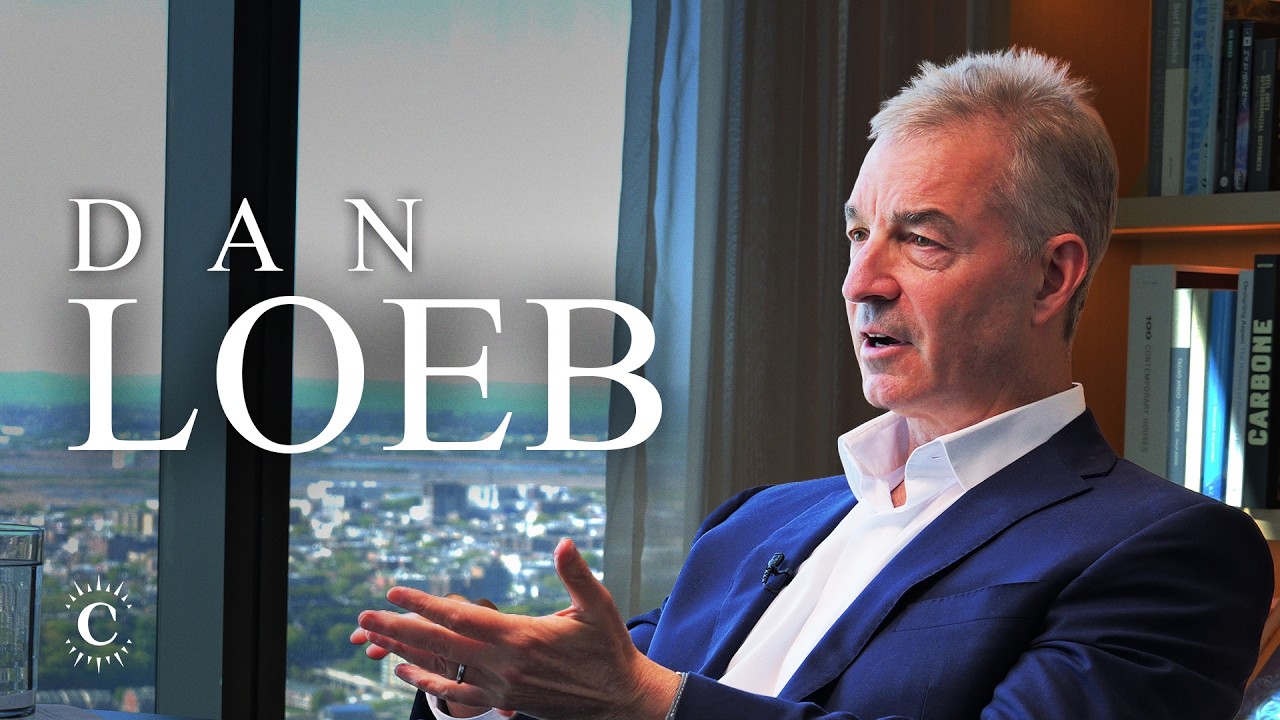
  • Dan Loeb on Building Third Point’s $25 Billion Investment Empire: AI, Activism, Credit, and the FTX Mistake

    Dan Loeb has spent three decades turning a $3 million fund into Third Point, a roughly $25 billion collection of hedge fund, credit, insurance, and venture businesses. In this Invest Like the Best conversation with Patrick O’Shaughnessy, Loeb walks through how he reinvented his strategy from deep value and event-driven trades into quality and thematic investing, why he now believes every serious investor has to be a technology investor, how he reads the AI cycle and the semiconductor melt-up, where activism and corporate governance still pay, and the single mistake that taught him the most. It is a rare, unhurried look at how a famously sharp-elbowed activist actually thinks about markets, businesses, and people.

    TLDW

    Loeb covers an enormous amount of ground: his daily process for staying ahead of the information firehose, Jensen Huang’s AI stack as a mental model, and why Nvidia, Anthropic, and Elon Musk’s companies are the three most consequential firms he tracks. He traces Third Point’s roots in credit and event-driven investing at Jefferies, the influence of Joel Greenblatt’s “You Can Be a Stock Market Genius,” and his later pivot to quality investing shaped by “The Outsiders” and Lawrence Cunningham’s “Quality Investing.” He argues the AI rally is not a dot-com-style valuation bubble because the leaders generate enormous cash, explains why human judgment and structural market quirks still create alpha, and makes the case that AI will never fully run a capital system. He digs into corporate governance and his father’s influence, the Sotheby’s and Sony activism campaigns, the hard reality of activism in Japan, and what investing in Danaher’s operating system taught him. He names FTX as his hardest lesson, breaks down Third Point’s evolution into a 60-percent-credit platform spanning CLOs, structured credit, reinsurance and annuities, describes how he is pushing his analysts to use AI and Claude daily, and closes on kindness and the friend who let him sleep on a couch before he made it.

    Thoughts

    The most striking thing about Loeb is that he treats his own strategy as a thing to be disrupted rather than defended. He built his reputation on Greenblatt-style special situations, spin-offs, demutualizations, and post-reorg equities bought cheap because of forced selling and sandbagged guidance. Most investors who win that way spend the rest of their careers protecting the formula. Loeb instead watched the people who stayed rigid about deep value and low multiples underperform or disappear, and deliberately retrained himself and his team around business quality and thematic conviction. The willingness to abandon a winning identity is the actual edge here, more than any single trade. It is the rare investor who can say his current strategy would not fit cleanly on a PowerPoint deck and treat that as a feature.

    His AI framing deserves attention because it is unfashionably calm. The bear case on AI is usually about valuation, and Loeb dismantles it on the leaders’ own numbers: these are companies investing off their balance sheets, generating enormous cash, trading at multiples that do not resemble 1999. He was short the dot-com bubble, so he is not a permabull cheering from the sidelines. His real point is subtler, that the danger is expectations, not valuations. The semiconductor index ran up 40 percent on genuinely strong fundamentals, but Micron and Nvidia both put up monster quarters and saw their stocks fall because expectations had simply outrun even great results. That gap between fundamentals and price is where he thinks the human investor still earns a living, precisely because quant strategies, CTAs, and risk-managed pods are forced to sell into weakness rather than buy it.

    The governance material is the most quietly radical part of the conversation. Loeb defends shareholder primacy against the Business Roundtable’s softer stakeholder language, but his argument is not the cartoon version where shareholder value means strip-mining a company. It is that boards have one job, accountability for capital allocation and management, and that vague multi-stakeholder mandates become an excuse for directors to avoid the hard work. His read on bad governance is almost always relational: directors who let loyalty to an underperforming CEO override their duty, or who sit on boards for status and income. The Sotheby’s story is the clean illustration, a centuries-old, high-status business run unprofitably because nobody treated it like a business. Loeb’s pattern is to find the gap between claimed status and actual performance and to raise the social cost of coasting.

    What is genuinely new in Loeb’s posture is how he talks about AI inside his own firm. He is not pitching it as a moat or a headcount-reduction story. He frames Claude and AI tools as a way to make each person a more autonomous self-improver, something that gives back whatever you put into it, with some analysts running agents overnight and burning tokens while he personally uses it more for queries. Coming from a 30-year fundamental investor, the absence of defensiveness is the signal. He pairs it with Brad Gerstner’s nod to “Essentialism”: the firehose is now infinite, so the scarce skill is deciding what is actually relevant. That is a more honest answer to the AI question than either doom or hype.

    Finally, the FTX confession is worth sitting with because of how he frames it. He does not retreat into cynicism about venture or crypto. He notes that Sam Bankman-Fried, fraud aside, had a real nose for value, with stakes in Anthropic, Cursor, and Solana that would have made him a top venture investor of the era. The lesson Loeb extracts is procedural, not philosophical: their due diligence now includes checking bank balances, the most basic verification that would have surfaced the problem. It is a useful reminder that even sophisticated capital can skip boring fundamentals when a company is growing fast and the cap table looks good. The discipline is not in having a grand theory of fraud, it is in never skipping the unglamorous checks.

    Key Takeaways

    • Loeb’s macro focus right now collapses to two variables: where oil goes, dictated by war and geopolitics, and what AI does on the spending and infrastructure front and its impact on society and the economy.
    • He argues you can no longer punt on technology and focus on industrials or consumer; tech is a big, growing, compounding part of the economy that affects everything else, so every investor has to become a tech investor.
    • He uses Jensen Huang’s AI stack as a mental model: power and energy at the bottom, then chips and infrastructure, up through large language models, software, and applications.
    • The three most consequential companies he tracks are Nvidia, Anthropic, and Elon Musk’s companies collectively.
    • Third Point’s roots are in credit and event-driven investing, shaped by his time at Jefferies watching investors like David Tepper before he founded Appaloosa, Eric Mindich at Goldman, and firms like Angelo Gordon and Farallon.
    • Joel Greenblatt’s “You Can Be a Stock Market Genius” was his foundational framework: spin-offs, demutualizations, privatizations, and post-reorg equities where a new, illiquid security gets dumped by holders who will not do the work.
    • Spin-off managers often sandbag guidance because their incentive packages get set at the time of the spin-off, creating a predictable gap between conservative numbers and real value.
    • From 1995 to roughly 2013-2015, event-driven special situations were Third Point’s bread and butter; those opportunities still exist, but the real edge now is overlaying them with a business-quality lens.
    • The pivot to quality and thematic investing was influenced most by “The Outsiders” (capital allocation plus great operations) and Lawrence Cunningham’s “Quality Investing” (high-moat, high-return-on-capital businesses to own for years).
    • AI disruption made last year one of the worst for many apparently high-quality companies, as businesses that looked durable rapidly became less so.
    • Loeb sees the AI rally as fundamentally different from the dot-com bubble: the leaders invest off their balance sheets, generate enormous cash, and do not carry the valuation excess of 1999.
    • The danger in semis is expectations, not valuation: Nvidia and Micron posted spectacular quarters yet saw stocks fall because expectations had outrun even great numbers.
    • Structural forces still create alpha for fundamental investors: quants, CTAs, and multi-strategy pods have risk metrics that force selling on the way down, the opposite of what is rational for long-term holders.
    • He believes AI will not fully run a capital system; private equity, restructurings, creditor committees, and high-touch negotiation will always need humans.
    • His interest in governance came from his father, a securities lawyer and corporate governance expert who sat on the boards of Mattel and Williams-Sonoma and pushed ethical sourcing ahead of his time.
    • Loeb defends shareholder primacy, citing Milton Friedman and Warren Buffett, and criticizes the Business Roundtable’s move away from shareholder value as a distraction from the board’s real duty.
    • Bad governance usually comes from directors letting loyalty to a weak CEO override fiduciary duty, lacking the knowledge to do the job, or serving for status and income.
    • Writing is a core activism lever: great writing is clear thinking, and social pressure through writing and PR is one of the most effective ways to move a board, alongside financial and legal levers.
    • The Sotheby’s campaign targeted a high-status, centuries-old business run unprofitably; Third Point bought 9.9 percent, eventually brought in Tad Smith from MSG, who cleaned up operations and technology before the company sold.
    • Third Point increasingly prefers to back great companies with excellent management and cheer them on rather than hunt for mismanaged businesses, because bad management tends to cluster into a morass.
    • Third Point is a collection of businesses; the flagship hedge fund grew from $3 million to about $9 billion and is roughly 30 percent credit, with the broader firm closer to 60 percent credit.
    • The firm spans a roughly $7 billion CLO business, structured and corporate credit, an insurance company, asbestos liabilities, a small private credit unit, and a venture capital arm.
    • The unifying thread is valuing enterprises across early, mid, and mature stages and investing in whichever fulcrum security offers the best risk-reward, from equity to senior debt.
    • Loeb cites buying Twitter’s financing debt near 96-97 cents at a 12 percent yield when most credit investors were scared, and a difficult xAI debt financing, as examples of cross-discipline conviction.
    • He is the portfolio manager only of the hedge fund; the credit, CLO, structured credit, and high-yield businesses have their own PMs and investment committees he does not sit on.
    • The Sony campaign saw Third Point own up to 7 percent and push to separate the conglomerate; management resisted for years before spinning out the semiconductor and financial services businesses.
    • He learned that activism in Japan is hard, but the government often wants reform; he co-wrote a paper with Larry Lindsey and Niall Ferguson urging corporate governance and return on invested capital as a fourth arrow of Abenomics, picked up as a Wall Street Journal editorial.
    • Investing in Danaher was his most instructive experience, teaching him how the Danaher Business System drives continuous improvement (Kaizen) and how the company celebrates rather than shames underperformance because problems are fixable.
    • FTX was his hardest lesson; it looked great and was verifiable on the blockchain, but was not what it appeared, and now Third Point’s diligence includes checking bank balances.
    • He notes that, fraud aside, Sam Bankman-Fried had a strong nose for value with stakes in Anthropic, Cursor, and Solana.
    • Recent mistakes also include shorts where Third Point thought certain info-services businesses would resist AI disruption; he still expects a shakeout with some phoenixes rising from the ashes.
    • He is pushing his whole team to use AI daily, hiring native computer scientists and system integrators, and describes Claude as a tool that makes you autonomous and gives back whatever you put into it.
    • Third Point’s distinctive edge is optimism about AI creating net jobs and the ability to default into credit investing during stressed times, as it did with investment-grade credit in 2020.
    • Credit is hard to copy because it runs on relationships, not electronic trading; that is why Third Point built into CLOs and eyes the roughly $6 trillion structured credit market rather than treating it as tourism.
    • The great analyst has changed: 20 years ago it was someone who could model fast and crack a complex restructuring (Loeb made a career-defining bet on Drexel Burnham claims); today it is a Gavin Baker type who deeply understands an industry, like the analyst who flew to Texas and realized Casey’s General Stores was really a pizza chain.
    • Outside the US, Loeb is more bullish on Korea, Taiwan, and Japan as hunting grounds, finds Europe tough on regulation (though he owns Rolls-Royce and ASML), and finds the Middle East the most vibrant region.
    • What worries him most is not the business but running out of time for family, surfing, and reading; what excites him is incorporating everything relevant about the world and forming relationships with people building interesting things.
    • His closing reflection is on kindness as a top-tier value, and the friend, Carter, who let him sleep on a couch and seeded his early fund, echoing a Palmer Luckey line that money cannot buy friends who believed in you when you had nothing.

    Detailed Summary

    Staying ahead of the firehose and reading the macro

    Loeb opens by admitting he does not have a perfectly organized system for processing the modern flood of information. He checks the news for what is relevant to the economy and to Third Point’s positions, tries not to obsess over minute-to-minute moves, and leans more tactical than strategic. When people ask him about macro, he says the usual government-reported metrics (growth, unemployment, inflation, rates, currencies, gold, crypto) are trumped right now by two things: where oil goes, which depends on war and geopolitics, and what AI does on the spending and infrastructure side and its impact on society and the economy. To understand technology, he leans on Jensen Huang’s framing of the AI stack and talks to smart people regularly, and he watches three companies above all: Nvidia, Anthropic, and Elon Musk’s companies as a group.

    From event-driven roots to quality investing

    Third Point’s DNA comes from Loeb’s time as a credit investor at Jefferies, where he watched some of the best distressed, event-driven, and risk-arbitrage investors operate, from David Tepper to Eric Mindich to firms like Angelo Gordon and Farallon. His first lens was event-driven: spin-offs, demutualizations, privatizations, and post-reorg equities, where a newly created and illiquid security gets dumped by holders who will not do the work, and management sandbags guidance because incentive packages are set at the spin date. He barely thought about moats or returns on capital; he just wanted to buy something genuinely cheap with those characteristics. That was the firm’s bread and butter from 1995 until roughly 2013-2015. Those opportunities still exist, but Loeb describes deliberately evolving toward business quality and thematic investing, influenced by “The Outsiders” on capital allocation and Lawrence Cunningham’s “Quality Investing” on durable, high-return businesses. He organized the team around industry experts rather than generalists. The twist: AI disruption recently turned many apparently high-quality companies into much lower-quality ones, fast.

    The AI cycle, bubbles, and the human edge

    Loeb resists the bubble narrative. He was short the dot-com bubble and remembers the valuation excess; today’s AI leaders, by contrast, invest off their balance sheets and generate enormous cash, so unless you believe the capex yields no return, the earnings and multiples do not look like 1999. The real driver of volatility, he argues, is expectations: the semiconductor index ran up 40 percent on strong fundamentals, but Nvidia and Micron both delivered blowout quarters and still saw their stocks fall because expectations had run too high. That dynamic is exactly where a fundamental investor earns a living, because quants, CTAs, and risk-managed pods are structurally forced to sell into weakness. He also doubts AI will ever fully run a capital system, since private equity, restructurings, creditor committees, and high-touch credit always need humans. He cites “Reminiscences of a Stock Operator” and Ecclesiastes: there is nothing new under the sun, and human nature, with its bubbles, panics, and extremes, does not change.

    Governance, his father, and the duty of boards

    Loeb traces his governance interest to his father, a securities lawyer and corporate-governance expert who served on the boards of Mattel and Williams-Sonoma and championed ethical sourcing before it was common. He calls the American board system beautiful: directors are answerable to shareholders and accountable for strategy and key financial decisions. Governance breaks down when directors lose sight of their fiduciary duty, lack the knowledge or talent diversity to do the job, or prioritize things other than shareholders. He invokes Milton Friedman and Warren Buffett to argue that caring about communities, employees, and conduct is not inconsistent with shareholder value but part of it, and criticizes the Business Roundtable for muddying the board’s core duty. The most common failure he sees is directors letting loyalty to an underperforming CEO override their duty. Most of the time Third Point redirects existing boards without even taking a seat; the extreme proxy fights are the exception.

    Activism, writing, Sotheby’s, and Sony

    Great writing, Loeb says, is clear thinking and organizing your thoughts to get a desired outcome, and it is one of activism’s most effective levers alongside financial and legal pressure. Social pressure through writing and PR can move a board on its own. He sees a pattern in his campaigns: targets that hold themselves out as high status but are not living up to it. Sotheby’s is the clean example, a centuries-old, high-status business run unprofitably, where Third Point bought 9.9 percent, gave the existing CEO a year, then helped install Tad Smith from MSG, who modernized operations and technology before the company was sold. Sony was a two-act campaign in which Third Point owned up to 7 percent and pushed to break up the conglomerate; he recounts sharing the thesis with Andrew Ross Sorkin at the New York Times under embargo, the panic it caused, and how management resisted for years before spinning out the semiconductor and financial services units. The lesson: activism in Japan is genuinely hard, even though the government wanted reform. He co-authored a paper with Larry Lindsey and Niall Ferguson arguing corporate governance and return on invested capital should be a fourth arrow of Abenomics, which ran as a Wall Street Journal editorial.

    The Danaher operating system

    Loeb calls Danaher his most instructive investment. He and his partner persuaded the company to compress its five-day Danaher Business System training into a single day, and he came away with a deep appreciation for how a real operating system drives continuous improvement. The standout lesson was cultural: Danaher holds people individually accountable, but when it finds someone underperforming it celebrates rather than shames, because the problems are addressable and fixable, and it does this relentlessly across operations and working capital. He also points to the diaspora of Danaher executives, including Larry Culp and the leadership at Ingersoll Rand, as evidence of the system’s depth. The investment worked for about four years before COVID-era order surges and inventory swings turned tailwinds into headwinds; Third Point sold and has recently bought back in modestly.

    The structure of Third Point and the fulcrum security

    Third Point is not one fund but a collection of businesses. The flagship hedge fund grew from $3 million to about $9 billion and is roughly 30 percent credit, generically around 110 percent long and 30-40 percent short on the equity side. Across the firm the credit weight is closer to 60 percent, spanning a roughly $7 billion CLO business, several billion in structured and corporate credit, an insurance company, a couple billion in asbestos liabilities, a small new private credit unit, and a venture arm. The unifying thread is valuing enterprises at any stage and investing in whichever fulcrum security (the one with the best risk-reward) makes sense. Loeb illustrates with Credit Suisse’s takeover by UBS, where the holdco paper proved the fulcrum, and with buying Twitter’s resold financing debt near 96-97 cents at a 12 percent yield when other credit investors were scared, plus a difficult xAI debt financing that few credit people wanted. He pushes back on the idea that he sits atop everything: he is the PM only of the hedge fund, while the other businesses have their own PMs and committees he is not on.

    Insurance, the FTX lesson, and recent mistakes

    Loeb started a Bermuda reinsurance company in 2010, backed by himself, Kelso, and Pinebrook, on a barbell thesis of investing the float in Third Point and treasuries to defer taxes and lever capital. The reinsurance side soured, and about three years ago he concluded they had the right idea but the wrong vehicle, that plain-vanilla annuities (which can only invest in credit) would have fit better. Third Point merged the reinsurer into its UK closed-end fund, Third Point Offshore Investors, reincorporated from Guernsey to Cayman, and repurposed it into an insurance company managing private credit, structured credit, whole-loan mortgages, real estate lending, and investment-grade debt. His hardest lesson was FTX: it looked great, was verifiable on the blockchain, and had a strong cap table, but was not what it seemed; diligence now includes checking bank balances. He notes Sam Bankman-Fried, fraud aside, had a great nose for value (Anthropic, Cursor, Solana). Other recent mistakes were shorts where Third Point bet certain info-services businesses would resist AI disruption; he still expects a shakeout with some survivors rising from the ashes.

    AI inside the firm, the analyst of the future, and kindness

    Loeb is pushing his entire team to use AI daily, hiring native computer scientists and system integrators, and describes Claude as a tool that makes you an autonomous self-improver and gives back whatever you put into it, with some analysts running agents overnight while he uses it more for queries. He pairs this with Brad Gerstner’s recommendation of “Essentialism”: you cannot do it all, so you must decide what is most relevant. The great analyst has changed: 20 years ago it was someone who could model fast and crack a complex restructuring, as Loeb did with the Drexel Burnham bankruptcy claims early in his career; today it is a Gavin Baker type who deeply understands an industry and its technology, like the analyst who flew to Texas and realized Casey’s General Stores was really a pizza chain in disguise. On the rest of the world, he is more bullish on Korea, Taiwan, and Japan, finds Europe tough on regulation (while owning Rolls-Royce and ASML), and finds the Middle East the most vibrant region. He closes on what worries and excites him (time with family, surfing, and reading versus the joy of incorporating everything relevant about the world), and on kindness, crediting his friend Carter, who let him sleep on a couch and seeded his early fund, and echoing Palmer Luckey’s line that money cannot buy friends who believed in you when you had nothing.

    Notable Quotes

    “I think you have to be a tech person today. It’s a big and growing and compounding part of the economy. It affects everything else.”

    Dan Loeb, on why no serious investor can punt on technology anymore

    “Hold on to your seats because things are only going to accelerate from here.”

    Dan Loeb, recounting a 2013 Davos warning about technological change he now applies to AI

    “Maybe that’s where the human element comes in, to understand and to be able to make those tough trading decisions when fundamentals are going one way and stock prices are going the other way, and to be able to take the pain of losses in the short run.”

    Dan Loeb, on where a human investor still has an edge over machines

    “It’s very different from the dot-com bubble, which we were short going into. You don’t have the valuation bubble now on those companies that you had back in those days.”

    Dan Loeb, on why he does not see the AI rally as a 1999-style bubble

    “When they found someone that was underperforming, it was celebrated instead of shamed, because look at all these things you’re doing wrong, we can fix those. And they did.”

    Dan Loeb, on the accountability culture he learned from the Danaher Business System

    “I would have to say our investment in FTX. It looked great. The company was growing fast. We could verify it all on the blockchain.”

    Dan Loeb, naming his hardest investment lesson

    “Be kind to people you have no idea how it will ever benefit you. And sometimes it will and sometimes it won’t.”

    Dan Loeb, on elevating kindness in your hierarchy of values

    “The one thing money doesn’t buy you is friends that believed in you when you had nothing.”

    Dan Loeb, quoting Gavin Baker quoting Palmer Luckey, on the friend who seeded his early fund

    Watch the full conversation between Dan Loeb and Patrick O’Shaughnessy here.

    Related Reading

  • Raoul Pal: Why the Crypto Bull Run Is Just Starting, the AI Economic Singularity, and Why You Should Never Sell Bitcoin

    Macro investor and Real Vision co-founder Raoul Pal returned to the When Shift Happens podcast for episode 173 to argue that the recent crypto drawdown is a nasty correction inside a much larger bull market, not the end of the cycle. Across an hour and a half he ties together the AI capital race, the coming economic singularity, why layer one blockchains are a kind of universal basic equity, and the deceptively simple discipline that actually compounds wealth: buy, hold, and almost never sell.

    TLDW

    Pal frames everything through what he calls the universal code, the conversion of units of energy into units of intelligence, and says the global race to fund AI is so large that no government or company can stop feeding it capital. That liquidity, plus relentless currency debasement, is the engine under both the AI stocks going vertical and the crypto market that has lagged them. He calls the Bitcoin slide from 126K toward 60K a normal correction in a bull market, says liquidity is now reaccelerating, and argues smart contract layer ones (Ethereum, Solana, Sui) are the best risk-adjusted bet because the entire financial system and a coming swarm of AI agents will run on those rails, giving crypto an effectively infinite total addressable market. He explains why he added Zcash as a Bitcoin-with-privacy and quantum-proof trade, lays out his plan to launch an NFT fund built around grail digital art and NFT-backed lending, and makes a data-backed case that buying oversold dips and never selling beats trying to trade cycles. The conversation closes on a 70/30 bullish framework for 2026 and 2027 and a reflection on kindness.

    Thoughts

    The strongest idea in this conversation is not a price target, it is a reframe. Pal keeps pulling the camera back from “what will Bitcoin do this quarter” to “what is the organizing principle of the entire economy right now,” and his answer is the funneling of all available capital into anything that produces intelligence. Once you accept that frame, the buy-the-dip behavior in both AI equities and crypto stops looking like mania and starts looking like a rational response to a one-way game. The part worth sitting with is his game-theory claim that neither the US nor China can stop, and that even a spectacular failure like an OpenAI blowup would simply trigger an instant asset auction rather than a collapse, because no single player can be allowed to win outright. Whether or not that is fully true, it is a genuinely different mental model than the recession-and-bust cycle most investors carry around.

    His layer-one thesis is the most actionable takeaway and also the most quietly radical. The pitch is that for the first time ordinary people can own a piece of the core infrastructure that the machine economy will be built on, the way you never got to own a slice of TCP/IP or the open web. He calls this universal basic equity and treats it as humanity’s pension plan. The honest tension he admits is that the racy returns may not be in the boring base layer at all, and that the truly investable winners of this era, the private stablecoin companies, are largely closed off to retail. So the layer-one trade is partly a consolation prize for the fact that the best businesses are unreachable. That is a more candid admission than most crypto bulls will make.

    The behavioral core of the episode is the most useful for a normal reader, and it is almost embarrassingly simple. Pal has been in markets for 35 years and says he does not know a single person who reliably buys bottoms and sells tops, including the legends, who he points out made most of their money on management fees rather than heroic trades. His prescription is to add only when the asset is one to two standard deviations oversold on its long-term log trend, otherwise do nothing, and to treat patience as an action rather than inaction. The line that does the most work is “the market owes you nothing.” It quietly dismantles the entitlement that drives people to overtrade, chase, and burn emotional energy on a strategy that the data says underperforms simply holding.

    Where a reader should keep some skepticism is the certainty. Pal assigns the bull case a 70 percent probability and the bear case 30, but the bear case he sketches (Middle East war reignites, inflation forces tightening, liquidity gets starved, the intelligence buildout slows) is not a minor footnote, it is the whole structure failing at once. The thesis also leans hard on the assumption that AI agents will become massive on-chain economic actors, which is plausible but still mostly forward-looking rather than observed. The value here is the framework, not the forecast. If you take one thing, take the energy-into-intelligence lens and the standard-deviation discipline, and hold the specific tickers and timelines loosely.

    Key Takeaways

    • Pal’s central frame is the universal code: the universe, and now the economy, continuously converts units of energy into units of intelligence, and capital flows to whatever produces the most intelligence.
    • The AI buildout is a race of nations and corporations that nobody can exit. Game theory means neither the US nor China can stop, because the other side would gain a decisive advantage.
    • Even a catastrophic AI failure would not break the trend. If OpenAI ran out of money, its assets would be auctioned instantly to multiple buyers so no single company could double its compute and win the whole game.
    • The economic singularity is the point where institutions and the way we measure the economy can no longer keep up with the speed of technology, made worse when AI and robots are added to the population as economic actors.
    • AI is the first real-world example of Reed’s law, the exponential of the exponential, where most past technology followed the slower Metcalfe’s law log channel.
    • By around 2028, roughly five to six years after AI went mainstream, AI will have produced more words than all of humanity has produced in sum total since the Gutenberg press.
    • The current run is funded by cash flow, not debt. Unlike the late-1990s tech boom, the buildout is paid for out of the earnings of the most cash-generative firms in history.
    • Chips and energy are the binding constraints. Companies report being booked out three years and beyond, and xAI is reportedly handing older data centers to Anthropic because no one can get enough compute.
    • Pal expects the Fed to run a Greenspan-style playbook, cut rates and then get out of the way, letting a productivity miracle grow the economy faster than the debt pile so debt to GDP falls.
    • Bitcoin falling from 126K toward 60K is a nasty correction in a bull market, not a bear market. Pal has seen many 50 percent Bitcoin drawdowns since 2013, and altcoins always fall further on the risk curve.
    • The 2025 to 2026 correction has been choppy and slow rather than the fast V-shape of 2021, which is part of why sentiment feels so bad.
    • Crypto lagged because liquidity is finite. The government shutdown withdrew liquidity, which hits crypto with about a three-month lag, while AI capex and Chinese gold buying sucked capital away.
    • Liquidity is now reaccelerating in the US, China, and globally, which Pal sees as the reason the worst is likely over for crypto.
    • The birth of economic agents in late 2024 gives crypto an effectively infinite total addressable market, since agents will be economic actors that hold treasuries, make payments, and transact on-chain.
    • Smart contract layer ones are Pal’s preferred bet. He compares the structure to operating systems and cloud, where value concentrates into three to five major players plus a few specialists.
    • He calls owning layer ones universal basic equity and humanity’s pension plan, the chance to own the rails the agentic economy will run on, something the internet never offered retail.
    • Discounted cash flow analysis is the wrong tool for valuing a blockchain. The whole purpose of the network is to be the cheapest, fastest, and most programmable, so high fees are a bug, not a strength.
    • Pal measures layer ones by intelligence density: number of developers, programmability, speed to finality, applications per user, and the ratio of stablecoins to total value locked as stored energy.
    • Only three tokens maintained economic density when the market fell 80 percent: Ethereum, Solana, and Sui. ETH is the safe Microsoft-like choice, Solana is faster and cheaper, Sui is earlier but extremely fast and programmable.
    • Pal added Zcash in the correction as a Bitcoin-with-privacy trade. The left-curve case is simple privacy value, the right-curve case is that it is also quantum-proof and a hedge against AI-enabled state surveillance.
    • He admits he did not execute the Zcash buy well, kept meaning to add more while traveling, and watched it run up 50 percent. He treats it as a small position, not a portfolio overhaul.
    • On Hyperliquid he is complimentary but uninvested, because he does not trade, use perps, or use leverage, and he expects Robinhood and Coinbase to compete hard for that niche.
    • DeFi is better suited to machines than humans. Agents may not even need front ends or websites, just low-friction access to swap across multiple stablecoins and currencies instantly.
    • DeFi is not dead despite mega-hacks. Pal argues hacks force better products, and notes that banks quietly absorb theft losses too, so the answer is to build more secure systems.
    • The entire financial system is moving to blockchain rails because they are the most efficient way to operate, a prediction Pal first made in 2014 before smart contracts existed.
    • Pal is launching an NFT fund focused on grail assets (one-of-one alien CryptoPunks, top artists) trading from roughly 600K to tens of millions, plus a convex middle tier of artists with social consensus.
    • He names artists like Dies with the most likes (whom he compares to a Hunter S. Thompson of art) and Kim Asendorf, whose work uses tokens at the pixel level.
    • The fund will also lend against NFTs for yields around 15 percent or more, acquiring assets cheaply if borrowers default and recycling yield into emerging artists.
    • His real estate analogy: a smaller NFT in a great collection is like a modest apartment in a billionaire neighborhood, while grails are the 20 million dollar penthouses that actually compound.
    • Bitcoin is partly an AI proxy because global savings should rise as AI lifts economic growth, and Bitcoin targets a share of those savings as a digital store of value.
    • The core mindset shift: if you know where the world is going and roughly where market cap is heading on the log trend, you would never sell, you would only ever accumulate.
    • Selling well is nearly impossible. Even if you take profit at two standard deviations overbought, adding it back at the bottom is something almost no one actually manages.
    • The people who made the most money in crypto are the ones who did not trade it. Pal cites holders who profited by doing essentially nothing while active traders lost their edge.
    • Pal’s discipline requires roughly two to three actions every five years: add when one to two standard deviations oversold, optionally trim when two standard deviations overbought, otherwise nothing.
    • By his standard deviation measure, Bitcoin and crypto are as cheap as they have been in their long-term uptrend versus the NASDAQ, which he reads as a signal to allocate more to crypto.
    • Fear and greed sat below 10 for the longest stretch in the index’s history during this correction, hitting its lowest reading ever, a classic oversold extreme.
    • His 2026 to 2027 bull case stacks stablecoin explosion, the Clarity Act getting signed, rising global liquidity, debt rollovers forcing money printing, a strong business cycle, AI agents, and a cheap entry point. He puts it at roughly 70/30 to the upside.

    Detailed Summary

    Two economies and the money illusion

    The conversation opens loosely with travel, stablecoin spending, and a riff on why people agonize over a 75 dollar airport breakfast but happily lose money on an NFT that drops 80 percent. Pal’s explanation is that we live in two economies at once. The crypto and tech economy can grow 50 to 150 percent in a good year, while the real economy grows around 2 percent. Money earned in the fast economy does not feel real, which is why people spend and speculate so freely with it. This sets up the rest of the episode, where Pal treats the fast economy as the place serious capital is being forced to go.

    The AI capital race nobody can stop

    Asked why the stock market only seems to go up, Pal gives two reasons: liquidity expansion and the most extraordinary capital event in human history, the funneling of all capital into intelligence. He frames it as a race of nations, corporations, and individuals that cannot be slowed because of game theory. No superpower can let another reach AGI alone, only the US and China can afford the race, and neither can stop without ceding the advantage. He even games out an OpenAI bankruptcy and concludes the US would instantly auction the assets across many buyers rather than let one firm double its compute and win, which is why he calls the whole thing too big to fail. The practical conclusion is blunt: buy the dip, because the structure forces capital to keep flowing.

    The economic singularity, Reed’s law, and electricity through sand

    Pal defines the economic singularity as the moment when institutions and our economic measurements can no longer cope with the speed of technology, especially once AI and robots count as population. He explains that almost all past technology adoption followed Metcalfe’s law, a log channel visible in the charts of Google, Facebook, and the NASDAQ, but AI is the first observed example of Reed’s law, the exponential of the exponential. To make it concrete he cites ARK research showing AI will, by roughly 2028, have produced more words per year than all of humanity, and notes Anthropic expected 10x growth and got 80x in a quarter. He marvels that we are putting electricity through silicon, the second most common element on Earth, and producing intelligence six orders of magnitude faster than a human neuron.

    Why crypto lagged and why the worst is over

    Pal explains the crypto underperformance mechanically. There is only so much liquidity, the government shutdown withdrew it, and that hits crypto with roughly a three-month lag, landing right in the middle of the October drawdown. At the same time, the AI buildout and Chinese gold buying pulled capital toward the longest-duration assets, leaving SaaS and crypto with nearly identical charts as they got left behind. His read for 2026 is that liquidity is now reaccelerating across the US, China, and the world, so there is nothing to worry about yet. The Bitcoin move from 126K toward 60K is, in his framing, a normal correction, comparable in length to the roughly six-month 2021 pullback that resolved into new highs.

    Layer ones as universal basic equity

    The heart of the investment thesis is that smart contract layer ones will accrue a growing share of crypto value as the investable infrastructure layer. Pal argues the entire financial system plus a coming swarm of AI agents will use these rails, giving crypto an infinite total addressable market. Like operating systems and cloud, value will concentrate into three to five chains plus specialists. He measures them by intelligence density rather than discounted cash flow, since the point of the network is to be cheapest and fastest. By his analysis only Ethereum, Solana, and Sui held economic density through an 80 percent drawdown. ETH wins on developers, security, and Lindy effects (the Microsoft you do not get fired for owning), Solana is faster and cheaper, and Sui is earlier but offers a different order of magnitude on speed, finality, and programmability. He frames owning a basket of four or five as humanity’s pension plan.

    Zcash, privacy, and the quantum hedge

    Pal reveals he added Zcash during the correction, alongside buying more Sui. He had said in December he would wait for it to pull back, and he did, though he admits he did not buy enough as it ran up 50 percent. His left-curve case is that privacy has real value and people will understand it more, making it essentially Bitcoin with privacy that could plausibly reach 5 to 10 percent of Bitcoin’s value. His right-curve case is that it is also quantum-proof and a hedge against governments wielding AI-enabled control over people. He dismisses the mid-curve worry that it will be banned, noting that the ban fear has shadowed crypto his entire career and never materialized.

    Agents, DeFi, and financial rails

    Pal argues the biggest future users of DeFi and crypto payments will be AI agents, whose scale is effectively infinite. Setting up agents himself, he keeps hitting walls that require small payments, and sees agents making endless micro-payments plus larger transactions, holding treasuries across multiple stablecoins and currencies, and rebalancing through DeFi instantly without any human involved. DeFi, he says, is actually better suited to machines than people, and may not even need front ends. On the wave of mega-hacks he is unbothered, arguing they force better products, that banks quietly absorb theft too, and that the financial system always migrates to the most efficient rails because that is how you make more money. He first predicted blockchain would become the financial industry’s infrastructure rail back in 2014.

    The NFT fund and grail digital art

    Pal is launching an NFT fund because so many people told him they want exposure but do not know how. The fund targets grail assets, the scarce one-of-one pieces with proven social consensus that trade from around 600K into the tens of millions, plus a convex middle tier of artists who have long-term proven value and could be wildly re-rated. He names Dies with the most likes, an Indiana artist cataloging the decline of middle America whom he likens to Hunter S. Thompson, and German artist Kim Asendorf, whose 3D works are built from individually tokenized pixels. The math of convexity is the draw: an artist re-rating from 20 to 200 ETH while ETH itself multiplies could compound into a 100x. The fund will also lend against NFTs for yields above 15 percent, acquiring assets cheaply on default and recycling yield into emerging artists, and will build a club connecting investors to artists. His real estate framing reassures smaller holders: owning a lesser piece in a top collection is like a modest flat in a billionaire neighborhood.

    Never sell, and the math of patience

    The behavioral spine of the episode is Pal’s argument that buying, holding, and accumulating beats trading cycles. He has built a Real Vision indicator that signals a buy when an asset is one to two standard deviations oversold on its log regression channel, and says it compounds at a stupid rate. The problem with selling is deciding how much and then having the discipline to buy it back at the bottom, which almost no one does. In 35 years he says he has never met anyone who reliably buys bottoms and sells tops, and notes the trading legends made most of their money on management fees. The people who made the most in crypto are the ones who did nothing. He reframes holding as patience, an active stance, and ties it back to the universal code: buying Bitcoin and doing nothing is the most energy-efficient trade you can make, while overtrading burns mental and emotional energy for a worse outcome. His advice to those tempted by AI’s vertical charts is to go play with AI and just hold your Bitcoin.

    The 2026 to 2027 outlook

    Pal closes the macro case by stacking the bull factors: a massive stablecoin expansion over the next 24 months, the Clarity Act getting signed and freeing builders, rising global liquidity, trillions in interest payments that force more money printing, a strong business cycle recycling earnings into speculative assets, the arrival of AI agents, and a cheap entry point with fear and greed at historic lows. He even floats a permanent resolution of Middle East conflict as part of the upside. The bear case is the mirror image: war reignites, inflation runs hotter, tightening starves capital, and the intelligence buildout slows. He puts the odds at roughly 70 percent bullish, 30 percent bearish, and says he does not see the bear case yet. The episode ends on a personal note about kindness, with Pal unable to name a single kindest act because, he says, everything is made of kindness.

    Notable Quotes

    “We’re going through the most extraordinary time in human history. Nothing else matters. This whole funneling of all capital into intelligence is the biggest race that’s ever happened.”

    Raoul Pal, on why capital keeps flooding into AI

    “The game is so big that nobody will stop.”

    Raoul Pal, on the game theory of the US and China AI race

    “This is how amazing it is. We’re putting electricity through sand and creating intelligence.”

    Raoul Pal, on silicon and the universal code

    “It’s a nasty correction in a bull market. I’ve been in crypto since 2013. I’ve seen many corrections, non-bear markets of 50% in Bitcoin.”

    Raoul Pal, on Bitcoin falling from 126K toward 60K

    “The market owes you nothing. You would just have to be better at doing a job.”

    Raoul Pal, on the entitlement that ruins crypto investors

    “This is humanity’s pension plan. We get to invest in the infrastructure rails of which all the agentic economy will run.”

    Raoul Pal, on owning layer one blockchains

    “The people who’ve made the most money out of crypto are the people who don’t trade it.”

    Raoul Pal, on why holding beats trading

    “Your job is to be a mercenary for your own capital. You want to make the most money over time.”

    Raoul Pal, on why no one has to stay loyal to crypto

    “Bitcoin and crypto is as cheap as it has been in its long-term uptrend versus NASDAQ.”

    Raoul Pal, on the relative value signal he watches

    This is a compressed look at a wide-ranging conversation. Watch the full episode on When Shift Happens here for Pal’s complete reasoning, the charts he references, and the back-and-forth that the summary above leaves out.

    Related Reading

    • Real Vision the financial media platform Raoul Pal co-founded, where his Global Macro Investor research and exponential age thesis live.
    • Metcalfe’s law (Wikipedia) the network-value relationship Pal uses to model the log regression channel for crypto.
    • Reed’s law (Wikipedia) background on the exponential-of-the-exponential growth Pal says AI is the first real-world example of.
    • Technological singularity (Wikipedia) context for the economic singularity Pal argues is now only about four years away.
    • Zcash the privacy coin Pal added in the correction as a Bitcoin-with-privacy and quantum-proof trade.