Anthropic set its IPO price range at $70 to $78 a share on November 10, 2026, offering 825 million shares on Nasdaq as ANT at up to about $1 trillion. The terms are in Amendment No. 2 to its Form S-1, filed the same day, and in a term sheet shared by ZeroHedge on X that puts pricing after the close on November 18. The amendment fills in the blanks left by Amendment No. 1 of November 2, which brought the third-quarter results, and the original S-1 of October 26. It also adds a $26.0 billion private placement with seven of Anthropic’s suppliers and partners, an $81 billion run-rate revenue figure, a larger $900.9 billion of committed spending, and a sharper safety disclosure: Anthropic says it has now met its Responsible Scaling Policy’s threshold for AI-accelerated research. This post has been updated around those terms. It will be updated again when the IPO prices.
TLDR
Anthropic is selling 825 million Class A shares at $70 to $78, about 97% new shares and 3% from existing holders, plus a 123.75 million share option for the underwriters, all new. Google, Nvidia, AMD, Broadcom, Micron, Microsoft and TSMC will buy another $26.0 billion of non-voting shares at the IPO price, and the company expects about $84.6 billion of net proceeds at the $74 midpoint. With about 13.1 billion shares outstanding afterwards, the range values Anthropic at roughly $917 billion to $1.02 trillion, around 12 times its $81 billion run-rate revenue at October 31. Third-quarter revenue was $17.0 billion, but the company swung to a $567 million operating loss as it bought expensive short-term compute, and committed spending now stands at about $900.9 billion. Founder control is unchanged.
Thoughts
The $26.0 billion private placement is the term that says the most about this IPO. Google and Nvidia are each putting in about $10.0 billion, AMD $2.5 billion, Broadcom, Micron and Microsoft $1.0 billion each, and TSMC $500 million, all at the IPO price. These are the same companies Anthropic pays for chips, cloud capacity and hosting, and several of them appear on the cost side of its $900.9 billion of commitments. Google’s purchase uses up an option it already held, and AMD’s counts toward a share purchase it agreed to as part of its hardware supply deal. Money that flows from supplier to customer and back to supplier is not fake, but it is circular, and it makes the demand for Anthropic’s stock look broader than the open-market order book alone. Note too that these shares are not under the underwriters’ lock-up, while 3.6 billion locked-up shares may become eligible for sale before the 180-day period ends.
The safety disclosure moved further in one week than most companies’ risk factors move in a year. Amendment No. 1 said Anthropic “may imminently meet” its Responsible Scaling Policy’s threshold for AI-accelerated research. Amendment No. 2 says it “made a determination that we have met this threshold,” based on what it expects from future models and its overall rate of progress rather than on what current models show. It says it is still assessing the data and will publish more reports. The filing already lists what such measures have looked like: a delayed pre-training run, limited releases like Mythos through Project Glasswing, and possible future steps that “affect whether, how, and when we develop or deploy new models.” An investor is being told, in a prospectus, that the company may slow itself down on purpose. That is rare, and it is honest.
On the price, the range asks investors to pay about 12 times run-rate revenue at the midpoint, and about 14 times the $68 billion that annualizing the third quarter gives. Run-rate revenue rose $10 billion in October alone, from about $71 billion to about $81 billion, so the multiple is shrinking fast if that pace holds. The filing is blunt that it may not: it warns that run-rate revenue annualizes a 28-day window, that model versions released in the prior six months made up over 80% of third-quarter revenue, and that it does not expect growth “at comparable rates.” The range sits 19% to 32% above the $58.90 per share the Series H round paid after the stock split, which is a modest step-up for a company whose revenue has grown about twelvefold in a year. Add the roughly 2.8 billion shares under options and unvested RSUs, and the midpoint value is closer to $1.18 trillion.
The IPO money matters most as a buffer against the compute bill. Anthropic had $131.8 billion of cash and short-term investments at September 30, and about $84.6 billion of net proceeds would take that to roughly $216 billion. Against it, about $70.7 billion of commitments fall due in the 12 months after September 30, and commitments signed after the quarter rose to about $105.7 billion, from $100.2 billion a week earlier. The third quarter showed why the buffer matters: demand outran contracted capacity, so Anthropic bought $5.0 billion of compute on short-term terms that “currently costs significantly more,” and compute rose from 48% to 58% of revenue. Margins will swing each time a large block of capacity arrives or falls short, and a consumption business can shrink faster than leases running into the 2040s can be cancelled.
GAAP results will look worse after the listing before they look better. No expense has yet been booked for RSUs, because they only vest on a listing. Had the offering closed on September 30, Anthropic would have recognized an $8.2 billion catch-up charge at once, with another $24.1 billion to follow over about two years. The non-cash marks on convertible notes, which produced a $104.0 billion nine-month net loss, stop once the notes convert, but the RSU charge starts then. Cash flow is the better guide: operating cash flow was a positive $6.6 billion for the nine months, against $2.0 billion burned in the same period of 2025.
Key Takeaways
- IPO terms: 825,000,000 Class A shares at $70.00 to $78.00, of which 801,351,354 are new and 23,648,646 come from selling stockholders. The underwriters can buy 123,750,000 more new shares. The base deal raises $57.75 billion to $64.35 billion, or up to $74.0 billion with the option.
- Timing and banks: the term sheet shows pricing after the close on November 18, 2026, with Goldman Sachs and Morgan Stanley as active bookrunners among 22 banks. Morgan Stanley is syndicate trading manager and Goldman Sachs is settlement agent.
- Concurrent private placement: $26.0 billion of Class N shares at the IPO price, from Google ($10.0 billion), Nvidia ($10.0 billion), AMD ($2.5 billion), Broadcom, Micron and Microsoft ($1.0 billion each) and TSMC ($500 million). It closes after the IPO and needs stockholder approval.
- Valuation: about 13.1 billion shares will be outstanding after the offering and placement, which puts the range at roughly $917 billion to $1.02 trillion before options and unvested RSUs, or about $968 billion at the midpoint.
- Net proceeds to Anthropic are estimated at $84.6 billion at $74, or $93.7 billion if the option is exercised. New investors face $65.79 of dilution per share against a pro forma net tangible book value of $8.21.
- Run-rate revenue was about $81 billion at October 31, 2026, up $10 billion from September 30.
- Q3 2026 revenue was $16,956 million, up from $11,555 million in Q2 and $1,382 million in Q3 2025. The Q3 GAAP operating loss was $567 million, against Q2 operating income of $974 million. Adjusted operating income was $2,463 million, a 15% margin.
- The Q3 net loss was $23,291 million, but $21,936 million of it is a non-cash fair-value charge on convertible notes. Q3 adjusted net income was $3,167 million, and nine-month operating cash flow was $6,569 million.
- Aggregate committed spend is about $900.9 billion, up from $895.4 billion in Amendment No. 1. About $451.6 billion falls before 2031 and about $70.7 billion within 12 months of September 30.
- Anthropic now says it has met its Responsible Scaling Policy’s AI research and development capability threshold, based on expected future models rather than current ones.
- Customers: more than 11,900 spend $100,000 or more a year, net revenue retention is about 900%, and an estimated 5% to 7% of nine-month revenue came from customers later found violating usage policy or commercial terms.
- Directors and their affiliates have indicated interest in buying up to $303 million of IPO shares. The listing will trigger an $8.2 billion catch-up RSU charge, with $24.1 billion more over about two years.
- Governance is unchanged: the founders’ Class F share carries 50.1% of votes and the Long-Term Benefit Trust elects a board majority. Anthropic will be a “controlled company” under Nasdaq rules.
Detailed Summary
Anthropic IPO terms: price range, shares and pricing date
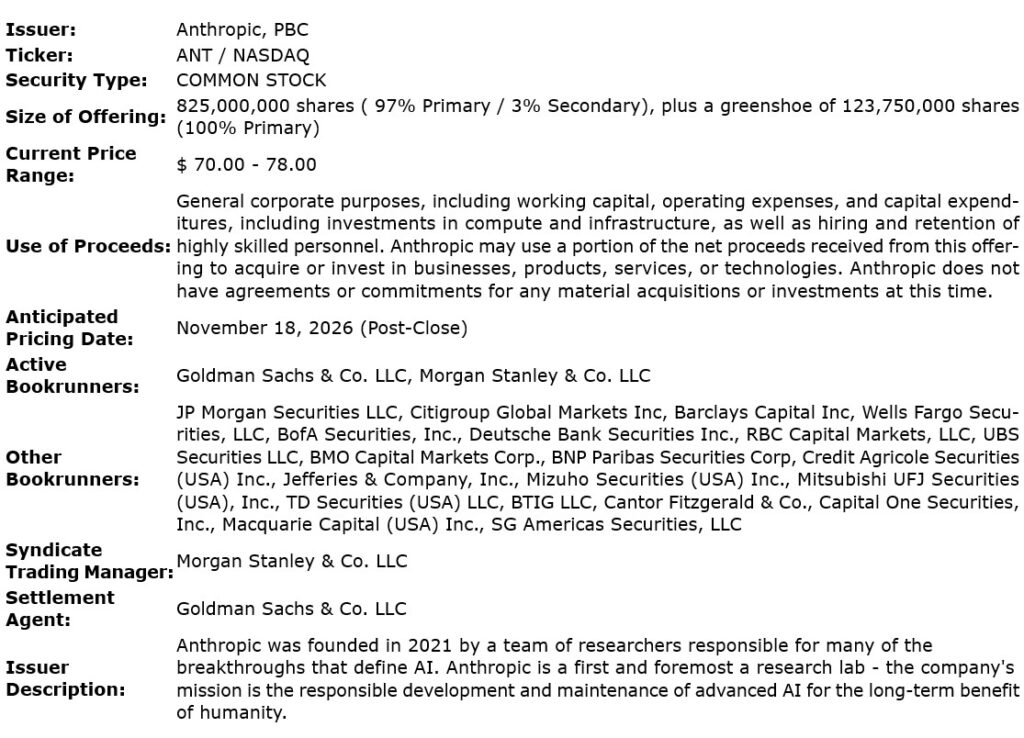
Amendment No. 2, filed November 10, 2026 under registration number 333-299633, sets an estimated price of $70.00 to $78.00 per share for 825,000,000 Class A shares listed on the Nasdaq Global Select Market as ANT. Anthropic sells 801,351,354 of them and selling stockholders sell 23,648,646, the 97% primary and 3% secondary split shown on the term sheet. The 123,750,000-share underwriters’ option is entirely new stock. The term sheet gives November 18, 2026, after the close, as the expected pricing date. Proceeds go to general corporate purposes, including compute and infrastructure, hiring, possible acquisitions, and tax withholding on RSUs that settle at the listing. The final price, underwriting discount and closing date are still blank.
The $26 billion private placement with Google, Nvidia and others
At the $74 midpoint, the seven investors buy 351,351,348 non-voting Class N shares: Google and Nvidia 135,135,135 each, AMD 33,783,783, Broadcom, Micron and Microsoft 13,513,513 each, and TSMC 6,756,756. The dollar amount is fixed, so the share count moves with the final price. Anthropic pays no underwriting fees on these shares. The placement closes immediately after the IPO, depends on stockholder approval that the company expects to get, and the IPO does not depend on it. The shares are unregistered and restricted, but they are not covered by lock-up agreements, and Google gets registration rights for them.
How fast is Anthropic’s revenue growing?
Quarterly revenue rose from $376 million in Q1 2025 to $787 million, $1,382 million, $2,040 million, $4,731 million, $11,555 million and $16,956 million in Q3 2026. Q3 growth was 1,127% year over year, while compute and infrastructure expense grew 382%. Run-rate revenue reached about $81 billion at October 31, 2026. The filing credits Mythos 5.1, Fable 5.1 and Opus 5.5, all released in September 2026, along with Claude Cowork and agentic coding. It also warns that model versions released in the prior six months made up over 80% of Q3 revenue.
Why did Anthropic swing back to an operating loss in Q3?
Total Q3 operating expenses were $17,523 million against $16,956 million of revenue. Compute was the main driver, at $9,863 million, including $5.0 billion bought under short-term commitments to meet demand. Other operating and administrative expense rose to $3,588 million, mostly a $1,960 million non-cash charge for employee donation matching, settled in Class N shares. Personnel expense fell to $1,711 million as some option grants finished vesting. Adjusted operating income, which excludes stock compensation and the charitable charges, rose to $2.5 billion even as its margin fell from 19% to 15%.
Why the $23.3 billion Q3 net loss is mostly paper
Anthropic’s convertible notes, held by Amazon, Google and an infrastructure partner, are carried at fair value until they convert. As the company’s valuation climbs, the notes are worth more to their holders, and the increase is booked as an expense. No cash leaves the company. Q3 carried a $21,936 million charge, down from $59,597 million in Q2. At the IPO, $579.3 million of Amazon notes convert into 276,827,518 Class N shares, the most Amazon can take without passing its ownership cap. Strip out the note marks and the charitable and stock charges, and Q3 adjusted net income was $3,167 million.
Anthropic cash, cash flow and the $15 billion credit facility
Cash and short-term investments were $131.8 billion at September 30. Nine-month financing inflows of $110.7 billion came mostly from the Series G and H preferred rounds. Accounts receivable climbed to $7.9 billion from $0.9 billion at the end of 2025. The revolving credit facility was enlarged from $3.25 billion to $15.0 billion on September 4, runs to 2031, and requires at least $5.0 billion of liquidity from the end of 2026. Undrawn partner financing totals $77.0 billion: up to $20.0 billion from Google, $15.0 billion from Amazon and $42.0 billion of 9% notes from Broadcom.
Anthropic compute commitments: the $900.9 billion explained
The filing builds the $900.9 billion from several parts:
- a contractual table of about $320.0 billion, almost all of it $313.8 billion of purchase commitments
- about $17.4 billion of short-term commitments
- about $451.2 billion of leases signed but not yet commenced, which begin between 2026 and 2028 and run about 10 years on average
- about $105.7 billion signed after September 30, plus about $6.6 billion of short-term agreements
Named agreements include:
- Microsoft, at least $47.2 billion and up to $49.2 billion between November 2026 and June 2033
- Google hosting, at least about $121.3 billion
- Amazon, at least $110.0 billion
- SpaceXAI, up to $120.5 billion and cancellable on 90 days’ notice after early 2027
- Nscale, about $44.6 billion
- Lambda, about $41.3 billion
- Broadcom TPU leases, about $161.2 billion of rent
- an AMD supply agreement expected to exceed $20 billion
About $186.2 billion of the total carries termination rights or contingent conditions, down from $213.8 billion in Amendment No. 1. A further $125 billion to $150 billion of Google TPU capacity and $150 billion to $175 billion of arrangements with no fixed dollar commitment sit outside the total. The commitment totals overlap with one another, so they should not be added together.
Who buys Claude, and how solid is the revenue?
Customers spending $100,000 or more include every Fortune 10 company, over 50% of the Fortune 500 and over 30% of the Global 2000. They produced $26.1 billion, or 74%, of trailing-twelve-month revenue, and about 40 million smaller customers produced the rest. About 79% of Q3 revenue came from outside the top five customers. Remaining performance obligations were only $13.8 billion at September 30, less than one quarter of revenue. The usage-policy estimate (5% to 7% of nine-month revenue) and cloud-marketplace exposure (44% of revenue) remain the main quality questions.
Founder control, share classes and lock-ups
Class A holders can never exceed 49.9% of the vote, because the founders’ single Class F share carries a fixed 50.1%. The Long-Term Benefit Trust’s Class T share elects a majority of the board. A new Class E, issued to employees other than the co-founders, votes only on limited matters and has no economic rights. After the offering there will be about 7.43 billion Class A and 5.66 billion Class N shares. The lock-up schedule:
- Most employees can sell 10% on the first trading day.
- Holders of more than 0.5% of fully diluted shares face staged releases over up to 365 days.
- Co-founders are locked up for up to 365 days, though each can sell up to 29% from around day 180 or after the first-quarter earnings release, whichever comes first.
Retail allocations are planned through Schwab, Fidelity, Robinhood, SoFi and others.
Government fight, lawsuits and safety disclosures
Anthropic won summary judgment in the Northern District of California on August 27, then lost 2-1 at the D.C. Circuit on September 25 over its supply-chain-risk designation, and has petitioned for rehearing en banc. The FTC issued a civil investigative demand in October 2026. New suits include Canadian news publishers, more music-publisher claims, and class actions over how Claude subscriptions were advertised. On safety, the filing now says Anthropic has met its Responsible Scaling Policy’s AI research and development threshold, and it still discloses a delay of more than a month to a frontier pre-training run to harden security against weight theft.
Notable Quotes
“It is currently estimated that the initial public offering price per share will be between $70.00 and $78.00.”
Anthropic S-1/A Amendment No. 2, cover page, on the price range
“Because the AI research and development capability threshold under our Responsible Scaling Policy applies where we ‘observe or expect’ a specified degree of accelerated progress, we made a determination that we have met this threshold based on what we expect from future models and our overall rate of progress, rather than on what we have observed from current models.”
Anthropic S-1/A Amendment No. 2, Risk Factors, on AI-accelerated research
“Our operating loss was $567 million for the three months ended September 30, 2026, compared to an operating income of $974 million for the three months ended June 30, 2026, primarily driven by $5.0 billion of compute under short-term commitments, which currently costs significantly more than comparable compute procured under our multi-year commitments, and $2.0 billion of non-cash charges related to our donation matching program.”
Anthropic S-1/A, Management’s Discussion and Analysis, on the Q3 swing to a loss
“We do not expect our revenue will continue to grow at comparable rates, and we cannot assure you that it will continue to grow at all.”
Anthropic S-1/A, Risk Factors, on future growth
“We recently chose to delay pre-training a new frontier base model for more than a month to allow time to further enhance our security measures related to preventing model weight exfiltration and protecting our intellectual property.”
Anthropic S-1/A, Risk Factors, on security
“We do not anticipate being able to safely use Claude to fully autonomously design and build successive generations of frontier models without meaningful human supervision or understanding, if and when that becomes technically possible.”
Anthropic S-1/A, Business, on “closing the loop”
Read Anthropic’s S-1/A Amendment No. 2 on SEC.gov.
Related Reading
- Anthropic S-1/A Amendment No. 1 (November 2, 2026) the filing that added the third-quarter results.
- Anthropic (Wikipedia) background on the company, its founders and its Claude models.
- The Long-Term Benefit Trust (Anthropic) the company’s own explanation of the trust that elects a board majority.
- Anthropic’s Responsible Scaling Policy the safety framework whose AI research threshold the filing now says has been met.