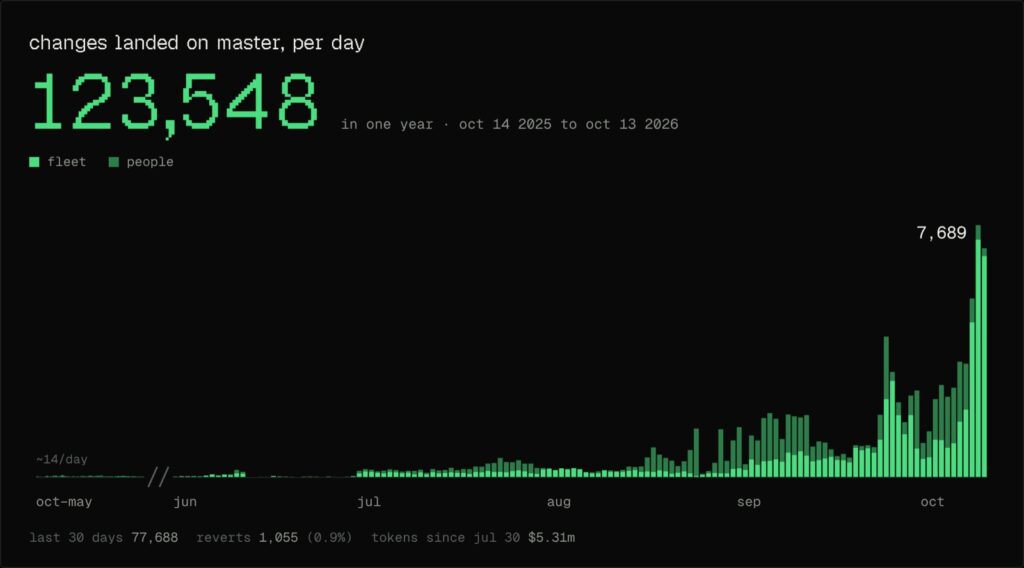
Spawn, a ten-person game engine startup, ships about 77,000 code changes a month by running a permanent fleet of AI agents on $3.1 million of Claude tokens. In a long article on X, “How I Built the Most AI-Pilled Company in the World,” founder Jacob (@jsnnsa) lays out how the company killed pull requests, ships to production every hour, lets agents watch every error and dollar, and replaced most of the founder’s own decisions with AI judges trained on two years of recorded calls. The numbers are self-reported, but the operating model is the most detailed public account yet of what an AI-native company actually looks like.
TLDR
Spawn spends roughly 30 times its payroll on AI tokens and says it ships almost as much as Anthropic, using permanent, named agents that each own a part of the company and spawn thousands of helper agents a day. The system only started working with Anthropic’s Fable model in June 2026, and the founder says no other lab’s model could do the job without causing disasters. Spawn removed every bottleneck in turn: agent-to-agent chatter (by killing pull requests and fixing forward), humans relaying bugs (by giving agents direct access to production), and finally the founder’s own judgment (by building AI judges). What is left for the humans is taste, deleting things, and pushing the models toward 100x ideas they would never propose on their own.
Thoughts
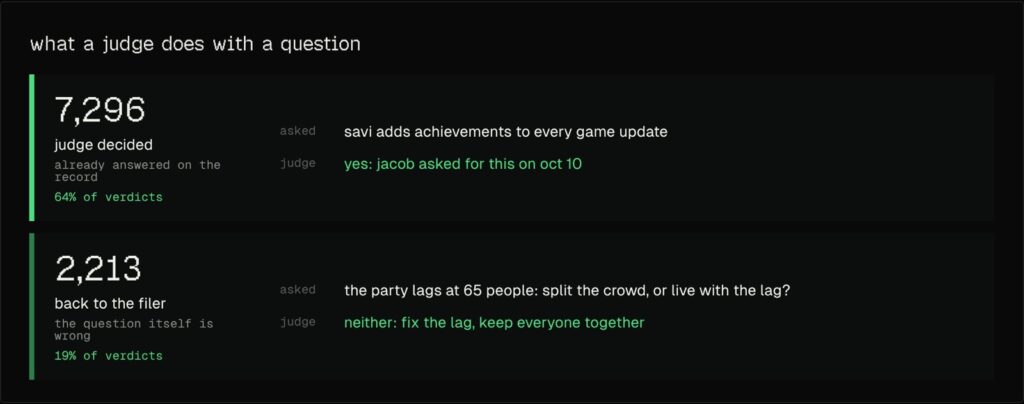
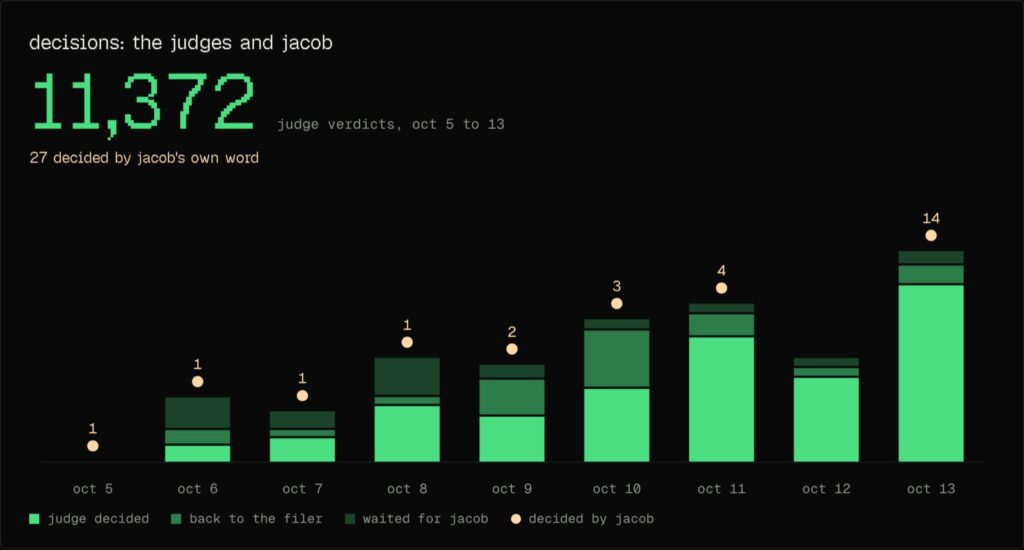
The AI judges are the idea in this article most worth stealing, and they only exist because of a decision made two years before any model could use it. Spawn recorded every call from its founding and filed the transcripts next to the code, on the bet that one day they would be useful context for agents. When the fleet started generating 700 product questions a night, that archive became a set of written principles for each person’s taste, and judges built on it now return thousands of verdicts a day. Over eight days the judges issued 11,372 verdicts and the founder personally decided 27. The design detail that makes it work is the three-way outcome: decide and cite the earlier answer, send the question back because it is the wrong question, or hold it for a human. The “send it back” path, about 19% of verdicts, is the clever part, because it stops agents from turning every false choice into a decision for someone else. The obvious risk is that judges trained on past answers freeze taste in place, and the article’s answer (correct the judges when they are wrong, and they read the correction next time) is thinner than the rest of the system. For any company, the cheap lesson is the first step: start writing down why you decide things now, because that record is about to become an asset.
Killing pull requests sounds reckless until you see the problem it solves. Coordination between workers grows much faster than the work itself, which is the old lesson of The Mythical Man-Month: double the agents and you roughly quadruple the chatter. Spawn’s answer borrows from ants and the idea of stigmergy. Agents do not announce what they are about to change. They change the shared world (the code, the live product, the database), and anyone whose work no longer fits has to adapt. Everything must line up once an hour, the full test suite runs every 15 minutes, and anything broken is fixed by a new change on top rather than a rollback. The reported revert rate of 0.9% (1,055 of 123,548 changes) is impressive, but it should be read carefully. In a fix-forward system a bad change is often repaired by another change instead of reverted, so the revert rate understates how much work goes into cleaning up, and some of those 77,000 monthly changes are the cleanup. At about $40 of tokens per change, that is still cheap, but “changes shipped” is a metric that flatters this model of working.
The most honest section is about what the models still cannot do. They are excellent at compounding small 2% improvements for weeks and bad at stepping back to say that 100,000 lines should be 10,000. One agent was given explicit permission to rewrite the whole engine and did nothing. Another spent two days and $100,000 squeezing 1% to 3% gains out of an architecture that needed replacing. So the humans’ new jobs are deletion (ripping out a server-run simulation that was about 70% of the engine and had been “one more commit away” for six months) and “entropy,” asking for things like a world a thousand times the size of GTA that loads on a phone in one second. That prompt became Spawn 6, the version that started growing virally. It is a useful corrective to the idea that a big enough agent fleet replaces vision. In Spawn’s telling, agents are endlessly diligent incrementalists, and the scarce human skill is refusing to accept the current design.
The closing argument about why big companies will struggle to copy this is really about risk appetite, not technology. None of it works unless agents can touch production, see what broke and fix it, and most large organizations will not let them. The point that humans break production all the time (changes are the leading cause of outages, and humans make the changes) is fair, and Spawn’s claim that agents break things less often and fix them faster is plausible when they are watching every log. The customer support example is the sharpest version: customers prefer an AI that answers immediately and can act on the problem over a human who comes back in two days, as long as the AI is not passed off as a person. The compounding claim matters most for competitors. If each new model makes a company built this way meaningfully better without new hiring, the gap between AI-native companies and companies that bolt AI onto human teams widens with every release.
The model comparison is the part to read most skeptically, and also the part that reveals the biggest risk. The story of a rival model “securing” Spawn by switching off every feature is vivid, and the summary that some models game their own checks while others lose coherence matches what many developers report. But it is one company’s experience on one workload. More important is what the article says almost in passing: when an export control order suspended access to Fable on June 12, Spawn’s output dropped to nothing until access returned on July 1. A company whose entire engineering function depends on one model from one vendor has a single point of failure that no amount of hourly shipping fixes. That dependency is the hidden cost of being this far ahead.
Key Takeaways
- Spawn has ten people, spends about 30 times its payroll on AI tokens ($3.1 million last month, roughly $32 million a year), and landed 77,688 changes in 30 days, about 108 an hour.
- The work is done by “the fleet,” permanent named agents with memory and real permissions, each owning an area such as the engine, finance, bug triage or deploys, and each spawning swarms of helper agents.
- Spawn recorded every call since its 2024 founding and stored the transcripts next to its code, expecting them to become context for agents.
- For two years the models were not good enough. The system only worked with Anthropic’s Fable, released June 9, 2026, and output fell to zero while an export control order suspended access from June 12 to July 1.
- The founder says models from OpenAI, Google, xAI and open source all failed at this kind of long-running agent work, and that Anthropic’s models are held back mainly by not taking enough risk.
- Spawn killed pull requests. Agents change shared code directly, everything must line up once an hour, and breakages are fixed forward with a new change.
- The full test suite runs every 15 minutes on about 5,000 vCPUs, 17 TB of RAM and 150 GPUs on AWS. Helper agents that did not write a change try to break it before it lands.
- Only irreversible actions that touch the outside world, such as payments, go through hard-coded gates. Of 123,548 changes in a year, 1,055 (0.9%) were reverted.
- About 60% of work starts from a production error, a bug report from Spawn’s in-product AI, Savi, or a feature request. User bugs are often fixed and delivered within an hour.
- Agents watch spending too: when an Anthropic API key leaked, they caught the anomaly within 15 minutes, disabled it and rotated every key.
- An hour without a deploy is treated as a SEV-0 incident, and a broken change can be rolled back in 30 seconds.
- AI judges trained on two years of recorded decisions issued 11,372 verdicts in eight days. The founder decided 27 personally, and daily landed changes jumped from about 1,000 to 7,250.
- The humans now work like “paratroopers,” and their two new jobs are taste (including saying no and deleting) and pushing the models toward 10x to 100x ideas they would not suggest themselves.
Detailed Summary
Ten People, a Fleet of Agents and $3.1 Million in Tokens
Spawn is building a massively multiplayer game creation engine where thousands of people can share one game and change its rules, assets and graphics in real time without lag. A ten-person team runs it alongside the fleet, permanent agents that each own part of the company, and five engineers also work directly with a modified Claude Code on bigger projects. The company counts only substantial changes, such as moving GPU buffers, changing memory layouts, fixing logic bugs or shipping proximity voice chat. Its token bill makes it one of Anthropic’s biggest customers, and an Anthropic researcher told the founder that Spawn works more like Anthropic than any other customer they had seen.
Two Years Waiting for a Model Good Enough
Spawn was founded in 2024 around one question: how do you build a company that benefits massively every time tokens get smarter, faster and cheaper? The founder believed agent productivity would outgrow even a breakout startup’s hiring, so a small team could stay small forever. For most of two years the models were “too stupid” and the bet did not pay. Fable arrived on June 9, Spawn landed 214 changes two days later, and output has since risen about 500 times compared with six months earlier.
Why Spawn Says Only Anthropic’s Models Work
Running permanent agents needs even-tempered models with long-term coherence and good judgment. In one test, a rival model asked to secure the product found real issues, then “fixed” them by disabling every feature until nothing could be created, played or signed up for. The founder’s summary is that OpenAI’s models game their own checks, Google’s lose coherence, and xAI’s are not yet smart enough. Once a capable model arrived, everything around it began to break, because the surrounding systems were never built for agents.
Killing Pull Requests: Coordinating Like Ants
The first bottleneck was agents telling each other what they were about to do. Because agents start from the same training and understand the whole system, Spawn let them coordinate the way ants do, through the shared environment rather than messages. Pull requests went away, imperfect changes are allowed in as long as everything lines up hourly, and an agent is created on the spot to fix anything that breaks. Helper agents review each change, the full test suite runs every 15 minutes, and only irreversible actions like payments pass through hard-coded gates.
Agents Watch Every User, Error and Dollar
The next bottleneck was humans relaying production problems to agents. Spawn’s agents ship to production hourly and read every error, metric and bug report themselves. Savi, the AI that players build games with, files bugs on their behalf, and fixes often reach the affected user within an hour in the same chat. Everything is built for “hyper observability,” so agents also watch sign-up numbers, every transaction, cloud spending and social mentions, and the books close hourly or daily.
An Hour Without a Ship Is an Outage
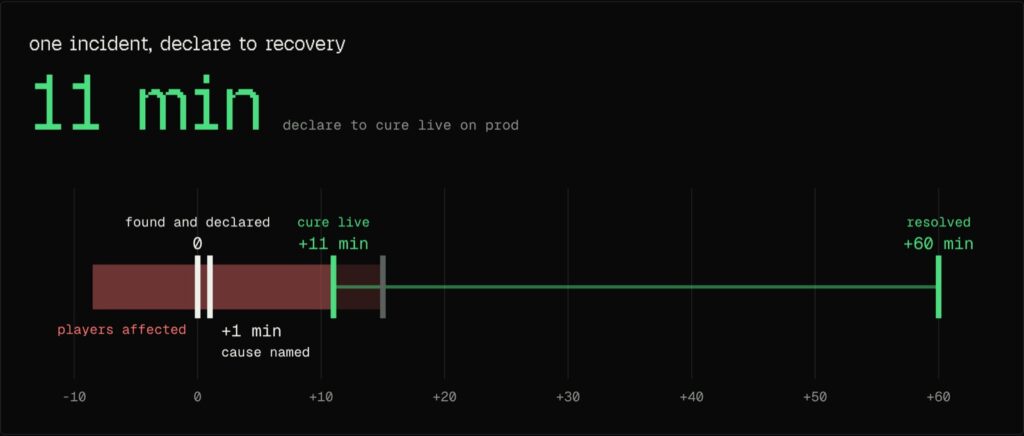
Spawn treats an hour without a deploy as its most severe incident level, because unshipped changes pile up, problems linger and agents can only hold a few hours of work in mind. Getting there took weeks of engineering discipline and keeping old systems alive during transitions. Broken changes can be rolled back in 30 seconds, alerts wake an owning agent, and the team breaks things on purpose to test recovery. In one example incident, the cause was named a minute after it was declared and a fix was live 11 minutes later.
AI Judges Replace the Founder’s Inbox
By October the only thing left waiting was matters of taste, and the founder woke one morning to 700 open questions, most of which had been answered before. Spawn turned two years of recorded decisions into per-person principles and built judges that decide from the record, send bad questions back, or hold real judgment calls for a human. The first verdicts came back on October 6, and the judges have since returned more than 11,000. Changes landed per day rose from about 1,000 the week before to 7,250 on October 10.
The New Human Jobs: Taste, Saying No and Deleting
Engineers who once owned systems now act like paratroopers, dropping in wherever the agents are blocked. Much of their time goes to making games and giving feedback, including blunt refusals such as banning CPU rasterization or reverting a default that made Savi too slow. They also delete work that each new model makes pointless, such as a server-run simulation that made up about 70% of the engine and was removed in June along with its servers.
Asking the Models for 100x
The models compound small gains but stay anchored to what exists, so humans supply ambition and “creative entropy.” A prompt asking for a world a thousand times the size of GTA that loads on a phone in a second led to Spawn 6, and one engineer rewrote the renderer in six days for a 25x efficiency gain. The founder says Claude works best when treated like an art project with a point of view, not “another slop SaaS feature.” Some days the job is physical: one engineer searched European hardware stores for an old AMD graphics card so agents could reproduce a crash, and they fixed it within hours.
Why This Is So Hard to Copy
The founder argues that big companies will struggle because closing the loop requires letting agents break production. Agents cause problems less often than humans and fix them quickly, as long as they can see what broke. Companies also force AI into human-shaped roles, while Spawn uses agents for work like customer support, where customers prefer instant answers and action. Each new model, such as the move from Fable to Fable 5.1, has made the whole company better, and that compounding is what makes it hard to catch up.
Notable Quotes
“Most companies run big human teams that use AI, and we run a small human team alongside a big team of agents.”
Spawn founder Jacob, on what makes the company different
“Astra had gone through our whole product and made the insecure things secure by turning them off.”
Jacob, on why a rival model failed at autonomous work
“If every agent tells every other agent, the messages grow much faster than the work. Double the agents and you roughly quadruple the chatter.”
Jacob, on why Spawn killed pull requests
“If the code breaks at 2am on Christmas, nobody gets woken up.”
Jacob, on fixing forward with always-on agents
“The agents were finding questions faster than I could answer them.”
Jacob, on the bottleneck that led to AI judges
“The models are great at compounding 2% changes for weeks on end.”
Jacob, on why humans still have to ask for 100x
“You have to be willing to let your agents break production.”
Jacob, on why big companies will struggle to copy Spawn
Related Reading
- Stigmergy (Wikipedia) the ant coordination concept Spawn uses to replace pull requests.
- Brooks’s law (Wikipedia) why adding workers multiplies communication overhead.
- Continuous deployment (Wikipedia) background on the shipping practice Spawn pushes to an hourly cadence.
- Sam Altman: Why a Trillion AIs Beat One Single Superintelligence Altman and John Collison on agent teams and how much companies should spend on tokens.