PJFP.com

Pursuit of Joy, Fulfillment, and Purpose

Tag: neuroplasticity

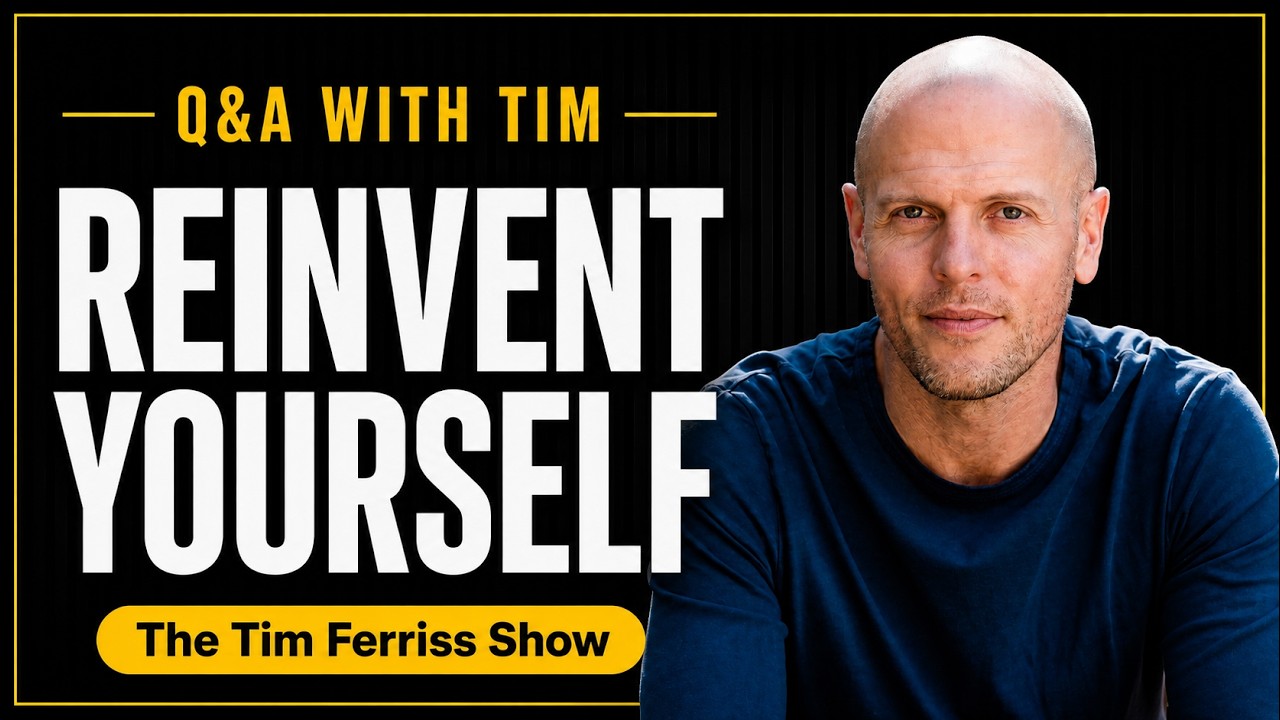
  • Tim Ferriss Q&A on Male Friendship, Reinvention in the Age of AI, Mini Retirements, One-Day TMS, and the One Habit He Would Keep for Cognitive Health

    Tim Ferriss sat outside with a laptop and a live chat and answered a few dozen reader questions in about seventy minutes, and the result is one of the better unstructured snapshots of how he actually thinks right now. He moves from transformation and therapy culture to career reinvention under AI, from the mechanics of male friendship to one-day brain stimulation protocols, from language learning to Alzheimer’s prevention, without much filtering. You can watch the full Q&A here.

    TLDW

    Ferriss argues that the skills that survive AI are the boring meta skills (learning, asking questions, written and verbal communication, negotiating), that most people trapped between two options have simply stopped generating options, and that the way men build close friendships is through shared activities and shared projects rather than sit-down emotional conversations. He warns that getting stuck in “doing the work” is as easy as getting stuck in hyper optimization, defends the mini retirement as a controlled burn that forces you to fix your systems, and describes a compressed one-day TMS protocol that gave him three to four months of relief from anxiety and insomnia. He covers his current training split (lift two to three times a week, yoga, daily movement, do not get injured), his sleep basics (sunlight, exercise, stop drinking water before bed), his three luxuries worth overspending on (manual therapy, ease of travel, healthcare), and his answer on cognitive decline with two parents-worth of Alzheimer’s in the audience question: exercise, above everything else. Along the way he makes the case that learning languages raises the resolution of your experience of reality, tells a 16-year-old that the phone is engineered to hijack their free will, and admits that if he could undo public visibility, he might take the deal.

    Thoughts

    The most useful thing in this session is the friendship answer, and it is useful precisely because it is unfashionable. A therapist wrote in to say that building emotional closeness is literally his job, that it comes easily with women, and that he has never cracked male friendship. The expected answer in 2026 is vulnerability: be brave, initiate, say the hard thing. Ferriss says the opposite. Put two men in chairs facing each other and you activate very old machinery that reads eye contact as threat. Put them around a fire, or on a hike, or a year deep into building something together, and the deep conversation happens sideways, as a byproduct. The prescription is not “be more open,” it is “find a recurring activity.” That reframes loneliness from a character problem into a logistics problem, which is the version you can actually solve this month.

    His answer on AI-proofing yourself is deliberately anticlimactic, and the anticlimax is the argument. Asked what a non-famous person with a family should do in the next twelve months to prepare for the coming decade, he does not name a tool, a model, or a prompt technique. He names learning, asking questions, writing, speaking, and negotiating. He also does something rarer, which is to point out the incentive structure behind the noise: an enormous amount of net worth is currently tied to convincing you that everything is about to change beyond recognition. Change is real and accelerating, and the people selling you the acceleration are not neutral. The hedge is to invest in the skills that were valuable in 1975 and will be valuable in 2045, and to notice that in-person human relationships remain a prerequisite for mental health rather than an optional add-on.

    The warning about self-improvement as a trap deserves more attention than it will get. Ferriss has spent twenty years as a figurehead of optimization culture, and here he says that it is just as easy, maybe easier, to get stuck in a never-ending cycle of polishing the self as it is to get stuck in hyper-optimized achievement. Both are obsessions with the self. One gets validated by a bank account, the other by pats on the back for doing the work. The dose makes the poison in both directions. Anyone who has spent three years in therapy, breathwork, plant medicine, and journaling and cannot point to a single relationship or project that got better should sit with that.

    The mini retirement pitch is stronger than the usual sabbatical argument because of the mechanism he gives. A one-week break lets you triage from a distance: you hop in, put out small fires, and come home to two weeks of damage control. Three to four weeks makes triage impossible, so you are forced to look hard at your systems, your policies, and the pile of work that does not need doing at all before you leave. The break is not the reward, it is the forcing function. He calls it a controlled burn that prevents bigger forest fires, and he frames his own four-month podcast hiatus the same way: a deliberate test of whether benching the golden goose ends the world. It did not.

    The medical material is the part to read carefully and act on slowly. A compressed one-day version of accelerated TMS, with a plasticity-enhancing drug given beforehand, reportedly giving three to four months of complete relief, is a genuinely significant claim if it holds up outside of one person’s experience. Ferriss is an investor in the company, discloses it, and is honest about why he cares: five days off work and travel prices most people out, and one day does not. He is equally honest on cognitive decline, where he says out loud that he does not buy the amyloid hypothesis that most therapeutics are built on, suspects vascular and mitochondrial causes, and then lands on the least exciting answer available. If you had to pick one intervention against dementia, pick exercise. He is throwing a kitchen sink of supplements and saunas at it too, and he is clear those are the garnish.

    Key Takeaways

    • Before asking how to escape the hyper-optimized phase, question whether you are actually stuck. The framing of the question is often the problem.
    • Ferriss credits his own shift to addressing childhood sexual abuse, and says the seventeen problems he thought were separate all traced back to one unaddressed thing.
    • He rereads Awareness by Anthony de Mello at least once a year, and recommends Internal Family Systems as a framework almost anyone can benefit from.
    • Getting stuck in “doing the work” is as real a failure mode as getting stuck in achievement. Any obsession with the self becomes poisonous at high enough doses.
    • When facing a big life pivot, read Derek Sivers on there always being more than two options. People who list only A and B have stopped thinking, not run out of options.
    • Sivers’ example: build the company after hours until it hits fifty percent of your salary, or pitch it to your boss as a division, or move to New Zealand and be a tour guide. The friend in the story realized he did not want a company at all, he was avoiding fixing his current situation.
    • Gratitude exercise from Chris Bosh: if five people put all their problems on a table, you would grab your own problems back.
    • Test a pivot with a two to four week experiment, and do it in addition to your current life rather than instead of it. Loving surfing on weekends does not mean you would love surfing as a Monday to Friday obligation.
    • Increase the dose of the thing before you jump, so you are testing the hypothesis rather than betting on it.
    • The five skills he believes survive AI: learning, asking questions, written communication, verbal communication, and negotiating.
    • He points to the metalearning section of The 4-Hour Chef as the ~80 pages of that book worth revisiting, and concedes the book overall tried to do too much.
    • Asking questions is a skill you turn on yourself, not just on other people. An 80/20 analysis is really a collection of questions for examining your own assumptions.
    • Kevin Kelly’s line that he does not write what he knows, he writes to find out what he thinks, is why writing does not get replaced by dictating to a chatbot.
    • Talking to an LLM has bias baked in twice: from the people who designed the system, and from memory features that turn your own chats into a self-reinforcing feedback loop.
    • Ferriss spent roughly ninety percent of a recent workday on pen and paper, because paper is nonlinear and a keyboard forces you down the page.
    • Suggested resources for communication and negotiation: On Writing Well, Secrets of Power Negotiating, Getting Past No, Getting to Yes, and a local Toastmasters chapter for verbal comms.
    • On staying morally grounded: read philosophy. It is not an ivory tower pursuit, it is learning how to live. Religion is an equally valid path to a consistent code.
    • His 2024 podcast sabbatical was an experiment in killing the golden goose. The fear was ungrounded, which he notes is true of most fears.
    • Rules that stuck after the sabbatical: no book-launch episodes, interview living legends before they can no longer sit for a few hours, and keep running format experiments.
    • The living legends run includes Andrew Weil at 84, Tish Rabe at 74, Wade Davis at 72, plus David Whyte, Frank Miller, and Danny Hillis. Most were not download hits and he does not expect them to be.
    • He runs a barbell strategy of guests: mostly unknown names, occasionally a household name like Tim McGraw or Steve Young.
    • Enjoying the work is not a soft preference, it is the energy layer that produces attention, which is what lets you outlast trends.
    • Read Blue Ocean Strategy now, because avoiding red-ocean competition is becoming existential for a lot of businesses.
    • Men bond through shared activities and shared projects, not face-to-face verbal sessions. Every close male friendship he has, old or new, was built that way.
    • The campfire insight: fires work for deep conversation because nobody makes eye contact. Two men staring at each other triggers a threat response that is millions of years old.
    • Moving to a new city? Build everything around a recurring shared activity: morning swims, rock climbing, a run followed by beers. Something inherently social with a partner or group.
    • A year spent building a card game with a friend produced more depth than any number of intentional deep conversations would have.
    • Current training: lifting two to three times a week split into push, pull, and legs, about an hour each; Iyengar yoga once or twice a week; some movement daily.
    • Two aging rules: do not get injured, because injuries accumulate, and something is always better than nothing. Twenty push-ups beats postponing to a day that never comes.
    • He still uses kettlebells for overhead pressing and cleans, but has cut swings because of lower spinal issues.
    • Strength work borrows from Pavel Tsatsouline’s greasing the groove (ten sets of two pull-ups, submaximal, short rests), finished with a five-second up, five-second down set to failure in the spirit of Occam’s Protocol from The 4-Hour Body.
    • To distinguish burnout from needing a vacation from having outgrown your life: take the vacation first, because it is the short, cheap, reversible test.
    • If the vacation does not fix it, take a mini retirement of three to four weeks minimum. Anything shorter lets you triage remotely instead of fixing the system.
    • He takes a mini retirement once or twice a year, recommends a change of geography, and calls the practice a controlled burn.
    • Distance produces fresh eyes, the same way a book draft has to sit for weeks before you can edit it honestly.
    • When problems start gluing themselves together into one unresolvable mass, he restarts TM twice a day. Twice daily specifically, not one longer session.
    • Same logic on meditation duration: fifteen minutes twice a day beats thirty minutes once.
    • For educators and clinicians working with teenagers, he points to Jonathan Haidt’s books and the state-level legislative work his research group is doing on phones in schools.
    • Advice for a 16-year-old in 2026: everything on the phone is engineered to hijack your free will. Run a digital mini retirement, delete the apps for three to four weeks, and measure anxiety and output before and after with no pressure on the result.
    • The SAINT accelerated TMS protocol has produced 70 to 80 percent remission in some treatment-resistant depression groups. Ferriss used it for generalized anxiety and OCD.
    • Ampa Health’s 1D protocol compresses five days of stimulation into one and pre-administers a plasticity-inducing drug. Ferriss reports three to four months of complete relief from a single day.
    • He is prioritizing compressed protocols specifically because most people cannot take five days off work or afford five days of travel for treatment.
    • Sleep basics before anything exotic: stop drinking water an hour or two before bed, get real sunlight, especially at sunset, and exercise enough that you are actually tired.
    • Walking is his highest-leverage daily habit. Any amount helps, but something changes after an hour, preferably two.
    • He batches calls into walks, including weekly one-on-ones with direct reports, which turns the inbox into movement.
    • Three luxuries worth overspending on: weekly manual and sports massage, anything that reduces travel friction, and healthcare for yourself and the people you love.
    • He paid for weekly massage when he was broke, sleeping on a futon and driving a hand-me-down minivan with the rear seats stolen out of it.
    • Travel hack: he kept a trunk of clothes, supplements, and everyday-carry gear in the basement of the New York hotel he always stayed at, so he never had to pack.
    • Concierge medicine is worth it for the peace of mind even if you never use it, the same way a very safe car is worth it even if you never crash.
    • He is getting heavily involved in Neko Health, the preventative health startup co-founded by Spotify’s Daniel Ek, currently in the UK and Sweden and expanding to the US.
    • On cognitive decline, with multiple relatives currently in his care with Alzheimer’s: if you pick one thing, pick exercise.
    • Specifics from his conversation with Dr. Tommy Wood: the Norwegian 4×4 interval protocol three times a week for six months produced roughly five years of benefit, and zone 2 work counts for mitochondrial health.
    • He does not buy the amyloid-beta and tau-tangle hypothesis that most Alzheimer’s therapeutics are built on, and suspects vascular dementia and mitochondrial dysfunction play a much larger role.
    • His stack around that: urolithin A, a sulforaphane precursor supplement, close attention to insulin sensitivity and glucose disposal, intermittent fasting of at least sixteen hours per Mark Mattson’s work, weight training, and sauna for heat shock proteins.
    • He invested in Jocasta Neuroscience, which is working on injectable klotho. In the meantime, exercise is what provokes natural klotho production.
    • Language learning has apparent longevity and cognitive benefits at the population level, and conversational function takes roughly 8 to 12 weeks. A thousand words covers about 80 percent of transactional conversation.
    • Words like the Japanese meiwaku compress a whole social situation into one expression, which is why he agrees with Wittgenstein that language sets the boundaries of your world.
    • Labels raise the resolution of experience. Learn the six to eight trees that make up ninety percent of your local forest and the walk becomes a different walk.
    • His practical language method: get a basic grammar overview from a phrasebook, then watch a movie or show you know by heart with subtitles in the target language.
    • He rates the Michel Thomas method highly for acquiring fundamentals in a week or two, including courses not recorded by Michel Thomas himself.
    • He thinks Duolingo is best positioned to crack AI-native language learning, and wants an AI-generated equivalent of the Duolingo Spanish podcast for Mandarin.
    • Instagram’s auto-dubbing produced idiomatic Japanese in his own voice, which he used to improve his own Japanese in five minutes because he already knew the content.
    • Analog still wins for vocabulary acquisition, because studying on a phone means competing with a thousand more tantalizing distractions.
    • Best purchase under $100: the full seven seasons of Parks and Recreation, watched one episode a night as a counterweight to doom scrolling.
    • When he writes late at night he mutes a favorite movie on a projector for company. Babe, The Bourne Identity, and Spirited Away have each run hundreds of times.
    • He never chose a public career deliberately. The first book was rejected by 25-plus publishers and he did not expect it to do anything.
    • If he could undo public visibility he would be tempted to take that deal, and he may eventually stop doing video entirely.
    • The half-life of fame keeps shrinking, from a meme that lasted a week ten years ago to one that lasts hours. Building a durable public profile gets harder while being findable gets easier.
    • Privacy used to be the default and is now closer to a luxury. Without proactive defenses, your life is available to anyone technical enough or willing to pay.
    • To find future standouts, look at what a teenager does on evenings and weekends: their obsessions, their self-taught projects, and how unorthodox their approach is. Do not dismiss Minecraft without asking what it is teaching.
    • On building an audience: be your authentically weird self, follow your own obsessions, and stop reading the tea leaves. The personal is the most universal.
    • He is not aiming to reach a hundred million people. Helping five people would make the work worth it.

    Detailed Summary

    Transformation, and the trap on the other side of it

    The first question came from a reader who had watched Ferriss shift from a driven, hyper-optimized investor to someone who talks openly about trauma, mental health, and meditation, and who wanted advice for people still stuck in the first mode. His first response was to challenge the premise: maybe you are not stuck. His own shift took decades and was driven by addressing childhood sexual abuse, which he has written about extensively and declined to relitigate here. What made it necessary was the recognition that seventeen problems he had been treating as separate were all downstream of one unaddressed thing. He does not think everyone has an elephant of that size in the room. For general-purpose tools he named two: Awareness, which he rereads at least annually, and Internal Family Systems, whose founder Richard Schwartz he has interviewed. Then came the counterweight. It is just as easy, maybe easier, to get stuck in doing the work as it is to get stuck in optimization. He gestured at Austin as the visible proof, a city full of people in a hyper-reflective, never-ending cycle of polishing the self. Whether the validation comes from a bank account or from being praised for doing the work, the underlying obsession is the same, and the dose makes the poison.

    Reinvention when the stakes are high

    A reader in his late forties asked how to tell a genuine next chapter from an impulse to escape, given that career, family, and financial obligations make big moves hard to test. Ferriss sent him to Derek Sivers’ post arguing that there are always more than two options, and read most of it aloud. The example in that post is a friend deciding between a frustrating job and quitting to start a company, met with a list of alternatives: build the company after hours until it produces half your salary, then quit; keep showing up but work on your own thing until you get fired; pitch the idea to your boss as a division so you stay on salary; or move to New Zealand and become a tour guide. The friend eventually realized he did not want a company, he wanted out of a situation he had not tried to fix. Ferriss added two moves. Write down everything that makes you want to escape, then run the Chris Bosh thought experiment: if five people put every insecurity, friction, and relationship problem on a table, you would grab your own back. And when you do test, use two to four week experiments layered onto your existing life rather than binary jumps, because the thing you love on weekends may collapse under the weight of being an obligation from Monday to Friday.

    Staying useful in the age of AI

    The most ambitious question of the session asked what a capable but non-famous person supporting a family should prioritize over twelve months to prepare for the coming decade. Ferriss refused to answer it bullet by bullet and gave the shape of his thinking instead. He keeps arriving at the same short list: learning, asking questions, written communication, verbal communication, and negotiating. He flagged the incentive problem first, that enormous amounts of net worth ride on selling you the magnitude of the coming change, then made the constant-factors case: real change is here and accelerating, and in-person human relationships remain non-negotiable for mental and spiritual health regardless. On learning, he pointed at the metalearning section of The 4-Hour Chef while conceding the book as a whole tried to do too much. Learning decomposes largely into asking questions, and questions are as much a tool for interrogating your own assumptions as for interviewing other people. On writing, he cited Kevin Kelly, founding editor of Wired, who writes not to record what he knows but to discover what he thinks, and warned that dictating into an LLM carries bias from both the system designers and the memory function, which reflects your own thinking back at you. He spent ninety percent of a recent day on pen and paper for exactly that reason. For negotiation he recommended Secrets of Power Negotiating, Getting Past No, and interviews with people from the Harvard Negotiation Project including William Ury, co-author of Getting to Yes. For staying morally grounded, read philosophy, which he defines as learning how to live rather than an academic pursuit, or take the religious path. What matters is having rules you follow consistently.

    What the sabbatical changed about the podcast

    Asked which post-sabbatical rules survived, Ferriss did something worth stealing: rather than trust his own memory, which he described as an act of creation that tends to flatter the creator, he asked a key employee what the answer was. Three rules stuck. No more book-launch episodes, which was the biggest change, because he did not want to be one stop on a guest’s twenty-podcast rotation. Living legends, meaning older guests who had not done many podcasts and might not be able to sit for a few hours much longer, a run that includes Andrew Weil at 84, Tish Rabe at 74 (the heir apparent to Dr. Seuss), and Wade Davis at 72, plus David Whyte, Frank Miller, and Danny Hillis. And continued format experiments: co-hosted episodes, meditation Mondays with Henry Shukman, Tim’s Foundry Kitchen, and the simplify-your-life compilations. He was explicit that most of these were not download winners and that he did not expect them to be, since the platforms push short clips with name recognition and sensationalism. He keeps a barbell of guests, mostly unknown with occasional household names like Tim McGraw or Steve Young. The justification is endurance: enjoyment produces energy, energy produces attention, and attention is what lets you outlast trends. For the generalizable version of the question, he recommended Blue Ocean Strategy and his own fear-setting exercise, which is free online.

    The art of male friendship

    A therapist in his thirties with no old friend group asked for the actual first move, and how to get past how weird it feels to initiate with another man. Ferriss answered with a story from the mountains of Montana: a small group of men spending a full day hiking, carrying weight, tending llamas, fishing, and scrambling over rocks, then sitting around a fire at night having unusually deep conversations. One of them named the mechanism out loud. It works because nobody is making eye contact. Two men in a sit-down session staring at each other activates ancient machinery that reads as threat, while a fire in the dark removes it. Crucially, the deep conversation was a small fraction of the day. Everything else was shared activity. His generalization is that men bond through activities and projects rather than face-to-face verbal intimacy, that women are far more adept at the latter for good evolutionary reasons, and that every close male friendship he has, whether twenty years old or two years old, traces back to something built or done together. For someone new in a city, the answer is the same: pick something recurring, active, and inherently social. Morning swims, rock climbing, a run followed by beers. He offered his own newer friendships as evidence, including a year spent building a card game with a friend, which surfaced plenty of deep material sideways without ever having to open the topic head-on.

    Training, sleep, and the rules of aging

    His current week is simpler than his reputation suggests. Lifting two to three times a week, split into pushing, pulling, and legs, roughly an hour each, is the backbone, because if he had to keep one modality for longevity it would be weight training. Add Iyengar yoga once or twice a week for alignment and prop-assisted adaptability, and some form of movement every day, whether biking, swimming, or walking. Kettlebells are still in rotation for cleans and overhead pressing, though he has cut swings because of lower spinal issues. His strength work leans on Pavel Tsatsouline’s greasing the groove, ten sets of two pull-ups with short rests, kept deliberately submaximal, finished with a slow five-second-up, five-second-down set to failure in the spirit of Occam’s Protocol from The 4-Hour Body. From The 4-Hour Body he also still uses the chop and lift work from the reversing-injuries chapter. The two rules that govern all of it: do not get injured, because injuries accumulate as you age, and something is always better than nothing. If the day fell apart and the gym is out, do twenty push-ups or ten laps. Scaling down beats postponing. On sleep, before anything exotic, stop drinking water an hour or two before bed, get real sunlight, especially as the sun goes down, and exercise enough that your body is actually tired. He named modern life’s two default deficiencies plainly: not enough sun, and not enough fatigue, because you spent the day eighteen inches from a screen. The one-day TMS protocol, he says, has been remarkable for sleep onset specifically.

    Vacation, burnout, and the mini retirement

    Asked how to tell needing a vacation from burnout from having outgrown your life, Ferriss offered a general decision rule before the specific answer: when your options include one that is short in duration, run it first and cross it off the list. So take the vacation. If that solves it, that was the answer. If not, take a mini retirement, a concept from The 4-Hour Workweek that he still runs once or twice a year. The three to four week minimum is the load-bearing detail. A week or two lets you keep triaging remotely, putting out small fires from a distance and returning to weeks of damage control. Three or four weeks makes that impossible, which forces you to examine your systems, your policies, what you can eliminate or automate, and what you are doing that never needed doing. That is the controlled burn that prevents the bigger forest fire, and it produces the same fresh eyes that a book draft needs after sitting untouched for a few weeks. He recommends a change of geography, though the mechanism works either way. His shorter-term intervention when problems start gluing together into one unresolvable mass is TM twice a day, and he is emphatic about the twice: fifteen minutes twice beats thirty minutes once. If a week or two of that does not clear the fog, he gets a mini retirement on the calendar, even if it is three months out, and then defends the date.

    Teenagers, phones, and what he would say to a 16-year-old

    An educator working in child and teen mental health and suicide prevention asked what to tell practitioners caring for young people right now. Ferriss pointed at Jonathan Haidt, both the books and the state-by-state legislative work his research group has done on restricting phones in schools. Speaking directly to a hypothetical 16-year-old, he was blunt: everything on the black mirror in your hand is designed to hijack your free will and turn you into a puppet of one machine or another. His intervention is a digital mini retirement. Delete the apps for three to four weeks, run an honest assessment beforehand of anxiety levels, depressive symptoms, output, and the gap between what you say you want and how you actually spend time, then look at the numbers afterward with no pressure and no expectations attached to the result. He framed the pitch in both directions on purpose. If you want a beautiful life with peace of mind and healthy relationships, this helps. If you want to be a world beater and operate at the highest level, this also helps.

    One-day TMS and the compressed-protocol bet

    Ferriss has used the SAINT protocol, a form of accelerated transcranial magnetic stimulation, for generalized anxiety disorder and OCD, and cited remission figures of 70 to 80 percent in some treatment-resistant depression groups. His mental model for it is mechanical rather than chemical: sometimes the anatomical structures are firing in the wrong order, like driving a manual car while using the clutch and gears out of sequence, and the fix is resequencing rather than a molecule. The standard SAINT course is five days of roughly ten stimulations per day, which is effectively a full week of your life. The company he recently got involved with, Ampa Health, where Dr. Jonathan Downar is involved, has compressed that into a single day and pre-administers a small dose of an antibiotic that helps induce plasticity. Ferriss reports three to four months of complete relief from one day of treatment, and says it still blows his mind. His stated reason for focusing on ultra-condensed and pharmacologically enhanced versions is access: most people cannot take five days off work or afford five days of travel, and a single day opens the aperture on who this can reach.

    What he pays top dollar for

    Three luxuries. First, massage and manual therapy, which he put first deliberately because he was paying for it weekly when he was broke, sleeping on a futon with roommates and driving a hand-me-down minivan someone had stolen the rear seats out of. Not relaxation massage, sports and repair work, and he considers it the core component of his health span. His scaling rule applies here too: cannot afford an hour, do thirty minutes; cannot afford thirty, find someone to work your IT bands for five. Second, ease of travel, which covers everything from expedited security lines to shipping luggage when your elbow hurts. His best example is a trunk of clothes, supplements, and everyday-carry gear stored permanently in the basement of the New York hotel he always used, so he could grab a toothbrush and get on a plane. Third, healthcare for himself and the people he loves, including trainers, doctors, and meal delivery for his parents. He quoted the old line that a well person wants a million things while a sick person wants only one, and said this is a place where he is happy not just to spend but to overspend, because concierge access at 2am is an insurance policy that pays in peace of mind even when it goes unused, like a very safe car. He also confirmed that he is getting heavily involved in Neko Health, the preventative health startup co-founded by Spotify’s Daniel Ek, currently operating in the UK and Sweden and expanding to the US.

    Cognitive decline, and the unglamorous answer

    A listener with two parents with Alzheimer’s asked for the single most important thing, saying she was overwhelmed by the hacks. Ferriss, who is currently caring for multiple relatives with Alzheimer’s and admits the topic terrifies him, gave one word: exercise. He referenced his conversation with Dr. Tommy Wood for specifics, including the Norwegian 4×4 interval protocol done three times a week for six months producing something like five years of benefit, and noted that zone 2 work counts for mitochondrial health. He then said something most people in the longevity space will not say out loud, which is that he does not buy the remove-amyloid-beta-and-tau-tangles-and-all-will-be-well hypothesis that a large share of therapeutics are predicated on. His suspicion is that much of it is vascular dementia and mitochondrial dysfunction. The rest of his stack follows from that: urolithin A for the mitochondrial box, a sulforaphane precursor supplement, close attention to insulin sensitivity and glucose disposal via weight training, intermittent fasting of at least sixteen hours along the lines of Mark Mattson’s work so that liver glycogen depletes and some ketone production kicks in, and a barrel sauna for heat shock proteins. He has invested in Jocasta Neuroscience, which is pursuing injectable klotho, while noting that exercise is what provokes natural klotho release in the meantime. His summary: pills and potions cobbled together will not do it if the exercise, the food, and the glucose control are not there.

    Why learn a language when AI can translate

    The longest answer of the session went to a question about whether AI has changed his thinking on language learning. He gave three reasons it still matters. There appear to be significant longevity and cognitive benefits to acquiring multiple languages at the population level. The time cost is far lower than people assume, roughly 8 to 12 weeks to conversational function, and about a thousand words to handle 80 percent of transactional conversation in restaurants and hotels, which he believes is achievable in around two weeks. And, most interestingly, he agrees with Wittgenstein that the limits of your language are the limits of your world. He gave examples: saudade in Portuguese, komorebi for dappled light in Japanese, and meiwaku, which compresses the entire situation of receiving an unwanted favor or gift and the obligation that follows into a single word. Then he made the analogy that carries the argument. Walk through the woods without knowledge and you see trees. Spend twenty dollars on a walk with a botanist who shows you the six to eight species that make up ninety percent of the local forest and how to tell them apart, and your experience of the same walk is higher resolution. Higher resolution and a better frame rate extend your experiential lifespan, which is a way to live longer that does not require waiting on the biological interventions billionaires are funding. On AI specifically, he thinks Duolingo is best positioned to crack it, wants an AI-generated Mandarin equivalent of the Duolingo Spanish podcast, and was startled by Instagram auto-dubbing that produced idiomatic Japanese in his own voice, which he then used to improve his Japanese in five minutes because he already knew the content. But he insists analog still wins for the grind, because studying on a phone means competing with a thousand more tantalizing distractions. His method: get the ten-page grammar overview from a traveler’s phrasebook, then watch something you know by heart with target-language subtitles. He is currently working through Parks and Recreation for exactly this reason, and rates the Michel Thomas method highly for the first week or two of fundamentals.

    Privacy, fame, and audience

    Asked how someone who values privacy reconciled that with a public career, Ferriss said he never really chose it. The first book was turned down by more than twenty-five publishers and bought for nothing, and he did not expect it to go anywhere. By the time it did, the genie was out of the bottle. If he could hit control-Z, there are times he would be tempted. He may eventually stop doing video, because he has no desire for more facial recognition. The silver lining he sees is that the half-life of fame keeps collapsing, from a meme that circulated for a week ten years ago to one that lasts hours, which means durable public profiles are getting harder to build even as everyone becomes easier to find. He described privacy as something that was a default for millennia and is now closer to a luxury, requiring proactive defenses and scrubbing services, and mused about private money and privacy coins while explicitly warning that none of it is investment advice and that crypto is an easy way to lose everything. On building a long-term audience, his advice was to be your authentically weird self and follow your own obsessions, because in nonfiction the personal is the most universal. Do not read the tea leaves to guess what an audience wants. Tools, platforms, and formats all change. He added that he is not trying to reach a hundred million people. If something helped him and he takes good notes and shares it and it genuinely helps five people, that is worth the time.

    Notable Quotes

    “As I get older, I think the rule number one is don’t get injured because they accumulate. And then number two, something’s better than nothing.”

    Tim Ferriss, on how his training philosophy changed approaching 50

    “There are lots of people who can’t seem to get past a hyper reflective never ending cycle of polishing the self.”

    Tim Ferriss, on the failure mode hiding on the other side of self-improvement

    “You know why also perhaps men in particular, and not saying this is limited to men, but love fires so much, is no eye contact. You’re staring at the fire.”

    Tim Ferriss, recounting what a friend said around a campfire in Montana

    “When I look at all of my male friends who have the closest male friendships, whether they are from 20 years ago or from a year or two ago, shared projects or shared activities is the answer.”

    Tim Ferriss, answering a therapist who had never cracked male friendship

    “Learning, asking questions, written and verbal communications and negotiating. Those are a handful of skills that I think will remain constant.”

    Tim Ferriss, on what to invest in over the next twelve months

    “Philosophy is not for people in academic ivory towers. In my opinion, if you look back, it’s learning how to live.”

    Tim Ferriss, on staying morally grounded

    “By doing that once or twice a year, you’re effectively doing a controlled burn, which prevents much bigger forest fires.”

    Tim Ferriss, on why he still takes mini retirements

    “Everything on this black mirror is designed to hijack your free will and to turn you into a puppet of the machine of some type.”

    Tim Ferriss, on what he would tell a 16-year-old in 2026

    “Suddenly, because you have these labels, your experience of reality is much higher resolution. And when it’s higher resolution, when you have also a better frame rate, I think you extend your experiential lifespan.”

    Tim Ferriss, on why language learning survives machine translation

    “If I had to pick one thing for cognitive health, it is the exercise.”

    Tim Ferriss, answering a listener whose parents both have Alzheimer’s

    Watch the full Q&A here for the complete answers, including the parts on kettlebell programming, privacy tooling, and what he looks for in a teenager who will turn out to be exceptional.

    Related Reading

  • Skittle Factories, Monkey Titties, and the Core Loop of You


    TL;DR

    Parakeet’s viral essay uses a Skittle factory as a metaphor for personality and how our core thought loops shape us—especially visible in dementia. The convo blends humor, productivity hacks (like no orgasms until publishing), internet weirdness (monkey titties), and deep reflections on identity, trauma, and rebuilding your inner world. Strange, smart, and heartfelt.


    Some thoughts:

    Somewhere between the high-gloss, dopamine-fueled TikTok scroll and the rot of your lizard brain’s last unpatched firmware update lies a factory. A real metaphorical one. A factory that makes Skittles. Not candy, but you—tiny, flavored capsules of interpretation, meaning, personality. And like all good industrial operations, it’s slowly being eaten alive by entropy, nostalgia, and monetization algorithms.

    In this world, your brain is a Skittle factory.

    1. You Are the Factory Floor

    Think of yourself as a Rube Goldberg machine fed by stimuli: offhand comments, the vibe of a room, Twitter flamewars, TikTok nuns pole dancing for clicks. These are raw materials. Your internal factory processes them—whirrs, clicks, overheats—and spits out the flavor of your personality that day.

    This is the “core loop.” The thing you always come back to. The mind’s default app when idle. That one obsession you never quite stop orbiting.

    And as the factory ages, wears down, gets less responsive to new inputs, the loop becomes the whole show. Which is when dementia doesn’t seem like a glitch but the final software release of an overused operating system.

    Dementia isn’t random. It’s just your loop, uncut.

    2. Core Loops: Software You Forgot You Installed

    In working with dementia patients, one pseudonymous writer-phenomenon noticed something chilling: their delusions weren’t new. They were echoes—exaggerated, grotesque versions of traits that were always there. Paranoia became full-on CIA surveillance fantasies. Orderliness became catastrophic OCD. Sweetness calcified into childlike vulnerability.

    Dementia reveals the loop you’ve been running all along.

    You are not what you think you are. You are the thing you return to when you stop thinking.

    And if you do nothing, that becomes your terminal personality.

    So what can you do?

    3. Rebuild the Factory (Yes, It Sucks)

    Editing the core loop is like tearing out a nuclear reactor mid-meltdown and swapping in a solar panel. No one wants to do it. It’s easier to meditate, optimize, productivity hack your life into sleek little inefficiencies than go into the molten pit of who you are and rewrite the damn code.

    But sometimes—via death, heartbreak, catastrophic burnout—the whole Skittle factory gets carpet-bombed. What’s left is the raw loop. That’s when you get a choice.

    Do you rebuild the same factory, or do you install a new core?

    It’s a terrifying, often involuntary freedom. But the interesting people—the unkillable ones, the truly alive ones—have survived multiple extinction events. They know how to rebuild. They’ve made peace with collapse.

    4. Monkey Titties and Viral Identity

    And now the monkeys.

    Or more specifically: one monkey. With, frankly, distractingly large mammaries. She went viral. She hijacked a man’s life. His core loop, once maybe about hiking or historical trivia, got taken over by monkey titties and the bizarre machinery of internet fame.

    This isn’t a joke—it’s the modern condition. A single meme can overwrite your identity. It’s a monkey trap: fame, absurdity, monetization all grafted onto your sense of self like duct-taped wings on Icarus.

    It’s your loop now. Congratulations.

    5. Productivity As Kink, Writing As Survival

    The author who shared this factory-mind hypothesis lives in contradiction: absurd, horny, brilliant, unfiltered. She imposed a brutal productivity constraint on herself: no orgasms until she publishes something. Every essay is a little death and a little birth.

    It’s hilarious. It’s tragic. It works.

    Because constraint is the only thing that breaks the loop. Not infinite freedom. Not inspiration. Not waiting for your muse to DM you at 2 a.m. with a plot twist.

    Discipline, even weird kinky discipline, is the fire alarm in the factory. You either fix it, or it burns down again.

    6. Your Skittles Taste Like Algorithms

    The core loop is increasingly programmed by the substrate we live on—feeds, timelines, ads. Our mental Skittles aren’t handcrafted anymore. They’re mass-produced by invisible hands. We’re all getting the same flavors, in slightly different packaging.

    AI writing now tastes like tapestry metaphors and elegant platitudes. Your thoughts start to echo the style of predictive text.

    But deep inside you, beneath the sponsored content and doomscrolling, the loop persists. Still waiting for you to acknowledge it. To reboot it. To deliberately choose a different flavor.

    7. What to Do With All This

    Stop optimizing. Start editing.

    Reject the fake productivity gospel. Burn your to-do list. Read Orwell’s Politics and the English Language. Re-read Atlas Shrugged if you dare. Dance. Fast. Suffer. Change. And when the factory explodes, use the rubble.

    Rebuild.

    And maybe, just maybe, make better Skittles.

  • The Art of Learning and Living: Lessons from Josh Waitzkin and Andrew Huberman’s Insights on Mastery, Growth, and Resilience

    Josh Waitzkin and Andrew Huberman discuss mastering learning and performance through embracing failure, leveraging interconnected principles across disciplines, managing stress and recovery, and fostering self-awareness. Key takeaways include turning weaknesses into strengths, using deliberate practices like the MIQ process, and prioritizing intrinsic growth and joy over results.


    Josh Waitzkin, a former chess prodigy turned martial arts champion and now an elite coach, embodies the art of learning in a way few others do. In a conversation with neuroscientist Andrew Huberman, Waitzkin’s unique insights into mastery, growth, and resilience unfold into a blueprint for achieving excellence across disciplines. This synthesis of mental and physical performance provides a deep well of lessons for anyone seeking to evolve and thrive.

    Waitzkin’s story begins with his early days in Washington Square Park, New York, learning chess from street hustlers. This unconventional foundation taught him not just the technical elements of the game but also the psychological nuances of competition—how to think several moves ahead, anticipate his opponent’s intentions, and thrive in chaos. From these beginnings, he rose to become a national chess champion, achieving the title of International Master. However, this intense period of his life came with its own pressures and challenges. The release of the movie Searching for Bobby Fischer introduced a layer of public scrutiny that eventually led Waitzkin to step away from competitive chess.

    The pivot to martial arts was not merely a change of discipline but an evolution of Waitzkin’s understanding of learning itself. Through Tai Chi and later Brazilian Jiu-Jitsu, he uncovered principles that transcended any single practice. Concepts like “harnessing the power of empty space”—an idea born from chess—took on new meaning in martial arts, where physical and psychological balance are equally critical. Waitzkin’s ability to transfer lessons across domains highlights one of his central philosophies: interconnectedness. He argues that the best learning occurs when we recognize and explore the thematic links between seemingly unrelated disciplines.

    Central to Waitzkin’s approach is the idea of turning weaknesses into strengths. He describes growing up in a “pressure cooker of competition,” where any unaddressed flaw would be exploited by opponents. This relentless exposure to his vulnerabilities instilled a mindset where avoiding weaknesses was not an option. Instead, he learned to embrace them, dissect them, and ultimately transform them into areas of strength. This philosophy extends to his coaching today, where he emphasizes that true growth comes from engaging with discomfort and adversity.

    Huberman, a neuroscientist renowned for his work on optimizing human performance, complements Waitzkin’s insights with scientific underpinnings. He explains how the brain’s capacity for plasticity is heightened during moments of failure or frustration. These are the moments when the brain releases neurochemicals like adrenaline and dopamine, signaling that something needs to change. Far from avoiding failure, Huberman and Waitzkin advocate for seeking it out as a necessary component of growth.

    One of Waitzkin’s most profound tools is what he calls the “Most Important Question” (MIQ) process. At the end of each workday, he poses a critical question to his subconscious mind and lets it percolate overnight. Upon waking, before any external input disrupts his thought process, he revisits the question and often finds clarity. This deliberate practice of engaging both the conscious and unconscious mind allows for deeper insights and sharper decision-making. It’s a method that bridges science and intuition, enabling high-level performers to unlock new levels of creativity and focus.

    Another hallmark of Waitzkin’s methodology is his emphasis on stress and recovery cycles. Whether it’s through cold plunges, intense visualization practices, or structured periods of reflection, he teaches the importance of oscillating between effort and recovery. Huberman supports this with evidence from neuroscience, noting how practices like deliberate cold exposure not only build resilience but also recalibrate the nervous system, enhancing focus and emotional regulation. This interplay between pushing limits and mindful recovery is crucial for sustained performance.

    Leadership, as discussed by Waitzkin, is rooted in authenticity and vulnerability. Drawing on his experiences with top-tier athletes and teams, including his collaboration with Boston Celtics coach Joe Mazzulla, he highlights the power of leading by example. True leaders, he argues, are those who confront their own weaknesses openly and work to transform them. This creates a culture of trust and continuous improvement, whether on the court, in the office, or within a family.

    One of the recurring themes in Waitzkin’s journey is the transition from a “preconscious” to a “postconscious” performer. In the early stages of mastery, there is often a sense of flow and intuitive engagement. Over time, as self-awareness grows and external pressures mount, performers can become trapped in overthinking or self-consciousness. The challenge, as Waitzkin describes, is to integrate this new awareness without losing the spontaneity and joy of the early stages. It’s about rediscovering freedom through a more nuanced understanding of oneself and one’s craft.

    Perhaps the most universal lesson from Waitzkin’s philosophy is the importance of loving the process. Whether it’s learning a new skill, recovering from a setback, or striving for excellence in any domain, the journey itself must be intrinsically rewarding. This mindset not only sustains motivation but also fosters a deeper connection to the work. It’s a perspective that encourages lifelong learning and growth, regardless of the field.

    Waitzkin and Huberman’s conversation offers a roadmap for anyone seeking to elevate their performance, embrace challenges, and live with greater intentionality. The lessons they share—from leveraging failure as a catalyst for growth to cultivating balance through stress and recovery—are both practical and profound. In a world that often prioritizes results over process, their insights serve as a powerful reminder that true mastery is about much more than winning. It’s about evolving as a learner, a leader, and a human being.